
Breed profile
Icelandic Sheepdog: The India Guide
Iceland's only native dog, rebuilt from 36 founders after a near-extinction, and protected by its own parliament since 1994.
Quick answer
There is no verifiable icelandic sheepdog price in india, because no Indian breeder, listing site or rescue carries the breed. Every rupee figure the Indian search results return for it is merchandise or a book, not a dog. The Royal Kennel Club registered five in the whole of 2025, and Indian import law bars bringing one in to breed or sell. Budget Indian care costs of roughly Rs 6,000 to Rs 10,000 a month instead.
This page summarises published breed-standard text, kennel-club registry statistics, government instruments and peer-reviewed veterinary and genetics research for general information. It is not a diagnosis and it is not treatment advice. Consult a registered veterinarian near you about your own dog before acting on anything here. Two things in this breed deserve a same-day appointment rather than a wait. A cloudy, bluish or suddenly changed lens in a young dog needs an ophthalmology opinion, because a cataract locus has now been associated with this breed in a 2025 genome study. And any thick double-coated northern dog that pants heavily, staggers, vomits or collapses after exercise in Indian heat is a heat-illness emergency: start cooling with cool water immediately and go to a veterinarian at once, because the case fatality rate for heat-related illness in the largest published UK study was 14.18 percent.
Icelandic Sheepdog at a glance
What the Icelandic Sheepdog is, and what its standard actually says
The Icelandic Sheepdog is Iceland's only native dog, a small Nordic herding spitz with an ideal height of 46 cm for males and 42 cm for females, recognised by the FCI on a definitive basis since 17 July 1972 as standard 289.
Start with the document. The FCI files the breed under its Icelandic name, Islenskur Fjarhundur, in Group 5, Spitz and primitive types, Section 3, Nordic Watchdogs and Herders, without a working trial, with Iceland as the country of origin and English as the official authentic language. Definitive acceptance is printed as 7/17/1972 and the official valid standard as 6/15/2018. The table proves its own format, because 17 and 15 cannot be months, so those read as 17 July 1972 and 15 June 2018.
The standard gives an ideal, not a range, and no weight at all
This is the single most misreported thing about the breed. Under SIZE the standard prints "Ideal height at withers: Male: 46 cm. Female: 42 cm", and nothing else. It is one figure per sex, not a band, and there is no weight anywhere in the document. The Royal Kennel Club's version says the same, giving 18 inches for males and 16.5 inches for females and no weight. So every height range and every weight you will read for this breed came from somewhere other than the breed standard.
| Source | Height | Weight | Life expectancy |
|---|---|---|---|
| FCI-Standard 289, the breed standard | Ideal 46 cm male, 42 cm female | Not stated | Not stated |
| Royal Kennel Club | Ideal 18 in (46 cm) male, 16.5 in (42 cm) female | Not stated | Not stated |
| American Kennel Club | 18 in male, 16.5 in female | 30 lb male, 25 lb female | 12-14 years |
| Wikipedia infobox, then its own body text | 46 and 42 cm, then 'about 45 cm for males' | 9-14 kg | 12-15 years |
| Dog Breeds List | 12-16 in (31-41 cm) | 20-30 lb (9-14 kg) | Not printed in the block |
Two of those rows are wrong on their face. Wikipedia's infobox cites the FCI standard for 46 and 42 cm and then its own Characteristics paragraph says heights at the withers are "about 45 cm for males and a few centimetres less for females", sourced to a book. Dog Breeds List's 12 to 16 inches converts to 31 to 41 cm, so its entire range sits below the standard's female ideal.
What the dog is for, and what it looks like
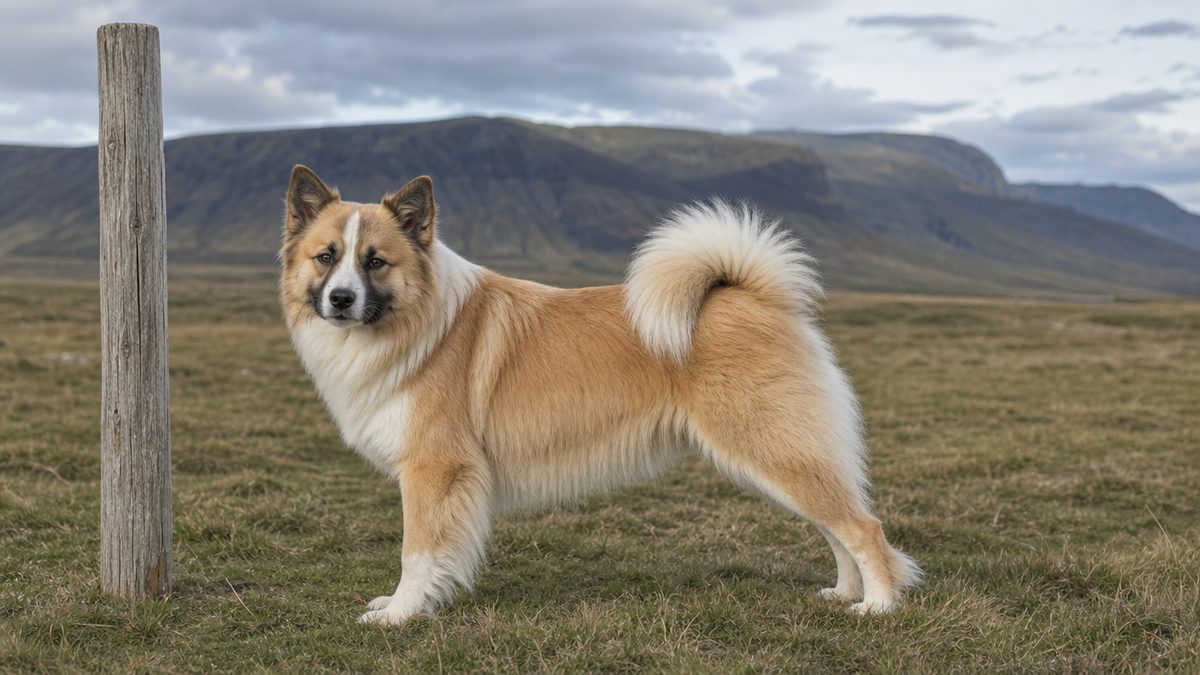
The standard's utilisation is herding dog, and it describes a hardy and agile herding spitz which barks, making it extremely useful for herding or driving sheep and other livestock, alert, announcing visitors without aggression, and cheerful, friendly, inquisitive, playful and confident with a gentle temperament. Seen from the side the dog is rectangular, the body longer than the height at withers, with the depth of chest equal to the length of the foreleg. There are two coat variants, short-haired and long-haired, both a thick, extremely weather resistant double coat.
Well developed double dewclaws on the hind legs are desirable, and their complete absence is listed as a fault. Very few breeds ask for that. If you are looking at a photograph and the hind legs are clean, look harder.
Four bodies publish a standard for this breed, and their fault lists differ
Read whichever standard governs the dog in front of you, because the FCI, the Royal Kennel Club, the United Kennel Club and the American Kennel Club do not say the same things. Three of the four give no weight at all, and the two that describe eye faults disagree about blue eyes.
| Body | Group | Height | Weight | Recognised |
|---|---|---|---|---|
| FCI, standard 289 | Group 5 Section 3, Nordic Watchdogs and Herders | Ideal 46 cm male, 42 cm female | Not stated | Definitive, 17 July 1972 |
| United Kennel Club | Herding Dog Group | Desirable 18 in (46 cm) male, 16.5 in (42 cm) female | In proportion to the height | 20 January 1996 |
| Royal Kennel Club | Pastoral, Imported Breed Register | Ideal 18 in (46 cm) male, 16.5 in (42 cm) female | Not stated | Standard last updated 4 July 2025 |
| American Kennel Club | Herding Group | 18 in male, 16.5 in female | 30 lb male, 25 lb female | Registrable 30 June 2010, AKC's 166th breed |
The heights agree across all four, which is unusual and worth saying. The weights do not exist in three of them. The UKC goes further than a silence and states that weight should be in proportion to the height, so the AKC's 30 and 25 pounds are the only registry weight figures for this breed anywhere.
Three places the fault lists genuinely diverge
- Blue eyes. The FCI lists blue eyes and yellow eyes as serious faults. The UKC lists yellow eyes and round protruding eyes as serious faults and does not mention blue eyes at all.
- Dewclaws. The FCI treats complete lack of dewclaws on the hind legs as a fault. The UKC calls lack of dewclaws a Serious Fault and says double dewclaws may be present on the front feet as well.
- Dentition. The FCI prefers complete dentition. The UKC requires a complete set of evenly spaced teeth in a scissors bite.
The UKC also disqualifies unilateral or bilateral cryptorchidism, viciousness or extreme shyness, and albinism, where the FCI's only disqualifying faults are aggressive or overly shy dogs and dogs clearly showing physical or behavioural abnormalities. None of this changes what the dog is. It changes what a judge or a breeder in a given country is measuring, and it is why asking which register a pedigree comes from is a practical question rather than a pedantic one.
The UKC writes that, having evolved in a country without natural predators, Icelandic Sheepdogs are not aggressive and have very limited hunting instincts, and that they drive livestock by barking and use that talent as watchdogs. That is the clearest one-sentence description of the breed's temperament in any of the four documents.
A thousand years in Iceland, and a written record most breeds do not have
The Icelandic Sheepdog arrived with the Norse settlement of Iceland and is one of very few breeds whose claim to ancient origin is supported by both archaeological and written evidence. Its home institutions and the FCI disagree by four years on when that arrival began.
The FCI standard says the breed descends from dogs brought to Iceland by the original Viking settlers, AD 870 to 930. The Icelandic Kennel Club's own page says AD 874 to 930. The Royal Kennel Club, having adopted the FCI text, prints 870 to 930. Bonbeno prints both rather than splitting the difference, and notes that 874 is the traditional date of the settlement in the Icelandic sources while 870 is the rounder figure the FCI carries.
The written trail, which is unusually long
- 1492. Marteinn Beheim wrote that Icelanders demanded a great price for their dogs but would give their children away because they could not feed them.
- 1555. Olaus Magnus described the dogs as light-coloured or white with a thick coat and popular among priests and upper-class women.
- 1570. John Caius noted the breed as a favourite among the British aristocracy, with coats so long and thick that the head could hardly be told from the body.
- About 1599. Shakespeare has Pistol say "Pish for thee, Iceland dog! thou prick-ear'd cur of Iceland!".
- 1662. Thomas Browne wrote of a sort "Headed like a Fox, which they say are bred betwixt Dogs and Foxes; these are desired by the Shepherds of this Country".
- 1755. Buffon discussed and illustrated the Chien d'Islande in volume five of the Histoire Naturelle.
- 1788. Gmelin classified it as a species, Canis islandicus.
A correction to the parent club's own history
The Icelandic Sheepdog Association of America, which is the AKC parent club, dates the Shakespeare reference to "Henry VIII, written around 1600";. The line is in Henry V, Act II Scene 1, spoken by Pistol, and it is quoted verbatim with that citation elsewhere. Bonbeno reports the parent club's version and the correction rather than quietly repeating either, because the parent club is otherwise the best-sourced account of this breed in English and its academic citations are worth taking seriously.
Where the breed sits genetically
The breed is grouped with the Norwegian Buhund, the Swedish Vallhund and the Norrbottenspets as deriving from the same ancestral stock. The parent club adds a specific finding: in spring 1983, blood samples from 56 Icelandic Sheepdogs were analysed and the results indicated a relationship with the Karelian Bear Dog, which the club reads as the breed having reached Iceland from Norway, with the Norwegian stock itself having come from further east.
Fifty-six dogs, blood groups rather than genomes, and a 1983 method. The parent club cites it to Stefan Adalsteinsson. It is real evidence and it is not a modern whole-genome study, so treat the Karelian Bear Dog relationship as a reasonable historical inference rather than as a settled genomic result.
Population fluctuations: 24,000 dogs in 1869, 10,000 by the 1880s, and a tax law that did it
Iceland's dog population fell from an estimated 24,000 in 1869 to about 10,000 by 1883 to 1887, and the cause was a law rather than a disease. That is the fall the breed's near-extinction story is built on, and almost nobody who repeats it names the mechanism.
The parent club's history gives the figures and the reason together. An 1869 law required that all dogs be heavily taxed except a limited number of sheepdogs allocated to each farm, because dogs were intermediate hosts of a tapeworm that caused infections in humans and in the heads of sheep. The population dropped accordingly. The club then adds the corrective that the main cause of tapeworm infestation was a general lack of hygiene among the public rather than the dogs themselves.
Two numbers people repeat, and where each actually comes from
The commonly repeated claim is that plague and canine distemper destroyed over 75 percent of the breed in the late nineteenth century. Wikipedia prints that sentence with no reference attached to it at all. The traceable version is in the parent club's history, where the physician Christian Schierbeck is recorded as saying that after the population was reduced to a quarter of its original size by pandemics and distemper, the price of a dog equalled the price of a horse and two sheep. A quarter remaining is a 75 percent loss, so the figure is real, and its provenance is a nineteenth-century doctor's estimate reported second hand rather than a count.
Schierbeck supplies the sharper number anyway. Travelling in Iceland over two years, and an owner of the breed himself, he located only 20 dogs with the distinct features of the breed. Twenty is a more useful figure than 75 percent, because it is a count of something he did rather than a proportion of something nobody measured.
Three different import bans, from three sources, on the same page
| Source | What it says | Where it appears |
|---|---|---|
| Icelandic Sheepdog Association of America | In 1901, Iceland enacted a law banning the import of all dogs | The club's Population Fluctuations section |
| Mark Watson, The Iceland Dog, 1956 | Since 1909 it has been against the law to import dogs without a special license | Quoted on the same club page |
| Wikipedia | Distemper losses led to a ban on the importation of dogs to Iceland, with no year given | History section, uncited |
The club's own page carries both 1901 and 1909, eight years apart, in two different sections, and does not reconcile them. Bonbeno prints both. A ban on all imports and a licensing requirement are also different instruments, so this may be two laws rather than one misdated one, and nothing Bonbeno reached settles it.
A round figure like 75 percent travels further than a specific one like 20 dogs, and it travels without its source. Following it back took two documents and produced a physician's second-hand estimate. Do that before quoting any dramatic proportion on any breed.
Organized breeding: the people who actually rebuilt the breed, with dates
Four named people and three institutions rebuilt the Icelandic Sheepdog between about 1950 and 1979, and the sequence is documented well enough to give year by year.
- Around 1930 and again around 1950, Mark Watson surveys the country. On his first trips he located several Icelandic Sheepdogs in the countryside. By his later trips around 1950 the breed was almost nowhere except in remote places such as Breiddalur, where he put the proportion showing the true type at around 90 percent.
- Watson exports breeding stock to California. Pall A. Palsson, then chief veterinary officer in Iceland, helped with the export and kept one female from the Vestfirdir. In California the dogs contracted distemper and some died; the survivors were bred and the breed was kept intact. Watson later moved back to England with the dogs.
- Palsson breeds the female he kept, at the Keldur clinic, and organised breeding is also funded by the Ministry of Agriculture at Hveragerdi.
- 1967, Sigridur Petursdottir starts a substantial breeding programme at the farm Olafsvellir in Skeidahreppur, working with Palsson. Her first dogs were too closely related to continue breeding, so she obtained permission to import two puppies from Watson in England, because the breeding stock in Iceland was very poor at the time.
- 4 September 1969, the Icelandic Kennel Club is founded by a group concerned with preserving the breed and saving it from extinction. The Nordic Kennel Union records that the breed was in imminent danger of extinction at that point.
- 1973, the club's first dog show at Hveragerdi. Twenty-three of the sixty dogs shown were of this breed.
- 1979, the breed club Deild Islenska Fjarhundsins is founded within the Icelandic Kennel Club and given responsibility for the development and safeguarding of the breed.
- 1994, the Althingi determines that the breed is part of Iceland's cultural heritage and should be protected as a national breed.
- 1996, the Icelandic Sheepdog International Cooperation is formed, initiated by Gudrun R. Gudjohnsen, then president of the Icelandic Kennel Club, to coordinate preservation across countries.
Two national breeds, two states protecting them
This is worth noticing beside Bonbeno's Hokkaido guide, because the two breeds arrived at the same place by different routes. Japan designated the Hokkaido a national natural monument on 21 December 1937 under a criterion for domesticated animals peculiar to Japan, and it remains a Foundation Stock Service breed at the American Kennel Club rather than a fully recognised one. Iceland went the legislative route instead. ISIC's own account is that in 1994, after many years of work, HRFI and the breed club DIF convinced the Althingi that preserving the Icelandic Sheepdog was the nation's responsibility, and that the Althingi then gave the Minister of Agriculture the task of forming a committee to oversee the breed's preservation as a national breed. Wikipedia records the same 1994 determination. Very few dog breeds have a legislature or a heritage ministry on the record about them, and both of these do.
The two also differ sharply in how much health evidence exists. The Hokkaido has one published genotyping survey, of 17 dogs from three kennels, which found 12 carriers and five affected by the Collie eye anomaly mutation. The Icelandic Sheepdog has a full pedigree analysis of 4,680 dogs and a 2025 genome study Ricketts SL, Ahonen S, Pettitt L, Freyer J. State protection and good documentation are not the same thing, and only one of these breeds has both.
A recovery is people and dates, not a slogan. Sigridur Petursdottir's programme worked because she recognised her own founders were too closely related and imported unrelated stock rather than breeding on regardless. That single decision is what the next section's numbers are measuring.
How many founders: 23, 26 or 36, and why the answer keeps changing
Every Icelandic Sheepdog alive descends from a few dozen founders, and the published sources give three different counts. Bonbeno prints all three with their sources rather than choosing the tidiest.
The peer-reviewed source is Oliehoek, Bijma and van der Meijden in Genetics Selection Evolution, 2009. It analysed pedigree records from seven countries, the Netherlands 725, Sweden 1,367, Iceland 1,654, Germany 153, Norway 774, Denmark 2,241 and Finland 113, and only Iceland had data going back to 1955, with breeding in the other countries starting in 1975 or later.
| Count | Where it is stated | Exact wording |
|---|---|---|
| 36 | Oliehoek 2009, Results | Of the 4,680 dogs in the data, 36 did not have any parents registered and were recognised as founders |
| 36 | Oliehoek 2009, Conclusion | The base population consisted of 36 Icelandic Sheepdog founders |
| 26 | Oliehoek 2009, Conclusion, two sentences later | About 16 of the original 26 founder genomes were lost by 1966 |
| 23 | The parent club, reporting Oliehoek's earlier 1999 work | All Icelandic Sheepdogs that exist today are the descendants of 23 unrelated dogs |
The 36 and the 26 sit in the same paper's own Conclusion, two sentences apart, and the paper does not reconcile them. The 23 comes from the parent club's account of Oliehoek's earlier 1999 study. One figure is stable across all three, which is the useful one: three founders account for more than 80 percent of the alleles in the current population.
The numbers that actually describe the genetic diversity
- Twenty founders were selected in 1955, chosen from remote areas of Iceland, with founder introductions continuing afterwards.
- Thirty-two of the 36 founders lived in Iceland, and four lived in Germany.
- Three of the 36 contributed more than 80 percent of the alleles of the current population, so in about 80 percent of cases a pedigree ends at one of those three.
- The current population in the study was 2,554 dogs representing 512 unique parent combinations, with 9.1 equivalent complete generations traced.
- Current diversity equals 2.2 equally contributing founders, against a maximum attainable 4.7.
- Average inbreeding coefficient 0.21 in a subset of 133 dogs born in Iceland, reported by Oliehoek from an earlier study.
An inbreeding coefficient of 0.21 is high. For reference, the offspring of a full brother and sister mating have a coefficient of 0.25. The paper notes, honestly, that it was surprising the breed showed no genetic disease at the time of the study given that level, and that population size was still increasing, which usually lowers genetic drift.
A fourth number, and why this page does not lead with it
Wikipedia states that in 2022 the total number registered world-wide was approximately 5000, sourcing it to the Icelandic Sheepdog International Cooperation. That is a round figure with no method attached, and it is the kind of number that survives by being repeated. Bonbeno reports it as a circulating estimate and builds nothing on it, because the pedigree study's 2,554 analysed dogs and 36 founders are countable and this is not.
The per-country record counts in Oliehoek 2009 add to 7,027, while the analysis describes 4,680 dogs in the data. The most likely explanation is that an exported dog appears in two national registers and was deduplicated, but the paper does not say so, and Bonbeno does not assert it.
Recognition is not binary, and this breed sits in four registries at once
Ask which register a pedigree comes from, because the Icelandic Sheepdog is recognised at four levels and they mean different things. National, Nordic regional, FCI, and separately the American and British kennel clubs.
- National. Hundaraektarfelag Islands, the Icelandic Kennel Club, founded 4 September 1969 specifically to save the breed, with the breed club Deild Islenska Fjarhundsins inside it since 1979.
- Regional. The Nordic Kennel Union, a forum for cooperation between the kennel clubs of Denmark, Finland, Iceland, Norway and Sweden. All five are also FCI members. This is the layer most breed pages skip entirely.
- International. The FCI, which accepted the breed on a definitive basis on 17 July 1972 as standard 289.
- Outside the FCI. The American Kennel Club made the breed eligible for registration and for Herding Group competition from 30 June 2010, following its October 2009 Board Meeting, and it is AKC's 166th breed. The Royal Kennel Club places it in the Pastoral Group on the Imported Breed Register, with a standard last updated 4 July 2025.
There is also a breed-specific international body. The Icelandic Sheepdog International Cooperation, formed in 1996, brings together the member clubs in Iceland, Denmark, Sweden, Norway, Finland, the Netherlands, Germany and Switzerland with the American parent club, and its members have agreed international breeding recommendations built on the advice of Pieter Oliehoek, Per-Erik Sundgren and others. For a breed rebuilt from a few dozen founders, a coordinating body across national registers is the mechanism that keeps genetic diversity from collapsing further.
What this means for India
For India the question resolves through the FCI, because the FCI's members register lists India as a full member represented by the Kennel Club of India in Chennai, so the KCI issues pedigrees against FCI nomenclature. The Icelandic Sheepdog is FCI standard 289 on a definitive basis, so an Indian pedigree is theoretically possible. That is a statement about paperwork and not about supply.
The breed is absent from Japan's register entirely
One useful comparison. The Japan Kennel Club's 2025 table covers 141 breeds and 302,530 dogs and runs down to rank 131, where breeds with a single registration are still printed. The Icelandic Sheepdog does not appear anywhere in it. The Finnish Lapphund appears once. So this is not merely a breed that is rare in India; it is a breed absent from a major Asian registry that lists single-dog entries.
The Kennel Club of India publishes no breed list for any breed, so a query there returns zero for this breed and zero for every control breed. That is a broken instrument, not a finding, and Bonbeno does not report it as evidence about Indian recognition.
Five dogs in a year: the Royal Kennel Club register, and the 1905 problem
The Royal Kennel Club registered five Icelandic Sheepdogs in the whole of 2025, and the breed appears in only one column of the RKC's ten-year table. Its own parent club, meanwhile, records that the English Kennel Club entered one into its registry in 1905.
| Period | Registrations |
|---|---|
| 2025, first quarter | 0 |
| 2025, second quarter | 2 |
| 2025, third quarter | 0 |
| 2025, fourth quarter | 3 |
| 2025, year total | 5 |
| 2026, first quarter | 2 |
| 2026, second quarter | 3 |
The quarterly row reconciles: 0 plus 2 plus 0 plus 3 is 5, which is the printed year total. The ten-yearly Pastoral table for 2016 to 2025 carries a value for this breed in the 2025 column only, which is what a brand-new register entry looks like. And the breed is already matching its full-year 2025 figure inside the first half of 2026.
A check on the register itself, since these numbers carry weight
Bonbeno took both datasets from the Royal Kennel Club's own breed-registration statistics index, which publishes quarterly, ten-yearly, export and vulnerable-native-breed tables group by group, and extracted the PDFs with pypdf rather than a web extractor, because a web extractor has silently dropped rows from a Kennel Club statistics PDF before. The Pastoral group's 2025 quarterly columns sum to 9,263 against a printed year total of 9,263. Its ten-yearly table reconciles in all ten columns once the four late-starting breeds, the Hungarian Mudi, the Icelandic Sheepdog, the Pyrenean Sheepdog (Smooth Faced) and the White Swiss Shepherd Dog, are aligned to the years their rows actually begin. So the Pastoral group's arithmetic is clean, and the five is a number you can rely on.
The part nobody reconciles
The breed's arrival on the Royal Kennel Club's Imported Breed Register in 2025 is not its first appearance in a British registry. The parent club's history states that the English Kennel Club entered an Icelandic Sheepdog into its registry in 1905 and at the same time published a breed standard translated from Danish, that the breed was rarely shown in England afterwards, and that one advanced to Best in Show competition at Crufts in 1960. It also records that the breed was recognised in Denmark in 1898 and first exhibited at the Tivoli in Copenhagen in 1897, where three dogs took part.
Bonbeno could find no Royal Kennel Club statement reconciling a 1905 registry entry with a 2025 Imported Breed Register addition, and does not guess at one. The likeliest reading is that a lapsed nineteenth-century recognition and a modern import-register listing are two different administrative acts a century apart, but that is an inference and it is labelled as one here.
Five dogs a year in Britain, and none at all in Japan's 141-breed register Japan Kennel Club, Registrations by breed, is the reason no Indian supply exists. A breed at that volume does not develop an export trade, and India separately bars importing dogs to breed or sell.
Icelandic Sheepdog price in India: every rupee figure on the SERP is merchandise
There is no Icelandic Sheepdog price in India, and the way the Indian search results fail is unusually clear. Every rupee number they return for this breed is the price of a T-shirt, a craft item or a paperback.
Search the target term with results restricted to India and this is what comes back, in order. A Quora thread asking how expensive Icelandic Sheepdog puppies are. An Etsy India category page headed "Buy Icelandic Sheepdog Online In India", whose rupee figures of Rs 473, Rs 350, Rs 589, Rs 1,179 and Rs 1,399 are merchandise. A US marketplace quoting 2,500 to 2,650 US dollars. An Amazon India listing for a paperback titled The Icelandic Sheepdog: The dog of the Vikings at Rs 3,454. A breed database quoting 1,000 to 1,500 US dollars. A Flipkart listing for the same book. An Indian dog price list that does not mention the breed. Royal Canin's Indian site, which publishes a breed page for a dog that is not in India.
That absence is earned, not assumed. A control query for a Labrador puppy price in India, run on the same instrument in the same session, returned genuine Indian listing pages quoting city-by-city Indian prices. The search works. What it finds for this breed is merchandise.
| Source | Figure printed | What it actually is |
|---|---|---|
| Etsy India | Rs 350 to Rs 1,399 | Merchandise: prints, apparel and craft items |
| Amazon India | Rs 3,454, marked down from Rs 4,076 | A paperback book |
| Flipkart | Listed as a low-price item | The same book |
| Dog Breeds List | 1,000 to 1,500 US dollars average | A US retail estimate |
| Good Dog | 2,500 to 2,650 US dollars | A US marketplace's national range |
| Royal Canin India | No price | A breed page served to India for a breed not sold in India |
Do not convert the dollar figure
Running 1,000 US dollars through an exchange rate produces a rupee number that looks like a puppy price and is not one. Bonbeno has repeatedly caught Indian breed pages doing exactly that, publishing tables whose rupee values divide cleanly back into round dollar amounts. A converted number tells you what an American breeder charges, expressed in rupees. It does not describe an Indian market, because there is not one.
The breed is not expensive in India and it is not cheap in India. It is unavailable in India, and that is a different fact and a more useful one. What is knowable is the cost of ownership for a small double-coated herding dog living in an Indian city, and the next section gives those figures with their source.
The Royal Kennel Club registered five of these dogs in 2025 and DGFT Trade Notice 22/2022-23 states that Indian import applications for trading or breeding purposes shall be duly rejected. No supply chain can form between those two facts, so there is no puppy price to converge on.
What a small double-coated dog actually costs to keep in India
Budget Rs 6,000 to Rs 10,000 a month for a dog of this size in an Indian city on the most widely cited Indian cost table, and add a cooling line that no Indian table carries.
The purchase price is unknowable here. The cost of ownership for a 9 to 14 kg double-coated dog in Pune or Chennai is not, because it is the same as for any dog of that size and coat, and it is published. Supertails' 2026 Indian price list breaks running costs out by breed size, and its medium-breed column gives food at Rs 2,500 to Rs 4,000 a month, routine veterinary visits at Rs 800 to Rs 1,500, annual vaccinations at Rs 1,500, grooming at Rs 800 to Rs 1,500, six months of training at Rs 2,000 to Rs 5,000, treats and toys at Rs 500 to Rs 1,000, and flea and deworming at Rs 400 to Rs 700, against a printed monthly total of Rs 6,000 to Rs 10,000. Its small-breed column runs Rs 4,000 to Rs 8,000, and this breed sits between the two.
That table does not add up, and you should know why before you use it
Add the medium column's own rows and the printed total does not reproduce. Read every row as monthly and the range comes to Rs 8,500 to Rs 15,200 against a printed Rs 6,000 to Rs 10,000. Convert the annual vaccination row to about Rs 125 a month and the six-month training row to about Rs 333 a month and the bottom of the range comes to roughly Rs 5,458, which still misses Rs 6,000. Neither reading works, because the column mixes monthly, annual and six-monthly rows under a heading that reads MONTHLY TOTAL. Use the individual rows and build your own total.
The same page prices grooming lower as the dog gets larger, dropping from Rs 1,500 to Rs 3,000 a month for a small breed to Rs 500 to Rs 1,200 for a large one. For a double coat that ordering is backwards, because undercoat volume and drying time rise with size and Indian groomers price accordingly.
| Line | Published Indian figure | Bonbeno's note for this breed |
|---|---|---|
| Food | Rs 2,500-Rs 4,000 medium, Rs 1,500-Rs 2,500 small | A 12 kg working herder sits near the top of the small band |
| Routine veterinary | Rs 800-Rs 1,500 | Add an annual eye examination, for the reason in the eye section |
| Vaccination | Rs 1,500 a year | Roughly Rs 125 a month once the puppy course is done |
| Grooming | Rs 800-Rs 1,500 | Treat this as a floor. A thick double coat is priced above a smooth one |
| Flea, tick and deworming | Rs 400-Rs 700 | Non-negotiable through an Indian monsoon |
| Cooling | Not a line item on any Indian table Bonbeno found | The largest single omission for a northern breed in India |
First-year costs run higher than the monthly rate. The same source puts the whole first year at Rs 80,000 to Rs 2,00,000 including purchase, vaccinations, food, training and supplies, and separately advises paying Rs 800 to Rs 1,500 for an independent pre-purchase veterinary consultation before completing any payment. That last piece of advice is the most valuable line on the page and it applies double to a breed nobody in India can supply.
The same page says Indian dog prices run from Rs 2,000 for an indie to over Rs 1,50,000 for a KCI-registered show dog, and then a few paragraphs later that the average varies from Rs 5,000 to Rs 1,00,000 and up. Bonbeno prints both rather than choosing the tidier one.
Heat tolerance: Reykjavik against an Indian city, in degrees
The Icelandic Sheepdog is a sub-Arctic dog and India is not sub-Arctic, and the gap is measurable. NASA POWER's cell for Reykjavik returns an annual mean air temperature of 4.58 degrees Celsius against 27.95 for Chennai, a difference of 23.37 degrees.
Bonbeno uses NASA POWER queried by explicit latitude and longitude rather than a named-city climate page, because named-city pages have repeatedly served this site a document for the wrong place. Every query below echoed back its coordinates and its grid elevation, and both are printed so a reader can check them.
| Place | Lat, lon queried | Grid elevation returned | Annual mean air temp | Warmest month mean | Annual mean relative humidity |
|---|---|---|---|---|---|
| Reykjavik, Iceland | 64.147, -21.943 | 101 m | 4.58 C | 11.10 C (July) | 87.8 % |
| Chennai | 13.083, 80.271 | 49 m | 27.95 C | 31.51 C (May) | 72.4 % |
| Delhi | 28.614, 77.209 | 206 m | 25.60 C | 35.88 C (June) | 45.6 % |
| Mumbai | 19.076, 72.878 | 97 m | 26.77 C | 31.19 C (May) | 67.4 % |
| Bengaluru | 12.972, 77.595 | 842 m | 23.74 C | 28.37 C (April) | 67.9 % |
| Pune | 18.520, 73.857 | 636 m | 23.86 C | 28.93 C (April) | 66.8 % |
Reykjavik's warmest month, July, averages 11.10 degrees, and its coldest month, February, averages 0.02. Bengaluru, the coolest big Indian city on this table, averages 20.22 degrees in December, its own coolest month, which is nine degrees warmer than Reykjavik's warmest month. The standard describes a double coat that is thick and extremely weather resistant, which is a specification for keeping weather out rather than heat off.
The Reykjavik cell sits at 101 metres against a city nearer 28, so at the standard lapse rate it reads roughly half a degree too cold. That is small enough not to matter and it is printed anyway, because a figure whose limits are hidden is a figure a reader cannot check.
What the heat evidence supports, and what it does not
Two large UK studies of the same 905,543-dog cohort give the transferable findings, and they are different papers with different case definitions. Hall and colleagues in Scientific Reports found that dogs at or above their breed and sex mean bodyweight carried 1.42 times the odds of heat-related illness, that dogs over 50 kg carried 3.42 times the odds of dogs under 10 kg, and that the case fatality rate for a heat-illness event was 14.18 percent. Hall and colleagues in Animals, on exertional illness in the same cohort, reported 1,259 events from 1,222 dogs, of which 380 had no trigger recorded, leaving 879 with a recorded trigger, and of those 879 events 652, or 74.2 percent, were exertional.
Neither paper modelled this breed individually, so Bonbeno attaches no breed-specific odds ratio to it. What transfers is the weight gradient, and on that this breed is better placed than most northern dogs, because at 9 to 14 kg it sits at the bottom of the scale rather than the top. It is still a heat-sensitive dog. Coat and origin put it well outside its range in an Indian plains summer, and being the least heat-sensitive northern breed on a list is not the same as being suited to Chennai.
Of the 879 heat-illness events with a recorded trigger, 652 were exertional, 113 environmental and 46 from vehicular confinement, and 14.18 percent of events were fatal. In India the danger to a northern dog is the walk, not the parked car.
The Indian hill stations people suggest, and why their satellite figures are wrong
Do not plan a cold-climate dog around a hill-station number you have not checked. NASA POWER returns a grid cell rather than a point, and in Indian mountains that cell missed the town by between 731 and 1,935 metres in every case Bonbeno queried.
Gangtok, Shimla, Manali, Darjeeling, Srinagar, Ooty and Munnar are exactly the places an Indian reader names when asked where a Nordic breed could live. Query them by coordinates and the service answers for a cell whose mean elevation can sit well over a kilometre away from the town beneath it. Temperature falls with height at roughly 6.5 degrees per 1,000 metres, so the error is large and it runs in both directions.
| Place | Grid elevation returned | Town's real elevation | Divergence | Cell's annual mean | Direction of the error |
|---|---|---|---|---|---|
| Manali | 3,985 m | about 2,050 m | 1,935 m too high | -0.56 C | Far too cold |
| Gangtok | 3,240 m | about 1,650 m | 1,590 m too high | 7.45 C | Too cold |
| Ooty | 785 m | about 2,240 m | 1,455 m too low | 23.50 C | Far too warm |
| Shimla | 898 m | about 2,200 m | 1,302 m too low | 21.15 C | Too warm |
| Munnar | 711 m | about 1,600 m | 889 m too low | 22.91 C | Too warm |
| Darjeeling | 1,314 m | about 2,045 m | 731 m too low | 18.42 C | Too warm |
Shimla is the clearest case. Its cell reports an annual mean of 21.15 degrees and an annual maximum 2-metre temperature of 43.87 degrees. Nobody who has been to Shimla believes 43.9 degrees. The cell is averaging a hill station at 2,200 metres with the valley floor beneath it, and the valley dominates. Ooty fails the same way in reverse of what you would expect, with a cell at 785 metres describing a town at 2,240.
The correction, and why it is an estimate
Apply the lapse rate to each divergence and the corrected figures land close to what these towns are actually like. Shimla's 21.15 corrects to about 12.7, Manali's minus 0.56 to about 12.0, Gangtok's 7.45 to about 17.8, Ooty's 23.50 to about 14.0 and Darjeeling's 18.42 to about 13.7. Every one of those sits within a couple of degrees of the town's known climate, which is the check that says the diagnosis is right rather than convenient. Bonbeno prints the correction as an estimate and never as a measurement.
The plains rows need no correction. Delhi's cell sits 10 metres below the city, Chennai's 43 metres above, Bengaluru's 78 metres below, Mumbai's 83 above and Pune's 76 above. NASA POWER tracks the Indian plains well and fails only in mountains, which is worth knowing before you take any satellite figure for a hill station at face value.
A corrected Shimla at roughly 12.7 degrees annual mean is genuinely cooler than most of India and still nearly three times Reykjavik's 4.58. It also does not help most readers, because the people searching for this breed live in Delhi, Mumbai, Bengaluru, Chennai and Pune, where the annual means run 23.7 to 27.9 degrees.
Indian import law: the narrow route in, and the one that is closed
Import an Icelandic Sheepdog only as your own pet, through one of seven named entry points, with an import licence obtained in advance. The commercial route is closed by rule.
DGFT Trade Notice No. 22/2022-23 dated 19 December 2022, headed Guidelines for import of Pet Animals, is the instrument. It records ITC (HS) 01061900, Mammals: Other, with an Import Policy of Restricted, subject to Policy Condition 6 of the Chapter, and Policy Condition (6) as printed concerns the Wild Life (Protection) Act 1972 and CITES, which does not touch a domestic dog.
- No import for trade or breeding. The notice states that no applications for trading or breeding purposes, or applications made on behalf of another person or entity, shall be duly rejected. The drafting is awkward and the effect is not: those applications are refused.
- Seven entry points only. Import of pet animals is allowed only through the airports and seaports of Delhi, Mumbai, Chennai, Hyderabad, Bengaluru and Kolkata and, since October 2024, Kochi airport Department of Animal Husbandry….
- Advance NOC. A quarantine-clearance applicant must obtain an Advance No Objection Certificate from the Regional Officer or Quarantine Officer of the Animal Quarantine and Certification Station at the port, submitting the DGFT import licence and the health paperwork.
- Two months of lead time. The notice tells applicants to begin the authorisation process at least two months before travel.
One caution about a headline you may have seen. A separate instrument, S.O. 4396(E) of 10 October 2024, permits pet dogs and cats through Cochin International Airport under the Livestock Importation Act 1898, with jurisdiction to the quarantine station at Chennai. That is a different Act governing a different route. Bonbeno has not checked it against the DGFT notice's own port list and does not claim it amends that list.
The constraint from the other end
Iceland itself is worth mentioning here, because it is the source of the breed and it restricts movement in the other direction. The breed's own history records that Iceland banned dog imports early in the twentieth century, with the parent club dating it to 1901 and Mark Watson dating a licensing requirement to 1909. Modern Iceland retains strict animal-import controls. A prospective Indian owner is therefore looking at a small European supply, a conservation-managed breeding population, and an Indian import route that admits pets and refuses traders.
Nothing Bonbeno found suggests the 1994 Althingi resolution protecting the breed as part of Iceland's cultural heritage bars taking a dog out of Iceland. Do not let a seller use the phrase national breed to justify a premium or to explain a delay.
What the 2017 Rules require of anyone breeding or selling this dog in India
The Prevention of Cruelty to Animals (Dog Breeding and Marketing) Rules 2017 govern any Indian sale, and one of their provisions collides directly with the founder arithmetic behind this breed.
Cite these correctly or a reader who checks will land somewhere else. The Rules themselves run from Rule 1 to Rule 13, and everything numbered above 13 is a paragraph of the Second Schedule rather than a Rule. The Second Schedule is made binding by Rule 6, headed Requirements to be met by breeders and establishments, which is exactly why writing "Rule 6(3)" or "Rule 8(10)" misdirects anyone who looks it up.
- Rule 8(1)(a), a genuine Rule in the main body, requires every breeder to ensure that pups less than eight weeks in age are not sold.
- Second Schedule Part II paragraph 6(3) prohibits in-breeding, defined as breeding between relatives of the second to fourth grade in straight or side line within the first four generations, giving uncle to niece, nephew to aunt, cousin to cousin and grandparent to grandchild as examples, and incest breeding between parents and children or brother and sister.
- Second Schedule Part III paragraph 8(10) requires that dogs shall have been tested for genetic defects, and its list opens with the word including, so it is illustrative rather than closed. It names hip dysplasia first, then progressive retinal atrophy, night blindness, hypothyroidism, entropion, ectropion, jaw defects and cryptorchidism.
- Second Schedule Part IV paragraph 21(1), Outdoor housing facilities, bars keeping in outdoor facilities, without the attending veterinary practitioner's written approval, dogs not accustomed to local temperatures and breeds that cannot tolerate them, giving long-haired breeds in high-temperature locations as its own example.
Where paragraph 6(3) collides with the breed's own arithmetic
This is the sharpest collision on the page. Paragraph 6(3) prohibits mating within four generations for second to fourth grade relatives. The published pedigree analysis found an average inbreeding coefficient of 0.21 in a subset of 133 Icelandic-born dogs, and that three of 36 founders account for more than 80 percent of the alleles in the current population, with the most distant founders appearing ten to twenty generations back. A hypothetical Indian line founded on two or three imports would breach paragraph 6(3) within two generations, which is a legal reason as well as a genetic one that no Indian line exists.
Paragraph 8(10) applies too, and note what it names and does not name. Hip dysplasia is on the list. Cataract is not, but the clause says including, so an unlisted defect does not fall outside it. Paragraph 21(1) applies directly, because this is a thick double-coated northern breed and India is a high-temperature location.
Across the whole gazette the words BAER and deaf do not appear, and there is no patellar or dental testing requirement. Never accept a claim that Indian law mandates a patella grade or a hearing test, because it does not.
Temperament: a cheerful herding dog that barks for a living
The standard describes a hardy and agile herding spitz which barks, cheerful, friendly, inquisitive, playful and confident with a gentle temperament, alert and announcing visitors without aggression. Take the barking clause literally, because it is written into the breed's job description.
Very few breed standards name barking as a working virtue. This one does, saying the barking is what makes the dog extremely useful for herding or driving sheep and other livestock. A dog selected for a thousand years to bark at livestock in open country does not stop having that opinion because it now lives on the fourth floor in Pune.
Who this dog suits
- Households that want a friendly, involved dog. This is not an aloof primitive breed. The standard's words are cheerful, friendly, inquisitive and playful, and the parent club adds the wide smile as a breed characteristic.
- Families with children. Gentle temperament and confident bearing are in the standard, and aggression or excessive shyness is the only disqualifying fault.
- Owners who will give it a job. The parent club records the breed being trained for search and rescue in Iceland and abroad, as companion dogs for autistic children, for finding sheep lost in snowdrifts and even for locating birds' eggs by scent. It wants work.
Who should not buy one
- Anyone in a noise-sensitive Indian apartment. A breed standard that names barking as a working trait is telling you something a training class will only partly undo.
- Anyone who wants a low-maintenance dog. A thick double coat plus a working brain plus Indian heat is three management problems, not one.
- Anyone buying without a plan for the hot months. See the climate sections. This is a decision about your April, not your December.
One identification point matters. Blue eyes are a serious fault and yellow eyes are a serious fault in the standard. A seller presenting a blue-eyed dog as a rare or premium colour is describing a serious fault and charging for it.
A confident and lively bearing is described as typical of the breed, and there is a marked difference in appearance between the sexes. A cowering, flat, silent dog is not a calm example of this breed. It is an unhappy one.
Training a vocal herding spitz in an Indian city
Train the Icelandic Sheepdog around two things it will do without instruction, which are barking and moving livestock. Everything else follows more easily than with a primitive hunting spitz, because this breed genuinely wants to work with people.
This is not an aloof breed. The standard's cheerful, friendly, inquisitive and confident temperament makes it more biddable than a Japanese hunting spitz, and the parent club's record of the breed working in search and rescue and as an assistance dog supports that Icelandic Sheepdog Association of America. The training problem in India is not motivation, it is the barking and the heat.
A realistic Indian timeline
- Weeks 8 to 16, socialise hard and early. In an Indian city that means traffic, autos, lifts, construction noise, cattle, other dogs and strangers, in short positive doses. Do it before the window closes rather than after the vaccination course finishes.
- From week 8, put barking on cue and then on an off cue. Teaching a bark you asked for is what gives you a quiet you can ask for. Suppressing it from the start does not work with a breed selected to bark.
- Months 4 to 8, build a recall that survives distraction. A herding dog with an opinion about a passing scooter is a real Indian hazard.
- Months 8 to 18, keep paying through adolescence. Short sessions, high-value food, and no compulsion.
- Throughout, train in the cool hours. A training session is exercise, and 652 of the 879 heat-illness events with a recorded trigger in the UK data were exertional.
A professional group programme in India runs about Rs 2,000 to Rs 5,000 for a six-month course on the widely cited Indian figures, and it is the highest-return line in the budget for this breed specifically, because the thing you most need help with, barking, is the thing owners most often try to fix badly on their own.
From March to October, move the whole schedule to before sunrise and after dark. The recall you drill at 2 pm in an Indian April is the session that produces a heat-illness event in a double-coated northern dog.
Exercise: an agile working herder on an Indian clock
Plan on 45 to 75 minutes of real work a day plus mental work, taken entirely in the cool hours, and expect to split it into two sessions around the middle of an Indian day.
The standard describes agility and endurance with good driving action, covering the ground effortlessly. That is a working herder's specification. It is a smaller dog than most northern breeds, so the distance requirement is lower than a Malamute's, but the mental requirement is higher than most Indian owners expect.
The daily plan across the Indian year
- November to February. Delhi's January mean is 13.61 degrees and Pune's is 19.85. Full exercise, daylight workable in the north.
- March to June. Delhi's May mean is 35.05 degrees with a cell maximum of 48.79. Pre-dawn and post-sunset only, shortening as the temperature climbs.
- July to September. Mumbai and Chennai add humidity that blocks evaporative cooling, with Chennai's annual mean relative humidity at 72.4 percent. Reduce duration as well as moving the timing.
- All year, use the head. Scentwork, herding-ball games, food puzzles and shaping sessions tire a working herder without raising core temperature, and they are the single best substitute for the distance you cannot safely give it.
Under-exercised, this breed barks. That is the specific failure mode, and it is why the exercise section and the temperament section are really one problem. An Icelandic Sheepdog that is bored in an Indian flat becomes a noise complaint, and the owner then treats the barking as a training issue when it is an exercise issue.
Of the 879 UK heat-illness events with a recorded trigger, 652 were exertional, 113 environmental and 46 from vehicular confinement, and 14.18 percent of heat-illness events were fatal. Exercise is the trigger. Plan the day around that.
Grooming two coat variants in Indian humidity
Brush weekly through most of the year and daily through the seasonal sheds, and never clip the coat. This breed comes in two coat types and the long-haired one needs materially more work in an Indian monsoon.
The standard specifies a double coat, thick and extremely weather resistant, in two variants. The short-haired variant has a fairly coarse outer coat over a thick soft undercoat, shorter on the face, head, ears and front of legs and longer on the neck, chest and back of thighs, with a bushy tail. The long-haired variant has a longer outer coat, more length behind the ears, on the neck, withers, chest and back of thighs, fringes on the back of the forelegs, and a very bushy tail.
Why not to shave a double coat in a hot country
The Indian instinct is to clip a heavy coat off in April. Do not. The outer coat is a barrier against solar radiation and the undercoat insulates in both directions. Clipping removes the barrier and exposes skin that has never seen the sun, and it does not stop the dog overheating, because a dog sheds heat by panting rather than through its skin. Manage heat with shade, water, air movement and timing.
The monsoon problem overseas guidance does not have
Northern breed-club grooming advice assumes a dog can be towelled and left to air dry. In an Indian monsoon that instruction is wrong. At ambient humidity above 80 percent a dense undercoat stays damp for hours, and warm damp undercoat against skin is where hot spots and yeast begin. Dry this dog to the skin with a forced-air dryer every time it is bathed or soaked, and plug the ears before bathing. The standard notes very mobile ears reacting sensitively to sounds, and a mobile erect ear is easier to dry than a drop ear, which is one thing in the breed's favour here.
- Weekly, an undercoat rake and a slicker. Line-brush to the skin rather than skimming the surface.
- Daily during the shed. A thick double coat will shed heavily on a seasonal cycle and Indian air conditioning can make that cycle irregular.
- Never a clipper. De-shed rather than shave.
- Check the hind dewclaws. Double dewclaws are desirable in this breed and their nails need trimming, because they do not wear down on the ground.
- Tick and flea cover all year. Rs 400 to Rs 700 a month on the published Indian figures.
A breed standard that wants well developed double dewclaws on the hind legs is a breed standard that gives you four extra nails per hind leg to keep short. An ingrown dewclaw nail is a common and entirely preventable problem, and Indian groomers unfamiliar with the breed will not think to check.
Health: a small literature, and what the pedigree tells you instead
Four papers name this breed in PubMed and only two are about it, so the honest health picture comes from population genetics rather than from clinical studies. That picture is a narrow founder base and a high average inbreeding coefficient.
A PubMed phrase search for "Icelandic Sheepdog" returns four records. Two are about the breed itself, the 2009 pedigree analysis and a 2025 genome study of cataracts in northern breeds. The other two are Norwegian Lundehund papers that use this breed as a comparison, one a 2017 genetic-rescue study and one a 2023 gut-microbiome study. Controls run on the same instrument in the same session returned 126 records for Labrador Retriever and hip dysplasia and 74 for Shiba Inu and dog, so the search was working.
What the pedigree evidence implies clinically
The 2009 study is blunt about the risk without naming a disease. Average inbreeding of 0.21 in a subset of 133 Icelandic-born dogs, current diversity equivalent to 2.2 equally contributing founders against a maximum attainable 4.7, and three founders behind more than 80 percent of the alleles. The authors write that it was surprising the breed showed no genetic disease at the time given that level of inbreeding, and stress that preserving the remaining genetic diversity matters because otherwise adaptation could be compromised and specific genetic disorders could become fixed.
That is a warning about the future rather than a list of present conditions, and it is why the international breeding recommendations agreed across the ISIC member clubs exist at all.
What to screen
- Eyes, annually. See the next section. This is the one condition with a 2025 genome study attached.
- Hips. Indian law names hip dysplasia first in its genetic-defect clause, and the Icelandic Kennel Club maintains a hip and elbow screening programme for its breeds.
- Patellae. Worth asking about in any small spitz, while noting that no Indian legal requirement exists for it, because the 2017 Rules never mention patellar luxation.
- Heat. Not hereditary, and in India the most likely thing to harm this dog. The case fatality rate for a heat-illness event in the largest UK study was 14.18 percent.
Life expectancy, and who is guessing
The breed standard prints no life expectancy, and neither does the Royal Kennel Club's version. The AKC prints 12 to 14 years and Wikipedia's body text says some twelve to fifteen years, sourced to a general encyclopedia. Bonbeno found no cohort study of longevity in this breed, so it carries no lifespan figure of its own and reports the two circulating ones as what they are.
OFA publishes a breed only once it has 100 hip evaluations, or 50 for its other databases. Bonbeno could not retrieve a published OFA statistics row for this breed, and where a row is absent that is a threshold effect rather than a health finding. Write no row in OFA's published statistics tables, never absent from the OFA database.
Cataracts and CPT1A: a 2025 genome study that names this breed
A 2025 genome-wide study associates common variants in the CPT1A gene with bilateral posterior polar subcapsular cataracts in four northern breeds, and the Icelandic Sheepdog is one of the four.
The paper is Ricketts and colleagues, PLoS One, 4 April 2025. Read the design carefully, because the breeds in the scan and the breeds in the association are not the same list. The genome-wide association study itself was run in three breeds, the Siberian Husky, the Alaskan Malamute and the Samoyed. It found an association on canine chromosome 18 in the Siberian Husky at a P-value of 1.1 times ten to the minus seven, independently replicated in a second larger case-control set at 9.8 times ten to the minus twenty-nine, with the Samoyed showing evidence in the same region at 2.4 times ten to the minus five.
The authors then resequenced the associated 6.5 megabase region in ten Siberian Huskies and did whole-genome sequencing of a Husky, a Malamute, a Samoyed and a Norwegian Buhund case. That fine-mapping identified common variants in the carnitine palmitoyltransferase 1A gene which are, in the paper's own words, strongly associated with bilateral posterior polar subcapsular cataracts in the Siberian Husky, Samoyed, Icelandic Sheepdog and Norwegian Buhund. The authors add that CPT1A is expressed in the dog lens and retina, and that further work is needed to explain the mechanism.
| Breed | In the genome-wide scan | In the CPT1A association |
|---|---|---|
| Siberian Husky | Yes, primary and replication | Yes |
| Samoyed | Yes | Yes |
| Alaskan Malamute | Yes | Not named in the association statement |
| Norwegian Buhund | Whole-genome case only | Yes |
| Icelandic Sheepdog | No | Yes |
What this means for a buyer, stated at the right strength
This is a 2025 association study, not a validated commercial test result for this breed, and the paper says the pathophysiology is not yet understood. So do not treat it as a screening protocol. Treat it as a strong reason to have a veterinary ophthalmologist examine the eyes of any dog of this breed annually, to ask a breeder directly what eye examinations the parents have had and when, and to take a lens change in a young dog seriously rather than waiting.
The Indian angle is practical rather than legal. Cataract is not named in the genetic-defect clause of the 2017 Rules, but that clause opens with the word including and is therefore illustrative rather than closed. Veterinary ophthalmologists are concentrated in a handful of Indian cities, so book the appointment early rather than assuming you can get one quickly.
It would be easy to write that this breed was studied in a genome-wide scan for cataracts. It was not. It appears at the association stage, alongside the Norwegian Buhund, after fine-mapping in other breeds. That distinction is the difference between reporting a paper and overstating it.
Feeding a small working herder in India
Feed to body condition rather than to a chart, split into two meals, and budget Rs 1,500 to Rs 4,000 a month depending on which Indian size band you place a 9 to 14 kg dog in.
The breed standard gives no weight at all, so a feeding chart keyed to weight has nothing authoritative to key to. The figures in circulation are 9 to 14 kg from a general encyclopedia and 30 pounds for a male and 25 for a female from the AKC, which is 13.6 and 11.3 kg. Those broadly agree, which is more than can be said for the height figures, and they still are not the standard's.
Body condition, in three checks at the door
- Ribs. Easily felt under a thin fat cover, without pressing.
- Waist. A visible tuck behind the ribs, seen from above.
- Underline. The standard specifies only a slight tuck up, so this breed should not look drawn up like a sighthound.
Life stages
- 8 weeks to 4 months. Four meals a day on a puppy food suited to a small to medium breed.
- 4 to 8 months. Three meals. This is where Indian owners most often overfeed, because a thickening coat reads as condition.
- 8 months to adult. Two meals, reducing as growth stops rather than after weight appears.
- Adult in Indian heat. Feed the larger meal in the cool of the evening, and never within an hour either side of exercise.
Water matters more than food for this coat in an Indian summer. A thick double coat plus a hot climate pushes intake up sharply from March, and a bowl that sufficed in December will not in May. Put out several, refill them, and place them in shade the dog actually uses.
There is no published Indian feeding guidance specific to this breed, because there are no Icelandic Sheepdogs in India. Everything here is general guidance for a small double-coated working dog and it is labelled that way rather than dressed up as breed-specific advice.
The first year, month by month
Plan the first year around three things: the socialisation window closing at about 16 weeks, putting the barking on cue before it becomes a habit, and the fact that every month from March to October is a heat-management month in India.
- Month 2. Eight weeks is the earliest lawful sale age in India under Rule 8(1)(a). Begin the vaccination course, and begin socialisation the same week rather than after the course finishes.
- Month 3. The window is open and short. Traffic, lifts, tiled floors, strangers, calm adult dogs, in short positive exposures. Four meals a day. Start rewarding quiet as deliberately as you reward anything else.
- Month 4. Vaccination course completing. Begin recall in an enclosed space. Move all outdoor work to the cool hours if the month falls between March and October.
- Month 5. Three meals. Begin lead manners properly. Start weekly line-brushing now, and start handling the hind dewclaws so nail trims are not a fight later.
- Month 6. First veterinary ophthalmology examination, and ask the breeder for the parents' eye results in writing. Discuss neutering timing with your vet rather than defaulting to six months.
- Months 7 to 9. Adolescence. Expect the recall to fall apart and rebuild it. Two meals. Keep paying for quiet.
- Months 10 to 12. Adult exercise load, still in the cool hours. First significant seasonal shed likely. Annual booster, and set the annual eye examination as a recurring appointment.
The Indian calendar matters more than the puppy's age
A puppy whose socialisation window falls in December gets a very different first year from one whose window falls in May. Delhi's January mean is 13.61 degrees and its May mean is 35.05. If the window lands in the hot months, the exposures have to happen at dawn and after dark, and they still have to happen. Skipping socialisation because it is hot produces an adult that is heat-intolerant and unsocialised at the same time.
Book the six-month ophthalmology examination when you get the puppy, not at five months. Indian veterinary ophthalmologists are concentrated in a few cities and the wait is real.
Icelandic Sheepdog against the breeds Indian buyers cross-shop
Cross-shop this breed against the Indian Spitz, the Samoyed, the Finnish Lapphund and the Indian Pariah Dog, because those are the dogs an Indian buyer arrives here from. On availability the Icelandic Sheepdog loses to all four, and on heat it beats only one of them.
| Breed | Royal Kennel Club 2025 registrations | Adult height | Available in India | Heat tolerance, Bonbeno rating |
|---|---|---|---|---|
| Icelandic Sheepdog | 5, on the Imported Breed Register | Ideal 46 cm male, 42 cm female | No verified listing found | 2 of 5 |
| Samoyed | 302 | Larger, and far more heavily coated | Yes, at published Indian prices | 1 of 5 |
| Finnish Lapphund | 51 | Similar size, denser coat | Rare, occasional imports | 2 of 5 |
| Indian Spitz | Not an RKC breed | Small | Yes, everywhere, cheaply | 4 of 5 |
| Indian Pariah Dog | Not an RKC breed | Medium | Free to adopt in every metro | 5 of 5 |
Five registrations in a whole year, in a country with one of the world's largest pedigree registries, is the number to hold on to. The Samoyed managed 302 in the same group in the same year. A breed producing five UK puppies annually does not develop an export trade to India.
Icelandic Sheepdog against the Samoyed
Choose neither for an Indian plains city, and if you are choosing anyway, the Icelandic Sheepdog is the less bad of the two. It is a smaller dog with a less profuse coat, and size matters here: Hall and colleagues found dogs over 50 kg carried 3.42 times the odds of heat-related illness compared with dogs under 10 kg, and dogs at or above their breed and sex mean bodyweight carried 1.42 times the odds. A 12 kg herding spitz sits at the bottom of that gradient. The Samoyed does not.
Icelandic Sheepdog against the Finnish Lapphund
These two are the closest comparison on this page and Indian pages confuse them constantly. Both are Nordic herding spitzes in FCI Group 5, both are double-coated, both are rare in India. The differences that matter are that the Icelandic Sheepdog's standard requires well developed double dewclaws on the hind legs and treats their complete absence as a fault, and that the Icelandic breed has the better documented population history, because someone has actually published a pedigree analysis of it.
The honest recommendation
Adopt an Indian Pariah Dog if what drew you was a medium, alert, cheerful, hardy working dog with pricked ears and a curled tail. It has that outline, it is free, it is available in every Indian city today, and it is the only dog on this table adapted to the climate you will keep it in. Bonbeno rates it 5 of 5 for heat tolerance against this breed's 2. If you specifically want the small fluffy spitz look, the Indian Spitz is the sensible answer and it is already everywhere.
Dog Breeds List prints the Icelandic Sheepdog at 12 to 16 inches, or 31 to 41 cm. The FCI standard's ideal is 46 cm for a male and 42 cm for a female. That published range lies entirely below the standard, so a reader comparing on size is comparing the wrong dog.
Six mistakes Indian buyers make with this breed
The commonest mistake is reading a rupee figure on an Indian search result as the price of a dog. On this breed, in India, those figures are the price of a T-shirt or a paperback.
- Mistaking merchandise for a market. Search the Indian results for this breed's price and you get Etsy listings at a few hundred rupees, a book on Amazon at Rs 3,454 and the same book on Flipkart. None of them is a dog, and no Indian listing site carries the breed at all.
- Trusting a height range that sits below the breed standard. Dog Breeds List prints 12 to 16 inches against the standard's ideal of 46 cm and 42 cm. Its top figure of 41 cm is below the standard's ideal for a female.
- Treating a weight figure as the standard's. The FCI standard gives no weight at all and the Royal Kennel Club's version gives none either. The AKC's 30 and 25 pounds and Wikipedia's 9 to 14 kg are those bodies' own numbers, not the standard's Wikipedia, Icelandic Sheepdog.
- Reading the 2010 AKC recognition as the breed's arrival in the West. The parent club's own history records the English Kennel Club entering an Icelandic Sheepdog into its registry in 1905, with a breed standard translated from Danish, and a dog reaching Best in Show competition at Crufts in 1960.
- Buying on the near-extinction story without reading the genetics. Three of the 36 recorded founders contributed more than 80 percent of the alleles of the current population, and a study of 133 Icelandic-born dogs found an average inbreeding coefficient of 0.21. That is a breed to buy carefully, not a romance.
- Planning for a cold-climate dog in an Indian plains city. Reykjavik's NASA POWER cell returns an annual mean of 4.58 degrees Celsius against Chennai's 27.95. That gap is 23.37 degrees and no grooming schedule closes it.
The overseas figures for this breed run from about 1,000 US dollars on one breed database to 2,500 to 2,650 dollars on a US marketplace. Converting either into rupees produces a number that looks Indian and describes an American transaction. Bonbeno has repeatedly caught Indian pages publishing exactly that kind of converted figure, and it is how a fabricated price enters an AI answer as fact.
Adoption, and what to do instead of waiting for an Icelandic Sheepdog
Adopt rather than wait, because the wait has no end date. There is no Indian Icelandic Sheepdog breeder, rescue, breed club or waiting list, and the sensible alternative is already in a shelter in your city.
Say the finding first. Bonbeno could not locate a single verified Icelandic Sheepdog in India, from a breeder, a listing site, a rescue or a show record, on a search whose control query returned genuine Indian Labrador listings in the same session. That is the answer to the question this page is about.
The only lawful route is a personal pet import, and it is narrow
Import one only as your own pet, and only through the named entry points. DGFT Trade Notice 22/2022-23 lists dogs under ITC (HS) 01061900 as a Restricted import and states that applications for trading or breeding purposes, or applications made on behalf of another person or entity, shall be duly rejected. Entry is allowed only through the airports and seaports of Delhi, Mumbai, Chennai, Hyderabad, Bengaluru and Kolkata and, since October 2024, Kochi airport, and the applicant must obtain an Advance No Objection Certificate from the quarantine officer at the port Department of Animal Husbandry…. The notice tells applicants to start at least two months before travel. The full route is set out in how to import a dog to India.
There is a second constraint most importers do not think about, and it runs the other way. This breed's own home institutions manage it as a conservation population, with international breeding recommendations agreed across the member clubs of the Icelandic Sheepdog International Cooperation. A breeder in Iceland, Denmark or Sweden placing a puppy will care where it goes and what it is bred to. An Indian buyer who cannot answer those questions will not get one, and that is the system working.
What to adopt instead, and why it is not a consolation prize
- Adopt an Indian Pariah Dog if you wanted an alert, hardy, cheerful working dog with pricked ears and a curled tail. Same outline, free, and adapted to the climate.
- Adopt an Indian Spitz if the small fluffy spitz look is what you are after. It is India's own answer to the same brief and it is available everywhere.
- Foster first. A month of fostering tells you whether you actually want a vocal herding dog in a flat, which is the real question underneath the breed choice.
- Verify whatever you are offered. Ask to see the dam on site, the pedigree in the seller's own name, and a health check by a veterinarian you chose.
Three checks before money moves, if you are offered one anyway
- Check the hind dewclaws. The standard says well developed double dewclaws on the hind legs are desirable and lists their complete absence as a fault. A dog with clean hind legs is not typical of the breed.
- Check the eyes. Blue eyes and yellow eyes are both serious faults, and round or very light eyes are faults. Ask separately about cataracts, for the reason set out in the eye section.
- Ask which register. A genuine dog carries a pedigree from an FCI member club or from a Nordic Kennel Union member, and the NKU covers Denmark, Finland, Iceland, Norway and Sweden, all five of which are also FCI members. Ask which one, and ask to see the paper.
We do not broker sales, recommend breeders or link puppy listings. Where a breed has no Indian market we say so plainly and do not manufacture a price to fill the gap. Closing the question honestly is more useful to an Indian reader than keeping it open with a number nobody can act on.
Icelandic Sheepdog questions Indian buyers actually ask
What is the Icelandic Sheepdog price in India?
There is no verifiable Icelandic Sheepdog price in India. No Indian breeder, listing site, marketplace or rescue carries the breed, on a search whose control query for a Labrador returned genuine Indian listings in the same session. Every rupee figure the Indian results surface for this breed belongs to Etsy merchandise or to a paperback book on Amazon and Flipkart.
How expensive are Icelandic Sheepdogs?
Overseas figures run from about 1,000 to 1,500 US dollars on one breed database to 2,500 to 2,650 dollars on a US marketplace. Neither is an Indian price, and converting either into rupees produces a number that describes an American transaction rather than an Indian market. Bonbeno publishes no rupee purchase price for this breed because none exists.
How rare is the Icelandic Sheepdog?
The Royal Kennel Club registered five in the whole of 2025, on the Pastoral Group's Imported Breed Register, and the breed appears in only the 2025 column of the RKC's ten-year table. It does not appear at all in the Japan Kennel Club's 2025 table of 141 breeds, which lists breeds with a single registration.
How big is an Icelandic Sheepdog?
The FCI breed standard gives an ideal height at withers of 46 cm for males and 42 cm for females, as a single ideal rather than a range, and states no weight at all. Circulating weight figures of 9 to 14 kg and of 30 and 25 pounds come from an encyclopedia and from the American Kennel Club, not from the standard. One ranking page prints 12 to 16 inches, a range that lies entirely below the standard.
Was the Icelandic Sheepdog nearly extinct?
Yes, twice over. Iceland's dog population fell from an estimated 24,000 in 1869 to about 10,000 by 1883 to 1887 after an 1869 dog tax law, and a travelling physician later located only 20 dogs with the breed's distinct features in two years. By around 1950 Mark Watson found the true type surviving mainly in one remote valley, Breiddalur, at roughly 90 percent of the dogs there.
How many founders does the Icelandic Sheepdog have?
The published numbers disagree and Bonbeno prints all of them. The 2009 pedigree study says 36 founders in its Results and again in its Conclusion, then refers two sentences later to 26 original founder genomes, while the American parent club, reporting the same author's earlier 1999 work, says 23 unrelated dogs. All three agree that three founders account for more than 80 percent of the current population's alleles.
Can an Icelandic Sheepdog live in the Indian climate?
Only with serious heat management, and not comfortably in the plains. Reykjavik's NASA POWER cell returns an annual mean of 4.58 degrees Celsius against 27.95 for Chennai and 25.60 for Delhi. Bengaluru's coldest month is about nine degrees warmer than Reykjavik's warmest. Exercise must move to before sunrise and after dark from March to October.
What health problems does the Icelandic Sheepdog have?
The one fresh clinical finding is cataracts. A 2025 genome study associated common variants in the CPT1A gene with bilateral posterior polar subcapsular cataracts in four northern breeds including this one, although the genome-wide scan itself was run in the Husky, Malamute and Samoyed. Beyond that the pedigree evidence matters more than any disease list, because average inbreeding was 0.21 in a subset of 133 Icelandic-born dogs.
Do Icelandic Sheepdogs bark a lot?
Yes, and the breed standard says so as a virtue rather than a fault. It describes a hardy and agile herding spitz which barks, making it extremely useful for herding or driving sheep and other livestock. In an Indian apartment that is the single most likely reason an owner regrets the breed, and it is a management problem rather than a temperament fault.
When was the Icelandic Sheepdog recognised by kennel clubs?
The FCI accepted it on a definitive basis on 17 July 1972 as standard 289. The American Kennel Club made it registrable from 30 June 2010 as its 166th breed, in the Herding Group. The Royal Kennel Club lists it in the Pastoral Group on the Imported Breed Register with a standard last updated 4 July 2025, although the breed's own parent club records the English Kennel Club entering one into its registry as early as 1905.
Can I import an Icelandic Sheepdog to India?
Only as your own pet, and only through seven entry points. DGFT Trade Notice 22/2022-23 lists dogs as a Restricted import under ITC (HS) 01061900 and states that applications for trading or breeding purposes, or applications made on behalf of another person, shall be duly rejected. Entry is allowed only through Delhi, Mumbai, Chennai, Hyderabad, Bengaluru, Kolkata and, since October 2024, Kochi, with an advance no objection certificate from the quarantine officer.
Is the Icelandic Sheepdog protected by law?
In Iceland, yes, in a heritage sense. The Althingi determined in 1994 that the breed is part of the country's cultural heritage and should be protected as a national breed. That is a parallel to Japan designating the Hokkaido dog a national natural monument in December 1937. Neither instrument is an export ban, and neither should be used by a seller to justify a premium.
Are Icelandic Sheepdogs good pets?
Yes for a household that wants a friendly, involved dog and can live with the voice. The FCI standard describes a cheerful, friendly, inquisitive, playful and confident dog with a gentle temperament, alert and announcing visitors without aggression, which makes it a fit for families with children and more biddable than a Japanese hunting spitz. The two catches are written into the same standard: it is a herding spitz which barks, and under-exercised in an Indian flat it becomes a noise complaint. Its homeland cell at Reykjavik averages 4.58 degrees Celsius a year, so the plains need serious heat management.
Are Icelandic Sheepdogs aggressive?
No. The FCI standard describes a dog that announces visitors without aggression, and its only disqualifying faults on temperament are aggressive or overly shy dogs. The UKC's standard puts the reason plainly: having evolved in a country without natural predators, Icelandic Sheepdogs are not aggressive and have very limited hunting instincts, and they drive livestock by barking and use that talent as watchdogs. What an Indian owner will meet is noise rather than aggression, and it is an exercise problem before it is a training one.
Compare with similar breeds
Icelandic Sheepdog sits in 2 Bonbeno groups. Each one compares it directly against the breeds it is genuinely an alternative to, on the same figures.