
Breed profile
Lapponian Herder: FCI 284, Not the Finnish Lapphund, and What India Actually Quotes
Finland's reindeer-herding spitz, separated from the Finnish Lapphund in 1966, carrying a brand-new 2026 breed standard, 6,850 registered births of public health data, and no verifiable Indian market at all.
Quick answer
No verifiable Lapponian Herder price in India exists. The two Indian pages quoting one, happypet.care and poodles.in, publish the identical band of Rs 70,000 to Rs 1,50,000 and identical monthly running costs, and those running costs are byte-identical to the same sites' Whippet pages. The Lapponian Herder is FCI standard 284, lapinporokoira, a separate breed from the Finnish Lapphund since 1966, and Finland registered 292 of them in 2025.
This page reports registry statistics and published veterinary research for general information. It is not a diagnosis, a screening result or a treatment plan. Heat-related illness in an arctic double-coated dog develops fast in Indian conditions and is a veterinary emergency, and any suspected eye disease in this breed needs an ophthalmologist rather than a general opinion. Consult a registered veterinarian about your own dog before acting on anything here.
Lapponian Herder at a glance
What the Lapponian Herder actually is
The Lapponian Herder is a medium-sized double-coated herding spitz from Finnish Lapland, registered by the Fédération Cynologique Internationale as standard 284 under its Finnish name lapinporokoira, and bred by the Sami people to work reindeer.
Start with the register, because almost every dispute about this breed dissolves once you read it. The FCI prints the breed as LAPINPOROKOIRA (284), gives its English name as Lapponian Herder, files it in Group 5, Spitz and primitive types, Section 3 Nordic Watchdogs and Herders, records Finland as the country of origin, and accepted it on a definitive basis on 13 November 1970. English is the official authentic language of the standard, which matters because it means the English text is the original rather than a translation, and no figure in it has passed through a translator.
The current standard is unusually fresh. The FCI's official valid standard for the breed dates from 11 February 2026, with the English text published 23 March 2026. That makes it one of the newest documents in the whole of Group 5, and it means any Indian breed page written from an older text is describing a superseded document.
The standard's own utilisation line is two words: Reindeer herder. Not companion, not watchdog, not family dog. Everything difficult about keeping this breed in an Indian flat follows from that line.
What the standard says the dog looks like
FCI 284 describes "a herding spitz, medium sized, clearly longer than the height at the withers", with strong bone and muscle, and adds that the dog "is muscular, however must not give the impression of being heavy". It then quantifies the shape: the body is about 10 percent longer than the height at the withers, and the depth of the body is about half the height at the withers. The coat clause is the one that decides whether the dog can live here: "The outer coat is of medium length or long, straight, rather erect and harsh. The undercoat is fine and dense."
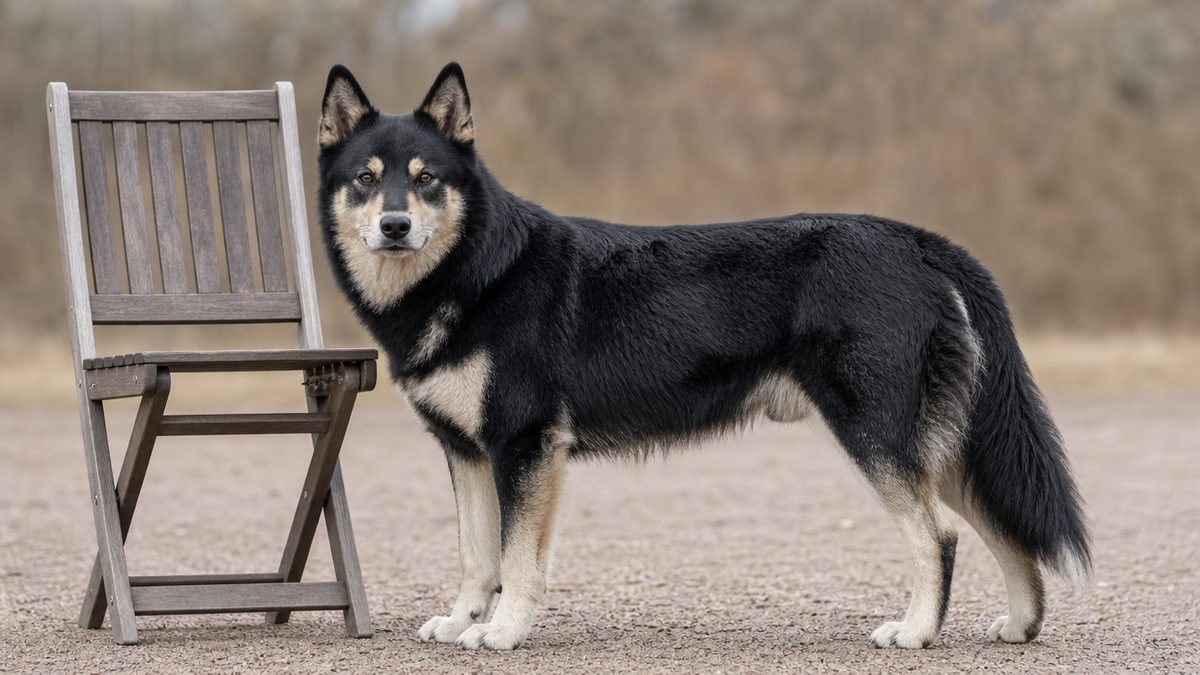
The colour clause is narrow, and it is the most useful identification tool a buyer has. The standard permits "black in different shades, even greyish or dark brown with a lighter shade than the basic colour", with greyish or brownish markings on the head, lower body and legs and white markings allowed on neck, chest and legs. It then disqualifies blue, sable and fawn colour outright, along with drop ears and an overshot or undershot mouth.
| Clause | What the standard says |
|---|---|
| Utilisation | Reindeer herder |
| Proportions | Body about 10 percent longer than height at withers; depth about half the height |
| Ears | Pricked, medium length, set rather apart; slightly floppy ears accepted; drop ears disqualify |
| Tail | Medium length, low set, hanging in repose; may not raise over the back |
| Coat | Outer coat medium length or long, straight, rather erect and harsh; undercoat fine and dense |
| Colour | Black in shades, greyish or dark brown with lighter markings; blue, sable and fawn disqualify |
| Height | Males 51 cm ideal, females 46 cm ideal, tolerance plus or minus 3 cm |
| Weight | No figure given at all |
| Temperament | Docile, calm, friendly, energetic and willing to work; barks readily when working |
Two of those rows do work no photograph caption does. The tail hangs. A Lapponian Herder carrying its tail curled over the back is showing a listed fault, and that single detail separates it from the Finnish Lapphund at twenty paces. And the dog barks readily when working, which the standard states as a positive breed characteristic rather than a flaw, because a herding spitz moves reindeer with its voice.
This dog is sold in English as the Lapponian Herder, the Lapland Reindeer Dog and the Lapp Reindeer Dog, in Finnish as lapinporokoira, and in Swedish as lapsk vallhund. One American breeder's own section heading reads "Florida Lapinporokoira or Lapp Reindeer Dog or Lapsk Vallhund", all three names for one breed on one page. The FCI's own French, German and Spanish names for breed 284 all translate as Finnish Lapland Shepherd, which is where the phantom breed name Lapponian Shepherd comes from.
Three Lapland breeds, and the test that separates them
Three separate FCI breeds come from the Lapland reindeer culture, and the fastest way to tell them apart is to read their colour and tail clauses rather than to look at photographs.
The confusion is not the reader's fault. Finland has two Lapland breeds and Sweden has a third, all in Group 5 Section 3, all double-coated, all descended from Sami herding dogs, and two of them were registered as a single breed until the 1960s. Indian sellers blur them routinely, and so do some overseas ones.
| Lapponian Herder | Finnish Lapphund | Swedish Lapphund | |
|---|---|---|---|
| FCI number | 284 | 189 | 135 |
| Register name | LAPINPOROKOIRA | SUOMENLAPINKOIRA | SVENSK LAPPHUND |
| FCI English name | Lapponian Herder | Finnish Lapponian Dog | Swedish Lapphund |
| Country of origin | Finland | Finland | Sweden |
| Definitive FCI acceptance | 13 November 1970 | 22 August 1955 | 19 January 1955 |
| Current standard published | 11 February 2026 | 30 September 2016 | 10 November 2011 |
| Male ideal height | 51 cm | 49 cm | 48 cm |
| Female ideal height | 46 cm | 44 cm | 43 cm |
| Tolerance as printed | plus or minus 3 cm | a tolerance of 3 cm | allowance for plus or minus 3 cm |
| Colour | Black in shades, greyish or dark brown, lighter markings. Blue, sable and fawn disqualify | All colours are permitted, basic colour dominant | Usually solid black, bronzing typical as bear-brown shades |
| Coat | Medium or long, straight, rather erect and harsh | Profuse, males with an abundant mane, outer coat long and harsh | Profuse double coat standing straight out from the body |
Read the colour row twice, because it is the whole test. FCI 189 says "All colours are permitted"; for the Finnish Lapphund. FCI 284 disqualifies blue, sable and fawn in the Lapponian Herder. FCI 135 describes the Swedish Lapphund as usually solid black with bronzing. So a cream, red or wolf-sable Lapland dog cannot be a correct Lapponian Herder, whatever the seller calls it, and a solid black one with no markings at all is more likely Swedish than Finnish. The Swedish Lapphund was in fact the first of the three into the FCI register, accepted on 19 January 1955, seven months before the Finnish Lapphund.
The proportions test, which works on a photograph
The Lapponian Herder is the long one. Its standard specifies a body about 10 percent longer than the height at the withers and calls the dog "clearly longer than the height at the withers". FCI 189 calls the Finnish Lapphund only "slightly longer than the height at the withers", and FCI 135 gives the Swedish Lapphund a "rectangular body shape" with no percentage. Stand the three side by side and the Herder is the one that reads as a rectangle on legs rather than a fluffy square.
The second visual is the tail, already noted, and the third is the head furnishing. The Finnish Lapphund standard describes a profuse coat in which males carry an abundant mane; the Lapponian Herder's says only that the hair is often more profuse on the neck, chest and back of the thighs. A dog with a lion-like ruff is not a Lapponian Herder.
There is no FCI breed called the Lapponian Shepherd
The FCI's letter index for L lists eight breeds, and the only Lapland entry among them is LAPINPOROKOIRA (284). No breed named Lapponian Shepherd appears anywhere in it. The name is a back-translation: the FCI's own French name for breed 284 is BERGER FINNOIS DE LAPONIE, the German is FINNISCHER LAPPLANDHIRTENHUND and the Spanish is PASTOR FINLANDÉS DE LAPONIA, and all three mean Finnish Lapland shepherd dog. The Finnish Kennel Club's own Swedish-language page for the breed is filed under lapsk vallhund, which means the same thing.
So if a seller offers you a Lapponian Shepherd, they are either using a translated name for this breed or they do not know which breed they are selling. Ask for the FCI number. There are only three answers that make sense, and they are 284, 189 and 135.
Reindeer herding, a war, and snowmobiles
The Lapponian Herder descends from Sami reindeer-herding dogs of northern Fennoscandia, but the modern breed is young and it nearly disappeared twice in one lifetime.
The Finnish Kennel Club dates the written record precisely. The earliest information on reindeer husbandry in Lapland comes from the 16th and 17th centuries, and the first mentions of reindeer-herding dogs appear in the book Lapponia, published in 1674. The dogs are far older than the breed.
Organised breeding is recent and it failed on the first attempt. An effort to launch it in the late 1930s produced no visible results, and systematic kennel work reached the breed only in the 1950s. FCI 284's own history agrees: "Acceptance to the breed register was started in the 1950's. At that time the modern Finnish Lapphund and the Lapponian Herder were still recognized as the same breed";.
Two population crashes, both documented by the breed's own kennel club
The Finnish Kennel Club names two threats in the recent history of the reindeer-herding dog. The first was the Lapland War, fought in the closing stages of the Second World War, which destroyed a large part of all Lapponian Herders. The second was the spread of snowmobiles through reindeer husbandry, which removed the dog's job. A revitalisation effort began only in 1959.
That is an unusually honest origin story for a kennel club to print, and it explains the shape of the modern population. A breed rebuilt from survivors of a war and then made economically redundant by a machine does not have a deep founder base, which is exactly what the gene-pool figures later on this page show.
The separation date, where three official documents disagree
This is the most interesting factual problem on the page, and no ranking page mentions it. FCI Standard 284 states that "The Lapponian Herder was separated into its own breed 10.12.1966, as it had been noted that two different reindeer herding breeds existed";. The Finnish Kennel Club's breed page agrees on the year, saying the revitalisation effort begun in 1959 produced the Lapponian Herder, "whose breed characteristics were confirmed by the Finnish Kennel Club in 1966";.
But FCI Standard 189, the Finnish Lapphund's own document, dates the same event to 1967: "The first standard of the Lapponian Herder was established by the Finnish Kennel Club in 1945. The breed's name was changed into Lapponian Dog in 1967";. And the FCI register gives a third date entirely, recording the Lapponian Herder's definitive acceptance by the FCI on 13 November 1970.
| Document | Date given | What that date actually describes |
|---|---|---|
| FCI-Standard 284, breed history | 10 December 1966 | The Finnish Kennel Club separating the Lapponian Herder into its own breed |
| Finnish Kennel Club breed page | 1966 | Breed characteristics confirmed by the Finnish Kennel Club |
| FCI-Standard 189, breed history | 1967 | The remaining breed's name being changed to Lapponian Dog |
| FCI nomenclature register | 13 November 1970 | The FCI accepting breed 284 on a definitive basis internationally |
Read that way the conflict mostly resolves, and the resolution is more useful than any single date. Two Finnish documents put the domestic separation in 1966. FCI 189 dates the surviving breed's renaming to 1967, which is a different event a year later. The FCI's own international recognition came four years after that, in 1970. Anyone who writes that the breeds split in 1967 has taken the renaming date from the other breed's standard.
Pedigrees, health records and older studies from before 1966 describe a single undivided breed. If you are ever handed a document claiming deep Lapponian Herder ancestry from the 1950s, it is describing dogs that were not yet a separate breed, and some of those animals became Finnish Lapphunds instead.
One further correction is worth making because the site's own sibling page carries it. The Finnish Lapphund guide quotes FCI 189 as saying "males 49 cm and females 44 cm with a tolerance of ±3 cm". Extracting the FCI's English PDF directly with pypdf shows the authentic text reads "with a tolerance of 3 cm", with no plus-or-minus sign anywhere in the document. The intended meaning is almost certainly symmetrical, and FCI 284 and FCI 135 both do print the symbol, but the quotation marks on that sibling page enclose words the standard does not use.
Where the Lapponian Herder is recognised, including in India
The Lapponian Herder holds full FCI recognition as standard 284, which settles its status in India, because the Kennel Club of India registers against FCI nomenclature.
Recognition questions on this site usually end in a hedge. This one does not. The FCI lists the breed's status as Recognized on a definitive basis, with definitive acceptance on 13 November 1970, country of origin Finland, and no working trial required under FCI nomenclature.
That answers the India question by a route worth explaining, because the direct route does not work. The Kennel Club of India publishes no per-breed list at all, so a search of its site returns nothing for this breed and nothing for a control breed either. That is a limitation of the instrument, not a finding about the breed, and it must not be reported as the breed being unrecognised in India. What is checkable is that India sits in the FCI as a full member represented by the Kennel Club of India, Chennai, so the KCI issues pedigrees against FCI nomenclature, and breed 284 is in that nomenclature.
The AKC records it but does not fully recognise it
The American Kennel Club has recorded the Lapponian Herder in its Foundation Stock Service since April 2017, and has assigned it a Herding Group designation for the day it graduates. Foundation Stock Service is a waiting room. It permits record-keeping and some performance events, and it does not permit AKC conformation showing. The breed has not moved out of it in the nine years since.
Finland admits the breed to working trials domestically, and its kennel club credits that admission with part of the breed's rising popularity. Note the apparent contradiction with the FCI line "Without working trial": those are two different things. The FCI phrase means the breed is not subject to a compulsory working trial before a conformation title, not that no trials exist for it.
| Body | Status | Date |
|---|---|---|
| Fédération Cynologique Internationale | Recognised on a definitive basis, standard 284 | 13 November 1970 |
| Suomen Kennelliitto (Finland) | One of Finland's five native breeds, own breed standard | Characteristics confirmed 1966, new standard 1997 |
| American Kennel Club | Foundation Stock Service, Herding Group designation, not eligible for conformation | Recorded since April 2017 |
| Kennel Club of India | Registers against FCI nomenclature as an FCI full member; no per-breed list published | Not separately checkable |
Because the breed is FCI-definitive, a genuine pedigree for a Lapponian Herder anywhere in the FCI system will name breed 284 and the standard it was judged against. Ask for the number. A pedigree that names no FCI number, or that names 189, is not a pedigree for this breed.
Lapponian Herder price in India, and why no figure survives checking
No verifiable Lapponian Herder price in India exists. Two Indian pages publish a band of Rs 70,000 to Rs 1,50,000, they publish the identical band as each other, and neither figure can be traced to a dog that was sold here.
Say the conclusion first, because the rest of this section is the working. Bonbeno could not find one checkable Indian transaction, one Indian breeder, or one Indian registration figure for this breed. What exists is two content pages that print a number.
The first is happypet.care, which holds position one in the Indian result set for this query and gives a cost of buying of Rs 70,000 to Rs 1,50,000. The second is poodles.in, whose page is titled *Lapponian Herder Price in India, Diet, Grooming and Care Guide* and which gives exactly the same band, in its body copy and again in its FAQ: "A Lapponian Herder puppy in India typically costs ₹70,000 to ₹1,50,000, depending on lineage, breeder reputation, and city". Both figures were read out of each page's raw markup rather than from a search snippet, because a snippet can carry a number the page does not.
| Source | Figure | What checking it showed |
|---|---|---|
| happypet.care | Rs 70,000 - Rs 1,50,000 | Present in raw markup. Identical to poodles.in. Running costs identical to the same site's Whippet page |
| poodles.in | Rs 70,000 - Rs 1,50,000 | Present in raw markup. Running costs identical to the same site's Whippet page |
| PetzLover India | Search snippet advertised a dollar range on an India URL | Page unreachable. HTTP 403 behind a CAPTCHA on two attempts, direct and stealth-proxied. No figure used |
| Good Dog (United States) | 1,400 - 1,500 US dollars | A genuine US marketplace band, not an Indian one |
Test one: is the rupee figure a converted dollar figure?
Indian breed pages routinely publish a US dollar price run through one exchange rate. This one is not that, and the arithmetic says so cleanly. Rs 70,000 divided by 84.38 is 829.58 and Rs 1,50,000 divided by 84.38 is 1,777.67, neither a whole number. At 74 the quotients are 945.95 and 2,027.03. At 66.67 they are 1,049.95 and 2,249.89. None of them lands on a figure a seller would print.
The figures do divide at a flat 80, giving 875 and 1,875 dollars. That test proves nothing on its own, because any rupee figure ending in three zeros divides cleanly at 80 by construction, and the quotients are the tell. No breeder anywhere prices a puppy at 875 dollars and its litter-mate at 1,875. The real US band for this breed, from a marketplace that actually lists it, is 1,400 to 1,500 dollars, which at 84.38 would come to roughly Rs 1,18,000 to Rs 1,26,600 and matches neither end of the Indian band.
So the Indian figure is rupee-native and arbitrary rather than converted. That is a different fault from a conversion, and it needs saying differently: nobody did arithmetic on a foreign price here, somebody chose a number.
Test two: does the number change when the breed changes?
This is the test that settles it, and it is described in the next section in full. In short, the two sites' monthly cost lines for this arctic herding spitz are identical to the rupee to their own pages for the Whippet, a short-coated English sighthound with the opposite grooming load. A figure that does not move between those two dogs is not measuring either of them.
This page publishes no Indian price for the Lapponian Herder, and it does not convert the US band into rupees to fill the gap. A converted foreign price presented as an Indian one is fabrication with a calculator attached, and it is the single most common failure on Indian breed pages. If you are quoted a price for this breed in India, ask which FCI-registered parents the puppy came from and which country they were imported from, and expect the conversation to end there.
The size-band default, proved with a control
The running costs on both Indian pages are template constants attached to a size tag, and pulling an unrelated breed of the same size from the same sites proves it in one step.
Indian breed sites publish running costs that look like measurements and are actually defaults keyed to a size band. The test is cheap: pull a second, unrelated breed of the same tagged size from the same site and compare the lines. If they match to the rupee, the number is a template.
Both sites tag the Lapponian Herder as a Medium Breed. So does the Whippet, an English sighthound with a short single-layered coat, a completely different build and, on happypet.care's own page, a shedding level recorded as Low against the Lapponian Herder's Moderate.
| Line | Lapponian Herder | Whippet | Match? |
|---|---|---|---|
| Food, basic to premium | Rs 2,250 - Rs 3,000 | Rs 2,250 - Rs 3,000 | Identical |
| Veterinary, basic to premium | Rs 600 - Rs 1,200 | Rs 600 - Rs 1,200 | Identical |
| Grooming, basic to premium | Rs 700 - Rs 1,200 | Rs 700 - Rs 1,200 | Identical |
| Monthly total | Rs 3,550 - Rs 5,400 | Rs 3,550 - Rs 5,400 | Identical |
| Cost of buying | Rs 70,000 - Rs 1,50,000 | Rs 20,000 - Rs 50,000 | Different |
| Size tag | Medium Breed | Medium Breed | Identical |
Every running-cost line matches to the rupee. The grooming line is the one that gives the game away, because it says an arctic dog with a fine dense undercoat and a moderate shedding rating costs exactly what a smooth-coated sighthound costs to groom. That is not possible, and the sites' own shedding fields contradict it.
poodles.in reproduces the same pattern independently. Its Lapponian Herder page prints a monthly expense summary of Rs 3,550 to Rs 5,400 built from food Rs 2,250-3,000, grooming Rs 700-1,200 and health Rs 600-1,200; its Whippet page prints the identical summary from the identical three lines. Two domains, four pages, one set of numbers.
A refinement: the bands are assembled line by line, not row by row
Pulling a third breed sharpens the finding. happypet.care's Finnish Lapphund page is also tagged Medium Breed, and it carries the same food line of Rs 2,250 to Rs 3,000 but a different veterinary line of Rs 1,200 to Rs 1,800 and a different grooming line of Rs 1,200 to Rs 1,800, for a monthly total of Rs 4,650 to Rs 6,600.
So the food figure is shared across all three breeds while the veterinary and grooming figures come from a small set of preset tiers. The cost table is assembled from independent preset lines rather than copied as a whole row, which is why a page can look breed-specific while none of its numbers describes the breed.
| Breed | Food | Veterinary | Grooming | Monthly total |
|---|---|---|---|---|
| Lapponian Herder (Finland, arctic herding spitz) | Rs 2,250 - 3,000 | Rs 600 - 1,200 | Rs 700 - 1,200 | Rs 3,550 - 5,400 |
| Whippet (England, short-coated sighthound) | Rs 2,250 - 3,000 | Rs 600 - 1,200 | Rs 700 - 1,200 | Rs 3,550 - 5,400 |
| Finnish Lapphund (Finland, long-coated spitz) | Rs 2,250 - 3,000 | Rs 1,200 - 1,800 | Rs 1,200 - 1,800 | Rs 4,650 - 6,600 |
What does vary per breed on those pages is the buying price and the stated ideal weather, which is precisely what makes the template hard to spot. The Lapponian Herder is given an ideal weather figure of 15 degrees Celsius, the Finnish Lapphund 5 to 20 degrees and the Whippet 15 to 30 degrees. Those differ, so the page looks bespoke, while its cost table is a default.
Open the same site's page for an unrelated breed of the same stated size, and put the two cost tables side by side. It takes about a minute. If the lines match to the rupee, you are reading a size-band constant, and the correct response is to ignore it rather than to budget from it.
What keeping this dog in India would actually cost
The true cost of ownership starts with cooling, because it is the one line every Indian breed page leaves out and the largest recurring cost of keeping an arctic double-coated dog here.
Since no breed-specific Indian cost figure survives checking, the honest approach is to build the budget from what a 20 kg working dog needs in an Indian city, and to be explicit about which lines are estimates and which are template numbers this page refuses to reuse.
The published Indian figures give a monthly total of Rs 3,550 to Rs 5,400. That number is a size-band default shared with the Whippet, so it should not be used as a budget. More importantly, it contains no cooling line at all, and for this breed cooling is not optional comfort. It is the difference between a dog that is uncomfortable and a dog that is at risk.
The line nobody prints
A dog bred for a homeland that averages minus 0.84 degrees Celsius across the year cannot regulate itself through an Indian summer by panting alone. In practice that means air conditioning or at minimum a cooled room, running for a large part of the day, for roughly eight months a year in Chennai, Mumbai, Delhi, Kolkata and Hyderabad, and rather less in Bengaluru or Pune. The electricity cost of that depends on your tariff, your insulation and how many hours you run it, so this page gives no rupee figure for it, but it is the single largest line in the real budget and it is absent from every page that ranks for this query.
| Line | Basis | Confidence |
|---|---|---|
| Puppy purchase | No verifiable Indian figure exists; imported dogs would additionally carry freight, quarantine and paperwork | None. Do not budget from a published Indian number |
| Cooling and electricity | Eight months a year of cooled indoor space in most Indian metros | High that it is needed, none on the rupee amount |
| Food | A 20 kg active working dog on a complete diet | Moderate. Do not use the Rs 2,250 template figure, which is shared with a Whippet |
| Routine veterinary care | Annual vaccination course, year-round tick and flea prevention, deworming | High that it is needed, and it is higher in India than in Finland because of tick-borne disease pressure |
| Coat maintenance | Brushing equipment and a proper high-velocity dryer, not salon visits | High. The dog needs no trimming, so the spend is equipment rather than grooming bills |
| Eye screening | Annual ophthalmologist examination, given three documented retinal conditions in the breed | High that it is needed; specialist availability is limited outside major metros |
| Joint screening | Hip and elbow radiographs if the dog is ever bred, which Finland scores at scale | Only relevant to breeding |
Why the grooming line is the wrong shape in India
The published pages put grooming at Rs 700 to Rs 1,200 a month, the same as a Whippet's. For this breed the shape of the spend is different rather than merely the amount. The coat is straight, harsh and medium to long, so it needs no clipping, no stripping and no scissoring, and a salon has very little to do to it. What it does need is a slicker brush, an undercoat rake and a dryer powerful enough to get a dense undercoat genuinely dry, because a coat that stays damp in Indian monsoon humidity is where skin and ear problems start. That is a one-time equipment cost rather than a monthly bill.
The double coat is insulation in both directions and the guard hairs shield skin from direct sun. Clipping it does not cool the dog and it exposes skin that has never seen Indian sunlight. If a groomer offers a summer shave for a Nordic breed, decline it and find another groomer.
Heat, humidity and the monsoon, measured rather than asserted
The Lapponian Herder comes from a homeland whose warmest month is cooler than India's coolest metro month, and that single comparison decides most of what follows.
Every breed page says Nordic dogs are heat-sensitive. Almost none says by how much. This section queries NASA POWER by explicit latitude and longitude for the homeland and for eleven Indian locations, and reports the grid-cell elevation alongside every figure, because POWER returns a grid cell rather than a point and in mountainous terrain the cell can miss the town beneath it by more than a kilometre.
The homeland, with its elevation checked
Reindeer herding in Finland centres on Lapland, so the homeland points are Inari, Sodankylä and Rovaniemi, plus Kautokeino across the Norwegian border. Inari at 68.906 N, 27.029 E returns a cell elevation of 237.75 m against a real town elevation near 119 m, an overstatement of about 119 m, which at the standard lapse rate is under one degree of error. Sodankylä is out by 49 m, Rovaniemi by 67 m and Kautokeino by 134 m. All four homeland cells are usable, and checking them matters, because a wrong homeland baseline would corrupt the comparison exactly as badly as a wrong Indian one.
| Place | Coordinates | Cell elevation | Annual mean | Warmest month | Coldest month |
|---|---|---|---|---|---|
| Inari, Finnish Lapland | 68.906 N, 27.029 E | 237.75 m | -0.84 C | 13.6 C (July) | -12.8 C (January) |
| Sodankyla, Finnish Lapland | 67.418 N, 26.590 E | 227.84 m | -0.41 C | 14.6 C (July) | -13.5 C (January) |
| Rovaniemi, Finnish Lapland | 66.500 N, 25.733 E | 151.72 m | 0.71 C | - | - |
| Kautokeino, Norwegian Finnmark | 69.012 N, 23.041 E | 439.95 m | -1.61 C | - | - |
Now put that beside India, and the scale of the problem becomes a single sentence. Inari's warmest month averages 13.6 degrees Celsius. Chennai's coolest month, January, averages 24.1 degrees. India's mildest month in a coastal metro is 10.5 degrees warmer than the hottest month this breed was shaped in.
A second comparison lands harder. The highest temperature the Inari cell recorded across the whole 2001 to 2020 period is 28.08 degrees. Chennai's annual mean is 27.95 degrees. The most extreme heat this dog's homeland has produced in twenty years is roughly an average Chennai day.
| City | Cell elevation vs real | Annual mean | Warmest month | Max recorded |
|---|---|---|---|---|
| Inari (homeland) | 237.75 m vs ~119 m | -0.84 C | 13.6 C | 28.08 C |
| Delhi | 206.37 m vs ~216 m, out by -10 m | 25.60 C | 35.9 C (June) | 48.79 C |
| Kolkata | 7.35 m vs ~9 m, out by -2 m | 25.81 C | - | 46.81 C |
| Chennai | 48.95 m vs ~6 m, out by +43 m | 27.95 C | 31.5 C (May) | 42.70 C |
| Mumbai | 97.15 m vs ~14 m, out by +83 m | 26.77 C | 31.2 C (May) | 44.91 C |
| Hyderabad | 494.59 m vs ~542 m, out by -47 m | 26.10 C | - | 45.00 C |
| Pune | 635.99 m vs ~560 m, out by +76 m | 23.86 C | 28.9 C (April) | 43.20 C |
| Bengaluru | 841.72 m vs ~920 m, out by -78 m | 23.74 C | 28.4 C (April) | 40.38 C |
Those eight cells are all within about 85 m of their towns, so the plains figures can be used as printed. Bengaluru and Pune are the mildest large Indian cities on this table, and even they run roughly 24 degrees annual mean against the homeland's minus 0.84, a gap of about 25 degrees.
The hill stations, and why the raw climate data misleads there
Indian hill stations are the only places worth considering for an arctic breed, and they are also where NASA POWER's grid cells are most wrong, so every figure below carries an explicit elevation correction.
Whenever an Indian page suggests a cold-climate breed might manage in Ooty, Shimla or Darjeeling, it is reaching for the right idea with the wrong numbers. POWER's grid cell in mountainous terrain can sit more than a kilometre away from the town underneath it, in both directions, so the raw output is right for the cell and wrong for the place.
The errors measured for this page are large and they run both ways. Manali's cell sits at 3,984.73 m against a town near 2,050 m, 1,935 m too high, which returns an absurd annual mean of minus 0.56 degrees. Ooty's cell sits at 784.64 m against a town near 2,240 m, 1,455 m too low, which returns a far-too-warm 23.50 degrees. Neither figure describes the town.
| Place | Cell elevation | Real elevation | Cell error | Raw annual mean | Corrected estimate |
|---|---|---|---|---|---|
| Ooty | 784.64 m | ~2,240 m | -1,455 m | 23.50 C | about 14.0 C |
| Shimla | 897.65 m | ~2,200 m | -1,302 m | 21.15 C | about 12.7 C |
| Darjeeling | 1,313.52 m | ~2,045 m | -731 m | 18.42 C | about 13.7 C |
| Manali | 3,984.73 m | ~2,050 m | +1,935 m | -0.56 C | about 12.0 C |
| Gangtok | 3,239.61 m | ~1,650 m | +1,590 m | 7.45 C | about 17.8 C |
| Leh | 4,532.61 m | ~3,500 m | +1,033 m | -2.75 C | about 3.9 C |
The corrected column applies a lapse rate of about 6.5 degrees per 1,000 metres to the elevation error, and it is an estimate labelled as one, not a measurement. It is included because the raw figures are actively misleading without it: taken as printed, Manali looks like Lapland and Ooty looks like Bengaluru, and neither is true.
What the corrected figures actually say
Even after correction, no Indian hill station reaches the homeland. Ooty at roughly 14 degrees, Shimla at roughly 12.7 and Darjeeling at roughly 13.7 all sit about 13 to 15 degrees above Inari's annual mean of minus 0.84. Leh at roughly 3.9 degrees is the closest place in India to this breed's climate, and Leh is a high-altitude cold desert with limited veterinary infrastructure and an air-freight-only supply chain.
There is a second reason to be careful with hill stations, and it is the monsoon rather than the temperature. Darjeeling's relative humidity runs at 89 to 90 percent through July and August, and Ooty's sits between 81 and 83 percent from June to November. A dense undercoat in months of that humidity is a skin and ear problem waiting to happen, and it is a different failure mode from heat.
No two locations queried for this page returned byte-identical series, so no cell was queried twice by accident, and the four homeland points differ from each other as they should. That check matters because two towns returning the same numbers to the decimal means one grid cell was sampled twice and cannot distinguish anything.
What the heat research says, and what it does not say about this breed
The largest published study of canine heat-related illness gives two risk factors that transfer to this breed honestly, and one number that must not be attached to it.
The reference work is a pair of 2020 papers by Hall, Carter and O'Neill on the same VetCompass cohort of 905,543 UK dogs under primary veterinary care in 2016. They are separate papers with separate case definitions, and mixing them is the commonest error on breed pages, so each figure below names its paper.
The *Scientific Reports* paper identified 395 confirmed heat-related illness events and reported a case fatality rate of 14.18 percent. Its bodyweight findings are the ones that transfer: dogs at or above the mean bodyweight for their breed and sex carried an odds ratio of 1.42, with a 95 percent confidence interval of 1.12 to 1.80.
The *Animals* paper used a wider case definition and found 1,259 events from 1,222 dogs. Of those, 380 had no trigger recorded, leaving 879 events with a recorded trigger, of which 652 were exertional. That is 74.2 percent of the 879 events with a recorded trigger, not of the 1,259. Environmental heat accounted for 113 of the 879, at 12.9 percent, and confinement in a vehicle for 46, at 5.2 percent.
Roughly three in four heat-related illness events with a recorded trigger were exertional, not dogs left in cars. The dominant risk is a dog exercising in heat, which for an Indian owner of a working herding breed is the exact situation that arises every single day.
What this page will not claim
Neither Hall paper modelled the Lapponian Herder. The breed is far too rare in the UK to have met an inclusion threshold, and no odds ratio specific to it exists anywhere. This page therefore claims only the transferable bodyweight factor and the exertional trigger split, and states plainly that the breed itself was not modelled. An odds ratio imported onto a breed the authors never studied would be fabrication wearing a citation.
The same discipline applies to lifespan. McMillan's 2024 study of companion dog longevity is the paper most often quoted for breed medians, and it was checked directly for this page: the strings "Lapponian" and "Lapphund" appear zero times in the article as published on PubMed Central. So no McMillan median is quoted here, and the lifespan figures used on this page come from Finland's own death register instead, which is better data for this breed anyway.
Practical thresholds for an Indian owner
Working from the climate table rather than from a rule of thumb, the operating windows in an Indian metro are narrow. In Chennai the coolest month averages 24.1 degrees and the warmest 31.5, so there is no month in which midday exercise is reasonable. In Delhi the January mean of 13.6 degrees is genuinely workable and the June mean of 35.9 degrees is not, so the year splits into roughly four usable months and eight difficult ones.
Watch for heavy panting that does not settle within a few minutes of stopping, bright red gums, unsteadiness, vomiting or collapse. Move the dog into shade or air conditioning, wet the coat through to the skin with cool rather than iced water, offer small drinks, and go to a veterinarian immediately. With a case fatality rate near 14 percent in the largest published series, this is an emergency and not a wait-and-see.
Temperament, and who should not buy this breed
The breed standard describes a docile, calm, friendly, energetic dog willing to work that barks readily when working, and the last four words decide whether it fits an Indian household.
FCI 284's temperament clause is short and every word of it is load-bearing: "Docile, calm, friendly, energetic and willing to work. Barks readily when working." Its disqualifying faults list bars aggressive or overly shy dogs from the ring, which means unstable temperament is a formal fault rather than a quirk.
Read together, that describes a hardy working dog that is easy to live with and hard to satisfy. It is not a guarding breed, it is not suspicious of strangers, and it is not sharp. What it is, is employed. A reindeer herder works at a distance from its handler over open ground, makes its own decisions about where stock should go, and uses its voice to move animals that weigh far more than it does.
The barking is the job, not a fault
This deserves its own heading because it is the most common reason a Nordic herding breed is rehomed. The standard states that the dog barks readily when working as a positive breed characteristic. A Lapponian Herder that is under-exercised and under-occupied in a flat will not stop being a herding spitz; it will find something to herd and something to bark at, and in an Indian apartment block with shared walls and close neighbours, that becomes a housing problem within weeks.
You can reduce it with real work, structured training and enough exercise. You cannot train it out, and any seller who tells you the breed is quiet has not read the standard.
Who this breed genuinely suits
- Households with a fenced outdoor space in a cool-climate Indian location, not a balcony in a metro.
- Owners who already train dogs and want a partner for herding, agility, obedience or scent work rather than a companion.
- Families able to exercise a working dog properly at dawn and after dark, every day, through the hottest eight months.
- Homes where a vocal dog will not create a neighbour dispute.
- Owners willing to run cooling for much of the year and to treat that as a fixed cost of the decision.
Who should not buy one
- First-time owners buying on looks, because this dog is photogenic and demanding in equal measure.
- Apartment households in Chennai, Mumbai, Kolkata, Delhi or Hyderabad, where the climate table gives no comfortable month at all.
- Buyers who want a quiet dog, since the standard itself says otherwise.
- Anyone who cannot guarantee cooled indoor space through an Indian summer.
- Anyone who wants a Finnish Lapphund and has been offered this breed instead, or the reverse, which is the most common way an Indian buyer ends up with the wrong dog.
Docile, calm and friendly is the standard's own description, and there is nothing in the temperament clause that argues against children. The practical caution is mechanical rather than behavioural: a 51 cm herding dog that barks and body-checks livestock for a living can knock a small child over without any intent to, so supervise early interactions and teach the dog that people are not stock.
Training a dog bred to make its own decisions
Train the Lapponian Herder with short, frequent, reward-based sessions that give it a job, because it learns quickly and resists repetition that has no purpose.
The starting point is favourable. This is a breed Finland admits to working trials, and its own kennel club credits that admission with part of the breed's rising registration numbers over the last decade. A dog that can be trained to a national trial standard is a trainable dog.
The complication is what it was trained to do. Herding reindeer over open fell is a job of independent judgement at distance. The handler cannot see what the dog sees and cannot micro-manage it. So the breed was selected for animals that think for themselves, and a dog selected for initiative will experiment rather than wait.
What works
- Reward-based marker training, because a dog bred to solve problems will solve them faster for a reward than under pressure.
- Short sessions of five to ten minutes, repeated several times a day, rather than one long drill.
- Real jobs rather than obedience for its own sake: scent games, retrieves with a purpose, tidying toys, carrying things.
- Recall trained from the very first week, off a long line, because a herding spitz that has learned to ignore a recall at distance is extremely hard to fix.
- Teaching a quiet cue early, on the understanding that it manages barking rather than removes it.
What does not work
- Harsh corrections, which produce a dog that stops offering behaviour and becomes harder to read.
- Long repetitive drills, which a problem-solving dog will start editing to make interesting.
- Training in the middle of an Indian day, because a hot dog cannot learn and the session teaches it that training is unpleasant.
- Leaving the dog to entertain itself, which is how the barking becomes self-rewarding.
Realistic timelines in Indian conditions
The Indian complication is not the dog, it is the clock. Every training session and every walk has to happen inside the two cool windows the climate allows, and those windows are also when you are commuting. Households that fail with this breed usually fail on scheduling rather than on method.
| Period | Priority | Indian constraint |
|---|---|---|
| Weeks 8-16 | Socialisation to people, traffic noise, surfaces, handling. Crate and toilet routine | Socialise indoors and at dawn; the socialisation window does not pause for summer |
| Months 4-6 | Recall on a long line, loose-lead walking, quiet cue, settle on a mat | Sessions before 7 am and after 7 pm; keep them short |
| Months 6-12 | Impulse control, distance work, first structured sport or scent work | Adolescent energy peaks exactly when outdoor time is most restricted |
| Months 12-18 | Proofing recall around distractions; consider herding, agility or obedience | Plan indoor enrichment for the eight difficult months, not just walks |
One legal point belongs here rather than in a footnote. India's Prevention of Cruelty to Animals (Dog Breeding and Marketing) Rules 2017 make de-barking an offence alongside tail docking, ear cropping and de-clawing, under Second Schedule Part II paragraph 6(8), which forbids those procedures and "any change of appearance by artificial means" outright. For a breed whose standard says it barks readily, that is worth knowing before anyone suggests a surgical answer to a training problem.
Exercise, and what happens in India when it is not delivered
Plan on 60 to 90 minutes of real activity a day, split across the two cool windows an Indian day allows, and accept that the second window is the one most owners miss.
The standard describes the gait as "free, flexible, effortless and sound" and says "the trot is tireless";. That is a specification for endurance rather than speed, and it is the shape the exercise has to take: sustained movement, not a sprint in a park.
The published Indian pages put the requirement at 60 to 90 minutes daily with a high energy level, and unlike their cost tables that figure is at least the right order of magnitude for a working herding breed. What those pages omit is when.
The Indian scheduling problem, in numbers
Work it from the climate table. Chennai's coolest month averages 24.1 degrees and its warmest 31.5. There is no month in Chennai when a double-coated arctic dog should be trotting at noon. Delhi is more seasonal, with a January mean of 13.6 degrees that is genuinely comfortable and a June mean of 35.9 that is dangerous, so a Delhi owner gets roughly four workable months and eight constrained ones.
That leaves two windows almost everywhere in India: before sunrise, and an hour or more after sunset once pavement has released its heat. Both are short. Both collide with commuting. The households that fail with Nordic working breeds in India nearly always fail here, not through indifference but because two rigid daily windows are genuinely hard to hold for ten to fourteen years.
| Slot | Content | Duration |
|---|---|---|
| Pre-dawn, daily | Steady lead walk or off-lead trot on grass, plus a short training set | 35-45 minutes |
| Post-sunset, daily | Second walk with sniffing time, or a scent game in a cooled room | 25-35 minutes |
| Twice weekly | Structured sport session: herding where available, agility, obedience or nosework | 30-45 minutes |
| Daily, indoors | Food puzzles, shaping sessions, chew work in the hot hours | 15-20 minutes |
| Monsoon substitution | Indoor work when the ground is wet, followed by proper drying if the coat gets soaked | As needed |
What under-exercise looks like
It does not usually look like a destroyed sofa. In this breed it looks like noise, because the standard's "barks readily when working" becomes barking at nothing when there is no work. It also shows as fence-line patrolling, herding the household's children or ankles, and an inability to settle indoors. Every one of those is a symptom of an unemployed working dog rather than a behaviour problem in its own right.
Indian pavement and concrete hold heat long after the air has cooled, and paw pads burn before an owner notices. Put the back of your hand flat on the ground for seven seconds before an evening walk. If you cannot hold it there, the dog should not be walking on it, whatever the thermometer says.
Coat care in Indian humidity
Brush the Lapponian Herder's double coat through with an undercoat rake two or three times a week, more during a moult, and dry it completely after every bath, because a damp undercoat in Indian humidity is the real risk rather than the shedding.
The coat this breed carries is described precisely in its standard: "The outer coat is of medium length or long, straight, rather erect and harsh. The undercoat is fine and dense." The hair is often more profuse and longer on the neck, chest and the backside of the thighs. That is a working weatherproof coat, not a show coat, and it is meaningfully less coat than the Finnish Lapphund's, whose standard describes a profuse coat and an abundant mane on males.
The practical consequence is good news. No trimming, no stripping, no clipping and no scissoring. A groomer has very little legitimate work to do on this dog, and the running cost is equipment rather than salon visits, which is the opposite shape from the Rs 700 to Rs 1,200 monthly line the Indian pages print.
The routine that matters in India
- Brush to the skin two or three times a week with a slicker and an undercoat rake, working in sections rather than skimming the top coat.
- Increase to daily through a moult, when a Nordic double coat sheds undercoat in sheets rather than gradually.
- Bathe rarely, and only when the dog is genuinely dirty, because frequent bathing strips the coat's weather resistance.
- Dry the coat completely to the skin after every bath and after any monsoon soaking, using a high-velocity dryer rather than a towel and time.
- Plug or protect the ears before any bath, and dry the ear canals afterwards.
- Check between the toes and under the tail weekly through the monsoon, where damp collects and is not visible.
Why a Finnish grooming guide does not transfer
Northern kennel clubs write coat advice for northern air. In Finnish Lapland the annual mean humidity in the Inari cell runs above 90 percent but at temperatures near or below freezing, where a coat dries because the air is cold and the dog goes indoors to heat. In an Indian monsoon the humidity is comparable and the temperature is twenty-five degrees higher, which is the condition in which a dense undercoat stays wet for hours.
So the instruction to towel a Nordic dog and let it air dry, which is sound in Lapland, is the wrong instruction in Mumbai in July, where relative humidity averages 90 percent and the mean temperature is 26.6 degrees. Dry the dog actively. This is one of the few places where following an overseas breed club's advice literally would make an Indian dog worse off.
The double coat insulates in both directions and the guard hairs block direct sun from the skin. Clipping it off removes the sun barrier, does not improve heat loss meaningfully, and can permanently change how the coat regrows. Manage heat with shade, cooling and timing instead.
One more thing the standard rules out. The feet are described as covered with dense hair on all sides including underneath, and the pads elastic and thick. Keep the hair between the pads trimmed level with the pad in Indian conditions, because matted foot hair traps moisture and grit, but leave the foot furnishing itself alone.
Health, from Finland's own screening register
The Finnish Kennel Club publishes every screening result for this breed openly, so the figures below are denominators rather than estimates, and they cover 6,850 dogs born between 2000 and 2026.
Most breed pages guess at health. This one does not need to, because Finland puts the whole register in public. Every figure in this section comes from KoiraNet, the Finnish Kennel Club's breeding database, filtered to the Lapponian Herder under breed code 284, by year of birth from 2000 to 2026, on database version v2026.4.29.
Read one caveat first. The 2024, 2025 and 2026 birth-year rows are incomplete, because those dogs are still too young to have been screened. In the hip table, 2023 shows a 49 percent screening rate and 2025 shows 6 percent, and the same applies to the elbow dysplasia and patella rows. That is age, not a collapse in screening discipline, and any percentage taken from the most recent rows alone would be misleading.
| Screen | Dogs examined | Result | Rate |
|---|---|---|---|
| Hips, FCI A to E | 2,719 of 6,850 born | A 1,163, B 894, C 554, D 94, E 14 | 24.35 percent dysplastic (C, D or E) |
| Elbows, grades 0 to 3 | 2,379 | Grade 0 in 2,269, grade 1 in 93, grade 2 in 14, grade 3 in 3 | 4.62 percent with any grade |
| Patella, grades 0 to 4 | 1,463 | Grade 0 in 1,448; grades 1 to 4 in 13; 2 operated | 1.03 percent with any abnormality |
| Eyes | 2,771 | 2,392 free of inherited eye disease | 13.68 percent with a finding |
| Spondylosis, grades 0 to 4 | 839 | Grade 0 in 819, grade 1 in 14, grade 2 in 6, none at grade 3 or 4 | 2.38 percent affected |
Spondylosis is screened least of the five, with 839 dogs examined and 20 showing any grade. Every row above reconciles: the A to E counts sum to exactly 2,719, the elbow grades to exactly 2,379, the patella grades to exactly 1,463 and the spondylosis grades to exactly 839. That check is worth stating, because a source whose parts do not add to its whole cannot be quoted safely.
Hips: the honest reading
24.35 percent of 2,719 screened Lapponian Herders were graded C, D or E. That is not a low figure, and it deserves saying plainly rather than being softened. It is also worth reading the distribution rather than the headline: 554 of those 662 were grade C, the mildest dysplastic grade, while grade E, the most severe, accounted for just 14 dogs across twenty-six birth years.
The trend within the register is not encouraging and the page should say so. In 2004, 66 percent of scored dogs were grade A and 6 percent were C. In 2020, 36 percent were A and 33 percent were C. Screening rates roughly doubled over the same period, from 27 percent of the 2004 cohort to 51 percent of the 2020 cohort, so part of that shift is more dogs being screened rather than worse hips. It is not possible to separate the two effects from the published table, and this page does not pretend otherwise.
Patella: the figure that contradicts the Indian pages
Indian breed pages list patellar luxation among this breed's common health issues. Finland examined 1,463 Lapponian Herders and found any abnormality in 15 of them, 1.03 percent. Calling that common is wrong by any reasonable definition.
It is worth adding a legal note here, because the same pages often imply Indian law requires patella testing. It does not. Across the whole gazette text of the Prevention of Cruelty to Animals (Dog Breeding and Marketing) Rules 2017, the words "patella" and "luxation" appear zero times, and so do "BAER" and "deaf";. The Rules' testing clause names other things entirely, as the next section explains.
KoiraNet's eye summary and its per-diagnosis detail lines are consistent with each other, which is not something this site can say of every registry. Its detail rows count findings rather than dogs, so a dog with two diagnoses appears twice and the rows can exceed the number examined, but the headline healthy count tracks the No evidence of inherited eye diseases line year by year.
Three retinal diseases, and what a DNA certificate does not cover
The Lapponian Herder carries at least three separately published inherited retinal conditions, one of which is exclusive to the breed, and a commercial DNA panel does not test for all of them.
This is the breed's defining health story and no page ranking in India mentions any of it.
1. Generalised progressive retinal atrophy
A 2007 Cambridge study mapped the retinal atrophy locus in the Finnish lapphund to the centromeric region of chromosome 9, near GALK1, and concluded that the disease in that breed "may correspond to progressive rod-cone degeneration". The detail that matters here is the comparison it ran: "Swedish lapphund cases, but not Lapponian herder cases, had the same GALK1 microsatellite genotype as Finnish lapphund cases";.
So the three Lapland breeds do not all carry the same retinal disease, and a result from one does not transfer to another. Anyone reasoning from Finnish Lapphund eye data to a Lapponian Herder is reasoning across a boundary the original paper explicitly drew.
2. Canine multifocal retinopathy 3, exclusive to this breed
A 2010 study of BEST1 variation across breeds found seven novel coding variants in exon 10, and reported that two linked mutations were associated with canine multifocal retinopathy exclusive to the Lapponian Herder, designated cmr3. Its conclusion states that a third independent canine model for human bestrophinopathies has been established in this breed, and that cmr3 is predicted to work through a distinctly different molecular mechanism from the earlier forms.
The same survey found two individuals of the Jämthund and Norfolk Terrier breeds heterozygous for conservative changes that were judged unlikely to be disease-causing, which is a useful cross-reference for anyone reading this site's Jämthund guide.
3. An IFT122 variant found in 2021
A Helsinki group studied Lapponian Herders with progressive retinal atrophy in which the known PRCD and BEST1 variants had already been excluded, which by itself tells you the first two conditions do not explain every case in the breed. They collected DNA from 10 affected and 34 unaffected Lapponian Herders, ran a genome-wide association study that identified a locus on chromosome 20, and whole-genome sequencing of an affected dog revealed a missense variant, c.3176G>A, in the intraflagellar transport 122 gene, interrupting a highly conserved residue at p.(R1059H).
The paper adds a line that matters for the sibling breed: "The variant was also found in Finnish Lapphunds, in which its clinical relevancy needs to be studied further." Found, not proven to cause disease there. That distinction should survive into any breeder's claim about it.
| Condition | Gene | Status in the Lapponian Herder | Status elsewhere |
|---|---|---|---|
| Generalised PRA | PRCD region, near GALK1 on CFA9 | Associated with generalised PRA in the breed; the breed's cases did NOT share the Finnish Lapphund marker genotype | Finnish and Swedish Lapphund cases shared that genotype |
| Canine multifocal retinopathy 3 | BEST1, two linked exon 10 mutations | Exclusive to this breed as of the 2010 study | cmr1 in mastiff-related breeds, cmr2 in the Coton de Tulear |
| Retinitis pigmentosa model | IFT122 c.3176G>A, p.(R1059H), CFA20 | Identified in cases where PRCD and BEST1 were excluded | Also found in Finnish Lapphunds, clinical relevance unresolved |
Finland's own eye register shows what this looks like in a population rather than a laboratory. Across births from 2000 to 2026, 2,771 dogs were examined and 2,392 were recorded free of inherited eye disease, leaving 379 with a finding, and the year-by-year diagnosis lists name PRA, multifocal retinal dysplasia, persistent pupillary membrane, PHTVL/PHPV and several cataract types. Nine dogs in the death register died of eye disease at a mean age of 8 years 1 month.
A commercial DNA panel is sold for this breed, and the Pompe paper's own competing-interests statement records that a DNA test covering the Finnish Lapphund, Swedish Lapphund and Lapponian Herders is commercially available. Ask which laboratory, which specific variants, and what both parents' results were. Then ask separately for a recent ophthalmologist examination, because a DNA panel that covers PRCD and BEST1 says nothing about the IFT122 variant or about anything the eye examination would find.
Lifespan and causes of death, from 1,254 recorded deaths
Finland's death register records 1,254 Lapponian Herder deaths at a mean age of 10 years 8 months, and cancer is the single largest disease category at 235 of them.
Published lifespan figures for this breed range from 10 to 12 years on one ranking page to 12 to 14 on another and 10 to 14 on the AKC's happypet.care breed page for the Lapponian… American Kennel Club. None of them says where the number came from. Finland's register does better than an estimate, because it counts actual deaths.
KoiraNet records 1,254 deaths of Lapponian Herders across birth years 2000 to 2026, at a mean age at death of 10 years 8 months. The categories sum exactly to that total, which is the first thing to check in any register table.
| Cause | Deaths | Share | Mean age at death |
|---|---|---|---|
| Age, natural or euthanasia | 325 | 25.9% | 13 years 11 months |
| Tumour or cancer | 235 | 18.7% | 11 years 2 months |
| Cause of death not specified | 156 | 12.4% | 10 years 2 months |
| Euthanasia, non-diagnosed | 108 | 8.6% | 11 years 4 months |
| Accident | 72 | 5.7% | 5 years 5 months |
| Other unspecified disease | 65 | 5.2% | 9 years 9 months |
| Skeletal or articular disease | 47 | 3.7% | 7 years 5 months |
| Spinal disease | 37 | 3.0% | 9 years 2 months |
| Euthanasia for behavioural problems | 32 | 2.6% | 5 years 6 months |
| Liver or digestive disease | 30 | 2.4% | 8 years 6 months |
| Neurological disorder | 25 | 2.0% | 8 years 10 months |
| Urinary disorder | 24 | 1.9% | 9 years 11 months |
| Heart disease | 20 | 1.6% | 8 years 7 months |
| Respiratory disease | 17 | 1.4% | 12 years 1 month |
| Eye disease | 9 | 0.7% | 8 years 1 month |
| All causes | 1,254 | 100% | 10 years 8 months |
How to read a mean age at death
A mean across everything a register records is dragged down by dogs that never had a chance to age. The 325 dogs recorded as dying of age reached a mean of 13 years 11 months, while the 72 killed in accidents averaged 5 years 5 months and the 32 euthanised for behavioural problems averaged 5 years 6 months. So the population mean of 10 years 8 months is an accurate summary of the register and an understatement of what a healthy, well-managed dog can expect.
The right way to state it for a buyer is this: a Lapponian Herder that avoids accidents and behavioural euthanasia and is not lost to cancer has a realistic chance of reaching thirteen or fourteen. The commonly published bands of 10 to 12 and 12 to 14 both sit inside that picture, and neither is derived from data this specific.
Cancer is the number to plan around
Tumour or cancer accounts for 235 of 1,254 deaths, 18.7 percent, at a mean age of 11 years 2 months. It is the largest single disease category by a wide margin, roughly five times the next-largest disease group. That is not unusual for a medium-sized breed that lives well into its teens, and it is the reason a Lapponian Herder in its second decade earns twice-yearly veterinary checks rather than annual ones.
Thirty-two dogs, 2.6 percent of all recorded deaths, were euthanised for behavioural problems at a mean of 5 years 6 months. In a breed the standard calls docile, calm and friendly, that number is not about temperament faults. It is about a working herding spitz whose needs were not met, and it is the most preventable line in the whole table.
Pompe disease, dwarfism and a small gene pool
Two further inherited conditions are documented in this breed group, and Finland's own gene-pool arithmetic explains why breeders watch them closely.
Pompe disease, glycogen storage disease type II
A 2013 study described the genetic defect behind canine Pompe disease and reported that affected dogs are homozygous for the GAA c.2237G>A mutation, leading to a premature stop codon at amino acid position 746, and that three related breeds from Scandinavia carry the same mutation.
The paper is blunt about severity: the affected dogs mimic infantile-onset human Pompe disease "genetically, but also clinico-pathologically". Its competing-interests statement records that a DNA test for the Finnish Lapphund, Swedish Lapphund and Lapponian Herders is commercially available, which is the clearest indication in the paper itself of which three breeds are meant.
This is a recessive condition, so a carrier is healthy and only two carriers bred together produce affected puppies. That makes it entirely avoidable by testing, and it is the single most important question to put to any breeder of a Lapland breed.
Pituitary dwarfism, and a study that looked at this breed
A 2021 Helsinki study investigated combined pituitary hormone deficiency in Karelian Bear Dogs, mapped it and identified a candidate POU1F1 defect, and in doing so also examined Lapponian Herders as a related breed. The condition is characterised in the Karelian Bear Dog rather than in this breed, and this page does not claim a prevalence for the Lapponian Herder, because none was published.
The gene pool, in Finland's own numbers
Rarity is usually asserted on breed pages and rarely quantified. Finland publishes the arithmetic. Across a four-year generation, the Lapponian Herder's effective population was 213 in 2026, 236 in 2025 and 253 in 2023, running at 53 to 56 percent of the theoretical maximum.
The trend that matters is the inbreeding coefficient, and it is genuinely good news. The mean inbreeding coefficient of registered litters fell from 6.91 percent in 2000 and 7.93 percent in 2002 to 2.55 percent in 2023, 1.77 percent in 2024 and 2.04 percent in 2026. Finnish breeders have roughly quartered it in a generation and a half, on a breed rebuilt from war survivors.
| Year | Registrations | Litters | Mean litter size | Breeders | Litter inbreeding | Effective population per generation |
|---|---|---|---|---|---|---|
| 2000 | 127 | 27 | 4.7 | 21 | 6.91% | 82 (48%) |
| 2010 | 249 | 50 | 4.9 | 35 | 4.08% | 196 (54%) |
| 2020 | 364 | 64 | 5.7 | 46 | 2.50% | 246 (51%) |
| 2023 | 329 | 59 | 5.5 | 42 | 2.55% | 253 (53%) |
| 2024 | 270 | 47 | 5.6 | 33 | 1.77% | 241 (54%) |
| 2025 | 292 | 50 | 5.7 | 39 | 2.26% | 236 (55%) |
Two cross-checks passed on that table. The Finnish Kennel Club's breed page states that 334 Lapponian Herders were registered in 2021, and KoiraNet's independent breeding table gives 334 for the same year. And Pohjoismäki's 2018 SNP analysis places the reindeer-herding Lapphund and Lapponian Herder together, closely related to each other and sharing common origins with north-eastern Eurasian Laika breeds rather than with Elkhounds and the Swedish Vallhund, which is consistent with the register's history and inconsistent with the popular framing of these dogs as Scandinavian elkhound relatives. A companion study by the same group showed how quickly breed subpopulations fragment when breeding is geographically isolated or driven by differing ideals, which is the risk a gene pool this size runs.
A 2024 study went further back still, analysing eight dog fur samples between 100 and 200 years old taken from traditional North Swedish clothing. It confirmed that the Lapphund and Elkhound breeds originate from the local dog population, found a distinct decrease in genetic diversity consistent with intense breeding, and identified MSRB3, a gene associated with breed-related ear morphology, under selection in all Lapphund and Elkhound breeds. The pricked ear FCI 284 requires was selected for deliberately, and recently enough to be visible in the genome.
Feeding a working spitz in an Indian climate
Feed to body condition rather than to a printed gram figure, because the breed standard gives no weight at all and the Indian pages that print calorie numbers are working from a template.
Feeding and nutrition for this breed have to start with what is not known. FCI-Standard 284 specifies height and gives no weight figure whatsoever. Neither does the Finnish Kennel Club's breed page. So there is no authoritative weight for this breed, and any feeding chart that starts from one is starting from someone's estimate.
The estimates that circulate are wide and one of them is implausible. The AKC gives a single figure of 70 pounds, about 31.8 kg, for a dog it lists at 18 to 20 inches. Dimensions.com gives 55 to 70 pounds, 24.9 to 31.8 kg. Set 31.8 kg against a 51 cm withers height and against the standard's own instruction that the dog "must not give the impression of being heavy", and the AKC number looks like the top of a range rather than an average.
Feed to condition, and here is how to read it
- Feel the ribs through the coat with flat fingers; you should find them easily under a thin fat cover without pressing.
- Look down at a standing dog; a waist should be visible behind the ribcage.
- Look from the side; the belly should tuck up rather than run parallel to the ground.
- Weigh monthly through the first year and quarterly after that, using the same scale each time.
- Re-check condition every time the coat changes through a moult, because a thick coat hides weight gain for months.
Life stages
| Stage | Approach | Indian note |
|---|---|---|
| 8 to 16 weeks | Four meals a day of a complete growth diet for medium breeds | Keep food and water bowls out of direct sun; discard uneaten wet food within the hour in humid weather |
| 4 to 8 months | Three meals; avoid over-supplementing calcium, which does not help joints and can harm them | Growth coincides with the hottest months for spring litters; appetite drops in heat and that is normal |
| 8 to 18 months | Two meals; move to adult food when growth plateaus rather than on a fixed date | Feed the larger meal in the cool window, after the evening walk has settled |
| Adult | Two meals, adjusted to actual workload rather than to a table | Working weeks and idle monsoon weeks need different amounts; adjust rather than fixing the ration |
| Senior, from about 8 years | Two meals, monitor weight and muscle rather than only weight | Twice-yearly veterinary checks matter more here given cancer at 18.7 percent of recorded deaths |
Water deserves a line of its own. A double-coated dog in Indian heat loses water fast through panting, and dehydration compounds heat risk directly. Keep multiple bowls in cool spots, refresh them at least twice a day in summer, and carry water on every walk that runs longer than fifteen minutes.
A 2023 Helsinki study whose title states that distinct healthy and atopic canine gut microbiota is influenced by diet and antibiotics is one of only twelve papers in PubMed whose title or abstract mentions a Lapphund at all. It is a mechanistic study, not a feeding recommendation, and no published evidence supports any particular commercial diet for this breed. Feed a complete food, watch the dog's condition, and treat any grain-free or breed-specific marketing claim as unproven.
The first year, month by month
Plan the first year around two fixed constraints: the socialisation window, which closes at about sixteen weeks whatever the weather, and the Indian heat calendar, which decides when the puppy can go outside.
Indian law sets the starting point and it is not negotiable. Rule 8(1)(a) of the Prevention of Cruelty to Animals (Dog Breeding and Marketing) Rules 2017 requires that "pups less than eight weeks in age are not sold";. A seller offering a six-week-old puppy is breaking the law, and this is the single most useful sentence on this page for a buyer talking to a breeder.
The same Rule adds a second condition worth knowing: 8(1)(b) requires that dogs over six months are not sold without first being sterilised, unless the sale is to another licensed breeder.
| Age | What matters | The Indian complication |
|---|---|---|
| Before collection | Confirm the puppy is at least eight weeks; ask for both parents' hip, elbow, eye and DNA results | Ask which FCI number the pedigree names; 284, not 189 |
| 8-10 weeks | Settling, crate introduction, toilet routine, first vaccinations | Keep the puppy in a cooled room; a small puppy overheats faster than an adult |
| 10-14 weeks | Peak socialisation: people, surfaces, sounds, car travel, handling for grooming | Do it indoors and at dawn; do not postpone it to a cooler season, because the window will have closed |
| 14-16 weeks | Vaccination course completed; first careful outdoor exposure | Check pavement temperature with the back of your hand before every outing |
| 4-6 months | Recall on a long line, loose-lead walking, quiet cue, first grooming sessions with a rake | Teething coincides with summer in most litters; keep chews available indoors |
| 6-9 months | Adolescence; recall degrades and barking increases; hold the routine | Energy peaks when outdoor time is most restricted, so indoor enrichment carries the load |
| 9-12 months | Structured activity: nosework, obedience or agility foundations | First full monsoon; establish the drying routine before the coat gets soaked |
| 12-18 months | Growth plateaus; move to adult feeding; first adult eye examination | Book an ophthalmologist rather than a general check, given three retinal conditions in the breed |
What to ask before you commit
- Ask for the FCI breed number on the pedigree and confirm it reads 284.
- Ask for both parents' hip and elbow scores, which Finland grades and publishes as a matter of routine.
- Ask which specific DNA variants were tested and by which laboratory, and for both parents' results.
- Ask for a recent ophthalmologist examination separate from any DNA certificate.
- Ask the age of the puppy in writing, and decline anything under eight weeks.
The critical socialisation period closes at roughly sixteen weeks regardless of season. A puppy that arrives in April in Chennai still needs the same exposure as one that arrives in December, so the work moves indoors and into the pre-dawn hour rather than being postponed. A summer puppy that was kept in because of heat becomes a fearful adult, and that is not recoverable at eight months.
Lapponian Herder against the breeds Indian buyers cross-shop
Buyers looking at a Lapponian Herder are usually choosing between it, the Finnish Lapphund and a Siberian Husky, and the three differ most in the things that matter in India: coat load, noise and heat.
The comparison that matters is not aesthetic. All three are double-coated northern dogs that will struggle in Indian heat. The differences that decide a household are how much coat, how much noise, how much exercise and how findable the dog is.
| Lapponian Herder | Finnish Lapphund | Siberian Husky | |
|---|---|---|---|
| FCI number, read from the register for this page | 284 | 189 | Not checked for this page |
| Original job | Reindeer herder | Reindeer herder and watchdog | Sled dog |
| Male ideal height in the FCI standard | 51 cm, tolerance plus or minus 3 cm | 49 cm, tolerance 3 cm | Not checked for this page |
| Weight in the FCI standard | None given | None given | Not checked for this page |
| Coat in the FCI standard | Medium to long, straight, erect, harsh; fine dense undercoat | Profuse, males with an abundant mane | Not checked for this page |
| Colour rule in the FCI standard | Black in shades, greyish or dark brown with lighter markings; blue, sable and fawn disqualify | All colours permitted | Not checked for this page |
| Tail in the FCI standard | Hangs in repose; must not raise over the back | Carried curved over the back | Not checked for this page |
| Availability in India | No verifiable market | Rare and imported | The arctic breed India actually sells in volume |
| Public health data | Finland publishes hips, elbows, patella, eyes, spondylosis and deaths | Finland publishes the same | No single comparable public register |
Lapponian Herder or Finnish Lapphund?
These two were one breed until 1966, which is why the question is hard. The practical split is coat and drive. The Finnish Lapphund carries substantially more coat, with a profuse jacket and an abundant mane on males, which in Indian humidity is more brushing, more drying time and more risk of a coat that never gets properly dry. The Lapponian Herder's coat is harsh, straight and medium, and it is the easier of the two to maintain here.
In the other direction, the Lapponian Herder is the more demanding dog to occupy. It is longer in body, built for a tireless trot, and its standard names barking as working behaviour. If the household wants a companion that happens to look northern, the Lapphund is the softer choice. If it wants a working partner, the Herder is the right dog and the wrong climate.
Lapponian Herder or Siberian Husky?
This is the comparison most Indian buyers are actually making, because the Husky is the arctic breed India actually sells. The honest answer is that neither belongs in most of India, and the Husky's popularity here has produced a large volume of poorly bred dogs and a well-documented rehoming problem. What the Lapponian Herder offers over it is published health data on 6,850 registered births and a temperament clause that describes a docile, calm, friendly dog willing to work. What the Husky offers is that you can actually find one, which is not the same as a recommendation. This page did not open the Husky's own FCI standard, so it makes no claim about what that document says.
If what appeals is an intelligent, athletic, vocal, highly trainable medium dog that will work all day, an Indian pariah or Indie dog delivers most of that specification and is already adapted to the climate. It is the only option on this page you can meet tomorrow, assess in person, and take home the same week.
What Indian owners get wrong with this breed
The five failures below are specific to this breed in this climate, and four of them start before the dog arrives.
1. Buying the wrong breed under this breed's name
This is the most common failure and it is structural rather than careless. Three FCI breeds come out of Lapland, two of them Finnish, and they were one breed until 1966. Sellers blur them, and translated names make it worse, since the FCI's own French, German and Spanish names for breed 284 all mean Finnish Lapland shepherd. Ask for the FCI number on the pedigree. If the answer is 189 you are being offered a Finnish Lapphund, and if there is no number you are being offered nothing verifiable.
2. Budgeting from a template
Both Indian pages that publish costs for this breed give a monthly figure that is identical to their own Whippet pages poodles.in breed page for the Whippet. Budgeting from it produces a number with no cooling line, no equipment line and no specialist eye examination line. The correct response is to build the budget yourself from the categories in the cost section, and to accept that the largest line, cooling, has no published figure.
3. Shaving the coat in summer
The instinct is humane and the effect is not. The double coat blocks direct sun from skin that has never been exposed, and removing it does not improve heat loss meaningfully. Manage heat with cooled indoor space, timing and water instead, and keep the coat brushed out so air can move through it.
4. Letting the coat dry on its own after a monsoon soaking
Overseas breed advice says to towel a Nordic dog and let it air dry, and in Lapland that is correct. In Mumbai in July, with mean humidity at 90 percent and a mean temperature of 26.6 degrees, a dense undercoat stays wet for hours. Dry the dog actively, plug the ears before baths, and check the ear canals afterwards.
5. Treating the barking as a training failure
The standard says the dog barks readily when working. An owner who buys this breed for an apartment and then tries to eliminate barking is fighting the breed definition. Manage it with exercise, work and a trained quiet cue, and be aware that Indian law forbids the surgical option: de-barking is prohibited under the Second Schedule Part II paragraph 6(8) of the 2017 Rules alongside docking and cropping.
Indian law's genetic-testing clause, Second Schedule Part III paragraph 8(10), requires that breeding dogs "shall have been tested for genetic defects, including hip dysplasia, progressive retinal atrophy, night blindness, hypothyroidism, entropion, ectropion, overshot, undershot jaw...";. Progressive retinal atrophy is named in that list, and this breed carries three separately published retinal conditions. Anyone breeding Lapponian Herders in India without eye testing is not merely unwise, they are outside the Rules.
What an Indian search for this breed actually returns
An Indian search for the Lapponian Herder returns two content pages with a template price, several unreachable listing pages, and on one major search engine, results about a public library in Tokyo.
This section exists because the search itself is part of the answer. A buyer typing this breed's name into an Indian search box is not shown an Indian market, and it is worth knowing exactly what they are shown instead.
The search engine substituted the query, and the control proves it
Searching Bing with an India country parameter on 2 September 2026 produced this. The control query, "labrador retriever price in india", returned About 26,400 results and ten genuine Indian Labrador price pages, so the instrument was working. In the same session:
| Query | Reported result count | What the ten results were actually about |
|---|---|---|
| labrador retriever price in india (control) | About 26,400 | Indian Labrador price pages. Control passed |
| lapponian herder price in india | About 45,100 | Yakumo Central Library, Meguro Ward, Tokyo |
| is lapponian herder good for india | About 50 | Reddit threads about pirated software |
| lapponian shepherd dog | About 50 | Chinese-language Zhihu and Baidu threads about WAD files |
| lapponian herder price in india, no country parameter | About 62 | Figma product and investor pages |
| lapponian shepherd dog breed, no country parameter | About 31,900 | YouTube-to-MP4 converter sites |
Dropping the country parameter was tried once, because it sometimes recovers the real results. It did not. The Labrador control still passed without the parameter while the target query returned a fresh and entirely different substitution, which is the clearest possible demonstration that the problem is bound to the query rather than to the country setting or to a broken engine.
The literature search behaved completely differently, which is worth saying because it shows the problem is with one engine rather than with the breed's name. PubMed, queried across every name this dog carries and with controls passing in the same session, returned three records for Lapponian Herder and zero for Lapinporokoira, Lapland Reindeer Dog, Lapponian Shepherd and lapsk vallhund. That is a real, controlled result. Two things follow from the Bing session, and both are stated rather than glossed. No absence is claimed from any of those result sets, because a poisoned result set proves nothing in either direction. And no People Also Ask questions could be harvested, so none appear on this page and none were invented to fill the gap.
A second engine did work, and here is what it showed
DuckDuckGo's HTML endpoint returned a genuine Indian result set for the same query and passed its own Labrador control in the same session. Its top results were happypet.care and poodles.in, whose figures are dissected earlier on this page, two PetzLover India listing URLs, and then generic Indian dog price lists that are not about this breed at all.
The listing pages could not be read, so nothing is quoted from them
Both PetzLover India URLs were fetched twice, once directly and once through a stealth proxy, and both attempts returned HTTP 403 behind a page reading "PetzLover - Verify You Are Human";. The search index advertised a dollar-denominated price range on an India-scoped URL and a count of available listings, and neither could be confirmed against the page.
So this page quotes no figure from them. A snippet is not a page, an index can be months stale, and a structured extraction run against a CAPTCHA wall returns invented content in the shape you asked for rather than reporting the failure. The honest statement is that the listings could not be read.
When a breed has no real market, the vacuum fills with generated content, and answer engines then quote that content back as fact. The two figures circulating for this breed in India come from two pages sharing one template. If you later see a confident Indian price for a Lapponian Herder in an AI answer, trace it: it will almost certainly resolve to one of those two pages, and their cost table belongs to a Whippet.
Adoption, and the honest alternative
You will almost certainly not find a Lapponian Herder to adopt in India, because no verifiable Indian population exists to surrender dogs into rescue.
Adoption is a real section on every Bonbeno breed page rather than a closing disclaimer, and on this page it has an unusual answer.
Finland registered 292 Lapponian Herders in 2025, from 50 litters bred by 39 breeders, and its peak year this century was 364 in 2020. That is the global heartland of the breed. India has no verifiable population at all, and a breed with no population produces no rescues, no rehomes and no surrenders.
If you want this specific dog
- Expect to import, and expect that to be the largest and slowest part of the process rather than the price.
- Work through the Finnish breed club route, since Finland is where the breeding population and the health data both are.
- Ask for both parents' KoiraNet records, which are public and which will show hip, elbow, patella and eye results for the actual dogs.
- Confirm the pedigree names FCI 284 and not 189.
- Plan the climate management before the dog arrives, not after.
If what you want is the dog behind the description
Read back what this breed actually is: a medium, athletic, intelligent, vocal, highly trainable working dog that thinks for itself, needs an hour or more of daily work, and was shaped by an environment nothing like India. Strip the origin story away and that specification describes a great many dogs already sitting in Indian shelters.
Indian pariah dogs, commonly called Indies, are the closest honest match on every axis that matters here. They are medium-sized, athletic, intelligent, trainable, and already adapted to the heat, humidity, parasite load and disease pressure that this page spends nine sections warning about. They are also the only option discussed anywhere on this page that you can meet in person tomorrow, assess with your own eyes, and take home the same week.
| Route | Realistic timeline | What you can verify before committing |
|---|---|---|
| Adopt an Indian pariah or shelter dog | Days to weeks | Temperament, size, age and health, in person |
| Adopt a Lapponian Herder in India | No verifiable route found | Nothing, because no Indian population exists |
| Import from Finland | Many months | Both parents' public KoiraNet screening records and the FCI pedigree number |
| Buy from an Indian seller quoting a price | Immediate, and that is the warning | Ask for the FCI number and the parents' screening results, and expect the conversation to stop |
If this page has talked you out of importing an arctic reindeer-herding dog into an Indian metro, it has done its job. If you still want one and you live somewhere genuinely cool, you now know to ask for FCI 284 on the pedigree, both parents' hip and eye results from a public register, and a specific list of DNA variants tested. Those three questions are more protection than any price comparison.
Lapponian Herder questions an Indian buyer actually needs answered
What is the Lapponian Herder price in India?
No verifiable Lapponian Herder price in India exists. Two Indian pages quote Rs 70,000 to Rs 1,50,000, and both print the identical band while their monthly running costs are byte-identical to the same sites' Whippet pages. A figure that does not change between an arctic herding spitz and a short-coated English sighthound is a template default, not a price for this breed.
Is the Lapponian Herder the same as the Finnish Lapphund?
No. They are two separate FCI breeds with separate standard numbers, 284 for the Lapponian Herder and 189 for the Finnish Lapphund, and FCI 284's own history says the Lapponian Herder was separated into its own breed on 10 December 1966 after it was noted that two different reindeer-herding breeds existed. They were registered as one breed before that.
How can I tell a Lapponian Herder from a Finnish Lapphund by looking?
Check the tail and the colour, because both are written into the standards. FCI 284 says the Lapponian Herder's tail hangs in repose and lists a tail curled or curved over the back as a fault, and it disqualifies blue, sable and fawn. FCI 189 permits all colours in the Finnish Lapphund and describes a tail carried curved over the back.
Can a Lapponian Herder survive in Indian heat?
Not comfortably anywhere in mainland India. The homeland grid cell at Inari in Finnish Lapland averages minus 0.84 degrees Celsius across the year and its warmest month averages 13.6 degrees, while Chennai's coolest month averages 24.1 degrees. India's mildest metro month is more than ten degrees warmer than the hottest month this breed evolved in, and the standard requires a fine dense undercoat.
Is the Lapponian Herder recognised by the Kennel Club of India?
India is a full FCI member represented by the Kennel Club of India, Chennai, so the KCI issues pedigrees against FCI nomenclature and the Lapponian Herder sits in that nomenclature as standard 284, recognised on a definitive basis since 13 November 1970. The KCI publishes no per-breed list, so no separate Indian registration figure for this breed can be checked.
How healthy is the Lapponian Herder?
Finland publishes the numbers openly rather than estimating them. Across dogs born from 2000 to 2026, 2,719 were hip-scored and 24.35 percent came back dysplastic, 4.62 percent of 2,379 elbow scores showed any grade, and only 1.03 percent of 1,463 patella examinations found any abnormality. Recorded deaths number 1,254 at a mean age of 10 years 8 months.
What eye diseases does the Lapponian Herder carry?
Three separately published retinal conditions, which is unusual for a breed this small in number. Generalised progressive retinal atrophy has been linked to PRCD, canine multifocal retinopathy 3 was established as a mutation exclusive to this breed, and a 2021 genome-wide study of 10 affected and 34 unaffected Lapponian Herders found a missense IFT122 variant on chromosome 20.
How much does a Lapponian Herder cost per month in India?
No breed-specific Indian figure can be quoted, because the two Indian pages that publish one give the same food, veterinary and grooming lines to the Whippet. What is real is that a 20 kg working dog in an Indian metro needs year-round parasite prevention, an annual vaccination course and, in practice, indoor cooling for eight months of the year, and cooling is the line those pages never include.
How big is a Lapponian Herder?
The breed standard gives ideal heights of 51 cm for males and 46 cm for females with a tolerance of plus or minus 3 cm, so the honest range across both sexes is 43 to 54 cm, and it gives no weight figure at all. The AKC's 70 pounds, about 31.8 kg, is a single number that contradicts the standard's own instruction that the dog must not look heavy.
Does Indian law say anything about keeping this breed?
Yes, and it names the breed's own risk. The Prevention of Cruelty to Animals (Dog Breeding and Marketing) Rules 2017, Second Schedule Part IV paragraph 21(1), bars keeping in outdoor facilities, without an attending veterinary practitioner's written approval, dogs not accustomed to local temperatures and breeds that cannot tolerate them, naming long-haired breeds in high temperature locations.
Is a Lapponian Herder good for an apartment?
No, and the breed standard explains why in one line. It says the dog barks readily when working, because barking is how a herding spitz moves reindeer, so vocalisation is the breed's working tool rather than a training fault. Combine that with an hour or more of daily exercise that in India is only possible around dawn and after dark.
Can I adopt a Lapponian Herder in India instead of buying one?
You are very unlikely to find one, because Finland registered only 292 in 2025 and no verifiable Indian population exists to surrender dogs into rescue. What Indian shelters do hold in large numbers are indigenous dogs already adapted to this climate, and for a household that wants an active, vocal, trainable working dog, that is the honest substitute.
Why does the Lapponian Herder have a brand-new breed standard?
The FCI published a revised official valid standard for breed 284 on 11 February 2026, with the English text dated 23 March 2026, which makes it one of the newest documents in Group 5. Any Indian page describing this breed from an older standard is describing a superseded document, and the current text is the one a buyer should check a dog against.
Is the Lapponian Herder recognised by the American Kennel Club?
Only partially. The AKC has recorded the breed in its Foundation Stock Service since April 2017 with a Herding Group designation, which allows record-keeping and some performance events but not AKC conformation showing. Foundation Stock Service status is a waiting room rather than full recognition, and the breed has not moved out of it.
Is a Lapponian Herder a good family dog?
On temperament, yes: FCI 284 describes a docile, calm, friendly, energetic dog willing to work, bars aggressive or overly shy dogs as disqualifying faults, and it is not a guarding breed and not suspicious of strangers. What makes it hard to live with is that it is employed. It needs an hour or more of daily work, in India only around dawn and after dark, and it barks readily when working. The climate is the larger problem: its homeland at Inari averages below freezing across the year.
Are Lapponian herders rare?
Yes. Finland, the breed's global heartland, registered 292 Lapponian Herders in 2025 from 50 litters bred by 39 breeders, with a peak this century of 364 in 2020 and 334 in 2021. India has no verifiable population at all, which is why no Indian price survives checking and why a breed with no population here produces no rescues, no rehomes and no surrenders. The AKC has held it in its Foundation Stock Service since April 2017.
Do Lapponian herders bark a lot?
Yes, by design. FCI 284 states that the dog barks readily when working and lists it as a positive breed characteristic rather than a flaw, because a herding spitz moves reindeer that weigh far more than it does with its voice. Vocalisation is the breed's working tool, not a training fault, and it is the single reason the breed is a poor fit for an Indian apartment with shared walls. It is the noisier of the two Finnish Lapland breeds.
Compare with similar breeds
Lapponian Herder sits in 2 Bonbeno groups. Each one compares it directly against the breeds it is genuinely an alternative to, on the same figures.