
Breed profile
Ryukyu Dog (Ryukyu Inu): The India Guide
An Okinawan boar dog protected by its prefecture, held by one preservation society, and carrying a studbook that stopped issuing pedigrees around 2004.
Quick answer
No ryukyu dog price in india exists, and no Indian page carries the breed at all. The Ryukyu is an Okinawan boar dog that its prefecture designated a natural monument in 1995, held by one preservation society whose studbook stopped issuing pedigrees around 2004, with about 450 dogs left in 2018. Its homeland is hotter and wetter at peak than Chennai, which makes it one of the few heat-adapted breeds on this site.
This page summarises press reporting, registry records, peer-reviewed veterinary research and Indian government instruments for general information. It is not a diagnosis and it is not treatment advice. Consult a registered veterinarian near you about your own dog before acting on anything here, and treat heat collapse and tick-borne illness as same-day emergencies rather than as things to raise at the next check-up.
Ryukyu at a glance
What the Ryukyu dog is, and why no breed standard settles it
The Ryukyu is a medium boar-hunting dog native to Okinawa and Ishigaki, protected by its prefecture since 1995, and it has no published breed standard that Bonbeno could obtain in any language.
That absence is the first thing to say, because every other page about this dog prints a height and a weight as though a standard existed behind them. What exists instead is a preservation society, a prefectural designation, and Okinawan press reporting, and this page is built on those.
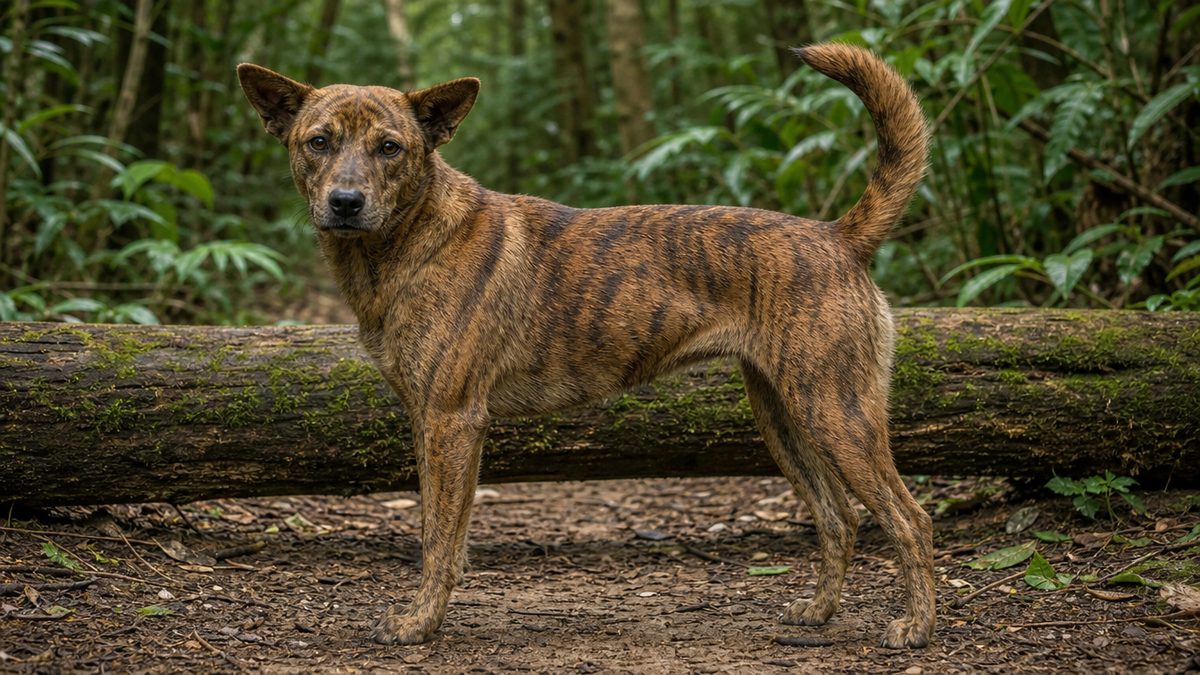
The history is Jomon rather than modern. Japanese sources place the Ryukyu among the Jomon-period dogs of Okinawa, kept as a hunting dog for wild boar, and record that when northern Yayoi dogs entered the archipelago with continental migrants they reached everywhere except Hokkaido and the Nansei Islands, so those two regions kept their Jomon lineages while mainland Japanese breeds absorbed the newer blood. Numbers then collapsed through the Second World War and the arrival of Western dogs with the American military, after which the breed survived only as a hardy working hunting dog in the Yanbaru forest of northern Okinawa Island and on Ishigaki in the Yaeyama Islands. Japanese sources describe an alert, agile medium dog of 49 to 55 cm in males and 46 to 52 cm in females, weighing 15 to 20 kg, with pricked ears set wide in what Japanese describes as an inverted figure-eight, brown or blue eyes, and a semicircular raised sickle tail. Coat colours run red, white, black, brindle and dark brown.
The coat description is the most useful sentence written about this dog
Japanese sources describe the coat as a hard, short, double structure that is not densely grown, and say in the same breath that this gives it excellent heat resistance. That is a mechanism rather than an adjective, and it is why this breed rates 5 of 5 for heat tolerance where a Hokkaido rates 2.
The same source lists being strong in heat among the breed's temperament characteristics, alongside friendliness with people and a strong territorial sense. A dog described by its own country as heat-strong is a rare thing on a site that mostly has to warn Indian buyers about the opposite.
Two lines, and two breed-specific oddities
Okinawan sources record two lines within the breed, the Yanbaru line from northern Okinawa Island and the Yaeyama line from Ishigaki. They also record two physical features that no other Japanese breed page carries: pronounced dewclaws, described locally as a sixth toe, and spotted tongues.
| Attribute | Japanese sources | English Wikipedia |
|---|---|---|
| Height, male | 49 to 55 cm | 46.3 to 49.6 cm |
| Height, female | 46 to 52 cm | 43.4 to 46.9 cm |
| Weight | 15 to 20 kg, both sexes | Not stated |
| Coat | Hard, short, double, not densely grown | Nine colours listed, no structure |
| Ears | Pricked, set wide | Not described |
| Tail | Semicircular raised sickle | Not described |
| Sourcing | Okinawa Times, 8 January 2022 | Uncited breed-standard section |
The height figures differ by nearly six centimetres at the male ceiling. Bonbeno publishes both and follows neither silently, because the Japanese figures carry a named newspaper citation and the English ones carry nothing.
The breed is 琉球犬, romanised Ryukyu Inu or Ryukyu Ken. In Okinawa it is called Turaa when brindle and Akain when red, with brindle further split into red, black and white brindle. Searching the Okinawan colour names is often what surfaces the local reporting at all.
A prefectural natural monument, not a national one
Okinawa Prefecture designated the Ryukyu a natural monument in 1995, five years after its preservation society was founded, and Japan's national register has never held it.
The prefectural designation is real and is reported independently. Ryukyu Shimpo describes Ryukyu-ken as designated a protected species by the Okinawan government, and the Japanese encyclopedia entry files the breed under the category of Okinawa Prefecture designated natural monuments and dates the designation to 1995.
Why the national register matters here
Japan's national cultural-property register protects dogs under criterion four, domesticated animals peculiar to Japan. Bonbeno enumerated records 401/3100 to 401/3150 one at a time on 9 September 2026 and found exactly seven dog designations. The Hokkaido record at 401/3116 was read in the same session as the in-document control that the register was answering correctly.
| Breed | Register record | Designated | Level |
|---|---|---|---|
| Akita | 401/3105 | 31 July 1931 | National |
| Kai | 401/3106 | 22 January 1934 | National |
| Kishu | 401/3108 | 1 May 1934 | National |
| Koshi, extinct | 401/3110 | 28 December 1934 | National |
| Shiba | 401/3112 | 16 December 1936 | National |
| Shikoku, as 土佐犬 | 401/3113 | 15 June 1937 | National |
| Hokkaido | 401/3116 | 21 December 1937 | National |
| Ryukyu | No record | 1995 | Okinawa Prefecture only |
That table is the whole argument about what this dog is. Six living Japanese breeds carry a national designation made between 1931 and 1937; the Ryukyu carries a prefectural one made in 1995, sixty years later, and after the population had already collapsed.
The other Japanese bodies that do not hold it
The preservation society NIPPO, which wrote the Japanese Dog Standard in 1934 and classifies the native breeds by size, lists six breeds and the Ryukyu is not one of them. The Japan Kennel Club's 2025 table of 141 breeds and 302,530 dogs returns zero hits on 琉球, while returning the Hokkaido at 24 dogs as the control that the search string works.
Internationally the position is the same. The breed appears in neither the FCI's complete 46-entry Group 5 list nor its 20-entry provisional register.
This site's rule is to check the state and not only the cynological body, and Okinawa Prefecture is a state actor. A prefectural natural monument designation is a real legal protection with real funding behind it. It is simply not the same instrument as a national designation, and no English page distinguishes the two.
The register: founded 1990, last pedigree about 2004
The Ryukyu Inu Hozonkai began registering pedigrees in 1990 with 17 dogs, and an Okinawan newspaper reported in April 2017 that no pedigree had been issued for almost thirteen years.
That single sentence in Ryukyu Shimpo is the most consequential fact on this page. Its exact wording is that a preservation society to prevent the extinction of Ryukyu-ken was established in 1990, that activity has almost entirely ceased because of breeding difficulty and the burden on individual members, and that a pedigree has not been issued for almost thirteen years.
Counting back from April 2017 places the last pedigree at about 2004. The Japanese encyclopedia entry describes the same arc from the other end: the society was founded in 1990 with 23 members and 17 dogs and began pedigree registration, membership reached 320 with over 1,200 dogs by 2000, then the society went dormant as members aged and pedigree certificates stopped being issued.
What that does to the breed question
This site applies a two-condition test to decide whether an animal is a breed: a written standard that a population is bred toward, and a studbook recording individuals generation by generation. The Ryukyu meets neither condition today.
- No written breed standard could be obtained in Japanese or English, and the two encyclopedia versions disagree about the dog's height by nearly six centimetres English Wikipedia, Ryukyu Inu.
- A studbook existed from 1990 and has issued nothing since about 2004.
- No kennel club anywhere registers the breed, checked against the FCI's definitive and provisional registers and the Japan Kennel Club's 2025 table Federation Cynologique Internationale Japan Kennel Club.
- The state recognition is real but is prefectural rather than national, and postdates the population collapse.
- Uncontrolled crossing is reported as a live problem now that the breed has become better known.
Bonbeno's verdict, and the reasoning
The honest verdict is a state-recognised native type with a lapsed register, not a breed in the sense the FCI or NIPPO uses the word. Between about 1990 and 2004 it was closer to a breed in formation, because a society was actively registering a defined population toward a shared idea of type. That process stopped, and nothing has replaced it.
Calling it simply a type would understate the prefectural designation and the twelve years of pedigree work. Calling it a breed would overstate a studbook that has issued nothing for two decades. Publishing both halves is the only description the documents support.
Five students at Okinawa Prefectural Chubu Norin High School took on a preservation project in April 2017, caring for a Ryukyu dog adopted from the society and searching for a purebred mate. That is a genuine conservation effort by named people in a named school. It is not a studbook, and it should not be reported as one.
Seventeen dogs, then twelve hundred, then four hundred and fifty
The Ryukyu population ran from 17 dogs at the society's founding in 1990 to over 1,200 by 2000 and back to about 450 by 2018.
That trajectory is more informative than any single figure. A breed recovering seventyfold in ten years and then losing nearly two thirds of that gain in eighteen more is describing an organisation rather than a population: the numbers rose while the society registered and fell after it stopped Kakazu Y. High School students work to save….
| Year | Dogs | Society | Source |
|---|---|---|---|
| 1990 | 17 | Founded, 23 members, registration begins | Japanese encyclopedia entry |
| 1993 | 134 registered | Active | English Wikipedia |
| 2000 | Over 1,200 | 320 members | Japanese encyclopedia entry |
| About 2004 | Not stated | Last pedigree issued | Ryukyu Shimpo, April 2017 |
| 2015 | As few as 400 | Dormant | English Wikipedia |
| 2017 | Not stated | Activity almost entirely ceased | Ryukyu Shimpo, April 2017 |
| 2018 | About 450 | Dormant | Japanese encyclopedia entry |
How much of this Bonbeno could verify, and how much it could not
The 2017 figures come from a newspaper article that was opened and read in English. The 1990, 1995, 2000 and 2018 figures come from a Japanese encyclopedia entry that attributes them to a specific community newsletter, 広報みやこ issue 46 of January 2018.
Bonbeno downloaded that newsletter and could not read it. The file is 4.85 megabytes across eight pages and yields 103 extractable characters, which means it is an image scan with no text layer. Those four figures are therefore reported here as what the Japanese article attributes to that newsletter, and not as figures this page verified at source.
The absences that make the rarity real
Four independent registers were checked and none holds the breed. The FCI's Group 5 list runs to 46 entries and the provisional register to 20, and the Ryukyu is in neither. NIPPO lists six native breeds and this is not one. The Japan Kennel Club's 2025 table returns zero on a search string that returns the Hokkaido correctly in the same pass.
The scientific literature is empty too. Four English name forms return zero PubMed records with clean, unrewritten translation lines, against a control that returned 126 in the same session.
There is no reliable figure for how many Ryukyu dogs exist today. The most recent one available is about 450 from 2018, and it reaches this page through a document that could not be read. Anyone quoting a 2026 population for this breed is quoting something nobody has counted.
Ryukyu dog price in India: there is no market and no page
No ryukyu dog price in india exists, and unlike most rare breeds this one does not even have an Indian page inventing a figure.
That is worth stating precisely, because the usual finding on this site is the opposite. Five Indian breed and marketplace sites were probed by URL on 9 September 2026, each with a Labrador Retriever control. The control returned a complete page carrying 28 rupee figures on the site that works, so the URL pattern and the site were both live.
The Ryukyu path on that same site returns HTTP 200 with the title Dog Breed Not Found and zero rupee figures. That is a soft 404: a status-code check passes it, and only reading the returned title reveals that the page does not exist.
Why there is nothing to price
The supply side answers this on its own. About 450 dogs existed in Okinawa in 2018, the register that would identify them stopped issuing pedigrees around 2004, no kennel club anywhere can export the breed on papers Japan Kennel Club, and Indian import law rejects any application to import a dog for trade or breeding.
Four conditions have to hold before an Indian puppy price can exist. A population large enough to export from, a pedigree register that can identify a dog as the breed, a lawful import route, and a buyer. This breed fails the first three, so any Indian puppy price you meet was generated rather than observed.
What to distrust if a figure ever appears
- Any rupee figure that divides cleanly by 84.38, 80 or 74 into a round dollar or yen amount, which is a converted foreign price rather than an Indian observation.
- Any monthly cost row identical to the rupee with another breed's row on the same site, which this site has documented across three unrelated breeds.
- Any page reached at HTTP 200 whose title says the breed was not found.
- Any AI answer that says no Indian price exists and then prints a rupee band in the next sentence.
- Any listing whose photographs show a tightly curled tail over the back, which belongs to the Japanese mainland breeds rather than to this one.
We will not convert a Japanese figure into rupees and present it as an Indian price, and we will not estimate one from a comparable breed. Where no Indian market exists, the honest number is none, and the useful content is the running cost of a dog this size, which the next section gives.
The real cost of ownership in India for a 15 to 20 kg dog
Keeping a 15 to 20 kg short-coated dog in an Indian metro costs roughly Rs 5,500 to Rs 10,000 a month once parasite control, food, vaccination and consultations are counted honestly.
The purchase price is unavailable and the running cost is not, and for an Indian reader the second number is the one that matters. Every figure below comes from a page that was opened.
The lines you can price
- Parasite control at Rs 1,103 a month, from NexGard Spectra for 15 to 30 kg dogs at Rs 3,308 for three tablets, covering ticks, fleas, roundworm and hookworm in one product.
- Vaccination at Rs 699 for anti-rabies and Rs 899 for the 9-in-1, or an annual booster course from Rs 3,199.
- Consultation at Rs 500 to Rs 1,000 a visit, and boarding at Rs 500 to Rs 2,000 a day.
- Municipal registration at Rs 500 in Delhi or Rs 50 in Chennai, which is a yearly line.
- Grooming at Rs 100 to Rs 500, because a hard short coat that is not densely grown needs almost nothing.
The spread on one identical vaccine
The same 9-in-1 vaccine costs Rs 600 at a Goa government veterinary hospital, from Rs 899 at a Vetic clinic, and from Rs 1,999 through a vet-at-home service that also charges a Rs 699 visit fee. A 3.3 times spread on one drug is a function of delivery model rather than of the medicine.
Chennai residents can do better than any of those. Greater Chennai Corporation runs six pet clinics giving treatment and anti-rabies vaccination at no cost, and issued 9,115 pet licences in 2024 at Rs 50 each.
| Line | Low | High | Note |
|---|---|---|---|
| Food | Rs 2,800 | Rs 5,000 | For a lean, active 15 to 20 kg dog |
| Parasite control | Rs 1,103 | Rs 1,103 | NexGard Spectra 15 to 30 kg, monthly |
| Vaccination, spread | Rs 150 | Rs 320 | Annual booster divided by twelve |
| Vet consultations | Rs 250 | Rs 1,000 | Two to twelve visits a year |
| Grooming | Rs 100 | Rs 500 | A short sparse coat needs very little |
| Contingency | Rs 1,200 | Rs 1,200 | The line that stops a Rs 20,000 bill becoming a crisis |
| Total | Rs 5,603 | Rs 9,123 | Before boarding |
Air conditioning. Every other imported breed on this site needs a room kept cool through an Indian summer, and that electricity is a real recurring cost. A dog whose homeland peaks at a higher wet-bulb temperature than Chennai needs shade and water instead, which is the one place a Ryukyu would be cheaper to keep than a Labrador.
Heat tolerance: the homeland peaks hotter than Chennai does
Okinawa's peak wet-bulb temperature is 26.49 C against Chennai's 26.11 C, which makes the Ryukyu the most heat-adapted non-Indian breed on this site.
NASA POWER, queried at 26.2124 N 127.6809 E, returns a Naha cell at 3.58 m against a real elevation near 30 m, an annual mean of 23.98 C, an August peak of 28.99 C, a January mean of 18.85 C, and annual relative humidity of 79.71 percent. Computing Stull wet bulb from those monthly means gives a July and August peak of 26.49 C.
Chennai's cell returns 27.95 C annual and 72.39 percent, with a May peak wet bulb of 26.11 C. So Okinawa is four degrees cooler on the annual mean and 0.38 C hotter at peak wet bulb, which is the number that actually describes how hard a dog has to work to lose heat.
Northern Okinawa, where the breed actually worked
The Yanbaru forest of northern Okinawa Island is where this dog survived as a hunting breed after the war. A Kunigami cell at 26.75 N 128.1667 E returns 14.94 m against a real elevation near 100 m, an annual mean of 23.25 C, 79.28 percent humidity and a peak wet bulb of 26.35 C. Both Okinawan points come out above Chennai at peak.
| Place | Cell elevation | Annual mean | Hottest month | Annual humidity | Peak wet bulb |
|---|---|---|---|---|---|
| Naha, Okinawa | 3.58 m | 23.98 C | August, 28.99 C | 79.71 percent | 26.49 C |
| Kunigami, Okinawa | 14.94 m | 23.25 C | August, 28.88 C | 79.28 percent | 26.35 C |
| Bengaluru | 841.72 m | 23.74 C | April, 28.37 C | 67.94 percent | 21.86 C |
| Pune | 635.99 m | 23.86 C | April, 28.93 C | 66.80 percent | 22.97 C |
| Delhi | 206.37 m | 25.60 C | June, 35.88 C | 45.56 percent | 26.50 C |
| Mumbai | 97.15 m | 26.77 C | May, 31.19 C | 67.39 percent | 25.77 C |
| Chennai | 48.95 m | 27.95 C | May, 31.51 C | 72.39 percent | 26.11 C |
What the coat description adds to the climate data
Two independent lines of evidence point the same way. The climate says Okinawa is more heat-loaded at peak than Chennai. The breed description says the coat is a hard short double structure that is not densely grown, with excellent heat resistance, and lists being strong in heat among the breed's characteristics. A sparse double coat is exactly what a subtropical hunting dog would evolve.
That combination is rare. Most double-coated breeds on this site come from places that are cold, and their coats are dense. This one is double-coated and sparse, which is a different animal.
The rating is 5 of 5, and it still is not immunity
Hall 2020 in Animals found that 652 of the 879 heat-related illness events with a recorded trigger were exertional, that is 74.2 percent, and the companion paper puts case fatality at 14.18 percent across 395 confirmed events with 1.42 times the odds for dogs at or above their breed and sex mean bodyweight. Heat illness is caused by exercise, and a boar hound will run itself into trouble in any climate.
Delhi. Its June mean of 35.88 C is nearly seven degrees above Okinawa's hottest month and its July peak wet bulb of 26.50 C edges Naha's 26.49 C, but it arrives with 45.56 percent humidity rather than 80, so a dog adapted to humid 29 C is not automatically adapted to dry 36 C. Coastal and peninsular India is the natural fit.
Where in India a Ryukyu dog would actually thrive
Chennai, Kochi and Mumbai are the Indian cities closest to Okinawa's heat and humidity profile, and this is the rare breed for which the coast is the easy answer rather than the hard one.
Chennai runs a 27.95 C annual mean at 72.39 percent humidity with a May peak wet bulb of 26.11 C, against Okinawa's 23.98 C at 79.71 percent and a peak of 26.49 C. India is warmer on the annual average and slightly gentler at the extreme, which is a comfortable place for a heat-adapted dog to land.
Mumbai at 26.77 C and 67.39 percent, and Kolkata at 25.81 C and 73.93 percent, sit in the same envelope. Bengaluru and Pune are cooler and drier still, at 23.74 C and 23.86 C, and would be easy in a different way.
The Indian winter is the only real problem, and it is small
Okinawa's coolest month averages 18.85 C. Delhi's January mean is 13.61 C, five degrees below that, on a coat that is short and not densely grown. A Delhi or Jaipur winter would need a coat for morning walks, which is the reverse of the advice this site gives for almost every other imported breed.
The disease pressure a heat-adapted coat does not protect against
Heat adaptation says nothing about parasites. A West Bengal study of 584 client-owned dogs presenting at a Kolkata animal health centre found Babesia gibsoni in 76.54 percent, Anaplasma in 55.75 percent, and two or more concurrent pathogens in 72.9 percent of the 584 dogs screened. A southern Indian study of 120 clinically affected dogs found Babesia in 66.7 percent, peaking pre-monsoon between March and May.
Both sampled dogs already brought to a clinic with signs, so they describe risk among dogs that get sick rather than risk to every dog. Read that way they still make year-round parasite control the least negotiable line in the budget.
One Okinawan parallel worth knowing
The only canine literature the Ryukyu Islands produce in a PubMed search is about parasites rather than about the breed. A 1969 Journal of Medical Entomology paper on canine filariasis in Okinawa is one of only two records returned by a Ryukyu and canine search. A dog from a subtropical island is a dog from a heartworm and tick-borne disease environment, and that transfers to India directly.
For this breed, look at the coldest month rather than the hottest. A city whose January mean stays above about 18 C is inside the range the dog evolved with. Chennai at 24.09 C, Mumbai at 23.19 C and Kochi at 27.33 C all clear it comfortably; Delhi at 13.61 C and Jaipur at 14.51 C do not.
Indian import law, and why it is academic for this breed
Indian law permits you to bring in a Ryukyu dog as your own accompanying pet and rejects any application to import one to breed or to sell, and in practice there is nothing to import.
DGFT Trade Notice 22/2022-23 of 19 December 2022 places dogs under ITC (HS) 01061900 as a Restricted import. Three routes are permitted and the notice names them: a pet accompanying an owner with a valid pet book in the importer's name, research use with a CPCSEA recommendation, and Defence or Police use. Applications for trading or breeding purposes shall be duly rejected.
There is no import licence a would-be Indian breeder can apply for that changes this, and the search results say nothing either way: a Bing India control returned About 16,200 results and ten genuine Indian Labrador price pages in the same session, so the instrument was working, while no People Also Ask module rendered even for the control. For most rare breeds on this site the practical barrier is that clause. Here the barrier arrives earlier. With about 450 dogs in existence, a register that has issued no pedigree since about 2004 and no kennel club export route anywhere Japan Kennel Club, there is no document an Indian importer could present even under the personal pet route.
What the 2017 Rules would require of an Indian keeper
- Do not remove the dewclaws. Second Schedule Part II paragraph 6(8) forbids de-clawing and any change of appearance by artificial means, and Okinawan sources record pronounced dewclaws as a breed characteristic Japanese Wikipedia, 琉球犬.
- Do not sell a pup under eight weeks old, which Rule 8(1)(a) prohibits outright.
- Test breeding dogs for the genetic defects Second Schedule Part III paragraph 8(10) names, including hip dysplasia and progressive retinal atrophy.
- Get written veterinary approval before any outdoor housing arrangement, under Second Schedule Part IV paragraph 21(1), which bars keeping a dog outdoors where it is not accustomed to local temperatures.
- Register the dog with your municipality, at Rs 500 in Delhi or Rs 50 in Chennai Greater Chennai Corporation.
Cite the paragraph, not a Rule number
The 2017 Rules run 1 to 13 and there is no Rule 14. Everything numbered above 13 is a Second Schedule paragraph, so a page citing the outdoor-housing clause as Rule 21 or the mutilation clause as Rule 6(8) is citing provisions that do not exist under those names.
If an Indian seller offers you a Ryukyu dog, ask which register issued its pedigree. The only correct answer would be the Ryukyu Inu Hozonkai, and that society has issued nothing for roughly two decades. Any other answer means the dog is something else.
Temperament: friendly with people, strongly territorial, built to hold a boar
Okinawan sources describe the Ryukyu as friendly with people, strongly territorial and strong in heat, and the one published account of an individual dog describes an animal that hardly ever followed commands.
Those three temperament words come from the Japanese breed description and are worth taking literally. Friendly with people is unusual among primitive hunting breeds and is a genuine point in the dog's favour. Strongly territorial is the qualifier that decides whether it suits a flat.
The most useful single account is journalistic rather than descriptive. Ryukyu Shimpo reports a student taking on a Ryukyu dog named Shoto in October 2016, and records that at first the free-wheeling dog was rarely calm and hardly ever followed commands, making him a handful, and that only after a lot of training did the two begin to relate to one another.
Who this breed would suit
- Owners in coastal or peninsular India who want a dog that can genuinely be exercised in April.
- Owners with a house and a secure yard rather than a shared stairwell, given the territorial description.
- Owners who want an independent hunting dog and will not be offended by one.
- Owners who will socialise a puppy hard through the eight to sixteen week window.
- Owners already living with a landrace or a primitive breed who know what a poor recall costs.
Who should look elsewhere
- First-time owners, because a territorial boar hound with no training tradition behind it is a demanding first dog.
- Households in a small flat with shared corridors, where territoriality becomes a daily conflict.
- Households with cats or free-ranging poultry, given what the breed was kept to do.
- Anyone wanting a dog with predictable conformation, because no operating standard defines it.
- Anyone in Delhi or another north Indian city who will not buy a winter coat.
A note about how little of this is documented
Every temperament claim on this page comes from Okinawan press and encyclopedia summaries rather than from a breed-club standard or a behavioural study, because none exists. That is a weaker evidence base than this site normally works from, and saying so is more useful than dressing it up.
This is a working island boar dog that Okinawa protects as cultural property, with about 450 individuals left, no operating register and no standard. It is the most heat-adapted breed on this site and the least documented. Both halves of that sentence matter.
Training a landrace with no training tradition behind it
To train a Ryukyu dog, expect the starting point that Okinawan reporting describes, a free-wheeling animal that is rarely calm and hardly ever follows commands, and build from there with food and patience.
That description is not this page's characterisation, it is a newspaper's account of a specific dog in the care of a specific student, and it is the only detailed training account published about the breed in English. The same account records that after a lot of training the student felt they could finally relate to one another, which is the realistic shape of the work.
There is no breed-club training guidance, no obedience tradition and no behavioural literature for this dog. What exists is a landrace that hunted boar semi-independently in forest, and everything about that job selects for a dog that decides.
The five things worth teaching first
- Name response, paid every time for six months, because a dog that voluntarily looks at you can be redirected out of anything.
- A hand-target, which moves the dog without a collar grab and is the calmest way off a scent.
- Mat settling, which is what makes a strongly territorial dog liveable when someone comes to the door.
- Loose-lead walking on a Y-front harness, taught before the puppy reaches 12 kg rather than after.
- A stationary wait at doors and gates, which is the behaviour that actually prevents an escape.
Off-lead recall is deliberately absent. On a boar hound with a live prey drive, the honest plan is a long line in open ground and a properly fenced area, and building your life around a recall this dog may never offer is how dogs are lost.
Socialisation, in an Indian city
A puppy that will live in Chennai or Kochi has to meet autorickshaw noise, temple loudspeakers, cattle, cyclists and free-ranging dogs before sixteen weeks, at a distance it can cope with. On a strongly territorial breed that window decides whether the adult can share a building at all.
Compulsion breaks this kind of dog quickly. A territorial landrace that is corrected hard becomes reactive rather than compliant, and the behaviour you punished happens sooner next time rather than later.
Expect name response and a hand-target inside three weeks. Expect mat settling to take six. Expect loose-lead walking to take three months and door manners to hold by six. Do not expect an off-lead park recall at any age, and spend the money on the fence.
Exercise: a boar hound with an Indian clock that actually works
A Ryukyu dog needs 60 to 90 minutes of real daily exercise, and it is the one imported breed on this site that can take that at Indian hours without a special plan.
The breed hunted wild boar in the Yanbaru forest of northern Okinawa and on Ishigaki, and survived as a working hunting dog there after the war precisely because that work continued. That is a stamina job over broken subtropical ground, not a pavement circuit.
The Indian window is unusually wide for an imported breed. Naha peaks at a 28.99 C monthly mean and a 26.49 C wet bulb, against Chennai's 31.51 C and 26.11 C, so a morning walk in Chennai is inside rather than outside what this dog evolved with.
What 60 to 90 minutes should contain
- Forty to sixty minutes of continuous forward movement, on a long line wherever the ground is open.
- Fifteen minutes of scent work, which tires a hunting breed faster than distance does.
- Structured play with rules, so that arousal has a built-in off switch.
- Free running only inside a boundary the dog cannot clear or slip.
- Shade and water at both ends, because heat adaptation is not heat immunity.
Adaptation is not immunity, and the numbers say so
Hall 2020 in Animals recorded 1,259 heat-related illness events from 1,222 UK dogs, of which 879 carried a recorded trigger, and 652 of those 879, or 74.2 percent, were exertional rather than environmental or vehicular. Exercise is how dogs overheat, whatever their homeland.
The companion paper puts case fatality at 14.18 percent across 395 confirmed events, and reports 1.42 times the odds of an event for dogs at or above their breed and sex mean bodyweight, with a confidence interval of 1.12 to 1.80. Neither paper modelled this breed, so no breed-level odds ratio exists for it and none is offered here.
Stop if the tongue widens and flattens, if the dog seeks shade unprompted, if the pant does not settle within a minute of standing still, or if the stride shortens. Wet the belly, groin and paws rather than the back, offer water, and get to a veterinarian the same day if the dog does not normalise within ten minutes.
Grooming a sparse double coat, and why it is nothing like a Hokkaido's
The Ryukyu carries a hard short double coat that Japanese sources describe as not densely grown, so it needs about ten minutes of grooming a week and none of the monsoon drying work a plush double coat demands.
The distinction matters because the words double coat usually mean the opposite on this site. A Hokkaido or a Shikoku carries a soft dense undercoat that has to be raked out and dried to the skin after every bath. This breed's coat is described as double in structure but sparse in density, and explicitly as the reason for its heat resistance.
The weekly routine
- Rubber curry mitt over the whole dog once a week, which lifts the dead hair a short coat sheds and takes five minutes.
- Hands-on check over ears, throat, armpits, groin and between the toes, which is a tick check rather than a grooming task.
- Dewclaws checked and trimmed, because Okinawan sources record them as pronounced and Indian law forbids removing them Prevention of Cruelty to Animals.
- Nails every three weeks, since a dog exercised on soft ground will not wear them down.
- Bath only when actually dirty, roughly every eight to ten weeks.
Ticks are the real Indian grooming job
A short coat makes ticks findable rather than repelling them. Against a Kolkata clinic caseload of 584 dogs showing Babesia gibsoni in 76.54 percent and two or more concurrent pathogens in 72.9 percent of those screened, and a southern Indian series of 120 clinically affected dogs putting Babesia at 66.7 percent, a weekly hands-on sweep plus monthly NexGard Spectra at Rs 1,103 for a 15 to 30 kg dog is the whole prevention programme.
One thing not to do
Do not clip this coat to make the dog cooler. There is very little of it, and the sparse double structure is what the breed evolved to shed heat with. A white or white-brindle dog, both of which occur, is the most exposed to Indian ultraviolet and should be kept out of direct midday sun.
Run both hands over the whole dog against the lie of the coat once a week, checking ears, throat, armpits, groin and between the toes, then the mitt, then the dewclaws. On this coat that is the entire grooming programme, and it is a disease check rather than a cosmetic one.
Health: no literature, no screening, and a very small population
The Ryukyu has no published health literature at all, and the honest health finding about it is population size rather than any named condition.
Four English name forms return zero PubMed records with clean, unrewritten translation lines, against a control that returned 126 in the same session. There is no case report, no prevalence survey, no genetic study and no screening scheme for this breed in any language this page could search.
The Japanese form 琉球犬 returns zero with a blank translation line, which means the query was emptied rather than run. Bonbeno makes no claim about Japanese-language veterinary literature on this breed, because it could not be searched.
The population is the health finding
About 450 dogs remained in 2018, down from over 1,200 in 2000, with no studbook operating since about 2004 to record who is related to whom. A closed population of that size, with no pedigree recording, is a population where inbreeding accumulates without anyone being able to measure it.
Japanese reporting names the resulting problem directly: now that the breed has become better known through television, uncontrolled and indiscriminate crossing is occurring. That is the opposite failure from inbreeding and both are happening in the absence of a register.
What the island's own literature does contain
The only canine records a Ryukyu search returns are about parasites. A 1969 Journal of Medical Entomology paper on canine filariasis in Okinawa is one of two records returned by a Ryukyu and canine query, and it is about the islands rather than the breed. A wider Okinawa and dog search returns eleven records, all veterinary epidemiology.
That tells an Indian reader something practical anyway. A dog from a subtropical island is a dog from a heartworm and tick-borne disease environment, and both transfer directly to coastal India.
The absences, stated plainly
- No published life expectancy. McMillan 2024's Table S5 lists 345 breeds and the Ryukyu appears in none of them, not even with an exclusion flag, unlike the Hokkaido, Kishu, Shikoku, Korean Jindo, Taiwan Dog and Thai Ridgeback.
- No published hip or elbow screening statistics.
- No breed-club health survey, because the breed club is dormant.
- No genetic test panel for the breed's own mutations.
- No breed standard against which a veterinarian could judge conformation.
For scale rather than substitution, McMillan's nearest measured Japanese breeds are the Shiba Inu at a median 14.6 years on 91 deaths and the Akita at 11.4 years on 2,358 deaths. Neither figure belongs to this breed and neither should be quoted as if it did.
Ask whether the dog has a pedigree and from which body. Ask what is known about its parents and grandparents. Ask a veterinarian to record a weight, a height and a photograph, because on a breed with no standard and no register, an individual dog's own record is the only documentation that will ever exist for it.
Feeding a 15 to 20 kg island hunting dog in India
Feed a Ryukyu dog to a visible waist and easily felt ribs, because bodyweight at or above the breed mean is the one heat risk factor with a published odds ratio behind it.
Hall 2020 in Scientific Reports found that dogs at or above their breed and sex mean bodyweight carried 1.42 times the odds of a heat-related illness event, with a confidence interval of 1.12 to 1.80. That applies to a heat-adapted breed as much as to any other, because the mechanism is exertion rather than ambient temperature.
Japanese sources give the adult weight as 15 to 20 kg in both sexes, which is a narrow enough range to use as a target. There is no breed standard behind it, so body condition scoring rather than a number is the honest guide.
Portion and life stage
- Puppies to four months, four meals a day on an all-breed growth food with controlled calcium.
- Four to eight months, three meals, watching that growth stays steady rather than fast.
- Eight months onward, two meals a day, timed around the cooler ends of the day.
- Adults at 15 to 20 kg, roughly 260 to 360 g of a good dry food a day, adjusted weekly by feel rather than by the bag.
- Seniors from about eight years, the same weight held steady, with joint support discussed with your own veterinarian.
Raw meat and a hunting dog
A boar-hunting breed invites the same mistake this site has documented in western Japan, where feeding hunting dogs raw wild boar meat carried a threefold risk of lung fluke infection. In India the equivalent routes are raw river fish and raw offal from informal slaughter. Cook it, or do not feed it, and ask your veterinarian before starting any raw diet.
Indian availability
Everything a medium active dog needs is stocked in every Indian metro, and the practical decision is price and consistency rather than formulation. Budget Rs 2,800 to Rs 5,000 a month for food for a dog this size, change brands over a week rather than overnight, and move the main meal to after the evening walk in the hot months.
Weigh the dog at your veterinary clinic every three months and write the number down. Indian clinics will do it free, and on a breed with no standard and no register, that written series is the only longitudinal record the animal will ever have.
The first year, month by month
A Ryukyu puppy's first year runs from a hard socialisation push before sixteen weeks to a second fear period around eight months and full physical maturity near eighteen months.
- Weeks 8 to 10. Home, crate, name response, four meals a day, and the first vaccination discussion with your own veterinarian. Indian law prohibits the sale of pups under eight weeks, so a younger puppy is a red flag about the seller.
- Weeks 10 to 16. The socialisation window, and on a strongly territorial breed the most important eight weeks of its life.
- Months 4 to 5. Adult teeth arrive and chewing peaks. Loose-lead walking is taught now, while the puppy is still under 12 kg.
- Months 5 to 6. Prey drive appears. The long line becomes permanent equipment in open ground and the fence gets checked properly.
- Months 6 to 8. A second fear period is common in primitive breeds. Repeat easy versions of things the dog already knows.
- Months 8 to 12. Growth slows and the daily load can move toward the adult 60 to 90 minutes.
- Months 12 to 18. Physical maturity completes. Hold off repetitive high-impact work until your veterinarian confirms the growth plates have closed.
The Indian calendar is easy for this breed and hard for the north
In Chennai, Mumbai or Kochi no month falls outside the envelope this dog evolved with, so a puppy can be socialised year-round. That is the opposite of every Japanese mainland breed on this site, where the April to June window is the constraint.
In Delhi the constraint is December to February, when the monthly mean of 13.61 C sits five degrees below Okinawa's coolest month. A puppy socialising through a north Indian winter needs a coat and middle-of-the-day walks.
Everything on this list can slip except the eight to sixteen week window. A strongly territorial landrace that misses it in an Indian city becomes an adult that cannot share a building, and on a breed with no standard and no register there is no breeder support network to fall back on.
Ryukyu against the breeds it is actually compared with
Against the Japanese natives the Ryukyu loses on documentation and wins outright on heat; against an Indian landrace it loses on availability and matches on everything else.
| Breed | Heat tolerance | National recognition | Operating studbook | 2025 Japan registrations |
|---|---|---|---|---|
| Ryukyu | 5 of 5 | Prefectural only, 1995 | No, dormant since about 2004 | None |
| Hokkaido | 2 of 5 | National, 1937 | Yes, NIPPO and JKC | 11 NIPPO, 24 JKC |
| Shikoku | 2 of 5 | National, 1937 | Yes, NIPPO and JKC | 252 NIPPO, 51 JKC |
| Kai Ken | 2 of 5 | National, 1934 | Yes | 78 NIPPO, 60 JKC |
| Shiba Inu | 2 of 5 | National, 1936 | Yes | 13,722 NIPPO, 3,598 JKC |
| Taiwan Dog | 3 of 5 | FCI definitive, 2015 | Yes | 2 JKC |
| Indian Pariah Dog | 5 of 5 | None | No | Not registered |
Against the Hokkaido
Japanese sources say recent research has shown the Hokkaido dog and the Ryukyu to be genetically very close, both having kept Jomon lineages when Yayoi dogs entered the archipelago and spread everywhere except Hokkaido and the Nansei islands. That shared ancestry makes the climate divergence the more striking: the Hokkaido's home cell runs a 6.17 C annual mean and this one's runs 23.98 C.
Everything else favours the Hokkaido on paper. It carries a national monument designation from 1937, an FCI standard, and registrations in two Japanese studbooks. The Ryukyu carries a prefectural designation and a dormant register.
Against the Shikoku
These two are the closest functional comparison, because both are medium Japanese boar hounds. The Shikoku has a national designation, an FCI standard, two operating registers and 303 puppies recorded in 2025. The Ryukyu has none of those. If you want a documented Japanese boar hound, the Shikoku is the answer and the Ryukyu is not available at all.
Against an Indian landrace
The honest comparison is the Indian Pariah Dog. Both are heat-adapted native landraces rated 5 of 5, both are medium and short-coated, and neither has a breed standard or an operating studbook. One of them adopts free in every Indian metro and the other has about 450 individuals on two Japanese islands.
If the appeal is a heat-adapted medium landrace with pricked ears, a sickle tail and an independent temperament, India already has one and it is free to adopt. If the appeal is specifically an Okinawan boar dog, there is no lawful route to one and no register that could tell you whether the dog you were offered was genuine.
Six mistakes people make about this breed
The six recurring mistakes are calling it one of Japan's native breeds, quoting an unsourced height, treating the register as current, assuming a double coat means cold adaptation, searching only the English name, and believing an Indian listing.
- Calling it one of Japan's six native breeds. Japan's national register holds seven dog designations, all made between 1931 and 1937, and this is not one of them; the designation here is prefectural and dates from 1995 Japanese Wikipedia, 琉球犬.
- Quoting the English height figures without saying where they come from. English Wikipedia gives males 46.3 to 49.6 cm in an uncited section, while the Japanese article gives 49 to 55 cm attributed to a named newspaper Japanese Wikipedia, 琉球犬.
- Describing the preservation society in the present tense. Ryukyu Shimpo reported in April 2017 that its activity had almost entirely ceased and that no pedigree had been issued for almost thirteen years.
- Reading double coat as cold adaptation. Japanese sources describe this coat as double in structure but not densely grown, and name that as the reason for its heat resistance.
- Searching only the English name. The Okinawan colour names Turaa and Akain are what surface the local reporting, and the Japanese form returns a blank PubMed translation line rather than a searchable query.
- Believing any Indian page that appears to carry the breed. The one Indian site with a matching URL pattern returns HTTP 200 with the title Dog Breed Not Found, which a status-code check passes.
A seventh mistake, and it is a sourcing one
Several English pages state the 1995 designation, the 1990 founding and the population figures as established fact. They trace, through the Japanese article, to a single community newsletter that Bonbeno downloaded and could not read: 4.85 megabytes across eight pages yielding 103 extractable characters, which means it is an image scan with no text layer.
That does not make the figures wrong. It means nobody quoting them in English has read the document they rest on, and this page says so rather than repeating them as verified.
Paying anything at all for a dog described as a Ryukyu outside Okinawa. With about 450 dogs in existence, no operating register, no kennel-club export route and no breed standard to check a dog against, there is no way to establish that any animal offered to you is this breed.
Adoption, and what to do instead
No Ryukyu dog is available to adopt in India, and the useful answer is that India already has a heat-adapted medium landrace that meets the same want and costs nothing.
Rescue works on supply. A breed with about 450 individuals, all on Okinawa and Ishigaki, produces no Indian rescues, and no Indian shelter network lists it poodles.in, breed directory.
What an Indian adopter can get that meets the same want
- An Indian Pariah Dog, if the appeal is a heat-adapted medium landrace with pricked ears, a sickle tail and an independent temperament. Free to adopt in every metro and rated 5 of 5 for heat tolerance exactly as this breed is.
- A Kombai through a Tamil Nadu rescue, if the appeal is a boar hound with genuine drive in a climate of equivalent heat load.
- A Chippiparai, if the appeal is a lean short-coated hunting dog for a hot climate.
- A Shiba Inu, if the appeal is specifically a Japanese primitive breed and you can accept a small one and a cold-climate coat.
- A Shikoku, if the appeal is a documented medium Japanese boar hound, though it is not available in India either.
If you are in Okinawa rather than in India
The realistic route is the preservation network rather than a breeder. The 2017 newspaper account describes a dog adopted from the preservation society by students, and a purebred mate being sought for it, which is what conservation of a population this small actually looks like. Anyone joining that effort is joining a conservation project, not buying a pet.
How to verify any dog offered as a Ryukyu
- Ask which body issued the pedigree. The only correct answer is the Ryukyu Inu Hozonkai, and it has issued nothing since about 2004.
- Check the tail. This breed carries a raised semicircular sickle, not a tight curl over the back, which is a mainland Japanese trait.
- Check the coat density. A plush, dense double coat is wrong for a breed whose own description says the coat is not densely grown.
- Look for the recorded breed markers, the pronounced dewclaws and the spotted tongue, and do not accept their absence as proof either way.
- Measure the dog and record which source's range you are using, because the two published height ranges differ by nearly six centimetres.
We report published figures as editorial content. We do not broker sales, recommend breeders, accept payment for placement, or link puppy listings, and we will not publish an Indian price for a breed with no Indian market and no operating studbook. Where adoption is the honest answer, we say so and name what is actually available.
Ryukyu dog questions people actually ask
What is the Ryukyu dog price in India?
No ryukyu dog price in india exists, and no Indian page carries the breed at all. Five Indian breed and marketplace sites were probed by URL with a Labrador Retriever control that returned a full page on each; the Ryukyu path returned a soft 404 titled Dog Breed Not Found. With about 450 dogs left in Okinawa in 2018, there is no supply anywhere to price.
Is the Ryukyu dog a recognised breed?
It is recognised by a Japanese prefecture and by no kennel club. Okinawa Prefecture designated it a natural monument in 1995, and Okinawan press describes it as designated a protected species by the Okinawan government. It appears in neither the FCI's 46-entry Group 5 list nor its 20-entry provisional register, and the Japan Kennel Club records no registrations.
Is the Ryukyu one of Japan's six native dog breeds?
No, and that is the commonest error about it. Japan's national cultural-property register holds exactly seven dog designations under criterion four, domesticated animals peculiar to Japan, and they are the Akita, Kai, Kishu, Koshi, Shiba, Shikoku and Hokkaido. The preservation society NIPPO likewise lists six breeds and the Ryukyu is not among them.
Does the Ryukyu dog have a studbook?
It had one and it stopped. The Ryukyu Inu Hozonkai was founded in 1990 with 23 members and 17 dogs and began pedigree registration, reaching over 1,200 dogs by 2000. Ryukyu Shimpo reported in April 2017 that no pedigree had been issued for almost thirteen years, which places the last one at about 2004.
How tall is a Ryukyu dog?
The sources disagree and Bonbeno publishes both. Japanese Wikipedia gives males 49 to 55 cm and females 46 to 52 cm at 15 to 20 kg, attributed to an Okinawa Times report of 8 January 2022. English Wikipedia gives males 46.3 to 49.6 cm and females 43.4 to 46.9 cm in a section that cites nothing. No page anywhere notes that the two disagree.
How many Ryukyu dogs are left?
About 450 as of 2018, according to the figure Japanese Wikipedia attributes to a 2018 Okinawan community newsletter. The trajectory is the finding rather than the number: 17 dogs at the society's founding in 1990, over 1,200 by 2000, and about 450 by 2018. English Wikipedia separately gives as few as 400 as of 2015.
Can a Ryukyu dog handle Indian heat?
Better than any other imported breed on this site. Naha's peak Stull wet-bulb temperature is 26.49 C against Chennai's 26.11 C, so the homeland is more heat-loaded at peak than an Indian metro, and Okinawan sources describe the coat as a hard short double structure that is not densely grown, with excellent heat resistance, and the dog itself as strong in heat.
What is a Turaa or an Akain?
They are the Okinawan names for this dog by coat colour. Turaa means the brindle or tiger coat and Akain means the red coat, and brindle is further split into red brindle, black brindle and white brindle. Searching either term rather than Ryukyu Inu is often what finds the Okinawan material at all.
Is there any veterinary research on the Ryukyu dog?
None. Four English name forms return zero PubMed records with clean, unrewritten translation lines, and the control returned 126 in the same session. The Japanese form returns zero with a blank translation line, which means the query was emptied rather than run, so Bonbeno makes no claim about Japanese-language literature.
How long does a Ryukyu dog live?
No figure exists and none should be quoted. McMillan 2024, the largest UK longevity study, lists 345 breeds in its Table S5 and the Ryukyu appears in none of them, not even with an exclusion flag, unlike the Hokkaido, Kishu, Shikoku, Korean Jindo, Taiwan Dog and Thai Ridgeback which are all listed and flagged N.
Can I import a Ryukyu dog into India?
Only as your own accompanying pet, and in practice not at all. DGFT Trade Notice 22/2022-23 permits entry for a pet with a valid pet book in the importer's name and states that applications for trading or breeding purposes shall be duly rejected. With no operating studbook, no exporting kennel club and about 450 dogs, there is nothing to import.
What does a medium dog cost to keep in India each month?
Budget Rs 5,500 to Rs 10,000 a month for a 15 to 20 kg short-coated dog. That covers food, Rs 1,103 a month for NexGard Spectra at the 15 to 30 kg dose, an annual booster from Rs 3,199 spread across the year, and Rs 500 to Rs 1,000 a consultation. Municipal registration costs Rs 500 in Delhi and Rs 50 in Chennai.
Does the Ryukyu dog really have six toes?
Okinawan sources record pronounced dewclaws, described locally as a sixth toe, along with spotted tongues, as breed characteristics. Anyone keeping such a dog in India should know that Second Schedule Part II paragraph 6(8) of the 2017 Rules forbids de-clawing and any change of appearance by artificial means, so removing them would be unlawful here.
What is the rarest Japanese dog?
Bonbeno cannot rank it, but the Ryukyu is a strong candidate on the only count that exists: 17 dogs when its preservation society was founded in 1990, over 1,200 by 2000, and about 450 by 2018, with no pedigree issued since about 2004 and no place in the FCI's 46-entry Group 5 list, its 20-entry provisional register, NIPPO's six native breeds or the Japan Kennel Club's 2025 table of 141 breeds. Anyone quoting a 2026 population for it is quoting something nobody has counted.
Is Okinawa dog friendly?
If the question is about Okinawa's own dog, the Japanese breed description gives three words: friendly with people, strongly territorial, and strong in heat. Friendly with people is unusual among primitive hunting breeds and a genuine point in the Ryukyu's favour; strongly territorial is the qualifier that decides whether it suits a flat, and the one published account of an individual dog describes an animal that hardly ever followed commands. Every temperament claim rests on Okinawan press and encyclopedia summaries, because no standard or behavioural study exists.
What is Japan's national dog?
Not one dog but seven, on the national register. Japan's cultural-property register protects dogs under criterion four, domesticated animals peculiar to Japan, and Bonbeno enumerated it record by record on 9 September 2026 to find exactly seven designations: the Akita, Kai, Kishu, Koshi, Shiba, Shikoku and Hokkaido, six of them living breeds designated between 1931 and 1937. The Ryukyu is not among them; its designation is prefectural, made by Okinawa in 1995, sixty years later and after the population had already collapsed.
Compare with similar breeds
Ryukyu sits in 1 Bonbeno group. Each one compares it directly against the breeds it is genuinely an alternative to, on the same figures.