
Breed profile
Jeju Dog (제주개): Korea's Undesignated Native Breed
Rebuilt from three surviving dogs in 1986, held today at a single provincial livestock institute, and the one Korean native breed the state has decided it cannot designate.
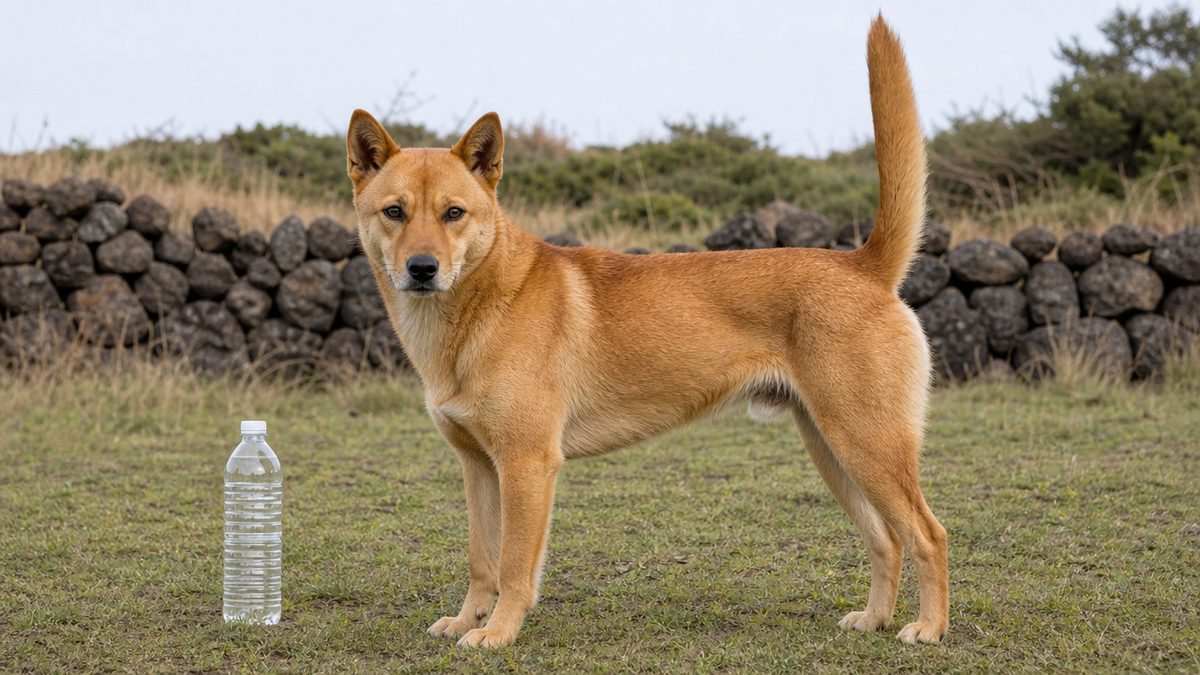
Quick answer
There is no jeju dog price in india, and there is barely a price anywhere. Every Jeju dog is held by one South Korean provincial institute, which last sold puppies in 2017 at 50,000 won and has suspended all distribution since 2018. The breed is not a natural monument, is unrecognised by the FCI, and cannot be lawfully imported to India to breed or sell.
This page summarises South Korean government press releases and heritage records, Korean and English news reporting, peer-reviewed research and Indian statutory instruments for general information. It is not a diagnosis and it is not treatment advice. Consult a registered veterinarian near you about your own dog before acting on anything here. One thing matters the same day rather than at the next check-up: any dog that pants heavily, staggers, vomits or collapses after exercise in Indian heat is a heat-illness emergency, so begin cooling with cool water at once and go to a veterinarian immediately, because the case fatality rate for heat-related illness in the largest published UK study was 14.18 percent. Note also that no health screening data of any kind has been published for this breed, so nothing on this page should be read as a health profile.
Jeju at a glance
What the Jeju dog is, and why there is no breed standard to quote
The Jeju dog is a rare Korean native hunting breed from Jeju Island, rebuilt from three surviving animals in 1986 and held today almost entirely at one provincial livestock institute.
Every other breed page on this site opens by quoting a breed standard. This one cannot, because no kennel club anywhere has written one. The FCI does not recognise the breed, its nomenclature list for the letter J carries only the Jack Russell Terrier, the Jämthund and the Yugoslavian Shepherd Dog Sharplanina, and there is no Korean national standard because the breed is not a natural monument and has no dedicated statute the way the Jindo does Korean Jindo Dog Protection and Promotion….
The only measurements anyone has published
One 2010 Dong-A Ilbo report of the institute's own description is the source of every size figure in circulation: body length 49 to 55 cm, weight 12 to 16 kg, and a life expectancy of around 15 years. Read that carefully. It gives length, not height at the withers, which is the measure every breed standard uses, so the number cannot be compared directly with the Jindo's 50 to 55 cm at the withers. The institute's own breed page does publish a withers height, 45.6 cm for a female and 46.2 cm for a male, in a table whose length and weight figures round to the newspaper's. The breed test below says what that table is and is not.
Korean government material adds the temperament and working description. The National Institute of Animal Science describes a breed that is gentle in character yet agile in movement, with developed hearing, smell and sight, and outstanding at hunting wild animals such as pheasant. Older reporting names badgers and pheasants as the quarry.
| Item | What the source says | Source |
|---|---|---|
| Body length | 49-55 cm (length, not withers height) | Dong-A Ilbo, 2010 |
| Weight | 12-16 kg | Dong-A Ilbo, 2010 |
| Lifespan | About 15 years | Dong-A Ilbo, 2010 |
| Head | Broad forehead, narrow muzzle | Halla Ilbo, 2022 |
| Tail | Carried stiffly upright, unlike the Jindo's curl | Dong-A Ilbo, 2010; Halla Ilbo, 2022 |
| Coat | Mostly yellow; a double or triple coat with coarse guard hairs, in a private society's text the institute reproduces | Jeju institute breed page, quoting the Jeju Dog Research Society |
| Breed standard | None adopted by any kennel club or state body | FCI nomenclature; Jeju institute breed page |
It will not fill the gaps. There is no standard adopted by any body, no temperament study, no health data and no register shown. The fullest description that exists is a private society's, reproduced on the institute's own page and treated in the breed test below as a description rather than a standard. Where a competitor page prints confident conformation detail without naming that source, it has invented it or copied it from a Jindo page. Bonbeno prints what the Korean record contains and says plainly where it stops.
제주개, 제주견, Jeju gae, Cheju kae: the names and the two spellings
Use Jeju dog in English and 제주개 in Korean, and expect to meet 제주견 in Korean government and press material as well Dong-A Ilbo, Im Jae-young, 16 August 2010.
The Hangul is 제주개 and the Hanja is 濟州犬. Revised Romanisation, the South Korean standard since 2000, gives Jeju gae; McCune-Reischauer, the older system, gives Cheju kae. Both point at the same island and the same dog, and the C spelling is why some older references file the breed under Cheju.
Two Korean forms circulate and they are not interchangeable in tone. 제주개 uses 개, the native Korean word for dog. 제주견 uses 견, the Sino-Korean reading of the same character, which reads as more formal. The Dong-A Ilbo report and much of the government material use 제주견; the newer Halla Ilbo reporting and the National Institute of Animal Science press release use 제주개 Halla Ilbo (한라일보), Kim Ji-eun National Institute of Animal Science. If you are searching Korean sources, search both, because each returns material the other misses.
Why the naming matters more here than usual
This is a breed whose entire English-language record consists of one Wikipedia article, a handful of aggregator pages copying it, and two news reports. Every fact that reaches an English reader has passed through a translation. Bonbeno keeps the Korean script beside the romanisation, names which romanisation system is in use, and quotes the Korean sources by date and outlet, so that a reader who wants to verify a claim can find the original rather than a paraphrase. The same discipline is applied on the Fuegian dog and Hare Indian dog pages.
Jeju Black Dog is not a name for this breed. Jeju black cattle and the Jeju black pig are separate, genuinely designated Korean livestock; a PubMed search for 'Jeju black' returns 42 records and they are about the cattle and the pig. Do not let a listing borrow the reputation of another Jeju animal.
Is the Jeju dog a natural monument? No, and the Korean government says so itself
The Jeju dog holds no natural-monument designation, and the clearest statement of that comes from South Korea's own agriculture research agency rather than from an absence of evidence.
In a press release of 25 July 2019 headed 'The Jeju dog is a Korean native dog too', the National Institute of Animal Science of the Rural Development Administration set out the position in one line: there are seven Korean native dog breeds; the Jindo, the Sapsaree, the Gyeongju Donggyeongi and the North Korean Pungsan are designated natural monuments; and three breeds including the Jeju dog are undesignated. That is a government body describing the state's own register, in the present tense, in a document released under an open government licence.
The designation attempt, and why it stopped
The attempt was real and it ran for over a decade. In August 2010 the Jeju Livestock Promotion Institute announced it would raise the population to about 160, complete genetic analysis, secure 100 or more qualifying dogs within two to three years and apply to the Cultural Heritage Administration around 2013. In July 2017 an institute official was still saying the institute would do its best to have the breed designated a state natural monument.
By July 2022 it was over. The Halla Ilbo reported, quoting the institute, that the designation work was effectively stopped. The reason given was documentary: unlike the Jindo and the Sapsaree, historical and scholarly evidence for the Jeju dog is markedly lacking. An institute official put it directly, that official historical and cultural records and scientific data are what a designation requires and that the surviving documentary and basic material on the Jeju dog does not exist. The Cultural Heritage Administration itself had returned a judgment that designation is not possible.
The register was checked directly, with a control
Bonbeno searched the Korea Heritage Service's National Heritage Portal for 제주개 on 31 August 2026. It returns real Jeju provincial monuments, including the Yeondong and Daepo signal-fire stations and four Oedo dolmens, and real Jeju natural monuments including Geomunoreum and the human and animal footprint fossil site. It returns no record for the Jeju dog under any category. The control worked in the same search: the Gyeongju Donggyeongi record came back in full, classified as a natural monument, biological science monument, special category, quantity 200 head, designated 2012.11.06. A designated Korean dog breed is findable by this instrument. This one is not there.
It does not mean the breed is fake or that Korea thinks so. The same 2019 press release concluded, on 16 microsatellite markers across seven breeds, that the Jeju dog is genetically close to the Korean native dogs, appears to be an independent breed, and is genetically very distant from foreign dogs such as the German Shepherd, which the authors read as evidence of genetic distinctiveness as a Korean native dog. The problem is paperwork about history, not biology.
Is the Jeju dog a breed? Bonbeno's two-condition test, run on the institute's own documents
The Jeju dog is a type on Bonbeno's two-condition test, specifically a landrace under institutional preservation. To count as a breed on this site an animal needs a written standard and a studbook, a register recording individuals generation after generation. No kennel club or state body has adopted a standard for this dog, and no document from the institute that holds every living animal names a register Fédération Cynologique Internationale. Condition one fails on a controlled absence. Condition two is not shown on any source available and is recorded as open rather than decided.
This is the one verdict the rest of this page never states, and it can be run now because the institute's own breed page has been read. That page belongs to the Livestock Resources Division of the body the province's July 2026 release and the page itself now style 축산생명연구원, a name that translates roughly as livestock and life-science research institute, in place of the 축산진흥원 (Livestock Promotion Institute) named in every other source on this page. It is the document most likely to name a standard or a register for the dog. It names neither, and what it does contain decides both conditions. This page uses the word breed elsewhere in the everyday sense the National Institute of Animal Science uses, 품종; the verdict here is about documents.
| Condition | Verdict | Evidence |
|---|---|---|
| A written breed standard | None adopted by any body | The FCI letter J index carries three breeds and no Jeju dog. No natural-monument designation exists, so no heritage-service management guideline defines the dog, and the 2022 integrated guideline covers exactly three breeds National Institute of Animal Science. The institute's page publishes a measurement table and a long description, and labels the description as excerpted from a private society's website |
| The closest thing to a standard | A private description, and an unseen 1999 academic one | The society text on the institute's page describes head, eyes, nose, muzzle, teeth, neck, feet, body, tail, coat and colour classes, states that dewclaws are to be removed and classes white patching as a mongrel mark. The same page states that Yoon Shin-geun's 1999 study established standards for the appearance and temperament of four native dogs including the Jeju. No kennel club, the institute or the state has adopted either, and Bonbeno has not seen the 1999 text |
| A studbook | Not shown on any document | The institute's page records three founders bought in June 1986, 78 head held in June 2025, a 1999 DNA purity test of seven dogs and a microsatellite study it dates to 2018 and describes as accumulating basic data for bloodline management. Its reference list carries pedigree-establishment and bloodline-registration studies for the Jeju horse dated 1989, 1990 and 2003, and none for the dog |
| What the programme says about its own records | A system still being built, on three dates | August 2010, secure 100 qualifying dogs and establish the bloodline within two to three years. July 2017, continue genetic research in order to establish a stable pure-bloodline preservation and increase system. July 2026, build a systematic husbandry management system |
| Korean kennel-club route | Closed | Korea's FCI member body is the Korea Kennel Federation, whose pedigree rule, quoted on Bonbeno's Sapsali page, admits only breeds in the FCI standard, and this dog holds no FCI number |
| State designation | Refused | The Cultural Heritage Administration returned a judgment that designation is not possible, on documentary grounds |
| Formal verdict | Type, specifically a landrace under institutional preservation | It fails condition one on a controlled absence and does not meet condition two on any document available. What exists is a closed population bred by line breeding from three founders inside one provincial kennel, which is a conservation herd and is not, on the documents, a registered breed |
Condition one, read against the institute's own page
Read the institute's page for what it is. Its growth and reproduction table gives a female at 12.6 kg, 45.6 cm at the withers and 49.1 cm long, and a male at 16.3 kg, 46.2 cm and 55.8 cm, with a 60-day gestation, a 15-year lifespan and litters of five to seven. The newspaper figures carried elsewhere on this page, 49 to 55 cm long and 12 to 16 kg, are that table rounded, so a withers height does exist for this dog and it comes from the institute rather than from a newspaper. A measurement table is still not a standard. The Tonya Finosu page on this site draws the same line for two academics' figures on 38 dogs.
The long description is a different kind of document. The institute prints it under a repeated header stating that it is excerpted and organised from the website of the Jeju Dog Research Society (제주견연구회), representative Bae Gi-hwan, which it calls the most realistic account of the dog. The text gives a male at 45 to 52 cm and 12 to 18 kg and a female at 45 to 50 cm and 12 to 15 kg, ranks the black 청개 as the most prized colour and yellow as the commonest, describes a double or triple coat with guard hairs two to three times the undercoat, states that dewclaws are to be removed, and classes white patching as a mongrel mark. That is what a club standard looks like before a club adopts it. Bonbeno's Koolie page counts an unofficial club conformation document as a standard because the Koolie's own registers apply it. Nothing applies this one. No kennel club has adopted it, the institute reproduces it as background rather than as its own rule, its ranges disagree with the institute's own table on the same page, and its author is a private society whose own site is not read here.
The 1999 claim deserves its own line. The institute's page states that Yoon Shin-geun's 1999 study of Korean dogs' morphology, haematology and microsatellite DNA defined four pure Korean dogs, the Jindo, Pungsan, Jeju and Donggyeong, and established standards for their appearance and temperament. That is one researcher's proposed standard, reported at second hand. Bonbeno has not seen the document and no body cites it as its standard. The Korea Kennel Federation's own pedigree rule, quoted on the Sapsali page, bars any dog outside the FCI standard from a pedigree application, and India's route runs through the same system, because the Kennel Club of India issues pedigrees against FCI nomenclature and the FCI has no Jeju dog Fédération Cynologique Internationale.
Condition two, and the sentence on each date that keeps it open
A studbook records individuals generation after generation. Every document on this page describes the Jeju programme in terms of headcount, purity and intent, and none names a register. The Dong-A Ilbo's August 2010 report of the institute's plan is the clearest. Raise the population to about 160, secure 100 or more dogs meeting the registration criteria within two or three years, elucidate the genetic characteristics and establish the bloodline, then apply around 2013. A body that plans to establish the bloodline has not yet established it. The same report says the 50 selected animals came through line breeding and that 31 puppies were not yet classified, which is selection and grading rather than registration.
Seven years on, the wording had not moved. In July 2017 an institute official told the Seogwipo Sinmun that genetic research into the dog's relatedness to other breeds would continue in order to establish a stable pure-bloodline preservation and increase system. In July 2022 the Halla Ilbo reported the province maintaining the headcount with minimal breeding, and a local animal group proposing a full census of every dog ever distributed, which is what you propose when no register of them exists. In July 2026 the province's own release recorded the three founders, six refurbished kennel buildings and a director's undertaking to build a systematic husbandry management system.
Against that, two things are genuinely known. The 1999 DNA test of seven institute dogs found high purity, and the 2019 microsatellite study of 20 institute dogs measured heterozygosity at 56 percent National Institute of Animal Science. Both measure the population's genetics, and neither requires or demonstrates a pedigree. The contrast is the Sapsali, where a 2024 heritability study could only have been computed from a multi-generation pedigree and where the heritage register prints a registered-individual count of 200. No equivalent exists for this dog. The institute's own reference list cites bloodline-establishment and bloodline-registration studies for the Jeju horse dated 1989, 1990 and 2003, and lists nothing of the kind for the dog.
What would move the verdict, and where it sits on this site
This verdict places the Jeju dog on Bonbeno's page for dog types that are not breeds, beside the Sakhalin Husky and the Kamchatka sled dog, and it moves the day either document surfaces. An institute register listing each dog by sire, dam and birth date since June 1986, or a published analysis built on a pedigree relationship matrix of the institute's dogs, would settle condition two and change the verdict to register without standard, which keeps a dog off that page as the New Zealand Heading Dog shows. Adoption of a standard by the Korea Kennel Federation, the institute or the state, with no register, would make it standard without register, which stays on the page as the Kamchatka sled dog does. Both together would make it a breed in formation or a breed. Line breeding a closed population for four decades makes an internal mating record likely. Likely is not shown, and this page does not assert what its sources do not.
This page was built on 31 August 2026 without the institute's own breed page and said in several places that nobody had published a withers height or a coat description for this dog. The institute's page carries both, a 45.6 to 46.2 cm withers height in its own table and a double-or-triple-coat description in the society text it reproduces, and the overview, grooming, trait notes and FAQ have been corrected against it. The verdict is unchanged by either, because neither a measurement table nor a private description is a standard, and neither is a register.
The English record on this breed is wrong, and here is exactly how
English Wikipedia's Jeju dog article asserts a designation that never happened, contradicts itself in its own body text, and prints two population figures that appear nowhere in the source it cites.
This matters more than it would on a popular breed. The Jeju dog has one English-language reference page, and everything downstream copies it. Getting it wrong once poisons the whole English record, and an answer engine reading that record will repeat the error confidently.
| Claim in the Wikipedia lead | What the cited Dong-A Ilbo article actually says |
|---|---|
| In 2010 Korea designated the Jeju Dog as a national heritage animal | Headlined 'natural monument designation pursued'; describes a plan to apply to the Cultural Heritage Administration around 2013 |
| Which will allow for subsequent national protection | No designation had occurred; the institute was still building the population toward the criteria |
| A current population of close to 300 | 81 dogs at the institute, comprising 50 selected animals and 31 unclassified puppies |
| Pure bred population about 69 as of September 2010 | No figure of 69 appears anywhere in the article |
The article refutes itself two paragraphs later. Its History section says only that in 2010 it was announced that there would be an effort to nominate them as a Korean national monument, citing the same reference. So the lead and the body of one article disagree, and the body is the half that matches the source.
The arithmetic in the source does reconcile, which is how you know which figure to trust
The Dong-A Ilbo report states that in 1986 the institute found three Jeju dogs presumed to carry pure bloodline, selected 50 through line breeding, and was rearing 81 dogs including 31 puppies not yet classified. Fifty plus thirty-one is eighty-one. The figures close. Wikipedia's 300 and 69 close against nothing.
Watch the error propagate
Animalia's Jeju dog page reproduces the same two numbers, a current population close to 300 and a pure-bred population of about 69 as of September 2010, in the same order. It ranks second in India for this query. So an Indian reader searching this breed meets the error twice on the first page of results, from two apparently independent sources that are not independent at all.
The Jeju dog was never designated a Korean natural monument. The designation was pursued from 2010, was still being pursued in 2017, and was abandoned by 2022 after the Cultural Heritage Administration ruled it not possible on evidentiary grounds. Anyone quoting a 2010 designation, including a listing that uses it to justify a price, is repeating an error in one Wikipedia sentence.
Near extinction: three dogs in 1986, and what happened before that
The entire living population of this breed descends from three dogs found on Jeju Island in June 1986, two females and one male.
The Jeju Special Self-Governing Province Livestock Promotion Institute was established in June 1986 and began the same month with those three animals as the founding stock for a pure bloodline preservation and increase programme The Korea Times, Lee Han-soo, 11 July 2017. Three founders is an extraordinarily narrow base for a breed, and everything else on this page follows from it, including the genetic-diversity figure below.
How a whole island's dogs got down to three
The Korean and English accounts agree on the mechanism and differ on emphasis. The Dong-A Ilbo report states that the Jeju dog came from China around 3,000 years ago, was used to hunt badgers and pheasants, and was then requisitioned for military use during the Japanese occupation, after which most disappeared or lost their pure bloodline. The word used is 공출, a term for compulsory wartime requisition, and it is the same process that hollowed out several Korean and Japanese native breeds in the same decades.
English Wikipedia adds, without a citation, that the dogs became military dogs and were often eaten when no longer needed, and that this was the primary cause of the breed becoming endangered. Bonbeno does not repeat an uncited claim as fact. What the sourced record supports is the requisition, and that is enough to explain the collapse.
The 1999 purity check
In June 1999 the institute DNA-tested seven Jeju dog specimens it was rearing and found high purity, on which basis it concluded the breed held a bloodline comparable to the Jindo's. That result is worth reading precisely: it says the surviving line is not visibly crossed, and it says nothing about how much variation survived the bottleneck. Those are different questions, and the 2019 microsatellite work answered the second one differently.
The Halla Ilbo reports the presumption that the Chinese Zhejiang dog entered the Korean peninsula and Jeju. The Dong-A Ilbo says the breed came from China about 3,000 years ago. Both are presented in their sources as supposition rather than finding, and no genetic study has tested either. Bonbeno reports them as the hypotheses Korean sources carry, not as origin.
Population size: the whole published series, and where two sources disagree
The provincial institute held 78 Jeju dogs in June 2025 on its own breed page, and the full published series runs from three founders in 1986 through 81 in 2010, 65 in 2017 and 75 in 2022 to that figure Halla Ilbo (한라일보), Kim Ji-eun.
Very few breeds anywhere have a population history this completely documented, because very few breeds live entirely inside one government kennel. Every figure below comes from a named Korean source with a date.
| Date | Dogs held | Detail given by the source | Source |
|---|---|---|---|
| June 1986 | 3 | Two females and one male, the founding stock | Halla Ilbo, 2022 |
| August 2010 | 81 | 50 selected through line breeding plus 31 unclassified puppies | Dong-A Ilbo, 2010 |
| July 2017 | 65 | 38 adults, 4 growing dogs, 23 puppies | Seogwipo Sinmun, 2017 |
| July 2019 | 49 | Described as stably managed | National Institute of Animal Science |
| 2019 | 51 | Retrospective figure in later reporting | Halla Ilbo, 2022 |
| 2020 | 57 | Halla Ilbo, 2022 | |
| 2021 | 64 | Halla Ilbo, 2022 | |
| 2022 | 75 | Current holding at time of report | Halla Ilbo, 2022 |
| June 2025 | 78 | Held at the institute, on its own breed page | Jeju institute breed page |
Two of those rows disagree. The National Institute of Animal Science press release of July 2019 says the institute was stably managing 49 dogs; the Halla Ilbo's 2022 retrospective series gives 51 for 2019. Two Korean sources, one government and one newspaper, two figures for the same year, two apart. Bonbeno prints both rather than averaging them or picking the government one by default. The likeliest explanation is a different counting date within the year, but neither source states its census date, so that remains a guess and is labelled one.
What the arithmetic that does close tells you
The 2017 figure reconciles internally: 38 adults plus 4 growing dogs plus 23 puppies is 65. The 2010 figure reconciles: 50 plus 31 is 81. Where a source's own components add to its own total, the total is usable. That check is the reason this page can build a series at all, and it is the check Wikipedia's 300 fails.
The 2010 institute plan was to reach about 160 dogs that year and 100 or more qualifying animals within two to three years. Fifteen years later, in June 2025, the population is 78. A stated target is not a population size, and any page quoting 160 as a Jeju dog population is quoting a plan that was not met.
The 2017 lottery: the only real price this breed has ever had, and why it stopped
The province charged 50,000 won to adopt a Jeju puppy and 30,000 won to buy an aged or rejected dog at its July 2017 public lottery, and it has released no dog to the public since.
This is the closest thing to a market this breed has, and it was a government lottery rather than a market. On 4 July 2017 the Jeju Livestock Promotion Institute announced that 26 Jeju dogs would be offered by lottery on 11 July at its Jeju dog kennel. Applications closed at 6pm on 10 July, by visit or telephone. Distribution was priced at 50,000 won and sale at 30,000 won, limited to one dog per person, once a year.
What the 26 dogs actually were, and why other reports say 20
The 26 comprised 20 puppies for distribution, five born in April and 15 in May, and six older animals for sale, four aged dogs and two that had failed selection. After animal-protection groups objected, the institute cancelled the sale of those six. That is why the Korea Times reported 20 puppies and the Korean local press reported 26: twenty-six minus the six cancelled is twenty. The two figures are not a contradiction, they are before and after.
Demand was heavy. More than 500 people applied for the 20 puppies, 14 males and six females. Winners were chosen by lottery, then their breeding environment was inspected and they were interviewed before the puppy was handed over, and inspectors checked the dogs every month afterwards.
The criticism that ended it
The animal protection group CARE said at the time that the Jeju dog is an endangered native dog and that selling young puppies at a minimum price as if they were objects destroyed the institute's efforts since 2015 to register the breed as national heritage. By 2022 the province had stopped entirely. The Halla Ilbo reports distribution suspended since 2018 in response to criticism of the lottery method, insufficient verification of rearing environments and inadequate after-care, and that resumption was under internal review and not decided. A local animal group told the paper that people who received a Jeju dog had bred from it and given the puppies away as gifts, and suggested a full census of every distributed animal with neutering.
| Figure | Scope as the source states it | Source |
|---|---|---|
| 125 dogs | Distributed annually since 2012, up to 2016 | Seogwipo Sinmun, July 2017 |
| 125 puppies | Sold since 2012 | Korea Times, July 2017 |
| 801 dogs | Distributed in total up to 2017 | Halla Ilbo, July 2022 |
| Zero | Provincial distribution since 2018 | Halla Ilbo, July 2022 |
Bonbeno cannot reconcile 125 with 801, and says so rather than choosing. Two 2017 sources independently give 125 for the public auction programme from 2012; a 2022 source gives 801 up to 2017 without stating what period or mechanism it covers. If 801 counts every animal that ever left the institute since 1986, including transfers and gifts, the two are compatible. Neither source says that, so it stays an open question on this page.
The Korea Times put the 2017 puppy price at about 43 US dollars. Running 50,000 won through today's exchange rate would produce a rupee figure that looks like an Indian price and describes nothing: a nine-year-old government adoption fee, in a lottery that no longer runs, for a dog that cannot leave Korea. Bonbeno has repeatedly caught Indian breed pages manufacturing prices exactly that way, and will not do it here.
Genetic diversity: 56 percent, and what that number is measuring
The Jeju dog's genotypic diversity measures 56 percent against 61 percent for the Jindo and 70 percent for the Gyeongju Donggyeongi, the lowest of the Korean native breeds tested.
The National Institute of Animal Science analysed 20 Jeju dogs held at the provincial institute against seven breeds, using 16 microsatellite markers, and published the work in the Journal of Life Science in June 2019 Ko Min-jeong, Kwon Seul-gi, Kim Hye-ran. The comparison set included the Donggyeongi, the Jindo, the German Shepherd and the Labrador Retriever.
Two findings came out of it, and they point in opposite directions.
- The good one. The Jeju dog sits genetically close to the other Korean native dogs and appears to be an independent breed, and is genetically very distant from foreign breeds such as the German Shepherd, which the authors read as evidence of genetic distinctiveness as a Korean native dog.
- The worrying one. Its genotypic diversity, meaning heterozygosity, is 56 percent, below the Jindo's 61 and well below the Donggyeongi's 70. The institute's own reading is that this shows preservation as a small population with no introgression of foreign genes, and that new Jeju bloodlines are needed to secure diversity Jeju Sori (제주의소리), '멸종위기 제주개.
Why 56 percent is the predictable consequence of three founders
A closed population founded on three animals loses variation every generation, and the loss is fastest when the population stays small. This one started at three in 1986 and had reached 81 by 2010 and 75 by 2022 Halla Ilbo (한라일보), Kim Ji-eun. That is roughly seventy animals maintained across three and a half decades with no outside input by design, because the whole purpose of the programme was to preserve a pure bloodline. The 1999 DNA test that found high purity and the 2019 analysis that found 56 percent heterozygosity are measuring the same fact from two sides.
How the number compares outside Korea
A published study of 11 East Asian native dog populations, 213 animals across eight microsatellite loci, found expected heterozygosities ranging from 0.310 to 0.718 with a mean of 0.580, the highest in the Korean native dogs studied and the lowest in the Shiba. The Jeju dog's 0.56 sits just below that study's 11-population mean. That is not catastrophic on its own, and it is the lowest figure the Korean programme itself has published for a native breed it is trying to preserve.
The 2001 Journal of Heredity study used eight loci across 11 populations and did not include the Jeju dog at all. The 2019 Korean study used 16 markers across seven breeds and did. Different marker panels give different absolute heterozygosities, so the comparison above is a rough placement rather than a like-for-like ranking, and this page says so instead of putting the two on one chart.
The three-breed problem: how Korean dog research keeps leaving this dog out
Every major genomic study of Korean native dogs covers the Jindo, the Sapsaree and the Donggyeongi, and none of them includes the Jeju dog.
This is the single most consequential fact about the breed for anyone trying to research it, and no page anywhere states it. The Korean native-dog research programme has effectively settled on three subjects, and the Jeju is not one of them.
| Study | What it did | Breeds included | Jeju included |
|---|---|---|---|
| Ahn 2023, iScience | Whole-genome variation in 205 canids, ancestry and structure | Sapsaree, Jindo, Donggyeongi | No |
| Kang 2025, J Vet Sci | Disease-variant screening on 32 whole genomes | Donggyeongi, Sapsaree, Jindo | No |
| Kim 2001, J Heredity | 8 microsatellite loci, 213 animals, 11 East Asian populations | Sapsaree, Jindo and others | No |
| Ko 2019, J Life Science | 16 microsatellite markers, 7 breeds, 20 Jeju dogs | Jeju, Donggyeongi, Jindo, German Shepherd, Labrador | Yes |
The 2023 iScience study sequenced 205 canids to place Korean breeds within East Asian dog ancestry, and named the Sapsaree, the Jindo and the Donggyeongi. The 2025 disease-variant screen used whole genomes from 32 animals of the same three breeds and identified four disease-associated variants; the Jeju dog was not screened, so nothing is known about whether it carries any of them.
The literature search, run properly and with controls
A PubMed phrase search for 'Jeju dog' in title or abstract returns zero records. 'Jejugae' and 'Jeju-gae' each return zero. A search for the plural returns 68, but PubMed's own query translation shows it was rewritten to Jeju in all fields combined with the MeSH term for dogs, and every title read back is a Korean clinical veterinary paper about kidney disease, osteotomy or lymphoma with no connection to the breed. Controls in the same session returned 126 for Labrador with hip dysplasia, 74 for Shiba Inu with dog, 23 for 'Jindo dog' and 2 for 'Hokkaido dog'.
That is a zero earned rather than assumed. The instrument worked, the query was widened by the database itself and still found nothing on-topic, and the same day's search for 'Korean native dogs' and 'Korean indigenous dog' returned the entire Korean genomics literature without naming this breed once.
Roughly a quarter of Jindo dogs tested carry a hereditary high-potassium red-cell phenotype that makes onion markedly more dangerous and can make a routine potassium reading look alarming. Nobody has tested a Jeju dog for it. Bonbeno does not transfer the Jindo figure to this breed, because the whole point of the phenotype work is that it is breed-specific. What an owner can reasonably do is mention the possibility to a veterinarian and keep onion and garlic out of the food anyway, which is correct advice for every dog.
Jeju dog price in India: there is none, and the reason is supply rather than cost
There is no jeju dog price in india, because there is no Indian supply and, since 2018, no supply anywhere. The province that holds the entire population has released no dog to the public for eight years.
Say the negative first and then evidence it. An India-restricted search on 31 August 2026 for 'jeju dog breed price in india' returned a 2017 Korea Times news report, an aggregator page, three generic Indian dog price lists that never name the breed, English Wikipedia, a Facebook post about veterinary paperwork on Jeju Island, and a page about the most expensive dog breeds in India. A second query for 'jeju dog puppy for sale india price rupees breeder' returned Indian Spitz sale videos, Indian kennel Instagram accounts, a Gaddi breeders group and indiadogs.com. Not one Indian Jeju listing appeared in either.
That absence is earned rather than assumed. The control query 'labrador retriever puppy price in india kennel', run on the same instrument in the same session, returned genuine Indian Labrador price pages quoting basic quality at ₹30,000 to ₹60,000, KCI-registered at ₹60,000 to ₹90,000 and champion bloodline at ₹90,000 to ₹1,20,000. The search worked. What it found for the Jeju dog is what is there.
This breed is not rare in the way an expensive breed is rare
The distinction matters because the pet internet flattens it. An expensive rare breed has a small supply and a price that rises to clear it. This breed has no supply at all: 75 animals, all in one government kennel, none released since 2017, and a distribution programme suspended on welfare grounds rather than commercial ones. There is no queue to join and no premium that clears it. The correct word is unavailable, not expensive.
| Figure | What it actually is | Still current |
|---|---|---|
| 50,000 won | Jeju province's July 2017 adoption price for a puppy, by lottery | No, suspended since 2018 |
| 30,000 won | The same lottery's sale price for aged or rejected adults | No, that sale was cancelled |
| About 43 US dollars | The Korea Times' contemporaneous conversion of the 50,000 won figure | No |
| Any rupee figure | Not sourced to anything. No Indian listing for the breed exists | Never was |
What a listing claiming to sell one is really selling
The Indian result set for this query returns Indian Spitz puppies at ₹4,000, general kennel accounts advertising all breeds, and price lists covering forty breeds that do not include this one. Those are the animals actually available. If a seller offers you a Jeju dog in India, the dog in front of you is something else, and the most likely something else is a locally bred spitz-type dog that is perfectly good and worth a fraction of what you are being asked.
Ask which register issued the pedigree, and note that no register anywhere issues one for this breed. Ask which of the seven permitted Indian ports the dog entered through and whose name is on the DGFT import authorisation Department of Animal Husbandry…. Ask which year the Jeju Livestock Promotion Institute released the parent, given that the last public distribution was July 2017. No genuine seller of this breed exists in India, so no one can answer all three. The full route is set out in how to import a dog to India.
What a medium 12-16 kg dog actually costs to keep in India
Budget ₹6,000 to ₹10,000 a month for a medium dog in an Indian city on the most widely cited Indian cost table, and build your own total from the rows rather than trusting the printed one.
The purchase price of this breed does not exist. The cost of ownership for a 12 to 16 kg working dog in Chennai or Pune does, because it is the same as for any dog of that size and it is published. Supertails' 2026 Indian dog price list gives a medium-breed column of food ₹2,500 to ₹4,000, routine vet visits ₹800 to ₹1,500, annual vaccination ₹1,500, grooming ₹800 to ₹1,500, six months of training ₹2,000 to ₹5,000, treats and toys ₹500 to ₹1,000, and flea and deworming ₹400 to ₹700, against a stated cost per month of ₹6,000 to ₹10,000.
The printed total does not reproduce from its own rows
Read every row as monthly and the low end reaches ₹8,500 and the high end ₹15,200, against a printed monthly total of ₹6,000 to ₹10,000. Read vaccination as ₹125 a month and the six-month training row as ₹333 a month and the low end drops to about ₹5,458, which undershoots ₹6,000. Neither reading works, because the column mixes monthly, annual and six-monthly figures under a heading that says monthly total. Use the rows.
| Line | Published Indian figure | Note for a dog of this size |
|---|---|---|
| Food | ₹2,500-₹4,000 | At 12-16 kg, the lower half of the medium range is realistic |
| Routine veterinary | ₹800-₹1,500 | No breed-specific screening exists to add, which is itself the problem |
| Vaccination | ₹1,500 a year | Roughly ₹125 a month after the puppy course |
| Grooming | ₹800-₹1,500 | No coat description has been published, so treat this as an ordinary medium-dog figure |
| Flea, tick and deworming | ₹400-₹700 | Non-negotiable in an Indian monsoon |
| Training | ₹2,000-₹5,000 for six months | The highest-value line for any independent hunting breed |
| Cooling | Not a line item on any Indian table | Budget it anyway from March to October |
First-year costs sit above the run rate. The same source puts the whole first year at ₹80,000 to ₹2,00,000 including purchase, vaccinations, food, training and supplies, and separately advises paying ₹800 to ₹1,500 for an independent pre-purchase veterinary consultation before completing any payment. On a breed with no pedigree, no registry and no health record, that consultation is the only verification available to you, and it is the cheapest thing on the list.
The same page opens by saying Indian dog prices run from ₹2,000 for an indie to over ₹1,50,000 for a KCI-registered show dog, then says a few paragraphs later that the average price varies from ₹5,000 to ₹1,00,000 and up. Bonbeno prints both rather than picking the tidier one.
Heat tolerance, and a satellite finding that matters for every Korean and Indian hill reading
Jeju Island runs at a 16.21 degree annual mean with nearly 80 percent humidity, which is 11.74 degrees cooler than Chennai and warmer than any other East Asian breed origin on this site.
NASA POWER was queried on 31 August 2026 by explicit latitude and longitude, with every query echoing back the coordinates and the grid elevation served. The cell over Jeju City at 33.4996 N, 126.5312 E reports an elevation of 53.71 m, an annual mean of 16.21 C, an annual maximum of 31.09 C, an annual minimum of minus 1.77 C, relative humidity of 79.86 percent, an August mean of 26.8 C and a January mean of 7.4 C.
| Place | Grid elevation | Annual mean | Annual maximum | Gap to Jeju |
|---|---|---|---|---|
| Jeju City, South Korea | 54 m | 16.21 C | 31.09 C | - |
| Chennai | 49 m | 27.95 C | 42.70 C | +11.74 C |
| Mumbai | 97 m | 26.77 C | 44.91 C | +10.56 C |
| Kolkata | 7 m | 25.81 C | 46.81 C | +9.60 C |
| Delhi | 206 m | 25.60 C | 48.79 C | +9.39 C |
| Pune | 636 m | 23.86 C | 43.20 C | +7.65 C |
| Bengaluru | 842 m | 23.74 C | 40.38 C | +7.53 C |
A Jeju August at 26.8 C mean and 80 percent humidity is genuinely close to a Bengaluru or Pune summer. This is a subtropical-edge maritime island, not a cold-climate origin, and that is why this page rates the breed's heat tolerance 3 rather than the 2 a northern spitz would get. What it does not license is a claim that the dog is heat-proof: Chennai's annual maximum of 42.70 C is more than eleven degrees above anything the island produces.
The satellite finding, published because it changes how these figures should be read
Read the rating as relative rather than absolute. This is still a heat-sensitive dog in Chennai in May, and it is a less heat-sensitive dog than any northern spitz would be in the same street, because its home island is a subtropical-edge maritime one rather than a cold one.
NASA POWER returns a grid cell rather than a point, and on Jeju the cell fails in a way worth naming. Querying Jeju City in the north, Seogwipo in the south and a point on Hallasan in the centre returned the same cell three times: elevation 53.71 m and annual mean 16.21 C for all three. Hallasan is a volcano of about 1,947 m. The cell therefore reports South Korea's highest mountain as a 54-metre coastal plain, an elevation error of roughly 1,893 m.
Two things follow and both are useful. Byte-identical results for two different towns mean one cell was queried twice, so the north-south comparison that Jeju residents would consider obvious cannot be made from this dataset at all. And a lapse-rate correction at roughly 6.5 degrees per 1,000 metres puts the real Hallasan summit near 3.9 C annual mean rather than 16.21, which is why the mountain holds snow into spring while the coast does not. Seongsan on the east coast did return a different cell, at 47.21 m and 16.34 C, so the island spans more than one cell and only the central block is affected.
What the heat-illness evidence says for a dog this size
The largest published study followed 905,543 UK dogs in 2016 and recorded 395 confirmed heat-related illness events with a case fatality rate of 14.18 percent. Bodyweight at or above the breed and sex mean carried an odds ratio of 1.42; dogs over 50 kg carried 3.42. At 12 to 16 kg this breed is nowhere near the heavy band. The transferable risk is the first one, and it is the one an owner controls. The companion paper found that of 879 events with a recorded trigger, 652, or 74.2 percent, were exertional rather than environmental. For an agile hunting dog in an Indian summer that is the sentence to remember.
Second Schedule Part IV paragraph 21(1) of the Prevention of Cruelty to Animals (Dog Breeding and Marketing) Rules 2017 bars keeping in outdoor facilities, without the attending veterinary practitioner's written approval, dogs not accustomed to the temperatures prevalent in the area, breeds that cannot tolerate them, and sick, infirm, aged or young animals. Note the citation form: this is a Second Schedule paragraph, not a Rule, and the string 'Rule 21' appears zero times in the gazette.
Indian import law, and the Korean side that never arises
Indian law bars importing a dog to breed or sell, and on the Korean side the question does not arise, because no Jeju dog has left the provincial institute since 2017.
DGFT Trade Notice No. 22/2022-23, headed Guidelines for import of Pet Animals, was read here from the gazette PDF rather than from a summary. It records ITC (HS) 01061900, Mammals: Other, Import Policy Restricted, subject to Policy Condition 6, and Policy Condition (7) is the operative one.
- Import is allowed only for a pet dog with a valid pet book and relevant records in the name of the importer, for R&D organisations with the recommendation of CPCSEA, or for internal security by the Defence and Police Forces.
- Verify whose name is on the application, because any application for trading or breeding purposes, or made on behalf of some other person or entity, shall be duly rejected.
- Register the import licence early: the notice advises starting the authorisation process at least two months before travel.
- Screen the port before booking, because entry is allowed only through the airports and seaports of Delhi, Mumbai, Chennai, Hyderabad, Bengaluru and Kolkata and, since October 2024, Kochi airport Department of Animal Husbandry….
The Korean side is a policy, not a statute, and that is the interesting part
The Jindo has a dedicated Act of the National Assembly that makes its home county a protection zone, bars removing a dog from it without permission, and gives officials power to inspect ships and vehicles. The Jeju dog has none of that. No statute names it, no natural-monument designation covers it, and the 2022 integrated guideline for natural-monument bred animals covers exactly three breeds and not this one.
What restricts it instead is simply that one provincial body owns every animal and has chosen not to release any since 2017. That is a weaker legal position and a stronger practical one. A statute can be complied with; a decision not to distribute cannot be applied for.
One connection between the two breeds worth knowing
The superseded 2019 management directive for the Jindo required the county to secure frozen genetic material and preserve it permanently at two places: the Livestock Genetic Resources Center and the Jeju Livestock Promotion Institute. So the institute holding every living Jeju dog is also one of the two national repositories for the Jindo's frozen germplasm. Korea has concentrated a great deal of its native-dog genetic insurance in one building on one island.
India is a full FCI member represented by the Kennel Club of India, which issues pedigrees against FCI nomenclature. Because the FCI does not recognise this breed, no Indian pedigree could be issued for a Jeju dog even if one arrived lawfully. It would be, in registry terms, an unregistrable import of a breed that does not exist on paper outside Korea. Royal Canin's Indian breed directory shows the contrast: it carries a Korean Jindo Dog page and states its facts come from the FCI.
Temperament: two descriptions that do not quite agree, and no study behind either
Korean government material calls the Jeju dog gentle and agile; English-language pages call it a loyal guard dog. Those are not the same claim, and no behaviour study of this breed has ever been published.
Start with what the Korean state says, because it is the only description with an institution behind it. The National Institute of Animal Science describes a breed that is gentle in character yet agile in movement, with developed hearing, smell and sight, and known to be outstanding at hunting wild animals such as pheasant. The Halla Ilbo adds excellent hunting ability alongside the physical description of a broad forehead, narrow muzzle and upright tail.
English Wikipedia says something different in emphasis: a reputation for being loyal guard dogs with an acute sense of smell and hearing, curious and aggressive when ordered to attack prey, and suited to hunting, having been known to hunt pheasants, deer and badgers. Two of those three claims carry citation-needed tags on the article itself.
| Source | Description given | Evidence behind it |
|---|---|---|
| National Institute of Animal Science, 2019 | Gentle in character, agile, developed hearing, smell and sight, outstanding hunter | Government breed description, no behaviour study |
| Halla Ilbo, 2022 | Excellent hunting ability | Institute description |
| Dong-A Ilbo, 2010 | Hunted badgers and pheasants before the occupation | Historical account |
| English Wikipedia | Loyal guard dog, curious, aggressive on command to attack prey | Two of three claims flagged citation needed on the page itself |
What Bonbeno will and will not infer
A dog selected for centuries to find and hold small game on an island, then rebuilt from three animals inside a state kennel, is likely to be independent, alert and strongly motivated by movement. That much follows from the working description and from what every landrace hunting breed on this site shares. It does not follow that the dog is a natural guard, that it is good or bad with children, or that it is safe with cats, and this page does not say any of those things because nobody has published anything that would support them.
Compare that with the Jindo, where a survey of 189 owners produced hard proportions for the five commonest behaviour problems, led by excessive excitability at 46.8 percent and excessive vocalisation at 30.2 percent, with aggression the rarest at 1.4 percent. The Jeju dog has no equivalent at all. An owner considering this breed is making a decision with less behavioural evidence behind it than for almost any dog on this site.
Every Jeju dog alive was raised in an institutional kennel, and the province suspended distribution in 2018 partly because rearing environments in private homes were not being verified and after-care was inadequate. A dog from a kennel-reared line entering a household is a socialisation problem before it is a temperament question, whatever the temperament turns out to be.
Training: what you can say about a breed with no training literature
Train a Jeju dog the way you would train any independent island hunting landrace, in short food-led sessions with heavy early socialisation, and accept that no study of this breed exists to refine that advice.
The honest starting point is the gap. There is no published training study, no owner survey, no working trial and no breed club curriculum for this dog anywhere. What follows is reasoning from the working description, labelled as such.
- Train in five to ten minute sessions several times a day, and stop while the dog is still interested. A dog described as agile with developed senses is a dog that disengages when bored.
- Socialise early and deliberately to Indian street conditions: horns, two-wheelers, cattle, free-roaming dogs, lifts and festival noise.
- Feed the training from the daily ration rather than adding treats on top, so a 12 to 16 kg dog does not gain weight while learning.
- Screen every off-lead space before you use it. A pheasant and badger hunter with developed sight and smell is not a candidate for an unfenced Indian park.
- Verify the recall against distraction, not against an empty garden, and write down what you tested.
The nearest evidence, and why it is only nearest
The closest published work on any Korean native breed is the Jindo socialisation experiment, which took twelve puppies, gave half a structured programme from week seven to week thirteen, and found a single difference at week nine in playful reactivity, with no effect on fearfulness or sociability toward people even at sixty weeks. That is a Jindo result on twelve dogs, and this page does not transfer it to a different breed with a different founder history. It is offered as the state of the evidence on Korean native dogs generally, which is thin.
One thing the institutional history does tell you
The province's own reason for suspending distribution in 2018 was that recipients had bred from their dogs and given the puppies away, and that after-care was not verified. Read that as a training and management problem rather than a temperament one. The people who received these dogs did not have a plan, and the state that gave them out did not check. If you ever end up with a rare landrace dog, the plan is the part that matters.
Six months of professional training costs ₹2,000 to ₹5,000 on the published Indian figures. For any independent hunting breed that is the cheapest risk reduction available, and it should be booked before the dog arrives rather than after the first problem.
Exercise: a hunting dog's requirement on an Indian clock
Plan an hour of real work a day for a Jeju dog, and in India take it before sunrise and after dark from March to October.
The working description is unambiguous even though the training literature is empty. The Korean government describes a dog that is agile, with developed hearing, smell and sight, outstanding at hunting wild animals such as pheasant, and older reporting names badgers and pheasants as the historic quarry. That is a working hunting dog's requirement, not a companion's.
The constraint in an Indian city is the window rather than the capacity. Of 879 heat-related illness events with a recorded trigger in the largest published study, 652, or 74.2 percent, were exertional rather than environmental. The dog that wants to run is the dog that gets into trouble, and this breed's home island tops out at an annual maximum of 31.09 C against Chennai's 42.70.
- Train the walk to the temperature rather than the clock. In Chennai in May that means being home before 06:30, not setting out then.
- Screen the surface with the back of your hand before every walk. If you cannot hold it there for five seconds, the dog should not be on it.
- Feed at least an hour after exercise rather than before it.
- Verify recovery: a dog still panting hard twenty minutes after coming in did too much.
- Socialise the second daily session indoors on hot days. Scentwork in a folded towel uses more of a hunting dog's head than a hot walk uses of its legs.
What under-exercise does to a breed like this
There is no Jeju study to quote, so take the nearest evidence and label it. In the Korean owner survey of 189 Jindo, the two commonest reported problems were excessive excitability at 46.8 percent and excessive vocalisation at 30.2 percent, while destructive behaviour was rare at 4.3 percent. An under-worked island hunting dog does not usually wreck the furniture. It barks and cannot settle, and in an Indian flat with shared walls that is the problem the neighbours notice.
Every animal of this breed has been reared in a provincial institute kennel. A kennel-reared dog moving into a flat is a dog that has never met a lift, a doorbell or a street, and its exercise plan has to start with exposure rather than distance.
Grooming: honest limits on what can be said
Groom a Jeju dog weekly and dry it to the skin after any monsoon soaking, and treat every more specific instruction you read online as invented.
No breed standard exists, and the one coat description in print is not a standard. English Wikipedia's uncited line says tawny brown hair. The institute's own breed page goes further, in text it labels as excerpted from a private society, and describes a double or triple coat, a soft undercoat under guard hairs two to three times its length and coarse enough to keep snow and grass seed out, long on the tail and thighs, medium on the shoulders and cheeks and short on the legs and face, in a range of colours of which yellow is the commonest. No source states whether it sheds seasonally or how it behaves wet. Any page that tells you those things is filling a gap.
What can be said, and why
Two things are safe. First, this is a medium island working dog of 12 to 16 kg with no exaggerated features described anywhere, so ordinary weekly brushing is the correct default. Second, Jeju Island runs at 79.86 percent annual humidity, so whatever the coat is, it evolved in damp air and is not naive to it. What it has not met is damp air at Chennai's temperature.
- Groom weekly with a slicker and a comb, working to the skin rather than skimming the surface.
- Screen the ears every week through the monsoon and dry the canal after any bath or swim.
- Verify the tick and flea preventive date on a calendar rather than from memory, at ₹400 to ₹700 a month on published Indian figures.
- Register the dog with a groomer before you need one, and describe the coat honestly rather than by breed name.
- Preserve the coat rather than clipping it. Dogs lose heat by panting, not through the skin, so shaving removes a solar barrier without cooling the animal.
The Indian monsoon problem, which applies whatever the coat turns out to be
Overseas grooming advice assumes a dog can be towelled and left to air dry. In an Indian monsoon that is wrong for any dog with more than a smooth single coat: at high ambient humidity a damp undercoat stays damp for hours, and warm damp hair held against skin is where hot spots and yeast start. Dry to the skin with a forced-air dryer after every soaking, and plug the ears before bathing.
A seller describing a Jeju dog's coat in confident detail is reciting a private society's text from the institute's page or inventing, because no standard exists and no dog has left the institute since 2017. Treat coat detail as a tell rather than as information.
Health: the emptiest record on this site, stated plainly
No health data of any kind has been published for the Jeju dog. There is no lifespan study, no screening scheme, no OFA row and no disease-variant panel.
This section exists to say what is not known, because on this breed that is the finding.
| Evidence type | What was checked | Result |
|---|---|---|
| Peer-reviewed literature | PubMed phrase search, title and abstract | Zero records; controls returned 126 and 74 |
| Alternative name forms | 'Jejugae', 'Jeju-gae' | Zero each |
| Orthopedic screening | OFA full statistics dump, case-insensitive | 'JEJU' zero occurrences; LABRADOR control 109 |
| Disease-variant panel | 2025 whole-genome screen of Korean native breeds | Breed not included |
| Ancestry and structure | 2023 whole-genome study of 205 canids | Breed not included |
| Genetic diversity | 2019 microsatellite study, 20 Jeju dogs | Heterozygosity 56 percent |
| Lifespan | Any published study | None; one 2010 newspaper figure of about 15 years |
The Orthopedic Foundation for Animals dump was retrieved in full on 31 August 2026 and searched case-insensitively: 'JEJU' appears zero times and 'KOREA' zero times, against controls in the same retrieval of 109 for LABRADOR, 89 for AKITA, 80 for CHOW, 55 for SHIBA and 22 for HOKKAIDO. OFA publishes a breed only once it has 100 hip evaluations, or 50 for its other databases, so this absence means too few evaluations rather than a healthy breed.
The one health-adjacent number, and what it implies
Genetic diversity of 56 percent, the lowest of the Korean native breeds measured, in a population founded on three animals and closed by design ever since Halla Ilbo (한라일보), Kim Ji-eun. Low heterozygosity in a closed population raises the expected frequency of recessive disease, and the Korean institute's own recommendation is to secure diversity using new Jeju bloodlines. That is not a diagnosis of any particular condition. It is the reason a diagnosis is more likely than the empty literature suggests.
What an owner should do with an empty record
Screen broadly rather than narrowly. With no breed-specific panel to run, the sensible baseline is a full physical, a complete blood count and biochemistry with a recorded baseline, hip and elbow radiographs read by someone who does them regularly, and an eye examination by a veterinary ophthalmologist before twelve months. None of that is breed-specific advice; it is what you do when nobody can tell you what to look for.
Roughly one Jindo in four carries a hereditary high-potassium red-cell phenotype that makes onion markedly more dangerous and can make a routine potassium result read as hyperkalaemia. No Jeju dog has been tested for it and this page does not assume the trait crosses. Keep onion and garlic out of any dog's food regardless, and mention the possibility to your veterinarian before a potassium value is interpreted.
Feeding a 12-16 kg working dog in India
Feed a Jeju dog to a visible waist rather than to a bowl size, split the ration into two measured meals, and keep onion and garlic out of everything it eats.
The only size figures ever published for this breed put it at 12 to 16 kg with a body length of 49 to 55 cm. That is a compact working dog, and the difference between the bottom and the top of that weight range is a third of the animal's mass, so where you keep it inside the range matters.
It matters for one specific reason. In the largest published heat-illness study, bodyweight at or above the breed and sex mean carried an odds ratio of 1.42 for heat-related illness. In India that is one of very few heat-risk levers an owner controls completely, and on a breed with no published health data it is one of very few interventions with evidence behind it at all.
- Feed two measured meals a day for an adult, three or four for a puppy under six months.
- Screen every ingredient list for onion powder and garlic powder, which appear in a great deal of human food and in some pet treats.
- Verify body condition monthly by feel: ribs easily found under a thin fat cover, a waist visible from above, an abdominal tuck from the side.
- Adopt a no-table-scraps rule as a household policy rather than a personal one, because the person who breaks it is usually a guest.
- Register the dog's weight in a note on your phone every month, because a one kilogram drift on a 14 kg dog is seven percent and invisible by eye.
Why the onion rule is stricter than usual on a Korean native breed
Onion is toxic to every dog through oxidative damage to red cells. In one Korean native breed, the Jindo, a quarter of animals tested carry a hereditary high-potassium red-cell phenotype in which that damage is far worse. Nobody has tested a Jeju dog, so this page does not claim the trait is present. It does mean that in an Indian kitchen, where onion and garlic are the base of most home cooking, the cheap and correct policy is total exclusion rather than moderation.
There is no published growth curve, no breed-specific energy requirement, no food-allergy record and no data on food-responsive disease. Feed it as a medium working dog and let the body condition score decide, because there is nothing more specific to follow.
The first year, month by month
Plan a Jeju puppy's first year around three windows: the socialisation window to about thirteen weeks, the adolescent independence that arrives around six to nine months, and the first Indian summer.
- Weeks 0 to 8. The pup stays with its mother and litter. Rule 8(1)(a) of India's 2017 Rules says pups less than eight weeks in age are not sold, and anyone offering a six-week puppy of any breed is breaking it.
- Weeks 8 to 13. The window the only published Korean native-dog socialisation experiment used, running its programme from week seven to week thirteen. Handle daily, meet vaccinated adult dogs, and introduce Indian street noise in small doses.
- Months 3 to 4. Complete the vaccination course, roughly ₹1,500 a year on published Indian figures. Start the crate and the long line while the dog still wants to be near you.
- Months 4 to 6. Take the baseline bloods now rather than later, because with no breed reference ranges published anywhere your own dog's baseline is the only reference you will ever have.
- Months 6 to 9. Independence arrives and the hunting drive switches on. A dog described as agile with developed hearing, smell and sight is at its least reliable off lead in this window.
- Months 9 to 12. Book the professional training if you have not, at ₹2,000 to ₹5,000 for six months, and radiograph hips and elbows once growth plates have closed.
The first Indian summer is the real test
Whenever the puppy was born, its first March to June in India is the event to plan around. A young dog is one of the categories Second Schedule Part IV paragraph 21(1) names as not to be kept in outdoor facilities without written veterinary approval, and a growing dog handles heat worse than a finished adult. Move walks to before sunrise, put a fan or air conditioning where the dog sleeps, and stop the walk on the dog's breathing rather than on the clock.
One entry to make in month one
Record everything, because on this breed you are the record. Weight monthly, a photograph in profile every three months, the baseline blood panel, and the results of any screening you run. There is no breed database to compare against and no club collecting figures, so an owner's own file is the only longitudinal data this dog will ever generate.
Not from India. The provincial institute last released puppies in July 2017, by lottery, at 50,000 won, to Jeju residents whose homes were inspected and whose dogs were then checked monthly. That is the only channel this breed has ever had, and it has been closed since 2018.
Jeju against the Korean and Indian dogs worth comparing it to
Compare the Jeju dog against the three Korean breeds that did get designated and against the Indian dogs you can actually bring home, because on every practical axis it loses to all of them.
| Breed | Natural monument | Genetic diversity | Dedicated statute | Registered or held |
|---|---|---|---|---|
| Jeju dog | No, application abandoned | 56 percent | None | 75 at one provincial institute, 2022 |
| Jindo | Yes, Natural Monument No. 53 | 61 percent | Korean Jindo Dog Act | 1,262 registered, 2023 |
| Gyeongju Donggyeongi | Yes, designated 2012.11.06 | 70 percent | None; covered by the 2022 guideline | 200 head on the register |
| Sapsaree | Yes | Not given in this source | None; covered by the 2022 guideline | 200 head on the register |
Read that table as a story about evidence rather than about dogs. The Jindo had a colonial-era designation to inherit and a body of documentation behind it; the Donggyeongi appears in the Donggyeong japgi and the Jeungbo munheon bigo and turns up as clay figurines in Silla tombs. The Jeju dog has neither, and the institute's own explanation for the failed designation was exactly that.
Against the Japanese cases on this site
The Hokkaido shows what a well-documented designation looks like: a dated government record, a criterion, and a designating authority that can be quoted. On climate the Jeju dog is the warmer origin of the two by a wide margin, 16.21 C annual mean against the Hokkaido's 6.17. On evidence it is far behind, and the gap is documentation rather than biology.
Against what an Indian buyer can actually get
Nothing on this page is an argument for waiting. The Indian Pariah Dog is a genuine indigenous landrace, rated 5 of 5 for heat tolerance where this breed rates 3, free to adopt in every metro, and available today. The Indian Spitz is the dog the Indian search results actually return for this query, at around ₹4,000 in current listings, with a local vet who has seen a hundred of them. Both are better answers for an Indian household than a dog that cannot be obtained.
A complete, dated, publicly documented population history from three founders to seventy-five animals, kept by a government body that publishes its numbers Dong-A Ilbo, Im Jae-young, 16 August 2010 Seogwipo Sinmun (서귀포신문), Yang Yong-ju. Very few breeds anywhere can be traced that precisely. It is a superb conservation case study and a terrible pet-buying proposition, and those two things are not in tension.
Six mistakes made about this breed, five of them in English
Six errors account for almost everything wrong in the English-language record on this dog, and only one of them is about keeping the animal.
- Calling it a natural monument. It is not, and Korea's own National Institute of Animal Science lists it among three undesignated native breeds. The designation was pursued from 2010, still being pursued in 2017, and abandoned by 2022 after the Cultural Heritage Administration ruled it not possible.
- Quoting a population of 300. That figure comes from one Wikipedia sentence and appears nowhere in the Korean source it cites, which gives 81 Dong-A Ilbo, Im Jae-young, 16 August 2010. The provincial institute held 75 in 2022.
- Quoting 69 pure-bred dogs as of September 2010. Same sentence, same problem. No figure of 69 appears in the cited article, and the aggregator that copies it is not an independent confirmation.
- Treating 49 to 55 cm as a height. It is a body length, from a 2010 newspaper report of the institute's own description. Comparing it with a withers height from a breed standard makes this dog look far larger than it is.
- Describing the coat as if from a standard. The only description is a private society's text reproduced on the institute's page, which no body has adopted. Confident coat detail presented as breed-standard fact is a tell that a page is inventing or copying without saying so.
- Assuming a curled tail. The one feature Korean reporting names as the difference from the Jindo is that this dog carries its tail stiffly upright rather than curled. A photograph of a curl-tailed dog labelled Jeju is a photograph of something else.
The seventh mistake, and it is the expensive one
Paying money. There is no Indian listing for this breed on a controlled search whose control returned genuine Indian Labrador price pages in the same session, no register anywhere issues a pedigree for it, and no dog has left the Korean provincial institute since July 2017. Any transaction offered to you in India involves a different animal.
Search 제주개 and 제주견 in Korean rather than Jeju dog in English, because the Korean record is where the numbers live National Institute of Animal Science. Then check whether the source's own figures add up: 50 plus 31 is 81 in the 2010 report, and 38 plus 4 plus 23 is 65 in the 2017 report Seogwipo Sinmun (서귀포신문), Yang Yong-ju. Where components reconcile with the stated total, the total is usable. Where they do not exist, as with the 300 figure, the number is not.
Adoption: there is no route to this dog, and what to do about that
Adopt a dog you can actually meet, because the only channel this breed has ever had was a Jeju provincial lottery open to local residents, and it has been closed since 2018.
It is worth being exact about what that channel was, because it is the closest thing to responsible placement any rare landrace on this site has had. Applicants applied in person or by telephone to the institute, one dog per person, once a year. Winners were drawn by lottery, their breeding environment was inspected, they were interviewed, and inspectors then checked the dog every month after handover The Korea Times, Lee Han-soo, 11 July 2017. Even that was judged insufficient: the province stopped in 2018 because after-care was not being verified and recipients had bred from their dogs and given the puppies away.
Why an Indian import is not the workaround
The DGFT route is built around a pet dog with a valid pet book and records in the importer's own name, applied for at least two months before travel, entering through one of the six ports the DGFT notice names, with any application made on behalf of another person or entity to be duly rejected. An arrangement in which someone else obtains the dog and ships it to you is the category the notice refuses. And there is no dog to obtain: the source population is 75 animals in a government kennel that has not released one in eight years.
What to adopt instead, and why it is not second best
Every Indian metro has adoptable dogs today, and two of them answer what draws people to this breed. The Indian Pariah Dog is a genuine indigenous island-and-mainland landrace, independent, alert, hardy, rated 5 of 5 for heat tolerance where this dog rates 3, and free. The Indian Spitz is already here in numbers, easy to groom, easy to vet and easy to verify. If the appeal is a rare East Asian working breed with real paperwork, the Jindo at least has a register, a standard and a literature, even though it cannot lawfully be traded into India either.
- Adopt through a registered shelter or recognised rescue rather than a marketplace, and meet the dog twice before committing.
- Screen for household fit rather than for looks: a resident dog, small children or a cat matter more than coat colour.
- Register the dog with your municipality where local rules require it, and microchip it whatever the rules say.
- Train from week one and budget the six-month course at ₹2,000 to ₹5,000 as part of the adoption rather than as an extra.
- Verify the vaccination and deworming record in writing before the dog goes home.
It is one of the clearest conservation stories in the dog world: three animals in 1986, a closed programme for four decades, a measured genetic cost of 56 percent heterozygosity, a government that publishes its counts, and a designation that was refused on honest evidentiary grounds rather than granted on sentiment Halla Ilbo (한라일보), Kim Ji-eun. Learning that is worth more than owning the dog, and unlike the dog it is available to anyone.
Jeju dog questions worth asking before you believe a listing
What is the Jeju dog price in India?
There is no verifiable Jeju dog price in India. An India-restricted search on 31 August 2026 returned no Indian breeder, listing site, marketplace or rescue offering the breed, while the control query for Labrador puppies returned genuine Indian price pages with tiered rupee ranges in the same session. Any rupee figure you are quoted is invented.
Is the Jeju dog a natural monument?
No. South Korea's National Institute of Animal Science stated in July 2019 that of seven Korean native dog breeds the Jindo, Sapsaree, Gyeongju Donggyeongi and the North Korean Pungsan are designated natural monuments, and that three breeds including the Jeju dog are undesignated. That is the Korean government describing its own register.
But Wikipedia says Korea designated the Jeju dog in 2010. Which is right?
Wikipedia is wrong, and its own article contradicts itself. The lead claims a 2010 designation; the History section of the same article says only that an effort to nominate the breed was announced. Both cite one Dong-A Ilbo report headlined 'natural monument designation pursued', which describes a plan to apply around 2013.
How many Jeju dogs are there?
The institute's own breed page gives 78 in June 2025. The Halla Ilbo gave 75 in 2022, up from 51 in 2019, 57 in 2020 and 64 in 2021. Earlier counts were 81 in August 2010 and 65 in July 2017. The National Institute of Animal Science gave 49 for 2019, two fewer than the newspaper figure for the same year.
Why did the natural monument designation fail?
The Jeju Livestock Promotion Institute told a Korean newspaper in July 2022 that documentary and historical evidence for the breed is markedly lacking compared with the Jindo and Sapsaree, that official historical, cultural and scientific records are what a designation requires, and that the Cultural Heritage Administration had returned a judgment that designation is not possible.
제주 견 가격은 얼마인가요?
The province charged 50,000 won to adopt a puppy and 30,000 won to buy an aged or rejected dog at its July 2017 public lottery, limited to one dog per person once a year. The Korea Times put the puppy price at about 43 US dollars at the time. That is the only genuine price this breed has ever had.
Can you buy a Jeju dog now?
No. The province suspended distribution entirely in 2018 after animal-welfare groups criticised the lottery method, weak verification of rearing environments and poor after-care, and no provincial distribution has taken place since. A 2022 report said resumption was under internal review and not decided.
Is the Jeju dog inbred?
Its genetic diversity is measurably the lowest of the Korean native breeds tested. The National Institute of Animal Science measured genotypic diversity, that is heterozygosity, at 56 percent against 61 percent for the Jindo and 70 percent for the Gyeongju Donggyeongi, and said new bloodlines are needed to secure diversity.
How big is a Jeju dog?
The institute's own breed page gives a female at 12.6 kg, 45.6 cm at the withers and 49.1 cm long, and a male at 16.3 kg, 46.2 cm and 55.8 cm, with a lifespan of 15 years. The 49 to 55 cm and 12 to 16 kg figures in circulation are that table rounded, and they are body length rather than withers height. There is no breed standard behind any of it.
How do you tell a Jeju dog from a Jindo?
By the tail. Korean reporting names the defining difference plainly: the Jindo carries a curled tail while the Jeju dog carries its tail stiffly upright. The Jeju dog is also described as having a broad forehead and a narrow muzzle, and is smaller at 12 to 16 kg against the Jindo's 18 to 23 kg.
Can I legally import a Jeju dog to India?
Not to breed or sell one. DGFT Trade Notice 22/2022-23 makes dogs a Restricted import and states that any application for trading or breeding purposes, or made on behalf of another person, shall be duly rejected. In practice the question does not arise, because no Jeju dog has left the provincial institute since 2017.
Is there any published health data on this breed?
None. A PubMed phrase search for the breed in title or abstract returns zero records against controls returning 126 and 74 in the same session, the Orthopedic Foundation for Animals has no statistics row for it, and the three whole-genome studies of Korean native dogs cover the Jindo, Sapsaree and Donggyeongi and exclude the Jeju.
What is a famous Korean dog breed?
The Jindo, and the Korean state's own register explains why it and not the Jeju dog is the famous one. South Korea's National Institute of Animal Science stated in July 2019 that of seven Korean native dog breeds the Jindo, the Sapsaree, the Gyeongju Donggyeongi and the North Korean Pungsan are designated natural monuments, and that three breeds including the Jeju dog are undesignated. The Jindo also has a dedicated Act of the National Assembly, which no other Korean breed has, and every major genomic study of Korean native dogs covers the Jindo, the Sapsaree and the Donggyeongi and leaves the Jeju dog out.
Why are Jindo dogs considered a national treasure in Korea?
Because the Jindo is a designated natural monument with its own statute. A dedicated Act of the National Assembly makes its home county a protection zone, bars removing a dog from it without permission, and gives officials power to inspect ships and vehicles. The Jeju dog has none of that: no statute names it, no natural-monument designation covers it, and when the province sought designation, the Cultural Heritage Administration returned a judgment that it is not possible, because the official historical, cultural and scientific records a designation requires exist for the Jindo and the Sapsaree and are markedly lacking for the Jeju dog.
제주 견의 특징은 무엇인가요?
The question asks what the Jeju dog's characteristics are, and the only description with an institution behind it is the Korean state's. The National Institute of Animal Science describes a breed that is gentle in character yet agile in movement, with developed hearing, smell and sight, known to be outstanding at hunting wild animals such as pheasant. Korean reporting adds a broad forehead, a narrow muzzle and a tail carried stiffly upright, unlike the Jindo's curl. The provincial institute's own page gives a female at 12.6 kg and 45.6 cm at the withers and a male at 16.3 kg and 46.2 cm. No kennel club anywhere has written a breed standard for it.
Compare with similar breeds
Jeju sits in 1 Bonbeno group. Each one compares it directly against the breeds it is genuinely an alternative to, on the same figures.