
Breed profile
New Zealand Heading Dog: breed status, price in India and heat
New Zealand's other working dog, the quiet one, tested against Bonbeno's own two-condition rule and against Indian heat. It passes on the studbook and fails on the standard, which is the reverse of the Huntaway.
Quick answer
The New Zealand Heading Dog passes only half of Bonbeno's two-condition test for a breed. The NZSDTA keeps a stud register that admits a dog on winning a Standard Open event, but Dogs New Zealand's 224-breed index carries no Heading Dog under any name, while the Huntaway sits in it as DNZ 535. No new zealand heading dog price in india exists. Heat tolerance 3 of 5.
This page is general information for Indian pet owners and is not veterinary advice. It cannot diagnose, treat or replace an in-person examination. Take any dog showing collapse, laboured panting, sudden lameness, a non-weight-bearing limb or a temperature above 39.5 C to a registered veterinarian immediately, and discuss vaccination, deworming, joint screening and any breeding decision with your own vet before acting on anything written here.
New Zealand Heading Dog at a glance
What a New Zealand Heading Dog is, and what was bred out of the Border Collie
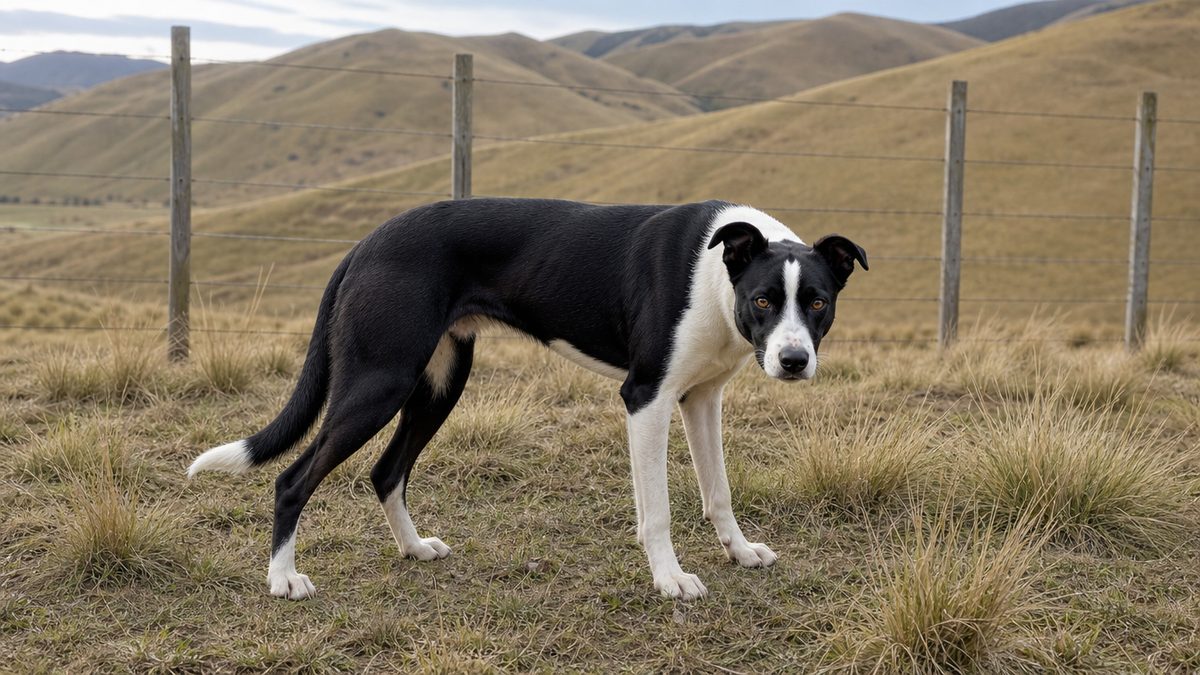
A New Zealand Heading Dog is a Border Collie taken to New Zealand and changed in three specific ways: a shorter coat for hotter summers, a standing rather than clapping working style so a shepherd can see it across tussock, and a wider cast. Te Ara, New Zealand's national encyclopedia, calls it an upstanding, long-legged and smooth-haired speedster.
Start with the job, because every physical trait follows from it. Heading, or casting, means going around a flock of sheep. The dog runs out wide, gets to the far side, and brings the stock back to the handler, holding them with strong eye at close quarters rather than driving them away. That is the opposite of what the Huntaway does, and the two dogs exist as a pair.
Te Ara's description is the authoritative short one. The New Zealand heading or eye dog goes around and heads stock, and eyeballs them at close quarters to hold them, is discouraged from barking, and is at its best with quick-reaction, close-quarters work such as catching or shedding, which means separating individual sheep from a mob.
Three changes from the Border Collie, and why each one happened
| Trait | Border Collie | Heading Dog | Stated reason |
|---|---|---|---|
| Coat | Long-haired | Shorter, smooth or even-haired | To suit the hot summers of the local environment |
| Working posture | Claps, drops on its belly and crawls while stalking | Stays standing on its feet | To stay visible to a shepherd at long distance in native tussock |
| Distance | Shorter working range | Bred to run longer distances | New Zealand hill country and larger flocks |
| Grip | Standard | Some lines larger and more hard nosed | To deal more easily with cattle |
The coat row is the whole reason this page exists for an Indian reader, and it is the most misused fact about the breed. A dog bred short-coated for hot summers sounds heat-adapted. The climate section puts a number on which summers those were, and the number is not encouraging.
The posture row is the one nobody explains properly. Te Ara sets out the Border Collie's problem in New Zealand plainly: it shows strong eye like a predator, claps down on its belly and crawls along while stalking stock, and on New Zealand's large farms that practice makes it very difficult for both sheep and shepherd to get a good view of the dogs, for instance on rough pasture with stumps and scrub, and in the open spaces of the high country and mountains. A dog you cannot see is a dog you cannot command.
One caution about the sourcing of that coat claim, because this page leans on it. The history Wikipedia gives for the short coat, that the dogs were bred with shorter-haired dogs to suit hot summers, is cited not to a register or a paper but to a blog post by Clive Dalton, the same author who wrote the Te Ara entry. Dalton is the right authority on New Zealand farm dogs and a blog is still a blog, so Bonbeno treats the claim as well-attributed rather than as documented, and the climate section tests it against measured temperatures rather than accepting it.
Where the strain came from, and one dog's name
The founding stock is documented and it narrows to a remarkable degree. Te Ara records that almost all sheepdogs imported into New Zealand between 1910 and 1930 have a dog known as Old Hemp somewhere in their pedigree. Old Hemp was born in 1893 in Northumberland, England, his sire Roy was good tempered, easy moving and not crouching too much, his dam Meg was extremely strong-eyed, and his talents were passed on to over 200 pups.
Read Roy's description again. Not crouching too much is exactly the trait New Zealand farmers went on to select for, a full generation before the Heading Dog was a recognisable thing. The strain that became this dog was already latent in the founder's own sire.
What it looks like, from the sources that describe it
There is no written breed standard for this dog anywhere, so the description below is assembled from three descriptive sources rather than from a prescriptive document, and this page says so rather than presenting it as a standard.
- Build. Sturdy, long-legged and even-haired, using visual prowess, intelligence and quick movement to control sheep. Upstanding and long-legged, a speedster.
- Coat. Smooth-haired, even-haired. One ranking travel page describes medium hair, which contradicts both, and is a good reminder to prefer the national encyclopedia over a blog.
- Colour. Generally black and white, often with the black forming a mask-like shape on the head, but also black and tan strains, red or amber, with or without white. One ranking page states that the distinctive colour patterning was developed to make the dogs easier to spot out in the field, which is plausible and which Bonbeno could not trace to a primary source.
Because no document publishes one. The NZSDTA, which keeps the studbook, has no requirements on physical form or colour, since farmers are only interested in a dog's ability to work. Dogs New Zealand publishes no standard for the breed at all. Every height and weight range you will find online for this dog traces back to a content farm rather than to a register, and Bonbeno would rather print nothing than print an invented range.
Is the New Zealand Heading Dog a breed? It passes one condition and fails the other
The New Zealand Heading Dog has a studbook and no written standard, which is the exact reverse of the Huntaway and the closest call Bonbeno's two-condition test has produced. Bonbeno maintains a page for dog types that are not breeds, and the rule it applies is that a breed has a written standard and a studbook behind it. Here only one of the two exists.
Take the conditions separately, because the sibling Huntaway page established the structure and this dog breaks it.
Condition one: is there a written standard? No.
Dogs New Zealand publishes no breed standard for the Heading Dog, and Bonbeno verified that against the club's own complete index rather than by guessing a URL. The index states that there are 224 breeds of dog as recognised by Dogs New Zealand, categorised within seven breed groups, and links every one to its own official standard. Bonbeno read the whole document on 2 September 2026 and searched it case-insensitively.
| String searched | Occurrences | Reads as |
|---|---|---|
| Heading | 0 | No Heading Dog under that name |
| Eye Dog | 0 | None under the alternative name either |
| Nz Huntaway | present, DNZ 535, Working group | Control passes |
| Border Collie | present, DNZ 516, Working group | Control passes |
| Australian Kelpie | present | Control passes |
| Bearded Collie, Collie (Rough), Collie (Smooth) | present, 514, 520, 522 | Controls pass |
The letter N block of that index runs Neapolitan Mastiff, Newfoundland, Norfolk Terrier, Norwegian Buhund, Norwegian Elkhound, Norwich Terrier, Nova Scotia Duck Tolling Retriever, Nz Huntaway, and then straight to O. The Huntaway is there. The Heading Dog is not, and neither is a New Zealand Eye Dog. Four control breeds in the same document return correctly, so this is a real absence and not a broken search.
Wikipedia states the same conclusion in its infobox, that the breed is not recognised as a breed by any major kennel club, and Bonbeno confirmed it against three registers rather than one. The United Kennel Club's 300-plus breed index carries 43 herding breeds including the Border Collie, the Australian Kelpie, the English Shepherd and the Stumpy Tail Cattle Dog, and no Heading Dog in any of its nine groups. The FCI's definitive letter-N index carries thirteen breeds and no New Zealand breed, and its twenty-breed provisional register carries none either Federation Cynologique Internationale. Kennel club recognition is therefore absent everywhere it could exist.
Condition two: is there a studbook? Yes, and it is merit-based.
The New Zealand Sheep Dog Trial Association keeps a stud register, and Bonbeno read the revised rules on the association's own page rather than a summary of them. Entry is conditional on winning, not on parentage.
- Rule E2(a) requires that all dogs which have won a Standard Open event, or enter for an Island or New Zealand Championship, be registered in the NZSDTA Stud Register.
- Rule E2(b) requires the application within 28 days of the win, through the Stud Register Representative for the Centre of domicile, and states that failure means the dog is not allowed to compete in any further Standard Open trials.
- Rule E2(c) requires an official Stud Book registration or receipt number before a qualified dog can compete at a New Zealand or Island Championship.
- Rule E2(d) requires registered dogs which have changed ownership to have the ownership transferred before they are eligible to compete.
Read Rule E2(a) again and notice what it does not say. It does not say Huntaway. It says all dogs which have won a Standard Open event, with no breed qualifier anywhere in the rule set. Te Ara confirms the reading from the other side: only working dogs that win official dog trials can be recorded in the studbook of the NZSDTA, and the association has no requirements on physical form or colour, as farmers are only interested in a dog's ability to work. So a Heading Dog that wins an Open enters the same book on the same terms as a Huntaway.
This is a genuine studbook and not a list. The books are printed annually, set out in alphabetical order of owners with an indexing system, carry eight four-generation pedigrees on a page, are available back to 1999, and the 2025 edition is current. Registration costs 15 dollars, transfers are free, and the association states there is zero tolerance on the 28-day deadline. That is a working register of recorded ancestry, maintained continuously for over a quarter of a century.
Bonbeno's Huntaway page describes the NZSDTA stud register as a merit register in which entry follows winning a Standard Open event within 28 days rather than parentage. Bonbeno re-read the association's own page for this breed and that account is exactly right, quoted rules and all. Two things can now be added to it. The rules are dated as the Stud Register Rule and Clarification 2018, so they are not undated. And they are breed-agnostic on their face, which the Huntaway page did not state and which is the fact that decides this breed's status.
The verdict, and a stale sentence in a national encyclopedia that is still half true
Bonbeno's verdict is that the New Zealand Heading Dog stays off the dog types that are not breeds page, but by a narrower margin than any dog this site has assessed. It has a real, continuously maintained studbook and no written standard anywhere. The reader should be told which half is missing rather than given a yes or a no.
Set the two New Zealand working dogs side by side, because the contrast is the finding.
| Condition | Huntaway | Heading Dog |
|---|---|---|
| A written standard | Yes, Dogs New Zealand DNZ 535, dated 9 August 2013, eighteen prescriptive sections | No, none anywhere; absent from the Dogs NZ 224-breed index |
| A studbook | Yes, the NZSDTA stud register, merit-based | Yes, the same register, on the same breed-agnostic rules |
| FCI or KCI route | None | None |
| UKC entry | None | None |
| Bonbeno verdict | A breed, cleanly, on both conditions | A breed on the evidence that matters, with one condition unmet |
Why the verdict still lands on breed. The two-condition test exists to separate a name that anybody can apply to any dog from a population somebody is actually keeping track of. The Heading Dog is tracked. There is a book, it is printed every year, it holds four-generation pedigrees, it has been kept since at least 1999, and a dog gets into it by winning in front of judges rather than by an owner's assertion. That is a stronger claim to identity than a written standard nobody enforces would be.
Why the missing standard still matters. Without a document, there is nothing to measure a puppy against. The NZSDTA has no requirements on physical form or colour, so there is no height, no weight, no coat definition and no fault list. Every specification you will read for this dog online was written by a content site, not by a register, which is why the overview section prints no measurements.
The Te Ara sentence that was true, went stale, and is still true here
This is the finding no ranking page has, and it turns on a date. Te Ara, New Zealand's national encyclopedia, states that New Zealand working dogs, heading dogs and huntaways, have never been registered by the New Zealand Kennel Club. That entry was published on 1 March 2009 by Clive Dalton.
Dogs New Zealand, which is the New Zealand Kennel Club renamed, published its official Huntaway standard as DNZ 535 carrying the copyright line 09 Aug 2013. So the sentence was correct when written and was overtaken four years later, for one of the two dogs it names. For the Heading Dog it remains exactly true today, which Bonbeno verified independently against the club's current 224-breed index rather than by trusting the encyclopedia.
Te Ara adds a second registration fact that survives intact and that nobody quotes. Since 1968, because farm working dogs do well in obedience tests, they have been allowed separate registration as non-pedigree, speyed and castrated working dogs, which maintains a record of the genes in the farm dog population. So a Heading Dog can register with the national kennel club, as a non-pedigree working dog, and cannot be registered as a breed. That is a precise distinction and it is the honest answer to anyone who says the dog is or is not recognised.
No Dogs New Zealand pedigree can exist for a New Zealand Heading Dog, because the club holds no such breed. No FCI pedigree can exist, so no Kennel Club of India registration can follow. The only genuine document is an NZSDTA stud register entry, which records a dog that won an Open trial in New Zealand and which is not transferable paperwork in the sense an Indian buyer means. If somebody in India shows you a Heading Dog pedigree, ask which body issued it, then open that body's own breed list and look for the breed yourself.
Separate breed, working strain, or a New Zealand name for a Border Collie?
The honest answer is a working strain of Border Collie that has been separately selected for over a century and is not separately registered anywhere. It is not a distinct breed in any register's sense, and it is not simply the same dog under a local name either, because the traits selected for are documented and specific.
Three positions are available and each has evidence. Bonbeno sets them out and then says which one the evidence supports.
| Reading | Evidence for it | Evidence against |
|---|---|---|
| A separate breed | Named separately in national sources and in the NZSDTA's own world; over a century of separate selection | No register anywhere holds it as a breed, and no written standard exists |
| A New Zealand name for the Border Collie | Descended directly from imported Border Collies; Old Hemp in almost every pedigree | Coat, working posture and cast were all deliberately changed, and Te Ara lists the two as separate entries |
| A working strain of the Border Collie | Both of the above at once, which is what a strain is | Nothing, and this is what the sources actually describe |
The strain reading is the one that fits every source without straining any of them. Wikipedia says the dog is derived from the Border Collie, that early settlers brought those dogs to New Zealand to herd sheep and then went on to breed more specified dogs. Te Ara lists the New Zealand heading or eye dog and the border collie as two separate entries under the same Heading dogs section, describing one as bred from the other and giving each a different working description. Neither source treats them as the same dog, and neither treats them as unrelated.
The three differences, and how to see them
- The clap. A Border Collie shows strong eye like a predator, claps by dropping onto its belly, and crawls along while stalking stock. A Heading Dog stays standing. This is the most visible difference in the field and the reason the strain was created, because on rough pasture with stumps and scrub, and in the open high country, a clapped dog is invisible to both sheep and shepherd.
- The coat. A Border Collie is described by Te Ara as a long-haired breed. The Heading Dog is smooth-haired, and the short coat was bred in deliberately for hotter summers.
- The cast. The Heading Dog was bred to run longer distances, for New Zealand's larger farms, and in some lines to be larger and more hard nosed to deal with cattle.
One health finding that argues they are not interchangeable
Here is the strongest evidence that these are genuinely different populations rather than one dog under two names, and it comes from a genome. Smith and colleagues whole-genome sequenced 249 New Zealand working dogs in 2025, of which 104 were Heading dogs, and reported allele frequencies separately by breed. Several of those frequencies diverge sharply from what is published for Border Collies, and they diverge from Huntaways in the same dataset, which is what a separately managed population looks like.
The clearest case is neuronal ceroid lipofuscinosis. The CLN8 variant runs at an allele frequency of 0.063 in Heading dogs against 0.027 in Huntaways, with 12.5 percent of Heading dogs carrying it against 5.4 percent of Huntaways. Running the other way, the SOD1 degenerative myelopathy risk allele sits at 0.019 in Heading dogs against 0.215 in Huntaways. Two breeds on the same farms, sampled in the same study, with an eleven-fold difference on one variant and a two-fold difference on another.
That is not proof of breed status and this page does not claim it is. Allele frequencies differ between lines within a single breed too. What it does establish is that the Heading Dog is a distinguishable population that a geneticist can report separately, which is more than can be said for most names that get argued about.
Which one should an Indian reader actually buy?
The Border Collie, because you can. It holds a Dogs New Zealand standard at DNZ 516, an FCI standard, and therefore a Kennel Club of India route, and there is an established Indian market with published prices that Bonbeno's Border Collie page works through. The Heading Dog has none of that, and the price section shows what an Indian search for one actually returns.
Ask what makes it one rather than a Border Collie, and listen for whether the answer is about the dog or about the paperwork. The genuine answers are a short smooth coat, a standing rather than clapping working style, and an NZSDTA stud register number for a dog that won an Open trial in New Zealand. Anything else, including a certificate from a registry you have not checked, is a Border Collie with a more expensive name on it.
New Zealand Heading Dog price in India: none published, and what a search returns instead
No new zealand heading dog price in india exists, and Bonbeno publishes no rupee figure. The breed appears zero times on the three largest published Indian dog price lists, no Indian seller was found under a search whose control passed in the same session, and even in New Zealand the dogs move through rehoming rather than through a retail market.
Take the price lists first, because they are where an Indian buyer lands. Bonbeno searched all three in full on 2 September 2026 and counted every occurrence, with controls in the same documents.
| List | Breeds covered | Heading Dog | Border Collie | Labrador control |
|---|---|---|---|---|
| Supertails, Dog Price List in India 2026 | 40+ | 0 | 2 | 18 |
| WrapInFur, Dog Price List in India 2026 | 50+ | 0 | 2 | 24 |
| PawSpace, Dog Price in India 2026 | 40 | 0 | 1 | 10 |
The Border Collie column is the useful one. These are pages that do list a herding dog of exactly this type, with a price, on all three, and they do not list this one PawSpace, Dog Price in India 2026. So the absence is not because the lists ignore working breeds. It is because the breed is not sold here. The Huntaway returns zero on all three too, which is what Bonbeno's Huntaway page found independently.
What an Indian search actually returns
This is the more informative half. A search for the breed with price and puppy terms, run against India, returned no Indian kennel, no Indian classified and no Indian listing of any kind. What came back was merchandise and New Zealand rehoming.
- A book on Amazon.in, a New Zealand Heading Dog Training Guide covering tricks, socialising, housetraining, agility and obedience.
- An Etsy craft listing, a New Zealand Heading Dog SVG bundle sold as a digital download.
- Retired Working Dogs New Zealand, which states in terms that it advertises on behalf of owners looking to rehome, not sell, their dogs, and whose breed selector carries Heading Dog and Heading Dog X.
- New Zealand farm classifieds and Facebook groups, including a listing for Huntaway pups and a four-month Huntaway crossed with a Heading Dog, all in New Zealand and none reachable from India.
Nothing offered was a dog available in India. That composition is the evidence, and it is worth more than a rupee figure would be. Where a breed genuinely trades here, an India-localised search fills with kennels and city-wise price tables inside three results, as the Labrador control did in the same session.
Why no market can form
- No registry route. The breed is absent from Dogs New Zealand's 224-breed index, the UKC's 300-plus index and both FCI registers, so no Kennel Club of India pedigree can follow Federation Cynologique Internationale.
- No lawful commercial import route. DGFT Trade Notice 22/2022-23 permits import of a dog only as a pet with a valid pet book in the importer's name, for R&D with CPCSEA recommendation, or for internal security by the Defence and Police Force, and states that applications for trading or breeding purposes shall be duly rejected.
- No exporting supply either. The dogs that leave New Zealand working life go through a rehoming charity rather than a breeder network, and that charity's stated model is rehoming, not selling.
Run three checks before you believe it. Divide the figure by 84.38 and by 74, because Indian pages routinely republish a US dollar band through one exchange rate and the quotient is the tell. Ask whether the page carrying it is Indian at all. Then ask the seller what makes the animal a Heading Dog rather than a Border Collie, since the Border Collie is on all three of those price lists at a real Indian price and is the dog most likely to be in the crate. A premium charged for a name that no register holds is the whole scam in one sentence.
The one rupee figure worth having is not a price at all. It is the running cost, which the cost of ownership section builds from the medium-breed column of the fullest published Indian table, and which for a dog with no purchase price is the entire cost of the decision.
Cost of ownership in India for a medium working herding dog
Budget ₹6,000 to ₹10,000 a month to keep a dog of this size and drive in an Indian city, using the medium-breed column of the fullest published Indian cost table, plus ₹1,500 a year for vaccination. With no purchase price to add, the running cost is the whole cost, and one row in that table is far too high for this dog while another is far too low.
The medium column is the right one for a long-legged herding dog of roughly Border Collie build, and there is no published height or weight for the breed to argue with, because no register publishes one.
| Category | Published range |
|---|---|
| Dry or wet food | ₹2,500 to ₹4,000 a month |
| Routine vet visits | ₹800 to ₹1,500 a month |
| Vaccinations | ₹1,500 a year |
| Grooming | ₹800 to ₹1,500 a month |
| Training | ₹2,000 to ₹5,000 over six months |
| Treats and toys | ₹500 to ₹1,000 a month |
| Flea control and deworming | ₹400 to ₹700 a month |
| Stated monthly total | ₹6,000 to ₹10,000 |
The table does not add up, and the gap is worth naming
Add the source's own rows and the printed total is too high at both ends. Taking the floor of every row, ₹2,500 food plus ₹800 vet plus ₹800 grooming plus ₹500 treats plus ₹400 parasite control is ₹5,000, plus ₹125 a month of vaccination at ₹1,500 a year and ₹333 of training spread over six months, giving ₹5,458 against a printed ₹6,000. At the ceiling the rows give ₹9,658 against a printed ₹10,000.
The gap is ₹542 at the floor and ₹342 at the ceiling. Bonbeno is not calling the table wrong, because a published total may hold a deliberate buffer for what a row list misses. Bonbeno is saying the arithmetic does not reproduce, so treat the headline as an estimate with padding and build your own budget from the rows.
Three rows move for this breed, in both directions
- Grooming falls to the floor and below it. The ₹800 to ₹1,500 line assumes a coat that needs professional attention. Te Ara describes a smooth-haired dog and Wikipedia an even-haired one, so weekly brushing at home is the entire job and most of this row disappears Wikipedia, New Zealand Heading Dog. Its….
- Food sits at the top of its band. This is a working-line dog selected to run long distances day after day, and an underfed one loses condition fast. Expect the ₹4,000 end rather than the ₹2,500 end.
- Training is compulsory, not optional. A ₹2,000 to ₹5,000 six-month course is the cheapest insurance against a highly intelligent herding dog with nothing to do inventing its own job in Indian traffic.
- Orthopaedic budget is the line nobody prints. This is the row that matters most for this breed, and it is set out below.
The orthopaedic line, which is genuinely breed-specific
This is the cost row that separates the Heading Dog from every other medium herding dog on this site, and it comes from two New Zealand studies rather than from a guess. Cave's national survey of 2,214 working farm dog presentations across 30 rural practices found Heading dogs over-represented in multiple ligamentous injury of the stifle, disruption of the gastrocnemius or Achilles tendon, tarsal injuries and hip luxation. The TeamMate longitudinal study found that of 323 dogs free of musculoskeletal abnormality at enrolment, 184 or 57 percent developed at least one over 4,508 dog-months at risk, and that Huntaways had a lower rate of carpal abnormalities than Heading dogs at an incidence rate ratio of 0.6.
Those were working dogs on farms, so the rates are not transferable to an Indian pet household and this page does not transfer them. What transfers is the pattern: the injuries this breed gets are stifle, hock and carpus, which are exactly the joints a fast dog loads when it turns hard. A cruciate ligament repair in an Indian metro is a five-figure bill, and it arrives on a Sunday.
Before any money changes hands, pay for an independent veterinary consultation on the puppy, from a vet the seller did not choose. Then check the age: Rule 8(1)(a) of the Prevention of Cruelty to Animals (Dog Breeding and Marketing) Rules 2017 requires that pups less than eight weeks in age are not sold, and Second Schedule Part III paragraph 8(9) states that vaccination can start at seven to eight weeks and is usually completed at eighteen weeks. And if you are being offered this breed at all, read the price section first, because the animal is far more likely to be a Border Collie.
Heat tolerance: the breed was bred for hot summers, and Indian summers are 12 degrees hotter
Heat tolerance is rated 3 of 5, which is higher than this site gives most working breeds and lower than the breed's own origin story implies. The Heading Dog was genuinely bred with a shorter coat to suit the hot summers of its environment. Those summers peak at 30.42 C in the breed's own hill country, against 42.70 C in Chennai.
This is the most interesting climate case on the site, because the breed's founding claim is a heat claim and it is true. It just does not mean what an Indian reader would take it to mean.
The homeland numbers, with the grid cell checked
Bonbeno queries climate by explicit latitude and longitude, and checks the elevation NASA POWER reports against the real ground, because a grid cell in hill country can miss the town beneath it badly. Here the cells are usable, which is worth stating because on the sibling New Guinea singing dog page they were not.
| Place | Cell elevation | Real elevation | Annual mean | Hottest-month daily max |
|---|---|---|---|---|
| Taihape, 39.680 S 175.800 E | 712.68 m | about 450 m | 9.66 C | 30.42 C in January |
| Wanaka, 44.700 S 169.150 E | 924.26 m | about 300 m | 6.16 C | 27.28 C in January |
| Lake Tekapo, 44.005 S 170.478 E | 869.46 m | about 710 m | 6.78 C | 29.62 C in January |
Taihape is not an arbitrary choice. It is the district where the only published hip dysplasia survey of this breed was conducted, so the climate figure and the health figure come from the same ground. Wanaka is where New Zealand sheepdog trials began, as early as 1867. Lake Tekapo carries the Mackenzie Country monument to the working dog. The cells sit 263 m, 624 m and 159 m above the real towns, which is close enough to use in rolling hill country and is stated rather than hidden.
The gap against Indian cities, in plain numbers
Indian plains cells are accurate, which makes the comparison usable: Delhi's sits 10 m below the real city, Chennai's 43 m above, Bengaluru's 78 m below and Pune's 76 m above.
| Place | Annual mean | Hottest-month daily maximum | Gap against Taihape |
|---|---|---|---|
| Taihape, the breed's own hill country | 9.66 C | 30.42 C | reference |
| Chennai | 27.95 C | 42.70 C in May | 12.28 C hotter at peak |
| Delhi | 25.60 C | 48.79 C in June | 18.37 C hotter at peak |
| Bengaluru | 23.74 C | 40.38 C in April | 9.96 C hotter at peak |
| Pune | 23.86 C | 43.20 C in April | 12.78 C hotter at peak |
Read the last column and the origin story falls into place. The hot summers this dog was bred short-coated for peak at 30.42 C. Bengaluru, which is the mildest large Indian city in this table, runs nearly 10 C above that at its own peak, and Delhi runs more than 18 C above it. The breed's heat adaptation is real and it was calibrated to a New Zealand January, not an Indian May.
The other half of the homeland picture is the winter. Taihape's coldest-month daily minimum is minus 4.66 C in August and Lake Tekapo's is minus 17.36 C. This is a temperate hill-country dog with a genuine cold season, and no part of plains India gives it one.
Why it is rated 3 and not lower
Three things pull upward and they are the reason this dog scores better than most working breeds here.
- The coat is the right one. Short and smooth is the best working configuration under Indian sun, and unlike almost every other heat comparison on this site the coat was selected for heat rather than against it.
- The size is right. A medium dog sits well below the weight bands where risk climbs: in a cohort of 905,543 dogs, bodyweight at or above the breed and sex mean carried an odds ratio of 1.42 for heat-related illness, and dogs over 50 kg an odds ratio of 3.42.
- The homeland is humid too. Taihape's annual mean relative humidity is 85.77 percent, higher than Chennai's 72.39 percent, so humidity itself is not the novel stressor.
What holds it at 3 is drive, not anatomy. The largest study of heat-related illness in dogs found that of 879 events with a recorded trigger, 652 or 74.2 percent were exertional, against 46 or 5.2 percent from vehicular confinement. A dog selected to run all day, in a country where the heat wave season normally runs March to June and peaks in May, is the exact profile that dominates that count. This is not a heat-tolerant pet, it is a hardy working dog that will run itself into trouble because you asked it to.
Second Schedule Part IV paragraph 21(1) of the Prevention of Cruelty to Animals (Dog Breeding and Marketing) Rules 2017 bars keeping in outdoor facilities, without the attending veterinary practitioner's written approval, dogs that are not accustomed to the temperatures prevalent in the area and breeds that cannot tolerate them. Note the citation form: the Rules themselves stop at Rule 13, so this is a Second Schedule paragraph and not a Rule, and the string Rule 21 appears zero times in the gazette. A short-coated dog is better placed under that clause than a long-haired one, which is the one genuine advantage this breed has over its Border Collie parent in India.
Temperament and household fit: the quiet one, and why that is not the same as easy
A New Zealand Heading Dog is biddable, intelligent, quiet and relentlessly driven, and the last of those cancels most of the comfort in the first three. Te Ara records that this dog is discouraged from barking while all huntaways are bred to bark, so the noise problem belongs to the other breed and the drive problem belongs to this one.
Start with the working description, because temperament in a working strain is a byproduct of selection rather than a separate thing. This is a dog that goes around stock and holds it with the eye, working at close quarters, at its best on quick-reaction jobs like catching or shedding. Everything a household experiences follows from that: intense focus, sensitivity to movement, an instinct to circle and block, and a low tolerance for having nothing to do.
What the sources actually say about living with one
Wikipedia is blunt and it is the most useful sentence available. The breed requires an agrarian environment and is generally not intended to be kept as house pets, and if left alone for too long they may try to escape or herd small animals or children. It also records that these dogs are very aware of their surroundings and able to adapt to quick movements in their line of sight, which is the same trait described positively.
Ranking pages add owner-level observation that is consistent with this. One notes that on long brisk walks or jogs the dog will be most comfortable next to or behind their person, which is a herding dog managing its handler. Another lists as one of three little-known facts that they are not big barkers, and that they vary widely in looks. Both of those match the primary sources, which is worth saying, because on many breeds they do not.
The three household problems, in order of how often they bite
- Herding the family. A dog selected to control movement by eye and body position will apply that to children running, cyclists, autos and delivery riders. It is not aggression, it is the job. In an Indian shared compound it is a complaint and occasionally a nipped heel.
- Boredom, expressed as escape. Wikipedia records the escape attempt as a documented failure mode of an under-occupied dog of this breed. In Indian conditions that means a dog on a road, and Cave's national survey found automotive incidents accounting for 19 percent of traumatic injuries among New Zealand working farm dogs, in a country with far less traffic than any Indian city.
- Sensitivity. This is a soft, handler-focused strain, not a robust one. Contrast the Huntaway, whose own kennel club standard asks for a nature that is robust and not easily offended. Nothing comparable is written for the Heading Dog, and the working style implies the opposite: a dog that reads a handler at 300 metres reads a raised voice at three.
Who this dog genuinely suits in India
| Household | Verdict | Why |
|---|---|---|
| Farm or large rural property with livestock | The only good fit | The dog has a job, which is the whole design |
| Semi-rural home with land and a working dog sport | Workable with real commitment | Herding trials, agility or flyball substitute for the job |
| Urban house with a garden and an athletic owner | Difficult but not impossible | Two structured hours a day, every day, including in May |
| Apartment | Rated 1 of 5 | Drive with nowhere to go, and a lift full of moving legs |
| First-time owner | No | A highly trainable dog trains itself when you do not |
One thing this breed is not is a guard dog. It is quiet by selection, discouraged from barking in its own working culture, and its instinct on a stranger at the gate is to watch rather than to announce. If you want an alert dog for an Indian house, this is close to the worst choice among working breeds, and its own sibling the Huntaway is close to the best.
If the appeal here is a smart, quiet, short-coated, athletic herding dog for an Indian city, the Border Collie is the same dog with a longer coat, a Kennel Club of India route and an actual Indian market, and the Bonbeno page for it works through the heat reality in detail. If the appeal is a New Zealand working dog specifically, the Huntaway has a national kennel club standard behind it and the same absence of an Indian market. And if the appeal is a short-coated, heat-hardy, intelligent dog you can bring home this month, that is the Indian pariah dog and it costs almost nothing.
Training: the easiest dog on this site to teach, and the easiest to ruin
To train a New Zealand Heading Dog, give the eye a legal outlet early, keep pressure low, and build distance work rather than obedience drills. Trainability is rated 5 of 5 on this site, the highest it gives, because this strain was selected for over a century on nothing except working ability under command at distance.
The reason this dog is easy to teach is also the reason it goes wrong. A dog that reads a handler across a paddock reads a frustrated owner across a living room, and a dog that learns in three repetitions learns the wrong thing in three repetitions too.
Four things that work
- Give the eye a job in the first year. Herding instinct trials, treibball, agility or structured scent work all channel the same drive. Without an outlet the dog picks its own, and the options in an Indian city are traffic, children and other people's pets.
- Train the cast, not the sit. The natural shape of this dog's work is going out wide and coming back, so teach a directed send, a stop at distance and a recall through distraction. Those three are more useful and more satisfying to the dog than a stack of stationary cues.
- Keep the pressure off. This is a soft, handler-sensitive strain. A raised voice shuts it down faster than it corrects it, and there is no standard anywhere asking for a robust nature the way the Huntaway's does.
- Socialise to Indian streets specifically, and early. Autos, two-wheelers, cattle, free-roaming dogs and crowds all move, and a herding dog's default response to movement is to control it. Sixteen weeks is the window.
Two things training will not remove
Movement sensitivity. You can teach the dog what to do instead, and you cannot teach it not to notice. Plan for a long line near roads and livestock for the dog's whole life, not just its first year.
The need for a job. Wikipedia records that if left alone for too long these dogs may try to escape or herd small animals or children. That is a description of an unemployed working dog, and no amount of obedience training substitutes for employment.
How the trial culture that shaped this dog actually works
This is worth understanding because it explains the selection pressure. Sheepdog trials began in New Zealand as early as 1867 in Wanaka, and the dog has been an integral part of them since. Winning a Standard Open event is what puts a dog into the NZSDTA stud register, within 28 days, and a dog that fails to register cannot compete in any further Standard Open trials.
So the breeding population is filtered on competition results rather than on looks, generation after generation. That is why the dog trains well and why it varies so much in appearance, which one ranking page lists as a little-known fact and which is really the defining consequence of the register's design.
| Period | Focus | The specific risk if you skip it |
|---|---|---|
| 8 to 16 weeks | Socialisation to traffic, crowds, cattle and free-roaming dogs | An adult that herds two-wheelers |
| 4 to 8 months | Marker training, recall through distraction, long-line habits | Chasing that becomes self-rewarding |
| 8 to 14 months | A real outlet: herding, agility, treibball or structured scent work | Escape behaviour, which Wikipedia documents for this breed |
| 14 months to 2 years | Distance work, stop at distance, directed sends | A bored adult that trains itself on the household |
| Throughout | Low-pressure handling and no harsh corrections | A shut-down soft dog that stops offering behaviour |
A six-month professional course runs ₹2,000 to ₹5,000 on the medium-breed line of the fullest published Indian cost table, which is genuinely affordable. And unlike most breeds on this site, the trainer does not need breed-specific experience: any competent Indian trainer who has worked with Border Collies has worked with this dog's parent breed and its working style. Ask for positive-reinforcement methods and a sport outlet, and be honest that you are hiring them to give a working dog a job rather than to fix a behaviour problem.
Exercise: a farm requirement, and what happens to the joints when you compress it
The daily requirement for a New Zealand Heading Dog is a job on land, and the honest Indian substitute is at least two hours of structured work split across the two cool windows of the day. This is a dog bred to muster hill country and to run longer distances than a Border Collie, on farms in a country with about 200,000 working farm dogs Wikipedia, New Zealand Heading Dog. Its….
Exercise need is rated 5 of 5, and the failure mode is documented rather than assumed. Wikipedia records that if left alone for too long these dogs may try to escape or herd small animals or children. That is an under-exercised working dog in one sentence.
Why distance alone is the wrong prescription
Two hours of walking does not meet this dog's need, and it may create a problem. The cost of ownership section sets out the injury pattern and it bears directly on how you exercise: Cave's national survey of 2,214 working farm dog presentations found Heading dogs over-represented in multiple ligamentous injury of the stifle, disruption of the gastrocnemius or Achilles tendon, tarsal injuries and hip luxation. The TeamMate study found the most common abnormalities across 323 working dogs were reduced range of motion and swelling of the carpus or stifle, with the hip the most common site of pain, and that Huntaways had a lower rate of carpal problems than Heading dogs at an incidence rate ratio of 0.6.
Those are the injuries of hard turning on hard ground, not of long steady distance. In an Indian city, that translates into a specific warning: repetitive ball-chucking on tarmac or dry compacted maidan is close to the worst thing you can do with this dog. Fetch on concrete is a stifle injury being scheduled.
A workable Indian day
| Time | Activity | Why then |
|---|---|---|
| Before 07:00 | 45 to 60 minutes of brisk walking, long-line running on grass, directed sends | The only reliably cool window in an Indian summer |
| Mid-morning | Ten minutes of training, then a puzzle feeder or scatter-fed portion | Mental work tires a herding dog faster than distance does |
| Afternoon | Rest indoors, out of the sun, on a cool floor | Exertional cases are 74.2 percent of triggered heat illness |
| After 19:00 | 45 to 60 minutes of sport work, herding practice or structured scent work | Second cool window, and the session that prevents the escape behaviour |
Note what the table does not say. There is no midday run and no daytime cycling row, because the heat wave season in India normally runs from March to June and peaks in May, with five to six heat wave events a year over the north, and Delhi's hottest-month daily maximum is 48.79 C against 30.42 C in the breed's own hill country.
Surfaces, which matter more for this breed than for most
- Grass and soft ground for anything fast. Turning at speed is what this dog does and hard surfaces are what damages the joints doing it.
- Check the tarmac with the back of your hand. If you cannot hold it there for five seconds, it will burn pads, and an Indian afternoon road routinely fails that test in May.
- Watch fence lines and gates. Cave's survey found transit across fence lines accounting for 16 percent of traumatic injuries among New Zealand working farm dogs, and the authors specifically conclude that altering modes of transit across fence lines has the potential to reduce large numbers of serious orthopaedic injuries. An Indian compound gate a dog jumps daily is the same hazard.
- Do not let it launch off furniture or a terrace step repeatedly. The carpus is the joint the TeamMate study found most often affected, and repeated landing is how carpal problems start.
Find the sport, not the distance. Herding instinct work is rare in India but agility, flyball, treibball and canine scent work are all growing in the metros, and any of them gives a working dog a job that its brain accepts as one. Ten minutes of scent work in a hot afternoon indoors does more for this dog than an hour of walking in the same heat, and it does it without loading a stifle. The training section covers what to teach and in what order.
Grooming a short working coat in Indian humidity
To groom a New Zealand Heading Dog, brush weekly, check the ears, trim the nails monthly and run your hands over the whole dog daily for ticks. The short coat is the trait the strain was created for, and it is the one genuine practical advantage this dog has over its Border Collie parent in India.
Grooming load is rated 2 of 5, which is low, and the reason is written into the breed's origin. Te Ara describes a smooth-haired dog, Wikipedia an even-haired one, and Wikipedia adds that because of the Border Collie's long hair these dogs were bred with shorter-haired dogs to create a breed better suited to the hot summers of the local environment Wikipedia, New Zealand Heading Dog. Its….
One source disagrees, and it is the one you should not follow
A travel company's blog that ranks for this term describes the dogs as having medium hair. That contradicts the New Zealand national encyclopedia and Wikipedia, both of which describe a smooth or even coat, and it contradicts the breed's own founding rationale. Bonbeno follows the national encyclopedia, and flags the disagreement rather than quietly averaging it, because a reader budgeting for grooming in an Indian summer needs to know which one is load-bearing.
There is a real variation underneath the disagreement, though, and it is worth stating. With no written standard and a register that has no requirements on physical form or colour, coat length is not controlled by anything. Individual dogs vary, which is exactly what one ranking page lists as a little-known fact about the breed. Look at the parents before you assume the coat.
The weekly routine, which takes five minutes
- Brush once a week with a rubber curry or a slicker, more often through a seasonal shed. There is no coat to shape and nothing to strip.
- Check the ears weekly and dry them properly after any bath or swim, because Indian humidity and a damp ear canal is how otitis starts.
- Trim nails monthly. A long nail changes how the foot loads, which matters more than usual in a breed whose published injuries are carpal and tarsal.
- Bathe only when genuinely dirty, and dry to the skin rather than leaving the dog to air-dry in humid air.
- Check the feet after every fast session. Pads, webbing and between the toes.
In India, grooming is mostly parasite work
The brushing is trivial. The tick check is not. Across four Indian cities and 525 dogs, 261 or 49.7 percent with a 95 percent confidence interval of 45.4 to 54.1 were infected with one or more tick-borne pathogen by PCR, and Rhipicephalus or Haemaphysalis ticks were found on 278 of the dogs, 53 percent. Hepatozoon canis was commonest at 30 percent, Ehrlichia canis at 20.6 percent, and concurrent infection with more than one pathogen occurred in 39 percent of cases.
Run your hands over the dog every day, and pay attention to the black areas. A black and white dog with a black mask on the head is the worst possible background for spotting an engorged tick, and this breed's commonest colouring is exactly that. Ears, under the collar, between the toes, groin, armpits.
Year-round preventive cover matters more here than a seasonal approach would in New Zealand, and it is the row of the Indian cost table that should sit at its ceiling rather than its floor: flea control and deworming at ₹400 to ₹700 a month on the medium-breed column.
The published Indian medium-breed grooming line runs ₹800 to ₹1,500 a month, which assumes periodic professional appointments. This coat needs none. Move that money to parasite prevention and to a joint-friendly surface for exercise, both of which address things that are documented to affect this breed, and neither of which appears anywhere on a published Indian cost table.
Health: the healthier hips, the worse joints, and the genome that separates the two breeds
The New Zealand Heading Dog has markedly better hips than the Huntaway and a markedly worse injury record, and two New Zealand studies establish both. Hip dysplasia ran at 6.3 percent of 48 Heading Dogs against 23.6 percent of 93 Huntaways in the only radiographic survey of the two breeds. No breed screening scheme exists anywhere, and the breed has no row in OFA's published statistics.
This is the section where a page about an unregistered working strain outperforms the pages about most recognised breeds, because New Zealand's veterinary schools have studied these dogs properly and almost nobody quotes the results.
Hips: the one radiographic survey, with its denominators
Hughes conducted a practice-based survey from Taihape Veterinary Services in the North Island, recruiting farmer clients and radiographing dogs under anaesthesia in a standard position, scored on the New Zealand Veterinary Association Hip Dysplasia Scheme.
| Measure | Heading Dogs | Huntaways |
|---|---|---|
| Dogs radiographed | 48 | 93 |
| Prevalence of hip dysplasia, combined score of 10 | 6.3 percent | 23.6 percent |
| Average combined score | 5.9 | 10.8 |
| Position against NZVA breed averages | Lower end | Higher end |
| Overall prevalence across both breeds | 17.7 percent of 141 | 17.7 percent of 141 |
The arithmetic reproduces exactly, which is worth checking rather than assuming: 17.7 percent of 141 is 25 dogs, 23.6 percent of 93 is 22 and 6.3 percent of 48 is 3, and 22 plus 3 is 25. The odds ratio for a Huntaway carrying a score of 10 was 4.6, with a 95 percent confidence interval of 1.3 to 16.0. That interval is wide and crosses nothing, so the direction is solid and the magnitude is not precise. Forty-eight dogs is a small sample and this page treats it as one.
For context rather than comparison, OFA's published hips table gives the Border Collie at rank 131 on 21,159 evaluations, 89.3 percent normal and 9.9 percent dysplastic. Both component sets reproduce their totals exactly. Do not read that as a like-for-like figure. OFA is a voluntary US registry that publishes submitted radiographs, so it carries submission bias, while Hughes radiographed recruited working dogs on farms. The two numbers happen to sit close together and they are measuring different things.
The genome, which separates the two New Zealand breeds sharply
In 2025 Smith and colleagues at Massey University whole-genome sequenced 249 New Zealand working dogs, 130 Huntaways, 104 Heading dogs and 15 intercrosses, and reported allele frequencies by breed. Of 435 probably causal variants from the Online Mendelian Inheritance in Animals database, 27 segregated in the sample and 408 did not. Of the 27, eleven affect morphological or aesthetic traits and sixteen were previously implicated in disease.
| Gene | Condition | Heading dogs | Huntaways |
|---|---|---|---|
| CLN8 | Neuronal ceroid lipofuscinosis | 0.063 | 0.027 |
| CUBN | Intestinal cobalamin malabsorption | 0.029 | 0 |
| SOD1 | Degenerative myelopathy | 0.019 | 0.215 |
| VPS13B | Trapped neutrophil syndrome | 0.010 | 0.023 |
| SGSH | Mucopolysaccharidosis IIIA | 0 | 0.004 |
| VWF | Von Willebrand disease I | 0 | 0.035 |
Two rows are the story and they run in opposite directions. The SOD1 degenerative myelopathy risk allele sits at 0.019 in Heading dogs against 0.215 in Huntaways, an eleven-fold difference, with 3.8 percent of Heading dogs carrying one copy and none carrying two, against 35.4 percent of Huntaways carrying one and 3.8 percent carrying two. And neuronal ceroid lipofuscinosis runs the other way: the CLN8 variant sits at 0.063 in Heading dogs against 0.027 in Huntaways, with 12.5 percent of Heading dogs carrying it against 5.4 percent of Huntaways.
Three rows are clean for this breed. Mucopolysaccharidosis IIIA and Von Willebrand disease type I both returned zero in the Heading dog sample, and trapped neutrophil syndrome ran at less than half the Huntaway frequency.
The paper also prints a Total column across all 249 dogs. For most variants it reconciles with the two breed columns on a weighted average, but for SGSH the total allele frequency of 0.01 is roughly four times what the Huntaway figure of 0.004 and the Heading dog figure of 0 can produce between them, and the total genotypes for VWF include homozygotes that neither breed column contains. The most likely explanation is the 15 intercross and other-breed dogs in the sample, which sit in the total and in neither breed column. Bonbeno could not confirm that from the text and therefore quotes only the two breed columns, which are the ones that matter here.
Injuries, lifespan and what no study covers
The health issue most likely to end a New Zealand Heading Dog's working life is orthopaedic injury rather than inherited disease, and a national survey names the exact joints. No lifespan figure exists for this breed from any study Bonbeno could open, so this page prints none.
Cave and colleagues ran a national questionnaire-based cross-sectional study over twelve months from April 2008, covering 30 of 66 approached rural practices with representation from all major rural regions of New Zealand. It recorded 2,214 presentations excluding revisits, of which 51 percent were Huntaways and 39 percent Heading dogs.
| Heading dogs over-represented in | Huntaways over-represented in |
|---|---|
| Multiple ligamentous injury of the stifle | Constipation |
| Disruption of the gastrocnemius or Achilles tendon | Gastric dilatation-volvulus |
| Tarsal injuries | Theriogenological problems |
| Hip luxation | Laryngitis |
| Hip dysplasia | |
| Degenerative lumbosacral disease |
Read the left column as one thing rather than four. Stifle ligaments, Achilles, tarsus and hip luxation are all the injuries of a fast dog decelerating and turning under load. That is what heading is: casting out at speed, then stopping and turning to hold stock with the eye. The Huntaway's column is a list of bulk and gut problems, which is what a 30 to 40 kg dog that walks and barks gets.
The TeamMate longitudinal study adds the incidence. Of 323 working farm dogs free of musculoskeletal abnormality at enrolment, 184 or 57 percent with a 95 percent confidence interval of 52 to 62 percent developed at least one over 4,508 dog-months at risk, a rate of 4.1 dogs per 100 dog-months. The most common abnormalities were reduced range of motion and swelling of the carpus or stifle, the hip was the most common site of pain, and Huntaways had a lower rate of carpal abnormalities than Heading dogs at an incidence rate ratio of 0.6 with an interval of 0.3 to 1.0. Eighty-one of 119 dogs, 68 percent, that had a first abnormality developed a second.
The TeamMate cohort is worth one line of provenance, because this page leans on it twice. It is a longitudinal study of New Zealand working farm dogs run from Massey University, whose first paper sets out the methods, the population characteristics and the health of the dogs at enrolment. The musculoskeletal findings quoted here come from its second paper, and both are open access.
Those were working dogs on farms and the rates do not transfer to an Indian pet household. What transfers is the pattern and one conclusion the authors draw themselves: traumatic injury involved injury by stock at 20 percent, automotive incidents at 19 percent, transit across fence lines at 16 percent and dog bites at 12 percent, and altering modes of transit across fence lines has the potential to reduce large numbers of serious orthopaedic injuries. A gate an Indian dog jumps every day is that hazard.
What to screen, given that no scheme exists
There is no breed screening scheme, no breed club health survey and no CHIC-style panel for this dog, and it has no row in OFA's published statistics tables, a controlled absence: searching the full 2.23-million-character pull returned zero for HEADING, HUNTAWAY and NEW ZEALAND against 85 for BORDER COLLIE and 109 for LABRADOR. In the absence of a scheme, screen on what the evidence names.
- Hips, once at maturity. The Hughes figure is reassuring at 6.3 percent, but that is 3 dogs out of 48, and it does not make an individual's hips normal.
- A DNA panel including CLN8 and SOD1. Both are now published with per-breed frequencies for this dog, which is precisely what the Smith paper was written to enable. A CLN8 carrier bred to a CLN8 carrier is the only way that disease appears.
- Orthopaedic examination annually in a working or sporting dog, with attention to carpus, stifle and tarsus, because those are the joints two studies name.
- Eyes once, on general principle for a Border Collie-derived strain, and note that Bonbeno found no breed-specific eye data at all to support or refute it.
Lifespan, and the honest blank
Bonbeno prints no median lifespan for this breed. The two large UK life-table studies this site relies on elsewhere are built from breeds present in UK primary veterinary care, and this one is not among them. Borrowing a Border Collie median would be exactly the substitution this site refuses, and every lifespan figure you will find for this dog online traces to a content site rather than to a cohort. A blank is more useful than a borrowed number, because it tells you what is actually known.
Add the risks that come with the country rather than the breed. Across four Indian cities and 525 dogs, 261 or 49.7 percent carried a tick-borne pathogen by PCR. In Indian working kennels, ehrlichiosis ran at 19.1 percent of 225 suspected cases by dot-ELISA and 5.8 percent by nested PCR, and of 46 total positive cases 24 were apparently healthy dogs, with concurrent Ehrlichia canis and Babesia gibsoni infections mostly fatal. For a working dog outdoors in India, that is a bigger threat than anything in the New Zealand literature.
Feeding a working herding dog in India, scored rather than measured
To feed a New Zealand Heading Dog, work to a body condition score of 4 or 5 out of 9, split the ration across two meals, and keep the dog lean because its documented health problems are joints. No breed-specific nutrition study exists, so this section separates general practice from the parts that follow from the published injury pattern.
Say the disclaimer first. Bonbeno found no breed feeding trial, no published energy requirement and no nutrition study for this dog. What follows is general veterinary practice for an athletic medium working dog, plus two adjustments that follow from evidence that does exist.
Score the dog, do not measure the cup
A body condition score is a nine-point scale assessed with your hands and eyes and it works across foods, brands and individual metabolisms. Aim for 4 or 5. You should feel the ribs easily under a thin fat cover, see a waist from above and see an abdominal tuck from the side.
For this breed the leanness is orthopaedic rather than cosmetic. Every extra kilogram loads a stifle, a tarsus and a carpus, which are precisely the joints two New Zealand studies name for this dog. It is also a heat measure: bodyweight at or above the breed and sex mean carried an odds ratio of 1.42 for heat-related illness across a cohort of 905,543 dogs.
| Stage | Meals a day | Notes |
|---|---|---|
| 8 to 16 weeks | 4 | Growth food, weigh weekly, do not push growth |
| 4 to 6 months | 3 | Score every fortnight; this is where over-conditioning starts |
| 6 to 14 months | 2 | Move to adult food as growth slows; keep visibly lean through the growth plates closing |
| Adult, working or sporting | 2 | Never within an hour either side of hard exercise |
| Adult, city pet | 2 | Expect to feed less than a farm dog and adjust downward on score |
| Senior | 2 | Watch for muscle loss over the hindquarters rather than weight gain |
The published Indian medium-breed food line runs ₹2,500 to ₹4,000 a month, and a genuinely worked dog of this type sits at the top of that band. A city-kept one that gets an hour of walking will not, and feeding it as though it did is how the joints get loaded.
Two adjustments specific to this dog
- Never feed close to hard exercise. This is standard practice for any deep-chested athletic dog, and it matters on New Zealand farms specifically: gastric dilatation-volvulus was among the most important non-traumatic causes of loss in Cave's national survey, though it was the Huntaway rather than the Heading Dog that was over-represented in it. The habit costs nothing and the failure is catastrophic.
- Feed part of the ration as work. A scatter-fed or puzzle-fed meal gives a herding brain twenty minutes of employment, which is the cheapest enrichment available and the one that reduces the escape behaviour Wikipedia documents for the breed.
Cobalamin is worth one line, because the genome data raise it. The CUBN variant causing intestinal cobalamin malabsorption ran at an allele frequency of 0.029 in Heading dogs against zero in Huntaways, with 5.7 percent of Heading dogs carrying one copy and none carrying two in that sample. It is a recessive condition and no dog in the study was affected, so this is not a reason to supplement. It is a reason that a Heading Dog with unexplained failure to thrive, poor appetite and lethargy deserves a B12 assay rather than a diet change, and that is a conversation with your vet.
Ordinary Indian cautions apply as they do to every dog. A rice-heavy household diet with no real protein source does not support a lean muscular working animal, cooked bones and chocolate and onion and grapes stay off the list, and anything beyond that, raw feeding included, is a conversation with your own veterinarian rather than with a page.
For a dog whose home district peaks at 30.42 C and which you are keeping somewhere that peaks at 42.70 C or higher, water access is the cheapest intervention available. Multiple bowls, refilled twice daily, shade at every rest point, and a hard rule that the dog never waits in a parked vehicle. Vehicular confinement accounted for 46 of 879 triggered heat-illness events in the largest study, 5.2 percent, which is small only because most owners already know it.
Month by month through the first year in India
The first year with a New Zealand Heading Dog is a socialisation and joint-protection project, and both windows close. Socialisation closes at around sixteen weeks. The growth plates close at around fourteen months, and what you do with the dog before then decides how the stifles and carpi hold up afterwards.
One legal boundary sets the start, and it applies to any dog bought in India. Rule 8(1)(a) of the Prevention of Cruelty to Animals (Dog Breeding and Marketing) Rules 2017 requires that pups less than eight weeks in age are not sold, and Second Schedule Part III paragraph 8(9) states that vaccination can start at seven to eight weeks and is usually completed at eighteen weeks. A six-week-old puppy is a breach you can name.
| Age | Priority | The specific risk if you skip it |
|---|---|---|
| 8 to 10 weeks | Settle, handle daily, start the vaccination course, gentle floor surfaces | Slippery tile is where early joint strain starts in a fast puppy |
| 10 to 16 weeks | Socialisation to autos, two-wheelers, crowds, cattle and free-roaming dogs | This window does not reopen, and an unsocialised herding dog controls traffic |
| 4 to 8 months | Marker training, recall through distraction, long-line habits, no forced running | Self-rewarding chase, and repetitive impact on open growth plates |
| 8 to 14 months | Build a real outlet: agility foundations, treibball, scent work, herding if available | Escape behaviour, which Wikipedia documents for this breed |
| 14 months to 2 years | Increase intensity as growth plates close, add distance work and directed sends | An adult that never learned a legal job |
| Throughout | Daily tick check, water access, cool-window exercise only in summer | Tick-borne disease and exertional heat illness |
The joint rules for the first fourteen months
This is the part that is genuinely breed-specific, and it follows directly from the injury pattern two New Zealand studies document Isaksen KE, Linney L, Williamson H.
- No repetitive ball chucking, especially on tarmac or dry compacted ground. The skid-and-turn is exactly the loading that damages a stifle.
- No jumping off furniture, terrace steps or vehicle tailgates as a habit. The carpus is the joint the TeamMate study found most often affected, and repeated landing is how carpal problems begin.
- No forced distance running, cycling or treadmill work before the growth plates close. Free play on grass at the puppy's own pace is the right kind of exercise.
- Lay rugs or mats on tiled floors. An Indian home is mostly polished stone or vitrified tile, and a fast puppy on that surface slides.
- Keep the puppy lean. Every extra kilogram lands on the same four joints.
The Indian summer rule, built in the first year
From March to June, when the Indian heat wave season normally runs and peaks in May, a growing dog goes out before seven in the morning and after seven in the evening and not in between. Build that habit in the first summer and it holds for life. The arithmetic that justifies it is not marginal: Delhi's hottest-month daily maximum is 48.79 C and Chennai's is 42.70 C, against 30.42 C in the district where this breed's own hip survey was conducted.
The one screening decision to make before two years
Have the hips imaged at maturity and take a DNA panel that includes CLN8 and SOD1, because those two now have published per-breed frequencies for this dog and a 2025 paper exists specifically to enable that testing Smith et al. 2025, Table 1. If you have any intention of breeding, that panel is not optional, and Indian law is explicit that dogs shall have been tested for genetic defects, with hip dysplasia named first in the list.
Bonbeno publishes this for completeness and for readers who already have the dog, in New Zealand or elsewhere. It is not an invitation to acquire one in India, where there is no lawful commercial import route, no Indian seller found under a controlled search and no register that issues paperwork for the breed. If this timeline reads as achievable to you, the Border Collie is the same project with a legal supply chain, and the Indian pariah dog is the same project starting this week for almost nothing.
Head to head against the Huntaway, the Border Collie and the Kelpie
An Indian buyer choosing between these four is really choosing between two axes: whether the dog barks, and whether you can lawfully get one. On the first the Heading Dog and the Huntaway are opposites. On the second the Border Collie and the Australian Kelpie win outright, because they hold kennel club standards and the two New Zealand dogs do not.
One rule governs the table. Breed recognition here is a statement about registers Bonbeno opened on 2 September 2026, not a judgement about the dogs.
| Breed | Written standard | Studbook | Available in India | Heat tolerance |
|---|---|---|---|---|
| New Zealand Heading Dog | None, anywhere | NZSDTA stud register, merit-based | No lawful route | 3 of 5 |
| Huntaway | Dogs New Zealand DNZ 535, dated 9 Aug 2013 | The same NZSDTA register | No lawful route | 3 of 5 |
| Border Collie | Dogs New Zealand DNZ 516, plus an FCI standard | Kennel club registration | Yes, with a KCI route | See its own page |
| Australian Kelpie | Dogs New Zealand and FCI standards | Kennel club registration | Yes, with a KCI route | See its own page |
The first two rows are the interesting ones and they are the reverse of each other. The Huntaway has an official numbered national standard and the same studbook. The Heading Dog has the studbook and no standard at all. Same country, same register, same trials, same farms, and one of the two got written down. Nobody who ranks for either term has noticed.
Heading Dog against Huntaway, on the points that decide it
| Point | Heading Dog | Huntaway |
|---|---|---|
| The job | Goes around stock and heads it back, holding with the eye | Drives stock away from the handler by barking |
| Voice | Discouraged from barking | Bred to bark, selected for a loud deep bark all day |
| Size | Medium, no published figure exists | 30 to 40 kg dogs, 25 to 35 kg bitches |
| Coat | Smooth or even-haired | May be smooth, medium, long, grizzly, bearded or rough |
| Hip dysplasia | 6.3 percent of 48 dogs | 23.6 percent of 93 dogs |
| Degenerative myelopathy allele | 0.019 | 0.215 |
| Neuronal ceroid lipofuscinosis allele | 0.063 | 0.027 |
| Over-represented injuries | Stifle ligaments, Achilles, tarsus, hip luxation | Constipation, GDV, laryngitis, hip dysplasia, lumbosacral disease |
| Apartment noise problem | Low; this is the quiet one | Severe; the bark is the breed |
That table is assembled from four documents rather than from opinion: the Dogs New Zealand Huntaway standard, Te Ara, Hughes 2001 and Smith 2025 Dalton C. Farm dogs, Heading dogs Hughes PL. Hip dysplasia in the New Zealand… Smith et al. 2025, Table 1. On paper the Heading Dog is the healthier and quieter of the two, and the more fragile under work. That is a real trade and it is not stated anywhere else.
One further contrast the Huntaway's own standard supplies. That document asks for a nature that is robust and not easily offended. There is no equivalent sentence for the Heading Dog because there is no document, but the working style implies the opposite, and every training source describes a handler-sensitive dog. If you want a dog you can be clumsy with, the Huntaway is the one its own kennel club says so about.
Against the Border Collie and the Kelpie
For an Indian buyer this is where the decision actually gets made, and it is not close. The Border Collie is this dog's parent breed, holds Dogs New Zealand standard 516 and an FCI standard, and therefore has a Kennel Club of India route and a real Indian market with published prices. The Australian Kelpie is the Australasian working dog Indian buyers most often cross-shop, and it too holds kennel club standards.
The Heading Dog's one genuine advantage over the Border Collie in India is the coat, and it is a real advantage rather than a marketing one, because the short coat was bred in for heat and because Indian law treats coat length as material: Second Schedule Part IV paragraph 21(1) names long-haired breeds in high temperature locations as an example of breeds that cannot tolerate prevailing temperatures Wikipedia, New Zealand Heading Dog. Its…. That advantage is worth having and it is not worth an unlawful import.
Bonbeno prints no price column in these tables, because only two of the four dogs have a verifiable Indian price and putting a rupee figure beside a breed with no lawful supply route invites exactly the fabrication the price section documents. Compare on registry position and availability instead. Those are the columns that decide what you can actually do, and they are the columns nobody else fills in.
Mistakes Indian readers make about the New Zealand Heading Dog
Five errors account for almost everything wrong on the Indian internet about this dog, and three of them come from taking one true sentence and stretching it. Each is listed with the check that catches it.
1. Reading bred for hot summers as heat-proof
The claim is true and the inference is wrong. The Heading Dog genuinely was bred with a shorter coat to suit the hot summers of its environment. Those summers peak at a daily maximum of 30.42 C in the breed's own hill country, against 42.70 C in Chennai and 48.79 C in Delhi. The check is to ask which summers, and to look up the number rather than accepting the adjective.
2. Assuming a quiet dog is an easy dog
This breed is genuinely quiet, and Te Ara records that it is discouraged from barking while all huntaways are bred to bark. That solves the apartment noise problem and solves nothing else. Wikipedia records that the breed requires an agrarian environment, is generally not intended to be kept as a house pet, and may try to escape or herd small animals or children if left alone too long. The check is to ask what the dog does with a day, not what it sounds like.
3. Believing a rupee price, or a pedigree
The breed appears zero times on the three largest published Indian price lists while the Border Collie appears on all three WrapInFur, Dog Price List in India 2026 PawSpace, Dog Price in India 2026, and no register anywhere holds the breed, so no Dogs New Zealand, FCI or Kennel Club of India paperwork can exist for it Federation Cynologique Internationale. The check is two-part: divide any quoted figure by 84.38 and by 74 to see whether it is a converted dollar band, and then ask which body issued the certificate and open that body's own breed list yourself.
4. Buying an unregistered Border Collie at a Heading Dog premium
This is the mistake with a real Indian victim, and it is the likeliest one. The two dogs share ancestry, look similar to a buyer, and one of them is available here at a published price while the other is not. The check is to ask what makes this dog a Heading Dog, and to verify the answer against something. The genuine markers are a short smooth coat, a standing rather than clapping working style, and an NZSDTA stud register number for a dog that won a Standard Open trial in New Zealand. An unregistered dog with none of those is a Border Collie or a Border Collie cross, which is a fine dog at a fair price and not this one.
5. Treating a 2009 encyclopedia sentence as current
Te Ara states that New Zealand working dogs, heading dogs and huntaways, have never been registered by the New Zealand Kennel Club. It was published on 1 March 2009 and it was overtaken in 2013 for the Huntaway, which Dogs New Zealand now carries as DNZ 535. For the Heading Dog it is still exactly true. The check is to date the source and then open the register, which is how Bonbeno established that half the sentence is stale and half is not.
| Mistake | The check |
|---|---|
| Bred for hot summers means heat-proof | Ask which summers, then look up the number: 30.42 C against 42.70 C |
| Quiet means easy | Ask what the dog does with a day, not what it sounds like |
| A quoted price or a pedigree | Divide by 84.38 and 74, then open the issuing register's own breed list |
| Paying a premium for a Border Collie | Ask for coat, working posture and a stud register number |
| Quoting a 2009 sentence as current | Date the source, then check the register yourself |
Most readers who reach this page want a smart, quiet, short-coated, athletic dog that will work with them and cope with Indian heat. That description fits the Indian pariah dog better than it fits this breed, and the pariah is heat-adapted to India rather than to a New Zealand January, is available in every Indian city, costs ₹0 to ₹3,000 in adoption fees, and is seen weekly by every Indian vet. Wanting a working dog is a good instinct. Importing one from a country that does not sell them is the part that does not follow.
A note on what the ranking pages are. Two of the first-page results for this breed are template guides whose section structure, from definition and colours through to FAQs, is reproduced identically for dozens of unrelated breeds on the same site. That is not a reason to dismiss every fact on them, and it is a reason to check any figure they print against a register or a paper, which is what this page has done throughout.
One last observation about what people actually search. No People also ask module rendered for this breed on the instrument Bonbeno used, but Bing's own People also search for module returned eight verbatim refinements, including New Zealand sheepdog, heading dogs for sale nz and smithfield dog, and its suggestion strip offered New Zealand Heading Dog Health Issues, New Zealand Heading Dog vs Border Collie and New Zealand Heading Dog Training Tips. All three of those suggestions have a section on this page, and the smithfield refinement is answered in the overview and by Te Ara, which describes the Smithfield as like a small huntaway that may have a bobbed tail.
Adoption and sourcing: the route that exists is in New Zealand, and it is rehoming
You cannot adopt a New Zealand Heading Dog in India, and no Indian seller was found under a search whose control passed in the same session. In New Zealand there is a genuine route, and it is worth describing because it is the model this site would like more working breeds to have.
Set the Indian position out plainly first, because every ranking page skips it.
- No Indian breeder or listing exists. An India-localised search for the breed with price and puppy terms returned a training-guide book on Amazon.in, a craft file on Etsy, New Zealand rehoming pages and New Zealand farm classifieds. It returned no Indian dog.
- No registry can issue paperwork. The breed is absent from Dogs New Zealand's 224-breed index, the United Kennel Club's 300-plus index and both FCI registers, so no Kennel Club of India registration can follow Federation Cynologique Internationale.
- No lawful commercial import route exists. DGFT Trade Notice 22/2022-23 permits import of a dog only as a pet with a valid pet book and records in the importer's name, for R&D with CPCSEA recommendation, or for internal security by the Defence and Police Force, and states that any applications for trading or breeding purposes shall be duly rejected. Entry is allowed only through the airports and seaports of Delhi, Mumbai, Chennai, Hyderabad, Bengaluru and Kolkata and, since October 2024, Kochi airport, and the passenger-baggage route without DGFT authorisation is open only to a person transferring residence after two years of continuous stay abroad. The full route is set out in how to import a dog to India.
The New Zealand route, which is rehoming rather than selling
Retired Working Dogs New Zealand exists to place working dogs into new homes at the end of their farm careers, and it states its model in terms on its own submission page: it advertises on behalf of owners looking to rehome, not sell, their dogs. Its breed selector carries Heading Dog, Heading Dog X, Huntaway, Huntaway X, Border Collie, Border Collie X, Kelpie and Handy.
That is the honest supply picture for this breed worldwide. These dogs are working animals that come out of a job, and the people placing them are farmers and a charity rather than breeders with waiting lists. It is also why no price exists: a rehoming charity does not set one.
If you are in a country where you can get one
- Ask about the working line, not the looks. The NZSDTA stud register records dogs that won a Standard Open event, within 28 days of the win, and the register is the only ancestry document that exists for this dog.
- Ask for the DNA panel. CLN8 and SOD1 both now have published per-breed frequencies for this dog, and the 2025 paper was written specifically so that breeders could screen on them.
- Ask about the hips and the joints. Hughes found 6.3 percent hip dysplasia in 48 Heading Dogs, which is reassuring at breed level and says nothing about an individual.
- Ask what the dog did all day, and be honest about whether you can replace it.
What an Indian reader should do instead
Two options, both real and both better than waiting for a supply chain that cannot form.
Adopt an Indian pariah dog. It is India's own short-coated, heat-adapted landrace, present in every Indian city, and adoption fees run ₹0 to ₹3,000 covering vaccination, deworming and microchipping, through organisations including SPCA India, World for All and Animal Aid Unlimited alongside hundreds of city-level rescues. Everything this page praises about the Heading Dog's coat and hardiness is truer of the pariah in Indian conditions.
Or buy a Border Collie properly. It is this breed's parent, holds a Dogs New Zealand standard at DNZ 516 and an FCI standard, has a Kennel Club of India route and an established Indian market, and Bonbeno's Border Collie page works through the heat reality and the price spread in detail. You will get the same brain, the same drive and the same training experience, with a longer coat and real paperwork.
Which body issued the paperwork, and does that body's own published breed list carry the breed. What import authorisation covered the animal's entry, and under which policy condition of DGFT Trade Notice 22/2022-23. What is the dog's NZSDTA stud register number, or its parents'. And what makes this animal a Heading Dog rather than a Border Collie, in terms of coat and working posture. Stop at the first question without a document, and remember that Rule 8(1)(a) of the 2017 Rules means no puppy under eight weeks is lawfully for sale in India whatever breed it is.
Common questions about the New Zealand Heading Dog
Is the New Zealand Heading Dog a breed?
It is half a breed on Bonbeno's own two-condition test, and the half it fails is the one nobody checks. There is a studbook, the NZSDTA stud register, which admits a dog on winning a Standard Open event within 28 days. There is no written standard, because Dogs New Zealand's 224-breed index carries no Heading Dog under any name.
New Zealand Heading Dog vs Border Collie: what is the difference?
Three things, all of them working traits. The Heading Dog was bred with a shorter coat for hotter summers, it was bred to stay standing rather than clap down so a shepherd could see it across tussock at distance, and it was bred to cast further. Te Ara describes the Border Collie as long-haired, clapping on its belly and crawling while stalking stock.
What is the New Zealand Heading Dog price in India?
There is none. The breed appears zero times on the three largest published Indian dog price lists, covering 40-plus, 50-plus and 40 breeds, while the same three pages carry Labrador 18, 24 and 10 times. Bonbeno quotes no rupee figure, because no verifiable Indian figure exists and a converted foreign price would be an invention.
Do New Zealand Heading Dogs have any common health issues?
Yes, and they are injuries rather than inherited disease. A national survey of 2,214 New Zealand working farm dog presentations found Heading dogs over-represented in multiple ligamentous injury of the stifle, disruption of the gastrocnemius or Achilles tendon, tarsal injuries and hip luxation, which is the profile of a fast dog that turns hard.
What is the lifespan of a New Zealand Heading Dog?
Bonbeno found no life table and no cohort study covering this breed, so this page prints no median lifespan and no confidence interval. The two large UK life-table studies are built from breeds present in UK primary veterinary care, and this one is not among them. Every lifespan figure you will read for this dog online is unsourced.
What is the exercise requirement of a New Zealand Heading Dog?
The requirement is a farm, honestly stated. Te Ara records about 200,000 working farm dogs in New Zealand doing exactly this job, and the breed was selected to cast wide and run long distances day after day. In an Indian city, plan on two hours of structured work daily and accept that it will still be less than the dog was built for.
What are the grooming needs of a New Zealand Heading Dog?
Low. Te Ara describes a smooth-haired dog and Wikipedia an even-haired one, and the short coat is the specific thing that was bred into it. Weekly brushing, ear checks, monthly nails and daily tick checks in India is the whole job, so the published Indian medium-breed grooming line of Rs 800 to 1,500 a month is an overestimate here.
Are New Zealand Heading Dogs good with children?
With supervision and early socialisation, generally yes, but the herding instinct is the real issue rather than aggression. A dog selected to control movement by eye and body position will try to control running children, and that means circling, blocking and occasionally nipping heels. It is a management problem in an Indian household with a shared compound.
Are New Zealand Heading Dogs good for families?
Only for active rural or semi-rural families who want a working partner rather than a companion. Wikipedia records that the breed requires an agrarian environment and is generally not intended to be kept as a house pet, and that if left alone too long the dogs may try to escape or herd small animals or children.
Does this breed get along with other pets?
With other dogs, usually. With anything smaller or faster, less reliably, because the strong eye and the chase are the same behaviour. Cave's national survey found dog bites accounting for 12 percent of traumatic injuries among New Zealand working farm dogs, so even among their own kind these dogs are not conflict-free.
Are New Zealand Heading Dogs quiet?
Yes, and it is the defining contrast with the Huntaway. Te Ara records that the heading or eye dog is discouraged from barking, while all huntaways are bred to bark and are selected for a loud deep bark. Wikipedia records that barking and nipping are discouraged in trials, though some dogs will bark when more pressure is needed.
What kind of training does a New Zealand Heading Dog need?
Early, structured, and built around the eye rather than against it. This is a highly biddable dog selected over generations for handler responsiveness at distance, so the training problem is not compliance, it is giving the instinct a legal outlet. Without one it will work traffic, children or livestock instead.
Can you adopt a New Zealand Heading Dog?
In New Zealand, yes, and that is the route that actually exists. Retired Working Dogs New Zealand states plainly that it advertises on behalf of owners looking to rehome, not sell, their dogs, and its breed list carries Heading Dog and Heading Dog X. In India there is no route at all, and no Indian listing was found under a search whose control passed.
Is the New Zealand Heading Dog recognised by any kennel club?
No major one. Bonbeno checked three registers on 2 September 2026. Dogs New Zealand's 224-breed index carries no Heading Dog. The United Kennel Club's 300-plus breed index carries none in any of its nine groups. The FCI's definitive letter-N index and its 20-breed provisional register carry no New Zealand breed at all.
Compare with similar breeds
New Zealand Heading Dog sits in 1 Bonbeno group. Each one compares it directly against the breeds it is genuinely an alternative to, on the same figures.