
Breed profile
New Guinea singing dog: breed status, price in India and heat
An ancient New Guinea canid whose status is disputed twice over, as a taxon and as a breed, tested here against Bonbeno's own two-condition rule and against Indian heat.
Quick answer
The New Guinea singing dog passes Bonbeno's two-condition test for a breed, because two organisations publish a written standard and the Singer stud book records ancestry, but that answer sits inside a taxonomic dispute the evidence does not resolve. It has been published as a species, a wolf subspecies and a domestic dog. No new guinea singing dog price in india exists. Heat tolerance 2 of 5.
This page is general information for Indian readers and is not veterinary advice. It cannot diagnose, treat or replace an in-person examination. Any dog showing collapse, laboured panting, a temperature above 39.5 C, sudden lameness or a sudden behaviour change needs a registered veterinarian immediately, and vaccination, deworming, parasite control and any breeding decision should be discussed with your own vet before you act on anything written here.
New Guinea singing dog at a glance
What a New Guinea singing dog is, and what it is named after
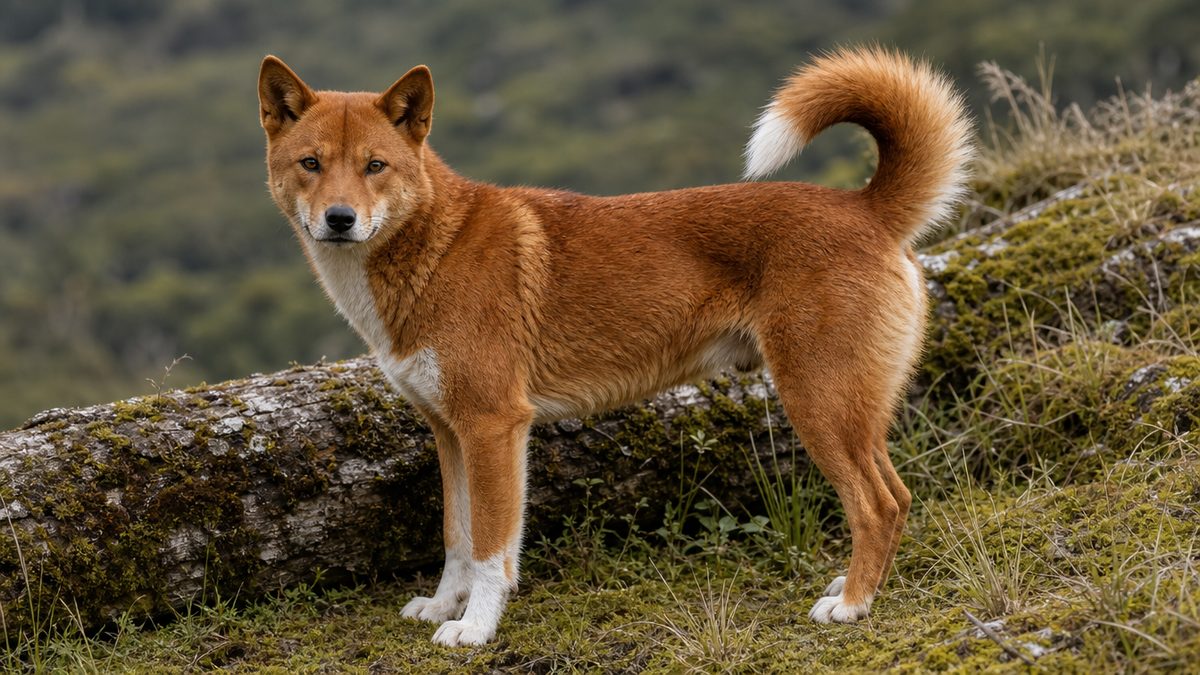
A New Guinea singing dog is a small fox-like canid of the New Guinea Highlands, named for a modulated howl whose pitch rises and falls, and it is the only dog on this site whose scientific name is still argued over in print. Two organisations publish a written breed standard for it, no kennel club of any size registers it today, and its entire captive population descends from eight animals.
Start with the sound, because the name comes from it and so does most of the attention. The animal produces a long modulated howl that rises and falls in pitch, often chorused with other dogs, and its own breed standard calls the dramatic ability to vary the pitch of that howl the breed's most unique characteristic. It does not bark repetitively. The vocal repertoire the standard describes runs to yelps, whines and single-note howls, which is why a 2016 comparative study of canid howl structure across species and subspecies included it alongside wolves and jackals rather than alongside pet dogs.
The written record of the dog is older than the recording of its voice. On the Torres expedition to the south coast of New Guinea in 1606, Captain Don Diego de Prado y Tovar wrote of finding small dumb dogs that neither bark nor howl, and do not cry out even if beaten with sticks. On 26 October 1897 the Lieutenant-Governor of British New Guinea, Sir William MacGregor, recorded a wild dog at 7,000 feet on Mount Scratchley and obtained the first specimen.
How it got the name Hallstrom's dog
The modern name traces to two dogs and one benefactor. In 1956, Albert Speer and J. P. Sinclair obtained a pair in the Levani Valley, in what is now Hela Province in Papua New Guinea, and sent them to Sir Edward Hallstrom, who forwarded them to Taronga Zoo in Sydney. In 1957 the Australian mammalogist Ellis Troughton examined those two specimens and classified them as a distinct species, *Canis hallstromi*, in Hallstrom's honour. The Continental Kennel Club still carries Hallstrom's Dog as an official alias, alongside New Guinea Dingo.
That single pair matters more than a naming footnote should. The captive animals in American and European collections descend from the Taronga stock, and in 1976 the German explorer Wolfgang Nelke captured five more dogs in the Eipomek River Valley and sent them to Germany. Between them, those handfuls of animals are most of what the world has.
What the two written standards actually prescribe
Two documents describe this dog in prescriptive detail, and Bonbeno read both. Where they agree, the figures below are safe. Where they disagree, the table says so, because nobody else prints them side by side.
| Point | NGSD Club of America | Continental Kennel Club |
|---|---|---|
| Height, males | 14 to 18 inches average | 14 to 18 inches |
| Height, females | 13 to 17 inches average | 12 to 17 inches |
| Weight | 17 to 30 pounds average | 17 to 31 pounds, both sexes |
| Head | Wedge-shaped, prominent stop, lip corners turned up into a grin | Wedge-shaped from any direction, vulpine, muzzle-to-skull ratio 4:5 |
| Nose | Always solid black | Well-pigmented and black |
| Ears | Erect, small, triangular, set wide apart, tilting forward about 60 degrees when alert | Small to medium, erect by maturity, 10 and 2 o'clock at rest, 11 and 1 when alert |
| Bite | Scissors or level, teeth large for the size of the dog | Level or scissor, forty-two teeth |
| Body proportion | About 20 percent longer than the height at the withers | Height to length about 5:4 to 10:7 |
| Coat | Short, dense, double, plush, hair not over about 1.5 inches | Harsh weather-resistant outer coat over a short dense undercoat |
| Unilateral cryptorchidism | Acceptable but not preferred | Permitted, although not preferred, uniquely among breeds |
| Life expectancy | Not stated | 15 to 17 years |
Three rows there do work no ranking page does. The female height floor differs by a full inch between two current documents, 13 against 12, and the weight ceiling differs by a pound, so an Indian reader told that this dog is 13 to 17 inches has been given one club's figure as though it were the breed's. The life-expectancy row is an absence in one document and a claim in the other, so this page reports 15 to 17 years as the Continental Kennel Club's published figure and not as a study finding. And the cryptorchidism row is the most revealing sentence either standard contains, which the breed status and health sections take apart.
Both standards describe an anatomy no domestic breed standard describes. The American club's document states that these dogs can pass their bodies through any opening wide enough to admit the head. The Continental Kennel Club's document states that the dog can rotate its forefeet and hindfeet more than a normal canine, which assists in climbing, and can splay its forelegs sideways to 90 degrees. Those are not charming quirks. They are the reason a standard Indian balcony grille or compound wall will not hold this animal, and they are written down in the breed's own paperwork.
Is the New Guinea singing dog a breed? Tested against Bonbeno's own rule
The New Guinea singing dog passes Bonbeno's two-condition test, but it passes on private paperwork rather than on a kennel club's. Bonbeno maintains a page for dog types that are not breeds, and the rule that page applies is that a breed has a written standard and a studbook behind it, so a puppy can be measured against something. Both exist here. Neither is held by a national kennel club anywhere in the world.
Take the conditions one at a time, because each has a twist.
Condition one: is there a written standard?
Yes, and there are two of them. The New Guinea Singing Dog Club of America publishes a breed standard running through general appearance, characteristics, skull, teeth, eyes, nose, ears, neck, forequarters, forelegs, feet, body, hindquarters, tail, coat, coat colour, height and weight, gait and disqualifications, and it closes with a named disqualification list. The Continental Kennel Club publishes a second, independent standard, filed under Breed Group 1, Primitive, Pariah and Feral Breeds, which is longer still and adds proportions, expression, stop, cheeks, dentition, croup, underline, ribs, pasterns and movement.
The American club's document says something on its own face that is worth reading twice. It states that the standard is based on the original United Kennel Club standard. So a UKC standard for this animal existed.
Bonbeno read the United Kennel Club's complete current breed-standards index on 2 September 2026. It states that the UKC recognises over 300 separate breeds and lists every one by group. The Sighthound and Pariah group carries 25 breeds including the Basenji, the Canaan Dog, the Carolina Dog, the Thai Ridgeback and the Xoloitzcuintli. There is no New Guinea singing dog in it, or in any of the other eight groups. That is a registry that holds the Carolina Dog and the Canaan Dog, two other primitive pariah-type dogs, and does not hold this one. Bonbeno could not establish from a document it opened when or why the entry ended, so this page states the present position and no date.
Condition one is therefore met, but with a qualification the reader should carry: the standards that exist are club and private-registry documents, not a national kennel club's. That is the same footing as the Koolie, which passes this test on the Koolie Fundamentals and three private Australian registers, and a weaker footing than the Huntaway, which passes on a numbered national standard.
Condition two: is there a studbook?
Yes, and it has a name and a keeper. The New Guinea Singing Dog Conservation Society's own About page states that I. Lehr Brisbin PhD started the Singer stud book, and that Janice Koler-Matznick began to maintain it in 1995. That is a studbook in the ordinary sense: a record of ancestry for a closed population, kept so that a breeding decision can be made against a pedigree rather than against a guess.
It is also a conservation studbook rather than a kennel-club one, and the difference is publishable. A kennel-club studbook exists so that a dog can be shown, bred and sold with papers. A conservation studbook exists to manage genetic variation in a population too small to manage by instinct. The Society's stated purpose is exactly that, and the 2020 genome paper describes its primary aim as maintaining as much genetic variation within the population as possible. The two kinds of book do the same clerical job and answer to different questions, and only one of them is about selling you a puppy.
One registry contradicts itself about its own age
A small thing, but it is the kind of thing this site checks. The Conservation Society's About page states that Janice Koler-Matznick founded the society in 1993 and worked to establish it as a 501(c)(3) non-profit in 1995. The footer printed at the bottom of that same website states that the society was founded in 1996, with 501(c)(3) status established in 2001. English Wikipedia gives a third year, 1997. Three founding years, two of them on one website, one of them in the footer of the page carrying the other. Bonbeno reports the disagreement and picks none of them.
The verdict on breed status, and the four layers that disagree
The New Guinea singing dog does not belong on Bonbeno's dog types that are not breeds page, because a written standard exists twice over and a studbook exists and is named. What that verdict does not settle is the harder question, which is not cynological at all.
Four bodies hold four different positions on this animal, and each answer is correct within its own frame. Printing them together is more useful than picking one.
| Layer | Status | What it lets you do |
|---|---|---|
| NGSD Club of America | Written standard published, stated to be based on the original UKC standard | Measure a dog against a document, and enter a rare-breed show |
| Continental Kennel Club | Recognised, Breed Group 1, Primitive, Pariah and Feral Breeds | Register a dog with a private US registry that also runs a puppy marketplace for the breed |
| NGSD Conservation Society | Singer stud book, started by I. Lehr Brisbin and maintained since 1995 | Trace ancestry inside a closed conservation population |
| UKC, FCI and the Kennel Club of India | Absent from all three today | Nothing internationally, and no route into a Kennel Club of India pedigree |
The last row is the one an Indian reader needs. Bonbeno read the FCI's definitive letter-N index, which carries thirteen breeds, from the Nederlandse Kooikerhondje 314 to the Nova Scotia Duck Tolling Retriever 312, with no New Guinea breed among them. Bonbeno then read the twenty-breed provisional register in full, which runs from the Australian Stumpy Tail Cattle Dog 351 admitted in 2005 to four breeds admitted on 11 February 2026, and carries no New Guinea breed either. India sits at the FCI through the Kennel Club of India, so no FCI route means no KCI pedigree. Any paperwork offered with this animal in India is a private registry's, and a buyer should be told which one.
Why a breed can be recognised and still unclassified
Recognition and classification are answers to different questions, and this dog is where they come apart. A kennel club asks whether a population breeds true enough to be described in a document and traced in a book. A taxonomist asks what the animal is. The New Guinea singing dog satisfies the first test on private paperwork while the second remains genuinely open, and no ranking page separates the two.
The Greenland Dog page on this site works the same seam from the other side, where genetics says one thing and every registry that holds the breed says another. There the dispute is between two named populations. Here it is between two named kingdoms of question, and the honest answer is that the paperwork is settled and the animal is not.
A New Guinea singing dog offered for sale in India can carry no FCI pedigree and no Kennel Club of India registration, because neither body holds the breed. The only papers that can genuinely exist are a private US registry's certificate or an entry in a conservation stud book kept by a non-profit, and the second of those is not transferable paperwork in the way a buyer imagines. If you are shown a pedigree, read whose name is on it before you read anything else on it.
Is it a species, a subspecies, a dingo or a dog? Five names for one animal
The honest answer is that this is not settled, and every confident version you will read is one position stated as though it were the consensus. The animal has been formally published under at least five names, the most recent authoritative decision went one way, and researchers disputed that decision in print. Bonbeno sets out the positions and does not pick one.
This is the only page on this site where the taxonomic status of the animal is more contested than its breed status. Start with the names actually used in the literature, because the count itself is the finding.
| Name | Position it encodes | Where it appears |
|---|---|---|
| *Canis hallstromi* | A distinct wild species | Troughton's 1957 description of the two Taronga Zoo specimens |
| *Canis lupus dingo* | A subspecies of wolf, with *hallstromi* a synonym of the dingo | Wozencraft, Mammal Species of the World, third edition, 2005 |
| *Canis familiaris* | Within the range of variation of the domestic dog | The 2019 IUCN Canid Specialist Group workshop |
| *Canis dingo hallstromi* | A subspecies of a separate dingo species | Koler-Matznick and Stinner, Zoo Biology 2011 |
| *Canis papuensis* | A distinct species under a different epithet | Listed among the breed's scientific names by its own Conservation Society |
Two of those rows are load-bearing and should not be summarised away. The 2011 den-digging paper is published in a peer-reviewed zoo journal under the title *Canis dingo hallstromi*, which is a fourth binomial for the same animal, used by the author who founded its conservation society. And a 2021 veterinary survey files it as *Canis lupus dingo*, listing it alongside the dingo, the grey wolf, the red wolf and the coyote in a paper whose own title is about nondomestic species of the Canidae family. So a 2021 veterinary paper treated this dog as nondomestic two years after an IUCN workshop treated it as feral domestic.
The Conservation Society itself simply lists the lot. Its own page names the animal as Papuan dog *Canis papuensis*, Hallstrom's dog *Canis hallstromi*, *Canis familiaris*, *Canis familiaris hallstromi* and dingo *Canis lupus dingo*, without choosing. When the body that keeps the studbook declines to name the species, a breed page that names it confidently is not being careful.
The confusion runs all the way into how the animal is filed by the institutions a reader trusts. The San Diego Zoo publishes it as an animal fact sheet, organised as About, Habitat and Diet, Family Life and Conservation, in the same format it uses for wild species. Dogster publishes it as a dog breed with sections on families, other pets and grooming. Both are reputable, both are current, and they are describing the same animal in two different categories of thing.
What the 2019 IUCN decision actually did
In 2019 a workshop hosted by the IUCN Species Survival Commission Canid Specialist Group concluded that the New Guinea singing dog and the dingo are feral dogs, *Canis familiaris*, and therefore should not be assessed for the IUCN Red List at all. That ruling is worth restating plainly, because its practical effect is easy to miss. It does not say the animal is common. It says the animal is not wild, and the consequence is that this dog has no conservation status in the register a reader would go to for one.
It was disputed at the time. A BBC Wildlife feature records that some researchers dispute the decision, arguing that the evidence supports recognition of the New Guinea singing dog as a distinct wild canid that deserves assessment and protection. The same feature sets out the sequence cleanly: a new wild species in 1957, a feral subspecies of the dingo by 1969, a feral domestic dog in 2019.
The dispute is not peculiar to this animal either. The dingo's own taxonomic placement has been fought over in *Zootaxa* by a twelve-author reply, and because the two dogs are treated together in almost every scheme, a decision about one carries the other with it. That is why a page about a New Guinea dog keeps citing papers about Australian ones.
What the 2020 genome study changed, and the objection published against it
The 2020 nuclear genome study of the rediscovered highland wild dogs moved the question without closing it, and it is the strongest single piece of evidence on this animal. It established that the wild Papuan dogs and the captive singing dogs come from the same historic stock. It did not establish what that stock is.
The highland wild dog was found where nobody had looked. In 2016 an expedition led by the New Guinea Highland Wild Dog Foundation, with the University of Papua, reported 15 animals on the western side of the island near the open-cut Grasberg Mine. A 2018 expedition took blood from three of them, and those three samples carry the whole genome analysis. Three animals is a small number and the paper says so, calling for sampling from Puncak Mandala, Puncak Trikora and the Papua New Guinea side of the island.
The findings are narrow and specific, and they are worth reading in that form rather than as a headline.
- Same historic stock. Single-nucleotide polymorphism genotypes show strong similarity between the highland wild dogs and the homogeneous captive population, and phylogenetic and haplotype analyses place them as extant animals arising from the same historic stock.
- The wild population is far more diverse. Observed heterozygosity in the highland wild dogs is significantly higher than in the captive singing dogs at a Wilcoxon p of 0.0021, and higher than in a mixed dingo population at 0.0006.
- They are not village dogs. About 72 percent of the highland wild dog genome resolves to captive singing dogs or dingoes, the Oceanic groups, while New Guinea village dogs share 87 percent of their genome with breed dogs and only 13 percent with Oceanic dogs.
- The maternal haplotype does not match. Mitochondrial DNA from 9 of 24 presumed highland wild dog scat samples carried the A29 haplotype rather than the A79 haplotype that is unique to the captive singing dog, and A29 is also found in dingoes, some Asian and Arctic breed dogs and village dogs.
The fourth point is the one nobody repeats, and it is why this page will not overstate the study. The wild dogs and the captive dogs do not share the singing dog's own diagnostic maternal haplotype. That is compatible with the captive population being a narrow sample of a broader wild one, which is what the authors argue, and it is not the clean identity a headline implies. The paper is also careful about a technical limit: the Illumina CanineHD marker set was chosen because the markers are polymorphic in European breed dogs, which can depress apparent diversity in everything else.
The objection, and the reply, six months apart
A careful reader should look at the exchange rather than the abstract. Dwyer and Minnegal, of the University of Melbourne, published a Comment in the same journal, Relationship between wild-living and village-living dogs in New Guinea. The original authors published a Reply whose title states its position outright: Genetics supersedes observational records regarding New Guinea canids. Both appeared in the issue of 23 March 2021.
The objection has a documented basis. A 2016 literature review by the same Melbourne authors concluded that at the time of European colonisation the wild dogs and most or all village dogs of New Guinea comprised a single though heterogeneous gene pool, and that there is no definitive evidence that the founding members of captive singing dog populations were wild-living animals rather than dogs born and raised in village populations. If that is right, the captive stock is a sample of village dogs, and the wild-canid framing goes with it.
Where the two positions genuinely agree
Both sides accept that these dogs sit inside a distinct Oceanic canid lineage. Whole-genome work published in 2020 places the ancestors of the dingo and the singing dog arising in southern East Asia, moving through Island Southeast Asia about 9,900 years ago and reaching Australia about 8,300 years ago, and explicitly rejects an arrival with the Austronesian expansion that reached New Guinea about 3,600 years ago. Earlier immunogenetic work on dog leucocyte antigen diversity had already grouped the indigenous dogs of Bali, Australia and New Guinea together as a set worth studying as one, and a 2018 genome-wide SNP study of Australian native canids reached the same region from the Australian side.
Three statements are supported and no more. The captive New Guinea singing dogs and the Papuan highland wild dogs come from the same historic stock. That stock sits inside a distinct Oceanic canid lineage, close to the dingo and clearly apart from modern breed dogs and from New Guinea village dogs. And whether that lineage is a species, a subspecies or a domestic dog gone feral is a live disagreement between named researchers, published in the same journal within six months of each other. Bonbeno publishes the disagreement. A page that resolves it is telling you something the literature does not.
One more caution about a number that circulates. The Continental Kennel Club's history states that the ancestors were brought to New Guinea approximately 6,000 years ago. The whole-genome dating above gives a migration through Island Southeast Asia around 9,900 years ago and an arrival in Australia around 8,300 years ago, and rejects a 4,300-year arrival outright. The registry's round figure matches neither, so treat it as a registry's summary rather than a date.
New Guinea singing dog price in India: there is none, and here is the proof
No new guinea singing dog price in india exists, and Bonbeno publishes no rupee figure for this animal. The breed appears zero times on the three largest published Indian dog price lists, no Indian seller was found under a search whose control passed in the same session, and the only lawful import routes exclude buying one. That is a finding, not a gap.
Take the price lists first, because they are the pages an Indian buyer actually lands on. Bonbeno searched all three in full on 2 September 2026 and counted every occurrence, with controls.
| List | Breeds covered | Singing dog | Labrador control |
|---|---|---|---|
| Supertails, Dog Price List in India 2026 | 40+ | 0 | 18 |
| WrapInFur, Dog Price List in India 2026 | 50+ | 0 | 24 |
| PawSpace, Dog Price in India 2026 | 40 | 0 | 10 |
Every one of those pages carries the Labrador many times over, and every one carries the Indian pariah dog too, at 6, 10 and 11 occurrences WrapInFur, Dog Price List in India 2026 PawSpace, Dog Price in India 2026. So the instrument works and the zero is a zero. Absence from all three is the strongest available evidence that no Indian market exists for this animal, and it is a stronger form of evidence than any single search result, because these are the pages that exist to list every breed anyone might ask about.
What an Indian search actually returns instead
This is the more useful half. A search for this breed with price and puppy terms, run against India, returned no Indian seller and no Indian listing. What it returned was a book: a Flipkart product page for a New Guinea Singing Dog guide, published by Global Pet Care International. Alongside it sat an Etsy listing for a personalised singing dog garden flag priced in Hong Kong dollars, a ResearchGate paper on the breed's status and scientific importance, a Quora thread about Carolina dog values, and a Reddit thread in which somebody looking for a pariah dog is told to consider one.
Nothing offered was a dog. That is the composition finding this site relies on, and it is worth more than a rupee figure would be. Where a breed genuinely trades in India, an India-localised search fills with classifieds, kennels and city-wise price tables within the first three results. Here the commercial results are merchandise about the animal rather than the animal.
Do three things before you believe it. Divide the figure by 84.38 and by 74, because Indian pages routinely republish a US dollar band run through one exchange rate and the quotient is the tell. Check whether the page carrying it is Indian at all, since Rs is used for both Indian rupees and Pakistani rupees and the two are not close in value. Then ask which animal the seller actually has, because the global captive population is 200 to 300 animals held largely for conservation, and the probability that one of them is for sale in an Indian city is not a small number, it is a claim that needs extraordinary proof.
Why no price can form, structurally
Two facts close the loop, and neither is about supply and demand.
- No registry route into India exists. The breed is absent from the FCI's definitive and provisional registers, so the Kennel Club of India cannot issue a pedigree for it, and it is absent from the United Kennel Club's 300-plus breed index as well United Kennel Club.
- No lawful commercial import route exists. DGFT Trade Notice 22/2022-23 permits import of a dog only as a pet with a valid pet book in the importer's name, for R&D with CPCSEA recommendation, or for internal security by the Defence and Police Force, and states that applications for trading or breeding purposes shall be duly rejected.
- The population is too small to supply a market. The entire captive population descends from eight partially related founders and numbered no more than 200 to 300 animals worldwide when the 2020 genome paper was written, with an inbreeding coefficient estimated above 0.50.
Between them those three facts mean no lawful supply chain can form, so a published Indian price for this breed would have to be either invented or a different dog's. The nearest thing to an honest number on this page is the cost of ownership for a small dog in an Indian city, which is real, published and sourced, and which is the figure that would actually matter if the rest of this were possible.
Cost of ownership in India for a 17 to 30 pound dog
Budget ₹4,000 to ₹8,000 a month to keep a dog of this size in an Indian city, using the small-breed column of the fullest published Indian cost table, plus ₹1,200 a year for vaccination. With no purchase price to add, the running cost is the whole cost, and it is the only rupee figure on this page that describes something real.
The small-breed column is the right one. Both written standards put this dog at 17 to 30 or 17 to 31 pounds, which is 8 to 14 kg, below the medium band that starts around Beagle size.
| Category | Published range |
|---|---|
| Dry or wet food | ₹1,500 to ₹2,500 a month |
| Routine vet visits | ₹500 to ₹1,000 a month |
| Vaccinations | ₹1,200 a year |
| Grooming | ₹1,500 to ₹3,000 a month |
| Training | ₹0 to ₹3,000 over six months |
| Treats and toys | ₹300 to ₹800 a month |
| Flea control and deworming | ₹300 to ₹600 a month |
| Stated monthly total | ₹4,000 to ₹8,000 |
The small-breed column fails its own arithmetic in the opposite direction to the large one
Add the source's own rows and the printed total is too low at both ends, which is the reverse of what the same table does for a large dog. Taking the floor of every row, ₹1,500 food plus ₹500 vet plus ₹1,500 grooming plus ₹300 treats plus ₹300 parasite control is ₹4,100, plus ₹100 a month of vaccination at ₹1,200 a year and ₹0 of training, giving ₹4,200 against a printed ₹4,000. Taking the ceiling of every row gives ₹7,900, plus ₹125 and ₹500 of training spread over six months, giving ₹8,525 against a printed ₹8,000.
Run the same check on the large-breed column of the same table and the printed total comes out higher than its rows, at ₹8,000 against ₹7,250 at the floor. One table cannot be padding its total for a big dog and shaving it for a small one, so the totals are estimates rather than sums. Build your own budget from the rows, and treat any single headline figure as an approximation with an unexplained sign.
Three rows move for this animal, and one of them collapses
- Grooming falls to nothing. The ₹1,500 to ₹3,000 small-breed grooming line is written for a Shih Tzu or a Lhasa Apso. This coat is short, dense and double, hair no longer than about 1.5 inches, and the standard requires the dog to be presented in a completely natural condition with no trimming, not even the whiskers. Weekly brushing at home is the entire job, so most of the biggest single row in that column simply disappears.
- Containment becomes a capital cost. A dog that can pass its body through any opening wide enough to admit its head and splay its forelegs sideways to 90 degrees needs proper fencing rather than a balcony grille Continental Kennel Club. That is a one-time four-figure or five-figure spend nobody's cost table prints.
- Parasite control moves to the top of its band and stays there. Across four Indian cities and 525 dogs, 261 or 49.7 percent carried at least one tick-borne pathogen by PCR, and ticks were found on 278 of them, 53 percent. Year-round preventive cover is not optional here in the way it is in a cold climate.
- Training does not scale down. The ₹0 floor on the small-breed training row assumes a lap dog. This animal's own standard warns that the hunting drive may take over despite any previous training, so a professional course is the sensible spend, not the optional one.
The cost line nobody can price
Indian veterinary experience with this animal is effectively zero, and that has a price. There is no Indian breed-specific dosing history, no local reference range for anything, and no vet in the country who has seen a hundred of them. The one thing published research does supply is reassuring on one narrow point: a survey of eight canid taxa found the New Guinea singing dog carrying the wild-type ABCB1 gene, so normal P-glycoprotein function is expected and the ivermectin sensitivity that affects some herding breeds is not indicated here, though the authors note the sample was small.
Adoption of a dog in India runs ₹0 to ₹3,000 in fees covering vaccination, deworming and microchipping. That figure exists, is published, and applies to an animal you can actually bring home this month. It is the number the adoption section builds on, and for the reader drawn to a primitive prick-eared dog it is the whole answer.
Can a New Guinea singing dog live in the Indian climate?
No, and the reason is the opposite of what the name suggests. A tropical island sounds like a hot place, but these dogs live on a tropical *mountain*, between roughly 3,900 and 4,170 m, where the estimated annual mean is around 3 to 4 C against Chennai's 27.95 C NASA POWER climatology API. Heat tolerance is rated 2 of 5.
Getting that figure took more care than usual, and the difficulty is itself worth publishing, because it is the reason nobody else has printed one.
One grid cell describing a glacier, a mine and a town at once
Bonbeno queries climate by explicit latitude and longitude rather than by place name, because a place name can silently return another country's data. NASA POWER returns a grid cell rather than a point, and in mountains that cell can miss the ground beneath it badly. On this breed's home massif it fails worse than anywhere this site has measured.
| Point queried | Real elevation | Cell elevation | Error |
|---|---|---|---|
| Puncak Jaya summit, 4.079 S 137.158 E | about 4,884 m | 2,391.07 m | −2,493 m |
| Grasberg Mine, 4.053 S 137.116 E | about 4,270 m | 2,391.07 m | −1,879 m |
| Tembagapura town, 4.110 S 137.110 E | about 1,900 m | 2,391.07 m | +491 m |
All three returned byte-identical figures: an annual mean of 14.27 C, a hottest-month daily maximum of 21.51 C in January, a coldest-month daily minimum of 6.47 C in October and an annual mean relative humidity of 93.04 percent. One cell is simultaneously describing a glaciated summit, an open-pit mine 600 m below it and a mining town 2.4 km below that, and it is wrong about all three. Bonbeno therefore publishes the correction rather than the cell.
Correcting by the standard lapse rate of about 6.5 C per 1,000 m, the annual mean at 4,000 m comes out near 3.8 C, and at the top of the observed highland range near 2.7 C. The hottest-month daily maximum corrects to around 11 C. Those are estimates and this page labels them estimates, but they are far closer to the animal's real world than the raw cell, and the direction of the error is not in doubt.
The gap against Indian cities, in plain numbers
Indian plains cells are accurate, which is what makes the comparison usable. Delhi's cell sits 10 m below the real city, Chennai's 43 m above, Bengaluru's 78 m below and Pune's 76 m above.
| Place | Annual mean | Hottest-month daily maximum |
|---|---|---|
| Highland wild dog range, corrected to 4,000 m | about 3.8 C, estimated | about 11 C, estimated |
| Chennai | 27.95 C | 42.70 C in May |
| Delhi | 25.60 C | 48.79 C in June |
| Bengaluru | 23.74 C | 40.38 C in April |
| Pune | 23.86 C | 43.20 C in April |
Read the right-hand column. Delhi's hottest month runs a daily maximum roughly 38 C above the estimated hottest-month maximum where these dogs actually live. That is not a large gap, it is a different planet, and the World Health Organization's India page notes that the heat wave season normally runs March to June, extends into July in rare cases, and peaks in May, with five to six heat wave events a year over the north.
Why it is rated 2 and not 1
Two things pull upward and neither is decisive. The coat is short and dense rather than long, and the standard caps hair at about 1.5 inches with no feathering, which is a better configuration under Indian sun than any Nordic double coat. And the dog is small, 8 to 14 kg, which matters: in a cohort of 905,543 UK dogs, bodyweight at or above the breed and sex mean carried an odds ratio of 1.42 for heat-related illness, and dogs over 50 kg an odds ratio of 3.42. This animal is nowhere near that band.
Do not read that as heat-tolerant. The Hall cohort did not include this breed, so those odds ratios describe a transferable risk factor rather than a finding about singing dogs, and the larger companion paper shows where the danger actually sits: of 879 heat-related illness events with a recorded trigger, 652 or 74.2 percent were exertional, against 46 or 5.2 percent from vehicular confinement. A high-drive dog exercised in Indian heat is the exact profile that dominates that count.
One further note, and it cuts against the intuition that a humid highland prepares a dog for a humid plain. The homeland cell reports 93.04 percent annual mean relative humidity, higher than Chennai's 72.39 percent, so this is a wet-adapted animal. Humidity is not the problem. Twenty-four degrees of extra heat is.
Indian law and the singing dog: the taxonomy question becomes a legal one
For this one breed the unresolved taxonomy stops being academic at the customs desk. India's import policy puts wild animals and dogs in different boxes with different rules, and which box this animal falls into is precisely the question nobody has settled. Two of India's own breeding rules also collide directly with clauses both written standards carry.
Start with the import policy, because the structure of it is the point. Under Trade Notice 22/2022-23, ITC (HS) 01061900, Mammals Other, is Restricted, and it is restricted subject to Policy Condition 6 of the chapter.
| Condition | What it says | If it applies here |
|---|---|---|
| Policy Condition (6) | Import of wild animals as defined in the Wild Life (Protection) Act 1972 is prohibited, and CITES-listed species are subject to CITES | Import is prohibited outright |
| Policy Condition (7) | Import of dogs is allowed only for a pet dog with a valid pet book in the importer's name, R&D with CPCSEA recommendation, or internal security by the Defence and Police Force | A narrow personal-pet route exists |
| Policy Condition (8) | Import of commercial dogs for breeding or any other commercial activity is not permitted | No commercial route exists either way |
Read the first row against the taxonomy section and the problem is obvious. If the animal in front of an Indian customs officer is a domestic dog, Conditions 7 and 8 govern it. If it is *Canis hallstromi* or a nondomestic *Canis lupus dingo*, the wild-animal condition sits above them. A 2021 veterinary paper filed it as nondomestic; a 2019 IUCN workshop filed it as feral domestic Wikipedia, New Guinea singing dog. Records…. Bonbeno is not a legal adviser and does not know which reading an officer would take. It is enough to say that this is the only dog on this site where that question has a customs consequence, and that nobody should assume the friendlier answer.
The rest of the notice is unambiguous whichever way that falls. Applications for trading or breeding purposes, or made on behalf of another person or entity, shall be duly rejected. Entry is allowed only through the airports and seaports of Delhi, Mumbai, Chennai, Hyderabad, Bengaluru and Kolkata and, since October 2024, Kochi airport. Permanent import of up to two pets as passenger baggage without DGFT authorisation is open only to a person transferring residence to India after two years of continuous stay abroad, and applicants are advised to start at least two months before travel. The full route is set out in how to import a dog to India.
The DGFT's own PDF of Trade Notice 22/2022-23 returned HTTP 403 AccessDenied to Bonbeno on 2 September 2026, so the text above was read from a full reproduction at World Trade Scanner rather than from the issuing department's file. That is a weaker provenance than this site prefers and it is stated rather than hidden. Anyone acting on the notice should obtain the current text from DGFT directly.
Two clauses of Indian law that collide with the breed's own standards
The Prevention of Cruelty to Animals (Dog Breeding and Marketing) Rules 2017 apply to anyone breeding dogs in India. Bonbeno extracted the gazette itself with pypdf, giving 14 pages and 51,940 characters, and read the clauses rather than a summary of them. Two of them land squarely on this breed.
- Cryptorchidism. Second Schedule Part III paragraph 8(10) requires that dogs shall have been tested for genetic defects, and its list names, in terms, unilateral cryptorchid or full cryptorchid males. Both written standards for this breed tolerate exactly that. The American club's standard says unilateral cryptorchidism is acceptable but not preferred because of the high percentage of unilateral cryptorchids in the still small population, and the Continental Kennel Club's standard says this is the only breed in which monocryptorchid males are permitted Continental Kennel Club. A breed standard written around a founder bottleneck meets a rule written to stop founder bottlenecks.
- Rear dewclaws. The American club's standard states that dewclaws should not be removed from the front feet but may be removed from the back feet. Second Schedule Part II paragraph 6(8) forbids de-clawing along with tail docking, ear cropping, de-barking, branding, dyeing and any other kind of mutilation of any body part of the pup, and adds that any change of appearance by artificial means is strictly forbidden. The word dewclaw appears zero times in the gazette, so a reader must reason from the mutilation clause rather than from a named prohibition, but the direction of it is not ambiguous.
One more clause matters for the climate argument. Second Schedule Part IV paragraph 21(1), Outdoor housing facilities, bars keeping in outdoor facilities, without the attending veterinary practitioner's written approval, dogs that are not accustomed to the temperatures prevalent in the area and breeds that cannot tolerate them. Note the citation form: the Rules themselves stop at Rule 13, so this is a Second Schedule paragraph and not a Rule, and the string Rule 21 appears zero times in the gazette.
Finally, the ordinary sale rules apply here as everywhere. Rule 8(1)(a) requires that pups less than eight weeks in age are not sold, and Rule 8(1)(b) that dogs over six months are not sold without first being sterilised unless sold to another licensed breeder. Those are Rules, correctly numbered, and a seller breaching either is breaking something you can name.
Temperament and household fit, from the two standards that describe it
Both written standards describe an intelligent, curious, affectionate animal that is aloof with strangers, can be aggressive toward dogs of the same sex, and carries a hunting drive that overrides training when prey appears. That combination suits a specialist keeper with secure ground and suits almost no Indian household.
Read the descriptions in the breed's own paperwork rather than in a listicle, because they are unusually frank.
The American club's standard states that the dogs are active, lively and alert, that they constantly explore their environment using all five senses, and that they are gentle and affectionate with people they know but can be aloof with strangers and aggressive toward other dogs, especially of the same sex. The Continental Kennel Club's standard opens its temperament section by saying the breed is first and foremost a feral dog, that these dogs developed alone in the wilderness without reliance on humans, and that dogs raised by people from young pups are eager to interact with people.
Those two documents were written by different organisations and they agree on the shape of the animal. That agreement is worth more than any owner anecdote, and it is the basis for everything below.
The three sentences a buyer should read twice
- On prey drive. Their hunting drive is intense and may take over when prey is detected, despite any previous training. The Continental Kennel Club puts it as an extremely high prey drive, making any other animal fair game. In an Indian context that means cats, chickens, community dogs and small children running.
- On containment. They have incredible structural flexibility and can pass their bodies through any opening wide enough to admit their head. If left in an unstimulating environment they will figure out how many options there are to escape to find a more stimulating one.
- On other dogs. Aggression toward dogs of the same sex is written into the standard as a breed characteristic rather than as a training failure. A shared Indian society compound with free-roaming dogs is the wrong environment for that trait.
What owner-reported evidence adds, and what it cannot
A 2021 survey of owners of singing dogs kept as companion animals in North America found that they behave like other ancient and primitive domestic dog breeds and showed less aggression than many of the breeds in the study, with trainability similar to Basenjis and Canaan Dogs, and that owners compared living with one to living with a Shiba Inu or an Akita. Some owners reported dog sports and therapy or service work.
Weigh that carefully rather than dismissing it. It is real evidence that a well-raised singing dog in the right hands is a manageable animal, and it corrects the wolf-in-the-house framing that most pages reach for. What it cannot do is describe the average outcome, because the people who own these dogs in North America are self-selected specialists and the survey reached owners rather than the dogs who did not stay in homes. Bonbeno reports it as owner-reported and does not convert it into a temperament rating.
Who this animal is genuinely wrong for
Everyone reading this in an Indian city, and the reasons stack.
- Apartment households. Rated 1 of 5 on this site. Balcony grilles do not hold a dog built to squeeze through its own head-width, and a chorused howl in a stairwell is a neighbour problem you cannot train away.
- Homes with other pets. The prey drive is written into two standards. A household cat is not a risk to be managed here, it is an incompatibility.
- First-time owners. Rated 1 of 5, and not only because the dog is difficult. There is no lawful supply route, no Indian veterinary experience, and a global population small enough that every individual animal belongs to a conservation calculation.
It is worth noticing that the behaviour described in both standards is what you would expect of an animal that has not been under selection for cooperation with people. Nothing in either document describes biddability, handler focus or a wish to please, which are the traits every working breed standard on this site leads with. That is a behavioural observation and not a taxonomic argument, and it does not settle whether the dog is a species or a breed. But it is consistent with a population that spent most of its history living alongside people rather than for them.
Training: what works, what this animal refuses, and realistic timelines
To train a New Guinea singing dog, work with its curiosity and its problem-solving rather than against its independence, and accept from the start that recall around prey will never be reliable. Its own standard says the hunting drive may take over despite any previous training, and that sentence should shape every decision you make.
Trainability is rated 2 of 5 on this site, and the rating is about compliance rather than intelligence. Every source agrees the animal is bright. The Conservation Society describes highly intelligent and resourceful hunters, expert problem solvers who learn quickly. The Continental Kennel Club standard says they are eager to learn tricks when in the right mood. The phrase in the right mood is doing a great deal of work in that sentence.
Four things that transfer from primitive-breed training
- Train for enrichment, not obedience. Puzzle feeders, scent games and novel objects meet the drive the standard describes, which is constant exploration using all five senses. A dog whose curiosity is fed is a dog that is not testing your fence.
- Pay well and pay immediately. Owner reports place trainability alongside the Basenji and the Canaan Dog, breeds that work for a clear reward and disengage from repetition. Short sessions, high-value food, and stop before the dog does.
- Socialise early and keep socialising. The Continental Kennel Club standard states that when kept as pets these dogs must undergo socialisation and companionship obedience training to understand the boundaries that exist outside the wild. Do it in the first sixteen weeks and then keep doing it.
- Manage rather than correct. Aggression toward same-sex dogs is in the standard as a breed characteristic. Separate, do not referee.
The two things training cannot fix
Be honest with yourself about these before anything else, because they are structural rather than behavioural.
Recall around prey. This is the sentence to plan around: the hunting drive is intense and may take over when prey is detected, despite any previous training. There is no protocol in this page or anywhere else that makes an off-lead singing dog safe near livestock, poultry, cats or a road. Plan for a long line and a secure area, permanently.
Voice. The animal does not bark repetitively, which sounds like good news until you hear the alternative. Its most unique characteristic is the ability to vary the pitch of a howl, and it will sing, and it will howl in chorus with anything that answers. In an Indian apartment block, where a neighbour's dog answering across a courtyard is a certainty, that is a nightly event and it is not a training problem.
A realistic first-year timeline
| Period | What is achievable | What is not |
|---|---|---|
| 8 to 16 weeks | Handling, crate, name response, exposure to novelty and to people | Reliable recall of any kind |
| 4 to 8 months | Lead manners, a marker word, basic position cues, enrichment routine established | Off-lead freedom, contact with unfamiliar same-sex dogs |
| 8 to 14 months | Long-line freedom in secure ground, scent work, sport foundations | Recall competing with a moving animal |
| Adult | A cooperative, engaged, contained dog with a job | An off-lead dog around livestock, poultry or traffic |
That last row does not soften with age. It is the same row at eight years as at eight months, and any page that tells you otherwise is describing a different animal.
A six-month professional course in an Indian city runs ₹0 to ₹3,000 on the small-breed line of the fullest published cost table, and ₹2,000 to ₹5,000 on the medium one. That is affordable and worth every rupee. The difficulty is not price or availability. It is that no Indian trainer has worked with this animal, so you would be paying a good generalist to learn on your dog, and the honest place to start is a trainer with real primitive-breed experience on Shiba Inus, Basenjis or Indian pariah dogs.
Exercise: containment and enrichment, not distance
To meet a New Guinea singing dog's needs, supply secure ground it can explore and problems it can solve, rather than a fixed number of kilometres. Exercise need is rated 5 of 5 on this site for an unusual reason: this is not a stamina athlete like a herding breed, it is a wild-living hunter that will dig, climb and escape when it is bored.
The Continental Kennel Club's standard states the requirement more plainly than any care blog does. If left to their own devices in an unstimulating and unenriched environment, these dogs will create their own entertainment, often to the tune of exploring what their surroundings are made of and figuring out how many options there are to escape to find a more stimulating environment. That is the exercise brief, written by a registry.
The anatomy that decides what a fence has to do
Three sentences from the two standards, together, describe an animal no ordinary Indian boundary will hold.
- It can pass its body through any opening wide enough to admit its head.
- It can rotate its forefeet and hindfeet more than a normal canine, which assists in climbing.
- It can splay its forelegs sideways to 90 degrees.
Measure your gaps, not your height. A standard Indian society compound gate with 100 mm vertical bars, or a balcony grille of the same spacing, is an open door to an 8 to 14 kg dog with a narrow skull. The Conservation Society describes the same trait from the field, noting dogs that navigate dense vegetation with agility and stealth. This animal is agile in a way that is genuinely unusual among dogs, and it is the single most practical thing on this page.
What a workable daily routine looks like
| Time | Activity | Why then |
|---|---|---|
| Before 07:00 | 45 to 60 minutes of long-line walking and free sniffing on secure ground | The only window in an Indian summer that is safely cool |
| Mid-morning | Puzzle feeder or scatter-feed the day's ration | Feeds the exploration drive the standard describes |
| Afternoon | Rest indoors, out of the sun | Exertional heat illness accounts for 74.2 percent of triggered cases in the largest cohort study |
| After 19:00 | 45 minutes of scent work, novel objects or secure-garden freedom | Second cool window, and mental work tires this dog faster than distance does |
Note what that table does not contain. There is no running-partner row, and no cycling row. In a country where the heat wave season normally runs from March to June and peaks in May, and where Delhi's hottest month carries a daily maximum of 48.79 C, sustained forced exercise with a dog adapted to a 4,000 m tropical mountain is the exact scenario that dominates the heat-illness literature.
Under-exercise does not look like restlessness
It looks like a missing dog. Every other breed page on this site can say that an under-exercised dog chews furniture and barks. Here the registry-documented failure mode is different and more serious: the animal solves the problem of the enclosure. Plan for that, and treat a secure, roofed, dig-proof run as the baseline rather than the upgrade.
It is a rare conservation animal at large with an extremely high prey drive, in a country whose free-roaming dog population it would hybridise with immediately. Researchers name hybridisation as one of the most serious threats facing the breed, and Indian street dogs are exactly the population that threat describes. Containment is not a convenience question here. It is the whole ethical case for keeping the animal at all.
Grooming a short double coat in Indian humidity
To groom a New Guinea singing dog, brush weekly, bathe rarely, dry the ears properly and leave everything else alone. The coat is short, dense and double, with hair not exceeding about 1.5 inches and no feathering, and the breed's own standard requires it to be presented in a completely natural condition with no trimming, not even the whiskers. Grooming load is rated 2 of 5.
The two standards describe the coat slightly differently and the difference is worth knowing. The American club's calls the texture plush, with the undercoat often visible through the guard hairs, longest on the shoulders, the centre of the back and the backs of the thighs. The Continental Kennel Club's calls the outer coat harsh and weather-resistant over a short dense undercoat, with short coat on the face, ears, skull and fronts of the legs. Plush and harsh are not the same word, and both are current.
Whichever is right, this is a double coat, and a double coat is a heat management system rather than an insulation layer. The Conservation Society records that the coat is typically dense and short, shedding with the seasons. In India that seasonal shed becomes a near-continuous one, because the temperature cue that triggers a clean twice-yearly moult in a cold climate never arrives.
The five-minute weekly routine
- Brush once a week with a rubber curry or a slicker, more often through a shed. There is no coat to shape and no undercoat to strip.
- Check the ears every week and dry them after any swim or bath. Erect ears ventilate well, which helps, but Indian humidity does not.
- Trim nails monthly. Feet are small, compact and cat-like with well-arched toes, and the front dewclaws must stay on.
- Bathe only when genuinely dirty, and dry down to the skin afterwards rather than leaving the dog to air-dry in humid air.
- Leave the whiskers. The standard's no-trimming clause is explicit about them, and they are sensory equipment.
The clipping question, answered before you ask it
Never clip this coat. A short double coat clipped down in an Indian summer loses its guard layer, which is the part that reflects solar load and blocks insect access, and what regrows is often patchy. There is no version of Indian heat that a clip solves for this animal, and the breed's own standard forbids trimming outright as a condition of presentation. If your dog is struggling with heat, the answer is shade, airflow, water and a changed schedule, not scissors.
The parasite half of grooming, which matters more here than the brushing
In India, coat care is mostly tick and flea care. Across four Indian cities and 525 dogs, 261 or 49.7 percent carried one or more tick-borne pathogen by PCR, with Hepatozoon canis commonest at 30 percent, Ehrlichia canis at 20.6 percent and Babesia vogeli at 5.5 percent, and Rhipicephalus or Haemaphysalis ticks were found on 278 of the dogs, 53 percent. Concurrent infection with more than one pathogen occurred in 39 percent of cases.
Run your hands over the dog every single day. A dense short coat hides an engorged tick well, and the standard's own preferred colours, red ranging from fawn to deep rust and sable with dark tipping, are the worst possible background for spotting one. Ears, between the toes, under the collar, in the groin.
The published Indian small-breed grooming line runs ₹1,500 to ₹3,000 a month, which is the largest single row in that column. It is written for a Shih Tzu, a Lhasa Apso or a Maltese, all of which need a professional appointment every few weeks. This coat needs none, ever. Delete that row, keep the money for parasite prevention, and you have funded the thing that actually threatens the dog in India.
Health, life span and the founder bottleneck nobody prints with its denominator
The defining health fact about this animal is not a disease, it is a founder population of eight partially related animals behind every captive singing dog alive, with an inbreeding coefficient estimated above 0.50. No breed-specific screening scheme exists, the breed has no row in OFA's published statistics, and both of its written standards tolerate a defect because of that bottleneck.
Start with the numbers, because they are the ones every other page states without a denominator.
| Figure | Value | Source |
|---|---|---|
| Founders of the entire captive population | 8, partially related | Surbakti et al. 2020 |
| Captive animals alive worldwide | No more than 200 to 300 | Surbakti et al. 2020 |
| Estimated inbreeding coefficient | Greater than 0.50 | Surbakti et al. 2020, citing earlier work |
| Captive dogs genotyped in the 2020 study | 10 on the SNP chip, 16 in the combined dataset | Surbakti et al. 2020 |
| Living with owners in North America | Speculated at 300 to 500 | NGSD Conservation Society |
Two of those rows disagree and this page prints both. The 2020 paper says no more than 200 to 300 captive animals remain alive today, worldwide. The Conservation Society says the known population living with owners within North America is speculated to be around 300 to 500. The Society's own word is speculated, the paper's figure is six years older, and a North American subset cannot exceed a world total. Bonbeno does not average them and does not pick one.
An inbreeding coefficient above 0.50, in plain terms
A coefficient above 0.50 is higher than full-sibling mating produces in a single generation from unrelated parents. It means that for more than half of the genome, the two copies an animal carries are identical by descent from one of those eight founders. The practical consequence is not one named disease. It is elevated risk across the board of recessive conditions, reduced fertility and reduced litter viability, and the 2020 authors say so directly, warning that each new generation of captive dogs increases the risk for fixation of deleterious alleles.
The measured consequence is visible in the data. Observed heterozygosity in the captive dogs is significantly lower than in the wild highland dogs, at a Wilcoxon p of 0.0021, and the authors describe the captive animals as inbred and as encapsulating a severely limited amount of the genomic variation of the original wild population.
The cryptorchidism clause, which is the bottleneck made visible
This is the single most revealing sentence in either standard, and it appears in both. The American club's standard states that because of the high percentage of unilateral cryptorchids in the still small population, unilateral cryptorchidism is acceptable but not preferred, while bilateral cryptorchidism is a disqualification. The Continental Kennel Club's standard states that this breed is the only breed in which monocryptorchid males are permitted, although not preferred.
Two independent registries wrote a defect into a standard because excluding it would shrink an already tiny gene pool. That is an honest piece of drafting and it is worth admiring. It is also, in India, a direct collision: Second Schedule Part III paragraph 8(10) of the Prevention of Cruelty to Animals (Dog Breeding and Marketing) Rules 2017 lists unilateral cryptorchid or full cryptorchid males among the genetic defects a breeding dog must have been tested for. The Indian law section works that through.
Clinically, a retained testicle is not a cosmetic matter. It carries a well-recognised elevated risk of neoplasia and of torsion, and the standard answer anywhere in the world is surgical removal. A dog kept intact with a retained testicle for breeding purposes is a dog whose owner has chosen the population's genetics over the individual's risk.
What is not known, stated as not known
Bonbeno found no breed-specific screening scheme, no hip or elbow scheme, no eye scheme and no DNA panel for this animal from any source it could open. It has no row in OFA's published statistics tables, and that absence is a controlled one: searching the full 2.23-million-character statistics pull case-insensitively returned zero for SINGING, GUINEA and DINGO, against 109 for LABRADOR, 85 for BORDER COLLIE and 62 for BASENJI. OFA requires 100 hip evaluations before publishing a breed at all, so this is what a genuinely unevaluated population looks like.
One narrow positive finding does exist. A survey of eight canid taxa tested the ABCB1-1delta mutation, which causes ivermectin and related drug sensitivity in some herding breeds, and found all eight, the New Guinea singing dog included, carrying the wild-type gene and expected to have normally functioning P-glycoprotein transporters. The authors note the sample was small and a more robust study is needed, so treat it as reassurance rather than clearance.
Life span, and the Indian disease pressure that would decide it
The only published life span figure Bonbeno could open for this breed is the Continental Kennel Club's 15 to 17 years, and this page reports it as a registry's claim rather than as a study finding. No peer-reviewed life table covers this animal, and in India the thing most likely to shorten a life here is not inherited at all.
Be clear about what is missing. The two large UK life-table studies that this site leans on elsewhere are built from breeds present in UK primary veterinary care, and this animal is not one of them. Borrowing a median from a related breed would be exactly the substitution this site refuses, so this page prints no median and no confidence interval. A registry's round figure and a life table are not the same kind of number, and 15 to 17 years for a dog whose global population is 200 to 300 animals is a statement about what a club has observed rather than what a cohort has measured.
The other unquantified factor is upward rather than downward. A small dog of 8 to 14 kg would ordinarily be expected to outlive a large one, and everything published about this animal describes a lean, hard-muscled, structurally sound body with no exaggeration anywhere. What pulls the other way is a genome in which more than half the loci are identical by descent from eight animals. Bonbeno cannot net those two off against each other honestly, so it does not try.
What would actually threaten this dog in an Indian city
Three Indian-specific pressures apply to any dog here, and they are measured.
| Finding | Figure | Study |
|---|---|---|
| Dogs infected with one or more tick-borne pathogen, by PCR | 261 of 525, 49.7 percent, 95 percent CI 45.4 to 54.1 | Abd Rani et al., four Indian cities, 2011 |
| Hepatozoon canis | 30 percent | Same |
| Ehrlichia canis | 20.6 percent | Same |
| Dogs carrying Rhipicephalus or Haemaphysalis ticks | 278 of 525, 53 percent | Same |
| Concurrent infection with more than one pathogen | 39 percent of cases | Same |
| Ehrlichiosis in Indian working kennels, by dot-ELISA | 19.1 percent of 225 suspected cases | Mittal et al., 2017 |
| Ehrlichiosis in the same cases, by nested PCR | 5.8 percent | Same |
Two details in that second study matter more than the headline. Of 46 total positive cases, 24 were apparently healthy dogs, so a normal-looking animal is not a clear one. And concurrent infections of *Ehrlichia canis* and *Babesia gibsoni* were mostly fatal. For an animal with no Indian veterinary history and a heavily inbred immune background, that is the risk profile to plan around, and it is met with year-round parasite prevention rather than with a screening scheme that does not exist.
Heat is the third. The largest cohort study of heat-related illness in dogs found a case fatality of 14.18 percent among 395 confirmed events in 905,543 dogs, which is a high number for something entirely preventable. Its companion paper puts 652 of 879 triggered events, 74.2 percent, in the exertional category. Neither study included this breed, so those are transferable risk figures rather than breed findings, and the climate section explains why an animal from a 4,000 m tropical mountain sits at the wrong end of them.
With no breed scheme to follow, the sensible baseline is the general one: a cardiac auscultation and a full orthopaedic examination at maturity, an ophthalmologist's examination once, a thyroid panel if anything is unexplained, and a documented decision about any retained testicle taken with a veterinary surgeon rather than with a breed club. Every one of those is a general-practice item available in an Indian metro. None of them is a substitute for the population-level screening that a breed of 200 to 300 animals cannot support, and saying so is more useful than inventing a protocol.
Feeding an 8 to 14 kg hunter in India, and the body condition score that decides it
To feed a New Guinea singing dog, work to a body condition score rather than to a cup measurement, split the daily ration across two meals, and use a good part of it as enrichment rather than putting it in a bowl. No breed-specific feeding research exists, so this section says which parts are general small-dog practice and which parts are specific to this animal.
Start with the honest disclaimer. Bonbeno found no peer-reviewed nutrition study, no published energy requirement and no breed feeding trial for this animal from any source it could open. What follows is general veterinary practice for a lean, active, 8 to 14 kg dog, applied to a body both standards describe as lean and muscular with substantial but never heavy bone Continental Kennel Club.
Score the body, do not measure the cup
A body condition score is a nine-point scale you assess with your hands and eyes, and it is the only feeding instrument that works across foods, brands and individual metabolisms. Aim for 4 or 5 of 9. You should feel the ribs easily under a thin fat cover without pressing, see a waist from above, and see an abdominal tuck from the side. Both standards ask for a defined waist at the flank and a moderate tuck-up, so the breed's own paperwork describes the target Continental Kennel Club.
In India this matters more than in a cold climate for a mechanical reason. Bodyweight at or above the breed and sex mean carried an odds ratio of 1.42 for heat-related illness across a cohort of 905,543 dogs. Fat is insulation, and insulation is the last thing an animal from a 4,000 m mountain needs in a Chennai May.
A workable schedule
| Stage | Meals a day | Notes |
|---|---|---|
| 8 to 16 weeks | 4 | Small frequent meals, growth food, weigh weekly |
| 4 to 6 months | 3 | Drop one meal, keep the ration steady, score every fortnight |
| 6 to 12 months | 2 | Move to adult food as growth slows, expect appetite to swing |
| Adult | 2 | Split morning and evening, scatter or puzzle at least one of them |
| Senior | 2 | Same ration structure, watch for muscle loss rather than weight loss |
The published Indian small-breed food line runs ₹1,500 to ₹2,500 a month, which is realistic for an 8 to 14 kg dog on a mid-range commercial diet. Expect the upper end rather than the lower, because this is a high-drive animal, not a lap dog of the same weight.
Two things specific to this animal
- Feed part of the ration as work. The exploration drive both standards describe is met more cheaply through food than through anything else. Scatter-feeding in grass, frozen puzzle toys and hidden portions turn a meal into forty minutes of the mental work this independent dog otherwise creates for itself.
- Guard the food. An animal with an extremely high prey drive that can climb, squeeze and problem-solve will teach itself to open a bin, a fridge or a neighbour's chicken coop. Store food in sealed containers behind a door that latches, and treat counter-surfing as a containment issue rather than a manners one.
Two ordinary Indian cautions apply as they do to every dog. A rice-heavy household diet without a protein source is not adequate for a lean muscular animal, and cooked bones, chocolate, onion, garlic and grapes remain off the list. Anything beyond that, including raw feeding, is a conversation to have with your own veterinarian, not with a page.
For a dog adapted to a cloud forest at 93.04 percent annual mean relative humidity and a hottest-month daily maximum near 11 C, an Indian summer is a continuous dehydration event. Multiple bowls, shade, refilled twice a day, and a hard rule that the dog is never left in a parked vehicle. Vehicular confinement accounted for 46 of 879 triggered heat-illness events in the largest study, 5.2 percent, which is small only because most owners already know it and still not zero.
Month by month through the first year, if you are ever responsible for one
The first year with a New Guinea singing dog is a containment and socialisation project rather than an obedience one, and the window that matters most closes early. This timeline is built from what the two written standards prescribe, what Indian law requires and what general primitive-breed practice supports, and it says so wherever it is inference rather than evidence.
One legal boundary sets the start. Rule 8(1)(a) of the Prevention of Cruelty to Animals (Dog Breeding and Marketing) Rules 2017 requires that pups less than eight weeks in age are not sold, and Second Schedule Part III paragraph 8(9) states that vaccination can start at seven to eight weeks and is usually completed at eighteen weeks. Anyone offering a six-week-old puppy of any breed in India is breaching a rule you can name.
| Age | Priority | The specific risk |
|---|---|---|
| 8 to 10 weeks | Settle, handle daily, start the vaccination course | Handling tolerance is easier to build now than at any later point |
| 10 to 16 weeks | Socialisation to people, surfaces, sounds, vehicles and traffic | This window does not reopen; an under-socialised adult of this breed is aloof rather than shy |
| 4 to 6 months | Audit every gap in every boundary, at head width | The puppy is now agile enough to test them and small enough to fit |
| 6 to 9 months | Long-line work, marker training, scent games, adult food | Prey drive comes online; the first serious chase usually happens here |
| 9 to 12 months | Neuter or spay discussion, orthopaedic and cardiac check at maturity | A retained testicle must be identified and a decision documented with a vet |
| 12 months on | Maintain socialisation, maintain containment, maintain enrichment | Everything above is a maintenance programme, not a course you finish |
The gap audit, which is genuinely specific to this breed
Do this once, properly, at four months. Take the puppy's skull width and walk the property measuring every vertical gap: balcony grille, gate, compound wall drainage, air-conditioner cutout, window mesh. Anything wider than the head passes the whole dog, because the standard says so in terms. Then check upward, because this animal rotates its feet to climb and splays its forelegs to 90 degrees. A wall that stops a Labrador does not stop this.
Cryptorchidism, and when to look
Both testicles should be descended by around eight weeks and are normally checkable well before six months. In this breed that check is not routine, it is the specific inherited finding the standards themselves flag: unilateral cryptorchidism is written into both documents as tolerated because of the founder bottleneck Continental Kennel Club. If one is missing, that is a surgical conversation about neoplasia and torsion risk rather than a show-ring conversation.
The Indian summer rule for a growing dog
From March to June, when the Indian heat wave season normally runs and peaks in May, a growing puppy of a highland breed goes out before seven in the morning and after seven in the evening and not in between. That is not caution, it is the arithmetic: Delhi's hottest-month daily maximum is 48.79 C against an estimated 11 C in the range these dogs come from. Build the habit in the first summer and it holds for life.
Bonbeno publishes this timeline for completeness and for the small number of specialist keepers and conservation facilities who may genuinely need it. It is not an invitation. There is no lawful route to buy this animal in India, no Indian veterinary experience with it, and a worldwide captive population small enough that every individual matters to a breeding programme rather than to a household. If this timeline reads as achievable to you, the responsible next step is the adoption section, not a search for a seller.
The singing dog against the dogs Indian readers actually confuse it with
Readers arrive at this breed from three directions, and each one leads to a different comparison. Some want an ancient primitive dog with prick ears. Some have read that it is a kind of dingo. Some are chasing rarity. The table below sets the animal against the four dogs those readers usually mean, on the points that decide the answer.
One rule governs the whole table. Breed recognition here is a statement about registers Bonbeno opened, not a judgement about the animals.
| Breed | Registry position | Available in India | Heat tolerance |
|---|---|---|---|
| New Guinea singing dog | Two private written standards, a conservation stud book, absent from UKC, FCI and KCI | No lawful route | 2 of 5 |
| Indian pariah dog | India's own landrace, widely kept and rehomed | Yes, free to adopt | 5 of 5 |
| Basenji | UKC Sighthound and Pariah group, FCI 43 | Yes, imported and bred | See the breed's own page |
| Canaan Dog | UKC Sighthound and Pariah group, FCI 273 | Rare but registrable | See the breed's own page |
| Dingo | Not a domestic breed under any register | No lawful route | Higher, an Australian animal |
Two rows there do the real work. The Basenji is the honest answer for almost every reader drawn to this page by the barkless prick-eared primitive dog. It is genuinely ancient, genuinely primitive, genuinely vocal in an unusual way rather than a barking way, it holds an FCI standard so a Kennel Club of India pedigree exists for it, and it is legally obtainable. The United Kennel Club files it in the same Sighthound and Pariah group it uses for the Carolina Dog and the Canaan Dog, and does not file the singing dog anywhere.
The Indian pariah dog is the better answer still, and it is the one this site keeps returning to. It is India's own ancient landrace, adapted to exactly the heat and disease pressure the climate and life span sections describe, and it costs ₹0 to ₹3,000 in adoption fees.
Against the dingo, which is the comparison most pages make
The dingo comparison is real and it is also the source of most of the confusion. Genetically, the singing dog and the dingo sit together in a distinct Oceanic lineage, and the 2020 study places the Papuan highland wild dogs basal to both. The mitochondrial evidence complicates it: the A79 haplotype is unique to the singing dog while the A29 haplotype found in the wild highland dogs also occurs in dingoes, Asian and Arctic breed dogs and village dogs.
Physically they are not interchangeable. The singing dog is markedly smaller, at 17 to 30 pounds against a dingo's typical adult weight, and Tim Flannery's field description was of an animal that looks similar to the dingo, only smaller. If an Indian seller offers you a dingo-like dog and calls it a singing dog, size is the first thing to check and the hardest thing to fake.
What no comparison table can capture
The vocalizations are the one axis on which this animal genuinely has no competitor, and it is why the comparison usually starts. No other canid on this site is described in its own breed standard as having a dramatic ability to vary the pitch of its howl as its most unique characteristic. That is a real distinction and it is worth stating plainly, alongside the equally real point that a chorused howl is a liability in an apartment block and an asset in a valley.
Bonbeno prints no price column in the table above, because only two of those five dogs have a verifiable Indian price and putting a rupee figure beside a dog with no lawful supply route would invite exactly the fabrication the price section documents. Compare on availability and on registry position instead. Those are the columns that decide whether you can lawfully and responsibly own the animal, and they are the columns nobody else fills in.
Mistakes Indian readers make about the New Guinea singing dog
Five errors account for almost everything wrong on the Indian internet about this animal, and four of them come from reading one confident source instead of two contradictory ones. Each is listed with the check that catches it.
1. Reading a tropical island as a hot climate
This is the biggest one and it is entirely understandable. New Guinea is on the equator, so a reader assumes the dog is heat-adapted and would do well in Chennai. The animal lives between roughly 3,900 and 4,170 m on a glaciated massif, where the estimated annual mean is around 3 to 4 C NASA POWER climatology API. The check is elevation, not latitude. Ask what altitude a breed comes from before you ask what latitude.
2. Treating one registry's answer as the answer
The Continental Kennel Club recognises this as a breed and runs a puppy marketplace for it. The United Kennel Club's current 300-plus breed index does not carry it at all. The FCI carries it in neither the definitive nor the provisional register. Every one of those statements is true and they describe different registers. The check is to name the register whenever anyone says recognised, and to ask whether that register issues anything the Kennel Club of India will accept.
3. Believing a rupee price
There is no verified Indian price for this animal and there cannot be one, because no lawful commercial import route exists and the worldwide captive population is 200 to 300 animals Surbakti et al. 2020. The check is three-step: divide any quoted figure by 84.38 and by 74 to see whether it is a converted dollar band, confirm the page carrying it is Indian rather than Pakistani since Rs means two currencies, and then ask which specific animal the seller is holding. A page that quotes a price for a breed with no supply chain is describing something else.
4. Buying an unregistered lookalike
This is the mistake with a real Indian victim. India has a large population of unregistered prick-eared, red or sable, fox-faced dogs, and most of them are Indian pariah dogs or pariah crosses, which are wonderful animals sold under a false name at a false price. The check is size and paperwork. Ask to verify the animal against the written standard: 14 to 18 inches at the withers for a male, 17 to 30 pounds, a solid black nose, white on no more than one third of the body, and a thick white or very light tan brush on the underside of the tail. Then ask who would register the dog, and check that registry's own breed list yourself rather than taking a certificate at face value.
5. Reading a taxonomic dispute as a settled fact in either direction
Both confident versions are wrong. It is not established that this is a wild species, and it is not established that it is simply a feral domestic dog. A 2019 IUCN workshop chose the second, researchers disputed it in print, a 2021 veterinary paper filed the animal as nondomestic anyway, and a 2020 genome study plus a published Comment and Reply left the question open Stafford EG, Harrison T, Kortum Cairns KM, Surbakti S, Parker HG. The check is to look for a Comment and a Reply, because on a contested question the objection is usually published in the same journal and almost nobody reads it.
| Mistake | The check |
|---|---|
| Assuming a tropical island means a hot-adapted dog | Ask the altitude, not the latitude |
| Taking recognised at face value | Name the register, then open its own breed list |
| Believing a quoted rupee price | Divide by 84.38 and 74, check the host country, ask which animal |
| Buying a prick-eared lookalike | Measure against the written standard, then check the registry yourself |
| Reading the taxonomy as settled | Look for the published Comment and Reply |
Most readers who reach this page want a dog that is ancient, independent, quiet in the ordinary sense, low-grooming, heat-hardy and genuinely unusual. That dog exists in India, it is the Indian pariah dog, and it is free. Every health issue that this page has to leave blank for the singing dog, because no scheme and no cohort exists, is better understood in a landrace that thousands of Indian vets see every week. Wanting a primitive dog is a good instinct. Importing one is the part that does not follow.
One last observation about what Indian readers are actually asking. A genuine People also ask module does exist for this breed, and the four questions it returned were how many puppies a singing dog has, whether they are rare, what their characteristics are, and whether they are good companion dogs. Three of those four are answered on this page with a cited figure. The first is answered by saying that Bonbeno could find no published litter-size figure for the breed and will not invent one, which is the least satisfying answer on the page and the only honest one.
Adoption, sourcing and the conservation question you are actually being asked
You cannot adopt a New Guinea singing dog in India, and the honest advice is not to try. What you can do is understand what the animal needs from people who are not going to own one, and then adopt the dog that is already waiting in your own city for ₹0 to ₹3,000 in fees.
Set out the sourcing position plainly, because every ranking page skips it.
- No Indian breeder exists. Bonbeno found no Indian listing, no Indian kennel and no Indian classified for this breed under a search whose control returned a full set of genuine Indian price pages in the same session. What an India-localised search returns instead is a book about the breed on Flipkart and a garden flag on Etsy.
- No lawful commercial import exists. DGFT Trade Notice 22/2022-23 states that applications for trading or breeding purposes shall be duly rejected, and Policy Condition 8 bars import of commercial dogs for breeding or any other commercial activity.
- The personal-pet route is narrow and does not apply to a purchase. Permanent import of up to two pets as passenger baggage without DGFT authorisation is open only to a person transferring residence to India after two years of continuous stay abroad, with a valid pet book in the importer's name.
- And the wild-animal condition may sit above all of that. Policy Condition 6 prohibits import of wild animals as defined in the Wild Life (Protection) Act 1972, and whether this animal falls under it is the unresolved question the taxonomy section describes.
Even overseas, this is not an ordinary rehoming market. A ranking American page states plainly that the dogs are rare in the US and that it is challenging to find breeders with puppies available, directing readers to a club's listings instead. The 2020 study's own captive samples came from sanctuaries and private owners who had rescued them from zoos and exotic animal breeders across seven US states and Canada, which is a description of a rescue population rather than a supply chain.
What the conservation programme actually needs
This is the part worth reading even if you never keep one. With eight founders, an inbreeding coefficient above 0.50 and 200 to 300 animals worldwide, every breeding decision in this population is a genetics decision rather than a preference. The Conservation Society's primary aim is to maintain as much genetic variation within the population as possible, and it maintains the Singer stud book to do it. The 2020 authors argue for infusing highland wild dog genetics into the captive population, and note that including even a small number of individuals from a natural population can significantly lift the genetic diversity of a captive breeding programme.
A pet buyer is not part of that, and a pet buyer in India actively works against it. A dog placed into a household with free-roaming dogs outside the gate is a hybridisation risk, and hybridisation is named among the most serious threats facing the breed. Wanting one is not the same as helping.
How to help without owning one
- Support the field work rather than the market. The two organisations that exist are the New Guinea Singing Dog Conservation Society, which funds genetics and health research, and the New Guinea Singing Dog Club of America, a national breed club and rescue.
- Read the source rather than the summary. The 2020 study is open access at PubMed Central, as are the Comment and the Reply, and reading all three takes an hour.
- Do not repeat a price you cannot trace. The most useful thing an Indian reader can do about this breed is refuse to circulate a rupee figure for it.
The dog you can actually bring home
Adopt an Indian pariah dog. It is India's own ancient landrace, prick-eared, short-coated, heat-hardy, independent, and present in every Indian city in numbers. Adoption fees run ₹0 to ₹3,000 and cover vaccination, deworming and microchipping, and the same source names SPCA India, World for All and Animal Aid Unlimited among the organisations that place them, alongside hundreds of city-level rescues. Every reason to want a singing dog is better served by a dog that is already here.
Ask four questions in this order, and stop at the first one without a document. Which register issued the paperwork, and does that register's own published breed list carry the breed. What import authorisation covered the animal's entry, and under which policy condition. Who bred it, and is that breeder in the Singer stud book. And what happens to the dog if you say no. A seller who cannot answer the first two is not selling you this breed, whatever the animal in the crate looks like.
Common questions about the New Guinea singing dog
Are New Guinea singing dogs rare?
Yes, and the number has a denominator. The entire captive population descends from only eight partially related founders, no more than 200 to 300 captive animals were alive when the 2020 genome study was written, and the inbreeding coefficient for that population has been estimated above 0.50. The Conservation Society separately estimates 300 to 500 living with owners in North America.
Are New Guinea singing dogs good companion dogs?
For almost every Indian household the honest answer is no, and the reason is not temperament. There is no lawful route to acquire one here, both written standards describe a dog that is aloof with strangers with an intense hunting drive, and one of them warns that it can pass its body through any opening wide enough to admit its head. This is a rare conservation animal, not a pet you can shop for.
What are the characteristics of a New Guinea singing dog?
It is a small to medium fox-like dog with a wedge-shaped head, prick ears, obliquely-set triangular eyes, a plush double coat and a brush tail, standing 14 to 18 inches at the withers for males and weighing 17 to 30 pounds. Its defining trait is a modulated howl whose pitch rises and falls, and it does not bark repetitively.
How many puppies does a New Guinea singing dog have?
Bonbeno found no published litter-size figure for this breed from a source it could open, so this page prints none. The only peer-reviewed reproduction paper Bonbeno located is a 2011 first report of den-digging and parental behaviour in captivity, and it does not supply a breed litter average. An unsourced number would be a guess with a citation attached.
Is New Guinea singing dog a domestic, feral or wild dog?
That is genuinely unresolved and this page does not resolve it. The animal has been published as a distinct species Canis hallstromi, as the wolf subspecies Canis lupus dingo, as Canis dingo hallstromi and as the domestic dog Canis familiaris, and a 2019 IUCN Canid Specialist Group workshop chose the last of those, a decision some researchers dispute in print.
How is it related to the Australian dingo?
Closely, and the 2020 nuclear genome study sharpened the picture rather than settling it. Highland wild dogs from Papua sit basal to both the dingo and the captive singing dog on the phylogenetic tree, and 72 percent of the highland wild dog genome resolves to captive singing dogs or dingoes, against New Guinea village dogs sharing 87 percent of theirs with breed dogs.
What is the New Guinea singing dog price in India?
There is none. The breed appears zero times on the three largest published Indian dog price lists, covering 40-plus, 50-plus and 40 breeds, while the same three pages carry Labrador 18, 24 and 10 times. Bonbeno quotes no rupee figure for this animal because no verifiable Indian figure exists, and a converted foreign price would be an invention.
Can a New Guinea singing dog be imported into India?
Not in any ordinary way, and the taxonomy is what decides it. ITC (HS) 01061900 is Restricted subject to Policy Condition 6, which prohibits importing a wild animal as defined in the Wild Life (Protection) Act 1972, while Policy Conditions 7 and 8 govern dogs and bar import for breeding or commerce. Which condition applies depends on a classification nobody has settled.
How long does it live?
The Continental Kennel Club prints a life expectancy of 15 to 17 years on its breed page, and Bonbeno reports that as a registry claim rather than as a study finding, because no peer-reviewed life table Bonbeno could open covers this animal. Both large UK life-table studies of companion dogs are built on breeds present in UK primary veterinary care, which this one is not.
Was it really thought to be extinct?
In the wild, yes, and the 2020 paper says so in its own words: the absence of sightings and the lack of exports since the late 1970s supported the hypothesis that the singing dog was extinct in the wild. The 2016 expedition that reported 15 highland wild dogs near the Grasberg Mine, and the 2018 blood sampling of three of them, is what overturned it.
Is it under threat?
The wild population's size and distribution are not known, which is a different statement from a threat category. The 2019 IUCN workshop's decision that the animal is a feral domestic dog means it is not assessed for the Red List at all, so it has no conservation status in the place a reader would look for one. Hybridisation with village dogs is the threat researchers name.
How does it 'sing'?
It produces a long modulated howl whose pitch rises and falls, sometimes chorused with other dogs, and its own breed standard calls the ability to vary the pitch of the howl the breed's most unique characteristic. The same standard records a complex vocal repertoire of yelps, whines and single-note howls rather than repetitive barking.
Does the New Guinea singing dog climb?
Yes, and both written standards describe the anatomy that allows it. The Continental Kennel Club standard records that the dog can rotate its forefeet and hindfeet more than a normal canine, which assists in climbing, and can splay its forelegs sideways to 90 degrees. The American club's standard says it can pass its body through any opening wide enough to admit its head.
Where does it live?
In the mountains of New Guinea, on both sides of the political border between Papua New Guinea and the Indonesian provinces of Papua. Reported habitat runs from 2,500 to 4,700 m, and the highland wild dogs studied in 2020 were observed between roughly 3,900 and 4,170 m at the base of Puncak Jaya, in the Tembagapura district of Mimika Regency.
Compare with similar breeds
New Guinea singing dog sits in 1 Bonbeno group. Each one compares it directly against the breeds it is genuinely an alternative to, on the same figures.