
Breed profile
New Zealand Huntaway: breed, price and heat tolerance in India
New Zealand's loudest working dog, tested against Bonbeno's own two-condition rule for what makes a breed, and against Indian heat.
Quick answer
The Huntaway is a breed on Bonbeno's own two-condition test, and it passes cleanly: Dogs New Zealand publishes a written standard for it, numbered DNZ 535 and dated 9 August 2013, and the New Zealand Sheep Dog Trial Association keeps a stud register. No Huntaway price in India exists, because the breed appears zero times on the three largest published Indian price lists. Heat tolerance 3 of 5.
This page is general information for Indian pet owners and is not veterinary advice. It cannot diagnose, treat or replace an in-person examination. Take any dog showing collapse, laboured panting, lameness, sudden behaviour change or a temperature above 39.5 C to a registered veterinarian immediately, and discuss vaccination, deworming, screening and any breeding decision with your own vet before acting on anything written here.
Huntaway at a glance
What a Huntaway is, and why it barks
A Huntaway is a large New Zealand herding dog bred to drive sheep away from the handler using a deep, loud, sustained bark, and it is the only major working breed in the world selected on voice rather than on eye or grip. Dogs New Zealand carries it as breed DNZ 535 in the Working group, with a written breed standard dated 9 August 2013.
Start with the sound, because everything else follows from it. The Dogs New Zealand standard states that a Huntaway's voice, meaning its bark when moving stock, should be deep, loud and able to be maintained all day. No other breed standard on this site asks for that. A Border Collie is asked to be silent. A Kelpie is asked to be silent. The Huntaway exists because New Zealand farmers found that silence did not work on their country.
The standard explains the reasoning in its own history section, and it is worth reading rather than summarising. As New Zealand's sheep population grew and flocks got bigger, farmers found that traditional working dogs like Border Collies were less able to cope with the mild, moist climate and the size of the farms, and that with the shepherd often far behind the dog, the silent working method of the collie made it difficult to manage the flock and keep track of the dog. So they went looking for a dog with a short-haired coat, greater stamina, and the ability to bark to control the flock.
Seven possible ancestors, and the standard admits it does not know
The Dogs New Zealand standard names seven breeds as possible contributors and then says plainly that the exact origins are unknown. That honesty is rarer than it should be in breed history, and it is worth quoting the list because it explains what a Huntaway can look like.
- Border Collie, the base the whole project started from and the dog the standard says could not cope.
- Bearded Collie, which is where a bearded or rough coated Huntaway most plausibly comes from.
- Labrador, which is a reasonable explanation for the food motivation every New Zealand trainer complains about.
- Rottweiler, which is why so many Huntaways are black and tan and why a photograph of one is routinely mistaken.
- Harrier, a pack scenthound with carrying voice, which is the obvious candidate for the bark.
- Gordon Setter, another black and tan gundog.
- Smithfield Collie, the old English droving dog that also sits in the Australian Cattle Dog's founding story.
Read that list beside the FCI's Australian Stumpy Tail Cattle Dog standard and a pattern appears. The Smithfield turns up in both founding accounts, on both sides of the Tasman, doing the same job of moving stock over unfenced country. Two national working dogs, two different climates, one imported English ancestor.
The physical description, and the sentence that undercuts it
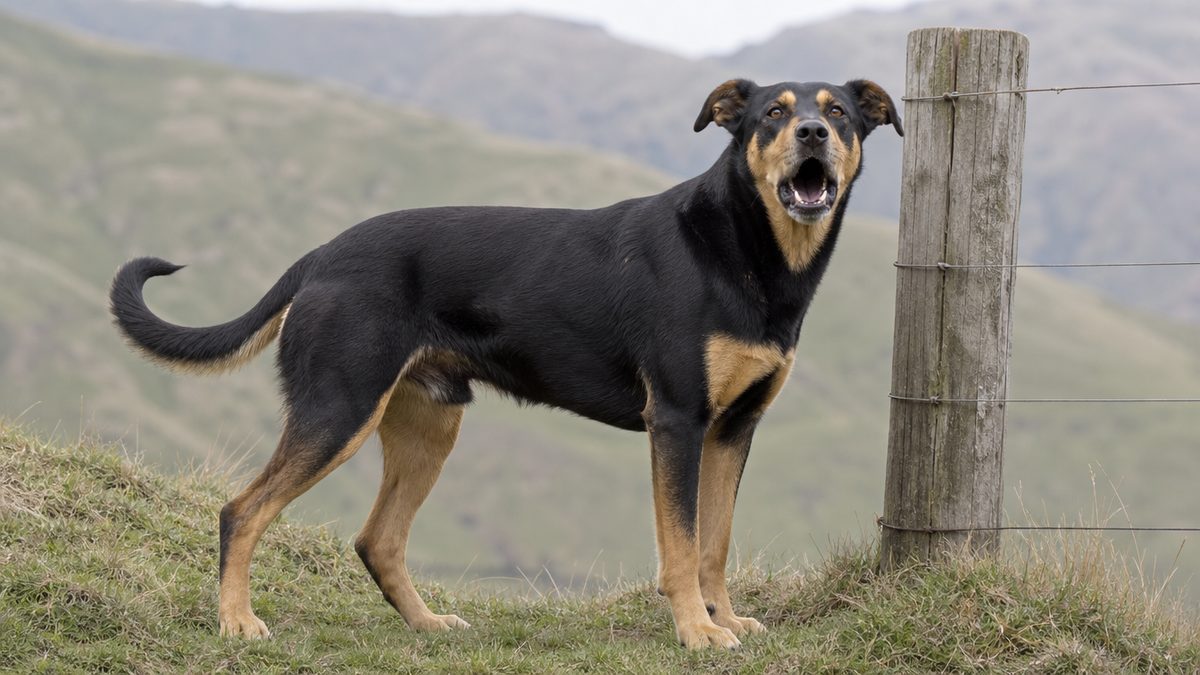
The standard describes a well-built, robust dog of medium to large height and weight, usually short-haired, with a deep chest showing lung power, a strong neck, stooping shoulders and a well bent hock, and an expression of high intelligence. It then says something no other breed standard on this site says. A Huntaway's colour, coat and size are totally irrelevant as compared to their working ability, although it is accepted that a high percentage fit into the mid size, black and tan, smooth haired range.
| Point | What the standard says |
|---|---|
| Height | Dogs 61 to 66 cm, bitches 56 to 61 cm, opened by the words though any size is acceptable |
| Weight | Dogs 30 to 40 kg, bitches 25 to 35 kg, described as the mid range rather than a limit |
| Coat | May be smooth, medium, long, grizzly, bearded or rough, with or without undercoat |
| Colour | Totally irrelevant, though a high percentage are black and tan |
| Nose | Black, whatever the colour of the dog |
| Ears | Moderately wide at the base, set on top of the skull rather than the side, carried semi-erect with the tips slightly drooping when alert |
| Bite | Scissor bite required; under or overshot mouth is a Very Serious Fault |
| Voice | Deep, loud and able to be maintained all day |
That coat clause matters more in India than anywhere else it will be read. A Huntaway may or may not carry a double coat, because the standard permits both, so two dogs of the same breed can arrive with completely different heat loads. Ask what the parents' coats were before anything else.
Heavy pendulous ears AND pricked ears are both listed as Very Serious Faults in the Dogs New Zealand standard, which leaves a narrow correct form: moderately wide at the base, set on top of the skull, carried semi-erect with the tips slightly drooping in an attitude of listening. A black and tan dog with fully pricked ears sold to you as a Huntaway is more likely a Rottweiler cross or a Kelpie cross. This costs you nothing to check and it is the one conformation point the standard is strict about.
Is the Huntaway a breed? Tested against Bonbeno's own rule
The Huntaway is a breed on Bonbeno's own two-condition test, and it passes more cleanly than any contested dog this site has assessed. Bonbeno maintains a page for dog types that are not breeds, and the rule that page applies is that a breed has a written standard and a studbook behind it, so a puppy can be measured against something. The Huntaway has both, and one of them is official.
Take the conditions separately, because the second one has a twist that no ranking page mentions.
Condition one: is there a written standard?
Yes, and it is a national kennel club's official document rather than a club handout. Dogs New Zealand publishes a breed standard for the NZ Huntaway under the number DNZ 535, filed in the Working group, carrying the copyright line 09 Aug 2013. It runs to eighteen prescriptive sections covering Origin, Description, Temperament, Head and Skull, Muzzle, Mouth, Eyes, Ears, Neck, Forequarters, Body, Hindquarters, Feet, Tail, Coat, Colour, Size and Faults, and it closes with the same undescended-testicle clause an FCI standard carries.
It is also prescriptive in the way standards are. It lists eleven Very Serious Faults by name, including a domed skull, a high peaked occipital bone, heavy pendulous or pricked ears, weak jaws, a snipy muzzle, full staring or light eyes, crooked legs, flat or hare feet, cow hocks, a tail twisted or carried over the back, and an under or overshot mouth. A document that can disqualify a dog on eleven named points is a standard by any working definition. Kennel club recognition is therefore not in doubt, and Wikipedia records it as the first recognition of a dog breed of New Zealand origin.
Wikipedia's own article says the Huntaway is distinguished only on working ability and that there is no prescribed appearance or lineage, and then links, from its own infobox, a New Zealand Kennel Club standard that prescribes appearance in eighteen sections and names eleven Very Serious Faults. Both statements sit on one screen. Neither is tested. Reading the standard is what resolves it, and nobody ranking for this term has done that.
Condition two: is there a studbook?
Yes, and it is a merit register rather than a closed parentage register, which is the most interesting fact about this dog and appears on no other page. The New Zealand Sheep Dog Trial Association keeps a stud register, and its revised rules make entry conditional on winning rather than on breeding.
- Rule E2(a) requires that all dogs which have won a Standard Open event, or enter for an Island or New Zealand Championship, be registered in the NZSDTA Stud Register.
- Rule E2(b) requires the application within 28 days of the win, through the Stud Register Representative for the Centre of domicile, and states that failure means the dog is not allowed to compete in any further Standard Open trials.
- Rule E2(c) requires an official Stud Book registration or receipt number before a qualified dog can compete at a New Zealand or Island Championship.
- Rule E2(d) requires that registered dogs which have changed ownership have the ownership transferred before they are eligible to compete.
So a Huntaway enters the studbook by winning a sheep dog trial, not by having two registered parents. That inverts the usual logic of a breed register, and it is exactly what you would expect of a population selected on working ability. It still satisfies the condition, because a studbook that records ancestry and enforces transfer of ownership is a studbook whatever the entry criterion. It also means an ordinary farm Huntaway that never trials is unregistered in that book, which is the normal state of most of the 26,884 Huntaways on New Zealand's national dog database.
The verdict, and the two things that do not change it
The Huntaway does not belong on Bonbeno's dog types that are not breeds page. It has an official written standard from a national kennel club and a studbook kept by its parent working body, which is both conditions met with room to spare.
The FCI's absence does not change that. Bonbeno read the FCI's definitive letter-H index, which carries eight breeds, Halden Hound 267, Hamiltonstovare 132, Hanoverian Scent Hound 213, Harrier 295, Hellenic Hound 214, Hokkaido 261, Hovawart 190 and Hygen Hound 266, with no Huntaway among them. Bonbeno then read the 20-breed provisional register in full, which carries the Australian Stumpy Tail Cattle Dog 351 and the Lancashire Heeler 360 and no New Zealand breed at all. Both checks passed a control in the same session. Dogs New Zealand sits in the FCI's own members list as an Associate member, which is a weaker status than the Kennel Club of India's full membership, and that is the likely reason a New Zealand breed has never been advanced.
The second thing that does not change it is stranger, and it is the part worth telling a buyer. The breed's own standard ends by recording that it is the opinion of the New Zealand Sheepdog Trial Association that a Huntaway should never be shown, due to the large variance in colour, type and size and the inability to prove in a show ring their core and only task of working stock, and that a New Zealand Huntaway should not be kept solely as a pet. A kennel club published a conformation standard and then printed, inside it, the working body's objection to ever judging the dog on conformation. That is a breed which is recognised and does not want the recognition used.
| Layer | Status | What it lets you do |
|---|---|---|
| Dogs New Zealand | Recognised, breed DNZ 535, standard dated 9 Aug 2013 | A pedigree, a Working group entry, and a document to measure a puppy against |
| NZSDTA Stud Register | Registered on winning a Standard Open event | Compete at Island and New Zealand Championships, and record a recorded pedigree |
| FCI | Absent from both the definitive and the provisional register | Nothing internationally, and no route into a Kennel Club of India pedigree |
Compare that with the Koolie, which this site assessed the same way and also called a breed. The Koolie passes on an unofficial club document called the Koolie Fundamentals and three competing private registers. The Huntaway passes on a national kennel club's numbered standard and one parent-body register. Same test, same answer, and the Huntaway's evidence is the stronger of the two.
Huntaway price in India: there is no market to price
No Huntaway price in india can be quoted, because Bonbeno found no verifiable Indian supply and will not convert a foreign figure into rupees. The breed appears zero times across the three largest published Indian dog price lists, while the control term Labrador appears ten or eleven times on each of them PawSpace, Dog Price in India 2026.
That is a controlled absence rather than an empty search, and the difference matters. Each of those three pages was downloaded in full and searched as raw text, not summarised by a tool.
| Source | Breeds it claims to cover | Huntaway mentions | Labrador mentions |
|---|---|---|---|
| Supertails, Dog Price List in India 2026 | 40+ | 0 | 10 |
| WrapInFur, Dog Price List in India 2026 | 50+ | 0 | 11 |
| PawSpace, Dog Price in India 2026 | 40 | 0 | 10 |
The control is what makes the zero worth publishing. A search that returns nothing on your breed and nothing on a Labrador has told you about the instrument. A search that returns nothing on your breed and ten Labrador hits on the same page, in the same read, has told you about the market. Bonbeno also ran the query as a search, and a control search on labrador retriever price in india returned a full set of Indian price pages in the same session while the Huntaway query returned only generic price-list pages carrying no Huntaway row.
Why no Indian supply chain can form
Two independent facts close the route, and each of them is checkable. First, there is no Indian pedigree pathway. The FCI does not recognise the Huntaway in either its definitive index or its provisional register Federation Cynologique Internationale, and the Kennel Club of India issues pedigrees against FCI nomenclature as India's FCI member, so a Kennel Club of India Huntaway pedigree cannot exist. Second, the import route is closed for exactly the purpose a supply chain needs.
DGFT Trade Notice 22/2022-23 classifies dogs under ITC (HS) 01061900 as a Restricted import. Policy Condition 7 allows import only for a pet dog with a valid pet book and records in the importer's own name, for research by an R&D organisation with CPCSEA recommendation, or for internal security by the Defence and Police Force. Policy Condition 8 states that import of commercial dogs for breeding or any other commercial activity is not permitted, and paragraph 6 states that any applications for trading or breeding purposes, or applications made on behalf of some another person or entity, shall be duly rejected. Entry is limited to the airports and seaports of Delhi, Mumbai, Chennai, Hyderabad, Bengaluru and Kolkata and, since October 2024, Kochi airport Department of Animal Husbandry…. The full route is set out in how to import a dog to India.
Put those together and the position is simple. Nobody can lawfully import a Huntaway into India to breed from or to sell, and nobody can register one with the Kennel Club of India. What remains is one narrow lawful path, a person moving to India with their own dog and its pet book, which produces individual animals and never a market.
Ask three questions before anything else. Which register holds the parents, given that no Indian register can. Which of the seven named ports the founding stock entered through, and on whose pet book. And what the dog will look like, given that its own standard says colour, coat and size are irrelevant, so there is nothing to check the puppy against on appearance. A seller who can answer all three has something remarkable. Bonbeno has not found one.
What the breed costs where it does exist
In New Zealand a working Huntaway is not usually a retail purchase at all. It is bred on farm, worked, and sold or given between farmers, and the dogs that reach a register do so by winning trials rather than by being sold. The breed is common there in a way it is nowhere else, sitting second on the national dog database with 26,884 registrations against the Labrador Retriever's 40,485 and the Border Collie's 22,530. Huntaway, Border Collie and Heading dogs together account for 68,392 of New Zealand's 578,157 registered dogs, close to 12 percent.
That is the real answer to the price question. This is a rare breed in India and an unremarkable one in New Zealand, and the reason is not fashion. It is that the dog was built for a job that exists on 440-hectare hill farms and does not exist in an Indian city.
The honest number on this page is therefore no number. Bonbeno's editorial rule is that a page with no verifiable Indian price says so three times rather than borrowing once, and the sections below give the costs that are real instead: what any 30 to 40 kg dog costs to keep in India, and what the veterinary literature says you will be paying to manage.
Cost of ownership in India for a 30 to 40 kg working dog
Budget ₹8,000 to ₹14,000 a month to keep a Huntaway-sized dog in an Indian city, using the large-breed column of the fullest published Indian cost table, plus ₹1,800 a year for vaccination. There is no Huntaway price in india to add to that, so the running cost is the whole cost, and it is the number that actually decides whether you can keep this dog.
The table below is published for a large breed, which is the right column for a dog the Dogs New Zealand standard puts at 30 to 40 kg for males and 25 to 35 kg for females Supertails, Dog Price List in India 2026.
| Category | Published range |
|---|---|
| Dry or wet food | ₹4,000 to ₹6,000 a month |
| Routine vet visits | ₹1,000 to ₹2,000 a month |
| Vaccinations | ₹1,800 a year |
| Grooming | ₹500 to ₹1,200 a month |
| Training | ₹3,000 to ₹8,000 over six months |
| Treats and toys | ₹600 to ₹1,200 a month |
| Flea control and deworming | ₹500 to ₹800 a month |
| Stated monthly total | ₹8,000 to ₹14,000 |
That table does not add up, and you should know by how much
Add the source's own rows and the printed total is too high at both ends. Taking the floor of every row, ₹4,000 food plus ₹1,000 vet plus ₹500 grooming plus ₹600 treats plus ₹500 parasite control is ₹6,600, plus ₹1,800 a year of vaccination at ₹150 a month, plus ₹3,000 of training spread over six months at ₹500 a month, giving ₹7,250 against a printed ₹8,000. Taking the ceiling of every row gives ₹11,200, plus ₹167 and ₹1,333, so ₹12,700 against a printed ₹14,000.
The gap is ₹750 at the floor and ₹1,300 at the ceiling. Bonbeno is not calling the table wrong, because a published total may deliberately hold a buffer for the things a row-by-row list misses. Bonbeno is saying the arithmetic does not reproduce, so treat ₹8,000 to ₹14,000 as an estimate with padding rather than as a sum, and build your own budget from the rows.
What a Huntaway changes about that budget
Two rows move for this breed and one moves in your favour.
- Grooming falls to the bottom of its band. A short smooth coat needs weekly brushing and nothing professional, so the ₹500 floor is realistic where a Golden Retriever owner pays the ceiling.
- Food sits at the top of its band, and then some. This is a working-line dog with genuine stamina, and New Zealand owners feed it accordingly, with 97 percent of surveyed owners feeding once a day on a mixture of dry food and homekill meat.
- Training is not optional. A ₹3,000 six-month course is the cheapest insurance you will ever buy against a 35 kg dog that has learned to bark at everything.
- Screening is an extra line nobody prints. Hip radiography under sedation, a cardiac examination and a DNA test are not in that table, and this breed needs all three.
The cost line the table cannot show you
Add a realistic complications budget, because the New Zealand veterinary record on this breed is unusually detailed. A national survey of 2,214 working farm dog presentations across 30 rural practices found Huntaways over-represented in constipation, gastric dilatation-volvulus, theriogenological problems, laryngitis, hip dysplasia and degenerative lumbosacral disease. Gastric dilatation-volvulus was among the most important non-traumatic causes of loss in that survey. Emergency gastropexy in an Indian metro is a five-figure bill, and it arrives without warning.
The TeamMate longitudinal study gives the other half of the picture. Of 323 dogs that were free of musculoskeletal abnormality at enrolment, 184, or 57 percent, developed at least one over 4,508 dog-months at risk, a rate of 4.1 dogs per 100 dog-months. Those were working dogs on farms rather than pets on pavements, so the rate is not transferable to an Indian household, but it tells you what the body is built to spend.
Before any money changes hands, pay ₹800 to ₹1,500 for an independent veterinary consultation on the puppy, from a vet the seller did not choose. Then check the age. Rule 8(1)(a) of the Prevention of Cruelty to Animals (Dog Breeding and Marketing) Rules 2017 requires that pups less than eight weeks in age are not sold, and Second Schedule Part III paragraph 8(9) states that vaccination can start at seven to eight weeks and is usually completed at eighteen weeks. A seller offering a six-week-old puppy is breaking a rule you can name.
Heat tolerance in India, measured against the homeland
Bonbeno rates the Huntaway 3 of 5 for heat tolerance, because the usual short smooth coat is the best working configuration for Indian sun while the homeland it was selected in is roughly 17 C cooler than Chennai on annual mean. The Taihape grid cell returns an annual mean of 9.66 C and a hottest-month maximum of 30.42 C, against Chennai's 27.95 C and 42.70 C.
Every figure below was queried from NASA POWER by explicit latitude and longitude over the 2001 to 2020 climatology, so no place-name lookup could quietly serve a different town. POWER returns a grid cell rather than a point, so the elevation it reports is echoed beside each row and checked against the real town.
| Place | Cell elevation | Annual mean | Hottest month maximum | Annual humidity |
|---|---|---|---|---|
| Taihape, NZ hill country | 712.68 m | 9.66 C | 30.42 C (January) | 85.8 percent |
| Timaru, South Island | 116.86 m | 11.42 C | 27.71 C (January) | 77.3 percent |
| Palmerston North | 200.00 m | 12.26 C | 32.77 C (January) | 83.7 percent |
| Gisborne, warmest NZ region | 134.97 m | 14.22 C | 33.68 C (February) | 78.9 percent |
| Bengaluru | 841.72 m | 23.74 C | 40.38 C (April) | 67.9 percent |
| Pune | 635.99 m | 23.86 C | 43.20 C (April) | 66.8 percent |
| Delhi | 206.37 m | 25.60 C | 48.79 C (June) | 45.6 percent |
| Mumbai | 97.15 m | 26.77 C | 44.91 C (April) | 67.4 percent |
| Chennai | 48.95 m | 27.95 C | 42.70 C (May) | 72.4 percent |
Check the elevation before you trust the number
POWER's cell sat 253 m above Taihape and 125 m above Gisborne, both of which push the reported temperature slightly too cold. Correcting at the standard lapse rate of about 6.5 C per 1,000 m raises the Taihape estimate to roughly 11.3 C and Gisborne to roughly 15.0 C, which is a Bonbeno estimate and is labelled one. On the Indian side the plains cells were accurate, at 10 m below Delhi, 43 m above Chennai, 78 m below Bengaluru, 83 m above Mumbai and 76 m above Pune, so those figures are the towns.
The Ooty query returned a cell elevation of 784.64 m for a town at roughly 2,240 m, an error of about 1,455 m, and it therefore reported an implausible annual mean of 23.50 C for a hill station. Bonbeno does not publish that figure. Correcting the same 23.50 C down by 1,455 m at 6.5 C per 1,000 m gives roughly 14.0 C, which is an estimate rather than a measurement, and which lands within about 1 C of the corrected Gisborne figure. On that estimate the Nilgiris are the closest Indian analogue to a Huntaway's homeland, and the plains are not close at all.
The homeland is wet, and that changes what surprises the dog
The interesting result is not the temperature gap, it is the humidity. Taihape's cell records 85.8 percent annual humidity and Palmerston North's 83.7 percent, both higher than Chennai's 72.4 percent and far above Delhi's 45.6 percent. The Dogs New Zealand standard says the same thing in words, describing the mild, moist climate that Border Collies could not cope with and that the Huntaway was bred for.
So a Huntaway is not a dry-climate dog meeting Indian monsoon humidity for the first time. It is a cool-and-wet dog meeting hot-and-wet. Humidity is the half of the Indian climate this breed is already built for, and heat is the half it is not, which is the opposite of what most imported herding breeds face here.
What the heat evidence actually supports
The Huntaway is absent from the two large United Kingdom heat-illness studies, so Bonbeno claims only the factors that genuinely transfer. Hall 2020 in *Scientific Reports* identified 395 confirmed heat-related illness events among 905,543 dogs under primary veterinary care, an incidence of 0.04 percent and a case fatality of 14.18 percent, and found that dogs at or above their breed and sex mean bodyweight carried 1.42 times the odds of heat-related illness. A 40 kg Huntaway is a dog at the top of its own breed's weight range, which is precisely the factor that study measured.
The companion paper matters more for this breed than for almost any other on the site. Hall 2020 in *Animals* identified 1,259 heat-related illness events from 1,222 dogs in the same cohort, and of the 879 events with a recorded trigger, 652, or 74.2 percent, were exertional, against 113 environmental and 46 from vehicular confinement. Exertion is what a Huntaway does. A dog selected to muster hill country all day, run by an owner who wants to give it a proper run at 4 pm in May, is the exact profile that dataset is describing.
Where Indian law meets this dog
Second Schedule Part IV paragraph 21(1) of the Prevention of Cruelty to Animals (Dog Breeding and Marketing) Rules 2017 bars keeping certain dogs in outdoor facilities without the attending veterinary practitioner's written approval. Two of its three categories fit a Huntaway in India exactly. Sub-clause (i) covers dogs that are not accustomed to the temperatures prevalent in the area or region in question, which describes an imported New Zealand working dog with no qualification at all. Sub-clause (ii) covers breeds that cannot tolerate those temperatures, such as long-haired breeds in high temperature locations, which reaches a rough, bearded or long-coated Huntaway even though the commonest smooth-coated form escapes it.
That is a legal reason, not merely a welfare one, to keep this dog indoors and cooled through an Indian summer. The World Health Organization's India page puts the heat wave season from March to June, extending in rare cases to July, with an average of five to six heat wave events a year over the northern parts of the country and May as the peak month. May is also, on the figures above, when Chennai's maximum is 12 C above anything the breed's homeland produces.
- Work the dog before 6.30 am and after 8 pm, from March to June, and shorten sessions rather than adding shade.
- Watch weight, because being at or above the breed mean carries measurable odds of heat illness.
- Treat exertion as the risk, not parked cars, because 74.2 percent of triggered events in the largest series were exertional.
- Rate a rough-coated dog lower than the 3 of 5 on this page, because the standard permits a coat this rating does not assume.
Temperament, and who should not buy this dog
A Huntaway's temperament is robust, food-motivated, biddable and extremely vocal, and its own standard asks for a nature that is robust and not easily offended while still retaining a high degree of trainability. The reason for that combination is stated in the same sentence, because the dog does a big percentage of its work under command at distance.
Unpack robust and not easily offended, because it is the whole personality in five words. A Huntaway works a long way from its handler, in wind, on a hill, being shouted at across a valley. A soft dog would shut down. So the breed selects for a dog that absorbs pressure, keeps working, and does not sulk. That is excellent in a shepherd's hands and it is exactly why an inconsistent household ends up owned by the dog rather than the other way round.
The bark is a feature, and it is the reason most of them are rehomed
Nothing on this page matters more to an Indian buyer than this. The standard requires a deep bark, specifically that a Huntaway's voice when moving stock should be deep, loud and able to be maintained all day. A New Zealand trainer's guide to keeping the breed as a pet opens on the same point and lists barking first among the personality traits to remember.
This is not a behaviour you correct out of the dog. It is the trait the breed was created for, in the same way a Beagle's nose or a Border Collie's stare is. You can train a Huntaway to be quiet on cue, and thousands of New Zealand owners do, but you are managing a selected drive rather than fixing a fault.
An Indian apartment or gated society shares walls, corridors and lift lobbies. A dog bred to be audible across a hill farm will be audible through two flats. Before considering this breed, ask whether your building's rules survive a dog that announces every delivery, every lift arrival and every dog walked past the gate, at a volume designed to move sheep. That question ends the conversation for most readers, and it should.
What the breed's own body says about pet ownership
The Dogs New Zealand standard records the New Zealand Sheepdog Trial Association's opinion that a New Zealand Huntaway should not be kept solely as a pet. Bonbeno reports that as what it is, an opinion of the working body printed inside an official standard, and it is unusual enough to be worth weighing. No parent club of a Labrador or a Golden Retriever writes that sentence.
Read alongside the trainer's guide, the position is less absolute than it sounds. That guide is built around two real populations, older retired working Huntaways and younger dogs that failed as working dogs or came through rescue, and it treats both as trainable pets rather than lost causes. So the honest reading is that a Huntaway bought as a puppy for a flat is a mistake, and a Huntaway rehomed into an active household with land and a job is a good dog.
Aggression, and what the record actually shows
Nothing in the breed's own standard describes aggression, and the New Zealand veterinary literature does not report it as a breed problem. The national survey of 2,214 working farm dog presentations records dog bites as 12 percent of traumatic injuries, but that is dogs being bitten in a kennel-and-team environment, not dogs biting people. What Indian owners will actually meet is pushiness, noise and a large energetic dog that has decided what the afternoon plan is.
Household fit, honestly
| Situation | Verdict |
|---|---|
| Farm, plantation or estate with stock | The dog it was built for. Everything on this page works in your favour |
| House with a large fenced garden and an active owner | Workable, with two hours of real work a day and a hard rule about barking |
| Apartment in a metro | No. The bark alone ends it, and the exercise requirement finishes the argument |
| First dog | No. A robust, self-directed 35 kg dog is not a starter animal |
| Household with small children | Possible but demanding. This is a big dog that moves stock by pressure and noise, and it needs supervision rather than trust |
| Owner who works long hours | No. An under-worked Huntaway barks, digs and redecorates |
One more point that Indian buyers underrate. This is a dog you have to socialise deliberately to Indian street conditions, because it was selected in a country where a working dog meets sheep, wind and one handler. Autorickshaws, firecrackers, cattle on the road, free-ranging dogs and crowded markets are all novel, and a robust temperament is not the same thing as a socialised one.
Training a Huntaway: easy to teach, easy to spoil
To train a Huntaway, use food and distance work rather than pressure, and put a quiet cue on the bark in the first four months. The breed's own standard asks for a high degree of trainability because a big percentage of the work happens under command at a distance, and a New Zealand trainer's guide to the breed names food motivation as one of the five traits to plan around.
Bonbeno rates this breed 4 of 5 for trainability, one point below the Koolie and level with most working collies. The dog learns fast, works willingly at distance, and does not take offence, which is a rare and useful combination. What it does not do is fill its own day sensibly.
The bark cue comes first, before sit
Teach a bark cue and a quiet cue in the same week, in that order, and pay both. This is counter-intuitive and it is what New Zealand handlers do, because a behaviour on cue is a behaviour you can end on cue. A Huntaway that has never been paid for barking has no idea that stopping is a thing you can ask for, and a trainer's guide for the breed states plainly that Huntaways love to bark and can be trained not to.
- Capture the bark with a marker and a treat, so it comes under a word rather than under arousal.
- Add a quiet cue immediately, paying two seconds of silence, then five, then ten.
- Build duration on quiet in the room where the doorbell rings, not in the garden.
- Manage the trigger for the first six months, because rehearsed barking at a lift lobby is very hard to undo.
Food is the lever, and it is also the problem
Use food, because it works better on this breed than praise does, and watch the waistline while you do. The TeamMate cohort of 641 New Zealand working farm dogs recorded a median body condition score of 4 on a 9-point scale, which is lean, and those are dogs in full work. An Indian pet Huntaway on the same feeding and a fraction of the exercise will not hold a 4.
That matters beyond appearance. Being at or above the breed and sex mean bodyweight carried 1.42 times the odds of heat-related illness in a cohort of 905,543 dogs, so a heavy Huntaway in an Indian May is carrying a measurable, published risk rather than a cosmetic one.
Distance work, because the dog was built for it
Train at range from the start. The breed was developed to muster hills and mountains where the handler cannot walk or ride, so worded commands and whistles carry the work. That is an advantage almost no other pet breed gives you. A Huntaway will happily take a recall, a stop and a direction at fifty metres, and giving it that job is the cheapest way to tire the brain in a country where an off-lead hill is not available.
Twenty minutes of distance work in a fenced ground beats an hour of lead walking for this dog, and it beats it on both tiredness and heat load. Stops, directional sends, a placeboard and a whistle recall will exhaust an intelligent working dog in a fraction of the time and a fraction of the sun exposure. Do it early morning and you have solved exercise, training and heat management in one session.
What this breed resists
Harsh handling does not shut a Huntaway down, and that is the trap. A soft breed tells you immediately that your training is wrong. A dog selected to be not easily offended absorbs a bad method for months and then presents as stubborn, when what it has actually learned is that your voice is background noise. If you find yourself repeating a cue louder, stop and change the reinforcer.
Lead pressure is the other predictable fight, and the breed's own trainers list pulling among the standard problems. A 35 kg dog that has learned to lean into a collar is a genuine handling risk on an Indian road. Fix it with a front-clip harness and paid loose-lead work in the first six months, not at eighteen.
A realistic timeline
| Age | Target |
|---|---|
| 8 to 16 weeks | Bark and quiet cues on, name response, crate settled, deliberate socialisation to Indian street noise |
| 4 to 6 months | Loose lead on a front-clip harness, recall paid at 20 m, a settle on a mat while the doorbell rings |
| 6 to 12 months | Distance stop and directional sends, quiet cue holding through a delivery, first hip radiograph discussion with your vet |
| 12 to 24 months | A job that runs all year, whistle work, and a heat protocol that survives its second Indian summer |
Daily exercise, and what an Indian city can actually supply
A Huntaway needs about two hours of real work a day, split around the heat, and it needs the work to have a job in it. Its own standard asks for great endurance and a voice that can be maintained all day, and the New Zealand farms it was built for run a median of 440 hectares with a median of six working dogs each Singh I, Tucker LA, Gendall P.
Bonbeno rates this breed 5 of 5 for exercise need, the highest rating on the scale, and the rating is about mental load as much as distance. A dog that has spent a hundred and fifty years being selected to make decisions on a hillside does not settle after a lead walk around a park.
Split the day around the heat, not around your schedule
In an Indian summer the useful hours are before 6.30 am and after 8 pm, and that is not a preference. Chennai's hottest month peaks at 42.70 C, Delhi's at 48.79 C and Pune's at 43.20 C, against 30.42 C in the hill country this breed was made for. The World Health Organization puts India's heat wave season from March to June with May as the peak month.
The evidence on what goes wrong is unusually specific. Of the 879 heat-related illness events with a recorded trigger in a cohort of 905,543 United Kingdom dogs, 652, or 74.2 percent, were exertional, against 113 environmental and 46 from vehicular confinement. Exercise is the mechanism. A conscientious owner giving a working dog a proper run in the afternoon is the profile that dataset describes, not a careless one leaving a dog in a car.
| Slot | What it does | Duration |
|---|---|---|
| 05.45 to 06.45 | Off-lead or long-line work in a fenced ground, with stops, sends and recalls | 60 minutes |
| Midday | Indoors, cooled, with a chew or a scatter feed. No walk | 0 minutes |
| 20.15 to 21.00 | Loose-lead walking on cooled surfaces, plus a training set | 45 minutes |
| Twice a week | A longer hill or beach session in the coolest hour available | 90 minutes |
| Daily, any time | Ten minutes of scentwork or a puzzle feeder indoors | 10 minutes |
Check the surface, not the air
Put the back of your hand on the pavement for five seconds before an evening walk. Indian tarmac and concrete hold heat for hours after the air has dropped, and a dog is walking on it barefoot with its belly a few inches above it. A dog's cooling depends on moving air over wet surfaces, and radiant heat from below defeats that faster than air temperature suggests.
What happens without the work
An under-exercised Huntaway does not become calm, it becomes employed. The predictable outputs are barking at everything that moves past the gate, digging, destructive chewing, and lead pulling that hardens into a genuine handling problem on a 35 kg dog. In a flat, the first of those alone will get you a complaint before the dog is a year old.
Give the dog a repeatable job with an end. Herding balls, a formal retrieve, a placeboard routine, scentwork, or carrying a pack on a morning walk all satisfy a working dog in a way that distance alone does not. The test is whether the activity has a beginning, a task and a finish. Aimless movement tires the body and leaves the brain running, which is how an energetic breed ends up barking at 11 pm.
Joints are the reason to build slowly
Do not run a Huntaway puppy on hard ground before the growth plates close, and be conservative about stairs and jumping in the first year. This breed carries a documented hip dysplasia burden, at 23.6 percent of 93 radiographed Huntaways against 6.3 percent of 48 Heading Dogs, an odds ratio of 4.6. A dog with borderline hips that has been road-run at seven months arrives at four years old with a problem, and Indian orthopaedic referral is expensive and thin outside the metros.
The musculoskeletal picture in adults is equally clear. In the TeamMate follow-up, 184 of 323 working dogs, 57 percent, developed at least one musculoskeletal abnormality over 4,508 dog-months, with reduced range of motion and swelling of the carpus or stifle commonest and the hip the commonest site of pain. Those were farm dogs, so the rate does not transfer to a pet, but the pattern of what wears out does.
Compare this against the Border Collie if you are choosing between them. The Border Collie needs comparable work with less bulk to cool, and it is the breed New Zealand farmers found could not manage their conditions, which tells you the two dogs are not interchangeable in either direction.
Grooming and skin care in Indian humidity
To groom a Huntaway in India, brush weekly, check ears and feet daily in the monsoon, and run a year-round tick programme, because the coat itself is the easiest part of this dog. The Dogs New Zealand standard permits a coat that may be smooth, medium, long, grizzly, bearded or rough, with or without undercoat, and the commonest form is short and smooth.
Bonbeno rates grooming load 2 of 5, which is genuinely low for a 35 kg herding dog. A short flat coat needs a rubber curry or a slicker once a week, more during a seasonal shed, and no professional appointment at all. That is the ₹500 floor of the published Indian grooming band rather than the ₹1,200 ceiling.
Ask which coat before you ask anything else
The standard's coat clause is unusually permissive, and it has a real consequence in India. Two full-pedigree Huntaways can arrive with completely different coats, one smooth and one bearded, because the standard treats coat as irrelevant to the breed. A bearded or rough coated dog carries a heavier heat load and a slower drying time, and it is also the dog that Second Schedule Part IV paragraph 21(1)(ii) of the 2017 Rules reaches when it names long-haired breeds in high temperature locations.
Ask what coat both parents carried, not what coat the puppy has. A six-week-old puppy's coat tells you very little, and this is the one breed where the answer changes your heat protocol, your grooming budget and, for an outdoor dog, your legal position under paragraph 21(1)(ii).
Never let a working dog air dry in an Indian monsoon
Overseas working-dog advice routinely says to towel a dog and let it air dry, which is sensible in a cool, dry climate and poor advice in a Bengaluru July. A wet ear canal at 30 C is an incubator. Dry the ears with cotton wool after every bath, swim or heavy rain, and use a vet-recommended drying solution rather than water or spirit.
Bonbeno wanted to cite an Indian otitis prevalence series here and could not. The paper this site has used elsewhere would not download in this session, and Bonbeno does not cite a document it has not opened, so no Indian otitis percentage appears on this page. What can be cited is the New Zealand record on this specific breed. In the national survey of 2,214 working farm dog presentations, Huntaways were apparently over-represented in laryngitis, which is a throat rather than an ear finding but points at the same anatomy being worked hard.
Skin takes more damage than the coat suggests
In the TeamMate enrolment examinations of 641 New Zealand working farm dogs, skin abnormalities including scars and callouses were found in 272 dogs, 42 percent, second only to musculoskeletal findings at 43 percent. Those dogs were working through gorse and wire rather than Indian scrub, but the lesson transfers: this is a dog that collects small wounds, and in Indian humidity a small wound becomes a pyoderma quickly.
- Check feet, elbows and flanks after every off-lead session, because a grass seed or a thorn found on day one is an antiseptic wash and found on day five is a vet visit.
- Dry the dog properly after rain, paying attention to the ears, the armpits and the groin.
- Clip nothing. Shaving a double-coated dog removes the insulating layer that keeps radiant heat off the skin and does not make it cooler.
- Watch for black hair follicular dysplasia, a coat condition reported in a New Zealand Huntaway in the New Zealand Veterinary Journal, in which hair in the black areas of a black and tan dog thins and breaks.
Ticks are the real grooming job in India
This is where an Indian owner's routine differs most from a New Zealand one. A survey across four Indian cities found that 261 of 525 dogs, 49.7 percent, carried at least one tick-borne pathogen by PCR, with Hepatozoon canis commonest at 30 percent, Ehrlichia canis at 20.6 percent and concurrent infection with more than one pathogen in 39 percent of cases. Rhipicephalus or Haemaphysalis ticks were found on 278 of those dogs, 53 percent.
The finding that matters most for a working dog is from a study of organised Indian kennels. Across 225 suspected cases, ehrlichiosis prevalence was 1.3 percent by microscopy, 19.1 percent by dot-ELISA and 5.8 percent by nested PCR, and of 46 total positive cases, 24 were apparently healthy dogs. More than half the positives looked fine. A weekly tick check on a hardy dog that never complains is therefore not optional in India, and neither is a year-round preventive discussed with your own vet.
Run your hands over the whole dog once a week, ears and interdigital spaces included, and treat that as the grooming session rather than as an extra.
Health risks, screening and what no study can tell you
Four conditions carry real published evidence in this breed, and they are hip dysplasia, gastric dilatation and volvulus, mucopolysaccharidosis type IIIA, and dilated cardiomyopathy Hendriks MM, Hill KE, Cogger N, Jones BR Yogalingam G, Pollard T, Gliddon B Munday JS, Dyer CB, Hartman AC. That is an unusually strong evidence base for a working landrace, because New Zealand's veterinary school has been studying its own national dog for twenty-five years.
Bonbeno rates the health issues screening burden 4 of 5, higher than the breed's hardy reputation suggests. The reason is not that the Huntaway is a fragile dog. It is that three of the four conditions below are actionable before you buy, and nobody in India is going to check them for you.
Gastric dilatation and volvulus: the number that should change your feeding
This is the single most striking figure on this page. In a New Zealand case-control study of 41 dogs with gastric dilatation or gastric dilatation and volvulus against 82 working farm dogs presenting with trauma, the odds that a case was a Huntaway, after adjusting for age and season, were 19 times higher than the odds a control was a Huntaway. Gender and bodyweight were not risk factors.
The associated case series is equally practical. Of the 41 dogs whose stomach contents were recorded, 25, or 61 percent, had predominantly food or bones in the stomach, and 26 of 27 had a history of having eaten meat or bones or scavenged a carcass. Of the 62 cases in the series, 40, or 65 percent, returned to work after treatment. The national disease survey independently found Huntaways over-represented in gastric dilatation-volvulus and named it among the most important non-traumatic causes of loss.
A dog that is restless, drooling, pacing, with a swelling behind the ribs and repeated unproductive retching, is a surgical emergency and not a stomach upset. Find your nearest 24-hour small-animal surgical facility and save the number before you bring this breed home, because most Indian cities have very few and the drive is the part you cannot shorten later. Then take the New Zealand study's own hint seriously: do not free-feed bones, and do not let a Huntaway scavenge.
Hip dysplasia, and the Indian legal hook nobody mentions
A practice-based radiographic survey in the Taihape district scored the hips of 141 dogs under anaesthesia against the New Zealand Veterinary Association Hip Dysplasia Scheme, 93 Huntaways and 48 Heading Dogs. Overall prevalence, defined as a combined score from both hips of 10, was 17.7 percent. In Huntaways it was 23.6 percent, against 6.3 percent in heading dogs, an odds ratio of 4.6 with a 95 percent confidence interval of 1.3 to 16.0, and average scores of 10.8 against 5.9. The author concluded that consideration should be given to removing high-risk Huntaways from the breeding pool.
Note the width of that confidence interval, 1.3 to 16.0, on a sample of 93 and 48. The direction is solid and the magnitude is not precise, and the author calls it a preliminary study. Bonbeno reports it as the best figure that exists rather than as a settled rate.
India's own law reaches this. Second Schedule Part III paragraph 8(10) of the Prevention of Cruelty to Animals (Dog Breeding and Marketing) Rules 2017 requires that dogs shall have been tested for genetic defects, including hip dysplasia, progressive retinal atrophy, night blindness, hypothyroidism, entropion, ectropion, overshot and undershot jaw. Hip dysplasia is the first condition the clause names, and it is the one condition with a published prevalence near a quarter in this breed. Any Indian breeder of a Huntaway who has not hip-scored the parents is outside that clause.
Mucopolysaccharidosis type IIIA is a solved problem, if you test
Mucopolysaccharidosis type IIIA, also called Sanfilippo syndrome, is an autosomal recessive lysosomal storage disease that destroys the central nervous system, and the New Zealand Huntaway is the animal in which it was characterised. The disease-causing mutation was identified as 708-709insC in the sulphamidase gene, and its frequency in a sample group of 203 New Zealand Huntaways was 3.8 percent. A screening programme followed.
That means a DNA test exists and a carrier can be identified before a mating. Two carriers bred together give an expected one in four affected puppies; a carrier bred to a clear dog gives none. This is the cheapest health decision on the whole page and the one an Indian buyer is least likely to be offered.
The 2025 whole-genome survey confirms the gene is still segregating. Sequencing 249 New Zealand Huntaway and Heading dogs, and testing 435 probably causal variants from the Online Mendelian Inheritance in Animals database, found 27 segregating in the sample, with notable disease variants in CUBN, CLN8, SGSH, SOD1, VWF and VPS13B. SGSH is the sulphamidase gene, so the MPS IIIA variant has not been bred out.
Dilated cardiomyopathy, honestly bounded
Dilated cardiomyopathy carries a real signal and a small sample. In the Massey University necropsy database between January 1999 and March 2006, twelve dogs were identified with the disease, and prevalence in Huntaways was significantly higher than in all breeds, p equals 0.008, and than in large breeds, p equals 0.025. All four affected Huntaways were male, with an average age of 4 years, and clinical signs ran from one day to three weeks before presentation.
Four dogs is four dogs. The authors say so themselves, calling the findings preliminary and asking for more cases. Bonbeno publishes the p-values and the denominator together so a reader can weigh both, and does not turn four necropsies into a breed rate.
Two more findings worth knowing
- A progressive myelopathy and neuropathy was described in three 20-month-old litter-mate Huntaways with progressive ataxia, with axon and myelin degeneration in the spinal cord and some peripheral nerves. The cause was not determined and was thought likely to be genetic or nutritional. The paper warns that early signs can be mistaken for orthopaedic disease such as hip dysplasia, which matters in a breed with a 23.6 percent hip figure Hughes PL. Hip dysplasia in the New Zealand….
- The multidrug-resistance mutation is present but rare. Of 189 Huntaways sampled across seven New Zealand regions, two were heterozygous carriers of the ABCB1-1delta allele, 187 were homozygous wild type, and none was homozygous for the mutation. Two in 189 is 1.1 percent. Mention it to your vet before ivermectin-class drugs anyway, because the authors recommend exactly that conversation.
The OFA has no row, and there is no lifespan figure
Bonbeno searched a 31 August 2026 snapshot of the Orthopedic Foundation for Animals published statistics tables, 2,225,140 characters, case-insensitively. It contains no Huntaway row and no row containing the string HUNT, against a control of 109 occurrences of LABRADOR in the same file. That is an absence in that snapshot rather than a claim about the OFA database today, and it is expected: OFA requires 100 hip evaluations before publishing a breed, and this dog is essentially absent from North America.
There is also no peer-reviewed lifespan figure for the Huntaway anywhere, and Bonbeno will not substitute one. Teng 2022's United Kingdom life tables carry no Huntaway row, and McMillan 2024, across 584,734 dogs and 155 breeds, carries none either. Any Huntaway lifespan you read is an estimate. Say so when you repeat it.
Feeding a working dog that is not working
To feed a Huntaway in India, split the daily ration into two or three meals, hold the dog at a body condition score of 4 or 5 on the 9-point scale, and leave clear time either side of hard exercise. New Zealand's own data says both halves of that: 97 percent of surveyed owners feed once a day, and this breed carries 19 times the odds of gastric dilatation compared with a trauma control Hendriks MM, Hill KE, Cogger N, Jones BR.
Read those two findings together, because they contradict the practice most Huntaway owners inherit. Once-a-day feeding is normal on a New Zealand farm, and it is the wrong default for a breed with this bloat signal in an Indian household where the dog does a fraction of the work.
What New Zealand owners actually feed, and why it does not transfer
A cross-sectional survey of New Zealand Sheep Dog Trial Association members, completed by 542 of 676 eligible owners, covered 2,861 dogs over a year old. The commonest diet was a combination of dry food and homekill meat, fed by 328 of 542 owners, 61 percent, during peak work and 313 of 542, 58 percent, off-peak. Most owners, 526 of 542 or 97 percent, fed once a day.
The study's own conclusion is the part worth carrying. Homekill may be deficient or marginal in vitamins and minerals, so opportunities exist to improve these dogs' diets and therefore their longevity and performance. The traditional working-dog diet is being flagged by the researchers who documented it, not endorsed by them.
For an Indian owner it does not transfer at all. Homekill is not a category here, raw meat handling at 35 C ambient is a different food-safety problem, and a pet Huntaway in a Pune flat burns a small fraction of a mustering dog's calories.
A workable Indian feeding plan
| Stage | Meals a day | What to prioritise |
|---|---|---|
| 8 to 16 weeks | 4 | A large-breed puppy food with controlled calcium, to slow growth rather than speed it |
| 4 to 12 months | 3 | Steady growth, no calcium supplements, and no free access to bones |
| 12 months to 7 years | 2 or 3 | A weighed ration rather than a scooped one, split around the work |
| 7 years onward | 2 or 3 | Fewer calories, joint support discussed with your vet, unchanged portion discipline |
Use large-breed puppy food deliberately rather than by default. Fast growth on a calorie-dense adult food is the classic way to turn a genetically borderline hip into a clinical one, and this breed already carries a published hip dysplasia prevalence of 23.6 percent.
Keep it lean, and know what lean looks like
The TeamMate cohort of 641 New Zealand working farm dogs recorded a median body condition score of 4 on a 9-point scale, with an interquartile range of 3 to 5. That is genuinely lean, and those were dogs in full work. Aim for 4 or 5 in a working Indian dog and 5 in a pet, and recheck monthly by feel rather than by eye.
Weight is not cosmetic in this climate. Dogs at or above their breed and sex mean bodyweight carried 1.42 times the odds of heat-related illness in a cohort of 905,543 dogs, so an overfed Huntaway in an Indian May is carrying a measured risk rather than a look. A lean dog is a more heat-tolerant dog, and that is the cheapest intervention on this page.
Split the ration into two or three meals rather than one. Leave a clear ninety minutes either side of hard exercise. Do not feed bones or allow scavenging, because 25 of 41 recorded cases had predominantly food or bones in the stomach and 26 of 27 had eaten meat, bones or a carcass. And raise prophylactic gastropexy with your vet if the dog is being neutered anyway, because in this breed the odds ratio justifies the conversation.
Food motivation is a tool and a trap
Huntaways are famously food-driven, and New Zealand trainers list it among the traits to plan around. Use it. Pay training out of the daily ration rather than on top of it, which keeps the dog lean and makes every session free.
The trap is counter-surfing, which is a training problem in most breeds and a medical one in this breed. A dog that raids a bin, eats a pile of chapatis and then goes for a run has assembled the exact sequence the New Zealand case series describes. Bin lids, a closed kitchen and a solid leave-it cue are worth more here than on almost any other page of this site.
Water matters more than any feeding chart. Put out more water points than you think you need through an Indian summer and refill rather than top up, because a dog drinking heavily in April is doing the cooling work its coat cannot do for it.
Month by month through the first year
Plan a Huntaway's first year around three fixed points, the eight-week legal floor on sale, the vaccination course that runs from seven or eight weeks to about eighteen weeks, and a hip conversation with your vet before the first birthday Hughes PL. Hip dysplasia in the New Zealand…. Everything else on this timeline is training and heat management.
Two Indian legal points anchor the start. Rule 8(1)(a) of the Prevention of Cruelty to Animals (Dog Breeding and Marketing) Rules 2017 requires that pups less than eight weeks in age are not sold, and Second Schedule Part III paragraph 8(9) states that vaccination can start at seven to eight weeks and is usually completed at eighteen weeks. A seller offering a six-week-old puppy is breaking a rule you can name to them.
| Age | Health and legal | Training and management |
|---|---|---|
| 0 to 8 weeks | With the breeder. Sale before eight weeks is prohibited under Rule 8(1)(a) | Nothing you control. Ask to see the dam and the litter twice |
| 8 to 12 weeks | First vaccinations and deworming with your own vet | Name, crate, toilet routine, and the bark and quiet cues started in week one |
| 12 to 16 weeks | Vaccination course continuing towards its eighteen-week completion | Deliberate socialisation to horns, autos, crowds, cattle and free-ranging dogs |
| 4 to 6 months | Growth check and body condition scoring monthly | Loose lead on a front-clip harness, recall paid at 20 metres, a settle on a mat |
| 6 to 9 months | Discuss neutering timing and, in this breed, prophylactic gastropexy | Distance stop and directional sends. No road running on hard surfaces |
| 9 to 12 months | Raise hip radiography with your vet, and DNA testing if the parents were untested | A job that repeats daily, and the quiet cue holding through a doorbell |
| 12 to 18 months | Hip score if not already done. Cardiac auscultation at an annual check | Build duration, not intensity. Growth plates close late in a 35 kg dog |
The first summer is the one that catches people
A puppy bought in December meets its first Indian April at about five months old, at exactly the age an owner starts increasing exercise. That is the wrong month to do it. India's heat wave season runs March to June with May as the peak, and 74.2 percent of the triggered heat-illness events in the largest published series were exertional. Hold the workload flat through the first hot season and build it in the monsoon instead.
Verify the parents' hip scores and the MPS IIIA DNA result, in writing, from the testing laboratory rather than from the seller's word. This breed has a published hip dysplasia prevalence of 23.6 percent and a 3.8 percent carrier frequency for the 708-709insC mutation in a 203-dog sample, and Indian law's own genetic-defect clause names hip dysplasia first Ministry of Environment. A seller who cannot produce either document has not tested.
What good looks like at each stage
- At 12 weeks, the puppy should recover from a startle within seconds. A dog selected to be not easily offended should show that early.
- At 16 weeks, the ears should be settling towards semi-erect with drooping tips. Fully pricked or heavy pendulous ears are both Very Serious Faults in the standard.
- At 6 months, you should be able to interrupt a bark with a cue. If you cannot, get help now rather than at eighteen months.
- At 12 months, the dog should still be lean enough that you feel ribs easily, matching the working median body condition score of 4.
One age-specific warning from the literature. A progressive myelopathy and neuropathy was described in three 20-month-old litter-mate Huntaways presenting with progressive ataxia, and the paper explicitly notes that early signs can be mistaken for orthopaedic disease such as hip dysplasia. A young Huntaway that becomes wobbly rather than lame deserves a neurological examination, not just a hip radiograph.
Growth-plate closure is late in a dog of this size, so keep jumping, stairs and hard-surface running conservative until at least fourteen months. The adult musculoskeletal picture in this population is demanding enough without adding to it: 184 of 323 working dogs developed at least one musculoskeletal abnormality over 4,508 dog-months at risk, with the hip the commonest site of pain.
Huntaway against the working dogs you can actually get in India
An Indian buyer drawn to the Huntaway will end up with a Border Collie, an Australian Kelpie, an Australian Cattle Dog or an Indian Pariah Dog, because those four are obtainable here and the Huntaway is not. The comparison below is therefore about which of them does the job you wanted the Huntaway for, not about which dog wins.
Two things separate the Huntaway from every dog in this table. It works by voice rather than by eye, and it is heavier than any of the herding breeds beside it, at 30 to 40 kg for males against the Australian Cattle Dog's 46 to 51 cm frame Embark Veterinary.
| Breed | Registry status | Bonbeno heat rating | Working style | Obtainable in India |
|---|---|---|---|---|
| Huntaway | Dogs New Zealand DNZ 535; absent from the FCI | 3 of 5 | Drives stock away by sustained deep barking | No. Zero entries on three major Indian price lists |
| Border Collie | FCI recognised | 2 of 5 | Gathers silently by eye and body position | Yes, widely, with published Indian prices |
| Australian Kelpie | ANKC and FCI recognised | 2 of 5 | Silent, works at distance, backs over sheep | Yes, but thinly |
| Australian Cattle Dog | FCI 287, definitive since 20 March 1972 | 3 of 5 | Moves cattle by heeling, described as a silent heeler | Yes, with published Indian prices |
| Indian Pariah Dog | No FCI standard; a native landrace | 5 of 5 | Not a herding dog. A hardy, low-maintenance companion | Yes, free, from any Indian shelter |
The Border Collie comparison is the honest one
Read the Huntaway's own standard and it is a document about the Border Collie's limits. New Zealand farmers found that traditional working dogs like Border Collies were less able to cope with the mild, moist climate and the size of the farms, and that a silent working method made it hard to manage the flock when the shepherd was far behind the dog. The Huntaway was the answer to that specific problem.
For an Indian buyer the practical consequence is blunt. If you want a herding dog for an apartment or a small house, the Border Collie is the wrong choice too, and the Huntaway is the same wrong choice at 35 kg with a bark selected to carry across a valley. Neither breed is the answer to a small-space brief.
Noise is the axis nobody tabulates
Every ranking page compares these breeds on energy and trainability and none of them compares noise, which is the trait that actually decides whether a dog survives in Indian housing. The Huntaway's standard requires a deep bark that can be maintained all day, and a New Zealand trainer's guide opens on barking as the first personality trait to plan around. The Australian Cattle Dog's standard, by contrast, describes a silent heeler.
That is not a small difference. It is the difference between a dog that annoys the neighbours occasionally and one whose defining working behaviour is a noise complaint.
Where the Huntaway wins
- Heat, against the collies. Bonbeno rates the Huntaway 3 of 5 and the Border Collie, Kelpie and German Shepherd 2 of 5, because the usual short smooth coat sheds heat better than a full herding coat.
- Robustness. The standard asks for a dog not easily offended, which makes it more forgiving of a novice handler's inconsistency than a Border Collie is.
- Evidence. New Zealand has studied its national dog properly, so a buyer gets published prevalence figures for hip dysplasia, gastric dilatation, MPS IIIA and dilated cardiomyopathy Yogalingam G, Pollard T, Gliddon B Munday JS, Dyer CB, Hartman AC. Very few landraces come with that.
- Distance work. Nothing in this table takes commands at range as naturally, because that is what the breed was selected on.
The comparison that matters most
Set the Huntaway against the Indian Pariah Dog rather than against another import. If what you want is a hardy, low-maintenance, genuinely heat-adapted dog that will work with you outdoors, the Pariah is rated 5 of 5 for heat on this site against the Huntaway's 3, costs nothing to adopt, carries no import problem, no registry problem and no MPS IIIA, and is standing in a shelter in your own city today.
The Huntaway is a better answer only to one question, which is how to move a large mob of sheep across steep country while you stand a long way behind it. If that is genuinely your question, you are on a farm, and you should be talking to New Zealand working-dog people rather than to any Indian seller.
Bonbeno also assessed the Koolie and the Australian Stumpy Tail Cattle Dog against the same breed-versus-type rule, and all three are breeds. That is worth saying because the working-landrace label gets used as though it settled the question, and it does not.
Mistakes Indian buyers and writers make with this breed
The commonest mistake is treating the Huntaway's breed status as unanswerable, when a national kennel club has published a numbered standard for it since 2013. The second commonest is buying the dog for a flat. The rest are errors of sourcing, dating and arithmetic that a reader can now check for themselves.
Mistake one: repeating that there is no standard
Wikipedia's own article states that the Huntaway is distinguished only on working ability and that there is no prescribed appearance or lineage, and then links from its infobox to a New Zealand Kennel Club standard that prescribes appearance across eighteen sections and names eleven Very Serious Faults Dogs New Zealand. Both claims sit on one screen and neither has been tested. Open the standard before repeating either.
Mistake two: the dating, which the breed's own standard gets later than its newspapers
The Dogs New Zealand standard says the NZ Huntaway was first bred around the early 1900s. Wikipedia says the breed dates from the late 19th century, and its own reference list cites a Timaru Herald report of a Mackenzie Country dog trial from 29 June 1870 and newspaper advertisements from 1884 and 1885.
Bonbeno is not adjudicating that. The point is that the breed's own official document dates it later than the contemporary press record its encyclopedia entry cites, a gap of at least thirty years, and no page anywhere mentions the disagreement. Where a page needs a date, say early 1900s per the standard and note that trial reports naming huntaways run from 1870.
Mistake three: assuming absent from the FCI means unrecognised
Recognition is not binary, and this breed proves it. Dogs New Zealand recognises the Huntaway as DNZ 535 while the FCI recognises no New Zealand breed at all, and Dogs New Zealand itself sits in the FCI's members register as an Associate member rather than a full one Federation Cynologique Internationale. A dog can be fully recognised nationally and invisible internationally, which is exactly the layered picture this site found in the Nordic Kennel Union and on the Koolie page.
Mistake four: buying the bark and then trying to remove it
The single most predictable failure is an Indian buyer who reads intelligent, trainable, energetic working dog, buys one into an apartment, and then spends a year trying to train out the trait the breed exists for. The standard requires a voice that is deep, loud and able to be maintained all day. You can put a bark on cue and a quiet on cue. You cannot make the dog quiet by default, because a hundred and fifty years of selection went the other way.
Mistake five: trusting a rupee figure that has no source
There is no published Indian Huntaway price at all. The breed appears zero times on the three largest Indian dog price lists, covering 40-plus, 50-plus and 40 breeds, against ten or eleven Labrador mentions on each PawSpace, Dog Price in India 2026. Any figure you are shown was produced by something other than a Huntaway sale in India, and this site has documented converted dollar lists, recycled house price points and marketplace carousels containing none of the breed being advertised.
The published Indian large-breed monthly cost table gives rows that sum to about ₹7,250 at the floor and ₹12,700 at the ceiling, against a printed total of ₹8,000 to ₹14,000. That is a gap of ₹750 and ₹1,300. It may be deliberate padding. It is still a total that does not reproduce from its own rows, and a reader who adds a column up is a reader who is harder to sell to.
Mistake six: feeding it like a farm dog while exercising it like a pet
Ninety-seven percent of surveyed New Zealand owners feed once a day, and the same breed carries 19 times the odds of gastric dilatation or volvulus compared with a trauma control Hendriks MM, Hill KE, Cogger N, Jones BR. Copying the farm feeding routine into an Indian flat combines the risky meal pattern with none of the work. Split the ration.
Mistake seven: skipping the tests because the dog looks fine
A robust breed that does not complain is exactly the breed whose problems get found late. Of 46 ehrlichiosis-positive dogs in a study of organised Indian kennels, 24 were apparently healthy. Of 641 New Zealand working farm dogs examined on enrolment, 475, or 74 percent, had a clinical abnormality of some kind. Screen on schedule rather than on symptoms.
Mistake eight: writing that the OFA has no data on the breed
The correct statement is narrower and Bonbeno makes it narrowly. A 31 August 2026 snapshot of the OFA's published statistics tables, searched case-insensitively across 2,225,140 characters, contains no Huntaway row and no row containing the string HUNT, against a control of 109 LABRADOR occurrences in the same file. That is an absence in that snapshot, not proof the breed is absent from the OFA's database, and OFA requires 100 hip evaluations before it publishes a breed at all.
Adoption and responsible sourcing
You cannot adopt a Huntaway in India, because no Indian Huntaway population exists to rehome from, and the two honest routes are adopting an Indian dog instead or moving your own Huntaway with you under the pet-import rules. Bonbeno does not recommend breeders and does not link puppy listings.
Start with what the search that brought you here is likely to find. Because the breed has no Indian market, a listing offering a Huntaway in an Indian city is more likely to be a mislabelled crossbreed, a Rottweiler-cross or an auto-generated shell page than a real dog. The breed appears zero times across the three largest published Indian price lists, and the control term Labrador appears ten or eleven times on each of them WrapInFur, Dog Price List in India 2026 PawSpace, Dog Price in India 2026.
Route one, and the one Bonbeno recommends: adopt an Indian dog
Adopting from an Indian shelter costs ₹0 to ₹3,000, a fee that typically covers vaccination, deworming and microchipping. If what drew you to this breed was a hardy, intelligent, weatherproof working companion, the Indian Pariah Dog is that dog, rated 5 of 5 for heat tolerance on this site against the Huntaway's 3, and it is already acclimatised to the country you live in.
If you specifically want a herding dog, both the Border Collie and the Australian Cattle Dog turn up in Indian breed rescue, and either is obtainable without an import problem. Ask any rescue what the dog's noise profile is before you commit, because that is the trait that sends working dogs back.
Route two: bring your own dog with you
This is the only lawful way a Huntaway reaches India, and it is narrow by design. DGFT Trade Notice 22/2022-23 makes dogs a Restricted import under ITC (HS) 01061900, and Policy Condition 7 permits entry only for a pet dog with a valid pet book and records in the importer's own name, for research by an R&D organisation with CPCSEA recommendation, or for internal security by the Defence and Police Force.
- Confirm which arm you fall under. Import as passenger baggage without DGFT authorisation is limited to a person transferring residence to India after two years of continuous stay abroad, for up to two pets.
- Start the application at least two months before travel, which is the notice's own advice.
- Route the animal through one of the seven permitted entry points, the airports and seaports of Delhi, Mumbai, Chennai, Hyderabad, Bengaluru and Kolkata and, since October 2024, Kochi airport, and expect quarantine at a government station where required Department of Animal Husbandry….
- Abandon any plan involving breeding or resale. Paragraph 6 states that applications for trading or breeding purposes, or applications made on behalf of some another person or entity, shall be duly rejected.
If you are somehow offered a Huntaway in India
Ask for four documents and walk away if any is missing. This is the same discipline Bonbeno applies to every breed with no lawful Indian supply chain.
| Document | Why it must exist |
|---|---|
| The founding dog's pet book and DGFT paperwork | It is the only lawful route into the country, and it names the importer |
| Hip scores for both parents | Published prevalence is 23.6 percent in a radiographed sample, and Second Schedule Part III paragraph 8(10) names hip dysplasia first among the genetic defects a breeding dog must have been tested for |
| An MPS IIIA DNA result for both parents | The 708-709insC mutation ran at 3.8 percent in a 203-dog sample and a test exists |
| A date of birth putting the puppy over eight weeks | Rule 8(1)(a) prohibits the sale of pups less than eight weeks in age |
No Kennel Club of India pedigree can exist for this breed, because the KCI issues pedigrees against FCI nomenclature and the FCI carries no Huntaway in either its definitive index or its 20-breed provisional register Federation Cynologique Internationale. A seller offering KCI papers for a Huntaway is offering something that cannot be issued.
Ask which of the seven named ports the founding stock came through, and on whose pet book. Then ask what the puppy should look like at maturity, given that the breed's own standard says colour, coat and size are totally irrelevant compared with working ability. A seller cannot describe a dog whose standard refuses to describe it, and cannot produce an import trail that was never created.
If you already have one
Then the whole of this page applies and none of the sourcing does. Register the dog with your municipal corporation as local rules require, get it microchipped, hip-score it before breeding anything from it, keep it lean at a body condition score of 4 or 5, run a year-round tick programme given that 49.7 percent of dogs sampled across four Indian cities carried a tick-borne pathogen, and work it before sunrise from March to June World Health Organization India.
And take the working body's own view seriously rather than as an insult. The New Zealand Sheepdog Trial Association's opinion, printed inside the official standard, is that this dog should not be kept solely as a pet. Give it a job that repeats every day and the opinion stops applying to you.
Huntaway questions Indian readers actually ask
Are Huntaways good family dogs?
Huntaways can be good family dogs for the right family, and their own registering body advises against it. The Dogs New Zealand standard records the New Zealand Sheepdog Trial Association's opinion that a New Zealand Huntaway should not be kept solely as a pet, because the breed is selected only for working ability. A robust, food-motivated, non-aggressive dog suits an active household with land; it does not suit a flat.
Are Huntaway dogs noisy?
Yes, and the noise is the breed. The Dogs New Zealand standard requires a voice that is deep, loud and able to be maintained all day, because the Huntaway drives sheep by barking rather than by eye. That is a selected trait, not a training failure, and in an Indian apartment block it is the single most likely reason the dog is rehomed.
What is the average lifespan of a Huntaway dog?
No peer-reviewed lifespan figure exists for the Huntaway, and Bonbeno will not borrow one. The two large United Kingdom life-table studies, Teng 2022 across the VetCompass population and McMillan 2024 across 584,734 dogs and 155 breeds, contain no Huntaway row, because the breed is essentially absent from Britain. Anything you read as a Huntaway lifespan is an estimate rather than a measurement.
What is the difference between a Kelpie and a Huntaway?
A Kelpie is an Australian dog that works stock silently and largely by eye and body position; a Huntaway is a New Zealand dog that works stock by voice, driving sheep away from the handler with a deep sustained bark. The Kelpie holds an Australian National Kennel Council standard and the Huntaway holds a Dogs New Zealand one, so both are breeds, but they solve opposite problems.
Heading Dog vs Huntaway: What's the Difference?
A Heading dog gathers sheep towards the handler in silence, and a Huntaway drives them away by barking. They are separate populations with different disease patterns: one radiographic survey found hip dysplasia in 23.6 percent of 93 Huntaways against 6.3 percent of 48 Heading dogs, an odds ratio of 4.6, and a veterinary survey found Huntaways over-represented in gastric dilatation-volvulus and Heading dogs in stifle and tendon injuries.
How Big Do Huntaway Dogs Get?
The Dogs New Zealand standard says any size is acceptable, then gives a mid range of 61 to 66 cm and 30 to 40 kg for dogs and 56 to 61 cm and 25 to 35 kg for bitches. Read that opening clause carefully, because it is the point of the breed: size is described rather than prescribed, and a Huntaway outside those numbers is not a fault.
Can a Huntaway live in a city or suburb?
A Huntaway can live in a suburb with land and hours of daily work, and it cannot live in an Indian apartment. The barrier is the bark, which the standard requires to be deep, loud and sustainable all day, followed by an exercise requirement built for mustering hill country on farms with a median size of 440 hectares.
Are Huntaway dogs easy to train?
Huntaways are easy to train and easy to spoil. Their own standard asks for a nature that is robust and not easily offended while retaining a high degree of trainability, because a large share of the work happens under command at distance. That robustness means the dog absorbs correction without shutting down, which is exactly why an inconsistent owner gets a large, loud, self-employed dog.
Are Huntaway dogs aggressive?
Nothing in the breed's own standard describes aggression, and nothing in the New Zealand veterinary literature reports it as a breed problem. The standard asks for robustness and trainability. The behaviour Indian owners will actually meet is noise and pushiness from an under-exercised working dog, not hostility.
What is the Huntaway price in India?
No Huntaway price in India can be quoted, because no verifiable Indian supply exists. The breed appears zero times on the three largest published Indian dog price lists, which cover 40-plus, 50-plus and 40 breeds, while the control term Labrador appears 10 or 11 times on each of them. Any rupee figure you are shown for a Huntaway is unsupported.
Can you import a Huntaway into India?
You can import a Huntaway only as your own pet, never to breed or sell it. DGFT Trade Notice 22/2022-23 makes dogs a Restricted import, allows entry only for a pet dog with a valid pet book in the importer's name, for CPCSEA-recommended research, or for Defence and Police use, states that applications for trading or breeding purposes shall be duly rejected, and limits entry to six named ports. DAHD added a seventh port, Cochin International Airport at Kochi, for pets arriving under the baggage rules in October 2024.
Is the Huntaway recognised by any kennel club?
Yes. Dogs New Zealand publishes an official breed standard for the NZ Huntaway as breed DNZ 535 in the Working group, dated 9 August 2013, and Wikipedia records it as the first recognition of a dog breed of New Zealand origin. The Federation Cynologique Internationale does not recognise it, in either its definitive index or its 20-breed provisional register.
Does the Huntaway have a studbook?
Yes, and it is unusual. The New Zealand Sheep Dog Trial Association keeps a Stud Register, but entry is earned rather than inherited: rule E2(a) requires that every dog winning a Standard Open event, or entering an Island or New Zealand Championship, be registered, and E2(b) gives 28 days to do it. It is a merit register rather than a closed breed register.
What health tests should a Huntaway breeder have done in India?
Hip scoring comes first, because a radiographic survey put hip dysplasia at 23.6 percent in Huntaways, and Indian law backs it: Second Schedule Part III paragraph 8(10) of the Dog Breeding and Marketing Rules 2017 requires that breeding dogs have been tested for genetic defects, naming hip dysplasia first. Add DNA testing for the MPS IIIA 708-709insC mutation, and a cardiac examination.
Compare with similar breeds
Huntaway sits in 1 Bonbeno group. Each one compares it directly against the breeds it is genuinely an alternative to, on the same figures.