
Breed profile
Halls Heeler: the extinct dog behind the Blue Heeler
A historical Australian type that no longer exists as a distinct population, tested against Bonbeno's own two-condition rule and against what Indian sellers use the name for.
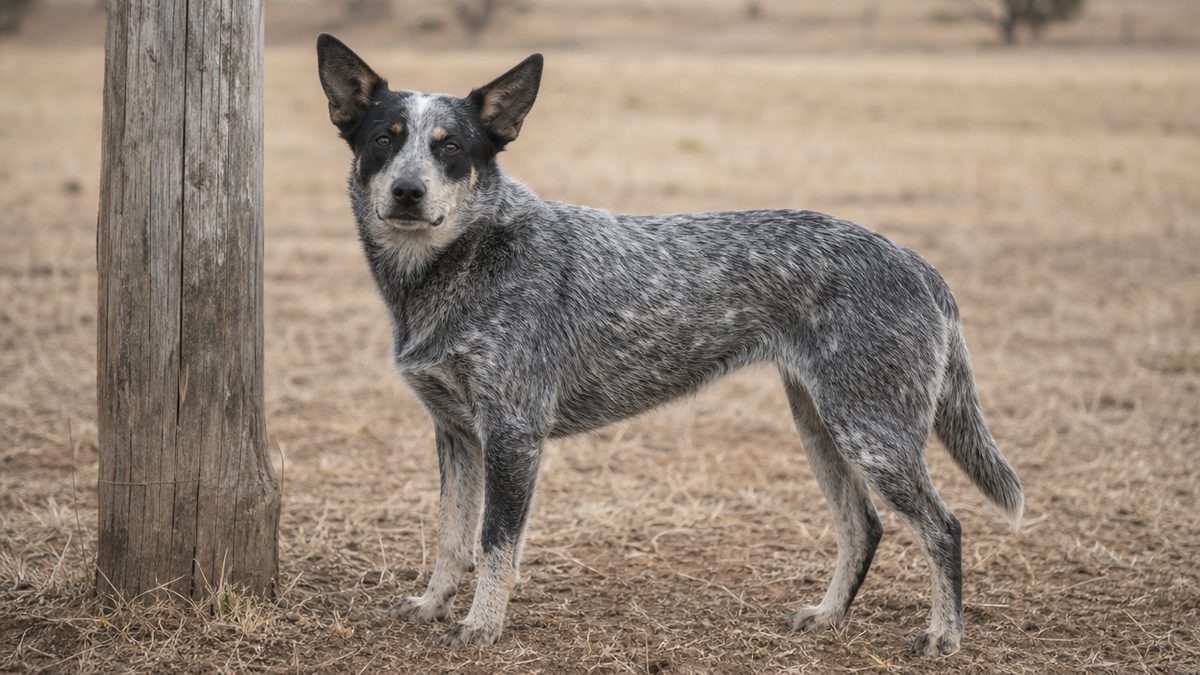
Quick answer
The Halls Heeler is extinct and cannot be bought anywhere. It was the working type Thomas Simpson Hall bred in the Upper Hunter Valley of New South Wales from about the 1820s, and it survives only inside two living breeds, the Australian Cattle Dog and the Australian Stumpy Tail Cattle Dog. On Bonbeno's two-condition test it is not a breed and never was, because no written standard or studbook was ever made for it. Search the Australian Cattle Dog instead.
This page is general information for Indian pet owners and is not veterinary advice. It cannot diagnose, treat or replace an in-person examination. Take any dog showing collapse, laboured panting, sudden weakness, a swollen abdomen with unproductive retching, or a temperature above 39.5 C to a registered veterinarian immediately, and discuss vaccination, deworming, hearing testing and any breeding decision with your own vet before acting on anything written here.
Halls Heeler at a glance
What a Halls Heeler was, and why nobody has one
The Halls Heeler was the cattle-working dog Thomas Simpson Hall bred in the Upper Hunter Valley of New South Wales from about the 1820s, and it is extinct as a distinct population. Wikipedia prints Breed status: Extinct in the article's own infobox and files it under Extinct dog breeds, and no register anywhere holds the name Australian National Kennel Council.
That is the whole answer, and it is worth giving it in the first line rather than the last, because most pages ranking for this term will try to sell you one.
The name is a person's name. Thomas Simpson Hall was a pastoralist, a son of the Hawkesbury pioneer George Hall whose family arrived in the New South Wales Colony in 1802. By 1825 the Halls held two cattle stations in the Upper Hunter Valley, Gundebri and Dartbrook, and had begun expanding north into the Liverpool Plains, New England and Queensland. Robert Kaleski, the man who later wrote the first standard for the cattle dog, is the one who called Hall's dogs Halls Heelers.
The problem the dog was built to solve
Cattle had to be moved to Sydney and other markets along unfenced stock routes through rugged bush and mountain ranges, in small mobs, before refrigeration made large consignments possible. The droving dogs then in use were commonly Smithfield dogs, which barked at cattle and bit them on the nose, and that aggravated the stock. Hall needed a dog that could muster and move cattle without winding them up.
The answer was a dingo cross. The dingo seldom barks and instinctively bites at the heel or hindquarters of an animal it chases, and crossing that instinct into an imported herding dog produced a heeler that works silently. Every account of this dog agrees on the dingo. They disagree on almost everything else.
Four documents, four different founding crosses
Bonbeno opened each of these and read it rather than summarising a summary, and they do not reconcile.
| Source | Founder named | Imported parent | Date given |
|---|---|---|---|
| FCI Standard 351, Australian Stumpy Tail Cattle Dog | Thomas Simpson Hall | Smithfields, the Northern English herding dogs | circa 1830 |
| FCI Standard 287, Australian Cattle Dog | Nobody. Hall is not mentioned in the document | Blue merle, smooth haired Collies | Not given |
| Dogs New Zealand, breed record 504 | Nobody. Hall is not named | The Smithfield, then Blue Merle Smooth Collie | The 1830s |
| Wikipedia, Halls Heeler | Thomas Simpson Hall | Imported blue-speckled Highland Collies | The 1820s, probably at Dartbrook |
| The 1976 plaque at Blue Heeler Bridge, Dartbrook | Thomas S. Hall | A pair of smooth coated blue merle collies | 1840 |
Read the first and fourth rows together and the contradiction is flat. FCI 351 makes the Smithfield the founding cross that produced Hall's Heeler. Wikipedia makes the Smithfield the dog being replaced, because it barked and bit noses. Those cannot both be true, and no page ranking for this term mentions that they conflict.
The 1976 Australian Cattle Society of NSW plaque at the Blue Heeler Bridge in Dartbrook commemorates Thomas S. Hall who in 1840 in this area carried out his breeding experiments with the native dog the dingo and a pair of smooth coated blue merle collies. Wikipedia quotes that plaque in full and then says plainly that it perpetuates a potential mistake, because the article dates the work to the 1820s and disputes the imported breed. Bonbeno could not open the Monument Australia record for the plaque directly, so the wording here is as Wikipedia reproduces it.
How the type ended
It did not die out. It was absorbed. By the 1890s dogs of Halls Heeler ancestry had attracted a group of Sydney men interested in the new practice of showing dogs competitively, none of them stockmen working cattle daily, and of those breeders the Bagust family was the most influential. Robert Kaleski, a young associate of Harry Bagust, wrote that in 1893, when he got rid of his cross-bred cattle dogs and took up the blues, breeders had started breeding to fix the type, and that he drew up a standard for them on those lines.
That standard was published by the New South Wales Department of Agriculture in 1903. The moment it appeared, the population had a document, and the dog with a document is called the Australian Cattle Dog. Queensland breeders accepted short-tailed as well as long-tailed dogs as varieties within a single breed and exhibited both, usually in separate classes, which is where the Australian Stumpy Tail Cattle Dog comes from.
So the Halls Heeler is the name for the population before the paperwork. Its two descendants are living, recognised, documented breeds, and it is not.
Is the Halls Heeler a breed? Tested against Bonbeno's own rule
The Halls Heeler is not a breed on Bonbeno's own two-condition test, and it fails both conditions rather than one. Bonbeno maintains a page for dog types that are not breeds, and the rule that page applies is that a breed has a written standard and a studbook, so a puppy can be measured against a document. No standard and no studbook was ever made for this dog, and the extinction is a separate fact on top of that.
Take the conditions one at a time, because the reasoning matters more than the verdict.
Condition one: was there ever a written standard?
No. The first standard written for these dogs was written for a different name. Robert Kaleski drew it up in the 1890s for the blues he had taken up, and it was published by the New South Wales Department of Agriculture in 1903 as a standard for the Cattle Dog. Kaleski is the same man who coined the label Halls Heeler for Hall's dogs, and he wrote no standard under that name.
The breed standards that exist today are downstream of that document and are held by the descendants. The Australian Cattle Dog holds FCI Standard 287, published 8 October 2012, and an ANKC standard last updated 14 December 2009 Australian National Kennel Council. The Australian Stumpy Tail Cattle Dog holds FCI Standard 351, published 6 July 2005. Neither document is a Halls Heeler standard, and FCI 287 does not use the name Hall at all.
Condition two: was there ever a studbook?
No. The population Hall bred was a station population, kept on properties, traded between drovers and never registered. Drovers outside the Hall family were keen to obtain the dogs, and among them were members of the Timmins family whose Halls Heelers became known as Timmins Biters. A name that changes when the dogs change hands is a description, not a studbook entry.
The registers that would hold it today hold nothing. Bonbeno read the ANKC Group 5 Working Dogs index in full: it carries 37 breeds, the string Heeler appears zero times, and both the Australian Cattle Dog and the Australian Stumpy Tail Cattle Dog are present, so the control passed and the absence is a finding. Neither the FCI's definitive nomenclature nor its provisional register carries the name. A 31 August 2026 snapshot of the OFA's published statistics tables, 2,225,140 characters searched case-insensitively, contains no row holding the string HALL, and the only rows holding HEELER are Lancashire Heeler, against a control of 109 LABRADOR occurrences in the same file.
Why the Koolie precedent does not rescue it
Bonbeno assessed the Koolie against this same rule and concluded that the Koolie is a breed, despite the Australian National Kennel Council refusing to recognise it, because the Koolie has both a written conformation document and a four-section register with a Registrar and five-generation certificates. The site's stated position is that being a landrace is not what puts a dog on the types-not-breeds page; what puts it there is the missing standard, not the way the population was shaped.
That test cuts the other way here, and cleanly. The Koolie has an unofficial standard rather than no standard, and a private register rather than no register. The Halls Heeler has neither, has never had either, and has no living population that could be given either. Kennel club recognition was never withheld from this dog; it was granted, under a different name, to its descendants.
| Population | Written standard | Studbook | Bonbeno verdict |
|---|---|---|---|
| Halls Heeler | None, ever | None, ever | A type, and an extinct one |
| Koolie | Unofficial, the Koolie Fundamentals | Yes, three private registers | A breed |
| New Zealand Huntaway | Official, Dogs New Zealand DNZ 535 | Yes, the NZSDTA Stud Register | A breed |
| Australian Cattle Dog | Official, FCI 287 and ANKC | Yes | A breed |
Historical type, synonym, or living population?
It is the first, it is used commercially as the second, and it is definitely not the third. That three-part answer is the honest one and no ranking page gives it.
- As a historical ancestor type, yes. Wikipedia calls it the presumed ancestor of the Australian Cattle Dog and the Australian Stumpy Tail Cattle Dog, and FCI 351 calls Hall's Heeler the first Australian cattle dog Federation Cynologique Internationale.
- As a synonym for the living breed, in current commercial use. Dogs New Zealand's own breed record for the Australian Cattle Dog lists Halls Heeler under Other Names, alongside Queensland Heeler and Blue Heeler. A national kennel club treats the two names as one dog.
- As a bloodline label inside that breed, also in current use. Australian breeder directories advertise litters with the Halls Heeler name inside the Australian Cattle Dog listing, and no directory carries a Halls Heeler breed section.
- As a living distinct population, no. No register holds it, no standard describes it, and every dog offered under the name is a registered or unregistered Australian Cattle Dog.
So this page belongs on Bonbeno's types-not-breeds list, and it earns its place there for a different reason from every other entry on that page. The others are living populations that never got a document. This one is a historical population that got a document and a new name at the same moment, in 1903, and the old name kept circulating without it.
Halls Heeler price in India: there is nothing to price
No Halls Heeler price in india exists, and no Halls Heeler price exists anywhere, because the type is extinct and nobody has one to sell. The name appears zero times across the three largest published Indian dog price lists, while the control term Labrador appears ten or eleven times on each of them WrapInFur, Dog Price List in India 2026 PawSpace, Dog Price in India 2026.
Each of those pages was downloaded and searched as raw text rather than summarised. On two of them the string hall does appear, and on both it sits inside the word challenges PawSpace, Dog Price in India 2026.
| Source | Breeds covered | Halls Heeler | Heeler of any kind | Labrador |
|---|---|---|---|---|
| Supertails, Dog Price List in India 2026 | 40+ | 0 | 0 | 10 |
| WrapInFur, Dog Price List in India 2026 | 50+ | 0 | 0 | 11 |
| PawSpace, Dog Price in India 2026 | 40 | 0 | 0 | 10 |
Read the fourth column, because it carries a second finding. Not one of those lists carries any Heeler at all, so even the living Australian Cattle Dog is absent from India's biggest published price tables. That does not mean the Australian Cattle Dog has no Indian market, and Bonbeno's own guide to that breed compares published Indian figures for it. It means the breed sits outside the mainstream list, which is worth knowing before you accept any figure for it.
What is actually being sold under this name
Three different things, and none of them is a Halls Heeler.
- A registered Australian Cattle Dog with a marketing label. Australian breeder directories advertise litters using the Halls Heeler name inside the Australian Cattle Dog breed listing. The directory carries no Halls Heeler breed section, because the registry does not have one.
- A registry synonym. Dogs New Zealand's breed record for the Australian Cattle Dog lists Halls Heeler under Other Names, so a national kennel club is itself using the name for the living breed.
- An empty marketplace built by software. Creatures.com publishes a Halls Heeler page with sections for listings, a herdbook, community profiles and breeders, and every counter reads empty.
Creatures.com's Halls Heeler page carries a Halls Heeler Tools block offering calculators, generators and guides preset for Halls Heeler, including a Dog Name Generator and a Dog Gestation Calculator to estimate due dates, windows and reproductive milestones. It is offering breeding tools for a dog that has not existed as a population for over a century. Its Featured Listings carousel on that page holds a White Park bull in Earlham, Iowa at USD 3,700, a Miniature Crosses bull in Bugscuffle, Tennessee at USD 2,100, and an Indio Gigante chicken pullet at USD 400. Two cattle and a chicken, and zero dogs. Bonbeno cites this page only as evidence of fabrication, never for a fact.
Why no lawful Indian supply chain can form for the name
Two independent facts close the route even for the living descendants, and they close it absolutely for a name no register holds.
First, there is no pedigree pathway. The Kennel Club of India issues pedigrees against FCI nomenclature as India's FCI member, and the FCI has no Halls Heeler in its nomenclature. Any paperwork offered for a Halls Heeler cannot be issued by anybody.
Second, DGFT Trade Notice 22/2022-23 makes dogs a Restricted import under ITC (HS) 01061900. Policy Condition 7 permits entry only for a pet dog with a valid pet book and records in the importer's own name, for research by an R&D organisation with CPCSEA recommendation, or for internal security by the Defence and Police Force, and Policy Condition 8 states that import of commercial dogs for breeding or any other commercial activity is not permitted. Paragraph 6 says that any applications for trading or breeding purposes shall be duly rejected, and paragraph 7 limits entry to the airports and seaports of Delhi, Mumbai, Chennai, Hyderabad, Bangalore and Kolkata. DAHD added a seventh port, Cochin International Airport at Kochi, for pets arriving under the baggage rules in October 2024. The full route is set out in how to import a dog to India.
So the honest number on this page is no number, and the useful advice is a redirect. If a rupee figure for a Halls Heeler is put in front of you, the seller is either using the name for an Australian Cattle Dog, in which case ask for that breed's paperwork and its BAER result, or is selling something else entirely. There is no third option, because the dog the name refers to is a rare thing indeed: one that stopped existing before Indian pet retail did.
Cost of ownership in India for the dog this type became
Budget ₹6,000 to ₹10,000 a month to keep an Australian Cattle Dog in an Indian city, using the medium-breed column of the fullest published Indian cost table, and add a BAER hearing test that no Indian cost list includes. There is no Halls Heeler to cost, so this section prices the living breed a reader searching the name will actually end up with.
Use the medium-breed column, not the large one. The Australian Cattle Dog stands 46 to 51 cm for males and 43 to 48 cm for females under FCI Standard 287, which is a medium dog, and that column is where its cost of ownership honestly sits.
| Category | Published range |
|---|---|
| Dry or wet food | ₹2,500 to ₹4,000 a month |
| Routine vet visits | ₹800 to ₹1,500 a month |
| Vaccinations | ₹1,500 a year |
| Grooming | ₹800 to ₹1,500 a month |
| Training | ₹2,000 to ₹5,000 over six months |
| Treats and toys | ₹500 to ₹1,000 a month |
| Flea control and deworming | ₹400 to ₹700 a month |
| Stated monthly total | ₹6,000 to ₹10,000 |
Check that total against its own rows
It does not reproduce. Taking the floor of every row, ₹2,500 food plus ₹800 vet plus ₹800 grooming plus ₹500 treats plus ₹400 parasite control is ₹5,000, plus ₹1,500 a year of vaccination at ₹125 a month, plus ₹2,000 of training spread over six months at ₹333 a month, giving ₹5,458 against a printed ₹6,000. Taking the ceiling of every row gives ₹8,700, plus ₹125 and ₹833, so ₹9,658 against a printed ₹10,000.
The gap is ₹542 at the floor and ₹342 at the ceiling. That is small enough to be deliberate rounding, and Bonbeno reports it rather than passing the total on unchecked. Build your budget from the rows, and treat the headline as an estimate with a little padding.
The line no Indian cost list contains
Every published Indian cost table omits the single most important test for this breed. Congenital sensorineural deafness ran at 11.4 percent across 524 Australian Cattle Dog puppies tested as complete litters, and 17.8 percent across 315 Australian Stumpy Tail Cattle Dogs. A brainstem auditory evoked response examination is a specialist neurology procedure available in very few Indian cities, and it is not in the ₹6,000 to ₹10,000.
Indian law does not help you here either. Across the whole Prevention of Cruelty to Animals (Dog Breeding and Marketing) Rules 2017 gazette, the strings BAER and deaf appear zero times, so there is no Indian legal requirement to hearing-test a breeding dog of a predisposed breed. The genetic-defect clause, Second Schedule Part III paragraph 8(10), names hip dysplasia, progressive retinal atrophy, night blindness, hypothyroidism, entropion, ectropion and jaw defects, and it does not name deafness.
Ask your vet what a BAER examination costs in your city and where the nearest machine is, before you buy rather than after. A unilaterally deaf dog is a manageable pet and a bilaterally deaf one is a serious commitment in Indian traffic, and the difference is not something you can hear from the puppy's behaviour at eight weeks. Since Indian law will not make the breeder do it, you have to.
The other line that is real and unpriced
Add year-round parasite control at the top of its band rather than the bottom. A survey across four Indian cities found 261 of 525 dogs, 49.7 percent, carrying at least one tick-borne pathogen by PCR, with Hepatozoon canis commonest at 30 percent and Ehrlichia canis at 20.6 percent, and ticks on 278 of the dogs, 53 percent. In a study of organised Indian working kennels, 24 of 46 ehrlichiosis-positive dogs were apparently healthy.
The rest of the cost picture is favourable. This is a short-coated dog, so the grooming line sits at its floor rather than its ceiling, and it is a hardy breed with no exotic dietary needs. What it costs is time, not money, and the exercise section explains why that is the expensive part.
Heat tolerance: the homeland is hotter than Chennai
Bonbeno rates this lineage 3 of 5 for heat tolerance, and it is one of the very few imported working types whose homeland runs hotter than the Indian city it is compared with. The Upper Hunter Valley cell where Thomas Hall bred returns a February maximum of 43.65 C against Chennai's 42.70 C in May.
Every figure below was queried from NASA POWER by explicit latitude and longitude over the 2001 to 2020 climatology, so no place-name lookup could serve a different town by accident. POWER returns a grid cell rather than a point, so each cell elevation is echoed and checked.
| Place | Cell elevation | Annual mean | Hottest month maximum | Annual humidity |
|---|---|---|---|---|
| Muswellbrook, Upper Hunter NSW | 379.40 m | 16.61 C | 43.65 C (February) | 67.3 percent |
| Bengaluru | 841.72 m | 23.74 C | 40.38 C (April) | 67.9 percent |
| Pune | 635.99 m | 23.86 C | 43.20 C (April) | 66.8 percent |
| Delhi | 206.37 m | 25.60 C | 48.79 C (June) | 45.6 percent |
| Mumbai | 97.15 m | 26.77 C | 44.91 C (April) | 67.4 percent |
| Chennai | 48.95 m | 27.95 C | 42.70 C (May) | 72.4 percent |
Read the two columns separately, because they say opposite things
On peak heat the Upper Hunter beats Chennai. On annual mean it is 11.34 C cooler, 16.61 C against 27.95 C. That combination is the whole climate argument for this lineage, and it is why the rating is 3 rather than 4 or 2.
A dog selected on a New South Wales cattle station meets 43 C, and it meets it for a few weeks in summer with cool nights and a cool winter behind it. An Indian plains dog meets 40 C or more for four months, with night temperatures that do not fall far, and no cool season to recover in. Surviving a hot afternoon is not the same capability as surviving a hot season.
Humidity does transfer well. The Upper Hunter cell records 67.3 percent annual humidity, statistically indistinguishable from Bengaluru's 67.9, Mumbai's 67.4 and Pune's 66.8, and only 5 points below Chennai's 72.4. This is not a dry-climate dog meeting Indian humidity for the first time.
Two elevation checks, one of which failed
POWER's Muswellbrook cell sits at 379.40 m, well above the Upper Hunter valley floor, which pushes the reported temperature slightly cool; correcting at roughly 6.5 C per 1,000 m would raise the annual mean by about 1.5 C, and that is a Bonbeno estimate rather than a measurement. On the Indian side the plains cells were accurate, at 10 m below Delhi, 43 m above Chennai, 78 m below Bengaluru, 83 m above Mumbai and 76 m above Pune, so those rows are the towns.
The Ooty query failed outright and Bonbeno does not publish its figure. POWER returned a cell elevation of 784.64 m for a town at roughly 2,240 m, an error of about 1,455 m, and therefore an implausible annual mean of 23.50 C for a hill station. A hill-station comparison for this lineage would need a different instrument.
The coat is the reason for the 3
FCI Standard 287 describes a smooth double coat with a short dense undercoat and an outer coat that is close, straight, hard and lying flat so as to be rain-resisting, with body hairs averaging 2.5 to 4 cm. That is the best working configuration for Indian sun. It blocks radiant heat without trapping the volume of air a 10 cm herding coat traps, and it dries quickly after rain.
It is still a double coat, so it still holds an insulating layer against the skin, and the dog still cools by panting rather than through it. Never shave it. Removing the undercoat removes the barrier between Indian sun and skin and makes the dog hotter, not cooler.
What the heat evidence supports, and what it does not
Neither the Halls Heeler nor its descendants appear in the large United Kingdom heat-illness studies as named breeds, so Bonbeno claims only the transferable factors. Hall 2020 in *Scientific Reports* found 395 confirmed heat-related illness events among 905,543 dogs, an incidence of 0.04 percent and a case fatality of 14.18 percent, and found that dogs at or above their breed and sex mean bodyweight carried 1.42 times the odds of heat-related illness. A heavy cattle dog is exactly that dog.
The companion paper is the one that matters for a working breed. Hall 2020 in *Animals* identified 1,259 heat-related illness events from 1,222 dogs in the same cohort, and of the 879 events with a recorded trigger, 652, or 74.2 percent, were exertional, against 113 environmental and 46 from vehicular confinement. Exercise is the mechanism, so the risk arrives through a well-meaning owner giving a working dog a proper run in May.
The World Health Organization puts India's heat wave season from March to June, extending in rare cases to July, with an average of five to six heat wave events a year over the northern parts of the country and May as the peak month. Second Schedule Part IV paragraph 21(1) of the Dog Breeding and Marketing Rules 2017 also bars keeping a dog not accustomed to local temperatures in an outdoor facility without the attending veterinary practitioner's written approval, which reaches any imported dog in its first Indian summer.
A heat-tolerant dog by the standards of this site is one that can work in the Indian hot season, and this lineage cannot. It can live through it comfortably indoors, worked at dawn and after dark, which is a different and more useful claim.
One registry makes a claim the others do not
The United Kennel Club's standard for the Australian Cattle Dog states in its History section that the breed is a silent heeler and is able to withstand the heat better than any other herding breed. That is a strong claim from a registry document rather than from a seller, and the coordinates on this page broadly support it: the Upper Hunter cell peaks at 43.65 C against Chennai's 42.70 C.
Bonbeno still rates the lineage 3 of 5 rather than 4, because withstanding heat better than other herding breeds is a relative claim, and every breed it is being compared with is rated 2 on this site. The UKC also specifies a body coat of 1 to 1.5 inches, which is 2.5 to 3.8 cm and agrees closely with the FCI's 2.5 to 4 cm, so the two registries describe the same insulating layer.
Temperament, inherited from a dog bred to bite cattle
The temperament this lineage carries is watchful, suspicious of strangers, and physically direct with anything that moves, because it descends from a dog selected to control wild cattle by biting their heels. FCI Standard 287 calls the Cattle Dog a self-appointed guardian to the stockman, his herd and his property, naturally suspicious of strangers, and requires it to be amenable to handling.
Read that alongside the founding story and the personality makes sense. Hall wanted a dog that would not aggravate cattle by barking at them and biting their noses, so he bred in the dingo's habit of working silently and biting at the heel. Silence plus a heel bite is a superb combination on a stock route and a demanding one in an Indian residential colony.
The heel bite is the trait to plan around
FCI 287 is explicit that the dog is required to move difficult cattle by heeling or biting, which is why the standard insists on sound, strong, evenly spaced teeth. A standard that specifies dentition because of biting is describing a hardwired behaviour, not a training problem.
In practice that means a young dog will apply the behaviour to whatever moves fastest. Running children, joggers, cyclists, two-wheelers and autorickshaws all qualify. Nothing about that is aggression in the legal or behavioural sense; it is stock work aimed at the wrong species, and it needs management from week nine rather than correction at month nine.
Most Indian homes have a rhythm of people arriving that an Australian cattle station did not: domestic help, cooks, drivers, delivery riders, gas cylinders, courier agents, building staff. A dog whose own standard calls it a self-appointed guardian, naturally suspicious of strangers, will treat every one of those as an event unless you deliberately socialise it to them in the first four months. Pay the dog for the arrival of strangers, every day, before it decides for itself what arrivals mean.
Intelligence is not the same thing as easy
The standard calls the dog always alert, extremely intelligent, watchful, courageous and trustworthy, with an implicit devotion to duty. That is real and it is not a comfort. An energetic, extremely intelligent dog with no assignment writes its own job description, and the job it picks is usually guarding, herding or dismantling.
Bonbeno rates this lineage 2 of 5 for being good with strangers, which is a low score and an accurate one, and 4 of 5 for trainability, which is a high one. Both are true at once. The dog learns quickly and defends by default.
Who should and should not take one on
| Situation | Verdict |
|---|---|
| Farm, plantation, orchard or estate | The dog it was built for. Everything on this page works for you |
| House with a securely fenced garden and an active owner | Workable, with real daily work and deliberate stranger socialisation |
| Apartment in a metro | No. The exercise requirement and the guarding default both fail here |
| First dog | No. A biting-bred guardian is not a starter animal |
| Household with toddlers | Demanding. Heeling behaviour and running children are a predictable collision that needs constant supervision |
| Household with frequent staff and deliveries | Possible, but only with a socialisation plan started in the first four months |
One thing this lineage is not
It is not a barker. FCI 287 describes a dog whose defining working method is silence, which is the opposite of a New Zealand Huntaway, whose standard demands a deep bark maintained all day. If noise complaints are your main housing constraint, this lineage is the better of the two working types, and the exercise requirement is still what will decide it.
The old accounts make the same point from the other direction. The Smithfields that Hall was replacing were described as noisy dogs that barked at cattle, and the whole purpose of the dingo cross was a quieter dog Dogs New Zealand. Dogs New Zealand's own record puts it plainly, calling the Smithfield hardy yet noisy and the result of the dingo cross quieter but more unruly and a strong biter. Quiet and strong-biting is exactly the trade this lineage still carries.
Training: redirect the bite before you do anything else
To train this lineage, put the heeling instinct on a legal target in the first four months and build stranger tolerance at the same time, because both problems are much cheaper to prevent than to fix. The breed's own standard requires the dog to move difficult cattle by heeling or biting, so the behaviour is selected rather than learned.
Bonbeno rates this lineage 4 of 5 for trainability. It is quick, willing and trainable, and it will out-think a casual owner inside a fortnight.
Give the bite a job it is allowed to do
Do not try to remove the behaviour. Move it. A dog that has a sanctioned outlet for chasing and gripping stops experimenting on children and vehicles.
- Introduce a tug toy that only appears on your cue and disappears on your cue, so gripping becomes a game you start and end.
- Add a flirt pole two or three times a week, which satisfies the chase-and-grip sequence in ten minutes rather than an hour.
- Teach a rock-solid leave it and an interrupt cue, and pay both from the daily ration rather than as extras.
- Enforce a household rule that nobody runs past the dog. This is the single highest-value rule in an Indian home with children.
Socialisation is a separate project, and it is time-limited
Because the standard describes a dog naturally suspicious of strangers and a self-appointed guardian, stranger tolerance has to be built rather than assumed. Do it before sixteen weeks and it is easy. Do it at eighteen months and you are counter-conditioning an adult guardian.
Make a written list of every category of person who comes to an Indian home and work through it deliberately: domestic help, cook, driver, courier, food delivery rider, gas delivery, security guard, plumber, electrician, neighbours' children. Pay the dog for each arrival. That list is the curriculum.
Congenital deafness runs at 11.4 percent in complete-litter tested Australian Cattle Dog puppies, so a unilaterally or bilaterally deaf dog is a realistic outcome rather than a rare one. Train a deaf dog on hand signals and a vibration collar rather than a shock collar, keep it on a long line in unfenced space permanently, and get a BAER result early so you are building the right system from week nine instead of discovering the problem at six months.
What this lineage resists
Repetition without purpose. A dog bred to make its own decisions on a stock route will disengage from drilling, then re-engage instantly for something that looks like work. Keep sessions short, vary them, and finish while the dog still wants more.
It also resists being out-stubborned. Escalating pressure on a courageous dog with implicit devotion to duty produces a dog that stops offering behaviour, not one that complies. Change the reinforcer rather than the volume.
A realistic timeline
| Age | Target |
|---|---|
| 8 to 16 weeks | BAER result known. Tug and leave-it on cue. The full arrivals list worked through and paid |
| 4 to 6 months | Loose lead on a front-clip harness, recall paid at 20 metres, a settle on a mat through a doorbell |
| 6 to 12 months | Interrupt cue holding around running children and two-wheelers. Growth-safe exercise only |
| 12 to 24 months | A daily job that repeats, plus a heat protocol that survives its second Indian summer |
Body condition is a training variable
Pay training out of the daily ration rather than on top of it. That keeps the dog lean, and lean matters here because dogs at or above their breed and sex mean bodyweight carried 1.42 times the odds of heat-related illness across a cohort of 905,543 dogs. A dog trained on food it did not otherwise need is a heavier dog in an Indian May.
One historical note worth carrying into training. Every account of this lineage's founding agrees that the dingo contributed silence and a heel bite, and that later crosses were introduced to regain control of the result Federation Cynologique Internationale. Dogs New Zealand's record describes the first dingo cross as quieter but more unruly and a strong biter, and names the Blue Merle Smooth Collie as the cross introduced to regain control. Your training is doing the same job that cross did.
Daily exercise, and the two hours nobody budgets for
Plan on about two hours of real work a day, split around the Indian heat, with at least a third of it mental rather than physical. FCI Standard 287 describes a dog whose combination of substance, power, balance and hard muscular condition must convey great agility, strength and endurance, and whose prime function is the control and movement of cattle in both wide open and confined areas.
Bonbeno rates this lineage 5 of 5 for exercise need, the top of the scale. The founding brief was moving wild cattle across unfenced country with almost no labour available, and nothing in either surviving standard has softened it Wikipedia, Halls Heeler.
Split the day around the heat, not around your calendar
From March to June the usable hours are before 6.30 am and after 8 pm. Delhi's hottest month peaks at 48.79 C, Mumbai's at 44.91 C, Pune's at 43.20 C and Chennai's at 42.70 C, and the World Health Organization puts May as the peak month of India's heat wave season.
The reason to be strict is in the data rather than in caution. Of the 879 heat-related illness events with a recorded trigger in a cohort of 905,543 dogs, 652, or 74.2 percent, were exertional, against 113 environmental and 46 from vehicular confinement. The dominant mechanism is a dog being exercised, not a dog being neglected.
| Slot | What it does | Duration |
|---|---|---|
| 05.45 to 06.45 | Off-lead or long-line work in a fenced ground, with recalls and directional sends | 60 minutes |
| Midday | Indoors and cooled, with a chew or a scatter feed. No walk | 0 minutes |
| 20.15 to 21.00 | Loose-lead walking on cooled surfaces, plus a training set | 45 minutes |
| Twice a week | A flirt pole or herding-ball session, which satisfies the chase-and-grip sequence fast | 15 minutes |
| Daily, any time | Scentwork or a puzzle feeder indoors | 15 minutes |
Test the surface, not the air temperature
Put the back of your hand on the pavement and hold it there for five seconds before an evening walk. Indian tarmac and concrete hold radiant heat for hours after the air has cooled, and the dog is walking on it barefoot with its belly a few inches above it. A short-coated dog is not protected from ground heat by its coat, only from sun above.
What happens without the work
An under-exercised dog of this lineage does not become calm. It becomes employed, and it picks the job itself.
- Heeling the fastest-moving thing available, which in an Indian home is a child or a two-wheeler at the gate.
- Guarding escalates, because a standard that describes a self-appointed guardian plus boredom equals a dog that patrols.
- Destruction, usually of doors, skirting and anything at the boundary of its territory.
- Escape, because a dog bred to work wide open and confined areas will test a compound wall it has time to study.
Give the dog a repeatable job with a beginning, a task and an end. A formal retrieve, a placeboard routine, scentwork, a herding ball, or carrying a pack on the morning walk all satisfy a working dog in a way that distance alone does not. Aimless movement tires the body and leaves the brain running, which is how a working breed ends up patrolling the gate at midnight.
Build joints slowly, and know what the register says
Keep hard-surface running, stairs and jumping conservative until the growth plates close. The OFA's published statistics for the Australian Cattle Dog, read from a 31 August 2026 snapshot, give hip dysplasia across 6,135 hip evaluations with 81.3 percent normal and 16.7 percent dysplastic, and elbows across 3,437 evaluations with 11.9 percent abnormal.
Treat those as a floor rather than a rate. OFA figures come from voluntarily submitted radiographs, which biases them towards dogs whose owners expected a good result, and the numbers move as evaluations are added. Publish the denominator beside the percentage, which is what this page does, and ask any breeder for the actual scores rather than for a reassurance.
Indian law reaches this one. Second Schedule Part III paragraph 8(10) of the Dog Breeding and Marketing Rules 2017 requires that breeding dogs shall have been tested for genetic defects, and hip dysplasia is the first condition it names. A breeder who has not hip-scored the parents is outside that clause, whatever they call the dog.
Grooming and skin care in Indian humidity
To groom this lineage in India, brush weekly, never shave, and treat the weekly tick check as the grooming session rather than as an extra. FCI Standard 287 describes a smooth double coat with a short dense undercoat and an outer coat that is close, straight, hard and lying flat so as to be rain-resisting, with body hairs averaging 2.5 to 4 cm.
Bonbeno rates grooming load 2 of 5, which is genuinely low. A rubber curry or a slicker once a week, more during a seasonal shed, and no professional appointment at all. That puts you at the floor of the published Indian grooming band rather than its ceiling.
Never shave a rain-resisting coat
The standard's phrase is worth reading literally. A coat that is close, straight, hard and flat-lying so as to be rain-resisting resists weather in both directions. Removing it in an Indian summer exposes skin that has never been exposed, and the undercoat that gets clipped away is the layer holding radiant heat off that skin. Both surviving standards fault a coat that is either too long or too short, which tells you the length is functional.
The seasonal shed is heavy and short. Expect two concentrated periods a year, manage them with a deshedding tool and more frequent brushing, and do not respond to them with clippers.
Colour, and the word the standards refuse to use
The Australian Cattle Dog comes in blue and red, described in the standard as blue, blue mottled or blue speckled with permissible black, blue or tan markings, or a good even red speckle all over including the undercoat. What looks like merle is not merle. Modern coat-genetics work places the blue as roan, on a different gene and a different chromosome from merle, and the Australian Cattle Dog guide works through that in detail.
That matters historically on this page, because the founding accounts keep saying merle. FCI 351 says the blue colouring came from the blue merle Collie, and the 1976 Dartbrook plaque names a pair of smooth coated blue merle collies Wikipedia, Halls Heeler. Merle is in the ancestry. It is not in the modern coat, and a merle-patterned dog sold to you as this lineage is carrying a gene the breed does not have.
Puppies of this lineage are born white or near white with dark head markings, and the roan or speckle develops over the first weeks. Ask the age of the litter and look. A fully coloured three-week-old litter is not this lineage. That one observation separates a real litter from a mislabelled one before any paperwork appears, and it costs nothing.
Skin in an Indian monsoon
Dry the dog properly after rain and after any bath, with attention to the ears, the armpits and the groin. A short coat dries fast, which is an advantage, but a wet ear canal at 30 C is an incubator regardless of coat length. Use a vet-recommended ear drying solution rather than water or spirit, and check the ears after every swim.
Bonbeno wanted to cite an Indian otitis prevalence series on this page and could not. The paper this site has used elsewhere would not download in this session, and Bonbeno does not cite a document it has not opened, so no Indian otitis percentage appears here.
Ticks are the real grooming job
This is where an Indian routine departs most from an Australian one. A survey across four Indian cities found 261 of 525 dogs, 49.7 percent, infected with one or more tick-borne pathogen by PCR, with Hepatozoon canis commonest at 30 percent, Ehrlichia canis at 20.6 percent, Mycoplasma haemocanis at 12.2 percent, Anaplasma platys at 6.5 percent and Babesia vogeli at 5.5 percent. Concurrent infection with more than one pathogen occurred in 39 percent of cases, and Rhipicephalus or Haemaphysalis ticks were found on 278 of the dogs, 53 percent.
The finding that matters most for a working dog is from Indian organised kennels. Across 225 suspected cases, ehrlichiosis prevalence was 1.3 percent by microscopy, 19.1 percent by dot-ELISA and 5.8 percent by nested PCR, and of 46 total positive cases, 24 were apparently healthy dogs. More than half the positives showed nothing. A stoic working breed will not tell you it has a tick-borne infection.
Run your hands over the whole dog once a week, ears and interdigital spaces included, and screen with your vet on a schedule rather than on symptoms. Keep a year-round preventive going, discussed with your own vet, because the Indian tick season is not a season.
Health: the deafness the founding cross left behind
Congenital deafness is the defining inherited risk in both surviving descendants of this type, running at 11.4 percent across 524 complete-litter tested Australian Cattle Dog puppies and 17.8 percent across 315 Australian Stumpy Tail Cattle Dogs. There are no Halls Heeler health figures, because there is no Halls Heeler, so this section reports the living lineage.
Bonbeno rates health screening burden 5 of 5 for this lineage, the top of the scale, and it is almost entirely one condition.
The numbers, and what makes them trustworthy
A United Kingdom study screened Australian Cattle Dog puppies by brainstem auditory evoked response between 1999 and 2019, at 4 to 10 weeks of age, and included only complete litters with full phenotypic data, which is what makes it a prevalence estimate rather than a submission sample. Of 524 puppies, hearing was bilaterally normal in 464, or 88.6 percent. Unilateral congenital sensorineural deafness ran at 9.7 percent and bilateral at 1.7 percent, giving an overall prevalence of 11.4 percent.
The arithmetic closes: 9.7 plus 1.7 is 11.4, and 100 minus 88.6 is 11.4. A pigmented face patch was the only phenotypic variable significantly associated with the condition, and it was associated with reduced risk.
The bobtailed sibling is worse. Of 315 Australian Stumpy Tail Cattle Dogs tested by the same method, 56, or 17.8 percent, were deaf, 39 unilaterally and 17 bilaterally, and the trait is an autosomal recessive that maps to canine chromosome 10.
The screening finding that should change how you buy
This is the most useful result on the page and almost nobody quotes it. A study of 608 pups from 122 litters across ten breeding kennels found that after ten years of BAER testing, from 1998 to 2008, no substantial reduction in prevalence was evident. The odds ratio for deafness per extra year since testing began in a kennel was 1.01, with a 95 percent confidence interval of 0.88 to 1.17, and 1.03 (0.82 to 1.30) even in the subset where both parents had tested normal.
Testing the parents is not enough. What did work was depth of pedigree.
| Grandparents BAER-tested normal | Prevalence | Counts |
|---|---|---|
| None | 17 percent | 5 of 29 |
| One | 12 percent | 9 of 74 |
| Two | 9 percent | 9 of 101 |
| Three | 8 percent | 6 of 71 |
| All four | 0 percent | 0 of 9 |
Note the last row's denominator honestly: nine puppies. Zero of nine is encouraging and it is not a rate. The authors' own conclusion is the safe reading, that exclusive breeding of litters in which both parents and all four grandparents are BAER-tested normal is expected to reduce prevalence to the greatest extent over the long term.
Ask for the BAER test result on both parents. Then ask for the results on all four grandparents. A breeder who has the first and not the second is doing what the ten-year study found does not work on its own. And note that Indian law will not back you up here: across the whole Dog Breeding and Marketing Rules 2017 gazette the strings BAER and deaf appear zero times, so no Indian rule requires hearing testing of a predisposed breed.
The register disagrees with the studies, and the reason matters
The OFA's published BAER row for the Australian Cattle Dog, read from a 31 August 2026 snapshot, gives 4,283 evaluations with 95.2 percent normal, 0.2 percent equivocal and 4.6 percent abnormal, ranking the breed third behind the Dalmatian and the Manchester Terrier. That 4.6 percent sits well below the 11.4 percent found in complete-litter testing.
Both figures can be right, because they measure different things. OFA publishes voluntarily submitted results, so litters and individuals are self-selected. The United Kingdom study included only complete litters, which catches every affected puppy in a litter rather than the ones an owner chose to record. Use the complete-litter figure when deciding what risk you are taking, and the register figure only as a floor. Never quote 4.6 percent as this lineage's deafness rate.
The rest of the picture, with denominators
From the same OFA snapshot: hip dysplasia across 6,135 hip evaluations at 81.3 percent normal and 16.7 percent dysplastic; elbows across 3,437 evaluations at 11.9 percent abnormal; and progressive retinal atrophy across 4,178 evaluations at 47.7 percent normal, 43.0 percent carrier and 9.3 percent affected. That last row is a DNA test rather than an examination, which is why the carrier proportion is so high, and it makes the condition avoidable by testing rather than by hoping.
The eye tables carry the internal contradiction this site has documented across many breeds, and it is present here too. The summary eye row gives 94.3 percent normal of 1,539 evaluations, while the detail row labelled NORMAL gives 1,229 of 1,537, which is 80.0 percent. That is a 14.3 point gap on near-identical denominators. Bonbeno publishes both and quotes neither as the rate.
Lifespan
No peer-reviewed lifespan figure exists for the Halls Heeler, and none can, because the population ended before the studies began. For the living lineage, Dogs New Zealand's breed record gives 10 to 13 years. The two large United Kingdom life-table studies, Teng 2022 and McMillan 2024 across 584,734 dogs and 155 breeds, carry no row for this breed, and McMillan's medium-breed median of 12.5 years is context rather than a breed figure McMillan KM, Bielby J, Williams CL.
Bonbeno will not repeat the 29-year Bluey record here as a lifespan. The Australian Cattle Dog guide works through what that claim actually rests on, and the short answer is family testimony rather than a contemporaneous record.
Why the deafness has not been bred out
The deafness in this lineage has resisted forty years of selection because its genetics are not simple, and a genome-wide association study in the Australian Cattle Dog found the associated regions sitting on different chromosomes from the piebald locus that was expected to explain it. That single result explains most of the frustrating health issues history of both surviving breeds.
Congenital deafness in dogs is usually tied to white pigmentation, controlled primarily by the piebald locus on chromosome 20 and also by merle on chromosome 10. The obvious hypothesis was therefore that white patterning in cattle dogs predicts deafness, and that breeders could select against it by eye.
That hypothesis has now failed twice, from two directions.
Colour does not predict it in this breed
A large multi-breed study using brainstem auditory evoked response testing found no differences among the Australian Cattle Dog colour varieties, and no gender differences in any breed tested. In the Dalmatian, blue eyes were positively associated with deafness and patches negatively associated; in the Australian Cattle Dog, the colour varieties gave nothing to select on.
The one phenotypic handle that has been found is narrow. In the United Kingdom complete-litter study, the presence of a pigmented face patch was the only variable significantly associated with congenital deafness, and it was associated with reduced risk. That is a useful observation and it is not a test. A face patch lowers the odds; it does not tell you the puppy hears.
The genome does not point where it should
The genome-wide association study included bilaterally deaf, unilaterally deaf and matched control dogs from the same litters, phenotyped by BAER, across the Dalmatian, Australian Cattle Dog and English Setter. In the bilaterally deaf against control Australian Cattle Dog design the authors found one genome-wide significant association and 14 suggestive chromosome-wide associations.
None of those sat on the same chromosome as the piebald locus. The authors read that as evidence of complex genetic architecture and note that larger samples may be needed to detect the loci modulating risk in piebald dogs. In plain terms, there is no single gene to test for and no DNA test to sell you.
Colour gives you nothing. The genome gives you no single-locus test. And testing parents alone produced no substantial reduction in prevalence across ten years and ten kennels. The only thing that has been shown to move the number is depth of pedigree testing, where prevalence ran at 17 percent with no BAER-tested normal grandparents and 0 of 9 with all four tested normal. So the question to a breeder is about grandparents, and there is no shortcut around it.
What this means for an Indian buyer specifically
It means the risk cannot be managed by looking at the puppy, and it cannot be managed by a cheek swab. It can only be managed by a hearing examination and by pedigree depth, and neither is easy to obtain in India.
That is a real constraint rather than a reason to avoid the breed. A unilaterally deaf dog, which is 9.7 of the 11.4 percentage points, lives an ordinary life with a permanent long-line rule near roads. A bilaterally deaf dog is a bigger commitment and an entirely workable one on hand signals. What you must not do is find out at eight months.
The historical footnote is worth keeping in view. The white patterning that carries this risk entered the lineage after Thomas Hall's dogs, through the Dalmatian cross that the Bagust breeders made in the 1890s, which FCI 287 records as a later injection alongside black and tan Kelpie blood. The Halls Heeler itself is described everywhere as a blue speckled or blue mottled dog rather than a heavily white one. The deafness is a legacy of what came after the type this page is named for, not of the type itself.
A third prevalence figure, and an abstract that does not add up
A Polish study using the same BAER method tested 62 Australian Cattle Dogs among 243 dogs across four predisposed breeds, and found 3 of the 62, or 4.8 percent, deaf. That sits close to the OFA register's 4.6 percent and far below the 11.4 percent found by complete-litter testing in the United Kingdom.
Read that abstract's overall row carefully, because its own arithmetic does not close. It reports that among the 243 dogs tested, 156 (81 percent) had a normal BAER, 27 (11 percent) were unilaterally deaf and 12 (5 percent) were bilaterally deaf. The two deafness percentages reproduce on 243, at 11.1 and 4.9 percent, and the normal figure does not: 156 of 243 is 64.2 percent, not 81 percent, and the three counts sum to 195 rather than 243. Bonbeno therefore uses only the breed-specific figure, 3 of 62, which divides correctly to 4.8 percent, and flags the overall row as internally inconsistent rather than quoting it.
The wider point stands whichever figure you take. All four Australian Cattle Dog prevalence estimates, from Poland, the United Kingdom, the OFA register and the Australian screening cohort, are non-zero, and the authors of the Polish study conclude that preventive BAER screening should be routinely performed in these breeds.
Feeding a medium working dog in Indian conditions
To feed this lineage, weigh a measured ration into two meals, keep the dog visibly lean, and budget ₹2,500 to ₹4,000 a month on the medium-breed column of the fullest published Indian cost table. Weight is not cosmetic in this climate, because dogs at or above their breed and sex mean bodyweight carried 1.42 times the odds of heat-related illness in a cohort of 905,543 dogs.
Use the medium column deliberately. FCI 287 puts the Australian Cattle Dog at 46 to 51 cm for males and 43 to 48 cm for females, and neither the FCI standard nor the Royal Kennel Club's gives a weight at all, so anyone quoting a confident kilogram figure from either has not read them.
A workable Indian feeding plan
| Stage | Meals a day | What to prioritise |
|---|---|---|
| 8 to 16 weeks | 4 | A medium-breed puppy food with controlled calcium, to slow growth rather than speed it |
| 4 to 12 months | 3 | Steady growth, no calcium supplements, weight checked monthly by feel |
| 12 months to 7 years | 2 | A weighed ration rather than a scooped one, split around the work |
| 7 years onward | 2 | Fewer calories, joint support discussed with your vet, unchanged portion discipline |
Slow growth is the point of the puppy phase. Published OFA statistics put hip dysplasia at 16.7 percent across 6,135 evaluations in this breed, and rapid growth on a calorie-dense adult food is the reliable way to convert a borderline hip into a clinical one.
Lean is a heat intervention
Aim for a body condition score of 4 or 5 on the 9-point scale and check monthly by feel rather than by eye. You should find ribs easily under a thin layer, see a waist from above and a tuck from the side.
The reason is measured rather than aesthetic. Hall 2020 in *Scientific Reports* found 395 confirmed heat-related illness events among 905,543 dogs, an incidence of 0.04 percent, a case fatality of 14.18 percent, and odds of 1.42 for dogs at or above their breed and sex mean bodyweight. In a country where Delhi peaks at 48.79 C and Chennai at 42.70 C, a lean dog is a materially safer dog.
Pay every training session out of the day's measured ration rather than on top of it. This lineage is quick to learn and quick to gain, and a dog trained on extra food is a heavier dog in May. It also solves the other problem: a working dog that earns its dinner has had a job that day, which is the whole management strategy for the breed compressed into one habit.
Water, and the thing Indian owners underdo
Put out more water points than you think you need through the hot season, and refill rather than top up so you can see how much has gone. A dog drinking heavily in April is doing the cooling work its coat cannot do, and a sudden change in that volume is one of the earliest signals you will get of something wrong.
Carry water on every walk from March onward, and offer it before the dog looks like it needs it. Exertional heat illness accounted for 652 of the 879 triggered events, 74.2 percent, in the largest published series, which means the risk window is the walk itself rather than the hour after it.
What not to do
- Do not free-feed. A measured bowl is the only way you will notice appetite changing in a stoic breed that hides illness.
- Do not supplement calcium in a growing puppy, whatever a seller tells you. It does not build better hips.
- Do not feed immediately before or after hard exercise. Leave a clear ninety minutes either side, which is cheap insurance in any deep-chested working dog.
- Do not switch food abruptly when you move cities, which Indian owners do constantly. Transition over a week.
One historical footnote that is also practical. Every account of this lineage's founding describes a dog built to work long days on poor country with minimal support Wikipedia, Halls Heeler. That efficiency is still in the dog, and it means a pet on a city routine needs noticeably less food than its size suggests. Most overweight dogs of this lineage in India are being fed for the job they are not doing.
Four registries, two of which decline to give a weight
Weight is where the documents diverge, and it matters because Indian sellers quote kilograms confidently. FCI Standard 287 gives no weight. The Royal Kennel Club's standard, last updated 1 April 2025, gives height at withers of 46 to 51 cm for dogs and 43 to 48 cm for bitches and no weight either. The United Kennel Club gives 33 to 50 pounds, which is 15.0 to 22.7 kg, and the American Kennel Club gives 35 to 50 pounds, 15.9 to 22.7 kg American Kennel Club. The two that publish a figure disagree by two pounds at the floor and agree at the ceiling.
The Royal Kennel Club adds a caution worth repeating to any buyer. Its own note for prospective puppy buyers states that the breed standard is a guide and a description of the ideal, that the size described does not imply a dog will match the measurements given, and that a dog might be larger or smaller than the stated size. A seller treating a standard's numbers as a guarantee is misreading the document.
Lifespan is the other place the registries part company. The American Kennel Club gives 12 to 16 years and Dogs New Zealand's breed record gives 10 to 13 Dogs New Zealand. Neither is a study, and the two large United Kingdom life-table papers carry no row for this breed at all McMillan KM, Bielby J, Williams CL. Plan on the overlap, 12 to 13 years, and treat anything longer as a bonus.
Month by month through the first year
Fix three dates before anything else: the eight-week legal floor on sale, the BAER hearing test in the first weeks, and the vaccination course that runs from seven or eight weeks to about eighteen weeks Marsh O, Freeman J, Pollard D. The hearing test is the one no Indian rule will make anybody do, and it is the one that changes how you raise the dog.
Two Indian legal anchors start the timeline. Rule 8(1)(a) of the Prevention of Cruelty to Animals (Dog Breeding and Marketing) Rules 2017 requires that pups less than eight weeks in age are not sold, and Second Schedule Part III paragraph 8(9) states that vaccination can start at seven to eight weeks and is usually completed at eighteen weeks.
| Age | Health and legal | Training and management |
|---|---|---|
| 0 to 8 weeks | With the breeder. BAER testing is done at 4 to 10 weeks, so ask for it now. Sale before eight weeks is prohibited | Nothing you control. Look at the litter: at two weeks it should be white or near white with dark head markings |
| 8 to 12 weeks | First vaccinations and deworming with your own vet. Confirm the BAER result in writing | The arrivals list started: staff, delivery riders, guards, neighbours. Tug and leave-it on cue |
| 12 to 16 weeks | Vaccination course continuing towards its eighteen-week completion | Socialisation window closing. Finish the arrivals list. Introduce traffic noise at distance |
| 4 to 6 months | Monthly weight and body condition check | Loose lead on a front-clip harness, recall paid at 20 metres, interrupt cue around moving children |
| 6 to 9 months | Discuss neutering timing with your vet | No road running on hard surfaces. Flirt-pole work instead |
| 9 to 12 months | Raise hip radiography, and a DNA test for progressive retinal atrophy if the parents were untested | A daily job that repeats. First full heat protocol rehearsed before March |
| 12 to 24 months | Hip and elbow scores if not already done, before any breeding decision | Build duration rather than intensity. Growth plates close late |
Get the hearing result before the puppy comes home
Testing happens at 4 to 10 weeks of age, which is before you take delivery, so this is a question for the breeder rather than a task for you. Congenital deafness runs at 11.4 percent in complete-litter tested puppies of this breed, and 9.7 of those 11.4 points are unilateral, meaning a puppy can hear, respond normally, and still be deaf in one ear.
That matters because a unilaterally deaf dog cannot localise sound. In Indian traffic that is a safety fact rather than a curiosity, and it is a permanent argument for a long line rather than off-lead freedom near a road.
Ask to see the BAER certificate itself, from the testing centre, with the puppy's identification on it, and ask the same for both parents and all four grandparents. A ten-year study across ten kennels found that testing parents alone produced no substantial reduction in prevalence, with an odds ratio of 1.01 per extra year of testing, while prevalence fell to zero in the small group whose four grandparents had all tested normal. Verify the paperwork rather than the reassurance.
The first summer catches people out
A puppy bought in December meets its first Indian April at about five months, exactly when an owner starts increasing exercise. That is the wrong month. India's heat wave season runs March to June with May as the peak, and 74.2 percent of triggered heat-illness events in the largest published series were exertional. Hold the workload flat through the first hot season and build it in the monsoon.
What good looks like at each stage
- At 12 weeks, the puppy should approach a stranger who is paying it, rather than watching from behind you. A standard describing a self-appointed guardian means this needs building early.
- At 16 weeks, the ears should be coming up. FCI 287 asks for moderate, preferably small, broad-based, pricked and moderately pointed ears set wide on the skull.
- At 6 months, you should be able to interrupt a chase with a cue. If you cannot, get help now rather than at eighteen months.
- At 12 months, the ribs should still be easy to find. Most overweight adults of this lineage in India were overfed as adolescents.
One more thing to register early. Get the municipal dog licence and the microchip done in the first months rather than after a problem, and keep the vaccination card, the BAER certificate and the parents' hip scores in one place. That folder is what turns a claim about a dog into a documented dog, which is the whole argument of this page in miniature.
The two dogs the Halls Heeler actually became
A reader searching this name has two real choices, the Australian Cattle Dog and the Australian Stumpy Tail Cattle Dog, because those are the living breeds the type became. The table below compares them on the points that decide an Indian purchase, and adds the working dogs an Indian buyer will actually cross-shop.
The two descendants split at the show ring rather than in the paddock. Queensland breeders accepted short-tailed as well as long-tailed cattle dogs as varieties within a single breed and exhibited both, usually in separate classes, and the bobtailed line was later given its own standard Federation Cynologique Internationale.
| Breed | Registry status | Deafness evidence | Bonbeno heat rating | Obtainable in India |
|---|---|---|---|---|
| Halls Heeler | None anywhere. Extinct | None. No population to study | Not rated separately | No. Nothing exists to buy |
| Australian Cattle Dog | FCI 287 definitive since 20 March 1972; ANKC standard | 11.4 percent of 524 complete-litter tested puppies | 3 of 5 | Yes, with published Indian prices on its own guide |
| Australian Stumpy Tail Cattle Dog | FCI 351, provisional register; ANKC standard | 17.8 percent of 315 dogs, mapped to CFA10 | 3 of 5 | Barely. Rare even in Australia |
| Australian Kelpie | ANKC and FCI recognised | Not a recognised breed problem | 2 of 5 | Yes, thinly |
| Indian Pariah Dog | No FCI standard; a native landrace | Not a recognised breed problem | 5 of 5 | Yes, free, from any Indian shelter |
Cattle Dog against Stumpy Tail
Take the Australian Cattle Dog unless you have a specific reason not to. It has the stronger registry position, definitive FCI recognition since 1972 against the Stumpy Tail's place on the provisional register, a far larger gene pool, and a measurably lower deafness prevalence, 11.4 percent against 17.8 percent Federation Cynologique Internationale Marsh O, Freeman J, Pollard D Sommerlad S, McRae AF, McDonald B.
The Stumpy Tail is the more historically interesting dog and the harder one to source responsibly. Its own FCI standard is the document that names Thomas Simpson Hall, records the two schools of origin, and notes that Stumpy Tails were generally bred in the spacious rural areas of Australia with only a small number registered in the stud books, and that the breed was renamed the Australian Stumpy Tail Cattle Dog in 2001. A small historical registration base is exactly the condition that concentrates a recessive like deafness.
The bobtail is a gene, not a docking
This one is worth stating plainly in India, because tail docking is prohibited here under Second Schedule Part II of the Dog Breeding and Marketing Rules 2017. The Stumpy Tail's short tail is inherited, and FCI 351 attributes it to the Smithfield in the founding cross. A short-tailed cattle dog in India is either a genuine Stumpy Tail or a docked Australian Cattle Dog, and the second is illegal. Ask which, and look at the Australian Stumpy Tail Cattle Dog guide before you accept an answer.
Against the dogs you will actually be offered
Most Indian buyers who reach this page are choosing between a cattle dog and a Kelpie or a Border Collie. The distinguishing axis is not energy, which they all have. It is what the dog does with its mouth and with strangers.
- A cattle dog heels. Its own standard requires it to move difficult cattle by heeling or biting, and it is naturally suspicious of strangers. That is a guarding, gripping dog.
- A Kelpie works silently at distance and does not guard by default. It is the easier dog in a household with constant visitors.
- A Huntaway barks. Its standard demands a deep bark maintained all day, which is the single worst trait for Indian apartment living.
- An Indian Pariah Dog is rated 5 of 5 for heat on this site, costs nothing to adopt, and is already acclimatised.
The honest recommendation
If you searched Halls Heeler because you liked the history, read it here and then buy nothing on the strength of it. If you searched because you wanted the dog, the answer is an Australian Cattle Dog with a BAER certificate on both parents and, ideally, all four grandparents.
And if what appealed was a hardy, weather-proof, intelligent working dog with a genuine Indian heritage rather than an imported one, the Indian Pariah Dog does that job better in this climate than anything descended from the Upper Hunter Valley, and it is sitting in a shelter in your city today.
Mistakes writers and buyers make with this name
The commonest mistake is treating the Halls Heeler as a dog you can acquire, when it is an extinct breed with no standard and no studbook and never had either. The rest are errors of sourcing and of repeating one origin story as settled when four documents disagree.
Mistake one: buying from a marketplace that has never had one
Creatures.com ranks for this term and publishes a Halls Heeler page with sections headed Halls Heelers for Sale, Halls Heeler Herdbook, Halls Heeler Profiles and Halls Heeler Breeders. Every counter reads empty, the page offers a Dog Gestation Calculator preset for the breed, and its Featured Listings carousel holds a White Park bull, a Miniature Crosses bull and an Indio Gigante chicken pullet, with zero dogs.
Bonbeno cites that page only as evidence of fabrication, never for a fact. The pattern is one this site has documented before on extinct and obscure breeds, and it exists because nobody else writes those pages, so an empty template ranks by default.
Mistake two: repeating one founding cross as settled
Four documents give three different imported parents and three different dates, and no page anywhere puts them side by side. FCI 351 says Smithfields. FCI 287 says blue merle smooth Collies and never mentions Hall. Dogs New Zealand says the Smithfield first and then the Blue Merle Smooth Collie to regain control. Wikipedia says imported blue-speckled Highland Collies, and says the Smithfield was the dog being replaced.
The dates run from the 1820s in Wikipedia's text, to circa 1830 in FCI 351, to 1840 on the Dartbrook plaque that Wikipedia itself quotes and then calls a potential mistake. Write it as contested, because it is.
Mistake three: assuming Timmins was a rival
FCI 351 presents a drover named Timmins of Bathurst as the second of two schools of thought about the founder, mating a Smithfield with the Dingo in 1830 to produce red bob-tailed dogs known as Timmins Biters. Wikipedia presents the Timmins family as drovers downstream of Hall, whose Halls Heelers became known as Timmins Biters.
One version makes them independent inventors and the other makes them customers. Bonbeno does not adjudicate that, and neither should a page that has not opened both documents.
This is the cleanest example on the site of two official documents from the same body disagreeing about the same event. FCI 351, the Australian Stumpy Tail Cattle Dog standard, names Thomas Simpson Hall and calls his dogs the first Australian cattle dog to be known as Hall's Heeler. FCI 287, the Australian Cattle Dog's own standard, describes the same origin without the man, and the word Hall appears nowhere in it. Both are current, both are official, and Bonbeno publishes the disagreement rather than picking the more convenient one Federation Cynologique Internationale.
Mistake four: calling the coat merle
Merle is in the ancestry and not in the modern coat. FCI 351 says the blue colouring came from the blue merle Collie, and the 1976 plaque names blue merle collies Wikipedia, Halls Heeler. The living breed's pattern is roan and ticking, on a different gene, and FCI 287 describes it as blue, blue mottled or blue speckled and as red speckle, never as merle. A merle-patterned dog sold as this lineage is carrying something the breed does not have.
Mistake five: quoting the OFA deafness figure as the rate
The OFA's published BAER row gives 4.6 percent abnormal across 4,283 evaluations, and the complete-litter United Kingdom study gives 11.4 percent across 524 puppies Marsh O, Freeman J, Pollard D. The register figure is built on voluntarily submitted results and the study figure on whole litters. Quote the study when assessing risk, quote the register as a floor, and never present 4.6 percent as this lineage's deafness prevalence.
Mistake six: believing parent testing is enough
It is the most repeated piece of advice about this breed and the evidence says it does not work alone. After ten years of BAER testing across ten kennels, no substantial reduction in prevalence was evident, with an odds ratio of 1.01 per extra year of testing, and 1.03 even where both parents had tested normal. Ask about grandparents.
Mistake seven: expecting Indian law to cover deafness
It does not. Across the whole Prevention of Cruelty to Animals (Dog Breeding and Marketing) Rules 2017 gazette, the strings BAER and deaf appear zero times, and the genetic-defect clause at Second Schedule Part III paragraph 8(10) names hip dysplasia, progressive retinal atrophy, night blindness, hypothyroidism, entropion, ectropion and jaw defects without mentioning hearing. The absence is real and citable, and it means the buyer carries this one.
Mistake eight: writing that the OFA has no data on Halls Heelers
Bonbeno makes that claim narrowly. A 31 August 2026 snapshot of the OFA's published statistics tables, 2,225,140 characters searched case-insensitively, holds no row containing the string HALL, and the only rows containing HEELER are Lancashire Heeler, against a control of 109 LABRADOR occurrences in the same file. That is an absence in that snapshot on that date. For an extinct type it is also exactly what you would expect, and it proves nothing that the extinction did not already settle.
Adoption: what to do if you searched this name
You cannot adopt a Halls Heeler, because none exists to rehome, and the useful action is to redirect the search rather than to keep looking. Adopt an Australian Cattle Dog from Indian breed rescue, or adopt an Indian dog, and treat any listing using the Halls Heeler name as a listing for something else.
Bonbeno does not recommend breeders and does not link puppy listings. What follows is what a reader who typed this name should actually do next, in order.
Step one: understand what you were searching for
The name refers to a historical station population that ended by absorption in the 1890s and 1900s, not by loss. There was never a written standard for it and never a studbook, which is why Bonbeno files it as a type rather than a breed. Its working ability survives intact in two living breeds, and its paperwork begins the moment those breeds were named.
So the emotional pull of the name, an original, unspoiled, working Australian dog bred by a man on a station, is real history and it is not a purchasing option. Anybody offering it as one is selling an Australian Cattle Dog, or is selling nothing at all.
Step two: adopt the living breed instead
Australian Cattle Dogs turn up in Indian breed rescue, usually at eighteen months to three years, and usually for the same reason: an owner bought an energetic, robust working dog into a flat and could not meet it. That is a good dog in the wrong home rather than a bad dog, and rescue is where the honest supply is.
- Ask the rescue what the dog does when a stranger arrives, because the standard describes a self-appointed guardian and you need to know where this individual sits.
- Ask whether the dog has ever been hearing-tested, and assume it has not. Deafness runs at 11.4 percent in this breed and unilateral deafness is invisible without a test.
- Ask what the dog does with running children and two-wheelers, because heeling is selected behaviour rather than a training failure.
- Commit to two hours a day before you sign anything, because the exercise requirement is what sent the dog to rescue in the first place.
An Indian shelter adoption fee typically runs ₹0 to ₹3,000 and covers vaccination, deworming and microchipping. Pay ₹800 to ₹1,500 for an independent veterinary consultation from a vet the rescue did not choose, before you take the dog home.
Step three: consider the dog that actually suits the climate
If what drew you to the Halls Heeler was the idea of a hardy, unfussy, weather-proof working dog rather than a particular pedigree, the Indian Pariah Dog is that dog and Bonbeno rates it 5 of 5 for heat tolerance against this lineage's 3. It costs nothing, has no import problem, no registry problem and no known breed-wide deafness risk, and it is already adapted to the country you live in.
That is not a consolation prize. A dog bred in the Upper Hunter Valley for a February peak of 43.65 C and an annual mean of 16.61 C is being asked to live somewhere with an annual mean of 27.95 C when it comes to Chennai. The Indian dog was selected here.
If you are offered a Halls Heeler anyway
Ask four questions and expect the conversation to end.
| Ask for | Why it cannot exist |
|---|---|
| The breed standard the puppy was bred to | None was ever written. Kaleski's 1903 standard was written for the Cattle Dog |
| The studbook the parents are registered in | None exists. The ANKC Group 5 index carries 37 breeds and no Heeler of any kind |
| A Kennel Club of India pedigree | The KCI issues pedigrees against FCI nomenclature, which holds no Halls Heeler |
| The import trail for the founding stock | DGFT Trade Notice 22/2022-23 rejects any application for trading or breeding purposes outright |
If the seller answers that it is really an Australian Cattle Dog, that is the honest answer and the conversation can continue on that basis. Ask for the BAER certificates, the parents' hip scores and a date of birth putting the puppy over eight weeks, which Rule 8(1)(a) requires Sommerlad SF, Morton JM, Johnstone I.
The Halls Heeler is history, not livestock. Read it, then go and look at the Australian Cattle Dog guide, which covers the living breed, its published Indian price range, its deafness risk and its heat reality, or the Australian Stumpy Tail Cattle Dog guide if the bobtail is what you were after. Both of those dogs exist, and one of them is probably what you meant.
If you already have a dog of this lineage
Then the whole of this page applies and none of the sourcing does. Get a BAER test done whatever the age, because knowing whether a dog can localise sound changes how you handle it near Indian traffic permanently. Register the dog with your municipal corporation, microchip it, hip-score it before any breeding decision, keep it lean at a body condition score of 4 or 5, run a year-round tick programme given that 49.7 percent of dogs sampled across four Indian cities carried a tick-borne pathogen, and work it before sunrise from March to June.
And use the right name for it. The dog you own is an Australian Cattle Dog, which is a documented breed with a standard, a studbook and a hundred and twenty years of records behind it. The Halls Heeler is what it came from.
Halls Heeler questions, answered against the documents
Is the Halls Heeler extinct?
Yes. Wikipedia prints Breed status: Extinct in the article's own infobox and files it under Extinct dog breeds, and no kennel club anywhere holds the name. The type survives only as ancestry inside the Australian Cattle Dog and the Australian Stumpy Tail Cattle Dog, both of which are living recognised breeds.
What is a Halls Heeler?
A Halls Heeler was the working cattle dog Thomas Simpson Hall bred on his Dartbrook station in the Upper Hunter Valley of New South Wales from about the 1820s, by crossing imported collies with selected dingoes. Robert Kaleski, who later wrote the first cattle dog standard, is the man who called Hall's dogs Halls Heelers.
Is a Halls Heeler the same as a Blue Heeler?
Commercially, yes, and historically, no. Dogs New Zealand lists Halls Heeler as an Other Name for the Australian Cattle Dog alongside Queensland Heeler and Blue Heeler, so a registry treats the names as synonyms. Historically the Halls Heeler is the ancestor and the Australian Cattle Dog is the descendant, separated by the Bagust breeders of the 1890s and by Kaleski's 1903 standard.
Can you still buy a Halls Heeler?
No, and anything sold under the name is an Australian Cattle Dog. Australian breeder directories use Halls Heeler as a kennel and bloodline label inside the Australian Cattle Dog listing, not as a separate breed. Creatures.com runs a Halls Heeler marketplace, herdbook, breeder directory and gestation calculator whose counters all read empty.
What breeds made the Halls Heeler?
The sources disagree flatly and Bonbeno publishes the disagreement rather than picking one. FCI Standard 351 says Thomas Simpson Hall crossed Smithfields with dingoes. Wikipedia says he crossed imported blue-speckled Highland Collies with dingoes, and that Smithfields were the dogs being replaced because they barked and bit cattle on the nose. Both cannot be right.
What is the difference between a Halls Heeler and an Australian Cattle Dog?
Documentation. The Australian Cattle Dog has an FCI standard, number 287, definitive since 20 March 1972, an ANKC standard last updated 14 December 2009, and a studbook. The Halls Heeler has none of those and never did, which is exactly why Bonbeno files it as a type rather than a breed.
Are Halls Heeler and Timmins Biters the same dog?
Two respectable sources give opposite answers. FCI Standard 351 presents Timmins of Bathurst as a rival founder to Hall, producing red bob-tailed dogs called Timmins Biters in 1830. Wikipedia presents the Timmins family as drovers downstream of Hall, whose Halls Heelers became known as Timmins Biters. One makes them rivals and one makes them the same dogs under a second owner's name.
Who was Thomas Simpson Hall?
Thomas Simpson Hall was an Australian pastoralist, a son of the Hawkesbury pioneer George Hall whose family reached the New South Wales Colony in 1802. By 1825 the Halls held two Upper Hunter Valley cattle stations, Gundebri and Dartbrook, and were expanding north into the Liverpool Plains, New England and Queensland.
What is the Halls Heeler price in India?
There is no Halls Heeler price anywhere, because the type is extinct, and there is no Indian price for its descendants on the major lists either. The name appears zero times across the three largest published Indian dog price lists, covering 40-plus, 50-plus and 40 breeds, while the control term Labrador appears 10 or 11 times on each.
Did the Halls Heeler come from the dingo?
Every source agrees on the dingo and disagrees on the other parent. FCI 351, FCI 287, Dogs New Zealand and Wikipedia all put the dingo in the founding cross. They differ on whether the imported dog was a Smithfield, a blue merle smooth Collie or a blue-speckled Highland Collie, and on whether the year was the 1820s, 1830 or 1840.
Should I get a BAER test for an Australian Cattle Dog puppy in India?
Yes, and insist on it for both parents and all four grandparents if you can. Congenital deafness ran at 11.4 percent across 524 complete-litter tested puppies, and a ten-year screening programme in ten kennels produced no substantial reduction. Prevalence fell to zero only in the small group where all four grandparents had tested normal.
What should I read instead if I searched for a Halls Heeler?
Read the Australian Cattle Dog guide, which covers the living breed, its published Indian price range, its congenital deafness risk and its heat tolerance. If you want the bobtailed line, read the Australian Stumpy Tail Cattle Dog guide, whose own FCI standard is the document that names Thomas Hall.
Compare with similar breeds
Halls Heeler sits in 2 Bonbeno groups. Each one compares it directly against the breeds it is genuinely an alternative to, on the same figures.