
Breed profile
Phu Quoc Ridgeback: Vietnam's Flagship Breed, Checked Against Its Own Registry
One of three ridgeback breeds on earth, the only one whose own kennel association publishes a numbered national standard, and the one every English-language page calls unrecognised.
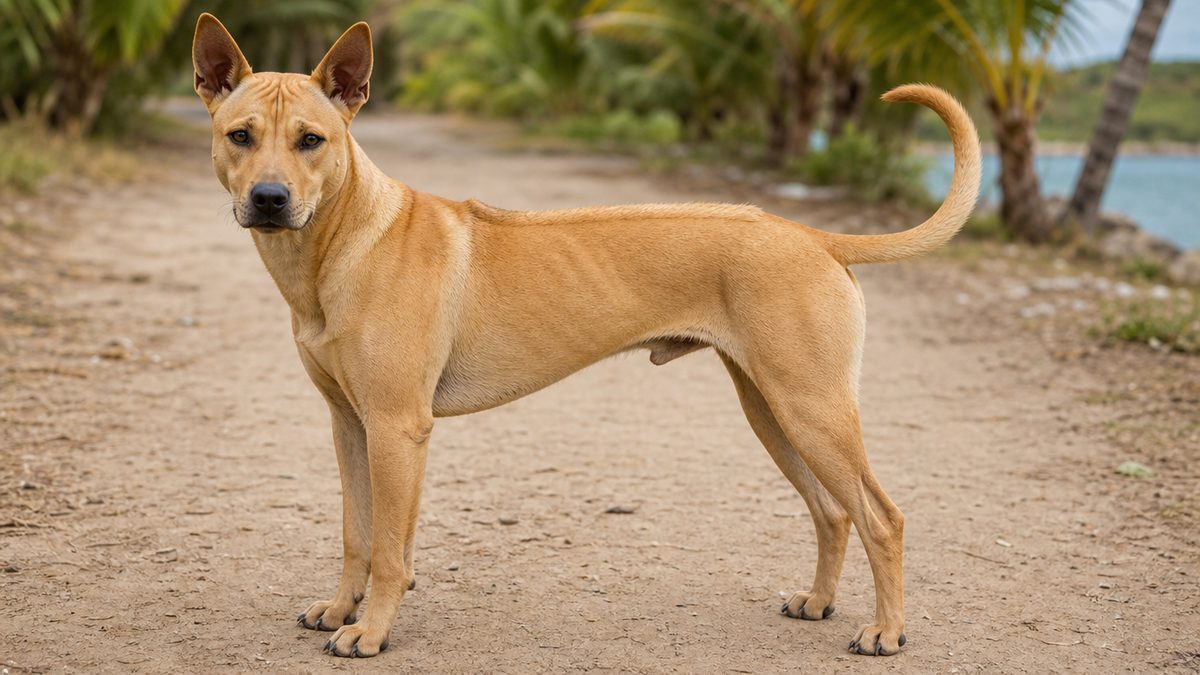
Quick answer
The Phu Quoc Ridgeback is a 46 to 56 cm primitive hunting dog from Phu Quoc island in southern Vietnam, carrying a reversed ridge along its spine. It holds breed standard 001/VN from the Vietnam Kennel Association, which also keeps its studbook, and the United Kennel Club separately lists it for registration without a standard. It is absent from the FCI register. No Indian price exists, because no lawful supply chain does.
This guide is general information for Indian pet owners and is not a diagnosis. Always consult a registered veterinarian near you before acting on anything you read here, and treat any swelling, discharge or draining hole along a ridged dog's spine as an urgent veterinary problem rather than a skin blemish.
Phu Quoc Ridgeback at a glance
What the Phu Quoc Ridgeback is, and what its own registry says
The Phu Quoc Ridgeback is an indigenous, medium-sized primitive hunting dog from Phu Quoc island in Kien Giang province, southern Vietnam, standing 48 to 56 cm at the withers in males and 46 to 52 cm in females, and carrying a dorsal ridge, a strip of reversed hair along its spine. Its breed standard is a real document with a number, 001/VN, issued by the Vietnam Kennel Association.
Start with the sentence the whole internet repeats, because it is the one worth testing. English Wikipedia's opening paragraph says the breed "is not recognized by the Federation Cynologique Internationale or any other major club", sourced to a 2014 illustrated dog book. Google's knowledge panel for the breed reproduces that sentence almost word for word. Half of it is correct and half of it is not, and the half that is wrong is the half that matters to anyone deciding whether this is a real breed.
The Vietnam Kennel Association publishes a numbered breed standard for the Phu Quoc dog. It is standard 001/VN, first adopted on 20 September 2009 and reissued as 001/VN/04.10.2023, which the association published as eight page scans alongside the PDF. The reissued document runs to six pages with a genuine text layer, which means it can be read rather than guessed at, and Bonbeno extracted it with pypdf rather than relying on anybody's summary. It gives origin, purpose, proportions, temperament, a full anatomical description, gait, skin, coat, colour, size and a list of disqualifying faults.
Wikipedia knows the standard exists, because its own infobox links it under the heading "Vietnam Kennel Association";. That is a direct contradiction of its own lead sentence, sitting two centimetres away from it on the same screen. The link is also broken: the slug Wikipedia uses returns HTTP 404, while the live VKA slug, which hyphenates the standard number differently, returns HTTP 200. Both were fetched in the same session on 8 September 2026. So the one piece of evidence that would have corrected the article is present, unread and unreachable.
The two-condition test, applied
A breed, as this site uses the word, needs two things: a written standard, and a studbook that records which animals meet it. Ask both questions of the Phu Quoc and both come back yes, with the same body holding both.
- Written standard. Yes. VKA 001/VN/04.10.2023, six pages, machine-readable, with twelve disqualifying faults and stated height, weight and proportion ranges.
- Studbook. Yes. The VKA's own 2016 report tabulates pedigrees issued between 2012 and 2015: 536 F0, 1,361 F1, 230 F2 and 17 F3, totalling 2,144 dogs breed-assessed and holding pedigrees. The column sums to the printed total exactly.
- Who holds each. The same organisation, in Ho Chi Minh City, which the FCI's own members register lists as Vietnam's Associate member.
That verdict is not the same as international recognition, and this page does not pretend otherwise. The Federation Cynologique Internationale does not hold the breed. Its definitive nomenclature index for the letter P carries 27 entries, from Parson Russell Terrier to Pumi, with the Pekingese at 207, the Pharaoh Hound at 248 and the Pug at 253 present as in-document controls, and no Phu Quoc among them. Its provisional register carries 20 breeds, the highest number in use being 378, and no Vietnamese breed appears on it either.
Standard 001/VN carries a line reading PHAN LOAI THEO FCI, classifying the breed in Group 5, Section 7, primitive hunting dogs. The FCI has never granted the Phu Quoc a group, because it does not hold the breed at all. A national body printing an FCI classification is describing where it files the dog using FCI vocabulary. Only the FCI's own register settles recognition, and it says no.
What the dog actually looks like, from the standard
Read the appearance section of 001/VN and a specific animal appears, not a marketing description. Overall it is a chasing hound of medium size, very trim but firm and well muscled, with a muscular neck broadening into the shoulders. Body length to height at withers is 10.5 to 10, chest depth to height is 1 to 2, and muzzle length to skull length is 4.5 to 10. The head is moderately long with vertical forehead wrinkles when the dog is attentive. The nose is black, the tongue carries black spotting, and a fully black tongue is highly prized. Ears are erect, carried forward, shell-shaped, with a base at least as wide as the ear is tall. Eyes are almond, dark brown to brown, and must be colour 4a or darker on the FCI eye-colour chart.
The tail is soft, flexible, moderately short, set low, and when raised curves like a bow without the tip touching the back. Feet are long ovals with thick pads and tight, high toes, and the nails must be black or brown. Shoulder lay is specified numerically at 105 to 110 degrees, which is unusually precise for a native-breed standard and tells you the document was written by people who had studied FCI form.
The Straits Times, reporting from the island in April 2026, describes the same animal in plainer language: lean, agile, athletic, famous for feline agility, one of very few breeds that climbs trees, an excellent guard dog, hunter and swimmer, helped by webbing between the toes.
Recognition: a national register, a state postage stamp, and no FCI number
Recognition is not one question, it is three, and the Phu Quoc Ridgeback answers them differently. Its national kennel association recognises it with a numbered standard and a studbook. The Vietnamese state recognises it on a postage stamp. The Federation Cynologique Internationale does not recognise it at all.
Check the cynological body first, because that is where the argument usually stops. The Vietnam Kennel Association's own downloads register has a breed-standards category, and it holds exactly two entries: the Phu Quoc dog as standard 001/VN/20.09.2009 and the H'Mong bobtail as 002/VN/20.09.2009 Vietnam Kennel Association. Of Vietnam's four native breeds, only two carry a numbered national standard, and the Phu Quoc holds the first number ever issued.
That two-breed count needs one correction, and it is the kind that only turns up if you read past the index. The association separately published decision 006/2019/QD-CT of 20 September 2019, recognising a Bac Ha breed standard. It sits in the news section rather than the standards register, it carries no /VN number on its face, and it is published as seven image scans with no text layer at all, so its contents cannot be read by anyone who has not looked at the pictures. The honest statement is therefore: two numbered standards in the register, and a third breed recognised by decision outside it.
| Breed | Numbered VKA standard | Where it is published | Readable? |
|---|---|---|---|
| Phu Quoc Ridgeback | 001/VN, 20.09.2009, reissued 04.10.2023 | Standards register and news | Yes, six-page PDF with a text layer |
| H'Mong bobtail | 002/VN, 20.09.2009 | Standards register | Yes, PDF |
| Bac Ha | None visible; recognised by decision 006/2019/QD-CT | News section only | No, seven image scans |
| Lai (Song Ma) | None | Nowhere | No standard exists |
The FCI answer, with the controls that make it worth trusting
Before the FCI, note a second body that almost nobody checks. The United Kennel Club lists the Phu Quoc Ridgeback in its own breed-standards index, in the Bloodlines Listing Service Group, and its breed record then says in plain words that no breed standard exists for the Phu Quoc Ridgeback and this breed is not eligible to compete in UKC Conformation events, while offering Single Registration so the dog can be recorded. That is the two-condition test split cleanly across two continents: Vietnam supplies the standard, America supplies a second register, and neither body supplies both. Read the footer of that UKC page and you get the opposite answer, because it still prints the boilerplate line Official UKC Breed Standard, Revised December 1, 2014 underneath a page that has just told you there is no standard. Vietnam belongs to the FCI as an Associate member, represented by the Vietnam Kennel Association at 188C Le Van Sy, Phu Nhuan district, Ho Chi Minh City. In the same session, the same register returned India as a Full member represented by the Kennel Club of India, Chennai, which proves the instrument distinguishes membership classes rather than printing a default.
The breed itself is absent from both FCI registers. The definitive nomenclature index for the letter P carries 27 breeds with the Pekingese, Pharaoh Hound, Pug and Puli present as in-document controls, and no Phu Quoc. The provisional register carries 20 breeds, the highest number in use being 378, and includes the Kintamani-Bali dog at 362, an Indonesian native breed admitted provisionally in February 2019. So the FCI does admit South-East Asian native breeds. It simply has not admitted this one.
The VKA applied to join the FCI in 2009, the same year it adopted the Phu Quoc standard. Seventeen years later the breed still has no FCI number. Its own association knows exactly why: the 2016 report lists inconsistent type, uncontrolled crossbreeding, a shallow pedigree base with only one F3 litter in the country, and a shortage of trained native-breed judges, of whom it then had six qualified and five in training.
The state recognised it anyway, and that is a separate fact
On 11 October 2024 Vietnam's Ministry of Information and Communications issued a four-stamp thematic set titled Cho, introducing four native Vietnamese dog breeds as quoc khuyen, national dogs: the Bac Ha, the Song Ma, the H'Mong bobtail and the Phu Quoc. The stamps are 37 by 37 mm squares at face values of 4,000 and 15,000 dong, and the reference material was supplied by the Vietnam-Russia Tropical Centre. The set was carried on the postal network until 30 June 2026.
Read that as what it is. A postal authority is not a studbook, and a stamp confers no pedigree. But state recognition and registry recognition are different instruments answering different questions, and a page that checks only the kennel body reports half the position. Here the two agree: the Phu Quoc is the flagship, first in the register and present on the stamp.
Two Phu Quoc dogs, called Dom and Ven, appeared at the FCI World Dog Show in Paris on 5 July 2011. They were admitted by special permission and could not compete for top honours, because the breed is not on the FCI's list. That is the practical meaning of the absence: a Vietnamese owner can win at home under a Vietnamese standard, and cannot enter the ring abroad. It is a limit on where the dog can be shown, not a verdict on whether it is a breed.
Phu Quoc Ridgeback price in India, and why there is not one
There is no Phu Quoc Ridgeback price in India, because there is no Indian population, no Indian breeder and no lawful route to import breeding stock. Bonbeno publishes no rupee figure for this dog and converts none, because a foreign price run through an exchange rate is a fabrication with arithmetic attached.
Test that claim rather than taking it, because an absence is easy to assert and easy to get wrong. The single Indian domain ranking in the top ten for this breed is GoofyTails, a pet-accessory retailer. Its Phu Quoc Ridgeback page returns HTTP 200, names the breed 21 times, and contains exactly one rupee figure in its raw markup: an empty cart reading zero. It carries no puppy listing, no breeder contact and no adoption route. That is composition evidence, not a result count, and it is what a genuinely absent market looks like from the inside.
The law explains why nothing fills the gap. DGFT Trade Notice No. 22/2022-23 of 19 December 2022 files live dogs under ITC(HS) 01061900 as a Restricted import. Entry is permitted for a pet dog with a valid pet book and records in the importer's own name, for research by an organisation holding a CPCSEA recommendation, or for internal security by the Defence and Police Force. Applications for trading or breeding purposes shall be duly rejected, and entry is limited to a named set of ports with quarantine at that port's government station.
Put the two together. The Kennel Club of India issues pedigrees against FCI nomenclature, because the FCI's own members register lists India as a Full member represented by the Kennel Club of India, Chennai. The FCI does not hold the Phu Quoc. So an Indian buyer cannot obtain a KCI pedigree for the dog, and an Indian breeder cannot lawfully import one to found a line. No supply chain can form, and none has.
What the dog costs where it exists
Vietnamese figures are worth reporting precisely because they do not converge on a market rate. Reporting from the island in April 2026, the Straits Times found an uncertified puppy fetching 3 million to 5 million dong, which it described as double or triple the price of a non-pedigree pup from a pet shop, while a certified purebred fetched over 1,000 US dollars, a significant sum locally. That gap between paperwork and no paperwork is the whole story of the breed's current market pressure.
| What was priced | Figure | Where | What it tells you |
|---|---|---|---|
| Uncertified puppy | 3 to 5 million dong | Phu Quoc island, April 2026 | The floor: a ridged puppy with no pedigree |
| Certified purebred puppy | Over USD 1,000 | Vietnam, April 2026 | The premium the studbook creates |
| Any Phu Quoc Ridgeback | No price exists | India | No population, no breeder, no lawful import for breeding |
| The only Indian page ranking for the term | One rupee figure, and it is an empty cart | goofytails.com | An accessory shop, not a supply |
This site has repeatedly caught Indian breed pages publishing a US dollar figure divided by a single exchange rate and presented as a local price, and has caught an answer engine inventing a rupee band for a page that contained no number at all. A dong figure run through today's rate is the same error in a third currency. There is no Indian breeding population of this dog, so anything offered here under the name is a different animal, a crossbreed, or a listing that does not exist.
The honest arithmetic, shown rather than hidden
For completeness, run the division tests this site runs on every suspicious Indian figure. There is nothing to run them on. No Indian page publishes a Phu Quoc Ridgeback price at all, so there is no rupee number to divide by 84.38, by 80 or by 74, and no quotient to sanity-check against what a seller would plausibly print. An absence of numbers is a cleaner result than a set of numbers that all divide neatly, and it is the correct outcome to publish.
What an Indian reader can price is the cost of keeping a 15 to 20 kg dog in India, and that is real, published and sourceable. It is set out in the next section, and it applies whether the dog in your house is a Phu Quoc Ridgeback, a Kombai or a free pariah from the street outside.
What a 15 to 20 kg primitive hunting dog costs to keep in India
Budget roughly Rs 4,500 to Rs 9,000 a month for a 15 to 20 kg dog in an Indian metro, built from published rate cards rather than a template. The single largest swing is not the food, it is the delivery model you choose for routine veterinary work, where the same vaccine varies by more than three times.
Every figure below comes from a page that was opened and a price that was printed on it. None was converted from a foreign currency, and none is a rounded guess. Where a figure is a promotional floor rather than a market average, that is said.
| Line | Published figure | Source and caveat |
|---|---|---|
| Anti-rabies, single dose | Rs 699 | Vetic clinic list price |
| 9-in-1 DHPPiL, single dose | Rs 899 | Vetic clinic list price |
| Kennel cough | Rs 1,349 | Vetic clinic list price |
| Puppy core course | From Rs 6,499 | Vetic, a promotional floor from one chain, and the price differs between its own city pages |
| Annual booster | From Rs 3,199 | Vetic, same caveat |
| Consultation | Rs 500 to Rs 1,000 | One data point, not two: two unrelated organisations publish this range byte-identically |
| Grooming, bath and styling | From Rs 1,869 | Vetic Delhi; this breed needs almost none of it |
| Tick and flea, 15 to 30 kg | Rs 1,103 per month | NexGard Spectra, 3 tablets at Rs 3,308 |
| Delhi pet dog registration | Rs 500 | MCD, new registration; renewal also Rs 500 |
| Chennai pet licence | Rs 50 | Greater Chennai Corporation |
Two of those lines deserve a sentence each. The Rs 500 to Rs 1,000 consultation range is one data point, not two: a dog sanctuary and a general insurer publish it identically to the rupee, along with an identical vaccination range, and two unrelated organisations agreeing exactly on two separate quantities means one copied the other. And the Vetic course prices differ between that chain's own city pages on the same day, so record which city page a figure came from and never read a difference between cities as a price rise.
The spread is the actionable fact, not the number
The most useful thing an Indian owner can know about routine veterinary cost is that it is a function of delivery model rather than of the drug. The same 9-in-1 vaccine runs from a government veterinary hospital rate through a private clinic list price to a vet-at-home visit fee, and the multiple between the ends is large enough to change a household budget. Choose the model deliberately, and use a municipal clinic where one exists.
Chennai is the clearest case. The Greater Chennai Corporation charges Rs 50 for a pet licence, and its six municipal veterinary clinics provide treatment and anti-rabies vaccination free of cost. For a household in Chennai keeping a hardy short-coated dog, that turns the largest recurring veterinary line into almost nothing. Delhi's Municipal Corporation charges Rs 500 to register a pet dog, with the same fee on renewal and a late fee per month.
Where this breed is cheap, and where it is not
- Grooming: near zero. The standard specifies a 1 to 2 cm coarse body coat with no undercoat mentioned. A rubber curry once a week costs nothing, and the Rs 1,869 bath-and-styling line on a Delhi salon list is optional in a way it is not for a Shih Tzu.
- Parasite control: unavoidable and the biggest fixed line. At Rs 1,103 a month for a 15 to 30 kg dog, monthly tick and flea cover is the largest recurring cost after food, and for a dog with this prey drive and this much outdoor time it is not optional.
- Food: moderate. A 15 to 20 kg active dog sits at the small end of a large-breed feeding chart, which puts it well below the Great Dane end of any Indian cost table.
- Fencing and space: the hidden line nobody budgets. This dog digs, climbs and hunts. The real cost of keeping one in India is a secure boundary, and no rate card prices that.
Indian breed-listing sites publish running costs as shared template constants across groups of unrelated breeds, with the same three preset lines summing to the same total for a Pug and a wire terrier. If you meet a page giving a neat monthly figure for the Phu Quoc Ridgeback, pull one unrelated breed from the same site and compare the lines to the rupee. Where they match, the figure is a template constant and not an observation of anything.
Indian climate suitability: the rare imported breed that finds India cool
Phu Quoc island runs an annual mean of 28.11 degrees C and 79.40 percent humidity, which is hotter and wetter than Chennai, Mumbai, Kolkata, Bengaluru, Delhi and Pune. On heat tolerance this breed is not adapting downward to India; it is adapting upward from somewhere hotter, and that makes it one of the few imported dogs India genuinely suits.
Every figure here came from the NASA POWER climatology API queried by explicit latitude and longitude, with the grid cell's own reported elevation echoed for each point, because a climate page that quotes a slug-based city lookup can be handed the wrong place entirely.
| Point | Cell elevation | Annual mean T2M | Annual mean RH2M | Peak monthly wet bulb |
|---|---|---|---|---|
| Phu Quoc, Duong Dong cell | 3.23 m | 28.11 C | 79.40 % | 26.45 C (May) |
| Chennai | 48.95 m | 27.95 C | 72.39 % | 26.11 C (May) |
| Mumbai | 97.15 m | 26.77 C | 67.39 % | 25.77 C (June) |
| Kolkata | 7.35 m | 25.81 C | 73.93 % | 27.09 C (June) |
| Delhi | 206.37 m | 25.60 C | 45.56 % | 26.50 C (July) |
| Pune | 635.99 m | 23.86 C | 66.80 % | 22.97 C (June) |
| Bengaluru | 841.72 m | 23.74 C | 67.94 % | 21.86 C (May) |
Read the first row against the rest and the usual imported-breed warning inverts. The homeland is hotter than Chennai on the annual mean and 7 points more humid, and its peak wet bulb sits above Chennai's. Only Kolkata, at 27.09 degrees C in June, produces a wet-bulb load the island does not, and only by about half a degree. Humidity is this dog's native condition, not a shock, which is exactly the mistake this site has caught itself making about northern and coastal breeds before.
The instrument failed on the island, and that is worth stating
NASA POWER returns a grid cell, not a point, and Phu Quoc is small enough to break it. Four points across the island returned only two distinct cells. Duong Dong town and An Thoi at the southern tip, about 38 km apart, came back byte-identical on a cell at 3.23 m. Ganh Dau in the north-west and a point on Nui Chua, the island's highest ground at roughly 565 m, likewise came back byte-identical, on a cell reported at 52.70 m.
So POWER describes a 565 m mountain as 53 m of coastal plain, an error near minus 512 m, and cannot distinguish the island's north from its south at all. This is the same failure this site has recorded on small islands elsewhere, and it means the homeland figures above should be read as an island-wide average rather than as any particular village. The coastal cell is the right one to compare against Indian cities, because that is where the dogs and the people are.
The homeland cell reports a T2M_MAX of 31.86 degrees C. That is the highest value in the whole climatology period, not a mean daily maximum, and quoting it as an average would understate the island's real afternoons rather than overstate them. Wet bulb here is computed from T2M and RH2M by the Stull formula, never from T2M_MAX, because pairing an extreme with mean humidity produces wet-bulb figures higher than any ever recorded on Earth.
Where in India this dog would actually struggle
- Delhi and the north-west in May and June. Delhi's June mean of 35.88 degrees C at 36 percent humidity is 6.5 degrees hotter than anything Phu Quoc produces. The island's heat is wet and capped near 29 degrees C; Delhi's is dry and unbounded, and a dog with no experience of it will not self-regulate on arrival.
- Any city, on any surface, between 11 am and 4 pm. Short coat and thin skin are no protection against a Chennai pavement. Walk at dawn and after dark.
- Bengaluru and Pune, on the cold end. Both sit near 840 m and 636 m and drop to 20.2 and 19.6 degrees C in December and January. That is mild by Indian standards and cool by Phu Quoc standards, where the coldest month is 27.0 degrees C. A thin-coated island dog will genuinely want a bed off the floor in a Bengaluru January.
- The monsoon, for the ears and feet rather than the body. Rain is not the problem; standing water and permanently damp paws are.
Indian law reinforces the same point from the other direction. Second Schedule Part IV paragraph 21(1) of the Dog Breeding and Marketing Rules 2017 bars keeping in outdoor facilities, without the attending veterinary practitioner's written approval, dogs not accustomed to the temperatures prevalent in the area and breeds that cannot tolerate them, naming long-haired breeds in high-temperature locations as the example. A Phu Quoc Ridgeback is not long-haired, but a newly arrived one is squarely inside limb (i), not accustomed to local temperatures.
The practical answer for an Indian household is that heat tolerance is the one axis on which this breed asks nothing unusual of you. Shade, water and a floor that is not hot are enough, which is more than can be said for most imported dogs sold in this country.
Temperament and household fit: who this dog is for
The Phu Quoc Ridgeback suits a rural or semi-rural Indian household with land, a secure boundary and an owner who has kept a primitive breed before. It does not suit a first dog, a flat, or a home that wants a dog to be biddable rather than co-operative.
The breed standard describes the temperament in one paragraph and it is a useful one, because it was written by people selecting for work rather than for show ring manners. Standard 001/VN gives good stamina, endurance and agility, fast speed with sudden changes of pace and direction especially in short, tight spaces, no fear of height and no fear of water, strong climbing and jumping, and the ability to dig deep. It then calls the dog alert but friendly, suitable both for hunting and as a family companion.
Note what the standard makes a disqualifying fault: an aggressive or excessively timid dog is put out of the ring, as is any dog with abnormal physical or nervous characteristics. That is a registry actively selecting against nervous aggression, and it is the single best answer to the question Google asks most often about this breed.
What owners actually report, which is reserve rather than aggression
Reserve with strangers is the consistent thread. Vietnamese breeders describe an independent thinker that assesses a situation before acting and that stays cautious with people it does not know. Where that tips into defensiveness, the cause named is under-socialisation rather than temperament. This is the ordinary profile of a primitive landrace: the dog was bred to make its own decisions in the field, and a dog that makes its own decisions will sometimes decide against you.
The Straits Times found the same animal described from two directions on the same island. A four-month-old puppy at a beach resort escorts arriving guests to their rooms and waits to be scratched behind the ears, while a Ho Chi Minh City breeder says plainly of the adult that these are semi-wild hunting dogs with a lot of energy that need a large space, and that not many people can afford that, especially in cities. Both are true. The puppy is a puppy, and the adult is a hunting dog.
| Household | Verdict | Why |
|---|---|---|
| Farmhouse or plot with a walled compound | Good fit | Space to run, a boundary to respect, and work to do |
| Independent house with a small garden | Workable | Only with two hours of daily exercise and a dig-proof fence line |
| Metro apartment | Wrong dog | The breed's own breeders say so before anyone else does |
| Home with cats or small pets | High risk | A hunting landrace with a strong prey drive, not a retriever |
| First-time dog owner | Wrong dog | Independence plus prey drive plus no local veterinary familiarity |
| Family with young children | Depends on the individual | The standard selects for friendliness; the dog still has a hunter's reflexes |
The prey drive is the thing Indian owners will underestimate
In Vietnam this dog hunts, swims and fishes, and the stamp issue describes it as kept both to guard the house and to catch fish. Transplant that into an Indian neighbourhood full of free-ranging dogs, cats, poultry and monkeys and you have a management problem rather than a training problem. A Phu Quoc Ridgeback off lead in an Indian street is not a dog you will recall, and no amount of positive reinforcement changes what a landrace was selected to do for two hundred years.
Ask instead whether you can give a dog like this a job. Independence stops looking like stubbornness the moment a primitive breed has something to do. Scent games, water work, a long line in open ground and a genuine daily distance will produce a settled dog. A bored one will dig out, climb out or hunt on its own account, and every one of those is a behaviour the standard specifically praises.
One further honest note. There is no Indian veterinary or behavioural experience with this breed, because there are no Phu Quoc Ridgebacks in India. Everything above is drawn from Vietnamese sources describing Vietnamese dogs, and an Indian owner would be the first person in the country to find out how the breed behaves in an Indian household. That is a real risk and it belongs in the decision.
Training a primitive hunting landrace, and what it resists
Train a Phu Quoc Ridgeback by giving it a reason rather than a command, and expect recall to be the one thing you never fully own. This is a dog that learns a route in one repetition and then decides, independently, whether following it is worth doing today.
Start with what the standard rewards, because a standard is a statement of what the breeders selected for. Standard 001/VN praises sudden changes of speed and direction in tight spaces, climbing, jumping, digging and fearlessness of height and water. None of those is a biddability trait. A dog selected for independent decision-making in cover is not going to behave like a Labrador, and treating it as one is where Indian owners of primitive breeds usually go wrong.
A realistic first-year timeline
- Weeks 8 to 16, socialise hard and early. This is the window that decides whether adult reserve reads as calm or as defensive. Traffic, autos, cattle, temple bells, other dogs behind a barrier, and as many strangers as your vaccination schedule allows.
- Months 3 to 6, build the long line habit. Never let this dog learn that off-lead means self-employment. A 10 m line in open ground gives freedom without teaching the wrong lesson.
- Months 4 to 8, teach a stationary default. A mat or a bed the dog goes to and stays on is worth more than five obedience cues, because it gives you somewhere to put the dog when the doorbell goes.
- Months 6 to 12, add real work. Scent games, water retrieves, tracking. A primitive breed with a job is a different animal from the same dog without one.
- Month 12 onward, accept the ceiling on recall. Manage it with a fence and a line rather than trying to train through a two-hundred-year selection pressure.
What this breed resists, specifically
Repetition without purpose is the fastest way to lose it. Ten repetitions of a sit will produce a dog that has stopped listening, not a dog that sits better. Harsh correction is worse: the standard's disqualification of the excessively timid dog exists because nervous animals were not wanted, and a heavy-handed owner will manufacture exactly the temperament the register selects against.
Containment is the other resistance, and it is physical rather than behavioural. This dog digs deep and climbs well by its own standard's description. An Indian compound wall that holds a Labrador will not necessarily hold a Phu Quoc Ridgeback, and the fix is a dug-in fence line and a smooth surface it cannot get a purchase on, not a stern word.
Water is the most useful training tool available for this breed in India. It comes from an island, it swims to fish, and it has webbed feet, all of which mean a canal, a farm tank or a safe river stretch will burn more energy in twenty minutes than an hour of pavement walking. Swimming also puts nothing through the joints, which matters for a dog you are asking to exercise hard in a hot country.
Train for the vet, because Indian vets have never seen one
Add one non-obvious training goal that this page recommends over any obedience cue. Teach the dog to accept full-body handling, especially along the spine and the ridge, from the first week. There is no Indian veterinary familiarity with this breed, an Indian vet will be examining one for the first time, and the ridge line is exactly where a dermoid sinus would present. A dog that permits a stranger to run a hand slowly down its back is a dog whose most breed-specific health risk can actually be checked.
Pair that with crate acceptance and muzzle acceptance taught as games rather than as restraints. Both are ordinary good practice and both are worth more in a breed with this prey drive than any advanced obedience title.
Daily exercise requirement, and what happens without it
Give a healthy adult Phu Quoc Ridgeback two hours of real work a day, split around the Indian heat, and treat that as a floor rather than a target. Without it the dog does not become naughty, it becomes self-employed, and every escape behaviour it uses is one its own breed standard praises.
The conservation centre that holds the largest single population of these dogs built an obstacle course rather than a paddock, which tells you what the breed needs. Thanh Nga Dog Farm on Phu Quoc island spans 5 hectares, houses over 300 ridgebacks, and runs a 400 m course in which the dogs run through tall grass, climb over trees, crawl through tunnels and swim across water. That is the exercise specification, written by the people with the most animals.
| Slot | What | Why it works in India |
|---|---|---|
| 05:30 to 06:30 | Long line walk or run on soft ground | Before the pavement heats; the coolest hour in every city measured here |
| Midday | Nothing outdoors | Chennai and Delhi surfaces between 11 am and 4 pm are the real hazard, not the air |
| 19:00 to 20:00 | Scent work, flirt pole, or a second walk | Darkness suits a crepuscular hunter and avoids stray-dog traffic |
| Twice a week | Swimming, where safe water exists | Webbed feet, an island origin, and zero joint load |
| Daily, indoors | Ten minutes of food puzzles or shaping | Mental load substitutes for distance on days you cannot get out |
Monsoon and heat adjustments
During a Mumbai or Kolkata monsoon the constraint changes from heat to footing and skin. The coat dries fast, which is the advantage of a 1 to 2 cm stiff jacket over any double coat, but standing water and permanently wet paws are how interdigital problems start. Towel the feet and between the toes after every wet walk, and check the webbing, which this breed has more of than most.
In the pre-monsoon months the constraint is wet-bulb load rather than air temperature. Kolkata peaks at a monthly wet bulb of 27.09 degrees C in June and Delhi at 26.50 degrees C in July, both above the 26.45 degrees C the homeland reaches in May. Those are the two Indian cities where an imported island dog would meet conditions genuinely harder than home, and both of them reach that peak during the rains rather than in the dry heat everyone worries about.
What an under-exercised Phu Quoc Ridgeback does
- Digs. The standard names the ability to dig deep as a breed characteristic, and the stamp issue describes burrow digging as normal behaviour. Expect it in your garden, not in a den.
- Climbs. Tree climbing is the breed's most-repeated party trick and a 6 ft compound wall is easier than a tree.
- Hunts. Cats, poultry, monitor lizards and other people's small dogs are all inside the prey template.
- Vocalises and paces. The quiet, watchful default described in the standard turns into restlessness long before it turns into destruction, which gives you a warning if you are looking for one.
A Ho Chi Minh City breeder told the Straits Times that misconceptions about this breed start with people forgetting they are semi-wild hunting dogs with a lot of energy that need a large space, and that not many people can afford that, especially in cities. Ho Chi Minh City is a dense, hot, apartment-heavy Asian metro. Everything he says about it applies unaltered to Mumbai, Bengaluru and Chennai.
Grooming and coat care in Indian humidity
Grooming a Phu Quoc Ridgeback takes about five minutes a week, and the standard tells you exactly why: a 1 to 2 cm coarse, stiff body coat with no length anywhere to mat. What replaces brushing on this breed is a weekly inspection of the ridge, which is the only part of the coat with a health question attached to it.
Standard 001/VN specifies the coat precisely. Hair is short with a coarse, hard texture, body length 1 to 2 cm, and the ridge and tail hair no longer than 5 cm. The skin is tight and close-fitting to the body. A soft or plush coat, described in the standard as lông nhung, velvet hair, is a disqualifying fault, as is a body coat under 1 cm. So both extremes are selected out, and what remains is a jacket that sheds water, dries fast and needs no scissors.
The five-minute weekly routine
- Rub the whole dog with a rubber curry or a grooming mitt, against the lie of the coat and then with it. That lifts dead hair and does the entire de-shedding job.
- Run a flat palm slowly down the spine from the neck to the tail set, feeling the ridge line for any dimple, swelling, tuft, moist spot or opening.
- Check the feet, especially between the toes and across the webbing, which stays damp longer than the rest of the dog in an Indian monsoon.
- Look into the ears, which are erect and open and therefore well ventilated but exposed to dust and grass seed.
- Clip the nails, which the standard requires to be black or brown and which grow fast on a dog exercised on soft ground rather than tarmac.
Bathing, and a rule imported from a different climate
Overseas breed advice for short-coated primitives generally says to bathe rarely and let the dog air dry. The first half transfers to India and the second half does not, in a specific way. Air drying is fine on a 1 to 2 cm coat in Chennai in April and is a poor idea in a Mumbai August at 90 percent humidity, because water sitting in the ear canal and between webbed toes has nowhere to go. Plug the ears before a bath, and dry the feet and ears by hand even when you let the body dry itself.
The ridge on this breed is a strip of hair growing in the reverse direction along the spine, and the standard requires it to be longer than half the length of the back and no wider than the back itself. It does not need brushing, oiling or shaping, and no product improves it. What it needs is looking at, because a dermoid sinus, which the same standard lists as a disqualification, presents on or beside exactly that line.
Where humidity does bite
The parts of an Indian year that trouble a short-coated dog are not about the coat at all. Ticks are the recurring problem, and Indian veterinary work on tick-borne disease in clinic populations reports high burdens: one Odisha series found Ehrlichia canis in 56 of 178 dogs tested, 31.46 percent, with 79 percent of infected animals having a tick history. Those figures describe dogs presented at veterinary clinics rather than a random population, and they should be read that way, but the message for a dog with this much outdoor time is unambiguous.
Monthly tick and flea cover is therefore the real grooming budget for this breed. A 15 to 30 kg dog runs about Rs 1,103 a month on NexGard Spectra, which also covers roundworm and hookworm in the same tablet. That single line costs more per year than every brush, shampoo and salon visit this dog will ever need.
Health, the ridge, and the dermoid sinus question answered honestly
No published study has measured dermoid sinus in the Phu Quoc Ridgeback. What exists instead is registry evidence, and it is stronger than most rare breeds get: the breed's own standard makes dermoid sinus cyst a disqualifying fault, and the same association's internal report names crossbreeding as pushing the condition beyond control.
Take the ridge first, because every health claim about ridged dogs traces back to it. In Rhodesian Ridgebacks, a duplication of FGF3, FGF4, FGF19 and ORAOV1 was shown in 2007 to cause the hair ridge and to predispose to dermoid sinus. That paper, in Nature Genetics, is the source of every sentence you will read linking ridges to dermoid sinus, and it is real.
What almost nobody repeating it knows is that the link has since been materially qualified by the same institute twice in one year. In January 2022 Zhang and Distl published a study of Rhodesian Ridgebacks indicating that the duplication responsible for the hair ridge is not identical with the hypothesised locus for dermoid sinus. A month later Distl published a segregation analysis on 12,700 puppies from 1,622 Rhodesian Ridgeback litters born in Germany between 2001 and 2019, and concluded that the ridge locus was unlikely to determine the expression of dermoid sinus.
| Finding | Figure | Source |
|---|---|---|
| Overall dermoid sinus prevalence, 12,700 puppies | 2.53 % | Distl 2022, Vet J 280:105803 |
| Prevalence in the 1,269 all-ridged litters | 2.81 % | same |
| Ridgeless dogs that still had dermoid sinus | 2 animals, in 46 litters segregating ridgelessness | same |
| Trend per birth year | Falling 0.099 percentage points a year | same |
| Heritability estimate | 0.78 plus or minus 0.11 | same |
| Genetic correlation with ridgelessness | Minus 0.11 | same |
| Is the ridge locus the dermoid sinus locus? | Unlikely, on both 2022 papers | Distl 2022; Zhang and Distl 2022 |
There is no Phu Quoc Ridgeback dermoid sinus prevalence study. A PubMed search for ridgeback in the title or abstract combined with Vietnam or Vietnamese returned zero records, with a clean query translation, no rewrite warning, and a control query that returned 126 records in the same session. So the zero is real and it means nobody has done this work. Borrowing 2.53 percent from a German Rhodesian Ridgeback cohort and printing it as this breed's rate would be fabrication wearing a citation.
What the Phu Quoc's own registry says, which is not nothing
Two Vietnamese documents address the condition in this breed directly, and together they are the best evidence available. The current breed standard, 001/VN/04.10.2023, lists bi benh u nang bieu bi (Dermoid Sinus Cyst - DSC) among its disqualifying faults, alongside missing ridge, wrong proportions, missing teeth and a non-black nose. A registry does not disqualify for a condition it considers hypothetical.
The reason it appears there is set out in the association's own internal report of 7 January 2016. Reviewing the breed's development from 2009 to 2015, the head of the VKA's native-breeds group writes that unguided breeding and crossbreeding, especially with the Thai Ridgeback, deformed Phu Quoc type and simultaneously drove the risk of DSC beyond control. He says it twice, once about mainland breeders and once about the farms on the island itself.
State that carefully, because it is a different kind of claim from a prevalence figure. It is a registry's own assessment that the condition was increasing and that crossbreeding was the mechanism, published before the standard was rewritten to disqualify it. It gives no number, no denominator and no diagnostic criteria, and it should never be quoted as though it did.
What a dermoid sinus is, and what an Indian owner should watch for
A dermoid sinus is a tube of skin that failed to separate from the neural tube during embryonic development, leaving a narrow tract running inward from the skin surface along the dorsal midline. It presents as a small dimple, a tuft of hair growing from a pit, a firm cord under the skin, or a moist opening that discharges. Some tracts end shallowly and some reach the spinal cord, where infection becomes meningitis. It is congenital, so it is present at birth whether or not it is visible.
- Check the whole midline, not just the ridge. Distl's series records the condition on the dorsal midline and both cranial and caudal to the ridge itself.
- Check by hand, weekly, from puppyhood. A slow palm down the spine finds a cord long before a discharge appears.
- Treat any draining hole on the back as urgent. In India this will usually be read first as a wound or a tick abscess, which delays the right answer.
- Tell your vet the breed's ridge status before the examination, because an Indian veterinarian will not have seen a ridged primitive breed and the differential will not be top of mind.
Lifespan, and the Indian health risks that are actually measured
This page publishes no lifespan figure for the Phu Quoc Ridgeback, because none has been measured. The health risks an Indian owner can plan around are the Indian ones, and those do have numbers, denominators and a caveat that must travel with them.
Three separate sources were checked for a breed lifespan and all three are silent. The VKA standard 001/VN states no life expectancy anywhere in its six pages. The peer-reviewed literature contains no Phu Quoc longevity cohort, and the closest thing to breed genetics is a 2023 study of 429 dogs across three regions of Vietnam analysing 582 bp of mitochondrial HVI, which reports high genetic diversity and rare haplotypes but measures no health outcome and studies Vietnamese village dogs generally rather than this breed. The listing sites that print 8 to 9 years, or 12 to 14, cite nothing.
So the honest answer is that nobody knows, and a rare-breed page that says so is more useful than one that borrows a plausible range. Where a figure genuinely matters to you, ask the breeder for the ages at death of their own last three generations, which is a real answer from a real studbook rather than a number from a template.
What is measured in India, and how to read it
Tick-borne disease is the largest documented risk to any outdoor-living dog in this country, and the Indian veterinary literature is unusually good on it. One Odisha series found Ehrlichia canis in 56 of 178 dogs tested, 31.46 percent, with 75 percent of infected animals weighing over 20 kg and 79 percent carrying a tick history.
These studies sampled clinically suspected dogs or clinic caseloads, not random populations. The correct way to say it on a public page is among dogs tested at veterinary clinics. Written any other way, a 31.46 percent figure reads as one Indian dog in three, which it is not. What the figure genuinely supports is the conclusion that in a dog with a tick history and the right clinical signs, tick-borne disease is a leading differential rather than an exotic one.
- Monthly parasite cover, year round. Rs 1,103 a month for a 15 to 30 kg dog, covering ticks, fleas, roundworm and hookworm in one tablet.
- Core vaccination, on a schedule your vet sets. Anti-rabies alone is Rs 699 at a private clinic list price, and free at a Greater Chennai Corporation municipal clinic.
- A tick check after every walk in grass, concentrating on the ears, the webbing between the toes and the groin.
- A weekly spine palpation, which is the breed-specific addition to an ordinary Indian health routine.
What Indian law requires of anyone breeding this dog
If a Phu Quoc Ridgeback were ever bred in India, Second Schedule Part III paragraph 8(10) of the Dog Breeding and Marketing Rules 2017 would apply. It requires that breeding dogs have been tested for genetic defects, including hip dysplasia, progressive retinal atrophy, night blindness, hypothyroidism, entropion, ectropion, overshot and undershot jaw, wry mouth, two or more missing teeth, and unilateral or full cryptorchidism. The word is including, so the list is illustrative rather than closed, and a breeder could not argue that dermoid sinus falls outside it merely because it is unnamed.
Two of those items line up neatly with this breed's own standard. Standard 001/VN disqualifies a dog missing any tooth other than a single PM1, and disqualifies a male without two normally developed testicles in the scrotum. Indian law and the Vietnamese register agree on both points, which is a rarer alignment than it sounds.
Feeding a 15 to 20 kg working dog in India, life stage by life stage
Nutrition for a Phu Quoc Ridgeback follows a medium, high-activity dog rather than a large one, so feed to keep the ribs easy to feel through a 1 to 2 cm coat. The standard is unusually direct about condition: it calls for a very trim, well-muscled body with a very tucked-up belly, and a fat Phu Quoc is a dog outside its own breed description.
The current standard puts adult weight at 15 to 20 kg for males and 12 to 18 kg for females. Use that as the target, not as a description, because it is a range a registry selects for rather than a range dogs drift into. Note also that the Straits Times reports the breed weighing up to 22 kg when fully grown, which sits 2 kg above the standard's male ceiling. Both figures are published, they disagree, and this page prints both rather than averaging them.
| Stage | Meals per day | What matters most |
|---|---|---|
| 8 to 16 weeks | 4 | Growth food at a medium-breed calorie density; never free feed a primitive breed |
| 4 to 6 months | 3 | Keep the puppy lean through the fastest bone growth |
| 6 to 12 months | 2 to 3 | Move onto adult food at around 10 to 12 months for this size class |
| 1 to 7 years | 2 | Split around exercise; feed after the morning run, not before |
| 7 years and older | 2 | Same volume, lower calories, and watch the topline muscle rather than the scale |
Indian practicalities that change the answer
- Fish is native to this dog's diet, not an exotic addition. Vietnamese sources describe a dog kept partly to catch fish, and the conservation centre feeds hundreds of kilograms of fish a month alongside rice. Indian coastal households have an easy, cheap, appropriate protein here.
- Rice is the base its own population eats. That does not make it optimal, and it does mean this is not a breed with a delicate grain-sensitive gut by history.
- Feed after exercise in summer, never before. A deep-chested, tucked-up dog exercised hard after a full meal is the classic bloat setup, and Indian heat compounds it.
- Water availability beats water quantity. A dog that swims in its homeland will drink a lot, and the practical answer in an Indian summer is several bowls in shade rather than one large one.
- Weigh the food. Indian portioning is usually done by eye and by kindness, and the single most common welfare problem this site sees in Indian pet dogs is quiet, well-meant overfeeding.
Body condition, judged the way the standard judges it
Standard 001/VN gives you a body-condition test better than any chart. It asks for a body that is very trim yet firm with well-developed muscle, skin that is tight and close-fitting, and an underline that is very tucked up. If you cannot see a waist from above and a rising tuck from the side on a short-coated dog, the dog is carrying weight the register would mark down.
The disqualification list in the standard includes a body coat under 1 cm and a velvet coat, both of which change how a dog looks under the hand. On a correctly coated Phu Quoc you should feel ribs immediately through the jacket with no searching. If you have to press, the dog is overweight, and no amount of coat is hiding it on a breed with hair this short.
One honest limitation. There is no Indian feeding trial, no Indian nutritional work and no Indian veterinary experience with this breed, so everything above is a medium-breed protocol applied to a dog whose adult weight the standard specifies. That is the correct level of confidence to have, and it is more than any ranking page offers, because none of them opens the standard at all.
Month by month through the first year
Plan a Phu Quoc Ridgeback's first year around three things the breed makes non-negotiable: a spine check every week from week eight, socialisation finished before the reserve hardens, and a fence built before the digging starts. Everything else is ordinary puppy raising.
| Age | Ordinary puppy work | The Phu Quoc-specific addition |
|---|---|---|
| 8 to 10 weeks | Settle in, four meals, crate as a den, first vet visit | Palpate the whole dorsal midline for a dimple, tuft, cord or moist spot |
| 10 to 14 weeks | Core vaccination course, handling, name and recall games | Introduce water early; this breed swims and the confidence is easiest now |
| 14 to 16 weeks | Socialisation sprint: traffic, cattle, autos, strangers, other dogs | The window that decides whether adult reserve reads as calm or defensive |
| 4 to 6 months | Three meals, lead manners, first long line | Fence audit: dig-proof the base before the dog discovers it can |
| 6 to 8 months | Adolescent recall collapse, keep the long line on | Prey drive switches on; stop trusting off-lead entirely |
| 8 to 10 months | Two meals, adult food transition | Ridge inspection becomes a fixed weekly habit, not an occasional one |
| 10 to 12 months | Adult exercise load, real work introduced | Assess against the standard: is the ridge longer than half the back? |
Why the socialisation window matters more in this breed
The adult temperament described by every Vietnamese source is reserve with strangers, and reserve is the finished state of a primitive dog rather than a fault. What decides whether it lands as a calm, watchful adult or as a defensive one is almost entirely what happened before sixteen weeks. The standard puts an aggressive or excessively timid dog out of the ring, so the register is selecting for the outcome you are trying to raise, and it is worth working with rather than against.
In an Indian context that means deliberate exposure to the things this country actually contains. Free-ranging dogs behind a gate, cattle on a road, an auto-rickshaw's engine note, firecrackers at a distance in October, a temple crowd, a vet's examination table. A rural Vietnamese village dog met all of this by accident. An Indian puppy in a compound will not, unless you arrange it.
Legal points that bite in the first year
- Never take a puppy under eight weeks. Rule 8(1)(a) of the Dog Breeding and Marketing Rules 2017 requires that pups less than eight weeks in age are not sold. A seller who offers you a six-week puppy has told you what kind of seller they are.
- Register the dog. Delhi's MCD charges Rs 500 for a new pet dog registration; Greater Chennai Corporation charges Rs 50 for a pet licence.
- No docking, no cropping, no cosmetic surgery. Second Schedule Part II paragraph 6(8) forbids tail docking, ear cropping, de-barking, de-clawing, branding, dyeing and any change of appearance by artificial means. Nothing in this breed's standard asks for any of them, which makes it an easy breed to keep lawfully.
- Sterilisation before resale. Rule 8(1)(b) bars selling a dog over six months of age without first sterilising it, unless the sale is to another licensed breeder.
The standard names the ability to dig deep, to climb and to jump well as breed characteristics, and Vietnamese sources describe burrow digging as normal behaviour. Every owner who loses a primitive dog through a boundary loses it at adolescence, and every one of them says afterwards that the dog had never tried before. It had never been bored before.
Phu Quoc Ridgeback compared with the dogs Indian buyers cross-shop
An Indian buyer drawn to the Phu Quoc Ridgeback is usually after one of three things: a ridge, a lean heat-hardy primitive, or a rare national breed. Each of those wants a different comparison, and for two of the three there is a dog you can actually obtain in India.
| Phu Quoc Ridgeback | Thai Ridgeback | Rhodesian Ridgeback | |
|---|---|---|---|
| Height, standard | Males 48-56 cm, females 46-52 cm | Larger than the Phu Quoc | Larger again |
| Weight, standard | Males 15-20 kg, females 12-18 kg | Heavier | Heaviest of the three |
| FCI status | Not held, definitive or provisional | FCI recognised | FCI recognised |
| National register | VKA standard 001/VN plus studbook | Thai national register | Multiple, including the RKC |
| Dermoid sinus evidence | Named as a disqualification; no prevalence study | No prevalence study found | 2.53 % of 12,700 German puppies |
| Relationship to the others | Evolved separately; crossbreeding with the Thai is the breed's main present threat | Distinct breed | Distinct breed, different continent |
The single most useful line in that table is the last one. The three ridgebacks look related and are not, and the Straits Times reports the expert position plainly: the similarities are superficial and the three breeds evolved separately. Wikipedia adds that recent genetic work challenges the old assumption that the Phu Quoc descends from the Thai Ridgeback. Crossing them is not restoring a shared ancestry, it is the mechanism the VKA blames for deforming Phu Quoc type and raising dermoid sinus.
If what you want is a lean, heat-hardy primitive, India already has one
| Dog | Available in India? | Heat tolerance | What you give up or gain |
|---|---|---|---|
| Phu Quoc Ridgeback | No lawful supply | Excellent; homeland hotter than Chennai | Nothing to give up, because nothing to buy |
| Indian pariah dog | Free, everywhere, today | Excellent, and locally adapted | No pedigree; you gain a known-healthy street-selected dog |
| Kombai | Yes, in Tamil Nadu | Excellent | A harder guarding temperament, and no international register either |
| Rajapalayam | Yes, with KCI recognition | Very good | Larger, more reserved, and needs the same land |
| Basenji | Rare but importable | Good | An FCI number, an established health screening programme and a price |
That table is the honest recommendation this page exists to make. An Indian household that wants a 15 to 20 kg short-coated, heat-tolerant primitive with a hunting drive and a low grooming load is describing the Indian pariah dog as accurately as it is describing the Phu Quoc Ridgeback, and one of the two is sitting outside the gate. The pariah also has something the Phu Quoc does not: a large, locally adapted population that Indian vets know how to treat.
If what you want is the rare national breed, compare the paperwork
Set the Phu Quoc against its own countryman, the Lai, and the difference is instructive. Both are Vietnamese national dogs and both appear on the 2024 stamp set. Only one has a breed standard and a studbook. The Phu Quoc holds standard 001/VN and 2,144 issued pedigrees; the Lai has no standard in any register on earth. Two dogs, one country, one honour, and completely different answers to the only question that decides whether a name describes a breed.
Every large breed-listing site repeats the same line, Wisdom Panel included, and none of them opens the register. Ask any answer engine whether the Phu Quoc Ridgeback is a recognised breed and it will tell you no, because it is summarising a sentence that traces to one 2014 book by way of Wikipedia's lead. Ask it which Vietnamese breed has a numbered national standard and it has nothing to say at all. The difference between those two answers is a six-page PDF that anyone could have opened at any time in the last three years.
Mistakes Indian readers make about this breed
The commonest mistake is believing the sentence every page prints, that no kennel club recognises this dog. The next commonest is being offered one in India at all. Both are avoidable in about two minutes, and this section shows how.
1. Repeating that the breed is unrecognised
Wikipedia's lead says the Phu Quoc Ridgeback is not recognised by the FCI or any other major club, and Google's knowledge panel repeats it. The FCI half is true and checkable. The other half is contradicted by Wikipedia's own infobox, which links a Vietnam Kennel Association standard on the same screen. Open the VKA's standards register yourself; it takes one click and it holds two numbered Vietnamese standards, the first of which is this breed's.
2. Believing an Indian price quote
There is no Indian breeding population and no lawful import route for one. The only Indian domain ranking for the breed is an accessory retailer whose raw markup contains a single rupee figure, an empty cart at zero. Any Indian price you are shown is therefore describing some other animal. Verify the paperwork yourself: ask which register issued it, ask how the dog entered the country, and refuse to verify anything by phone.
3. Reading a Rhodesian Ridgeback health figure as this breed's
The 2.53 percent dermoid sinus prevalence that circulates for ridged dogs is from 12,700 Rhodesian Ridgeback puppies in Germany. It has never been measured in the Phu Quoc. Worse, the underlying genetic story has moved: two 2022 papers from the same institute conclude that the ridge duplication is unlikely to be the dermoid sinus locus. A page still telling you the ridge gene causes dermoid sinus is four years behind its own source.
4. Treating the ridge as a grooming feature
The ridge is where a congenital defect presents, and it is the one part of this dog that needs looking at every week. Owners who brush it, oil it or try to make it stand up more are managing the wrong thing. Run a hand down the spine instead, and know what a dimple, a tuft from a pit, or a firm cord feels like before you need to.
5. Assuming Indian humidity will be the problem
It will not. Phu Quoc runs 79.40 percent annual humidity against Chennai's 72.39 and Mumbai's 67.39, and its annual mean temperature is higher than any Indian metro measured here. The risk in India is dry extreme heat in the north-west in May and June, and hot ground surfaces everywhere at midday. Framing this as a humidity problem gets the season and the city wrong.
6. Putting one in a flat because it is only 18 kg
Weight is the wrong measure for a dog selected to dig, climb, swim and hunt across an island. The breed's own Vietnamese breeders name space as the limiting factor and say plainly that most city owners cannot provide it. An 18 kg Phu Quoc Ridgeback needs more ground than a 30 kg Labrador.
7. Cross-breeding it with a Thai Ridgeback because they look alike
This is the mistake the breed's own registry is most worried about. The VKA's 2016 report names crossbreeding with the Thai Ridgeback as the mechanism deforming type and pushing dermoid sinus beyond control. Two ridged breeds that evolved separately are not two lines of one breed, and a cross between them belongs to neither register.
Open vka.vn, go to the breed-standards download category, and count the entries. There are two. Then open the 001/VN PDF and read the height, the weight and the disqualification list for yourself. If a page you are reading disagrees with that document, the page is wrong, whoever wrote it and however many times it has been repeated.
Adoption and responsible sourcing, for a breed you cannot buy here
You cannot adopt a Phu Quoc Ridgeback in India, because there are none to adopt. What you can do is adopt the dog this breed is a proxy for, which is a lean, short-coated, heat-hardy Indian primitive, and there are hundreds of thousands of them waiting in every city in the country.
Say the honest thing first. No Indian shelter holds this breed, no Indian rescue has a waiting list for it, and no Indian breeder produces it. The route by which a dog reaches an Indian household legally is set out in DGFT Trade Notice 22/2022-23 and it covers a pet already owned by the importer, research with a CPCSEA recommendation, or Defence and Police use, with applications for trading or breeding to be duly rejected. There is no adoption pipeline because there is no population.
What to adopt instead, and why it is not a consolation prize
The Indian pariah dog matches almost every functional trait that draws people to the Phu Quoc Ridgeback. It is lean and short-coated, it needs no grooming, it is adapted to heat that would trouble most imported breeds, it has a working prey drive, and it is genetically robust in a way no small closed population can be. It also costs nothing, and Indian veterinarians know exactly how to treat it. The only thing it lacks is a ridge and a certificate.
- Ask the shelter for an adult, not a puppy. With an adult you can see the temperament you are getting, which matters more in a primitive-type dog than in any other kind.
- Ask for a dog already living with other dogs, if you have one at home, because prey drive and dog tolerance are the two traits that decide whether the placement holds.
- Get the vaccination record and the sterilisation certificate in writing. Anti-rabies alone is Rs 699 at a private clinic list price, and free at a Greater Chennai Corporation municipal clinic.
- Register the dog with your municipality. Rs 500 in Delhi, Rs 50 in Chennai.
- Budget the monthly parasite line before you commit, at about Rs 1,103 for a 15 to 30 kg dog.
If you are outside India and looking at the real breed
The sourcing question changes entirely, and the answer is documentary. Ask for the VKA pedigree record, and ask which generation it records, because the association's own studbook distinguishes F0, F1, F2 and F3 and only 17 F3 dogs existed in the whole country as of 2015. Ask whether the parents were breed-assessed at a national show, which is the VKA's own route to a pedigree. Ask specifically about dermoid sinus in the line, because the standard disqualifies it and a breeder who has not thought about it has not read the standard.
Ask one more question that almost nobody asks: whether any Thai Ridgeback appears anywhere in the pedigree. The VKA's own report names that cross as the source of both type deformation and rising dermoid sinus risk, and a breeder who is casual about it is casual about the thing the register is most worried about.
The people doing the work on Phu Quoc island are running a 5 hectare centre with over 300 dogs, a 400 m obstacle course and a shrinking population, down by nearly a quarter from a peak of more than 400 three years ago, because breeding a true Phu Quoc dog is difficult and expensive. An Indian reader can help conserve this breed only by understanding that story and repeating it accurately, which costs nothing, and cannot support it by buying a dog that does not exist here.
Bonbeno does not recommend breeders, does not link puppy listings and does not broker sales. Everything above is editorial reporting of published prices and published rules, and the recommendation this page actually makes is the free one: go and meet the Indian dogs that already need homes.
Phu Quoc Ridgeback questions Indian readers actually ask
Are Phu Quoc ridgebacks aggressive?
No, and their own breed standard says so twice. The Vietnam Kennel Association's standard 001/VN describes the temperament as alert but friendly, suited to hunting and to family companionship, and it makes an aggressive or excessively timid dog a disqualifying fault at a show. What owners meet instead is reserve. Vietnamese breeders describe a semi-wild hunting dog that assesses a situation before acting, which reads as aloofness rather than aggression, and which turns into defensiveness only when the dog is under-socialised.
How rare is the Phu Quoc Ridgeback?
Rare in the register and less rare in the field, and the gap between those two numbers is the honest answer. The Vietnam Kennel Association's last broad census in 2017 counted about 3,700 dogs in Vietnam, including village dogs and undocumented offspring, while its official registry has since been refined to roughly 800 certified purebreds. Its own studbook issued 2,144 pedigrees across four generations between 2012 and 2015. Outside Vietnam the breed is a rounding error, and in India there is no population at all.
How much do Phu Quoc ridgebacks cost?
In Vietnam, an uncertified puppy fetched 3 to 5 million dong and a certified purebred over 1,000 US dollars when the Straits Times reported the market in April 2026. In India the answer is that no price exists, because no Indian population exists and no lawful import route for breeding stock exists either. Bonbeno publishes no rupee figure for this dog and converts none, because a foreign price run through an exchange rate is a fabrication with arithmetic attached.
Is a Ridgeback a good family dog?
That depends entirely on which of the three ridgeback breeds you mean, and Google's question does not say. For the Phu Quoc specifically, it is a good family dog in the household it was bred for, which is a rural one with land, and a poor one in an Indian flat. The breed's own standard calls it suitable as a hunting dog and a family companion, while a Ho Chi Minh City breeder says plainly that these are semi-wild hunting dogs that need a large space few city owners can provide.
Is the Phu Quoc Ridgeback recognised by any kennel club?
Yes, by two of them, which is the point almost every English-language page gets wrong. The Vietnam Kennel Association recognises it fully, and the United Kennel Club in the United States lists it for registration in its Bloodlines Listing Service Group while stating on the same page that no breed standard exists for it and that the breed cannot compete in UKC conformation. The VKA issued breed standard 001/VN on 20 September 2009 and reissued it on 4 October 2023, and it keeps the studbook that issued 2,144 pedigrees between 2012 and 2015. What is true is that the Federation Cynologique Internationale does not hold the breed, on either its definitive or its provisional register, seventeen years after Vietnam applied to join.
Does the Phu Quoc Ridgeback get dermoid sinus like the Rhodesian Ridgeback?
No published study has measured dermoid sinus in the Phu Quoc Ridgeback, and this page will not borrow a Rhodesian figure to fill the hole. What does exist is registry evidence: the VKA's 2016 internal report names uncontrolled crossbreeding, especially with the Thai Ridgeback, as pushing dermoid sinus cyst beyond control, and the 2023 standard makes the condition a disqualifying fault. That is the breed's own registry treating the risk as real, which is different from a prevalence figure and should be quoted differently.
Can you import a Phu Quoc Ridgeback to India?
Only as your own already-owned pet, and never for breeding or sale. DGFT Trade Notice 22/2022-23 files live dogs as a Restricted import and permits entry only for a pet with a valid pet book in the importer's own name, for research with a CPCSEA recommendation, or for Defence and Police use. It states that applications for trading or breeding purposes shall be duly rejected. Between that and the absence of any FCI or KCI route, no lawful Indian breeding population can form.
How hot is too hot for a Phu Quoc Ridgeback in India?
Hotter than most Indian cities get, which makes this one of the few imported breeds India actually suits. NASA POWER puts Phu Quoc island at an annual mean of 28.11 degrees C with 79.40 percent humidity, above Chennai, Mumbai, Kolkata, Bengaluru, Delhi and Pune. The genuine risk is Delhi and Rajasthan in May and June, where dry-bulb temperatures exceed anything the island produces, and where Indian law bars keeping an unacclimatised dog outdoors without a vet's written approval.
What is the Phu Quoc Ridgeback's lifespan?
No breed-specific lifespan study exists, and this page publishes no figure rather than repeating one from an aggregator. The VKA standard states no life expectancy, the peer-reviewed literature contains no Phu Quoc longevity cohort, and the 8 to 9 year figures circulating on breed-listing sites carry no source. Anyone quoting a precise lifespan for this dog is quoting a template default, not a measurement of Vietnamese dogs.
Do Phu Quoc Ridgebacks really have webbed feet and climb trees?
The webbing is well attested and the tree-climbing is reported by every serious source but measured by none. The stamp issue describes a foot structure suited to moving over sand and an ability to dig burrows, the Straits Times reports webbing between the toes as part of what makes the dog a swimmer and a fisher, and the breed standard specifies a long oval foot with thick pads and tight, high-arched toes. Treat the climbing as a widely reported behaviour rather than a measured trait.
Is the Phu Quoc Ridgeback related to the Thai Ridgeback?
Less closely than the shared ridge suggests, and mixing the two is the breed's biggest present threat. Wikipedia reports that the descent-from-Thai-Ridgeback assumption has been challenged by recent genetic work, and the VKA's own 2016 report names crossbreeding with the Thai Ridgeback as the mechanism deforming Phu Quoc type and raising dermoid sinus. Two ridged breeds that look alike, evolved separately and should not be bred together is the accurate summary.
What colours does the breed standard allow?
Three, and the current standard is stricter than the internet suggests. Standard 001/VN permits three coat colour options, black, yellow and brindle with black stripes on a yellow ground, and it disqualifies any dog outside that list. Sites describing Phu Quoc Ridgebacks in a wide range of colours including brown are describing the population rather than the standard, and a dog outside those three colours cannot be shown or bred under the register that defines the breed.
Compare with similar breeds
Phu Quoc Ridgeback sits in 1 Bonbeno group. Each one compares it directly against the breeds it is genuinely an alternative to, on the same figures.