
Breed profile
Langqing: a coat colour that several dogs can have, sold as a breed
Chinese sources say plainly that langqing names a wolf-grey coat colour several breeds can carry. English sources turned it into a wolfdog. This page reads both.
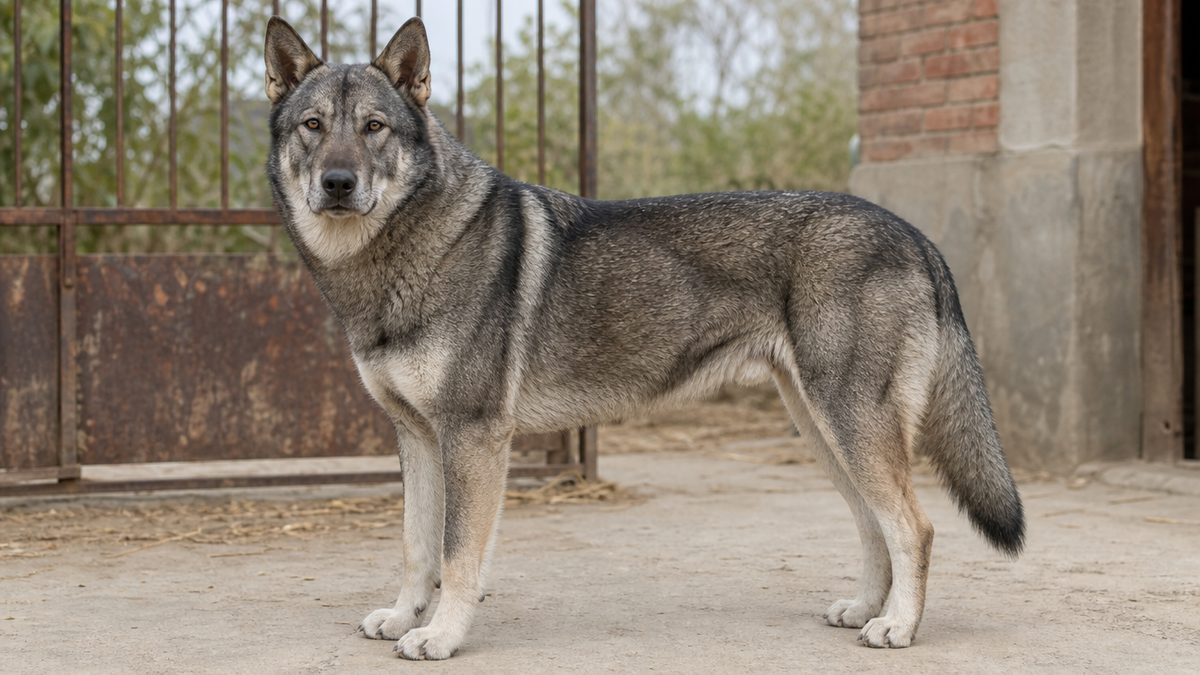
Quick answer
The langqing dog is not a settled breed. Langqing (狼青) is a Chinese word for a wolf-grey or steel-blue coat colour, and Baidu Baike states plainly that the langqing dog is not a single pure breed but a collective term for wolf-type dogs carrying that colour. No kennel club publishes a standard for it and no register holds a studbook. India has no langqing population, no price and no lawful commercial import route.
This page is general information for Indian pet owners and is not veterinary advice. It cannot diagnose or treat any animal and it does not replace an examination. Consult a registered veterinarian near you before acting on anything here, and in particular before supplementing a growing puppy's diet, changing a vaccination schedule or acting on any care instruction translated from another country.
Langqing at a glance
Langqing overview: the background the English pages leave out
The langqing is not a settled breed, and the clearest statement of that comes from China rather than from anyone arguing about it in English. Baidu Baike's own lemma says the langqing dog is not a single pure breed but a collective term for wolf-type dogs carrying the langqing coat colour.
Start with the sentence, because everything else follows from it. Baidu Baike's 狼青犬 entry, lemma 3343469, opens by giving the animal's scientific classification as 学名:暂无明确分类, meaning no clear classification at present. Its section on main varieties then states: 狼青犬并非单一纯种,而是对具有狼青色毛色的狼种犬的统称,血统复杂. The langqing dog is not a single pure breed, but a collective term for wolf-type dogs having the langqing coat colour, and its bloodline is complex.
That entry has been edited 129 times, viewed 386,862 times, and was last updated on 2 April 2026. It is not an obscure corner of the Chinese internet. It is the main Chinese-language reference for this name, and it says the name describes a colour rather than a lineage.
What the English page says instead
English Wikipedia's article opens by calling the animal a Chinese dog breed widely distributed in northern China, and only then adds that it is a generalized dog type. The infobox leaves the FCI standard field, the kennel club name field and the kennel club standard field all blank, which is the same page quietly recording that no registry holds it.
The source attached to that opening sentence is worth naming. For the claim that this is a breed, the article cites a Sina News report of 11 September 2013 headlined that a vicious dog which killed a girl in Hebei is still at large and that police shot at it and missed. A news report of a fatal dog attack is the citation carrying the word breed. The citation is real; the claim it is asked to support is not in it.
The Chinese and English articles look like independent corroboration and are not. English revision 1350558895 was made by the editor Wtf35861887 at 16:28:04 UTC on 22 April 2026; Chinese revision 92378821 was made by the same editor at 16:29:41 UTC the same day 狼青犬, Chinese Wikipedia. Raw wikitext pulled…. One contributor writing a parallel pair is one data point, not two, and it is worth checking who is behind two sources before treating their agreement as confirmation.
And the Chinese article says something the English one does not
The two versions are not translations of each other. Chinese Wikipedia carries a sentence with no equivalent in the English lead: 該犬一般被視為一種廣義上的犬型,而非嚴格定義的純血犬種. This dog is generally regarded as a broad dog type rather than a strictly defined pure-blooded breed.
So the same editor, on the same day, told Chinese readers it is a type and English readers it is a breed. Whether that was deliberate or an artefact of how each language's conventions read, the effect on an Indian searcher is the same: the English internet inherited the stronger claim.
What the dog actually is, on the balance of the Chinese sources
Reading the Chinese material together gives a consistent picture that no English page carries. The langqing is a large, alert, wolf-grey guarding dog found across northern China, kept at forest farms, enterprises, warehouses, villas, resorts and fish ponds for supervision, guarding, patrolling, robbery and theft prevention, hunting and fighting.
Its bloodline is mixed and, in Baidu Baike's own words, 因长期无序杂交导致血统混杂,遗传特征不稳定, long-term disordered crossbreeding has produced mixed bloodlines and unstable genetic characteristics, so directed selection would be needed to clarify classification. The same entry says its essence is a German Shepherd derivative, similar in position to the Czechoslovakian Wolfdog, and that directed selection would be needed before a stable new breed could form.
China Science Communication, the state science-popularisation platform, describes it more warmly but no more definitively: produced by Chinese dog enthusiasts continuously improving and selecting from good wolf-type dogs, adaptable, easy to keep, loyal in guarding, and an excellent first choice for guarding a home.
None of those accounts describes a landrace with a fixed regional type, and none describes a registered breed. They describe a colour and a job.
The name is a colour: what 狼青 means, and which breeds carry it
Langqing (狼青) is a Chinese word for a wolf-grey or steel-blue canine coat colour, and several unrelated breeds carry it. Establishing that is the whole point of this page, because a buyer told they are getting a langqing has been told the dog's colour and nothing else.
Four independent Chinese-language sources say the same thing, and two of them are the ones English pages already cite without reading this part.
A Sohu article of 1 April 2020 states it most directly: 狼青是家犬的一种毛色,又称貂色、黑貂色、紫貂色,是原始狼的颜色. Langqing is a coat colour of the domestic dog, also called sable, black sable or purple sable, and it is the colour of the original wolf. It then names where you find it: 常见于狼种犬有:昆明犬、德国牧羊犬、中国本土狼青犬,其他一些犬种如高加索犬、藏獒等也有狼青色. It is commonly seen in wolf-type dogs including the Kunming dog, the German Shepherd and China's native langqing dog, and other breeds such as the Caucasian Shepherd and the Tibetan Mastiff also have the langqing colour.
Read that list again. The Kunming dog, the German Shepherd, the Caucasian Shepherd and the Tibetan Mastiff are four separate recognised breeds, and the source says all of them can be langqing. A word that applies across four breeds is a colour adjective, not a breed noun.
English Wikipedia says it too, and nobody quotes that sentence
The English article's own Name section reads: *Langqing (狼青) refers to a type of canine coat color characterized by a grayish-blue or steel-blue tone, similar to that of a wolf. The term can also be used to describe various dog breeds that possess this coloration.* It then adds that the Langqing Quan received its name in 1950 for its distinctive coat, as it only exhibits Langqing colors.
That section carries no reference at all. It is the most important paragraph on the page and it is the one nobody downstream repeats, because the article's first line says breed and aggregators copy first lines.
On the query *langqing dog* from India on 3 September 2026, Google's own generated panel printed the sentence *Langqing (狼青) refers to a type of canine coat color characterized by a grayish-blue or steel-blue tone, similar to that of a wolf*. Bonbeno does not cite generated answers as evidence of fact, and records this only as an observation about the search result page. It is unusual and worth noting that the machine summary reached the correct reading while the human-written aggregator pages beneath it did not.
The translation trap this sits inside
Chinese canine vocabulary has two words that both look like wolf in English and mean different things. 狼犬 (langquan) means a shepherd or Alsatian-type dog, not a wolf dog. 狼青 (langqing) means the wolf-grey colour. Read either literally and a sentence about local shepherd-type dogs with wolf-grey coats becomes a sentence about wolfdogs.
The consequences are visible on these pages. English Wikipedia files the Langqing Quan under Category:Wolfdogs, and its Background section states that the animal was formed by cross-breeding between Tugou, a wolfdog strain in northern China, and Chinese wolves. Its sources for that are an anonymous forum post and the China Science Communication entries.
What those Chinese entries actually say is narrower. The 中华狼青 entry opens its description with 狼青犬民间说法是用狼犬和狼杂交而成, the FOLK SAYING is that the langqing dog is made by crossing shepherd-type dogs with wolves. 民间说法 marks a popular belief, not a finding. The hedge is in the Chinese and it is gone in the English, and a wolf hybrid category was applied on the strength of what survived.
Baidu Baike, on the same question, gives two accounts and prefers neither wolf story. The first is that the dogs were left behind by the invading Japanese army and crossed with local Chinese breeds; the second is that they are wolf and dog crosses. It then records that in 1914 Japan occupied the Jiaodong peninsula in Shandong, obtained German Shepherds from the local German military dog base, and bred from them militarily, eventually producing the Japanese langqing dog.
The clean test: what Chinese scholars call the black-saddled dogs
There is one place where Chinese writing draws the line explicitly, and it settles the question. Chinese Wikipedia records that Chinese scholars call the Qingdao-line shepherd dogs 黑背狼青, black-backed langqing, and 視其為狼色德國牧羊犬,而非狼青犬本種, regard them as wolf-coloured German Shepherds rather than as the langqing dog proper.
Note the construction. 狼色德國牧羊犬 is wolf-coloured German Shepherd. The colour word is doing exactly the job this page says it does: describing the coat of a dog whose breed is named separately. That sentence is cited to Ma Dajun and Lou Hongjun's 2004 article in the journal *China Working Dog*.
So when an Indian seller offers a langqing, the honest translation of what they have said is *a wolf-grey dog*. Which dog is a separate question, and it is the one to ask.
Appearance: a 30 cm height spread is not a breed description
Chinese sources give male langqing shoulder heights from 65 cm to 95 cm and female heights from 55 cm to 75 cm, and one platform contradicts itself inside a single entry. A range that wide is a description of a regional population, not a breed standard.
Put the figures in one place, because separately each looks reasonable and together they do not.
| Source | Male height | Female height |
|---|---|---|
| China Science Communication, 狼青 entry | 65 to 75 cm | 55 to 70 cm |
| China Science Communication, 中华狼青 entry, first paragraph | 75 to 85 cm | 70 to 75 cm |
| China Science Communication, 中华狼青 entry, later paragraph | 70 to 88 cm | 65 to 75 cm |
| Baidu Baike, 狼青犬 lemma | About 65 to 85 cm | About 55 to 75 cm |
| English Wikipedia infobox | 70 to 85 cm | 70 to 85 cm |
| English Wikipedia body, Hebei dogs | Average 88 cm, some 90 to 95 cm | Not given |
| English Wikipedia body, smaller regional dogs | 66 to 71 cm | 61 to 66 cm |
The two China Science Communication entries were uploaded on the same day, 31 December 2021, by the same 科学百科 desk [科普中国]-中华狼青, China Science Communication. The second one gives 75 to 85 cm for males in its opening summary and 70 to 88 cm for males further down the same page. That is not a disagreement between sources; it is a disagreement inside one document.
Baidu Baike is the only source that explains the spread rather than printing it: 公犬肩高约65-85厘米,母犬肩高约55-75厘米,存在地域差异, males about 65 to 85 cm and females about 55 to 75 cm, with regional variation. Regional variation is exactly what you would expect from a colour term applied to whatever large wolf-grey dog a district happens to keep.
English Wikipedia's infobox lists Luqing Quan among the breed's alternative names, as though it were a neutral synonym. The Chinese article explains what it is: 反對河北系狼青犬者則稱其為「驢青犬」, those who oppose the Hebei line call them 驢青犬, donkey-blue dogs, meaning coarse and stout as a donkey. It is an insult about the oversized Hebei dogs, and it reached the English page as a name.
What the sources do agree on
The agreed picture is a wolf-shaped dog rather than a measured one. Baidu Baike describes a large head in proportion to the body, sometimes with the characteristic forehead wrinkling known as 五花脑; small, thick, triangular erect ears; deep or light brown eyes, sometimes yellow-brown; a broad black nose and black non-drooping lips; a body slightly longer than tall; a deep broad chest; a level back; strong straight forelegs; and a large full tail set high.
The coat is the one thing every source treats as definitional, which is consistent with the name being a colour. Both Wikipedia articles record a double coat, and Baidu Baike specifies a thick soft undercoat. The colours are given as 铁青 iron-grey, 青白 blue-white, 草黄 grass-yellow and 蓝灰 blue-grey, with northern dogs described as darker and running to 青灰, 铁青 and 草黄青.
The disqualifying-fault list, and why it is not a standard
There is one document-shaped artefact worth taking seriously. The 中华狼青 entry lists faults: a sagging back, ears that do not stand and a tail curled upward are all 失格, disqualifying. It requires a black face and muzzle, a thick long vertical tail, a broad head and thick muzzle, and triangular eyes, and states that white eyes are top grade.
That reads like a standard, and it is the nearest thing this dog has. It is not one, for two reasons. No body issues it, so there is no register against which a dog could be judged and no judge accountable for the judgement. And it disagrees with its own sister entry on the same platform about both height and colour, which a standard cannot do.
One further detail matters more than it looks. The same entry says ears usually stand at three to seven months, and Baidu Baike says from about three months, adding that if the ears do not stand it is probably calcium deficiency and recommending supplementation and then taping them together. Hold that thought: it is picked up in the feeding section, where the published feeding trials on large-breed puppies say something very different, and in the grooming section, where Indian law says something different again.
Bonbeno's two-condition test, and the recognition question
The langqing fails both conditions of Bonbeno's two-condition test, and the Chinese sources agree rather than argue. No body publishes a written standard for it and no register holds a studbook, so a buyer has nothing to check a puppy against.
Bonbeno maintains a page for dog types that are not breeds, and its rule is that a breed has a written standard and a studbook behind it, so an individual animal can be measured against a document. A type is a description, and many different dogs satisfy it at once, so there is nothing to check.
Being a landrace does not automatically put a dog on that page. The English Shepherd is a landrace and a standardised breed at once, and the Africanis is a landrace with an official emerging-breed standard. What matters is whether a document exists.
Condition one, a written standard: not met
No kennel club anywhere publishes a standard for the langqing. The closest artefact is the fault list on China Science Communication's 中华狼青 entry, which no body issues and which contradicts its own sister entry on height and colour.
Baidu Baike states the position in its own words rather than leaving it to be inferred: the bloodline is complex, long-term disordered crossbreeding has produced unstable genetic characteristics, and 需定向选育以明确分类, directed selection is needed to clarify classification. It adds that only if the langqing or similar Chinese crossbred dogs stopped being crossed with other breeds and with wolves, so that the bloodline stabilised, would that be enough to form a new Chinese breed.
That is a Chinese encyclopedia saying, in its own conservation section, that this is not yet a breed and describing what would have to happen for it to become one.
Condition two, a studbook: not met
No register holds langqing pedigrees. On recognition by the international body, the FCI's letter L index was read live on 3 September 2026 with the page heading confirmed before anything was read off it. The letter returns exactly eight definitively recognised breeds: Labrador Retriever (122), Lagotto Romagnolo (298), Lakeland Terrier (70), Lancashire Heeler (360), Landseer (226), Lapinporokoira (284), Leonberger (145) and Lhasa Apso (227). Labrador Retriever heads the list and is the in-document control, so the page loaded. Langqing appears zero times.
This site's Liangshan Dog page records the same eight FCI letter-L breeds with the same numbers. Bonbeno re-derived the list independently for this page rather than copying it, and it matched exactly, breed for breed and number for number. That is worth saying: a sibling claim was tested and it held.
The India route closes with it. India is a full FCI member represented by the Kennel Club of India in Chennai, so the KCI issues pedigrees against FCI nomenclature. A breed absent from FCI nomenclature cannot be registered with the KCI, which means no Indian pedigree for a langqing can exist regardless of what any seller's paperwork claims.
| Condition | Status | Evidence |
|---|---|---|
| A written breed standard published by a body | Not met | No club or registry publishes one. The nearest artefact is an encyclopedia fault list that contradicts its own sister entry on height and colour |
| A studbook recording individuals | Not met | Absent from the FCI letter L index of eight breeds, with the Labrador present as an in-document control. No Chinese register holds it either |
Why this verdict is not a criticism of the dogs
The dogs are real and they work. Every Chinese source describes animals doing genuine jobs across northern China, and China Science Communication's entry has a named academic contributor, 高立杰, an Associate Professor at the College of Animal Science and Technology, Hebei Agricultural University. This is not a made-up animal.
What does not exist is the thing a buyer needs. If you are handed a langqing puppy, there is no document that says what it should grow into, no register that says who its parents were, and no body you can complain to if it becomes something else. On a guard dog of 65 to 85 cm with a documented attack risk, that gap matters more than it would on a small companion breed.
It also means one specific claim can be dismissed immediately. Nobody can sell you a pedigree langqing, in India or anywhere, because there is no pedigree to issue. Any paperwork offered under that description names a different breed or names nothing at all.
Langqing dog price in India: none exists, and what is sold instead
There is no langqing price in india. An India-located Google search on 3 September 2026 returned about 181 results with no Indian seller, against a control search in the same session that returned ten genuine Indian Labrador pages.
Say the absence first, because it is the answer, and because the temptation on a page like this is to convert a foreign figure into rupees. Bonbeno will not, and neither should anyone else: converting a price is how a number that describes nothing acquires a currency symbol and starts being quoted.
The absence was earned. The control query *labrador retriever price in india*, run at gl=IN and hl=en through the same stealth proxy in the same session, returned Mr n Mrs Pet, Wrapinfur, Supertails, Tradeindia, BARF India, AsiaPets and petsworld.in, plus two Indian price videos, and rendered its own People Also Ask box. The instrument was working. It simply had nothing Indian to show for this name.
The one page that does print a price, and what is wrong with it
BreedsPedia ranks eighth for this term in India and gives a price of 500 to 1,500 euros. It also files the langqing in the Hound group, gives its origin as Guizhou Province, its size as Small, its weight as unknown kg, its height as unknown cm and its life span as 10 to 14.
Every one of those is wrong or empty. The Chinese sources place the dog in northern China, principally Hebei and Shandong, roughly two thousand kilometres from Guizhou; they describe a guarding dog rather than a hound; and they give shoulder heights from 65 cm upward, which is not small by any measure.
BreedsPedia's own sentence reads: *The Langqing is a small breed weighing between unknown kg and standing unknown cm tall. Its sturdy physique and well-proportioned body make it instantly recognisable*. The software's null placeholders have been printed straight into an English sentence, and the next line reads *Known for its Loyal, intelligent, independent, athletic, energetic*, with the slot filled and the grammar unrepaired. That is proof the page was assembled rather than written, and its euro price came from the same machine. Its illustration is served from cdn4.thedogapi.com rather than being a photograph of a langqing.
Creatures.com, judged page by page rather than by domain
The fourth result is a Creatures.com breed page, and it deserves a more careful verdict than the domain's reputation would give it. Its prose is good. It calls langqing a Chinese working dog label rather than a tightly standardized international breed, says the name is used inconsistently, warns buyers to ask what breeding population and health checks sit behind a puppy, and tells readers to treat it as a serious working dog rather than a novelty wolf hybrid.
Its data furniture is another matter. All four counters read empty: no marketplace listings, no herdbook records, no community profiles and no breeders. And its colour list runs to exactly 55 entries including Albino, Blue Merle, Harlequin, Leucistic, Piebald, Red Merle and Tuxedo, and lists both Gray and Grey as separate colours, which is a generated list rather than an observed one.
That 55-entry list is byte-identical to the one this site recorded on the same domain's Liangshan Dog page, which is a sibling claim Bonbeno re-counted item by item for this page and confirmed. The prose is per-page and worth reading; the colour list is template filler and worth ignoring.
What an Indian buyer is actually offered
Searching this name with a price intent in India surfaces something different again: a Delhi seller's video offering a *Chinese German Shepherd and Chinese Labrador, first time in India*, at Rs 15,000 per puppy, and an Instagram page printing a city-by-city *wolf dog price in India* breakdown of Rs 45,000 to Rs 55,000 in Mumbai and Rs 60,000 to Rs 75,000 in Delhi with no source of any kind.
Neither is a langqing price. The first is a seller using a nationality as a marketing adjective on a recognised breed; the second is a number attached to the phrase wolf dog, which in India attaches to nothing specific at all. If either is what you were shown, you were being sold a German Shepherd or an unspecified crossbreed under a more exotic label.
The import route, and why it is closed
India's import restriction on dogs closes the question independently. Dogs enter under ITC(HS) 01061900 as a Restricted item. DGFT Trade Notice 22/2022-23 permits import only for a pet dog with a valid pet book and records in the importer's name, for R&D organisations with a CPCSEA recommendation, or for internal security by the Defence and Police Force. Policy Condition 8 states that import of commercial dogs for breeding or any other commercial activities is not permitted, paragraph 6 that any applications for trading or breeding purposes shall be duly rejected, and paragraph 7 that entry is allowed only through the airports and seaports of Delhi, Mumbai, Chennai, Hyderabad, Bangalore and Kolkata. DAHD added a seventh port, Cochin International Airport at Kochi, for pets arriving under the baggage rules in October 2024. The full route is set out in how to import a dog to India.
Put the two facts together. No FCI or KCI route to register the dog, and no lawful commercial route to import one. Between them they mean no legitimate Indian supply chain for a langqing can form, whatever anyone offers you.
What a large double-coated guarding dog costs in India each month
A 30 to 45 kg double-coated guarding dog costs roughly Rs 8,500 to Rs 15,000 a month to keep properly in an Indian metro. There is no langqing purchase price to research, but every care figure below was read live from an Indian provider's own page on 3 September 2026.
Size sets almost every recurring cost in India, and the Chinese sources put males at 65 to 85 cm at the shoulder. A dog of that height carries roughly 30 to 45 kg, which puts it in the large-breed band for food, in the top band for parasite dosing and in the large or extra-large band for boarding. The figures below are for that band and would be wrong for a smaller dog.
Vaccination, and a spread you can use
Vetic, a clinic chain across seven metros, publishes a seven-visit puppy course on days 30, 45, 60, 75, 90, 105 and 120. On 3 September 2026 its national page priced that course from Rs 6,499 against a struck-through Rs 8,111, and the annual booster from Rs 3,199 against Rs 3,806. Its Mumbai page, read the same day and naming twelve Mumbai clinics, priced the identical schedule from Rs 7,199 against Rs 8,691, with the booster at Rs 3,299.
That is a Rs 700 gap, about 10.8 percent, on one chain's same product on the same day, decided purely by which city page you land on. Meanwhile the individual vaccine prices are identical on both: anti-rabies Rs 699, Puppy DP Rs 849, 9-in-1 DHPPiL Rs 899, Canine Corona Rs 899 and Kennel Cough Rs 1,349.
You can check the package against its parts in a minute. Adding the seven visits at those component prices gives Rs 8,091, which is within Rs 20 of the national page's own struck-through Rs 8,111. So the discount is real, and the city difference is in the discount rather than in the medicine.
Greater Chennai Corporation charges Rs 50 for a pet dog licence and runs six pet clinics providing all treatment and anti-rabies vaccination free of cost; it issued 9,115 licences in 2024. Delhi's MCD charges Rs 500 to register and Rs 500 to renew, with a Rs 100 a month late fee, and its portal records 18,958 certificates issued since 2021 and 71 of 1,006 applications rejected in FY 2026-27. Municipal fees barely move; retail prices move within days.
The monthly lines for a large guarding dog
Parasite control is the line Indian owners most often under-budget, and on an outdoor-working dog it is not optional. NexGard Spectra for the 15 to 30 kg band costs Rs 3,308 for three tablets at Supertails, MRP Rs 3,375, which is Rs 1,103 a month, and covers ticks and fleas together with roundworm and hookworm in one product. A 35 to 45 kg dog needs the next pack size up, so treat Rs 1,103 as a floor.
Grooming on a double-coated dog is a moult problem rather than a haircut problem. Vetic's Delhi page lists bathing from Rs 934, complete bath and styling from Rs 1,869 and add-ons from Rs 99, and Voice of Stray Dogs gives a wider Indian range of Rs 300 to Rs 2,000 for grooming and Rs 500 to Rs 1,000 for a consultation. Budget for two heavy de-shedding sessions a year on top of routine baths.
Boarding a large dog in Bengaluru runs Rs 899 for up to 24 hours at PawSpace, with daycare to ten hours at Rs 799 and up to four hours at Rs 599. Note that many Indian boarding operators will refuse a dog with a guarding temperament and no vaccination record, which is a real constraint rather than a hypothetical one.
| Line | Monthly cost | Source and basis |
|---|---|---|
| Food, large-breed dry diet | Rs 5,000 to Rs 8,000 | Arithmetic from roughly 350 to 450 g a day, not a quoted price. Verify grams per day against your own pack |
| Tick, flea and worm control | Rs 1,103 and up | Supertails NexGard Spectra 15 to 30 kg, three tablets Rs 3,308; a heavier dog needs a larger pack |
| Vaccination, amortised | Rs 267 to Rs 275 | Vetic annual booster Rs 3,199 national or Rs 3,299 Mumbai, divided by 12 |
| Routine vet, amortised | Rs 250 to Rs 500 | VOSD consultation Rs 500 to Rs 1,000, three to six visits a year |
| Grooming and de-shedding | Rs 934 to Rs 1,869 | Vetic Delhi, one visit a month, more during the moult |
| Municipal licence, amortised | Rs 4 to Rs 42 | GCC Rs 50 a year in Chennai; MCD Rs 500 a year in Delhi |
| Cooling, hot months | Rs 500 to Rs 2,500 | Bonbeno estimate, not a quoted price. A double-coated dog in Chennai or Delhi needs reliable cooling rather than a fan |
| Realistic monthly total | Rs 8,500 to Rs 15,000 | Sum of the rows above, excluding boarding and any illness |
Two honesty notes on that table. The food and cooling rows are estimates rather than quoted prices, and they are labelled as such, because the retail row this site holds for a large-breed 15 kg bag went stale inside a week. And the total excludes boarding, which at Rs 899 a night adds Rs 6,300 for a week away, and excludes illness entirely.
The point of publishing this on a page with no breed price is simple. The purchase is the small number. A dog of this size costs somewhere near Rs 1 lakh to Rs 1.8 lakh over ten years in routine care alone, before a single emergency, and that figure is the same whatever name is on the puppy.
Climate: northern China gets the heat and then a hard freeze, India does not
Northern China's summer is genuinely hot, so the usual claim that a Chinese guarding dog cannot take Indian heat is too simple. What northern China also has is a winter that drops to a January mean of -2.50 C in Jinan and -18.69 C in Harbin, and India offers no such recovery.
NASA POWER was queried by explicit latitude and longitude on 3 September 2026 for both homelands and destinations, with the cell elevation echoed back and checked against the real town elevation, because POWER returns a grid cell rather than a point. All nine points queried are plains sites where the cell tracks the town, so no lapse-rate correction was needed NASA Langley Research Center.
| Place | Annual mean | Warmest month | Coldest month | Peak monthly mean daily max | Mean humidity |
|---|---|---|---|---|---|
| Harbin, Heilongjiang | 4.19 C | 23.68 C in July | -18.69 C in January | 39.25 C in June | 70.37 percent |
| Beijing | 11.61 C | 26.55 C in July | -5.23 C in January | 42.18 C in May | 52.41 percent |
| Jinan, Shandong | 13.08 C | 27.00 C in July | -2.50 C in January | 42.81 C in July | 63.86 percent |
| Bengaluru | 23.74 C | 28.37 C in April | 20.22 C in December | 40.38 C in April | 67.94 percent |
| Pune | 23.86 C | 28.93 C in April | 19.62 C in December | 43.20 C in April | 66.80 percent |
| Delhi | 25.60 C | 35.88 C in June | 13.61 C in January | 48.79 C in June | 45.56 percent |
| Kolkata | 25.81 C | 31.53 C in May | 17.31 C in January | 46.81 C in May | 73.93 percent |
| Mumbai | 26.77 C | 31.19 C in May | 23.19 C in January | 44.91 C in April | 67.39 percent |
| Chennai | 27.95 C | 31.51 C in May | 24.09 C in January | 42.70 C in May | 72.39 percent |
Read the columns in the right order
The warmest-month column looks reassuring and is the wrong column. Jinan's July mean of 27.00 C is close to Chennai's May mean of 31.51 C, and Jinan's peak daily maximum of 42.81 C actually exceeds Chennai's 42.70 C. A hardy northern Chinese dog does meet real heat at home.
The annual mean and the coldest-month columns are where the difference lives. Jinan averages 13.08 C across the year against Chennai's 27.95 C, a gap of 14.87 C. And Jinan's January averages -2.50 C, when a double-coated dog is in its element, against Chennai's January mean of 24.09 C, which is above every month Jinan ever records except June, July and August.
So the honest framing is not that this dog cannot take heat. It is that the dog gets eight or nine months a year to recover, and in Chennai it gets none. A double coat built for a -2.50 C January is being asked to work through a 24.09 C one.
Delhi's mean humidity of 45.56 percent is lower than Jinan's 63.86 percent. Dry heat is easier for a panting dog than humid heat of the same temperature, because evaporative cooling still works. So of the six Indian cities measured, Delhi is the one where a northern Chinese dog's cooling machinery is least compromised, despite Delhi carrying the worst peak at 48.79 C in June. Chennai and Kolkata, at 72.39 and 73.93 percent humidity, are the hard ones. That is a more useful ranking than a blanket warning.
Why this page still rates heat tolerance at 2 of 5
Three reasons, and they are cumulative. First, the recovery gap above. Second, bodyweight: Hall's Scientific Reports study of 905,543 UK dogs found bodyweight at or above the breed and sex mean carried an odds ratio of 1.42 for heat-related illness, and dogs over 50 kg an odds ratio of 3.42. The langqing was never in that model, so those odds ratios are not its own, but the bodyweight factor is the transferable part and this is a large dog.
Third, and most relevant to a guarding dog, the trigger. In Hall's *Animals* paper from the same cohort, of the 879 heat-related illness events with a recorded trigger, 652 were exertional at 74.2 percent, against 113 environmental at 12.9 percent and 46 from vehicular confinement at 5.2 percent. A patrolling dog that reacts to an intruder at two in the afternoon is doing the exertional thing in the worst hour.
Indian law reaches the same place from the other direction. The Prevention of Cruelty to Animals (Dog Breeding and Marketing) Rules 2017, Second Schedule Part IV paragraph 21(1), bars keeping in outdoor facilities, without the attending veterinary practitioner's written approval, dogs not accustomed to the temperatures prevalent in the area, breeds that cannot tolerate them such as long-haired breeds in high temperature locations, and sick, infirm, aged or young animals. A double-coated dog kept outdoors as a guard in Chennai sits inside the first two categories at once.
The practical guidance is the same one this site gives on every thick-coated northern breed. Treat a heat-sensitive dog's midday as unavailable from March to October, provide shade and moving air rather than a kennel with a metal roof, and budget for reliable cooling as a running cost rather than a luxury.
Temperament: the Chinese sources are unusually blunt about this dog
Chinese sources describe the langqing's temperament as fierce, highly aggressive, sharply territorial and hard to control, and one states that low controllability is the main reason it has not been used as a police dog. Chinese breed copy usually flatters, which makes those admissions worth taking seriously.
The consistent description across the Chinese material is a dog with a keen nose, high alertness, strong attack drive, strong resistance to being struck, and a refusal to retreat once challenged. Baidu Baike puts it as 性情凶狠, fierce in nature; 攻击性非常强, extremely strong aggression; and 向挑战者立即进攻,决不后退半步, attacks a challenger immediately and never retreats half a step [科普中国]-狼青, China Science Communication.
That is the language of a working guard, and every source pairs it with the job list: guarding, patrolling, robbery prevention, theft prevention, hunting and fighting, at forest farms, enterprises, warehouses, villas, resorts and fish ponds.
The admission that matters most
One sentence on Sohu carries more decision value than the rest of the temperament literature combined: 狼青犬服从性、可控性比较低,没有德国牧羊犬、昆明犬好,这也是狼青犬没有被用于警犬的主要原因. The langqing's obedience and controllability are relatively low, not as good as the German Shepherd's or the Kunming dog's, and this is the main reason the langqing has not been used as a police dog.
Take that seriously because of what it costs the writer to say. The article is otherwise admiring, and it is telling readers that China's own police services looked at this animal and chose two other breeds. The same article adds that the dog has 一种高傲和不羁的性格, a proud and unruly character, will not readily submit to an owner it does not respect, and may turn on an owner who fails to establish that.
Baidu Baike records that item 19 of Changsha's published dangerous dog catalogue is the langqing dog, that under the city's regulations keeping a dangerous dog in the strict management area requires a police keeping permit, and that bringing one into that area draws an order to correct, with refusal punishable by confiscation of the dog and a 1,000 yuan fine. It notes that other places list it as a banned breed. No Indian law names this dog at all, but a city in its own country regulating it is a fact worth knowing before you seek one out.
Household fit, stated plainly
Baidu Baike's own harms section says the dog presents an attack risk to strangers and to other animals, that strangers who provoke it are likely to be attacked, and that its strong territorial sense means visitors to the home are easily frightened by it. It then gives the correct response: socialise early and always use a lead outdoors.
For an Indian household that adds up to a specific and unromantic conclusion. This is not an apartment dog, it is not a dog for a home with regular visitors, deliveries or domestic help coming and going, and it is not a first dog. Those are not moral judgements about the animal; they are what the sources describing it actually say.
The variability problem underneath the temperament problem
There is a second issue that a temperament description cannot capture. Because no standard and no studbook exist, temperament is not being selected for by anyone in particular. Baidu Baike says long-term disordered crossbreeding has produced mixed bloodlines and unstable genetic characteristics, and English Wikipedia records that since the early twentieth century Chinese kennels and enthusiasts have crossed these dogs with German Shepherds, Great Danes and Czechoslovakian Wolfdogs to produce new types, distinguished as old-version and new-version langqing.
Crossing a guarding dog with a Great Dane and with a Czechoslovakian Wolfdog produces two very different animals, and both can be sold under one name. That is the practical meaning of a colour term used as a breed name: the temperament you are promised and the temperament you get are not connected by any document.
If what appeals here is an alert, territorial, wolf-grey guarding dog, the German Shepherd is the breed Baidu Baike itself names as this dog's essence, and it comes with a written standard, a studbook, screening guidance and a real Indian presence. That is a better answer to the same want.
Training: hard by the sources' own account, and harder without a standard
Chinese sources say the langqing is difficult to train, shows no enthusiasm in training, and complies mainly to avoid losing its food. That is an unusually frank assessment, and it is the opposite of what an aggregator page will tell you.
The Sohu article is worth quoting at length because nothing in English says anything like it. It states that where other breeds happily complete a task on command, the langqing is a hundred times unwilling; that it has no positive attitude in training and does not pay attention; and that when it does accept a command it is going through the motions out of fear that the owner will withhold food.
Its recommended solution is greed. The article advises using the dog's fondness for food, working a reward-and-correction structure, and giving small treats during sessions to raise motivation. That is broadly sound modern advice arrived at from an unflattering premise.
China Science Communication's entry pulls the other way, describing the dog as 很有灵性天生具有易驯服的优点, spiritually intelligent with a natural advantage of being easy to tame, and this is one of the reasons langqing enthusiasts like it. So the Chinese sources disagree with each other about trainability, and this page prints the disagreement rather than picking the flattering one.
What both accounts agree on
Both agree the dog is intelligent and both agree it is not naturally compliant. Baidu Baike frames the same trait as high independence possibly accompanied by nervousness, contrasted with the German Shepherd, which it describes as more stable and easier to live with, noting that the German Shepherd's obedience and stability make it usable as a family companion and guide dog while the langqing's fierceness and alertness confine it to guarding and watching roles.
The practical reading for an owner is that this is a dog that will work for a handler it respects and will test one it does not. On a 65 to 85 cm animal with the attack drive the sources describe, that is a serious commitment rather than a quirk.
China Science Communication's rearing section advises that for 20 days after bringing a puppy home you should not bathe it, not take it out for walks and not let it contact other dogs, so that it can adapt to the new environment. India's Prevention of Cruelty to Animals (Dog Breeding and Marketing) Rules 2017, Second Schedule Part III paragraph 7, requires that every dog be kept in a clean, healthy and safe environment and be provided with all socialisation opportunities, vaccinations and de-worming necessary to provide maximum mental and physical well-being. Read back verbatim from the gazette. Twenty days of isolation on a guarding breed at exactly the age when tolerance of novelty is cheapest to build is the wrong trade, and the same source's advice that missing a meal or two after purchase does no great harm is not advice any veterinarian would give.
How to socialise a guarding breed in India specifically
The way to socialise safely while a vaccination course is still running is to control the exposure rather than to avoid it. Carry a young puppy through busy places rather than walking it on the ground. Arrange contact with known, fully vaccinated adult dogs rather than at a public park. Invite the people your household actually sees, the delivery rider, the domestic help, the security guard, to give the puppy food, so that the categories of person a guarding dog will later react to are established as safe early.
That last point matters more in India than in most markets, because Indian households typically have more regular non-family callers than the northern Chinese farm compounds these dogs were selected in. A dog bred to challenge everyone approaching a fish pond has to unlearn that in a building with a gate, a lift and a stream of visitors.
One more legal fact belongs here. Rule 8(1)(a) states that every breeder shall ensure that pups less than eight weeks in age are not sold. That is a Rule, not a Schedule paragraph, and a seller offering a six-week puppy of any breed is breaking it. On a large guarding dog, the two weeks lost with the litter are exactly the weeks that teach bite inhibition.
Exercise: a patrol dog's workload in a country with three usable hours
Chinese sources describe the langqing as needing constant walking and running and describe it patrolling forest farms, warehouse compounds and fish ponds. Indian heat compresses the safe exercise window to roughly three hours a day for much of the year, and that gap is the central practical problem.
Baidu Baike states it directly in its management section: 狼青犬精力旺盛,运动量大,必须经常进行散步、奔跑等活动. The langqing is high-energy with a large exercise requirement and must regularly walk, run and be similarly active. English Wikipedia's working-dog section lists the roles the energy goes into: supervision, care, guarding, robbery prevention, theft prevention, patrolling, hunting and fighting.
A dog kept to patrol a forest farm or a large fish-pond compound is exercising all day at its own pace. That is a different workload from a walked pet dog, and it is the workload the temperament was selected against.
The Indian window, in numbers
Here is the constraint. Chennai's warmest month averages 31.51 C with a monthly mean daily maximum of 42.70 C. Delhi's June averages 35.88 C with a mean daily maximum of 48.79 C. Kolkata pairs a 46.81 C May maximum with 73.93 percent mean humidity. Jinan, by comparison, averages 13.08 C across the year.
For a double-coated dog in Chennai that leaves roughly the hours before seven in the morning and after eight at night, for about eight months of the year. Bengaluru and Pune, at annual means of 23.74 C and 23.86 C, are meaningfully easier and give a longer usable morning.
| City | Annual mean | Humidity | Practical guidance |
|---|---|---|---|
| Bengaluru | 23.74 C | 67.94 percent | The mildest option. Morning and evening work is realistic year-round; April needs care |
| Pune | 23.86 C | 66.80 percent | Similar, with a harder March to May at a 43.20 C April peak |
| Delhi | 25.60 C | 45.56 percent | Driest air in India, so panting works better, but the 48.79 C June peak is the worst on the list |
| Kolkata | 25.81 C | 73.93 percent | Heat plus the highest humidity measured. The hardest combination for cooling |
| Mumbai | 26.77 C | 67.39 percent | Warm nights mean poor overnight recovery for a thick-coated dog |
| Chennai | 27.95 C | 72.39 percent | Warmest annual mean. Even January averages 24.09 C, above Jinan's July |
In Hall's *Animals* study of 905,543 UK dogs, of the 879 heat-related illness events with a recorded trigger, 652 were exertional, which is 74.2 percent, against 113 environmental at 12.9 percent and 46 from vehicular confinement at 5.2 percent. Exercise is the commonest trigger by a wide margin, and that is in Britain. An owner trying to give a patrol-bred dog its Chinese workload in a Chennai May is running straight at the single biggest cause of canine heat illness in the data.
Closing the gap without heat
The gap between three usable hours and an all-day patrol job cannot be closed with more walking, because the limit is the clock. It has to be closed with work that is mentally expensive and physically cheap, and the sources give a strong hint about what that should be: every one of them describes a keen nose.
Scatter feeding, article searches indoors, tracking games on a long line at first light and simple guarding-adjacent tasks such as escorting a household member between rooms all buy the kind of tiredness a walk does not. For a dog whose whole selection history is watching and reacting, giving it something legitimate to watch is more useful than adding a kilometre.
One caution specific to this breed's temperament. Do not use bite work, protection sports or agitation games to burn energy on a dog described by its own literature as fiercely aggressive with low controllability. Building drive on an animal you cannot reliably call off is the wrong direction, whatever the trainer offering it says.
And on the practical side, an unrecognised guarding breed with no vaccination record is the dog Indian daycare and boarding operators most often refuse. If your week depends on being able to board the dog, sort the paperwork before the puppy arrives rather than after.
Grooming a double coat in Indian humidity, and the ear-taping problem
Grooming a langqing means managing a double coat through two heavy moults a year and, in Indian humidity, drying it properly. It also means refusing one specific instruction the Chinese sources give, because taping a puppy's ears is prohibited under Indian law.
Both Wikipedia articles record a double coat and Baidu Baike specifies a thick, soft undercoat beneath a harder outer coat 狼青犬, Baidu Baike lemma 3343469. That is a northern dog's insulation, built for a Jinan January averaging -2.50 C or a Harbin January averaging -18.69 C, and it does not stop working when the dog moves somewhere warm.
The routine is straightforward. Brush weekly with an undercoat rake through most of the year and daily during the two seasonal moults, which in India tend to be less sharply defined than in a cold climate and so drag on longer. Never shave a double coat to cool the dog: the undercoat is what keeps the sun off the skin, and shaving it removes insulation in both directions.
The coat problem the Chinese sources actually complain about
There is a specific cosmetic issue in the literature and it is worth knowing because it drives bad feeding decisions. Sohu says the langqing's defining feature is its blue-grey coat, but that the colour easily turns yellowish, which is treated as an obvious fault, blamed partly on genetics and partly on incorrect feeding, and answered with a recommendation to feed food containing deep-sea fish oil to fix the colour.
Read that in context. The name of this dog is its coat colour, so a coat that yellows is, on the folk logic of the name, a dog becoming less of a langqing. That is exactly the pressure that turns a colour word into a market, and it is why coat-improving supplements get sold hard around this name. A shiny coat follows a complete diet; it is not bought separately.
Baidu Baike advises that if a langqing puppy's ears have not stood by about three months it is probably calcium deficiency, recommends supplementing and sunning, and then says that if the ears still do not stand you can stick a breathable nasal strip in the middle of each ear and bind the two ears together with breathable tape, taking care not to bind too tightly. In India that is unlawful. The Prevention of Cruelty to Animals (Dog Breeding and Marketing) Rules 2017, Second Schedule Part II paragraph 6(8), states that there shall be no tail docking, ear cropping, de-barking, de-clawing, branding, dyeing, injecting substances to enhance visual appeal, performing a surgery or procedure to camouflage or hide any defect or infirmity or any other kind of mutilation of any body part of the pup, and that any change of appearance by artificial means is strictly forbidden. Read back verbatim from the gazette PDF.
The collision is sharper than it first looks, because the Chinese fault list makes ears that do not stand a disqualifying fault. So the imported advice creates a cosmetic requirement, and then supplies a method of meeting it that Indian law forbids. An Indian owner following the source would be breaking the Rules to fix a fault that no Indian body recognises in the first place.
There is a second clause worth knowing alongside it. Paragraph 6(9) states that breeding to create new breeds of dogs or unusual looks shall be strictly prohibited. Since Baidu Baike's own account is that this population would need directed selection to become a stable new breed, anyone attempting that programme in India would be running at that clause directly.
What Indian humidity adds
Two things. A thick undercoat that stays damp after a monsoon walk is a skin problem waiting to happen, so dry the dog down to the skin rather than towelling the surface, and check the areas that hold moisture, behind the erect ears, under the collar, in the groin and between the toes.
And ticks hide in an undercoat far better than in a short coat, which matters given the Indian tick-borne-disease picture covered in the health section. A weekly hands-on check, done as part of brushing rather than as a separate chore, is the cheapest diagnostic tool an Indian owner has.
On cost, this is not an expensive coat to maintain. Vetic's Delhi page lists bathing from Rs 934, complete bath and styling from Rs 1,869 and add-ons from Rs 99, and the wider Indian range runs Rs 300 to Rs 2,000. What a double-coated dog needs is a de-shedding session at each moult and a reliable dry afterwards, not a haircut.
Health and lifespan: no literature, no screening, no published lifespan
The langqing has no veterinary literature. PubMed holds zero genuine records about the dog under six name forms against passing controls, no register publishes screening data for it, and no source gives a health-backed lifespan. This section proves that absence and then covers what a large dog in India actually faces.
Proving an absence takes more than one query, so six name forms were run through NCBI's E-utilities on 3 September 2026, with the query translation read every time and the title read back for every returned record. *Langqing Quan*, *Langqing dog*, *Qinglang*, *Tugou*, *Chinese wolfdog* and *wolf green AND dog* each returned zero in title and abstract.
Two queries returned something, and reading the records is what settles them. *Langqing[tiab]* returned one record, PMID 40766764, which is a Frontiers in Pharmacology paper on Langqing Meiduo Jiujie pills, a Tibetan medicine formulation for acute liver injury. The all-fields form *Langqing* returned seven, whose titles are composted cattle manure and watermelon yield, a Chinese wild boar genome assembly, a traffic-flow prediction network, the Tibetan medicine paper and two pygmy hog genomics papers. In those, Langqing is functioning as a person's given name.
So the count is seven and the number of records about the dog is zero. That is the trap this project has documented repeatedly: a non-zero result count is not proof the search worked, and a name that also means something else will fill the count with noise.
Controls ran in the same session and passed: *Labrador Retriever[tiab] AND hip dysplasia[tiab]* returned 47, *Basset Hound[tiab]* returned 101, and *Kunming dog[tiab]* returned 5. The instrument worked, and the Kunming control is the useful one: a comparable Chinese working breed has five papers, and this one has none.
Neither Wikipedia article gives a life span. Baidu Baike gives none. China Science Communication gives none. The only figure in the ranking set is BreedsPedia's 10 to 14, on a page that also prints its own null placeholders into its prose and files a 65 to 85 cm northern guarding dog as a small hound from Guizhou. A number from that source is not a measurement.
What an unstandardised population means for health risk
The absence of data is not the only problem; the absence of selection is. Baidu Baike says long-term disordered crossbreeding has produced mixed bloodlines and unstable genetic characteristics, and English Wikipedia records deliberate crossing with German Shepherds, Great Danes and Czechoslovakian Wolfdogs since the early twentieth century.
Each of those parents brings its own inherited risks, and a population assembled from them without a register cannot screen for anything, because nobody knows what any individual dog carries. Where a German Shepherd buyer in India can ask for hip and elbow scores on both parents, a langqing buyer has nothing equivalent to ask for.
Indian law assumes screening exists. Second Schedule Part III paragraph 8(10) requires that breeding dogs have been tested for genetic defects including hip dysplasia, progressive retinal atrophy, night blindness, hypothyroidism, entropion, ectropion, overshot and undershot jaw, wry mouth, two or more missing teeth and cryptorchidism. The word is *including*, so the list is illustrative rather than closed. On an unregistered population that requirement has no machinery behind it.
The risks that are real and sourced for any large dog in India
Tick-borne disease is the dominant one, and it matters more for an outdoor guarding dog with a dense undercoat than for an indoor companion. A Kerala survey of 120 dogs tested at veterinary clinics found *Babesia* in 66.7 percent, which is 80 of 120, and *Ehrlichia canis* in 5.0 percent, peaking before the monsoon between March and May. A West Bengal survey of 584 dogs found *Babesia gibsoni* in 76.54 percent, *Anaplasma* in 55.75 percent, and two or more pathogens in 72.9 percent.
Read those correctly. Both studies sampled dogs brought to clinics, usually because something was already wrong, so they describe dogs presented for testing rather than a random Indian dog population. What they establish is that these organisms are common enough among tested dogs that year-round tick control is a baseline cost rather than an optional one, which is why the cost table treats Rs 1,103 a month as a floor.
Heat illness is the second and is covered in the climate section, where the exertional finding of 652 of 879 triggered events applies directly to a patrolling dog. The third is developmental orthopaedic disease from mismanaged growth, which is covered in feeding and is the one risk on this page that an owner creates rather than inherits.
One absence worth stating so nobody fills it in: Indian law contains no patella-testing requirement and no dental requirement. Anyone telling you a puppy needs a patella grade under Indian rules is inventing a rule.
Feeding: the calcium advice attached to this name is contradicted by trials
The feeding advice circulating under this breed name tells owners to add about a teaspoon of calcium powder a day to a growing puppy's food so that its ears stand. Controlled feeding trials in giant-breed puppies found that excess calcium produced rickets-type skeletal disease that only partly reversed.
State the source first, in its own words. China Science Communication's 狼青 entry says the puppy needs plenty of calcium to develop, that calcium powder can suitably be added to the feed, that roughly one small teaspoon a day is needed and the dose should be increased proportionally with age, and that supplementation can stop at one year once teeth and bones are essentially complete. Baidu Baike adds the motivation: if the ears have not stood by about three months it is probably calcium deficiency, so supplement with shrimp shell, goat milk, soy products and pet calcium tablets, and sun the dog daily.
That is a coherent folk theory and it is not what the feeding literature found.
What the controlled trials measured
Schoenmakers and colleagues fed three groups of Great Dane puppies from weaning to seventeen weeks: a control diet composed to published nutritional requirements, a high-calcium diet, and a high-calcium-and-phosphorus diet. The dogs on high calcium without proportionally high phosphorus became hypercalcaemic and hypophosphataemic and had severe disturbances in skeletal development, growth and mineralisation typical of rickets. After their calcium intake was normalised the rickets resolved, but osteochondrotic lesions then became apparent. The high-calcium-and-phosphorus group grew slowly and showed disturbances resembling osteochondrosis that had only partly resolved after ten weeks back on a normal diet.
Dobenecker's review of the wider literature reaches the same place: in most clinical trials excess calcium was connected to alterations in normal healthy skeletal development, producing severe clinical symptoms in some dogs and subclinical radiographic or histological changes in others, with phosphorus acting as an important co-factor that can alleviate or aggravate the outcome.
Do not add calcium powder, tablets, extra milk or bone to a complete large-breed puppy food. A complete diet is already balanced for calcium and phosphorus together, and it is the pairing rather than the calcium alone that matters. Ears standing is a matter of cartilage development and genetics on a timetable of three to seven months, not a calcium dial. If your puppy's ears concern you, ask a veterinarian rather than reaching for a supplement, and note that the source recommending the supplement also recommends taping, which is prohibited in India.
The rest of the imported advice, checked
The same rearing section contains four more instructions worth examining. It says a puppy should not be bathed for 20 days after arriving, should not go out and should not meet other dogs; that a two-to-three-month puppy knows hunger but not fullness, so going hungry for a meal or two after purchase does no great harm; that for two to three months a new puppy must not eat meat, drink milk or eat bones; and that puppy food should be soaked soft in hot water and fed at a third of a standard paper cup three times a day.
The isolation advice runs against Indian law, which requires all socialisation opportunities, and is dealt with in the training section. The deliberate underfeeding advice is one no veterinarian would give, particularly for a large-breed puppy in a hot country where dehydration and hypoglycaemia both move faster. The bland-diet advice is defensible in its first days as a way to avoid gastrointestinal upset during a stressful move, and the portion advice is too vague to act on for a dog whose adult weight is somewhere between 30 and 45 kg.
The general rule this illustrates is worth carrying beyond this breed. Care instructions written for another country assume that country's climate, veterinary access and law. Check each one against all three before following it.
What it costs to feed this size in India
A monthly kibble figure is arithmetic rather than a quoted price and this page will not present it as a retail fact. At roughly 350 to 450 grams a day for a 35 to 45 kg dog, a 15 kg bag lasts about 33 to 43 days, putting a large-breed dry diet somewhere near Rs 5,000 to Rs 8,000 a month depending on brand.
Verify the grams per day against the pack you buy rather than against that estimate, because Indian retail rows go stale fast: this site holds a large-breed bag row whose product URL later served a different pack at a different price within a week.
Two practical rules for a deep-chested large dog. Split the daily ration into two or three meals, and leave an hour either side of hard exercise, which in India means the pre-dawn or post-sunset session rather than the middle of the day. And weigh the dog monthly rather than judging by eye, because a thick double coat hides both weight gain and weight loss until they are substantial.
First year month by month, with the imported advice corrected
This timeline is built from Indian law, an Indian clinic's published vaccination schedule and the large-breed growth literature, and it corrects the imported Chinese advice at the three points where the two collide. It applies to any 30 to 45 kg guarding-type puppy bought in India.
Every date below comes from a document Bonbeno opened: the Prevention of Cruelty to Animals (Dog Breeding and Marketing) Rules 2017 for the legal points, Vetic's published schedule for the vaccination dates, and the Great Dane feeding trial for the growth guidance. Where a Chinese source says something different, both are shown.
| Age | What should happen in India | What the imported advice says |
|---|---|---|
| Under 8 weeks | The puppy must not be sold. Rule 8(1)(a) states that every breeder shall ensure pups less than eight weeks in age are not sold | Not addressed |
| Day 30 | Puppy DP, from Rs 849 at Vetic | Not addressed |
| First 20 days home | Socialise deliberately and safely. Part III para 7 requires all socialisation opportunities | No bath, no walks, no contact with other dogs for 20 days |
| First days home | Feed to appetite on the diet the breeder used, then transition slowly | Missing a meal or two does no great harm |
| Day 45 | 9-in-1 DHPPiL, from Rs 899 | Not addressed |
| Day 60 | Canine Corona, from Rs 899 | Not addressed |
| Day 75 | 9-in-1 DHPPiL repeat | Not addressed |
| Day 90 | Anti-rabies from Rs 699 plus Corona | Not addressed |
| Month 3 | Ears may or may not stand. Take veterinary advice, add nothing | Probably calcium deficiency; supplement, then tape the ears together |
| Day 105 | 9-in-1 DHPPiL repeat | Not addressed |
| Day 120 | Anti-rabies plus Kennel Cough from Rs 1,349, completing the course | Not addressed |
| By 18 weeks | Vaccination usually completed, per Part III para 8(9) | Not addressed |
| Months 4 to 8 | Peak skeletal growth. Complete large-breed puppy food, no calcium added | One teaspoon of calcium powder a day, increasing with age |
| Month 6 | Municipal registration where required. Delhi MCD Rs 500, Chennai GCC Rs 50 | Not addressed |
| Months 3 to 7 | Ears stand or do not, on their own timetable | Ears usually stand at three to seven months |
| Month 12 | First annual booster, from Rs 3,199 nationally or Rs 3,299 in Mumbai | Calcium supplementation can stop at one year |
The three collisions, and how to resolve each
The first is socialisation. Twenty days of isolation on a guarding breed removes exactly the window in which a dog learns that unfamiliar people are not threats, and it runs against Indian law, which requires all socialisation opportunities. Resolve it by controlling exposure rather than avoiding it: carry the puppy through busy places, arrange contact only with known vaccinated adults, and have your household's regular callers hand-feed it.
The second is calcium. Adding it during months four to eight is the specific mistake the Great Dane trial measured, where the rickets resolved once intake normalised but osteochondrotic lesions then appeared. Resolve it by feeding a complete large-breed puppy food and adding nothing.
The third is ear taping, which is prohibited in India under Second Schedule Part II paragraph 6(8) as a change of appearance by artificial means. Resolve it by not doing it. There is no Indian standard this dog can fail, so there is no cosmetic requirement to meet.
Greater Chennai Corporation's six pet clinics provide all treatment and anti-rabies vaccination free of cost and the licence is Rs 50; the corporation issued 9,115 licences in 2024. Delhi's MCD registration is Rs 500 with a Rs 100 a month late fee, and its portal records 18,958 certificates issued since 2021 and 71 of 1,006 applications rejected in FY 2026-27. Using municipal services where they exist and a private clinic where they do not cuts a first year well below the Rs 6,499 to Rs 7,199 package route.
What to establish before the puppy arrives
- Find out which breed the seller will actually name on any paperwork, since no registry issues langqing pedigrees.
- Get the date of birth in writing and check it against the eight-week rule.
- Ask what the dam and sire were and whether either was screened for hips, and expect no useful answer on an unregistered population.
- Line up a veterinarian who has handled large guarding breeds before, not after, the dog is reactive.
- Check that your building, your lease and your local municipal rules permit a large guarding dog, because the argument is easier before the puppy is home.
Langqing against the four dogs Google itself raises on this search
Google's People Also Ask box on this query asks about the Chongqing dog, the Kunming wolfdog and the Chow Chow rather than about the langqing, which tells you exactly what the name is cross-shopped against. Here is how the langqing compares with those three and with the German Shepherd.
The comparison that matters most is not about size or coat. It is about whether a document exists that tells you what you are buying.
| Langqing | German Shepherd | Kunming dog | Chow Chow | |
|---|---|---|---|---|
| Written breed standard | None, in any register | Yes | Chinese state acceptance | Yes, FCI 205 |
| Studbook | None | Yes, worldwide | Held in China | Yes |
| FCI recognition | Absent from letter L | Recognised | Not FCI-recognised | Recognised, number 205 |
| Registrable with the KCI in India | No | Yes | No | Yes |
| Shoulder height | 65 to 95 cm across sources | Standardised | Standardised in China | Standardised |
| Used as a police dog | No, on low controllability | Yes, worldwide | Yes, China's main service breed | No |
| Peer-reviewed literature | Zero records | Extensive | 5 PubMed records | Extensive |
| Available in India | No listing found | Widely | No listing found | Yes |
The German Shepherd comparison is the honest one
Baidu Baike does not treat the German Shepherd as a rival to the langqing; it treats it as the langqing's origin, saying 其本质是德牧的衍生品种, its essence is a German Shepherd derivative. Its near-species comparison section then contrasts the two directly: the langqing is fiercer, more aggressive and more protective with higher independence and possible nervousness, while the German Shepherd is more stable and easier to live with, which is why the German Shepherd is used for family companionship and guide work and the langqing for guarding and watching.
It adds that the langqing's coat is dominated by langqing colour and its build is taller and leaner, with the wrinkled 五花脑 forehead and triangular or rhombic eyes, against the German Shepherd's common black-back-and-tan-belly colouring and rounder eye, and states that the langqing's intelligence is not inferior to the German Shepherd's but that it needs professional training.
For an Indian buyer that is close to a complete answer. If you want the wolf-grey look, German Shepherds come in it, and the colour is sold as such: Chinese-language listings for German Shepherds advertise 经典狼青, classic langqing, as one of the available colours alongside black-and-silver and steel-grey. Buying a wolf-grey German Shepherd gets you the appearance with a standard, a pedigree and screening behind it.
English Wikipedia states that police in Yunnan selected several Langqing Quan and East European Shepherds in Kunming and crossbred them with other local Chinese breeds to create the Kunming dog, and that the langqing wolf-grey coat is a genetic contributor to one of the Kunming dog's three major coat colour lines Kunming dog, English Wikipedia. That passage carries no citation. Given that langqing names a colour, a Chinese founding account describing local wolf-grey shepherd-type dogs would read, translated literally, as an account of Langqing Quan the breed. Bonbeno reports the claim and does not endorse it, and notes that the colour reading makes better sense of the sentence than the breed reading does.
The Chongqing and Chow Chow questions
Google asks how much a Chongqing dog costs and whether a Chow Chow is expensive on this results page, which is the generic price impulse attaching itself to whichever Chinese breed is nearby. The useful contrast is structural rather than financial. The Chongqing Dog is a genuinely old Chinese landrace with a written standard behind it, and the Chow Chow is FCI standard 205 and is sold in India through ordinary channels.
Both of those have a price because both have a definition. The langqing has neither. That is not a small distinction dressed up: a price is a statement about a defined thing, and where the definition is a colour that several breeds can have, the price cannot mean anything.
If your want is a Chinese working dog specifically, the Kunming Dog is the one with a state acceptance behind it and five peer-reviewed papers to its name, against this dog's zero. If your want is an alert guarding dog you can actually buy in India with paperwork, it is the German Shepherd. If your want is a heat-adapted alert dog that costs nothing, it is the Indian Pariah Dog, which frequently carries the same wolf-grey colouring the name langqing describes.
What English-language sources get wrong about the langqing
Six specific errors circulate about this name in English, and every one of them traces to a Chinese source that was translated rather than read. Each is listed with the document that corrects it, so a reader can check rather than trust.
Mistake one: treating a colour word as a breed name
This is the error everything else hangs off. Langqing means a wolf-grey or steel-blue coat colour, and a published Chinese article lists the Kunming dog, the German Shepherd, the Caucasian Shepherd and the Tibetan Mastiff as breeds that carry it. English Wikipedia says the same thing in its own Name section and then calls the animal a breed in its first line. Baidu Baike states outright that it is not a single pure breed but a collective term for wolf-type dogs of that colour.
Mistake two: reading the wolf-cross story as a finding
China Science Communication marks the wolf-cross account as 民间说法, a folk saying, before repeating it. The English article states the cross with Chinese wolves as fact in its Background section and files the whole page under Category:Wolfdogs, citing an anonymous forum post among its sources. The hedge is present in the Chinese and absent in the English, and a taxonomic category was applied on the strength of what survived.
Mistake three: treating the two Wikipedia articles as two sources
They are one editor's parallel pair, written 97 seconds apart on 22 April 2026 狼青犬, Chinese Wikipedia. Raw wikitext pulled…. Two mastheads can be one person, and it is harder to spot than duplicate numbers because the two texts genuinely differ, with the Chinese carrying a type-not-breed sentence the English lacks. Check who is behind two sources before treating their agreement as corroboration.
English Wikipedia's infobox lists Luqing Quan among the breed's alternative names, with nothing to mark it. The Chinese article explains that 驢青犬, donkey-blue dog, is what critics of the oversized Hebei line call those dogs, meaning coarse and stout as a donkey. An insult travelled into an English infobox as a synonym, which is the kind of thing that happens whenever a name list is translated without its surrounding sentence.
Mistake five: publishing a size, a group and an origin the sources do not support
BreedsPedia files this dog as a small hound from Guizhou Province with a price of 500 to 1,500 euros, on a page whose own prose reads *weighing between unknown kg and standing unknown cm tall*. The Chinese sources place it in northern China as a guarding dog of 65 to 85 cm. When a page prints its own null placeholders into a sentence, nothing else on it is an observation.
Mistake six: following the care advice without checking it against Indian law
The imported advice recommends twenty days of isolation for a new puppy, deliberate underfeeding in its first days, about a teaspoon of calcium powder a day, and taping the ears if they do not stand 狼青犬, Baidu Baike lemma 3343469. In India the isolation runs against the requirement for all socialisation opportunities, the calcium runs against controlled feeding trials in giant-breed puppies, and the taping is prohibited outright as a change of appearance by artificial means Schoenmakers I, Hazewinkel HA, Voorhout G.
Ask of any imported care instruction what climate, what veterinary access and what law it assumes. On this breed name all three assumptions are wrong for an Indian reader.
The mistake Bonbeno is most likely to make here
The temptation on this page was to declare flatly that the langqing does not exist, which would be neater and wrong. The dogs are real, they do real work across northern China, and a named Associate Professor at Hebei Agricultural University contributed to one of the encyclopedia entries about them.
What does not exist is the breed. This page therefore says the population is real and documented in Chinese, that the boundaries of the name are disputed even within China, and that no standard or studbook exists to make it a breed. It publishes no lifespan, converts no foreign price and rates temperament from the Chinese sources' own words rather than from a template.
- Read the source language for a term's ordinary meaning before accepting the exotic reading.
- Check whether a hedge like folk saying was present in the original and lost in translation.
- Check whether two agreeing sources share an author before counting them twice.
- Treat a page that prints its own null values as generated, and take nothing from it.
- Test an imported care instruction against local climate, local veterinary practice and local law before following it.
Adoption and responsible sourcing: what to do with this want in India
No verified langqing exists in India, so the practical question is what to do with the want behind the search. Adoption of a heat-adapted Indian dog answers it best, and a recognised guarding breed bought through a checkable chain answers it second best.
Take the direct route first. If what drew you here is an alert, territorial, wolf-grey dog that watches the gate, India already has that dog and it is free. The Indian Pariah Dog evolved in this climate rather than being asked to endure it, frequently carries exactly the wolf-grey agouti colouring the word langqing describes, and you can adopt one from a shelter in any Indian metro at no purchase cost.
That is not a consolation recommendation. On the two axes this page has measured, heat and availability, it is straightforwardly the better answer. Everything in the cost section still applies, since vaccination, parasite control, food and municipal registration cost the same whatever the dog's origin, but the purchase price falls to zero and the supply chain is local and checkable.
If you want a recognised guarding breed instead
The German Shepherd is the honest substitute, and Baidu Baike agrees, calling the langqing a German Shepherd derivative. It is available in India with a written standard, a studbook, a KCI pedigree route and screening you can ask for by name, and it comes in the wolf-grey colouring if that is the appeal. On temperament it is the safer choice too: the Chinese sources themselves rate it as more obedient and more controllable than the langqing.
Two independent facts close it. First, recognition: the FCI's letter L index returns eight breeds and none is this one, with the Labrador Retriever present as an in-document control, and India's KCI issues pedigrees against FCI nomenclature. Second, import: dogs enter India under ITC(HS) 01061900 as a Restricted item, and DGFT Trade Notice 22/2022-23 permits entry only for a pet dog with a valid pet book in the importer's name, for R&D with a CPCSEA recommendation, or for Defence and Police use, states that applications for trading or breeding purposes shall be duly rejected, and limits entry to six named ports. DAHD added a seventh port, Cochin International Airport at Kochi, for pets arriving under the baggage rules in October 2024. No pedigree to issue and no lawful commercial route to import.
How to verify a seller, whatever the label
- Ask which breed the papers name, in writing, and verify it with the issuing registry rather than with the seller. Nobody can issue a langqing pedigree.
- Check the date of birth against Rule 8(1)(a), which requires that pups less than eight weeks in age are not sold.
- Ask what the parents were screened for, and treat a confident answer about an unregistered population with more suspicion than a vague one.
- Look at where the dogs are housed, remembering that Part IV paragraph 21(1) bars keeping dogs unaccustomed to local temperatures in outdoor facilities without the attending veterinarian's written approval.
- Walk away from a seller quoting a price for a name with no standard behind it, since there is nothing for the price to describe.
The pages you will meet, and what they are for
Three of the ten results for this term in India are worth naming. Creatures.com's prose is genuinely good on this breed and its data furniture is template filler, with four empty counters and a generated 55-colour list that includes albino, harlequin and both Gray and Grey. BreedsPedia is generated end to end and prints its own null values into its sentences. DOGICA's Chinese-breeds list uses Langqing Quan as a foundation-stock label for another breed entirely, which is a fourth distinct sense of the word.
Judge those page by page rather than by domain. Creatures.com's warning that buyers should ask what breeding population sits behind a puppy is exactly right and worth repeating; its colour list is worthless. A site-level verdict is not evidence about a page.
The short version
Langqing is a wolf-grey coat colour. Langqing Quan is what northern China calls the large wolf-grey guarding dogs that carry it, most of them German Shepherd derivatives, with a bloodline Baidu Baike calls complex and unstable and a classification it calls absent. No standard, no studbook, no literature, no Indian population and no lawful route to one.
A reader who leaves knowing that is better served than one who leaves with a euro price and a Guizhou origin. And an Indian reader who wanted a wolf-grey guard dog can have one this week, from a shelter, for nothing.
Langqing dog: the questions Google actually shows, and the ones worth asking
Who was China's favourite pet?
Google shows this question above the langqing results and it is not about the langqing at all. The honest answer for this page is that the langqing has never been anyone's pet in that sense: every Chinese source describes a guarding and patrolling animal kept at farms, warehouses, villas and fish ponds, and one city lists it as a dangerous dog requiring a police permit.
Are kunming wolfdogs good pets?
Google shows this question on the langqing results page, and the two dogs are genuinely linked. The Kunming dog is a recognised Chinese working breed; the langqing is the coat colour said to feed one of its three colour lines. Chinese sources rate the Kunming dog as more obedient and more controllable than the langqing, which is why police forces use the Kunming and not the langqing.
How much does a Chongqing dog cost?
Google shows this question above the langqing results because the search is confused with other Chinese breeds. Bonbeno publishes no price for the Chongqing dog on this page, because a figure quoted out of context on the wrong breed's page is exactly how invented prices spread. What matters here is that no Indian price exists for the langqing itself.
Is Chow Chow an expensive dog?
Google raises this on the langqing results page, and the contrast is the useful part. The Chow Chow is FCI standard 205, holds a written standard and a studbook, and is genuinely sold in India. The langqing holds neither, which is why one of these two breeds has a checkable market price and the other cannot.
Is the langqing a real dog breed?
Not on the evidence, and the clearest statement comes from China. Baidu Baike's own lemma says the langqing dog is not a single pure breed but a collective term for wolf-type dogs having the langqing coat colour, opens by recording that it has no clear scientific classification, and says its essence is a German Shepherd derivative that would need directed selection before a stable breed could form.
What does langqing mean in Chinese?
Langqing (狼青) is a coat colour. A Chinese article puts it plainly: langqing is a coat colour of the domestic dog, also called sable, black sable or purple sable, the colour of the original wolf, seen in the Kunming dog, the German Shepherd and native Chinese wolf-type dogs, and also carried by the Caucasian Shepherd and the Tibetan Mastiff.
What is the langqing dog price in India?
There is no langqing price in India, because no Indian listing for the name exists. An India-located Google search returned about 181 results with no seller, against a control search in the same session that returned ten genuine Indian Labrador pages. Any rupee figure attached to this name has been invented rather than observed.
Is the langqing a wolf hybrid?
The claim is a folk belief and the Chinese state science platform labels it as one. Its entry says the popular saying is that the langqing was made by crossing shepherd-type dogs with wolves, marking it as 民间说法, a folk account, not a finding. Baidu Baike's own summary attributes the origin instead to German Shepherd derivation crossed with local Chinese dogs.
How big is a langqing dog?
Nobody agrees, and the spread is the answer. China Science Communication's langqing entry gives males 65 to 75 cm; its Chinese Langqing entry gives 75 to 85 cm in one paragraph and 70 to 88 cm in another; Baidu Baike gives about 65 to 85 cm; and English Wikipedia reports Hebei dogs averaging 88 cm with individuals at 90 to 95 cm. That is a 30 cm span for one supposed breed.
Can you buy a langqing dog in India?
No verified langqing exists in India. There is no Kennel Club of India route, because the KCI issues pedigrees against FCI nomenclature and the FCI's letter L index holds eight breeds of which none is this one. Dogs are also a Restricted import into India and applications to import for breeding or trading are rejected outright, so no lawful commercial supply chain can form.
Is the langqing dog banned anywhere?
Yes, in parts of China rather than in India. Baidu Baike records that item 19 of Changsha's published dangerous dog catalogue is the langqing dog, that keeping one in the strict management area requires a police permit, and that bringing one in without permission draws an order to correct, with refusal punishable by confiscation and a 1,000 yuan fine. No Indian law names the breed at all.
Should I supplement calcium to make a langqing puppy's ears stand up?
No, and this is the most dangerous care advice attached to the name. Chinese sources recommend calcium supplementation and then ear taping when ears fail to stand. A Great Dane feeding trial found that high calcium without proportionally high phosphorus produced rickets-type skeletal disease, and that once calcium was normalised the rickets resolved but osteochondrotic lesions appeared. Ask a veterinarian before adding anything.
What is the difference between a langqing and a German Shepherd?
One has a standard and one does not. Baidu Baike says the langqing's essence is a German Shepherd derivative, and Chinese scholars call the wolf-coloured Qingdao-line dogs 黑背狼青 while treating them as wolf-coloured German Shepherds rather than langqing proper. The practical difference for an Indian buyer is that a German Shepherd puppy can be checked against a written standard and a pedigree, and a langqing cannot.
Compare with similar breeds
Langqing sits in 2 Bonbeno groups. Each one compares it directly against the breeds it is genuinely an alternative to, on the same figures.