
Breed profile
Laizhou Hong: The India Guide
A Chinese guardian breed whose own standard prints an FCI group the FCI has never granted, whose bitch height floor sits above its dog height floor, and which instructs breeders to remove dewclaws except where the law forbids it. Indian law forbids it.
Quick answer
The Laizhou Hong is a large Chinese guardian breed of 64 to 79 cm, black with red tan markings, bred in Shandong from Great Dane, German Shepherd and Rottweiler stock crossed with local dogs. Its China Kennel Union standard prints FCI Group 2, but the FCI register lists no such breed under any name. No Indian seller offers one, no rupee price exists, and the breed has zero peer-reviewed literature.
This page summarises published breed-standard text, government notifications, registry records and peer-reviewed veterinary research for general information. It is not a diagnosis and it is not treatment advice. Consult a registered veterinarian who has examined your own dog before acting on anything here, and be aware that this breed has no peer-reviewed literature at all, no screening scheme, no published life expectancy and almost certainly no Indian veterinarian who has seen one, so no breed baseline exists to compare your dog against.
Laizhou Hong traits, rated for India
What the Laizhou Hong is
The Laizhou Hong is a large Chinese guardian and working dog from Laizhou in Shandong province, built from imported European stock crossed with local dogs and named for the red markings that distinguish it. Its own breed standard puts dogs at 64 to 79 cm at the withers, describes a moderately large molossoid, and gives no weight at all.
The only drafted standard for the breed comes from the China Kennel Union's China Native Dog Conservation Club, which published it in parallel English and Chinese. It sets out the breed's utilisation as companion, working dog and guard dog, gives the general appearance as a moderately large sized molossoid, and specifies a body longer than the height at withers.
Read as a physical description, the standard adds up to a heavy-boned but athletic animal rather than a bulky one. It asks for a firm, level, well muscled back, a chest reaching to the elbows at half the height at withers, well developed hindquarters with wide, muscular thighs, and an overall outline longer than it is tall. The eyes are asked to show an intelligent and eager expression, and the prick ears, set high and wide apart and explicitly not cropped, give the alert head carriage that Chinese sources describe as imposing. Every account of the breed, whether it calls the dog calm or fierce, agrees that it is intensely loyal to its own household.
Size and weight, and the defect in the standard
The standard's size clause reads, verbatim, height at the withers Dogs 64-79 cm, Bitches 65-70 cm. Read those two ranges together and the document contradicts itself: the bitch floor of 65 cm sits one centimetre ABOVE the dog floor of 64 cm, which would make the smallest permissible male smaller than the smallest permissible female in a breed the same standard says shows sexual dimorphism. The Chinese text carries the identical figures, so this is not a translation slip.
No weight appears anywhere in the standard. Every weight figure in circulation therefore comes from somewhere else, and the somewheres disagree. Chinese Wikipedia prints 30 to 60 kg across both sexes. Chinese popular sources give males 65 to 80 cm at 40 to 60 kg and females 60 to 70 cm at 35 to 50 kg. A United Kingdom dealer states that a male can reach 32 inches and weigh 77 to 85 pounds, which is 81 cm and 35 to 39 kg, a combination no large dog achieves without being severely underweight.
| Source | Male height | Female height | Weight |
|---|---|---|---|
| China Kennel Union standard | 64 to 79 cm | 65 to 70 cm | Not stated |
| Chinese Wikipedia infobox | 64 to 80 cm, both sexes | 64 to 80 cm, both sexes | 30 to 60 kg |
| Chinese popular sources | 65 to 80 cm | 60 to 70 cm | 40 to 60 kg male, 35 to 50 kg female |
| UK guard-dog dealer | up to 32 inches, about 81 cm | Not stated | 77 to 85 lb, about 35 to 39 kg |
Coat colour, which most photographs get wrong
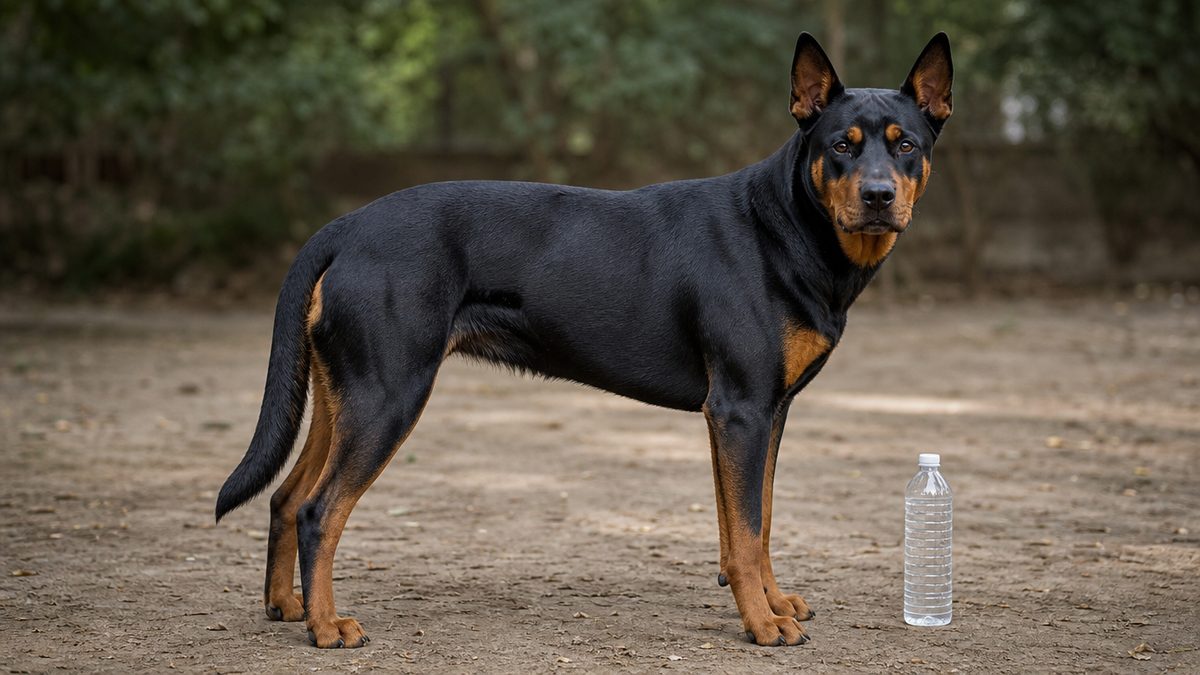
The standard is unambiguous about colour and most images of this breed are not. It specifies black with clearly defined marking of a rich red tan on the cheek, muzzle, throat, chest and legs, as well as over both eyes and under the base of the tail. That is a black and tan pattern, close to a Rottweiler's in layout, and the fault list calls white marks on the forechest or white feet highly undesirable. A great many dogs sold as Laizhou Hongs online are solid red or fawn with no black at all.
The name reinforces the point rather than contradicting it. Hong means red in Chinese, and Chinese sources explain the name from red hair at a minimum of six separate locations on the body. Six red points on a black dog is precisely the pattern the standard describes.
Head, ears and bite
The head is strong and elongated with a flat forehead running parallel to the bridge of the nose, a defined but not pronounced stop, a broad black nose and almond-shaped eyes from light amber to dark brown. The ears are pricked, set high and wide apart, medium sized and explicitly not cropped. The jaws are powerful with a scissor bite and 42 correctly placed teeth, and overshot, level bite, undershot and missing teeth are all disqualifying faults.
That bite clause is worth holding on to, because it is the exact opposite of what the China Kennel Union's Chongqing dog standard requires, and the two documents come from the same club. Where the Chongqing standard mandates an undershot bite, this one disqualifies it.
Is the Laizhou Hong a recognised breed?
No international kennel federation recognises the Laizhou Hong, despite its own breed standard printing the line FCI-CLASSIFICATION: Group 2 at the top of the page. That line is the single most consequential error in this breed's literature, and it propagates into every page that copies the standard.
We read the registers rather than repeating what a breed page says about them. The FCI definitive nomenclature under the letter L returns exactly eight breeds: Labrador Retriever, Lagotto Romagnolo, Lakeland Terrier, Lancashire Heeler, Landseer, Lapinporokoira, Leonberger and Lhasa Apso. The Labrador sits first on that list, so the page loaded and a zero is a real zero. Under the letter C, where the name Chinese Red Dog would file, the register returns 44 breeds of which exactly two are Chinese. The provisional register, read at its real address, returns 20 breeds and carries no Chinese entry. The AKC breed selector, which lists both recognised and Foundation Stock Service breeds, returns Laizhou zero times while carrying Rottweiler, Great Dane and German Shepherd Dog as controls.
A Serbian seller advertising two Laizhou Hong puppies on a United States marketplace at 4,000 US dollars lists them as coming With FCI pedigree. No FCI register lists this breed under any name we searched, and the FCI does not issue pedigrees for breeds it does not recognise. That claim is checkable in about ninety seconds and it does not survive the check.
What the China Kennel Union actually is, and actually confers
The China Kennel Union is a full FCI member for China, which is exactly why its standards look authoritative and why the classification line misleads so effectively. But the body that drafted this standard is its subordinate China Native Dog Conservation Club, and that club's charter says in its own words that it works on ancient Chinese native breeds that are NOT recognised by the FCI, carrying out historical research, drafting standards, appraising dogs, keeping breeding registers and submitting breeds for certification so that they may in time reach the standard for FCI breed certification and registration. The club describes itself as working toward FCI recognition. Its own standard's classification line describes that destination as though it had been reached.
What the club actually issues is documented and it is not nothing. Its regulations require appraisal by a CKU-designated FCI or CKU judge, the applicant to be a registered CKU member and the dog's real owner, the dog to be at least nine months old on the day, the first three registered generations to pass a physical appraisal, and every appraised dog to be microchipped and DNA blood-sampled for parentage verification. A dog completing that process receives a CKU China Native Dog pedigree. That is a genuine, verifiable record. It is a different document from an FCI pedigree, and confusing the two is how a buyer ends up paying import prices for a dog no registry outside China will record.
How far the breed is from an FCI submission, on the club's own numbers
The same regulations page states the club's own understanding of what FCI breed-standard registration requires, and it is unusually specific. Five thresholds are listed: a complete breed standard; five generations of pedigree registration; eight distinct bloodlines registered; one thousand registered individuals; and submission of the data and the standard by an FCI member country.
Set that against the record. The club's news index shows six breeds appraised between 2016 and 2018, with the Laizhou Hong appearing twice, and no event of any kind recorded after 17 December 2018. The club's own appraisal-activities page lists only one event at all, for a different breed, contradicting its own news index. No public figure anywhere states how many Laizhou Hongs hold a CKU pedigree, how many bloodlines are registered, or how many generations deep the register runs. On the evidence available, nobody outside the club can say whether the breed is near one thousand registrations or nowhere near it.
One recognition fact that points the other way
Chinese Wikipedia records that the breed appeared at the 2019 World Dog Show in Shanghai under Group 11, described as non-FCI breeds. That is worth publishing because it cuts against the Group 2 claim from inside the show system itself: at an FCI-format event in the breed's own country, the Laizhou Hong was exhibited in the group explicitly set aside for breeds the FCI does not recognise. The same Wikipedia article nonetheless repeats the Group 2 line as fact in its body text while leaving its own FCI standard field blank.
Two further records complete the picture, and both cut against the idea that state recognition is quietly available somewhere. China's own livestock catalogue does not help: Ministry of Agriculture and Rural Affairs Announcement No. 303 of 27 May 2020, approved by the State Council, published the National Catalogue of Livestock and Poultry Genetic Resources and left dogs out entirely, with the character for dog appearing zero times across the whole instrument in either of its common forms. And the club's own event record shows how thin the appraisal history is: the Laizhou Hong's single-breed show and off-site appraisal is dated 31 October 2017 on the club's news index while the notice itself gives the event as 15 December 2017 at the Weifang Lutai Convention Centre, naming an FCI and CKU all-breed judge as the club's adviser for it. Two events in 2017 and nothing after 2018 is the whole documented appraisal history of the breed. It remains unrecognised by every kennel federation outside China and uncatalogued by the Chinese state.
Reading the breed standard closely: four things nobody has flagged
The Laizhou Hong standard rewards a close reading, because four separate problems sit inside a document that every ranking page quotes and none appears to have read to the end. Two are internal contradictions, one is a translation divergence, and one is an instruction that Indian law prohibits.
One: the size clause contradicts itself
The standard gives dogs 64 to 79 cm and bitches 65 to 70 cm. The bitch floor is a centimetre above the dog floor, and the dog range spans 15 cm against the bitch range's 5 cm. A 15 cm span is very wide for a single sex in any standard, and combined with the inverted floors it reads like a transcription problem rather than a considered specification. The standard's own fault list, meanwhile, penalises a lack of sexual dimorphism, which the size clause as written would make difficult to judge.
Two: the English and Chinese texts disagree about the coat
The English coat clause reads that the hair is short, dense, smooth and glossy, coarse, dull or a double coat. The Chinese clause on the same page specifies a short, dense, smooth and glossy, coarse and hard DOUBLE coat, with no single-coat option offered. The fault lists diverge in the same direction: the English penalises a thin coat and bald patches, the Chinese penalises a single coat and bald patches.
For an Indian reader that divergence is not academic, because it is the difference between a short-coated dog and a double-coated one in a country where seven to ten months of the year clear a 25C monthly mean. A United Kingdom dealer markets this breed precisely to buyers who love the intelligence of the German Shepherd but do not want to deal with the hair. If the Chinese text governs, that pitch is wrong, because a double-coated dog sheds and needs undercoat work.
We publish both readings rather than picking one. There is no Langue faisant foi line on this document to tell us which language is authentic, because it is not an FCI standard and carries none of the FCI's authenticity apparatus. Plan for a double coat, because that is the more demanding case in Indian humidity and the Chinese text is the one drafted where the breed lives.
Three: the Chinese fault list still contains a placeholder
In the Chinese faults section, the list of hindquarter faults reads cow hocks, XXX, open or too soft paws, crooked toes, colourless nails. The literal string XXX sits where a translated term should be, corresponding to the English spread locks, itself almost certainly a typo for spread hocks. A published breed standard carrying an untranslated placeholder is a small thing on its own. It is a useful thing to know when weighing how much editorial attention the rest of the document received.
Four: the dewclaw instruction, and why India is the exception it names
The standard's rear pastern clause reads that dewclaws are to be removed, except in those countries where it is prohibited by law. India is such a country, and the exception is not a technicality. Second Schedule Part II paragraph 6(8) of the Prevention of Cruelty to Animals (Dog Breeding and Marketing) Rules, 2017 provides that there shall be no tail docking, ear cropping, de-barking, DE-CLAWING, branding, dyeing, injecting substances to enhance visual appeal, performing a surgery or procedure to camouflage or hide any defect or infirmity or any other kind of mutilation of any body part of the pup, and that any change of appearance by artificial means is strictly forbidden.
So an Indian breeder following the standard as written would be committing exactly the act paragraph 6(8) prohibits, and the standard itself anticipates this and carves India out. This is the rare case where a foreign breed standard tells you to check your own law and is right to. Note also what the standard does not require: it explicitly says the ears are not cropped, so unlike many guardian breeds this one presents no cropping collision at all.
One more consequence follows for anyone judging photographs. A Laizhou Hong lawfully bred in India will have its front dewclaws, and any image of the breed showing them removed shows a dog that could not lawfully have been produced here. Bonbeno's own image brief for this page requires visible dewclaws for that reason.
One practical note for anyone reading the standard alongside an Indian veterinarian. Dewclaw removal is normally performed in the first few days of life, long before a buyer sees a litter, so by the time you meet a puppy the decision has already been taken by whoever bred it. In India that decision is not the breeder's to take, which makes front dewclaws a quick and honest test of whether a litter was produced under Indian law.
History: an eighty-year disagreement about where this breed came from
Accounts of the Laizhou Hong's origin disagree by about eighty years and by two entire founder breeds, and no English page publishes the disagreement. The China Kennel Union standard credits German colonists in Shandong from 1898; Chinese popular sources describe a Laizhou crossbreeding project with a different and longer founder list, and one account dates the whole thing to the 1970s.
The standard's own historical summary reads that following the opening of Shandong province by Germany in the 19th century, and the lease of Jiaozhou Bay and the Qingdao Peninsula from the Qing dynasty in 1898 for 99 years, German colonists arrived with their dogs, and that dogs were then needed for farming, hunting and guarding, so they used the Great Dane, German Shepherd, Rottweiler, Shandong Xian Hound and native breeds to establish the Laizhou Hong. Chinese Wikipedia gives a compatible but shorter version, placing the origin in Zhuqiao town in Laizhou in the 19th century with local enthusiasts crossing Xian hounds and native breeds with the Great Dane, German Shepherd and Rottweiler.
Chinese popular sources tell a materially different story. They describe the breed as selectively bred by the people of Laizhou from the Great Dane, the flat-backed German Shepherd, the Korean Dosa, the Shandong Xian Hound and the Japanese wolf-grey dog crossed with local dogs, fixed as a new line through generations of selection followed by close-relative breeding. A separate widely shared account places the work in the 1970s using wolf-grey dogs, old working-line and show-line German shepherds and the Shandong Xian hound, and suggests possible Dobermann blood.
| Source | Date | Named founders |
|---|---|---|
| China Kennel Union standard | From 1898 | Great Dane, German Shepherd, Rottweiler, Shandong Xian Hound, native breeds |
| Chinese Wikipedia | 19th century | Great Dane, German Shepherd, Rottweiler, Xian hound, native breeds |
| Chinese popular sources | Not dated | Great Dane, flat-backed German Shepherd, Korean Dosa, Shandong Xian Hound, Japanese wolf-grey dog, local dogs |
| A widely shared enthusiast account | 1970s | Wolf-grey dog, working-line and show-line German Shepherd, Shandong Xian hound, possibly Dobermann |
| UK dealer, copying the standard | From 1898 | Great Dane, German Shepherd Dog, local dogs including the Shandong Xian Hound. Drops the Rottweiler |
What survives across every version
One founder appears in all five accounts and it is the local one: the Shandong Xian Hound. That matters more than it looks, because it is the only element of this breed's ancestry that has ever been genotyped. The largest SNP survey of Chinese indigenous breeds sampled 12 Shandong Xi dogs among its 157 dogs from 15 breeds, and used 10 Rottweilers among its Western controls. So two of the breeds every account names as Laizhou Hong founders sit in a published dataset, on a 170K SNP chip, and the resulting breed has never been sampled at all.
The same study reports historical introgression of Western dogs into two Chinese breeds it did survey, which establishes that its design could detect exactly the kind of European admixture every Laizhou Hong origin story describes. The tool exists and the question has not been asked.
The dates that do not fit
Two details sit awkwardly with the 1898 colonial story and are worth flagging rather than smoothing. The first is the name Soviet Red Dog, which Chinese Wikipedia lists among the breed's nine alternative names and Chinese popular sources use as a primary alias. A Soviet name is difficult to reconcile with a German colonial foundation and points toward a mid-twentieth-century episode instead.
The second is the documentary trail. The earliest references Chinese Wikipedia can cite for the breed are two Chinese animal-husbandry articles from 1994, both from authors connected to the Zhuqiao town government in Laizhou. If the breed had existed as a recognised local type since 1898, ninety-six years of silence before its first citable write-up is a long gap. None of this disproves the colonial account, and the German presence in Shandong from 1898 is a matter of ordinary historical record. What it does mean is that the breed's own standard states as settled history something that its own country's literature does not settle.
A page that picked one origin story and printed it would look more authoritative and would be less true. Where sources disagree this widely, the disagreement is the finding. An Indian buyer being told this is an ancient Chinese breed with 1898 German ancestry deserves to know that Chinese sources also describe it as a 1970s project fixed by close-relative breeding.
Laizhou Hong price in India: none exists, and one foreign price does
No Laizhou Hong price in India exists, because no Indian seller lists the breed. The only published asking price we found anywhere in the world is 4,000 US dollars, from a Serbian seller on a United States marketplace, and Bonbeno publishes no rupee conversion of it.
An India-located search for laizhou hong dog price in india buy puppy on 2 September 2026 returned twelve organic results. The commercial ones were a United States breeder, a United Kingdom guard-dog dealer, a Serbian listing on a US-facing marketplace and an Australian foundation breeder. The single Indian domain in the whole set was a generic 40-breed national price list that never mentions this breed. Not one Indian breeder, classified listing or marketplace page offered a Laizhou Hong.
The control proves the instrument. Run in the same session with the same tool and the same India geotargeting, labrador retriever price in india returned ten genuine Indian price pages including two complete city-by-city tables. So the geotargeting worked, the index worked, and the zero is a property of the breed.
The one price that exists, and what is wrong with the listing
A Serbian seller advertises two female Laizhou Hong puppies born 25 January 2023 on a United States marketplace at a stated price of 4,000 US dollars, giving both parents as Hips B and Elbows 0 with a clean degenerative myelopathy result, and adding the line With FCI pedigree. The hip and elbow grades are in FCI format, which is presumably where the confidence comes from. The pedigree claim is not survivable: the FCI's letter L register returns eight breeds and none is this one, and the FCI does not issue pedigrees for breeds it has not recognised.
Converting a foreign asking price at an exchange rate and printing the result as an Indian price is the single commonest way fabricated Indian dog prices are manufactured, and this site has traced that pattern across many breeds. There is no Indian market for this breed, so there is no Indian price. A converted number would look like information and would be fiction.
What the other sellers publish
Two of the three remaining commercial results publish no number at all. The United Kingdom dealer asks buyers to telephone for price and information, and concedes in its own text that information on the breed is scant. A United States breeder states only that the breed is still very new to the Western world so they are quite expensive, and that starting a breeding programme is a huge investment and very risky. Neither reticence is sinister on its own, but between them they mean the entire global published price evidence for this breed is a single listing.
The comparison that is actually useful
Since no Laizhou Hong price exists in India, the honest thing is to price the dogs an Indian buyer would realistically consider instead. Every figure below is published by an Indian seller for the Indian market.
| Breed | Published Indian range | Recognised by FCI |
|---|---|---|
| Laizhou Hong | No Indian price exists | No |
| Rottweiler | ₹18,000 to ₹80,000 | Yes, standard 147 |
| German Shepherd | ₹20,000 to ₹75,000 | Yes, standard 166 |
| Great Dane | ₹20,000 to ₹80,000 | Yes, standard 235 |
| Doberman | ₹20,000 to ₹70,000 | Yes, standard 143 |
| Cane Corso | ₹50,000 to ₹2,50,000 | Yes, standard 343 |
| Saint Bernard | ₹25,000 to ₹1,00,000 | Yes, standard 61 |
| Indian indie | ₹0 to ₹2,000 by adoption | No, and none needed |
Two of the top three rows there are named founder breeds of the Laizhou Hong, and both are available in India today with an FCI standard, a Kennel Club of India registration route and a price you can compare across sellers. That is the practical shape of this page's conclusion.
Note also what a real Indian price disagreement looks like, so you can recognise one. Supertails puts the Labrador at ₹8,000 to ₹80,000 while Mr n Mrs Pet puts the same breed at ₹30,000 to ₹1,20,000 and repeats that identical band for all eight of its cities. Two sources, one common breed, a floor differing by nearly four times, and both openly published. A breed with no Indian sellers has no such spread to show, which is itself the tell.
Cost of ownership in India for a 40 to 60 kg guardian
Budget ₹12,000 to ₹20,000 a month to keep a dog of this size in India, and treat that as a size-band figure rather than a Laizhou Hong figure. At 64 to 79 cm and a reported 40 to 60 kg for males, this breed sits in the giant band rather than the large one.
Supertails organises its monthly running-cost table explicitly by size band, with the Giant column naming the Great Dane and Saint Bernard as its examples. That is the right column for a dog the size of a Laizhou Hong male, and it is worth saying loudly that these are band numbers. Indian breed sites routinely publish identical cost tables for unrelated breeds of the same size while presenting them as breed research; this source at least labels what it is doing.
| Line item | Large band | Giant band, the right one here |
|---|---|---|
| Dry or wet food | ₹4,000 to ₹6,000 | ₹6,000 to ₹10,000 |
| Routine vet visits | ₹1,000 to ₹2,000 | ₹1,500 to ₹3,000 |
| Vaccinations | ₹1,800 a year | ₹2,000 a year |
| Grooming | ₹500 to ₹1,200 | ₹600 to ₹1,500 |
| Training, over six months | ₹3,000 to ₹8,000 | ₹5,000 to ₹10,000 |
| Treats and toys | ₹600 to ₹1,200 | ₹800 to ₹1,500 |
| Flea control and deworming | ₹500 to ₹800 | ₹600 to ₹1,000 |
| Monthly total | ₹8,000 to ₹14,000 | ₹12,000 to ₹20,000 |
Three lines that move for this breed
- Training, at the top of the range and then some. A large territorial guardian described in its own country's literature as fierce by nature and likely to injure people without proper training is not a dog to economise on. Budget the ₹10,000 end of the six-month figure and expect to keep paying beyond it.
- Grooming, at the bottom. A short, dense, smooth and glossy coat needs a rubber mitt and nothing else, so ₹600 to ₹1,500 a month is generous if you do it yourself. This is the one place the breed is genuinely cheap in India.
- Cooling and containment, neither of which the table has a row for. A 60 kg guardian in a country with seven to ten months above a 25C monthly mean needs air conditioning or a genuinely cool room, and it needs fencing that a determined 60 kg dog respects. Both are capital costs before month one.
What the first year actually costs
Twelve months at the giant-band midpoint of about ₹16,000 comes to roughly ₹1,92,000 before any purchase price, before any import cost, and before cooling and fencing. Add the first-year vaccination course at ₹2,000, sterilisation, a crate sized for a 60 kg dog and the professional training this breed needs, and a realistic Indian first year clears ₹2,25,000 comfortably. That figure is the same for a Great Dane or a Rottweiler of similar size, which is exactly the point: the ongoing cost is a function of the dog's mass, not of its rarity.
A Rottweiler at ₹18,000 to ₹80,000 gives you the same black and tan colouring, much of the same guarding temperament, an FCI standard you can read, a Kennel Club of India registration route, Indian veterinarians who know the breed, and the identical ₹12,000 to ₹20,000 monthly bill. The Laizhou Hong gives you the monthly bill and none of the rest.
One more running cost belongs here and is specific to a deep-chested giant. Gastric dilatation and volvulus is a surgical emergency with a window measured in hours, and emergency abdominal surgery for a 60 kg dog is among the most expensive single events in Indian small-animal practice. Know where your nearest twenty-four-hour surgical facility is before you need it, and factor that risk into whether a giant guardian suits your household at all.
Heat tolerance: a freezing-winter breed in a country with no winter
The Laizhou Hong comes from a place whose January mean is below freezing, and that single fact governs everything about keeping one in India. Laizhou's January mean is minus 2.37C against Chennai's 24.09C, a gap of 26.46 degrees, and the breed's size puts it in a weight band the heat-illness literature flags directly.
We queried NASA POWER by explicit latitude and longitude rather than by place name, and checked the returned cell elevation as well as the coordinates. Laizhou's cell came back at 73.39 m against a town near 30 m, an overstatement of about 43 m on a coastal plain, which is well inside the range where the cell describes the town. Qingdao, the German colonial city the breed's own standard names, returned 29.96 m against a town near 25 m, an error of about 5 m. Neither point is mountainous, so neither carries the elevation problem that makes hill-station data unreliable.
| Place | Annual mean | Coldest month | Hottest month | Months at or above 25C mean |
|---|---|---|---|---|
| Laizhou, Shandong | 12.71C | minus 2.37C (Jan) | 26.60C (Jul) | 2 |
| Qingdao, Shandong | 13.60C | 1.54C (Jan) | 25.81C (Aug) | 1 |
| Chennai | 27.95C | 24.09C (Jan) | 31.51C (May) | 10 |
| Mumbai | 26.77C | 23.19C (Jan) | 31.19C (May) | 9 |
| Kolkata | 25.81C | 17.31C (Jan) | 31.53C (May) | 8 |
| Hyderabad | 26.10C | 20.76C (Dec) | 33.30C (May) | 7 |
| Delhi | 25.60C | 13.61C (Jan) | 35.88C (Jun) | 7 |
| Pune | 23.86C | 19.62C (Dec) | 28.93C (Apr) | 4 |
| Bengaluru | 23.74C | 20.22C (Dec) | 28.37C (Apr) | 3 |
The summer is not the surprising part
Two features make this breed heat-sensitive out of proportion to its short coat. Mass is the first: heat production scales with body volume while heat loss scales with surface area, which is why a bodyweight over 50 kg showed up as its own risk factor rather than as a proxy for something else. Drive is the second, because a guardian bred for courage and hardness does not stop working when it should. UK emergency practice recorded 384 heat-related illness events among 167,751 dogs in 2022 with an event fatality rate of 26.56 percent, and that is in a country whose hottest month is cooler than a Chennai January.
Laizhou does get hot. Its July mean of 26.60C is warmer than Bengaluru's hottest month and its highest monthly maximum reaches 40.44C, so this is not a breed that has never met heat. Two months a year clear a 25C monthly mean there. What it has never met is heat that does not stop. Chennai clears that threshold ten months a year and never falls below 24.09C in any month, so a Laizhou Hong moved there loses the ten-month recovery window its physiology is built around and gains a permanent one.
The winter gap is the sharper number and it works in the other direction. A dog whose ancestors spent every January at or below freezing carries the coat and the mass for that, and neither can be removed on arrival in Chennai. Qingdao's January mean of 1.54C makes the same point for the colonial city the standard names.
Why size makes this worse, with a citation
Two findings from the heat-illness literature bear directly on a dog this large, and neither requires importing an odds ratio onto a breed nobody studied. In a cohort of 905,543 UK dogs under primary veterinary care, bodyweight at or above the breed and sex mean was a significant risk factor for heat-related illness, and so was a bodyweight over 50 kg. Chinese sources put adult males of this breed at 40 to 60 kg, which puts a substantial share of them straight into the flagged band.
The second finding is about what triggers the illness. Exertional heat-related illness accounted for 74.2 percent of events with a recorded trigger, against 12.9 percent for environmental heat and 5.2 percent for vehicular confinement. For a working guardian with real drive, that reframes the risk entirely. The danger is the patrol, the guard work and the afternoon walk, not the parked car.
Second Schedule Part IV paragraph 21(1) of the 2017 Rules bars keeping in outdoor facilities, without the attending veterinary practitioner's written approval, dogs not accustomed to the temperatures prevalent in the area and breeds that cannot tolerate them, naming long-haired breeds in high temperature locations as its example. A guardian breed is exactly the dog people house outdoors in India. Note the citation form: this is a Second Schedule paragraph, and the string Rule 21 appears zero times in the gazette.
City by city: where a Laizhou Hong would cope, and where it would not
Bengaluru and Pune are the only large Indian cities where a Laizhou Hong would face a manageable year, and even there the dog gets no winter at all. Nowhere in plains India offers anything resembling the freezing January this breed's physiology assumes.
Bengaluru and Pune, the least bad option
Bengaluru runs an annual mean of 23.74C with three months at or above a 25C monthly mean and a coldest month of 20.22C in December. Pune runs 23.86C with four such months and a December mean of 19.62C. Those are the two mildest big-city profiles in our set and they are the only ones where a 50 kg short-coated guardian could work outdoors most of the year with shade and timing. What neither offers is a cold season: Bengaluru's coldest month is still 22.6 degrees warmer than Laizhou's.
Delhi, the split year
Delhi gives this breed the one thing no other Indian city does, a genuine winter, at a January mean of 13.61C. It also gives it a June mean of 35.88C and a recorded monthly maximum of 48.79C, with seven months at or above 25C. A Laizhou Hong in Delhi would be comfortable from November to February and would need serious management from April to September. If you are going to keep one in India, this is the profile that most nearly resembles a seasonal climate, at the cost of a genuinely dangerous summer.
Chennai, Mumbai and Kolkata
These are the hardest. Chennai clears a 25C monthly mean in ten months of twelve and its coldest month is 24.09C. Mumbai clears it in nine and its coldest month is 23.19C. Kolkata clears it in eight. A large guardian in any of them lives permanently in the summer half of its own tolerance range with no recovery season, and if the Chinese text of its standard is right about the double coat, it does so in insulation.
A practical routine that works
- Move all exercise and guard work to before sunrise and after dark from March to October. In Chennai and Mumbai, treat that as the whole year.
- Provide continuous shade and moving air wherever the dog is stationed, and standing water rather than a bowl that empties in an afternoon.
- Keep the dog lean. Bodyweight above the breed mean is a named risk factor, and on a breed with no published mean the practical test is your hands on the ribs rather than a number.
- Watch for the signs that are not panting: stumbling, vomiting, bright red or very pale gums, collapse. Event fatality for heat-related illness in a UK emergency caseload was 26.56 percent, so this is not a wait-and-see condition.
- Cool with water on the belly, groin and paws plus airflow, and get to a veterinarian. Do not use ice water on a collapsed dog.
There is no Indian city whose climate suits this breed. There are two, Bengaluru and Pune, where a careful owner could manage it, and one, Delhi, where it would get a real winter and a dangerous summer. That is a very different statement from saying the breed adapts well, which is what Chinese sources claim when they describe it as adapting quickly to local diet, soil and water. That claim is about moving within China, and it has never been tested in a tropical climate.
One climate-adjacent Indian risk deserves naming here because it is year-round rather than seasonal. A multiplex PCR survey of 719 dogs in Punjab found Babesia gibsoni in 8.9 percent, Hepatozoon canis in 5.1 percent, Ehrlichia canis in 2.6 percent and Babesia vogeli in 1.1 percent, with breed, sex and location all significantly associated with Babesia gibsoni. An outdoor guardian dog is the highest-exposure category there is for tick-borne disease in India, and a short glossy coat makes ticks easier to find, which is one genuine advantage this breed brings.
Temperament: two accounts that flatly contradict each other
The Laizhou Hong's own literature describes two different dogs, and an Indian buyer should read both before deciding. Its breed standard calls it friendly and calm and very devoted to the family; Chinese popular sources call it fierce by nature and warn that a badly trained one will injure people.
The China Kennel Union standard's behaviour clause reads that the breed is friendly and calm, very devoted to the family, enjoys working and shall have good working ability, courage and hardness, and that the particular values of self-confidence and intrepidness are required along with adaptability and attention to fit the social environment. Its disqualifying faults include aggressive or overly shy, which is standard FCI-format language.
Chinese popular sources describing the same breed use different vocabulary entirely. They call it strongly territorial with a loud, imposing voice, an excellent house and property guard, and fierce by nature with strong wariness toward strangers, and state plainly that if the owner does not train and teach it well, it will injure people because of its strong attacking power. The same source recommends it as a guard dog and says that if it is to be a family companion it must be given socialisation training as a puppy.
A breed standard is a document written to get a breed recognised. It describes the temperament the drafters want judged and bred toward. A popular article is written to describe the dogs people actually meet. Neither is lying, and the gap between them is roughly the gap between an aspiration and a population. When they disagree this sharply, plan for the harder description and be pleased if you get the easier one.
What both accounts agree on
Three things survive in every source. The breed is a guard dog by purpose rather than by accident, its utilisation line in the standard naming companion, working dog and guard dog in that order. It is strongly bonded to its own household. And it needs a job, with the standard requiring good working ability, courage and hardness and popular sources describing it as a multi-talented worker with a police-dog background in its early years.
There is no measured temperament data of any kind. That is the sharpest contrast with the Kunming dog, whose institution publishes annual five-part test scores on 92 genotyped breeding dogs and openly reports where the breed underperforms. Nothing comparable exists here, so every temperament statement about the Laizhou Hong, including the ones on this page, is description rather than measurement.
Household fit in India
- Suits a securely fenced independent house with a real guarding requirement, an experienced owner, and a household prepared to manage a 50 kg territorial dog around visitors, delivery workers and domestic staff.
- Does not suit a flat, a first dog, a household with a constant stream of unfamiliar visitors, or anyone who wants the dog primarily for children.
- Requires deliberate early socialisation to Indian street life. A breed selected on wariness toward strangers will otherwise generalise that wariness to the entire neighbourhood.
- Needs an owner who understands that a loud territorial dog in an Indian residential colony is a neighbour relations problem as much as a training one.
Training a large guardian with no measured baseline
Train a Laizhou Hong on the assumption that everything social has to be built deliberately, because no measured trainability data exists for this breed at all and the descriptive sources disagree about how difficult it is. Budget the top of the ₹5,000 to ₹10,000 six-month range for professional help and treat it as non-optional.
The evidence gap here is the story. For the Kunming dog, China's other purpose-built working breed, the breeding institution publishes annual behaviour-test scores and heritability estimates. For the Laizhou Hong there is nothing: no test, no scores, no heritability, no published training protocol, and no peer-reviewed literature under any of its nine names. Anyone who tells you this breed is easy or difficult to train is describing dogs they have met, which may be four dogs.
The descriptive sources do agree on one thing, which is that the breed is trainable in the sense of being willing to work rather than in the sense of being biddable. The standard asks for a dog that enjoys working with good working ability, and Chinese sources call it easy to domesticate, highly intelligent and quick to bond, while warning in the same paragraph that untrained it will injure people. Those are compatible statements about a working guardian: motivated to do a job with you, and dangerous without one.
What the standard implies about training
The standard asks for self-confidence and intrepidness, courage and hardness, and adaptability and attention to fit the social environment. Read as a training brief rather than as a judging brief, that is a dog with a high threshold for pressure and a real need for structured social exposure. Hardness in working-dog vocabulary means resilience to correction, which cuts both ways: the dog recovers from mistakes, and the dog is not much moved by them either.
A workable plan
- Start at eight weeks, which is also the earliest a pup may lawfully be sold in India under Rule 8(1)(a) of the 2017 Rules.
- Prioritise a reliable recall and a rock-solid settle over anything else. On a 50 kg guardian these are safety equipment, not tricks.
- Socialise to the specific Indian inputs that will otherwise trigger guarding: the doorbell, delivery riders, domestic staff arriving daily, cattle, firecrackers, and the gate.
- Introduce a formal greeting protocol for visitors and use it every single time. Consistency does more with a territorial breed than any correction.
- Get professional help in the first year. Six months of training in the giant band runs ₹5,000 to ₹10,000, which is a rounding error against a ₹1,92,000 first year.
- Do not add protection work. This breed guards without being taught to, and adding bite work to an untrained young guardian in an Indian residential setting creates a liability.
Chinese sources state directly that if the owner does not train and teach this breed well, it will injure people because of its strong attacking power. That sentence is in the popular Chinese literature about the breed, not in a critic's account of it. Take it at face value and plan the training budget accordingly.
One breeding rule that differs between China and India
If you are thinking beyond a single dog, note that the two systems set different minimum ages. The China Kennel Union's native-dog rules require both sexes to be at least 12 months old at mating and set three months minimum between a litter's birth and the next mating. India's Second Schedule Part II paragraph 6(7) bars using a male for breeding before his eighteenth month, and paragraph 6(6) caps a female at five litters in her lifespan. The Indian floor for a stud dog is six months higher than the Chinese one, which matters for anyone importing a breeding programme along with a breed.
Exercise: what a guardian needs, and what nobody has measured
No published source gives a daily exercise figure for the Laizhou Hong, so this page gives no minute count. What the standard and the Chinese descriptions establish is the type of work rather than the quantity: this is a patrolling guardian with real drive, not an endurance athlete and not a couch dog.
The standard describes a gait that is elastic, elegant, agile, free and ground covering, with the forelegs reaching out as far as possible and the hindquarters providing far-reaching elastic drive, and calls gait of special importance to both working ability and appearance. Chinese sources describe a dog that is agile and swift with strongly developed hindquarters, good explosive power and fast running speed. Together those describe a big dog that moves well and wants to.
The Indian constraint that shapes everything
Whatever the requirement is, it has to fit into a window that is dark and cool. Chennai, Mumbai and Kolkata offer that for roughly two hours at each end of the day for most of the year, and the middle of the day is not negotiable for a 50 kg dog from a place with a freezing January. Exertional heat-related illness was the predominant trigger in the largest UK dataset at 74.2 percent of events with a recorded cause, and exertion is precisely what a guardian breed with good explosive power will do if given the chance.
- Two structured sessions daily, before sunrise and after dark, from March to October across most of India and year round in the coastal metros.
- Patrol work rather than jogging. This breed's job is walking a boundary and noticing things, and a slow perimeter walk with sniffing satisfies it better than distance.
- Weight-appropriate loading only. A 40 to 60 kg dog should not be doing sustained roadwork before its growth plates close at roughly 14 to 18 months.
- Mental work indoors in the heat. Scent games on a tiled floor under a fan are the half of the requirement that can be met in a Chennai afternoon.
- No forced exercise in heat at any age, and no exercise within an hour either side of a meal because of the bloat risk in a deep-chested giant.
A strongly territorial 50 kg dog with a loud voice needs fencing that holds it and a boundary it understands. In Indian residential settings, most incidents involving guardian breeds begin with a gate left open rather than with a training failure. Fence first, then train, then exercise.
Grooming a short glossy coat, with one unresolved question
Grooming a Laizhou Hong is a rubber-mitt job once or twice a week and nothing more, which makes it the cheapest line in this dog's Indian budget at ₹600 to ₹1,500 a month. The unresolved question is whether the coat is single or double, because the breed's own standard says both.
The English coat clause reads short, dense, smooth and glossy, coarse, dull or a double coat. The Chinese clause on the same page specifies a coarse, hard double coat with no single-coat option, and the Chinese fault list penalises a single coat where the English penalises a thin coat. Those are not the same specification, and no authenticity line on the document tells you which language governs.
The practical answer is to look at your own dog rather than at the standard. Part the coat over the shoulder and the loin: a double coat shows a soft, dense, differently coloured layer beneath the guard hairs, and a single coat does not. That takes ten seconds and settles what a published standard cannot.
| Task | If single-coated | If double-coated |
|---|---|---|
| Brushing | Rubber mitt weekly | Undercoat rake twice weekly, more when shedding |
| Shedding | Light and continuous | Heavy seasonal blows, twice a year |
| Bathing | Monthly at most | Monthly at most, and dry to the skin every time |
| Drying after rain | Towel is enough | Towel then cool dryer, check armpits, groin, tail base |
| Monthly cost | ₹600 to ₹1,500 | ₹600 to ₹1,500, plus your own time |
What a UK dealer gets wrong about this
A United Kingdom guard-dog dealer markets the breed to buyers who love the intelligence of the German Shepherd but do not want to deal with the hair, and calls it a very clean animal. If the Chinese text of the standard governs, that pitch is wrong: a double-coated dog sheds, and it sheds heavily twice a year. An Indian buyer choosing this breed as a low-shedding alternative to a German Shepherd should verify the coat on the actual dog before believing the marketing.
Grooming as the tick check, which matters more in India
Whatever the coat turns out to be, grooming a guardian dog in India is primarily a tick inspection and should be treated as one. The Punjab multiplex PCR survey of 719 dogs found Babesia gibsoni at 8.9 percent by PCR against 5.0 percent by microscopy, and Hepatozoon canis at 5.1 percent by PCR against 1.0 percent by microscopy. Microscopy, which is what a routine Indian clinic runs first, missed most of what was there.
Work through the coat with your fingers rather than your eyes, every day for an outdoor dog: ears and the fold behind them, under the collar, armpits, groin, between the toes, around the anus and along the tail. A short glossy coat is the one genuine grooming advantage this breed offers in India, because a feeding tick on a short-coated dog is findable in a way it is not on a Tibetan Mastiff. Keep a monthly preventive running year round rather than seasonally, at the ₹600 to ₹1,000 the giant band allows.
Ask for PCR. The Punjab data show microscopy finding roughly half the Babesia gibsoni and a fifth of the Hepatozoon canis that PCR found in the same 719 samples. A negative blood smear is not a negative result for tick-borne disease in India.
Feeding a giant-band dog in India
Feed a Laizhou Hong to body condition and to a slow, controlled growth curve, because it is a giant-band dog with no breed-specific feeding data and one named weight-related heat risk. Budget ₹6,000 to ₹10,000 a month for food in the giant band.
Two published findings shape this and neither is a portion size. Bodyweight at or above the breed and sex mean was a significant risk factor for heat-related illness in a 905,543-dog cohort, and a bodyweight over 50 kg was significant on its own. Chinese sources put adult males at 40 to 60 kg, which means feeding decisions on this breed move it in and out of a flagged risk band. In a country with seven to ten months above a 25C monthly mean, keeping this dog lean is a heat intervention.
The second is longevity. The Dogs Trust study of 584,734 UK dogs reports that larger body size is associated with shorter life expectancy. Since no breed figure exists for the Laizhou Hong, size is the only lever an owner actually controls, and overfeeding a giant puppy to a bigger adult works against the dog in both directions.
Life-stage feeding
- Eight weeks to four months, four meals a day, on a large or giant-breed puppy formulation with controlled calcium. Rapid growth in a giant breed is an orthopaedic problem, not an achievement.
- Four to seven months, three meals a day. This is the window in which overfeeding does the most lasting damage.
- Seven to twelve months, two meals a day, staying on the puppy formulation rather than switching at a year.
- Twelve to eighteen months, two meals a day, switching to adult food only once growth plates close at roughly 14 to 18 months.
- Adult, two meals a day, split morning and evening and kept well clear of any working or exercise session.
Gastric dilatation and volvulus is a surgical emergency in deep-chested giant breeds, with a window measured in hours. Feed two or three smaller meals rather than one large one, use a slow feeder if the dog eats fast, and do not exercise for an hour either side of a meal. Know your nearest twenty-four-hour surgical facility before you need it, because for a 60 kg dog this is the single most expensive foreseeable event of its life.
Indian availability, and one claim to be careful with
Everything this dog needs is available in India. Giant-breed dry food from the major brands sold here works, as do home-cooked diets balanced by a veterinary nutritionist. What does not work for a 50 kg growing guardian is an unbalanced rice and curd diet, which remains the commonest Indian feeding mistake in this weight class.
One claim from the Chinese literature deserves a caveat rather than a repetition. Chinese sources say the breed tolerates coarse feed, is not fussy, and adapts quickly to local diet, soil and water. That is a claim about moving a dog within China, and it has never been tested on a tropical diet, a tropical parasite load or Indian water. Treat it as folklore about hardiness rather than as a licence to feed a giant breed poorly.
Body condition, which replaces the chart nobody has
Run your hands over the ribs weekly. You should feel each rib easily under a thin covering without seeing them across a room, with a visible waist from above and a tuck from the side. Because the breed has no published mean weight, your hands are the only instrument available. Err lean, and err lean harder in summer.
Health problems and life expectancy: an evidence base of zero
The Laizhou Hong has no peer-reviewed literature, no screening scheme, no registry statistics and no published life expectancy. That is not a gap in this page's research; it is the finding, and it is the most important health fact an Indian buyer can be given.
We searched PubMed through the E-utilities endpoint on 2 September 2026, reading the query translation line on every query, and every name form returned zero: the phrase Laizhou Hong, Laizhou Red, Laizhou red dog, and Laizhou combined with dog or canine. The last of those returned zero with no quoted-phrase warning at all, which means the search ran and found nothing rather than failing to parse.
That zero is only worth something because the instrument proved itself. Four controls in the same session returned Labrador retriever with hip dysplasia 47, German Shepherd with dog 1,051, Chow Chow with dog 41 and Tibetan mastiff 31. And the homonym behaved exactly as a working search should: Laizhou alone in title or abstract returns 385 records, all of them about Laizhou Bay and Bohai Sea pollution rather than a dog. The engine found the place and correctly found no dog attached to it.
An absence is only evidence when a control succeeded in the same session, and when every name the breed carries has been searched. Chinese Wikipedia lists nine names for this dog, and we searched the transliterated forms plus the English ones. If the breed has literature under a Chinese-character name we did not search, we have not found it, and we say so rather than claiming the absence is total.
What can be screened, since nothing is published
Indian law supplies the checklist that the breed's own literature does not. Second Schedule Part III paragraph 8(10) of the 2017 Rules requires that dogs shall have been tested for genetic defects, including hip dysplasia, progressive retinal atrophy, night blindness, hypothyroidism, entropion, ectropion, overshot and undershot jaw where the incisors do not touch or mesh, wry mouth, two or more missing teeth, and unilateral or full cryptorchid males. The word including matters: the list is illustrative rather than closed.
For a giant guardian breed, three of those deserve particular attention and two more should be added on size grounds alone. Hip dysplasia is the obvious one, and the only individual health data we found anywhere for this breed were parental hip and elbow grades of Hips B and Elbows 0 on a single sales listing, alongside a clean degenerative myelopathy result. Those describe two dogs, not a population, and a seller's own claim about its own stock is the weakest form of health evidence there is.
| Question | Status | What an owner can actually do |
|---|---|---|
| Peer-reviewed literature | Zero papers under any searched name | Nothing. Do not accept a breed-specific claim without a source |
| Life expectancy | No published figure | Nothing. Larger size is associated with shorter life generally |
| Hip and elbow scores | No breed statistics anywhere | Radiograph the individual dog; named in Indian law |
| Degenerative myelopathy | One seller's clean result on two parents | DNA test is widely available; ask for the certificate |
| Eye conditions | No breed screening scheme | Ophthalmic exam; PRA and night blindness named in law |
| Bloat and torsion | No breed data, but a deep-chested giant | Feeding protocol, and know your emergency surgeon |
| Heat-related illness | Not modelled; over 50 kg is a flagged band | Keep lean, work in the cool hours |
| Tick-borne disease | Not breed-specific; Indian pressure is high | Year-round prevention and PCR rather than smear |
The lifespan question, answered by refusing to answer it
The Dogs Trust longevity study partitions 584,734 UK dogs including 284,734 deceased across 155 named breeds, and the Laizhou Hong is not among them. The RVC life tables give an all-breed life expectancy at age 0 of 11.23 years across 30,563 deaths, but that is a population average and printing it as this breed's lifespan would substitute an average for a measurement. This page therefore gives no lifespan. Anyone selling you one with a figure attached should be asked where the figure came from.
The Dogs Trust longevity paper carries an Author Correction published on 16 April 2024, revising a Miniature Dachshund median in one figure legend. It changes nothing for this breed, and it is worth knowing about because the parent paper is very widely quoted and the correction almost never is.
Indian law: three clauses this breed's own documents run into
Owning a Laizhou Hong is lawful in India, but three separate provisions of the 2017 Rules collide with instructions or history contained in the breed's own documents. One concerns dewclaws, one concerns how the breed was reportedly fixed, and one concerns creating breeds at all.
The settled position first. No Indian law in force today bans owning, breeding or selling any particular dog breed. A 2024 central circular listing breeds for a ban was quashed by the Karnataka High Court on 10 April 2024 and set aside by the Delhi High Court on 16 April 2024, and the Centre told the Bombay High Court in January 2025 that it is not acting on it. Bonbeno has not seen the circular itself and its reproductions disagree on how many breeds it named, so this page states the position without a breed count. The Laizhou Hong appears on no reproduction of that list.
One: the dewclaw instruction
The breed standard's rear pastern clause tells breeders that dewclaws are to be removed, except in those countries where it is prohibited by law. Second Schedule Part II paragraph 6(8) of the 2017 Rules provides that there shall be no tail docking, ear cropping, de-barking, de-clawing, branding, dyeing, injecting substances to enhance visual appeal, performing a surgery or procedure to camouflage or hide any defect or infirmity or any other kind of mutilation of any body part of the pup, and that any change of appearance by artificial means is strictly forbidden. India is precisely the exception the standard anticipates, and an Indian breeder who followed the instruction would be doing the prohibited thing.
Two: how the breed was reportedly fixed
Chinese popular sources describe the breed as having been fixed as a new line through generations of selection followed by close-relative breeding. Second Schedule Part II paragraph 6(3) prohibits two named mating techniques: in breeding, defined as breeding between relatives of the second to fourth grade in straight or side line within the first four generations, giving uncle to niece, nephew to aunt, cousin to cousin and grandparent to grandchild as examples; and incest breeding, defined as mating between parents and children or between brother and sister. Only out breeding and line breeding are permitted.
So the method the Chinese literature credits with fixing this breed is a method Indian law prohibits. That does not make the breed illegal here, and it has no retrospective reach over work done in Shandong. It does mean an Indian breeder could not lawfully consolidate a small imported founder population the way this breed was reportedly consolidated, which is a real practical obstacle for anyone imagining an Indian breeding programme.
Three: creating a new breed
Second Schedule Part II paragraph 6(9) reads that breeding to create new breeds of dogs or unusual looks shall be strictly prohibited. Every account of the Laizhou Hong's origin describes exactly that: crossing Great Danes, German Shepherds and Rottweilers with local dogs until a distinct new breed existed. The programme that produced this dog could not lawfully be run in India today.
All three are Second Schedule paragraphs, not Rules. We extracted the 14-page gazette with pypdf and the string Rule 21 appears zero times in 51,953 characters. The Rules themselves run from Rule 1 to Rule 13 only, so every provision numbered above 13 is a Second Schedule paragraph. Rule 8(1)(a), the eight-week minimum sale age, is a genuine Rule and should be cited as one.
Import, and what we could not verify
Importing a dog into India for trading or breeding is not permitted, and importing one as a pet requires either an import licence or the personal baggage route with documentation in the importer's own name. Bonbeno normally quotes the DGFT trade notice directly. On 2 September 2026 we could not: the DGFT's own hosted PDF returned HTTP 403 to two independent tools, so this page quotes no clause from it and gives no port list rather than repeating a summary we could not check.
The obstacle that does not depend on that document is the registry one. India is a full FCI member through the Kennel Club of India, so the export pedigree an Indian registry works against is an FCI-format one, and no FCI register issues a pedigree for this breed under any name. A CKU China Native Dog pedigree is a genuine document with microchip and DNA verification behind it, and it is not an FCI pedigree. A seller offering an FCI pedigree for this breed is offering something that does not exist.
The first year, month by month, for a giant guardian
A Laizhou Hong's first year is a growth-management problem before it is a training problem, because a dog heading for 40 to 60 kg does most of its structural damage in the months when it is being overfed and over-exercised. The Indian legal markers give the timeline its fixed points.
No breed-specific developmental data exists for the Laizhou Hong, so the timeline below combines Indian law, the breed's own standard, its club's registration rules and general giant-breed practice. Chinese Wikipedia gives litter size as 6 to 9 puppies, which is the only reproductive figure published anywhere for the breed.
| Age | What is happening | What you do |
|---|---|---|
| Birth to 7 weeks | Litter of 6 to 9 with the dam | Nothing. No lawful sale in this window |
| 7 to 8 weeks | Vaccination may begin, per the Rules | First vaccinations. Rule 8(1)(a) bars sale under eight weeks |
| 8 to 12 weeks | Primary socialisation window closing fast | Daily controlled exposure to Indian street life, gates and visitors |
| 3 to 4 months | Rapid growth begins. Four meals a day | Giant-breed puppy food, controlled calcium, no forced exercise |
| Up to 18 weeks | Vaccination course usually completed | Finish before unrestricted public exposure |
| 4 to 7 months | Peak growth, and the easiest window to overfeed | Three meals. Professional training class. Weekly rib check |
| 6 months | Sale after six months needs prior sterilisation under the Rules | Discuss neutering timing with your vet for a giant breed |
| 7 to 12 months | Adolescence. Territorial behaviour switches on | Hold the visitor protocol steady. Two meals a day |
| 9 months | The China Kennel Union's own minimum age for appraisal | Relevant only if the dog carries a CKU registration |
| 12 months | CKU rules would allow mating at this age | Indian law would not, for a male |
| 14 to 18 months | Growth plates close | Switch to adult food. Sustained roadwork may now begin, in cool hours |
| 18 months | Indian minimum age for a stud dog | Second Schedule Part II paragraph 6(7) |
Two Indian rules people get wrong
Rule 8(1)(a) requires that pups less than eight weeks in age are not sold, and Rule 8(1)(b) that dogs over six months are not sold without first being sterilised unless the buyer is another licensed breeder. Both are Rules in the body of the instrument and should be cited that way. The breeding-technique, housing and health provisions quoted elsewhere on this page are Second Schedule paragraphs.
The second is the lifetime cap. Second Schedule Part II paragraph 6(6) provides that no female dog shall be exploited to give birth to more than five litters of pups during her lifespan. For a breed whose global population is undocumented and whose club sets a one-thousand-dog threshold before an FCI submission is even contemplated, that cap is worth knowing: expanding a rare breed quickly and expanding it lawfully in India are not the same project.
Overfeeding a giant-breed puppy to make it look impressive at six months is the commonest and most expensive error in this weight class. It loads immature joints, and on a breed with no published hip statistics you have no population data to reassure you afterwards. Feed to a lean body condition and let the dog take eighteen months to finish.
Laizhou Hong compared with the dogs an Indian buyer can actually get
Two of this breed's own named founders are available in India today with an FCI standard, a registration route and a published price. That is the comparison that decides this page, and the table below sets it out alongside the other Chinese breeds Bonbeno has checked.
| Breed | Indian price | FCI status | Size | Heat fit for plains India | In India |
|---|---|---|---|---|---|
| Laizhou Hong | No Indian price exists | Absent from every register | 64 to 79 cm | Poor, freezing-winter origin | No |
| Rottweiler | ₹18,000 to ₹80,000 | Standard 147 | 56 to 68 cm | Moderate | Yes, widely |
| German Shepherd | ₹20,000 to ₹75,000 | Standard 166 | 55 to 65 cm | Poor to moderate | Yes, widely |
| Great Dane | ₹20,000 to ₹80,000 | Standard 235 | 72 to 90 cm | Moderate, short coat | Yes |
| Doberman | ₹20,000 to ₹70,000 | Standard 143 | 63 to 72 cm | Moderate, short coat | Yes |
| Bully Kutta | Varies locally | Not recognised | Large | Excellent, native | Yes |
| Indian pariah dog | ₹0 to ₹2,000 by adoption | Not recognised | Medium | Excellent, native | Yes, everywhere |
Against the Rottweiler, which is the real question
The Rottweiler is the closest available substitute and the comparison is not close. It shares the black and tan pattern, much of the guarding temperament and a similar Indian running cost, and it adds an FCI standard you can read, a Kennel Club of India registration route, published Indian prices across multiple sellers, hip and elbow schemes with real breed statistics behind them, and Indian veterinarians who have seen thousands of them. The Laizhou Hong is taller, by roughly 10 cm at the top of the range, and that is the entire advantage.
The Great Dane covers the height. At 72 to 90 cm it exceeds the Laizhou Hong's 79 cm ceiling, it is available in India at ₹20,000 to ₹80,000, and its short coat handles Indian heat better than a possible double coat does. If the appeal is a very tall, imposing, short-coated guardian, the Great Dane is that dog with paperwork.
Against the other Chinese breeds Bonbeno has checked
This site has now examined four Chinese breeds and they fall into a clear order. The Fu Quan is a name with no register, no standard, no study and no state certificate. The Chongqing dog has a China Kennel Union standard that prints an unearned FCI Group 2 line and no literature. The Laizhou Hong has the same club, the same unearned Group 2 line, the same absence of literature, and additionally a standard that contradicts itself on size, disagrees with itself between languages on coat, and carries an untranslated placeholder. The Kunming dog has five peer-reviewed papers and a Chinese state livestock certificate, and still no kennel club anywhere recognises it.
The pattern across all four is the same and it is worth stating plainly. Chinese working and guardian breeds have real histories, real populations and in one case real science behind them, and none of them has kennel club recognition outside China. Anyone selling you one on the strength of an FCI classification printed on a Chinese club standard is selling you a line from a document rather than an entry in a register.
Indian guardian breeds exist, are adapted to this climate, and need homes. A Bully Kutta or a large indie gives you the guarding presence, the size and the territoriality without the import problem, the registration problem or the heat problem, and an Indian veterinarian will have seen one.
Seven mistakes Indian buyers make with the Laizhou Hong
Almost every Laizhou Hong mistake in India happens at the paperwork stage rather than with the dog. Seven recur, and each is checkable in a few minutes with a browser.
- Believing the FCI Group 2 line. It is printed on the breed's own standard by a club whose charter says it works on breeds the FCI does not recognise. The FCI letter L register returns eight breeds and none is this one.
- Accepting an FCI pedigree. A Serbian listing at USD 4,000 advertises puppies with FCI pedigree. That document cannot exist for a breed absent from FCI nomenclature. Ask which register issued it, then read that register.
- Confusing a CKU native-dog pedigree with FCI recognition. The CKU pedigree is real, with microchipping and DNA parentage verification behind it, and it is a different document with a different scope.
- Trusting a size figure. Four sources give four different sizes, and the standard's own bitch floor of 65 cm sits above its dog floor of 64 cm. Measure the actual dog.
- Buying it as a low-shedding German Shepherd alternative. A UK dealer markets it that way, while the Chinese text of the breed's own standard specifies a double coat and calls a single coat a fault.
- Removing the dewclaws because the standard says to. India is the exception the standard itself names, and de-clawing is prohibited by Second Schedule Part II paragraph 6(8).
- Assuming the breed adapts because Chinese sources say it adapts well. That claim describes moving a dog within China, from a place whose January mean is below freezing. It has never been tested in a tropical climate.
The check that catches most of these
Open the register rather than reading about it. On this breed that one habit disposes of items one, two and three in under five minutes, because the FCI's letter L page is a short list of eight breeds and either your dog's breed is on it or it is not. The same habit works on the AKC, whose breed selector lists every recognised and Foundation Stock Service breed in one string.
Two mistakes about the dog rather than the paperwork
The first is under-fencing. A strongly territorial 50 kg dog with a loud voice in an Indian residential colony is a neighbour-relations problem waiting for an open gate, and the breed's own popular literature warns that a badly trained one will injure people. Fencing and a visitor protocol are not optional extras on this breed.
The second is treating a clean blood smear as a clean bill of health. The Punjab PCR survey found Babesia gibsoni in 8.9 percent of 719 dogs where microscopy found 5.0 percent, and Hepatozoon canis in 5.1 percent where microscopy found 1.0 percent. For an outdoor guardian in India, that gap is the difference between catching a tick-borne infection and missing it.
Which register issued the pedigree, and may I see the entry in that register? Under what authorisation was the parent imported into India? And which Indian veterinarian has treated this breed before? There is currently no honest set of answers to all three, and that is the most useful thing this page can tell an Indian buyer.
Adoption and responsible sourcing
No lawful supply of Laizhou Hongs exists in India, so adoption is not a consolation prize here but the only realistic route to a dog of this type. Indian shelters hold large guardian-type dogs continuously, and they arrive already adapted to the climate this breed is not.
Separate the want from the name first. Buyers drawn to the Laizhou Hong usually want four things: a very large guarding presence, black and tan colouring, a short coat that is easy to keep, and something nobody else on the street has. The first three are available in India today. The fourth is what costs an import that cannot be registered and a pedigree that does not exist.
Where to look in India
- Municipal and NGO shelters in every metro hold large guardian-type dogs and Rottweiler and German Shepherd crosses continuously, and intake rises after every festival season.
- Breed-specific rescue operates in India for the Rottweiler and the German Shepherd, both named founders of this breed, and a cross gives you much of the type with a veterinary community that knows it.
- Indian guardian breeds, including the Bully Kutta, are available through regional networks and are genuinely adapted to Indian heat.
- Foster before you commit. A month fostering a 40 kg guardian tells you more about whether your household, your fencing and your neighbours can absorb one than any breed page can.
How to verify a source, whatever the dog
Indian law supplies the standard and it applies to every seller. A breeder must be registered, must not sell a pup under eight weeks under Rule 8(1)(a), must not sell a dog over six months without sterilising it first under Rule 8(1)(b), and must have had breeding dogs tested for the genetic defects listed in Second Schedule Part III paragraph 8(10). Those requirements do not depend on the breed being recognised anywhere.
- Ask to see the dam on the premises with the litter. A seller who will not show you the mother is not a breeder.
- Ask for the breeding establishment's registration number and verify it independently rather than accepting a photograph of a certificate.
- Ask which genetic-defect tests were run on both parents and ask for the reports, not a verbal assurance. Hip and elbow radiographs and a degenerative myelopathy DNA test are the minimum for a giant guardian.
- Verify the puppy's age with your own veterinarian before money changes hands, because eight weeks is a legal floor rather than a guideline.
- Ask which register the pedigree comes from and open that register yourself. On this breed, that single question ends most conversations.
If you want this breed's job done in an Indian home, adopt a large guardian-type dog or buy a Rottweiler at ₹18,000 to ₹80,000, spend what you saved on six months of professional training at ₹5,000 to ₹10,000, and put the rest into fencing and cooling. You get the same monthly cost of ownership, a dog your veterinarian recognises, a pedigree that means something, and an animal that can breathe in May.
Bonbeno does not recommend breeders, does not link puppy listings and does not broker sales. We report published price ranges as editorial content. On this breed the only published price anywhere in the world is a single foreign listing carrying a pedigree claim that fails against the register it names, and reporting that is more useful to an Indian reader than any number we could invent.
Laizhou Hong: questions Indian readers actually ask
Is the Laizhou Hong recognised by the FCI?
No. The Laizhou Hong appears in no FCI register under any name. The definitive nomenclature under the letter L returns exactly eight breeds, with the Labrador Retriever first as a control, and none of them is this one. The letter C returns 44 breeds of which only two are Chinese, and the provisional register returns 20 with no Chinese entry at all.
Why does the Laizhou Hong standard say FCI Group 2 then?
Because the China Kennel Union drafted the standard in FCI format and filled in the classification line as an aspiration rather than a fact. The same club's charter states plainly that it works on Chinese breeds that are not recognised by the FCI and submits them for certification so they may in time reach the standard for FCI registration. The line describes where the club would file the breed, not where the FCI has.
What does a CKU registration actually give you?
A CKU China Native Dog pedigree, issued after an appraisal, and nothing more. The club's own rules require a CKU-designated judge to appraise the dog at nine months or older, the first three registered generations to pass a physical appraisal, and every registered dog to be microchipped and DNA-sampled. That is a real record-keeping system. It is not an FCI pedigree and no FCI member registry is obliged to accept it.
What is the Laizhou Hong price in India?
No Laizhou Hong price in India exists, because no Indian seller lists the breed. An India-located search on 2 September 2026 returned twelve results with every commercial one based in the United States, the United Kingdom, Serbia or Australia, while the control query for Labrador prices returned ten genuine Indian price pages in the same session.
How much does a Chinese Red Dog cost?
The only published asking price we found anywhere was 4,000 US dollars, from a Serbian seller advertising two female puppies on a United States marketplace. That listing also claims an FCI pedigree, which cannot exist for a breed absent from FCI nomenclature, so treat the price and the paperwork claim with equal caution. Bonbeno publishes no rupee conversion of that figure.
How big does a Laizhou Hong get?
The China Kennel Union standard gives 64 to 79 cm at the withers for dogs and 65 to 70 cm for bitches, which places the bitch floor one centimetre above the dog floor and is plainly a defect in the document. It gives no weight at all. Chinese popular sources give males 65 to 80 cm and 40 to 60 kg and females 60 to 70 cm and 35 to 50 kg, and Chinese Wikipedia collapses both sexes into 64 to 80 cm and 30 to 60 kg.
Is the Laizhou Hong a good guard dog?
Its own literature says yes and then disagrees with itself about what that means. The CKU standard describes a friendly, calm dog very devoted to the family with courage and hardness. Chinese popular sources describe the same breed as fierce by nature, strongly territorial and highly wary of strangers, and warn that an owner who does not train it properly will find it injuring people. Read both before deciding.
Can a Laizhou Hong live in Indian heat?
A Laizhou Hong is poorly suited to plains India on the numbers. Its home district runs an annual mean of 12.71C with a January mean of minus 2.37C and only two months at or above a 25C monthly mean, while Chennai runs 27.95C annual with ten such months and never drops below 24.09C. The January gap between the two places is 26.46C.
Should you remove a Laizhou Hong puppy's dewclaws?
Not in India, where doing so is unlawful. The breed standard tells breeders that dewclaws are to be removed except in those countries where it is prohibited by law, and India is one of them. Second Schedule Part II paragraph 6(8) of the 2017 Rules names de-clawing among the mutilations that are strictly forbidden, alongside tail docking and ear cropping.
What health problems does the Laizhou Hong have?
Nobody knows, and that is the honest answer. The breed has zero peer-reviewed literature under any of its nine names, no screening scheme, no registry statistics table and no published life expectancy. The only health data we found attached to an individual dog were the hip and elbow scores and a degenerative myelopathy result on one seller's listing, which describe two animals rather than a population.
How long do Laizhou Hong dogs live?
No published life expectancy exists for the Laizhou Hong. The largest UK longevity study partitions 584,734 dogs across 155 named breeds and this is not one of them. What that study does report, and what applies to any dog of this size, is that larger body size is associated with shorter life expectancy.
Is the Laizhou Hong the same as the Chinese Red Dog?
Yes, those are two names for one breed, and there are at least nine in circulation. Chinese Wikipedia lists Zhuqiao Red Dog, Chinese Black Wolf Dog, Soviet Red Dog, Shandong Red Dog, Mountain Red Dog, Tiger-form Dog, Chuan Red Dog, Laizhou Hong and Chinese Red Dog. The Soviet Red Dog name sits awkwardly against a founding story that credits German colonists.
Where did the Laizhou Hong come from?
Accounts disagree by about eighty years. The China Kennel Union standard credits German colonists who arrived in Shandong after the 1898 Jiaozhou Bay lease and crossed Great Danes, German Shepherds, Rottweilers and Shandong Xian Hounds with local dogs. Chinese popular sources place the work in Laizhou with a different founder list that adds a Korean Dosa and a Japanese wolf-grey dog, and one account dates the whole project to the 1970s.
Can you import a Laizhou Hong into India?
Importing a dog into India for breeding or sale is not permitted, and importing one as a pet leaves you with a dog no Indian registry can record. India is a full FCI member through the Kennel Club of India, so the export pedigree an Indian registry works against is an FCI-format one, and no FCI register issues a pedigree for this breed. A CKU native-dog pedigree is not a substitute.
What is the temperament of a Laizhou Hong dog?
Its own literature describes two different dogs. The China Kennel Union standard calls the breed friendly and calm, very devoted to the family, keen to work, with courage, hardness, self-confidence and intrepidness required, and lists aggressive or overly shy as disqualifying faults. Chinese popular sources call the same breed strongly territorial, fierce by nature and highly wary of strangers, and warn that a badly trained one will injure people. Plan for the harder description and be pleased if you get the easier one.
What were Laizhou Hong bred for?
Farming, hunting and guarding, according to the standard's own historical summary: after Germany leased Jiaozhou Bay in 1898, colonists in Shandong crossed the Great Dane, German Shepherd, Rottweiler, Shandong Xian Hound and native dogs to establish a large guardian and working dog. Chinese popular sources give a different founder list that adds the Korean Dosa and a Japanese wolf-grey dog, and one account dates the whole project to the 1970s, so the origin accounts disagree by about eighty years.
Compare with similar breeds
Laizhou Hong sits in 1 Bonbeno group. Each one compares it directly against the breeds it is genuinely an alternative to, on the same figures.