
Breed profile
Podenco Andaluz: Price in India, Nine Varieties and What the Decree Left Out
One breed, three sizes and three coats, written into Spanish law in 2001 and still outside the FCI. What the decree actually says, what it forgot to say, and why no Indian page can quote a price.
Quick answer
No verified podenco andaluz price in india exists. The top Indian result for the commercial query is a paperback training guide on Flipkart, the second is an Etsy craft market, and the seventh is a wordsearch puzzle book. Not one rupee figure on that page is attached to a live dog. Treat this as an import question and budget for care instead.
This page reports published veterinary research, registry documents and government instruments for general information. It is not veterinary advice and it cannot replace examining your own dog. Parasite control, tick-borne disease testing and any heat-exposure decision must be settled with a registered veterinarian who has seen the animal, because the right protocol depends on your city, your dog's age and its current parasite status. If your dog is panting hard, staggering or collapsing in the heat, cool it with water and get it to a veterinarian immediately.
Podenco Andaluz at a glance
What the Podenco Andaluz is, in the words of the decree that defines it
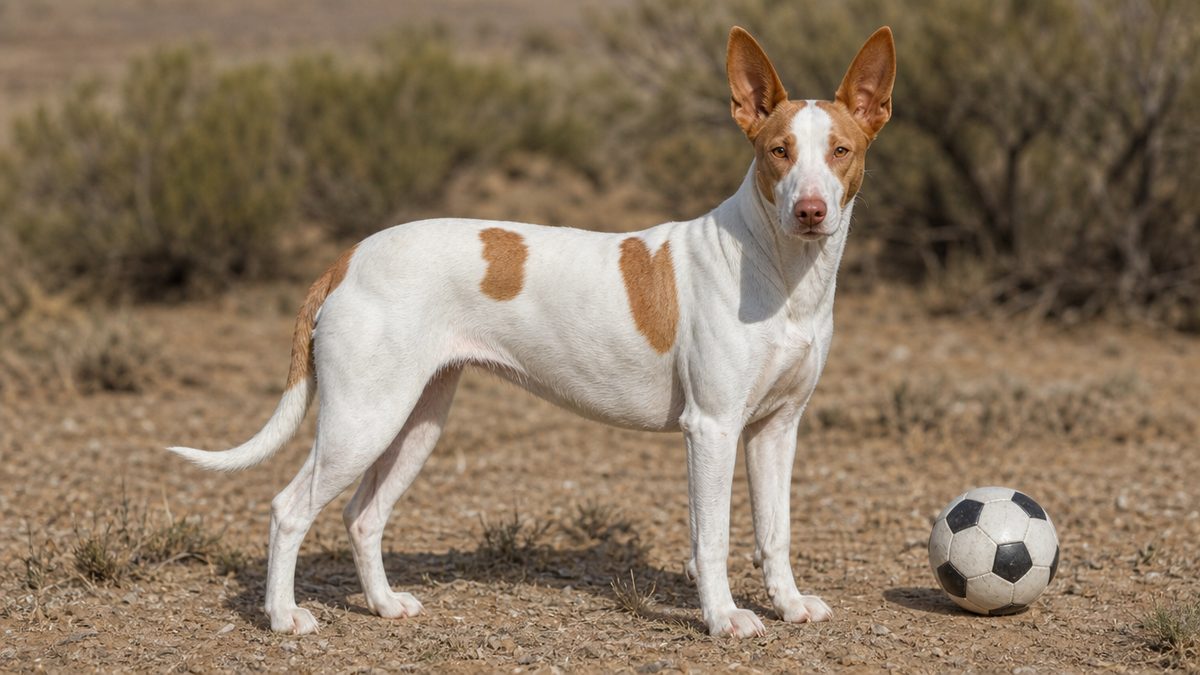
The Podenco Andaluz is a Spanish hunting dog from Andalusia that exists in three sizes and three coat types, defined not by a kennel club but by an article of Spanish law.
Read the instrument first, because it is unusual. Real Decreto 558/2001, the Spanish decree regulating official recognition of pure-bred dog breeder organisations, carries an annex naming the Spanish canine breeds and then publishes the full racial prototype of each one inside the decree itself. The Podenco Andaluz is block 35 of that text, running to about 10,800 characters from description through the disqualifying faults. So the breed standard for this dog is a legal document, and article 8 requires that prototype to be single for the whole national territory.
The decree opens the prototype with the fact that governs everything else about the breed. The Podenco Andaluz is a breed that presents three different sizes, and within those there are three distinct coat varieties. Three by three gives nine combinations, which is why English sources describe nine varieties.
Size and weight, from the decree
| Size | Males | Females | Weight |
|---|---|---|---|
| Talla grande (large) | 54-64 cm | 53-61 cm | 27 kg plus or minus 6 |
| Talla mediana (medium) | 43-53 cm | 42-52 cm | 16 kg plus or minus 6 |
| Talla chica (small) | 35-42 cm | 32-41 cm | 8 kg plus or minus 3 |
That is a spread from an 8 kg terrier-sized dog to a 33 kg boar hound under one breed name, which is the single most important thing an Indian buyer needs to understand before anything else. Asking what a Podenco Andaluz weighs has no answer until you say which size.
English Wikipedia's infobox gives the medium female range as 42 to 53 cm; the decree and the Spanish kennel club's own record both say 42 to 52 Real Sociedad Canina de Espana Real Decreto 558/2001, de 25 de mayo. Google's AI Overview goes further, printing the three bands as 30 to 43, 40 to 53 and 50 to 64 cm, which understates the floor of every one of the three. Zooplus, unusually, reproduces the decree exactly.
Coat: three types, and one line that matters in India
The decree gives the three coat types with measured lengths. Smooth or short hair at 2 cm plus or minus 1; hard or cerdeno wire hair at 5 cm plus or minus 1; long silky sedeno hair at 8 cm plus or minus 2. The smooth coat is hard and flat to the touch, the wire-haired coat is coarse, the silky coat is soft. In both the sedeno and the cerdeno the dog is covered by abundant hair over all body regions, shorter on the limbs and head.
Then comes the clause that decides the grooming section: 'Destacandose la ausencia de subpelo';, the absence of an undercoat is notable. No undercoat, in any of the three coats. That is a hot-country design, and it also means there is no seasonal blow to manage in an Indian monsoon.
Colour, and a hard limit
The coat is white or cinnamon, or both together. White exists in silvered, matt and ivory variants and the cinnamon ranges from pale to a burning cinnamon. The decree then closes the door: 'Colores admitidos: el canela y el blanco. Colores no admitidos: el resto de los colores'. Any black, or any other colour in any shade, is a disqualifying fault, not a minor one.
Two features are fixed across all nine varieties, whatever the size and whatever the coat. The breed carries erect ears, triangular with blunt tips, and ears that are not completely erect are a disqualifying fault rather than a minor one. And the eyes are small and round with a honey or hazel iris, because a blue or green iris disqualifies too.
What the breed was built to do
The decree's own function clause is direct. The Podenco Andaluz, by its scent and its developed hunting instinct, can take on everything from searching out a rabbit in bramble to the hard seizing of wild boar, by way of retrieving ducks from water, and adding its agility and extraordinary stamina gives an animal exceptionally equipped for hunting. It is a rabbit dog, a boar dog and a retriever in one breed, which explains the three sizes rather than merely accompanying them.
Recognition: in Spanish law, out of the FCI, and filed two ways by its own kennel club
The Podenco Andaluz is recognised by the Spanish state and unrecognised by the Federation Cynologique Internationale, and the Spanish kennel club files it in two different groups on two documents linked from the same page.
The Spanish state position, which is the strong one
The breed is one of 33 named in the annex to Real Decreto 558/2001, and the decree carries its full prototype. It has been there from the beginning: the annex as originally published on 14 June 2001 listed 15 breeds and the Podenco Andaluz was one of them, with its prototype already in the text. The annex has been amended eight times since, most recently by Orden APA/698/2020, which added only the Valdueza.
Two features of that recognition matter more than the label. Article 2.2 defines a Spanish canine breed as a pure breed originating in Spain with a defined prototype and aptitudes, traditionally linked to livestock activity, guarding, hunting, companionship and other uses set out in the annex. And article 3.1 gives official recognition of the studbook-keeping association not to Madrid but to the autonomous community in which the breed originates, weighing the technical, sociocultural and historical evidence. For this breed that means Andalusia, and it is why the Spanish kennel club notes that the standards of the Spanish breeds are those approved by the corresponding autonomous communities.
News reports and even regional governments routinely describe Spanish breed recognition as entry into the Catalogo Oficial de Razas de Ganado de Espana. That catalogue is Anexo I of Real Decreto 45/2019 and it holds no dogs. The cleanest proof is Orden APA/698/2020 itself: its article 1 adds a dog breed to the annex of Real Decreto 558/2001, and its article 2 amends Anexo I of Real Decreto 45/2019 by replacing a list of sheep breeds. One order, two annexes, the dog in one and the sheep in the other.
The FCI position, established from the register rather than assumed
The Podenco Andaluz holds no FCI number. Five independent lines say so.
- The FCI's definitive letter-P index, served in Spanish, lists 27 breeds including Podenco Canario 329, Podenco Ibicenco 89, Podenco Portugues 94 and Presa Canario 346. The Podenco Andaluz is not among them.
- The FCI's provisional register holds 20 entries and does not include it, while it does hold the Ratonero Bodeguero Andaluz at 371 and the Ratonero Valenciano at 370, two breeds from the very same Spanish decree. So the absence is not because the FCI declines Spanish national breeds.
- Perini and colleagues state it in print. Their 2023 paper says the Royal Spanish Canine Society recognises and includes the Podenco Andaluz and the Podenco Valenciano, 'which are not recognised by the FCI', in its National Origins Book.
- The Spanish kennel club files the breed in a group named after the fact: Grupo 11, 'Razas no reconocidas por la FCI';.
- English Wikipedia says the same, adding a claim that the breed was recognised by Germany's Verband fur das Deutsche Hundewesen in 2014. Bonbeno could not test that claim, because the URLs assembled for it returned 404 and a guessed URL that 404s proves nothing about recognition. It is recorded here as untested rather than repeated as fact.
And the kennel club contradicts itself, on two documents one click apart
The Real Sociedad Canina de Espana's web record for the Podenco Andaluz prints 'Clasificacion rSCE: Grupo 11 - Tipo Primitivo - Perros de Caza';. The downloadable ficha PDF, linked from that same record by a 'Descargar ficha PDF' button, prints 'Clasificacion RSCE: Grupo 5o - Seccion Perros de Caza. Sometida a prueba de trabajo.';.
| Field | RSCE web record | RSCE downloadable ficha |
|---|---|---|
| Group | Grupo 11, the non-FCI national group | Grupo 5, an FCI group |
| Working trial | Not stated | Sometida a prueba de trabajo |
| Utilizacion | Perro de pastoreo, de guarda y de defensa | Perro de pastoreo, de guarda y de defensa |
| Sizes and coats | Three and three | Three and three |
Every other field on the two documents matches word for word, including the utilization line and the three sizes and three coats, which is what makes the group line stand out. The likeliest reading is that the ficha is a print of an earlier version of the same page and was never regenerated when the web record moved from Grupo 5 to Grupo 11. That is an inference, and it is labelled as one. What is not an inference is the state of the two documents today: the society's own downloadable file places a breed the FCI does not hold into an FCI group, and adds a working-trial requirement that no FCI standard for this breed exists to impose.
www.rsce.es refuses direct connections from this environment, so both the web record and the ficha PDF were retrieved through a proxy render, and the PDF was read through a parser rather than downloaded and extracted locally. The ficha's non-classification fields match the independently retrieved web record verbatim, which is why the classification line is reported here. The society's Podenco Canario ficha, checked the same way, turned out to be an image scan whose text came back as unusable garbage, and nothing from that file is quoted anywhere on Bonbeno.
What the record's own utilizacion line says, and why it is wrong
Both RSCE documents print the breed's utilization as 'Perro de pastoreo, de guarda y de defensa';, a herding, guarding and defence dog. The body of the same record then describes, at length, a hunting dog that works rabbits in bramble, seizes boar, retrieves ducks from water and acts as a quitaor alongside greyhounds. The state decree's own function clause says the same. The field is simply wrong, and it is wrong on both of the society's documents for this breed. Guarding is a real secondary role for the large size at Andalusian farmsteads, but it is not the breed's utilization and no other source treats it as such.
History and origins: no antiquity claim, and the closest dog to Egypt anyway
The Podenco Andaluz is the only Spanish podenco whose own standard makes no claim about where it came from, and it is the population that the best genetic study places closest to Egyptian dogs.
Begin with the absence, because it is the finding. Real Decreto 558/2001's prototype for this breed contains no history section at all. It opens at Description, moves to Function of the breed, then General appearance, and never says where the dog came from. The Spanish kennel club's record follows the decree and adds no origin story either.
That is not how the neighbours behave. FCI Standard 329 tells you that the Podenco Canario is 'un perro de origen faraonico' with an age of about seven thousand years. FCI Standard 89 tells you that the Ibizan Hound is one of the oldest breeds in existence and can be seen in the tombs of the pharaohs. This breed's governing document says nothing, and that silence is more defensible than either claim.
FCI 89's authentic Spanish says the Ibizan Hound's 'primeros indicios se remontan al 3.400 A.C.', the first traces go back to 3400 BC. Its English translation says 'the existence of the breed can already be proved in the year 3400 BC';. The word 'proved' is not in the original, and neither is 'the breed'. A translated standard can strengthen a claim its own authentic text only gestures at.
What the genetics found when it sampled this breed
Perini and colleagues in 2023 surveyed 272 unrelated dogs from eight Mediterranean populations at the genomic and mitochondrial level, and the Podenco Andaluz was one of them, with 31 dogs sampled. The eight were the Podenco Valenciano at 61, the Podenco Ibicenco at 38, the Podenco Canario at 30, this breed at 31, the Podengo Portugues at 17, the Maltese Kelb tal-Fenek at 32, the Egyptian Baladi street dog at 30 and the Cirneco dell'Etna at 33, with 29 German Shepherds as an outgroup.
The result inverts the marketing. Pairwise genetic differentiation singled out the Egyptian Baladi street dog and the Podenco Andaluz as the closest pair in the whole study, at FST 0.012, although at a level the authors call not significant, followed by the Egyptian population and the Podenco Valenciano at 0.025 and the two mainland Spanish podencos with each other at 0.016. The Kelb tal-Fenek, the breed sold in English as the Pharaoh Hound, registered the highest divergences of every population in the study.
| Population | Sampled | Relationship to Egyptian street dogs | Antiquity claim in its own standard |
|---|---|---|---|
| Podenco Andaluz | 31 | Closest pair in the study, FST 0.012 | None |
| Podenco Valenciano | 61 | Second closest, FST 0.025 | None |
| Podengo Portugues | 17 | Close, FST 0.041 | - |
| Podenco Ibicenco | 38 | Island-isolated, high divergence | Yes, 3400 BC |
| Podenco Canario | 30 | Island-isolated, high divergence | Yes, about 7,000 years |
| Kelb tal-Fenek | 32 | Highest divergence of all | No history section |
The breed with no origin claim is the one nearest the Egyptian dogs, and the breeds with the loudest claims are the ones furthest away. That is not a small irony; it is a direct consequence of geography. The two island podencos and the Maltese breed have been isolated, and isolation produces distance from everything, including from Egypt.
The maternal line adds a second, older thread
On the mitochondrial side the picture is richer for this breed than for its island relatives. The Podenco Andaluz recorded the second-highest haplotype diversity of any population in the study at Hd 0.903, behind only the Egyptian Baladi street dog at 0.945. It also carried haplogroup C, which the two island podencos and the Kelb tal-Fenek did not, and within that haplogroup its shared clade included the Egyptian Baladi street dog, the Podenco Valenciano, the Podengo Portugues and eleven ancient dog sequences from Italy, Switzerland, France, Germany and Romania.
The authors read that as the conservation over several millennia of ancient European mitotypes in the Mediterranean native hound-like populations. Clade C, together with D, was predominant in ancient European dogs of some 7,000 years ago and is rare in modern European dogs, so a living breed carrying it is carrying something genuinely old.
The study's own published highlight reads that it confirms the Mediterranean hound-like dogs' origin as a recent event, and its abstract states that none of the populations studied indicates being a direct descendant of the Egyptian dogs, while adding that there is not enough evidence in that study to exclude completely the potential of an ancient common relationship. Old maternal lineages in a modern breed are exactly what Parker and colleagues described from the other direction when they found that Mediterranean warren hounds have been recreated in recent times from combinations of other breeds. Ancient material, recent breed.
The honest summary for this breed is short. Its own standard claims nothing, its genetics show the closest measured link to modern Egyptian dogs of any podenco and an unusually deep maternal diversity, and no published work supports an unbroken ancient pedigree for it or for any of its relatives. A breed that does not oversell itself and turns out to have the better data is worth more attention than one that does the reverse.
Podenco Andaluz price in India
No verified Podenco Andaluz price in India exists, and the top result on the Indian commercial search is a 213 gram paperback.
That is not a figure of speech. Searching 'podenco andaluz price in india' from India on 8 September 2026 returned ten organic results, and the first is a Flipkart listing for the 'Andalusian Hound (Podenco Andaluz) Training Guide' whose own specification block gives width 8 mm, height 229 mm, length 152 mm and weight 213 g, because it is a book.
| Position | Domain | What it sells | Rupee figure |
|---|---|---|---|
| 1 | flipkart.com | A paperback training guide | Not shown |
| 2 | etsy.com | Craft items in an India storefront | Rs 228 to Rs 1,173 |
| 3 | zooplus.co.uk | A UK breed article | None |
| 4 | thesprucepets.com | A generic podenco article, priced in dollars | None |
| 5 | dogbreedslist.info | An aggregator profile | None |
| 6 | hopeforpodencos.com | A UK rescue charity | None |
| 7 | amazon.in | A wordsearch puzzle book | Not shown |
| 8 | honestdog.de | A German breed page priced in euros | None |
| 9 | en.wikipedia.org | An encyclopedia article | None |
| 10 | ebay.com | The same training guide | None |
Four of the ten results are merchandise, two of them the same book, and the only rupee figures on the entire page belong to an Etsy craft storefront at Rs 228, Rs 586, Rs 597 and Rs 1,173. Not one rupee figure is attached to a live dog. There is no Indian breeder, no Indian litter and no Indian listing.
A wordsearch book and a set of craft listings produce plausible-looking rupee figures under the exact breed name a buyer typed. An aggregator, or an answer engine, reading that page has four candidate prices and no signal that any of them describes an animal. Before quoting any rupee figure for a rare breed, confirm the listing is for a live dog.
What the overseas figures are, and why they are not converted here
HonestDog, the German page at position eight, quotes a puppy price of 1,500 to 2,500 euros. The Spruce Pets, writing about podencos generally, gives about 1,000 US dollars with 2,000 to 2,500 for a specific type. Converting either into rupees would produce a number no seller in India has ever quoted, for a dog no seller in India has. A rupee figure obtained by division is arithmetic, not a price, and this page publishes none.
The same German page is worth reading for what it admits rather than what it charges. It carries two headings that say the quiet part: 'No Health Tests Available' and 'No verified Podenco Andaluz breeders on HonestDog yet';. A commercial breed platform stating that it has no breeders and no health data for a breed is the clearest possible statement of that breed's position outside Spain.
Rare in registers, common in the field
The Spanish kennel club's own essay on this subject is the most useful thing written about the breed anywhere, and it explains a paradox that would otherwise look like a contradiction. It says that among the breeds which have not been successfully consolidated in modern cynology are the Podencos Andaluces, which stand among the most important in Spain's canine heritage by number of individuals and by physical and functional homogeneity, and that it is frustrating that many years after their officialisation as a breed, and with thousands of individuals performing their hunting function admirably, only a few have chosen to complete the three generations of a pedigree.
So the breed is simultaneously numerous and, in registry terms, vulnerable. The society lists it among 21 Spanish breeds considered vulnerable for the year from 1 May 2026 to 30 April 2027. Vulnerability here is a statement about registrations, not about how many dogs exist, and an Indian reader should read every rarity claim about this breed through that lens.
English Wikipedia says the breed was among 'the sixteen Spanish breeds considered by the Real Sociedad Canina de Espana to be vulnerable';. The society's own one-page list for 2026 to 2027 names 21: Gos d'Atura Catala, Ca de Bestiar, Mastin del Pirineo, Ca de Bou, Ratonero Valenciano, Ratonero Bodeguero Andaluz, Podenco Ibicenco, Podenco Canario, Sabueso Espanol, Perdiguero de Burgos, Alano Espanol, Euskal Artzain Txakurra, Galgo Espanol, Podenco Andaluz, Valdueza, Xarnego Valenciano, Perro de Pastor Garafiano, Maneto, Perro Leones de Pastor, Pachon Navarro and Majorero.
Monthly cost of ownership in India
Budget roughly Rs 2,500 to Rs 5,000 a month for a small or medium Podenco Andaluz in an Indian city and Rs 4,000 to Rs 8,000 for a large one, before any illness.
The range is wide because the breed is, and because Indian veterinary pricing is a function of delivery model rather than of the drug. Every figure below comes from a named Indian source that was opened.
| Item | Small, 8 kg | Medium, 16 kg | Large, 27 kg |
|---|---|---|---|
| Tick, flea and worm cover, monthly | Lower weight band | Rs 1,103 (15-30 kg band) | Rs 1,103 (15-30 kg band) |
| Deworming per dose, at Rs 125.67 a tablet per 10 kg | About Rs 126 | About Rs 251 | About Rs 377 |
| Food, monthly, indicative | Rs 900 to 1,500 | Rs 1,800 to 3,000 | Rs 3,000 to 5,000 |
| Annual vaccination allowance | From Rs 899 for the 9-in-1, Rs 699 anti-rabies | Same | Same |
| Consultation | Rs 500 to 1,000 | Rs 500 to 1,000 | Rs 500 to 1,000 |
Two of those rows carry a caveat. The consultation range published by VOSD is byte-identical to that published by a large general insurer, on the consultation figure and on the core-vaccination figure. Two unrelated organisations agreeing to the rupee on two separate quantities is evidence of copying, so this page treats them as one data point.
The other is the parasite line. NexGard Spectra's 15 to 30 kg pack works out at Rs 1,103 a month and covers ticks, fleas, roundworm and hookworm together, and a Drontal Plus tablet at Rs 125.67 covers 10 kg of bodyweight per dose. A small talla chica dog is genuinely cheaper to run than a large one, and this is where the difference shows.
What the working population actually spends its year on
There is one published account of how these dogs are kept, and it is worth reading against an Indian pet budget. A 2026 survey of 30 hunting-pack breeders in the Sierra Morena of Cordoba found packs averaging 51.9 dogs, predominantly the large-sized Podenco Andaluz, working about 40 hunting events a year, fed on commercial feed combined with supplementary food, and given routine deworming every six months.
Two things follow for an Indian owner. Six-monthly deworming is a pack-management interval for working dogs in a dry climate, and it is not the right interval for a single pet dog in an Indian city, where monthly combination cover is the norm your vet will recommend. And a commercial-feed-plus-supplement diet at pack scale tells you nothing about what one dog in Pune should eat, which is why the feeding section below is built from Indian retail figures instead.
Delhi's MCD registers pet dogs at Rs 500 and has issued 18,958 certificates since 2021, rejecting 71 of 1,006 applications in FY 2026-27. Greater Chennai Corporation licenses pet animals at Rs 50, issued 9,115 licences in 2024, and runs six pet clinics giving treatment and anti-rabies vaccination free of cost. Microchipping at a named Chennai clinic is Rs 1,250.
Heat tolerance and the Indian climate
The Podenco Andaluz is a genuinely hot-country dog with no undercoat, and the step it cannot take for granted in India is humidity rather than temperature, which is the exact reverse of its Canary Islands cousin.
Andalusia is hot and dry, and the dog is built for it. The decree specifies no undercoat in any of the three coat types, skin of medium thickness with no folds or wrinkles anywhere on the body, and a light pigmentation in harmony with the coat. That is a design for shedding radiant heat in dry air.
What the homeland climate actually measures
NASA POWER was queried by explicit latitude and longitude for three Andalusian points and six Indian cities, and every returned grid-cell elevation was compared against the real elevation of the place.
| Place | Cell elevation vs real | Annual mean C | Annual RH % | Hottest month | Peak wet bulb C |
|---|---|---|---|---|---|
| Cardena, Sierra Morena | 628 m vs 600 m, +28 | 15.56 | 60.52 | July, 27.33 | 16.42 (Aug) |
| Cordoba | 409 m vs 120 m, +289 | 16.88 | 61.05 | August, 28.14 | 17.74 (Aug) |
| Seville | 188 m vs 7 m, +181 | 18.01 | 62.53 | August, 28.63 | 18.83 (Aug) |
| Bengaluru | 842 m vs 920 m, -78 | 23.74 | 67.94 | April, 28.37 | 21.86 (May) |
| Pune | 636 m vs 560 m, +76 | 23.86 | 66.80 | April, 28.93 | 22.97 (Jun) |
| Mumbai | 97 m vs 14 m, +83 | 26.77 | 67.39 | May, 31.19 | 25.77 (Jun) |
| Chennai | 49 m vs 6 m, +43 | 27.95 | 72.39 | May, 31.51 | 26.11 (May) |
| Delhi | 206 m vs 216 m, -10 | 25.60 | 45.56 | June, 35.88 | 26.50 (Jul) |
| Kolkata | 7 m vs 9 m, -2 | 25.81 | 73.93 | May, 31.53 | 27.09 (Jun) |
The Sierra Morena cell is the accurate one, at 28 metres from the real elevation, and it happens to be the exact region where the only published study of this breed's working population was carried out. So the homeland baseline on this page is the one place where the model and the dogs coincide.
The comparison that decides how you keep the dog
Read the two right-hand columns together. Cordoba in August averages 28.14 degrees, which is hotter than Bengaluru's hottest month and only three degrees below Chennai's. So the raw temperature step into an Indian city is small, and for Bengaluru and Pune it barely exists.
The humidity step is the one that matters. Andalusia runs about 60 to 63 percent annual humidity; Chennai runs 72.39 and Kolkata 73.93. Combine the two into wet-bulb load and the gap opens out: peak wet bulb in the Sierra Morena is 16.42 degrees, against 26.11 in Chennai and 27.09 in Kolkata. That is a step of nearly ten degrees, and no coat adaptation covers it.
The Podenco Canario comes from a homeland at 78.2 percent annual humidity, higher than every Indian metro, so for that breed the humidity is familiar and the temperature is the shock. The Podenco Andaluz comes from a homeland drier than Chennai, so for this breed the temperature is familiar and the humidity is the shock. Two Spanish podencos in one decree, opposite climate problems in India.
City by city, in practice
- Bengaluru is the closest Indian analogue, at +5.4 degrees of wet bulb on the Sierra Morena peak but a near-identical hottest-month temperature. Sensible timing covers most of the year.
- Pune is next, at +6.6. April is the hot month rather than May, which shifts the difficult window earlier than most owners expect.
- Mumbai and Chennai add nine to ten degrees of wet-bulb load. Exercise moves to before 7 am and after 8 pm through the hot and humid months.
- Kolkata is the hardest at +10.7 degrees, peaking in June when the pre-monsoon heat and the rising humidity overlap.
- Delhi is the closest match on humidity, at 45.56 percent against Andalusia's 60, and the worst on temperature, with a June mean of 35.88 degrees. A dog with no undercoat and pale skin needs shade discipline there rather than a shorter walk.
The statutory hook applies here too. Second Schedule Part IV paragraph 21(1) of the Prevention of Cruelty to Animals (Dog Breeding and Marketing) Rules 2017 bars keeping in outdoor facilities, without an attending veterinary practitioner's written approval, dogs not accustomed to local temperatures and breeds that cannot tolerate them.
Hall and colleagues studied 905,543 UK dogs under primary veterinary care in 2016 and recorded 1,259 heat-related illness events in 1,222 dogs. Of the 879 events with a recorded trigger, 652, or 74.2 percent, were exertional rather than environmental. This breed is not in that study's breed list, so no breed-specific odds ratio applies. The transferable lesson is exact and it decides the exercise section: for a heat-tolerant working hound in India, the danger is running in the heat, not sitting in it.
Temperament and household fit
The Podenco Andaluz is described by its own registry as intelligent, noble, sociable and highly trainable, and as a dog that breaks its bond with an owner who punishes it unjustly.
The breed record's temperament clause is unusually specific and worth quoting closely. It describes great intelligence, nobility, sociability and constant alertness, with measured reactions to stimuli that denote a lively and balanced character; a dog very affectionate, submissive and loyal with its owner, but which breaks this bond in the face of unjust punishment; and it credits all of that with giving the breed a great capacity for training.
That last clause is the one to carry into an Indian home. A standard that names unjust punishment as the thing that destroys the relationship is telling you the training method before you ask.
The second temperament, in the field
The same record then describes the working dog, and it reads differently: a sober temperament with great vivacity, always alert, affectionate, submissive and loyal with its owner but wary and gruff with strangers, with very developed senses, tireless and tenacious in the search, agile and very fast over broken ground. Reserve with strangers is normal in this breed and it is not a fault to be trained out.
The prey drive, and what it actually means in a flat
The decree's function clause tells you the range: rabbit in bramble, boar at close quarters, duck retrieved from water. In India that translates to squirrels, street cats, poultry and any small pet in the household.
- Do not keep this breed with cats, rabbits or birds unless they are permanently and physically separated.
- Assume a chase beats a recall on the first attempt, and engineer the environment rather than training against instinct.
- Expect jumping and climbing, and audit fencing before the adolescent growth spurt rather than after the first escape.
- Accept that off-lead freedom in an unfenced Indian park is not a reasonable goal, whichever of the three sizes you have.
Which size suits which household
| Size | Typical adult | Realistic Indian setting |
|---|---|---|
| Talla chica | 8 kg plus or minus 3, 32-42 cm | A flat with a genuinely secure balcony and two daily outings; the only size that is honestly apartment-plausible |
| Talla mediana | 16 kg plus or minus 6, 42-53 cm | A house with a walled compound; the classic rabbit dog and the most versatile of the three |
| Talla grande | 27 kg plus or minus 6, 53-64 cm | A property with real land; this is the boar-pack dog and the farm guard, and it does not downsize |
It suits a household with secure walled outdoor space, two adults who will take the dawn and late-evening slots seriously, no small pets, and a preference for a companionable dog over a biddable one. It does not suit a first-time owner, a flat without outdoor space, a home with free-roaming pets, or anyone whose exercise plan is one evening walk.
Training: what works, what this breed resists, and one legal warning
To train a Podenco Andaluz, use reward and repetition and never correction, because the breed's own registry record names unjust punishment as the thing that ends the relationship.
That clause is the whole training philosophy in one line. The record describes a dog very affectionate, submissive and loyal with its owner, 'pero rompe este vinculo ante el castigo injusto';, and then credits its intelligence and balance with giving it a great capacity for training. Read together, those two statements say the breed is highly trainable and unusually fragile to unfairness.
The one published timeline, and where it comes from
A 2026 survey of 30 hunting-pack breeders in the Sierra Morena of Cordoba is the only published account of how these dogs are actually raised, and it gives a figure worth knowing: training generally began at around 14.5 months of age and followed regular weekly routines. The typical breeder in that survey was a 48-year-old man with 28.5 years of experience and basic formal education, running a pack averaging 51.9 dogs across about 40 hunting events a year.
Fourteen and a half months is late by pet-dog standards, and it is not advice to wait that long before starting basic manners. What it tells you is that the working behaviour is expected to come after adolescence, not during it, and that the Spanish assumption is a long slow start rather than an early intensive one. Owners who panic at a twelve-month-old podenco that seems to have forgotten everything are measuring against the wrong calendar.
A realistic first-year plan for an Indian home
- Build containment before the dog arrives. Secure fencing with nothing climbable within a metre of it, and a gate airlock at the entrance.
- Start long-line work from week one and keep it through the first year. A 10 metre line on a harness gives freedom without testing a recall you do not yet have.
- Socialise in short, calm, repeated exposures. Wariness with strangers is written into the breed record, and pushing through it produces avoidance rather than confidence.
- Train the recall as a paid emergency behaviour on food that outranks the environment, and never spend it on routine lead-clipping.
- Substitute the hunt rather than suppressing it. Scent trails, hidden food and a flirt pole give the search sequence somewhere to go.
- Screen every training method you are offered against the punishment clause above, and discard anything built on correction.
Before repeating any Spanish or European breeding guidance for this breed, check it against the 2017 Rules. Second Schedule Part II paragraph 6(3) prohibits in-breeding, defined as breeding between relatives of the second to fourth grade in straight or side line within the first four generations, and incest breeding between parents and children or brother and sister. A pack of 51.9 related dogs managed over decades is a population where those matings are easy to make by accident. Only outbreeding and line breeding are permitted in India.
The disqualifying faults that are also training questions
The decree's disqualifying list is worth reading before you buy, because two of its entries concern behaviour rather than shape. Under functionality it disqualifies latir en falso, giving voice falsely; cobro imperfecto, an imperfect retrieve; a lack of stamina and agility in the hunt; miedo al disparo, fear of gunfire; and a very slow hunting rhythm. A breed standard that disqualifies for a false alert is a breed standard that expects honesty from the dog, and it tells you the temperament was selected as hard as the shape.
Daily exercise requirement, and what happens without it
Plan two structured sessions a day timed to the cool hours, sized to which of the three podencos you actually have, and add scent work as a daily fixture rather than a treat.
The working benchmark is public. Packs of predominantly large Podenco Andaluz in the Sierra Morena work about 40 hunting events a year across broken ground, and the decree describes a dog agile and very fast over rough terrain, tireless and tenacious in the search. Forty working days a year is not the daily requirement, but the engine that does them does not switch off on the other 325.
| Size | Daily total | Shape of it |
|---|---|---|
| Talla chica, 8 kg | 60 to 75 minutes | Two walks plus 15 minutes of scent games indoors |
| Talla mediana, 16 kg | 90 minutes | Two sessions with a long-line free-running component in one |
| Talla grande, 27 kg | 2 hours | Two sessions, one with real sprint work, plus daily scent work |
The Indian timing problem, in numbers
The climate table above sets the constraint. Peak wet bulb in the Sierra Morena is 16.42 degrees; in Chennai it is 26.11 and in Kolkata 27.09. Meanwhile the largest study of canine heat-related illness found 74.2 percent of the 879 events with a recorded trigger were exertional rather than environmental. Combine those and the rule is simple: the risk for this breed in India is exercise in the heat, not heat.
- Bengaluru and Pune: before 8 am and after 7 pm through the hot season, with April rather than May as the pinch month in both.
- Mumbai and Chennai: before 7 am and after 8.30 pm from March to June, and again through the humid post-monsoon shoulder.
- Kolkata: before 6.30 am and after 8.30 pm, with June the hardest month of the year.
- Delhi: before 6.30 am and after 8.30 pm in May and June, and be aware that a 35.88 degree monthly mean is a sun-exposure problem for a dog with no undercoat and light skin pigmentation.
What under-exercise looks like in this breed
Not boredom on a sofa. Fence work, digging, escape attempts and a rising sensitivity to movement outside the compound. The search sequence is a chain; if the early links never fire, the dog finds its own triggers.
A dog selected to find rabbits inside bramble by nose will work a scattered handful of food in long grass for twenty minutes and come in genuinely tired. In a Chennai May, when the outdoor window is 90 minutes long at either end of the day, indoor scent games are not a substitute for exercise. They are the part of the exercise that the weather cannot take away.
Grooming and coat care in Indian humidity
Grooming a Podenco Andaluz costs almost nothing if you have the smooth coat and real weekly work if you have the wire-haired or silky one, and none of the three carries an undercoat.
The decree gives three coats with measured lengths, and the grooming load follows directly from which one you have.
| Coat | Length | Texture | Indian weekly routine |
|---|---|---|---|
| Liso (smooth) | 2 cm plus or minus 1 | Hard and flat to the touch | One rubber-curry session; nothing else |
| Cerdeno (wire-haired) | 5 cm plus or minus 1 | Coarse | Two brush-outs; check for damp trapped against skin after rain |
| Sedeno (long silky) | 8 cm plus or minus 2 | Silky | Two to three brush-outs; watch the feathering behind the ears and the tail |
The line that changes the Indian calculation is the decree's own: the absence of an undercoat is notable in both the sedeno and the cerdeno types. No undercoat means no seasonal blow, no matted dead coat trapped against skin in the monsoon, and no reason to ever clip this dog. It also means very little insulation, so a Delhi or Pune winter night will want a coat for a dog you bought as a hot-climate breed.
The monsoon rules that overseas guidance gets wrong
- Dry the ears properly after every bath and every soaking. Do not follow the common European instruction to towel the dog and let it air dry; an Indian monsoon is not a European summer and a damp ear canal is how otitis externa starts.
- Bathe rarely, every six to eight weeks or when genuinely dirty, and dry the wire-haired and silky coats down to the skin rather than to the surface.
- Check the feet weekly. The decree calls for hard, resistant pads on a dog that works rock, and Indian tarmac at 45 degrees is a different surface.
- Trim nails every three to four weeks; a dog exercised on grass and earth does not wear them down.
- Search for ticks after every grass outing, in the ears, the armpits and between the toes.
Two features that need Indian sun discipline
The nose and lips are specified color miel, honey-coloured, and the skin pigmentation is light or in harmony with the coat. Lightly pigmented skin on a dog's muzzle and thin ear leather burn, and a white-coated dog burns through the coat. In Delhi and Chennai that argues for midday shade and a conversation with your vet about a dog-safe sunscreen from April to June.
VOSD gives Rs 300 to Rs 2,000 for grooming in India, and the upper figure is for coated breeds. A smooth Podenco Andaluz sits at the very bottom of that band or outside it; a silky sedeno sits in the middle. Even the heaviest of the three is a brush-and-bath dog, not a salon dog, because there is nothing to strip, clip or scissor.
Health risks, screening and the gap in the paperwork
No screening scheme exists for the Podenco Andaluz in any registry, the one published concern in its working population is leishmaniasis, and the Indian risks are tick-borne disease and heat.
Start with the honest gap, because a ranking page states it for us. HonestDog's breed profile carries a health heading that reads, in full, 'No Health Tests Available';, and a sourcing heading that reads 'No verified Podenco Andaluz breeders on HonestDog yet'. That is a commercial breed platform admitting it has neither health data nor breeders for this dog, and it is the most accurate sentence about the breed's health on the ranking set.
No registry publishes a hip, elbow, eye or cardiac statistic for this breed, because registries publish those once enough dogs have been evaluated and the registered population is far too small. Any page quoting a percentage of dysplastic Podencos Andaluces is quoting nothing.
What the working population's own breeders worry about
The 2026 Sierra Morena survey asked, and the answer is specific. Forty-three percent of the 30 breeders surveyed reported concern about leishmaniasis, and health management in those packs consisted mainly of routine deworming every six months. Canine leishmaniasis is endemic across the Mediterranean basin and is transmitted by sandflies, and a dog living outdoors in Andalusia is exposed to it in a way a house dog is not.
Forty-three percent of breeders reporting concern is not 43 percent of dogs infected. The study measured what breeders said worried them, in a survey about management practice, and Bonbeno reports it as what it is. No prevalence figure for leishmaniasis in this breed was found.
The Indian health picture, which is different
For any outdoor-oriented dog in India, tick-borne infection outranks almost everything else. Among dogs tested at veterinary clinics in West Bengal, 584 screened, *Babesia gibsoni* was found in 76.54 percent and *Anaplasma* in 55.75 percent, and 72.9 percent of the 584 dogs screened carried two or more pathogens. A Kerala series of 120 dogs found *Babesia* in 66.7 percent, 80 of 120, with *Ehrlichia canis* at 5.0 percent and a pre-monsoon peak from March to May.
Both studies sampled clinically suspected dogs or clinic caseloads, not random populations. They tell you how common co-infection is among dogs already brought to a vet, which is the right denominator for deciding whether to test a sick dog and the wrong one for estimating risk in a healthy pet.
Mosquito-borne disease is the other transferable risk. A 2025 review synthesising 60 canine studies reports India chiefly through Dirofilaria hongkongensis at 25.0 to 25.3 percent rather than through *Dirofilaria immitis*, which dominates southern Europe. The species mix differs; the exposure of a dog exercised at dawn and dusk does not. Prophylaxis is a conversation with your vet, and it is not optional for an outdoor-oriented hound in India.
What the decree itself flags as a health matter
The disqualifying-fault list is a health document as much as a show document. It disqualifies monorquidia and criptorquidia, undescended testicles; albinismo; prognatismo and enognatismo, the two jaw malocclusions; the absence of more than two premolars or of any incisor or canine; and a blue or green iris.
Three of those intersect Indian law directly. Second Schedule Part III paragraph 8(10) of the 2017 Rules requires breeding dogs to have been tested for genetic defects including hip dysplasia, progressive retinal atrophy, night blindness, hypothyroidism, entropion, ectropion, overshot and undershot jaw where the incisors do not touch or mesh, wry mouth, two or more missing teeth, and unilateral or full cryptorchidism. The word is 'including', so the list is illustrative rather than closed. A breeder in India producing this breed would have to test for defects the Spanish standard already disqualifies, which is an unusually clean overlap between a foreign standard and Indian law.
Lifespan, and why this page prints none
No published life expectancy figure exists for the Podenco Andaluz. The large longevity studies are built from UK Kennel Club breeds and this one is not among them. McMillan and colleagues' 2024 study was fetched in full and searched here; the word Podenco occurs zero times, but so do Whippet and Basenji, because the breed list lives in supplementary tables rather than in the body. That control failed, so no absence is claimed from it, and no median is borrowed from a related breed.
Feeding and body condition
Feed a Podenco Andaluz to the size it actually is, keep it visibly lean, and split the ration around the exercise windows rather than around the clock.
The decree describes a harmonious, compact, very rustic and well-planted dog with strongly developed musculature and no folds or wrinkles anywhere. That is a working condition specification: lean, muscled, and not the round-bodied outline many Indian owners read as healthy.
- Feed roughly 120 to 180 g a day for a talla chica of 8 kg, 200 to 300 g for a talla mediana of 16 kg, and 300 to 420 g for a talla grande of 27 kg, of a good dry food, adjusted to the dog rather than to the bag.
- Split the ration into two meals timed away from the exercise windows, not immediately before or after a run.
- Weigh the food rather than scooping it. A hound at correct weight has very little margin either side.
- Check the ribs weekly by hand. You should feel them easily under skin with no fat pad.
- Provide water in more than one place and refresh it through the day, because a lean dog with no undercoat in a Chennai May dehydrates faster than a heavier, better-insulated one.
What the Spanish packs feed, and why it is not your model
The Sierra Morena survey found that feeding practices commonly combine commercial feed with supplementary food items. That is pack economics in a rural system, feeding fifty-two dogs across a season with forty working days in it. It is not a template for one pet dog in Pune, and importing it produces an unbalanced diet and an overweight dog on the non-working days.
Puppy and adolescent feeding
A podenco grows tall before it fills out, and the adolescent phase from six to fourteen months looks alarmingly gangly in all three sizes. Feed a growth food appropriate to the adult size the puppy is heading for, keep it lean through the growth plates, and do not supplement calcium, which harms rather than helps a fast-growing hound. The Spanish assumption that serious work starts at about 14.5 months is a useful reminder that this is a slowly finished breed.
In the hot season move both meals further into the cool hours. A dog fed a full meal at 2 pm in Delhi in June will lie flat and digest badly, and a deep-chested dog fed immediately after a dawn run sits at the wrong end of the bloat conversation. Thirty to sixty minutes of settling either side of exercise is the whole rule.
Month by month through the first year in India
Plan a podenco puppy's first year around three fixed constraints: the vaccination schedule, the Indian heat calendar, and finishing the fencing before the dog can clear it.
The legal floor comes first. Rule 8(1)(a) of the Prevention of Cruelty to Animals (Dog Breeding and Marketing) Rules 2017 requires that pups less than eight weeks in age are not sold. Any seller offering a younger puppy is breaking that rule, whatever the breed and whatever the price.
| Age | Health and legal | Training and environment |
|---|---|---|
| 8 to 12 weeks | Core vaccination course begins; deworm to your vet's schedule; anti-rabies from Rs 699 at a clinic, free at a Chennai municipal clinic | Settle in; crate and long line introduced; no unsupervised compound access |
| 3 to 4 months | Course completed; register with the municipality at Rs 500 in Delhi or Rs 50 in Chennai; microchip around Rs 1,250 | Short calm socialisation outings; recall paid heavily indoors first |
| 4 to 6 months | Monthly parasite cover begins | Fence audit before the growth spurt; remove anything climbable near the boundary |
| 6 to 9 months | Adolescent growth; keep lean; neutering timing is a vet conversation, not a default | Scent work becomes the main outlet; expect the recall to degrade sharply |
| 9 to 12 months | First annual booster planning; tick checks after every grass outing | Long line only outdoors; fix the two daily exercise slots to the cool hours |
| 12 to 15 months | Adult food transition by size | The Spanish working benchmark starts here, at about 14.5 months |
The two windows that go wrong
Months four to six are when the fence stops being adequate, because the jump develops faster than owners expect and a talla grande puppy is already most of the way to 27 kg of athlete. Audit the boundary before this window, not after the first escape.
Months six to nine are when the recall collapses. That is normal adolescence and it is sharper in a scent hound. Owners who respond by removing the long line lose the behaviour permanently; owners who keep the line and keep paying the recall get it back around fourteen months, which is exactly where the Spanish pack breeders say training properly begins.
A puppy landing in Delhi in May or Chennai in April spends its critical socialisation window indoors, because outdoor time is unsafe. Where you have any choice, aim for arrival in the cool months so that months three to five fall outside the hot season.
Podenco Andaluz against the breeds it is cross-shopped with
The Podenco Andaluz is compared with three different things: the Spanish podencos that do hold FCI numbers, the short-legged Maneto it is often confused with, and the Indian hounds a buyer here can actually obtain.
| Breed | FCI number | RSCE group | Antiquity claim in its own standard | On the 2026 vulnerable list |
|---|---|---|---|---|
| Podenco Andaluz | None held | Grupo 11 on the record, Grupo 5 on the ficha | None | Yes |
| Podenco Canario | 329 | Grupo 5 | Yes, about 7,000 years and Egyptian origin | Yes |
| Podenco Ibicenco | 89 | Grupo 5 | Yes, first traces to 3400 BC | Yes |
| Podenco Valenciano / Xarnego | None held | Grupo 11 | Not applicable | Yes |
| Maneto | None held | Grupo 11 | Not applicable | Yes |
Two of the five hold FCI numbers and three do not, and all five are on the same vulnerable list Real Sociedad Canina de Espana. Recognition and rarity are not the same axis, which is the single most useful thing that table says.
Against the Podenco Canario, the clean contrast
Same country, same decree, same annex, opposite outcomes. The Podenco Canario holds FCI 329 on a definitive basis since 24 June 1987 and its standard asserts an Egyptian origin about seven thousand years old; the Podenco Andaluz holds no FCI number and its standard claims nothing at all Real Decreto 558/2001, de 25 de mayo. Their climates are opposite too: the Canario's homeland is more humid than any Indian metro while the Andaluz's is drier than Chennai. If you want one sentence: the Canario is an oceanic-humid island breed and the Andaluz is a dry-continental mainland one.
Against the Maneto, which is the confusion that matters in Spain
The Maneto is the short-legged Andalusian podenco, filed beside this breed in RSCE Grupo 11 and listed beside it as vulnerable Real Sociedad Canina de Espana. It is a separate breed rather than a fourth size of this one, and a Podenco Andaluz talla chica at 32 to 42 cm on normal legs is not a Maneto. Anyone offering you a small short-legged podenco should be asked which of the two they mean.
Against the famous relatives
The Ibizan Hound and the Pharaoh Hound are the two podenco-type breeds with international profiles, and the 2023 study ranks them the opposite way from their reputations: the Kelb tal-Fenek recorded the highest genetic divergences of every population studied, while this breed sat closest of all to the modern Egyptian street dog population. The Cirneco dell'Etna is the Sicilian member of the group, and the same study found it more strongly connected to the mainland Spanish podencos, this breed among them, than to the Kelb tal-Fenek.
What to buy instead, in India
The honest alternative is an Indian hunting hound. The Mudhol Hound and the Rampur Greyhound fill a similar working role in a similar body, are adapted to Indian heat by residence rather than by inference, and can be obtained here without an import licence. The Galgo Espanol is the Spanish comparison, and it is the breed this one works beside as a quitaor in hare coursing, so the two share a welfare position as well as a country.
Mistakes Indian owners and Indian pages actually make with this breed
Six mistakes recur around the Podenco Andaluz, and most of them are made by pages rather than by owners, because almost nobody in India has the dog.
1. Quoting a book price as a dog price
The top Indian result for the commercial query is a paperback training guide weighing 213 grams, the seventh is a wordsearch puzzle book, and the only rupee figures on the page belong to an Etsy craft storefront Etsy India market page for 'podenco…. Before quoting any rupee figure for a rare breed, confirm the listing is for a live animal.
2. Asking what a Podenco Andaluz weighs
The question has no answer until you say which of the three sizes. The decree runs from 8 kg plus or minus 3 to 27 kg plus or minus 6, a spread of roughly four to one. A page that gives one weight for this breed has silently picked a size and not told you which.
3. Trusting the size bands on the ranking pages
Google's own AI Overview prints the three bands as 30 to 43, 40 to 53 and 50 to 64 cm, which understates the floor of every one against the decree's 32 or 35, 42 or 43, and 53 or 54 Real Decreto 558/2001, de 25 de mayo. English Wikipedia gives the medium female ceiling as 53 where the decree and the Spanish kennel club both say 52 Real Sociedad Canina de Espana. Zooplus, unusually among the ranking set, reproduces the decree exactly.
4. Reading the registry's utilization field
Both of the Spanish kennel club's own documents for this breed print the utilization as a herding, guarding and defence dog, on pages whose entire body describes a hunting dog Real Sociedad Canina de Espana. An Indian buyer who reads that field and expects a livestock guardian will get a scent hound with a very high prey drive, which is a different animal in every respect that matters.
5. Treating rare as scarce
The Spanish kennel club describes a breed with thousands of individuals working well in the field, of which only a few have completed the three generations of a pedigree, and lists it as vulnerable in the same breath Real Sociedad Canina de Espana. The vulnerability is in the studbook, not in the countryside. Reading it as scarcity leads directly to paying a scarcity premium for a dog that is not scarce.
6. Importing overseas breeding advice without checking Indian law
Two clauses catch this breed specifically. Second Schedule Part II paragraph 6(3) prohibits in-breeding within four generations and incest breeding, which is a real constraint in a population managed as large related packs. And paragraph 6(8) forbids de-clawing and any change of appearance by artificial means, which matters because the decree makes the presence of dewclaws a disqualifying fault, so a breeder tempted to remove one to meet the standard would be committing an offence under the 2017 Rules Prevention of Cruelty to Animals.
Bonbeno publishes no lifespan figure for the Podenco Andaluz, no hip dysplasia percentage and no Indian purchase price, because none of the three exists in a source that could be opened. Filling those cells with a related breed's numbers would make the page look complete and make it wrong.
Adoption, responsible sourcing and the welfare position
Adopt rather than import, because Indian law closes the commercial route entirely and because Spain's national animal welfare law does not cover this breed's working population.
Start with what the law permits. DGFT Trade Notice 22/2022-23 makes dogs a Restricted import under ITC(HS) 01061900. Entry is permitted for a pet accompanying a passenger with a valid pet book in the importer's name, for research with a CPCSEA recommendation, or for Defence and Police use, and applications for trading or breeding purposes shall be duly rejected, with entry limited to seven named ports. The full route is set out in how to import a dog to India.
Read together with the absence of any Indian breeder, that means no lawful supply chain for this breed exists in India and none can form. Nobody can import one to sell you and nobody can import a pair to breed from. The only lawful route is a person relocating to India with their own dog.
The welfare position, sourced from an instrument
Podencos are widely reported to be abandoned in large numbers in Spain at the end of the hunting season. Bonbeno could not source that claim to a figure with a stated denominator, from a government instrument, a shelter or an NGO, so it is not asserted on this page as a number. Repeating a circulated figure without its denominator is how a claim becomes a fact without ever becoming true.
What can be sourced is the legal position, and it is more concrete than any circulated percentage. Spain's Ley 7/2023, de 28 de marzo, de proteccion de los derechos y el bienestar de los animales sets a national floor for the protection and welfare of companion animals. Article 1.3 lists what falls outside that floor, and subparagraph (e) ends with this sentence:
> 'Igualmente quedaran excluidos los perros de caza, rehalas y animales auxiliares de caza. Todos ellos se regulan y quedaran protegidos por la normativa vigente europea, estatal y autonomica correspondiente, y que les sea de aplicacion al margen de esta ley.'
That is: hunting dogs, hunting packs and auxiliary hunting animals are likewise excluded, and are regulated and protected by whatever other European, state and regional rules apply to them outside this law. The string 'caza' occurs exactly twice in the entire consolidated text of that law, and both occurrences are inside that one exclusion.
The word the statute uses is 'rehalas', and the only published study of this breed's working population is a survey of rehalas, packs averaging 51.9 dogs built predominantly on the large-sized Podenco Andaluz. So the exclusion is not incidental to this breed. The population that most of these dogs belong to is named, by its own Spanish term, in the provision that puts it outside the national welfare statute. That is a documented fact rather than an abandonment estimate, and it is what an Indian reader should carry away from the welfare question.
Rescue is how these dogs actually change hands
Podencos reach homes outside Spain overwhelmingly through rescue rather than through breeders. A charity registered in England and Wales under number 1212896 runs a podenco centre, ranks in the top ten of the Indian search results for this breed, and is the source Google's own AI Overview cites first for the breed's size bands, ahead of Wikipedia. A rescue charity outranking every commercial source on a breed's own commercial query is itself the answer to the question of how the breed is distributed.
If you are set on this breed, verify these things
- Establish which size and which coat you are being offered, because the answer changes the dog, the exercise plan and the budget.
- Check the colour against the standard. White and cinnamon only; the presence of black or any other colour in any shade is a disqualifying fault.
- Check the seller against Rule 8(1)(a), which bars the sale of pups under eight weeks.
- Reject any cropped or docked dog outright. Second Schedule Part II paragraph 6(8) forbids tail docking, ear cropping, de-barking, de-clawing and any change of appearance by artificial means, and the decree independently disqualifies amputated ears and an amputated tail.
- Register and microchip the dog. Delhi charges Rs 500, Chennai Rs 50, and microchipping runs about Rs 1,250 at a named Chennai clinic SKS Veterinary Hospital, Chennai.
- Ask about parasite history, and plan monthly cover from arrival rather than the six-monthly deworming interval Spanish pack breeders use.
The Indian alternative that actually exists
If what appeals is the shape, the drive and the low grooming load rather than the passport, adopt an Indian hound. The Mudhol Hound and the Rampur Greyhound are obtainable here, suit the same household profile, and are adapted to Indian heat by living in it. Indian shelters also carry large numbers of lean, prick-eared, high-drive indies whose care requirements overlap this breed's almost exactly. The realistic outcome for an Indian reader who arrived here is not a Podenco Andaluz. It is a better-informed choice about a dog they can actually give a home to.
The first 30 days in an Indian home, and how this page was checked
Spend the first month on containment, parasite control and a recall training habit, and read the two paragraphs at the end about what this page could not establish.
A 30-day plan
- Week 1. Walk the boundary with the dog on a lead and find the three places it will test. Remove anything climbable within a metre of the fence.
- Week 1. Vaccinate to your vet's schedule if the course is incomplete, and start monthly parasite control. Deworming at Rs 125.67 a tablet per 10 kg of bodyweight comes to about Rs 126 for a small dog and Rs 377 for a large one.
- Week 2. Begin recall training indoors on a food reward that outranks the environment, before the dog has ever been asked to recall in the open.
- Week 2. Fix the two exercise slots to the cool hours and hold them, because an energetic hound given its outings at random becomes an energetic hound that patrols the fence.
- Week 3. Move recall training onto a 10 metre long line in a quiet space, and keep the line beyond the end of the month.
- Week 3. Register the dog with the municipality and microchip it.
- Week 4. Add scent work as a daily fixture. A dog bred for rabbit hunting will work a scattered handful of food in long grass for twenty minutes and come in genuinely tired.
Confirm the ears are fully erect, because ears that are not completely erect are a disqualifying fault in the decree and a semi-erect ear in an adult is a sign the dog is not what the listing said. And confirm there are no dewclaws, and that none has been removed, because their presence is a disqualifying fault under the standard while their removal is prohibited in India.
Expect an aloof dog for the first fortnight
This breed is described in its own registry record as wary and gruff with strangers, and a newly arrived dog treats the whole household as strangers. An aloof first two weeks is normal and is not a temperament problem. Let the dog approach rather than approaching it, keep visitors down, and the affectionate half of the record's description arrives on its own.
What was verified, and how
Bonbeno reads the instruments rather than the summaries, and it is worth stating what that meant here.
- The Spanish decree was read twice, once as the consolidated text and once as originally published on 14 June 2001, so no claim about it rests on a single document. Both were fetched, tag-stripped and searched Boletin Oficial del Estado. The ear defect described below was confirmed in both copies independently.
- The most recent amendment was opened. Orden APA/698/2020 added exactly one breed to the annex, the Valdueza, on a favourable report of the Comision Nacional de Zootecnia dated 21 May 2020, and its second article edits a different decree's annex to remove two sheep breeds.
- The FCI was checked in two registers with in-document controls, the definitive letter index and the 20-entry provisional list Federation Cynologique Internationale.
- The genetics was read from the papers, with Perini's sample sizes taken from its own materials and methods and the Parker passage extracted from a reprint with pypdf.
- The climate was pulled by coordinate, with every grid-cell elevation compared against the real elevation of the place.
The defect in the legal text, which nobody appears to have reported
Reading the decree closely turns up something that matters. Block 35's head section runs from the skull through the nose, muzzle, lips, jaw, cheeks and eyes, and then reaches 'h) Orejas', ears. What follows under that heading is this: the placement is almost straight, of medium size, cylindrical in form, with a wide insertion into the head and the trunk, tending to form a 45 degree angle with the longitudinal diameter of the body, of great musculature and tight skin that never forms a dewlap.
That is a description of a neck. A dewlap is a fold of skin under the throat, and an ear does not insert into the trunk. The decree contains no separate 'Cuello' entry, and the words 'triangular' and 'puntas romas', blunt tips, appear nowhere in the block. The Spanish kennel club's own record for the breed carries both paragraphs correctly and separately: ears of medium set-on with a wide base, raised energetically when alert, triangular in form with blunt tips; and then a neck whose upper profile is almost straight, of medium size, cylindrical, with wide insertion into the head and trunk and no dewlap.
The same decree disqualifies a dog whose ears are not completely erect, and disqualifies amputated ears. So the legal instrument that defines this breed sets a disqualifying fault about the ears and never describes the ears. This was checked in the consolidated text and in the original 2001 publication, two separate BOE documents, and both carry the identical defect. A judge or a buyer working from the gazette alone cannot tell what a correct Podenco Andaluz ear looks like.
What could not be established
- No Indian price, because no Indian listing for a live dog of this breed exists, and the import rules make a commercial one impossible.
- No lifespan, because the large longevity studies are built on UK Kennel Club breeds and the in-document control for that check failed.
- No screening statistic, because no registry has enough evaluations of this breed to publish one, which a commercial breed platform states on its own health heading.
- No abandonment figure with a denominator, which is why this page reports the statutory exclusion in Spain's welfare law instead of a circulated percentage.
- No test of the German recognition claim. English Wikipedia says the Verband fur das Deutsche Hundewesen recognised the breed in 2014; the URLs assembled to check it returned 404, and a guessed URL that 404s proves nothing about recognition. It is recorded as untested.
Podenco Andaluz questions Indian buyers actually ask
How big do Podenco Andaluz dogs get?
It depends which of the three sizes you have. Real Decreto 558/2001 sets large at 54 to 64 cm for males and 53 to 61 cm for females at 27 kg plus or minus 6, medium at 43 to 53 and 42 to 52 cm at 16 kg plus or minus 6, and small at 35 to 42 and 32 to 41 cm at 8 kg plus or minus 3. Google's own AI Overview widens the floor of all three bands.
Are Podenco dogs good pets?
Podencos make good pets for owners who can contain them and exercise them properly. The Podenco Andaluz record describes great intelligence, nobility and sociability, and a dog very affectionate and loyal with its owner. The failure modes are a hunting prey drive around cats and rabbits, an ability to clear ordinary fencing, and a working history that assumes a job.
How much does a Podengo dog cost?
Google asks this with the Portuguese spelling, and neither dog has an Indian price. The Portuguese Podengo is FCI 94 and the Podenco Andaluz has no FCI number at all. In India the search for either returns books, craft listings and stock photographs, so the honest answer is that no rupee purchase figure exists for either breed.
What is the Podenco Andaluz price in India?
No verified Podenco Andaluz price in India exists. The top Indian result for that query is a paperback training guide on Flipkart weighing 213 grams, the second is an Etsy craft market whose rupee figures run Rs 228 to Rs 1,173, and the seventh is a wordsearch puzzle book on Amazon.in. Not one of those prices belongs to an animal.
Is the Podenco Andaluz recognised by the FCI?
No. It is absent from the FCI's letter-P index, which lists 27 breeds including the Podenco Canario at 329 and the Podenco Ibicenco at 89, and absent from the provisional register, which holds two other breeds from the very same Spanish decree, the Ratonero Bodeguero Andaluz at 371 and the Ratonero Valenciano at 370.
Is the Podenco Andaluz a recognised breed at all?
Yes, in Spanish law. The breed is one of 33 named in the annex to Real Decreto 558/2001, and the decree carries its full racial prototype as Bloque 35, so the Spanish state both names the breed and publishes its standard. The Real Sociedad Canina de Espana files it in Grupo 11, its honestly labelled group for breeds the FCI does not recognise.
Can I import a Podenco Andaluz into India?
Only as your own accompanying pet. DGFT Trade Notice 22/2022-23 makes dogs a Restricted import under ITC(HS) 01061900, allows entry for a pet with a valid pet book in the importer's name, for research with a CPCSEA recommendation, or for Defence and Police use, and says applications for trading or breeding purposes shall be duly rejected.
Is the Podenco Andaluz rare?
It is registered rarely and bred widely, which is not the same thing. The Real Sociedad Canina de Espana says the breed sits among the most important in Spain's canine heritage with thousands of individuals hunting well, and that only a few have completed the three generations of a pedigree. It also appears on the society's 21-breed vulnerable list for 2026 to 2027.
Which coat does a Podenco Andaluz have?
One of three. The decree sets smooth or short hair at 2 cm plus or minus 1, hard or cerdeno wire hair at 5 cm plus or minus 1, and long silky sedeno hair at 8 cm plus or minus 2. All three lack an undercoat, which the standard states explicitly, and that matters more in Indian humidity than the length does.
Does the Podenco Andaluz cope with Indian heat?
Better than a northern breed and worse than its Andalusian record suggests. Its home range peaks at 27.3 degrees in July in the Sierra Morena at about 60 percent humidity, giving a peak wet bulb of 16.4 degrees. Chennai's peak wet bulb is 26.1 and Kolkata's 27.1, a step of nearly 10 degrees that dry-heat adaptation does not cover.
What health problems does the Podenco Andaluz have?
No screening scheme exists for the breed in any registry, and one ranking page prints No Health Tests Available on its own health heading. The published concern in the working population is leishmaniasis, reported by 43 percent of 30 surveyed Sierra Morena pack breeders, and the Indian equivalents are tick-borne disease and heartworm.
What does a Podenco Andaluz cost to keep each month in India?
Budget roughly Rs 2,500 to Rs 5,000 a month for a small or medium dog and Rs 4,000 to Rs 8,000 for a large one, before any illness. That covers food, monthly parasite cover at Rs 1,103 in the 15 to 30 kg band, deworming at Rs 251 to Rs 377 a dose, and an annual vaccination and consultation allowance.
How long does a Podenco Andaluz live?
No published life expectancy figure exists for this breed. The large longevity studies are built on breeds registered with the UK Kennel Club, which this one is not, and the 10 to 12 year figure on aggregator pages traces to no study Bonbeno could open. This page publishes no lifespan rather than borrowing a related breed's median.
Compare with similar breeds
Podenco Andaluz sits in 2 Bonbeno groups. Each one compares it directly against the breeds it is genuinely an alternative to, on the same figures.