
Group
Mediterranean primitive hounds, and why they are not sighthounds
Prick-eared rabbit hunters that work by nose, ear and eye, filed as primitive rather than sighthound, sold on an Egyptian story the genetics rejects.
Quick answer
A Mediterranean primitive hound is a prick-eared rabbit-hunting dog from Iberia, the Balearics, Sicily, Malta or Crete that hunts by scent, hearing and sight together, and that its own standard files as a primitive type rather than a sighthound. Five of the eight hold FCI numbers in Group 5, so a Kennel Club of India pedigree route exists in principle; the Cretan Hound, Podenco Andaluz and Podenco Valenciano hold national standards only, so it does not. No verified Indian listing exists for any of them, and every page here reports the pharaonic origin story against the studies that tested it.
The breeds
These dogs look like sighthounds and are not filed as them. The standards that govern them describe a dog that finds a rabbit by nose and ear before it ever sees one, and that single fact decides how each one behaves on an Indian street.
 Cirneco dell'EtnaA heat-adapted Sicilian hound with a genuine claim on Indian summers, an origin story the genetics do not support, and an Indian...
 Cretan HoundCrete's hare-hunting hound, recognised by the Kennel Club of Greece but absent from both FCI registers, sold on a 4,000-year...
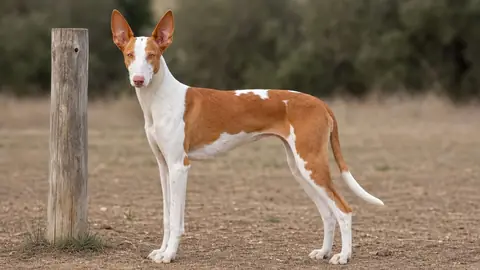 Ibizan HoundWhat FCI Standard 89 says in Spanish, what the genetics say about Egypt, and why no Indian page quoting a price actually prints...
 Pharaoh HoundThe registries still say ancient Egypt. The published genetics says Malta, and says it in one sentence you can read for yourself.
 Podenco AndaluzOne breed, three sizes and three coats, written into Spanish law in 2001 and still outside the FCI. What the decree actually...
 Podenco CanarioWhat FCI Standard 329 says in its authentic Spanish, what the Spanish state decree leaves out, and why the only rupee figures on...
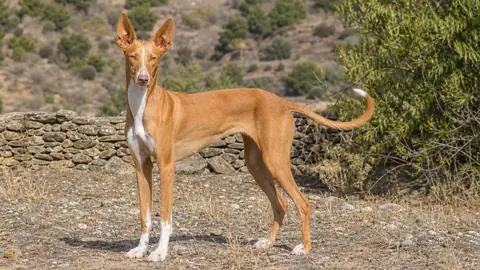 Podenco ValencianoA Valencian rabbit-hunting podenco whose own founding order credits it with legendary resistance to extreme heat, and which sits...
 Portuguese PodengoOne breed in three sizes, or three breeds. The FCI, the Portuguese kennel club and the AKC disagree, and the answer changes what...
Compare the breeds side by side
To compare these 8 breeds directly, read across the table rather than down the guides. Heat tolerance is a Bonbeno rating out of 5 for Indian conditions, and the reasoning behind each one sits on the breed's own page.
| Breed | Heat tolerance | Published price, India |
|---|---|---|
| Cirneco dell'Etna | 4 of 5 | See page |
| Cretan Hound | 3 of 5 | Rs 6,000 to Rs 10,000 |
| Ibizan Hound | 3 of 5 | See page |
| Pharaoh Hound | 3 of 5 | None. One unsourced Rs 1-4 lakh band exists in the whole Indian result set |
| Podenco Andaluz | 4 of 5 | None. The top Indian result is a paperback |
| Podenco Canario | 4 of 5 | None. The rupee figures are a book and a cushion |
| Podenco Valenciano | 4 of 5 | See page |
| Portuguese Podengo | 4 of 5 | none found |
What matters in this group
The points below are what the evidence on these 8 guides actually supports, not what the category is assumed to mean.
- The primitive-versus-sighthound distinction is written into the standards themselves, not inferred. FCI Standard 89 places the Ibizan Hound in Group 5, Section 7, primitive type hunting dogs, states that it relies on scent and hearing more than on sight, prefers a suspended trot to a sighthound's gallop, and disqualifies any dog showing evidence of crossing with a Galgo or other form of sighthound. FCI Standard 199 says the Cirneco uses sight only to select where to search and that the sense of smell carries it along the trail, and the Italian kennel club states that no parallelism with a levriero can be sustained. FCI 329 calls the Podenco Canario primarily a tracking dog that must neither bark nor seize the game while scenting. The Portuguese Podengo standard disqualifies any sign of crossbreeding to sighthounds. The Cretan standard describes a dog that searches using all senses, following scent by ground and air, and the Pharaoh Hound's says it hunts by scent and sight and uses its ears to a marked degree. Other registries file some of them differently, with the UKC placing the Cirneco and the Canario in its Sighthound and Pariah Dog Group, but the documents that define the breeds do not.
- Every breed here attracts a pharaonic origin story, and the pages report where it comes from and what tested it. FCI 89's authentic Spanish says the Ibizan Hound's earliest indications go back to 3400 BC; the English translation hardens that to proved. FCI 329 calls the Podenco Canario a dog of pharaonic origin about seven thousand years old, and FCI 199 says the Cirneco probably descends from the hunting dogs of the pharaohs. The Pharaoh Hound's own standard contains the word Egypt zero times, and the Spanish decree defining the Podenco Andaluz carries no history at all. Parker 2004 in Science found the Pharaoh and Ibizan Hounds recreated in more recent times from combinations of other breeds. Perini 2023 sampled 272 dogs across eight Mediterranean populations, seven of them on this page, and found none to be a direct descendant of Egyptian dogs, listing a recent origin among its highlights. Two results invert the marketing. The Podenco Andaluz, whose standard claims nothing, sat closest to modern Egyptian street dogs at an FST of 0.012, and the Portuguese Podengo sat further from the Kelb tal-Fenek at 0.176 than from a German Shepherd at 0.165. Talenti 2018 dated the Cirneco's haplotype sharing with the Pharaoh Hound to about 1950. The Cretan Hound's 4,000-year figure rests on an unpublished club study.
- For an Indian buyer the paperwork splits the group in two. The Ibizan Hound (FCI 89), Pharaoh Hound (248), Cirneco dell'Etna (199), Podenco Canario (329) and Portuguese Podengo (94) hold definitive FCI numbers, so the Kennel Club of India, a full FCI member, could in principle register one on an import pedigree. The Cretan Hound is recognised by the Kennel Club of Greece since March 2003 and by Germany's VDH from 1 January 2015 and is absent from both the FCI definitive nomenclature and the provisional register. The Podenco Andaluz is one of 33 breeds in the annex to Spain's Real Decreto 558/2001, with its full prototype printed in the decree, and the Real Sociedad Canina files it in Grupo 11, the group for breeds the FCI does not recognise. The Podenco Valenciano holds a Valencian standard and studbook under Orden 6/2015 and was added to the national annex in 2016 without a prototype. For those three no KCI pedigree can exist. Recognition still buys nothing on the ground. No page found a verified Indian listing for any breed here; an Indian listing page prices Maltipoos and a Doxiepoo at Rs 98,999 under a Cirneco heading, and DGFT Trade Notice 22/2022-23 states that import applications for trading or breeding purposes shall be duly rejected.
- Heat is where the group divides rather than agrees, and the pages measured it from NASA POWER by coordinate rather than assuming a Mediterranean dog copes with May. The Cirneco's Etna slopes run 27.3 C at 50.8 percent humidity in August, giving 6.4 C of evaporative headroom, and the Sierra Morena of the Podenco Andaluz peaks at a 16.4 C wet bulb at about 60 percent humidity. Those two are dry-heat dogs. Heraklion runs 26.2 C at 69.6 percent, only 3.1 C of headroom, and the Cretan page says plainly that within the Mediterranean primitive hounds this is not the dry-heat specialist. Malta runs 77.06 percent annual humidity and Las Palmas 78.18 percent, both higher than any Indian metro, at annual means of 19.80 C and 20.19 C. Against that, Chennai's peak wet bulb is 26.1 C and Kolkata's 27.1 C, while Bengaluru's 21.86 C sits below the summer peaks of Ibiza at 22.6 C and Malta at 23.23 C. The transferable rule is exertion, because 652 of 879 heat-illness events with a recorded trigger in the largest study were exertional, and every breed here was selected to run.
- The clinical trap that unites the group is thyroid. Second Schedule Part III paragraph 8(10) of India's 2017 Rules requires breeding dogs to be tested for hypothyroidism, and lean primitive hounds run low resting thyroid values as normal physiology. In one series of 398 sighthounds, 71.9 percent had been diagnosed hypothyroid on a low total T4 or T3 alone and only 16.3 percent had any corroborating abnormality, and OFA records 15.4 percent of 52 Cirnechi as equivocal. Uhrikova 2013 sampled 192 dogs across eight sighthound breeds including the Pharaoh Hound and concluded the Greyhound laboratory profile should not be applied to other sighthounds; the Cretan page adds that none of those studies included a Mediterranean primitive-type hound. The Ibizan Hound carries DEA 1 in 75 percent of 92 dogs typed, with an 18.5 percent sensitisation risk from untyped transfusion, which matters in cities where two in five dogs carry Ehrlichia canis. Screening data is thin. OFA holds 653 Ibizan hips at 1.7 percent dysplastic and 292 Podengo Pequeno hips at 1.4 percent, no hip row for the Cirneco, and no published screening statistic for the Cretan, Andaluz or Valenciano. The Podenco Canario's one measured risk is heartworm, at 43 percent against 19 percent of all dogs on Gran Canaria in 2010.
Membership is generated from the breed data itself, not typed by hand, so this list cannot drift from the guides it points at and fills in as more publish. The 8 guides here cite 315 sources between them.
This page is a directory of published Bonbeno guides, generated from their data rather than written as clinical guidance, so no veterinarian reviewed this page itself. Each linked guide carries its own veterinary review and its own health sections. Breed level evidence describes populations, and your animal is an individual, so consult your nearby vet before acting on anything you read here.
Common questions
How does Bonbeno decide which breeds belong on this page?
Membership is generated from each breed's own published data rather than chosen by an editor. The group is defined by a shared trait rather than a rating, so its members are named in the site's own cluster definition and each one is checked against the published guide before it appears. A breed appears here the moment its guide publishes and meets that rule, and never before, which is why no link on this page can point at a guide that does not exist.
What is a Bonbeno heat tolerance rating?
It is a 1 to 5 rating of how well a breed copes with Indian conditions, where 5 is best. Almost no international breed reference publishes one, and in a country where summer temperatures pass 45 C it is the most decision-relevant trait there is. It is Bonbeno's own judgement, built from published heat-illness evidence where that exists and stated as inference where it does not.
Are the prices on this page current?
Each price is read from that breed's own guide, where it is compared across published Indian sources and cited. Published Indian breed prices disagree widely between sellers, sometimes by more than a lakh for the same breed, so treat the figure here as the lowest band Bonbeno found and read the guide for the full range.
Does Bonbeno sell or broker any of these dogs?
No. Bonbeno does not sell pet food, products or animals and does not broker puppy or kitten sales. Nothing on this page is a listing, and no breeder or seller can pay to appear on it.