
Breed profile
Poitevin: The Complete India Guide
One of the tallest scent hounds the FCI recognises, bred in Poitou to run wolves, and described in English by a standard that gets its eyes wrong.
Quick answer
The Poitevin dog is a large French pack scent hound, FCI standard 24, standing 62 to 72 cm for males and 60 to 70 cm for females. No Indian price exists for it and Indian import law bars bringing one in to breed or sell. Its authentic French standard requires brown eyes; the English edition prints round instead, and the United Kennel Club has copied that error.
This page summarises published veterinary research, registry documents and breed-standard text for general information. It is not a diagnosis and it is not treatment advice. Consult your nearby vet about your own dog before acting on anything here, and treat a rectal temperature at or above 41.0 degrees Celsius after exertion in heat as an emergency.
Poitevin at a glance
What the Poitevin actually is
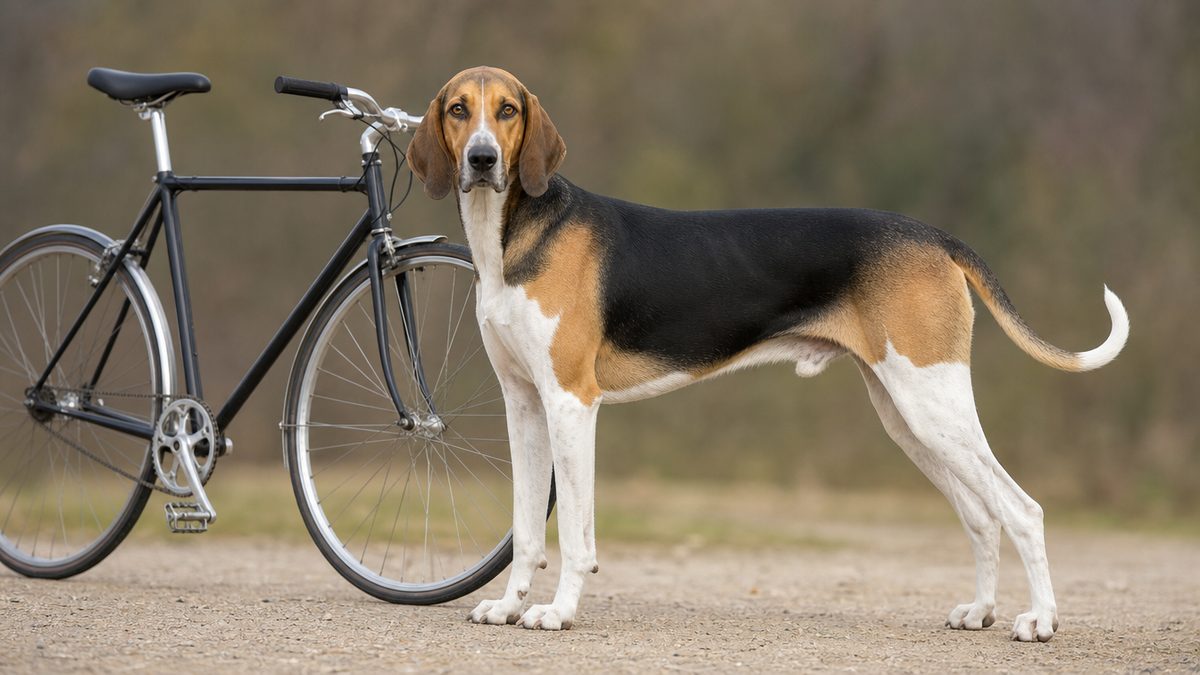
The Poitevin is a large French pack scent hound recognised by the FCI as standard 24, standing 62 to 72 cm at the withers for males and 60 to 70 cm for females, and it is one of the tallest scent hounds on the FCI register.
The FCI's own record settles the classification without argument. Record 24 places the Poitevin in Group 6, Scent hounds and related breeds, Section 1.1 Large size Hounds, with a working trial, and gives its definitive acceptance as 30 September 1963 and the valid standard as published on 17 November 1978. The country of origin is France and the official authentic language is French. The English edition carried on the FCI's own site is dated 4 March 1997 and states on its face that it is a translation by Mrs. Kincaid brought up to date by Dr. Paschoud, with the official language given as FR.
The size is the first thing to get right
A Poitevin is a tall dog by any measure. The standard's 62 to 72 cm for males puts it above the Labrador Retriever, above the Beagle by more than thirty centimetres, and into the height band a reader would associate with a Greyhound rather than with a hound. The athletic, light build is the other half of the picture. The standard opens by asking for strength, elegance and lightness together, and Wikipedia's sources describe the appearance as a mixture of a foxhound and a greyhound.
| Field | What the standard says |
|---|---|
| Height, males | 62 to 72 cm |
| Height, females | 60 to 70 cm |
| Weight | Not given, in any of the four language editions |
| Coat | Short and glossy |
| Colour | Tricolour with black saddle, or tricolour with large black patches; sometimes white and orange; wolf-coloured hair is quite frequent |
| Neck | Long, slim, without dewlap |
| Ears | Medium width, fine leather, set on a little low, medium length, slightly turned |
| Disqualifying faults | Aggression or extreme shyness; physical or behavioural abnormality; black and white hounds; dewlap |
| Working trial | Required, per the FCI nomenclature |
What the breed standard does not contain
Three absences in FCI 24 matter more than anything it says, and no page ranking in India records any of them. The standard gives no weight at all. A search of all four language editions for a figure in kilograms returns nothing; the only numbers with units anywhere in the document are the four height figures. It has no brief historical summary, in English, French, German or Spanish, so the governing document says nothing whatever about where this breed came from. And it has no temperament clause, beyond disqualifying an aggressive or overly shy dog.
Wikipedia gives the Poitevin's weight as 20.5 to 30.5 kg, and its own citation for that is a book rather than the standard. FCI 24 contains no weight. If you are told a Poitevin 'should weigh' a particular figure, ask which document says so, because the governing one does not.
That last absence is worth pausing on. A reader arriving from a Labrador or a German Shepherd page expects a standard to describe character, and this one simply does not. Everything you will read about the Poitevin's temperament comes from breed books and from the French hunting literature, not from the document that governs the breed.
The English standard describes a different eye from the French one
The authentic French text of FCI 24 requires brown eyes, and the English edition prints round instead, replacing a colour requirement with a shape requirement that appears in no other language edition.
This is the single most checkable error on the English-language internet about this breed, and it sits inside the FCI's own document. Extract all four language editions of FCI Standard 24 with pypdf and read the eye clause in each, and three of the four agree while the fourth does not.
| Edition | The eye clause, verbatim | Says the eye is |
|---|---|---|
| French, 06.01.1997, authentic | YEUX : Grands, bruns, encercles de noir, le regard expressif | Brown |
| German, 03.03.1997 | AUGEN: Gross, braun, schwarz eingerahmt, mit ausdrucksvollem Blick | Brown |
| Spanish, 28.11.1996 | OJOS: Grandes, pardos, bordeados de color negro. La mirada es expresiva | Brown |
| English, 04.03.1997 | EYES: Large, round, surrounded with black. Lovely expression | Round |
French is the authentic language for this standard, and that is not an inference. The English edition itself prints 'Official language (FR)' immediately under its translation credit, and the German prints 'Offizielle Originalsprache (FR)'; Federation Cynologique Internationale. Where a translation and the authentic text disagree, the authentic text governs. So the requirement is a brown eye, and 'round' describes nothing the standard asks for.
The error has propagated into a second registry
The United Kennel Club's official Poitevin standard reads 'The eyes are large and round, surrounded by black, with a lovely expression';. That is the FCI English edition word for word, including the error. The UKC recognised the breed on 1 January 1996, a year before the FCI's English edition carries its date, and the two texts track each other closely throughout, so the direction of copying is not in doubt in substance even where the dates are close.
The practical consequence is precise. No English-language breed document anywhere requires the eye colour the governing standard requires. An English-reading judge, breeder or buyer working from either the FCI English edition or the UKC standard has a shape requirement the breed does not have, and has lost a colour requirement the breed does have.
Download the four PDFs from fci.be, extract them with pypdf rather than reading them through any rendering layer, and search each for its eye clause. The French is at 024g06-fr.pdf, the German at 024g06-de.pdf, the Spanish at 024g06-es.pdf and the English at 024g06-en.pdf. The word you are looking for is bruns, braun and pardos against round.
A second, smaller drift in the same document
The ear clause moves too. The French says the ears are 'legerement tournees', slightly turned, with no direction given. The English says they 'turn slightly inward' and the UKC repeats that as 'turn slightly inward'; United Kennel Club. That is a specification added in translation rather than one lost, which is the opposite failure from the eye clause and worth knowing about because it shows the drift runs both ways.
The FCI once held a second Poitevin, and cancelled it
FCI record 27 is the Normand-Poitevin, accepted on a definitive basis on 26 October 1963 and now carrying the breed status Cancelled, and no page ranking in India for this breed mentions that it ever existed.
The FCI nomenclature server resolves on the trailing number in a record's URL, which makes the whole register enumerable by probing record numbers and reading back each page's own title. Doing that across records 1 to 400 on 9 September 2026 returns two records whose titles contain the string POITEVIN. Record 24 is the Poitevin. Record 27 is the NORMAND-POITEVIN.
| Field | Poitevin (24) | Normand-Poitevin (27) |
|---|---|---|
| Group | 6, Scent hounds and related breeds | 6, Scent hounds and related breeds |
| Section | Scent hounds, Large-sized Hounds | None printed |
| Definitive acceptance | 30 September 1963 | 26 October 1963 |
| Authentic language | French | None printed |
| Valid standard published | 17 November 1978 | None printed |
| Standard PDFs offered | Four, in EN, FR, DE and ES | None, in any language |
| Country of origin | France | France |
| Working trial | Subject to one | Not subject to one |
| Breed status | Recognized on a definitive basis | Cancelled |
The two acceptances sit twenty-six days apart in the autumn of 1963. Whatever the Normand-Poitevin was, the FCI admitted it to definitive status almost immediately after the Poitevin, then later cancelled it, and the record it left behind still answers at HTTP 200 today with every substantive field blank.
Why a cancelled record matters to a reader
It matters because a rare breed's name is the thing a seller trades on, and a compound name is the easiest thing to misuse. A Normand-Poitevin cannot be papered by anyone: there is no standard to judge it against, no section to file it in, and no authentic language text to translate. If the name is ever offered to you, the correct response is that the FCI cancelled the breed and published no standard for it at any point.
Record 27 returns a complete, well-formed FCI page with the breed name printed on it and the status Cancelled in the body. Nothing about the response warns you that the breed is retired unless you read the status field. The same behaviour has already caused confident errors elsewhere on this site, and it is why every FCI claim on this page names the field it came from.
Enumerating the register also settles a smaller question honestly. Numbers above 400 return a generic nomenclature index page at HTTP 200 rather than a 404, identical for every number, so the register's upper edge is visible only by reading the returned title rather than the status code.
Poitevin price in India
No Poitevin price in India exists, and any rupee figure quoted for this breed is invented rather than observed. A live Google India search on 9 September 2026 returned no Indian listing offering the breed at any price.
Start with what the search actually returns. The ten organic results for 'poitevin dog' on Google India were Wikipedia, an encyclopedia aggregator, an Indian pet-blog page, the United Kennel Club standard, a stock-photo library, an Italian hunting magazine, a Reddit thread, Royal Canin's breed library and two YouTube videos. Not one is a listing. There is no Indian marketplace page, no classified advertisement and no kennel offering a Poitevin puppy.
Why no price can form, in law
The absence is not an accident of search. Indian import law closes the supply chain. DGFT Trade Notice 22/2022-23 of 19 December 2022 places dogs under ITC(HS) 01061900 as Restricted, and its Policy Condition (7) allows the import of dogs only for three purposes, being a pet dog with a valid pet book and records in the importer's name, import by an R&D organisation with a CPCSEA recommendation, and import for internal security by the Defence and Police Force.
Policy Condition (8) of the same notice reads: 'Import of commercial dogs for breeding or any other commercial activities other than the purposes mentioned above is not permitted.' Paragraph 6 adds that 'any applications for trading/breeding purposes, or applications made on behalf of some another person/entity shall be duly rejected';.
So nobody can lawfully import a Poitevin into India to breed from or to sell. The only lawful route is a returning owner bringing their own registered pet, through one of seven named entry points, being the airports and seaports of Delhi, Mumbai, Chennai, Hyderabad, Bengaluru and Kolkata and, since October 2024, Kochi airport, with an Import Authorisation applied for at least two months before travel Department of Animal Husbandry…. An import authorisation obtained that way covers one owner's own dog and creates no breeding stock. The full route is set out in how to import a dog to India.
What you are actually being offered if someone quotes a price
Three things, and it is worth being able to tell them apart. A different breed sold under this name, most often a Grand Anglo-Francais Tricolore or a large tricolour crossbreed, since the tricolour pattern is shared. An auto-generated shell page that exists identically for every breed name and stocks none of them. Or a converted foreign figure, which you can test yourself by dividing the rupee number by 84.38 and by 74 and seeing whether it lands on a round dollar or euro amount.
Bonbeno publishes no Poitevin price because there is no honest one to publish. That is the same answer we give on every page for a breed with no Indian market, and it is a stronger answer than a number would be. What we can give you instead is what it costs to keep a dog of this size in India, which is real, published and checkable, and that is the next section.
What a hound this size actually costs to keep in India
Running costs for a 62 to 72 cm hound in India come to roughly Rs 6,000 to Rs 12,000 a month once food, parasite control, vaccination and routine veterinary care are counted, and every figure below comes from a named Indian source rather than from a breed page.
The cost of ownership for a large hound is driven by body mass, and this is a large dog. Take the figures separately rather than as a single band, because the spread inside each line is the useful part.
| Item | Published figure | Source and caveat |
|---|---|---|
| Anti-rabies vaccination | Rs 699 | Vetic clinic list price, national page |
| 9-in-1 DHPPiL | Rs 899 | Vetic clinic list price |
| Kennel cough | Rs 1,349 | Vetic clinic list price |
| Puppy DP | Rs 849 | Vetic clinic list price |
| Tick and flea plus worming, monthly | about Rs 1,103 | NexGard Spectra 15-30 kg, 3 tablets Rs 3,308, so Rs 1,103 a month |
| Delhi pet dog registration | Rs 500 new, Rs 500 renewal | MCD, dogs only, late fee Rs 100 a month |
| Chennai pet licence | Rs 50 | Greater Chennai Corporation, pet animals generally |
Two of those lines deserve a note. The Vetic prices are one chain's list prices and that chain quotes different course prices on different city pages on the same day, so treat them as a real observation of one provider rather than as a market average. The NexGard figure is for the 15 to 30 kg weight band, and a Poitevin at the top of its height range may need the next band up, which costs more.
One framing correction before the numbers are read. A large hound is expensive to keep in India in a way a small dog is not, and the gap is almost entirely food and dose-banded medication rather than veterinary fees. A 30 kg dog eats roughly four times what a 8 kg dog eats and needs the larger, dearer tablet of every parasite product, so the monthly figure scales with body mass rather than with breed.
The line nobody prices honestly
Food is the largest recurring cost and the one most often understated on Indian breed pages. FCI 24 gives no weight, so nobody can tell you a Poitevin's daily ration from the standard. What is calculable is that a lean, hard-working hound of 25 to 30 kg eats roughly 300 to 400 grams of a good dry food a day, and at Indian large-breed kibble prices that is a four-figure monthly number before anything else is bought.
Greater Chennai Corporation's six municipal veterinary clinics provide treatment and anti-rabies vaccination free of cost, and the city's pet licence is Rs 50. For a reader in Chennai that is a materially more affordable baseline than any private rate card, and it is a published municipal fact rather than an offer.
Set against that, the cost that actually decides whether this breed works in India is not money. It is the ninety minutes a day of real exercise the dog needs, taken at hours when it is safe to move a large heat-sensitive hound, which in most Indian cities means before dawn and after dark for four months of the year.
Suitability for the Indian climate
The Poitevin's homeland is colder than any Indian city in any month, and the comparison is not close. Poitiers averages 11.90 C across the year and 20.59 C in July, its warmest month, while Chennai's coolest month averages 24.09 C.
Every figure here comes from NASA POWER queried by explicit latitude and longitude over the 2001 to 2020 climatology window, and every point carries the elevation POWER reports for its own grid cell checked against an independent 90 metre digital elevation modelOpen-Meteo elevation API. That check is not decorative. POWER returns a grid cell rather than a point, and in hill country the cell can miss the ground by hundreds of metres, which moves the temperature with it.
Poitiers at 46.5802 N, 0.3404 E returns a cell elevation of 133.84 m against a real ground elevation of 120 m, an error of +13.84 m, which is about 0.09 C of lapse rate and therefore negligible. A second Poitou point, Parthenay, returns 127.97 m against 159 m, an error of -31.03 m. Both are usable, and they are usable because Poitou is flat farmland rather than hill country.
| Place | Annual mean C | Warmest month | Coolest month | Annual RH % |
|---|---|---|---|---|
| Poitiers, Poitou | 11.90 | JUL 20.59 | JAN 4.01 | 80.86 |
| Bengaluru | 23.74 | APR 28.37 | DEC 20.22 | 67.94 |
| Pune | 23.86 | APR 28.93 | DEC 19.62 | 66.80 |
| Delhi | 25.60 | JUN 35.88 | JAN 13.61 | 45.56 |
| Kolkata | 25.81 | MAY 31.53 | JAN 17.31 | 73.93 |
| Mumbai | 26.77 | MAY 31.19 | JAN 23.19 | 67.39 |
| Chennai | 27.95 | MAY 31.51 | JAN 24.09 | 72.39 |
Read the first and last rows together. Poitou's hottest month is 3.5 degrees cooler than Chennai's coldest month. There is no Indian city, and no month of the Indian year, that resembles the climate this breed was selected in. Bengaluru at 23.74 C annual is the closest of the six and it is still nearly twelve degrees warmer across the year.
Humidity is not the problem, and wet bulb is
Poitou is humid. Its annual relative humidity of 80.86 percent is higher than Bengaluru's 67.94, higher than Mumbai's 67.39 and higher than Chennai's 72.39. So the common claim that Indian damp will finish a European hound has it backwards for this breed. What hurts is heat, or heat combined with humidity, and the number that captures the combination is the wet bulb temperature, because a dog sheds heat by evaporation and evaporation stops when the air is already saturated at that temperature.
| Place | Peak wet-bulb month | Peak wet bulb C |
|---|---|---|
| Poitiers, Poitou | JUL | 16.59 |
| Bengaluru | MAY | 21.86 |
| Pune | JUN | 22.97 |
| Hyderabad | JUN | 23.35 |
| Mumbai | JUN | 25.77 |
| Chennai | MAY | 26.11 |
| Delhi | JUL | 26.50 |
| Kolkata | JUN | 27.09 |
The gap between Poitou's peak and Kolkata's is 10.5 degrees of wet bulb, and that is the honest measure of what an Indian summer asks of this dog. A heat-sensitive working hound moved from a 16.59 C evaporative ceiling to a 27.09 C one has lost most of its ability to cool itself while working.
Hall 2020 modelled heat-related illness across 905,543 UK dogs and found bodyweight at or above the breed and sex mean carried 1.42 times the odds of heat-related illness, rising to 3.42 for dogs over 50 kg. The Poitevin is not among the breeds that paper modelled, so no breed-specific odds ratio exists for it and none is offered here. The transferable finding is the bodyweight one, and a large hound in hard condition sits in the band that carried raised odds.
One further distinction from the same team matters for a working hound. Hall's companion paper on the same 905,543-dog cohort reports that of the 879 heat-related illness events with a recorded trigger, 652, or 74.2 percent, were exertional rather than environmental, against 113 environmental and 46 from vehicular confinement. For a breed selected to run, that is the relevant number: the danger is what the dog does, not only where it is left.
Temperament and who should not buy one
The Poitevin is an aloof, independent pack hound rather than a companion dog, and its own breed literature says it does not adapt well when kept outside a pack. FCI 24 contains no temperament clause at all beyond disqualifying aggression and shyness.
Begin with the document, because the absence is the finding. FCI Standard 24 describes head, body, limbs, gait, skin, coat, colour and size, and says nothing about character except in its disqualifying faults, which exclude a dog that is 'Aggressive or overly shy';. There is no behaviour and temperament section of the kind the FCI's model standard normally carries. So anyone describing this breed's personality is working from books and from French hunting practice.
What those sources say is consistent and unflattering for a pet home. Wikipedia's compiled account, resting on Morris, Fogle, Alderton and the Canine Chronicle, describes the breed as more aloof than many other hounds and as not adapting well when not kept in a pack environment. That is a specific claim about housing rather than a vague one about friendliness, and it is the claim an Indian buyer needs.
The voice is the job
A pack hound is vocal by selection, not by accident. The hunter follows the pack by ear across ground they cannot see, so a hound that runs mute is a hound that has failed at its work. The breed's literature praises a melodious voice while hunting and records packs working for up to seven hours. In a French forest that is the point. In an Indian apartment block it is a complaint from every neighbour on the stairwell, and it does not switch off.
- Choose another breed if you live in a flat, because a 62 to 72 cm pack hound with a working voice has nowhere to put either.
- Choose another breed if you want a dog that stays close off lead, because this one was selected to work at distance from its handler.
- Choose another breed if you are away all day, because a hound bred to live in a pack does not do well alone.
- Consider one only if you have land, other dogs, a genuine daily running outlet, and cool hours to use it in.
If what draws you is the nose and the voice, a Beagle gives you both at a quarter of the size and is actually obtainable in India. If what draws you is the running, a Rampur Greyhound or a Mudhol Hound gives you speed in a body built for this climate. Neither substitution is a consolation prize.
None of this makes the Poitevin a difficult or dangerous dog. It makes it a specialist. The breed is not described as aggressive anywhere in its literature, and aggression is a disqualifying fault in the standard. It is simply an animal whose requirements almost no Indian household can meet, and saying so is more useful than a paragraph about how affectionate hounds can be.
Training approach and what this breed resists
Train a Poitevin for recall first and everything else second, because an independent trailing hound selected to work at distance is a dog whose default answer to a fresh scent is to leave. Recall training against competing scent is the whole problem.
The breed is trainable for its own job and stubborn about yours, and that is not a contradiction. A pack hound is bred to make decisions without a handler, to hold a line for hours and to ignore distraction. Every one of those qualities works against a sit-stay in a park. Nothing in FCI 24 addresses temperament or trainability, so there is no registry guidance to quote here, only the working record.
What actually works
- Build recall on a long line for the first year, and never let the dog rehearse a successful chase, because one success outweighs fifty recalls.
- Pay recall with food that outranks the environment, and keep that value high for the life of the dog rather than fading it out.
- Give the nose a legal outlet daily, because scent work satisfies the drive that otherwise powers the escape.
- Socialise early and widely to Indian street conditions, traffic, cattle, other dogs and crowds, because an under-socialised hound of this size is unmanageable rather than merely rude.
- Accept a long-line default in open ground for life, since honest management beats an obedience claim you cannot cash.
The socialisation window matters more here than on a companion breed, because the adult is large enough that a mistake is not recoverable by strength. Start the moment the vaccination schedule allows, and prioritise recovery from surprise over exposure count.
The safe hours to train a large heat-sensitive hound in most Indian cities are before dawn and after dark for four to five months of the year. That is also when visibility is worst and street dogs are most active. Plan the training year around the climate rather than fighting it, and treat a fluorescent harness and a light as basic equipment rather than as an accessory.
Two things this breed does not need. It does not need harsh handling, which produces a shut-down hound rather than a compliant one. And it does not need a dominance framework, which has no evidential support in any species and does nothing for a dog whose problem is scent motivation rather than status.
Daily exercise requirement, and what happens without it
A Poitevin needs at least ninety minutes of real work a day across two or three sessions, and that is a floor rather than a target for a breed whose own record is seven hours of hunting at pack speeds around 56 km/h.
Take the working figures seriously, because they set the scale. The breed's literature records packs reaching 56 kilometres per hour and hunting for up to seven hours, and quotes the 12th Duke of Brissac calling the Poitevin the greyhound among French hounds for its speed. No amount of lead walking in an Indian city approximates that, and pretending otherwise is how these dogs end up destructive.
| City | Usable hours, Apr to Jun | Practical plan |
|---|---|---|
| Bengaluru, Pune | 05:30 to 08:00 and after 19:00 | Two sessions of 45 minutes, one with scent work |
| Delhi, Ahmedabad | 05:00 to 07:00 and after 20:30 | Dawn session only in the worst weeks, indoors midday |
| Chennai, Mumbai, Kolkata | 05:00 to 07:00 and after 20:00 | Short sessions, high water, no midday movement at all |
Substitute the nose for the distance
You cannot give this dog seven hours, and you can give it the part of the job it misses most. Scent work is the highest-value substitution available, because it uses the drive the breed was built around and it tires a hound far faster than walking does. Thirty minutes of tracking or a scattered search in a safe enclosed space is worth more than an hour on a pavement.
- Hide food in a garden or a terrace and let the dog work the pattern out rather than showing it.
- Lay a short drag trail with a scented cloth and reward at the end of it.
- Rotate the search area so the problem stays novel, because a solved puzzle stops being exercise.
- Swim the dog where clean water is genuinely available, since swimming loads the body without loading the heat.
Baying, digging, escaping and weight gain, in that order. A pack hound that cannot run does not become calm, it becomes loud. If a Poitevin in an Indian home is barking through the afternoon, the answer is almost never a bark collar and almost always that the dog has had no work and cannot safely be given any at that hour.
One caution about intensity. Building a young hound's engine on hard surfaces in heat is how you produce both an orthopaedic problem and a heat casualty. Keep the first year's work low-impact and short, and let the distance come after the growth plates close.
Grooming and coat care in Indian humidity
Groom a Poitevin in ten minutes a week and spend the saved time on its ears, because the coat is short and glossy while the ears are set on a little low and are long enough to trap moisture in an Indian monsoon.
FCI 24 gives the coat in six words: 'Hair: Short and glossy';. There is no undercoat clause, no trimming instruction and no furnishing. A rubber curry mitt twice a week lifts dead hair and distributes oil, and that is the entire coat routine. The coat colour is tricolour with a black saddle or with large black patches, sometimes white and orange, and wolf-coloured hair is described as quite frequent.
A short glossy single coat is the dog's heat management, not an obstacle to it. Clipping removes the layer that reflects radiant heat and exposes skin that has never seen Indian sun, which makes overheating and sunburn more likely rather than less. The standard describes the coat as short already, so there is nothing to take off.
The ears are the real grooming job
The standard sets the ears as medium width, fine leather, set on a little low, medium length and slightly turned. That is a shorter, higher ear than a Bloodhound's, and it is still a drop ear over a warm canal in a country with a monsoon. An ear infection in a drop-eared hound in an Indian August is the single likeliest veterinary bill this breed will generate.
- Check both ears weekly, lifting the leather and looking rather than sniffing from a distance.
- Dry the canal after every swim and after every bath, because water left in a warm canal is the mechanism.
- Use a vet-recommended cleaner rather than any home remedy, and stop if the dog flinches.
- See your nearby vet at the first head shake or odour rather than at the third, since early otitis is cheap and chronic otitis is not.
The Indian evidence on ear disease is worth knowing even though none of it is breed-specific. Published Indian clinic series show otitis clustering with the monsoon in several regions, and the mechanism named most often is water in the canal after bathing. Overseas breed clubs frequently advise letting a hound air dry, which is sound in a European autumn and wrong in an Indian August.
Parasites, not coat, drive the grooming calendar
The other reason to handle this dog weekly is ticks. Indian clinic series report high tick-borne disease burdens among dogs presented for testing, with one West Bengal series of 584 dogs screened finding Babesia gibsoni in 76.54 percent and two or more pathogens in 72.9 percent of the 584 dogs screened. A Kerala series of 120 dogs found Babesia in 66.7 percent with a pre-monsoon March to May peak. Both sampled dogs already at a clinic, so they describe a caseload rather than the street, and that caveat belongs beside the number every time it is used.
Health issues, screening and what is actually known
No breed-specific health data exists for the Poitevin anywhere, and the honest position is that nobody has collected any. The breed has no peer-reviewed literature, no screening scheme, no registry statistics and no life table, and every one of those absences was tested with a passing control.
Start with the literature, because it is the cleanest of the four absences. A controlled PubMed search on 9 September 2026 returned eight records for 'Poitevin' in title or abstract and not one of them is about a dog. Every scoped name form returned zero: 'Poitevin hound', 'Poitevin dog', 'Chien de Haut-Poitou', 'Haut-Poitou', 'Sabueso Poitevin' and 'Normand-Poitevin'. Controls run in the same session returned 126 for Labrador retriever hip dysplasia and 141 for Jack Russell Terrier, so the instrument was working.
What the eight records actually are
| Homonym | What it is | Example |
|---|---|---|
| Marais Poitevin | France's second-largest wetland, a toponym | Oecologia 183(1):201-210, PMID 27796507 |
| Poitevin | A common French surname, including a homeopathy author and an anatomist | Homeopathy 104(4):269-76, PMID 26678728 |
| Trait Poitevin | A French draft HORSE breed | Genet Sel Evol 41(1):5, PMID 19284689 |
The third row is the trap. The only hit that survived a dog-scoped filter is a horse-genetics paper, Leroy 2009, whose abstract names 'the Boulonnais, Landais, Merens, Poitevin and Pottok breeds' among French horses. An automated reader collecting breed health data by name match would attach equine microsatellite diversity to a dog. That is worth stating plainly, because it is exactly how a wrong figure gets onto a breed page.
The wetland hits are worth one line, because they are the largest single block. A search on the breed name returns ecological work set in the Marais Poitevin, France's second-largest wetland, which shares the name and has nothing to do with dogs.
Never substitute a related breed's numbers. A page with no lifespan study, no screening data and no literature should say so rather than borrow once from the English Foxhound or from hounds in general. Bonbeno publishes no Poitevin life expectancy figure, no hip dysplasia rate and no disease prevalence, because none exists.
What a buyer can still act on
Absence of breed data is not absence of risk, and three things transfer honestly from size and shape rather than from breed. A deep-chested dog of this build carries the conformational risk factor for gastric dilatation-volvulus, so feeding practice matters. A drop-eared dog in a monsoon climate carries otitis risk. And a large dog in hard working condition sits in the bodyweight band Hall 2020 associated with raised odds of heat-related illness.
Ask a seller for the parents' hip and elbow scores under any scheme at all, and treat 'the breed has no problems' as the answer of somebody who has not looked. A breed with no data is a breed where you carry the risk yourself, and your nearby vet is the person to plan that with.
For context on what a real lifespan figure looks like, the UK life tables built on VetCompass data give an all-breed life expectancy at age zero and per-breed tables for the breeds with enough deaths to model. The Poitevin is not among them, which is the same answer the OFA tables and PubMed give. Where a breed has no cohort, this site prints no figure.
Why no screening data exists, and what happened when we looked
The Poitevin holds no breed code with the Orthopedic Foundation for Animals and appears in no OFA statistics table, and OFA's own publication threshold explains why that is a statement about sample size rather than about soundness.
OFA's breed-code list was read directly from the registry's own markup on 9 September 2026 and carries 482 breed entries. The Poitevin is not among them, tested against the fragments POITEV, POITOU and HAUT rather than against the full name only, because OFA is documented as misspelling breed names and as writing '&' where a reader would write 'and'. Controls passed in the same session, with LABRADOR returning 109, BULLDOG 170 and BEAGLE 61, so the absence is real.
'Breeds are not included in the OFA statistics tables until a minimum number of individuals have been evaluated. For hips, each breed must have at least 100 evaluations in the database. For all other databases, there must be at least 50.'; That sentence is the correct thing to cite for any breed with no OFA row, and it is a better answer than 'no row found'.
| Register | Result for the Poitevin | Control that passed |
|---|---|---|
| OFA breed-code list, 482 entries | No code | LABRADOR 109, BULLDOG 170, BEAGLE 61 |
| OFA published statistics tables | No row, under any disease | Same session, same dump |
| PubMed, six name forms | Zero on-breed records | Labrador hip dysplasia 126 |
| McMillan 2024 longevity tables | Not among the 155 purebred breeds | Study's own breed list |
| FCI register, records 1 to 400 | Present as 24; a second record, 27, is Cancelled | English Setter 2, Chesapeake Bay Retriever 263 |
The comparison that makes the OFA absence meaningful is the one next door. The Porcelaine, the other French scent hound in this cluster, does hold an OFA code, `POR`, filed under Hound, and it still has no published statistics row. So OFA recognises that breed as registrable and has never accumulated enough evaluations to publish. The Poitevin has not even reached the code stage.
Write the absence precisely
There is a real difference between 'absent from the OFA database' and 'no row in OFA's published statistics tables', and pages here get corrected for blurring it. For the Poitevin both statements happen to be true, since it holds no code and has no row. For the Porcelaine only the second is true. Saying which one you mean is the difference between a checkable claim and a vague one.
The French club requires no health test at all
The Societe Centrale Canine approves a selection grid for every breed, and the one governing the Poitevin is the grid for the breeds managed by the Club du Chien d'Ordre, adopted by the SCC breeding commission on 18 April 2007 and approved by its committee on 17 July 2007. Read it and the requirement at every cotation level is confirmation, a show grade and genetic identification, which is a parentage check rather than a disease test. There is no hip scheme, no elbow scheme, no eye scheme and no named disease gene anywhere in it. The grid is nearly twenty years old and has not been revised.
The grid's PDF metadata title reads 'GRILLE DE SELECTION DE L'EPAGNEUL de SAINT USUGE', a different breed entirely, because the SCC built the file from a shared template. The PRINTED page heading is the correct one. Any pipeline that trusts PDF metadata over printed text will file this document under a spaniel.
Feeding a large working hound in India
Feed a Poitevin to a body condition score rather than to a chart, because FCI 24 gives no weight in any of its four language editions and no published feeding guidance for the breed exists.
The standard's silence is the starting point. Search all four editions of FCI 24 for a figure in kilograms and there is none; the only numbers with units are the four height figures. Wikipedia's 20.5 to 30.5 kg comes from breed books rather than from the standard. So no registry can tell you what this dog should weigh, and the body condition score is the only instrument that works.
- Feel the ribs with flat fingers and expect to find them easily under a thin cover, without pressing.
- Look down at a standing dog and expect a visible waist behind the ribs.
- Look from the side and expect an abdominal tuck rather than a level underline.
- Weigh monthly on the same scale and record it, because a trend beats a single reading.
A hunting hound in work is meant to be lean, and the standard's own description of a slight tuck-up with sufficient room for the intestines is the shape to aim at. An Indian pet Poitevin, if one ever existed, would not be in work, so its ration would be materially lower than any French pack figure.
The deep chest changes how you feed, not just what
This is a deep-brisketed dog, described in the standard as very deep and proportionately more deep than wide. That conformation is the recognised risk factor for gastric dilatation-volvulus, which is a surgical emergency rather than an upset stomach.
Split the daily ration into two or three meals rather than one, avoid hard exercise for an hour either side of a meal, and slow a fast eater with a maze bowl. If the dog retches unproductively, has a distended abdomen and is restless, that is a same-hour emergency and the number to call is your nearby vet, not a helpline.
What Indian feeding actually costs
A lean 25 to 30 kg hound eats roughly 300 to 400 grams of a good dry food daily, which at Indian large-breed prices is the largest single line in the budget and comfortably exceeds every veterinary line combined in a healthy year. Fresh water matters more here than in Poitou, because a dog that cools by panting loses water fast, and in an Indian summer a large hound will drink several litres a day.
Month by month through the first year
Plan a Poitevin's first year around growth plates and heat rather than around obedience milestones, because a large hound that is over-exercised young or over-heated once carries the consequences for life.
This timeline is written for a dog of 62 to 72 cm adult height. It is deliberately generic on health, because no breed-specific developmental data exists for the Poitevin, and generic large-hound guidance honestly labelled is better than breed-specific guidance invented.
| Age | Priority | What to do |
|---|---|---|
| 8 to 12 weeks | Vaccination and habituation | Complete the core course with your vet; begin surface, sound and handling exposure indoors |
| 12 to 16 weeks | Socialisation window | Short daily outings in cool hours; meet traffic, cattle, crowds and other dogs at a distance the pup can handle |
| 4 to 6 months | Recall foundation | Long-line work only; never rehearse a chase; start scent games in the garden |
| 6 to 9 months | Growth protection | Keep impact low, no forced running, no stairs marathons; register the dog with your municipality |
| 9 to 12 months | Endurance, slowly | Build distance gradually in cool hours; introduce longer trailing games |
| 12 months and beyond | Adult workload | Ninety minutes daily minimum; full recall proofing continues for life |
The two mistakes that are hardest to undo
Over-exercising a growing large hound on hard surfaces is the first, and it produces orthopaedic problems that no amount of later care reverses. Missing the socialisation window is the second, and on a dog that will reach 70 cm it converts a manageable nervousness into an unmanageable one. Both are avoidable by doing less rather than more.
A puppy's first Indian summer is the highest-risk period of its life for heat. Young animals are named explicitly in Indian law as a category that must not be kept in outdoor facilities without a veterinarian's written approval, alongside dogs not accustomed to local temperatures and breeds that cannot tolerate them. Treat that clause as a care standard, not merely as a rule for breeders.
Register the dog when the municipality requires it rather than when you remember. Delhi's MCD charges Rs 500 for a new pet dog registration and Rs 500 to renew, with a late fee of Rs 100 a month, and Greater Chennai Corporation charges Rs 50 for a pet licenceGreater Chennai Corporation.
Head to head against the breeds an Indian buyer can actually get
Compare the Poitevin against the dogs an Indian buyer will really be choosing between, and it loses on every practical axis except scenting range, which is the one axis an Indian household has no use for.
The honest comparison set is not other French pack hounds, because none of them is obtainable here either. It is the scent hound that is genuinely sold in India, the Indian hounds built for this climate, and the village dog that is free and heat-adapted.
| Breed | Height | Indian availability | Heat tolerance | Voice |
|---|---|---|---|---|
| Poitevin | 62 to 72 cm | None found | Very poor | Very high, by design |
| Beagle | 33 to 40 cm | Widely available | Moderate | High |
| Rampur Greyhound | 56 to 76 cm | Regional, scarce | Good | Low |
| Mudhol Hound | 63 to 71 cm | Regional, state-supported | Good | Low |
| Indian Pariah Dog | 51 to 64 cm | Free, everywhere | Excellent | Moderate |
Read the availability column first. Four of the five can be obtained lawfully in India today and one cannot be obtained at all, which settles the practical question before any temperament discussion begins.
If it is the nose you want
A Beagle is the same instrument in a smaller housing, with the same recall problem and the same food motivation, and it fits an Indian flat in a way a 70 cm hound never will. It is also the breed most Indian buyers arriving at this page were actually looking for, since the tricolour pattern is shared and photographs of French pack hounds circulate widely without their scale.
If it is the size and the running you want
A Mudhol Hound reaches the same height, runs harder, and was selected in a Deccan climate rather than against it. A Rampur Greyhound does the same in the north. Both are Indian breeds with living populations, and neither requires an import authorisation that would be refused.
The Poitevin's genuine descendants are obtainable in Europe and are the sensible object of interest for anyone drawn to the type. The breed was central to creating the Grand Anglo-Francais Tricolore, the Chien Francais Tricolore and the Anglo-Francais de Petite Venerie Wikipedia, Poitevin (dog breed). All three are more numerous than the Poitevin and none is available in India either.
How rare the Poitevin really is, from the French studbook
France registered one Poitevin puppy in 2025 and none at all in 2023, and those figures come from the Societe Centrale Canine's own annual LOF statistics rather than from any breed page.
The SCC publishes its Livre des Origines Francais registrations by breed every year as a PDF, and the files self-corroborate because each one prints the previous year alongside the current one. Extracting them with pypdf and reading the Group VI rows gives a series that no English-language page carries.
| Year | Poitevin | Porcelaine | Billy |
|---|---|---|---|
| 2019 | 1 | 491 | 2 |
| 2020 | 60 | 520 | 4 |
| 2021 | 134 | 564 | 0 |
| 2022 | 82 | 544 | 13 |
| 2023 | 0 | 523 | 5 |
| 2024 | 110 | 326 | 1 |
| 2025 | 1 | 384 | 12 |
Every overlapping year agrees exactly across two files, which is what makes the series trustworthy. The 2022 file prints POITEVIN 134 82, the 2024 file prints POITEVIN 0 110 and the 2025 file prints POITEVIN 110 1, so 110 appears twice and 82 appears twiceSociete Centrale CanineSociete Centrale Canine.
Read the saw-tooth correctly, because it is not a population collapse
A series that runs 1, 60, 134, 82, 0, 110, 1 is not a population doing anything. It is a registration behaviour, and the Societe de Venerie says so in writing. Its own account of the French pack hounds states that the annual registration count is not really representative of the situation of these hounds in the field, because owners of packs of several dozen hounds are reluctant to undertake the formalities and expense, and because hunters have kept their own kennel books for centuries.
It means that in 2023 not one Poitevin litter was papered in France, and in 2025 exactly one puppy was. It does not mean only one Poitevin was born. The breed lives in hunting packs whose books are private, so the LOF figure is a floor on the population and a ceiling on the pedigreed population. Both statements are useful and they are different statements.
The contrast with the Porcelaine in the same table is the point. Both are French Group 6 scent hounds and both are rare by any ordinary standard, yet the Porcelaine registered 384 puppies in 2025 against the Poitevin's one. On the scale used by a French breed-club campaign for the native breeds, which sets a threshold of imminent peril below 100 births a year and a fragility band between 100 and 600, the Poitevin sits in the first and the Porcelaine in the second.
One caution about that campaign document. It is a club transcription of the SCC figures and it is exact for these two breeds while carrying errors for others, printing 671 for the Griffon Nivernais where the SCC file says 571. Cite the SCC statistics themselves, as this page does.
Where the breed standard and Indian law collide
FCI Standard 24 declines to eliminate a slightly overshot Poitevin, and Indian law names an overshot jaw among the genetic defects a breeding dog must have been tested for. That collision is specific to this breed and no page reports it.
The Prevention of Cruelty to Animals (Dog Breeding and Marketing) Rules, 2017 apply to anyone breeding dogs in India. Their Second Schedule Part III paragraph 8(10) reads, verbatim from the gazette: 'The dogs shall have been tested for genetic defects, including hip dysplasia, progressive retinal atrophy, night blindness, hypothyroidism, entropion, ectropion, overshot, undershot jaw (when incisors do not touch or mesh), wry mouth, two or more missing teeth, unilateral cryptorchid or full cryptorchid males'.
Now read FCI 24's disqualifying-fault list. Its final bullet reads: 'Hounds with slightly overshot mouth not to be disqualified, but all things being equal, the hound with correct jaw is to be preferred';. The authentic French carries the same provision, 'Les chiens legerement begus ne sont pas a eliminer', so this is the standard's own position rather than a translation artefact.
The standard tolerates a jaw the Rules name as a defect requiring a test. Those are not directly contradictory, because the Rules require testing rather than exclusion, but a breeder in India cannot treat the standard's tolerance as a reason to skip the test. The word in the clause is 'including', so the list is illustrative rather than closed, and an unlisted defect is not outside it.
A drafting oddity in the standard, present in the authentic text
That bullet sits inside a list headed DISQUALIFYING FAULTS while saying the fault is not disqualifying. It appears in the same position in the English, French, German and Spanish editions, so it is an original drafting defect rather than something introduced in translation. The UKC quietly repaired it by moving the sentence into its TEETH clause, where it reads 'A hound with a slightly overshot mouth is acceptable but not preferred';. So the American registry fixed the structural error and copied the translation error, which is an odd pair of outcomes from one source document.
Two clauses that apply to any large hound kept in India
- Second Schedule Part II paragraph 6(8) forbids tail docking, ear cropping, de-barking, de-clawing, branding, dyeing and any other mutilation, and any change of appearance by artificial means. FCI 24 requires a natural tail and natural ears anyway, so the standard and the law agree here.
- Second Schedule Part IV paragraph 21(1) bars keeping in outdoor facilities, without the attending veterinary practitioner's written approval, dogs not accustomed to local temperatures, breeds that cannot tolerate them such as long-haired breeds in high temperature locations, and sick, infirm, aged or young animals.
- Second Schedule Part II paragraph 6(3) prohibits in-breeding, defined as breeding between relatives of the second to fourth grade within the first four generations, and incest breeding between parents and children or brother and sister.
That last clause deserves attention for a breed whose French registrations run to single figures in some years. A population that small cannot be bred without close relatives, so the Rules and the arithmetic of rarity pull against each other. An Indian reader will never face that choice, because no lawful breeding population can form here, but it is the reason the breed's own future rests on French pack books rather than on studbook expansion.
What Indian readers get wrong about the Poitevin
The commonest mistake is scale. Photographs of French pack hounds circulate without any size reference, and the Poitevin is routinely imagined as a beagle-sized dog when the standard puts it at 62 to 72 cm.
- Assuming it is beagle-sized. The tricolour pattern is shared with several smaller hounds and the photographs rarely carry scale. This dog stands taller than a Labrador and close to a Greyhound.
- Trusting the weight figure. Wikipedia's 20.5 to 30.5 kg comes from books; FCI 24 gives no weight in any language edition, so no registry figure exists to check a dog against.
- Reading the English standard as authoritative. It is a translation, its own front matter says so, and it describes the eyes wrongly.
- Believing a quoted Indian price. No Indian listing exists, and any rupee figure is either a different breed or a converted foreign number.
- Treating a PubMed result count as literature. Searching the breed name returns eight records and none is about a dog; one is about horses.
- Assuming rarity means fragility in the wild population. French LOF registrations understate pack hounds by the Societe de Venerie's own account.
- Planning exercise around a walk. A breed with a seven-hour working record needs scent work, not distance on a pavement.
The mistake that costs a dog rather than money
Walking a large dark-saddled hound at midday in an Indian April is the error with the worst outcome, and it is the easiest to make because the dog will go willingly. A scent hound with a job in front of it does not self-regulate. The wet-bulb figures earlier on this page are the reason: at Kolkata's June peak of 27.09 C the evaporative route this dog cools by is far less effective than at Poitou's July peak of 16.59 C.
Heavy unrelenting panting, a dog that lies down and will not get up, brick-red or very pale gums, vomiting, wobbliness or collapse. Move the dog into shade, wet it with cool rather than ice-cold water, offer small drinks, and go to your nearby vet at once. A rectal temperature at or above 41.0 C after exertion in heat is an emergency.
One last mistake worth naming, because it is a research error rather than an ownership one. Several aggregator pages describe the Poitevin using material about the Grand Anglo-Francais Tricolore, which is a genuinely related and far more numerous breed the Poitevin helped create. If a page you are reading gives a Poitevin a temperament paragraph but no standard reference, that is usually what has happened.
Adoption and responsible sourcing
Adopt rather than chase this breed, because there is no lawful route to a Poitevin in India and the dogs that need homes here are in every city. The adoption answer for this page is not a disclaimer, it is the only realistic answer.
Nobody in India can sell you a Poitevin lawfully. DGFT Trade Notice 22/2022-23 permits import only for a returning owner's own registered pet, for R&D with a CPCSEA recommendation, or for Defence and Police use, and states that applications for trading or breeding purposes shall be duly rejected. So if you are offered a Poitevin puppy in India, the transaction is either a different breed or an unlawful import, and both are reasons to walk away.
What to do if the type is what appeals to you
- Contact a municipal shelter or an established rescue in your city and ask specifically for a large, high-drive young dog, since those are the hardest to place and the closest match in temperament.
- Consider an Indian Pariah Dog, which is heat-adapted, robust, free and available everywhere in India.
- Look at a Mudhol Hound through the Karnataka state programme if you want a large hound with papers and a living Indian population.
- Ask any seller for the parents, the pedigree issuer and the import paperwork before money changes hands, and verify each one independently.
Ask which registry issued the pedigree, then check that registry's own index for the breed rather than trusting the certificate. The FCI's register is enumerable and the Poitevin sits at record 24; a certificate naming any other number for this breed is wrong on its face. This is a free authenticity check that needs no expertise.
If you are outside India and reading this
The route to a Poitevin runs through the French hunting packs and the Club du Chien d'Ordre, which is the SCC-affiliated club covering the breed alongside the Billy, the three Francais and the three Grand Anglo-Francais. Expect to be assessed on whether you hunt, because that is what the breed is for, and expect the wait to be measured in years given that French registrations reached one puppy in 2025.
Bonbeno does not recommend breeders, link puppy listings or quote any price as an offer. This page reports what registries and governments publish, and the honest conclusion for an Indian reader is that this is a breed to read about rather than to acquire.
What the pages ranking in India actually tell you
The Indian search results for this breed carry no registry document read in the original, no Indian price, no climate assessment and no health data, and the top result contains two figures the governing standard does not support.
| Source | What it says | What the primary document says |
|---|---|---|
| Wikipedia | Height 60 to 72 cm | FCI 24: males 62 to 72, females 60 to 70. The single range describes neither sex |
| Wikipedia | Weight 20.5 to 30.5 kg | FCI 24 gives no weight at all, in any of four language editions |
| United Kennel Club | Eyes are large and round | The authentic French, the German and the Spanish all say brown |
| Google knowledge panel | Created in the 17th century to hunt wolves | FCI 24 has no historical summary in any language edition |
| Every ranking page | No Indian price | Correct, and none of them says why |
| Every ranking page | No mention of record 27 | The FCI register holds a cancelled Normand-Poitevin |
| Every ranking page | No heat assessment | Poitou's warmest month is cooler than Chennai's coldest |
Two of those rows are worth separating from the rest. The Wikipedia height and weight are not fabrications; they are sourced to breed books, and the books may well be describing real dogs. The problem is that they are presented in an infobox that also links the FCI standard, which invites a reader to think the standard is where they came from.
What the People Also Ask box shows
Google India returned four questions for this breed and not one is about it. Two are about other dogs, one of them a film Saint Bernard, one is a generic puppy-socialisation rule, and one asks which dogs are popular in France. That composition is itself the finding. A breed with a genuine search audience gets breed questions. This one gets questions about whatever Google can find people asking near the words.
Google printed 'About 173 results' for this query and 'About 192 results' for the Labrador control in the same session, and the Labrador is the thickest commercial dog query in India. A printed result count is not a measure of market size or of interest, and this page draws no conclusion from one. What evidences a thin Indian market here is composition, being zero listings against a passing control.
The gap this page fills is therefore not more words about a French hound. It is the four primary documents nobody opened, being the standard in all four of its languages, the FCI's own register including its cancelled record, the French studbook statistics, and the Indian instruments that decide whether the breed can be here at all.
Poitevin questions Indian readers actually ask
Is the original Beethoven dog still alive?
No. Google returns this question first for 'poitevin dog' in India, and it is about a Saint Bernard rather than a Poitevin. The dog that played Beethoven was a Saint Bernard, a different breed from a different country doing a different job. We answer it because Google asked it, and because the fact that a French pack hound's top question is about an American film dog tells you exactly how thin the Indian search results for this breed are.
What is the 7 7 7 rule for dogs?
The 7-7-7 rule is a socialisation guideline holding that a puppy should meet seven new people, seven new surfaces, seven new objects and so on before a set age. It is a rule of thumb rather than a published standard, and for a Poitevin the part that matters is the surfaces and the sounds, because an independent trailing hound that is under-socialised becomes a dog you cannot recall. Nothing in FCI 24 addresses socialisation at all.
Is Dogue de Bordeaux a good family dog?
The Dogue de Bordeaux is a different French breed and a very different proposition from the Poitevin, being a heavy mastiff rather than a light pack hound. Google returned this question on the Poitevin search, so we answer it plainly. Bonbeno keeps a separate page for that breed. For an Indian household the relevant contrast is that a Dogue de Bordeaux is brachycephalic and the Poitevin is not, so their heat problems are different problems.
What is a popular dog in France?
The popular French dogs are not the pack hounds. France's registrations are dominated by companion and working breeds such as the Berger Australien, the Golden Retriever and the Staffordshire Bull Terrier, while the Poitevin survives in a small number of hunting packs rather than as a pet. That gap is the single most useful thing to understand about this breed, because it explains why no pet market exists for it anywhere, India included.
How tall is a Poitevin?
FCI Standard 24 gives 62 to 72 cm at the withers for males and 60 to 70 cm for females, and all four language editions agree on those figures. That makes the Poitevin one of the tallest scent hounds the FCI recognises, taller than a Labrador Retriever and close to a Greyhound in height. Wikipedia's 60 to 72 cm collapses the two sexes into one range that describes no dog the standard describes.
What colour eyes should a Poitevin have?
Brown. The authentic French text of FCI 24 reads 'Grands, bruns, encercles de noir', the German reads 'Gross, braun, schwarz eingerahmt' and the Spanish reads 'Grandes, pardos, bordeados de color negro'. The English edition prints 'Large, round, surrounded with black', replacing the colour with a shape. French is the authentic language, so brown is the requirement and round is a translation error.
How much does a Poitevin cost in India?
No Indian price exists for a Poitevin, and any figure quoted to you is invented. A live Google India search for the breed returned no Indian listing offering one, and DGFT Trade Notice 22/2022-23 makes any import application for breeding or trading purposes one that shall be duly rejected. There is no lawful supply chain through which an Indian price could form, so the honest answer is that the question has no number in it.
Can a Poitevin live in India?
A Poitevin can survive in India with heavy management and it should not be asked to. Its homeland at Poitiers averages 11.90 C over the year and 20.59 C in its warmest month, which is below Chennai's coolest month at 24.09 C. A dog selected to run for hours in that climate has no thermal margin here, and the management burden falls on the dog rather than on the owner.
Is the Poitevin recognised by the Kennel Club of India?
India is a full member of the FCI represented by the Kennel Club of India, so the KCI issues pedigrees against FCI nomenclature, and the Poitevin sits in that nomenclature as standard 24. That is the accurate way to state it. The KCI publishes no breed list of its own, so a search of its site returns nothing for this breed and nothing for common breeds either, which makes any absence there an instrument limit rather than a finding.
What health tests should a Poitevin have?
No breed-specific screening scheme exists for the Poitevin anywhere, and the honest answer is that nobody has collected the data. The breed holds no code in OFA's 482-entry breed-code list and appears in no OFA statistics table. OFA publishes a table only once a breed has at least 100 hip evaluations, or 50 for its other databases, so absence here means too few dogs have been evaluated rather than that the breed is sound.
How long does a Poitevin live?
No published life expectancy figure for the Poitevin rests on data. The breed does not appear among the 155 purebred breeds in McMillan 2024's supplementary tables and it is not modelled in the UK life tables, so every lifespan number circulating for it is an estimate borrowed from hounds in general. Bonbeno publishes no figure rather than repeating one, which is the same answer we give for every breed with no cohort behind it.
Why does the FCI register list two Poitevins?
Because it once recognised two. Record 24 is the Poitevin and record 27 is the Normand-Poitevin, accepted on a definitive basis on 26 October 1963, twenty-six days after the Poitevin itself, and now carrying the breed status Cancelled. Its record still answers at HTTP 200 with no section, no authentic language, no standard publication date and no standard document in any language. No page ranking in India mentions it.
Is the Poitevin a good family dog?
For almost every Indian family, no. The breed's own literature describes it as more aloof than most hounds and as adapting poorly outside a pack, and its working record is seven hours of hunting at pack speeds around 56 km/h. It is not aggressive and it is not unsafe, but it is a specialist working animal whose needs a flat in an Indian city cannot meet honestly.
Compare with similar breeds
Poitevin sits in 1 Bonbeno group. Each one compares it directly against the breeds it is genuinely an alternative to, on the same figures.