
Breed profile
Magyar Agár (Hungarian Greyhound): Price in India, Heat, Health
A Hungarian coursing sighthound that is not a Greyhound, is protected by a parliamentary resolution Bonbeno read in full, has exactly one paper in the veterinary literature, and appears in Indian breed dropdowns without ever appearing in Indian kennels.
Quick answer
No honest magyar agar price in india can be quoted, because no Magyar Agár is verifiably offered for sale here. DogsIndia carries no page for the breed while its Komondor page loads normally, and Pupps&Stud lists Hungarian Greyhound in a dropdown of roughly four hundred breeds while stocking twelve dogs and no sighthound. This is not a Greyhound: FCI 240 gives males 65 to 70 cm against the Greyhound's 71 to 76. Bonbeno rates heat tolerance 3 of 5.
This page reports published veterinary research and registry data for general information. It is not a diagnosis and it is not a treatment plan. Sighthounds carry genuine anaesthetic, thyroid and haematology differences from other dogs, and a routine reference range can make a healthy Magyar Agár look diseased or a sick one look normal. Heat stroke, trauma from a chase and gastric dilatation are all emergencies. Consult a qualified veterinarian in your own city before acting on anything here, and tell that veterinarian the dog is a sighthound before any anaesthetic or blood work.
Magyar Agár at a glance
What the Magyar Agár is, and what it is not
The Magyar Agár is a Hungarian coursing sighthound recognised by the Federation Cynologique Internationale as breed standard 240 in Group 10, Section 3 Short-haired Sighthounds, without working trial, and accepted on a definitive basis on 29 March 1963.
Its country of origin is Hungary and the standard states the job plainly: a hunting and coursing dog which hunts the game by sight, whose nose is nevertheless noteworthy, especially skilled in coursings and race tracks and yielding good results particularly over longer distances, and a very good companion and a loyal watch dog.
The English name is doing real damage
The FCI's English title for this breed is Hungarian Greyhound, and that is the name every Indian aggregator uses. It is a translation of convenience. The FCI's own nomenclature files the Greyhound separately as standard 158, a British breed in the same Section 3, and the two documents describe different dogs FCI-Standard N° 158, GREYHOUND.
The native name is Magyar agár, where *agár* is simply the Hungarian word for a sighthound. Calling this dog a Hungarian Greyhound is like calling a Saluki an Arabian Greyhound: it is a description, not an identity, and it invites exactly the confusion the price section of this page runs into.
| Magyar Agár (240) | Greyhound (158) | Chart Polski (333) | |
|---|---|---|---|
| Ideal male height | 65 - 70 cm | 71 - 76 cm | 70 - 80 cm |
| Ideal female height | 62 - 67 cm | 68 - 71 cm | 68 - 75 cm |
| Skull | Moderately strong, broad, forehead fairly wide | Flat, moderate width | Upper part flat |
| Stop | Pronounced | Slight | Very lightly marked |
| Head shape | Wedge shaped, rather broad base | Long, moderate width | Strong, lean and long |
| Ears | Rather large, distinctly thick texture, rose | Small, rose-shape, fine texture | Medium, quite narrow, set at eye level |
| Erect ears | Faulty | not specified as permitted | Permitted when excited |
| Coat | Short, dense, coarse, smooth | Fine and close | Springy, rather harsh, variable length |
| Winter undercoat | Yes, considerable | not specified | not specified |
Read the height row first. A correct male Magyar Agár and a correct male Greyhound cannot be the same height. The Magyar Agár's ceiling of 70 cm sits below the Greyhound's floor of 71 cm FCI-Standard N° 158, GREYHOUND. That is a test anyone can run with a tape measure, and it is the single most useful thing on this page for someone being shown a dog.
A thirty-second test on a photograph
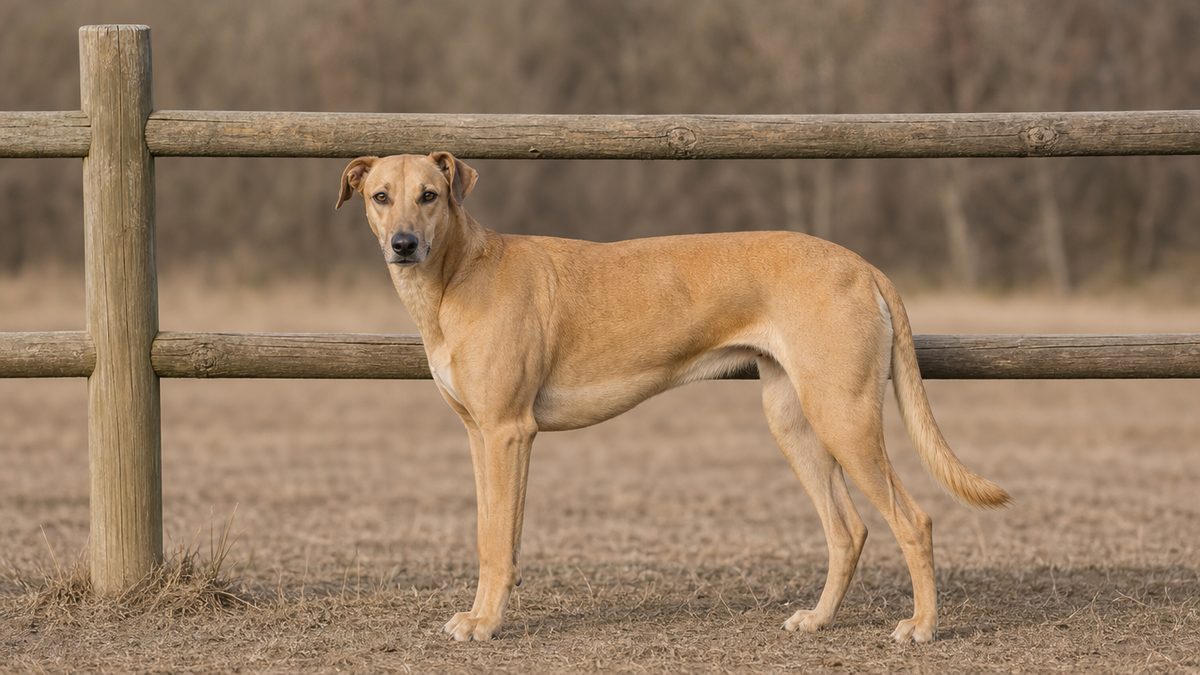
- Look at the stop, the step between the muzzle and the forehead. Pronounced means a Magyar Agár. Barely there means a Greyhound or a Chart Polski FCI-Standard N° 333.
- Look at the skull from the front. Broad and wedge-shaped with a wide forehead is this breed. Long and narrow is the Greyhound.
- Look at the ears. Rather large with thick leather is this breed; the UKC standard even says thick leather is preferred to thin. Small and fine is the Greyhound.
- Watch the ears when the dog gets excited. Fully erect is permitted in a Chart Polski and is a fault in a Magyar Agár.
- Feel the coat. Coarse means Magyar Agár. Fine and silky means Greyhound.
FCI 240 states, under Behaviour and Temperament, that the Magyar Agár is 'Excellent on the race-course; he is on some distances faster than the Greyhound';. Bonbeno checked the German text, which is the authentic language for this standard, and it says the same thing: 'Er ist auf manchen Strecken schneller als der Greyhound';. It is unusual for a breed standard to compare its dog to another breed by name, and rarer still for it to claim to beat it. The parent club puts it more precisely: the breed lacks the Greyhound's initial acceleration over a short sprint but has greater endurance over distance.
What the standard does not tell you
FCI 240 gives no weight at all, only ideal heights, and adds that the size measured in centimetres at the withers is less important than the overall balance of the dog. The UKC standard gives no weight either. So the widely quoted 22 to 31 kg comes from the North American parent club, not from a registry, and Bonbeno labels it as such wherever it appears. Animalia reprints the club figure without saying where it came from.
The standard also gives no life expectancy, which becomes a problem in the health section of this page.
The Hungarian resolution, read in full and checked line by line
Hungary's Parliament declared its listed animal breeds a national treasure by Resolution 32/2004 (IV. 19.) OGY, adopted on 19 April 2004 and in force from 4 May 2004, and the annex to that resolution names exactly nine dog breeds with the Magyar agár sixth on the list.
Bonbeno's Komondor and Kuvasz guides both rest on this instrument, so this page re-read it from the Hungarian National Legislation Database rather than inheriting the finding. The result confirms both earlier pages in full.
| # | As printed in Hungarian | In English |
|---|---|---|
| 1 | Komondor | Komondor |
| 2 | Kuvasz | Kuvasz |
| 3 | Mudi | Mudi |
| 4 | Puli | Puli |
| 5 | Pumi | Pumi |
| 6 | Magyar agár | Hungarian sighthound, this breed |
| 7 | Rövidszőrű magyar vizsla | Short-haired Hungarian Vizsla |
| 8 | Drótszőrű magyar vizsla | Wire-haired Hungarian Vizsla |
| 9 | Erdélyi kopó | Transylvanian Hound |
That is nine entries, no more and no fewer, and the Magyar agár is the sixth. Bonbeno's Kuvasz page recorded the identical list and the identical order, and this independent check finds no disagreement of any kind. An older FAO Animal Genetic Resources bulletin describes the same grouping from the outside, listing Hungary's registered native dogs as the herder's dogs Komondor, Kuvasz, Mudi, Puli and Pumi, plus the Magyar agár and the Erdélyi kopó.
The resolution calls the same list three different things
This is where the instrument gets interesting, and it matters more for this breed than for the guardians.
- The title reads *a védett őshonos vagy veszélyeztetett, magas genetikai értéket képviselő tenyésztett magyar állatfajták*, that is, protected indigenous or endangered, high-genetic-value bred Hungarian animal breeds.
- Paragraph 1, the operative declaration, reads *a védett őshonos és régi magyar állatfajtákat*, that is, protected indigenous and old Hungarian animal breeds.
- Paragraph 6 flattens both, declaring that the breeds listed in the annex are considered Hungarian indigenous animals which, in their names and in their pictorial representation, are symbols of Hungary.
So the title offers a disjunction, indigenous or endangered; paragraph 1 offers a conjunction, indigenous and old Hungarian; and paragraph 6 asserts that everything on the list is indigenous. Three labels, one list.
The resolution's own preamble draws the distinction explicitly. It says that species and breeds described as indigenous to the Carpathian Basin already had protection under the animal breeding act, but that 'the circle of old Hungarian domestic animal breeds is of a larger radius', because beyond the indigenous breeds there live in Hungary numerous breeds bred over a long period which form part of Hungarian national culture. In other words, the annex is deliberately the wider category, and paragraph 6's blanket 'indigenous' is a political flourish rather than a zoological finding.
Which label applies to this breed
The wider one, and the standard says why. FCI 240's historical summary states that the breed's origin goes back to the times when the Magyars conquered the country, evidenced by archaeological findings of skull bones, and then adds the sentence that decides the question: 'To increase the dog's speed the breed was crossed with different sighthound breeds in the 19th century';.
A population deliberately outcrossed to foreign sighthounds within the last two centuries sits comfortably in paragraph 1's 'old Hungarian' category and awkwardly in paragraph 6's 'indigenous' one. Bonbeno therefore describes the Magyar Agár as an old Hungarian breed of high genetic value under Resolution 32/2004, which is what the operative paragraph and the preamble together support, rather than as an unbroken indigenous line, which is what the marketing prefers.
That is not a criticism of the breed. The 19th-century outcrossing is in its own standard, printed by the FCI, and it explains the modern dog's speed. It is a criticism of pages that quote 'national treasure' as though it certified an unmixed thousand-year pedigree.
What the status does not do
It does not restrict export. Bonbeno read the complete text of Resolution 32/2004 including the annex, and it contains no provision at all about export, permits, prohibitions, restrictions or moving an animal across a border. What it does contain is paragraph 2, committing the state to assist the breeding and maintenance of listed breeds; paragraph 3, calling on civil and business organisations and private individuals to join in; and paragraph 5, requiring the Government to review the list at least every five years.
So this is a maintained register with a state commitment behind it, not an export control. Nobody should be told a Magyar Agár is unavailable in India because Hungary forbids it leaving. It is unavailable because nobody here breeds or imports one.
Magyar Agar price in India
There is no Magyar Agar price in India, because no Indian seller lists the breed. The nearest thing to an Indian offer is a filter dropdown, and the dropdown is not stock.
This page can be unusually precise about the absence, because the evidence is compositional rather than a bare count of search results.
What Bonbeno checked, breed by breed and site by site
- DogsIndia has no page for this breed. India's oldest breeder directory serves breed pages at dogsindia.com/<breed>.htm. Its Komondor page returns HTTP 200 with a real breed description and the line 'There are no breeders listed currently under this breed';. The equivalent Magyar Agár URL returns HTTP 404, so the site does not carry the breed at all.
- Pupps&Stud lists the breed in a dropdown and stocks none. This Indian platform advertises 'KCI Registered & Purebred' puppies and its breed filter carries HUNGARIAN GREYHOUND, alongside POLISH GREYHOUND, SPANISH GREYHOUND, MAREMMA SHEEPDOG and roughly four hundred other names. Its live Bangalore inventory on 2 September 2026 was twelve dogs across five breeds: three German Shepherds, four Cane Corsos, two English Cocker Spaniels, one Doberman Pinscher and two German Shepherd working line. Not one sighthound of any kind.
- No Indian seller appeared on page one. The organic results are YouTube, the UKC breed standard, Wikipedia, an American cost aggregator, Royal Canin India, a Reddit thread, the North American parent club, a Hungarian broker, Animalia and a stock-photo library.
- PetzLover India could not be reached. Its Magyar Agar URL returned HTTP 403 behind a CAPTCHA wall on every route tried, so Bonbeno draws no conclusion from it in either direction.
- The control passed, and it was re-run for this breed. A query for 'labrador retriever price in india' in the same session returned a dense Indian commercial set including Doggywala, Premium Pet House and Wrapinfur. The instrument was working.
The Pupps&Stud filter is the clearest example this site has found of the auto-generated shell. A list of roughly four hundred breed names, including Banjara Greyhound, Mahratta Greyhound, Maharashtrian Greyhound Tazi, Rampur Hound, Karst Shepherd, Kombai and Hälleforshund, sits above an inventory of twelve animals. An Indian buyer who selects HUNGARIAN GREYHOUND from that list and then makes an enquiry is not shopping. They are generating a lead for whatever the platform does have.
The only real prices are in dollars and euros
EuroPuppy, a Hungary-based international broker, was offering four Hungarian Greyhound puppies at the time of checking, with no Indian delivery route stated. The UKC links a breeder search and notes explicitly that the breeders on its list are not endorsed by the UKC. Neither publishes an Indian figure, and Bonbeno will not convert a foreign price into rupees and present the result as an Indian price.
That refusal is not caution for its own sake. Indian breed pages routinely publish a dollar figure divided by an exchange rate and presented as a rupee price, and this site has caught the same arithmetic on breed after breed. There is no rupee figure to test here, which is a cleaner outcome than a testable but fabricated one.
There is no lawful import route either
DGFT Trade Notice 22/2022-23 places live dogs under ITC(HS) 01061900 in the Restricted category. Entry is permitted only for a pet accompanied by a valid pet book in the importer's name, for research with a CPCSEA recommendation, or for Defence and Police use, and the notice states that applications for trading or breeding purposes shall be duly rejected.
So a person moving to India with their own Magyar Agár can bring the dog. Nobody can import one to breed or resell. Between an empty domestic market and a closed commercial route, no supply chain for this breed can lawfully form in India, and any Indian offer of a Magyar Agár puppy should be treated as a claim about a different dog until measured.
What you would be measuring for
Use the height test from the overview. A male at 65 to 70 cm with a pronounced stop, a broad wedge-shaped skull and rather large thick-leathered rose ears is consistent with the standard. A 74 cm dog with a flat narrow skull and small fine ears is a Greyhound, which India does have and which is a perfectly good dog. A 78 cm dog with variable-length springy coat and breeches is a Chart Polski. None of these is a fraud detector on its own, but a seller who cannot say which of the three they are holding is telling you something.
Cost of ownership in India for a 22 to 31 kg sighthound
Budget Rs 4,500 to Rs 9,000 a month for a dog this size in an Indian metro, built entirely from published Indian figures, because no breed-specific Indian cost table for this breed exists at all.
This is one of the rare breeds where Bonbeno cannot even find a template cost table to criticise. Happy Pet, which supplies the position-one Indian running-cost figures for most breeds, has no Magyar Agár page. Neither does any other Indian breed site Bonbeno reached. So the cost of ownership section is built from the ground up.
The Indian figures that actually apply
VOSD, an Indian sanctuary keeping over 1,800 dogs, publishes cost ranges for any dog in India rather than for a breed it has never seen. Those transfer honestly.
| Item | Published Indian range | What to budget for this breed |
|---|---|---|
| Quality food, medium dog | Rs 1,500 - Rs 4,000 / month | Rs 3,000 - Rs 4,000, this is a lean but athletic dog |
| Vet consultation | Rs 500 - Rs 1,000 per visit | Four to six routine visits a year |
| Annual vaccinations | Rs 1,500 - Rs 3,000 | Non-negotiable |
| Preventive care, done properly | Rs 5,000 - Rs 8,000 / year | Deworming, tick control, annual bloods |
| Grooming, basic wash | from Rs 300 per session | The cheapest grooming line of any breed on this site |
| Basic training course | Rs 5,000 - Rs 15,000 | Worth it for recall alone |
| Professional dog walker | Rs 3,000 - Rs 6,000 / month | Only if you cannot do the dawn run yourself |
| Boarding | Rs 500 - Rs 2,000 per day | A 10-day trip costs more than a month of food |
| Hospitalisation, 1 to 3 days | Rs 8,000 - Rs 30,000 | Where a chase injury or heat stroke lands |
| Orthopaedic intervention | Rs 30,000 - Rs 80,000 | A running dog breaks things |
VOSD puts the all-in monthly cost of a dog in India at Rs 3,000 to Rs 10,000 and beyond, the yearly cost at Rs 25,000 to Rs 80,000, and the lifetime cost at Rs 3 lakh to Rs 10 lakh or more. It also records that a dog costing Rs 4,000 a month in Pune can cost Rs 7,000 a month in South Delhi, so the city matters as much as the breed.
Grooming. The FCI standard describes a coat that is short, dense, coarse and smooth, with a dense undercoat developing only in winter. A weekly brush at home covers it. Against a long-coated breed needing a Rs 2,000 professional session every month through the monsoon, that is a saving of Rs 12,000 to Rs 24,000 a year, and it is real rather than a template constant.
Two costs this breed adds that most do not
Secure running space. A sighthound that never gallops is a sighthound with a behaviour problem, and Indian cities have very few securely fenced open spaces. Budget either a membership at a fenced facility, if your city has one, or the fuel and time to reach one several times a week. This is the largest hidden cost of the breed in India and no page prices it.
Sighthound-aware veterinary care. Sighthounds differ from other dogs in anaesthetic handling, in normal haematology and in thyroid readings, and a clinic that does not know that will either over-treat a healthy dog or under-prepare for a procedure. Finding and staying with a vet who knows this is worth more than any saving on food. The one peer-reviewed paper naming this breed exists precisely because generic reference values do not fit it.
Bonbeno's working budget
Rs 4,500 to Rs 9,000 a month in an Indian metro, plus a veterinary reserve fund. That is lower than the Rs 6,000 to Rs 12,000 this site budgets for a 40 to 52 kg long-coated guardian, and the difference is almost entirely food volume and grooming. Add the first-year loading VOSD identifies: a starter kit at Rs 2,000 to Rs 5,000, first vaccinations, deworming and health check at another Rs 2,000 to Rs 5,000, and a first month that runs Rs 15,000 to Rs 25,000 before anything unexpected happens.
Indian climate suitability, and why this breed scores higher than a guardian
Bonbeno rates the Magyar Agár 3 of 5 for heat tolerance, a point above the Kuvasz and two above the Komondor, because a short coarse coat on a lean sighthound sheds heat well and the Hungarian plain itself reaches 41 C in July.
The homeland is the Great Hungarian Plain, a flat continental grassland, and NASA POWER handles flat terrain accurately. Bonbeno queried Debrecen, the Hortobágy, Budapest and Kaposvár by explicit latitude and longitude and echoed each returned grid-cell elevation.
| Point queried | Cell elevation | Real elevation | Error |
|---|---|---|---|
| Debrecen, Hajdú-Bihar | 121.33 m | ~121 m | +0 m |
| Hortobágy puszta | 96.82 m | ~90 m | +7 m |
| Kaposvár, Somogy | 157.17 m | ~153 m | +4 m |
| Budapest | 178.05 m | ~102 m | +76 m |
| Chennai | 48.95 m | ~10 m | +39 m |
| Delhi | 206.37 m | ~216 m | -10 m |
| Jaipur | 405.74 m | ~431 m | -25 m |
| Hyderabad | 494.59 m | ~542 m | -47 m |
Every Hungarian cell landed within 76 m of the real ground, and Debrecen landed within a metre. Bonbeno's Maremmano-Abruzzese Sheepdog page, built the same day, had to discard a Gran Sasso query that came back 1,128 m below the pasture it was supposed to describe. The difference is terrain, not the tool: POWER fails in mountains and is accurate on plains. Both halves of that finding belong on the page.
| Place | Annual mean | Hottest month | Coldest month | Hottest month max | Annual RH |
|---|---|---|---|---|---|
| Debrecen (HU) | 11.38 C | 23.43 C (Jul) | -1.59 C (Jan) | 40.27 C | 73.35% |
| Hortobágy (HU) | 11.38 C | 23.54 C (Jul) | -1.67 C (Jan) | 41.22 C | 73.38% |
| Budapest (HU) | 10.75 C | 22.81 C (Jul) | -1.60 C (Jan) | 40.02 C | 74.69% |
| Chennai | 27.94 C | 31.51 C (May) | 24.09 C (Jan) | 42.70 C | 72.39% |
| Mumbai | 26.77 C | 31.19 C (May) | 23.19 C (Jan) | 44.91 C | 67.28% |
| Delhi | 25.57 C | 35.88 C (Jun) | 13.61 C (Jan) | 48.79 C | 45.51% |
| Jaipur | 25.55 C | 34.57 C (Jun) | 14.51 C (Jan) | 46.92 C | 40.86% |
| Hyderabad | 26.09 C | 33.30 C (May) | 20.76 C (Dec) | 45.00 C | 60.22% |
| Pune | 23.86 C | 28.93 C (Apr) | 19.62 C (Dec) | 43.20 C | 66.68% |
| Bengaluru | 23.74 C | 28.37 C (Apr) | 20.22 C (Dec) | 40.38 C | 67.84% |
The comparison that decides the rating
Chennai's coolest month, at 24.09 C, is warmer than Debrecen's hottest month at 23.43 C. That sentence looks damning and, taken alone, would put this breed where the guardians sit. But it is only half the picture, and the other half is the row nobody looks at.
The Hungarian plain records a July maximum of 41.22 C over the Hortobágy and 40.27 C at Debrecen. This is a continental climate with genuine summer heat, not a mild maritime one. A breed that was expected to run down hares across that plain in July has met 40 C before. What it has never met is a January that does not go below zero, and what it has never met is warm air that stays saturated.
Which Indian cities actually suit this dog
The relevant Indian variable for a short-coated running dog is not peak temperature. It is humidity during the warm season, because evaporative cooling is what a galloping dog depends on.
- Delhi and Jaipur are the closest analogues. Annual mean relative humidity of 45.51 and 40.86 percent, against the Hungarian plain's 73.35 percent, means the air is drier than the homeland, and the winters actually drop: Delhi averages 13.61 C in January and Jaipur 14.51 C. The problem there is the peak, with June maxima of 48.79 C and 46.92 C, which is simply beyond safe exercise at any hour.
- Bengaluru and Pune are the most liveable overall. Annual means of 23.74 and 23.86 C, hottest months under 29 C, and elevation that flattens the peaks. Pune's August humidity of 91 percent is the catch, and it lasts three months.
- Mumbai and Chennai are the worst fit. Chennai never drops below a 24.09 C monthly mean, and Mumbai combines 26.6 C with 90 percent relative humidity through July and August. A dog that cannot cool by evaporation cannot run, and a sighthound that cannot run is being kept badly.
- Hyderabad sits between them, with a 60.22 percent annual humidity and a 33.30 C May.
The Magyar Agár tolerates dry heat much better than any double-coated breed on this site and tolerates humid heat no better than they do. If your city's warm months are dry, this dog can work around them with dawn exercise. If your city's warm months are wet, the coat advantage disappears and the dog is simply a large animal that cannot cool itself.
The breed's own parent club puts the same point from the cold side, calling these very hardy dogs that tolerate lower temperatures better than some other short-coated sighthounds. Hardy against cold is not the same claim as hardy against wet heat, and no kennel club anywhere makes the second one for this breed. The Kennel Club of India issues pedigrees against FCI nomenclature and publishes no climate guidance at all, so an Indian buyer gets no help from that direction either.
Temperament, prey drive and household fit
The Magyar Agár is reserved with strangers, affectionate at home and quiet indoors, and its prey drive is the single trait that decides whether an Indian household can keep one safely.
The FCI standard describes the dog as untiring, full of stamina, fast, tough and robust, somewhat reserved by nature but not shy, sensible, intelligent and faithful, watchful, with a developed instinct to protect people and their houses and property, yet not aggressive or vicious. The German text carries the same description. The UKC repeats it almost word for word.
Note the unusual bit for a sighthound: a watchdog instinct. Animalia puts it directly, saying the breed has a much stronger guarding instinct than some other sighthound breeds, and the parent club calls them excellent watch dogs. This is not a Greyhound that lets everyone in.
Prey drive is the whole problem in an Indian street
The breed's stated purpose is to hunt game by sight. Animalia is candid about what that means at home: the breed can live peacefully with cats and small animals inside the house, but will tend to want to chase down anything that resembles prey.
Now put that dog on an Indian residential road. Free-ranging dogs, cats, chickens, goats, monkeys and cattle are all present, all moving, and none of them is behind a fence. A sight-chase reflex fires before a recall cue arrives, and a 30 kg dog at full speed does not stop for traffic.
Never off-lead outside a securely fenced area, no matter how good the recall is on a quiet morning. And muzzle-train the dog early, calmly and positively, so that a muzzle is a normal object rather than a punishment. A muzzle is not an admission that the dog is dangerous; it is what lets a high-prey-drive sighthound walk safely in a country with 62 million street dogs.
What it is like to live with
- Quiet indoors. The parent club describes a dog happy to spend a large portion of the day lounging around the house, while insisting it is by no means a couch potato.
- Good with children and other dogs, per both the club and Animalia, given proper socialisation.
- Reserved with strangers rather than friendly, which the standard states as breed type, not as a fault.
- Needs early and continued socialisation. The parent club is blunt that the breed requires a lot of it 'in order to be well-rounded, mentally balanced and happy', and says plainly that it is NOT the breed for everyone.
- Clean and low-odour, a function of the short coarse coat.
Where Bonbeno agrees with the aggregators, for once
Animalia says Magyar Agárs are very adaptable and can live comfortably in apartments as well as outdoor kennels, as long as they get adequate exercise and human interaction. Bonbeno accepts that, which is worth saying explicitly because the same site's claim that a Maremmano-Abruzzese Sheepdog can tolerate a city apartment is one this site disputes.
The difference is real and it is structural. A livestock guardian in a flat is a territorial animal with a job it cannot do. A sighthound in a flat is a sleeping dog waiting for its run. The flat is not the problem for this breed; the absence of a safe place to gallop is.
Who should not take on this breed in India
- Anyone without access to securely fenced open ground. This is the disqualifying condition, and most Indian cities fail it.
- Households with free-roaming small pets, including rabbits, poultry and outdoor cats. Indoor cohabitation with supervision is possible; an unsupervised chicken run is not.
- Anyone who wants a dog that greets guests warmly. Reserved is the breed standard, not a training gap.
- Anyone in Mumbai, Chennai or coastal Kerala who cannot exercise at dawn, because the humid months remove the dog's cooling margin exactly when it most needs to run.
- Anyone intending to course live game, which is an offence under Indian law and is covered in the training section of this page.
One instruction survives every disagreement between the sources. Socialise the dog early and keep socialising it, because the parent club, Animalia and the FCI standard all describe a reserved, watchful animal whose defaults harden without deliberate exposure FCI-Standard N° 240. In an Indian apartment block that means the building staff, the delivery riders and the neighbours' children, repeatedly and calmly, before the dog is six months old.
Training, and the Indian law that meets this breed's job description
Train recall, muzzle tolerance and a settle, accept that the sight-chase reflex will never be trained out, and know that the activity the FCI standard names as this breed's purpose is unlawful in India when the quarry is alive.
Start with what the standard asks the dog to be. FCI 240 gives the utilization as a hunting and coursing dog which hunts the game by sight, especially skilled in coursings and race tracks. Everything a trainer does is either working with that or working against it.
Four things to train, in order
- Recall, obsessively, from eight weeks. It will still fail against a moving cat, which is why it is trained alongside the next item rather than instead of it.
- Muzzle tolerance as a positive routine. Introduce the muzzle with food, in short sessions, long before you need it. In an Indian street this is the difference between a manageable dog and an incident.
- A settle on a mat. A sighthound sleeps most of the day and will happily learn a place to do it, which solves most indoor problems at once.
- Handling and restraint for the vet. Sighthounds need specific anaesthetic care and a dog that fights restraint makes that harder.
What not to bother with: ball chasing. The parent club notes the breed is not usually keen on it and recommends long walks, free running and trotting next to a bicycle instead. Trying to build a retrieve game on a coursing hound is a slow way to be disappointed.
Coursing in India, stated precisely
The FCI standard names coursing as the breed's purpose, and an Indian owner will reasonably ask whether they can do it here. The answer separates two different activities.
Clause (m) opens 'solely with a view to providing entertainment' and then covers a person who '(i) confines or causes to be confined any animal (including tying of an animal as a bait in a tiger or other sanctuary) so as to make it an object of prey for any other animal; or (ii) incites any animal to fight or bait any other animal'. Clause (n) covers anyone who 'organises, keeps, uses or acts in the management of, any place for animal fighting or for the purpose of baiting any animal'.
Live coursing for entertainment falls squarely inside that. Setting a sighthound on a hare in front of spectators is inciting an animal to bait another animal, and running a venue for it engages clause (n). Bonbeno states this as a legal reading of the clause, not as a court holding on coursing specifically.
Lure coursing is a different activity. A mechanical lure is not an animal, so no second animal is incited or baited and neither clause is engaged. The same applies to straight track racing behind an artificial lure. If you want to give this breed its job in India, that is the lawful form of it.
Two details worth knowing about the penalty, because pages that say only 'it is illegal' leave a false impression of deterrence. A first offence under section 11(1) carries a fine of not less than ten rupees and up to fifty rupees, and a second or subsequent offence within three years carries not less than twenty-five and up to one hundred rupees, or imprisonment up to three months, or both. The prohibition is real; the penalty is trivial.
What to require of a breeder, under Indian law
If a Magyar Agár ever is bred in India, the Dog Breeding and Marketing Rules 2017 give a buyer things to demand. Rule 8(1)(a), in the main body of the Rules which run 1 to 13, requires that pups less than eight weeks in age are not sold.
Second Schedule Part III paragraph 8(10) requires that breeding dogs have been tested for genetic defects, and names eleven: hip dysplasia, progressive retinal atrophy, night blindness, hypothyroidism, entropion, ectropion, overshot, undershot jaw when incisors do not touch or mesh, wry mouth, two or more missing teeth, and unilateral or full cryptorchid males.
Five of those eleven land on this breed by name. The parent club reports progressive retinal atrophy and thyroid disease in some lines. Entropion and ectropion are disqualifying faults in the FCI standard and disqualifications in the UKC one United Kennel Club. And both standards disqualify an undershot, overshot or wry bite, with the FCI adding missing incisors, canines, premolars 2 to 4 or molars 1 to 2 United Kennel Club.
The word 'including' in paragraph 8(10) makes the list illustrative rather than closed, so epilepsy being absent from it does not put epilepsy outside the clause. And there is no Indian patella requirement to ask about: the words patella and luxation appear zero times in the gazette.
Daily exercise: an hour of walking plus somewhere safe to gallop
Give this breed at least an hour of walking a day, preferably more, plus a genuine sprint in a securely fenced space several times a week, and schedule all of it at dawn for most of the Indian year.
The parent club sets the floor and is unusually direct about it: the Magyar Agár requires at least an hour-long walk every day, preferably more, and benefits from additional running either next to a bicycle or out on a hike. It adds that if you want a dog content with a quick twenty-minute walk around the block, this is not the breed for you.
Animalia rates the breed's activity level as very active while noting that it spends a good portion of the day sleeping. Both things are true, and that combination is what a sighthound is.
Walking is not the same as running, and this breed needs both
An hour of lead walking maintains condition. It does not satisfy a coursing hound, because the muscle and cardiovascular architecture the FCI standard describes, a brisket deep and distinctly rounded for adequate room for the heart and the big lungs, exists for one purpose. A dog built around that and never allowed to use it is under-exercised at a level a walk cannot reach.
The historical picture makes the scale clear. Animalia records the Hungarian tradition that the breed was expected to run alongside hunters on horseback for 30 to 50 kilometres a day, and that the smaller peasant-owned Farm Agárs, or Hare Catchers, are now extinct. That figure comes to Animalia from Wikipedia rather than from a primary source, so Bonbeno reports it as tradition rather than as a measurement. The direction of it is not in doubt.
A sprint for a 30 kg short-coated dog cannot happen between about 9am and 5pm for most of the Indian year. Chennai's hottest month averages 31.51 C with maxima to 42.70 C, Delhi's June maximum reads 48.79 C and Jaipur's 46.92 C in the same dataset. Dawn is the only reliable window in the plains, and in the monsoon cities it is the only window at all, because Mumbai in July combines 26.6 C with 90 percent relative humidity and Pune in August 23.3 C with 91 percent.
Where to run a sighthound in India
- A securely fenced private plot is the ideal, and it is why this breed suits a house with land rather than a flat.
- A fenced sports ground out of hours, arranged with the club or school that owns it, is the most realistic urban option.
- Lure coursing behind a mechanical lure, where a club exists, gives the dog its actual job lawfully.
- A long-line of 15 to 20 metres in open ground is the compromise when nothing fenced is available. It is not a gallop, but it is better than a lead.
- Never an unfenced park. One cat, one bicycle, one road.
What under-exercise looks like in this breed
Not destruction, usually, and not barking. A chronically under-run sighthound tends toward weight gain, stiffness, and a sharpened, more frantic response to any moving thing it does see, which makes walks harder rather than easier. The parent club ties long-term health directly to maintenance of a lean body weight from the beginning, and a dog that never runs is a dog that will not stay lean on any diet.
One structural point on joints. The breed has no published hip dysplasia figure anywhere, and its nearest relatives have the best hips in OFA's table, with the Greyhound at 2.2 percent dysplastic of 408 evaluations and the Italian Greyhound at 0.6 percent of 503. Sighthounds are the group least likely to be limited by hips, which means the exercise limit for this breed is heat and prey drive rather than orthopaedic risk. That is the opposite of the calculation for a heavy guardian breed.
Grooming: the lightest load of any breed on this site
Brush this coat once a week, check the ears and teeth on the same schedule, and spend the money you save on sun protection and a decent coat for a Delhi January.
The FCI standard describes the coat in nine words: hair short, dense, coarse, smooth, with a considerable amount of dense undercoat developing in winter time. The UKC says the same and ties the undercoat to cold climates rather than to the season. Animalia rates the breed easy to groom and recommends a weekly brush, which is right.
The weekly routine, and it really is weekly
- Brush once a week with a rubber curry or a hound glove. You are removing dead hair, not detangling; a coarse smooth coat does not mat.
- Check the ears every week and after any swim. The ears fold back against the neck as rose ears, which is better ventilated than a pendant ear but still traps moisture in an Indian monsoon.
- Brush the teeth. Both standards disqualify missing teeth and Indian law's paragraph 8(10) names two or more missing teeth as a genetic defect, so dentition matters more in this breed than in most Prevention of Cruelty to Animals.
- Trim nails monthly. The standard asks for strong nails kept short, and a running dog with long nails changes its gait.
- Bathe rarely. There is no coat here to hold odour.
VOSD puts a basic Indian grooming wash at around Rs 300 and a full session for a large long-haired breed at up to Rs 2,000. This breed needs neither on a schedule. Against a long-coated breed on monthly monsoon grooming, the saving is roughly Rs 12,000 to Rs 24,000 a year, and unlike a template cost table this one follows from a coat description in a registry standard.
The two things a short coat does not protect against
Sun. A thin coat over a lean, low-fat dog with little subcutaneous padding means Indian sun reaches skin easily, particularly on the belly, the inner thighs, the ear tips and the bridge of the nose. Pale and white-marked dogs are most exposed. The FCI standard permits all colours known in sighthounds except the eliminating list, so a very pale Magyar Agár is entirely correct and entirely sunburn-prone. Keep midday walks off tar, and use a vet-recommended sunscreen on exposed pink skin if your dog has any.
Cold. This surprises people. A short-coated sighthound with almost no body fat loses heat fast, and the undercoat the standard describes may never develop in an Indian plain because the trigger is a Hungarian winter, not an Indian one. Debrecen averages -1.59 C in January and this breed evolved to grow a coat for it. A dog raised in Chennai and then moved to Delhi, where January averages 13.61 C with cold nights, is a short-coated dog without the winter coat it would have grown at home. Buy it a fitted dog coat and use it.
Skin, ticks and the Indian season
A short coat makes tick checks easy and it makes tick exposure obvious rather than hidden, which is an advantage over any long-coated breed. Run a hand over the whole dog after every walk in grass, and pay attention to the ear folds, the armpits and between the toes. VOSD folds tick and flea prevention into its Rs 5,000 to Rs 8,000 a year preventive-care line, and on this breed that is money well spent rather than an optional extra.
Bonbeno publishes no Indian otitis percentage on this page. The Indian veterinary series this site cites elsewhere could not be re-opened for this build, because the journal host returned HTTP 403 to every route tried, and a figure quoted from a search snippet is not a figure. What can be said structurally is that a rose ear that folds back and lifts when the dog is alert ventilates better than a hanging ear, so ear disease should be a smaller problem in this breed than in a drop-eared one.
One caveat about that undercoat. The FCI standard says a considerable amount of dense undercoat may develop in winter time; the UKC standard ties it instead to cold climates United Kennel Club. In an Indian plain a Magyar Agár may never grow that undercoat at all, which is convenient for grooming and means the dog will feel a cold-season night in Delhi or Jaipur more than a Hungarian dog would.
Health, and the sighthound reference-range problem
No registry publishes a single health statistic for this breed, the parent club names three conditions from its own experience, and the one peer-reviewed paper that exists is about why normal dog reference values do not fit it.
Start with what is not there, because an honest absence is more useful than a borrowed number.
OFA holds nothing, and the control proves it
Bonbeno retrieved OFA's full disease-statistics tables, confirmed HTTP 200 and the page title 'Disease Statistics by Breed | OFA', and searched all 1.82 million characters of the result.
| Search string | Occurrences | Reading |
|---|---|---|
| MAGYAR | 0 | No row under the native name |
| AGAR | 0 | No row under the short native name |
| HUNGARIAN | 0 | No row under the FCI English name |
| CHART / POLSKI | 0 / 0 | The Chart Polski is absent too |
| GREYHOUND | 93 | Control passes |
| VIZSLA | 83 | Control passes, and a fellow annex breed |
| MUDI | 34 | Control passes, annex breed |
| PULI | 33 | Control passes, annex breed |
| KOMONDOR | 21 | Control passes, annex breed |
| PUMI | 19 | Control passes, annex breed |
That is as clean an absence as this site records. Five of the nine breeds on the same Hungarian annex return dozens of OFA rows each, and this one returns nothing under any spelling. Write it as 'no row in OFA's published statistics tables', not as 'absent from the OFA database': OFA requires 100 hip evaluations, or 50 for its other registries, before publishing a breed at all, and North American numbers for this breed are plainly below that.
What the parent club reports from its own dogs
The North American Magyar Agar Association describes the breed as generally very robust and healthy with a typical lifespan of 12 to 14 years, and then says the useful part: there have been reports of epilepsy, thyroid disease and progressive retinal atrophy in a few individuals and breeding lines. It strongly advocates health testing of all breeding stock, and notes that health testing has only recently gained a following in some European countries.
Animalia names the same three conditions, which is worth flagging because the same aggregator tells Indian readers that the Maremmano-Abruzzese Sheepdog has 'very strong health and no genetic diseases';. The difference is not research. It is what each breed's Wikipedia article happened to say.
Second Schedule Part III paragraph 8(10) of the Dog Breeding and Marketing Rules 2017 names eleven genetic defects a breeding dog must have been tested for, and five of them land on this breed: progressive retinal atrophy and hypothyroidism, both reported by the parent club; entropion and ectropion, both disqualifying faults in the FCI and UKC standards; and the overshot, undershot or wry bite that both standards also disqualify FCI-Standard N° 240 United Kennel Club. Whatever else is uncertain about this breed, the screening list is not.
The hypothyroidism trap, which is specific to sighthounds
This is the most important paragraph on the page for an Indian owner, and it is a collision between Indian law and sighthound physiology.
Paragraph 8(10) requires a hypothyroidism test. Sighthounds as a group normally run lower total T4 than other dogs. A laboratory using a generic canine reference range will therefore report a perfectly healthy Magyar Agár as hypothyroid, and an owner or breeder acting on that reading will start lifelong thyroid supplementation the dog does not need. The parent club independently reports genuine thyroid disease in some lines, so the answer is not to dismiss thyroid results either.
The practical instruction is short. Tell your veterinarian the dog is a sighthound before any thyroid panel, ask whether the laboratory holds sighthound-adjusted ranges, and ask for a full panel rather than a single total T4 before any diagnosis is made. The same warning applies to haematology, where sighthounds normally run higher red cell counts, and to anaesthesia. Ask specifically for a full thyroid function panel rather than a single total T4 reading, because thyroid function in a sighthound cannot be judged from one number against a general-population range.
The one paper in the literature, and what it is for
The whole literature is one paper, and the obvious search for it is a trap
PubMed holds exactly one record naming this breed, and the natural way to search for it silently returns papers about laboratory culture medium instead.
Bonbeno ran the absence properly, because a zero on one name is not a zero. A control query, greyhound in title or abstract combined with dog, returned 285 records in the same session, so the instrument was working.
Bonbeno searched PubMed under every name this breed carries. The result is a single record: Vörös, Hetyey, Reiczigel and Czirok, 'M-mode and two-dimensional echocardiographic reference values for three Hungarian dog breeds: Hungarian Vizsla, Mudi and Hungarian Greyhound', *Acta Veterinaria Hungarica* 2009, which examined 95 clinically healthy dogs including 22 Hungarian Greyhounds and established normal echocardiographic values for each breed.
Notice what that paper exists to do. It measures interventricular septal thickness, left ventricular internal diameter, left ventricular posterior wall thickness, left atrial and aortic diameters and fractional shortening, breed by breed, because breed-specific normal values differ. A sighthound's heart is larger relative to body size than a generic reference range assumes, and the FCI standard says so in its own way when it asks for a brisket deep and distinctly rounded to provide adequate room for the heart and the big lungs.
Bonbeno does not reproduce the paper's numeric tables here, because the abstract does not carry them and this site does not publish figures it has not read. What it publishes is the fact that they exist. If an Indian cardiologist tells you a Magyar Agár's heart looks enlarged, ask which reference values were used.
| Query | Records | What they actually are |
|---|---|---|
| 'Hungarian greyhound' in title or abstract | 1 | The Vörös 2009 echocardiography paper. This is the literature. |
| 'magyar agar' in title or abstract | 6 | All about laboratory agar. See below |
| magyar in title or abstract AND dog | 8 | German and Swiss tumour registries, Hungarian surnames |
| greyhound AND dog, the control | 285 | Control passes |
Searching PubMed for the phrase 'magyar agar' does not search for this breed. PubMed rewrites it into magyar in all fields AND agar in title or abstract, and returns six papers on beta-galactosidase production in Mucoromycota, thermoplastic starch, Francisella tularensis susceptibility and the compact growth of Staphylococcus haemolyticus in soft agar. The Hungarian word agár, meaning sighthound, collides with agar, the culture medium, and the accent that separates them is stripped by every search box. Anyone who runs that one query and reports six papers has reported the wrong six.
Two lessons follow for anyone checking this page. Search Hungarian greyhound rather than magyar agar, because the FCI English name is what the literature indexes. And read the query-translation line PubMed prints rather than the result count, because six records for an obscure breed looks like evidence and is not.
The wider point is that this breed has essentially no published health data. There is no life table, no registry statistic, no prevalence study and no breed-specific mortality figure. Every lifespan number in circulation, including Royal Canin India's 12 to 14 years, traces back to the parent club rather than to a study. Bonbeno reports the club figure as a club figure and publishes no median of its own.
For contrast, the breed this one gets mistaken for has a large modern literature. A 2026 genomic study of the racing Greyhound of Great Britain genotyped 54 greyhounds against 14 other breeds at 473,000 SNPs and reported an inbreeding coefficient of FROH = 0.47, higher than most other breeds, with the authors raising concerns about health impacts and proposing a framework for managing inbreeding. Nothing comparable exists for the Magyar Agár. A buyer should read the quiet in this literature as absence of study rather than as evidence of health.
Feeding a lean running dog in India
Feed for a lean body condition rather than to a weight target, split the ration into two meals, and ignore the one ranking page that tells you to buy food formulated for small breeds.
The governing instruction comes from the breed's own club and it is about body condition, not grams: being a large breed, proper nutrition, exercise and maintenance of a lean body weight from the beginning are crucial to long-term health. On a sighthound that is not a slogan. The breed is supposed to show muscle over a light frame, and a Magyar Agár carrying an extra three kilograms is carrying it on joints and a heart built for the lighter version.
A page-one error worth naming
Animalia's diet panel for this breed says Magyar Agárs 'require a well-balanced diet formulated for small but active dog breeds'. The same page gives the dog a weight of 22 to 31 kg and a withers height of 65 to 70 cm on the panel directly above it. A 31 kg dog is not a small breed, and small-breed formulations run at a higher energy density with a smaller kibble than a large athletic dog needs. This is a template slot filled wrongly, and an Indian owner following it will overfeed by calorie density while underfeeding by volume.
What to actually do
- Choose a large-breed adult formulation and adjust the quantity to body condition, checking ribs weekly. You should feel ribs easily under a thin layer and see a clear waist from above.
- Split the daily ration into two meals, morning and evening, and leave at least an hour either side of any running. A deep-chested dog carries gastric dilatation risk and the FCI standard describes exactly that chest.
- Feed the puppy on a controlled growth curve through the first year, on a large-breed puppy food rather than a general one.
- Weigh monthly and log it. Weight is a heat variable as well as a health one, and Hall 2020 reports rising heat-illness odds with bodyweight at or above the breed and sex mean.
- Keep water available always, and carry it on any walk between March and October.
What it costs in India
VOSD puts quality Indian dog food for a medium dog at Rs 1,500 to Rs 4,000 a month, rising above Rs 5,000 for large working breeds. A 22 to 31 kg athletic sighthound sits in the upper half of the medium band rather than in the working-breed band, so Rs 3,000 to Rs 4,000 a month is the realistic line. That is genuinely lower than for a 40 to 52 kg guardian, and it is one of the two places this breed is cheaper to keep in India.
VOSD names homemade food prepared under veterinary guidance as a legitimate way to reduce Indian costs, while noting that the ingredient and time cost is still real. For a growing large-breed puppy, get the calcium-to-phosphorus ratio checked rather than estimated. For an adult sighthound, protein quality matters more than protein quantity, and a lean dog on a modest ration is the target rather than a full-looking bowl.
One nutrition point that follows from the health section. If a thyroid result comes back low and supplementation is proposed, ask about sighthound reference ranges before changing anything, including the diet. Feeding a healthy dog as though it were hypothyroid, or supplementing it, is a longer-lasting mistake than a month of the wrong kibble.
The first year, month by month
Plan the first year around three fixed points: the eight-week legal floor for sale, a socialisation programme the parent club calls essential, and muzzle and recall work started before the prey drive matures.
Indian law sets the earliest date. Rule 8(1)(a) of the Dog Breeding and Marketing Rules 2017 requires that pups less than eight weeks in age are not sold, and that is a Rule in the main body, which runs 1 to 13, rather than a Second Schedule paragraph.
| Age | What matters most | What to actually do |
|---|---|---|
| 0 - 8 weeks | With the breeder, by law | Ask for the parents' thyroid and eye results before committing |
| 8 - 12 weeks | Socialisation window | Deliberate calm meetings with strangers, traffic, street dogs, children; begin vaccinations |
| 3 - 4 months | Recall foundation | Build recall while the chase reflex is still weak; start muzzle games with food |
| 4 - 6 months | Handling tolerance | Teach restraint, ear and mouth checks, and standing for examination |
| 6 - 9 months | Prey drive sharpens | This is when the dog starts noticing moving things properly. Lead and fence discipline becomes absolute |
| 9 - 12 months | Growth plates | No forced distance running, no repeated jumping; free galloping in a fenced space is fine |
| 12 - 18 months | Filling out | Keep the dog visibly lean; begin structured running work |
| 18 months+ | Adult | Two meals a day, weight logged monthly, dawn exercise year-round |
Socialisation is the club's own headline
The North American parent club states it plainly: the Magyar Agár requires a lot of early and continued socialisation in order to be well-rounded, mentally balanced and happy, and with proper training and socialisation can make a wonderful family pet. Read the conditional in that sentence. It is doing work.
The breed standard's own description explains why. A dog that is somewhat reserved by nature, watchful, and with a developed instinct to protect people and property is a dog whose defaults harden if nothing challenges them early. In an Indian apartment block, the strangers a puppy meets in its first four months decide how it treats delivery riders for the next twelve years.
A muzzle introduced to a confident twelve-week-old puppy alongside food is a normal object forever. A muzzle introduced to a nine-month-old sighthound after it has chased a cat across a road is a punishment, and the dog will fight it. This is the cheapest insurance available for a high-prey-drive breed in a country with free-ranging animals on every street, and almost nobody does it early enough.
Vaccination, from the Indian instrument
The gazette's own line is the broad one: all pups shall be vaccinated, which can start at the age of seven to eight weeks, and is usually completed at the age of eighteen weeks. Follow your own veterinarian for the specific schedule, because disease pressure differs sharply between Indian cities and seasons, and tell them the dog is a sighthound so that any sedation for the visit is planned accordingly.
First-year cost
VOSD puts the Indian starter kit at Rs 2,000 to Rs 5,000, the first round of vaccinations, deworming and health check at another Rs 2,000 to Rs 5,000, and the first month alone at Rs 15,000 to Rs 25,000 before anything unexpected happens, with a first-year total of Rs 30,000 to Rs 80,000. For this breed the lower half of that band is realistic, because the grooming line is close to zero. Add a basic training course at Rs 5,000 to Rs 15,000 and treat it as part of the purchase rather than as an extra.
Against the sighthounds an Indian buyer can actually get
Measure the dog before you compare anything else, because the Magyar Agár's height range does not overlap the Greyhound's and India has four of its own sighthounds that need no import at all.
| Breed | FCI no. | Ideal male height | Stop | OFA hip dysplasia |
|---|---|---|---|---|
| Magyar Agár | 240 | 65 - 70 cm | Pronounced | No row published |
| Greyhound | 158 | 71 - 76 cm | Slight | 2.2% of 408 |
| Chart Polski | 333 | 70 - 80 cm | Very lightly marked | No row published |
| Whippet | 162 | not compared here | - | 2.3% of 302 |
| Saluki | 269 | not compared here | - | 1.7% of 299 |
| Borzoi | 193 | not compared here | - | 2.1% of 925 |
| Italian Greyhound | 200 | not compared here | - | 0.6% of 503 |
Two things fall out of that table. The height ranges of the Magyar Agár and the Greyhound do not overlap, so a tape measure settles the identification question that a photograph cannot. And sighthounds as a group have the best hips in OFA's entire table, running between 0.6 and 2.3 percent dysplastic where a livestock guardian runs between 9 and 25 percent. Whatever else is uncertain about this breed, its group is not an orthopaedic risk group.
The comparison that actually matters in India
India has its own sighthounds, and they are the honest answer to almost everyone who arrives on this page. The Rampur Greyhound is a large Indian sighthound adapted to the climate, obtainable without an import licence and without a Hungarian broker. Pupps&Stud's own breed dropdown, the same one that lists Hungarian Greyhound without stocking it, also carries Banjara Greyhound, Mahratta Greyhound, Maharashtrian Greyhound Tazi, Rampur Hound, Chippiparai, Kanni and Pandikona.
An Indian sighthound gives you the same running dog, the same short coat, the same prey drive and the same quiet house manners, in an animal whose ancestors have handled Indian summers for centuries and which you can go and look at this week. The Rampur Greyhound page covers the largest of them. If the appeal is specifically a European racing dog, the Greyhound and the Whippet both exist in India in a way this breed does not.
Against the Hungarian breeds on the same annex
Five of the nine breeds in Resolution 32/2004's annex have Bonbeno pages or OFA data, and the contrast between them is the most useful thing a Hungarian-breed enthusiast can read.
The Magyar Agár is the only one of the four that a hot-country owner should even consider, and it is the only one with no health data at all. That is the trade this page exists to state honestly: better suited, worse documented.
And against the breed built alongside this page
Bonbeno's Maremmano-Abruzzese Sheepdog guide was researched the same day as this one, using the same climate instrument and the same registry pull. It scores 2 of 5 for heat where this breed scores 3, and the difference is not editorial preference. A 40 to 52 kg dog under 8 cm of long coat with a winter undercoat cannot shed heat the way a 22 to 31 kg short-coated sighthound can, and the Australian heat-illness study that names the Maremma Sheepdog among elevated-risk breeds does not name this one.
One caution about reading that as an endorsement. The Australian study also names the Italian Greyhound among its elevated-risk breeds, which is a sighthound. Short coat and lean build reduce heat risk; they do not remove it, and a dog that runs at speed generates heat faster than a dog that patrols. Hall 2020's companion paper found that 652 of the 879 UK heat-illness events with a recorded trigger, 74.2 percent, were exertional rather than environmental. For a breed whose whole purpose is to sprint, that is the number to remember.
What Indian buyers and Indian pages get wrong about this breed
Six mistakes recur, and three of them appear on pages currently ranking in India for this query.
1. Treating Hungarian Greyhound as a description of a Greyhound
The FCI's English name for this breed is Hungarian Greyhound, and it is a translation, not a taxonomy. The Greyhound is a separate FCI standard, number 158, with a flat skull, a slight stop, small fine ears and an ideal male height of 71 to 76 cm against this breed's 65 to 70 FCI-Standard N° 240. Measure the dog. The ranges do not overlap.
2. Quoting a life expectancy the FCI does not publish
Royal Canin India's breed page states 'Source: key facts and characteristics sourced from Fédération Cynologique Internationale (FCI)' and then gives an average life expectancy of 12 to 14 years. Bonbeno extracted the entire FCI standard, all 6,785 characters of it, and it contains no life expectancy at all. The 12 to 14 figure is the North American parent club's, and it should be attributed there.
3. Feeding it as a small breed
Animalia's diet panel asks for a diet formulated for small but active dog breeds, on a page whose own specification box gives the dog a height of 65 to 70 cm and a weight of 22 to 31 kg. That is a template slot filled with the wrong value, and following it means the wrong energy density and the wrong kibble size for a large athletic dog.
4. Assuming a national treasure cannot leave Hungary
Bonbeno read the full text of Resolution 32/2004 including the annex. It contains no provision about export, permits, prohibitions or restrictions of any kind. The reason there is no Magyar Agár in India is that nobody here breeds one and the commercial import route is closed under DGFT Trade Notice 22/2022-23, not that Hungary forbids it.
5. Accepting a low thyroid result at face value
Sighthounds normally run lower total T4 than other breeds, so a generic canine reference range makes a healthy Magyar Agár look hypothyroid. Indian law's Second Schedule Part III paragraph 8(10) mandates a hypothyroidism test on breeding dogs, which means this collision is written into the screening requirement itself. The parent club also reports genuine thyroid disease in some lines, so neither dismissing nor accepting the result is safe on its own. Ask which reference range was used, and ask for a full panel.
6. Letting a sighthound off-lead in an Indian street
The breed's stated use is to hunt game by sight, and Animalia notes it will tend to chase down anything resembling prey. An Indian residential road supplies moving cats, free-ranging dogs, goats and monkeys, and a 30 kg dog at speed does not stop for a car. Fenced ground or a long-line, always.
Searching PubMed for 'magyar agar' returns six papers, none of them about this dog. PubMed rewrites the phrase and finds agar, the laboratory culture medium, in papers on fungal beta-galactosidase, thermoplastic starch and Staphylococcus growth. A count of six looks like a small literature and is actually a wrong one. The correct search term is Hungarian greyhound, and it returns exactly one record.
The mistake that is not a mistake
Owners often report that the dog sleeps most of the day and conclude they have bought a lazy animal or that the exercise advice is overblown. Both the parent club and Animalia describe exactly that pattern: a dog happy to lounge for a large part of the day which is nevertheless by no means a couch potato and needs daily exercise to stay fit Animalia, Magyar Agár breed page. A sighthound's rest is not a substitute for its run, it is the recovery from it. Judge the dog's needs by what it does when let loose in a fenced field, not by what it does on the sofa.
Adoption, verification and the honest Indian route
You cannot adopt a Magyar Agár in India, so the useful version of this section is how to verify any sighthound you are offered and which dog to take home instead.
Adoption normally means a breed rescue or a shelter carrying the breed. Neither exists here. DogsIndia has no page for the breed while its Komondor page loads normally and prints its own 'no breeders listed' line, no Indian shelter network Bonbeno searched lists it, and the only breeder results are American and Hungarian United Kennel Club single registration….
Overseas the route is a parent club. The North American Magyar Agar Association publishes breed information and advocates health testing of all breeding stock, and the UKC links a breeder search while noting that the breeders on its list are not endorsed by the UKC United Kennel Club single registration…. Both are the right model. Neither ships to India.
Import is possible for your own dog and for nothing else
DGFT Trade Notice 22/2022-23 places live dogs under ITC(HS) 01061900 in the Restricted category, permitting entry only for a pet accompanied by a valid pet book in the importer's name, for research with a CPCSEA recommendation, or for Defence and Police use, and states that applications for trading or breeding purposes shall be duly rejected. A person relocating with their own Magyar Agár can bring the dog. Nobody can import one to breed or resell.
How to verify a sighthound somebody offers you as this breed
- Measure the withers. 65 to 70 cm for a male is consistent with FCI 240. 71 cm or more is outside it and inside the Greyhound's range FCI-Standard N° 158, GREYHOUND.
- Look at the stop in profile. Pronounced is this breed; slight is a Greyhound; very lightly marked is a Chart Polski FCI-Standard N° 333.
- Feel the ear leather. Rather large and distinctly thick is this breed, and the UKC says thick leather is preferred to thin. Small and fine is a Greyhound.
- Check the colour against the eliminating list. Blue, blue and white, brown, wolf grey, black and tan and tricolour are all eliminating faults in both standards, so a blue merle or black-and-tan 'Magyar Agár' is not one.
- Ask which registry issued the pedigree and check the number against the FCI's own record, which files this breed as 240.
- Ask for the parents' thyroid and eye results, the two screens the parent club names and Indian law requires.
- Check the age against Rule 8(1)(a). Under eight weeks is an illegal sale, not an early one.
If you want a sighthound in India, look at the Rampur Greyhound first. It is a large Indian sighthound, it is climate-adapted, and you can go and meet one. If you want a European racing dog specifically, the Greyhound and the Whippet are both present here in a way this breed is not. And if what you want is simply a fast, quiet, short-coated dog to run at dawn, India has 62 million stray dogs and a great many of them are exactly that, at an adoption fee VOSD puts as low as Rs 500 against Rs 80,000 for a breeder puppy.
What this breed asks of a home, stated once
Securely fenced ground to gallop in, several times a week. An owner who will muzzle-train early and never take the chance off-lead. A city whose warm months are dry rather than saturated. A veterinarian who knows what a sighthound's bloods and thyroid look like. And a willingness to accept that the breed has almost no published health data, so you are buying an animal about which the literature says one thing, once.
That last point is the fair summary of the whole page. The Magyar Agár is a good dog, better suited to Indian heat than most European breeds, protected in its own country by an instrument Bonbeno has now read three times across three breed guides, and completely unobtainable here. The honest recommendation is the Indian sighthound you can actually meet.
Magyar Agár questions Indian buyers actually ask
What is the Magyar Agar price in India?
No verifiable Magyar Agár price exists in India, because no Indian seller lists the breed. DogsIndia has no page for it while its Komondor page loads normally at the same URL pattern, and Pupps&Stud carries Hungarian Greyhound in a breed dropdown of roughly four hundred names while its live Bangalore inventory was twelve dogs across five breeds with no sighthound at all.
Is the Magyar Agar the same as a Greyhound?
No, and the two standards do not overlap on height. FCI 240 gives an ideal male Magyar Agár 65 to 70 cm at the withers while FCI 158 gives the Greyhound 71 to 76 cm, so a correct male of each breed cannot be the same height. The Magyar Agár also has a pronounced stop and a broad wedge-shaped skull where the Greyhound standard asks for a flat skull and a slight stop.
How do I tell a Magyar Agar from a Chart Polski?
Measure the dog and look at the ears. The Chart Polski is much bigger, at an ideal 70 to 80 cm for males against 65 to 70, and its standard permits fully erect ears in a state of excitement, while permanently pricked ears are explicitly faulty in the Magyar Agár. The Chart Polski's coat is also springy and of variable length with breeches and a tail brush; the Magyar Agár's is short and smooth all over.
Is the Magyar Agar a Hungarian national treasure?
Yes. Hungary's Parliament declared its listed animal breeds a national treasure by Resolution 32/2004 (IV. 19.) OGY, adopted on 19 April 2004 and in force from 4 May 2004. Bonbeno read the full text including the annex: under the heading KUTYA, meaning dog, it lists exactly nine breeds and the Magyar agár is the sixth, after Komondor, Kuvasz, Mudi, Puli and Pumi.
Does Hungary forbid exporting the Magyar Agar?
No. Bonbeno read the complete text of Resolution 32/2004 including its annex, and it contains no provision about export, permits, restrictions or moving an animal abroad. The resolution confers status, commits the state to support breeding, and requires the Government to review the list at least every five years. It is not an export control.
How long do Magyar Agars live?
The parent club gives a typical lifespan of 12 to 14 years, and Royal Canin India and Animalia print the same band. The FCI standard contains no life expectancy at all, which matters because Royal Canin attributes its key facts to the FCI and then prints a figure the FCI does not publish.
Is the Magyar Agar good in hot weather?
Better than most European breeds and still not an Indian dog. Its short, dense, smooth coat over a lean frame sheds heat well, and its homeland reaches a July maximum of 41.22 C, so it is not a cold-only breed. What it has never met is warm air at 90 percent humidity, which Mumbai and Pune supply for three months a year and which removes the evaporative cooling any dog depends on.
What health tests should a Magyar Agar breeder have done?
Thyroid, eyes and hips, in that order. The parent club reports epilepsy, thyroid disease and progressive retinal atrophy in some individuals and lines and advocates health testing of all breeding stock. Indian law reinforces two of those: Second Schedule Part III paragraph 8(10) of the Dog Breeding and Marketing Rules 2017 names hypothyroidism and progressive retinal atrophy among eleven defects a breeding dog must have been tested for.
Why does my vet say my sighthound's thyroid is low?
Because sighthounds normally run lower total T4 than other dogs, so a generic canine reference range makes a healthy dog look hypothyroid. Tell your veterinarian the dog is a sighthound before any thyroid panel, and ask whether the laboratory has sighthound-adjusted ranges. The same problem applies to haematology and to anaesthetic protocols.
Is coursing with a Magyar Agar legal in India?
Not with live quarry. Section 11(1)(m)(ii) of the Prevention of Cruelty to Animals Act 1960 makes it an offence, solely with a view to providing entertainment, to incite any animal to fight or bait any other animal, and clause (n) covers organising or keeping a place for baiting. Lure coursing behind an artificial lure involves no second animal and is a different activity entirely.
How much exercise does a Magyar Agar need?
At least an hour of walking a day, preferably more, plus running alongside a bicycle or out on a hike, according to the breed's own parent club. The club is blunt that a twenty-minute walk around the block is not enough and that this is not the breed for anyone who wants one.
Can I import a Magyar Agar into India?
Only as your own pet, never to breed or resell. DGFT Trade Notice 22/2022-23 puts live dogs under ITC(HS) 01061900 in the Restricted category and permits entry only for a pet accompanied by a valid pet book in the importer's name, for research with CPCSEA recommendation, or for Defence and Police use, and states that applications for trading or breeding purposes shall be duly rejected.
Does the Magyar Agar have hip dysplasia?
Nobody knows, because no registry publishes a figure for it. OFA holds no statistics row for the breed under any spelling, while returning 93 hits for Greyhound and 83 for Vizsla in the same pull, so the absence is real rather than a failed search. For scale, the Greyhound runs 2.2 percent dysplastic across 408 OFA evaluations, and sighthounds as a group have the best hips in the table.
What is the national dog of Hungary?
There is no single one. Hungary's Parliament declared nine dog breeds a national treasure by Resolution 32/2004 (IV. 19.) OGY, in force from 4 May 2004, and its annex lists them under the heading KUTYA in this order: Komondor, Kuvasz, Mudi, Puli, Pumi, Magyar agár, short-haired Hungarian Vizsla, wire-haired Hungarian Vizsla and Erdélyi kopó, the Transylvanian Hound. Paragraph 6 declares them symbols of Hungary in name and image, and the resolution contains no provision restricting their export.
Compare with similar breeds
Magyar Agár sits in 1 Bonbeno group. Each one compares it directly against the breeds it is genuinely an alternative to, on the same figures.