
Breed profile
Bruno Jura Hound: The Complete India Guide
The Jura Laufhund is one of four varieties inside a single FCI standard, its Bruno type is the only one left, and Switzerland registered 27 of them in 2024.
Quick answer
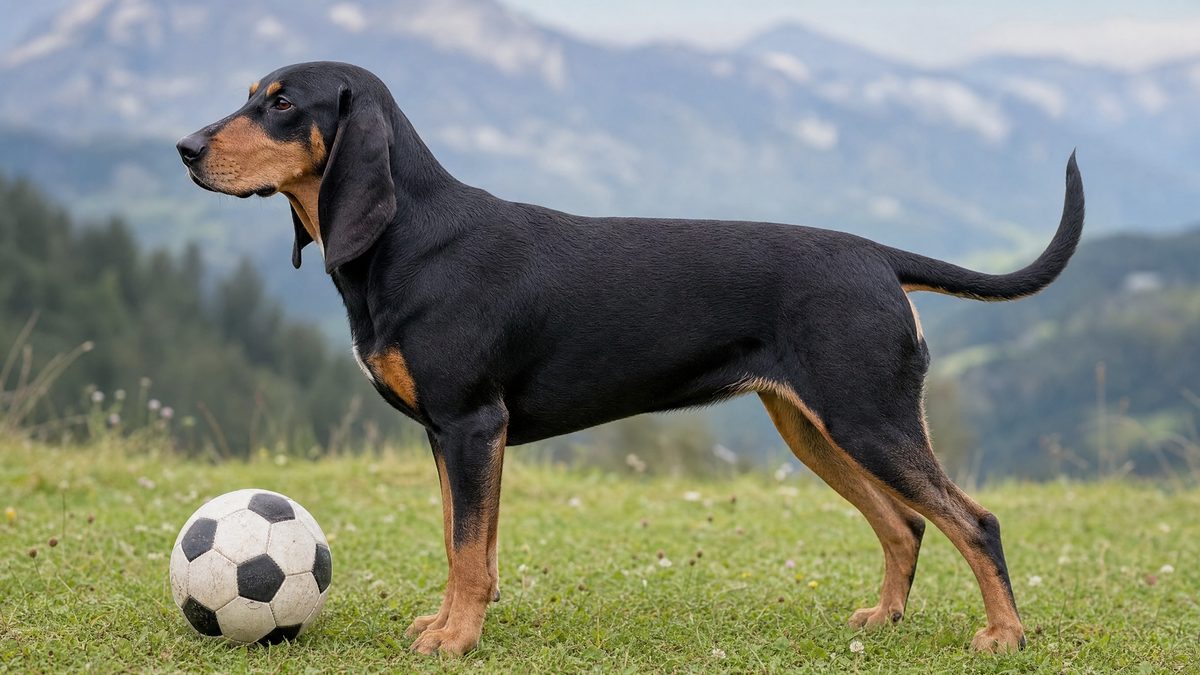
The Bruno Jura Hound is not a breed. It is the Jura variety of the Schweizer Laufhund, FCI standard 59, one of four varieties sharing one standard that separates them only by colour. Switzerland registered 27 Jura puppies in 2024 and one litter of eight by August 2026. No Indian price exists, and Indian import law bars any breeding import.
This page summarises published veterinary research, kennel-club statements and breed-standard text for general information. It is not a diagnosis and it is not treatment advice. Consult a registered veterinarian about your own dog before acting on anything here, and treat a rectal temperature at or above 41.0 degrees Celsius after exertion in heat as an emergency.
Bruno Jura Hound at a glance
What the Bruno Jura Hound actually is
The Bruno Jura Hound is not a breed in its own right. It is the Jura variety of the Schweizer Laufhund, the medium-sized Swiss scent hound that the Federation Cynologique Internationale recognises as standard number 59, definitively recognised on 25 August 1954 and classified in Group 6, Section 1.2 Medium-sized Hounds, with working trial.
Four varieties sit inside that one standard, and the FCI names them in this order: Bernese Hound, Jura Hound, Lucerne Hound, Schwyz HoundFederation Cynologique Internationale. In German the Jura variety is the Jura Laufhund; in French it is the Bruno du Jura, which is where the English name Bruno Jura Hound comes from. German Wikipedia states the position correctly in its first line, that the Jura Laufhund belongs to the breed Schweizer Laufhund. English Wikipedia's separate Bruno Jura Hound article instead prints, in its infobox, that the breed is 'Not recognised as a breed by any major kennel club';. Both statements are defensible and together they are the whole story: the animal is fully recognised, but not under that name and not as a breed.
| Item | What the primary source says | Source |
|---|---|---|
| Correct status | Jura variety of the Schweizer Laufhund, not a separate breed | FCI-Standard 59 |
| FCI breed number | 59, Group 6, Section 1.2, with working trial | FCI nomenclature |
| Definitive FCI recognition | 25 August 1954 | FCI nomenclature |
| Valid standard published | 28 November 2001, this edition dated 28 June 2002 | FCI nomenclature |
| Official original language | German | FCI nomenclature |
| Height, males | 49 to 59 cm, no tolerance | FCI-Standard 59 |
| Height, females | 47 to 57 cm, no tolerance | FCI-Standard 59 |
| Weight in the standard | None given at all | FCI-Standard 59 |
| Weight per the Swiss Kennel Club | 18 to 23 kg | SKG breed portrait |
| Coat | Short, smooth and dense, very fine on head and leathers | FCI-Standard 59 |
| Jura colour | Tan with black blanket, or black with tan markings | FCI-Standard 59 |
| Quarry | Hare, roe deer, fox and sometimes boar | FCI-Standard 59 |
The physical characteristics the standard actually specifies
FCI-59 describes a lean, long-headed, long-eared hound built for endurance rather than speed. It fixes three proportions numerically: body length to height at withers about 1.15 to 1, height at withers to depth of chest about 2 to 1, and length of muzzle to length of skull about 1 to 1. The skull is elongated, narrow, lean and rather rounded, with the occipital protuberance visible and the axes of skull and muzzle slightly divergent. The leathers are set below eye level and towards the back of the skull, narrow, drooping, folded and twisted, and long enough to reach at least the tip of the nose. That last clause is what makes this a genuinely long-eared dog rather than merely a drop-eared one, and it is the single most important line on the page for an Indian reader.
The forequarters are straight and vertical seen in profile, with medium bone and an ideal scapular-humeral angle of about 100 degrees. There is nothing in the standard about short legs. The Swiss short-legged hound is a different FCI breed with a different number, and confusing the two is the commonest error on the English-language internet about this dog.
If you want the real documents, search Schweizer Laufhund or Jura Laufhund, not Bruno Jura Hound. The Swiss parent club, the Swiss Kennel Club and the FCI all publish under the German name, and the registration statistics, the breeding rules and the club's own history exist only thereSchweizerische Kynologische Gesellschaft.
How the breed reached one standard
The unification took fifty-one years and cost the breed a fifth variety. In 1882 a separate standard was drawn up for each of the five Swiss Laufhund varieties then recognised, which were the Lucerne, Bernese, Jura, Schwyz and Thurgau hounds. Those standards were revised in 1909 and the revision recorded the complete disappearance of the Thurgau hound. On 22 January 1933 a single standard was established for the four remaining varieties. The Swiss Kennel Club adds the detail that the lost Thurgau hound was the rough-haired variety, which means the breed's only wire coat went with it.
English Wikipedia dates the five-variety standard to 1889 and the Thurgau disappearance to 1933. The FCI standard it cites says 1882 and 1909. Where a ranking page and the document it cites disagree, Bonbeno prints the document.
What separates the Jura from the other three, in the standard's own words
Colour is the only thing that separates the four varieties, and FCI-59 makes that unusually easy to verify because the entire standard is written once and only two of its clauses are split four ways.
Read FCI-59 from top to bottom and the four varieties appear in exactly two places: under SKIN, where each variety gets a one-line pigment description, and under COAT / Colour, where each gets a colour description and its own short list of colour faults. Head, ears, body, tail, limbs, gait, proportions, size, temperament, disqualifying faults and the working requirement are written once for all four. There is no separate head clause for the Jura, no separate size, and no separate ear length.
| Variety | Skin | Colour |
|---|---|---|
| Bernese Hound | Black skin under black coat, slightly white and black marbled under the white coat | White with black patches or black saddle, with light to dark tan markings over the eyes, on the cheeks, the inside of the leathers and around the vent |
| Jura Hound | Black skin under black coat but lighter under tan coat | Tan with black blanket, sometimes with black overlay, or black with tan markings over the eyes, on the cheeks, around the vent and on the legs, sometimes with a small white patch on the chest |
| Lucerne Hound | Black skin under black coat and lighter under blue speckling | Blue resulting from a combination of back hairs and white hairs, very heavily speckled, with black patches or black saddle and tan markings |
| Schwyz Hound | Dark grey skin under orange coat and white and black marbled under the white coat | White with orange patches or orange saddle, the white sometimes with very slight orange ticking |
The Jura is the only one of the four in which white is a fault
Three of the four varieties are described from a white ground colour. The Bernese is white with black patches, the Schwyz is white with orange patches, and the Lucerne is a blue that the standard defines as a mixture including white hairs. The Jura is the exception. Its two permitted patterns are tan with a black blanket, or black with tan markings, and neither begins with white. The standard then lists two colour faults for the Jura: a self-coloured coat, and an important white patch or strongly speckled white patch on the chest.
So a small white chest patch is tolerated on a Jura and anything more is a fault, while on the other three varieties white is the ground the pattern is painted on. That is the sharpest single test on the page. A black-and-tan Swiss hound with a broad white blaze or white feet is not a correctly marked Jura Hound, and no ranking page prints the rule.
Three questions place any Swiss Laufhund by colour. Is there orange anywhere? If yes it is a Schwyz. Is the ground white with black patches? If yes it is a Bernese. Is the whole dog a speckled blue-grey? If yes it is a Lucerne. Black-and-tan with at most a small chest patch is the Jura.
Coat type is identical, which is why the German phrasing misleads
The Swiss Kennel Club writes that the four varieties differ 'only in their Haarkleid', and the parent club writes that the Swiss Laufhunde have the same characteristics 'apart from their Haarkleid'; Schweizerischer Laufhundclub, Der Laufhund. Read in English as coat, that is wrong: FCI-59 gives all four the identical coat clause, short, smooth and dense, very fine on head and leathers. The same SKG page resolves the ambiguity two paragraphs later, saying the coat is short, smooth and dense and that four varieties are distinguished according to which colours predominate. Haarkleid there means coat colour, not coat type, and an English writer translating the phrase literally will tell a reader the four Swiss hounds have different coats. They do not.
Whether the Bruno and St Hubert types are both still recognised
One of the two historic Jura types is gone, and the governing standard says so in its own text. FCI-59's Brief Historical Summary ends with the sentence: 'The ancient variety, the hound of the Jura type St. Hubert, has in the meantime disappeared.'
That single line settles a question the English-language internet still treats as open. The Swiss parent club states the same thing in German on its own history page, writing that the original variety of the Jura Laufhund of the St Hubert type has disappeared today. Neither the FCI nomenclature entry nor the current standard lists a St Hubert type anywhere among the four varieties that carry a CACIBFederation Cynologique Internationale. The Bruno type is the Jura Hound. There is no second Jura variety to choose between.
What the ranking pages say instead
English Wikipedia carries a separate article titled St. Hubert Jura Hound, lists that type as an extant Swiss breed in its navigation box alongside the Bruno Jura Hound, and describes the Bruno as closely resembling 'the larger St. Hubert Jura Hound, to which it is closely related, although it has less pendulous dewlaps'; Wikipedia, St. Hubert Jura Hound. PetPremium, which ranks tenth on the Indian search, tells readers plainly that 'two varieties of the Jura hound exist, the Bruno Jura hound and the St. Hubert Jura hound', and adds that the St Hubert is larger, with a bigger head and ears and deeper skin folds.
| Source | Position on the St Hubert Jura type | Date |
|---|---|---|
| FCI-Standard 59 | Has in the meantime disappeared | 28.11.2001 |
| Schweizerischer Laufhundclub | The original St Hubert type of the Jura Laufhund has disappeared today | current |
| FCI nomenclature entry 59 | Four varieties listed, no St Hubert type | current |
| FCI varieties and CACIB table | Four varieties listed, no St Hubert type | current |
| English Wikipedia | Separate article, listed as an extant Swiss breed | 18.09.2025 |
| PetPremium | Two varieties of the Jura hound exist | 20.10.2024 |
| Wamiz | Not mentioned at all | current |
Three checks that show the Wikipedia pair is one animal, not two
- Both English articles rest on the same pages of the same four books. Alderton 2000 page 112, Fogle 2009 page 191, Morris 2001 page 94 and Hancock 2014 page 169 are cited on the Bruno article; Alderton page 112, Fogle page 191 and Hancock page 169 are cited on the St Hubert article.
- The St. Hubert Jura Hound article's own infobox prints the name 'Bruno du Jura Hound', which is the other article's subject.
- The Bruno Jura Hound article exists in nine languages and its German interwiki target is Jura Laufhund, the article that correctly calls it a variety of FCI-59. The St. Hubert Jura Hound article exists in one languageWikipedia, St. Hubert Jura HoundWikipedia, Jura Laufhund, German article.
If someone offers you a St Hubert Jura Hound, they are offering a type the governing standard records as extinct. There is no registry anywhere that will paper it, no club that recognises it, and no way to verify it. Treat the name itself as the warning.
The two dewlap descriptions are worth one more sentence, because they are the only substantive difference the books are said to record. FCI-59 requires a neck with 'skin loose at the throat, but without noticeable dewlap', and lists 'Dewlap too pronounced' as a fault. A heavy-dewlapped, heavy-flewed Swiss hound is therefore not a second variety under the current standard. It is a faulty one.
The FCI gives each variety its own CACIB and the breed none
Ask whether the four Swiss hounds are varieties or breeds and the FCI answers with a table rather than a word: on breed 59 the international show title goes to each of the four varieties separately, and not to the breed as a whole.
The FCI publishes a page titled 'FCI breeds with varieties and CACIB award', listing every definitively recognised breed that has size, coat or colour varieties, and marking with an asterisk which of them may be awarded the Certificat d'Aptitude au Championnat International de Beaute. For SCHWEIZER LAUFHUND - CHIEN COURANT SUISSE (59), validity date 28 November 2001, the breed-level CACIB column is empty and all four rows below it carry an asterisk: Bernese Hound, Jura Hound, Lucerne Hound and Schwyz Hound. The same asterisks appear against the four varieties on the breed's own nomenclature entry.
In practice that means a Jura Hound at an FCI international show competes for a Jura Hound CACIB, judged against other Jura Hounds, and never against a Bernese or a Schwyz. German Wikipedia puts it in one clause, that the four were combined by the FCI under one breed standard but are judged separately at shows. That clause is correct and it does not appear in English anywhere on the ranking set.
The American registry does the exact opposite
The United Kennel Club recognised the Swiss Hound in 2006 and revised its standard on 1 July 2009. Under Color, that standard reads: 'The Swiss Hound comes in four color varieties, which are all shown together at United Kennel Club conformation events.'; The colour text underneath is copied word for word from FCI-59, including the fault lists, so the two registries describe the same four varieties in the same language and then apply opposite show rules to them.
| Question | FCI | UKC |
|---|---|---|
| Recognised since | 25 August 1954 | 2006 |
| Are the four named? | Yes, as varieties | Yes, as colour varieties |
| Judged separately? | Yes | No, all shown together |
| CACIB to the breed? | No | Not applicable |
| CACIB to each variety? | Yes, all four | Not applicable |
| Working trial required? | Yes, per the nomenclature | Not stated in the standard |
| Size deviation | Disqualifying fault | Eliminating fault |
The show rule is the cleanest evidence of how seriously a registry treats the four as distinct populations. The FCI treats them as four gene pools that happen to share a written standard. The UKC treats them as four coat colours of one dog. If you ever see pedigree paperwork for this breed, check which registry issued it before assuming the word variety means the same thing.
One consequence nobody has printed
Because the FCI awards no CACIB at breed level, there is no such thing as an International Beauty Champion Schweizer Laufhund without a variety attached to it. A title certificate that says only Schweizer Laufhund, with no variety named, is not describing an FCI CACIB. For an Indian buyer being shown foreign paperwork for a rare imported dog, that is a free authenticity check that costs nothing and needs no expertise.
The small Swiss hound duplicates the four names and inverts the rules
FCI-60, the Schweizer Niederlaufhund, carries the same four variety names as FCI-59 and treats them in the opposite way: the CACIB goes to the breed and to none of the varieties, and the standard explicitly permits crossing them.
The FCI nomenclature entry for breed 60 lists four varieties in the order Jura Niederlaufhund, Schwyzer Niederlaufhund, Berner Niederlaufhund, Luzerner Niederlaufhund, and the CACIB column beside every one of them is blank. On the FCI's varieties table the pattern is printed the other way round from breed 59: SCHWEIZER NIEDERLAUFHUND (60), validity 13 October 2015, carries the asterisk at breed level, and Small Jura Hound, Small Schwyz Hound, Small bernese Hound and Small Lucerne Hound carry none.
| Item | Schweizer Laufhund (59) | Schweizer Niederlaufhund (60) |
|---|---|---|
| FCI section | 1.2 Medium-sized Hounds | 1.3 Small-sized Hounds |
| Definitive recognition | 25 August 1954 | 27 August 1954 |
| Valid standard | 28 November 2001 | 13 October 2015 |
| Original language | German | English |
| Male height | 49 to 59 cm, no tolerance | 35 to 43 cm, tolerance plus or minus 2 cm |
| Female height | 47 to 57 cm, no tolerance | 33 to 40 cm, tolerance plus or minus 2 cm |
| Coat types in the standard | One, short and smooth | Three, smooth, rough and double coat |
| CACIB to the breed | No | Yes |
| CACIB to each variety | Yes, all four | No |
| Mixing the four colours | Not provided for | Expressly allowed |
| Club founded | Not stated in the standard | 1 June 1905, as the Schweizerischer Dachsbracken Club |
The clause that makes the difference
FCI-60's colour section reads: 'Allowed are all types of colours as follows: white and black with tan markings (Small Bernese Hound), black with tan markings (Small Jura Hound), blue speckled with black mantle (Small Lucerne Hound) and white with orange-red mantle (Small Schwyz Hound) as well as all mixed colours of those.'; Those words are printed in bold, and the standard's closing line states that the latest amendments are in bold characters, so the whole permissive colour clause is a 2015 change.
FCI-59 contains no equivalent. A Jura crossed with a Schwyz produces a dog the medium-sized standard has no colour description for, which is why the medium breed keeps four separate CACIBs and the small breed does notFederation Cynologique Internationale. Read together, the two standards say that the small hound's four names are colour labels and the medium hound's four names are populations.
Where the American standard disagrees again
The UKC Small Swiss Hound standard, revised in 2009 and therefore predating the 2015 FCI revision, lists only two coat varieties, smooth and rough, and makes 'Any color not described in the standard' a disqualification. A mixed-colour small Swiss hound is expressly permitted by the FCI and expressly disqualified by the UKC. The UKC text also preserves something the 2015 FCI compression dropped: its Small Jura Hound entry allows 'deep black with tan markings' or 'alternatively tan with black mantle or saddle', where the current FCI-60 shorthand gives the Small Jura only 'black with tan markings'.
The UKC's Small Jura entry is also where the third coat came from. It records that this variety 'is usually smooth haired, seldom shows a double coat (Stockhaar)', a sentence written in 2009 about one variety. The FCI's 2015 revision promoted the double coat to a full breed-wide coat type in bold. The change is datable to 2015 and its origin is a note about the Jura.
The American standard is not the FCI standard translated
Two live breed standards describe this dog, and they disagree on size, on bite, on dewclaws and on what disqualifies. The differences are small in centimetres and large in consequence.
The UKC standard converts the FCI's metric heights to inches and the rounding changes the range at both ends. FCI-59 gives males 49 to 59 cm and females 47 to 57 cm, with the flat sentence 'No tolerance of undersize or oversize' and size outside the range listed among the DISQUALIFYING FAULTS. The UKC gives males 19 to 23 inches and females 18.5 to 22.5 inches, and makes 'Over or under the prescribed heights' an Eliminating Fault rather than a disqualification.
| Clause | FCI-59 (2001) | UKC (2009) | Effect |
|---|---|---|---|
| Male height | 49 to 59 cm | 19 to 23 in, that is 48.26 to 58.42 cm | The two ceilings differ by 0.58 cm |
| Female height | 47 to 57 cm | 18.5 to 22.5 in, that is 46.99 to 57.15 cm | Near identical |
| Size deviation | Disqualifying fault, no tolerance | Eliminating fault | Different severity |
| Bite | Scissor bite, pincer bite accepted | Scissors bite, pincer not mentioned | FCI is broader |
| Missing teeth | One or two PM1 or PM2 tolerated, M3 ignored | One or two 1st or 2nd premolars tolerated | Same in substance |
| Hind dewclaws | Without dewclaws, except where removal is prohibited by law | Not mentioned | UKC asks for nothing |
| Albinism | Not listed | Disqualification | UKC adds it |
| Cryptorchidism | N.B. only, two normal descended testicles | Disqualification | UKC is stricter |
| Varieties at shows | Judged separately, one CACIB each | All shown together | Opposite |
| Body proportion | Length to height about 1.15 to 1 | Just slightly longer than tall | FCI is numeric |
Nearly a fifth of Switzerland's Jura stud dogs are too tall for the American standard
The Swiss parent club publishes a register of available stud dogs with each dog's measured height at the withers. The edition dated 8 January 2026 lists 119 dogs across all four varieties, of which 38 are Jura, the largest single group, ahead of 36 Lucerne, 27 Schwyz and 18 Bernese. The Jura males run from 50 cm to 59 cm with a median of 57 cm and a mean of 56.4 cm.
Seven of those 38 Jura studs measure 59 cm. Every one of them is inside the FCI range and every one of them is above the UKC ceiling of 23 inches, which is 58.42 cm. That is 18.4 percent of Switzerland's available Jura stud dogs eliminated by the American standard for the same breedFederation Cynologique Internationale. Ten more measure 58 cm, so 17 of 38, or 44.7 percent, sit within 1 cm of the FCI ceiling where oversize disqualifies outright.
Wikipedia gives the Bruno Jura Hound 43 to 59 cm and the St Hubert Jura Hound 46 to 59 cmWikipedia, St. Hubert Jura Hound. PetPremium gives 16 to 23 inches, which starts at 40.6 cm. Wag! gives 17 to 23 inches. Not one of the 119 measured Swiss stud dogs of any variety stands under 49 cm, and the smallest dog in the whole register is a 49 cm Schwyz. A 43 cm Swiss Laufhund would be disqualified from every FCI ring in the world.
Wag!'s growth table is worth one line because it is arithmetically self-refuting rather than merely optimistic. It gives a male 11.0 inches at six months, 12.5 inches at twelve months and 19.0 inches at eighteen months. A hound that stands 31.7 cm at a year old and 48.3 cm at eighteen months does not exist, and 19.0 inches is itself below the FCI minimum of 49 cm. The table is generated filler on the page that ranks second in India for this breed.
How rare it really is, from the Swiss studbook
Switzerland registered 27 Jura Laufhund puppies in 2024, and by 23 August 2026 exactly one Jura litter of eight for the whole year. Those are the real numbers, and they come from the parent club's own annual statistics rather than from any breed-profile page.
The Schweizerischer Laufhundclub publishes a Statistik each year giving registrations in the Swiss studbook, the SHSB or Livre des Origines Suisse, broken down by variety, alongside litters by canton and a puppy series running back to 1981Schweizerischer Laufhundclub, Zucht. Seven consecutive editions are available. Read together they answer the question every rare-breed page dodges, which is not whether the dog is rare but which of the four varieties is rarest.
| Year | Jura | Lucerne | Schwyz | Bernese | All four |
|---|---|---|---|---|---|
| 2018 | 27 | 15 | 28 | 4 | 74 |
| 2019 | 12 | 23 | 18 | 20 | 73 |
| 2020 | 34 | 42 | 39 | 21 | 136 |
| 2021 | 50 | 24 | 24 | 5 | 103 |
| 2022 | 25 | 57 | 21 | 13 | 116 |
| 2023 | 29 | 12 | 29 | 20 | 90 |
| 2024 | 27 | 31 | 15 | 12 | 85 |
| Seven-year total | 204 | 204 | 174 | 95 | 677 |
| Share of the studbook | 30.1% | 30.1% | 25.7% | 14.0% | 100% |
The Jura is not the rare one. The Bernese is
Across those seven years the Jura and the Lucerne tie at 204 registrations each, the Schwyz follows at 174, and the Bernese trails at 95, which is 14.0 percent of the 677 puppies registeredSchweizerischer LaufhundclubSchweizerischer LaufhundclubSchweizerischer LaufhundclubSchweizerischer LaufhundclubSchweizerischer LaufhundclubSchweizerischer Laufhundclub. The Bernese Hound is the variety most often used to illustrate the breed and it is less than half as numerous as the Jura. If you are choosing a variety on scarcity, the Jura is one of the two commonest.
Litters tell the same story from the other side. The club's canton tables for 2019 through 2024 record 25 Jura litters out of 98 across all four varieties, producing 177 Jura puppies, an average of 7.1 per litterSchweizerischer LaufhundclubSchweizerischer LaufhundclubSchweizerischer LaufhundclubSchweizerischer LaufhundclubSchweizerischer Laufhundclub. The 2018 canton table is present in the club's PDF but its columns do not survive text extraction cleanly, so no 2018 litter figure is published here.
One bitch moves the national count
The year-to-year swing is the more useful number for a buyer. The Jura went from 12 puppies in 2019 to 50 in 2021, a factor of 4.2, and the 2019 figure came from a single litter registered in canton Schwyz. That one litter was also 10 males and 2 females, which is why the 2019 sex split looks extreme. When a whole national population turns on one to six litters a year, a single bitch moves the variety's share of the studbook by sixteen percentage points. Treat any claim about the breed getting rarer or commoner over a two-year window as noise.
The club's own 2021 edition prints a year total of 103 puppies. The 2022, 2023 and 2024 editions all restate 2021 as 105Schweizerischer Laufhundclub. Two late registrations moved the number after publication. That is normal for a studbook and it is why every figure on this page carries its year and its source.
The breed is also barely bred in the Jura. Of the four Jura litters born in 2024, one was in canton Jura, one in Bern, one in Valais and one in Graubunden. In 2023 one of three was in canton Jura, and in 2021 one of sixSchweizerischer Laufhundclub. The variety is named for a mountain range in which most of it is no longer born.
The whole breed has fallen 76 percent since 1981, and the club says why
The Swiss Laufhund's total annual puppy registration fell from 359 in 1981 to 85 in 2024, a drop of 76.3 percent across all four varieties, and the Swiss Kennel Club attributes it to restrictions on the way the breed hunts.
The club's statistics carry an unbroken year-by-year puppy series from 1981 to 2024. It is the longest continuous population record available for this dog, and the shape of it is a slide with two plateaus.
| Year | Puppies | Change from 1981 |
|---|---|---|
| 1981 | 359 | peak of the series |
| 1984 | 340 | down 5.3% |
| 1990 | 266 | down 25.9% |
| 1995 | 221 | down 38.4% |
| 2000 | 168 | down 53.2% |
| 2005 | 131 | down 63.5% |
| 2010 | 143 | down 60.2% |
| 2015 | 101 | down 71.9% |
| 2018 | 74 | down 79.4% |
| 2019 | 73 | down 79.7%, the low point |
| 2020 | 136 | down 62.1% |
| 2024 | 85 | down 76.3% |
The stated cause is a hunting restriction, not fashion
The Swiss Kennel Club's breed portrait, written jointly with the parent club, opens with the explanation: the Swiss Laufhund has been bred for centuries for the laute Jagd, the hunt in which the dog drives game while giving tongue, and resistance to that form of hunting is increasing, so in many places it can now be practised only in a very restricted way. The club names that as one of the main reasons the population of this unique native hunting breed is falling.
That matters to an Indian reader more than it looks. A breed whose numbers are falling because its job is being restricted is a breed still selected almost entirely for that job. The parent club's own training page sets out the three basic principles it breeds toward: the dog hunts alone, it searches diligently but stays in its handler's hand, and when it loses the trail it must return to its handler. There is no companion line, no show line separated from the working line, and no selection for anything else.
You are not buying a version of this dog that has been bred away from hunting for a few generations, as has happened with many Western gundogs. Every registered Jura Laufhund alive descends from a population selected inside the last few years for independent hunting, giving tongue, and working a trail for about an hour at a time.
For scale, Switzerland's national canine organisation registered 6,429 puppies of all breeds in 2022, the most recent year the FCI's figures give for that field, and 5,005 in 2025. The 116 Swiss Laufhund puppies registered in 2022 were 1.80 percent of the national total, and the 25 Jura puppies among them were 0.39 percent. That is roughly one Jura Laufhund in every 257 pedigree puppies born in Switzerland, in the country the breed comes from.
Bruno Jura Hound price in India
There is no Bruno Jura Hound price in India, because there are no Bruno Jura Hounds in India. Every rupee figure attached to this breed name online is either a converted dollar figure or a page that never mentions the breed below its own headline.
Start with what exists. As of 23 August 2026 the entire registered world production of Jura Laufhund puppies for the year is one litter, born on 16 April 2026 in canton Jura, of five males and three females. The club's list of litters with puppies still available on the same date contains one Lucerne litter and two Schwyz litters, and no Jura at all. A supply of eight puppies a year, in Switzerland, is not a supply chain that reaches Chennai.
| Source | Figure printed | What it is |
|---|---|---|
| Wamiz UK | No documented purchase cost; keeping cost 100 to 120 pounds a month | A UK keeping cost, not a purchase price, and not Indian |
| Wag! | Food 34 to 45 dollars a month, vet 600 to 1,500 dollars a year | US dollars, US costs |
| Justdial, Mumbai and Guna | No price anywhere on either page | An auto-generated pet-shop category, not a listing |
| Puppiezo | No Bruno Jura Hound category exists | The breed is absent from India's largest puppy retailer |
| Indian rupee figures | None found from any Indian seller | No Indian price was located |
What an Indian search actually returns
Search the breed name with India results and the commercial hits are a rolling pin on Etsy, an etched pint glass on eBay, stock photography on Alamy and Shutterstock, and a Justdial category page. The Justdial page is the instructive one. 'Popular Pet Shops For Bruno Jura Hound Dog in Mumbai' lists ten ordinary Mumbai and Thane pet shops, not one of which mentions the breed anywhere in its listing, and the identical category identifier serves the same shell for Guna in Madhya PradeshJustdial, Top Pet Shops For Bruno Jura…. The page is a template with a breed name dropped into the title.
Puppiezo, one of the largest Indian puppy retail sites, advertises pan-India delivery, more than 3,000 completed deliveries and health checks at more than 50 vet partners across more than 20 states. Its breed filter runs from american rottweiler to rottweiler and includes Lagotto Romagnolo, cavalier king charles and Italian Greyhound. There is no Bruno Jura Hound, no Jura Laufhund and no Swiss Hound.
Bonbeno has repeatedly found the figure Rs 98,999 attached on Indian listing pages to whichever puppy happens to be in stock, including on pages for breeds the site does not stock. It divides to 1,173.25 US dollars, so it is not even a conversion; it is a rupee-native charm price. If you are quoted Rs 98,999 for a Bruno Jura Hound, you are being quoted a template, not a dog.
Divide every rupee figure you are shown
Indian breed pages routinely publish a dollar figure run through one exchange rate and print the result as a local price. The test costs nothing. Divide the rupee figure by 84.38, then divide it again by 74, and see whether either division produces a round dollar number. Rs 42,190 is 500 dollars at 84.38 and Rs 37,000 is 500 dollars at 74; Rs 67,504 is 800 dollars at 84.38 and Rs 59,200 is 800 dollars at 74. If a page's whole price table divides cleanly by one rate and only a couple of local breeds refuse, you are reading a converted American list with two rows typed in by hand.
So the honest answer to the price question has three parts. No Indian seller offers the breed. No Indian price exists to report. And any figure you are offered should be divided by both rates before you treat it as a local number at all. An affordable price for a dog that does not exist is not a bargain, it is a different dog.
Why no lawful supply of this breed can form in India
Indian import law closes the only route by which a Jura Laufhund population could start here. Dogs are a Restricted import, breeding imports are refused by name, and the breed has no Indian registry to receive it.
DGFT Trade Notice No. 22/2022-23, dated 19 December 2022, sets out the position in four lines that between them settle the question.
- ITC (HS) 01061900, mammals other, carries the import policy 'Restricted'.
- Policy Condition (7) permits import of dogs only for a pet dog with a valid pet book and relevant records in the name of the importer, for R&D organisations conducting research with the recommendation of CPCSEA, or for internal security by the Defence and Police Force.
- Policy Condition (8) states that import of commercial dogs for breeding or any other commercial activities other than the purposes mentioned above is not permitted.
- Paragraph 6 states that any applications for trading or breeding purposes, or applications made on behalf of some another person or entity, shall be duly rejected.
Paragraph 7 limits entry to the airports and seaports of Delhi, Mumbai, Chennai, Hyderabad, Bangalore and Kolkata, six ports in total, with quarantine at the government station of those ports where required. DAHD added a seventh port, Cochin International Airport at Kochi, for pets arriving under the baggage rules in October 2024. Permanent import as passenger baggage without a DGFT authorisation is available only to a person transferring residence to India after two years of continuous stay abroad, and only for up to two pets. The full route is set out in how to import a dog to India.
What the quarantine service adds on top
The Animal Quarantine and Certification Services standard operating procedure requires the application to be filed through the CBIC's ATITHI 2.0 portal a minimum of seven days before embarkation, with vaccination and microchip certificates, an official health certificate signed by the competent authority, air ticket or airway bill and passport copyAnimal Quarantine and Certification…. An Advance No Objection Certificate is then issued within one working day. Airlines are directed not to carry the animal without it, and a passenger arriving with a fake, forged, tampered or altered NOC is issued a deportation or re-export order. An animal showing clinical signs of disease on arrival is quarantined at the AQCS station for 15 days.
One lawful route exists and it is a person moving to India with their own dog, already in their own name, in their own pet book. That route cannot start a population, because Rule 8(1)(b) of the Dog Breeding and Marketing Rules 2017 requires dogs over six months to be sterilised before sale unless sold to another licensed breeder, and DGFT paragraph 6 rejects any application made for breedingMinistry of Environment.
There is also no registry to receive one
The Kennel Club of India is not going to paper a Jura Laufhund into existence, because the breed reaches India through no register at all. The American Kennel Club's Foundation Stock Service, the entry-level American register that admits rare imports, lists Kai Ken, Estrela Mountain Dog, Dutch Shepherd, Peruvian Inca Orchid, Portuguese Pointer, Slovensky Cuvac and Transylvanian Hound, and contains no Schweizer Laufhund, no Swiss Hound and no Jura. The Royal Kennel Club's breeds A to Z lists the Great Swiss Mountain Dog and the White Swiss Shepherd Dog and nothing else Swiss and houndThe Royal Kennel Club. Only the UKC recognises it, in the United States, since 2006United Kennel Club.
For scale, the Kennel Club of India's studbook has registered 1,425,001 pure-bred dogs since its creation, and registered 33,880 in 2025. None of that volume can lawfully include a bred-in-India Swiss Laufhund, because no lawful founder can enter. That is not a gap in this page. It is the answer.
Where the breed standard and Indian law collide
Three clauses of FCI-59 meet Indian law head on, and in each case Indian law wins. The most useful one is the dewclaw clause, because the standard disapplies itself.
Hind dewclaws must stay on, and the standard says so
FCI-59 requires the hock to be 'Without dewclaws, except in countries where their removal is prohibited by law', and lists 'Dewclaws on hindlegs (unless removal prohibited by law)' among the faults. India is such a country. The Prevention of Cruelty to Animals (Dog Breeding and Marketing) Rules 2017, notified as G.S.R. 496(E) on 23 May 2017, state at Second Schedule Part II paragraph 6(8) that there shall be no tail docking, ear cropping, de-barking, de-clawing, branding, dyeing, injecting substances to enhance visual appeal, performing a surgery or procedure to camouflage or hide any defect or infirmity 'or any other kind of mutilation of any body part of the pup', and that 'any change of appearance by artificial means is strictly forbidden'.
Removing a hind dewclaw from a puppy is a mutilation of a body part and a change of appearance by artificial means. So the exception in the FCI standard applies by its own wording, and an Indian-bred Swiss Laufhund carrying hind dewclaws is not faulted. This is the rare case where a foreign standard has already written the Indian answer into itself, and no page in English points it out.
Seven of the eleven conditions Indian law wants tested are already in the standard
Second Schedule Part III paragraph 8(10) requires that dogs 'shall have been tested for genetic defects, including hip dysplasia, progressive retinal atrophy, night blindness, hypothyroidism, entropion, ectropion, overshot, undershot jaw (when incisors do not touch or mesh), wry mouth, two or more missing teeth, unilateral cryptorchid or full cryptorchid males';. Set that list beside FCI-59 and most of it is already there.
| Condition in Second Schedule Part III para 8(10) | Status under FCI-59 |
|---|---|
| Hip dysplasia | Not mentioned anywhere in the standard |
| Progressive retinal atrophy | Not mentioned |
| Night blindness | Not mentioned |
| Hypothyroidism | Not mentioned |
| Entropion | Disqualifying fault, even if operated |
| Ectropion | Disqualifying fault, even if operated |
| Overshot mouth | Disqualifying fault |
| Undershot mouth | Disqualifying fault |
| Wry mouth | Disqualifying fault, added in the 2001 amendments |
| Two or more missing teeth | Fault beyond one or two PM1 or PM2, M3 ignored |
| Cryptorchidism | N.B. requires two normal descended testicles |
Seven of the eleven are visible in a show ring and already carry consequences under the standardMinistry of Environment. The four that are not, hip dysplasia, progressive retinal atrophy, night blindness and hypothyroidism, are precisely the four you cannot see, and they are also the four for which no screening scheme exists for this breed anywhere. Indian law requires a test that the breed's own registries do not run.
FCI-59 disqualifies entropion and ectropion 'even if operated', and Indian law forbids 'performing a surgery or procedure to camouflage or hide any defect or infirmity'; Ministry of Environment. A breeder who surgically corrects an eyelid and then sells the dog as sound breaks both.
The population is too small to breed lawfully in India
Second Schedule Part II paragraph 6(3) of the Second Schedule prohibits in breeding, defined as breeding between relatives of the second to fourth grade in straight or side line within the first four generations, naming uncle to niece, nephew to aunt, cousin to cousin and grandparents to grandchildren, and prohibits incest breeding between parents and children or brother and sister. Only out breeding and line breeding are permitted. With four to six Jura litters registered worldwide in a year, avoiding all fourth-generation relatives is close to arithmetically impossible without repeated imports, and imports for breeding are refusedDirectorate General of Foreign Trade. Rule 5(2) additionally requires bitches to have reached eighteen months, 5(5) allows one litter a year with no artificial insemination, and 5(6) caps a bitch at five litters in her lifetime.
Suitability for the Indian climate
Heat tolerance rates 2 out of 5, and the reason is not the coat. The Jura's home range averages 8.92 degrees Celsius a year against 27.95 in Chennai, and its hottest month is cooler than Bengaluru's coldest.
Bonbeno queries NASA POWER by explicit latitude and longitude and echoes the coordinates the service returns, because a climate site that serves the wrong city silently would discredit the one rating on this page that is genuinely ours. The Jura baseline used here is Delemont, requested at 47.3646 north and 7.3450 east, returned as 7.345, 47.365 at 562.99 metres. That returned elevation is 150 metres above where Delemont actually sits, at 413 metres, and the same cell is what the service returns for Basel, 30 kilometres away and 153 metres lower. So the figures below describe a smoothed block of the Jura rather than the town, and Bonbeno says so rather than presenting them as a local reading. A second point on the Franches-Montagnes plateau at Saignelegier, requested at 47.2560 and 6.9950, returns 6.995, 47.256 at 535.92 metres and an annual mean within 0.21 degrees of Delemont's. An earlier revision of this page offered that as confirmation. It is not. Saignelegier really stands at about 982 metres, so its cell is 446 metres too LOW while Delemont's is 150 metres too HIGH. Two cells wrong in opposite directions by that much, agreeing to a fifth of a degree, are evidence that the model has flattened the terrain, not evidence that either reading is right. Close agreement between neighbouring cells in hill country is a symptom, not a check.
| Place | Annual mean C | Annual max C | Annual RH % | Peak monthly wet-bulb C |
|---|---|---|---|---|
| Delemont, Swiss Jura | 8.92 | 34.26 | 83.1 | 15.53 in July |
| Saignelegier, Swiss Jura | 9.13 | 37.01 | 82.8 | 15.42 in July |
| Bengaluru | 23.74 | 40.38 | 67.9 | 21.86 in May |
| Pune | 23.86 | 43.20 | 66.8 | 22.97 in June |
| Delhi | 25.60 | 48.79 | 45.6 | 26.50 in July |
| Kolkata | 25.81 | 46.81 | 73.9 | 27.09 in June |
| Mumbai | 26.77 | 44.91 | 67.4 | 25.77 in June |
| Ahmedabad | 27.57 | 48.58 | 48.3 | 26.11 in June |
| Chennai | 27.95 | 42.70 | 72.4 | 26.11 in May |
The single line that settles it
The Delemont cell's warmest month, July, averages 18.48 degrees. Bengaluru's coolest month, December, averages 20.22 degrees, and Pune's coolest, December, averages 19.62NASA POWER, Source Native Resolution…NASA POWER, Source Native Resolution…. The elevation error runs in the direction that makes this comparison harder rather than easier, because a cell sitting 150 metres too high reads cooler than the real town, so the true Jura July is somewhat warmer than 18.48 and the margin is narrower than these two numbers suggest. It does not close. The Jura's hottest month is cooler than the coldest month of the two mildest large Indian cities on this list. Chennai's coolest month, January, averages 24.09 degrees, which is 5.6 degrees above the Jura's summer peak. Delhi is the only city here with months genuinely colder than a Jura July, because Delhi's January averages 13.61 degrees.
Humidity is not the problem. Humidity at 28 degrees is
The Jura is more humid than every Indian city in the table on an annual basis, at 83.1 percent against 72.4 in Chennai and 45.6 in DelhiNASA POWER, Source Native Resolution…NASA POWER, Source Native Resolution…. That kills the argument that a Swiss hound is unused to damp air, and it kills the opposite argument that India is simply wetter. What changes is the combination. Peak monthly wet-bulb temperature runs 15.53 degrees at home and 27.09 in Kolkata, a gap of 11.56 degrees. Wet-bulb is the measure that matters for a panting dog, because it is the temperature evaporation can actually reach. At 15 degrees a hound sheds heat easily. At 27 it barely sheds heat at all.
Wamiz, the most detailed page on the Indian search results, says under Vulnerability to hot weather: 'With his short coat hair, this dog won't have many issues in periods of hot weather';. That is written for Britain and it is the most dangerous sentence about this breed available to an Indian buyer. A short coat does not cool a dog; evaporation from the respiratory tract does, and wet-bulb is exactly what stops it.
Managing a Swiss scent hound through an Indian summer
Schedule around wet-bulb, not around the thermometer, and give up the middle of the day from March to June in every city on the list except the Deccan hill cities, where you give up the afternoon only.
The reason a scent hound is a harder heat problem than its coat suggests is behavioural. FCI-59 describes a dog that hunts independently, searches with great determination even on difficult terrain, and is 'passionately keen on hunting';. The Swiss parent club's training principles require it to work a trail for about an hour and warn the handler to prevent it from overdoing things and pursuing game until it catches it. A dog that will not stop when it should is the exact profile that produces exertional heat illness.
The best available incidence data is British and it still peaks hard. VetCompass recorded 395 incident heat-related illness cases among UK dogs under primary veterinary care in 2016, an incidence risk of 0.04 percent, with 40 percent of them, 158 of 395, occurring in July alone and none at all in February, October or December. Event fatality was 14.18 percent in primary care, against 36 to 50 percent reported by referral studies and 53 percent in the largest hospital series of 126 dogs. In a UK summer, one month produced two fifths of the year's cases. India does not have one such month.
| City | Worst months | Practical rule |
|---|---|---|
| Bengaluru | March to May | Early morning and after dark; midday walks stop from March |
| Pune | April to June | Dawn and dusk from April; indoors 11 am to 5 pm in May |
| Delhi | May to August | Dawn only from May; the July wet-bulb of 26.50 is the year's worst |
| Mumbai | April to September | Dawn and after dark all summer and monsoon; humidity never drops |
| Kolkata | April to September | The hardest city on this list, peak wet-bulb 27.09 in June |
| Ahmedabad | April to September | Dawn only; June wet-bulb 26.11 with an annual max of 48.58 C |
| Chennai | March to October | Dawn and after dark for eight months of the year |
Six rules that are specific to this dog
- Never shave the coat. The Swiss Kennel Club states plainly that Laufhunde are never to be trimmed or clipped, and a short double-layered coat that is removed exposes skin to direct sun without improving heat loss.
- Do not use scent work as a hot-weather substitute for walking. Nose work at 30 degrees raises core temperature the same way running does, and this dog will not self-limit.
- Cool with water on the belly, groin and paw pads rather than over the back, because a dense coat holds warm water against the skin.
- Carry water on every outing longer than fifteen minutes from March onward, and stop when the dog stops seeking the trail rather than when it looks tired.
- Treat a rectal temperature at or above 41.0 degrees Celsius after exertion in heat as an emergency and start active cooling on the way to the clinic.
- Watch the ears in the same session, because a dog that has just been cooled with water is a dog with wet leathers, which is the subject of the two sections below.
The Swiss Kennel Club describes the Laufhund as a long-distance runner rather than a sprinter, badly suited to agility, and 'ganz in seinem Element' as a tireless companion on extended jogging rounds or during its owner's marathon training. In the Jura that is excellent advice. In Chennai between March and October it describes the commonest way an owner kills a heat-intolerant dog.
Grooming a short Swiss coat in Indian humidity
Coat care is genuinely light and the ears are not. FCI-59 gives all four varieties one coat clause, short, smooth and dense, very fine on the head and leathers, and the Swiss Kennel Club says the breed is never to be trimmed or clipped.
The whole grooming instruction from the two Swiss authorities fits in three sentences. The coat is short, smooth and dense, so it makes no great demands; you never trim and never clip; and because of the long leathers you must watch for inflammation of the external ear canalFederation Cynologique Internationale. Wamiz agrees on the routine, saying the Schweizer Laufhund group all have short hair and a low maintenance coat, no professional trim is needed, and a weekly brushing suffices.
| Task | Frequency | Why, in Indian conditions |
|---|---|---|
| Rubber curry or hound mitt | Twice a week | Short dense coat sheds year-round in a warm climate rather than in two seasons |
| Ear check, dry ear | Every day in monsoon, twice a week otherwise | The single highest-value five seconds in this dog's care |
| Bath | Once a month or after mud | Over-bathing strips oil and irritates skin already stressed by heat |
| Dry the leathers after every bath or swim | Every time, without exception | Never let the ears air dry in an Indian monsoon |
| Nails | Every three to four weeks | A hound walked on soft ground rather than rock does not wear them down |
| Tick check | After every outing on grass | Tick-borne disease pressure is a year-round Indian problem, not a seasonal one |
| Trim or clip | Never | Explicitly ruled out by the breed's own kennel club |
Why shedding is heavier here than the Swiss guidance implies
Wamiz rates shedding as average and calls it a low maintenance coat, which is a fair description of a temperate year with a clear photoperiod. Indian day length varies far less, so the two clean coat-blows a European owner expects flatten into a steady year-round drop. The practical consequence is that twice-weekly work with a rubber mitt removes more hair than a weekly brush and keeps the undercoat from packing down against the skin in humidity, which is where hot spots start.
Plug the ears before every bath and dry them afterwards, and do the same after any water play. The Swiss guidance never mentions it because the dogs are not used for water work and the climate dries the canal on its own. In Mumbai in August, at 90.4 percent relative humidity and a 24.78 degree wet-bulb, nothing in that ear canal dries by itself.
There is nothing in FCI-59 about coat shedding, and nothing anywhere in either Swiss source claiming the breed is suitable for allergy sufferers. That is worth saying only because it is the one claim this breed is not sold on. A dog with a dense short coat that sheds steadily is the opposite of the marketing, and no page has to be corrected on it.
The Swiss say ear problems are the exception, and their reasoning does not transfer
The Swiss Kennel Club gives two reasons why ear infections are rare in this breed, and neither of them is about ambient humidity, which is the factor that dominates in India.
The passage is worth quoting in full because it is the clearest example on this site of care advice written for one climate and copied into another. The SKG page, produced jointly with the parent club, says that because of the long leathers care must be taken that no inflammation of the external ear canal occurs, but that since Laufhunde are not usually used for water work and the inside of the ear leathers is only sparsely haired, ear problems are rather an exception.
Both reasons are true and both are about water getting in and hair holding it there. Neither addresses the reason an ear canal stays wet in Mumbai, which is that the air outside it is already at 90.4 percent relative humidity for two months of the year. An ear that is never swum in and has no hair in it still does not dry when there is nowhere for the moisture to go.
| Swiss reason | Holds in the Jura | Holds in India |
|---|---|---|
| The dogs are not used for water work | Yes | Yes, and irrelevant to monsoon humidity |
| The inner leather is only sparsely haired | Yes | Yes, and it does not create airflow |
| Ambient air dries the canal between exposures | Yes, annual mean 8.92 C | No; Mumbai runs 89.6% and 90.4% RH in July and August |
| The dog is not bathed often | Yes | Often no; heat management means frequent wetting |
| The leathers are short enough to lift | No; they reach at least the tip of the nose | No, and they seal the canal against a wet neck |
The ear the standard describes is the worst possible ear for this climate
FCI-59 requires leathers set on below the eye level and towards the back of the skull, narrow, drooping, folded and twisted, rounded at the tips, and in length reaching at least the tip of the nose. Folded and twisted is not decorative language; it describes a leather that lies against the head in a spiral, which is the single most effective way to close a canal off from moving air. The Palampur series found that among 81 diagnosed cases, breeds with pendulous ears accounted for the majority and erect-eared breeds for 25 of 81, or 30.86 percent.
Towelling a wet-eared hound and letting the rest happen on its own is standard advice in a temperate climate and it is wrong here. Dry inside the leather with a soft cloth, lift the ear and let air reach the canal for a few minutes, and do it every time the dog gets wet, including after cooling it in hot weather.
None of this contradicts the Swiss authorities. It says their reasoning is climate-dependent and their conclusion travels only as far as their climate does. A Jura Laufhund in the Jura probably does have exceptional ear health. The same dog in Kochi or Kolkata is a long-eared hound in the wettest ear environment on earth, and the next section shows what the Indian numbers look like.
What the Indian ear data actually shows, and one figure that does not add up
Four Indian series report canine otitis externa prevalence between 1.25 percent and 3.27 percent of dogs presented, they disagree on the seasonal peak, and the most detailed of them contains a percentage that fails its own arithmetic.
The Palampur study screened 2,476 dogs presented to the veterinary clinics of Dr G.C. Negi College of Veterinary and Animal Sciences between June 2022 and July 2023 and diagnosed 81 with otitis externa, a hospital prevalence of 3.27 percent. The Nagpur study reviewed 18,172 cases attending the Medicine Section of the Veterinary Clinical Complex at Nagpur Veterinary College from March to December 2025 and diagnosed 228, a prevalence of 1.25 percent.
| Series | Dogs screened | Cases | Prevalence |
|---|---|---|---|
| Palampur, Himachal Pradesh, 2022 to 2023 | 2,476 | 81 | 3.27% |
| Nagpur, Maharashtra, March to December 2025 | 18,172 | 228 | 1.25% |
| Guwahati, Assam, as cited by Nagpur | not stated | not stated | 2.11% |
| Chaudhary et al. 2023, as cited by Nagpur | not stated | not stated | 1.33% |
| A further Indian series cited by Nagpur | not stated | not stated | 4.58% |
| Parmar et al. 2020, as cited by Palampur | not stated | not stated | 57.76% |
| UK primary care, O'Neill et al. 2021, as cited by Palampur | not stated | not stated | 7.30% |
The season splits the evidence
Palampur found the incidence peaking sharply in the rains: 48 of 81 cases, 59.25 percent, fell in July and August, against 15 in April to June, 10 in December to March and 8 in September to November. The four seasonal counts sum to 81 exactly. That is the strongest monsoon signal in the Indian literature. Nagpur ran only from March to December and reports no seasonal table at all, so it neither confirms nor contradicts it. Bonbeno's own gundog pages have found an Indian series peaking in summer rather than monsoon, so the question is not settled and this page does not pretend it is.
A percentage that fails its own arithmetic
The Palampur paper's Table 5 lists 'Pendulous ear breed' with n equal to 53 and a percentage of 69.13. Divide it out: 53 of 81 is 65.43 percent, and 69.13 percent of 81 would be 56 dogs. The row is wrong on its own face. The likely source of the error is visible elsewhere in the same paper, which reports that bacterial infections were present in 65.43 percent of cases, the exact percentage 53 of 81 produces. Every other row in that table checks out, including erect ear breed at 25 and 30.86 percent, hypersensitivity at 37 and 45.67 percent, excessive moisture at 17 and 20.98 percent, and aural polyps at 6 and 7.40 percent.
This page reports the pendulous-ear finding as 53 of 81 cases, which is 65.4 percent, and names the discrepancy rather than repeating the printed 69.13 percent. Any figure quoted as n of N with a percentage attached should be divided out before it is trusted, whether it comes from a journal, a ranking page or an earlier draft of this page.
Two further Palampur findings transfer directly. All 81 cases showed secondary bacterial or fungal overgrowth on cytology, with cocci in 30 of 81, rods in 23 of 81, yeast in 13 of 81 and mixed infections in 15 of 81. And otoscopy found erythematous canals in 88.8 percent of cases, with canal stenosis already present in 10 of 81. Stenosis is the endpoint that stops responding to drops, and it was present in one case in eight at first presentation.
Health risks and what is actually known
The Swiss Kennel Club states that no breed-typical health problems have yet been observed in the Schweizer Laufhund. That is a real finding and it is not the same as a clean bill of health, because nobody has surveyed the breed.
The sentence is unambiguous in the original: 'Rassetypische Gesundheitsprobleme sind beim Schweizer Laufhund glucklicherweise noch keine beobachtet worden';. Fortunately, no breed-typical health problems have yet been observed. The word noch, meaning yet, is doing quiet work. A national kennel club saying it has seen nothing is evidence of absence only in proportion to how hard it has looked, and for a breed producing 85 puppies a year across four varieties there is no cohort to look at.
| Source | Claim | Evidence behind it |
|---|---|---|
| Swiss Kennel Club | No breed-typical problems observed yet | Club and registry experience, no published survey |
| PetPremium | No known genetic health conditions documented, due to minimal health surveys | States its own limitation, which is honest |
| Wamiz | Nine named conditions including hip dysplasia and PRA | No source given for any of them |
| Wag! | Allergies major, ear infections and eye injuries occasional | No source given |
| FCI-59 | Nothing on inherited disease at all | A conformation standard, not a health document |
| Peer-reviewed literature | Nothing on this breed | PubMed returns zero genuine records |
The nine-condition list on the SERP is not evidence
Wamiz lists hip dysplasia, elbow dysplasia, entropion, ectropion, cataracts, progressive retinal atrophy, patellar luxation, demodicosis and ear infections as this breed's common illnesses, with no citation for any of them. Entropion and ectropion are already disqualifying faults under FCI-59, so listing them as breed illnesses is describing the standard rather than the population. The rest is the generic hound list. Where the Swiss Kennel Club says nothing has been observed and a UK content site names nine conditions with no source, Bonbeno reports both positions and neither as fact.
Two risks that are real and are not inherited
The first is heat. That is covered above and it is the largest single health risk this dog faces in India by a wide margin. The second is the ears, and the Indian series in the previous section are the evidence for itSharma MR, Bhojne GR, Dhoot VM. Nagpur's authors attribute high susceptibility to middle-aged, male and medium-to-large breed dogs, noting anatomical, hormonal and exposure factors, and record that the largest weight band among their 228 cases was 24.1 to 34.0 kg at 40.35 percent. The Swiss Kennel Club gives this breed 18 to 23 kg, so it sits just under that band.
A Vetsuisse Zurich study of Capillaria boehmi, a nematode of the nasal and paranasal sinuses, reported three challenging canine cases, all of them scent hounds aged 3 to 9 years and weighing 19 to 31 kg. Two had been misdiagnosed as Trichuris, and all three kept excreting eggs despite fenbendazole, milbemycin oxime, moxidectin with imidacloprid and levamisole. The same study found the parasite in 190 of 218 Swiss red foxes, 87.2 percent. The clinical signs include impaired scent, which for a working hound is the whole animal.
Bonbeno's editorial position on this breed's health is therefore short. Nothing inherited is documented. The two documented risks are environmental and both are worse in India than at home. Anyone quoting you a screening result or an inherited-disease clearance for a Bruno Jura Hound is quoting something no registry issues.
Why no screening data exists, and what happened when we went looking
No screening figure is published on this page because none could be retrieved, and this section records exactly which routes were tried and how each one failed.
The Orthopedic Foundation for Animals publishes disease statistics by breed and is the usual source for hip, elbow and eye numbers on a breed page. Its statistics page was fetched directly on 24 August 2026 and returned 49,169 bytes containing the string 'Searching Database, Please wait.' and zero elements carrying a data-regcode attribute, which is the attribute the table rows use. The tables load from a separate host.
| Route | Result |
|---|---|
| ofa.org/diseases/disease-statistics/ direct fetch | HTTP 200, JS shell only, zero data-regcode rows |
| wp.ofa.org/api/js.php?id=ds, the data source named in that page | Connection timed out from this environment |
| ofa.org/advanced-search/ via a stealth proxy with a 15 second wait | HTTP 200, no breed list rendered, two links returned |
| Guessing a breed code | Refused; a guessed OFA code returns a real table for a different breed |
The absence is also predictable from OFA's own threshold
OFA requires a breed to accumulate 100 hip evaluations, or 50 in its other databases, before it appears in the statistics at all. The Schweizer Laufhund is not an American Kennel Club breed, is absent from the AKC Foundation Stock Service, and reaches North America only through the UKC, which registered it in 2006United Kennel ClubUnited Kennel Club. A breed with no AKC route and 85 puppies a year in its home country is not going to reach an American screening threshold, and no figure is published here rather than a guessed one.
The Swiss club runs its own gate instead, and it is measurable
What Switzerland has instead of a screening register is the Ankorung, the breeding admission, and its results are published. In 2024 the club admitted 39 dogs across all four varieties, of which 15 were Jura, 8 males and 7 females. The admission series runs from 175 in 1982 down to 21 in 2022 and back to 39 in 2024, tracking the puppy series. It is a conformation and working gate rather than a health gate, but it produces one hard number a health register would not: the measured height of every dog passed.
That is why this page can state, with a sample size, that all 38 available Jura stud dogs measure between 50 and 59 cm and not one falls outside the FCI range. Switzerland genuinely enforces the standard's no-tolerance size clause. It does not screen hips, eyes or thyroid, and nothing on the internet does either.
Since no breed screening scheme exists, ask for the individual dog's own results rather than a breed clearance: a hip radiograph read by a named specialist, an eye examination certificate with a date, and a thyroid panel. Indian law already requires a breeder to have tested for hip dysplasia, progressive retinal atrophy, night blindness and hypothyroidism among others, so those four are the ones to ask for by name.
Every peer-reviewed paper on the Swiss hounds is about the small one
PubMed holds three papers naming the Schweizer Niederlaufhund or the Small Swiss Hound and zero naming the Schweizer Laufhund or the Jura variety, and the searches were run with controls in the same session so the zero is a finding rather than a broken query.
Every query below was run through the PubMed E-utilities interface on 24 August 2026, and PubMed's own query translation and quoted-phrase warnings were read rather than the result count alone. That distinction turns out to decide the answer.
| Query | Count | What PubMed actually searched | Verdict |
|---|---|---|---|
| golden retriever, control | 937 | "golden retriever"[Title/Abstract] | Control passes |
| otitis externa AND dog, control | 200 | otitis externa MeSH AND dog | Control passes |
| beagle, control | 11,523 | "beagle"[Title/Abstract] | Control passes |
| "Bruno Jura Hound" | 0 | phrase not found; split into bruno AND jura AND hound | Genuine zero |
| "Jura Hound" | 0 | phrase not found; split into jura AND hound | Genuine zero |
| "Jura Laufhund" | 1,135 | collapsed to "jura"[All Fields] | Zero genuine records |
| "Schweizer Laufhund" | 6,342 | collapsed to "schweizer"[All Fields] | Zero genuine records |
| "Niederlaufhund" | 2 | "Niederlaufhund"[All Fields], phrase found | Two real papers |
| "Lucerne Hound" | 1 | lucerne mapped to Medicago sativa, the plant | Zero genuine records |
The two counts that look like coverage and are not
A search for the German breed name returns 6,342 records, which reads like a well-studied breed until you read the translation line: PubMed could not match the phrase and searched for the surname Schweizer instead. The same happens with Jura Laufhund, which collapses to the geological and geographical term jura and returns 1,135 records about limestone and the Jurassic. Both queries report the phrase as not found. An agent trusting the count would report this as one of the better-studied hounds in Europe. The honest answer is zero.
What the small hound has that this one does not
- A 2022 study in Genes identified the Alpine Dachsbracke and the Schweizer Niederlaufhund as the two breeds selected for hunting ability that segregate both FGF4 retrogenes, FGF4L1 on chromosome 18 and FGF4L2 on chromosome 12, and measured their separate effects on height at the shoulder, antebrachial length, carpal valgus and head width. FGF4L2 is the one carrying intervertebral disc herniation risk.
- A 2024 study in Animal Genetics found an 18,819 base-pair intragenic duplication in MFSD8 in two Small Swiss Hound littermates with neuronal ceroid lipofuscinosis, both homozygous, with perfect cosegregation across a large pedigree and autosomal recessive inheritance, refining the diagnosis to NCL7 and enabling a genetic test in the breed.
- A 2014 retrospective at the University of Zurich veterinary teaching hospital reviewed 134 dogs with lens luxation over 2000 to 2011, 0.41 percent of the 32,523 dogs presented, and named the Luzerner Niederlaufhund among the breeds suffering significantly more often from secondary lens luxation.
The FGF4 paper is the mechanism behind the commonest error about this breed. Wag! describes the Bruno Jura Hound as having 'short legs' and a 'long body';. Short legs in a Swiss hound means FCI-60 and two chondrodystrophy retrogenes, one of which carries disc disease. FCI-59 describes straight vertical forelegs and a body only about 1.15 times its heightBannasch D, Batcher K, Leuthard F. Getting the two breeds mixed up is not a naming quibble; it swaps a dog with no known chondrodystrophy for one with two copies of it.
So the position is precise. There is no published veterinary literature on the Jura Laufhund, none on the Schweizer Laufhund as a breed, and three papers on its short-legged relative. Any page that gives this breed a list of inherited conditions is not reading a literature, because there is not one to read.
The published life expectancy figures have nothing behind them
Two life expectancy figures circulate for this breed, 11 to 13 years and 12 to 14 years, they disagree, and neither carries a source. Bonbeno publishes both with that caveat rather than picking one.
PetPremium gives the Jura hound a life span of 11 to 13 years and repeats it twice on the same page. Wamiz gives the Schweizer Laufhund an average life expectancy of 12 to 14 years. Neither page names a study, a registry cohort, a breed club survey or an insurance dataset. Neither figure appears in FCI-59, which contains no lifespan clause at all, nor in the Swiss Kennel Club's breed portrait, nor anywhere in the parent club's published materialSchweizerische Kynologische GesellschaftSchweizerischer Laufhundclub, Der Laufhund.
| Source | Figure | Source given | Position on the Indian SERP |
|---|---|---|---|
| PetPremium | 11 to 13 years | None | 10 |
| Wamiz | 12 to 14 years | None | 6 |
| Wikipedia | No figure given | Not applicable | 1 |
| Wag! | No figure given | Not applicable | 2 |
| FCI-Standard 59 | No figure given | Not applicable | Not on the SERP |
| Swiss Kennel Club | No figure given | Not applicable | Not on the SERP |
| Peer-reviewed literature | No figure exists | Not applicable | Not on the SERP |
Why a lifespan figure is harder to source than it looks
Credible breed lifespan figures come from one of three places: a national breed-club mortality survey with a stated response rate, an insurance database large enough to hold the breed, or a primary-care veterinary cohort such as VetCompass. The Schweizer Laufhund fails all three tests. Its national population produced 85 registered puppies in 2024 and 677 across seven years, which is not a cohort any insurer or practice network holds enough of to compute a median age at death. The two figures on the SERP are therefore best read as house estimates for a medium-sized working hound, which is a reasonable guess and not a measurement.
Both figures, both attributed, neither endorsed. If a seller quotes you a lifespan for this breed, ask where the number comes from. There is no correct answer to that question at present, and a seller who produces one confidently has invented it.
One structural point is worth adding, because it applies to any rare breed. A lifespan range that appears on several sites in identical form usually has one origin, not several, and the way to check is to look for a shared numeric fingerprint. Here the two figures differ by a year at each end, which suggests two independent estimates rather than one copied source. That is mildly reassuring about their independence and tells you nothing at all about their accuracy.
Temperament, living conditions and who should not buy one
FCI-59 gives the breed four words that matter: lively, passionately keen on hunting, sensitive, docile and very attached to his master. Three of those four describe a good family dog and one of them describes the problem.
The full temperament clause reads 'Lively and passionately keen on hunting, sensitive, docile and very attached to his master';. The Swiss Kennel Club adds that the gentle nature makes the Laufhund very well suited as a family dog, and that its attachment to the handler reasserts itself the moment the trail is lost, when the dog returns directly to its handler. Both Swiss sources describe a genuinely docile, affectionate animal in the house. Neither describes an easy one outdoors.
| Setting | Verdict | Why |
|---|---|---|
| Metro apartment | No | A hound bred to be followed by ear has a carrying voice and no off-lead outlet |
| Independent house with a walled garden | Workable | Only with 90 minutes daily and an escape-proof boundary |
| Farmhouse or peri-urban plot | Good | The closest India offers to what the breed is built for |
| Kennel-only housing | Never | The Swiss Kennel Club calls pure kennel rearing reprehensible |
| Household with cats or rabbits | No | An independent hunting instinct that runs for an hour is not trainable away |
| Household with children | Good | Both Swiss sources describe a gentle, tolerant temperament |
| First-time owner | No | Wamiz says it needs a firm hand and is not always suited to a first-time owner |
The kennel rule is not a soft recommendation
The Swiss Kennel Club writes that pure kennel rearing is reprehensible and no longer thinkable today, that young Laufhunde reared that way become dull and later bring their owners trouble rather than pleasure, and that they should be allowed to spend at least a few hours every day inside the home. That is unusually strong language from a national kennel club and it is a direct instruction to anyone in India who is imagining a hunting hound living in a yard.
The voice is the reason this is not an apartment dog
The breed's job is the laute Jagd, the hunt in which the dog gives tongue continuously so the hunter can follow it by ear across countrySchweizerischer Laufhundclub, Der Laufhund. The Swiss Kennel Club describes a melodious cry as one of the qualities the smaller Niederlaufhund was selected for as well. A vocal instrument built to carry across a Jura valley does not become quiet in a flat in Andheri, and no training programme removes it. PetPremium's description, that the dog is alert, emits a loud bark and makes a good watchdog, is accurate about the mechanism and optimistic about the neighbours.
Anyone in a metro flat, anyone who wants a dog that will be reliable off-lead in an unfenced space, anyone with small pets, and anyone whose main outdoor window is between 10 am and 5 pm from March to June. Those four exclusions remove most Indian urban buyers, which is the honest answer whatever the marketing says.
Training a breed whose own kennel club warns against the word obedient
The Swiss Kennel Club translates the standard's word docile and then immediately warns that it must not be confused with blind obedience, because the breed's passion for following a trail with a low nose requires an independence that sometimes works against obedience.
That warning is the most useful training sentence published about this dog. The SKG writes that the FCI describes the character as lively and passionate for the hunt, sensitive, easy to lead and affectionate, and that 'easy to lead' must not be mistaken for blind obedience. The independence is functional. A dog that checked in with its handler every thirty seconds would be useless at driving game across a mountainside.
| Club principle | Working purpose | Pet-home consequence |
|---|---|---|
| The dog hunts alone | Independence at distance | Off-lead in unfenced ground is a permanent risk |
| It searches diligently but stays in its handler's hand | Range control | Recall training is a lifelong project, not a puppy course |
| When it loses the trail it returns to its handler | Self-recovery | The one reliable recall you get is the one after the scent dies |
| It works about an hour on hare or roe deer | Stamina | Ninety minutes a day is a floor, not a target |
| Reward with a treat, including on the hunt | Motivation | Food-marked recall works; punishment-based recall does not |
| Training begins in early puppyhood, through play | Early imprinting | Start the recall game the week the puppy arrives |
A realistic Indian training timeline
- Weeks 8 to 16: socialise hard and early to traffic, autos, livestock, temple crowds and other dogs, in the cool hours only. This is the window and it closes.
- Months 4 to 8: build the recall on food in a fenced space, never off-lead outside one. Introduce a long line and never remove it in open ground.
- Months 8 to 14: expect the recall to fall apart the first time a real scent crosses the path. That is not a failure of training; it is the breed working.
- Months 12 to 24: add scent work in the cool hours as the outlet. Twenty minutes of tracking tires this dog more than an hour on a pavement.
- Lifelong: keep the long line for anything that is not a walled space. The parent club's own principle is that the dog returns when it loses the trail, which means it does not return while it has one.
PetPremium suggests Jura hounds make good candidates for lure coursing. Lure coursing is a sighthound sport built on sprinting after a moving lure. The Swiss Kennel Club describes this breed as a long-distance runner and not a sprinter, poorly suited to sports requiring fast changes of direction and short bursts. The same PetPremium page rates training as 'Easy' three lines after saying the dog 'can be headstrong, and training can be mildly challenging'.
The productive alternatives the Swiss Kennel Club names are Schweissarbeit, the tracking of wounded game, and mantrailing where the work is not hunting, and it states that for both the dogs must be trained together with their handlers on appropriate courses. Mantrailing is the one of the two that transfers to India intact, because it needs no quarry and no hunting licence, only a person to find and cool hours to find them in.
Daily exercise requirement, and what happens without it
Ninety minutes a day across two or three sessions is the floor, because the parent club's own working standard is a dog that hunts a trail for about an hour at a stretch and is warned against overdoing it rather than encouraged to do more.
The parent club states the traditional work directly: the dog searches out the night trail of a hare or roe deer, jumps it and hunts it aloud to drive the game toward the hunter, and must hunt for roughly an hour, with the handler's job being to stop it pursuing until it catches the animal. That is the physiological baseline the breed is selected against, and it is a scent-driven hour, not a lead walk.
| Source | Figure or instruction |
|---|---|
| Schweizerischer Laufhundclub | Must hunt for approximately one hour on hare or roe deer |
| Swiss Kennel Club | A long-distance runner, not a sprinter; ideal on extended jogging rounds |
| Swiss Kennel Club | Badly suited to sports with fast direction changes, such as agility |
| Wag! | 120 minutes of activity per day, 14 miles of walking per week |
| Wamiz | One or two long exploratory walks per day |
| PetPremium | Requires some daily physical exercise and mental stimulation |
| Bonbeno, for India | 90 minutes across two or three sessions, a third of it nose work |
Why a third of it should be nose work
Twenty minutes of tracking tires this dog more than an hour on a pavement, and in India that difference is the whole plan, because nose work can be done at 6 am in a shaded compound while a 14-mile walking week cannot be done at all between March and June in most of the country. Scatter feeding, a scent trail laid with a dragged sock, and finding a hidden person are the three cheapest versions and all of them work indoors on the worst days.
The caveat is that nose work is not a cool activity. A dog working a trail at 30 degrees produces the same metabolic heat as a dog running, and this breed will not stop itself. Keep sessions to fifteen minutes in hot weather and end them on a find rather than on exhaustion.
What under-exercise produces in this specific breed
- Baying. A vocal hound with nothing to do uses the voice it was bred to use, and it carries.
- Escaping. A dog selected to leave the handler and work independently will test a boundary systematically rather than opportunistically.
- Trailing on walks. An under-worked nose fixes on the first strong scent and the walk stops being a walk.
- Weight gain. Wamiz notes that while working this dog does not gain weight easily, but that once retired to a sedentary life it becomes more prone to obesity.
- Destructive chewing indoors, which the Swiss Kennel Club effectively predicts when it warns that badly reared young Laufhunde bring their owners trouble rather than pleasure.
Two 40-minute sessions at dawn and after dark, plus 15 minutes of scent work indoors at midday, gets a Jura Laufhund through an Indian summer without a heat incident. It also requires someone at home twice a day, every day, for twelve years. That constraint, not the price, is what should decide the purchase.
Monthly cost of ownership for a medium working hound in India
Budget Rs 6,500 to Rs 14,000 a month for a 20 kg active hound in an Indian metro, and treat that as a structure rather than a quotation, because no Indian cost data exists for this breed specifically.
Every figure below is a cost structure for a medium-sized active dog of roughly the weight the Swiss Kennel Club gives this breed, 18 to 23 kg. Bonbeno does not have Indian cost data for a Jura Laufhund, because there are no Jura Laufhunds in India to have costs. What can be anchored is anchored, and what cannot is labelled.
| Item | Monthly range | Note |
|---|---|---|
| Food | Rs 3,000 to Rs 6,500 | A 20 kg working-line dog eats at the top of its size band |
| Tick and flea prevention | Rs 500 to Rs 900 | Year-round in India, not seasonal |
| Deworming | Rs 150 to Rs 300 | Quarterly, amortised |
| Routine vet | Rs 500 to Rs 1,200 | A Mumbai clinic listing on Justdial shows a consultation fee of Rs 500 |
| Ear care consumables | Rs 200 to Rs 500 | Cleaner, cotton, drying; higher in the monsoon |
| Grooming supplies | Rs 150 to Rs 400 | No professional trim is ever needed |
| Boarding or day care | Rs 0 to Rs 3,000 | Only if nobody is home twice a day |
| Vaccination, amortised | Rs 250 to Rs 500 | Annual boosters spread across the year |
| Contingency | Rs 1,000 to Rs 2,000 | Otitis treatment alone can consume a month of this |
| Realistic total | Rs 6,500 to Rs 14,000 | Excluding any purchase or import cost |
The three costs this breed adds that a Labrador does not
One of those rows is anchored rather than estimated. A Mumbai veterinary listing on the Justdial category page that carries this breed's name prints a consultation fee of Rs 500 and thirty-four years in healthcare, which is a real current Indian consultation price even though the page has nothing whatever to do with the breed.
- Ear management. Daily checks in the monsoon and a treated episode costing a consultation plus cytology plus a two-week course. The Palampur series found canal stenosis already present in 10 of 81 cases at first presentation, and stenosis is what turns a Rs 1,500 problem into a surgical one.
- Time, priced honestly. Ninety minutes a day at dawn and after dark for twelve years is the largest cost on this page and it does not appear in any price list.
- Containment. A boundary that holds a dog selected to work away from its handler is a construction cost, not a monthly one, and it is not optional.
Wag! prints food at 34 to 45 US dollars a month and vet costs of 600 to 1,500 dollars a year. Wamiz prints 100 to 120 pounds a month covering feed, vet bills and pet insurance in the UK. Neither is an Indian figure and neither should be converted into one, because the input prices differ far more than the exchange rate does.
One import cost cannot be given here at all. The Animal Quarantine and Certification Services publishes its accommodation and quarantine fee schedules, revised with effect from 1 May 2025, as PDFs. The charges file is an image scan with no text layer, from which our own extraction recovered fifteen characters, so no figure from it is reproduced on this page. Anyone importing a pet dog should read that schedule directly rather than trusting a summary of it.
A history with a Roman mosaic, a monastery and a lost rough coat
The breed's documented history runs from a Roman mosaic at Avenches through a monastery's correspondence in the 1470s to the loss of its rough-coated variety before 1909, and the two Swiss authorities disagree about the mosaic.
FCI-59 opens its history with the mosaic. The Swiss Hound's presence in the time of Roman Helvetia is certified by a mosaic discovered at Avenches showing packhounds corresponding to the varieties of Swiss hounds. The parent club adds the dates and the loss: the mosaic was discovered in 1735 at Avenches, the Roman Aventicum, and was destroyed by French cavalry in 1798, but Ritter had made drawings of it in 1794, which is how the depiction survives at all. The Swiss Kennel Club, on a page it wrote jointly with that same club, instead dates the discovery to the end of the eighteenth century. Two Swiss authorities, one mosaic, sixty years apart.
The oldest written record is a monastery's order book
The Swiss Kennel Club records that the first written references appear with Albrecht von Bonstetten, dean of the monastery at Einsiedeln, whose correspondence between 1475 and 1480 contains requests from dukes and clerical dignitaries of Milan for Laufhunde from the monastery's breeding. That is a specific, datable, checkable origin and it does not appear on any English page about this breed. FCI-59 compresses the same period into the observation that the hound was sought after by Italian dog lovers in the fifteenth century and by the French in the eighteenth, for its exceptional aptitude for hunting the hare.
| Date | Event | Source |
|---|---|---|
| Roman Helvetia | Packhounds depicted on a mosaic at Avenches | FCI-59 |
| 1735 | The mosaic is discovered | Schweizerischer Laufhundclub |
| 1475 to 1480 | Milanese dukes request Laufhunde from Einsiedeln monastery | Swiss Kennel Club |
| 1794 | Ritter draws the mosaic | Schweizerischer Laufhundclub |
| 1798 | French cavalry destroy the mosaic | Schweizerischer Laufhundclub |
| 15th and 18th centuries | Italian and then French demand for hare hunting | FCI-59 |
| 1882 | A separate standard for each of the five varieties | FCI-59, SKG, SLC |
| 1905 | The Schweizerischer Dachsbracken Club is founded on 1 June | FCI-60 |
| 1909 | Revision records the Thurgau hound as completely gone | FCI-59, SLC |
| 22 January 1933 | One standard for the four remaining varieties | FCI-59, SKG, SLC |
| 25 August 1954 | FCI definitive recognition of breed 59 | FCI nomenclature |
| 28 November 2001 | The current standard is published | FCI nomenclature |
The variety the breed lost was its only rough coat
The Swiss Kennel Club states that the Thurgau Laufhund disappeared as the rough-haired variety, and the parent club's historical gallery lists the five old forms as Schweizer Laufhund (Form I), Thurgauer Laufhund (Form II), Luzerner Laufhund (Form III), Berner Laufhund (Form IV) and Aargauer Meutehund (Jura) (Form V), alongside a separate image captioned Laufhund Rauhhaariger, the rough-haired LaufhundSchweizerischer Laufhundclub, Der Laufhund. Two things follow. The Jura's historic form carried a different name, the Aargau pack hound. And the breed's only wire coat left with Thurgau, which is why FCI-59 today has one coat clause and FCI-60, which was assembled later from different stock, has three.
English Wikipedia's account of the same events differs on both dates. It says a standard was established for five varieties in 1889, and that by 1933 the hound of Thurgovia had disappeared, citing FCI-Standard 59 page 2 for the second claim. Page 2 of that standard says 1882 and 1909. It also adds a claim the standard does not make, that in 1881 a Swiss cynologist evaluated numerous examples and determined there were seven distinct Swiss breeds.
Feeding a working hound whose standard gives no weight
Feed to body condition score rather than to a published weight, because FCI-59 gives no weight at all and the three figures in circulation disagree by 8 kg at the top.
The FCI standard specifies height twice, in centimetres, for each sex, and never mentions weight. That silence has been filled three different ways.
| Source | Weight | Basis |
|---|---|---|
| FCI-Standard 59 | Not given | The standard is silent |
| Swiss Kennel Club | 18 to 23 kg | The national kennel club of the country of origin |
| German Wikipedia | Up to 20 kg | Cites the FCI standard, which has no weight |
| English Wikipedia | 15 to 20 kg | Four print books, none checkable online |
| Wag! | 15.4 to 20 kg, that is 34 to 44 lb | No source given |
| PetPremium | 15.4 to 24.9 kg, that is 34 to 55 lb | No source given |
| Swiss clinical data, scent hounds | 19 to 31 kg in three cases | Vetsuisse Zurich, three scent hounds of unnamed breed |
Why the disagreement matters for a feeding chart
The gap between 15 kg and 23 kg is a 53 percent difference in body mass, which at maintenance is roughly 40 percent more food. Feeding a 22 kg hound on a 15 kg chart underfeeds a working dog; feeding a 16 kg bitch on a 23 kg chart makes her fat. The only source with a claim to authority here is the Swiss Kennel Club, which is the national body of the country of origin and gives 18 to 23 kg. Bonbeno uses that range and says plainly that the standard does not support it, because the standard says nothing.
The way out is not to pick a number. Feed to the WSAVA nine-point body condition score, aiming for 4 or 5 out of 9, where the ribs are easily felt with minimal fat covering, the waist is visible from above and the abdominal tuck is evident from the side. Score the dog every two weeks with your hands rather than your eyes, because a short dense coat hides a rib far better than a smooth one.
| Stage | Meals a day | Priority |
|---|---|---|
| 8 to 16 weeks | 4 | Growth food, small volumes, never in the heat of the day |
| 4 to 8 months | 3 | Watch the body condition score weekly; this is when overfeeding starts |
| 8 to 18 months | 2 | Move to adult food; the dog is still filling out at 18 months |
| Adult, working level | 2 | Feed the exercise you actually gave, not the exercise you planned |
| Adult, sedentary | 2 | Cut 15 to 20 percent; Wamiz warns of obesity once the dog retires |
| Senior, from 8 years | 2 | Protein maintained, calories reduced, joints monitored |
Never feed within an hour either side of exercise in hot weather, because a full stomach and a deep chest are the two ingredients of gastric dilatation and volvulus and FCI-59 requires a chest 'deeper than wide, well let down and reaching at least the point of the elbows';. And do not use food as the tool that keeps an under-exercised hound quiet, because this breed gains weight readily the moment the work stops.
Month by month through the first year
Plan the first year around three fixed points: the socialisation window closes at about sixteen weeks, Indian law forbids sale below eight weeks, and the dog is still growing into the FCI height range at eighteen months.
Rule 8(1)(a) of the Dog Breeding and Marketing Rules 2017 requires every breeder to ensure that pups less than eight weeks in age are not sold. That is Rule 8 in the body of the Rules, not the Second Schedule paragraph 8, and the two are numbered separately in the same document. Anyone offering a six-week-old puppy in India is breaking that rule regardless of breed.
| Age | What matters most | The Indian-specific bit |
|---|---|---|
| Under 8 weeks | Stays with the litter | Sale below 8 weeks is prohibited by Rule 8(1)(a) |
| 8 to 10 weeks | Home, crate, name, toilet routine | All outdoor work before 8 am and after 7 pm |
| 8 to 16 weeks | Socialisation, the window that closes | Autos, cattle, crowds, other dogs, monsoon rain, all in cool hours |
| 7 to 18 weeks | Vaccination course | The Rules note vaccination starts at 7 to 8 weeks and usually completes by 18 |
| 4 to 6 months | Recall on food in a fenced space | Never off-lead outside a wall, not once |
| 6 months | Ear routine becomes daily habit | First monsoon is the test; check the leathers every day |
| 6 to 9 months | Long line replaces the short lead outdoors | Heat scheduling becomes permanent, not seasonal |
| 9 to 12 months | Scent work begins properly | Fifteen minute sessions, cool hours, end on a find |
| 12 to 18 months | Adult height and coat arrive | Males finish inside 49 to 59 cm; anything under is not to standard |
| 18 months | Earliest lawful breeding age in India | Second Schedule para 5(2) and 5(7), both sexes |
The one milestone every ranking page gets wrong
Wag! publishes a growth table giving a male 11.0 inches at six months, 12.5 inches at twelve months and 19.0 inches at eighteen months. Even the final figure, 48.3 cm, is below the FCI's absolute minimum of 49 cm for a male, and a dog that gains only 1.5 inches between six and twelve months and then 6.5 inches in the following six is not a growth curve any mammal follows. Use the height range and the body condition score instead, and expect a Swiss Laufhund to reach most of its adult height by twelve months and to fill out until eighteen.
Teach the puppy to have its ears handled from week eight. Lift the leather, look inside, wipe, praise, release. Thirty seconds a day for a year buys you a dog that will let you check its ears daily for twelve years, in a climate where the Palampur series found 48 of 81 otitis cases arriving in July and August.
Head to head against the breeds an Indian buyer would actually get
Nobody in India chooses between a Bruno Jura Hound and another dog, because the first option does not exist. The useful comparison is against the medium scent hounds an Indian buyer can actually obtain, and on which the same questions have real answers.
| Jura Laufhund | Beagle | Basset Hound | Indian Pariah Dog | Rampur Greyhound | |
|---|---|---|---|---|---|
| Available in India | No | Yes, widely | Yes | Yes, free | Yes, regionally |
| Recognised by KCI | No route exists | Yes | Yes | Yes | Yes |
| Male height | 49 to 59 cm | Smaller | Much shorter, chondrodystrophic | Variable | Much taller |
| Ear type | Long, folded, twisted, reach the nose | Long drop | Extreme drop | Erect | Rose |
| Otitis risk in India | High | High | Very high | Low | Low |
| Heat tolerance | 2 of 5 | 3 of 5 | 2 of 5 | 5 of 5 | 5 of 5 |
| Voice | Bred to give tongue continuously | Bays | Bays | Barks normally | Quiet |
| Recall off-lead | Poor by design | Poor | Poor | Good | Moderate |
| Exercise floor | 90 minutes | 60 minutes | 45 minutes | 45 minutes | 60 minutes plus a sprint |
| Screening data available | None anywhere | Extensive | Extensive | Limited | Limited |
| Peer-reviewed literature | None on the breed | Extensive | Extensive | Growing | Limited |
Against the other three Swiss varieties
If the question is which colour variety to look for rather than which breed, the answer from the Swiss studbook is that the Jura and the Lucerne are the two commonest, at 204 registrations each over 2018 to 2024, and the Bernese is the genuinely scarce one at 95Schweizerischer Laufhundclub. On every other axis the four are identical, because FCI-59 writes head, body, size, temperament, coat and working requirement once for all four and splits only skin and colour. A buyer choosing between them is choosing a colour variety and nothing else.
Against the small Swiss hound
The Schweizer Niederlaufhund is the one comparison where the difference is biological rather than cosmetic. It stands 35 to 43 cm against 49 to 59, comes in three coat types against one, and is the shorter-legged animal that peer-reviewed work shows segregating both FGF4 retrogenes, including the FGF4L2 copy associated with intervertebral disc herniation risk. It is also the only one of the two with any published veterinary literature at allBetschart, Hassig. A hardy, trainable, straight-legged medium hound and a chondrodystrophic small one are not two sizes of the same dog.
If what appeals is a black-and-tan medium scent hound with a beautiful voice and a nose that works, the Beagle gives you the same package with a KCI route, a screening literature, an Indian price and an Indian vet who has seen a hundred of them. An imported rare hound is more expensive in every dimension including the ones that are not money.
Mistakes Indian buyers and owners actually make with this breed
Eight mistakes recur, and six of them are made before the dog arrives. The first is treating the name as a breed name at all.
- Searching the wrong name. Search Bruno Jura Hound and you get content pages. Search Schweizer Laufhund or Jura Laufhund and you get the FCI standard, the Swiss Kennel Club's portrait and seven years of studbook statistics. Every hard number on this page came from the second search.
- Believing the St Hubert type still exists. FCI-59 records it as disappeared and the parent club agrees. Anyone offering one is offering something no registry papersSchweizerischer Laufhundclub, Der Laufhund.
- Accepting a height figure from a content page. Wikipedia's 43 cm floor is 6 cm below the FCI minimum for a male, and size outside the range is a disqualifying fault with no tolerance.
- Confusing it with the short-legged Swiss hound. A long-bodied, short-legged Swiss hound is FCI-60, a different breed carrying two FGF4 retrogenes, one of which is associated with disc herniation riskBannasch D, Batcher K, Leuthard F.
- Reading a UK heat note as advice for India. 'Won't have many issues in periods of hot weather' is written for a country whose July wet-bulb is 15.53 degrees, not 27.09NASA POWER, Source Native Resolution…NASA POWER, Source Native Resolution….
- Failing to verify import paperwork. Only three purposes are permitted, applications for breeding are rejected by name, and entry is limited to seven ports.
- Letting the ears air dry. The Swiss reasoning about ear health assumes air that dries a canal. Mumbai in August runs 90.4 percent relative humidityNASA POWER, Source Native Resolution….
- Buying it as an apartment dog because the coat is short. Grooming load is genuinely low. Voice, exercise and containment are not.
The three that cost money after the dog arrives
Treating the ears reactively rather than daily is the first, and the Palampur series shows why: canal stenosis was already present in 10 of the 81 cases at first presentation, which is the point at which drops stop working. Exercising in the middle of the day is the second, and it is the one that kills dogs rather than costing money. Under-exercising and then feeding to compensate is the third, and Wamiz records the outcome directly, that a Swiss Laufhund does not gain weight while working but becomes prone to obesity once the life becomes sedentary.
How to verify a claim about this breed in two minutes
- Open the FCI standard PDF for breed 59 and search it. It is nine pages and it settles size, colour, ears, temperament and disqualifying faults.
- Open the FCI nomenclature entry and read the CACIB column. Four asterisks means four varieties judged separately.
- Open the Swiss club's Statistik for the year in question and read the Inscriptions au LOS table. It gives registrations by variety.
- Divide any n of N percentage you are shown. It caught an error in a peer-reviewed Indian paper on this very page.
The commonest Indian outcome is not buying the wrong Swiss hound. It is paying an import-scale price for a dog described with this breed's name and delivered as something else, in a market where the only pages that mention the name are an auto-generated pet-shop shell and a rolling pinJustdial, Top Pet Shops For Bruno Jura….
Adoption, and the only realistic routes to a dog like this
You cannot adopt a Bruno Jura Hound in India, and the honest alternative is to adopt the dog that already does the job you want, which in this country is usually a black-and-tan Indian pariah type with better heat tolerance than any Swiss hound will ever have.
Start with the arithmetic. Twenty-five Jura litters were registered worldwide across 2019 to 2024, and one across 2026 to 23 AugustSchweizerischer Laufhundclub. A rescue population is a fraction of a breeding population, and a fraction of 25 litters over six years, in Switzerland, is not a number that produces an Indian rehoming. The Swiss parent club does run an SOS-Laufhundevermittlung, an SOS rehoming service, listed under its breeding section, and that is where a genuinely displaced Swiss Laufhund goes.
| What appeals about the breed | The realistic Indian route |
|---|---|
| A nose that works | Adopt an Indian pariah type and start mantrailing; the nose is there |
| A black-and-tan medium hound | A Beagle from a KCI-registered litter, or a black-and-tan pariah from a shelter |
| A gentle family dog with children | Almost any well-socialised medium dog; this is not a rare trait |
| A dog that can run with you | An Indian pariah or a Rampur Greyhound, both heat-adapted |
| A rare breed for its own sake | Reconsider; the rarity is the reason the dog cannot be verified |
| A dog with a beautiful voice | Any hound; understand what that means in a flat before you choose it |
If you are determined to import one
- Establish that you personally qualify. The only route that works is a pet dog with a valid pet book and records in your own name, and applications made on behalf of another person or entity are rejected.
- Apply through the ATITHI 2.0 portal at least seven days before embarkation, with vaccination and microchip certificates, an official health certificate from the competent authority and your passport copy.
- Expect the Advance NOC within one working day, and understand that an airline is directed not to board the animal without it.
- Enter through one of the seven permitted ports: Delhi, Mumbai, Chennai, Hyderabad, Bengaluru, Kolkata or, since October 2024, Kochi Department of Animal Husbandry….
- Verify the pedigree names a variety. An FCI CACIB for this breed is always issued to a variety, never to Schweizer Laufhund alone.
- Do not plan to breed. That is not a caution, it is the law: Policy Condition (8) and paragraph 6 of the trade notice both close it.
A verifiable Jura Laufhund has a Swiss studbook number in the SHSB or LOS series, a named variety on its papers, a recorded height at the withers from its breeding admission, and a breeder who appears in the parent club's own registerSchweizerischer Laufhundclub. Bonbeno does not name breeders and does not link listings. It tells you which four things to ask for.
The last word belongs to the numbers rather than to sentiment. This is a breed whose home country registered 85 puppies of all four varieties in 2024, whose total has fallen 76.3 percent since 1981, and which is falling because the hunting it was built for is being restricted. It does not need Indian buyers. It needs Swiss hunters, and an Indian home that wants what it offers can find all of it in a dog that is already here and already suited to the heat.
What the pages ranking in India actually tell you
Twelve results fill page one of an Indian search for this breed name and only four of them are prose about the dog. Read together they contain one correct classification, two contradictory lifespans, four incompatible height ranges and one heat statement that could kill a dog here.
| Position | Site | What it gets right | What it gets wrong |
|---|---|---|---|
| 1 | Wikipedia | Colour, origin, the relationship to French hounds | Height floor of 43 cm; treats the St Hubert type as extant; calls the dog unrecognised |
| 2 | Wag! | Quarry, the Avenches mosaic, the four Swiss types | Short legs, long body, large domed head, and a growth table that is arithmetically impossible |
| 4 | Dog Scanner | The name and a two-line summary | Nothing beyond a breed-identification app's stub page |
| 6 | Wamiz | Varieties, the Thurgovia loss, the grooming routine | 1880 pedigree status and 1933 FCI recognition; nine uncited illnesses; the hot-weather note |
| 10 | PetPremium | That the AKC does not recognise it | Two extant Jura varieties; 16 inch height floor; lure coursing; UKC recognition denied |
| 12 | DogPack | A readable structure with a real FAQ block | No primary source anywhere and no registration or climate figure |
| off-page | Worldly Dogs | Names all four varieties correctly | No dates, no registry data, no standard text |
| 3, 5, 7, 8, 9, 11 | Pinterest, YouTube, Facebook, Shutterstock, Magnific | Images and video | Half of page one is not written content at all |
The two smallest results are the most honest
Dog Scanner's page is a stub built around a breed-identification app, and it says only that the Bruno Jura Hound is a medium-sized hound, usually black and tan or two-tone brown with no white, closely resembling its relative. Worldly Dogs is the only page outside Wikipedia that names all four Swiss varieties correctly under the heading Jura Laufhund Standards. Neither carries a false figure, because neither carries many figures.
DogPack is the newest entrant and the clearest illustration of the pattern. Its structure is good, with sections on history, temperament, physical characteristics, health, grooming, exercise, training, diet, adoption and a five-question FAQ, and it answers questions like how the breed handles colder weather and what training keeps it engaged. What it does not contain is a single registry number, a single climate figure, a single citation to FCI-59, or any mention of India.
Not one of the twelve results names the document that governs the breed. FCI-Standard 59 is nine pages, free, in English, and answers size, colour, ears, temperament, disqualifying faults and the St Hubert question outright. Every correction on this page came from reading it.
That is the gap this page exists to fill, and it is not a matter of writing more words. It is a matter of opening four documents that were always public: the FCI standard, the FCI nomenclature and CACIB tables, the Swiss Kennel Club's breed portrait, and seven years of the parent club's own studbook statisticsFederation Cynologique InternationaleSchweizerische Kynologische GesellschaftSchweizerischer Laufhundclub.
Bruno Jura Hound questions Indian buyers actually ask
Is the Bruno Jura Hound a real breed?
The Bruno Jura Hound is a real dog but not a separate breed. It is the Jura variety of the Schweizer Laufhund, FCI standard 59, one of four varieties that share a single standard which separates them only by skin pigment and coat colour. In German it is the Jura Laufhund and in French the Bruno du Jura.
What is the Bruno Jura Hound price in India?
No Indian price exists, because no Indian seller offers the breed. Puppiezo, one of India's largest puppy retailers, has no listing for it, and the Justdial pages carrying the breed name are auto-generated pet-shop category shells that never mention the breed again below the headline.
Does the St. Hubert Jura Hound still exist?
No. FCI-Standard 59 states in its own history section that the ancient variety, the hound of the Jura type St. Hubert, has in the meantime disappeared, and the Swiss parent club says the same in German. English Wikipedia nevertheless keeps a separate article listing it as extant.
How big do Jura Hounds get?
Males stand 49 to 59 cm and females 47 to 57 cm, and FCI-59 adds the sentence 'No tolerance of undersize or oversize' while listing size outside the range among the disqualifying faults. The Swiss club's register of 119 available stud dogs contains no dog under 49 cm.
How much does a Bruno Jura Hound weigh?
The FCI standard gives no weight at all. The Swiss Kennel Club gives 18 to 23 kg, German Wikipedia says up to 20 kg, and English Wikipedia and Wag! both give 15 to 20 kg. Feed to a body condition score of 4 or 5 out of 9 rather than to any of those numbers.
Can a Bruno Jura Hound handle the Indian climate?
Poorly. Heat tolerance rates 2 out of 5. The Swiss Jura averages 8.92 degrees Celsius a year against 27.95 in Chennai, and the Jura's warmest month, at 18.48 degrees, is cooler than Bengaluru's coolest month at 20.22. Peak monthly wet-bulb runs 15.53 at home against 27.09 in Kolkata.
Is the Bruno Jura Hound a good family dog?
In the house, yes. FCI-59 calls the breed sensitive, docile and very attached to his master, and the Swiss Kennel Club says the gentle nature makes it very well suited as a family dog. Outdoors it is a vocal, independent hunting hound with a poor recall by design, which is a different question.
How many Bruno Jura Hounds are there?
Switzerland registered 27 Jura puppies in 2024 out of 85 across all four varieties, and 204 Jura across 2018 to 2024. By 23 August 2026 the year's entire registered production was one litter of eight, born on 16 April in canton Jura.
Do Bruno Jura Hounds get ear infections?
The Swiss Kennel Club says ear problems are rather an exception, reasoning that the dogs are not used for water work and the inner leather is sparsely haired. Neither reason addresses ambient humidity, and Indian series report otitis externa in 1.25 to 3.27 percent of dogs presented, peaking in the monsoon at Palampur.
What is the life expectancy of a Bruno Jura Hound?
No sourced figure exists. PetPremium publishes 11 to 13 years and Wamiz publishes 12 to 14 years, neither citing a study, a registry cohort or a club survey. The FCI standard, the Swiss Kennel Club and the parent club all give no lifespan at all.
Are Bruno Jura Hounds prone to any specific health issues?
The Swiss Kennel Club states that no breed-typical health problems have yet been observed in the Schweizer Laufhund. No screening register holds the breed and PubMed returns zero genuine records for it, so any list of inherited conditions you see for this breed is not drawn from data on this breed.
Can I import a Bruno Jura Hound into India?
Only as your own pet dog with a valid pet book in your name, and only through Delhi, Mumbai, Chennai, Hyderabad, Bengaluru, Kolkata or, since October 2024, Kochi. DGFT Trade Notice 22/2022-23 states that applications for trading or breeding purposes shall be duly rejected, so no breeding import is possible.
How much exercise does a Bruno Jura Hound need?
Ninety minutes a day across two or three sessions, with about a third given to nose work rather than distance. The Swiss parent club's own working standard is a dog that hunts a trail for roughly an hour, and warns the handler to stop it overdoing things rather than to push it further.
What is the difference between the Schweizer Laufhund and the Schweizer Niederlaufhund?
They are two separate FCI breeds, 59 and 60. The medium hound stands 49 to 59 cm with one coat type and four varieties that each carry their own CACIB. The small hound stands 35 to 43 cm with three coat types, four varieties that carry no CACIB, and a standard that permits all mixed colours of them.
Is the Bruno Jura Hound recognised by the AKC or the Kennel Club?
No to both. The breed is absent from the AKC Foundation Stock Service and from the Royal Kennel Club's breeds A to Z. The United Kennel Club does recognise it, as the Swiss Hound, since 2006, and shows all four colour varieties together in one ring.
Do Jura Hounds bark a lot?
Yes, by design. The breed's job is the laute Jagd, the hunt in which the dog gives tongue continuously so the hunter can follow it by ear across country, and the Swiss Kennel Club describes that carrying, melodious voice as a selected quality. It does not switch off in a flat, no training programme removes it, and an under-exercised dog bays more, which is why this page rules out apartment living.
Compare with similar breeds
Bruno Jura Hound sits in 1 Bonbeno group. Each one compares it directly against the breeds it is genuinely an alternative to, on the same figures.