
Breed profile
St. Hubert Jura Hound: What It Actually Is
A Swiss hound type the governing standard records as gone, kept alive in English by one Wikipedia stub whose own infobox names a different dog.
Quick answer
The st hubert jura hound is not a breed and is not a living variety. It was the older, heavier type of the Jura Laufhund, one of four colour varieties inside FCI Standard 59, and that standard's own history says the Jura type St. Hubert has disappeared. Its authentic German text is more direct still, saying the original variety is gone today. No registry anywhere holds it.
This page summarises published veterinary research, registry documents and breed-standard text for general information. It is not a diagnosis and it is not treatment advice. Consult your nearby vet about your own dog before acting on anything here, and treat a rectal temperature at or above 41.0 degrees Celsius after exertion in heat as an emergency.
St. Hubert Jura Hound at a glance
What the St. Hubert Jura Hound actually is
The St. Hubert Jura Hound is a historic type of the Jura Laufhund, one of four colour varieties inside FCI Standard 59, and the standard's own history records that this type has disappeared.
One sentence in the governing document settles a question the English-language internet still treats as open. FCI Standard 59's brief historical summary ends: 'The ancient variety, the hound of the Jura type St. Hubert, has in the meantime disappeared.' German is the authentic language for this standard, stated on the English edition's own face as 'Official language (DE)', and the German text is blunter: 'Die ursprüngliche Varietät des Jura Laufhundes Typ St. Hubert ist heute verschwunden', the original variety of the Jura Laufhund of the St Hubert type is gone today.
Where the name sits in the actual structure
One framing point before the detail. The Schweizer Laufhund is a medium-sized pack hound rather than a solitary tracker, and the FCI files it in Subsection 1.2, Medium-sized Hounds. Calling it a pack hound matters for an Indian reader because a pack hound's voice, its tolerance of other dogs and its intolerance of solitude all follow from that one fact.
The structure is three levels deep and English-language pages routinely collapse it. FCI 59 is one breed, the Schweizer Laufhund, definitively recognised on 25 August 1954, holding four varieties separated only by colour, being the Bernese, Jura, Lucerne and Schwyz Hounds. Within the Jura variety the literature distinguishes two historic types, the Bruno and the St Hubert. The Bruno survives. The St Hubert does not.
| Source | Position on the St Hubert Jura type | Document date |
|---|---|---|
| FCI Standard 59, English | Has in the meantime disappeared | 28.06.2002 |
| FCI Standard 59, German, authentic | Is gone today | 28.06.2002 |
| FCI nomenclature record 59 | Four varieties listed, no St Hubert type | current |
| English Wikipedia | A separate article, listed as an extant Swiss breed | rev. 1312024769 |
| Wikipedia's own infobox for it | Not recognised as a breed by any major kennel club | rev. 1312024769 |
| PetPremium | Larger than the Bruno, with a larger head and ears | 20.10.2024 |
| DBpedia | altname Jura Laufhund St. Hubert, country Switzerland | current |
If somebody offers you a St Hubert Jura Hound, they are offering a type the governing standard records as gone. No registry anywhere will paper it, no club recognises it, and there is no document to check. Treat the name itself as the warning.
This page is consistent with three siblings built the same week. Bonbeno's Schweizer Laufhund page covers FCI 59 as a whole, the Schweizerischer Niederlaufhund page covers FCI 60 and the 2015 merger that inverted its variety rules, and the Bruno Jura Hound page covers the type that survived.
Bonbeno's two-condition test, applied to the name
To count as a breed on this site a dog needs two documents, a written breed standard and a studbook. The St Hubert Jura type has neither under that name, and the difference from an ordinary extinct breed is that it never had either.
The test matters here more than usual, because there are three genuinely different states a name can be in and English-language sources treat all three as the same. A breed can have ended, having had a standard and a register. A name can be a job description that never denoted a closed population. Or a name can be a type inside a living breed, which is what this one is.
| Condition | Verdict | Evidence |
|---|---|---|
| A written breed standard | Never existed under this name | FCI 59 is a single standard governing four varieties and naming no St Hubert type among them. The 1882 standards covered five varieties of the Swiss Hound and were consolidated into one on 22 January 1933 |
| A studbook | Never existed under this name | No pedigree authority holds the name. Absent from the FCI definitive register enumerated 1 to 400, absent from the FCI provisional register, and absent from OFA's 482-entry breed-code list, each read with in-document controls |
| Current classification | A disappeared TYPE, not a breed | FCI 59's own brief historical summary, in both the authentic German and the English translation |
| What the name denotes | A heavier historic form of one variety | The books distinguish it from the Bruno only by heavier flews and dewlaps, which the current standard faults |
| Living population | None under this name | The Jura variety survives as the Bruno type and carries its own CACIB within FCI 59 |
The verdict, and the word that fits it
The St Hubert Jura Hound is a historic type, and the correct sentence about it is that it disappeared into the variety it belonged to rather than that it died out as a breed. That distinction is not pedantry. The English Water Spaniel had a written standard and appeared in a kennel club stud book in a named class, and it still died out; that is a breed that ended. The Turnspit Dog was a job description that never had either document; that is a working category. This is a third thing again.
FCI 59 holds four varieties under one number and awards a separate CACIB to each variety and none to the breed. FCI 60, the short-legged Swiss hound recognised two days later in August 1954, holds four identically named varieties and awards one CACIB to the breed and none to any variety, because its four were separate breeds until the revised standard of 13 October 2015 merged them. Two Swiss scent hounds, exactly inverse regimes Federation Cynologique Internationale Federation Cynologique Internationale.
That inversion is why the variety-versus-breed question keeps recurring for Swiss hounds and why it has to be answered per number rather than in general. For 59 the varieties are the competing units. For 60 the breed is. A page that reasons from one to the other gets the opposite of the truth, and this site has been burned by exactly that before.
When the St Hubert type disappeared, and why no date can be given
No primary source dates the St Hubert type's disappearance, and the honest answer is that the governing standard states the fact without stating the year. What can be dated is the sequence around it.
FCI 59's history gives three dated events and one undated one, and the undated one is ours. Read in order.
| Date | What the standard records |
|---|---|
| Roman Helvetia | Presence certified on a mosaic discovered at Avenches, showing packhounds corresponding to the varieties of Swiss hounds |
| 15th century | Sought after by Italian dog lovers |
| 18th century | Influenced by French scenthounds brought back to Switzerland by mercenaries |
| 1882 | A standard established for each of the FIVE varieties of the Swiss Hound |
| 1909 | Those standards revised, and the total disappearance of the hound of Thurgovie noted |
| 22 January 1933 | One single standard established for the FOUR varieties |
| undated | The ancient variety, the hound of the Jura type St. Hubert, has in the meantime disappeared |
Two disappearances sit in that history and only one is dated. The Thurgovie hound's loss is pinned to the 1909 revision. The St Hubert type's is not pinned to anything; the phrase 'in the meantime' is doing all the work, and the authentic German simply says the type is gone today.
It will not invent a date. Several aggregator pages give the St Hubert type a century or a decade, and none cites a document. Where the primary source states a fact without a date, the honest page states the fact and says the date is not given, which is the same treatment this site applies to every undated extinction claim.
What the five-to-four count tells you
The 1882 standards covered five varieties and the 1933 consolidation covered four, and the variety lost between them is named as the Thurgovie. So the St Hubert was not one of the five. It was a type within the Jura variety, which is exactly how the standard phrases it, calling it the ancient variety of the Jura type St. Hubert. That arithmetic is available to anyone who reads the paragraph and no ranking page has done it.
The upper bound that can be stated safely is therefore 2001, the date the current standard was published with that sentence already in it, and the lower bound is 1882, when the Jura variety was first given a written standard of its own. Nothing narrower is supportable from any document this page could reach.
How one Wikipedia stub keeps a disappeared type alive in English
English Wikipedia's St. Hubert Jura Hound article contradicts itself twice inside its own infobox, rests on three pages of three books, and is the source almost every other English page traces back to.
Read the article rather than summaries of it and three defects are visible immediately.
- Its infobox name field prints 'Bruno du Jura Hound', which is the subject of a different Wikipedia article. The page is titled for one dog and its own data box names another.
- Its breed status field reads 'Not recognised as a breed by any major kennel club', which sits oddly under a heading calling it a breed of scenthound and which no reader reconciles with the article's existence.
- It is a stub, tagged as such, resting on three references: Alderton 2000 page 112, Fogle 2009 page 191 and Hancock 2014 page 169. The Bruno Jura Hound article cites the same three pages of the same three books.
The navbox tells you the template can do better
Wikipedia's Dogs originating in Switzerland navigation template lists the St. Hubert Jura Hound as an extant Swiss breed, alongside the Bruno Jura Hound, the Schweizer Laufhund and the Schweizerischer Niederlaufhund. In the same list it marks the Alpine Mastiff as extinct. So the template plainly carries an extinction convention and simply does not apply it here. That is not a limitation of the software, it is an editorial gap.
Wikipedia's Swiss navbox lists four Laufhund-family entries where the FCI holds two breeds, numbers 59 and 60. The Bruno Jura Hound and the St. Hubert Jura Hound are both types of one variety of FCI 59, which the Schweizer Laufhund entry also covers. A reader counting breeds from that navbox will count four and the register holds two.
The one substantive claim, tested
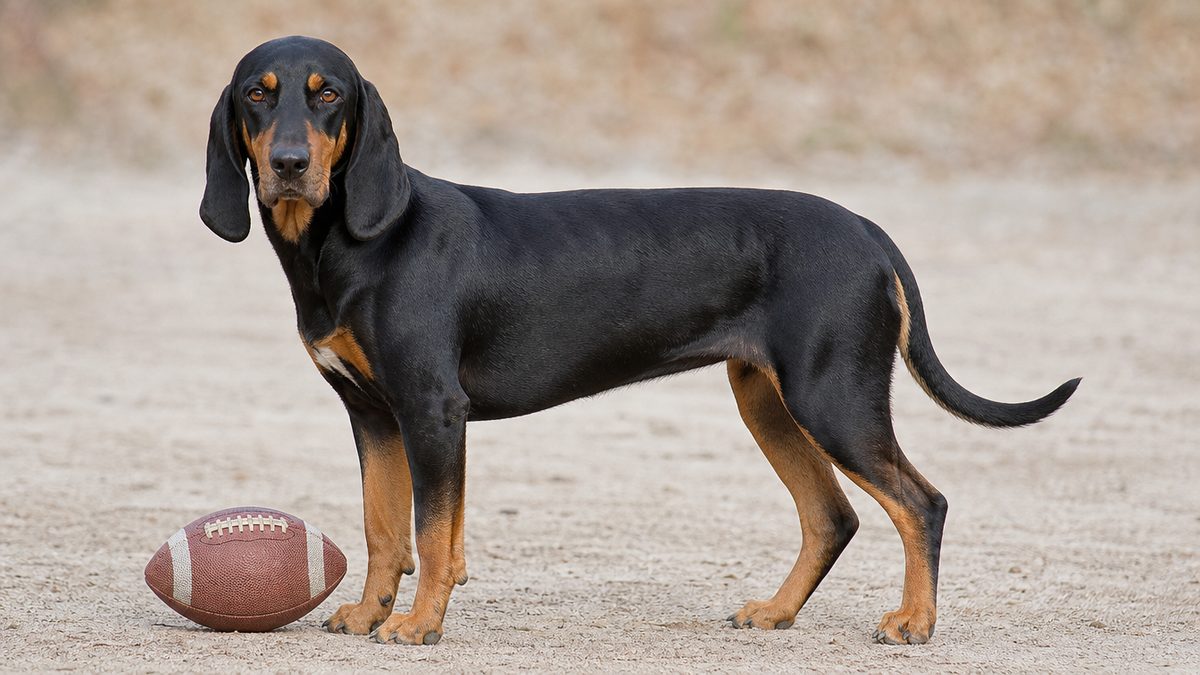
The books' distinguishing feature is dewlap. Wikipedia says the St Hubert type 'closely resembles the slightly smaller Bruno Jura Hound, to which it is closely related, although it has distinctly more pendulous flews and dewlaps', and PetPremium tells Indian readers the St Hubert falls at the higher end of the size range with a larger head and ears, weighing 34 to 55 poundsPetPremium, St. Hubert Jura Hound profile. FCI 59 requires a neck with skin loose at the throat but without noticeable dewlap, and lists a too-pronounced dewlap as a fault. The distinguishing feature of the second type is a fault under the standard governing the first.
Its height claim fails the same test. Wikipedia gives 46 to 59 cm; FCI 59 gives 49 to 59 cm for males and 47 to 57 cm for females and adds 'No tolerance of undersize or oversize'. A 46 cm dog is undersize for either sex and, under that clause, disqualified.
The article's defects propagate downstream mechanically. DBpedia's structured record for the name carries altname 'Jura Laufhund St. Hubert', coat Short, colour Black and tan and country Switzerland, every field derived from the Wikipedia article rather than from any registry. So a machine-readable knowledge base now asserts the breed's attributes, and its only upstream source is the stub that contradicts itself.
The name collides three ways, and one of them is another breed
St Hubert names a 7th-century saint, a Canadian restaurant chain, and the FCI's own name for the Bloodhound, and Google India's People Also Ask box for this breed is entirely about the saint.
This is homonym capture rather than a broken search. The engine works, the results genuinely match the string, and the string means something else in the world. Three separate collisions attach to this name and the most consequential is the third.
| Collision | What it is | How it shows up |
|---|---|---|
| Hubert of Liege | A 7th-century bishop, patron saint of hunters | All four People Also Ask questions, plus the Catholic Encyclopedia and parish sites in the organic results |
| St-Hubert BBQ | A Canadian rotisserie chicken chain from Quebec | Its own Wikipedia article in the results |
| Chien de Saint Hubert | The FCI's own name for the BLOODHOUND, record 84 | Video results describing 'The Saint Hubert Hound' as a large dog with long droopy ears and wrinkled skin |
The Bloodhound is filed by the FCI as the Chien de Saint Hubert at record 84. It is Belgian, at an ideal 68 cm for males and 62 cm for females with a 4 cm tolerance under FCI Standard 84, and built with the heavy flews and deep dewlap that FCI 59 faults in a Swiss hound. A page that merges 'St Hubert Hound' and 'St Hubert Jura Hound' will hand a reader Bloodhound size, Bloodhound ear care and Bloodhound health risks for a different dog in a different country.
The People Also Ask box is the evidence, not the noise
Google India returned four questions for this query and every one is about the saint, asking what he is famous for, whether he stopped hunting, what he is the patron saint of, and what his symbol is. The control query passed in the same session, so the instrument was working. A breed with a genuine search audience gets breed questions. This name gets hagiography, and that is a finding about the name rather than a failure of the harvest.
All four are answered verbatim in the FAQ on this page, untidied, because that is what Google actually asked. Answering them is also the most useful thing the page can do for a reader who typed the name expecting a dog, since the reason they got a saint is precisely the reason they will not find a breeder.
St Hubert Jura Hound price in India
There is no price in india for a St Hubert Jura Hound because there is nothing to sell. The type is recorded as disappeared, no registry holds the name, and no pedigree can be issued under it.
This is a stronger absence than the ordinary rare-breed absence. For most breeds on this site the answer is that no Indian market exists while the breed does. Here the name itself has no living referent, so the question has no number in it anywhere in the world, not only in India.
The living dog behind the name is also unobtainable here
If what you actually want is the Jura Laufhund that survives, Indian import law closes that route too. DGFT Trade Notice 22/2022-23 of 19 December 2022 places dogs under ITC(HS) 01061900 as Restricted, and Policy Condition (7) allows import only for a pet dog with a valid pet book in the importer's name, for an R&D organisation with a CPCSEA recommendation, or for Defence and Police use.
Policy Condition (8) reads: 'Import of commercial dogs for breeding or any other commercial activities other than the purposes mentioned above is not permitted.' Paragraph 6 adds that 'any applications for trading/breeding purposes, or applications made on behalf of some another person/entity shall be duly rejected'. An import authorisation for a personal pet covers one owner's own dog and creates no breeding stock.
What a quoted price under this name would actually be
- A different breed entirely, most often a Bloodhound, since the FCI's own name for that breed is Chien de Saint Hubert.
- A black-and-tan crossbreed presented under an unverifiable name, which is the easiest sale to make precisely because no document exists to check.
- An auto-generated listing shell that exists identically for every breed name and stocks none of them.
- A converted foreign figure, testable by dividing the rupee number by 84.38 and by 74 and seeing whether it lands on a round dollar or euro amount.
Bonbeno publishes no price for this name. What is real and checkable is what a medium hound costs to keep in India, and that follows.
What a medium Swiss hound costs to keep in India
The cost of ownership for a 49 to 59 cm hound in India runs roughly Rs 5,000 to Rs 10,000 a month once food, parasite control, vaccination and routine care are counted, and every figure below names an Indian source.
These figures apply to the living Jura Laufhund rather than to the disappeared type, and they are given because a reader who arrived here wanting the dog still needs to know what such an animal costs. A hound of this height is expensive relative to a small dog mostly through food and dose-banded medication rather than through veterinary fees.
| Item | Published figure | Source and caveat |
|---|---|---|
| Anti-rabies vaccination | Rs 699 | Vetic clinic list price, national page |
| 9-in-1 DHPPiL | Rs 899 | Vetic clinic list price |
| Kennel cough | Rs 1,349 | Vetic clinic list price |
| Tick and flea plus worming, monthly | about Rs 1,103 | NexGard Spectra 15-30 kg, 3 tablets Rs 3,308 |
| Delhi pet dog registration | Rs 500 new, Rs 500 renewal | MCD, dogs only, late fee Rs 100 a month |
| Chennai pet licence | Rs 50 | Greater Chennai Corporation |
Read the Vetic figures as one chain's list prices rather than as a market average, because that chain quotes different course prices on different city pages on the same day. The NexGard band fits this breed well, since a Jura Laufhund in condition sits inside 15 to 30 kg.
Greater Chennai Corporation's six municipal veterinary clinics provide treatment and anti-rabies vaccination free of cost, and its pet licence is Rs 50. For a Chennai reader that is a materially more affordable baseline than any private rate card, and a published municipal fact rather than an offer. Delhi's MCD charges Rs 500 to register a pet dog.
FCI 59 gives no weight for the breed, so no registry can tell you the ration. A lean hound of this height eats what its food's own feeding chart sets for its weight, and at Indian prices that is the largest recurring line.
Suitability for the Indian climate
The Swiss Jura is colder than any Indian city in any month, and this page publishes the homeland figures with their errors named because every Swiss grid cell this project has tested is unusable.
Switzerland is the worst terrain this site has measured for NASA POWER, and the Jura is the part of it that has already produced a documented error on a sibling page. POWER returns a grid cell rather than a point, and in hill country the cell's mean elevation can miss the ground by hundreds of metres, which moves the temperature with it at roughly 6.5 C per 1,000 m.
| Point | POWER cell | Real ground | Error | Annual mean returned |
|---|---|---|---|---|
| Delemont, Canton Jura | 562.99 m | 419 m | +143.99 m | 8.92 C |
| Saignelegier, Canton Jura | 535.92 m | 984 m | -448.08 m | 9.13 C |
| Basel | 562.99 m | 247 m | +315.99 m | 8.92 C |
Delemont's cell sits 150 metres too high and Saignelegier's sits 448 metres too low, and their annual means agree to 0.21 of a degree. Two cells wrong in opposite directions by 144 and 448 metres, agreeing that closely, prove only that the model has flattened the terrain. Never validate one hill-country cell against a neighbouring one; validate both against the real elevations.
A third tell fires here as well. Basel returns Delemont's cell byte for byte, at 562.99 m with an annual mean of 8.92 C and a July mean of 18.48 C, although the two towns are more than forty kilometres apart and 172 metres apart vertically. Two different places returning an identical series means one cell has been queried twice, and neither result can distinguish anything.
| Place | Annual mean C | Warmest month | Coolest month |
|---|---|---|---|
| Swiss Jura, working-altitude cell | 8.92 to 9.13 | JUL 18.48 to 18.60 | JAN -0.54 to -0.10 |
| Bengaluru | 23.74 | APR 28.37 | DEC 20.22 |
| Pune | 23.86 | APR 28.93 | DEC 19.62 |
| Delhi | 25.60 | JUN 35.88 | JAN 13.61 |
| Kolkata | 25.81 | MAY 31.53 | JAN 17.31 |
| Mumbai | 26.77 | MAY 31.19 | JAN 23.19 |
| Chennai | 27.95 | MAY 31.51 | JAN 24.09 |
The homeland row is presented as a band rather than a point, and named as a working-altitude cell rather than as any town, because that is what the elevation checks support. Even so the conclusion is not close. The Jura's warmest month is more than five degrees cooler than Chennai's coolest, and the direction of the elevation error does not threaten that, since correcting either cell to its true ground would make the homeland colder still at Saignelegier and only slightly warmer at Delemont.
Wet bulb is what actually caps the dog
A dog sheds heat by evaporation, so the wet bulb temperature is the ceiling on its cooling. The Jura cells peak around 15.4 to 15.5 C in July. Kolkata peaks at 27.09 C in June, Chennai at 26.11 C in May and Delhi at 26.50 C in July. A heat-sensitive hound moved across a gap of eleven to twelve degrees of wet bulb has lost most of its ability to cool itself while working.
Hall 2020 modelled 905,543 UK dogs and found that of the 879 heat-related illness events with a recorded trigger, 652, being 74.2 percent, were exertional rather than environmental. Neither the Schweizer Laufhund nor any of its varieties was modelled, so no breed-specific odds ratio exists and none is offered. For a working hound the transferable point is that the danger is what the dog does, not only where it is left.
Temperament and household fit
FCI 59 describes the living Jura Laufhund as lively and passionately keen on hunting, sensitive, docile and very attached to its master, and that combination makes a poor apartment dog and a good kennel companion.
Unlike the two French standards in this batch, FCI 59 does carry a behaviour clause, and it is short and useful: 'Lively and passionately keen on hunting, sensitive, docile and very attached to his master'. The utilization clause adds that the dog hunts hare, roe deer, fox and sometimes boar, in an independent manner giving tongue, searching and hunting with great determination even on difficult terrain.
Read those two clauses together
Docile and attached describes how the dog is with its handler. Independent and giving tongue describes how it works. Both are true and they pull in different directions in a household: a dog that is affectionate indoors and self-directed outdoors is exactly the dog that comes back for a cuddle and then leaves on a scent line.
- Choose another breed if you live in a flat, because a hound that gives tongue by design is unbearable through concrete.
- Choose another breed if the dog will be alone all day, because very attached is not a compliment when nobody is home.
- Choose another breed if you want reliable off-lead freedom, because this is a trailing hound.
- Consider one only with land, cool working hours, and something for the nose to do.
The Swiss Kennel Club describes pure kennel rearing of these hounds as reprehensible, which is worth knowing because the obvious Indian workaround for a vocal working dog is an outdoor kennel. That is neither the Swiss position nor lawful here without veterinary approval, since Indian law bars keeping dogs unaccustomed to local temperatures in outdoor facilities without an attending veterinary practitioner's written approval.
Nothing in the standard describes aggression, and an aggressive or overly shy dog is a fault. This is not a difficult temperament. It is a working temperament, and the mismatch is with Indian housing rather than with the dog.
Training approach and what this breed resists
Train the living Jura Laufhund for recall before anything else, because FCI 59 describes a dog that hunts in an independent manner and recall training against a live scent is the entire problem.
The registry itself treats working ability as part of the breed. FCI 59 is subject to a working trial under the FCI nomenclature, which means conformation alone does not qualify a dog. A breed assessed that way is trainable for its job by definition, and that is a different thing from being biddable in a park.
- Build recall on a long line through the first year, and never let the dog rehearse a successful chase.
- Pay recall with food that outranks the environment, and keep paying for the life of the dog.
- Give the nose a daily legal outlet, because scent work satisfies the drive that otherwise powers the escape.
- Socialise early to Indian street conditions, traffic, cattle, crowds and other dogs, at a distance the dog can handle.
- Keep a long-line default in open ground, since honest management beats an obedience claim you cannot cash.
The safe hours to work a heat-sensitive hound in most Indian cities are before dawn and after dark for four to five months of the year, which are also the hours of worst visibility and most street-dog activity. Plan the training year around the climate rather than against it, and treat a reflective harness and a light as basic equipment.
The standard's word sensitive is a training instruction in itself. Harsh handling on a sensitive trailing hound produces a shut-down dog rather than a compliant one, and a dominance framework does nothing for an animal whose motivation is scent rather than status.
Daily exercise requirement, and what happens without it
A Jura Laufhund needs at least ninety minutes of real work daily across two or three sessions, because FCI 59 describes a dog that searches and hunts with great determination even on difficult terrain.
The standard's own utilization clause sets the scale, describing a hound worked on hare, roe deer, fox and sometimes boar over difficult ground. This is an athletic endurance animal, and an Indian city walk does not approximate it.
| City | Usable hours, Apr to Jun | Practical plan |
|---|---|---|
| Bengaluru, Pune | 05:30 to 08:00 and after 19:00 | Two sessions of 45 minutes, one with scent work |
| Delhi, Ahmedabad | 05:00 to 07:00 and after 20:30 | Dawn session only in the worst weeks, indoors midday |
| Chennai, Mumbai, Kolkata | 05:00 to 07:00 and after 20:00 | Short sessions, water always, no midday movement |
Substitute the nose for the distance
Scent work is the highest-value substitution for any trailing hound, because it uses the drive the breed was built around and tires a dog faster than walking does. It also works indoors, which matters in a country where the outdoor window closes for months at a time.
- Scatter food across a room or terrace and let the dog solve the pattern rather than showing it.
- Lay a short drag trail with a scented cloth and reward at the end of it.
- Rotate the search area, because a solved puzzle stops being exercise.
- Swim the dog where genuinely clean water is available, since swimming loads the body without loading the heat.
Baying, digging, escaping and weight gain, in that order. A hound that cannot hunt does not become calm, it becomes loud. If a Swiss hound in an Indian home is vocal through the afternoon, the cause is almost always an unworked dog rather than a training failure.
Grooming and ear care in Indian humidity
Groom a Jura Laufhund in ten minutes a week and give the rest of the attention to its ears, because FCI 59 sets a short dense coat against ears long enough to reach at least the tip of the nose.
The coat is straightforward. FCI 59 gives it as short, smooth and dense, very fine on the head and leathers, and the coat colour for the Jura variety is tan with a black blanket or black with tan markings, with at most a small white patch on the chest. A rubber mitt twice a week covers the whole routine, and there is nothing to trim or strip.
A short dense coat is heat management rather than an obstacle to it. Clipping removes the layer that reflects radiant heat and exposes skin that has never met Indian sun, which makes both overheating and sunburn more likely. The standard already describes the coat as short.
The ears are the real job
India is far more humid than the Jura in the months that matter, and humidity is what turns a folded ear from a design feature into a clinical problem. The Swiss cells return annual relative humidity around 83 percent, which is high, and the difference is that Indian humidity arrives with heat rather than with an Alpine winter.
FCI 59 sets the ear low, below eye level and towards the back of the skull, narrow, drooping, folded and twisted, rounded at the tip and long enough to reach at least the tip of the nose. That is a long, folded, low-set ear lying over a warm canal. In an Indian August it is the likeliest veterinary bill this dog will generate, and an ear infection on a folded ear is harder to clear than on a simple drop ear.
- Check both ears weekly by lifting and unfolding the leather, rather than sniffing from a distance.
- Dry the canal after every swim and every bath, because water left in a warm folded canal is the mechanism.
- Use a cleaner your vet recommends, and stop if the dog flinches.
- See your nearby vet at the first head shake or odour rather than the third.
Swiss and other northern European sources routinely advise towelling a hound and letting it air dry, which is sound in an Alpine autumn and wrong in an Indian monsoon. Where an overseas club's care instruction assumes a climate India does not have, this site says so rather than reproducing it.
Ticks drive the handling calendar
The other reason to handle this dog weekly is tick-borne disease. Indian clinic series report heavy burdens among dogs presented for testing, with a West Bengal series of 584 dogs screened finding Babesia gibsoni in 76.54 percent and two or more pathogens in 72.9 percent of the 584 dogs screened. A Kerala series of 120 dogs found Babesia in 66.7 percent, peaking pre-monsoon between March and May. Both sampled dogs already at a clinic, so they describe a caseload rather than the street.
Health issues, and the one paper that exists outside PubMed
The Swiss Laufhund family has almost no clinical literature, and the single paper on the Jura Hound is not in PubMed at all. It surfaces only through Crossref, under a French breed name nobody searches.
Start with the controlled absence. Every Jura name form returns zero in PubMed: 'Jura Hound', 'Jura Laufhund', 'Bruno Jura', 'Schweizer Laufhund', 'Swiss Hound', 'Laufhund', 'St Hubert Jura' and 'Bruno du Jura'. Controls in the same session returned 126 and 141, so the instrument was working. The word Laufhund is not in PubMed's index at all.
Unquoted, 'Jura Laufhund' returns 1,140 records because PubMed searched Jura alone and reported Laufhund as a phrase not found; unquoted, 'Schweizer Laufhund' returns 6,354 because it searched Schweizer alone. Neither number is evidence of anything. Read the query translation line PubMed actually ran before treating a count as coverage.
The paper PubMed does not hold
One genuine clinical case report on this breed exists. Medan, Lucas, Etienne-Raffestin and Chaudieu published 'Adenome epithelial ciliaire chez un chien Bruno du Jura' in the Bulletin de l'Academie Veterinaire de France in 2026, describing an 11.5-year-old Bruno du Jura presented with advanced right-eye glaucoma, in which ultrasound showed a supero-temporal ciliary-body mass and histopathology after enucleation supported a ciliary epithelial adenoma.
It carries a DOI and no PMID, because the journal is not indexed in PubMed. It was findable only by searching Bruno du Jura, the French breed name, in Crossref. That is the general lesson rather than a detail: for a breed whose clinical literature is written in its own country's language, the working query is the name the clinicians there actually write, and a controlled PubMed zero can still be an undercount.
| Paper | Which dog it is about | Relevance here |
|---|---|---|
| Medan 2026, ciliary epithelial adenoma | A Bruno du Jura, FCI 59 | The only paper on this variety. Crossref only |
| Bergsjo 1981, retinal atrophy in a Swiss hound | Unstated variety, FCI 59 family | No abstract in PubMed, so the variety cannot be determined |
| Rietmann 2024, MFSD8 and neuronal ceroid lipofuscinosis | Small Swiss Hounds, FCI 60 | A different breed. Sibling literature only |
| Betschart 2014, lens luxation in 134 dogs | Luzerner Niederlaufhund, FCI 60 | A different breed and a different variety |
Two of those four are about FCI 60, the short-legged Schweizerischer Niederlaufhund, which is a separate breed from FCI 59Betschart, Hassig, Spiess. Transferring their findings to the Jura Hound would be exactly the error this site warns against. Bergsjo 1981 uses the plain English name and carries no abstract in PubMed, so the variety cannot be determined from the record.
Nobody can tell you this breed's hip rate, its eye rate or its lifespan, because nobody has measured them. Ask a seller to screen the parents under any scheme at all, and treat 'the breed has no problems' as the answer of somebody who has not looked. Consult your nearby vet about screening rather than any breed page.
Why no screening data exists, checked with controls
No Jura, Laufhund or Swiss Hound name holds a breed code with the Orthopedic Foundation for Animals, and OFA's own publication threshold explains why an absence here is a statement about sample size rather than about soundness.
OFA's breed-code list was read directly from the registry's own markup on 9 September 2026 and carries 482 breed entries. No Jura, Laufhund, Schweiz or Swiss Hound entry appears in it. The fragment SWISS returns only the Greater Swiss Mountain Dog and the White Swiss Shepherd, neither of which is a scent hound. Controls passed: LABRADOR RETRIEVER, BULLDOG and BEAGLE are all present in the code list, and in the statistics dump read in the same session LABRADOR returned 109 mentions, BULLDOG 170 and BEAGLE 61.
'Breeds are not included in the OFA statistics tables until a minimum number of individuals have been evaluated. For hips, each breed must have at least 100 evaluations in the database. For all other databases, there must be at least 50.' That sentence is the right thing to cite for any breed with no OFA row, and it is a better answer than 'no row found'.
| Register | Result | Control that passed |
|---|---|---|
| FCI definitive register, records 1 to 400 | No St Hubert record. Record 59 holds four varieties; record 84 is the Bloodhound | English Setter 2, Chesapeake Bay Retriever 263 |
| FCI provisional register | Absent | Buldogue Campeiro 374, Karaman 378 |
| OFA breed-code list, 482 entries | No code under any Jura or Swiss Hound name | LABRADOR RETRIEVER, BULLDOG and BEAGLE present |
| OFA published statistics tables | No row, under any disease | LABRADOR 109 mentions, BULLDOG 170, BEAGLE 61 in the statistics dump |
| PubMed, eight name forms | Zero on-breed records | Labrador hip dysplasia 126, Jack Russell Terrier 141 |
| McMillan 2024 longevity tables | Not among the 155 purebred breeds | The study's own breed list |
On life expectancy, this page gives no number
No published life expectancy figure for this breed or this variety rests on data. It is not among the 155 purebred breeds in the largest UK longevity study's supplementary tables, and no Swiss cohort study models it. Figures circulating on aggregator pages have no cohort behind them, and Bonbeno publishes none rather than repeating one.
The FCI checks here were done by enumerating the register itself rather than by guessing URLs, probing records 1 to 400 and reading back each page's own title. That matters because the FCI's server resolves on the trailing integer and discards the name slug, so a URL assembled from a breed name returns a real, complete page for whichever breed owns that number. Record numbers above 400 return a generic index page at HTTP 200 rather than a 404.
The provisional register was checked separately, because a breed absent from the definitive list can still sit in the provisional one. It does not. The FCI's provisional register holds no St Hubert, no Jura and no Laufhund entry, read with the Buldogue Campeiro at 374 from 6 August 2025 and the Macedonian Shepherd Dog Karaman at 378 from 11 February 2026 passing as in-document controls. Worth noting in passing that the FCI's own page title for that register misspells the word provisional.
Feeding a medium Swiss hound in India
Feed a Jura Laufhund to a body condition score rather than to a chart, because FCI 59 gives no weight and no published feeding guidance for the breed exists.
The standard sets height and proportions and no mass. It gives 49 to 59 cm for males and 47 to 57 cm for females, a body length to height ratio of about 1.15 to 1, and a height to chest depth ratio of about 2 to 1. Those proportions describe a lean, deep-chested, moderately long dog and they do not tell you what it should weigh.
- Feel the ribs with flat fingers and expect to find them under a thin cover, without pressing.
- Look down at the standing dog and expect a visible waist behind the ribs.
- Look from the side and expect an abdominal tuck rather than a level underline.
- Weigh monthly on the same scale and record it, because a trend beats a single reading.
The chest depth changes how you feed
A height to chest depth ratio of 2 to 1 is a deep-chested dog, and deep-chested conformation is the recognised risk factor for gastric dilatation-volvulus, which is a surgical emergency rather than an upset stomach.
Split the daily ration into two or three meals, avoid hard work for an hour either side of a meal, and slow a fast eater with a maze bowl. Unproductive retching, a distended abdomen and restlessness together are a same-hour emergency, and the number to call is your nearby vet.
Water matters more here than in the Jura. A dog cooling by panting loses water fast, and a hound of this size in an Indian summer will drink several litres a day. Offer it in more than one place and refresh it rather than topping it up.
Month by month through the first year
Plan a Swiss hound's first year around the socialisation window and the first Indian summer, because those are the two periods where a mistake cannot be corrected later.
This timeline is generic medium-hound guidance honestly labelled, because no breed-specific developmental data exists for FCI 59 or any of its varieties. Generic guidance named as generic beats breed-specific guidance invented.
| Age | Priority | What to do |
|---|---|---|
| 8 to 12 weeks | Vaccination and habituation | Complete the core course with your vet; begin surface, sound and handling exposure indoors |
| 12 to 16 weeks | Socialisation window | Short daily outings in cool hours; traffic, cattle, crowds and other dogs at a workable distance |
| 4 to 6 months | Recall foundation | Long-line work only; never rehearse a chase; begin scent games |
| 6 to 9 months | Growth protection | Low impact, no forced running; register the dog with your municipality |
| 9 to 12 months | Endurance, slowly | Build distance gradually in cool hours; introduce longer trailing games |
| 12 months onward | Adult workload | Ninety minutes daily; recall proofing continues for life |
A puppy's first Indian summer is the highest-risk heat period of its life. Indian law names young animals explicitly among the categories that must not be kept in outdoor facilities without a veterinarian's written approval, alongside dogs not accustomed to the temperatures prevalent in the area and breeds that cannot tolerate them. Treat that as a care standard rather than only a rule for breeders.
Register the dog when your municipality requires it. Delhi charges Rs 500 for a new pet dog registration and Rs 500 to renew, with a late fee of Rs 100 a month, and Greater Chennai Corporation charges Rs 50 for a pet licenceGreater Chennai Corporation.
Head to head against the dogs this name gets confused with
The useful comparison for this name is not other Swiss hounds but the three dogs readers actually mean when they type it, being the surviving Jura Laufhund, the Bloodhound and the short-legged Swiss hound.
| Dog | Register entry | Height | Status |
|---|---|---|---|
| St Hubert Jura type | None anywhere | Not specified in any standard | Recorded as disappeared in FCI 59 |
| Bruno Jura Hound | The Jura variety of FCI 59 | 49 to 59 cm males | Living, carries its own CACIB |
| Chien de Saint Hubert (Bloodhound) | FCI 84 | Ideal 68 cm for males and 62 cm for females, 4 cm tolerance | Living, a separate Belgian breed |
| Schweizerischer Niederlaufhund | FCI 60 | 35 to 43 cm | Living, four varieties merged in 2015 |
Two rows in that table are the ones that cause real damage. The Bloodhound stands at an ideal 68 cm for males and 62 cm for females, with a 4 cm tolerance either way, and is built with the heavy flews and deep dewlap FCI 59 faults, so merging it with a Swiss hound hands a reader the wrong size, the wrong ear-care burden and the wrong health profile Federation Cynologique Internationale. The Niederlaufhund is 35 to 43 cm for males and 33 to 40 cm for females, short-legged, and a different breed number entirely, so confusing it with FCI 59 halves the dog.
What an Indian buyer can actually get instead
| Breed | Indian availability | Heat tolerance | Voice |
|---|---|---|---|
| Any Swiss Laufhund variety | None | Very poor | Very high |
| Beagle | Widely available | Moderate | High |
| Basset Hound | Available | Poor | High |
| Indian Pariah Dog | Free, everywhere | Excellent | Moderate |
If the nose and the voice are the appeal, a Beagle is the same instrument in a housing an Indian home can hold. If the long folded ear is the appeal, a Basset Hound carries an even heavier one and a worse ear-disease burden in Indian humidity, so be clear you are choosing more work rather than less.
An Indian Pariah Dog is heat-adapted, robust, free, and available in every Indian city. For a household drawn to a working hound's temperament but living in an Indian climate, it is not a consolation prize; it is the animal that can actually do the job of being a dog here.
What readers get wrong about the St Hubert Jura Hound
The commonest mistake is believing the breed exists, and it is a reasonable mistake because Wikipedia, DBpedia and several aggregators all present it as a living Swiss breed.
- Believing it is a living breed. FCI 59's own history says the Jura type St. Hubert has disappeared, in the authentic German and in the English translation alike.
- Treating Wikipedia's article as a registry claim. It cites three book pages and no registry, and its own status field says no major kennel club recognises it.
- Reading the navbox as a breed count. Four Swiss Laufhund-family entries correspond to two FCI breed numbers.
- Confusing it with the Bloodhound. The FCI's own name for that breed is Chien de Saint Hubert, record 84.
- Taking the 46 cm height floor as real. FCI 59 gives 49 to 59 and 47 to 57 with no tolerance of undersize.
- Trusting an unquoted PubMed count. 'Schweizer Laufhund' unquoted returns 6,354 records for a search that never ran.
- Assuming a Swiss climate figure is precise. Every Swiss cell tested returns an unusable elevation, so the homeland figures here are bands with named errors.
The mistake that costs a dog rather than money
For anyone who does end up with a Swiss hound in India, working it in midday heat is the error with the worst outcome. A trailing hound with a job in front of it does not self-regulate. The wet-bulb gap between the Jura's July peak near 15.5 C and Kolkata's June peak of 27.09 C is the reason, because that is the ceiling on the evaporative cooling the dog depends on.
Heavy unrelenting panting, a dog that lies down and will not rise, brick-red or very pale gums, vomiting, wobbliness or collapse. Move to shade, wet with cool rather than ice-cold water, offer small drinks, and reach your nearby vet at once. A rectal temperature at or above 41.0 C after exertion in heat is an emergency.
One research mistake worth naming separately, because it is the one this site itself nearly made. Searching a breed's English or FCI name and finding nothing is not the end of the search. The only clinical paper on this variety exists under Bruno du Jura, the French name, and is absent from PubMed entirely. A controlled zero on the names you thought of is still a zero on the names you thought of.
Adoption and responsible sourcing
Adopt rather than pursue this name, because nothing can be sold under it honestly and the living Swiss hound behind it cannot lawfully be imported into India to breed or sell.
No pedigree can exist under this name. There is no standard to judge a dog against, no register to enter it in, and no club that recognises it. That is a stronger statement than for an ordinary rare breed, and it is the practical conclusion of everything above.
Before anything else, verify what you are being shown. Ask which registry issued a pedigree, read the breed name printed inside the document rather than on the covering email, and check that name against the register's own index. Every claim on this page was made that way, and every one of them is checkable in under ten minutes by anyone with a browser.
What to do if the type is what appeals to you
- Read the Bruno Jura Hound page, which covers the type that survives and the Swiss registration figures behind it.
- Ask a municipal shelter or an established rescue for a young medium hound-type dog, since those are hardest to place and closest in temperament.
- Consider an Indian Pariah Dog, which is heat-adapted, robust, free and available everywhere in India.
- Ask any seller which registry issued the pedigree, then check that registry's own index rather than trusting the certificate.
The FCI register is enumerable and resolves on the trailing number, so any certificate can be checked against it. The Schweizer Laufhund is record 59 and the Bloodhound is record 84Federation Cynologique Internationale. No FCI record exists for a St Hubert Jura Hound at any number. A certificate naming one is describing a document the FCI does not issue.
If you are outside India
The route to a living Jura Laufhund runs through the Swiss clubs and the Swiss Kennel Club, and the breed is worked rather than shown as a companion. FCI 59 is subject to a working trial, so a breeder will reasonably expect the dog to hunt. Expect a wait, and expect to be assessed.
Bonbeno does not recommend breeders, link puppy listings or quote any price as an offer. This page reports what registries and governments publish, and for this name the conclusion is that it belongs in a history section rather than in a search for a puppy.
What the pages ranking in India actually tell you
The Indian search results for this name carry no registry document, and the single most-cited page contradicts itself twice inside its own infobox while a chicken restaurant and a 7th-century bishop outrank the dog.
| Source | What it says | What the primary document says |
|---|---|---|
| Wikipedia | A breed of scenthound of the Jura Mountains | FCI 59 records the Jura type St. Hubert as disappeared |
| Wikipedia infobox | Name: Bruno du Jura Hound | That is a different article's subject |
| Wikipedia infobox | Not recognised as a breed by any major kennel club | Correct, and it contradicts the article around it |
| Wikipedia infobox | Height 46 to 59 cm | FCI 59: 49 to 59 males, 47 to 57 females, no tolerance |
| PetPremium | Larger than the Bruno, weighs 34 to 55 pounds | FCI 59 gives no weight at all and one size for the breed |
| Siwalu Software | Closely resembles the larger St. Hubert Jura Hound | Circular: it is describing the same dog twice |
| A video result | The Saint Hubert Hound is a large dog with wrinkled skin | That is the Bloodhound, FCI 84 |
| Every ranking page | No FCI standard quoted | The standard settles the question in one sentence |
What the People Also Ask box shows
Google India returned four questions and every one is about Saint Hubert of Liege, asking what he is famous for, whether he stopped hunting, what he is the patron saint of, and what his symbol is. The control passed in the same session. A query that resolves to hagiography is a query the engine cannot resolve to an animal, and that is the cleanest evidence on this page that the name has no living referent.
Google printed 'About 95 results' for this query and 'About 192 results' for the Labrador control in the same session. A printed result count is not a measure of anything and this page draws no conclusion from one. The evidence here is composition rather than volume: the organic results are dominated by the Catholic Encyclopedia, parish websites, a hunting order and a Canadian rotisserie chain.
The gap this page fills is a single sentence nobody had opened. FCI Standard 59 is free, public, and available in four languages on the FCI's own site, and its brief historical summary answers the question the entire English-language internet treats as unsettled. Reading the authentic German edition rather than the English translation makes the answer blunter still.
St. Hubert Jura Hound questions people actually ask
What is St. Hubert famous for?
Saint Hubert of Liege is famous as the patron saint of hunters and the first Bishop of Liege, best known for a vision of a crucifix between a stag's antlers while hunting on Good Friday. Google returns this question first for the breed name, which is the clearest evidence available that the name does not resolve to a dog. The hound type was named after him because he is the hunters' saint.
Did Saint Hubert stop hunting?
According to the legend, yes. The story holds that Hubert gave up his wealthy hunting life after the vision of the crucifix and entered the church, later becoming Bishop of Liege. Google asks this on a dog search because the name collides with the saint. The dog type named for him is recorded as gone by the standard that governed it, which makes the collision the only live part of the query.
What is Saint Hubert the patron saint of?
Hunters, principally, and also mathematicians, opticians and metalworkers. That patronage is why his name attaches to two separate hound lineages, the Belgian Chien de Saint Hubert which is the FCI's own name for the Bloodhound at record 84, and the Swiss Jura Laufhund type this page is about. Two different dogs, one saint, and a great deal of confusion in English.
What is the symbol of St. Hubert?
A stag with a crucifix between its antlers, which appears on hunting insignia across Europe and on the badges of hunting orders. The symbol matters here only because it explains the naming. A hound described as of the St Hubert type is being called a hunting saint's dog, not being assigned to a registry, and no registry has ever held the Swiss type under that name.
Is the St. Hubert Jura Hound a real breed?
No. It is a historic type of the Jura variety of the Schweizer Laufhund, FCI standard 59, and that standard's own brief historical summary records that the ancient variety, the hound of the Jura type St. Hubert, has in the meantime disappeared. The authentic German text is blunter, saying the original variety of the Jura Laufhund of the St Hubert type is gone today. No registry anywhere holds it.
What is the difference between the Bruno Jura and the St Hubert Jura?
The books record one substantive difference, which is that the St Hubert type carried heavier flews and a more pendulous dewlap. FCI Standard 59 requires a neck with skin loose at the throat but without noticeable dewlap, and lists a too-pronounced dewlap as a fault. So the only feature distinguishing the two is a fault under the current standard, which means a heavy-dewlapped Swiss hound today is a faulty Jura rather than a second variety.
How much does a St Hubert Jura Hound cost in India?
Nothing, because none exists to sell. The type is recorded as disappeared in the governing standard, no registry holds it, and no pedigree can be issued under the name. Separately, Indian import law bars importing any dog for breeding or trading, so no supply chain could form even for the living Jura Laufhund. Any price quoted to you under this name is for a different animal or for nothing at all.
Why does Wikipedia say it is a breed?
Wikipedia carries a stub article that calls it a scenthound breed of the Jura Mountains, and the article contradicts itself in two places. Its infobox prints the name 'Bruno du Jura Hound', which is a different article's subject, and its status field reads 'Not recognised as a breed by any major kennel club'. Both statements sit in the same box. The article rests on three pages of three books and cites no registry.
How tall is a Jura Hound?
FCI Standard 59 gives 49 to 59 cm at the withers for males and 47 to 57 cm for females, and adds 'No tolerance of undersize or oversize', which makes any deviation a disqualifying fault. Wikipedia's St Hubert Jura article gives 46 to 59 cm, a floor below the standard's floor for either sex. The proportions matter as much: body length to height is about 1.15 to 1.
Is there any health research on the Jura Hound?
One paper exists and PubMed does not hold it. A 2026 case report in the Bulletin de l'Academie Veterinaire de France describes an 11.5-year-old Bruno du Jura with advanced right-eye glaucoma and a ciliary-body mass, enucleated, with histopathology supporting a ciliary epithelial adenoma. It is findable through Crossref under the French breed name. Every PubMed query on every Jura name form returns zero against passing controls.
Is the St Hubert Jura Hound the same as a Bloodhound?
No, and this is the most consequential confusion attached to the name. The FCI's own name for the Bloodhound is Chien de Saint Hubert, record 84, a Belgian breed standing at an ideal 68 cm for males and 62 cm for females, with heavy flews and a deep dewlap. The Swiss Jura Laufhund is a different dog in a different country at 49 to 59 cm, whose standard faults a pronounced dewlap. Sharing a saint's name is the only thing they share.
Could a Jura Hound live in India?
It would need heavy management and no lawful route exists to bring one here. The Swiss Jura runs an annual mean around 8.9 to 9.1 C against Chennai's 27.95 C, and its warmest month is cooler than Chennai's coolest. Every Swiss grid cell this project has tested is unusable for elevation, so those figures are published with their errors named rather than as precise values.
Compare with similar breeds
St. Hubert Jura Hound sits in 3 Bonbeno groups. Each one compares it directly against the breeds it is genuinely an alternative to, on the same figures.