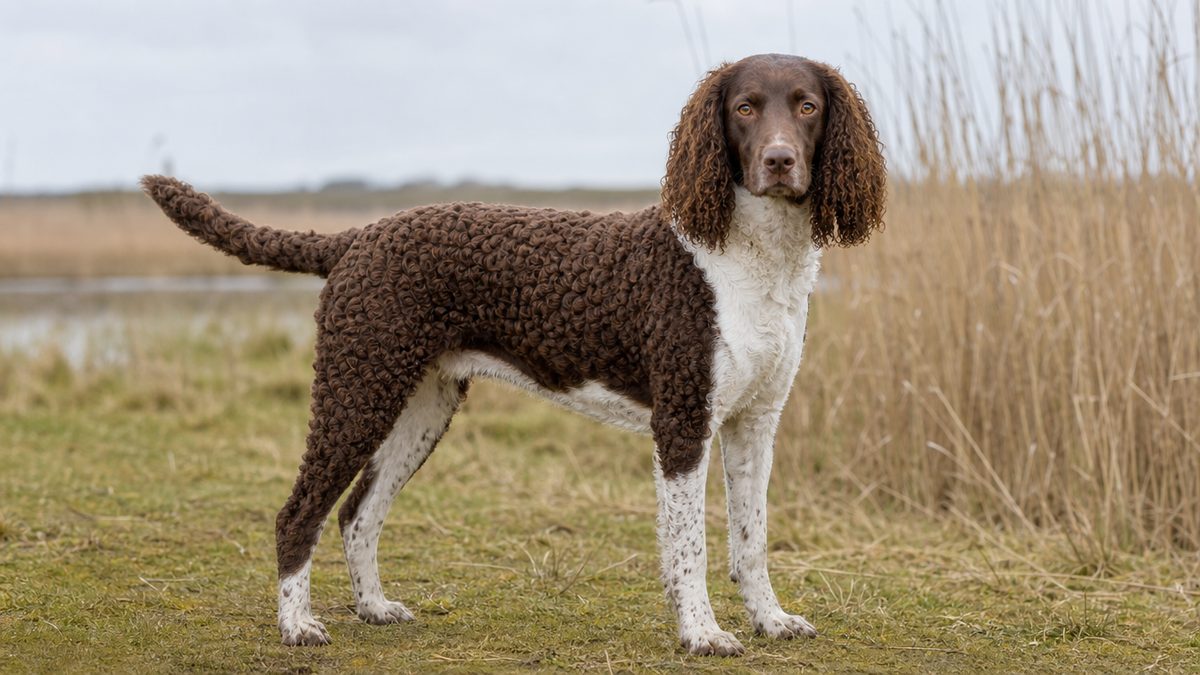
English Water Spaniel: The Duck Dog England Let Go
It hunted duck in East Anglia, it had a written standard, and the Kennel Club put it in a class it never bothered to define. Here is what the register actually holds, where the famous 1930s extinction date really comes from, and why every Indian page about it is selling you a different dog.
By Bonbeno EditorialVeterinary review: Dr. Ashish J., MVScUpdated 27 August 202646 min read
Quick answer
The English Water Spaniel cannot be bought in India or anywhere else, because the breed is extinct. It was a liver and white curly-coated gundog used for duck hunting in East Anglia, shown at early Kennel Club shows in a class called 'Water Spaniels other than Irish', and absorbed into other spaniel breeds by about 1900. Every Indian page offering one is offering a different dog.
Health information notice
This guide summarises nineteenth-century sporting literature, kennel-club stud books and registers, peer-reviewed veterinary research, Indian import and breeding law and satellite climate data as general information for Indian pet owners. It is not a diagnosis and it is not treatment advice. Consult a registered veterinarian near you before acting on anything you read here, and treat collapse, laboured panting that does not settle, a head held tilted with a painful ear, or sudden weakness as an emergency and go straight to a clinic.
English Water Spaniel traits, rated for Indian conditions
Heat tolerance1 of 5
The floor, and it rests on origin climate and workload rather than on measurement, because no measurement was ever taken. Norwich averages 10.11 C across the year and 17.13 C in July, while Chennai's coolest month averages 24.09 C. This was a heat-sensitive cold-water gundog under a thick oily jacket, and every Indian city in the comparison is hotter in its mildest month than East Anglia is in its warmest.
Availability in India1 of 5
Zero, and permanently so. The breed is extinct, there is no FCI number and therefore no Kennel Club of India pedigree route, and DGFT Trade Notice 22/2022-23 states that applications to import a dog for trading or breeding purposes shall be duly rejected. A controlled search returned ten Indian results, none of them this breed.
Registry recognition1 of 5
None, anywhere, and unrecognised is the correct word rather than unlisted. Absent from the Royal Kennel Club's 227-breed A to Z, absent from FCI nomenclature, absent from the American Kennel Club. It survives in registry documents only as a named extinct ancestor inside the United Kennel Club's American Water Spaniel standard.
Evidence quality3 of 5
Better than most extinct breeds, and that is the surprise of this page. Two published written descriptions exist, four volumes of the Kennel Club Stud Book carry the class, three period paintings survive, and one dog can be named with a registration number and three generations of breeding. What is missing is everything medical: no lifespan, no screening data, no health survey, no genuine peer-reviewed literature.
Grooming load in Indian humidity2 of 5
Heavy, and heavier than the curl suggests. A thick oily closely curled jacket mats from underneath, holds water against the skin, and cannot safely be shaved off in summer. The ears are the real work: long, pendulous, and covered in curls longer than the body coat, on a dog whose entire purpose is swimming.
Suitability for an Indian apartment1 of 5
None. This was a wildfowling dog expected to quarter heavy cover and swim repeatedly through a shooting day, and the nearest living equivalent's own spec card asks for one to two hours of exercise daily at a high energy level. The heat, not the floor space, is what settles it.
First-time owner friendly1 of 5
Not applicable in the ordinary sense, and misleading wherever an aggregator scores it. No living dog can be assessed, and the period sources describe training requirements for a silent hand-signal gundog rather than a household temperament. Any friendliness rating you see for this breed was generated, not observed.
Cost of ownership in India1 of 5
Unbuyable at any price, and Bonbeno publishes no rupee figure for it, because the only available numbers describe other breeds. The costs that would matter for a dog of this type in India are year-round tick prevention, monsoon ear care, active coat drying and cooling, and none of them buy the climate the breed needed.
What the English Water Spaniel was, and what it was not
The English Water Spaniel was a curly-coated British gundog bred to find and retrieve wildfowl from water, described in print from the sixteenth century onwards, and extinct as a breed by the early twentieth century.
Start with the job, because everything else follows from it. This was a wildfowler's dog, worked in reed beds, rivers, marshes and flooded ground, and its whole design was arranged around getting a shot duck out of cold water quietly. In the first half of the eighteenth century it was used mainly for duck hunting in East Anglia, the flat wet country of Norfolk, Suffolk and the fens, which is exactly the sort of ground that produces a water dog.
Hugh Dalziel, writing in the standard Victorian reference on British breeds, described what the work demanded, and the description is more useful than any spec card. The dog had to be under perfect command and obedient to a signal, because silence matters in freshwater shooting and wildfowl are wary. It had to be taught to slip into the water noiselessly rather than with a rush and a plunge. It had to quest assiduously and in silence, keep within range, work to hand signals, and retrieve boldly.
Every one of those is a training requirement rather than a conformation point, which tells you what kind of animal was being selected. This was a dog you trained to be quiet, not a dog you bred to look a certain way.
The size question, and why there are two answers
Two sizes were recognised, and the sources are consistent about it. Writers from the beginning of the nineteenth century generally describe two varieties used in wildfowling, the larger called the Water Dog and the smaller the Water Spaniel, both curly-haired. Dalziel's own advice was practical: for the freshwater fowler a large dog is not required, and one of 30 lb to 40 lb, roughly 14 to 18 kg, will work the sedges, reeds and willows of river sides better than a big one.
Drury adds the reason the two sizes existed at all, and it is a good one. A man who shot the sea coast needed a bigger, stronger dog than an inlander who found his quarry in marshes, rivers and sedgy ponds. So the size split was a working adaptation, not two breeds.
Edward Ash, writing in 1927 when the breed was already effectively gone, put the height at approximately 20 inches, about 51 cm, and the colours at liver or tan and white. That is the figure Wikipedia repeats today.
Three names for one dog, and one of them is Shakespeare's
The breed answered to Water Spaniel, Water Dog and Water Rug. The last is the interesting one. Drury's judgement was that Shakespeare's water-rug was probably a water spaniel used on the wildfowl of the Avon and the streams around Wootton Wawen and Henley-in-Arden. That is a reasonable inference from a playwright's vocabulary and a local landscape, and it is worth reading as exactly that rather than as a documented breed history.
The four texts that actually describe it, in order
Four early sources carry a real description of the English Water Spaniel, and reading them in order shows a single consistent dog rather than a legend that grew in the telling.
The value of these texts is that they were written by people who used the dog, before anyone had a breed club, a stud book or a reason to exaggerate. Dalziel's point, made twice, is that every writer on dogs from the fourteenth century to his own day referred to this dog and described it more or less minutely. Drury's revision of the same book puts the starting date at the sixteenth century instead, which is the first small disagreement on the page and worth noticing rather than smoothing over.
A dog whose service is required in fowling upon the water, somewhat big and of a measurable greatness, having long, rough and curled hair, not obtained by extraordinary trades but given by Nature's appointment
The Gentleman's Recreation
1686
A very similar description, per both editions of British Dogs
The Sportsman's Cabinet
1802 in Dalziel and Drury, 1803 on the plate itself
The hair long and naturally curled, not loose and shaggy, with an engraving from a Reinagle drawing showing a medium-sized liver and white curly-coated spaniel, legs feathered but not curled
The Sportsman's Repository
1820
If you want to hunt ducks or other waterfowl you had best use an English Water Spaniel; it has a curly coat like a Poodle and swims and dives as well as the ducks
The Caius date deserves a sentence of its own, because the two dates in that table are not a contradiction. Caius wrote his Latin account of British dogs in 1570, and Abraham Fleming's English translation appeared in 1576. Dalziel dates the work and Drury dates the English textW. D. Drury, 'British Dogs: Their Points. Both are defensible and neither is an error.
What the 1820 account adds
The Sportsman's Repository is the most specific of the four, and it reads like someone describing a dog he has actually shot over. It says the dog swims and dives as well as the ducks themselves, and that it is intelligent enough not to be lured away from the nesting places when the birds try to draw it off. It says the best of the breed were those with long ears whose coat was white under the belly and around the neck but brown on the back.
That last sentence is a colour preference stated by a working shooter, which is a different kind of evidence from a show standard, and it matches the Reinagle engraving of 1803 and the Chalon portrait of 1797.
One 1607 mention that does not describe anything
Ria Horter records that a standard work published in 1607 mentioned the 'Water Spagnel';. A mention is not a description, and Bonbeno lists it here as a name in circulation rather than as evidence about what the dog looked like. Where a source only names a breed, say so; the temptation on a rare breed is to promote a name into a portrait.
What it looked like, from the two written descriptions rather than the paintings
The English Water Spaniel was a leggy, medium-sized, thickly curled liver and white spaniel with a smooth face, long curl-covered pendulous ears and large spreading feet, and two separate written descriptions of it survive.
Most pages describe this breed from its paintings, which is why the descriptions wander. There are two written point-by-point descriptions available, and they agree closely, so this section works from those and uses the pictures only as a check.
Strong, compact, of medium size, leggy by comparison with the Clumber, Sussex or Field Spaniel, showing much greater activity
Body large, round and barrel-like, chest deep and broad, croup rising towards the stern so the dog stands higher behind than in front
Head
Rather long, brow apparent but not very great, jaws fairly long and slightly pointed
Skull long, straightish and rather narrow; jaws long and rather pointed, without superfluous lip
Face
Whole face and skull to the occiput covered with short smooth hair, and no forelock as in the Irish Water Spaniel
Curl should end at the occiput, leaving the face quite smooth and lean-looking, no topknot
Eyes
Fairly full but not watery, clear, brown, with an intelligent beseeching expression
Small, dark and intelligent
Ears
Long, rather broad, soft, pendulous, thickly covered with curly hair of greater length than on the body
Of medium length, set on forward, and thickly coated
Coat
Thick and closely curled over the upper body and sides, flatter on the belly and the front of the legs
Oily, and composed of thick, crisp curls; ears and stern thickly covered with ringlets
Colour
Prevailing colour liver and white, but whole liver, black, and black and white also described by some writers
Liver and white, self-coloured liver, or liver-roan and white, usually with a blaze up the face
Tail
Usually docked, rather thick, and covered with curls
Carried a little above the level of the back, but by no means highly
The one feature that settles arguments
The smooth face is the diagnostic point, and both descriptions insist on it. Dalziel writes that the whole face and skull to the occiput is covered with short smooth hair, with no forelock as in the Irish Water Spaniel. The Sporting Spaniel Society says the curl should end at the occiput, leaving the face quite smooth and lean-looking, with no topknot.
Two independent bodies both chose to define the breed against the Irish Water Spaniel's topknot. That is not a coincidence, and it is the reason the two breeds should never be described as versions of each other.
Where the descriptions disagree
They disagree on the ears and on the body. Dalziel wants long, rather broad ears; the Society wants ears of medium length set on forward. Dalziel wants a leggy, compact, active dog; the Society wants a large, round, barrel-like body with a rising croup. Those are different dogs at the margin, and the honest reading is that the Society's description was written later, for the show ring, on a population that had already drifted.
The docked tail is a historical fact, not a template
Dalziel records that the tail was usually docked. That was ordinary practice in nineteenth-century Britain and it is illegal in India today. Second Schedule Part II paragraph 6(8) of the Dog Breeding and Marketing Rules 2017 states that 'There shall be no tail docking, ear cropping de-barking, de-clawing, branding, dyeing, injecting substances to enhance visual appeal' and that 'any change of appearance by artificial means is strictly forbidden';. The law section below sets this out properly.
The breed did have a written breed standard, and Wikipedia says it did not
Two written descriptions of the English Water Spaniel were published, one by Hugh Dalziel and one by the Sporting Spaniel Society, which contradicts the most repeated sentence about this breed on the internet.
Wikipedia's account is that the Kennel Club initially had a class for 'Water spaniels other than Irish' because no standard was specifically set up for the English Water Spaniel. That sentence is cited to Dalziel. Dalziel's own text says something different and narrower.
What Dalziel actually complains about is that the Kennel Club set up no standard of its own. His words are that had the Kennel Club set up a standard of their own, which sportsmen and exhibitors could read and understand, there would be at least something tangible to deal with, and that instead they ignore the only descriptions we have of the breed and give us nothing but chaos, because dogs have won in this class of every variety of spaniel character except the right one.
Read that carefully. He is not saying the breed has no description. He is saying the registry refused to adopt the descriptions that already existed. He then prints one himself, running to eleven points from general appearance through to tail.
And a second one exists, from a real body
Drury's edition prints a further description under the heading 'Here is the description of the English Water Spaniel, published by the Sporting Spaniel Society', with twelve headed points from Skull to Colour. The Sporting Spaniel Society was a working-gundog body of the period, and its 1902 reclassification of spaniels is what retired the Norfolk Spaniel's name.
So the position is the opposite of the one that ranks. Two written breed standards for the English Water Spaniel were published. Neither was adopted by the Kennel Club, and that failure to adopt is the actual story.
What the ranking pages say about the breed standard, against what the cited books say Hugh Dalziel, 'British Dogs
Claim
Where it appears
What the source says
No standard was specifically set up for the English Water Spaniel
Wikipedia, cited to Dalziel
Dalziel says the Kennel Club set up no standard, then prints his own eleven-point description
The judging of the class was described as chaos by Hugh Dalziel
Wikipedia
Correct, and Dalziel's reason is that judges ignored the descriptions that did exist
The Kennel Club recognized fourteen English Water Spaniels
DogBreedInfo
No source says this. Drury says the Stud Book increased its list in that class by fourteen in twelve years
Recognition: UK Kennel Club
DogBreedInfo's spec block
The Royal Kennel Club's current Breeds A to Z carries 227 breeds and does not include it
The last row matters most for a reader, because a spec card that says a breed is recognised by the Kennel Club is the kind of thing an answer engine repeats. The Royal Kennel Club's complete A to Z listing was read in full on 27 August 2026. It holds 227 breed cards. Spaniel (Irish Water), Spaniel (Field), Spaniel (Clumber), Spaniel (Sussex), Spaniel (American Water) (Imp) and Retriever (Curly Coated) are all present as controls. There is no Spaniel (English Water).
What the Kennel Club Stud Book actually recorded, volume by volume
The Kennel Club never ran an English Water Spaniel class; it ran a class titled 'Water Spaniels other than Irish', and reading four volumes of the Stud Book directly shows that class shrinking from a crowded show ring in 1874 to one single dog in 1884.
This is the part no ranking page has done, and it is not hard: the Kennel Club Calendar and Stud Book is digitised and searchable, so the register can simply be read. Four volumes were read in full for this page.
1874, a real class with real competition
Volume I lists the class as Class XVII, Water Spaniels other than Irish, and its show reports name winners at meeting after meeting. Mr J. D. Gorse's Drake and Mr J. Bolton's Dash. Mr P. Bullock's Rover, repeatedly. Mr C. E. Crisp's Don. Captain the Hon. W. Arbuthnott's Flo, who wins at Hull, Birmingham and Alexandra Palace. Mr W. Page's Jessica. At one show the dog prizes were withheld altogether and only a bitch was placed.
Prizes being withheld is the detail Dalziel was complaining about. A judge who will not award a first prize is a judge who cannot find a dog matching a description, which is what happens when a class has no agreed standard.
1876, four dogs in the whole volume
Volume II of 1875 sits between them and shows the class already thinning. It carries the class at page 123 as Class XVI, and its show reports name the same handful of dogs over and over. At one meeting Captain the Hon. W. Arbuthnott's Flo took first and Holmes's Dash second. At another the first prize was withheld altogether, leaving Holmes's Dash placed second behind nobody and Mr J. Hiram's Albert third. At a third, Dash won and Arbuthnott's Young Rover was second. A class in which the judge repeatedly declines to award a first prize is a class in trouble.
Volume III moved the class to Class XVI and its pedigree section runs to a little over one page. It contains three dogs, Dash, Rover (Young) and Shylock, and one bitch, Flo. Shylock is the only new entry with a full pedigree: bred by his owner Mr W. Page of the White Lion Hotel, Banbury, whelped 1875, by Holmes's Dash out of Jessica.
1884, one dog
Volume XI carries the class as Class XVII, Spaniels, Water, other than Irish, at page 184. It contains exactly one animal.
By Mr Scott's Don out of Mr Watmore's Queen; Don by Mr Laycock's Dash out of his Fan
Show record
Sheffield, 3rd
That is the whole class. One liver dog with a white breast, born in Northumberland in 1881, third at Sheffield. Anyone writing about this breed can now name a specific animal with a registration number, a birth date, a colour and three generations of breeding, which is more than any secondary source about the English Water Spaniel currently offers.
What this does and does not prove
A single volume is a snapshot of one year's new entries, not a census of living dogs, so Swimmer being alone in 1884 does not mean he was the last of his kind. What it does establish is the direction and the scale: a class that filled show reports across Britain in 1874 was, ten years later, one dog. Dalziel had already put the cumulative list at about two dozen spaniels.
Where the 1930s extinction date comes from, and how firm it is
The 1930s date rests on one sentence written in 1967 by John F. Gordon, who said none had been seen for over thirty years, so 'the last specimen seen in the 1930s' is subtraction performed on that sentence rather than a recorded sighting.
Follow the citation back and the chain is short. Wikipedia opens by saying the breed has been extinct since the first part of the twentieth century, with the last specimen seen in the 1930s, and its History section attributes the underlying claim to Gordon. The source for that is Ria Horter's article, which quotes him verbatim: 'After two centuries of breeding it is now extinct', and 'None has been seen for over thirty years';.
Gordon wrote that in 1967. Sixty-seven minus thirty is 1937. That is the entire derivation of the 1930s.
Why that is weak evidence for a date
Three things are wrong with treating 1937 as a sighting. First, 'over thirty years' is a lower bound, not an interval; a writer who means forty years often writes over thirty. Second, it is a negative observation made in retrospect by one author, and negative observations about rare dogs are exactly the kind of statement that gets rounded. Third, and most simply, nobody has produced the sighting. There is no named dog, no owner, no place and no year attached to any last English Water Spaniel.
Gordon 1967, 'none has been seen for over thirty years', worked backwards
Extinct since the 1900s
An extinct-animals forum thread reproducing Wikipedia
Nothing further; it sits in the same paragraph as the 1930s claim
Disappeared sometime after 1903
DogBreedInfo
The publication date of Drury's revised edition, not an event
Extinct since the first part of the 20th century
Wikipedia's own opening clause
A hedge around the Gordon sentence
Not yet extinct, specimens survive in the eastern counties
Drury, in the same book
Drury's own belief, written while the class still existed
A firmer date is available, and it is earlier
The register gives a harder edge than the memoir does. Dalziel, published 1897, wrote that he did not believe the breed was lost, but that scattered throughout the country there were many specimens of the old English water spaniel. Drury, revising the same book, narrowed it: the breed is not yet extinct but that scattered throughout England, principally in the eastern counties, there are still specimens, and that most of the specimens in evidence are either foundlings or reversions that have cropped up in families of Land Spaniels.
That is a man defending a breed while conceding that what he is seeing are throwbacks appearing inside other breeds' litters. Set that beside the Stud Book, where the class held four dogs in 1876 and one in 1884The Kennel Club Calendar and Stud Book, and the useful statement is this: the English Water Spaniel had ceased to exist as a breeding population by about 1900, and the 1930s date describes the tail of individual look-alike dogs rather than the breed.
One named strain, and one man
Drury names the last holder of the type: 'it is probable that Sir Thomas Boughey, of Aqualate, possesses the sole remaining strain of these dogs. His Spaniels are an heirloom in the family; but, in defiance of the ordinary law, they have ever been distinguished by topknots';. That is the single most specific claim anyone makes about the breed's last days, and it comes with a self-refuting detail attached, because a topknot is precisely what both written descriptions say this breed must not have.
Why it disappeared, in the words of the people who watched it happen
The English Water Spaniel was absorbed into the land spaniel breeds rather than dying out, and its contemporaries blamed a registry that gave it a class but no definition.
Extinct breeds usually have one of three stories behind them: the work stopped, the population crashed, or the type was bred into something else. This one is squarely the third, and unusually the contemporaries said so at the time.
Dalziel's complaint is that while the Irish Water Spaniel continued, the English Water Spaniel was allowed to be quietly absorbed into other spaniel breeds. Horter puts it more bluntly still, calling it the only spaniel that really has disappeared, apparently without a trace, in contrast to the Tweed Spaniel which stood at the birth of the Golden Retriever and the Norfolk Spaniel which was simply an early edition of the English Springer.
The three mechanisms, and how much weight each carries
A class with no definition. The Kennel Club ran a class for Water Spaniels other than Irish and adopted no description for it, so dogs of every variety of spaniel character except the right one took the prizes. A show class that rewards the wrong dog is a selection pressure pointing away from the breed.
A newer import doing the same job better. DogBreedInfo's account is that the St. John's water dog began arriving from Newfoundland in the 1800s, was skilled at hunting, retrieving and water work, and displaced it. That is plausible and it matches the timing of the retriever breeds' rise, but Bonbeno reports it as an account rather than a proven cause, because the page carrying it is the same page that invents a lifespan.
Absorption into the land spaniels. This is the best evidenced. Drury records that by his time most specimens in evidence were foundlings or reversions cropping up in families of Land Spaniels, which is what a breed looks like after it has been bred into its neighbours.
The argument the judges used, and the answer to it
One school held that the English Water Spaniel had never existed as a distinct breed at all. Drury quotes the judge writing as 'Idstone': English Water Spaniels are simply crosses and modifications of the Irish race, in many cases imperfect examples of that for which Mr M'Carthy and Captain Montresor are celebrated.
Drury's reply is the sharpest paragraph in either book, and it is a piece of reasoning rather than an assertion. He concedes that the dogs actually winning prizes were as Idstone described them. Then he points out that Idstone's argument only works if the Irish Water Spaniel is the older variety, and that there is no evidence the Irish Water Spaniel existed as a distinct breed even as recently as the early decades of that century. Wikipedia agrees on the chronology, dating the Irish breed's development to the 1830s.
So the older dog was being called a degenerate copy of the younger one, by judges who had been rewarding the copies. That is a specific, evidenced, and slightly bleak explanation of how a breed dies inside a registry that has a class for it.
It is not the Irish Water Spaniel, and the difference is one you can see
The Irish Water Spaniel is a living FCI breed with a topknot and a bare rat tail, while the English Water Spaniel was defined by a smooth face with no topknot at all, which is the opposite feature.
This confusion is the main reason a reader ends up on the wrong page, and the two Indian commercial results for this query are both Irish Water Spaniel listings, so it costs money as well as accuracy.
The Irish Water Spaniel is fully recognised. The Federation Cynologique Internationale carries it as breed 124, Group 8, Section 3 Water Dogs, accepted on a definitive basis on 28 December 1954, country of origin Ireland, subject to a working trial. The Royal Kennel Club lists it as Spaniel (Irish Water) in the Gundog group. It is a living breed you can buy, register and show.
Recognised, FCI 124, definitive since 28 December 1954
Head furnishing
Face and skull smooth to the occiput, no forelock, no topknot
Distinctive topknot, which is the breed's signature
Tail
Curled and thickly covered, usually docked in period practice
The bare rat tail, famously covered in skin only
Colour
Liver and white, self liver, liver-roan and white, usually a blaze
Solid liver
Developed
Described in print from the sixteenth century
Developed as a breed from the 1830s
Available in India
No, and permanently so
Advertised, though see the price section on what is actually in stock
Keep the historic type and any modern claim of descent apart when you read about either breed. The English Water Spaniel is a historic type known only from written descriptions, three paintings and a show class; the Irish Water Spaniel is a living registered breed with a current standard, a working trial requirement and dogs you can go and look at. A sentence that slides from one to the other, as most pages do, is describing two different things.
The one thing nobody knows
Whether the English breed contributed to the Irish one is genuinely open, and the reason is documentary. Justin McCarthy, the man credited with developing the Irish Water Spaniel, left no written records, so it is unknown whether the English Water Spaniel was involved in its development. Bonbeno leaves that where the evidence leaves it. A page that resolves an open question to make a cleaner story is a page that will be quoted resolving it.
Drury's joke, and why it matters here
Drury took a swipe at the show fancy of his day for insisting that an Irish Water Spaniel's stern must be covered with skin only and as innocent of hirsute adornment as a mop-handle. The point underneath the joke is serious and it is this page's argument in miniature: the features that get written into standards are often the ones that are easiest to judge, not the ones that make the dog work. The English Water Spaniel had no such feature, and it had no standard anyone would enforce.
The three living breeds said to carry its blood, and how good each claim is
The American Water Spaniel, the Curly Coated Retriever and the modern Field Spaniel are all said to descend in part from the English Water Spaniel, and the three claims are supported by very different qualities of evidence.
An extinct breed's descendants are where fabrication creeps in, because the claim is unfalsifiable and flattering to everyone. So each of these is graded here by who is making it.
American Water Spaniel: the strongest claim, because a registry makes it
The United Kennel Club's official breed standard for the American Water Spaniel says in its History section that some say the breed developed from crosses of the now extinct English Water Spaniel, Irish Water Spaniel and the Flat Coated Retriever, and records that on 8 February 1920 the UKC registered the first American Water Spaniel, 'Curly Pfeifer'. That is a registry naming the breed in its own standard document, which is a stronger source than any encyclopedia.
Notice how the UKC standard is written, though. 'Some say' is doing careful work, and Bonbeno keeps it. The American Kennel Club's own American Water Spaniel page, which recognises the breed from 1940 and ranks it 176 of 210 for popularity, does not mention the English Water Spaniel at all.
The detail that makes the American claim interesting
Two points in the UKC standard are exactly the two points that defined the English breed. The skull must be 'covered with short smooth hair and without tuft or topknot'. The tail is faulted if it is a 'Rat or shaved tail';. Those are the English Water Spaniel's smooth face and the Irish Water Spaniel's rat tail, written into a living standard as a requirement and a fault respectively.
That is not proof of descent, and Bonbeno does not present it as proof. It is a real observation that nobody writing about this breed has made, and it is checkable in one document.
Curly Coated Retriever: a registry account, reported as such
Field Spaniel: the most specific, and the most checkable
The Field Spaniel claim is the only one with a named individual behind it. Wikipedia records that one of the four progenitor dogs used in creating the modern breed was an English Water Spaniel and Cocker Spaniel cross, registered at the time as a Sussex Spaniel because of his liver colour. A dog registered as one breed because of his colour, in an era when a class existed for spaniels nobody could define, is entirely consistent with everything else on this page.
Recognition today: none, anywhere, and here is how that was checked
No kennel club recognises the English Water Spaniel, and the check was run with controls so that an absence means an absence rather than a broken query.
Proving a negative is the whole job on an extinct breed, and it is the step most pages skip. Each register below was read as a complete list, and a control breed that must be present was confirmed in the same fetch.
124 Irish Water Spaniel and 110 Curly Coated Retriever both returned, each naming its breed on its own page
American Kennel Club
Absent
American Water Spaniel present, recognised 1940, ranked 176 of 210
United Kennel Club
Named only as an extinct ancestor inside another breed's standard
American Water Spaniel standard returned in full, revised 1 June 2012
What recognition means for an Indian reader
India is a full member of the FCI, represented by the Kennel Club of India in Chennai, so the KCI issues pedigrees against FCI nomenclature. That makes the FCI question the India question: a breed with no FCI number has no pedigree route in India, and the English Water Spaniel has no FCI number.
There is nothing unusual or unfair about that. A register records living breeding populations, and there is no population here to record.
The literature check, and why the numbers look wrong
A PubMed search for the exact phrase 'English Water Spaniel' returns 26 records, which looks like a body of research and is not. The returned query translation shows what happened: PubMed could not match the phrase, so it decomposed it into english AND water AND spaniel and searched that instead. Opening the first five records settles it. They are a paintball ingestion case report in a dog, two plant genomics papers on Alyssum and the Brassicaceae, a study of chronic ionizing radiation in aquatic plants, and a canine olfaction threshold study.
The control run in the same session shows the tool is working. 'Irish Water Spaniel' returns 6 records with the phrase preserved intact in the query translation, because that phrase exists in the index as a phrase. Zero peer-reviewed papers about the English Water Spaniel is the honest answer, and it is publishable, but only because the search proved itself first.
English Water Spaniel price in India: there is none, and here is the proof
No English Water Spaniel price exists in India or anywhere else, because the breed is extinct, and a controlled search shows that every Indian result for the query is a different breed.
Say the whole answer first. You cannot buy this dog. There is no price, no waiting list, no import route and no breeder, and any figure you are shown for an English Water Spaniel puppy is a figure attached to some other animal.
That claim was tested rather than assumed. A web search for 'english water spaniel price in india puppy', with location set to India, was run on 27 August 2026 and returned ten results. Not one was about the English Water Spaniel. The set was a Supertails Cocker Spaniel price guide, a Puppiezo Irish Water Spaniel listing, three American Water Spaniel pages, a Mr n Mrs Pet Cocker Spaniel cost article, a Good Dog Irish Water Spaniel page and a Pets4Homes Irish Water Spaniel page.
The control, run in the same session
An absence only counts if the instrument works, so the identical search was run for 'labrador retriever price in india' immediately afterwards. That query returned ten Indian pages carrying real rupee figures, including Mr n Mrs Pet at INR 30,000 to INR 1,20,000 across three quality tiers with a city-by-city table, Supertails at Rs 8,000 to Rs 70,000, and Asiapets at Rs 8,000 to Rs 30,000.
So the search engine returns Indian puppy prices when Indian puppy prices exist. For this breed it returns other breeds, because there is nothing to return.
What an Indian buyer is actually offered when they search for this breed Firecrawl web search
Position
What ranked
What it is selling
1
Supertails, Cocker Spaniel price in India
A different spaniel, Rs 18,000 to Rs 30,000, up to Rs 80,000 KCI-registered
2
Puppiezo, Irish Water Spaniel puppies for sale
A different breed, price given only by telephone
3, 4, 6, 8
Petfinder, Little Brownies Kennel, dogbreedslist, Emma.ca
American Water Spaniel, all United States pages
5, 9, 10
Good Dog, Lancaster Puppies, Pets4Homes
Irish Water Spaniel, United States and United Kingdom pages
7
Mr n Mrs Pet, Cocker Spaniel cost
A different spaniel, INR 35,000 to INR 1,20,000
What to do if a seller offers you one
Walk away, and treat the offer as information about the seller rather than about the dog. No lawful supply chain can exist: there is no living population to breed from, no FCI number and therefore no Kennel Club of India pedigree route, and DGFT Trade Notice 22/2022-23 states that applications to import a dog for trading or breeding purposes 'shall be duly rejected';. A seller quoting a price for an extinct breed is either mislabelling a crossbreed or is not selling a dog at all.
The one Indian page that ranks, and the eight animals in its shop window
The only Indian commercial result for this query is a Puppiezo page selling the Irish Water Spaniel, and its stock carousel contains eight animals, none of them a water spaniel of any kind.
Position two in the Indian search is Puppiezo's page, titled 'Irish Water Spaniel Price in India, Buy Premium Puppies Online', with a meta description promising KCI registered puppies from trusted breeders available nationwide. There is no price on the page for an Irish Water Spaniel. There is a telephone number and a carousel of what is actually in stock.
Rs 98,999 appears three times on that single page, attached to two Maltipoos and a Doxiepoo. Bonbeno has now recorded this exact figure across eleven pages of this site, attached to whichever puppy is in stock, on pages for breeds the site does not stock at all. It is a house price point, not a breed price.
It is also not a currency conversion. Rs 98,999 divided by 84.38 is 1,173.25 dollars, which is not a number any seller prints, and the same is true at 74 and at 80. This is a rupee-native charm price ending in 999, set by a shop, and it tells you what the shop charges rather than what a breed is worth.
Why this matters more than a wrong price usually does
An answer engine reading that page sees a title naming a water spaniel, a meta description promising KCI-registered puppies, structured data with review ratings, and eight rupee figures. It has no way to notice that the animals are two Maltipoos, two Poodles, a Cane Corso, a Goldendoodle, a Rottweiler and a Doxiepoo. This is precisely how a price band for a breed that has no Indian market gets manufactured and then quoted back as fact.
The eight-week rule is the one thing to check here
Every animal in that carousel is listed at 8 weeks. Rule 8(1)(a) of the Dog Breeding and Marketing Rules 2017 requires that 'pups less than eight weeks in age are not sold'. Eight weeks is the legal floor, not a selling point, and a listing that advertises the floor as a feature is worth reading twice. Note the citation form: this is Rule 8(1)(a) of the Rules themselves, which is a different provision from Second Schedule Part III paragraph 8(10) quoted elsewhere on this page.
Auditing the pages that rank: an invented lifespan and a gestation calculator
Two of the three most detailed English Water Spaniel pages on the internet fabricate care data for a dog that has not existed for a century, and both can be caught with checks that take under a minute.
This section exists because the search results for an extinct breed are unusually dangerous. Nobody competes for them, so a single template-generated page can own the query and become the source an answer engine cites.
DogBreedInfo: contradicts itself inside one spec block
The page prints a Height, Weight block that reads: Height 18 to 22 inches, Weight 35 to 55 pounds, Weight 55 to 90 pounds. Two different weight ranges, one after the other, with no label distinguishing them. A reader cannot use that and a machine will pick one.
It then does something worse. Under Life Expectancy it says that because this dog is extinct there are no records of how long they lived, and that because they are similar to the American Water Spaniel they probably lived around 12 to 15 years. Under Litter Size it repeats the move to arrive at 4 to 6 puppies. Under Health Problems it says that because the dog is extinct there are no known health issues.
Each of those sentences admits the absence of data and then supplies a number anyway. Never substitute a related breed's numbers. A page with no lifespan study should say so and stop, which is what this page does in its own health section.
The same page also advises that the breed would have done fine in a small space such as an apartment and would be content with daily walks, and that its longer fur required brushing about twice a week. That is care guidance for an animal nobody alive has met.
Creatures.com: sells what it says does not exist
The page opens honestly, stating that the breed no longer exists as a living standardized breed and that no responsible seller can offer a pure living English water spaniel. It then offers a marketplace alert for the moment a new English Water Spaniel listing goes live, an English Water Spaniel Herdbook, English Water Spaniel Profiles, an English Water Spaniel Breeders directory, and a Dog Gestation Calculator preset for the breed. All four counters read zero.
The colour list, and the control that proves what it is
The same page prints a Colors field listing 55 entries for a breed every historical source describes as liver and white. Among them are Albino, Leucistic, Melanistic, Blue Merle, Harlequin, Brindle and Reverse Brindle. It also lists Gray and Grey as two separate colours, which is a spelling variant rather than a colour and is the clearest possible sign of a machine-assembled master list.
The control was run on the same site. Creatures.com's Labrador Retriever page carries 634 breeders, 10 public profiles and 1 herdbook record, so the site can and does hold real content. Its colour list runs to 54 entries and includes Champagne, Charcoal and Fox Red, which are Labrador-specific, alongside Blue Merle and Harlequin, which are not. So the failure is per-breed on the content and site-wide on the colour field.
The detail that gives the whole thing away
The Featured Listings block on the English Water Spaniel page shows three live animals for sale. One of them, from Ravenna, Texas, is named 'Blue pullet';. A pullet is a young hen. The identical three listings appear on the Labrador Retriever page, which confirms the block is site-wide furniture rather than anything to do with either breed. Cite pages like these only as evidence of fabrication, never for a fact.
And the search engine itself, which has to be audited too
The last thing worth auditing is the instrument. A Bing India results page for 'english water spaniel' returned HTTP 200, the correct page title and 'About 7,370 results', and then served ten organic results every one of which was about Chase Sapphire Reserve credit-card airport lounge access. Nothing errored and the result count looked authoritative.
The control run in the same session through the same endpoint returned ten results genuinely about the breed for 'labrador retriever', with 'About 47,700 results';. So the fetch works and the substitution is specific to the obscure query. Bonbeno records that rather than drawing any conclusion from it, because a poisoned result set proves nothing in either direction, including about whether a People also ask box exists.
Monthly cost of ownership, and why the arithmetic is still worth doing
No English Water Spaniel can be kept in India at any monthly cost, but working the numbers for the nearest living equivalent shows what the real barrier is, and it is not money.
There is no cost of ownership for this breed because there is nothing to own. What follows is an honest substitute question: what would it cost to keep a 20 to 25 kg curly-coated working gundog in an Indian metro, and what would that money fail to buy?
Bonbeno publishes no rupee figure for this breed's purchase price, and that is deliberate. The only way to produce one would be to convert a foreign figure or to repeat a marketplace number attached to a different animal, and both are fabrication. The two Indian pages that rank for the query are a Cocker Spaniel guide and an Irish Water Spaniel listing whose stock is eight dogs of six other breeds.
What a comparable dog costs to keep well
The recurring costs that matter for a curly-coated water dog in India are food, ear care, tick and flea control, and grooming. Ear care is the one most owners underestimate, and the Indian evidence in the health section below is specific about why.
Food for a 20 to 25 kg active dog on a complete commercial diet, the largest recurring line and the one that scales with exercise.
Ear cleaning and vet visits for otitis externa, which in one Indian hospital series accounted for 3.27 percent of all dogs presented, peaked at 59.25 percent of cases in the rainy season, and was linked to water entering the ear in 20.98 percent of cases.
Tick and flea prevention, year round rather than seasonal, because Ehrlichia canis is endemic in tropical India.
Grooming for a thick curly coat that must be dried properly rather than left to air dry in a monsoon.
Air conditioning or a cool room through the hot months, which for a heat-sensitive northern gundog is a welfare requirement rather than a luxury.
The cost that cannot be paid
The one thing an Indian owner cannot buy at any price is the climate this dog was built for, and the climate section quantifies the gap. A wildfowling dog bred for a Norfolk winter is being asked to work in a place whose coolest month is warmer than its ancestral home's hottestNASA POWER 20-year climatology. No monthly budget closes that.
If you actually want this kind of dog
The useful spend is on a living breed that does the same job. The Curly Coated Retriever is FCI 110 and is documented on this site's own Curly Coated Retriever guide with real Indian price forensics. The Irish Water Spaniel is FCI 124 and is genuinely available, though the page selling it in India stocks neither. Either is a real dog with a real standard, real health screening and a real gene pool behind it.
Could an English Water Spaniel handle the Indian climate? The heat tolerance answer
Chennai's coolest month averages 24.09 C, which is 6.96 C hotter than the warmest month in the East Anglian country this breed worked, so its heat tolerance rating is the floor and the reason is arithmetic rather than opinion.
The heat rating is one of the few figures on this page that is genuinely Bonbeno's own rather than borrowed, so it was built from satellite climatology queried by explicit latitude and longitude rather than by place name. The origin point is longitude 1.2974, latitude 52.6309, Norwich, in the middle of the East Anglian wetland country where the breed was used for duck hunting in the first half of the eighteenth century. The interface echoed those coordinates back as 1.297 and 52.631, so no other place can have been served by accident.
NASA POWER 20-year climatology, January 2001 to December 2020, every point queried by coordinates NASA POWER 20-year climatology
Place
Annual mean C
Coolest month C
Warmest month C
Annual max C
Norwich, East Anglia
10.11
3.96 (Jan)
17.13 (Jul)
30.18
Shillong, Meghalaya
17.96
10.74 (Jan)
22.38 (Aug)
29.91
Bengaluru
23.74
20.22 (Dec)
28.37 (Apr)
40.38
Pune
23.86
19.62 (Dec)
28.93 (Apr)
43.20
Delhi
25.60
13.61 (Jan)
35.88 (Jun)
48.79
Kolkata
25.81
17.31 (Jan)
31.53 (May)
46.81
Mumbai
26.77
23.19 (Jan)
31.19 (May)
44.91
Chennai
27.95
24.09 (Jan)
31.51 (May)
42.70
One comparison carries the section. Norwich's warmest month averages 17.13 C. Chennai's coolest month averages 24.09 C. January in Chennai is nearly seven degrees hotter than July in the country this breed was bred for, and Chennai's annual mean of 27.95 C sits above anything Norwich reaches as a monthly average at all.
The hill-station test, and why it does not rescue the breed
Shillong was added as the fairest possible case, because it is the coolest large Indian settlement most readers could realistically move to. Its annual mean of 17.96 C is 7.85 C above Norwich's, and its warmest month of 22.38 C is 5.25 C above Norwich's warmest. Even the mildest option in India runs a full Norfolk summer hotter than the breed's home.
The largest primary-care study of the question reviewed 905,543 UK dogs under veterinary care in 2016 and identified 1,259 heat-related illness events from 1,222 dogs. Of those events, 380 had no trigger recorded. Of the remaining 879 events with a recorded trigger, 652 were exertional, which is 74.2 percent, followed by environmental at 113 events, 12.9 percent, and vehicular confinement at 46 events, 5.2 percent.
Exercise, not a parked car, is what puts dogs in clinics. Now read that against what this breed was for. A wildfowling dog works in cold water, swims repeatedly, and quarters heavy cover for hours; the Sportsman's Repository describes it swimming and diving as well as the ducks. That workload in a Chennai May is the exertional case in the dataset.
One transferable finding, and one that is not
This breed appears nowhere in Hall and colleagues' breed analysis, because it was extinct before the cohort existed, so none of the paper's breed-specific odds ratios may be applied to it. What transfers is the trigger split, which is not breed-specific: exertion is the dominant cause, it occurs year-round, and exertional heat-related illness in that dataset carried a 7.6 percent fatality rate. Borrowing a breed odds ratio for a breed the authors never studied would be fabrication wearing a citation.
The humidity trap, and why wet-bulb is the number that matters
Norwich is more humid than five of the seven Indian cities in this comparison, which sounds like good news for a marsh dog until wet-bulb temperature is computed and the picture reverses completely.
The raw humidity numbers point the wrong way, and they are worth printing for exactly that reason. Norwich's annual mean relative humidity is 85.41 percent. Kolkata's is 73.93, Chennai's 72.39, Shillong's 81.91, Bengaluru's 67.94, Mumbai's 67.39, Pune's 66.80 and Delhi's 45.56.
So the lazy shorthand that a British breed will struggle in India because India is humid is simply wrong here. East Anglia is a damp maritime climate and this dog worked in flooded ground through the winter. Moisture by itself was never the problem for it.
Wet-bulb, which combines the two
Wet-bulb temperature combines heat and moisture into the single figure that governs whether a body can shed heat by evaporation. Computed from each point's monthly mean temperature and relative humidity using the Stull formulation, the ranking inverts.
Wet-bulb temperature from NASA POWER monthly means, computed with the Stull (2011) formulation NASA POWER 20-year climatology
Place
Annual RH %
Annual wet-bulb C
Peak monthly wet-bulb C
Peak month
Norwich
85.41
8.57
14.72
July
Shillong
81.91
15.80
21.33
July
Pune
66.80
19.43
22.97
June
Bengaluru
67.94
19.48
21.86
May
Delhi
45.56
17.80
26.50
July
Mumbai
67.39
22.20
25.77
June
Kolkata
73.93
22.25
27.09
June
Chennai
72.39
24.04
26.11
May
Norwich's hardest month reaches a wet-bulb of 14.72 C. Kolkata's June wet-bulb is 27.09 C, which is 12.37 C higher. Chennai's annual mean wet-bulb of 24.04 C is 9.32 C above Norwich's single worst month, which means Chennai spends every month of the year past anything this breed's home climate ever produced.
Mumbai is the clearest single illustration of the reversal. Its relative humidity of 67.39 percent is below Norwich's by eighteen points, which by the lazy reading should make it the easier climate, and its June wet-bulb of 25.77 C is 11.05 C above Norwich's hardest month. Lower humidity, vastly higher heat load.
Why that matters for a curly-coated dog specifically
A dog cannot sweat over most of its body, so it dumps heat by panting, which is evaporative cooling from the airway. The higher the wet-bulb, the less each breath achieves. Add a thick, oily, closely curled coat designed to trap a warm insulating layer against cold water, and the animal is carrying a wetsuit into a sauna.
Delhi shows why relative humidity alone misleads in the other direction too. Its annual humidity of 45.56 percent is the lowest here by more than twenty points, which makes it look like the dry, tolerable option. Its July wet-bulb of 26.50 C is nonetheless the third highest of the eight, because the monsoon lands on top of extreme heat.
The one rule worth taking away
Plan exercise by wet-bulb rather than by temperature, for any thick-coated dog you actually own. Bengaluru and Pune, at annual wet-bulbs of 19.48 and 19.43 C, are genuinely the mildest large Indian cities for a working dog, and they still sit eleven degrees above this breed's home ground. Nothing in the table makes India workable for an English Water Spaniel. It does make the difference between Indian cities visible, which is useful for the dog in front of you.
Temperament: what the working literature says, and what nobody can tell you
The English Water Spaniel was described as biddable, silent under discipline and highly trainable to signal, and no source records anything about how it behaved as a household pet because it was never kept as one in numbers.
There are two honest paragraphs available on this breed's temperament and a great deal of confident invention around them. The honest material is all about work.
Dalziel's account is a list of behavioural requirements rather than adjectives. The dog had to be under the most perfect command and obedient to a sign. It had to enter water silently rather than plunging. It had to quest assiduously and in silence, keep well within range and work to signal, and be as bold and persevering as it was obedient. Drury reproduces the same passage almost word for word.
Read that as a temperament description and it says something specific: this was a dog that could be told what to do at a distance, without a voice, and would keep doing it. Handler focus and a soft mouth, not independence.
Where the confident descriptions come from
DogBreedInfo tells readers the breed was known to be extremely affectionate and loyal to their owners and easily trained because they were an intelligent breed, and that they were very popular and able to perform physical activity for hours a day without a break. No period source supports the affection and loyalty claims. They are the standard adjectives every breed page carries, applied to a dog nobody has observed since before the Second World War.
Bonbeno separates the two. Trainability to signal is documented. Household temperament is not, and this page does not supply it.
What can reasonably be inferred, and labelled as inference
Biddable under discipline, because silent hand-signal work at range cannot be got from a dog that is not.
Water-obsessed, because the whole selection pressure ran that way and the 1820 account describes a dog that would not be lured off its task by decoying birds.
Noise-sensitive in the useful direction, because it was trained to enter water without a splash and to quest without giving tongue.
Unknown with children, with cats and alone in a flat, because no source addresses any of it.
A gundog temperament is not a family-dog temperament
The two living relatives make the point. The American Water Spaniel is described by its own registry as a busy worker, eager to please and easily trained, with viciousness or extreme shyness as a disqualification, and the AKC adds that the breed craves companionship and is best suited to households where someone is home during the day. That is a real temperament note about a real breed. Applying it backwards to an extinct ancestor is exactly the substitution this page refuses to make.
Training a water spaniel: what the period sources demanded, and what still applies
Training an English Water Spaniel meant teaching silence, distance control and a clean water entry, and the same three things remain the core of gundog training for any living water breed today.
To train a dog of this type, start with silence and finish with water, because the order matters and the period sources are unusually explicit about it.
Dalziel's sequence is worth reading as a curriculum. Perfect command first, because silence in freshwater shooting is absolutely necessary to success and wildfowl are peculiarly wary and timid. Then obedience to a sign, because a voice carries across water. Then the water entry itself, taught so the dog slips in noiselessly rather than with a rush and a plunge, if the bag is to be well filled. Then questing in silence within range. Then retrieving, boldly and persistently, by early education and under the most perfect command.
The one instruction that does not transfer to India
Nothing in the training passage assumes a climate, which is unusual for period breed-club advice and worth noting, because overseas care guidance often does. Where it fails for an Indian handler is timing rather than method. Every session that involves swimming and retrieving is exertion, and exertion accounted for 652 of the 879 heat-related illness events with a recorded trigger in the largest UK study, 74.2 percent. In an Indian summer that means short sessions, early mornings, and water that is genuinely cool rather than a tank that has been standing in the sun.
What a modern handler would keep
Teach the recall and the stop whistle before any retrieving game, so distance control exists before excitement does.
Train hand signals from the start, because a gundog that only works to voice is a gundog that cannot work at range.
Build the water entry deliberately, from a walk-in shallow edge rather than a thrown dummy off a bank.
Cap every session on a success, since a spaniel that has been drilled past its concentration learns to switch off.
Verify the ears after every swim, which is the Indian addition the period sources never had to make.
That last item is not a nicety. In an Indian hospital series of 81 otitis externa cases, 20.98 percent were linked to water entering the ear and 33.33 percent showed moisture accumulation in the ear canal. A breed whose entire purpose is swimming, with long pendulous ears carrying curls longer than the body coat, is the highest-risk possible combination for that.
The advice that does not survive the journey
Overseas water-dog guidance routinely says to towel a dog off and let it air dry. In an Indian monsoon that is a mistake, because the ear canal never gets a chance to dry. The Palam Valley series found 59.25 percent of the year's otitis cases presenting in July and August alone. Dry the ear canal, not just the coat.
Exercise: what the job actually demanded, and what it means in an Indian city
An English Water Spaniel was expected to quarter heavy cover and swim repeatedly for a shooting day, which is roughly two hours of hard work, and an Indian city can supply the time but not the conditions for eight months of the year.
The exercise requirement can be read straight off the work rather than guessed. Wildfowling means walking wet ground, pushing through sedges, reeds and willows, and swimming out repeatedly for shot birds. That is a substantial daily workload for a 14 to 25 kg dog, and it is the reason the breed was described as swimming and diving as well as the ducks.
The nearest living comparison gives a number. Puppiezo's own spec card for the Irish Water Spaniel, the closest surviving equivalent, lists an exercise routine of 1 to 2 hours daily and a high energy level. The UKC calls the American Water Spaniel a busy worker. Neither is a dog that settles on a balcony.
Why an Indian city cannot supply it
The constraint is not space or time, it is heat. Working a thick-coated retrieving dog hard means generating heat at a moment when the wet-bulb temperature is already high, and the wet-bulb figures in the section above show Chennai above Norwich's worst month in every month of the yearNASA POWER 20-year climatology.
Months in which a hard swimming and retrieving session is realistic, by city, using annual wet-bulb as the guide NASA POWER 20-year climatology
City
Annual wet-bulb C
Practical reading
Norwich
8.57
Year round, which is the baseline this breed was built for
Shillong
15.80
Most of the year, with July and August restricted
Pune
19.43
Winter mornings only, from roughly late November to February
Bengaluru
19.48
Winter mornings only, similar window to Pune
Delhi
17.80
Winter is workable, April to September is not, and July is the worst month of the eight
Mumbai
22.20
Early mornings in January and February at most
Kolkata
22.25
Early mornings in December and January at most
Chennai
24.04
No month clears Norwich's hardest month
What under-exercising this type of dog produces
A bred-to-work spaniel that is not worked does not become calm. It becomes noisy, destructive and self-employed, because the drive to quest is not optional equipment. The honest version of that sentence, though, is that it applies to living water spaniels rather than to this one, and Bonbeno says so: no behavioural record of an under-exercised English Water Spaniel exists.
Swim, do not just walk
If you keep any water breed in India, swimming is the exercise that works here, because water at body temperature or below removes most of the heat load that walking creates. The catch is the ear, and it is a real one: clean and dry the canal after every session, since water entry accounted for 20.98 percent of cases in the Palam Valley series.
Grooming a curly coat in Indian humidity, and the hypoallergenic claim
The English Water Spaniel carried a thick, oily, closely curled jacket that was designed to hold water out rather than to be easy to keep, and in Indian humidity the ears and the undercoat are where that design turns into a problem.
The coat is the breed's defining feature and both written descriptions agree on it. Dalziel: thick and closely curled over the whole upper part of the body and sides, flatter on the belly and the front of the legs, which should be well clad at the back with feathery curls. The Sporting Spaniel Society is blunter about the working purpose, specifying a coat that is oily and composed of thick, crisp curls, with the ears and stern thickly covered with ringlets.
A working water dog needs a waterproof outer layer over a warm one, and oil plus tight curl is how a coat achieves that without a wetsuit. In a Norfolk January that is superb engineering. In a Mumbai June it is insulation you cannot remove.
What that coat needs in India
Brush to the skin rather than over the curl, because a tight curl mats from underneath and a surface brush leaves the mat intact.
Dry the dog actively after every swim and every bath, since air drying in monsoon humidity means a coat that stays damp against the skin for hours.
Check the ear canal, not just the ear leather, every single time the dog gets wet.
Resist shaving the coat off in summer, because a double-purpose coat also reflects sun and a shaved dog burns and overheats faster, not slower.
Inspect the feet after wet ground, because large spreading feet with hair between the pads hold moisture and grit.
The hypoallergenic question, which has a settled answer
Curly coats attract the hypoallergenic claim, and it is worth answering here because the two living relatives of this breed both attract it. The claim is unsupported. Vredegoor and colleagues measured Can f 1 across 196 dogs of so-called hypoallergenic breeds against 160 control dogs and found the hypoallergenic group came back higher, not lower: 2.26 against 0.77 micrograms per gram in hair, and 27.04 against 12.98 in coat samples, with no difference in airborne allergen.
Neither of the written descriptions of the English Water Spaniel says anything about shedding at allW. D. Drury, 'British Dogs: Their Points, and Puppiezo's own spec card for the Irish Water Spaniel prints Shedding: Yes. So a curly coat is not a low-allergen coat, and no historical source claimed otherwise.
The grooming schedule that ranks is invented
DogBreedInfo tells readers the breed's longer fur required brushing about twice a week and a bath when necessary, and that it was probably a light shedder because it is most closely related to the modern American Water Spaniel. Every clause there is a guess dressed as a care instruction, and the shedding claim contradicts the only spec card available for a living relative. A grooming schedule for a dog nobody has groomed since the 1930s is not information.
Health and life expectancy: what is genuinely unknown, said three times
No health data, no screening scheme and no life expectancy figure exists for the English Water Spaniel, because the breed died before veterinary record-keeping, breed health surveys and hip scoring existed.
This is the section where extinct-breed pages fabricate, so it is worth being precise about what is missing and why.
No breed survey was ever run; the breed predates every longevity dataset
Peer-reviewed literature
Zero genuine records
A PubMed phrase search returns 26 decomposed hits, none about any dog breed
Hip or elbow scoring
None
Orthopedic screening schemes postdate the breed by decades
Breed club health survey
None
No breed club ever existed; the Sporting Spaniel Society covered spaniels generally
Inherited disease register
None
No pedigree population survived to be tested
Insurance or primary-care data
None
The breed is absent from every veterinary cohort ever assembled
The literature search, and the number that looks like evidence
A PubMed search for the exact phrase returns 26 records, which is the kind of figure that gets quoted as a research base. It is not one. The query translation returned by the interface shows the phrase was decomposed into english AND water AND spaniel, and the first five records are a paintball ingestion case report in a dog, a serpentine-soil adaptation study in Alyssum, a study of ionizing radiation in aquatic plants, a canine olfaction threshold study, and a Brassicaceae phylogeny.
The control settles it. 'Irish Water Spaniel' run in the same session keeps the phrase intact and returns 6 records. So the tool works, the phrase simply is not in the index, and the honest count for this breed is zero.
The one health-adjacent fact the period sources do give
The sources describe a working animal selected on performance in cold water over roughly two centuries, with no show ring imposing an exaggerated feature on it, because the Kennel Club never adopted a standard for it. That is a genuine observation about the selection regime, and it is as far as the evidence goes. It is not a claim that the breed was healthy, which nobody can know.
The invented lifespan, named
DogBreedInfo states that because this dog is extinct there are no records of how long they lived, then adds that because they are similar to the American Water Spaniel they probably lived around 12 to 15 years, and does the same trick for litter size at 4 to 6 puppies. That is the substitution this site refuses. A page with no lifespan study should print no lifespan, which is why this one does not.
The two Indian health risks a dog of this type would actually face
A long-eared swimming dog in India faces two well-documented risks that its native climate never presented, ear disease driven by moisture and monsoon humidity, and tick-borne Ehrlichia canis infection.
This section is about the type rather than the individual breed, and it is labelled that way. Nothing here is a claim about the English Water Spaniel's own health records, which do not exist. It is what the Indian evidence says about dogs shaped like it.
Ear disease, which is the type's signature Indian problem
Pendulous ears are an established risk factor and the effect size is real. In the largest UK primary-care study of canine otitis externa, 1,631 of 22,333 dogs were affected in a single year, a one-year period prevalence of 7.30 percent, and breeds with pendulous pinnal carriage carried 1.76 times the odds of otitis externa compared with erect-eared breeds. Breeds with a V-shaped drop pinna came out at a similar 1.84.
The Indian picture adds the seasonal dimension that matters here. A cross-sectional study at Palampur in Himachal Pradesh screened 2,476 dogs presented between June 2022 and July 2023 and diagnosed 81 with otitis externa, a hospital prevalence of 3.27 percent.
Season-wise distribution of 81 canine otitis externa cases, Palam Valley, Himachal Pradesh Nainika and Pardeep Sharma
Season
Cases
Share of cases
Rainy, July to August
48
59.25 percent
Summer, April to June
15
18.51 percent
Winter, December to March
10
12.34 percent
Autumn, September to November
8
9.87 percent
Two months of the year carried 59.25 percent of the year's cases. The same paper records moisture accumulation in the ear canal in 33.33 percent of cases and water entry as the predisposing factor in 20.98 percent, which is the single most relevant number on this page for a breed whose job was swimming.
An arithmetic flag on the source, stated rather than hidden
That paper's ear-carriage table prints pendulous ear breed as 53 cases, 69.13 percent, and erect ear breed as 25 cases, 30.86 percent. Those cannot all be right: 25 of 81 is 30.86 percent exactly, but 53 of 81 is 65.43 percent, and 53 plus 25 is 78 rather than 81. Sixty-nine point one three percent of 81 is 56, and 56 plus 25 balances to 81, so the count of 53 is the likely slip and the percentage is the figure consistent with the rest of the table. Its prose also refers to 'a study of 50 cases' while giving denominators of 81. The seasonal rows reconcile cleanly and are used here without qualification.
Tick-borne disease, which has no British equivalent
Ehrlichia canis is endemic across tropical India and is a routine cause of serious illness in dogs that spend time in vegetation. A 2026 study of clinically suspected dogs from a tropical region of South India characterised occurrence, risk factors and molecular strains, and the disease's presence in the region is not in dispute.
For a dog worked in reed beds and long grass, year-round tick prevention is not optional in India, and it is a cost line that a British owner in 1880 simply did not have.
Feeding a working water dog in India, and the one thing nobody can tell you
No feeding record exists for the English Water Spaniel, so this section covers what a 14 to 25 kg working water breed needs in India and states plainly where the breed-specific answer stops.
There is no breed-specific feeding guidance for this dog and there never will be. What is documented is its working weight range, and that is enough to be useful without inventing anything.
What to feed a dog of this type in an Indian household
Match intake to actual work, because a swimming dog's requirement on a working day and a rest day are different numbers.
Split the daily ration into two meals rather than one, which is standard practice for any deep-chested active dog.
Separate feeding from hard exercise by a clear interval in both directions.
Weigh the food rather than scooping it, since the commonest Indian feeding error is a generous scoop repeated twice a day.
Score body condition monthly by hand, because a curly coat hides weight gain completely.
The coat-and-condition trap specific to this type
A thick curly jacket makes visual body condition scoring almost useless. You cannot see a waist through crisp curls, and an owner who judges by eye will consistently underestimate. Run your hands over the ribs and the spine instead, every month, and treat the coat as an obstacle to assessment rather than a source of information.
The AKC's note on the American Water Spaniel is worth borrowing as a general caution about this family of dogs: the breed tends to gain weight easily and should not be overfed. That is a statement about a living breed, cited as such, not a claim transferred onto the extinct one.
Water and heat, which is the Indian-specific line
A dog exercising in Indian heat loses water through panting faster than an owner expects, and exertional heat-related illness accounted for 652 of the 879 events with a recorded trigger in the largest study of the question, 74.2 percent, with a 7.6 percent fatality rate. Free water at all times, and a hard stop on exercise when panting does not settle within a few minutes of rest.
The first year, month by month, for a working water breed in India
No English Water Spaniel puppies exist, so this timeline is written for the living water breeds a reader might actually bring home, and every date in it is set by Indian law or Indian climate rather than by breed tradition.
There are no puppies of this breed to raise, and saying so is the first thing this section has to do. What follows is the timeline for a curly-coated water gundog in an Indian household, which is the question a reader searching this breed is usually one step away from.
Rule 8(1)(a) requires that pups less than eight weeks in age are not sold. A breeder offering a six-week puppy is breaking the law, not doing you a favour
7 to 8 weeks
Vaccination begins
Second Schedule Part III paragraph 8(9) records that vaccination can start at seven to eight weeks and is usually completed at eighteen weeks
8 to 12 weeks
Home, socialisation window
Run it indoors and in the early morning; a Chennai afternoon is not a socialisation environment
3 to 4 months
Water introduction
Shallow, cool, walk-in edges only. Dry the ear canal after every session
4 to 6 months
Recall and stop whistle
Build distance control before the adolescent independence arrives
6 months
Sterilisation decision point
Rule 8(1)(b) requires that dogs over six months are not sold without first being sterilised, unless sold to another licensed breeder
6 to 9 months
Coat changes, matting starts
The adult curl comes in; brush to the skin from now on or you will be clipping mats out
9 to 12 months
Real retrieving work
Restrict hard sessions to the cool months and the early morning; see the wet-bulb table
The monsoon, which is the year's real hazard
Plan the first monsoon deliberately. In the Palam Valley series, July and August alone produced 59.25 percent of the year's otitis externa cases, and a young dog with long, curl-covered ears learning to swim is the exact animal that series describes. Ear checks after every wetting, through the whole monsoon, are the single highest-value habit to build in year one.
What the law requires of whoever sold you the dog
The Rules place obligations on breeders that a buyer can check. Individual health records must be maintained for all animals above the age of eight weeks, or that have been weaned, or that have been treated with a medical procedure, whichever occurs first, and health records or a copy must accompany all animals upon transfer of ownership. Ask for them. A breeder who cannot produce them is not compliant.
Indian law: two clauses this breed's own description would break today
Indian breeding law prohibits tail docking outright and prohibits breeding for unusual looks, and the English Water Spaniel's own written description specifies a docked tail, which makes it a clean worked example of how a period standard collides with modern welfare rules.
The law is the most useful thing this page can give an Indian reader, because it applies to the dog they might actually buy. It is quoted here from a direct extraction of the gazette text rather than from any summary.
The docking clause, and why it lands on this breed
Dalziel's description of the English Water Spaniel ends with a plain statement of period practice: the tail is usually docked, rather thick, and covered with curls. That instruction is now unlawful in India. Second Schedule Part II paragraph 6(8) of the Prevention of Cruelty to Animals (Dog Breeding and Marketing) Rules 2017 reads, verbatim from the gazette:
"There shall be no tail docking, ear cropping de-barking, de-clawing, branding, dyeing, injecting substances to enhance visual appeal, performing a surgery or procedure to camouflage or hide any defect or infirmity or any other kind of mutilation of any body part of the pup and any change of appearance by artificial means is strictly forbidden.";
Note the citation form. This is Second Schedule Part II paragraph 6(8), not 'Rule 6(8)'. The Rules' own Rule 6 is a separate provision headed 'Requirements to be met by breeders and establishments', and it is the hook that gives the Second Schedule force. Citing the paragraph as a Rule sends anyone who looks it up to the wrong text.
The clause that this whole page is really about
Second Schedule Part II paragraph 6(9) is a single sentence: "Breeding to create new breeds of dogs or unusual looks shall be strictly prohibited.";
Read that against what happened to this breed. The English Water Spaniel was not bred out of existence by a search for unusual looks; it was lost because a registry ran a show class it never defined, and dogs of every variety of spaniel character except the right one won in it. The lesson runs the same direction as 6(9) even though the mechanism is the opposite. Both are about what happens when appearance-based judging is allowed to drive breeding decisions with no reference to what a dog is for. In one case it invents a breed; in the other it dissolves one.
The genetic-defect clause, quoted in full
Second Schedule Part III paragraph 8(10) requires that "The dogs shall have been tested for genetic defects, including hip dysplasia, progressive retinal atrophy, night blindness, hypothyroidism, entropion, ectropion, overshot, undershot jaw (when incisors do not touch or mesh), wry mouth, two or more missing teeth, unilateral cryptorchid or full cryptorchid males.";
The word 'including' makes that list illustrative rather than closed, so a defect being unlisted does not put it outside the clause. Two absences are worth recording because they are checkable: across the whole 14-page gazette, 'deaf' and 'BAER' each appear zero times, and 'hearing' appears once, in the context of an appeal hearing before the Secretary, Animal Husbandry. There is no Indian hearing-test requirement.
Import, which closes the last theoretical door
Even a hypothetical revived population could not lawfully be brought in for breeding. DGFT Trade Notice 22/2022-23 of 19 December 2022 places mammals under ITC(HS) 01061900 in the Restricted category, and Policy Condition 7 permits import of dogs only for a pet dog with a valid pet book and records in the importer's name, for R and D organisations with a CPCSEA recommendation, or for internal security by the Defence and Police forces. Policy Condition 8 states that import of commercial dogs for breeding or any other commercial activities is not permitted, and paragraph 6 adds that any applications for trading or breeding purposes shall be duly rejected.
Paragraph 7 of the same notice limits import of pet animals to the airports and seaports of Delhi, Mumbai, Chennai, Hyderabad, Bangalore and Kolkata, with quarantine at the government station of those ports where required. DAHD added a seventh port, Cochin International Airport at Kochi, for pets arriving under the baggage rules in October 2024. The full route is set out in how to import a dog to India.
One practical note for anyone weighing a living water breed instead. An import authorisation from the DGFT is required for any pet that is not travelling as passenger baggage with an owner transferring residence after two years of continuous stay abroad, for any temporary import, and for more than two animals; the application goes in against ANF-2M with the pet book, health certificate and supporting documents, and the notice advises starting at least two months before travel. That process exists for pets. It does not exist for breeding stock, which is the point.
English Water Spaniel compared with the four breeds people confuse it with
Four living breeds absorb almost every search that starts with the English Water Spaniel, and telling them apart takes three features: the topknot, the tail and the colour.
Use this table to work out which dog you are actually reading about, because the ranking pages for this query are mostly about one of the other four.
The extinct breed against the four living dogs it is confused with United Kennel Club
English Water Spaniel
Irish Water Spaniel
American Water Spaniel
Curly Coated Retriever
English Springer Spaniel
Status
Extinct
FCI 124, definitive 1954
UKC 1920, AKC 1940
FCI 110, definitive 1954
Recognised, RKC Gundog group
Topknot
None; face smooth to the occiput
Yes, the breed's signature
None; skull without tuft or topknot
None
None
Tail
Curled and feathered, docked in period practice
Bare rat tail
Rocker shaped, hair covered; rat or shaved tail is a fault
Straight, covered in curls
Feathered
Coat
Thick, oily, closely curled body coat
Tight liver ringlets
Closely curled or marcel effect
A mass of small tight curls
Straight or wavy, feathered
Colour
Liver and white, self liver, liver-roan and white
Solid liver
Solid liver or dark chocolate, a little white permitted
Look at the tail second. A bare rat tail means Irish Water Spaniel; a rocker-shaped hair-covered tail means American Water Spaniel, whose standard faults a rat or shaved tail.
Look at the colour third. Solid liver with no white points to the Irish Water Spaniel or the American Water Spaniel; liver and white with a blaze up the face is the English Water Spaniel pattern.
One caution on that test. It tells you which breed a description is describing. It cannot tell you which breed a living dog is, because the English Water Spaniel is extinct and nothing you meet can be one.
Which of them to buy instead, if the type appeals
The honest recommendation is the Curly Coated Retriever if you want the coat and the water drive in a breed with a real gene pool and real screening, and Bonbeno's Curly Coated Retriever guide works through what that costs in India. If you want a smaller dog, the American Water Spaniel is the closest thing in size and function to the freshwater English type, though it has no Indian market either, sits at 176 of 210 in AKC popularity and is registered mainly in the United States.
The mistakes Indian readers make about this breed, in order of cost
The expensive mistake is believing an English Water Spaniel can be bought, and the four cheaper ones all come from reading an aggregator spec card as though it were a record.
Paying a deposit for one. Nothing sold under this name is this breed. The commercial results for the Indian query are a Cocker Spaniel price guide and an Irish Water Spaniel page whose stock carousel holds two Maltipoos, two Poodles, a Cane Corso, a Goldendoodle, a Rottweiler and a Doxiepoo.
Taking the 12 to 15 year lifespan as a fact. It is an analogy to the American Water Spaniel, invented on a page that says in the same sentence that no records exist.
Believing the Kennel Club recognises it. DogBreedInfo's spec block prints Recognition: UK Kennel Club. The Royal Kennel Club's complete Breeds A to Z carries 227 breeds and this is not one of them.
Confusing it with the Irish Water Spaniel. They are opposite dogs on the one feature both English descriptions single out, the topknot.
Treating the curly coat as hypoallergenic. Vredegoor and colleagues measured higher Can f 1 in so-called hypoallergenic breeds than in controls, 2.26 against 0.77 micrograms per gram in hair.
The mistake that is worth more than the others put together
The deepest error is treating the 1930s as a date somebody wrote down at the time. It is a subtraction from a single 1967 sentence, and the register tells a different and earlier story: four dogs in the 1876 volume's class, one in 1884The Kennel Club Calendar and Stud Book. If you want a defensible sentence for an essay or a caption, use this one: the English Water Spaniel had ceased to exist as a breeding population by about 1900, and individual dogs answering to the description were reported for perhaps another generation.
And one mistake this page could have made
It would have been easy to publish a rupee price band here. Two figures were available: the Cocker Spaniel range from the Supertails result and the Rs 98,999 from the Puppiezo carouselPuppiezo, 'Irish Water Spaniel Price…. Neither describes this breed, and printing either would have handed an answer engine a price for an extinct dog. Bonbeno publishes none, and that is the correct outcome rather than a gap.
How to check any extinct-breed page in two minutes
Three questions catch almost every fabricated extinct-breed page. Does it print a lifespan or a litter size? Nobody can know either. Does it claim current kennel-club recognition? Check the register's own A to Z. Does it offer a marketplace, a herdbook or a breeder directory? Look at whether the counters are all zero, as they are on the Creatures.com page for this breed.
Adoption: what to do instead, and what this breed's ending is actually for
No English Water Spaniel can be adopted, so the useful action is to adopt a water-loving dog from an Indian shelter, and the useful lesson is what a century-old registry failure says about judging dogs on appearance.
There is nothing to adopt under this name, and nothing to rescue. What exists in India is a large population of dogs that would do most of what this breed did, and a smaller population of surrendered gundogs and gundog crosses in metro shelters.
What to look for if the water drive is what appeals
Test the water response before you commit, because it varies enormously between individuals and cannot be read off a coat.
Check the ears of any drop-eared shelter dog carefully, since chronic otitis is common and expensive and the Indian season makes it worse.
Prefer an adult over a puppy if you want to know what you are getting, particularly on drive and on noise.
Ask the shelter for a full tick-and-flea history, because Ehrlichia canis exposure is a real question in tropical India.
Budget for the coat honestly if you take a curly or thick-coated dog, because drying it properly in a monsoon is a daily job.
Why this page exists at all
A breed page for a dog nobody can buy has one job, and it is not nostalgia. The English Water Spaniel is the clearest available case of a breed lost not to disease or war or a collapsing gene pool, but to a registry that created a competition class and declined to say what should win it. Dalziel watched it happen and wrote down the mechanism: the Kennel Club ignored the only descriptions that existed and gave nothing but chaos instead, so dogs of every variety of spaniel character except the right one took the prizes.
That is the same failure mode Indian law now legislates against from the other end. Second Schedule Part II paragraph 6(9) prohibits breeding to create new breeds of dogs or unusual looks, and paragraph 6(8) prohibits every artificial change of appearance from tail docking to dyeing. Both clauses exist because appearance-led breeding decisions produce animals that serve a ring rather than a life.
The practical version, for a buyer today
When you are choosing a breed in India, ask what the standard rewards and whether the dog can still do its job. A breed whose defining feature is a shape, a colour or a coat texture that has to be maintained by a procedure is a breed being judged the way the English Water Spaniel was judged out of existence. A breed with a working test attached, like the Irish Water Spaniel and the Curly Coated Retriever, both of which the FCI marks as subject to a working trialFederation Cynologique Internationale, is being asked to prove something other than its looks.
The three living breeds that carry this one forward
English Water Spaniel questions people actually ask
Is the English Water Spaniel extinct?
Yes. The English Water Spaniel is extinct and no living population exists anywhere in the world. It was a curly-coated British gundog used for duck hunting, shown at early Kennel Club shows in a class called Water Spaniels other than Irish, and absorbed into the land spaniel breeds by about 1900. No kennel club recognises it today.
When did the English Water Spaniel go extinct?
The usual answer is the 1930s, but that date is arithmetic rather than a sighting. It comes from John F. Gordon writing in 1967 that none had been seen for over thirty years. The register suggests an earlier end: the Kennel Club Stud Book class held four dogs in the 1876 volume and one in the 1884 volume, so the breed had ceased to exist as a breeding population by about 1900.
What is the price of an English Water Spaniel in India?
There is no price, because the breed cannot be bought. A search for the term with location set to India returns ten results and none of them is this breed: they are Cocker Spaniel, Irish Water Spaniel and American Water Spaniel pages. A control search for Labrador Retriever prices returned real Indian rupee figures in the same session, which proves the absence is real.
Is your dog a English Water Spaniel?
No, and it cannot be. The breed has no living population, so no dog alive today is an English Water Spaniel. A curly liver and white spaniel is far more likely to be a Curly Coated Retriever, an Irish Water Spaniel, a working English Springer Spaniel or a crossbreed. Breed-identification apps that offer this label are matching a picture, not a pedigree.
What is the difference between the English and Irish Water Spaniel?
The topknot. Both written descriptions of the English Water Spaniel specify a face and skull covered in short smooth hair with no forelock and no topknot, which is precisely the Irish Water Spaniel's signature feature. The Irish breed also carries a bare rat tail and a solid liver coat, while the English breed was liver and white with a feathered, curl-covered tail.
Did the English Water Spaniel have a breed standard?
Yes, two of them, which contradicts the sentence most pages carry. Hugh Dalziel published an eleven-point description in British Dogs, and W. D. Drury printed a twelve-point description issued by the Sporting Spaniel Society. What did not exist was a Kennel Club standard: the club ran a class for Water Spaniels other than Irish and never defined it.
How many English Water Spaniels were registered with the Kennel Club?
The Kennel Club never registered any dog under that name, because its class was titled Water Spaniels other than Irish. Dalziel described the cumulative list as about two dozen spaniels, and Drury wrote that the Stud Book increased its list in that class by fourteen in twelve years. Claims that the Kennel Club recognised fourteen English Water Spaniels are a misreading of Drury's sentence.
What breeds descended from the English Water Spaniel?
Three living breeds are named as descendants with varying evidence. The United Kennel Club's American Water Spaniel standard says some say the breed developed from crosses of the now extinct English Water Spaniel, Irish Water Spaniel and Flat Coated Retriever. The Curly Coated Retriever and the modern Field Spaniel carry similar claims, the Field Spaniel's naming a specific progenitor dog.
What did the English Water Spaniel look like?
It was a leggy, medium-sized liver and white spaniel of about 51 cm with a thick, oily, closely curled body coat, a smooth face and skull with no topknot, long pendulous ears covered in curls longer than the body coat, and large spreading feet. Colour was usually liver and white with a blaze up the face, though self liver and liver-roan and white were also described.
How long did English Water Spaniels live?
Nobody knows, and any figure you are shown is invented. No breed survey, insurance dataset or veterinary cohort ever included this breed, because it disappeared before any of them existed. One widely copied page prints 12 to 15 years while admitting in the same sentence that no records exist; that number is borrowed from the American Water Spaniel by analogy.
Was the English Water Spaniel hypoallergenic?
No, and neither is any breed. Vredegoor and colleagues measured Can f 1 across 196 dogs of so-called hypoallergenic breeds against 160 controls and found the hypoallergenic group carried more allergen, 2.26 against 0.77 micrograms per gram in hair. Neither written description of this breed mentions shedding, and the nearest living relative's Indian spec card prints Shedding: Yes.
Could an English Water Spaniel live in India?
No, on climate alone, quite apart from being extinct. Norwich, in the East Anglian country where the breed worked, averages 10.11 C over the year and 17.13 C in July, while Chennai's coolest month averages 24.09 C. Every Indian city tested is hotter in its mildest month than the breed's home ground is in its warmest, and even Shillong runs 7.85 C above it.
Can I import an English Water Spaniel into India?
No, on two separate grounds. There is no living dog to import, and even if there were, DGFT Trade Notice 22/2022-23 places dogs in the Restricted category, permits import only for a pet with a valid pet book in the importer's name, for CPCSEA-recommended research or for Defence and Police use, and states that applications for trading or breeding purposes shall be duly rejected.
What happened to the English Water Spaniel?
It was bred into other spaniels rather than dying out, and its contemporaries said so at the time. The Kennel Club gave it a show class titled Water Spaniels other than Irish but never defined it, the Stud Book class held four dogs in 1876 and one in 1884, and Hugh Dalziel complained that while the Irish Water Spaniel continued, the English was allowed to be quietly absorbed into the land spaniel breeds, which had happened by about 1900. The 1930s date most pages print is John F. Gordon's 1967 arithmetic, not a sighting.
Compare with similar breeds
English Water Spaniel sits in 2 Bonbeno groups. Each one compares it directly against the breeds it is genuinely an alternative to, on the same figures.
Bonbeno is an independent pet reference for India. We do not sell pet food, products or animals, and we do not broker puppy sales. Price ranges here are reported from published sources as editorial content and are not offers.