
Extinct pack
Dumfriesshire Hound: The Scottish Black and Tan Pack, and the Autumn It Ended
This was never a breed you could buy. It was one man's private pack of large black and tan foxhounds in south-west Scotland, and it was broken up and sold in the autumn of 2002. Almost every page you will find says 2001. Here is the contemporaneous record, and what happened to the hounds.
Quick answer
The Dumfriesshire hound cannot be bought in India or anywhere else, because it was never a breed and no longer exists as a pack. It was Sir John Buchanan-Jardine's private pack of large black and tan foxhounds at Kettleholm near Lockerbie, and it was disbanded and its 80 hounds sold to hunts in France, Ireland and England in the autumn of 2002. No kennel club has ever registered it and no breed standard was ever written.
This guide summarises hunting and hound-breeding literature, kennel-club and pack registers, contemporaneous newspaper reporting, peer-reviewed veterinary research, Indian import and breeding law and satellite climate data as general information for Indian pet owners. It is not a diagnosis and it is not treatment advice. Consult a registered veterinarian near you before acting on anything you read here, and treat collapse, laboured panting that does not settle, a swollen or painful abdomen or sudden weakness as an emergency and go straight to a clinic.
Dumfriesshire hound at a glance
What the Dumfriesshire hound actually was, and what it was not
The Dumfriesshire hound was one man's private pack of unusually large black and tan foxhounds in south-west Scotland, bred from about 1920, and it was never a breed in the sense that word normally carries.
Get the category right first, because almost every error downstream follows from getting it wrong. This was a hunting pack, kennelled at Glenholm, Kettleholm, near Lockerbie in Dumfriesshire, established by Sir John Buchanan-Jardine after the First World War. Pack foxhounds in Britain are bred by their masters, recorded in the Foxhound Kennel Stud Book and drafted between packs. They are not registered with a kennel club and they are not sold as pets.
David Hancock, who has written on hounds for decades, states the distinction plainly: it may be questionable to regard the Foxhound as a breed, with some packs having claims to a distinct type or variety under that name, as the Dumfriesshire pack long demonstrated, but the Kennel Club recognises the Foxhound as one breed with one breed standard. So the Dumfriesshire was a distinctive type inside a recognised breed, and it never had a breed standard of its own.
The distinctive part
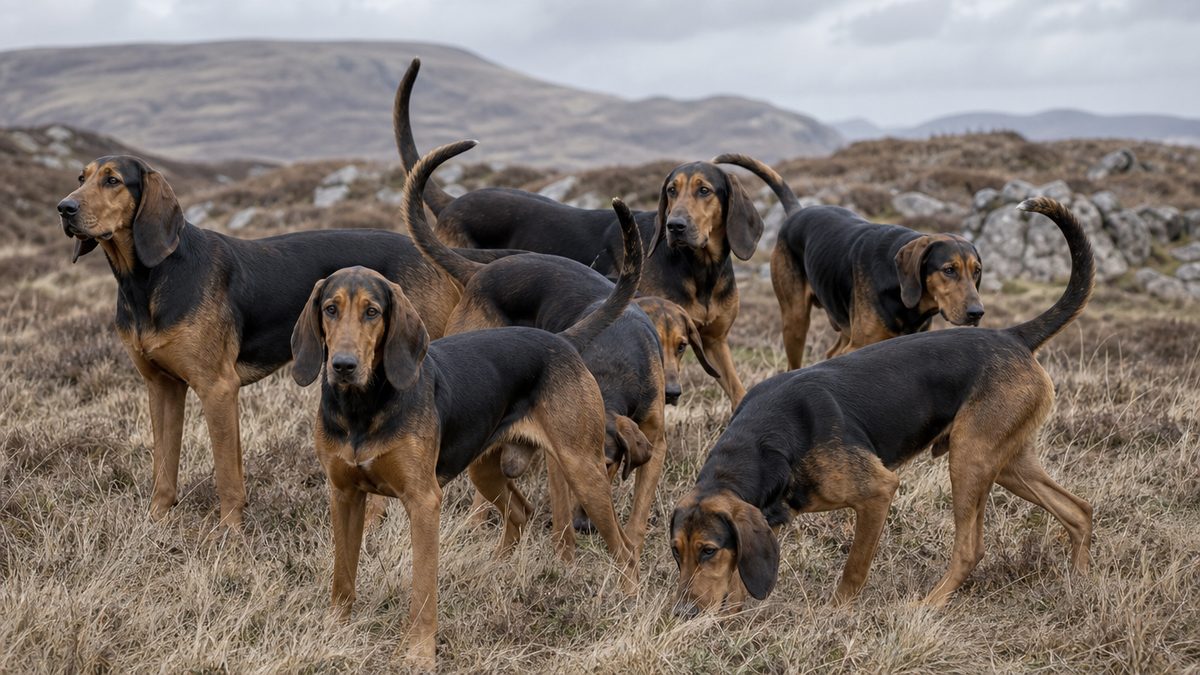
What set the pack apart was colour and size. Hancock lists it among the hound varieties that do not fit one blueprint, naming the Welsh with its rough griffon coat, the Fell with its lighter frame, and the Dumfriesshire with its distinctive black and tan jacket, adding in parenthesis that it is now sadly lost to us as a pack. British foxhounds are overwhelmingly white-based tricolours, so a solid black saddle over tan was unusual enough to be the pack's identity.
The hounds were also bigger than the norm. Wikipedia states they were larger than standard foxhounds, and the one figure that comes from someone who knew the founder puts the target at doghounds of at least 26 inches, about 66 cm at the withers.
The ancestry claim, and how firm it is
The usual account is that the hounds were created by crossing Bloodhound, Grand Bleu de Gascogne and English Foxhound. That sentence carries no citation on the page it comes from, no breeding record has been published, and Buchanan-Jardine's own book does not appear to be quoted anywhere in support of it. It is plausible, it is repeated everywhere, and it is not evidenced.
What is documented is the intention. Jean de Roualle, a French Master of hounds who exchanged hounds with Buchanan-Jardine for forty-seven years, wrote that from the age of twenty he wanted to create a breed of hounds entirely his own, totally different from the Anglo-Saxon packs. Buchanan-Jardine was born in 1900, so that dates the ambition to about 1920 and matches the standard account that the pack began after the First World War.
There were two hound packs in this county and the sources run them together. The Dumfriesshire Otterhounds were co-founded by Wilson Davidson around 1901 and hunted the Nith, the Annan and the Derwent. The Dumfriesshire Black and Tan Foxhounds are Buchanan-Jardine's, from about twenty years later. When a page says the Dumfriesshire hounds did something, check which pack it means, because they overlapped in place and name for eighty years.
The dispersal: the autumn of 2002, dated from the record
The Dumfriesshire pack was disbanded in the autumn of 2002 and its eighty hounds were sold to hunts in France, Ireland and England, which The Scotsman reported on 13 October 2002 with the kennels already empty.
That report is the load-bearing document on this page and it is worth quoting rather than summarising. It opens by calling the hunt the first victim of the Scottish parliament's legislation against hunting foxes with dogs, and states that the Dumfriesshire Hunt, which has been in existence for 150 years, has disbanded its pack of 80 dogs after being told it can no longer use land owned by Sir Rupert Buchanan-Jardine.
The Act itself is on the statute book as the Protection of Wild Mammals (Scotland) Act 2002, 2002 asp 6, and legislation.gov.uk records its creation date as 28 March 2002. The reason given for the disbandment is a landowner's legal exposure rather than a direct prosecution. Sir Rupert told the organisers he feared prosecution under the Protection of Wild Mammals (Scotland) Act if he allowed hunting over his 20,000 acres, and is quoted saying he regretted having to do it, that the decision was not his, that it had been forced on him by the Scottish parliament, and that the hunt was finished.
| When | What happened | Source |
|---|---|---|
| February 2002 | The Watson Bill passes the Scottish Parliament | The Field |
| 28 March 2002 | Protection of Wild Mammals (Scotland) Act 2002, 2002 asp 6 | legislation.gov.uk |
| 1 August 2002 | The Act comes into force | The Field |
| Autumn 2002 | The pack is disbanded and drafted to other hunts | The Field |
| Early October 2002 | The kennels stand empty, hounds sold | The Scotsman |
| 13 October 2002 | The disbandment is reported | The Scotsman |
| 2002 to 2005 | Neighbouring packs keep the country open, about 20 days a season | The Field |
| 3 October 2023 | The Act itself is repealed | legislation.gov.uk |
It was not the hunting ban alone
The Field, written by someone inside the hunt, sets out a stack of causes rather than one. Dumfries and Galloway had been badly hit during the foot-and-mouth epidemic, the hunt had already had several years of declining subscribers and shrinking country, and the ban was the final straw. In the autumn of 2002 the pack of black and tan foxhounds, famous for their low-scenting powers and wonderful deep cry, was disbanded and drafted to other hunts.
The scale of the loss beyond the hounds is worth recording. For the first time in 150 years Dumfriesshire no longer had its own foxhounds, and at the same time it lost its point-to-point course and around 30,000 acres of country. Of the ten Scottish foxhound packs facing the same law, the other nine stayed intact and continued as gun packs under the new rules.
What the kennelman said
The Scotsman's closing detail is the one that dates the emptying precisely. Kennelman John Carruthers, who had worked there for nearly twenty-five years, was described as close to tears the previous week as he surveyed the empty kennels, saying the end of his hunt was the end of a way of life in that part of the world. A report published on 13 October describing the kennels as empty the week before puts the hounds gone by early October 2002.
Where the 2001 date came from, and how far it travelled
The 2001 date that nine ranking pages carry originates in one uncited sentence on Wikipedia, and following it downstream shows a mirror cascade that has now produced three different years for the same event.
Wikipedia's opening sentence reads that the hounds were kennelled at Glenholm Kennels, Kettleholm, near Lockerbie until they were disbanded in 2001. No footnote is attached to it. The article carries a page-needed tag on its one book citation and two citation-needed tags elsewhere, both dated June 2020, so its own editors have flagged the sourcing as incomplete.
| Source | Date given | What kind of source it is |
|---|---|---|
| The Scotsman, 13 October 2002 | Autumn 2002 | Contemporaneous news report, kennels already empty |
| The Field, January 2008 | Autumn 2002 | Feature by a participant, with the legal chronology |
| Wikipedia | 2001 | Uncited sentence, article tagged since June 2020 |
| DogFlux | 2001 | Reproduces Wikipedia under a Wikipedia heading |
| Jesus Iniesta | 2001 | Reproduces Wikipedia, adds trait chips |
| OC Pets, United Arab Emirates | 2001 | Reproduces Wikipedia, dated 15 June 2026 |
| Academic Dictionaries | 2001 | Frozen older Wikipedia revision, spells it Glenholme |
| Grokipedia | 2001, and 2002 eighteen times | AI encyclopedia holding both |
| Kiddle | 2001 in the intro, 1986 in the France section | Children's encyclopedia, two dates in one article |
The 1986 date exists nowhere else
Kiddle's article says in its opening that the pack was officially stopped, or disbanded, in 2001, and then in its section headed Their Legacy in France says that even though the original Dumfriesshire Black and Tan Foxhound pack was disbanded in 1986, their legacy lives on. That is a fifteen-year discrepancy inside one short article aimed at children, and 1986 appears in no other source anywhere.
The tells that identify a copy
Two spelling variants make the copying visible. Wikipedia's current text says Glenholm Kennels; the Academic Dictionaries copy says Glenholme, and describes the ancestry as bloodhound, Gascoigne bleu and foxhound rather than Bloodhound, Grand Bleu de Gascogne and English Foxhound. Those are the fingerprints of an older Wikipedia revision frozen years ago and still ranking.
The most instructive case is Grokipedia, which is AI-written and does the research properly in one place and not in another. Its section headings include Circumstances of disbandment and Dispersal and modern influence, it uses 2002 throughout, and it nonetheless states that the facility served as the primary base for the pack until its disbandment in 2001. The wrong date survives inside an article that elsewhere knows better, because it came in from a different source than the surrounding prose.
The method costs one search. Find a contemporaneous report rather than a retrospective one: a newspaper piece published within weeks of the event, whose own metadata carries a publication date you can read. The Scotsman's page prints 'Published 13th Oct 2002' and its article metadata carries 2002-10-13, and the story describes the kennels as emptied the previous week. An encyclopedia written twenty years later cannot outweigh that.
Sir John Buchanan-Jardine, and what he was trying to build
Sir John Buchanan-Jardine set out from about the age of twenty to breed hounds entirely unlike the existing English packs, and the fullest account of what he wanted comes from a French Master who exchanged hounds with him for forty-seven years.
Buchanan-Jardine, 1900 to 1969, was a Master of Foxhounds and a Master of Bloodhounds, and the author of Hounds of the World in 1937, which is still cited as a standard reference on hound varieties. That book is the reason his name attaches to the pack in every account, and it is also the reason the accounts are thin, because almost nobody quoting it has opened it.
The memorial that nobody in English has used
The Rallye Pique Avant Nivernais, a French stag-hunting pack, publishes on its own hound pages a memorial to Buchanan-Jardine written by Jean de Roualle, who died in 1973. It is a personal document rather than a technical one, and it contains the specifics that the English pages lack.
De Roualle records that from the age of twenty Buchanan-Jardine wanted to create hounds entirely his own, totally different from the Anglo-Saxon packs, and that he wanted them very large: doghounds of at least 26 inches, with bitches smaller but only slightly so. Twenty-six inches is about 66 cm, which is at or above the top of the English Foxhound's usual range and explains the repeated description of these hounds as larger than standard.
What he was breeding for, in his own admirer's words
The obsession was voice. De Roualle writes that all his life, with fierce tenacity, Jock wanted to give his hounds that great quality of which the human ear never tires, fine cry, and that there were deep ones, light ones and howlers, which is genuinely rare today, and that almost half his pack made extraordinary music. He describes the whole pack as being like a carillon, a set of bells.
The comparison he reaches for at the end places the pack. He had hunted almost everywhere, in England, Ireland, the United States and Belgium, and had never heard cry and qualities like those of the Dumfriesshire pack. That is a professional judgement from a man who spent his life around hounds, and it is the closest thing to a performance record this pack has.
Buchanan-Jardine on foxhounds, quoted from his own book
Two passages from Hounds of the World survive in Hancock's writing. On colour, Buchanan-Jardine wrote that in the colour of foxhounds there are again different tastes, that at one time Belvoir tan hounds were the only ones in fashion and the less white they had the better coloured they were considered, and that he had known many good hounds marked with blue-mottled colour and with tan ticks down their legs, perhaps throwing back to the old Southern hound blood.
The second passage is his description of what he expected of a hound, and it is the best single argument on this page against keeping such a dog in an Indian city. He asked what other breed of dog could trot out a dozen or fourteen miles along the roads to a meet, then gallop about for five hours or so, often hard enough to tire out two thoroughbred horses in succession, all the time using his nose, intelligence and voice, then come home at night with his stern up, and do it regularly twice a week, adding that it is a great deal to expect of a dog.
Physical description: what can honestly be said about size and colour
The Dumfriesshire hounds were black and tan and larger than standard foxhounds, and beyond those two statements every measurement published about them comes from a page that cites nothing.
There is no breed standard for this hound and there never was one, so there is no document to measure the claims against. That is the whole difficulty of the physical description section on this page, and the honest response is to say what each figure rests on.
| Figure | Source | Evidence behind it |
|---|---|---|
| Doghounds at least 26 in (66 cm) | Jean de Roualle's memorial | Eyewitness testimony from a Master who exchanged hounds for 47 years |
| Larger than standard foxhounds | Wikipedia | Uncited, but consistent with the above |
| Height 60-70 cm | DogFlux | Unsourced spec-card field |
| Male weight 36 kg | DogFlux | Unsourced spec-card field |
| Tall stature, deep chest | Snoutastic | Describes the Southern Hound, a different breed |
| Black and tan | Hancock, Wikipedia, The Scotsman | Three independent sources agree |
| Short coat | DogFlux | Unsourced, though correct for any foxhound |
Note what happens in that table. The one figure with a named human behind it is de Roualle's 26 inches, and the aggregator range of 60 to 70 cm happens to contain it, which is exactly the kind of coincidence that makes an invented number look researched. A range wide enough to contain the truth is not evidence of knowing it.
The colour, which is the one thing everybody agrees on
Black and tan is confirmed from three directions. Hancock names the pack's distinctive black and tan jacket in a list of foxhound varieties. The Scotsman calls them the unique Black and Tan Dumfriesshire hounds. And the French packs that took the blood record it under the name Black and Tan rather than under any Scottish name.
That matters more than it sounds, because British foxhounds are overwhelmingly white-based. A pack of solid-saddled black and tan hounds in a country of tricolours was visually unmistakable at a distance, which is why the colour became the pack's name.
What the aggregators added
The rest of the physical description in circulation is generated. DogFlux prints height, weight, coat length, coat type and a shedding score of 4 out of 5 under a Characteristics heading, with a Population section beneath it, on a page whose narrative text is Wikipedia reproduced under a Wikipedia label. Snoutastic describes tall stature, a deep chest and a melodious voice, and its own text makes clear it is describing the Southern Hound.
Photographs of the pack exist, including in David Hancock's archive under a caption reading Dumfriesshire foxhounds, now lost, and in view-of-Dumfries local archives showing hounds at Hoddom Castle. What they cannot give you is a measurement, because nothing in frame is of known size. A picture of large black and tan hounds confirms colour and rough impression, and nothing more.
The French descent claim, tested against the French register
Black and Tan hounds do work in France today, in three of the 318 packs listed by the Societe de Venerie, but the specific pack Wikipedia names as descending from the Dumfriesshire does not appear in that directory at all.
The claim in circulation is one sentence, and Wikipedia tags it itself. It says there is a pack descended from them in France, known as Equipage de la Roirie, and that they are used also by the Equipage Pique Avant Nivernais as staghounds, along with the Francais Blanc et Noir hound, and the sentence ends with a citation-needed marker. Six ranking pages reproduce it anyway.
What the official directory shows
The Societe de Venerie publishes a directory of French hunting packs giving each one's quarry, hunting days, hound races, kennel and Master. Retrieved in full on 27 August 2026 it lists 318 packs, and Black and Tan appears in exactly three of them.
| Pack | Department | Quarry | Hound races named |
|---|---|---|---|
| Vautrait du Verdon | Alpes-de-Haute-Provence (04) | Wild boar | Grand Anglo Francais tricolore and Black and Tan |
| Rallye Ardillieres | Landes (40) | Roe deer | Francais Blanc et Noir and Black and Tan |
| Rallye Merrein | Gironde (33) | Roe deer and hare | Francais Blanc et Noir and Black and Tan |
| Rallye Pique Avant Nivernais | Nievre (58) | Red deer | Francais Blanc et Noir only |
| Equipage de la Roirie | Not listed | Not listed | Does not appear in the directory |
Three findings follow, and each was checked with controls in the same retrieval. The word Dumfriesshire appears zero times across the whole directory, as do Buchanan and Jardine, while chien appears 316 times and equipage 330, so the page loaded completely. Roirie appears zero times. And the Pique Avant Nivernais is in the directory, registered for Francais Blanc et Noir only, not Black and Tan.
The document that does support a connection
The connection is real, but the evidence for it is not where Wikipedia points. The Rallye Pique Avant Nivernais publishes on its own hound pages an editorial note saying the reader will find here interesting details on the origins of the black and tan contribution to the pack, above the memorial to Buchanan-Jardine. In that memorial de Roualle writes that Buchanan-Jardine's hounds were the only ones from across the Channel he used so many times for his crossings, and that as a result all his own hounds resembled them in size, constitution, coat, and the shape of head, shoulder and hock.
He also dates the beginning of the exchange: Jock gave him his first hound in 1923, a splendid harrier called Leader, and over forty-seven years they made many other exchanges. So Scottish hound blood was flowing into French packs from the 1920s, decades before the 2002 dispersal, which is a longer and better-documented connection than the one the aggregators repeat.
The modern editorial note on the French pack's page hyperlinks the words black and tan straight to the English Wikipedia article on the Dumfriesshire hound. So the framing around the memorial cites Wikipedia, while the memorial itself was written by a man who died in 1973 and is genuinely independent of it. When a foreign-language source appears to confirm an English claim, check whether it is confirming it or quoting it.
The otterhound cross, and the chronology that does not work
The Dumfriesshire Otterhounds were co-founded around 1901, roughly two decades before Buchanan-Jardine's black and tan foxhounds existed, so black and tan blood cannot have been present at the otterhound pack's foundation whatever happened later.
Wikipedia's sentence reads that these large hounds were also crossed with the Dumfriesshire otterhounds during the foundation of the Otterhound pack, and it is one of the few statements in the article that carries a footnote, pointing at a German otterhound site read through a 2005 Internet Archive capture.
What the British breed club's own archive shows
The Otterhound Club in Britain maintains a historic page for the Dumfriesshire Otterhounds, and it is a dated photograph archive rather than a narrative, which makes it unusually easy to check. Its captions include a Birmingham Dog Show brace prize certificate of 1900, huntsman Wilson Davidson with the hounds on the River Nith in 1905, a meet at Bridge of Dee in 1908, hounds in kennel at Annan in the 1900s, the pack in 1914, hounds crossing the Nith in 1936, Billy Scott with them on the River Carne in 1966, and the Dumfriesshire County Fair in 1969.
One caption settles the chronology: Wilson Davidson, co-founder of Dumfriesshire Otterhounds, circa 1901. Buchanan-Jardine was born in 1900 and began wanting his own hounds at about twenty, and every account places the black and tan pack after the First World War.
| Dumfriesshire Otterhounds | Dumfriesshire Black and Tan Foxhounds | |
|---|---|---|
| Founded | Circa 1901, co-founder Wilson Davidson | About 1920, Sir John Buchanan-Jardine |
| Quarry | Otter | Fox |
| Kennels | Annan | Glenholm, Kettleholm |
| Rivers or country | Nith, Annan, Derwent | Country around Lockerbie and Dumfries |
| Latest dated record found | Dumfriesshire County Fair, 1969 | Disbanded autumn 2002 |
| Named people | Wilson Davidson, Billy Scott, Dick Blaylock, Captain John Bell-Irving | Sir John and Sir Rupert Buchanan-Jardine, Nicky Birkbeck, John Carruthers |
What can and cannot be concluded
The careful reading is this. Black and tan foxhound blood cannot have gone into the Dumfriesshire Otterhounds at their foundation, because the otterhound pack was already about twenty years old when the foxhounds began. It could perfectly well have gone in afterwards, and the two packs sat in the same county under overlapping names for another fifty years, so contact between them is likely rather than surprising.
This page therefore reports the cross as possible and undated, and rejects only the phrase during the foundation. That is a narrower correction than saying the claim is wrong, and it is the one the evidence supports.
Both packs were called the Dumfriesshire hounds locally, both were black-and-tan-ish to a casual eye, both hunted the same country, and both are gone. The Otterhound Club files its page under Historic alongside the Kendal and District pack, which tells you the otterhound pack ended too. An aggregator reading two sources sixty years apart has no way to tell which pack either one meant.
The bloodhound packs: the best-cited descent claim, and its limits
The clean boot bloodhound claim is the only descent claim about these hounds that carries a real book citation with page numbers, and Bonbeno has not been able to read the book.
Wikipedia states that since the Second World War the Dumfriesshire hound has been used to improve speed and agility in several clean boot hunting bloodhound packs, and gives as an example that Eric Furness introduced Dumfriesshire hound blood into his Peak bloodhounds. Unlike the France sentence and the 2001 date, this one is footnoted, to Brian Lowe's Hunting the Clean Boot: The Working Bloodhound, Blandford Press, 1981, at pages 30, 95 and 172.
That is a proper citation: a named author, a named publisher, a year, an ISBN and three specific pages. Bonbeno has not obtained the book and therefore cannot confirm what those pages say, and this page states that rather than passing the claim through as verified. What can be said is that the claim is checkable by anyone with a library, which is more than can be said for most of what is written about this pack.
Why the claim is plausible on its face
Clean boot hunting means following a human runner's trail rather than an animal, and the packs that do it are bloodhound packs. Bloodhounds are famously slower and heavier than foxhounds, and a pack master wanting more pace without losing nose has an obvious reason to reach for a large scent-driven foxhound. If the Dumfriesshire hounds carried bloodhound ancestry themselves, as the usual account says, an outcross back into bloodhounds would be a short step rather than a long one.
It also fits the dispersal pattern. Buchanan-Jardine held Master of Bloodhounds as well as Master of Foxhounds, so the two worlds were connected in one person from the start.
The three descent claims, ranked by evidence
| Claim | Evidence | Bonbeno's position |
|---|---|---|
| Sold into hunts in France, Ireland and England, 2002 | Contemporaneous newspaper report | Accepted |
| Long exchange with French packs from 1923 | Named eyewitness memorial, 47 years | Accepted |
| Black and Tan hounds work in France today | Societe de Venerie directory, 3 of 318 packs | Accepted as to the hounds, not the name |
| Into clean boot bloodhound packs, Eric Furness | Book citation with page numbers, unread here | Plausible, uncorroborated by us |
| Into the Dumfriesshire Otterhounds at foundation | Chronologically impossible as worded | Rejected as worded, possible later |
| Equipage de la Roirie descends from them | Citation-needed sentence; pack not in the register | Not supported |
Read that table as a whole and the answer to what happened to the blood is not mysterious. Eighty hounds went into working packs abroad and at home in 2002, on top of eighty years of drafts and exchanges before that. The blood is dispersed through a dozen kennels in three countries, unnamed, and that is exactly what happens to a pack rather than to a breed.
There is no living population of Dumfriesshire hounds anywhere, and no register records the blood under that name. What survives is an unquantifiable contribution inside other packs, mostly in France where three hunts still call their hounds Black and Tan. Anyone who tells you they have a Dumfriesshire hound has a hound with some of that behind it at best, and nothing to prove it with.
Recognition status, register by register, each checked with a control
No kennel club anywhere has ever listed the Dumfriesshire hound, and four registers were read in full to establish it, each with control breeds that returned in the same retrieval.
The hound is unrecognised in both senses that matter: no register lists it, and no standard describes it. An absence only counts as evidence when the instrument is proved, so every check below was paired with breeds that should be present. Where the controls failed, the check was thrown away and repeated.
| Register | Listed? | Controls run in the same retrieval |
|---|---|---|
| FCI definitive register, letter D | No | 25 breeds returned, including Deerhound, Drever, Deutsche Bracke, Dunker |
| Royal Kennel Club, Breeds A to Z | No | Foxhound, Harrier, Otterhound, Bloodhound, Beagle, Basset all returned |
| American Kennel Club, full selector | No | Foxhound, Harrier, Otterhound, Bloodhound, Beagle, Basset all returned |
| OFA disease statistics | No | Harrier, Otterhound, Bloodhound, Beagle, Basset all returned |
| Kennel Club of India | By FCI nomenclature only | India is an FCI full member; no FCI entry exists to inherit |
| Foxhound Kennel Stud Book | Where pack hounds are recorded | Not a kennel-club register and not public |
The FCI check had to be done twice
This one is worth describing because it is how a false finding gets made. A first attempt at the FCI's letter D register returned a short page on which every control also returned zero, including Deerhound and Drever. That is a broken instrument rather than a finding, and reporting an absence from it would have been wrong.
Fetched properly with a full render, the same URL returns 25 breeds from Dachshund to Dunker, in alphabetical order, with Deerhound, Drever, Deutsche Bracke and Drentsche Patrijshond all present. Between Drotzoru Magyar Vizsla and Dunker is precisely where a Dumfriesshire entry would sit, and there is none.
The OFA absence is expected rather than telling
The Orthopedic Foundation for Animals publishes no statistics for this hound, and its full statistics page also returns zero for foxhound of any kind, while Harrier, Otterhound, Bloodhound, Beagle and Basset all appear. That is not a fact about the Dumfriesshire. It is a fact about pack hounds, which are not screened and registered the way pet breeds are, so an American orthopaedic register has nothing to hold on any foxhound.
The Indian recognition question, answered sideways
The Kennel Club of India publishes no breed list for any breed, so querying it returns nothing for the Dumfriesshire and nothing for a control either, which is a broken instrument and not a finding. The route that works is the FCI members register, which lists India as a full member represented by the Kennel Club of India in Chennai. Since the KCI issues pedigrees inside FCI nomenclature, and the FCI has no entry for this hound, there is nothing for an Indian register to recognise.
Why no kennel club ever listed it, and what a pack type actually is
The Dumfriesshire hound was never registered because British pack foxhounds are not kennel-club dogs at all, and understanding that removes most of the confusion around this hound at a stroke.
Two parallel systems have existed in Britain for more than a century. Show and pet dogs are registered with the Kennel Club, which writes one breed standard per breed and judges conformity to it. Working foxhounds are bred by hunt masters, recorded in the Foxhound Kennel Stud Book, judged at hound shows on working conformation and drafted between packs. A hound can spend its whole life in the second system and never touch the first.
David Hancock puts the consequence plainly. It may be questionable to regard the Foxhound as a breed, with some packs having claims to a distinct type or variety under that name, as the Dumfriesshire pack long demonstrated, but the Kennel Club recognises the Foxhound as one breed with one breed standard and will seek standardisation and conformation to a set word picture. He adds that Kennel Club recognition will hardly be noticed in the foxhound packs of Britain.
The varieties that a single standard cannot hold
Hancock lists the varieties that do not fit one blueprint: the Welsh with its rough griffon coat, the Fell with its lighter frame, the hounds showing the Curre influence at Chepstow with their characteristic lighter coat, the Dumfriesshire with its distinctive black and tan jacket, and the Belvoir with its classic tan-based tricolour markings. Five recognisably different hounds, one breed standard, and only one of them extinct.
So the right description of the Dumfriesshire hound is a pack type, and the reason it never became a breed is that its owner never wanted it to be one. A pack master breeds for what wins him a day's hunting, not for what wins a rosette, and the two goals diverge quickly.
What this means for anything you read about it
- No breed standard exists, so any height, weight or colour range presented as a specification is somebody's estimate.
- No stud book is public, so no pedigree for these hounds can be looked up by an ordinary reader.
- No health scheme covered them, so hip scores, elbow scores and DNA test results were never collected.
- No lifespan was ever recorded, because working pack hounds are not followed as individuals the way pet dogs are.
- No breed club existed, so there is no body that could vouch for a hound sold under the name today.
There is one more absence worth naming, because it is the one that decides whether a revival is even conceivable: no record of the gene pool survives either. A pack's breeding lives in its own kennel books, and when eighty hounds are sold into a dozen kennels in three countries, the gene pool does not vanish so much as become untraceable. Every one of those absences is normal for a British foxhound pack and none of them means the hounds were undocumented in their own world. Hunt records, hound show results and the Foxhound Kennel Stud Book all exist. They simply are not the kind of record an aggregator page can scrape, which is why the aggregator pages invented substitutes.
Wikipedia's infobox gives Breed status: Extinct, and the word breed in that box is what sets the whole downstream machinery running. Once a thing is filed as a breed, every breed template acquires a row for it: a lifespan field, a temperament score, a price band, a herdbook. None of those rows had anything to fill them, so they were filled anyway.
Dumfriesshire hound price in India, and what the search actually returns
No Dumfriesshire hound price in india exists, and none exists anywhere else either, because the pack was sold into working hunts in 2002 and no breeding population has carried the name since.
Say the structural fact first. This was never a dog you could buy. Pack foxhounds are bred by hunt masters for their own kennels and drafted or given between packs; they are not priced, listed or sold to the public. When the Dumfriesshire pack ended, its eighty hounds went to other hunts in France, Ireland and England, which is a transfer between working kennels rather than a retail sale.
What an Indian search returns
Searching the breed name with price from an Indian location returns almost entirely other dogs. The results are dominated by Mudhol Hound price guides at Rs 5,000 to Rs 25,000, a Facebook advertisement for a Mudhol puppy, an Afghan Hound marketplace page quoting INR 1,20,000 to INR 4,50,000, an Instagram reel selling a Pashmi hound puppy, and general Indian puppy marketplaces. The searches work; there is simply nothing of this hound in them.
| Result | What it is | Relevance to this hound |
|---|---|---|
| Mudhol Hound, Rs 5,000-25,000 | Indian sighthound price guide | A different breed entirely |
| Afghan Hound, INR 1,20,000-4,50,000 | Indian marketplace listing | A different breed entirely |
| Pashmi hound puppy reel | Instagram sales post | A different breed entirely |
| Creatures, 'Breed Facts, Prices & Breeders' | US aggregator | Names the hound; has nothing to sell |
| Indian puppy marketplaces | General listing sites | No entry for this hound |
| Bonbeno's finding | No price exists | There is nothing to price |
That substitution is the pattern this site sees on every unavailable breed, and here it is unusually clean: an Indian buyer searching for a Scottish black and tan hound is shown Indian hounds. Nobody is trying to deceive them. The search engine is doing its best with a query that has no answer.
The one page that does name it, and what it is offering
One result ranks in India under the title Dumfriesshire Hound Dog: Breed Facts, Prices & Breeders. Opened, it is a marketplace scaffold with four counters, and all four read zero: for sale 0, herdbook 0, profiles 0, breeders 0. Its own body text is careful, describing the hound as most accounts describe a large black-and-tan scenthound of foxhound type, and its headings promise a herdbook, a breeder directory and listing alerts.
Nothing on that page is a lie. It is a template applied to a name, and it will rank for a price query forever because the template has a price field. The honest reading is that even the site advertising prices for this hound is displaying, on the same screen, the fact that it has none.
Bonbeno's price sections cover adoption and availability rather than a purchase market when a breed is not sold through commercial channels. This is the far end of that: not a thin market but no market and no animal, for a hound that was never retailed even when it existed.
The currency tests, and the herdbook with nothing in it
The usual Bonbeno currency tests cannot be run on this hound, because no Indian page publishes a rupee figure for it at all, and the absence is itself the cleanest result on this page.
This site routinely finds that Indian breed prices are American dollar figures divided by a single exchange rate. The tests are mechanical: divide each rupee figure by 84.38, by 74, by 80 and by 66.67, and look at whether the quotient is a number a real seller would print. A whole table that divides cleanly by one rate is a converted list rather than an Indian market.
There is nothing here to divide. Searches from an Indian location for the hound with price, with puppy and with for sale returned no Indian page carrying a rupee figure attached to this name. The rupee figures that surfaced belong to the Mudhol Hound and the Afghan Hound.
| Test | Result | What it means here |
|---|---|---|
| Divide by 84.38 | No figures to test | No converted US price list exists for this hound |
| Divide by 74.00 | No figures to test | The large Indian price tables do not carry it |
| Divide by 80.00 | No figures to test | Nothing to produce a false match against |
| Divide by 66.67 | No figures to test | No paired rupee and dollar table found |
| Rs 98,999 house price point | Not found on this hound | The recurring Indian carousel price does not reach it |
| Rupee figures found at all | None | Every rupee figure on the results page is another breed |
The empty registry, which is the interesting artefact
The substitute for a price here is not a fabricated number, it is a fabricated institution. One ranking page runs, for this hound, a marketplace with listing alerts, a herdbook, a profiles directory and a breeder directory. Those are the four things that would make a breed tradeable, and the page has built all four for a pack that was dispersed twenty-four years ago.
A second page offers a search tool to check whether any USDA-licensed facilities breeding Dumfriesshire Hounds appear in its database. It returned HTTP 403 to a direct fetch, so this page draws no conclusion about what the tool displays and reports only that the search result advertises it.
Why an empty scaffold is more dangerous than a wrong number
A wrong price can be checked against another price. An empty registry cannot be checked against anything, and it does something a number does not: it tells a reader that a category exists. A herdbook implies pedigrees, a breeder directory implies breeders, and listing alerts imply that listings will one day appear. None of those will happen, because there is no population to generate them.
The practical test for an Indian reader is the one this page has been applying throughout. Ask what document would exist if the claim were true, then look for that document. For a purchasable hound the document is a register entry, and four registers were checked with controls and returned nothing.
Treat it as a red flag rather than as new information, because there is no supply for a price to describe. Divide it by 84.38, by 74 and by 80, ask whether the quotient is a figure a seller would print, and then ask the seller which register the hound is entered in. There is no correct answer to that last question.
The mirror cascade, page by page
Nine of the twelve pages ranking for this hound in India reproduce the same four Wikipedia sentences, and each one adds something that was not in the original: a lifespan, a height, a temperament score, a herdbook, or in one case an entirely different breed.
This audit exists because an Indian reader comparing these pages has no way to see that they are one page. The reach is wider than Britain: a veterinary group in the United Arab Emirates publishes the same four sentences, 2001 date included, under its own health-library branding and dated 15 June 2026. The Bing India results are all genuinely about this hound, so nothing below is the search engine serving the wrong thing. The pages simply carry material nobody sourced.
| Page | What it adds | What it rests on |
|---|---|---|
| Wikipedia | The 2001 date, the ancestry, the French claim | One book cited page-needed; two citation-needed tags |
| Snoutastic | A whole breed history, lifespan 8-10 yrs, three health screens | The Southern Hound, a different extinct breed |
| DogFlux | Height 60-70 cm, weight, shedding 4/5, a Population section | Nothing; the narrative is labelled Wikipedia |
| Grokipedia | Twelve section headings, a management account | AI generation; prints 2001 and 2002 both |
| Creatures | A marketplace, herdbook, profiles and breeder directory | Four counters, all reading zero |
| Jesus Iniesta | Happy in Cold Weather, Good with Kids, Highly Trainable | Attributed to Wikidata |
| BreederCheck | A USDA-licensed breeder search | Not verifiable; returned 403 |
| OC Pets, UAE | A veterinary-branded quick-facts box | Wikipedia, dated 15 June 2026 |
| Academic Dictionaries | Glenholme, Gascoigne bleu | A frozen older Wikipedia revision |
| Kiddle | 1986 as a second disbandment date | Nothing; it appears in no other source |
The page that is about a different dog
Snoutastic's entry is the clearest case of breed conflation this site has found. Its subtitle reads that the Dumfriesshire Hound, or Southern Hound, is a historic scent hound, and its history section states that the lineage traces to the Talbot, that the hound was likely introduced to Britain long before the Norman Conquest, that it was particularly favoured in southern England, and that its popularity waned in the eighteenth century leading to gradual extinction by the nineteenth.
Every one of those statements is about the Southern Hound, an English breed that died out roughly seventy years before Buchanan-Jardine was born, five hundred kilometres from Dumfriesshire. On the strength of it the page then supplies an average lifespan of 8 to 10 years, a weekly brushing schedule, nail trimming every 2 to 4 weeks, and recommendations for hip evaluation, cardiac evaluation and thyroid function testing.
The self-refuting page
Snoutastic also links, from the same profile, an article headed No Dog Is Hypoallergenic (And Your Allergist Agrees), while its own FAQ answers that this hound generally sheds less than average and often works better for households that want less loose hair. The article is right and the evidence is settled: Vredegoor and colleagues found higher Can f 1 in so-called hypoallergenic breeds than in controls and concluded there is no evidence for the classification.
The page that got closest
Grokipedia deserves credit for structure even while carrying the wrong date. Its headings include Origins and foundation, Breeding and development, Role in Scottish foxhunting, Notable masters and huntsmen, Circumstances of disbandment and Dispersal and modern influence, and it uses 2002 throughout its body. It then states that the kennels served as the primary base until disbandment in 2001. An AI encyclopedia can research a topic properly and still carry a bad fact in from the article it was seeded with.
Monthly cost in India for a 35 to 40 kg working hound, if one existed
A hound of this size and workload would cost roughly Rs 9,000 to Rs 20,000 a month to keep properly in an Indian metro, and the largest single line is not food, it is the tick and heat management a big scent hound needs here.
Treat this as a benchmark for the large hounds an Indian reader can actually acquire, since this one cannot be. No cost figure was ever published for these hounds, because they lived in a hunt kennel where the accounting was for a pack rather than a dog.
| Item | Lower | Upper | Note |
|---|---|---|---|
| Food | Rs 4,000 | Rs 9,000 | A 35-40 kg hound is at the expensive end of every food band |
| Tick and flea prophylaxis | Rs 900 | Rs 2,200 | Year-round in India, and dosed by weight |
| Deworming | Rs 200 | Rs 500 | Quarterly for an adult, monthly for a puppy |
| Ear care | Rs 200 | Rs 600 | Long drop ears in monsoon humidity |
| Routine vet, amortised | Rs 700 | Rs 1,800 | Annual vaccination and a check-up spread across the year |
| Grooming | Rs 200 | Rs 600 | A short jacket needs a rubber mitt, not a salon |
| Insurance or a savings float | Rs 1,500 | Rs 4,000 | Large deep-chested dogs carry a bloat risk |
| Cooling and exercise logistics | Rs 1,000 | Rs 2,000 | Fans, shade, and travel to somewhere it can run |
| Monthly cost, total | Rs 8,700 | Rs 20,700 | Excluding one-off setup and emergencies |
The line that is different from a pet-breed page
The last row has no equivalent on most breed pages and it is the one that actually decides this. A hound bred to gallop for hours needs somewhere to do it, and in an Indian city that means driving to open ground in the two hours a day the ground is cool enough. The monthly cost of that is fuel and time rather than fees, and it does not go away.
The grooming line, by contrast, is genuinely low. A short close foxhound coat needs a rubber mitt once a week, sheds water rather than holding it, and does not mat. Of every large imported breed this site has costed, a foxhound type would be among the cheapest to groom in Indian humidity.
Why the insurance float is not padding
Deep-chested dogs over about 30 kg carry a raised lifetime risk of gastric dilatation-volvulus, which is a surgical emergency measured in hours rather than days. No prevalence figure exists for this hound specifically, and this page does not borrow one from another breed. The provision is made on size and chest shape, which are the two things every source agrees on.
Nothing in it describes a purchase that is possible. Its value is that the shape of the cost is the same for any 35 to 40 kg scent hound in an Indian city, imported or adopted, and the two lines that dominate, tick prophylaxis and exercise logistics, are climate costs rather than breed costs.
Could a Dumfriesshire hound handle the Indian climate? The numbers are decisive
Chennai's annual mean temperature of 27.95 C is higher than the hottest temperature the Lockerbie point reaches in twenty years of satellite data, which settles the heat tolerance question for this hound before any question of coat or exercise arises.
The heat rating here is one of the few figures on this page that is genuinely Bonbeno's own, so it was built from satellite climatology queried by explicit latitude and longitude rather than by place name. The origin point is longitude -3.3560, latitude 55.1215, Lockerbie: the town The Scotsman names as Sir Rupert Buchanan-Jardine's home and the nearest town to the Glenholm kennels at Kettleholm. The API echoed those coordinates back, so no other place can have been served by accident.
| Place | Annual mean C | Coolest month C | Warmest month C | Annual max C |
|---|---|---|---|---|
| Lockerbie, Dumfriesshire | 8.26 | 3.00 (Feb) | 14.44 (Jul) | 26.45 |
| Shillong, Meghalaya | 17.96 | 10.74 (Jan) | 22.38 (Aug) | 29.91 |
| Bengaluru | 23.74 | 20.22 (Dec) | 28.37 (Apr) | 40.38 |
| Pune | 23.86 | 19.62 (Dec) | 28.93 (Apr) | 43.20 |
| Delhi | 25.60 | 13.61 (Jan) | 35.88 (Jun) | 48.79 |
| Kolkata | 25.81 | 17.31 (Jan) | 31.53 (May) | 46.81 |
| Mumbai | 26.77 | 23.19 (Jan) | 31.19 (May) | 44.91 |
| Chennai | 27.95 | 24.09 (Jan) | 31.51 (May) | 42.70 |
One comparison in that table does the whole job. Lockerbie's annual maximum across twenty years is 26.45 C. Chennai's annual mean is 27.95 C. The average temperature in Chennai is 1.50 C higher than the hottest hour these hounds' home ground ever produced.
The month-by-month picture is no kinder. Chennai's coolest month averages 24.09 C, which is 9.65 C above Lockerbie's warmest month of 14.44 C. Mumbai's coolest is 8.75 C above it. Even Bengaluru, the mildest large Indian city, runs 5.78 C hotter in December than Lockerbie does in July.
The hill-station exception, and why it is not one
Shillong was added to the table as the fairest possible test, because it is the coolest large Indian settlement most readers could plausibly move to. Its annual mean of 17.96 C is 9.70 C above Lockerbie's, and its warmest month of 22.38 C is 7.94 C above Lockerbie's warmest. The coolest place in India that has a town in it is still substantially hotter than a Dumfriesshire summer.
What the exertion evidence says
The largest primary-care study of the subject reviewed 905,543 UK dogs under veterinary care in 2016 and identified 1,259 heat-related illness events from 1,222 dogs. Of those events, 380 had no trigger recorded. Of the remaining 879 events with a recorded trigger, 652 were exertional, which is 74.2 percent, followed by environmental at 113 events, 12.9 percent, and vehicular confinement at 46 events, 5.2 percent.
Exercise, not a parked car, is what puts dogs in clinics, and exertional heat-related illness occurred year-round with a 7.6 percent overall fatality rate. Now read that against Buchanan-Jardine's own description of what he expected: fourteen miles to a meet, five hours of galloping, twice a week. A hound bred to that workload, in a Chennai May, is the exertional case in the dataset.
This hound appears nowhere in Hall and colleagues' breed analysis, so none of its breed-specific odds ratios may be applied to it. What does transfer is bodyweight, which is not breed-specific: dogs in every bodyweight category over 10 kg had greater odds of exertional heat-related illness than dogs under 10 kg, and dogs at or above their breed and sex mean weight had higher odds than those below it. A 35 to 40 kg hound is at the wrong end of both.
The humidity finding, and why wet-bulb is the number that matters
Lockerbie is more humid than any Indian city in this comparison, at 90.02 percent annual mean relative humidity, and that sounds like good news for the hound until you compute wet-bulb temperature.
The raw humidity numbers point the wrong way and are worth printing for that reason. Lockerbie's annual mean relative humidity is 90.02 percent. Kolkata's is 73.93, Chennai's 72.39, Shillong's 81.91, Bengaluru's 67.94, Mumbai's 67.39, Pune's 66.80 and Delhi's 45.56. The hound's home ground is the dampest place in the table by eight points.
So the shorthand that a northern breed will struggle in India because India is humid is simply wrong here. South-west Scotland is a wet maritime climate and these hounds worked in it every winter. Humidity by itself was never the problem.
Wet-bulb, which combines the two
Wet-bulb temperature combines heat and moisture into the single figure that governs whether a body can shed heat by evaporation. Computed from each point's monthly mean temperature and relative humidity using the Stull formulation, the picture reverses completely.
| Place | Annual RH % | Annual wet-bulb C | Peak monthly wet-bulb C | Peak month |
|---|---|---|---|---|
| Lockerbie | 90.02 | 7.21 | 12.78 | July |
| Shillong | 81.91 | 15.80 | 21.33 | July |
| Pune | 66.80 | 19.43 | 22.97 | June |
| Bengaluru | 67.94 | 19.48 | 21.86 | May |
| Delhi | 45.56 | 17.80 | 26.50 | July |
| Mumbai | 67.39 | 22.20 | 25.77 | June |
| Kolkata | 73.93 | 22.25 | 27.09 | June |
| Chennai | 72.39 | 24.04 | 26.11 | May |
Lockerbie's peak monthly wet-bulb is 12.78 C in July. Kolkata's is 27.09 C in June, which is 14.31 C higher. Chennai's annual mean wet-bulb of 24.04 C is 11.26 C above Lockerbie's hardest single month, meaning Chennai spends the entire year well past anything this hound's home climate could produce.
What that means for a hound rather than a spreadsheet
A dog cannot sweat over most of its body, so it dumps heat by panting, which is evaporative cooling from the airway. The higher the wet-bulb, the less each breath achieves. At Lockerbie's July wet-bulb of 12.78 C a galloping hound has an enormous margin; at a Kolkata June wet-bulb of 27.09 C it has almost none, and a 35 kg animal generating heat at working intensity runs out of margin fastest of all.
Delhi shows why relative humidity alone misleads in the other direction too. Its annual relative humidity of 45.56 percent is the lowest here by more than twenty points, which makes it look like the dry, tolerable option. Its July wet-bulb of 26.50 C is nonetheless the third highest of the eight, because the monsoon arrives on top of extreme heat.
Plan exercise by wet-bulb rather than by temperature, for any large thick-set dog you actually own. Bengaluru and Pune, at annual wet-bulbs of 19.48 and 19.43 C, are genuinely the mildest large Indian cities for a working dog, and they are still twelve degrees above this hound's home ground. Nothing in the table makes India workable for a Dumfriesshire hound. It makes the difference between Indian cities visible, which is useful for the dog in front of you.
Temperament, and why the scores you will see are worthless
No temperament assessment of the Dumfriesshire hound was ever recorded, because pack foxhounds are evaluated on work rather than on household behaviour, and every temperament score published for this hound was generated rather than observed.
What is documented is working character, and it comes from one man. Jean de Roualle wrote that Buchanan-Jardine's hounds had become all excellent, that for qualities of change they were almost all piercing on the animal, and above all that they had such cry that he had never heard a pack with the like. That is a description of hounds at work, in French venery vocabulary, and it does not translate into a family-dog profile.
What the ranking pages print instead
Three pages assign this hound a household temperament. One gives trait chips reading Happy in Cold Weather, Good with Kids and Highly Trainable, attributed to Wikidata. Another describes a gentle and affectionate temperament, loyalty, a calm demeanour indoors and a stubborn streak, with family suitability scored 5 out of 5 and other pets at 3 out of 5, on a page whose history section is about a different breed. A third has a Temperament section derived from Wikipedia's four sentences.
None of those is observation. The first is a database field, the second is generated around the wrong dog, and the third is inference from a paragraph that says nothing about behaviour.
What can honestly be said about how a pack hound behaves
General foxhound characteristics are well attested across the type, and this page states them as type characteristics rather than as facts about the Dumfriesshire specifically.
- Sociable with other dogs, because a pack hound that fights cannot be kennelled with thirty others.
- Driven by scent to the point of ignoring a handler, which is the trait the whole job depends on.
- Loud, and in this pack conspicuously so: its own admirer compared the pack to a carillon and singled out the howlers.
- Bred for stamina rather than for biddability, since a hound that checks in constantly is a hound not hunting.
- Reared in kennel with a professional huntsman, not in a house, so almost nothing is known about how these hounds behaved as single companions.
The Indian reading
Take the voice seriously if you are reading this while considering any foxhound type for an Indian flat. A pack bred deliberately for deep, carrying, varied cry, described by a professional as making extraordinary music, is not a dog that can live undetected in an apartment block. That is the one temperament claim about this pack that has a named source behind it, and it points the opposite way from every trait chip on the aggregator pages.
Ask what would have had to happen for the score to exist. A family-friendliness rating implies somebody watched these hounds with children and recorded it. For a private Scottish hunting pack dispersed in 2002 and never kept as pets, nobody did. A score with no possible observation behind it is a template default with a number in it.
Training: what pack hounds were taught, and what that is not
Dumfriesshire hounds were entered to a pack rather than trained as individuals, which is a completely different process from house training a dog and produces an animal most Indian households could not manage.
Entering a hound means running a young hound with experienced ones until it learns the job by imitation. There is no obedience course, no recall in the pet sense and no attempt to make the hound biddable off the line of a scent. The huntsman's control is exercised over a pack through voice and horn, not over an individual through cues.
That is why aggregator claims of high trainability are misleading rather than merely unsourced. A hound that has learned to hunt has learned to commit to a scent and ignore everything else, which is the exact opposite of what a city dog needs.
The realistic sequence, if such a hound existed here
| Age | Focus | Why it matters here |
|---|---|---|
| 8 to 12 weeks | Socialisation, name, handling, crate and car | The window closes fast and a 35 kg adult must accept handling |
| 3 to 6 months | Long-line recall, ignoring livestock and street dogs | A scent hound off lead in an Indian street is a traffic incident |
| 6 to 12 months | Loose-lead walking with a body harness, heat routine | Pulling power arrives before judgement does |
| 12 to 18 months | Scent games as a substitute for hunting | The drive has to go somewhere or it goes into the furniture |
| 18 months onward | Maintenance, and exercise planned by wet-bulb | Adult working weight is when heat risk peaks |
The two things worth training that owners skip
The first is a reliable stop at distance rather than a recall. A hound already committed to a scent will not turn back, and a whistle or a horn that means stand still is more achievable than one that means come here. This is standard practice in working hound circles and it transfers directly to any Indian owner of a nose-driven dog.
The second is heat discipline, and it has to be trained into the owner rather than the dog. A biddable, willing hound will keep working past the point where it should stop, which is precisely the exertional pattern that produced 652 of the 879 heat-related illness events with a recorded trigger in the UK primary-care data. The dog will not tell you. The clock and the wet-bulb figure have to.
Buchanan-Jardine asked what other breed of dog could trot fourteen miles to a meet, gallop for five hours, use its nose, intelligence and voice throughout, come home with its stern up and do it twice a week, and answered that it is a great deal to expect of a dog. That is the only first-hand statement about these hounds' minds that exists, and it describes working intelligence under fatigue rather than tractability in a living room.
The exercise requirement, in the founder's own numbers
Sir John Buchanan-Jardine described the workload he expected of a foxhound as fourteen miles to a meet, five hours of galloping, and the whole thing repeated twice a week, and called that a great deal to expect of a dog.
That passage, quoted from Hounds of the World, is the most useful sentence on this page for an Indian reader, because it converts an abstract idea of a working hound into hours and miles. He asked what other breed of dog could trot out a dozen or fourteen miles along the roads to a meet, then gallop about for five hours or so, often hard enough to tire out two thoroughbred horses in succession, all the time using his nose, intelligence and voice, then come home at night with his stern up, and do it regularly twice a week.
| Element | As described | In metric |
|---|---|---|
| Journey to the meet | A dozen or fourteen miles, trotting | About 19 to 23 km |
| Work at the meet | Gallop about five hours | Five hours of intermittent hard running |
| Horses tired in the process | Two thoroughbreds in succession | The rider changed horses; the hound did not |
| Journey home | Home at night with his stern up | Another 19 to 23 km, tail still carried high |
| Frequency | Regularly twice a week | Two such days every week in season |
| Founder's own verdict | It is a great deal to expect of a dog | His words, not ours |
Why no Indian city can supply that
The arithmetic is simple and it is climatic rather than logistical. A working day of that kind is possible only in cool conditions, and the exertional heat-illness data says exercise is the commonest trigger by a wide margin, at 652 of the 879 events with a recorded trigger. In an Indian metro the hours cool enough for hard work with a large thick-set dog are roughly dawn and late evening for most of the year, which is perhaps two hours a day in which several hours of work would need to happen.
That is not a scheduling difficulty to be solved with discipline. It is a mismatch between what the animal was built for and what the environment permits, and it applies to any large working hound in an Indian city, not only to this one.
The substitution that does work
Scent work is the honest substitute and it is genuinely satisfying for a nose-driven dog. It can be done indoors on a floor, in the coolest part of the day, in a small space, and it engages the faculty the hound was bred around. A tracking or search game that takes twenty minutes of concentrated searching will settle a scent hound in a way that an hour of walking on hot tar will not.
Press the back of your hand to the pavement and hold it for five seconds. If you cannot, neither can a dog whose pads are on it and whose head sits close to the radiating surface. For a large dog the problem compounds: more mass to cool, more heat generated per stride, and a longer time to shed it once overheated.
Grooming a short hound jacket, and the one part that suffers in India
A foxhound's short close coat needs a rubber mitt once a week and nothing else, which makes it the easiest large-dog coat to keep in Indian humidity, and the ears are where the trouble is.
No grooming guidance for these hounds was ever published, because a hunt kennel's coat care is a bucket of water and a brush. What can be said is what is true of any foxhound-type jacket, and it is genuinely good news relative to almost every other imported breed on this site.
The coat is short, dense and close-lying. It sheds water rather than absorbing it, it does not mat, it needs no stripping and no clipping, and a rubber curry mitt once a week removes the loose hair. Shedding is steady rather than seasonal and heavy, and a page giving it a score of 4 out of 5 is guessing, though the guess is not unreasonable for a double-coated working hound.
| Task | How often | Why, in Indian conditions |
|---|---|---|
| Rubber mitt over the coat | Weekly | Removes loose hair; no clipping or stripping needed |
| Ear check and dry | Twice weekly, daily in monsoon | Long drop ears trap warm damp air over the canal |
| Full tick check by hand | Daily | Babesia was found in 66.7 percent of clinically affected dogs in one southern Indian series |
| Nail trim | Every 3 to 4 weeks | City pavement does not wear nails the way rough country does |
| Bath | Only when genuinely dirty | Stripping the coat's oils helps nothing |
| Skin fold and pad check | Weekly | Monsoon damp and hot tar between them do the damage |
The ears are the whole grooming problem
Long drooping ears lying flat against the head create a warm, still, humid pocket over the ear canal, and an Indian monsoon supplies the humidity for free. Otitis externa in that setting is a management problem rather than an inherited one, and the management is boring and effective: look inside twice a week, dry the ear after any swim or bath, and never leave water in it.
This is one place where a breed-agnostic Indian rule beats a breed-specific claim. Any drop-eared dog in India needs this routine, and the length and set of these hounds' ears, described in every account as long and drooping, would have put them at the demanding end of it.
Tick checking is grooming here, not veterinary care
In Britain a weekly brush is cosmetic. In India, running your hands over a large short-coated dog daily is how tick-borne disease gets caught early, and a short jacket makes that easier rather than harder. A southern Indian molecular study of 120 clinically affected dogs found Babesia species in 66.7 percent of them, Ehrlichia canis in 5.0 percent, and noted that tick infestation was frequently observed among the cases.
Of everything about this hound, the coat is the single feature that would have been an advantage in India. A short, water-shedding, non-matting jacket on a large dog is far easier in monsoon humidity than a double coat, a corded coat or a harsh jacket needing hand stripping. It is worth saying plainly, because it is the only line in this whole guide where the answer to an Indian question is yes.
Health and life expectancy: nothing is known, and here is how that was established
No health data of any kind exists for the Dumfriesshire hound, no lifespan was ever recorded, and this page publishes neither, which puts it in a minority of one among the pages ranking for the name.
Every page ranking for this hound lists health issues for it, and not one of those lists rests on a survey, a screening scheme or a single published case. Three searches were run here and each was paired with controls, because an absence is only evidence when the instrument is proved to work.
PubMed, read by its query translation and not by its count
Searching the exact phrase for the hound returned zero records, and the translation the service returned shows PubMed had actually broadened the query, splitting the phrase into Dumfriesshire combined with hound or hounds. A broadened search that still returns zero is a stronger negative than a narrow one. Searching Dumfriesshire combined with dog also returned zero.
The bare place name returned 17 records, and this is exactly where a careless page would report literature. Opening all 17 shows what they are: a paper on markedly elevated D-dimer, a study of pollutants in barnacle goose eggs, forensic entomology and maggots, chainsaw deaths, a 1958 survey of respiratory symptoms in an agricultural community and an 1868 paper on the hepatic system in animals. Not one concerns a hound.
Controls run in the same session were sane: foxhound with dog returned 401 records, Labrador Retriever with hip dysplasia 126, and Otterhound with dog 2. So the tool works, and the honest answer is zero.
Europe PMC and OFA
Europe PMC returned zero for the exact phrase, against controls of Border Terrier at 418 hits and Keeshond at 226 in the same session. The Orthopedic Foundation for Animals publishes no statistics for this hound, and none for any foxhound at all, while Harrier, Otterhound, Bloodhound, Beagle and Basset all appear in the same retrieval.
| Question | Answer | Basis |
|---|---|---|
| Average life expectancy | Unknown | No figure was ever published |
| Inherited conditions | Unknown | No breed club, no health scheme, no survey |
| Hip or elbow scores | None exist | Pack hounds were never entered in screening schemes |
| Peer-reviewed papers | 0 | PubMed and Europe PMC, both with working controls |
| OFA evaluations | 0 | No foxhound of any kind appears in OFA's tables |
| What two ranking pages print | 10-12 years, and 8-10 years | Neither cites anything |
Why the two published lifespans should not be repeated
One page gives life expectancy as 10 to 12 years on an unsourced spec card. Another gives 8 to 10 years in an FAQ, on a page whose entire history section describes the Southern Hound. Both numbers are plausible for a large hound, which is what makes them dangerous: a plausible invented figure is indistinguishable from a researched one unless you check the source, and there is no source.
This page will not borrow another breed's prevalence figures, but two risks follow from size and shape rather than from breed and are worth an owner's attention on any 35 kg deep-chested dog: gastric dilatation-volvulus, which is a surgical emergency measured in hours, and orthopaedic wear in a heavy dog worked hard when young. Neither has a Dumfriesshire figure attached and neither is invented here.
What would actually threaten a large scent hound in India
The diseases that would have threatened a Dumfriesshire hound in India are not breed conditions but the tick-borne and viral diseases that threaten every dog here, and unlike the breed literature those have real Indian prevalence figures behind them.
This is where an Indian page earns its keep on an extinct breed, because the breed-specific literature is empty and the Indian literature is not.
Tick-borne disease, the dominant risk
A southern Indian molecular study screened 120 clinically affected dogs between November 2023 and September 2024 and found Babesia species in 66.7 percent of them, that is 80 of 120, with co-infections of Babesia gibsoni and Babesia vogeli making up 76.3 percent of the Babesia-positive cases. Ehrlichia canis was found in 5.0 percent, 6 of 120, and Anaplasma platys and Hepatozoon canis in 1.7 percent each.
Read the denominator carefully. Those were dogs already presenting with fever, anorexia and thrombocytopenia, so 66.7 percent is the share of sick dogs rather than of all dogs. The study found cases peaked in the pre-monsoon season, March to May, with tick infestation frequently observed.
A larger Andhra Pradesh study using multiplex PCR on 442 dogs found co-infection incidences of 1.81 percent for the four-pathogen combination and 9.28 percent for Babesia with Ehrlichia, and identified young age under one year, females, mongrels, rural dogs, kennel dogs and the presence of ticks as risk factors. It found incidence lower in the rainy season, especially in dogs that had had acaricidal treatment.
The two studies disagree slightly on seasonality, one finding a pre-monsoon peak and the other a quieter rainy season, and publishing that disagreement is more useful than smoothing it 'Co-infections of major tick-borne…. Both point the same practical way: tick control in India is a year-round job.
The kennel-dog finding, which lands directly on a pack hound
One risk factor in the Andhra Pradesh study is worth isolating because it describes exactly how these hounds lived. Kennel dogs were among the identified risk factors for tick-borne pathogens. A pack of eighty hounds sharing kennels, bedding and exercise yards in an Indian climate would have been an efficient transmission system, and that is a structural observation rather than a borrowed statistic.
Parvovirus, and the Chennai figure
An eight-year study at the Teaching Veterinary Hospital of Madras Veterinary College examined 6,105 suspected cases of canine parvoviral enteritis and diagnosed 4,258, a positivity rate of 69.75 percent, identifying winter and the month of July as periods of higher incidence. That is a hospital population rather than a general one, so it describes suspected cases confirmed rather than risk to a vaccinated puppy.
| Finding | Figure | Sample |
|---|---|---|
| Babesia species in clinically affected dogs, south India | 66.7% (80/120) | 120 dogs with fever, anorexia, thrombocytopenia |
| Babesia gibsoni and vogeli co-infection among those | 76.3% | Of the Babesia-positive cases |
| Ehrlichia canis, same study | 5.0% (6/120) | Same 120 dogs |
| Babesia with Ehrlichia co-infection, Andhra Pradesh | 9.28% | 442 dogs, multiplex PCR |
| Parvoviral enteritis positivity, Chennai | 69.75% (4,258/6,105) | Eight years of suspected cases, one teaching hospital |
Feeding a 35 to 40 kg working hound in India
Feed a hound of this size as a large working breed, which in Indian terms means roughly 500 to 800 grams of a good dry food a day at maintenance, split across two meals and never given close to hard exercise.
No feeding record for these hounds survives, because hunt kennels fed a pack on flesh and meal by the barrow rather than by the gram, and this page will not invent a figure and attribute it. What follows is reasoned from the hound's weight and workload, and said to be exactly that.
| Stage | Meals a day | Approach | What to watch |
|---|---|---|---|
| 8 to 16 weeks | 4 | Large-breed puppy food, weighed not scooped | Growing too fast is worse than growing slowly |
| 4 to 8 months | 3 | Same food, portion rising with weight | Joints are loading; keep the puppy lean |
| 8 to 18 months | 2 | Transition to adult food late in this window | Adolescent hounds look ribby; that is correct |
| 18 months onward | 2 | Adult large-breed food at maintenance | Weight at or above breed mean raises heat risk |
| Working or hot season | 2, timing shifted | Feed after work has finished and the dog has cooled | Never within an hour either side of hard exercise |
| 7 years onward | 2 | Senior formulation if the vet advises | Joints and dental disease |
The bloat rule, which is not optional on a dog this shape
A deep-chested dog over about 30 kg should not be fed close to hard exercise in either direction. Feed after the dog has finished working and fully cooled, not before, and let it rest afterwards. This is standard large-breed practice rather than a breed-specific finding, and it matters here because the whole point of a hound like this is that it works hard.
Why body condition is a heat question in India
Hall and colleagues found that dogs whose bodyweight was equal to or greater than their breed and sex mean had higher odds of heat-related illness than dogs below it, and separately that dogs in every weight band over 10 kg carried higher odds of the exertional form. On a 35 to 40 kg hound in an Indian climate, letting the dog carry two extra kilos is not cosmetic. Feel the ribs weekly under a thin covering, and look for a waist from above.
Indian availability
Large-breed dry food is well supplied in India and a 35 to 40 kg dog goes through it fast, which makes food the largest single line in the cost table on this page. Store it against humidity: buy the smaller pack more often, keep it sealed in a rigid container rather than rolled shut, and do not decant into an open bin, because an opened bag of kibble in an Indian monsoon goes stale and then mouldy.
A large working dog in India needs more water in more places than a small one, and shade it can choose for itself. Hall and colleagues found risk highest where a dog could not escape the heat source. A bowl in the kitchen and a fan in one room is not the same as a cool place the dog can reach on its own initiative.
The first year of a pack hound, and why no month-by-month timeline can be honest here
No month-by-month record of a Dumfriesshire puppy's first year exists, because pack puppies were walked out at farms and then entered to the pack, and nobody published a developmental timeline for them.
What is known is the shape of the system rather than the schedule. British foxhound packs put young hounds out at walk with local farms and supporters for several months, take them back into kennel, and then enter them to the pack alongside experienced hounds in the autumn. Young hounds are shown at puppy shows in the summer before they are entered, judged on conformation for work by visiting Masters.
That last part is documented for the successor pack rather than for this one, and the distinction matters. The Dumfriesshire & Stewartry held its first puppy show with a new entry of two and a half couple of doghounds and four and a half couple of bitches, judged by two visiting Masters. Hounds are counted in couples, which is one of many places where a pack vocabulary defeats a pet-breed template.
| Stage | What happens | How well documented for this pack |
|---|---|---|
| Whelped in kennel | Litter raised by the pack's own staff | Not documented for the Dumfriesshire specifically |
| Out at walk | Months at a local farm or supporter's house | Standard practice; no Dumfriesshire record found |
| Back to kennel | Rejoins the pack, learns kennel life | Not documented |
| Puppy show | Judged on working conformation by visiting Masters | Documented for the successor pack, 2007 onward |
| Entered | Runs with experienced hounds in autumn hunting | Standard practice; no Dumfriesshire record found |
| Drafted or retired | Moves to another pack or ends its working life | Documented at scale once, in 2002 |
The one first-year event that is documented, and it is the last one
The best-recorded moment in any Dumfriesshire hound's life is its departure. Eighty hounds of all ages were sold to hunts in France, Ireland and England in the autumn of 2002, which means whatever young hounds were in kennel that season were entered to a different pack in a different country. That is the whole documented life cycle of this pack's last generation.
Litter size, and the figure nobody has
No litter size for these hounds has been published, and this page does not print one. Foxhound litters are typically large, which is a type characteristic rather than a Dumfriesshire fact, and a pack running eighty hounds needs a steady annual entry to hold that number. Beyond that arithmetic there is nothing to say, and the aggregator pages that give a litter figure for this hound are filling a template field.
A puppy timeline is the most commercially useful section on a breed page, which is exactly why it attracts invention. For a pack that no longer exists and never sold a puppy to the public, the honest length of this section is the length of the evidence, and padding it would mean writing a generic large-breed timeline and attaching this hound's name to it. That is what two of the ranking pages did.
What Indian law says about reviving a pack like this
Recreating the Dumfriesshire hound in India would be unlawful, because Second Schedule Part II paragraph 6(9) of the Dog Breeding and Marketing Rules, 2017 states that breeding to create new breeds of dogs or unusual looks shall be strictly prohibited.
The clause is one sentence and it is unqualified: '(9) Breeding to create new breeds of dogs or unusual looks shall be strictly prohibited';. Buchanan-Jardine's project, on his own admirer's account, was precisely to create a breed of hounds entirely his own, totally different from the Anglo-Saxon packs. That is the activity the paragraph names.
Note where the clause lives, because almost every Indian page that quotes it gets the citation wrong. It is paragraph 6(9) of Part II of the Second Schedule, not 'Rule 6(9)'. There is a genuine Rule 6 in the Rules, headed 'Requirements to be met by breeders and establishments used for breeding or housing dogs for breeding', whose function is to make the Second Schedule binding, and citing a Schedule paragraph as a Rule sends any reader who looks it up to the wrong text.
| Provision | Where it sits | What it says |
|---|---|---|
| Eight-week sale minimum | Rule 8(1)(a) | Pups less than eight weeks in age are not sold |
| Sterilisation before sale over six months | Rule 8(1)(b) | Not sold without first being sterilised, unless to another licensed breeder |
| In breeding and incest breeding | Second Schedule Part II para 6(3) | Both prohibited; only out breeding and line breeding are permitted |
| Docking, cropping, de-clawing, mutilation | Second Schedule Part II para 6(8) | Strictly forbidden, including any change of appearance by artificial means |
| Creating new breeds or unusual looks | Second Schedule Part II para 6(9) | Strictly prohibited |
| Genetic-defect testing | Second Schedule Part III para 8(10) | Dogs shall have been tested for the listed genetic defects |
Paragraph 6(3) closes the method as well as the purpose
A revival from a handful of founders runs into the in-breeding prohibition immediately. Paragraph 6(3) prohibits in breeding, defined in the gazette as breeding between relatives of the second to fourth grade in straight or side line within the first four generations, giving uncle to niece, nephew to aunt, cousin to cousin and grandparents to grandchildren as examples, and separately prohibits incest breeding, defined as mating between parents and children or between brother and sister. Only out breeding and line breeding are permitted.
Pack breeding depends heavily on line breeding to fix type, which paragraph 6(2) does allow, but no small founding group gets through four generations without cousin matings. So Indian law closes the route twice, once on the purpose and once on the method.
The import route, which is closed independently
Even importing hounds of the surviving French Black and Tan lines would fail. Dogs sit under ITC(HS) 01061900 as a Restricted import, and Policy Condition 8 states that import of commercial dogs for breeding or any other commercial activity is not permitted, while the notice adds that any applications for trading or breeding purposes shall be duly rejected. Entry is limited to the airports and seaports of Delhi, Mumbai, Chennai, Hyderabad, Bengaluru and Kolkata and, since October 2024, Kochi airport, and an import authorisation must be obtained from DGFT. The full route is set out in how to import a dog to India.
Searched across the whole gazette, the strings 'deaf' and 'BAER' appear zero times and 'patella' appears zero times; 'hearing' appears once and refers to an appeal before the Secretary, Animal Husbandry. So there is no Indian hearing-test requirement and no patella-testing requirement for any breed, which is worth knowing because both get asserted on Indian breed pages as though they were law.
The Dumfriesshire hound against the hounds an Indian buyer can actually get
Compare the Dumfriesshire hound with the American Foxhound and the Bloodhound and the useful difference appears at once: the other two have a written breed standard, a register entry and a route into India, and this one has none of the three.
The comparison worth making here is not about conformation. It is about what exists on paper, because that is what separates a hound you can research and buy from a hound that lived and worked and left almost no record.
| Hound | Breed standard | Register entry | Height | Available in India |
|---|---|---|---|---|
| Dumfriesshire black and tan | None ever written | None, in any register | 26 in target, one eyewitness | No, dispersed 2002 |
| English Foxhound | Royal Kennel Club | Royal Kennel Club, Hound group | About 58-64 cm | Very rare, imports only |
| American Foxhound | American Kennel Club | AKC, Hound group | 53-64 cm | Rare, imports only |
| Bloodhound | Royal Kennel Club and AKC | Both, plus FCI 84 | 58-69 cm | Occasionally, imports |
| Otterhound | Royal Kennel Club and AKC | Both, plus FCI 294 | About 61-69 cm | Almost never |
| Indian Pariah Dog | Informal, KCI-recognised type | No closed stud book | 51-64 cm | Free from any shelter |
Why the American Foxhound is the honest comparison
The American Foxhound is the nearest thing an Indian reader can actually look up, and it makes the structural point better than any argument. It is a large working scenthound with a written standard, a place in the American Kennel Club's breed selector and a Hound group classification. The Dumfriesshire had the same job, similar size and a more distinctive coat, and none of the paperwork.
That difference is not a judgement on the hounds. It is a difference in what their owners wanted. British pack masters kept their hounds in the Foxhound Kennel Stud Book and had no use for a kennel club, and as David Hancock puts it, some packs have claims to a distinct type or variety under the Foxhound name, as the Dumfriesshire pack long demonstrated, while the Kennel Club recognises the Foxhound as one breed with one standard.
The heat comparison, which none of these hounds wins
Every hound in that table except the last is a large northern-origin dog, and Hall and colleagues found that dogs in all bodyweight categories over 10 kg had greater odds of exertional heat-related illness than dogs under 10 kg. A 35 to 40 kg pack hound sits at the far end of that scale, and the same study found purebred dogs carried 1.84 times the odds of crossbred dogs, with a confidence interval of 1.47 to 2.31.
The last row of the table is where the argument lands. An Indian reader who wants a big, nose-driven, deep-voiced dog that can work in heat is describing something the country already has in every shelter, and the climate sections of this page explain why that is not a consolation prize.
Every height above comes from a governing breed standard except the first, which comes from a memorial written by a French Master who exchanged hounds with the founder for forty-seven years and recorded that Buchanan-Jardine wanted doghounds of at least 26 inches. That is testimony rather than specification, and this page treats it as such. It is still better evidence than the centimetre ranges the aggregator pages print, which cite nothing.
Nine things people get wrong about the Dumfriesshire hound
The commonest mistake about the Dumfriesshire hound is the date: nine of the pages ranking for it say the pack was disbanded in 2001, and the contemporaneous newspaper report of the disbandment is dated 13 October 2002.
- Saying 2001. Wikipedia says it without a citation and everything downstream repeats it. The Scotsman reported the pack disbanded, the kennels emptied and the hounds sold on 13 October 2002, and The Field places it in the autumn of 2002.
- Calling it a breed. It was a private pack with a distinctive type, and no kennel club has ever registered it. The Kennel Club recognises one Foxhound breed with one breed standard, and pack hounds are recorded elsewhere.
- Confusing it with the Southern Hound. One ranking page publishes the Southern Hound's entire history, a different English hound extinct since the nineteenth century and descended from the Talbot, under this pack's name. The two are separated by a century and by the length of Britain.
- Quoting a lifespan. Two ranking pages print one, 10 to 12 years on one and 8 to 10 on another, and neither cites anything. No lifespan figure for these hounds has ever been published.
- Treating the French descent claim as settled. It rests on a sentence Wikipedia itself tags as needing a citation, and the specific pack it names does not appear in the Societe de Venerie's directory of 318 French packs.
- Assuming the hounds were put down. They were not. They were sold into working packs in France, Ireland and England, which is why the blood survives even though the pack does not.
- Reading the otterhound sentence as written. The Otterhound Club names Wilson Davidson as co-founder of the Dumfriesshire Otterhounds circa 1901, about two decades before Buchanan-Jardine's black and tan foxhounds existed, so black and tan blood cannot have been in that pack at its foundation.
- Believing the hunting ban is still the law. The Protection of Wild Mammals (Scotland) Act 2002 was repealed on 3 October 2023 and replaced by the Hunting with Dogs (Scotland) Act 2023. What ended the pack is no longer on the statute book.
- Thinking the modern Dumfriesshire & Stewartry Foxhounds are the same pack. They are a new hunt with the old name, founded from hounds given by the Buccleuch, College Valley, South and West Wilts, Border, Cumberland Farmers, Middleton and West of Yore, plus their huntsman's own breeding. No black and tan hounds went into it.
Only one of these can cost an Indian reader money, and it is the fourth combined with the second. A page that gives a lifespan and a temperament score has implied a pet, and a page that implies a pet invites a search for a seller. There is no seller. The only site offering prices and breeders for this hound displays zero listings, zero herdbook records, zero profiles and zero breeders on the same page.
Adoption, and what an Indian reader should actually do instead
No Dumfriesshire hound can be adopted anywhere, because the pack was dispersed into working hunts in 2002 and nothing survives under the name, so the useful question is what to adopt instead in a country these hounds could never have lived in.
Start with what happened to the hounds themselves, because it is the opposite of an adoption story and worth being clear about. Eighty hounds went as drafts into other packs, sold to hunts in France, Ireland and England. Pack foxhounds are not rehomed as pets in the ordinary way: they are reared in kennel, worked in a pack and drafted between packs, and a hound that leaves the system usually leaves it at the end of its working life.
What to adopt instead, and why this is not a consolation
The Indian Pariah Dog is the recommendation, and the argument is built from this page's own evidence rather than from sentiment. Every climate figure here describes a hound whose home ground averages 8.26 C across the year being imagined into a country whose mildest large city runs at 23.74 C NASA POWER 20-year climatology. The pariah dog's ancestors have been at Indian temperatures for as long as there have been dogs in India.
Hall and colleagues add a specific reason rather than a general one. Crossbred dogs in their UK primary-care population had significantly lower odds of exertional heat-related illness than Labrador Retrievers, and purebred dogs carried 1.84 times the odds of crossbreds. That is a British finding and should not be over-read in Chennai, but it points the same way as the temperature data.
If it is the nose and the voice you want
The thing that made these hounds worth writing about was not their looks. It was low scenting power and a cry that the French Master who knew them compared to a carillon. Indian shelters take in scent-driven, deep-voiced dogs constantly, usually described as hound mixes, and a dog that follows its nose and announces what it finds is not a rare commodity here.
- Ask the shelter for the intake date and any medical record, because a dog treated for tick-borne disease before adoption needs follow-up rather than a fresh start.
- Ask for deworming and vaccination dates in writing, since a Chennai teaching hospital confirmed parvoviral enteritis in 4,258 of 6,105 suspected cases across eight years, a positivity rate of 69.75 percent.
- Ask whether the dog has lived with children, cats or livestock, which predicts behaviour better than any breed label.
- Start tick prophylaxis on day one, because a southern Indian series found Babesia species in 66.7 percent of clinically affected dogs.
- Walk the dog before you commit, on a hot afternoon, and watch how it handles the heat rather than trusting a chart.
The one thing not to do
Do not pay a deposit to anyone offering a Dumfriesshire hound, in India or anywhere. There is no breeding population, no register, no stud book entry and no lawful import route: Indian rules place dogs under ITC(HS) 01061900 as a Restricted import and state that applications for trading or breeding purposes shall be duly rejected. A seller using this name is selling a different dog and has not said which.
This page exists to fix a date and to show what happened to eighty hounds, not to help anyone buy one. Take the heat and exercise findings, apply them to a dog you can actually get, and adopt locally. If you came here because an aggregator page made this hound sound like a family pet, that page was describing a different animal.
Dumfriesshire hound questions people actually ask
Who are Dumfriesshire Black & Tan Foxhounds?
They were a private pack of unusually large black and tan foxhounds bred from about 1920 by Sir John Buchanan-Jardine at Kettleholm near Lockerbie in south-west Scotland. They were never a registered breed, they were kept and worked as a hunting pack rather than as pets, and the pack was disbanded and its eighty hounds sold in the autumn of 2002.
What is a Dumfriessire Hound used for?
Nothing today, because none exists under that name. Historically the pack hunted fox in the country around Lockerbie and Dumfries, and its hounds were valued for low scenting power and an exceptionally deep cry. Their blood was also drafted into other packs, including French hunts and British clean boot bloodhound packs.
Where did hounds come from?
This pack's hounds are believed to have come from crossing Bloodhound, Grand Bleu de Gascogne and English Foxhound, which is what Wikipedia states, although no source is attached to that sentence and no breeding record has been published. What is documented is that Buchanan-Jardine set out from about the age of twenty to create hounds entirely unlike existing Anglo-Saxon packs.
Are Staghounds French hounds?
No. A staghound is a working description rather than a nationality, meaning any hound used on deer, and packs in Britain, France and America all use the term. In France the deer packs are mostly Francais Blanc et Noir and Grand Anglo Francais tricolore, and only three of the 318 packs in the Societe de Venerie's directory name Black and Tan hounds at all.
When was the Dumfriesshire pack actually disbanded?
In the autumn of 2002, not 2001. The Scotsman reported the disbandment on 13 October 2002, with the kennels already emptied and Sir Rupert Buchanan-Jardine quoted saying the hunt was finished, and The Field places it in the autumn of 2002. The 2001 date that nine ranking pages carry comes from an unsourced sentence on Wikipedia.
Why was the pack disbanded?
Because the landowner feared prosecution. Sir Rupert Buchanan-Jardine told the hunt it could no longer use his 20,000 acres, saying he risked prosecution under the Protection of Wild Mammals (Scotland) Act. Foot-and-mouth disease in Dumfries and Galloway and several years of falling subscriptions had already weakened the hunt before the ban arrived.
What happened to the hounds?
They were sold and drafted into other working packs rather than destroyed or rehomed as pets. The Scotsman reported at the time that the black and tan hounds were sold to hunts in France, Ireland and England, and The Field says the pack was disbanded and drafted to other hunts.
Is there still a pack in France descended from them?
Black and Tan hounds do work in France today, but not under the name Wikipedia gives. The Societe de Venerie's directory lists 318 packs, of which three name Black and Tan among their hound races: the Vautrait du Verdon, the Rallye Ardillieres and the Rallye Merrein. The Equipage de la Roirie that Wikipedia names does not appear in the directory at all.
What is the price of a Dumfriesshire hound in India?
There is no price, because there is nothing to sell. The pack was dispersed into working hunts in 2002, no kennel club has ever registered the hound, and no breeding population exists under the name. An Indian search for the price returns Mudhol Hound and Afghan Hound listings plus one American aggregator advertising prices and breeders it does not have.
How much does a Dumfriesshire Hound cost?
Nothing, in the sense that no transaction is possible. One ranking page runs a marketplace, a herdbook and a breeder directory for this hound, and every counter on it reads zero: no listings for sale, no herdbook records, no profiles and no breeders. That page still ranks in India for the price query.
Was the Dumfriesshire hound recognised by any kennel club?
No, and it never could have been on its own terms. The Kennel Club recognises the Foxhound as a single breed with a single standard, while pack hounds like these are recorded in the Foxhound Kennel Stud Book instead. The hound is absent from the FCI definitive register under D, from the American Kennel Club's complete breed selector and from the Royal Kennel Club's Breeds A to Z.
How big were Dumfriesshire hounds?
Larger than a standard foxhound, and the only figure from someone who knew the founder puts doghounds at 26 inches or more at the withers, about 66 cm. That comes from Jean de Roualle, a French Master who exchanged hounds with Buchanan-Jardine for forty-seven years. Every centimetre figure on the aggregator pages is unsourced.
What was the average lifespan of a Dumfriesshire hound?
No lifespan figure exists, because nobody published one and working pack hounds are not tracked the way pet breeds are. Two ranking pages nonetheless print life expectancy, one giving 10 to 12 years and another 8 to 10, and neither cites anything. Bonbeno publishes no lifespan for this hound.
Could someone recreate the Dumfriesshire hound in India?
No, that would be unlawful. Second Schedule Part II paragraph 6(9) of the Prevention of Cruelty to Animals (Dog Breeding and Marketing) Rules, 2017 states that breeding to create new breeds of dogs or unusual looks shall be strictly prohibited, and paragraph 6(3) separately prohibits the close matings that any recreation from a small founding group would require.
Is the hunting ban that ended the pack still in force?
No, and what replaced it is stricter. The Protection of Wild Mammals (Scotland) Act 2002 was repealed on 3 October 2023 by the Hunting with Dogs (Scotland) Act 2023, which tightened the exceptions the earlier Act had left open. The pack it helped end had already been gone for twenty-one years by then.
Compare with similar breeds
Dumfriesshire hound sits in 3 Bonbeno groups. Each one compares it directly against the breeds it is genuinely an alternative to, on the same figures.