
Breed profile
Red Decoy Dog: What It Actually Was
A fox-coloured English dog that lured ducks into nets, defined in 1886 by what it did rather than by what it was, and survived only through two breeds that still exist.
Quick answer
The red decoy dog was never a breed and cannot be bought in India or anywhere else. It was the working dog used to lure wildfowl into netted traps in England, and Sir Ralph Payne-Gallwey's 1886 manual defines it purely by function, calling it the piper and describing it as a bright intelligent little fellow about a third smaller than a fox. Two living breeds descend from that work.
This page summarises published veterinary research, registry documents and historical texts for general information. It is not a diagnosis and it is not treatment advice. Consult your nearby vet about your own dog before acting on anything here, and treat a rectal temperature at or above 41.0 degrees Celsius after exertion in heat as an emergency.
Red Decoy Dog at a glance
What a Red Decoy Dog actually was
A Red Decoy Dog was the working dog used to lure wildfowl into netted traps in England, defined in the primary literature by its job rather than by any breed name, and described only by colour, by size relative to a fox, and by its tail.
The whole question turns on one book, and the book is free. Sir Ralph Payne-Gallwey's The Book of Duck Decoys, published in London in 1886, is the standard nineteenth-century work on English decoys, and it tells you what the dog was in its glossary rather than in a breed chapter.
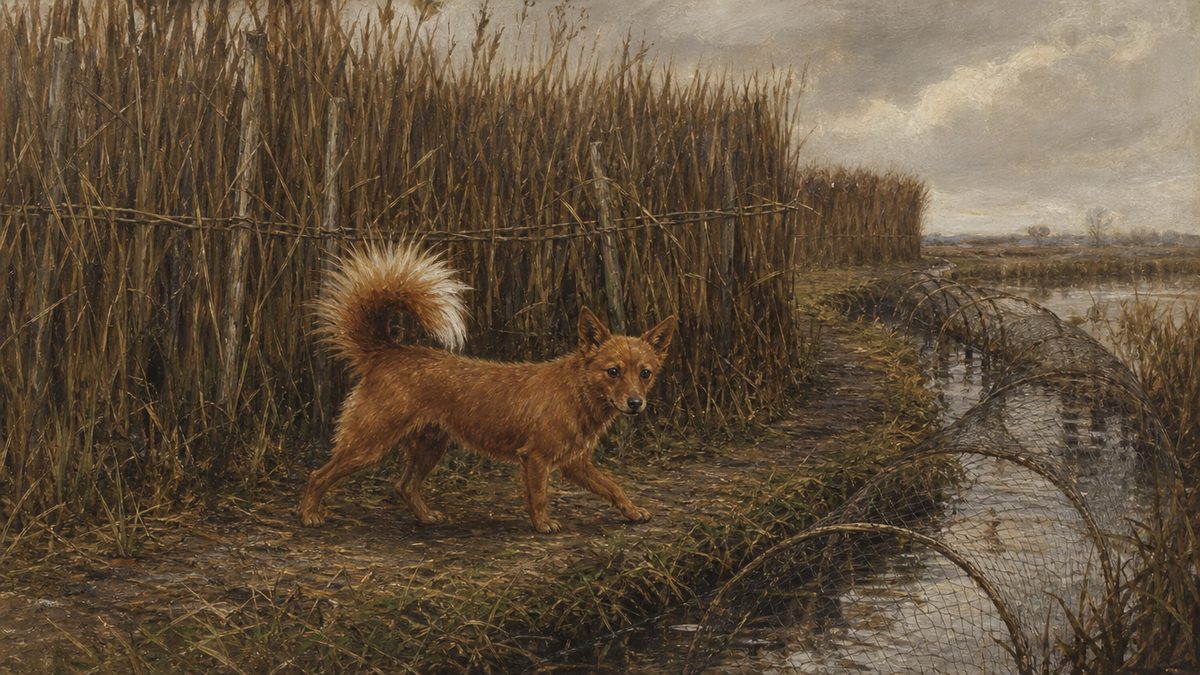
'A Decoyman is the man who works and manages the Decoy... The Piper is the dog used in Decoying. The Pipes are the long, curving, net-covered ditches in which the actual capture of the ducks takes place. The Screens are the reed shelters from behind which the Decoyman, unseen by the birds, practises his allurements on them. The Hoops are the curved rods of wood or iron...'
The dog is defined in a list of equipment. It sits between the man and the ditches, described the way the hoops and the screens are described, by what it is for. That is not how a breed is introduced in any nineteenth-century sporting book, and it is precisely how a working category is introduced.
The one physical description that exists
Payne-Gallwey's section headed simply 'The Dog' gives the only specification anyone wrote down: 'A bright intelligent little fellow, about a third smaller than a Fox, with a curly bushy tail if possible, and of a red or yellow colour. A good Decoy dog is hard to find, but, when obtained, is invaluable.';
| Attribute | What 1886 says |
|---|---|
| Size | About a third smaller than a fox |
| Colour | Red or yellow |
| Tail | Curly and bushy, if possible |
| Temperament | Bright and intelligent; should work cheerfully |
| Training | One wave of the hand or arm is enough, if properly trained |
| Height | Not given |
| Weight | Not given |
| Coat type | Not given |
| Head, ears, body, gait | Not given |
| Breed name | Not given |
| Pedigree or ancestry | Not given |
The quotation in circulation reads 'a bright little fellow'. The original reads 'A bright intelligent little fellow';. One adjective, lost in transmission, and it happens to be the one describing the quality the job actually required. This page quotes the scan rather than the quotation.
Read the phrase 'if possible' in the tail clause. A breed standard does not say a feature is desirable if it can be managed; a man describing what he looks for in a working animal does. And 'a good Decoy dog is hard to find' is what you say about a type you select from whatever is available, not about a breed you buy from a breeder.
One secondary source is worth naming because it independently reaches the same reading. David Hancock's survey of decoy dogs records that the distinctive feature of dogs used in this way was the well-flagged tail, and that their colour was usually fox-red. That is the 1886 specification restated a century later, still by feature and colour rather than by breed, by a writer who had read the same literature.
Bonbeno's two-condition test, applied to a job description
To count as a breed on this site an animal needs two documents, a written breed standard and a studbook. The Red Decoy Dog has never had either, at any point, and there is no serious argument that it did.
The test matters here because the Red Decoy Dog is routinely filed with breeds that genuinely ended, and that is a different thing. Some extinct breeds ran out of time having had both documents. This one had neither, so there was nothing to end.
| Condition | Verdict | Evidence |
|---|---|---|
| A written breed standard | Never existed | The only physical description in the primary literature gives colour, relative size and tail, with no height, weight, coat, head or body clause. Payne-Gallwey 1886 specifies less about the dog than about the netting |
| A studbook | Never existed | No pedigree authority has held the name. The FCI definitive register, enumerated 1 to 400 by probing every record and reading back its own title, contains no record whose title includes DECOY, with the English Setter at 2 and the Chesapeake Bay Retriever at 263 as controls |
| Contemporary classification | Equipment, not breed | Payne-Gallwey's glossary lists the Piper between the Decoyman and the Pipes, alongside the Screens and the Hoops |
| What the name denotes | A function | The piper is the dog used in decoying. The name describes the work, and the qualifier red describes the colour that worked |
| Closed gene pool | None | A good decoy dog is described as hard to FIND, which is what is said of an animal selected from the general population rather than bred from a register |
The verdict, and the word that fits it
The Red Decoy Dog is a working category, and it belongs beside the turnspit rather than beside the English Water Spaniel. This site has run the same test on both. The Turnspit Dog was a job description that never had either document, and the English Water Spaniel had a written standard and appeared in a kennel club stud book in a named class and still died out. The first is a category, the second is a breed that ended, and the Red Decoy Dog is the first kind.
On the same Indian results page, Google's AI answer states under a heading reading 'Not a Formal Breed' that rather than a strict purebred lineage, the term described any clever red dog with a well-flagged tail used for this hunting style. Wikipedia's article, ranking directly above it, opens by calling the Red Decoy Dog a now extinct breed of gundog. Two sources, one page, opposite verdicts, and only one of them matches the 1886 text.
One nuance that cuts the other way, and it is real. Sustained selection for a job in a fixed place does produce something like a landrace, and English decoy men were selecting for fox-red colour and a flagged tail over generations in the same marshes. That is how a landrace starts. It is not how a breed is made, because nobody wrote anything down.
One closing point on breed recognition as a concept, because this page turns on it. Breed recognition is a decision a register makes rather than a property an animal has, and the whole difference between this name and the Kooikerhondje is that a Dutch register made that decision and no English one ever did. The dogs may have been comparable animals doing comparable work. Only one of them acquired a document, and only the one with the document has a measurable population today.
When the Red Decoy Dog disappeared, and why no date is given here
No source dates the disappearance of the Red Decoy Dog, and Wikipedia says so itself. This page supplies no year, because none exists in any document we could reach.
Wikipedia's own article states plainly that it is unknown when the Red Decoy Dog became extinct, and reasons that its decline likely tracked the spread of shooting as wildfowlers replaced nets with shotguns. That is a sound mechanism and it is not a date.
What can be dated is the work, not the dog
The honest way to bound this is to date the practice rather than the animal. Duck decoying was a commercial industry in the English fens and coastal counties through the eighteenth and nineteenth centuries, and Payne-Gallwey wrote his manual in 1886 precisely because the practice was declining and he wanted it recorded. A dog defined entirely by a job vanishes when the job does, and it leaves no register behind to record the moment.
It will not invent a century. Several aggregator pages give the Red Decoy Dog a date of extinction and none cites a document for it. Where the best available source states that the date is unknown, the honest page states that the date is unknown. This is the same treatment this site gives every undated extinction claim, and it is why the turnspit page dates its own subject from five specific sources rather than from a round number.
The one thing that did survive, and it is not a dog
Decoy structures survive in England as heritage sites, with their pipes, hoops and screens intact, and several are managed for conservation rather than for capture. That matters for this page for one reason: the equipment outlasted the animal, and it is the equipment that tells you what the animal was. Payne-Gallwey's glossary defines the dog in the same list as the hoops, and the hoops are still there.
So the accurate summary is that a working type disappeared at an unrecorded moment when the work it existed for stopped being economic, leaving behind two breeds in other countries and a set of earthworks in England.
The two breeds that survived the work
Two living breeds still do what the Red Decoy Dog did, and both are on the FCI register with real health data behind them: the Nederlandse Kooikerhondje at 314 and the Nova Scotia Duck Tolling Retriever at 312.
The FCI's definitive register was enumerated record by record on 9 September 2026, reading each page's own title rather than assembling a URL from a name, and it holds both. No record's title contains DECOY, which is the register's answer to the question this page is about.
| Breed | FCI record | Country | Relationship to the decoy dog |
|---|---|---|---|
| Nederlandse Kooikerhondje | 314 | Netherlands | Does the same job in the same kind of trap, and is named for it |
| Nova Scotia Duck Tolling Retriever | 312 | Canada | Widely described as descending from English decoy dogs taken to Nova Scotia |
| Red Decoy Dog | none | England | Never registered anywhere |
The Kooikerhondje's name is the argument
Kooikerhondje means the little dog of the kooiker, the decoy man. The breed is named for the job, exactly as the English dog was, and the difference is that the Dutch wrote it down and registered it while the English did not. The same working category produced a breed in one country and nothing durable in the other, which is the cleanest illustration available of what registration actually does.
The Kooikerhondje has real, published screening data. OFA held 323 hip evaluations at 95.0 percent normal and 4.3 percent dysplastic on 9 September 2026 and 324 at 95.1 percent normal eight days later, with the components closing arithmetically on the later reading: excellent 27.8 plus good 63.3 plus fair 4.0 equals 95.1 exactly, and mild 4.3 plus moderate 0 plus severe 0 equals 4.3 exactly. The Red Decoy Dog has none of that, and never could have, because there was no population to measure.
What the Kooikerhondje's literature actually covers
The breed's veterinary literature clusters tightly on inherited disease, which is what a small registered population produces. It covers type III von Willebrand disease across several papers from the 1990s and 2000s, a hereditary inflammatory myopathy described in 2023, hereditary necrotising myelopathy linked to an IBA57 variant, and patellar luxationMandigers Paul JJ, Stehling Oliver. The Nova Scotia Duck Tolling Retriever's literature clusters on hypoadrenocorticism and an immune-mediated rheumatic disease complex.
Neither body of work would exist without a closed register and a breed club willing to fund it. That is the practical difference between a type and a breed, and it is worth more to a buyer than any origin story.
The name form decides the literature, by a factor of nearly five
Searching the surviving decoy breed under its FCI name returns 5 papers and searching it under the name clinicians use, singular and plural together, returns 19, from the same database in the same session.
This is a research finding rather than a breed finding, and it is the most transferable thing on this page. A controlled PubMed audit on 9 September 2026, re-run on 17 September with the query translation line read for every query and controls returning 126 and 141, produced these counts.
| Query | Records | What it is |
|---|---|---|
| 'Red Decoy Dog'[tiab] | 0 | The subject of this page |
| 'decoy dog'[tiab] and 'decoy dogs'[tiab] | 0 and 0 | The generic term |
| 'Kooikerhondje'[tiab] | 5 | The FCI and Dutch name |
| 'Kooiker dog'[tiab] and 'Kooiker dogs'[tiab] | 19 | The name clinicians writing in English use, 9 in the singular and 17 in the plural, 19 together |
| 'Dutch Kooiker'[tiab] | 15 | A third form |
| Kooiker[tiab] OR Kooikerhondje[tiab], every form at once | 24 | The real literature |
| 'Nova Scotia Duck Tolling Retriever'[tiab] | 24 | Singular only |
| 'Nova Scotia Duck Tolling Retrievers'[tiab] | 22 | Plural only |
| Union of singular and plural | 37 | The real literature |
The FCI name is the worst query for the Dutch breed. Searching 'Kooikerhondje' alone returns 5 of a real 24, a 4.8-fold undercount, because English-language clinical papers write 'Kooiker dog' or 'Kooiker dogs', and the singular of that form alone returns 9 against the plural's 17. And the singular loses a third of the tolling retriever's literature, since 24 singular against a union of 37 means 13 papers, or 35 percent, appear only under the plural. Neither loss announces itself; both queries return a clean, plausible, controlled result.
Why this belongs on a page about an extinct type
Because it is how a false absence gets manufactured. If you search a historical name, get zero, and stop, you conclude there is no literature on decoy dogs. There is a great deal, under two other names, and the animal you would be reading about is the one still doing the job. A controlled zero on the names you thought of is still a zero on the names you thought of.
The same discipline applies to the registers. OFA holds this breed only as NEDERLANDSE KOOIKERHONDJE, code KOO; neither 'Kooikerhondje' alone nor 'Red Decoy Dog' appears anywhere in its 482-entry breed-code list. A search on the short name returns nothing and the breed is plainly there.
Red Decoy Dog price in India
There is no price in india for a Red Decoy Dog, and no price anywhere, because no living population exists and no register has ever held the name.
This is the strongest form of price absence on this site. For a rare living breed the answer is that no Indian market exists. Here there is no animal, so there is no market anywhere in the world, and any offer under this name is an offer of something else.
The surviving breeds are also unobtainable here
If what you want is a living decoy dog, Indian import law closes that route. DGFT Trade Notice 22/2022-23 of 19 December 2022 places dogs under ITC(HS) 01061900 as Restricted, and Policy Condition (7) allows import only for a pet dog with a valid pet book in the importer's name, for an R&D organisation with a CPCSEA recommendation, or for Defence and Police use.
Policy Condition (8) reads: 'Import of commercial dogs for breeding or any other commercial activities other than the purposes mentioned above is not permitted.' Paragraph 6 adds that 'any applications for trading/breeding purposes, or applications made on behalf of some another person/entity shall be duly rejected';. An import authorisation for a personal pet covers one owner's own dog and creates no breeding stock.
What a quoted price under this name would be
- A different breed entirely, most plausibly a small red-and-white spaniel type sold under a romantic historical name.
- An auto-generated listing shell that exists identically for every breed name and stocks none of them.
- A converted foreign figure, testable by dividing the rupee number by 84.38 and by 74 and seeing whether it lands on a round dollar or euro amount.
- Merchandise rather than an animal, which is a documented mechanism on this site for breeds whose names double as ordinary words.
Bonbeno publishes no price under this name. What is real is what a small gundog costs to keep in India, which follows, and it applies to the surviving breeds rather than to a historical type.
What a small gundog costs to keep in India
The cost of ownership for a 9 to 23 kg gundog in India runs roughly Rs 3,500 to Rs 7,000 a month once food, parasite control, vaccination and routine care are counted, which makes it the cheapest dog in this cluster.
These figures apply to the surviving decoy breeds rather than to the historical type. The Kooikerhondje sits at 9 to 13 kg on the Dutch registry's page, since its FCI standard gives no weight, and the Nova Scotia Duck Tolling Retriever at 17 to 23 kg under FCI 312Federation Cynologique Internationale, so both fall well below the 60 cm hounds elsewhere in this batch and both are materially less expensive to keep.
| Item | Published figure | Source and caveat |
|---|---|---|
| Anti-rabies vaccination | Rs 699 | Vetic clinic list price, national page |
| 9-in-1 DHPPiL | Rs 899 | Vetic clinic list price |
| Kennel cough | Rs 1,349 | Vetic clinic list price |
| Tick and flea plus worming, monthly | about Rs 1,103 at the 15-30 kg band | A 9 to 13 kg Kooikerhondje takes a smaller and cheaper band |
| Delhi pet dog registration | Rs 500 new, Rs 500 renewal | MCD, dogs only, late fee Rs 100 a month |
| Chennai pet licence | Rs 50 | Greater Chennai Corporation |
Read the Vetic figures as one chain's list prices rather than a market average, since that chain quotes different course prices on different city pages on the same day. The NexGard figure quoted is for the 15 to 30 kg band and a Kooikerhondje-sized dog takes a cheaper one, so treat it as a ceiling rather than a cost.
Greater Chennai Corporation's six municipal veterinary clinics provide treatment and anti-rabies vaccination free of cost, and its pet licence is Rs 50. For a Chennai reader that is a far more affordable baseline than any private rate card. Delhi's MCD charges Rs 500 to register a pet dog and the same to renew.
Food is the smallest line in this cluster for exactly the reason the dogs are small. A 10 kg dog eats roughly 130 to 180 grams of a good dry food daily, which is a low three-figure monthly number, and even a 20 kg tolling retriever stays under what any 60 cm hound needs.
Suitability for the Indian climate, and the humidity result that surprises people
The Fens are more humid than any Indian city, at 84.66 percent annual relative humidity against Chennai's 72.39, so damp air is not what would trouble a decoy dog in India. Heat is.
This is one of the few homelands on this site where the grid cell is beyond argument. The Fens are flat and near sea level, which is exactly the terrain NASA POWER handles well.
Ely in Cambridgeshire returns a cell elevation of 25.56 m against a real ground elevation of 23 m, an error of +2.56 m. Nacton in Suffolk, beside a surviving duck decoy, returns 25.55 m against 29 m, an error of -3.45 m. Both are the most accurate homeland cells in this whole six-breed batch, and the reason is simply that the Fens have no terrain to flatten.
| Place | Annual mean C | Warmest month | Annual RH % |
|---|---|---|---|
| Ely, the Fens | 10.18 | JUL 17.37 | 84.66 |
| Nacton, Suffolk | 10.67 | AUG 17.38 | 85.25 |
| Yarmouth, Nova Scotia | 7.62 | AUG 16.48 | 85.43 |
| Kolkata | 25.81 | MAY 31.53 | 73.93 |
| Chennai | 27.95 | MAY 31.51 | 72.39 |
| Bengaluru | 23.74 | APR 28.37 | 67.94 |
| Mumbai | 26.77 | MAY 31.19 | 67.39 |
| Delhi | 25.60 | JUN 35.88 | 45.56 |
Read the humidity column and the usual claim collapses. The Fens at 84.66 percent, Suffolk at 85.25 and Nova Scotia at 85.43 are all more humid across the year than Kolkata at 73.93, Chennai at 72.39 or Mumbai at 67.39. A decoy dog spent its working life in wet reed beds, and English marsh air is not drier than Indian city air. It is wetter.
What actually hurts is heat, and wet bulb is the measure
A dog sheds heat by evaporation, so the wet bulb temperature caps its cooling, and that is where the gap is. Ely peaks at 14.72 C in July and Nacton at 15.14 C in August. Kolkata peaks at 27.09 C in June and Chennai at 26.11 C in May. That is a gap of eleven to twelve degrees, and it is the whole story.
So the correct framing for any Atlantic, North Sea or fenland breed in India is not that the humidity will finish it. It is that the combination of heat with humidity will, because the dog arrives from a place that is just as wet and eleven degrees cooler. Yarmouth in Nova Scotia makes the same point for the tolling retriever, running 85.43 percent annual humidity against a 7.62 C annual mean.
Hall 2020 found that of 879 heat-related illness events with a recorded trigger in a 905,543-dog cohort, 652, being 74.2 percent, were exertional rather than environmental. Neither surviving decoy breed was separately modelled, so no breed-specific odds ratio exists and none is offered. For a dog bred to run repeated sprints along a screen on command, the exertional finding is the relevant one.
Temperament, and what a job description tells you about it
The only temperament evidence for the historical decoy dog is a sentence about training, and it describes an animal working at distance on a silent hand signal, which is a high bar.
Payne-Gallwey gives one temperament requirement and one training observation, and both are worth reading closely. He asks that the dog 'should do his work cheerfully above all things, and be well rewarded for doing it, at the time', and records that 'One wave of the hand or arm is enough, if the dog is properly trained, to urge him on his career over the jump and round the front of each screen consecutively';.
Three things that sentence establishes
- The dog worked silently. A barking dog flushes the ducks it is luring, so quietness was not a preference but a requirement of the job.
- The dog worked at distance on a visual signal. No voice, no lead, no proximity, which is a demanding standard of trained response.
- The dog was paid immediately. 'Be well rewarded for doing it, at the time' is a description of contingent reinforcement written in 1886, and it is exactly what a modern trainer would prescribe.
A Victorian sporting writer specifying that the reward must come at the time is describing the timing principle that underpins all modern reward-based training. It is the most modern sentence in the book and it sits in a chapter about netting ducks. Nothing about this animal's handling was coercive, because coercion produces a dog that will not run cheerfully into a net tunnel.
What the surviving breeds inherited
The Kooikerhondje's FCI standard asks for a dog that is good natured and alert but not noisy, faithful, easy-going and friendly, with a zest for working, and the Dutch registry's own breed page calls it sensitive to noise and harsh words, needing no harsh voice or handRaad van Beheer op Kynologisch Gebied…. The Toller's FCI standard calls it highly intelligent and easy to train, with a strong retrieving desire and playfulness essential to its tolling ability. That combination makes them trainable to an unusual degree and also means they do poorly with harsh handling. A sensitive dog bred to work on a hand signal shuts down under pressure rather than complying.
None of this makes either breed an easy pet in an Indian flat. A dog with high prey drive for waterfowl, real energy and a need for a job is a demanding animal wherever it lives. It does mean the temperament problem is workload rather than character.
One trait the decoy job did NOT select for is worth naming, because it separates these dogs from every hound in this batch. A decoy dog was not independent. It worked to a signal, in sight of its handler, on a route the handler chose, and a dog that made its own decisions was useless in a decoy pipe. That is the opposite of the trailing hounds elsewhere in this cluster, and it is why the surviving breeds are far more biddable than their working history might suggest.
Training approach and what these dogs resist
Train a decoy-type dog with reward timing and distance work, because the historical job was a silent hand signal at range and the surviving breeds still learn that way faster than they learn anything else.
The primary source is unusually helpful here. Payne-Gallwey's requirement that the dog be rewarded at the time and worked on a single wave of the hand is a training specification, and it maps directly onto modern practice.
- Mark and reward within a second, because delayed reward teaches nothing and this type was selected on immediate contingency.
- Build a hand signal early alongside the verbal cue, since these dogs read gesture unusually well.
- Work distance deliberately rather than incidentally, sending the dog out and back over a fixed route the way the job did.
- Socialise early to Indian street conditions, traffic, cattle, crowds and other dogs, at a distance the dog can handle.
- Keep recall training live for the life of the dog, because a waterfowl drive does not fade.
Harsh corrections produce a shut-down dog rather than a compliant one, and the Dutch registry describes the Kooikerhondje as sensitive to noise and harsh words. A dominance framework has no evidential support in any species and does nothing for a dog whose motivation is a moving bird. Exercise the drive properly and the training holds.
The Indian constraint
The safe hours to work a heat-sensitive small gundog in most Indian cities are before dawn and after dark for four to five months of the year, which are also the hours of worst visibility. Plan the training year around the climate rather than against it, and treat a reflective harness and a light as basic equipment rather than an accessory.
Daily exercise requirement, and what the job actually demanded
A decoy-type dog needs sixty to ninety minutes of varied work daily, and the historical job tells you what kind: repeated short bursts on a fixed route rather than sustained distance.
The work was not endurance. Payne-Gallwey describes the dog running 'over the jump and round the front of each screen consecutively'; on a hand signal, appearing and disappearing to draw the ducks progressively up the pipe. That is interval work with a strong cognitive component, repeated until the birds are far enough in.
| City | Usable hours, Apr to Jun | Practical plan |
|---|---|---|
| Bengaluru, Pune | 05:30 to 08:00 and after 19:00 | Two sessions of 35 minutes, one with retrieve or search work |
| Delhi, Ahmedabad | 05:00 to 07:00 and after 20:30 | Dawn session only in the worst weeks, indoors midday |
| Chennai, Mumbai, Kolkata | 05:00 to 07:00 and after 20:00 | Short sessions, water always, no midday movement |
Replicate the pattern rather than the distance
- Set up a short fixed route with two or three turning points and send the dog round it on a signal.
- Use retrieves over water where genuinely clean water exists, since swimming loads the body without loading the heat.
- Hide objects and let the dog work the pattern out, because this type was selected for problem solving as much as for running.
- Rotate the route, because a solved pattern stops being exercise.
Restlessness, obsessive fetching, chewing and vocalising at movement outside. A small athletic gundog that cannot work does not become calm, it becomes anxious. These breeds do not manage boredom well, and a garden alone does not count as an outlet because the job was directed rather than free.
Grooming and ear care in Indian humidity
Groom a decoy-type dog twice a week and pay attention to the tail and the ears, because the defining feature of the historical type was a curly bushy tail and the surviving breed carries heavy ear furnishings.
The primary source specifies exactly one coat feature and it is the tail: 'with a curly bushy tail if possible';. That was not decoration. A well-flagged tail is what the ducks followed, so the feature the whole job depended on is also the feature that needs brushing.
The surviving Kooikerhondje carries a medium-length coat with distinct patches of clear orange-red on pure white and black hair tips on the ears that its standard calls earrings, and the tolling retriever carries a water-repellent double coat of medium length. Both mean feathering, and feathering in an Indian monsoon holds moisture against skin.
Feathering on the ears, tail and legs is a moisture problem when wet and a sun barrier when dry. Clipping it off exposes lightly pigmented skin to Indian sun on a red and white dog, which is a genuine burn risk. Dry it properly instead, which is the answer to both problems.
The ears are where the veterinary bill comes from
A drop ear with heavy furnishing over a warm canal in an Indian August is the likeliest source of an ear infection in either surviving breed. The coat colour on the Kooikerhondje makes this slightly easier to spot, since discharge shows on white hair, and that is the only advantage the colour gives.
- Check both ears weekly by lifting the leather and looking rather than sniffing from a distance.
- Dry the canal after every swim and every bath, which for a water-working breed means often.
- Use a cleaner your vet recommends, and stop if the dog flinches.
- See your nearby vet at the first head shake or odour rather than the third.
Ticks and a water dog
A dog worked in reed beds and long grass collects ticks, and the Indian tick-borne disease burden is heavy. A West Bengal series of 584 dogs screened at veterinary clinics found Babesia gibsoni in 76.54 percent and two or more pathogens in 72.9 percent of the 584 dogs screened. A Kerala series of 120 dogs found Babesia in 66.7 percent, peaking pre-monsoon between March and May. Both sampled clinic caseloads rather than the street, and that caveat belongs beside the figure. Run hands through the feathering weekly, because that is where ticks lodge.
Health issues, and where the real data is
The Red Decoy Dog has no health data of any kind, and the Kooikerhondje that inherited its job has some of the best screening data of any rare breed on this site.
The absence is total and it is not interesting on its own. A type with no population, no register and no name in any studbook cannot have health statistics, and no page should imply otherwise. What is interesting is the contrast with the breed that did get registered.
| Database | Evaluations | Result |
|---|---|---|
| Hips | 324, read 17 September 2026 (323 on 9 September) | 95.1 percent normal, 4.3 percent dysplastic (95.0 on 9 September) |
| Eyes | 426 | 99.1 percent normal |
| Patella | 345 | 94.5 percent normal, 5.5 percent abnormal |
| Von Willebrand's | 297 | 100.0 percent normal |
| Hereditary necrotizing myelopathy | 299 | 93.3 percent normal, 6.7 percent carrier |
| Elbows | no row | Below OFA's 50-evaluation publication threshold |
On 17 September 2026 the hips row reads excellent 27.8, good 63.3 and fair 4.0, which sum to 95.1 against a printed normal of 95.1. On 9 September it read 27.9, 63.2 and 4.0 against a printed 95.0, inside OFA's own rounding, and one more Good evaluation moved it. Mild 4.3, moderate 0 and severe 0 sum to 4.3, matching the printed dysplastic figure exactly on both readings. A row that closes both ways is a row you can trust; a row that does not is the wrong row or the wrong disease marker.
The elbow absence is a finding, not a gap
The breed has 324 hip evaluations and no elbow row at all. OFA's own threshold explains it: 'For hips, each breed must have at least 100 evaluations in the database. For all other databases, there must be at least 50.'; So more than 320 Kooikerhondjes have had hips scored and fewer than 50 have had elbows scored, which tells you what the breed's own community screens for.
What the literature covers
The Kooikerhondje's 24 papers cluster on inherited disease, which is what a small closed register produces. They cover type III von Willebrand disease across several papers, a hereditary inflammatory myopathy described in 2023, hereditary necrotising myelopathy linked to a novel IBA57 variant, and patellar luxationMandigers Paul JJ, Stehling Oliver. OFA now publishes a polymyositis DNA table for the breed as well, reading 65 tested, 63.1 percent normal and 36.9 percent carriers on 17 September 2026. The tolling retriever's 37 papers cluster on hypoadrenocorticism and an immune-mediated rheumatic disease complex.
Ask any seller of either surviving breed to screen for the conditions its own literature names, and ask for the parents' results rather than for reassurance. Neither breed is fragile, and both have specific, testable inherited risks that a responsible breeder will already be testing for. Consult your nearby vet about which tests are worth doing in India.
Life expectancy, and why this page gives no number
No life expectancy figure exists for the Red Decoy Dog and none can, because there was never a population to measure.
Neither surviving decoy breed is among the 155 purebred breeds in the largest UK longevity study's supplementary tables either, so even they have no cohort median published there. Figures circulating for both come from breed-club surveys and registry estimates rather than from veterinary cohorts, and this page does not repeat them as measurements.
| Register | Red Decoy Dog | Kooikerhondje | Control that passed |
|---|---|---|---|
| FCI definitive register, 1 to 400 | Absent, no DECOY record | Record 314 | English Setter 2, Chesapeake 263 |
| OFA breed-code list, 482 entries | Absent | Code KOO | LABRADOR 109, BULLDOG 170, BEAGLE 61 |
| OFA published statistics | Absent | Five databases published | Same session, same dump |
| PubMed, all name forms | Zero | 24 on-breed records | Labrador hip dysplasia 126 |
| McMillan 2024 longevity tables | Absent | Absent | The study's own breed list |
The temptation on a page like this is to give the historical type the Kooikerhondje's lifespan, since the two did the same job. That would be fabrication wearing a citation. Never substitute a related breed's numbers. A type with no population should say so, and this page says so three times rather than borrowing once.
The useful thing a reader can take away is not a number. It is that the two breeds which inherited this work have measurable, published, testable health data precisely because somebody registered them, and the English type has none precisely because nobody did.
Feeding a small working gundog in India
Feed a decoy-type dog to a body condition score, because no standard exists for the historical type and the surviving breeds span 9 to 23 kg, which is too wide for any single chart.
Payne-Gallwey gives no weight, no height and no feeding guidance, only that the dog is about a third smaller than a fox. For the living breeds, a Kooikerhondje sits at 9 to 13 kg on the Dutch registry's page and a tolling retriever at 17 to 23 kg under FCI 312Federation Cynologique Internationale, which is up to a two-fold difference in ration between two dogs doing the same historical job.
- Feel the ribs with flat fingers and expect to find them under a thin cover, without pressing.
- Look down at the standing dog and expect a visible waist behind the ribs.
- Look from the side and expect an abdominal tuck rather than a level underline.
- Weigh monthly on the same scale and record it, because a trend beats a single reading.
A water-working dog has one specific feeding rule
Do not feed immediately before swimming or hard retrieving work, and do not feed immediately after it either. The general deep-chest guidance applies less strongly here than to the large hounds elsewhere in this cluster, since neither surviving breed is markedly deep-chested, but the timing rule is worth keeping.
A dog that cools by panting loses water fast, and a small dog has less reserve than a large one. In an Indian summer a 10 kg working dog needs water available in more than one place and refreshed rather than topped up. Fresh water is a bigger determinant of how this dog copes with April than any brand of food.
One Indian-specific point on food availability. Small-breed formulations are widely stocked in Indian cities and cost materially less per month than large-breed ones, so a decoy-type dog is genuinely cheap to feed here compared with any of the 60 cm hounds on this site.
Month by month through the first year
Plan a decoy-type puppy's first year around the socialisation window and around building distance work early, because a dog bred to respond to a hand signal at range learns that best when young.
This timeline is generic small-gundog guidance honestly labelled, and it applies to the surviving breeds. No breed-specific developmental data exists for the historical type, and none can.
| Age | Priority | What to do |
|---|---|---|
| 8 to 12 weeks | Vaccination and habituation | Complete the core course with your vet; begin surface, sound and handling exposure indoors |
| 12 to 16 weeks | Socialisation window | Short daily outings in cool hours; traffic, cattle, crowds and other dogs at a workable distance |
| 4 to 6 months | Signal work | Introduce hand signals alongside verbal cues; begin short directed retrieves |
| 6 to 9 months | Distance and water | Extend the send-out; introduce clean water if genuinely available; register the dog with your municipality |
| 9 to 12 months | Pattern work | Build fixed routes with turning points; keep sessions short and frequent |
| 12 months onward | Adult workload | Sixty to ninety minutes daily; recall and signal work continue for life |
A puppy's first Indian summer is the highest-risk heat period of its life. Indian law names young animals explicitly among the categories that must not be kept in outdoor facilities without a veterinarian's written approval, alongside dogs not accustomed to the temperatures prevalent in the area and breeds that cannot tolerate them. Treat that clause as a care standard rather than only as a rule for breeders.
Register the dog when your municipality requires it rather than when you remember. Delhi's MCD charges Rs 500 for a new pet dog registration and Rs 500 to renew, with a late fee of Rs 100 a month, and Greater Chennai Corporation charges Rs 50 for a pet licenceGreater Chennai Corporation.
Where Indian law touches this dog
Indian law has nothing to say about a historical type and a good deal to say about the surviving breeds, and the clause that matters most is the one about coat and climate.
The Prevention of Cruelty to Animals (Dog Breeding and Marketing) Rules, 2017 apply to anyone breeding dogs in India. Three of their provisions reach a small feathered gundog directly.
- Second Schedule Part IV paragraph 21(1) bars keeping in outdoor facilities, without the attending veterinary practitioner's written approval, dogs not accustomed to the temperatures prevalent in the area or region in question, dog breeds that cannot tolerate them 'such as long-haired breeds in high temperature locations', and sick, infirm, aged or young animals.
- Second Schedule Part II paragraph 6(8) forbids tail docking, ear cropping, de-barking, de-clawing, branding, dyeing and any other mutilation, and any change of appearance by artificial means.
- Second Schedule Part III paragraph 8(10) requires breeding dogs to have been tested for genetic defects including hip dysplasia, progressive retinal atrophy, night blindness, hypothyroidism, entropion, ectropion, overshot and undershot jaw, wry mouth, two or more missing teeth and cryptorchidism.
Paragraph 21(1)(ii) gives its own example, being 'long-haired breeds in high temperature locations'. A Kooikerhondje with full ear, tail and leg feathering in an Indian summer is squarely the animal that clause was drafted about. It does not ban keeping the dog; it bars keeping it in an outdoor facility without written veterinary approval.
A citable absence
Paragraph 8(10)'s list is illustrative rather than closed, since the operative word is including, so a defect being unlisted does not put it outside the clause. Worth knowing for these breeds specifically, because the conditions their own literature names, being von Willebrand disease, inflammatory myopathy and necrotising myelopathy, appear nowhere in the Indian list and are still reachable by it.
The Rules never mention deafness at all: the terms BAER and deaf appear zero times across the whole gazette, verified with a pattern allowing whitespace and hyphens between every character so the absence is genuine rather than an extraction artefact.
Head to head against the dogs you can actually get
The Red Decoy Dog cannot be compared on availability because it does not exist, so the useful comparison is between its two living descendants and the small dogs an Indian buyer can genuinely obtain.
| Dog | Register entry | Weight | Indian availability |
|---|---|---|---|
| Red Decoy Dog | None, ever | Not recorded | Does not exist |
| Nederlandse Kooikerhondje | FCI 314 | 9 to 13 kg on the Dutch registry's page; none in FCI 314 | None found |
| Nova Scotia Duck Tolling Retriever | FCI 312 | 17 to 23 kg under FCI 312 | None found |
| Beagle | FCI 161 | No weight in FCI 161, which gives 33 to 40 cm | Widely available |
| Indian Pariah Dog | No FCI record | 15 to 30 kg across the sexes | Free, everywhere |
The first three rows are the point. One never existed as a breed, and two exist as breeds and are not obtainable in India. The remaining two are what an Indian reader can actually bring home.
If the size and the biddability appeal
A Beagle is the closest available match on size to a Kooikerhondje and the furthest away on trainability, since a scent hound follows its nose and a decoy dog watches its handler. Be clear which of those two traits drew you here, because they point at different dogs.
If the water work appeals
A Labrador Retriever is genuinely available in India, genuinely loves water and genuinely retrieves, and it is the honest substitute for anyone drawn to the tolling retriever. It is also twice the weight, so the Indian heat calculation is harder rather than easier.
This site now carries two English working names tested the same way. The Turnspit Dog and the Red Decoy Dog both fail the two-condition test and both were job descriptions. The English Water Spaniel passes both conditions and still died out. Three English dogs, two categories and one breed, and the difference is entirely whether anyone wrote a standard and kept a book.
What readers get wrong about the Red Decoy Dog
The commonest mistake is calling it an extinct breed, and it is an easy mistake because the highest-ranking page on the Indian search does exactly that.
- Calling it a breed. The 1886 primary source defines it in a glossary of decoy equipment as the piper, the dog used in decoying.
- Giving it an extinction date. Wikipedia states the date is unknown, and aggregators supply one anyway.
- Quoting the description short. The original reads 'A bright intelligent little fellow', and the circulating version drops the adjective.
- Confusing it with the tolling retriever. The Canadian breed is a real registered breed at FCI 312 and is roughly twice the size the 1886 text describes.
- Assuming Indian humidity is the obstacle. The Fens are more humid than any Indian city, at 84.66 percent against Chennai's 72.39.
- Searching only the FCI name for the surviving breed. 'Kooikerhondje' returns 5 papers, 'Kooiker dog' with its plural returns 19, and every Kooiker form together returns 24.
- Reading a zero as an absence. A controlled zero on the names you thought of is still a zero on the names you thought of.
The mistake that costs a dog rather than money
For anyone who does keep a surviving decoy breed in India, the risk is heat during work rather than heat at rest. These are small dogs with real drive and a strong retrieve, and they will keep going past the point of sense. Hall 2020 found 74.2 percent of triggered heat-related illness events were exertional rather than environmental, and a dog fetching in April sun is exactly that mechanism.
Heavy unrelenting panting, a dog that lies down and will not rise, brick-red or very pale gums, vomiting, wobbliness or collapse. Move to shade, wet with cool rather than ice-cold water, offer small drinks, and reach your nearby vet at once. A rectal temperature at or above 41.0 C after exertion in heat is an emergency.
One historical mistake worth correcting gently, because it is repeated with confidence. Decoy dogs were not trained to chase or to flush. They were trained to be interesting, moving in and out of view so that ducks followed them out of curiosity. A page describing the decoy dog as driving birds has the mechanism backwards, and the mechanism is the only genuinely unusual thing about the animal.
Adoption and responsible sourcing
Adopt rather than pursue this name, because nothing can be sold under it honestly and neither surviving decoy breed has a lawful Indian supply chain.
No pedigree can exist under this name anywhere in the world. There is no standard to judge a dog against, no register to enter it in, and no club that recognises it. Any paperwork offered with a Red Decoy Dog is either empty or for a different animal.
What to do if the type appeals to you
- Read the Kooikerhondje page, which covers the breed still doing this job and the health data behind it.
- Read the Nova Scotia Duck Tolling Retriever page for the Canadian half of the story.
- Ask a municipal shelter or an established rescue for a small, biddable, high-energy young dog, which is the closest temperament match genuinely available in India.
- Consider an Indian Pariah Dog, which is heat-adapted, robust, free and available everywhere in India.
The FCI register is enumerable and resolves on the trailing number, so any certificate can be checked. The Kooikerhondje is record 314 and the tolling retriever is record 312Federation Cynologique Internationale. No FCI record exists for a Red Decoy Dog at any number, so a certificate naming one is describing a document the FCI does not issue. To verify an OFA claim, note that the registry holds the Dutch breed only as NEDERLANDSE KOOIKERHONDJE with code KOO.
Bonbeno does not recommend breeders, link puppy listings or quote any price as an offer. This page reports what primary sources, registries and governments publish, and for this name the conclusion is that it belongs in a history of English wildfowling rather than in a search for a puppy.
What the pages ranking in India actually tell you
The Indian search results contain a direct contradiction between the top organic result and Google's own AI answer on the same page, and no page resolves it by opening the 1886 source.
| Source | What it says | What Payne-Gallwey 1886 says |
|---|---|---|
| Wikipedia | A now extinct BREED of gundog from England | Defines the piper in a glossary of decoy equipment |
| Google AI answer, same page | Not a Formal Breed, described any clever red dog with a well-flagged tail | Consistent with the 1886 text |
| Wikipedia | It is unknown when it became extinct | Correct, and several aggregators supply a date anyway |
| Multiple pages | 'a bright little fellow' | 'A bright INTELLIGENT little fellow' |
| Worldly Dogs | Most often mentioned as an ancestor of the tolling retriever | 1886 makes no ancestry claim at all |
| Every ranking page | No glossary quotation | The glossary is the decisive passage |
| Every ranking page | No climate assessment | The Fens are more humid than any Indian city |
The second row is the striking one. Google's own answer engine gets this right and the page ranking above it gets it wrong, on the same results page, in the same session. That is unusual enough to be worth recording, because this site more often documents answer engines laundering errors from ranking pages rather than correcting them.
What the People Also Ask box shows
Google India returned four questions and three are genuinely on-topic, asking what a decoy is for dogs, what red hunting dogs are called, and what breed a famous dog named Decoy is. Only the first is off-breed, being about Red Dog the Australian kelpie, and that is a homonym rather than noise. All four are answered verbatim in the FAQ, untidied.
Google printed 'About 193 results' for this query and 'About 192 results' for the Labrador control in the same session, and the Labrador is the thickest commercial dog query in India. Two nearly identical counts for a historical type and the most-searched dog in the country show exactly how little a printed result count measures. This page draws no conclusion from one.
The gap this page fills is one free book nobody opened. Payne-Gallwey's manual is out of copyright, fully scanned, and searchable, and its glossary answers in eight words a question the English-language internet has been treating as open: the piper is the dog used in decoying.
Red Decoy Dog questions people actually ask
What breed of dog was Red Dog?
Red Dog of the Pilbara was an Australian kelpie or kelpie cross who roamed Western Australia in the 1970s and became the subject of a book and a 2011 film. He has nothing to do with the Red Decoy Dog, and Google returns the question because the two names collide. The decoy dog was an English working type from two centuries earlier, and no individual dog of that type is named in any record.
What is a decoy for dogs?
In duck decoying a decoy is not an object but a structure: a pond with long curving netted ditches, called pipes, screened by reeds, into which wildfowl are lured and trapped. Payne-Gallwey's 1886 manual defines the whole system, listing the Decoy, the Decoyman, the Piper which is the dog, the Pipes, the Screens and the Hoops. The dog is one component of a piece of hunting architecture.
What are the red hunting dogs called?
Several, and the answer depends on the job. In duck decoying the fox-red dog was called the piper, defined by function rather than by breed. The surviving specialists are the Nederlandse Kooikerhondje, FCI 314, and the Nova Scotia Duck Tolling Retriever, FCI 312. Among red hounds the Irish Setter and the Redbone Coonhound are separate breeds with their own standards, and neither descends from decoy work.
What breed is Decoy Ohtani?
Decoy, the dog belonging to the baseball player Shohei Ohtani, is widely reported as a Nederlandse Kooikerhondje. What makes the question worth answering here is the name: Kooikerhondje means the little dog of the kooiker, the decoy man, so a dog of that breed called Decoy is named for the job its ancestors did. That job is the same one the English Red Decoy Dog performed.
Was the Red Decoy Dog a real breed?
No. It was a working type defined by what it did. Payne-Gallwey's 1886 manual, the standard nineteenth-century work on the subject, places the dog in its glossary of decoy equipment as the piper, and describes it only by colour, by size relative to a fox and by tail. No kennel club ever wrote a standard for it and no studbook ever held it. Google's own AI answer agrees, and Wikipedia calls it a breed.
When did the Red Decoy Dog go extinct?
Nobody knows, and Wikipedia says so in its own article. This page supplies no date, because no primary source gives one. What can be said is that decoying declined as shooting replaced netting for wildfowl, so the work the dog existed to do disappeared before any register could have recorded the dog. Several aggregator pages give a century anyway, and none cites a document for it.
How much does a Red Decoy Dog cost in India?
Nothing, because none exists anywhere. There is no living population, no register and no pedigree that can be issued under the name. If you were offered one, you would be offered a different dog. Separately, Indian import law bars importing any dog for breeding or trading purposes, so even the two surviving decoy breeds have no lawful Indian supply chain.
What did a decoy dog actually do?
It ran a fixed route to lure ducks. Payne-Gallwey records that one wave of the hand or arm was enough, if the dog was properly trained, to send it over a jump and round the front of each reed screen consecutively. Ducks follow a moving fox-like animal out of curiosity, so the dog's appearances and disappearances drew them progressively up the netted pipe until the decoyman closed it.
Is the Kooikerhondje the same as the Red Decoy Dog?
No, but it is the closest living thing. The Kooikerhondje is a Dutch breed doing the same job in the same kind of trap, and the FCI holds it as standard 314. The English decoy dog was never registered, so the two cannot be the same animal in any documentary sense. The Nova Scotia Duck Tolling Retriever, FCI 312, is the breed most often named as descending from English decoy dogs taken to Canada.
What health problems do decoy breeds have?
The name itself has no health data, because it has no population. The surviving Kooikerhondje does, and it is unusually well characterised for a rare breed: OFA published 324 hip evaluations at 95.1 percent normal and 4.3 percent dysplastic on 17 September 2026, and the veterinary literature clusters on type III von Willebrand disease, hereditary inflammatory myopathy and hereditary necrotising myelopathy. Consult your nearby vet about screening.
Could a decoy dog live in India?
The surviving breeds could manage better than most European gundogs, and no lawful route exists to bring one here. The interesting part is humidity: the Fens run 84.66 percent annual relative humidity, higher than Chennai at 72.39 or Mumbai at 67.39, so damp is not the shock. Temperature is, since Ely's warmest month averages 17.37 C against Chennai's coolest at 24.09 C.
Why do so many pages call it an extinct breed?
Because Wikipedia does, and almost everything downstream copies Wikipedia. Its article opens by calling the Red Decoy Dog a now extinct breed of gundog from England, and its own infobox sets breed status to Extinct. Google's AI answer on the same results page contradicts it directly, saying under a heading reading Not a Formal Breed that the term described any clever red dog with a well-flagged tail.
Compare with similar breeds
Red Decoy Dog sits in 3 Bonbeno groups. Each one compares it directly against the breeds it is genuinely an alternative to, on the same figures.