
Breed profile
Nova Scotia Duck Tolling Retriever: Four Registries, Four Different Answers
The smallest retriever, recognised by four registries that disagree on how long it lives, and carrying one of the best-documented immune-disease burdens in dogs.
Quick answer
No Indian seller publishes a defensible nova scotia duck tolling retriever price in india. The page ranking first shows five dogs at prices this site has already recorded on breeds that seller does not stock, and the page ranking second renders three French Bulldogs. What is real is the veterinary record: 24 peer-reviewed papers, a documented immune-disease burden, and a homeland whose warmest month is cooler than Chennai's coolest.
This page reports published veterinary research, registry data and screening statistics for general information. It is not veterinary advice and cannot diagnose your dog. Stiffness, neck pain, reluctance to move, unexplained collapse, repeated vomiting or sudden lethargy in a Toller need a veterinarian the same day, because this breed's known conditions include steroid-responsive meningitis-arteritis and Addison's disease, both of which can look mild shortly before they become emergencies. Always consult a qualified veterinarian before acting on anything you read here.
Nova Scotia Duck Tolling Retriever at a glance
What a Nova Scotia Duck Tolling Retriever is, in one job and one colour
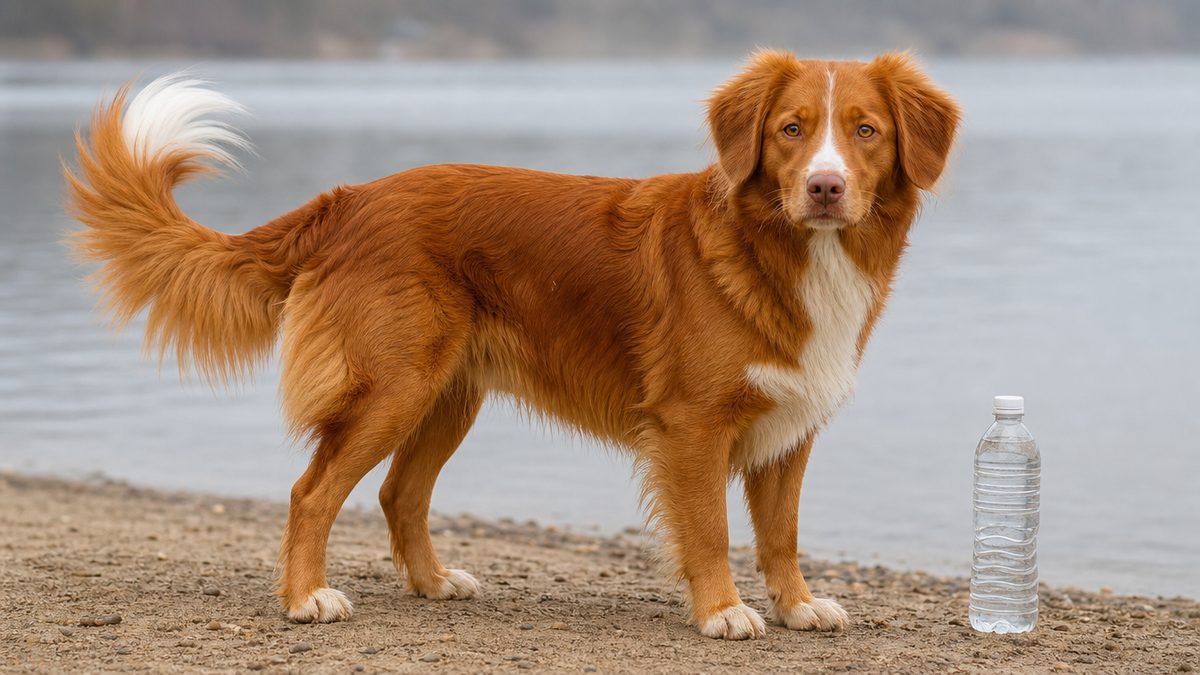
A Nova Scotia Duck Tolling Retriever is the smallest of the retrievers, a red gundog from one Canadian county that lures ducks into gun range by playing on the shoreline and then swims out to retrieve them.
The job is in the name, and it is unusual enough to be worth spelling out. The FCI standard describes the sequence directly: the dog runs, jumps and plays along the shoreline in full view of a flock of ducks, disappearing and reappearing while the hidden hunter throws sticks or a ball, until the ducks' curiosity draws them within gunshot range, and only then is the dog sent to retrieve. Tolling is a trick borrowed from the fox. The Canadian Kennel Club says hunters in Yarmouth County saw how well the fox's on-shore antics worked and built a dog to do the same thing.
Physically the breed is medium in every direction, and that is the standard's own word. The FCI gives ideal height for males over 18 months as 19 to 20 inches, 48 to 51 cm, and females 18 to 19 inches, 45 to 48 cm, with one inch either way allowed. Weight guidance is 45 to 51 lb, 20 to 23 kg, for adult males and 37 to 43 lb, 17 to 20 kg, for bitches. That puts a full-grown Toller several kilos below a Labrador and visibly smaller than a Golden Retriever, which matters in an Indian flat and matters even more when a seller shows you a photograph.
The colour is a disqualification, not a preference
Colour is where this breed standard has teeth. The FCI permits various shades of red or orange with lighter feathering, usually with white on at least one of the tail tip, feet, chest or blaze, and it disqualifies a silvery coat, grey in the coat, black areas in the coat, and any colour other than red or orange shades. The Royal Kennel Club lists the breed standard colours as Buff, Buff and White, Red, and Red and White, and places the breed in Colour Watch Category 0, meaning there are no non-breed-standard colour registration options at all.
That single fact is the most useful thing an Indian buyer can carry into a conversation with a seller. A golden dog is not a Toller. A grey-shaded dog is not a Toller. The AKC registers only Red, Buff and Red Gold, with white markings as the one permitted marking. If the animal in the photograph is the colour of a Golden Retriever, you are looking at a Golden Retriever, or something crossed with one.
Webbed feet and a coat built for cold water
The working equipment is real and it is written into the standard. The FCI requires strongly webbed feet of medium size on both front and back, tight and round with well arched toes and thick pads, and it makes lack of webbing a disqualifying fault. The webbed feet are not a marketing line; they are the reason the dog can swim hard enough to do the second half of its job.
The coat is the other half. The standard says plainly that the Toller was bred to retrieve from icy waters and must have a water-repellent double coat of medium length and softness with a softer, dense undercoat, which may carry a slight wave on the back and can form a long loose curl at the throat in winter. The Canadian Kennel Club describes the same coat and says grooming consists of frequent brushing to keep the undercoat free of mats. Hold that sentence, because everything this page later says about Indian heat follows from it. A coat engineered to keep a dog warm in the North Atlantic in November does not stop working when you land in Chennai.
Ask for the dog's height at the withers, in centimetres, before you ask anything else. An adult male Toller should stand 48 to 51 cm, with one inch of tolerance. A 60 cm dog is not this breed at any price.
Which registries hold the Toller, and why four of them disagree about it
Four registries hold the Nova Scotia Duck Tolling Retriever, and reading all four is how you discover they do not agree about its age, its history or how long it lives.
The FCI recognises the breed definitively as number 312, in Group 8, Retrievers, Flushing Dogs and Water Dogs, Section 1 Retrievers, subject to a working trial. Its country of origin is Canada, its date of acceptance on a definitive basis is 30 November 1981, and English is the authentic language of its standard. That date matters for India, because India is a full FCI member represented by the Kennel Club of India, so FCI recognition is what makes an Indian pedigree route possible in principle.
The breed appears on the FCI's letter N index alongside twelve others, which is how we confirmed the index had actually rendered rather than trusting a blank page. It is not on the FCI's provisional list, which holds twenty entries and is a different document entirely.
Three registries, three different founding dates
The history is genuinely unsettled, and no ranking page says so. Set the three accounts side by side and they cannot all be right.
| Source | When the breed was developed | What it adds |
|---|---|---|
| FCI Standard 312 | Early 19th century | 'developed in Nova Scotia in the early 19th century to toll and retrieve waterfowl' |
| Canadian Kennel Club | Latter half of the 19th century | 'perfected in the latter half of the 19th century', known as the Little River Duck Dog |
| Purina India | Early part of the 20th century | 'developed in Canada in the early part of the 20th Century' |
The Canadian Kennel Club is the registry of the country of origin, and it is the most specific of the three. It names Yarmouth County as the home of the breed, describes the foundation as a mixture of retrievers, spaniels and setters with a possible farm collie cross, and dates Canadian recognition to 1945. The AKC, meanwhile, states in its own Did You Know panel that the breed 'has been registered with the Canadian Kennel Club (CKC) since the late 1950s';. Those two claims are thirteen years apart, and they come from two of the world's largest registries writing about the same event.
The Canadian Kennel Club's own English page miscounts an inch
One small error is worth recording because it shows why reading a page in two languages is cheap insurance. The CKC's English text says females average '1 in (.5 cm) less' than males. One inch is 2.5 cm, not 0.5 cm. The French version of the identical paragraph, on the same page, prints '1 po (2,5 cm) de moins' and is correct. The registry contradicts itself between its own two languages, and the French half is the one to follow.
Britain came late. The Royal Kennel Club says the Toller 'arrived in Britain as recently as 1988' and places it in the Gundog group, and it records the breed as not a vulnerable native breed, which is correct because it is not native. Britain therefore has roughly forty years of registry history with this dog, against Canada's eighty.
There is no honest single answer to when this breed was made. A page that prints one date without saying the registries conflict has quietly chosen for you.
Nova Scotia Duck Tolling Retriever price in India, and why every figure you find is unusable
No Indian seller publishes a Nova Scotia Duck Tolling Retriever price in india that survives being checked, and the four pages that rank for that exact query fail in four different ways.
Start with the page at position one. Puppiezo's category page for this breed promises in its own meta description a 'Nova Scotia Duck Tolling Retriever Price' and 'KCI registered' puppies delivered across India. The rendered page contains no rupee figure at all, no listed animal and no price. Its own breed filter offers exactly three choices, Golden Retriever, Labrador Retriever and Black Toy Poodle, and its characteristics tag list carries three Lagotto Romagnolo search tags that have nothing to do with this breed.
Its sibling product page does carry prices, and they are the problem. That page shows five animals, named Fizey, Kuzo, Kazuka, Doir and Tugi, at Rs 98,999, Rs 92,599, Rs 94,999, Rs 1,20,000 and Rs 76,499, with every price hidden behind a 'View Price' popup. Bonbeno has recorded that exact set of figures, and an animal named Fizey, on other breeds' pages at the same seller, including breeds it does not stock. These are house price points attached to whichever puppy is in stock, not a valuation of this breed.
Rs 98,999 is also not a converted dollar figure. Divide it by 84.38 and you get 1,173.25, which is not a price any seller anywhere would print. Divide by 74 and you get 1,337.82. The number is rupee-native and it is a charm price, which is a different kind of unreliable from a converted one and needs saying differently.
Position two shows three French Bulldogs
Mr n Mrs Pet ranks second for the query and prints '3 Result Found' at the top of its Nova Scotia Duck Tolling Retriever page. The only three animals the page actually renders sit under a heading reading 'Similar breeds at other locations', and all three are French Bulldogs, in Mansa and Bangalore. Every price on the page is gated behind a sign-up redirect, so a visitor sees no Toller and no Toller price.
Position three is priced in dollars, for Boston
Wooffy ranks third in India and quotes nothing but US dollars: a puppy at $1,500 to $3,000, a first year of $3,250 to $6,350, ongoing costs of $1,100 to $2,150 a year and a lifetime of $18,000 to $32,000. Its regional section compares Boston, Seattle and the Bay Area against the Midwest and the American South. The page contains no rupee figure and never mentions India. It ranks for an Indian query because nobody has written a better one.
Supertails ranks for the term too, with a list titled 'Dog Price List in India 2026: Top 40 Breeds'. The Nova Scotia Duck Tolling Retriever does not appear anywhere in that 40-breed table. A price list ranking for a breed it does not list is the cleanest possible statement that the Indian market for this dog has not formed.
What an honest answer looks like
The honest answer is that this breed has no established Indian price because it has no established Indian population, and that inventing one would be the only way to fill the gap. What can be said with sources is what comparable dogs cost here. Supertails prices a Labrador Retriever at Rs 8,000 to Rs 80,000 and a Golden Retriever at Rs 25,000 to Rs 1,00,000, and puts the Indian range overall at Rs 2,000 for an indie up to over Rs 1,50,000 for a KCI-registered show-quality dog. A genuinely rare imported gundog would sit at or above the top of that band, if it existed here at all.
Search engines are not a way around any of this, and testing them is part of the job. Asking Bing India for this breed's price returns ten results about Nova India electrical goods, a Nova streaming app, Ai+ Nova 5G handsets and Northern Virginia Community College, under a confident 'About 194,000 results'. The control query for a Labrador's Indian price, run on the same endpoint in the same session, returned ten genuine Indian breed pages and a working People also ask box, so the instrument was healthy and the query was hijacked by the single word 'nova';. A result count is not a market, and a plausible result set is not evidence until the control has passed beside it.
Ask any Indian seller for the sire and dam's registration numbers, and for the height at the withers in centimetres. A real Toller has an FCI or CKC pedigree behind it and stands 45 to 51 cm. Neither question can be answered by a stock photograph.
Monthly cost of ownership in India, built from rates somebody publishes
Budget a Toller in India from its size, because no breed-specific Indian cost data exists, and a 17 to 23 kg dog with a heavy double coat sits in a well-documented price band.
Every figure below is a rate an Indian provider publishes, re-priced on 3 September 2026 rather than copied from an older note. That matters, because retail pet prices in India move within weeks while municipal fees barely move at all.
| Item | Published rate | Source and basis |
|---|---|---|
| Puppy vaccination course | Starts at Rs 6,499 | Vetic, seven visits at days 30 to 120, against a struck-through Rs 8,111 |
| Annual booster | Starts at Rs 3,199 | Vetic, against a struck-through Rs 3,806 |
| Anti-rabies, single dose | Rs 699 | Vetic list price |
| 9-in-1 DHPPiL | Rs 899 | Vetic list price |
| Kennel cough | Rs 1,349 | Vetic list price |
| Tick, flea and worm cover | Rs 1,103 a month | NexGard Spectra 15-30 kg, Rs 3,308 for three tablets |
| Delhi registration | Rs 500 a year | MCD, plus Rs 100 a month late fee |
| Chennai licence | Rs 50 | Greater Chennai Corporation |
Read the vaccination figures for what they are. They are one chain's promotional starting prices across its clinics, not a national average, and the word on the page is 'Starts at';. A single-clinic vet in a smaller city may charge less; a specialist referral hospital will charge more.
The parasite line is the one that is genuinely breed-relevant
A Toller sits in the 15 to 30 kg NexGard Spectra band, where three tablets cost Rs 3,308 against an MRP of Rs 3,375, which works out at Rs 1,103 a month and covers ticks and fleas together with roundworm and hookworm in one product. For most breeds that is a routine line. For this one it is closer to essential, and the reason is in the health section below: a breed with a documented immune-disease burden and low serum IgA is the wrong dog to run on lapsed tick cover in a country where a West Bengal survey of 584 dogs tested at veterinary clinics found Babesia gibsoni in 76.54 per cent and two or more pathogens in 72.9 per cent.
Where the honest uncertainty sits
Food is the line this page will not fake. A monthly kibble figure is arithmetic, not a quoted price, and it depends on the specific bag, the specific dog and the grams fed per day. Anyone printing a confident monthly food number for a breed with no Indian presence has calculated it, not observed it. Weigh the food, read the pack, and do your own multiplication.
For the wider picture, Supertails puts average Indian monthly maintenance at Rs 3,000 to Rs 11,000 in its body text and at Rs 3,000 to Rs 18,000 in its summary, depending on breed size. Note that the same page gives two different bands, which is a reminder that even a retailer writing about its own market is not a precise instrument.
The affordable half of this breed is real and worth stating. Grooming needs no professional visit, the dog is medium rather than giant, and its joints are sound. The expensive half is the immune system, and it is not something you can budget away in advance.
Greater Chennai Corporation states that its six pet clinics provide all treatment and anti-rabies vaccination free of cost, and issued 9,115 licences in 2024. If you are in Chennai, the Rs 50 licence is the cheapest paperwork in Indian dog ownership.
Can a Toller handle the Indian climate? The heat answer and the humidity surprise
A Toller struggles badly with Indian heat and copes with Indian humidity better than almost anyone expects, and the two halves of that sentence come from the same climate data.
Yarmouth County is the breed's home, so we queried NASA POWER by explicit latitude and longitude, 43.8374 north and 66.1174 west, and checked the cell before using it. POWER reports the grid cell elevation as 23.68 m against a real town elevation near 10 m, a difference of 13.7 m, so the cell describes the place rather than a hill above it.
The headline number is 16.48 C. That is Yarmouth's warmest month, August, as a monthly mean. Its coldest month, February, averages minus 1.10 C, and its annual mean is 7.62 C.
| City | Coolest month mean | Warmer than Yarmouth's warmest month? |
|---|---|---|
| Chennai | 24.09 C, January | Yes, by 7.6 C |
| Mumbai | 23.19 C, January | Yes, by 6.7 C |
| Bengaluru | 20.22 C, December | Yes, by 3.7 C |
| Pune | 19.62 C, December | Yes, by 3.1 C |
| Kolkata | 17.31 C, January | Yes, by 0.8 C |
| Delhi | 13.61 C, January | No. Delhi in January is genuinely cooler |
Five of the six are warmer in their coolest month than the breed's homeland is in its warmest. Delhi is the single exception, and only in January, which is worth saying rather than flattening into a blanket claim.
The humidity finding runs the other way, and it corrects a lazy assumption
Indian pages routinely warn that a coastal breed will suffer in Indian humidity. For this breed that is simply wrong, and the numbers say so. Yarmouth's annual mean relative humidity is 85.43 per cent, peaking at 90.57 per cent in July. Not one of the six Indian cities matches it: Chennai runs 72.39 per cent, Kolkata 73.93, Bengaluru 67.94, Mumbai 67.39, Pune 66.80 and Delhi 45.56.
The sharpest way to put it is a near-identical pair. Yarmouth in July sits at 90.6 per cent humidity with a monthly mean of 15.8 C. Mumbai in August sits at 90.4 per cent humidity with a monthly mean of 26.1 C. Almost the same air, 10.3 C apart. This coat evolved wet. What it never met is wet and hot together, and that combination is what defeats evaporative cooling in a panting dog.
What the law says about keeping this dog outside
Indian law speaks to exactly this animal. Second Schedule Part IV paragraph 21(1) of the Prevention of Cruelty to Animals (Dog Breeding and Marketing) Rules 2017 bars keeping in outdoor facilities, without the attending veterinary practitioner's written approval, dogs not accustomed to local temperatures and breeds that cannot tolerate them, naming long-haired breeds in high temperature locations. Note the citation form: this is a Second Schedule paragraph, not a Rule, because the Rules themselves stop at 13.
Practically, that means indoors with a fan or air conditioning during the day, walks before sunrise and after dark from March onwards, and no shaving. Shaving a water-repellent double coat removes the insulating layer that also keeps heat out and exposes skin that has never seen the sun.
Delhi's January is cooler than Yarmouth's August, which reads reassuring until you check June, when Delhi's mean daily maximum reaches 48.79 C. The annual swing, not the winter, is what a northern coat cannot follow.
Temperament and household fit: who should buy a Toller and who should not
Buy a Toller if you can give it several hours of varied activity a day and want a biddable, sensitive, intensely people-focused dog, and do not buy one as a low-effort family pet on the strength of its colour.
The standard's own temperament clause is short and it is a warning as much as a description. The FCI calls the Toller highly intelligent, easy to train and possessed of great endurance, a strong and able swimmer and a natural and tenacious retriever, and notes that its strong retrieving desire and playfulness are qualities essential to its tolling ability. Read that as a job description rather than a personality profile. The playfulness is not decoration, it is the working trait, and it does not switch off in a flat.
The Canadian Kennel Club adds that the breed has already made a name for itself in obedience competition and that its playfulness makes it an entertaining companion. Purina India, writing for a British audience on an Indian domain, calls it ideally suited to the active, country-dwelling family. That phrase is worth pausing on, because almost no Indian buyer of this page is a country-dwelling family, and the advice was not written for them.
The households this breed genuinely fits in India
- Households with a securely fenced outdoor space and someone at home for most of the day.
- Owners already doing a dog sport, because agility, flyball, obedience and tracking are where this breed's brain goes.
- Families with older children who can be taught to end a game rather than escalate it.
- Owners with a genuine tolerance for shedding, since the Royal Kennel Club records the breed as shedding and needing grooming more than once a week.
- Households near water they can safely use, because a dog with webbed feet and a retrieving drive is happiest swimming.
The households this breed will fail in
- Apartments where the only exercise is two short lead walks a day.
- Homes where the dog will be alone for a full working day, since a bored retriever redecorates.
- First-time owners who chose the breed from a photograph of its colour.
- Anyone planning to keep the dog on a balcony, terrace or in an outdoor kennel in an Indian summer.
- Buyers who cannot afford unplanned veterinary investigation, because this breed's known conditions arrive without warning.
The Royal Kennel Club rates the breed's exercise need at up to an hour a day and its home requirement as a small house. Purina's own page, on the same breed, says several hours a day will suit the Toller and that it enjoys walking more than two hours a day. Those two are not close, and an Indian buyer reading only the first will under-exercise the dog by a wide margin. When registries disagree this far, plan for the higher figure and be pleasantly surprised.
One temperament trait deserves its own line because it interacts with Indian conditions. This is a sensitive, handler-focused breed that reads its owner closely. That makes it very trainable and it also makes it prone to becoming clingy and anxious when under-stimulated. An energetic dog with nothing to do does not become calm; it becomes noisy, and in an Indian apartment building that becomes a neighbour problem before it becomes a dog problem.
This breed is known for a high-pitched excitement vocalisation, most often heard at the start of a game or a swim. It is normal, it is loud, and it carries through apartment walls. Factor it in before, not after.
Training a Toller: what works, what it resists, and realistic Indian timelines
Train a Toller with short, varied, reward-based sessions built around retrieving, because the FCI standard calls this breed highly intelligent and easy to train, and the difficulty is never getting it to learn but always giving it enough to learn.
The breed's own standard says the dog sets itself for springy action the moment the slightest indication is given that retrieving is required. That single sentence is your training currency. A retrieve is a more powerful reward for this dog than food, and any behaviour you want reliably can be paid for with a thrown object.
The Indian timeline, month by month, that actually works
- Weeks 8 to 16: socialise hard and early, and do it at dawn. Indian streets are loud, and this is a sensitive breed. Traffic, autos, cattle, other dogs and building noise all need to be met calmly while the puppy is still forming its judgements.
- Weeks 8 to 16: teach a settle on a mat before you teach anything else. A Toller that cannot switch off is the commonest failure mode in a flat.
- Months 3 to 6: build a swap and a retrieve-to-hand. Retrievers who learn to guard an object become difficult adults, and the standard requires softness in mouth, so trading up is trained, not innate.
- Months 4 to 9: proof recall against birds and water. The tolling drive is a chase drive with a job attached, and an Indian park with crows and pigeons is a harder test than a Canadian shoreline.
- Months 6 to 12: introduce a real activity. Agility, flyball, obedience, tracking or scent work all suit this breed, and the Royal Kennel Club and Purina both list them.
- Months 12 onward: keep sessions short and varied for life. This is not a dog you finish training.
What the breed resists
Repetition is the resistance point, not difficulty. Purina describes the Toller as quick to learn and willing to oblige but not a training-junkie type, easily bored without plenty of mental stimulation, and specifically recommends teaching a settle as part of the repertoire. A dog drilled through twenty identical recalls will disengage; the same dog will do twenty recalls happily if each one ends differently.
Harsh handling is the other resistance point, and it matters more here than in a tougher breed. A sensitive, handler-focused dog shuts down under correction and then generalises the shutdown to the context. Reward-based training is not a preference for this breed, it is the only approach that keeps the dog offering behaviour.
Heat is the constraint nobody plans for. From March to October in most Indian cities the only usable training windows are before sunrise and after dark, which means a working household has to build the dog's education around two narrow slots. Plan the day before you buy the dog, not after.
Webbed feet make a strong swimmer, not a safe one. Indian water bodies carry currents, leptospirosis risk and rubbish. Introduce water deliberately in a controlled place, and rinse and dry the coat afterwards every time.
The daily exercise requirement, and what an Indian flat does to a dog that misses it
Plan on 90 minutes to two hours of varied activity a day for an adult Toller, because the two registries that publish a figure differ by more than an hour and the higher one matches the breed's working history.
The Royal Kennel Club rates the breed at up to an hour a day and describes its home requirement as a small house with a small to medium garden. Purina, on the same breed, says several hours of dog exercise a day will suit the Toller and lists it as enjoying walking more than two hours a day. The Canadian Kennel Club splits the difference by saying the breed likes to work and should have lots of outdoor exercise.
When the sources spread that far, the safe planning number is the higher one, because the cost of over-providing exercise is a tired dog and the cost of under-providing it is a destroyed flat.
What the two hours should actually contain
- Thirty to forty minutes of continuous movement, ideally off-lead in a secure space or on a long line.
- Fifteen to twenty minutes of retrieving, which does more for this breed than an hour of plodding.
- Ten to fifteen minutes of scent or problem-solving work, which tires an intelligent dog faster than distance.
- A swim wherever one is safely available, since this is the activity the breed was built around.
- At least one genuinely new environment a week, because novelty is what stops a clever dog inventing its own entertainment.
Split the total across the two cool windows rather than trying to do it in one block. In Delhi from April to June, when the mean daily maximum runs to 48.79 C, a midday walk is not exercise, it is a heat-stroke risk. In Mumbai and Pune the constraint shifts from June to September, when humidity above 89 per cent makes panting inefficient at temperatures that look survivable on a thermometer.
What happens when the requirement is missed
An under-exercised Toller does not become a calm Toller. It becomes vocal, mouthy and destructive, and it fixates: repetitive tail-chasing, light-chasing and shadow-chasing all show up in bored retrievers. Those are welfare problems before they are behaviour problems, and they are the commonest reason an energetic gundog ends up rehomed.
There is also a joint argument for pacing a puppy. The breed carries a documented chondrodystrophy phenotype with intervertebral disc changes described in young Tollers, so the usual large-breed caution about repetitive high-impact exercise before the growth plates close applies here with extra force.
Press the back of your hand to the pavement for five seconds. If you cannot hold it there, the dog cannot walk on it, and a dark red coat over a black pavement absorbs more than you think.
Grooming a water-repellent double coat in Indian humidity
Brush a Toller thoroughly at least twice a week, dry it completely after any bath or swim, and never shave it, because the double coat that keeps cold water out also keeps radiant heat off the skin.
The coat is defined in the standard. It is a water-repellent double coat of medium length and softness with a softer, dense undercoat, sometimes slightly waved on the back, with soft feathering at the throat, behind the ears and at the back of the thighs, and moderate feathering on the forelegs. The Royal Kennel Club rates grooming as needed more than once a week and records the breed as shedding. The Canadian Kennel Club is more specific about the point of it: frequent brushing to remove dead hair and keep the undercoat free of mats.
Why the Indian instruction differs from the Canadian one
Overseas care guidance for double-coated breeds routinely says to towel a dog and let it air dry. In a Canadian autumn that is fine. In an Indian monsoon it is not, because a dense undercoat holds moisture against warm skin for hours and that is the condition bacteria and yeast need. The correction is simple and it is the one instruction on this page that genuinely does not transfer from the breed's homeland: dry the dog down to the skin, with a towel and then a cool-setting dryer, after every bath and every swim.
Pay particular attention to the ears. The standard describes triangular ears set high and well back, well feathered at the back of the fold. A feathered, folded ear over a damp canal in a humid Indian July is the classic setup for otitis externa, and plugging the ears before a bath costs nothing.
A practical Indian grooming week
- Brush twice a week with a slicker and then a metal comb, working down to the skin rather than skimming the topcoat.
- Increase to daily brushing during the two annual coat drops, which in Indian conditions are less predictable than in a temperate climate.
- Bathe only when genuinely dirty, because frequent bathing strips the water-repellent oils the coat depends on.
- Check and dry the ears, the armpits and the groin after every swim, since those are where moisture sits longest.
- Trim the feathering on the feet and hocks lightly if it collects mud, and leave the body coat alone.
The clipping question comes up constantly in Indian groomers' shops and the answer is no. A shaved double coat does not grow back the same, the undercoat regrows faster than the guard hairs and the dog ends up with a denser, less ventilated layer and unprotected skin. The coat is not the problem in Indian heat; the air temperature is, and you solve that with shade, water and timing rather than with clippers.
The affordable side of this breed shows up here. This is a coat that resists matting and dries fast, so a competent owner with a Rs 500 brush-and-comb kit does not need a professional groomer at all. Compare that with any continuously-growing coat and the saving over a decade is substantial.
A metal comb is the honest test. If it will not pass from skin to tip anywhere on the dog, the brushing has been cosmetic. Two minutes with a comb after brushing catches the mats a slicker misses.
Health risks and lifespan: the immune system is this breed's defining problem
The Nova Scotia Duck Tolling Retriever carries one of the best-documented immune-mediated disease burdens of any dog breed, and that, not its joints, is what an owner should plan around.
The foundational study is an insurance-database analysis of 445,336 dogs, of which 2,890 were Tollers covered by Agria in Sweden at some point between 1995 and 2006. Overall morbidity in Tollers was higher than in all other breeds but similar to other retrievers. The commonest reasons for veterinary visits were injuries, gastrointestinal disease and locomotor disorders. Crucially, the incidences of immune-mediated rheumatic disease, steroid-responsive meningitis-arteritis and lymphoma were all significantly higher in Tollers than in all other dog breeds and all other retriever breeds.
A 2024 owner survey put numbers on how often that happens over a lifetime. A questionnaire went to 4,102 Swedish owners with a 30 per cent response rate, returning 935 living dogs, about 20 per cent of the 4,564 registered in Sweden, plus 177 dead ones. Of the living dogs, 28 (3.0 per cent) had been diagnosed with immune-mediated rheumatic disease and 33 (3.5 per cent) with steroid-responsive meningitis-arteritis, with one dog having both. 129 (14 per cent) had or had had a neoplasia, and of the 177 dead dogs almost 40 per cent were reported as dying or being euthanised primarily because of cancer.
Those percentages were recomputed from the paper's own counts before being published here: 28 of 935 is 2.99, 33 of 935 is 3.53, and 129 of 935 is 13.8. They reproduce.
What IMRD and SRMA actually look like at home
Immune-mediated rheumatic disease is characterised by chronic stiffness and joint pain, and most but not all affected dogs carry antinuclear antibodies, which is why it is described as a systemic lupus erythematosus-related disorder. Steroid-responsive meningitis-arteritis is a non-infectious inflammation of the meninges and the vessels around them, and it presents as neck pain, fever and a dog that does not want to move its head. The association with this breed is not new. It was described in the Veterinary Record in 2002, twenty-three years before the Swedish prevalence figures.
C-reactive protein is often used to confirm inflammation. In 18 IMRD-affected Tollers measured against 19 healthy breed controls, dogs with IMRD and antinuclear antibodies did have higher CRP than controls, but for most of them the value stayed below the clinical decision limit for systemic inflammation. A normal CRP does not rule out IMRD in this breed.
There is a plausible mechanism running underneath all of this. The largest screening of serum IgA in dogs, covering 1,267 animals across 22 breeds, identified the Nova Scotia Duck Tolling Retriever as one of six additional breeds in which 10 per cent or more of tested dogs had very low IgA, below 0.07 g/l, alongside the Hovawart, Norwegian Elkhound, Bull Terrier, Golden Retriever and Labrador Retriever. IgA is the antibody that defends mucosal surfaces, and in both humans and dogs IgA deficiency is associated with recurrent mucosal infections and with immune-mediated disease.
For an Indian owner that matters more than it does for a Swedish one. Surveys of dogs presented at Indian veterinary clinics have found very high tick-borne pathogen loads, including Babesia gibsoni in 76.54 per cent of 584 dogs in West Bengal and Babesia in 66.7 per cent of 120 dogs in Kerala Kerala survey of canine tick-borne disease. Those are clinic caseloads rather than random populations, so they describe dogs that were tested, not dogs in general. Even read conservatively, they describe a pathogen environment that a breed with documented low mucosal immunity should not be asked to meet on lapsed parasite cover.
The lifespan nobody agrees on
Life expectancy is the question buyers ask first and it is the one the registries answer worst. The AKC publishes 12 to 14 years. Purina India publishes 10 to 14. The Royal Kennel Club's own breed characteristic tile reads 'Under 10 years';. That is a four-year spread between three bodies that all register the dog. Bonbeno prints all three rather than picking one, because there is no basis in the sources for choosing.
What to screen for before you buy, and what the published statistics show
Screen a Toller's parents for hips, elbows, eyes, prcd-PRA, collie eye anomaly, degenerative myelopathy and juvenile Addison's disease, because those are the tests the Royal Kennel Club names and the ones with published breed data behind them.
The Royal Kennel Club splits its recommendations into two tiers. Under Good Practice it lists prioritising genetic diversity, a DNA test for collie eye anomaly and choroidal hypoplasia, a DNA test for degenerative myelopathy and a DNA test for prcd-PRA. Under Best Practice it lists the CEA/CH DNA test again, a DNA test for degenerative encephalopathy, a DNA risk test for Juvenile Addison's disease, and eye, elbow and hip testing under the BVA/KC schemes. CEA is the one test the club places in both tiers, which is unusual and worth noticing.
The club also places the breed in Breed Watch Category 1, meaning no points of concern specific to the breed have been identified for special attention by show judges beyond what the standard already covers. That is a statement about visible conformation, not about internal medicine, and the contrast with the immune-disease literature is the point.
The joints are genuinely good, and nobody says so
| Screen | Evaluations | Result |
|---|---|---|
| Hips | 4,153 | 93.8% normal, 5.9% dysplastic (mild 4.0, moderate 1.8, severe 0.0), rank 173 |
| Elbows | 2,602 | 97.7% normal, 2.3% dysplastic, rank 120 |
| Eyes, summary row | 4,090 | 98.0% normal, 2.0% abnormal, rank 208 |
| Thyroid | 1,236 | 83.7% normal, autoimmune thyroiditis 1.1%, compensative 7.4%, rank 17 |
The breed code was read out of OFA's own markup, where the Nova Scotia Duck Tolling Retriever is DTR, rather than guessed from the name. Each row was matched to the column header that names its fields rather than to its position in the table, and the arithmetic closes: on hips, Excellent 21.9 plus Good 63.1 plus Fair 8.7 is 93.7 against a printed 93.8, and mild 4.0 plus moderate 1.8 plus severe 0.0 is 5.8 against a printed 5.9.
A hip dysplasia rate of 5.9 per cent across more than four thousand evaluations is a healthy result for a medium sporting breed, and it is the single most positive statistic on this page. Set against it is the thyroid row, where the breed ranks 17th out of hundreds, with compensative autoimmune thyroiditis at 7.4 per cent and equivocal results at 7.8 per cent. That is the immune theme again, showing up in an endocrine table.
One number this page will not use
OFA's eye data for this breed does not reconcile with itself. The summary row runs on 4,090 evaluations and reports 98.0 per cent normal. The per-diagnosis detail block on the same page runs on 4,088, two fewer, and its largest single row is 2,665 dogs at 65.2 per cent. Which diagnosis that row names could not be established from the rendered page, so no rate is derived from it here. Reporting an unresolved mismatch is more useful than quoting a number whose label is unknown.
Addison's disease, and why the human genetics did not transfer
Canine hypoadrenocorticism is uncommon in dogs generally and over-represented in this breed. A study of DLA class II haplotypes found DLA-DRB1*01502/DQA*00601/DQB1*02301 significantly more prevalent in affected Tollers (P = 0.044), found affected dogs 6.7 times more likely than controls to be homozygous across the DLA class II region (CI 1.5 to 29.3, P = 0.011), and noted that homozygous dogs tended to fall ill earlier. The authors also reported limited MHC diversity in North American Tollers, which connects the disease directly to the population-structure section below.
A companion study tested the genes associated with hypoadrenocorticism in humans and excluded almost all of them in the dog: AIRE, BAFF, Casp10, CD28, FASL, PTPN22 and TNFRSF6B were all excluded by linkage analysis in a Toller pedigree, with CTLA-4 the only candidate neither excluded nor confirmed. In other words, the human playbook did not transfer, and the canine cause remains unidentified.
Two 10-month-old sibling Tollers died suddenly with dilated cardiomyopathy and myocardial fibrosis, and whole genome sequencing found a frameshift deletion in LMNA. Three more Tollers with sudden death before two years of age were also homozygous, and one five-year-old heterozygote died suddenly. The variant was absent from 722 dogs of other breeds and was not homozygous in 784 further Tollers, so it is rare, recessive and specific to this breed.
The population problem: 28,668 dogs, an effective population size of 18
A peer-reviewed pedigree analysis of nearly the entire worldwide Toller registry found a realised effective population size of 18 and concluded that crosses to another breed are needed, which is the most consequential fact about this breed and appears on no page ranking in India.
The study covered nearly all the worldwide registration history of the breed, 28,668 Nova Scotia Duck Tolling Retrievers, with a reference population of females born between 1999 and 2008 and an average pedigree depth of 12.9 complete generation equivalents, which is unusually deep and makes the results trustworthy rather than noisy.
| Measure | Value | What it means |
|---|---|---|
| Dogs analysed | 28,668 | Close to the entire worldwide registry |
| Effective number of founders | 9.8 | The whole breed behaves as though descended from ten animals |
| Ancestors explaining over 50% of diversity | 2 | Two dogs account for more than half the gene pool |
| Average inbreeding coefficient | 0.26 | Higher than a full-sibling mating, which is 0.25 |
| Average kinship | 0.26 | Any two Tollers are related roughly as closely as siblings |
| Realised effective population size | 18 | Well below the level usually treated as sustainable |
An average inbreeding coefficient of 0.26 is the figure to sit with. A mating between full siblings produces offspring with an inbreeding coefficient of 0.25. The average Toller in this reference population is therefore slightly more inbred than a full-sibling cross, not because breeders are mating siblings, but because the founding population was tiny and everything since has been drawn from it.
The paper's own conclusion is unusually blunt for a genetics journal. It states that failure to use available genetic resources for sustainable breeding has depleted variation in both breeds studied, that a larger proportion of dogs should be used in reproduction, and that in the Nova Scotia Duck Tolling Retriever specifically, crosses with another breed are needed.
Why this connects to everything else on this page
Narrow populations concentrate immune-system variants, and this breed shows exactly that pattern. The Addison's study found limited MHC diversity in North American Tollers and found homozygosity across the DLA class II region associated with disease. Low diversity at the immune loci is not an abstract concern; it is the mechanism by which a small founding population turns into an immune-disease burden two centuries later.
The Royal Kennel Club's response is visible in its own recommendations, where prioritising genetic diversity sits in the Good Practice tier alongside the DNA tests. That is a kennel club naming inbreeding as a health test in its own right, which is rarer than it should be.
What it means for an Indian buyer specifically
An Indian buyer sits at the far end of a very narrow pipeline. Any Toller reaching India would come from a global population whose effective size is 18, with no local gene pool to widen it and no Indian breed club to coordinate matings. The practical consequence is that the usual advice, to ask for the parents' inbreeding coefficient alongside their health tests, matters more here than for a common breed, and that a seller who cannot produce a pedigree cannot answer the question at all.
The Royal Kennel Club publishes an inbreeding coefficient calculator for a prospective mating. A breeder who has used it will tell you the number without hesitating. A breeder who has never heard of it is not managing the problem this study describes.
Feeding a Toller in India: life stages, body condition and what is actually on the shelf
Feed an adult Toller twice daily to a body condition score rather than to a cup measurement, because this is a medium, athletic breed whose working metabolism disappears the moment it stops working.
Purina's own guidance for the breed is the sensible starting point and it is not breed-specific advice at all: a diet with the right balance of the main nutrient groups, constant fresh water, regular body condition scoring, and at least two meals a day in accordance with the feeding guidelines on the particular food. That last clause is the one Indian owners skip. The grams per day printed on an Indian bag are calculated for the food in that bag, and swapping brands without recalculating is how a lean gundog becomes an overweight one.
Life stages, in the order they arrive
- Eight weeks to four months: four meals a day of a large-breed or all-breed puppy food, keeping the puppy lean rather than round.
- Four to eight months: three meals a day, and this is the window where over-feeding does lasting joint damage.
- Eight to twelve months: two meals a day, transitioning to adult food gradually over a week to ten days.
- One to seven years: two meals a day, adjusted up on heavy activity days and down in the hot months when the dog naturally moves less.
- Seven years onward: two meals a day with the total reduced, since the RKC's own lifespan tile suggests this breed reaches its senior years earlier than the AKC's figure implies.
The Indian constraints nobody writes about
Heat suppresses appetite, and in a dog that is already lean this shows up faster than in a Labrador. From April to June expect the dog to eat less and time the larger meal for the cooler end of the day. Keep water available in more than one place, and change it rather than topping it up, because a bowl standing in 40 C air grows bacteria quickly.
Storage is the second constraint. Indian humidity spoils dry food faster than the pack date suggests. Buy the bag size you will finish within a month, decant into an airtight container, and keep it off the floor. A rancid bag is a common and entirely avoidable cause of the gastrointestinal upsets that the Swedish insurance data already lists among this breed's commonest reasons for a veterinary visit.
There is one breed-specific caution worth stating carefully. Owners of Tollers frequently move to limited-ingredient or novel-protein diets because of the breed's autoimmune reputation. No study cited on this page shows that any diet prevents immune-mediated rheumatic disease, steroid-responsive meningitis-arteritis or autoimmune thyroiditis in this breed. If a dog has a diagnosed food-responsive problem, feed for that problem. Feeding an expensive elimination diet to a healthy dog as insurance against an autoimmune condition is not supported by anything in the literature.
Run your hands along the dog's flanks. You should feel ribs easily under a thin layer of covering, with a visible waist from above and a tuck-up from the side. If you have to press, cut the portion by ten per cent and check again in a fortnight.
The first year, month by month, in Indian conditions
Plan a Toller puppy's first year around two fixed constraints, the vaccination schedule and the Indian heat calendar, because everything else can move and those two cannot.
Vetic's published Indian schedule runs to seven visits, at days 30, 45, 60, 75, 90, 105 and 120, covering Puppy DP, DHPPiL, canine corona, anti-rabies and kennel cough, with the full course starting at Rs 6,499 and the annual booster starting at Rs 3,199. Vaccinate on that schedule rather than an imported one, because the disease pressure it is written against is the Indian one.
| Age | What happens | The Indian detail |
|---|---|---|
| 8-10 weeks | Home, settle, crate and mat training begin | Rule 8(1)(a) of the 2017 Rules forbids selling a pup under eight weeks. Walk away from anyone offering younger. |
| 8-16 weeks | Vaccination course continues; socialisation window | Carry the puppy to busy places before it is fully covered. Dawn outings only from March onward. |
| 3-4 months | Bite inhibition, swap games, first grooming sessions | Get the puppy used to being brushed and having its ears handled now, not when the first mat appears. |
| 4-6 months | Adult teeth; recall foundations; first eye check | Book an ophthalmologist assessment if the parents' CEA and prcd-PRA status is undocumented. |
| 6-9 months | Growth spurt; keep impact exercise low | Skip stairs, long runs and repetitive jumping. The breed carries documented early disc changes. |
| 9-12 months | Adult food transition; a real activity begins | Start a sport. An energetic adolescent gundog with no job is where most rehoming decisions begin. |
| 12 months | Annual booster; registration renewal | Delhi charges Rs 500 with a Rs 100 monthly late fee; Chennai charges Rs 50. |
Two things on that table are legal rather than practical, and both are worth carrying into a purchase conversation. Rule 8(1)(a) of the Prevention of Cruelty to Animals (Dog Breeding and Marketing) Rules 2017 requires that pups less than eight weeks in age are not sold, and Second Schedule Part II paragraph 6(8) forbids tail docking, ear cropping, de-barking, de-clawing, branding and any change of appearance by artificial means.
That second clause bites on this breed in a way its standard does not anticipate. The FCI standard says front dewclaws 'may be removed' and states that rear dewclaws 'must not be present';. An Indian breeder following the standard literally would be removing dewclaws, and paragraph 6(8) names de-clawing and any other kind of mutilation of any body part of the pup as strictly forbidden. Where an overseas standard and Indian law disagree, Indian law governs what may lawfully be done here.
A puppy that lands in November gets a full cool season to meet the world. A puppy that lands in April gets six weeks of usable dawn slots before the socialisation window closes. If you can choose the month, choose it.
Toller against the retrievers Indian buyers actually cross-shop
Choose a Toller over a Labrador or a Golden Retriever only if you want a smaller, more intense dog and can source one honestly, because on availability, price and Indian support the other two win comfortably.
| Nova Scotia Duck Tolling Retriever | Labrador Retriever | Golden Retriever | |
|---|---|---|---|
| Published Indian price | None that survives checking | Rs 8,000-80,000 | Rs 25,000-1,00,000 |
| Height | 48-51 cm (male, FCI) | Larger and heavier | Larger and heavier |
| OFA hip dysplasia | 5.9% of 4,153 | See breed page | See breed page |
| Low serum IgA in 10%+ of dogs | Yes | Yes | Yes |
| Documented IMRD and SRMA excess | Yes, above all other retrievers | No | No |
| Indian availability | Effectively none | Very high | Very high |
| Coat care | Brush twice weekly, never shave | Lower | Higher |
| Exercise need | 90 minutes to 2 hours, varied | High | High |
The comparison that matters most is the one the ranking pages never make. All three of these breeds appear in the same IgA screening study as breeds where 10 per cent or more of tested dogs had very low serum IgA. So low mucosal immunity is a retriever-wide finding rather than a Toller peculiarity. What is peculiar to the Toller is the next step: the Swedish insurance data found its incidence of immune-mediated rheumatic disease, steroid-responsive meningitis-arteritis and lymphoma significantly higher than in all other retriever breeds, not just than in dogs generally.
On size, the Toller is the smallest of the retrievers and that is a genuine advantage in an Indian flat. On temperament it is the most intense of the three and the least forgiving of a sedentary household. On price it is the only one of the three with no honest Indian answer.
The comparison nobody makes, and should
Set the Toller against the Northern Inuit Dog, a breed Bonbeno researched in the same week using the same tools, and the contrast is the clearest illustration of what registry recognition buys a buyer. The Toller has four registries, 24 peer-reviewed papers, published OFA screening statistics across four body systems, and a kennel club that names seven specific pre-breeding tests. The Northern Inuit Dog has one paper, no registry, no published statistics row and a standard held by a private club.
Neither of those facts tells you which dog is nicer to live with. Both tell you how much you can find out before you buy, and that is what a buyer is actually purchasing when they pay for a pedigree.
A buyer who wants an athletic, biddable, water-loving retriever and lives in India can get one this month, from a documented Indian source, at a documented Indian price. That is not a consolation prize.
Mistakes Indian buyers and owners actually make with this breed
Six errors account for most of what goes wrong with a Toller in India, and five of them are made before the dog arrives.
1. Buying a colour rather than a breed
A red or golden medium dog with white markings is not automatically a Toller, and the standard is unusually strict about colour: silvery coat, grey in the coat, black areas in the coat and any colour other than red or orange shades are all disqualifying faults. Ask for height at the withers and for the parents' registration, and treat a photograph as a starting point rather than evidence.
2. Believing a price you found in a search result
The page ranking first for the Indian price query shows five animals at Rs 98,999, Rs 92,599, Rs 94,999, Rs 1,20,000 and Rs 76,499, figures already recorded at that seller on other breeds. The page ranking second shows three French Bulldogs. Neither is a price for this breed, and a number repeated in an AI summary is not more reliable for having been repeated.
3. Reading only one registry on health issues
The Royal Kennel Club places this breed in Breed Watch Category 1 with no points of concern for judges, which reads reassuring. The same club's own health page then lists seven pre-breeding tests including a risk test for juvenile Addison's disease. Both are true. A buyer who reads only the first has missed the entire health issues picture.
4. Shaving the coat for the summer
This is the commonest Indian grooming error with any double-coated breed and it is actively counterproductive. The coat is described in the standard as water-repellent with a dense undercoat, built for retrieving from icy water. Removing it exposes skin that has never had sun on it and leaves the dog with a denser, less ventilated regrowth. Solve heat with timing, shade and water instead.
5. Letting the coat air dry through the monsoon
Overseas breed-club guidance for double coats routinely says to towel off and let the dog air dry, and that instruction does not survive the journey to India. A dense undercoat holds water against warm skin for hours. Dry to the skin after every bath and every swim, and plug the ears before bathing.
6. Treating a normal blood test as an all-clear
In a study of 18 IMRD-affected Tollers against 19 healthy breed controls, affected dogs with antinuclear antibodies did show higher C-reactive protein, but for most of them the value stayed below the clinical decision limit for systemic inflammation. A dog with persistent stiffness and a normal CRP still needs investigating in this breed. The same caution applies to sudden collapse, which in a young Toller can be Addison's disease and is an emergency.
Buying an unregistered puppy from an unverifiable seller means you can never establish its parents' hip, eye, thyroid or Addison's status. For a breed whose central health risks are inherited and whose effective population size is 18, that paperwork is the product.
Adoption and responsible sourcing: what to do instead
Adopt rather than import, because no verified Indian breeding population of Nova Scotia Duck Tolling Retrievers exists and Indian law makes a lawful commercial supply chain impossible to build.
The legal position is unambiguous and it is the reason this breed will not appear in India through ordinary commerce. DGFT Trade Notice 22/2022-23 makes dogs a Restricted import under ITC(HS) 01061900. Entry is permitted only for a pet accompanying a transferee of residence or returning importer holding a valid pet book in the importer's name, for research and development with a CPCSEA recommendation, or for Defence and Police use, and applications for trading or breeding purposes shall be duly rejected. Entry is limited to seven named ports. The full route is set out in how to import a dog to India.
That leaves exactly one lawful route by which a Toller reaches an Indian home: an individual returning to India with their own dog. It is a route that produces single animals, not a market, and it explains why every Indian page claiming to sell this breed shows something else.
How to verify a seller, if you still intend to buy
- Ask for the sire and dam's FCI or Canadian Kennel Club registration numbers and check them with the issuing body, not with the seller.
- Ask for hip and elbow scores, an eye certificate, and prcd-PRA and CEA DNA results for both parents, and ask to see the laboratory reports rather than a summary.
- Ask for the coefficient of inbreeding for the mating, given a breed-wide average of 0.26.
- Visit the litter with the dam present, and refuse any transaction where the dam cannot be seen.
- Confirm the pups will be at least eight weeks old at sale, which Rule 8(1)(a) of the 2017 Rules requires.
- Walk away from any seller offering delivery across India without a visit, which is the pattern every page in this SERP follows.
The adoption route that actually exists
There is no Toller rescue network in India, and pretending otherwise would be dishonest. What does exist is a very large population of dogs already here that suit the same household. An owner who wants an athletic, biddable, water-loving, energetic dog can find one at any municipal or NGO shelter, and the practical support is better: Greater Chennai Corporation states that its six pet clinics provide all treatment and anti-rabies vaccination free of cost, and it issued 9,115 licences in 2024. Delhi's registration counters show 18,958 pet dog certificates issued since 2021.
If the specific pull is the tolling behaviour, understand what you are buying. Tolling is a niche hunting technique for wildfowl on a Canadian shoreline, and it has no Indian application. What transfers is the retrieving drive, the biddability and the swimming, and all three are available in dogs already in the country.
This is a fine breed and a poor Indian choice, and both halves of that sentence are meant. If you want this dog, get it where it lives. If you want what this dog does, adopt here and train for it.
Nova Scotia Duck Tolling Retriever questions Indian buyers actually ask
What is a Nova Scotia Duck Tolling Retriever?
The Nova Scotia Duck Tolling Retriever is the smallest of the retrievers, a red or orange gundog from Yarmouth County in Nova Scotia that lures ducks into gun range by playing along a shoreline. The Canadian Kennel Club recognised it in 1945 and the FCI holds it as breed 312.
What is a Duck Tolling Retriever?
A Duck Tolling Retriever is the same dog under a shorter name, and tolling is the job rather than a place. The dog runs and plays visibly on the bank so that curious waterfowl swim closer, then retrieves the shot birds. The FCI standard describes exactly this sequence in its utilisation clause.
How long do Nova Scotia Duck Tolling Retrievers live?
Four registries publish four different answers. The American Kennel Club says 12 to 14 years, Purina India says 10 to 14, the Royal Kennel Club's own breed tile says under 10 years, and a Bing result summary quoted 12. Nobody should quote one of those as settled when the bodies that register the dog disagree by four years.
Is a Nova Scotia Duck Toller a good dog breed?
It is a very good dog for the wrong Indian household and a poor one for most. The breed is intelligent, biddable and built to work in cold water for hours, so an Indian flat with two short walks will not satisfy it. Its immune-disease burden is also unusually well documented.
How much does a Nova Scotia Duck Tolling Retriever cost in India?
No Indian seller currently publishes a price for this breed that survives inspection. The page ranking first shows five animals at Rs 98,999, Rs 92,599, Rs 94,999, Rs 1,20,000 and Rs 76,499, which are the same recurring figures Bonbeno has recorded at that seller on breeds it does not stock.
Can a Nova Scotia Duck Tolling Retriever survive the Indian climate?
It can be kept in India with real effort and it should not be kept outdoors. Yarmouth's warmest month averages 16.48 C, which is cooler than the coolest month of Chennai, Mumbai, Bengaluru, Pune and Kolkata. Indian law also restricts outdoor housing for breeds that cannot tolerate local temperatures.
Is the Nova Scotia Duck Tolling Retriever a healthy breed?
It is healthy on joints and unusually unhealthy on immunity. OFA records 5.9 per cent hip dysplasia across 4,153 evaluations, which is low, while insured Swedish Tollers showed significantly higher incidence of immune-mediated rheumatic disease, steroid-responsive meningitis-arteritis and lymphoma than all other breeds and all other retrievers.
Do Nova Scotia Duck Tolling Retrievers get Addison's disease?
Yes, and the breed is one of the few in which the genetics have been studied directly. A dog leukocyte antigen class II haplotype was significantly more common in affected Tollers, affected dogs were 6.7 times more likely to be homozygous across that region, and homozygous dogs tended to fall ill earlier.
How much grooming does a Toller need in Indian humidity?
Brush the water-repellent double coat at least twice a week and never shave it. The Royal Kennel Club rates grooming as more than once a week and confirms the breed sheds. In Indian humidity the undercoat traps moisture against the skin, so drying after any bath or swim matters more than clipping.
Is the Toller recognised by the Kennel Club of India?
India is a full FCI member represented by the Kennel Club of India, and the FCI recognises the breed definitively as number 312, accepted on 30 November 1981. That makes an Indian pedigree route possible in principle, which is different from there being Indian breeding stock, and there is no evidence of the latter.
How much does it cost to keep a Toller in India each month?
Budget from the size, not the breed. For a 17 to 23 kg dog, monthly parasite cover alone runs about Rs 1,103 for NexGard Spectra, an annual vaccination booster starts at Rs 3,199, and a Delhi registration costs Rs 500 a year. Supertails puts general Indian upkeep at Rs 3,000 to Rs 11,000 a month.
How big does a Nova Scotia Duck Tolling Retriever get?
The FCI standard gives ideal height as 19 to 20 inches, 48 to 51 cm, for males over 18 months and 18 to 19 inches, 45 to 48 cm, for females, with one inch either way allowed. Weight guidance is 20 to 23 kg for males and 17 to 20 kg for bitches.
Where can I adopt a Nova Scotia Duck Tolling Retriever in India?
Almost certainly nowhere, and that is the honest answer. There is no Indian rescue network for a breed with no established Indian population. An Indian household that wants an active, water-loving, biddable dog will find far better odds, and a far better welfare outcome, at any municipal or NGO shelter.
Is the Toller a rare breed?
It is uncommon rather than endangered, and its genetics are narrower than its numbers suggest. A pedigree analysis of 28,668 registered dogs worldwide found an effective number of founders of 9.8, an average inbreeding coefficient of 0.26 and a realised effective population size of 18.
Compare with similar breeds
Nova Scotia Duck Tolling Retriever sits in 1 Bonbeno group. Each one compares it directly against the breeds it is genuinely an alternative to, on the same figures.