
Breed profile
Northern Inuit Dog: A Written Standard, a Disputed Studbook, No Registry
A British composite built in the 1980s to look like a wolf, famous as the Game of Thrones direwolves, holding a written standard and a stud book that no kennel club anywhere recognises.
Quick answer
No verifiable northern inuit dog price in india exists, and no kennel club anywhere recognises the breed. It is absent from the FCI, the Royal Kennel Club's 227-breed list and the AKC, each checked with controls that passed on the same document. It does have a written standard and a stud book, both held by private societies whose own accounts of that stud book contradict each other. Its society says it carries no wolf.
This page reports published veterinary research, registry records and breed society statements for general information. It is not veterinary advice and cannot diagnose your dog. A puppy with visibly shortened or bowing limbs, unusually large or protruding eyes, or cloudiness in the eyes needs a veterinarian urgently, because those are the described signs of the oculoskeletal dysplasia documented in this breed. Hind-limb wobbling or knuckling in an older dog also needs veterinary assessment. Always consult a qualified veterinarian before acting on anything you read here.
Northern Inuit Dog at a glance
What a Northern Inuit Dog is, and what it is not
A Northern Inuit Dog is a large wolf-like British composite created from the late 1980s by crossing dogs of unrecorded origin with Siberian Huskies, Alaskan Malamutes and German Shepherds, and it is not an Arctic breed, not an Inuit breed and not a wolfdog.
The name does most of the misleading. Nothing about this dog comes from the Arctic. The Northern Inuit Society's own history says the breed was inspired by the Inuit peoples of North America, Canada and Greenland, and that several dogs 'of unspecified origin' were imported into Britain in the early 1980s and used in a breeding programme with Siberian Huskies, Malamutes and German Shepherds to create a wolf look-alike that would be a suitable family pet. The dog was made in Britain, for British homes, from breeds you can buy in India today.
The breed standard, and who wrote it
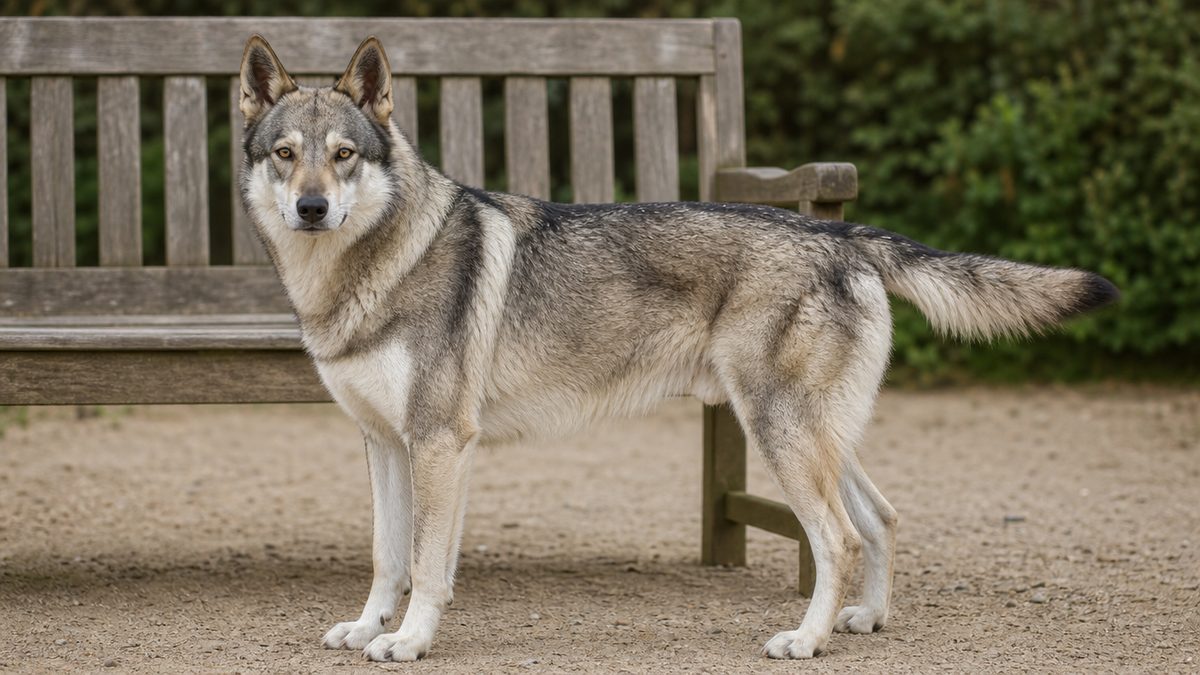
There is a written breed standard, and it is a real document rather than a marketing page. The Northern Inuit Society publishes it in full, opening 'GENERAL APPEARANCE: A dog of medium build, athletic but never racy' and running through head, ears, eyes, neck, forequarters, body, hindquarters, coat, gait, size, colour, temperament and faults.
| Point | What the standard says |
|---|---|
| Height, dogs | Minimum 25 in (64 cm), maximum 30 in (76 cm) |
| Height, bitches | Minimum 23 in (59 cm), maximum 28 in (71 cm) |
| Weight | Not stated anywhere in the standard |
| Coat | Dense, waterproof double coat, slightly coarse, body coat 3-5 cm, longer ruff and breechings |
| Ears | Fairly wide apart but not low set, not too large, carried erect |
| Eyes | Oval, set at a slightly oblique angle, any colour permitted |
| Tail | A smooth continuation of the croup, reaching no further than the point of the hock |
| Temperament | Friendly, placid and out going |
| Faults | Curly tails, long or single coats, ink marked, black and tan colours, cow or sickle hocks |
Two details on that table do real work. First, the standard states no weight at any point, so every weight figure circulating for this breed, and they circulate widely, comes from somewhere other than the document that defines the dog. Second, a curly tail is a fault. A great many photographs sold as Northern Inuits show a tail curled over the back, which is the single easiest way to spot an animal that does not meet the standard it is being sold under.
The temperament clause is worth reading against the marketing too. A dog advertised on its resemblance to a wolf is defined by its own society as friendly, placid and outgoing, and the Society's FAQ adds that Northern Inuits 'tend to make very bad guard dogs due to their friendly and inquisitive demeanour';.
A large, friendly, heavily-coated crossbred type with a written standard, a disputed stud book, no kennel club anywhere, and a single peer-reviewed paper to its name.
Kennel club recognition: the two-condition test, applied properly
The Northern Inuit Dog fails kennel club recognition everywhere it has been checked, while passing the two structural conditions of breedhood in a qualified way, because it has both a written standard and a stud book but both are held by private societies rather than any registry.
Recognition is a question with a documentary answer, so we opened the registers rather than repeating what other pages assert. Each check was run with a control on the same fetched document, because an absence read off a page that failed to render is not evidence of anything.
| Register | Northern Inuit Dog | Control on the same document |
|---|---|---|
| FCI definitive list, letter N | Absent from 13 breeds | Nova Scotia Duck Tolling Retriever 312 and eleven others present |
| FCI provisional list | Absent from 20 entries | Macedonian Shepherd Dog Karaman 378 down to Australian Stumpy Tail Cattle Dog 351 present |
| Royal Kennel Club Breeds A to Z | 'Inuit' appears 0 times in 227 breeds | 'Tolling' 4 times, 'Labrador' 4 times |
| American Kennel Club, letter N | 'Inuit' appears 0 times | 'Nova Scotia' 10, 'Newfoundland' 15, 'Norwegian' 44, 'Norwich' 15 |
The FCI letter index returned exactly thirteen breeds under N, from the Nederlandse Kooikerhondje to the Nova Scotia Duck Tolling Retriever, and the Northern Inuit Dog is not among them. One methodological note that cost time and is worth passing on: the URL /en/nomenclature/?letter=N does not filter by letter at all. It serves the provisional list, so anyone reading an absence off that address has read the wrong document.
The Royal Kennel Club matters most here, because Britain is where the breed was made. Its Breeds A to Z, which the club itself describes as its full list of recognised pedigree breeds, carries 227 breed entries across all seven groups. The strings 'Inuit', 'Northern', 'Utonagan' and 'Tamaskan' each appear zero times, while 'Tolling' and 'Labrador' appear four times each on the same fetch. A breed created in Britain forty years ago is absent from its own country's register. The American Kennel Club's letter N index behaves the same way: 'Inuit' appears zero times across 757,450 characters, while 'Nova Scotia' appears 10 times, 'Newfoundland' 15, 'Norwegian' 44 and 'Norwich' 15 on the same fetch.
The two-condition test: is there a standard, is there a stud book, and who holds each
Applied strictly, the answer is more interesting than a simple no.
- Is there a written standard? Yes. The Northern Inuit Society publishes a complete conformation standard covering appearance, structure, coat, size, colour, temperament and faults.
- Who holds it? A private breed society, not a national kennel club, and rival splinter clubs maintain their own versions.
- Is there a stud book? Yes, and the Society operates one, which is why registered animals can be traced at all.
- Who holds it? The same private society, with other clubs keeping separate registers after a series of splits.
- Is it closed? The evidence contradicts itself, which is the finding rather than a gap in it.
A splinter club states plainly that the Society operates a closed stud book, and blames the resulting high level of inbreeding for the fact that every Northern Inuit alive is related to the dogs used in Game of Thrones. The Society's own page carries a 2001 text claiming the breed has been bred 'solely to other Northern Inuits with no outcrossing or mixing with other breeds', and then, in the Society's present-day words immediately beneath it, says 'we have needed to add the odd backcross to the founding breeds to sustain the Northern Inuit as you see today';. A closed stud book that has been backcrossed to its founding breeds is not closed.
The Society is candid about the consequence. Its own sentence is that 'northern inuits are not a registered breed with the kennel club, this is something we are working towards';.
On this evidence the Northern Inuit Dog is a type being built into a breed, not a breed already recognised as one. It has the machinery, held privately and disputed between rival clubs. Bonbeno reports that verdict rather than acting on it, and takes no position on whether the cluster data should be changed.
One woman, four clubs and the Game of Thrones direwolves
The Northern Inuit Dog began with one British breeder in the late 1980s, fractured into at least four rival clubs within twenty years, and became internationally famous when its dogs played the direwolf pups in Game of Thrones.
The founder is named consistently across every account: Edwina 'Eddie' Harrison. A splinter club's own history says she began experimenting with many different breeds in 1988, including dogs imported from overseas, wanting a dog that would resemble a wolf while keeping the trainability and companionship of a dog. The Northern Inuit Society's older text puts the imports in the early 1980s and names Siberian Huskies, Malamutes and German Shepherds as the crossing stock.
The record that does not exist
What happened next is the most important sentence on this page, and it comes from one of the breed's own clubs rather than from a critic. Around 1996 Harrison was reported to the RSPCA for keeping her dogs in poor conditions, her health was failing, and her dogs were shared out among people who knew her. The club's own words are that 'there were no clear records as to exactly which breeds had been used to create the Wolfie looks that can be seen in the breed today';.
A breed whose founding crosses are unrecorded cannot have a verifiable pedigree back to its origin, however carefully anyone has kept records since. That is not an accusation, it is the clubs' own account, and it is the fact that most cleanly separates this dog from a registered breed.
The splits, in order
- The people holding the surviving descendants set up the Northern Inuit Dog Society of Great Britain.
- A group left over disagreements about what the dogs should look like, renamed their dogs Utonagans, meaning Spirit of the Wolf, and created The Utonagan Society.
- The parent body dropped 'of Great Britain' and became The Northern Inuit Society, which it remains.
- In 2005 another founder left and created The British Inuit Club, taking her dogs with her.
- Further clubs followed, including the Northern Inuits International Unleashed, and a separate Tamaskan line developed from related stock.
- All of those clubs remain active, each with its own register.
That history is why 'is it a breed' is a harder question than it looks. Six bodies each keeping a register of overlapping dogs, under at least three different names, is the opposite of what a single national stud book does.
The direwolves
Northern Inuits played the direwolf pups in Game of Thrones, and that is where almost all Indian awareness of this dog comes from. A splinter club adds a detail worth quoting because it is a health claim rather than a publicity one: 'it can be guaranteed that all Northern Inuits are related to those Direwolves given the closed stud book operated by the Society and the consequent high level of inbreeding';.
Read that carefully. A breed club is using its own most famous dogs to illustrate how narrow the gene pool is. The same paragraph says many breeders have since gone independent specifically to widen it and prevent the extinction of the breed. That is a candid statement about a real problem, and it belongs in any honest account of the dog.
A breed that becomes famous through a television series attracts buyers who want the look and have not read the standard. That pattern has damaged several breeds. It is the reason to read the Society's temperament clause, which asks for friendly, placid and out going, before deciding this is a wolf substitute.
The wolf content claim, tested against the published evidence
The Northern Inuit Dog has no demonstrated wolf content, its own society says so in writing, and no published genetic study has ever tested the question either way.
The claim is a marketing claim, so it deserves to be tested like one. Start with the party with the most to gain from saying yes. The Northern Inuit Society's own page reads: 'Many people ask if there is any wolf content in the Northern Inuit. Today the answer is no, if there ever was it would now be diluted to almost 0%';. The breed's own governing body denies the thing the breed is sold on.
What the literature says, which is almost nothing
We searched PubMed through the NCBI API and read every returned title back rather than trusting a count, because a result count for a breed with a homonym in its name proves nothing. The exact phrase 'Northern Inuit' returned 8 records and the unquoted 'Northern Inuit Dog' returned 8, and the two sets overlap in exactly one identifier.
Every other hit in both sets is about Inuit people rather than dogs: reproductive health interventions for Inuit youth, palliative care in the Qikiqtaaluk region of Nunavut, ringed seal mercury intake in the western Canadian Arctic, remote health care delivery in a northern Inuit community, cytomegalovirus seroprevalence in a Canadian Inuit community published in 1986, hepatitis A antibody prevalence in 1982, muscle plasticity in Greenland sled dogs, and alveolar hydatid disease among Alaskan Eskimos. Two of those predate the breed's existence entirely. The in-session control, a Labrador hip dysplasia query, returned 126 records, so the instrument was working.
The single genuine paper is about eyes and bones, not ancestry. It sequenced whole genomes to hunt a candidate gene and never addresses wolf content, because that was not its question.
The honest conclusion
So the position is this. There is no published genetic study of Northern Inuit Dog ancestry. There is a clear statement from the breed's own society that there is no wolf content. There is an admission from a splinter club that the founding crosses were never recorded, which means nobody can prove what went in from pedigrees alone. Anyone telling an Indian buyer that this dog is part wolf is asserting something that has never been measured, and that the people who register the dog deny.
It is worth saying why that matters beyond accuracy. Wolf-content claims change how a dog is treated. An owner who believes they have a part-wolf animal manages it as a dangerous exotic rather than as a large friendly crossbred, and in India a wolf claim also invites confusion with wildlife law that simply does not apply to a domestic dog.
The Czechoslovakian Wolfdog is what a genuinely wolf-derived breed looks like when a registry recorded the matings: named foundation animals, dated crosses and FCI recognition. The Northern Inuit has none of that paperwork, which is the difference between a documented hybrid origin and a look.
Northern Inuit Dog price in India, and the arithmetic that breaks it
No verifiable northern inuit dog price in india exists, and the one figure being circulated, Rs 2,000 to Rs 70,000, prices the dog below every single one of the three breeds its own society names as its foundation.
The figure comes from Bing India's own AI-generated summary, which asserts that 'the price of Northern Inuit dogs in India typically ranges from Rs 2,000 to Rs 70,000' and attributes it to '2 Sources' without naming them in the summary text. The page that band appears to rest on is a Petzlover classifieds listing. We opened it directly with a stealth proxy and it returned HTTP 403 with the page title 'PetzLover - Verify You Are Human' and a CAPTCHA image. Nothing on it could be read, so nothing from it is quoted here as a price.
Why Rs 2,000 to Rs 70,000 cannot describe this dog
The Northern Inuit Society names its foundation stock explicitly: Siberian Huskies, Malamutes and German Shepherds. An Indian retailer's own published price list gives current Indian bands for all three.
| Breed | Published Indian price band | Against the claimed Rs 2,000-70,000 |
|---|---|---|
| Siberian Husky | Rs 40,000 to Rs 1,50,000 | Floor is 20 times higher; ceiling more than double |
| Alaskan Malamute | Rs 60,000 to Rs 2,00,000 | Floor is 30 times higher |
| German Shepherd | Rs 20,000 to Rs 75,000 | Floor is 10 times higher |
| Indie or native dog | Rs 2,000 | Exactly the claimed floor |
The claimed floor of Rs 2,000 is the same figure that Indian retailer gives for an indie or native dog, which is the cheapest row in its entire list. A rare imported composite of three expensive northern breeds does not cost what a street dog costs. Either the listings behind that band are not Northern Inuits, or the band is not a price for this breed. Both readings point the same way.
Run the conversion tests as well, because a rupee figure that looks arbitrary is sometimes a converted dollar list. Rs 70,000 divided by 84.38 is 829.58, by 74 is 945.95 and by 80 is 875.00. Rs 2,000 divided by 84.38 is 23.70, by 74 is 27.03 and by 80 is 25.00. The 80 quotients are round only because both figures end in three zeros, which is arithmetic rather than evidence, and no seller anywhere prices a large dog at 25 dollars. These are rupee-native numbers, and they describe whatever animals are actually listed rather than this breed.
What the rest of the Indian result set is selling
Look at the composition of the page-one results rather than the count. Position three is an Instagram hashtag page. Position five is Etsy, selling Northern Inuit merchandise in rupees rather than dogs. Positions one and eleven are Quora threads. Position two is an American breed-data aggregator whose own Puppy Prices field reads 'Average (Unknown)';. Position eight is a general Indian dog price list in which the Northern Inuit Dog does not appear at all.
That is what a market that has not formed looks like. It is not proved by a small result count, which measures nothing on its own, but by what the results contain when you open them.
Bing printed a confident Indian price band for this breed and cited two sources, one of which will not open to a human or a crawler. Trace any quoted figure to the page it came from, then confirm the number is actually in that page before you believe it.
Monthly cost of ownership in India for a large northern-coated dog
Price a Northern Inuit in India as a 30 kg-plus double-coated dog, because no breed-specific Indian cost data exists and the standard gives no weight at all to work from.
The standard's silence on weight is a genuine obstacle here, and worth naming rather than papering over. The Northern Inuit Society's standard specifies heights of 64 to 76 cm for dogs and 59 to 71 cm for bitches but states no weight anywhere. Every weight figure circulating online for this breed therefore comes from somewhere other than the document that defines it, and the most-cited aggregator prints two different metric conversions for the same pound range on the same page.
What can be priced honestly is the care a large dog needs in India, from rates Indian providers publish. All of these were re-checked on 3 September 2026 rather than carried over from older notes.
| Item | Published rate | Basis |
|---|---|---|
| Puppy vaccination course | Starts at Rs 6,499 | Vetic, seven visits from day 30 to day 120 |
| Annual booster | Starts at Rs 3,199 | Vetic, kennel cough, anti-rabies, DHPPiL and corona |
| Anti-rabies, single dose | Rs 699 | Vetic list price |
| Kennel cough | Rs 1,349 | Vetic list price, relevant for a dog that will be boarded |
| Tick, flea and worm cover | Rs 1,103 a month at 15-30 kg | NexGard Spectra, Rs 3,308 for three tablets |
| Delhi registration | Rs 500 a year | MCD, with a Rs 100 monthly late fee |
| Chennai licence | Rs 50 | Greater Chennai Corporation |
Two of those lines need qualifying. The vaccination prices are one chain's promotional starting figures across its clinics, and the page itself says 'Starts at';. The parasite figure is for the 15 to 30 kg band; a dog at the top of this standard's height range will sit above it and cost more.
Grooming is the line that separates this breed from a short-coated dog of the same size. A dense waterproof double coat 3 to 5 cm deep, with a longer ruff and breechings, sheds heavily twice a year and needs either a committed owner with a comb or a paid groomer through every coat drop. In Indian conditions that is not optional maintenance, because a packed undercoat over damp skin is where skin disease starts.
For the wider frame, an Indian retailer's own list puts general monthly upkeep at Rs 3,000 to Rs 18,000 depending on breed size, and a large heavily-coated dog sits toward the upper half of that. Food is deliberately not given a monthly figure on this page, because a monthly kibble number is arithmetic from a specific bag and a specific dog rather than a price anyone publishes.
Greater Chennai Corporation charges Rs 50 for a licence and states that its six pet clinics provide all treatment and anti-rabies vaccination free of cost, having issued 9,115 licences in 2024. Delhi charges Rs 500 and has issued 18,958 certificates since 2021.
Heat tolerance and the Indian climate: an English dog in a wolf's coat
A Northern Inuit Dog copes badly with Indian heat, and the reason is that its coat was designed in eastern England rather than the Arctic, so it carries northern insulation without any of the acclimatisation the name implies.
Fix the origin first, because the marketing has moved it three thousand kilometres north. This breed was made in Britain from British-bred crossing stock. The correct climate baseline is therefore English, and the most apt English point is Newmarket in Suffolk, where the Animal Health Trust carried out the only peer-reviewed study of the breed.
We queried NASA POWER there by explicit latitude and longitude, 52.2450 north and 0.4060 east, and checked the returned cell before using it. POWER reports the cell elevation as 49.27 m against a real elevation near 25 m, a gap of 24.3 m, so the cell describes the place. Annual mean temperature 10.32 C, coldest month January at 4.16 C, warmest month July at 17.38 C, annual mean relative humidity 85.13 per cent.
| City | Coolest month mean | Highest monthly mean daily maximum |
|---|---|---|
| Newmarket, England | 4.16 C, January | 31.43 C, July |
| Delhi | 13.61 C, January | 48.79 C, June |
| Kolkata | 17.31 C, January | 46.81 C, May |
| Mumbai | 23.19 C, January | 44.91 C, April |
| Pune | 19.62 C, December | 43.20 C, April |
| Chennai | 24.09 C, January | 42.70 C, May |
| Bengaluru | 20.22 C, December | 40.38 C, April |
Four of those six Indian cities are warmer in their coolest month than Newmarket is in its warmest, which averages 17.38 C. Kolkata misses by 0.07 C, at 17.31 C in January, and Delhi's January is genuinely cooler at 13.61 C. That near-miss is worth printing rather than rounding away, because it is the kind of detail that shows the comparison was actually computed.
The coat is the problem and the standard describes it precisely: a dense, waterproof double coat, slightly coarse in texture, with a body coat of 3 to 5 cm and longer hair on the ruff and breechings. Five centimetres of dense insulation is a fixed property of the dog. It does not thin out because the dog was born in Pune, and shaving it removes the layer that keeps radiant heat off the skin while leaving the undercoat to regrow denser.
What Indian law says about this exact situation
The 2017 Rules speak to this animal directly. Second Schedule Part IV paragraph 21(1) bars keeping dogs in outdoor facilities, without the attending veterinary practitioner's written approval, where the dogs are not accustomed to local temperatures or belong to breeds that cannot tolerate them, naming long-haired breeds in high temperature locations. Note the form of that citation: it is a Second Schedule paragraph, because the Rules themselves stop at 13, and any page citing it as 'Rule 21' is citing something that does not exist.
In practice that means an indoor dog with fans or air conditioning, walks confined to before sunrise and after dark from roughly March to October, water available in several places, and no terrace or kennel housing. The monsoon brings the second problem: a dense undercoat that stays damp for hours is the setup for skin and ear disease, so drying the dog properly matters as much as cooling it.
Nothing about this dog came from the Arctic. Calling it heat-sensitive is not a slur on the breed; it is a description of 5 cm of dense waterproof coat meeting 48.79 C in a Delhi June.
Temperament and household fit: friendly, placid, and a very bad guard dog
Buy a Northern Inuit Dog for a friendly, sociable, people-dependent companion, and do not buy one expecting the character its appearance suggests, because its own society describes the opposite.
The standard's temperament clause is three words long: friendly, placid and out going. That is the entire specification, and it is the opposite of what a wolf-like appearance advertises.
The Society expands on it in its own FAQ and is unusually direct. Northern Inuits, it says, tend to make very bad guard dogs because of their friendly and inquisitive demeanour, so the best an owner may get is a bark, and some rarely bark at all while others prefer to howl. It also records that some of its members' dogs are registered as therapy dogs and used as assistance dogs, and that many have achieved bronze, silver and gold in the Kennel Club Good Citizen scheme.
Households this dog fits in India
- Homes with a securely fenced space and someone present for most of the day.
- Households already owning a second dog, since the Society says Northern Inuits often do better with company.
- Owners with previous experience of a working breed, ideally a German Shepherd or a northern spitz type.
- Families able to run the dog before sunrise and after dark for eight months of the year.
- Owners willing to manage a heavy double coat through Indian humidity rather than reaching for clippers.
Households where it will fail
- Anyone buying the breed as a guard dog, which its own society says it is not.
- Anyone buying it because it looks like a wolf and expecting a wolf's temperament.
- Flats where the dog is alone through a working day, because the Society flags separation problems directly.
- Households with free-roaming cats or small pets, given the high prey drive the Society describes.
- Any home planning to keep the dog outdoors in an Indian summer.
The separation problem deserves emphasis in Indian conditions. The breed's own literature describes dogs prone to destructive behaviour when left alone too long and recommends training for absence from a young age. In an Indian apartment a large, vocal, howling dog left alone all day becomes a complaint from the building association long before it becomes a training project, and that is a common route to rehoming.
One temperament trait genuinely does track the wolf-like look, and it is the prey drive. The Society notes an incredible sense of smell coupled with a high prey drive that can make the dogs prone to chasing and potentially hunting small animals such as mice and rabbits, and it says dogs introduced to livestock early may grow up not wanting to chase them. In an Indian street context that translates directly into risk around cats, poultry and free-roaming animals.
This breed's appearance sells an aloof, formidable dog and its standard specifies a friendly, placid, inquisitive one. Buyers who wanted the first and received the second are the group most likely to give the dog up.
Training a Northern Inuit Dog, and the benchmark its own society uses
Train a Northern Inuit Dog with short, varied, reward-based sessions and start recall immediately, because its own society says these dogs are not for the novice owner and are harder work than a German Shepherd.
The Society's wording is the useful part, because it is unusually unflattering about its own breed. Northern Inuits are intelligent but can become bored and impatient, so training must be kept fun, interesting and varied; they are not for the novice owner; and people experienced with the train-ability of a German Shepherd generally find Northern Inuits more of a challenge. A breed club setting the German Shepherd as the easier comparison is telling you something real.
The Society also says these dogs can successfully be trained to exercise off lead, while warning that a high prey drive combined with an incredible sense of smell makes them prone to chasing, and that recall training should begin as soon as possible.
An Indian training timeline that respects the heat
- Weeks 8 to 16: socialise deliberately and at dawn, exposing the puppy calmly to traffic, autos, cattle, crowds and other dogs while the window is open.
- Weeks 8 to 16: train being left alone in short, gradually lengthening absences, because separation distress is the failure mode this breed's own club names.
- Months 3 to 6: build recall on a long line around real distractions before the prey drive matures.
- Months 4 to 9: teach a reliable settle indoors, which is what makes a large dog liveable in an Indian flat.
- Months 6 to 12: introduce structured activity such as canicross, scootering or scent work, all of which the Society's members use.
- Months 12 onward: keep varying the work, because a bored intelligent dog of this size finds its own occupation.
Two Indian constraints shape all of that. The usable training windows from March to October are before sunrise and after dark, which compresses everything into two short slots a day. And a dog that howls rather than barks, in a building with shared walls, needs its absence training treated as a priority rather than an afterthought.
Method matters as much as timing. This is a friendly, biddable, people-focused animal despite its appearance, and it is trainable when the sessions stay short and the rewards stay varied. Harsh handling produces a dog that disengages, and a disengaged dog of 64 to 76 cm is not a small problem.
Owners who bought a wolf-like dog sometimes train it as though it were dangerous, which creates the reactivity they feared. Train the dog the standard describes, friendly and placid, because that is the animal in front of you.
Daily exercise, which is genuinely more moderate than the look suggests
Give a Northern Inuit Dog one long walk or two shorter ones a day, because its own society describes it as a medium-exercise dog rather than a northern breed with the stamina demands of a working sled dog.
This is one of the few places where the breed is easier than its reputation. The Society states that unlike some northern breeds, Northern Inuits do not require excessive amounts of exercise and are generally described as a medium exercise dog, with two walks a day or one longer walk often enough, while noting that they are quite happy to be out all day and that many members take them hiking.
For a large dog with a heavy coat in an Indian city, that is a manageable requirement, and it is the strongest practical argument anyone can make for keeping this breed here. The constraint is not distance, it is temperature.
How to structure it through an Indian year
- November to February: one long walk of 60 to 90 minutes, at almost any daylight hour in most cities.
- March to June: split into two walks, before sunrise and well after dark, and cut total duration on the worst days.
- June to September: watch humidity rather than temperature, because panting stops cooling efficiently above about 85 per cent.
- All year: add scent games and problem-solving indoors, which tire an intelligent dog without heat exposure.
- All year: check pavement temperature with the back of your hand before every walk.
The heat arithmetic is unforgiving. Delhi's mean daily maximum reaches 48.79 C in June and Kolkata's 46.81 C in May. A 30 kg dog under 5 cm of dense waterproof coat cannot shed heat at those temperatures by panting alone, and exercise in them is not training, it is risk.
Off-lead work needs its own caution in India. The Society's warning about prey drive and scent applies with extra force in a country where free-roaming cats, poultry and street dogs are everywhere, and where a lost dog has few of the recovery mechanisms a British owner would rely on. A long line in an enclosed space is the sensible default until recall is genuinely proofed.
Most large-breed pages warn that too little exercise ruins the dog. For this breed in India the commoner error is the opposite: an owner meeting the stated requirement at the wrong hour of the day.
Grooming a dense waterproof double coat through an Indian monsoon
Brush a Northern Inuit Dog at least twice a week and daily through a coat drop, dry it to the skin after every wetting, and never shave it, because the standard specifies 3 to 5 cm of dense waterproof coat that Indian humidity turns into a skin problem if it is left packed.
The coat is defined precisely in the standard: dense, waterproof and slightly coarse in texture, with a body coat of 3 to 5 cm, longer hair on the ruff and breechings, and a bushy tail. Long or single coats are listed as faults. That is a lot of insulation on a dog standing up to 76 cm.
The Indian correction to overseas advice
British and North American guidance for double-coated northern breeds routinely says to bathe rarely and let the coat dry naturally. In an English autumn that is sound. In an Indian monsoon it is not, because a dense undercoat holds moisture against warm skin for hours and that is the condition yeast and bacteria need. Dry the dog to the skin with a towel and a cool-setting dryer after every bath, every swim and every soaking on a walk, and pay particular attention to the ruff, the armpits and the breechings where hair is longest.
A practical Indian grooming routine
- Brush twice weekly with a slicker followed by a metal comb, working from the skin outward rather than over the surface.
- Go daily during the two annual coat drops, which are less predictable in a tropical climate than in a temperate one.
- Bathe only when genuinely dirty, since frequent bathing strips the oils that make the coat waterproof.
- Dry completely every time, and check the ears afterwards.
- Keep the nails short, and note that the standard permits five rear toes and makes dewclaw removal optional.
That last point collides with Indian law and the collision is worth stating. The standard says removal of dewclaws is optional, while Second Schedule Part II paragraph 6(8) of the 2017 Rules forbids de-clawing along with tail docking, ear cropping, de-barking and any other kind of mutilation of any body part of the pup, and any change of appearance by artificial means. An overseas standard permitting a procedure does not make it lawful here, and where the two differ Indian law governs.
The clipping question comes up in every Indian groomer's shop with a coat like this, and the answer is no. Shaving removes the guard hairs that keep radiant heat off the skin, exposes skin that has never seen sun, and produces a denser, less ventilated regrowth. Heat is managed with shade, water, air conditioning and timing, not with clippers.
If a metal comb will not pass from skin to tip anywhere on the dog, the brushing has been cosmetic. Two minutes with a comb after each brushing catches what a slicker skims over, and it is the difference between a managed coat and a matted one.
Health issues and lifespan: one paper, one gene, and a society keeping its own score
The entire peer-reviewed literature on the Northern Inuit Dog is a single 2019 paper on an inherited eye and bone disease, so everything else known about this breed's health comes from the breed societies themselves.
That imbalance is the health story, and it is worth stating before any individual condition. Searched through the NCBI API on the same day, with the same passing control, the Northern Inuit Dog returns one genuine record and the Nova Scotia Duck Tolling Retriever returns 24. A buyer comparing the two breeds is not comparing a healthy dog with an unhealthy one. They are comparing a dog whose risks have been measured with one whose risks have not.
Oculoskeletal dysplasia, the one thing that has been studied
Seven Northern Inuit Dogs were diagnosed by pedigree analysis with an autosomal recessive oculoskeletal dysplasia. All seven had short-limbed dwarfism and angular limb deformities together with a variable combination of macroglobus, cataracts, lens coloboma, microphakia and vitreopathy, and five of the seven had retinal detachment.
The mutations already known to cause the same disease in the Labrador Retriever and the Samoyed were both excluded. Whole genome sequencing then found a nonsense variant in COL9A3, which was genotyped across 1,232 dogs. All 7 affected Northern Inuits were homozygous for it, 31 of 116 unaffected Northern Inuits were carriers and 85 of 116 were clear, giving a significant association at p = 1.41 x 10 to the minus 11. All 1,109 dogs of other breeds tested clear, so the variant appears rare or absent elsewhere.
In a subset of 56 Northern Inuits unrelated at the parent level, the allele frequency was 0.08, giving an estimated carrier rate of 15 per cent and an affected rate of 0.6 per cent. Those figures reproduce from the paper's own numbers: 7 plus 116 plus 1,109 is 1,232, 31 plus 85 is 116, and an allele frequency of 0.08 yields a carrier rate of 14.7 per cent and an affected rate of 0.64 per cent. The authors' conclusion is that the variant is widespread in the breed.
The irony is worth recording. That work was done by the Kennel Club Genetics Centre at the Animal Health Trust, which is to say the research arm associated with the kennel club whose register does not contain this breed.
What the breed's own society reports, and the independent check that does not exist
Everything known about Northern Inuit health beyond one paper comes from the Northern Inuit Society itself, which mandates real testing and is also the only body scoring its own work.
Everything else comes from the Northern Inuit Society, which is an interested party and also the only body keeping records. Under its Code of Ethics all dogs in the breeding scheme must be hip, elbow and eye tested under British Veterinary Association schemes, and it reports a current BVA median hip score for the breed of 12, average elbow results of 0 and clear eye tests.
| Condition | What the Society says | Testable before breeding? |
|---|---|---|
| Hip dysplasia | More likely in large breeds; hip testing mandatory in the scheme | Yes, BVA hip score |
| Elbow dysplasia | Same reasoning; elbow testing mandatory | Yes, BVA elbow score |
| Hereditary eye disease | A handful of glaucoma cases, primary or secondary unconfirmed | Yes, BVA eye scheme |
| OSD3 oculoskeletal dysplasia | Named directly, with the limb and eye signs described | Yes, the COL9A3 variant is now known |
| Cryptorchidism | Cases decreasing; no test exists to predict it | No |
| Degenerative myelopathy | Laboklin Exon 2 test 8158D mandatory for all stud dogs | Yes |
| Epilepsy, Addison's disease, cancer | A small number of cases, monitored by a health advisor | No genetic tests available |
The degenerative myelopathy protocol is the most concrete thing the Society does. All stud dogs must be tested at Laboklin, dogs testing clear may cover any bitch, and any stud testing as a carrier or affected may only cover a bitch that has tested clear. That is a real, enforceable breeding rule, and it is more than several recognised breeds require.
Lifespan is reported by the Society as averaging between 12 and 15 years, while the aggregator page ranking second in India prints 12 to 14. Neither figure rests on a published mortality study, because none exists for this breed.
The absence that is itself a finding
The Northern Inuit holds an Orthopedic Foundation for Animals breed code, NI, so the database can accept its records. It has no row in OFA's published statistics tables at all, checked case-insensitively across a 2.2 million character dump in which 'LABRADOR' returns 109 rows, 'GOLDEN RETRIEVER' 101 and 'NOVA SCOTIA' 74. OFA publishes a breed only once it holds 100 hip evaluations, or 50 for its other databases, so this is an absence from the published tables rather than from the database. Either way, there is no independent screening statistic for this breed to check the Society's self-reported figures against.
One Indian risk sits outside anything either the Society or the literature measures. A heavily-coated dog carrying a dense undercoat is a harder tick check than a smooth-coated one, and surveys of dogs presented at Indian veterinary clinics have found very high tick-borne pathogen loads, including Babesia gibsoni in 76.54 per cent of 584 dogs in West Bengal, with 72.9 per cent of that sample carrying two or more pathogens. Those figures describe dogs that were tested at clinics rather than dogs in general, so read them as a picture of the pathogen environment rather than of every pet. Even read conservatively, they argue for running a heavily-coated dog on uninterrupted parasite cover and combing right down to the skin.
One more machine-readable detail says the same thing. In OFA's own breed filter the Northern Inuit carries an empty registry-group attribute, while the Nova Scotia Duck Tolling Retriever on the same document carries four filled ones, AKC Sporting, CKC Sporting, UKC Gun Dog and TKC Gundog. That is OFA's database recording, in a field nobody wrote as prose, that no registry group claims this dog.
Feeding a large northern-coated dog in India
Feed a Northern Inuit Dog to body condition rather than to a chart, because its own breed standard states no weight at all and the widely-quoted weight figures for this breed are internally inconsistent.
The problem is unusually literal. There is no weight in the standard, and the page ranking second in India gives male weight as 79 to 110 pounds converted to 36 to 50 kg in its data table and the same 79 to 110 pounds converted to 36 to 48 kg in its own prose, on the same page. One hundred and ten pounds is 49.9 kg, so the table is right and the prose is wrong, and neither is sourced to the standard.
That leaves body condition scoring as the only honest method, which is what it should be anyway.
Life stages
- Eight weeks to four months: four meals a day of a large-breed puppy food, keeping the puppy visibly lean.
- Four to eight months: three meals a day, and this is the window in which over-feeding a large breed does lasting joint damage.
- Eight to fourteen months: two meals a day, moving to adult food gradually over a week to ten days.
- Adult: two meals a day, adjusted down through the hot months when the dog naturally moves less.
- Senior, from about eight years: two smaller meals, with the total reduced as activity falls.
Growth pace matters more here than in a medium breed. A dog reaching 64 to 76 cm grows for well over a year, and the Society itself recommends against castration before at least 12 months on the strength of research into early neutering in large breeds. Feeding for rapid growth in a breed that already carries a documented hip and elbow screening requirement is working against the screening.
Two Indian constraints apply as they do to any large dog. Heat suppresses appetite from April to June, so time the larger meal for the cool end of the day and do not chase a bowl the dog is not interested in. And humidity spoils dry food faster than the printed date suggests, so buy a bag size you will finish inside a month and decant it into an airtight container off the floor.
No monthly food figure appears on this page, and that is deliberate. A monthly kibble cost is arithmetic from a specific bag, a specific dog's grams per day and a specific city's prices, not a number anyone publishes for this breed. Weigh the food and do the multiplication yourself.
Feel for ribs under a thin covering, look for a waist from above and a tuck-up from the side. In a heavily-coated dog you must use your hands, because the coat hides the shape completely.
The first year, month by month, in Indian conditions
Build a Northern Inuit puppy's first year around three fixed things, the vaccination schedule, the Indian heat calendar and an early habit of being left alone, because everything else can be rescheduled and those cannot.
Vaccinate on an Indian schedule rather than an imported one. Vetic's published course runs to seven visits at days 30, 45, 60, 75, 90, 105 and 120, covering Puppy DP, DHPPiL, canine corona, anti-rabies and kennel cough, starting at Rs 6,499, with the annual booster starting at Rs 3,199.
| Age | What happens | The Indian detail |
|---|---|---|
| 8-10 weeks | Home, crate and mat training, absence training begins | Rule 8(1)(a) of the 2017 Rules forbids sale under eight weeks |
| 8-16 weeks | Vaccination course; socialisation window open | Dawn outings only from March onward; carry the puppy where it cannot yet walk |
| 3-4 months | Handling, brushing and ear checks become routine | Start now, because a 30 kg adult that hates being groomed is unmanageable |
| 4-6 months | Recall on a long line; prey drive begins to show | Free-roaming cats and poultry make Indian recall training harder than British |
| 6-12 months | Growth continues; keep impact exercise low | Skip stairs and repetitive jumping; hip and elbow screening exists for a reason |
| 12 months | Booster; registration; castration decision | The Society advises against castrating males before at least 12 months |
| 12-18 months | Full height reached; adult coat settles | The first full coat drop in Indian humidity needs daily brushing |
Two items on that table are legal rather than practical. Rule 8(1)(a) of the Prevention of Cruelty to Animals (Dog Breeding and Marketing) Rules 2017 requires that pups less than eight weeks in age are not sold, and Second Schedule Part II paragraph 6(3) prohibits in-breeding, defined as breeding between relatives of the second to fourth grade within the first four generations, and incest breeding between parents and children or between brother and sister.
That second clause is worth holding against this breed specifically. One of its own clubs describes a closed stud book and a consequent high level of inbreeding as the reason every Northern Inuit alive is related to the Game of Thrones dogs. Anyone contemplating breeding this dog in India would need to demonstrate compliance with paragraph 6(3) from a pedigree whose founding crosses were never recorded.
A puppy arriving in November gets a full cool season of socialisation. One arriving in April gets a few weeks of usable dawn slots before the window closes and the heat shuts down daytime outings entirely.
Northern Inuit against the three breeds it was made from, and against a recognised one
Compare a Northern Inuit Dog with its own foundation breeds rather than with a wolf, because all three are available in India today at published prices with published health data behind them.
| Northern Inuit Dog | Siberian Husky | Alaskan Malamute | German Shepherd | |
|---|---|---|---|---|
| Published Indian price | None verifiable | Rs 40,000-1,50,000 | Rs 60,000-2,00,000 | Rs 20,000-75,000 |
| Kennel club register | None anywhere | FCI, RKC, AKC | FCI, RKC, AKC | FCI, RKC, AKC |
| Peer-reviewed papers | One | Extensive | Extensive | Extensive |
| Published screening statistics | None | Yes | Yes | Yes |
| Heat tolerance in India | Poor | Poor | Poor | Moderate |
| Who writes the standard | A private society | A national registry | A national registry | A national registry |
The row that matters is the last one. A recognised breed's standard is written by a body that also holds the stud book, adjudicates disputes and can discipline breeders. The Northern Inuit's standard is written by one of several rival private clubs, each keeping its own register after a series of splits. That is not a comment on the dogs; it is a description of what a buyer can and cannot verify.
The instructive contrast: a recognised breed checked the same way
Bonbeno researched the Nova Scotia Duck Tolling Retriever in the same session, with the same tools and the same controls, precisely to make this comparison fair.
| Northern Inuit Dog | Nova Scotia Duck Tolling Retriever | |
|---|---|---|
| FCI letter N index | Absent | Present as number 312 |
| Royal Kennel Club A to Z | Absent from 227 breeds | Listed under Gundog |
| AKC letter N index | Absent | Present |
| PubMed records, same control | 1 | 24 |
| OFA published statistics rows | 0, despite holding code NI | Hips, elbows, eyes and thyroid published |
| Named pre-breeding tests by a kennel club | None, because no kennel club holds it | Seven, listed by the Royal Kennel Club |
Neither column tells you which dog is nicer. Both tell you how much a buyer can find out before paying, and for an expensive purchase that is the thing being bought alongside the puppy.
One fair point in the Northern Inuit's favour belongs here. Its society mandates hip, elbow and eye testing plus a degenerative myelopathy DNA test on every stud dog, which is a stricter written requirement than some recognised breeds carry. The weakness is not the rules, it is that nobody outside the club audits them and no independent statistics exist to check them against. For comparison, the Royal Kennel Club's page for the recognised breed names its screening in public and by scheme, listing DNA tests for prcd-PRA, CEA/CH, degenerative myelopathy, degenerative encephalopathy and juvenile Addison's disease alongside the BVA/KC hip, elbow and eye schemes, and places the breed in Breed Watch Category 1. The difference is not stringency, it is who publishes and who can be held to it.
A Siberian Husky or an Alaskan Malamute delivers a comparable northern appearance in India today, with a registry behind it, published health data and a price you can verify. Both are just as heat-sensitive, so the climate problem does not go away.
Mistakes Indian buyers make with this breed, and one the ranking pages make for them
Six errors account for most of what goes wrong with a Northern Inuit Dog in India, and the largest of them is believing a page that has already contradicted itself twice.
1. Trusting the page that ranks second
The aggregator holding position two in India for this term contradicts itself repeatedly on one screen. Its table gives male height as 23 to 32 inches with a metric range of 58 to 81 cm, while its own prose gives 25 to 30 inches and attaches the same 58 to 81 cm, which belongs to the other range because 25 to 30 inches is 64 to 76 cm. Its table converts 79 to 110 pounds as 36 to 50 kg and its prose converts the identical pounds as 36 to 48 kg. Its trainability note reads 'The Mudi is average when it comes to training', naming a Hungarian herding breed. Its eight popularity rows are printed empty and its only reference is a YouTube video.
A page that cannot hold one height, one weight or one breed name across a single screen is not a source, and the leaked Mudi sentence is the seam that shows the page was assembled from a template rather than written.
2. Buying the wolf story
The breed's own society says there is no wolf content and that if there ever was any it is now diluted to almost zero. No genetic study has tested it. Paying a premium for wolf ancestry means paying for something the seller's own governing body denies.
3. Expecting a guard dog
The standard asks for friendly, placid and out going, and the Society writes that these dogs tend to make very bad guard dogs because of their friendly and inquisitive demeanour. Buying a wolf-like dog for security is the commonest mismatch in this breed and it is corrected by reading one paragraph.
4. Assuming a curly tail is normal
A curly tail is listed as a fault in the standard, which requires a tail that is a smooth continuation of the croup reaching no further than the point of the hock. Many animals sold under this name in photographs carry a tail curled over the back, which is the fastest visual check available to a buyer.
5. Shaving the coat for an Indian summer
A dense waterproof double coat of 3 to 5 cm is insulation in both directions. Removing it exposes unprotected skin and produces a denser regrowth. Heat is managed with air conditioning, shade, water and dawn walks, and the law backs that up: paragraph 21(1) of the Second Schedule restricts outdoor housing for breeds that cannot tolerate local temperatures.
6. Letting the coat dry by itself in the monsoon
Overseas guidance for northern coats says to let the dog air dry. In India that leaves warm damp skin under packed hair for hours, which is where skin and ear disease begins. Dry to the skin, every time.
Buying from a seller who cannot produce a society registration means you can never establish the parents' hip and elbow scores, eye results or degenerative myelopathy status. In a breed with a documented COL9A3 carrier rate near 15 per cent and no independent statistics to check anything against, that paperwork is the entire product.
Adoption and responsible sourcing: what an Indian buyer should actually do
Adopt in India rather than pursuing a Northern Inuit Dog, because the breed is unrecognised everywhere, has no verified Indian supply, and cannot lawfully be imported for trading or breeding.
The import position closes the question. DGFT Trade Notice 22/2022-23 makes dogs a Restricted import under ITC(HS) 01061900, permitting entry only for a pet accompanying a transferee of residence or returning importer with a valid pet book in that importer's name, for research and development with a CPCSEA recommendation, or for Defence and Police use, and stating that applications for trading or breeding purposes shall be duly rejected, with entry limited to six named ports. DAHD added a seventh port, Cochin International Airport at Kochi, for pets arriving under the baggage rules in October 2024. The full route is set out in how to import a dog to India.
Put that beside the recognition finding and no lawful supply chain can form. There is no kennel club register anywhere holding this breed, so there is no pedigree route The Royal Kennel Club, Breeds A to Z, and there is no commercial import route. What remains is a single returning owner bringing their own dog, which produces individual animals and not a market.
If you are determined to buy, verify these six things
- Ask which society the parents are registered with, and confirm the registration with that society rather than with the seller.
- Ask for BVA hip and elbow scores and an eye certificate for both parents, and ask to see the certificates.
- Ask for the Laboklin degenerative myelopathy result on the sire, which the Society makes mandatory for stud dogs.
- Ask whether either parent has been tested for the COL9A3 oculoskeletal dysplasia variant, given a carrier rate near 15 per cent.
- See the dam with the litter, and refuse any transaction that offers delivery without a visit.
- Confirm the pups will be at least eight weeks old at sale, as Rule 8(1)(a) requires.
The adoption route that exists here
No Northern Inuit rescue network operates in India, and inventing one would help nobody. What does exist is substantial and free at the point of use. Greater Chennai Corporation states that its six pet clinics provide all treatment and anti-rabies vaccination free of cost, and it issued 9,115 licences in 2024. Delhi's registration portal shows 18,958 pet dog certificates issued since 2021, with 71 of 1,006 applications rejected in the current financial year.
An Indian household that wants a large, friendly, active dog that is already acclimatised, already here and already healthy can adopt one this month. A household set on the northern look can buy a Siberian Husky or an Alaskan Malamute from a documented Indian source at a published price, with a registry behind it, and will face the same heat problem either way.
There is one further reason to think carefully before starting a breeding project here rather than simply buying a dog. Second Schedule Part II paragraph 6(9) of the 2017 Rules states that breeding to create new breeds of dogs or unusual looks shall be strictly prohibited. A programme whose stated purpose is a wolf look-alike sits squarely against that sentence, whatever its merits elsewhere.
This is an interesting dog with a candid breed society and a real health protocol, and it is a poor Indian choice on climate, supply and verifiability. If the pull is the look, buy a recognised northern breed. If the pull is a big friendly dog, adopt one here.
Northern Inuit Dog questions Indian buyers actually ask
How much does a Northern Inuit dog cost?
Nobody in India publishes a figure that survives inspection. Bing's own summary asserts Rs 2,000 to Rs 70,000 in India from two unnamed sources, and the page it leans on returned HTTP 403 behind a CAPTCHA when we opened it, so no listing and no price could be read.
Is a Northern Inuit dog a good kennel dog?
No, and its own society says so in different words. The Northern Inuit Society describes a friendly, placid, inquisitive dog that makes a very bad guard dog, prone to separation problems and better with company. A dog like that kept in a kennel run in Indian heat is being set up to fail.
Where can I find Northern Inuit dog puppies for sale?
Not lawfully in India from an import, and not verifiably inside it. DGFT Trade Notice 22/2022-23 makes dogs a Restricted import and says applications for trading or breeding purposes shall be duly rejected. No kennel club register in India, the FCI or Britain holds the breed at all.
What is the history of the Northern Inuit dog?
One woman, Edwina Harrison, began crossing dogs in Britain in 1988 to make something that looked like a wolf. She was reported to the RSPCA around 1996, her dogs were dispersed, and by her own breed clubs' account no clear records survive of which breeds went into them.
Is the Northern Inuit Dog recognised by any kennel club?
No national or international register holds it. It is absent from the FCI letter N index of 13 breeds, absent from the FCI provisional list of 20, absent from all 227 breeds in the Royal Kennel Club A to Z, and absent from the AKC letter N index, each checked with in-document controls.
Does the Northern Inuit Dog have wolf in it?
Its own society says no. The Northern Inuit Society writes that the answer today is no and that if there ever was any it would now be diluted to almost zero. No published genetic study has ever tested the breed's ancestry, so there is no evidence either way beyond that statement.
Is the Northern Inuit Dog the Game of Thrones direwolf?
Northern Inuits played the direwolf pups in the series, and one of the breed's own clubs states that every Northern Inuit alive is related to those dogs because of the closed stud book and the resulting high level of inbreeding. That is a claim about relatedness, not a claim about quality.
Can a Northern Inuit Dog live in the Indian climate?
Badly, and the marketing gets this backwards. The breed was made in Britain, not the Arctic, and Newmarket's warmest month averages 17.38 C. Delhi's mean daily maximum reaches 48.79 C in June. A dense waterproof double coat 3 to 5 cm deep has no answer to that.
What health tests does the Northern Inuit Dog need?
Its society mandates hip, elbow and eye testing under BVA schemes plus a Laboklin DNA test for degenerative myelopathy on all stud dogs. The one peer-reviewed paper on the breed found a COL9A3 variant causing oculoskeletal dysplasia, with a carrier rate of about 15 per cent.
How big does a Northern Inuit Dog get?
The Northern Inuit Society's own standard gives dogs a minimum of 25 in, 64 cm, and a maximum of 30 in, 76 cm, and bitches 23 to 28 in, 59 to 71 cm. It states no weight at all, so every weight figure circulating for this breed comes from somewhere other than the standard.
Is the Northern Inuit Dog a breed or a crossbreed?
It has a written standard and a stud book, which is what a breed needs, but both are held by private societies rather than any national registry, and rival clubs each keep their own. On that evidence it is a type being built into a breed rather than a breed already recognised as one.
How much does it cost to keep a Northern Inuit Dog in India?
Price it as a large northern-coated dog. Monthly parasite cover runs about Rs 1,103 for a 15 to 30 kg dog and more above that, an annual booster starts at Rs 3,199, and a Delhi registration costs Rs 500. Supertails puts general Indian upkeep at Rs 3,000 to Rs 18,000 a month.
Does Indian law allow breeding a Northern Inuit Dog?
Second Schedule Part II paragraph 6(9) of the 2017 Rules says breeding to create new breeds of dogs or unusual looks shall be strictly prohibited. A breeding project whose stated aim is a wolf-lookalike sits directly against that sentence, which is worth knowing before anyone starts one here.
Should I adopt instead of buying a Northern Inuit Dog?
In India that is barely a choice, because there is no verified supply to buy from. Greater Chennai Corporation runs six pet clinics giving all treatment and anti-rabies vaccination free of cost, and any Indian shelter can offer a large, friendly, active dog that is already here.
Compare with similar breeds
Northern Inuit Dog sits in 1 Bonbeno group. Each one compares it directly against the breeds it is genuinely an alternative to, on the same figures.