
Breed profile
English Springer Spaniel in India: Price, Heat and Health
What the registries, the OFA database and the Indian price pages actually say about this gundog, and what changes when you keep one in Chennai instead of Shropshire.
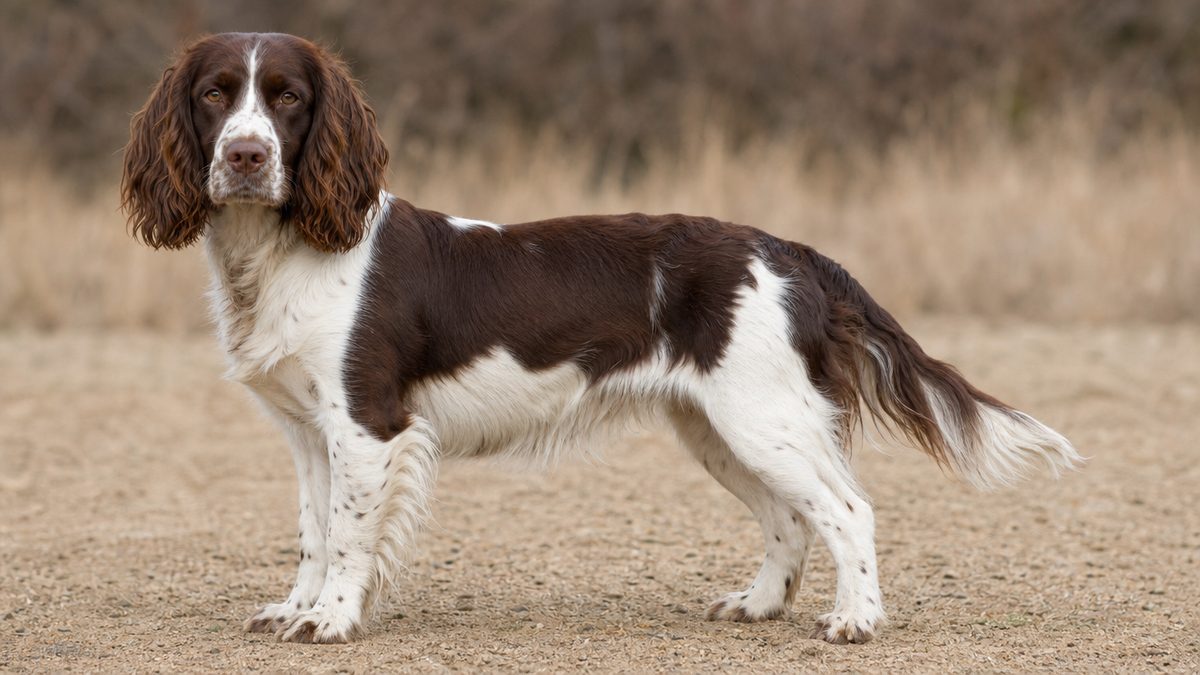
Quick answer
English Springer Spaniel price in India spans Rs 30,000 to Rs 1,05,000 across the two Indian sources that publish a figure, and neither one sells the breed. Three Indian marketplaces list zero Springers. The dog itself is a working gundog built for 9 degree Celsius England, with documented DNA tests for phosphofructokinase deficiency, fucosidosis and PRA-cord1.
This page is reference information, not veterinary advice. Inherited disease, ear infection, lameness and heat stress all need hands-on assessment. Consult a registered veterinarian before acting on anything here, and treat any collapse, sudden aggression or rapid vision change as an emergency.
English Springer Spaniel trait ratings for Indian homes
What the English Springer Spaniel actually is
The English Springer Spaniel is a medium-sized British flushing gundog, recognised by the FCI on a definitive basis as standard number 125 since 29 December 1954, and described by its own standard as the highest on leg and raciest in build of all British land Spaniels.
The FCI places the breed in Group 8, Retrievers, Flushing Dogs and Water Dogs, Section 2 Flushing Dogs, and lists its utilisation as flushing dog and retriever. It is subject to a working trial under FCI nomenclature, which matters more than it sounds: the FCI is saying the breed's title system still assumes it works. Its country of origin is Great Britain.
That recognition reaches India directly. The FCI members register lists India as a Full member represented by the Kennel Club of India at Anna Nagar, Chennai. So an Indian pedigree for this breed is issued against FCI nomenclature, and FCI standard 125 is the document an Indian buyer should be reading rather than a US or UK retailer's spec card.
Size, and why every Indian page gets it wrong
The FCI standard prints one line under Size and Weight: approximate height at withers, 51 cm, 20 inches. There is no separate figure for dogs and bitches, and no weight figure at all. The Royal Kennel Club standard says the same thing, approximate height 51 cms, and adds a note for prospective puppy buyers that the standard is a guide and a dog might be larger or smaller than the measurement given. The AKC standard is the only one of the three that quantifies weight, and it does so as an implication rather than a requirement: ideal height 20 inches for dogs and 19 for bitches, with anything more than an inch either way to be faulted, and a well-proportioned 20 inch dog weighing approximately 50 pounds against approximately 40 pounds for a 19 inch bitch.
| Source | Height | Weight | Notes |
|---|---|---|---|
| FCI standard 125 | 51 cm approximate, no sex split | none given | Official valid standard published 28 July 2009 |
| Royal Kennel Club | 51 cms approximate | none given | Standard last updated 1 August 2025 |
| AKC standard | 20 in dogs, 19 in bitches, ideal | approx 50 lb and 40 lb, stated as consequence | Approved 8 August 2023 |
| Purina India | 46 to 56 cm | 23 to 25 kg | Appears in no breed standard |
| Asia Pets | 46 to 56 cm | 18 to 25 kg | Identical height range to Purina India |
| Puppiezo | 19 to 20 inches | 18 to 25 kg | Closest of the three Indian sellers to a standard |
Two Indian pages print an identical 46 to 56 cm range that appears in none of the three standards, and both pair it with a weight band no standard states Asia Pets, English Springer Spaniel Puppies…. Convert the AKC figures and the mismatch is obvious: 20 inches is 50.8 cm and 19 inches is 48.3 cm, so the real spread between an ideal dog and an ideal bitch is about two and a half centimetres, not ten.
Coat, colour and ears
The FCI describes the coat as close, straight and weather resisting, never coarse, with moderate feathering on ears, forelegs, body and hindquarters, and the colours as liver and white, black and white, or either of those with tan markings. The AKC standard describes something different: an outer coat of medium length, flat or wavy, over an undercoat that is short, soft and dense, and it adds that the quantity of undercoat is affected by climate and season. The AKC also permits blue or liver roan and tricolour, where the Royal Kennel Club states that any other colour or combination of colours is unacceptable.
The ears are the feature that decides most of this page. Both British standards call them lobular, of good length and width, lying fairly close to the head and set in line with the eye The Royal Kennel Club. The AKC is blunter: long and fairly wide, hanging close to the cheeks, with a thin ear leather approximately long enough to reach the tip of the nose. That is a pendulous ear by any veterinary definition, and it is the single biggest health variable for this breed in an Indian monsoon.
One piece of context an Indian buyer will not find anywhere else. The Royal Kennel Club maintains a vulnerable native breeds list for British and Irish breeds falling below 300 registrations a year, and an at watch list for those between 300 and 450. At 5,845 registrations in 2025 the English Springer Spaniel is nowhere near either list, while the English Setter sits on the vulnerable list at 176 and the Gordon Setter at 93 The Royal Kennel Club. This is still a numerous breed at home, just a rapidly shrinking one.
The FCI standard says friendly, happy disposition, biddable, and that timidity or aggression is highly undesirable. The Royal Kennel Club has since hardened the same sentence to timidity or aggression unacceptable. Two registries choosing stronger language over time is not decoration. It is a breed with a documented aggression literature, covered further down this page.
Show or field: the split no Indian page mentions
Buy an English Springer Spaniel in India and you are buying one of two different dogs, because the registries hold a single breed while the breeders have run two separate populations for decades.
The English Springer Spaniel Field Trial Association is the AKC parent club for the breed, and it puts the position in one sentence: although the AKC may consider them one and the same, there is a distinct difference between show-bred and field-bred Springer spaniels. It then lists the differences. Field-bred dogs are smaller, often more white than brown or black and more heavily ticked, leaner in build, with a shorter coat and shorter ears, and a lighter, lower-maintenance coat reflecting an outdoor life. Show or bench Springers carry longer, thicker coats with more feathering and a composed demeanour, and need regular grooming to maintain that coat.
Nothing in the FCI or Royal Kennel Club standard names the two types for the Springer. The Royal Kennel Club does name the equivalent split for the English Setter, where its general appearance clause adds that the working English Setter may be proportionally lighter in build. It has not added the same line to the Springer standard, which is why the split stays invisible to anyone reading only the standard.
Why the split matters in India and not just at a dog show
- Coat load. A show coat with heavy feathering on ears, chest, legs and hindquarters is a different grooming proposition in 88 percent Bengaluru humidity than a field coat described by the parent club as shorter and lower-maintenance.
- Ear length. The parent club records shorter ears in field lines. A shorter ear leather dries faster, and ear carriage is the strongest conformational predictor of otitis externa in the UK primary-care data.
- Energy budget. A field-bred Springer is bred to quarter ground for hours. In a Chennai flat with a two-hour safe exercise window, that is a mismatch that training cannot fix.
- Aggression risk. The JAVMA survey of 1,053 adult Springers found show or bench lines among the variables associated with owner-directed aggression, and its own recommendation to prospective owners was to seek a female, hunting-type Springer from an experienced breeder.
- Disease frequency. The AKC Canine Health Foundation states that fucosidosis affects English Springer Spaniels especially those from UK and Australian conformation lines. Conformation means show.
How to tell which one you are being offered
Ask three questions and watch what happens. First, does the kennel run its dogs in field trials or in the show ring? The FCI records the breed as subject to a working trial, so a working answer is verifiable. Second, how long is the ear leather? The AKC standard's own yardstick is that it should reach approximately to the tip of the nose, and a field-bred ear is usually visibly shorter than that English Springer Spaniel Field Trial…. Third, what is the tail? The parent club notes that field dogs usually have full tails or tails docked at two-thirds length, while bench dogs are typically docked, and in India docking is prohibited outright, which means a docked import and a locally bred dog will not look alike.
Neither type is better. They are answers to different questions. A show-line Springer in a Pune apartment with an hour of morning exercise and weekly grooming is a workable dog. A field-line Springer in the same flat is an unhappy one, and the reverse is true on a farm outside Coimbatore.
Nothing. Across the three Indian marketplaces ranking for this breed, the word field does not appear as a line type and neither does bench or show line Mr n Mrs Pet, English Springer Spaniel… Asia Pets, English Springer Spaniel Puppies…. Purina India comes closest, noting only that show varieties can be less active and appear calmer than working types. That single clause is the most any Indian page says about the most consequential choice in the breed.
English Springer Spaniel price in India, and why the sources disagree
English Springer Spaniel price in India runs from Rs 30,000 to Rs 1,05,000 depending on which of the two Indian sources you read, and neither of them sells the breed, which is the first thing a buyer should know.
Exactly two Indian publishers print a rupee figure for this breed. Wrapinfur's 50-breed price list puts the English Springer Spaniel at Rs 30,000 to Rs 80,000 for the puppy and Rs 4,000 to Rs 8,000 a month, at row 36 of a 50-row table. Supertails prints a higher band inside a comparison table on its Beagle article: Rs 70,000 to Rs 1,05,000 for the puppy, Rs 6,500 to Rs 9,500 a month, and a first-year total of Rs 1,28,400 to Rs 2,31,000.
| Source | Puppy price | Monthly cost | What it is |
|---|---|---|---|
| Wrapinfur, Dog Price List in India 2026 | Rs 30,000 to Rs 80,000 | Rs 4,000 to Rs 8,000 | One row in a 50-breed listicle; no listings, no seller |
| Supertails, Beagle cost guide | Rs 70,000 to Rs 1,05,000 | Rs 6,500 to Rs 9,500 | One row in a Beagle comparison table; the article is about a Beagle |
| Puppiezo, breed page | no price for the breed | not stated | Carousel shows 2 Maltipoos, 2 Poodles, a Cane Corso, a Goldendoodle, a Rottweiler, a Doxiepoo |
| Mr n Mrs Pet, breed listing | price behind a sign-up wall | not stated | Reports 3 results and displays a Weimaraner, a Border Collie and a Newfoundland |
| Asia Pets, breed listing | no price | not stated | Prints Showing 0 results, then offers a Chihuahua, a Yorkshire Terrier and a Toy Pom |
| DogsIndia breeder directory | not applicable | not applicable | There are no breeders listed currently under this breed |
The bottom of one band is below the top of the other by 25,000 rupees
Wrapinfur's ceiling of Rs 80,000 sits Rs 25,000 below Supertails' ceiling of Rs 1,05,000, and Supertails' floor of Rs 70,000 sits above 90 percent of Wrapinfur's stated range. Two Indian publishers cannot both be describing the same market. Bonbeno publishes both rather than averaging them, because the average of two unsourced numbers is a third unsourced number.
The division tests, and what the quotients say
Indian breed pages routinely publish a US dollar price run through one exchange rate and presented as rupees, so every figure above was divided by the four rates this site has caught in use. None of them resolves.
| Rupee figure | Divided by 84.38 | Divided by 74 | Divided by 80 | Divided by 66.67 |
|---|---|---|---|---|
| Rs 70,000, Supertails floor | 829.58 | 945.95 | 875.00 | 1,049.95 |
| Rs 1,05,000, Supertails ceiling | 1,244.37 | 1,418.92 | 1,312.50 | 1,574.92 |
| Rs 6,500, Supertails monthly floor | 77.03 | 87.84 | 81.25 | 97.50 |
| Rs 30,000, Wrapinfur floor | 355.53 | 405.41 | 375.00 | 449.98 |
| Rs 80,000, Wrapinfur ceiling | 948.09 | 1,081.08 | 1,000.00 | 1,199.94 |
| Rs 98,999, Puppiezo carousel | 1,173.25 | 1,337.82 | 1,237.49 | 1,484.91 |
Nothing divides cleanly at 84.38, the strong test, and nothing divides cleanly at 74. Four of Wrapinfur's figures do resolve to round numbers at 80 and at 66.67, giving 375, 1,000, 50 and 100 dollars, but that proves nothing, because 1,000 divided by 80 is 12.5 and any rupee figure ending in three zeros passes at 80 by construction. Every Wrapinfur figure for this breed ends in three zeros. Supertails' figures fail even that weak test: Rs 1,05,000 over 80 is 1,312.50 and Rs 6,500 over 80 is 81.25, neither of which is a price a shop would print.
The honest reading is that these are rupee-native estimates rather than converted dollar lists. Nobody stripped a dollar sign and nobody ran a conversion. Two Indian content teams estimated a band for a breed neither of them stocks, and the bands do not agree.
Rs 98,999 appears three times on Puppiezo's English Springer Spaniel page, attached to two Maltipoos and a Doxiepoo, beside Rs 92,599, Rs 94,999, Rs 76,499 and Rs 1,20,000 on other breeds. It divides to 1,173.25 dollars at 84.38, so it is not a conversion either. It is a recurring house price point, and it is not this breed's price.
Monthly cost of a Springer in India, and the arithmetic that does not add up
Budget Rs 4,000 to Rs 9,500 a month for an English Springer Spaniel in India on the two published Indian estimates, then treat both with caution, because one is a generic size-class default and the other does not reconcile with its own first-year total.
Start with what each source actually did. Wrapinfur's monthly figure for this breed is not a breed figure at all. Its English Springer Spaniel row gives Rs 4,000 to Rs 8,000 a month and classifies the breed as Medium, and its separate Average Monthly Dog Maintenance Cost table gives the Medium Breeds column an estimated monthly total of exactly Rs 4,000 to Rs 8,000. The breed row is the size-class default copied across. That is not dishonest, but it means the number carries no information about a heavily feathered, ear-prone, high-drive gundog specifically.
| Expense category | Medium breed monthly, Rs |
|---|---|
| Food and treats | 2,000 to 4,000 |
| Grooming | 800 to 2,000 |
| Veterinary care | 500 to 1,500 |
| Toys and enrichment | 500 to 1,500 |
| Accessories and miscellaneous | 500 to 1,500 |
| Estimated monthly total | 4,000 to 8,000 |
Supertails prints a first-year total that its own monthly figure contradicts
Supertails' comparison table gives the English Springer Spaniel a puppy price of Rs 70,000 to Rs 1,05,000, a monthly cost of Rs 6,500 to Rs 9,500 and a first-year total of Rs 1,28,400 to Rs 2,31,000. Do the arithmetic. Rs 70,000 plus twelve months at Rs 6,500 is Rs 1,48,000, not Rs 1,28,400. The printed total is Rs 19,600 short. At the top end, Rs 1,05,000 plus twelve months at Rs 9,500 is Rs 2,19,000, and the printed total is Rs 12,000 over.
Run the same check on every row of that table and only one reconciles. The Pug row, Rs 35,000 plus twelve months at Rs 4,000, lands on exactly the Rs 83,000 printed. Five of the six rows, including this breed's, do not. A cost table that cannot hold its own arithmetic across its own rows was assembled rather than costed.
There is a second tell in the same table. Supertails gives the English Springer Spaniel and the Cocker Spaniel an identical monthly band of Rs 6,500 to Rs 9,500, while its own notes column says the Springer has the highest grooming of the six breeds and requires 90-plus minutes of exercise. Both statements cannot be true at once.
What actually drives the number in India
- Ear care, not coat care, is the recurring line. Otitis externa was diagnosed in 7.30 percent of a random sample of 22,333 UK dogs in a single year, and pendulous-eared breeds carried 1.76 times the odds of erect-eared ones. A single course of ear treatment plus a consultation in an Indian metro is routinely more than a month of food.
- Grooming frequency scales with the type you bought. The parent club describes the show coat as thicker with more feathering and needing regular grooming, and the field coat as lighter and lower-maintenance. Purina India puts the requirement at grooming every other day.
- Cooling is a real line item in most of India. It is not in either Indian estimate for this breed. Supertails' own Beagle article budgets Rs 2,000 to Rs 5,000 a month of cooling cost for a shorter-coated, lower-drive breed.
- DNA testing is a one-off, not a monthly. Three tests, done once by the breeder rather than by you, and the Royal Kennel Club names all three.
Take Wrapinfur's medium-breed build of Rs 4,000 to Rs 8,000, add a grooming line at the top of its range because this is a feathered coat in humid air, add a cooling allowance for eight months of the year, and treat ear treatment as an expected annual cost rather than a surprise. That gives a realistic Rs 7,000 to Rs 12,000 in a metro, above both published Indian estimates and below neither.
Heat and humidity: Bengaluru's coolest month beats Shropshire's warmest
Rate the English Springer Spaniel 2 out of 5 for heat tolerance in India, because the English gundog country it was bred for averages 9.1 degrees Celsius across the year and 15.6 in July, while Bengaluru, the mildest large Indian city, averages 20.2 in its coolest month.
Those figures come from NASA POWER's native-resolution climatology for 2001 to 2020, queried by explicit latitude and longitude so that no place name can be substituted by accident. Newport in Shropshire, at 52.769 N and 2.379 W, 132 m elevation, returns an annual mean 2 m air temperature of 9.1 degrees Celsius, a July mean of 15.6, a January mean of 3.5 and an annual mean relative humidity of 88.3 percent. That is the climate the coat described by FCI-125 as close, straight and weather resisting was selected in.
| Place | Annual mean | Warmest month | Coolest month | Annual mean RH | Peak monthly wet-bulb |
|---|---|---|---|---|---|
| Newport, Shropshire | 9.1 C | 15.6 C (July) | 3.5 C (January) | 88.3% | 13.7 C (July) |
| Bengaluru | 23.7 C | 28.4 C (April) | 20.2 C (December) | 67.9% | 21.9 C (May) |
| Pune | 23.9 C | 28.9 C (April) | 19.6 C (December) | 66.8% | 23.0 C (June) |
| Delhi | 25.6 C | 35.9 C (June) | 13.6 C (January) | 45.6% | 26.5 C (July) |
| Kolkata | 25.8 C | 31.5 C (May) | 17.3 C (January) | 73.9% | 27.1 C (June) |
| Hyderabad | 26.1 C | 33.3 C (May) | 20.8 C (December) | 60.3% | 23.3 C (June) |
| Mumbai | 26.8 C | 31.2 C (May) | 23.2 C (January) | 67.4% | 25.8 C (June) |
| Chennai | 27.9 C | 31.5 C (May) | 24.1 C (January) | 72.4% | 26.1 C (May) |
The comparison that settles it is not the peak. It is the floor. Bengaluru's coolest month, December, averages 20.2 degrees Celsius, which is 4.6 degrees warmer than the warmest month this breed's home country has ever had to offer. Chennai in January, its coolest month, is 8.5 degrees above a Shropshire July. There is no season anywhere in urban India that reproduces the climate this dog was built for.
The humidity trap, and why wet-bulb is the number that matters
Shropshire is humid. At 88.3 percent annual mean relative humidity it is more humid than every Indian city in the table. That is exactly why raw humidity is the wrong comparison and wet-bulb temperature is the right one, because a dog cools by evaporation and evaporation depends on temperature and humidity together. Wet-bulb figures above are computed from the NASA POWER monthly means using Stull's 2011 approximation NASA POWER Source Native Resolution….
Shropshire's peak monthly wet-bulb is 13.7 degrees Celsius. Kolkata's is 27.1, Delhi's 26.5 and Chennai's 26.1 Stull R. Wet-Bulb Temperature from Relative…. That is roughly double, and it means a Springer panting in Chennai in May has close to half the evaporative headroom it evolved with. Even Bengaluru's 21.9 is 8.2 degrees above the English peak. Dry heat in Delhi is survivable for longer than the temperature suggests; humid heat in Kolkata and Chennai is not.
What the UK evidence says about how dogs actually get heatstroke
The single most useful heat statistic for a gundog owner comes from VetCompass. Reviewing 905,543 UK dogs under primary veterinary care in 2016, Hall and colleagues identified 1,259 heat-related illness events from 1,222 dogs. Of those, 380 had no trigger recorded, and of the 879 events that did have a trigger recorded, 652, or 74.2 percent, were exertional. Environmental heat accounted for 113 events, 12.9 percent, and confinement in a vehicle for 46, 5.2 percent.
Then look at what counted as exertion. Of the 652 exertional events, the activity was unspecified in 101. Of the remaining 551, 372, or 67.5 percent, followed walking, against 97 after high-intensity activity such as running or cycling. The commonest way a dog reaches a veterinary clinic with heat illness is not a hard run. It is a walk, in the wrong conditions, at the wrong time.
In Chennai, Mumbai and Kolkata the workable window for a Springer is roughly first light to two hours after, and the last hour before dark, for eight months of the year. Bengaluru and Pune stretch that by an hour at each end. Delhi is the reverse case: its January mean of 13.6 degrees Celsius makes it the one city on this list with a genuine winter season for a gundog, and its June mean of 35.9 makes it the worst summer.
Temperament and who should not buy one
Buy an English Springer Spaniel if you want a biddable, people-focused working dog that needs a job, and avoid one if the household is out for nine hours a day, because the standard's own word for the breed is merry and the club's word for a bored one is difficult to live with.
The FCI standard describes the temperament in six words: friendly, happy disposition, biddable. The AKC standard adds the working reason behind it: the typical Springer is friendly, eager to please, quick to learn and willing to obey, and those traits are conducive to tractability, which is essential for appropriate handler control in the field. Read that as a design brief rather than a personality description. The breed was selected to stay in contact with a handler at forty metres in cover, and that is why it follows you from room to room in a two-bedroom flat.
The household fit, honestly
- Works well with: active families, joint-family homes where somebody is in most of the day, owners who enjoy training as a hobby rather than a chore, households on ground floors or with terrace access.
- Works badly with: dual-income flats empty from nine to seven, first-time owners who wanted a low-effort family dog, homes with resident small pets, apartments where barking triggers complaints.
- Needs deciding before purchase: whether the dog is show-bred or field-bred, because the parent club treats them as materially different animals.
- Non-negotiable: a genuine daily job. Purina's own guidance is that Springers are still very much working dogs at heart and need a job to do, whatever that is, because a bored Springer Spaniel is difficult to live with.
Vocal, and that is an apartment problem in India
Purina India's own need-to-know panel for this breed includes chatty and vocal dog, not a guard dog, extra training required and may require training to live with other pets. In a Mumbai or Bengaluru housing society those four lines matter more than any of the temperament adjectives. A vocal gundog that is not a guard dog barks at things without deterring anything, which is the worst combination for a shared wall.
Prey drive is a real constraint in Indian cities
This is a flushing breed. The FCI records its original purpose as finding and springing game for net, falcon or greyhound, and its present purpose as finding, flushing and retrieving game for the gun. Supertails' own Beagle article, describing a lower-drive breed than this one, still lists escape artists and strong prey drive as an India-specific challenge and recommends secure fencing of at least 1.2 m. On an Indian street with free-roaming cats, crows and community dogs, a Springer off-lead in an unfenced space is a recall problem waiting to become a traffic accident.
Good with children, with the usual caveat and one unusual one
Purina India rates the breed a great family dog and adds the standard caution that dogs and young children should never be left alone together. The unusual caveat is specific to this breed and comes from the veterinary literature rather than from a breed description. In the JAVMA survey of 1,053 adult English Springer Spaniels, 277 dogs, 26.3 percent, had bitten a human, and 65.2 percent of those bites were directed at familiar adults and children. That does not make the breed dangerous, and the next section explains why the framing matters. It does mean the ordinary supervision advice is not optional here.
If you cannot name the job this dog will do every single day, in writing, before the puppy arrives, buy a different breed. Scent work, retrieve games, a structured walk with tasks and a food puzzle all count. Being taken out to relieve itself does not.
Springer rage: what the evidence says, with the denominators attached
Read the aggression literature on this breed with its denominators visible, because the peer-reviewed work does not describe a mysterious rage syndrome, it describes owner-directed aggression measured in 1,053 dogs with identifiable and largely avoidable risk factors.
The popular term for this is springer rage, and it circulates on Indian forums and international breed pages alike, usually without a source. The largest published study of aggression in the breed does not use that framing. Reisner, Houpt and Shofer surveyed owners of adult American Kennel Club-registered English Springer Spaniels, mailing 2,400 randomly selected owners, and analysed 1,053 completed questionnaires, 56.1 percent of the 1,877 that were delivered. That is the denominator every figure below sits on, and it is worth carrying through the whole section.
The two headline numbers, and what each one includes
| Finding | Count | Share of 1,053 | What it includes |
|---|---|---|---|
| History of owner-directed growling or more intense aggression | 510 | 48.4% | Growling counts, so this is not a bite rate |
| Had bitten a human at some point | 277 | 26.3% | Any bite, at any point in the dog's life |
| Share of those bites directed at familiar adults and children | - | 65.2% of bites | Owners, family, familiar non-owners |
The 48.4 percent figure is the one most often misquoted. It counts growling, which is a warning rather than an injury, and it counts any such episode across an adult dog's life. Reporting it as half of Springers are aggressive is a misreading of the authors' own category. The bite figure of 26.3 percent is the harder number, and it is genuinely high for a gundog.
The risk factors are the useful part
The study identified the variables associated with owner-directed aggression, and they are mostly things a buyer can act on before the dog arrives. They were: male sex; neuter status, in either sex; show or bench lines; age over four years; aggression towards unfamiliar adults and children; acquisition from a hobby breeder; less responsiveness to obedience cues; and, most tellingly, a specific kennel and one popular sire from that kennel appearing in a four-generation pedigree.
That last item reframes the whole question. A trait that concentrates in one sire's descendants is a pedigree problem, not a breed-wide curse. It is also the reason a four-generation pedigree is worth asking for, and worth reading, before you pay for a puppy anywhere.
What the authors themselves recommended
The paper's own conclusion is that to reduce the risk of aggression, prospective owners might seek a female, hunting-type English Springer Spaniel from an experienced breeder, while cautioning that because the risk factors are broad and varied there are limits to how far behaviour can be predicted, and that further study of the inheritance of aggression in this breed is needed. Bonbeno reports that recommendation as the authors wrote it and does not extend it.
Four limits to keep attached to these figures
- Response bias. A postal survey about aggression is likelier to be returned by owners who have something to report, so 48.4 percent and 26.3 percent are upper estimates rather than population rates.
- Age of the data. The survey describes US AKC-registered dogs published in 2005, not Indian dogs in 2026, and the popular sire it implicates sits in pedigrees of that era.
- Definition width. Owner-directed aggression is a behavioural category recorded by owners, not a clinical diagnosis made by a behaviourist.
- No Indian equivalent exists. No published Indian series measures aggression in this breed, which is unsurprising given that three Indian marketplaces hold none of them.
Two registries have moved in the same direction on the point. The FCI standard says timidity or aggression is highly undesirable; the Royal Kennel Club standard, last updated 1 August 2025, says timidity or aggression unacceptable. A breed standard hardening its language about temperament is a signal worth reading.
Prefer a field or hunting-type line, prefer a female if the household includes small children, read four generations of pedigree, meet both parents, and treat any growl at a family member as a reason to book a veterinary behaviour consultation the same week rather than a training problem to correct at home.
Training a Springer in India: what works and what it resists
Train an English Springer Spaniel with reward-based work built around retrieving and scent, because the AKC standard describes the breed as quick to learn and willing to obey, and the one thing it genuinely resists is being asked to ignore its nose.
Purina's guidance is that this is a breed that will actively enjoy training, responds best to positive reward-based methods, and should be taught early to retrieve, to swap found objects happily and to recall reliably, because its busy nose can lead it anywhere. That is the correct order of priorities and it is worth stating plainly: recall and a clean swap are the two skills that keep this dog alive in an Indian city.
A realistic Indian timeline
| Age | Priority | Why it is timed here |
|---|---|---|
| 8 to 12 weeks | Name response, hand feeding, crate as a rest place, ear handling | Ear handling now is what makes monthly ear checks possible later |
| 12 to 16 weeks | Socialisation to traffic, lifts, tiled floors, other dogs, the groomer | The window closes; Indian apartment life is louder than English gundog country |
| 4 to 6 months | Recall on a long line, retrieve to hand, swap for food | Prey drive is switching on and the dog is fast enough to reach a road |
| 6 to 12 months | Settle on a mat, alone-time in short blocks, scent games indoors | Builds the off-switch that the monsoon and the summer both force on you |
| 12 months plus | Structured scent work, gundog-style retrieve, dog sports | This is the job that stops boredom becoming destruction |
What this breed resists
- Being asked to stop scenting. It cannot, and correcting it teaches the dog that you are unpredictable. Redirect into a permitted sniffing task instead.
- Long static obedience. The AKC standard's own note is that tractability is essential for handler control in the field, meaning movement. Twenty minutes of sit-stay in a hot living room is the wrong shape of training for this dog.
- Harsh handling. The breed's documented aggression risk factors include less responsiveness to obedience cues, and a dog that has learned to avoid a handler is exactly the dog you do not want carrying that risk.
- Indoor-only routines. Purina India describes this as a rural dog that needs long energetic walks with plenty of opportunities to run, sniff and explore. Indoor scent work substitutes for some of that, not all of it.
The Indian-specific training problems nobody writes about
Three come up repeatedly and none of them appears on an overseas breed page. The first is heat-shifted training hours. If the only safe window is 5.30 am to 7 am, then the entire training plan has to fit inside it, and a family that cannot get up at 5.30 will not train this dog. The second is lift and stairwell socialisation, which an English gundog puppy never encounters and an Indian apartment puppy meets on day one. The third is community-dog encounters, which are the commonest cause of a failed recall in Indian cities and which need to be trained for deliberately rather than avoided.
There is one thing this breed makes easy. It wants to be trained. Purina notes it lends itself well to scent work of any kind, including tracking, man-trailing and scent discrimination, all of which can be run indoors during the monsoon with nothing more than cardboard boxes and food. For eight months of the Indian year, indoor scent work is not a consolation prize. It is the main event.
Hide five pieces of food in a room, send the dog in, and let it work. It costs nothing, runs at any hour, ignores the weather entirely, and tires a Springer faster than a walk of the same length. Build it before the heat arrives, not during it.
Daily exercise, and what the Indian heat does to the number
An English Springer Spaniel needs 60 to 90 minutes of real exercise a day plus mental work, and in most Indian cities that has to be split across two windows at the ends of the day for eight months of the year.
The published requirements disagree, and the disagreement is instructive. Puppiezo, an Indian seller, puts the exercise routine at one hour daily. Supertails' comparison table says the breed requires 90-plus minutes. Purina India, serving British copy to Indian readers, says several hours of exercise per day is required and lists the breed as enjoying walking more than two hours a day.
| Source | Stated daily requirement | Where it was written for |
|---|---|---|
| Puppiezo | 1 hour | India, seller spec card |
| Supertails | 90-plus minutes | India, comparison table |
| Purina India | several hours, more than two hours of walking | United Kingdom, served on purina.in unchanged |
| Bonbeno, for an Indian city | 60 to 90 minutes split across two windows, plus 15 minutes of scent work | India, adjusted for the safe temperature window |
Purina's several hours is not wrong for Shropshire. It is unworkable in Chennai, where the annual mean is 27.9 degrees Celsius and the coolest month still averages 24.1. An Indian page that repeats it without qualification is telling a buyer to do something that the heat evidence says is the commonest way dogs reach a veterinary clinic with heat illness.
Why the walk itself is the risk, not the run
In the VetCompass heat-illness data, 652 of the 879 events with a recorded trigger were exertional, and within the 551 exertional events where the activity was specified, 372, or 67.5 percent, followed walking rather than running, cycling or any high-intensity activity. Only 97 events, 17.6 percent, followed high-intensity work. A dog does not need to be sprinting to overheat. It needs to be moving, in air it cannot shed heat into.
Set that against the wet-bulb figures. Chennai peaks at a monthly mean wet-bulb of 26.1 degrees Celsius and Kolkata at 27.1, against 13.7 in the Shropshire the breed came from. The evaporative cooling a Springer's body plan assumes is roughly halved.
A workable Indian exercise plan
- Morning block, 40 to 60 minutes, before sunrise plus one hour. Lead walk with sniffing time, then a short retrieve session in shade. This is the day's main exercise, all year.
- Evening block, 20 to 30 minutes, after the pavement has cooled. Test the pavement with the back of your hand for five seconds before you go out.
- Scent work, 10 to 15 minutes, indoors, any time. Runs during the monsoon, during a heatwave and during a curfew, and tires the dog disproportionately to its length.
- Water, only where it is clean. Purina notes the breed's love of water and its habit of finding puddles. A monsoon puddle in an Indian city is a leptospirosis and ear-infection risk, not a swim.
- Nothing at all between 11 am and 4 pm, March to October, in every city in the climate table except a Delhi winter.
What happens without it
Purina's own phrasing is the honest one: a bored Springer Spaniel is difficult to live with, and the breed should be taught to settle quietly from a young age while avoiding the temptation to try to exhaust it, a task that will never be fulfilled. Under-exercised Springers in Indian flats present with barking, destructive chewing, pacing and attention-seeking. Those are not temperament faults. They are a workload deficit.
Stop and cool the dog immediately at heavy open-mouth panting that does not settle within two minutes of shade, a bright red or very pale tongue, unsteadiness, or vomiting. Wet the coat with cool water, move air across it, and go to a veterinarian. Exertional heat illness in the UK data killed at a rate similar to a dog left in a hot car.
Grooming and ear care in Indian humidity
Groom an English Springer Spaniel every other day and treat the ears as a separate weekly job, because the coat is feathered and the ear is lobular, and Indian evidence puts drop-eared dogs at almost half of all diagnosed otitis externa cases.
Purina India states the requirement as grooming every other day and frequent brushing and trimming. That is a fair baseline for a show-line coat and more than a field-line coat needs, which is one more reason the type matters: the parent club describes the field coat as lighter and more low-maintenance, reflecting an outside lifestyle, against a bench coat that is thicker with more feathering and needs regular grooming to maintain.
The AKC standard adds a line no other standard does, and it is the most India-relevant sentence in any of them. Describing the outer coat over a short, soft, dense undercoat, it notes that the quantity of undercoat is affected by climate and season. A Springer that has spent its whole life in Chennai will not carry the undercoat an English one does. The FCI and Royal Kennel Club standards do not mention an undercoat at all, describing only a close, straight, weather-resisting coat with moderate feathering The Royal Kennel Club.
The ear is the health problem, not the coat
In the UK VetCompass study of 22,333 dogs, the one-year period prevalence of otitis externa was 7.30 percent, with a 95 percent confidence interval of 6.97 to 7.65, and ear carriage was one of the two highest-ranked risk factors. Breeds with pendulous ear carriage carried 1.76 times the odds of otitis externa compared with erect-eared breeds, with a confidence interval of 1.48 to 2.10, and V-shaped drop ears 1.84 times, 1.53 to 2.21. The English Springer Spaniel is not among the sixteen individually named high-risk breeds in that paper, so this page transfers only the conformational finding, which applies squarely: all three breed standards describe a long, lobular, close-hanging ear American Kennel Club The Royal Kennel Club.
The Indian evidence points the same way and adds a season. In 1,008 otitis externa cases drawn from 76,161 dogs presented at the Veterinary College, Hebbal, Bengaluru, drop-type pendulous ears accounted for 481 cases, 47.72 percent, against 283 prick-eared, 28.07 percent, and 244 intermediate, 24.21 percent, with a chi-square of 26.4368 and p below 0.00001.
Indian series disagree about the season, and that is worth knowing
| Series | Setting | Peak season | Figure |
|---|---|---|---|
| Chaudhary and Mirakhur, 1,008 cases | Veterinary College Hebbal, Bengaluru | Rainy, July to October | 41.87% of cases, against 32.83% winter and 25.30% summer |
| Nainika and Sharma, 81 cases from 2,476 dogs | Palam Valley, Himachal Pradesh | Monsoon | 59.25% of cases in July and August alone |
| Parmar and colleagues, 116 dogs | Anand Agricultural University, Gujarat | Reported separately | Microbiological series rather than a seasonal one |
Bonbeno publishes the disagreement rather than resolving it. Two Indian series peak in the wet season and one hill series peaks harder still, but this site has also recorded an Indian series where summer led the monsoon, so the safe reading is that the wet season is the highest-risk period in most of India and the risk is never zero. Note one arithmetic caveat on the Palam Valley paper: its ear-carriage table prints pendulous ear breed 53, 69.13 percent, and 53 divided by 81 is 65.43 percent, so the count and the percentage do not agree. The 69.13 percent figure is the one consistent with the rest of that table.
The routine that actually works here
- Brush every other day, working through the feathering on ears, chest, legs and hindquarters where mats start.
- Check the ear weekly, lifting the leather and looking and smelling. A sour smell precedes visible discharge.
- Dry the ear after every swim, bath and heavy rain. The VetCompass authors specifically recommend a dry paper cloth, judicious use of ear cleaners with antimicrobial properties and avoidance of overzealous ear-cleaning. Do not flush daily.
- Never shave the coat to cool the dog. The coat is described as weather resisting and it insulates against radiant heat as well as cold.
- Trim the hair between the pads before the monsoon, because it holds water and grit.
Two more things worth settling. A third Indian series, from Anand Agricultural University in Gujarat, worked microbiologically across 116 dogs with ear infections, which is why this site treats Indian otitis as a problem to culture rather than guess at. And the coat is not hypoallergenic: Purina India labels the breed non hypoallergenic on its own panel, and Vredegoor and colleagues measured Can f 1 across 196 dogs of so-called hypoallergenic breeds against 160 controls and found the hypoallergenic group higher, not lower.
Overseas spaniel care guidance that says to towel the dog and let it air dry was written for a dry climate. In Indian monsoon air a folded lobular ear does not air dry, it stays warm and wet, which is the exact microenvironment otitis externa needs.
Health risks and lifespan, from the registers rather than the breed pages
The English Springer Spaniel's biggest orthopaedic risk is its elbows, not its hips, and its median lifespan of 13.5 years is longer than the Labrador's, the Golden Retriever's and the Beagle's.
Every figure here is read off the Orthopedic Foundation for Animals disease-statistics tables, matched to the printed breed label rather than to a guessed code, using the code EN that OFA's own breed markup gives for this breed Orthopedic Foundation for Animals. Sample sizes are printed beside every percentage, because a live register moves as evaluations are added.
| Screen | Evaluations | Result | Breed rank | All-breed figure |
|---|---|---|---|---|
| Hips | 20,585 | 12.4% dysplastic, 86.2% normal | 108 | 14.2% dysplastic of 1,712,430 |
| Elbows | 5,917 | 16.0% abnormal, 83.9% normal | 31 | 12.0% abnormal of 650,073 |
| Eyes | 19,512 | 5.2% abnormal, 94.8% normal | 93 | 6.5% abnormal of 886,790 |
| Patella | 637 | 0.5% abnormal, 99.5% normal | 144 | - |
| Thyroid | 519 | 91.1% normal, 2.1% compensative autoimmune thyroiditis | 78 of 129 | 84.8% normal of 121,430 |
| Advanced cardiac | 173 | 89.6% normal, 5.2% abnormal | 41 | - |
| Congenital cardiac | 698 | 99.1% normal, 0.1% abnormal | 69 | - |
The elbows are the finding
At 16.0 percent abnormal across 5,917 evaluations the English Springer Spaniel ranks 31st of every breed in the OFA elbow register, worse than the all-breed 12.0 percent, worse than the Golden Retriever at 11.8 percent and worse than the Labrador at 9.9 percent. Broken out by grade, 13.0 percent are grade 1, 2.6 percent grade 2 and 0.4 percent grade 3, which sums to the 16.0 printed. Most of the burden is mild, and mild elbow dysplasia is still a lifetime of managed arthritis in a dog bred to work eight-hour days.
The hips are the better news. At 12.4 percent dysplastic across 20,585 evaluations the breed sits below the all-breed 14.2 percent, with 10.9 percent excellent, 60.6 percent good and 14.7 percent fair among the 86.2 percent normal. One arithmetic note for anyone checking: the dysplastic sub-grades of 7.9, 4.0 and 0.6 percent sum to 12.5, against the 12.4 printed in the summary column, which is rounding rather than a contradiction.
Read both numbers with the register's own limitation attached. OFA is a voluntary database, so the dogs in it are disproportionately the dogs a breeder chose to screen. It understates disease in unscreened populations and it is still the largest published dataset that exists for this breed.
Lifespan: two studies, two measures, both worth having
McMillan and colleagues, working from 584,734 UK dogs including 284,734 deaths, put the English Springer Spaniel's median survival at 13.5 years, 95 percent confidence interval 13.4 to 13.6, on 6,221 recorded deaths, with a hazard ratio of 0.70 against the crossbred group at p below 0.001 McMillan et al. 2024. That is longer than the Labrador at 13.1, the Golden Retriever at 13.2, the English Cocker Spaniel at 13.3 and the crossbred group at 12.0.
A second UK study measures something different and reports a lower figure, which is not a contradiction. Teng and colleagues built life tables from 30,563 dogs that died between 2016 and 2020 and report life expectancy at age 0 for the Springer Spaniel as 11.92 years, 95 percent confidence interval 11.69 to 12.13, fourth of the eighteen groups studied behind the Jack Russell Terrier, the Yorkshire Terrier and the Border Collie. Life expectancy from birth and median survival among dogs reaching adulthood are different quantities. That paper also groups Springer Spaniels without separating English from Welsh, so it is the less breed-specific of the two.
What is not a documented problem in this breed
Patellar luxation, on 637 evaluations at 99.5 percent normal, is not a breed issue. Thyroid disease is unremarkable: 91.1 percent normal on 519 evaluations, ranked 78th of 129 breeds, against an all-breed 84.8 percent. The eyes sit slightly better than the all-breed average at 5.2 percent abnormal against 6.5 percent, although the Royal Kennel Club still lists both the eye scheme and gonioscopy as good practice for the breed, which is a screening recommendation rather than a prevalence claim.
The Royal Kennel Club's good-practice list for the English Springer Spaniel is the eye scheme, gonioscopy, elbow dysplasia scoring and hip dysplasia scoring. Elbows are on that list for a reason, and elbows are the one an Indian seller is least likely to have.
The three DNA tests this breed has, and what each register shows
Ask for three DNA certificates before buying an English Springer Spaniel, because phosphofructokinase deficiency, fucosidosis and PRA-cord1 are all recessive, all have a test, and all are named as best practice by the Royal Kennel Club.
The Royal Kennel Club Health Standard lists five DNA tests under best practice for this breed: AMS, DAMS, fuco, PFK and PRA-cord1. Three of those have published OFA register data and are covered below. Every one of them is recessive, which is the point: a carrier is a normal, healthy, working dog for its whole life, and only a carrier-to-carrier mating produces an affected puppy. You cannot see this in a parent.
| Condition | Evaluations | Normal | Carrier | Affected | Breed rank in that table |
|---|---|---|---|---|---|
| Phosphofructokinase deficiency | 517 | 99.6% | 0.0% | 0.4% | 1 of 4 breeds listed |
| Fucosidosis | 199 | 100.0% | 0.0% | 0.0% | 1, the only breed listed |
| PRA-crd4/cord1 | 881 | 52.6% | 39.6% | 7.8% | 1 of 8 breeds listed |
| Degenerative myelopathy | 304 | 90.8% | 6.6% | 2.6% | 45 |
PRA-cord1 is the number that should stop a buyer
Of 881 English Springer Spaniels in OFA's PRA-crd4/cord1 register, 39.6 percent are carriers and 7.8 percent are affected, which works out at roughly 349 carriers and 69 affected dogs. The breed ranks first of the eight breeds in that table, well ahead of the Dachshund at 17.1 percent carriers and the Beagle at 19.4 percent, and against an all-breeds figure of 22.4 percent carriers and 3.9 percent affected.
Treat that 39.6 percent as a register figure, not a population prevalence. OFA is voluntary, and breeders test when they suspect risk, so the tested population is selected. What it does establish beyond doubt is that the mutation is common enough in this breed to matter, and that a Springer bought without a cord1 certificate is an unquantified risk of adult-onset blindness.
Phosphofructokinase deficiency: rare, testable, and this breed's own disease
PFK deficiency was described in English Springer Spaniels in 1986, when Giger and colleagues studied three families and found four males and one female with chronic haemolysis and haemolytic crises whose red-cell PFK activity was 8 to 20 percent of control Springers, alongside six clinically normal first-degree relatives running 38 to 51 percent. The paper confirmed autosomal recessive inheritance and identified the dogs as an animal model of human glycogen storage disease type VII.
OFA's PFK table contains four breeds and all four are spaniels: the English Springer Spaniel on 517 evaluations, the Boykin Spaniel on 104, the English Cocker Spaniel on 82 and the Cocker Spaniel on 77. The English Springer Spaniel is the only one of the four with any affected dogs recorded, at 0.4 percent of 517, which is two dogs. There is an oddity in that row worth naming: the carrier column reads 0.0 percent while two affected dogs are recorded, which cannot be biologically true of a recessive and is a property of what breeders choose to submit rather than of the disease.
Fucosidosis: the whole OFA table is this one breed
Fucosidosis is a lysosomal storage disease caused by deficiency of alpha-L-fucosidase, and the AKC Canine Health Foundation describes it as affecting English Springer Spaniels especially those from UK and Australian conformation lines. Skelly and colleagues at the University of Pennsylvania built the PCR test in 1999, screening 35 English-bred and 60 American-bred Springers plus one affected Colorado dog and its parents. Two carriers were found among the 35 English-bred dogs and none among the 60 American-bred dogs, and the Colorado defect proved identical to the British and Australian one.
Sources disagree on when signs start. The AKC Canine Health Foundation page says symptoms begin between one and two years of age and progress rapidly, while its own introduction describes signs appearing before a fourth birthday. Bonbeno prints both rather than picking one. OFA's fucosidosis table contains 199 evaluations, all English Springer Spaniels, all normal, with no carriers found.
A UK or Australian show-line import is exactly the population the AKC Canine Health Foundation flags for fucosidosis, and it is also the population Reisner associated with higher owner-directed aggression Reisner IR, Houpt KA. If a puppy is being sold to you in India as an imported show line, the DNA certificates stop being optional.
Feeding a Springer in India, by life stage
Feed an adult English Springer Spaniel twice daily to a body condition score rather than to a cup measure, because the breed standards give no weight target at all and the two Indian pages that do give one disagree with each other and with the AKC.
There is no official weight for this breed. The FCI standard prints a height and nothing else under Size and Weight, and the Royal Kennel Club does the same The Royal Kennel Club. The AKC is the only registry that states a figure, and it states it as a consequence rather than a requirement: a well-proportioned 20 inch dog in good condition will weigh approximately 50 pounds, about 22.7 kg, and a 19 inch bitch approximately 40 pounds, about 18.1 kg. Purina India prints 23 to 25 kg and Asia Pets prints 18 to 25 kg, neither of which comes from a standard.
Because the target is contested, feed to condition. Purina's own advice on the same page is to conduct regular body condition scores to keep the dog in ideal shape and to feed at least twice daily in line with the food's guidelines. The WSAVA nine-point body condition score chart is the standard tool and is free. Ribs easily felt under a thin fat cover, a visible waist from above and an abdominal tuck from the side is a 4 or 5 out of 9, which is where this dog should sit.
| Stage | Meals per day | Priority | Indian note |
|---|---|---|---|
| 8 to 16 weeks | 4 then 3 | Growth food, controlled growth rate | Keep the puppy lean; fast growth loads a breed with 16.0% abnormal elbows |
| 4 to 12 months | 3 then 2 | Large-puppy or medium-puppy formula, calcium not supplemented | Do not add calcium to a complete food |
| 1 to 7 years | 2 | Adult maintenance, portioned to condition | Cut portions in summer when exercise drops, not the other way round |
| 7 years plus | 2 | Joint support and weight control | Elbow arthritis is the commonest late cost in this breed |
| Any age, working dog | 2 plus post-work feed | Higher energy density | Never feed immediately before exercise in heat |
Three Indian feeding realities
- Summer appetite drops and owners over-feed to compensate. A Springer that eats less in May is behaving normally. Adding toppers to tempt it adds weight the elbows carry.
- Roti and rice as a filler is the commonest Indian error. It moves the diet away from the protein a working breed needs and toward calories the dog does not burn in a Chennai summer.
- Water discipline in the monsoon. Purina notes the breed's enthusiasm for splashing in puddles and even its own water bowl. Change bowl water at least twice daily in the wet season and do not let a Springer drink standing water outdoors.
Availability of appropriate food in India
Nothing about this breed needs a breed-specific formula. A medium-breed complete adult food from any of the brands widely stocked in Indian metros meets the requirement, and the money is better spent on a body condition score routine than on a bag with the breed name on it. What does need buying is a slow-feed bowl or a puzzle feeder, because this is a scenting breed that gets more out of working for food than eating it.
Ignore all four published weight figures and use the dog. If you cannot feel the ribs through a thin layer, feed 10 percent less for four weeks and re-check against the WSAVA chart. For a breed whose elbows rank 31st worst of every breed in the OFA register, every extra kilogram is loaded onto the joint that is already the weak one.
Month by month through the first year
Plan a Springer puppy's first year around three deadlines: the socialisation window that closes near sixteen weeks, the monsoon that arrives whatever month you bought in, and the growth period that decides how the elbows finish.
Indian law sets the start date. Rule 8(1)(a) of the Prevention of Cruelty to Animals (Dog Breeding and Marketing) Rules, 2017 requires every breeder to ensure that pups less than eight weeks in age are not sold. A seller offering a six-week Springer is breaking that rule, and a puppy taken that early misses the litter learning that this breed uses.
| Age | Health and care | Training and handling | Watch for |
|---|---|---|---|
| 8 to 10 weeks | Arrives no earlier than eight weeks by law; first vaccinations under way | Name, hand feeding, crate as rest place, daily ear handling | Loose stools from a diet change made too fast |
| 10 to 12 weeks | Vaccination course continues; deworming to schedule | Short lead walks in cool hours only | Puppy exhaustion mistaken for calmness in the heat |
| 12 to 16 weeks | Vaccination course completing | Traffic, lifts, tiled floors, groomer visit with no grooming done | The socialisation window closing while you wait for the last shot |
| 4 to 6 months | First adult ear check; teething | Long-line recall, retrieve to hand, swap for food | Prey drive switching on near roads |
| 6 to 9 months | Growth plates still open | Settle on a mat, alone-time in short blocks | Stairs and jumping down from furniture, both elbow loads |
| 9 to 12 months | Body condition score monthly | Structured scent work begins | Weight gain as growth slows but portions do not |
| 12 months | Ask the breeder for the parents' hip and elbow scores again | Adult exercise level reached | The first monsoon ear infection, usually around now |
Why the growth year decides the elbows
This breed carries 16.0 percent abnormal elbows across 5,917 OFA evaluations, ranked 31st of every breed in that register. Elbow dysplasia is developmental, so the months when the joint is forming are the months when management matters. Keep the puppy lean against the WSAVA chart, avoid repeated jumping down from height, avoid forced running on hard surfaces, and do not supplement calcium into a complete puppy food.
The monsoon deadline nobody plans for
Whatever month the puppy arrives, its first wet season is coming. Build the ear-handling habit before it does, because a puppy that already accepts having its ear lifted, wiped and dried is a dog you can check weekly for the next thirteen years. In the Bengaluru series the rainy season carried 41.87 percent of 1,008 otitis externa cases, and a dog that fights ear handling is a dog whose first infection is found late.
Three things to get in writing at collection
- The four-generation pedigree, because the JAVMA survey associated owner-directed aggression with a specific kennel and one popular sire appearing in a four-generation pedigree.
- Hip and elbow scores for both parents, which the Royal Kennel Club lists as good practice for this breed.
- DNA certificates for PFK, fucosidosis and PRA-cord1, named individually rather than described as health tested.
A well-run first year ends with a lean twelve-month-old that recalls off a distraction, settles on a mat for an hour, accepts ear handling without protest, has never been walked in midday heat, and has a folder containing three DNA certificates and two joint scores. None of that is expensive. All of it is easier to do than to retrofit.
English Springer Spaniel against the breeds Indian buyers cross-shop
Compare the English Springer Spaniel against the Labrador, the English Cocker Spaniel, the Golden Retriever and the Beagle on four numbers that are actually published, and the Springer wins on lifespan and loses badly on elbows.
Every figure in the table below comes from a register or a peer-reviewed paper, not from a breed description. Hip and elbow percentages are Orthopedic Foundation for Animals all-data figures with the sample size printed beside them, because a percentage from a live register moves as evaluations are added. Median lifespans are from McMillan and colleagues in Scientific Reports, built on 584,734 UK dogs including 284,734 deaths. UK registrations are the Royal Kennel Club's own 2025 count.
| Breed | OFA hips dysplastic | OFA elbows abnormal | Median lifespan, McMillan 2024 | UK registrations 2025 |
|---|---|---|---|---|
| English Springer Spaniel | 12.4% of 20,585 | 16.0% of 5,917 | 13.5 yr (13.4-13.6) | 5,845 |
| English Cocker Spaniel | 6.0% of 10,122 | 0.3% of 1,534 | 13.3 yr (13.2-13.3) | 21,618 |
| Labrador Retriever | 11.3% of 324,743 | 9.9% of 148,619 | 13.1 yr (13.0-13.1) | 29,919 |
| Golden Retriever | 19.3% of 192,927 | 11.8% of 84,073 | 13.2 yr (13.1-13.2) | 9,976 |
| Beagle | 18.5% of 1,778 | 0.0% of 409 | 12.5 yr (12.3-12.7) | hound group, not listed |
| All breeds, OFA register | 14.2% of 1,712,430 | 12.0% of 650,073 | crossbred 12.0 yr | gundog group 74,960 |
Read the elbow column first, because it is the one nobody prints. The English Springer Spaniel sits at rank 31 of every breed in the OFA elbow register, with 16.0 percent of 5,917 evaluations abnormal, against an all-breed figure of 12.0 percent. That is worse than the Golden Retriever at 11.8 percent and far worse than the English Cocker Spaniel at 0.3 percent. Indian pages that lump the two spaniels together as interchangeable ear-flapped family dogs are wrong on this specific point by a factor of fifty.
The hips run the other way. The Springer's 12.4 percent dysplastic across 20,585 evaluations is better than the all-breed 14.2 percent, better than the Golden Retriever's 19.3 percent and close to the Labrador's 11.3 percent. So a buyer who screens for hips and ignores elbows has screened the wrong joint for this breed.
Lifespan is where this breed quietly wins
The English Springer Spaniel's median lifespan of 13.5 years is the longest of the five, and the confidence interval is narrow because it rests on 6,221 recorded deaths. Its hazard ratio against the crossbred group is 0.70, meaning a shorter time to death is 30 percent less likely than for a crossbred. For an Indian family weighing a Springer against a Labrador or a Golden, that is roughly four extra months over a Labrador and eleven over a German Shepherd, whose median is 11.3 years in the same table.
One caution on that number. The paper's two supplementary tables do not agree on how many dogs it came from: Table S3 gives 17,905 English Springer Spaniels and Table S6 gives 17,735, made of 11,514 alive plus 6,221 deceased McMillan et al. 2024. The death count is identical in both, so the median and its interval stand, and Bonbeno quotes deaths rather than picking one of the two totals.
On availability, the comparison stops being close
The Cocker Spaniel outnumbers the English Springer Spaniel by 3.7 to 1 in its own home registry, at 21,618 registrations against 5,845 in 2025. In India the gap is wider still, because the Cocker has a real supply chain and the Springer does not. Three Indian marketplaces ranking for the Springer term hold zero of them, while the same sites carry Cocker listings continuously Asia Pets, English Springer Spaniel Puppies….
The English Cocker Spaniel is the same working type at roughly two-thirds the size, with 0.3 percent abnormal elbows against the Springer's 16.0 percent and 6.0 percent dysplastic hips against 12.4 percent, on OFA samples of 1,534 and 10,122. It is also the one spaniel an Indian buyer can actually find.
Nine mistakes Indian owners actually make with this breed
The commonest English Springer Spaniel mistake in India is treating the breed as one dog when the registries recognise one breed and the parent club describes two types, so a buyer ends up with a show-line coat and a field-line energy budget or the reverse.
- Buying the type by accident. The English Springer Spaniel Field Trial Association, which is the AKC parent club, says plainly that although the registry may consider them one and the same, show-bred and field-bred Springers differ in size, coat length, ear length, coat maintenance and demeanour. Ask which type the litter comes from and ask to see the parents working or being groomed. Nobody in India will volunteer it.
- Screening hips and skipping elbows. The breed's OFA elbow figure is 16.0 percent abnormal across 5,917 evaluations, worse than its 12.4 percent dysplastic hips and worse than the all-breed 12.0 percent. The Royal Kennel Club lists elbow scoring as good practice for this breed alongside hips, gonioscopy and the eye scheme.
- Skipping the DNA tests because the seller says the parents look fine. Phosphofructokinase deficiency, fucosidosis and PRA-cord1 are all recessive, so a carrier looks and performs normally for life. The Royal Kennel Club names all three as best-practice DNA tests for this breed.
- Air-drying the dog after a bath in the monsoon. Overseas care guidance for spaniels assumes a dry climate. In the Bengaluru series of 1,008 otitis externa cases, the rainy season carried 41.87 percent of them against 25.30 percent in summer and 32.83 percent in winter. Dry inside the pinna, plug the ears before bathing and do not leave a wet lobular ear folded shut.
- Over-cleaning the ears in response. The VetCompass otitis paper's own conclusion recommends cautious, low-harm ear care, naming a dry paper cloth, judicious use of antimicrobial ear cleaners and avoidance of overzealous ear cleaning. Daily flushing with liquid cleaner is the opposite of that advice.
- Walking the dog at the wrong hour and calling it a short walk. In Hall's UK data, 372 of the 551 exertional heat-illness events with a specified activity, 67.5 percent, followed walking rather than running or hard exercise. A midday walk in Chennai is not a mild version of a run. It is the commonest recorded trigger.
- Reading purina.in as Indian advice. The English Springer Spaniel entry on Purina's Indian site tells readers the breed is happiest wet and muddy in the middle of the countryside, needs several hours of exercise a day and suits families who love long country rambles, and it never mentions heat, humidity or the monsoon once. That is British copy served unchanged to an Indian audience.
- Paying a show-line premium for a pet. No Indian source publishes a verified English Springer Spaniel price at all. The two that publish a figure disagree by more than three times at the top end, and neither is a seller.
- Docking the tail because the standard mentions it. Both the FCI and the Royal Kennel Club standards record that the tail was previously customarily docked and describe docked and undocked tails side by side. In India the Second Schedule Part II paragraph 6(8) of the Prevention of Cruelty to Animals (Dog Breeding and Marketing) Rules, 2017 states that there shall be no tail docking, ear cropping, de-barking, de-clawing, branding, dyeing, injecting substances to enhance visual appeal, performing a surgery or procedure to camouflage or hide any defect or infirmity or any other kind of mutilation of any body part of the pup, and that any change of appearance by artificial means is strictly forbidden.
The mistake that costs the most money
Buying on the strength of an Indian listing page that has no dog behind it wastes the deposit and the months. Puppiezo's English Springer Spaniel page ranks first in India for the term and carries an availability carousel of eight animals: two Maltipoos, two Poodles, a Cane Corso, a Goldendoodle, a Rottweiler and a Doxiepoo. Not one is a Springer. Mr n Mrs Pet's page reports three results and shows a Weimaraner in Jaipur, a Border Collie in Pune and a Newfoundland in Bhopal. Asia Pets prints Showing 0 results and then offers a Chihuahua, a Yorkshire Terrier and a Toy Pom under the heading available pets of the same breed from other locations.
Rs 98,999 appears three times in that single carousel, attached to two Maltipoos and a Doxiepoo. It is a house price point that follows whichever puppy is in stock, not a Springer price, and any figure quoting it as one has read a shop window rather than a market.
Adoption and how to verify a Springer before you pay
Adopt or import rather than buy locally, because no Indian breeder directory currently lists a single English Springer Spaniel breeder and the marketplaces ranking for the breed hold none in stock.
DogsIndia has run breeder listings since the 1990s and is the oldest Indian directory of its kind. Its Springer Spaniel page carries a breed description for both the English and the Welsh Springer and then states, under Breeders' List, that there are no breeders listed currently under this breed. That is not a broken page. Its Labrador and German Shepherd pages carry long breeder lists on the same template.
Four checks that separate a real Springer from a mislabelled spaniel
- Ask for the Kennel Club of India pedigree and read the breed name on it. India is a full FCI member represented by the Kennel Club of India in Chennai, so an Indian pedigree is issued against FCI nomenclature, and the FCI recognises the English Springer Spaniel on a definitive basis as standard number 125, accepted 29 December 1954.
- Measure the dog. The FCI standard gives an approximate height at the withers of 51 cm with no separate figure for dogs and bitches and no weight at all, while the AKC standard gives an ideal 20 inches for dogs and 19 for bitches, faults anything more than an inch either way, and puts a 20 inch dog at approximately 50 pounds American Kennel Club. A 30 kg spaniel is not this breed.
- Ask for the three DNA certificates by name. Phosphofructokinase deficiency, fucosidosis and PRA-cord1 are the Royal Kennel Club's best-practice DNA tests for this breed, and each certificate names the laboratory and the result.
- Ask which type the litter is, and why. The parent club describes field-bred Springers as smaller, leaner, shorter-coated and shorter-eared, and show or bench Springers as thicker-coated with more feathering and needing regular grooming. In Indian humidity that difference is not cosmetic.
What Indian law already gives you as a buyer
Rule 8(1)(a) of the Prevention of Cruelty to Animals (Dog Breeding and Marketing) Rules, 2017 requires every breeder to ensure that pups less than eight weeks in age are not sold. Second Schedule Part III paragraph 8(10) of the same Rules states that the dogs shall have been tested for genetic defects, including hip dysplasia, progressive retinal atrophy, night blindness, hypothyroidism, entropion, ectropion, overshot, undershot jaw when incisors do not touch or mesh, wry mouth, two or more missing teeth, unilateral cryptorchid or full cryptorchid males. The word is including, so the list is illustrative rather than closed, and both hip dysplasia and progressive retinal atrophy are named, which covers two of this breed's three main screening questions.
Note what the Rules do not contain. Across all fourteen pages of the gazette text the words BAER and deaf do not appear at all, and neither does patella. Hearing appears once, describing an appeal hearing before the Secretary of the state animal husbandry department. So no Indian rule mandates a hearing test or a patella grade, and a seller who claims one is required is inventing it.
The realistic routes into a Springer in India
- Breed-specific rescue abroad, then a personal pet import. This is slow, expensive and subject to quarantine rules, and it is still the only route with a verifiable dog at the end of it.
- A working gundog kennel through the shooting community. The FCI lists the breed as subject to a working trial, so working lines exist and are documented.
- An Indian shelter spaniel of unknown parentage. Most Indian shelter spaniels are Cockers or Cocker crosses. That is not a downgrade: the English Cocker Spaniel has 0.3 percent abnormal elbows against the Springer's 16.0 percent.
- Waiting. Registrations in the breed's own home country fell from 9,827 in 2016 to 5,845 in 2025, a drop of 40.5 percent, so the export pool is shrinking rather than growing.
Owner-directed aggression in the JAVMA survey was associated with age over four years, which means an adult Springer has already shown you whether it has the problem, while a puppy has not. An adult also arrives with its coat, its ears and its energy level visible rather than promised.
English Springer Spaniel questions Indian buyers actually ask
What is an English Springer Spaniel?
An English Springer Spaniel is a medium-sized British flushing gundog recognised by the FCI as standard number 125 in Group 8, bred to find, flush and retrieve game. Its standard gives an approximate height of 51 cm and no weight at all, and describes a friendly, happy, biddable temperament in which timidity or aggression is highly undesirable.
Are English Springer Spaniels healthy?
Mostly yes, with one clear weak point. The breed's median lifespan of 13.5 years beats the Labrador, the Golden Retriever and the crossbred group, and its hips at 12.4 percent dysplastic are better than the all-breed average. Its elbows are not: 16.0 percent of 5,917 OFA evaluations are abnormal, ranking it 31st worst of every breed.
Are English Springer Spaniels still a popular dog breed?
Less popular every year in its own country. Kennel Club registrations fell from 9,827 in 2016 to 5,845 in 2025, a drop of 40.5 percent, and from a 2021 peak of 14,579 that is a fall of almost 60 percent. The Cocker Spaniel now outnumbers it 3.7 to one in the same register.
When did the Springer Spaniel become a breed?
Purina India gives two dates on the same page and they do not agree. It says the larger English Springer Spaniel was recognised as a distinct breed in 1902, and separately that Springers and Cockers were split into separately recognised breeds in 1892 by the Kennel Club of Great Britain. The FCI accepted the breed definitively on 29 December 1954.
How much does a dog cost in India in 2026?
Indian price lists in 2026 put purebred puppies between roughly Rs 8,000 and Rs 2,50,000 depending on breed, pedigree and city, with medium breeds typically Rs 30,000 to Rs 80,000. For this breed specifically, the two Indian sources that publish a figure disagree, giving Rs 30,000 to Rs 80,000 and Rs 70,000 to Rs 1,05,000.
How much does it cost to adopt a dog in India?
Adoption from an Indian shelter is usually free or a nominal fee covering vaccination and sterilisation, which is why Wrapinfur's own price list records the Indian Pariah Dog as adoption to Rs 15,000. For an English Springer Spaniel there is no Indian adoption route at present, because no Indian rescue or breeder directory currently lists one.
What is the cheapest dog breed in India?
The Indian Pariah Dog is the cheapest, available through adoption or up to Rs 15,000, followed by the Indian Spitz at Rs 5,000 to Rs 20,000 and the Pomeranian, Mudhol Hound, Chippiparai and Kanni at Rs 8,000 to Rs 25,000. Native breeds are cheaper to run as well as to buy, because they need less climate management.
Are there affordable purebred dogs available in India?
Yes, and the affordable ones are mostly the Indian breeds plus a handful of established imports. The English Springer Spaniel is not among them in any useful sense, because affordability requires supply and three Indian marketplaces ranking for this breed hold none of it. What you can find affordably is the English Cocker Spaniel.
Is an English Springer Spaniel suitable for Indian weather?
Only with a managed routine. The breed's home country averages 9.1 degrees Celsius annually and 15.6 in July, while Bengaluru's coolest month averages 20.2. Peak monthly wet-bulb temperature in Kolkata is 27.1 degrees Celsius against 13.7 in Shropshire, so evaporative cooling headroom is roughly halved and midday exercise is off the table for eight months.
What is springer rage and is it real?
The peer-reviewed literature measures owner-directed aggression rather than a rage syndrome. In 1,053 adult dogs, 510, or 48.4 percent, had a history of growling or worse at an owner and 277, or 26.3 percent, had bitten a human. Risk concentrated in show lines, males, neutered dogs, dogs over four, and one popular sire's descendants.
Which DNA tests should an English Springer Spaniel breeder have done?
Three by name: phosphofructokinase deficiency, fucosidosis and PRA-cord1, all listed as best practice by the Royal Kennel Club alongside hip and elbow scoring, gonioscopy and the eye scheme. The cord1 carrier rate in OFA's register is 39.6 percent of 881 dogs, so this is not a theoretical precaution.
Is the English Springer Spaniel a hardy dog for a first-time Indian owner?
Purina calls the breed generally a hardy one and rates it suitable for non-experienced owners, then adds that extra training is required and a bored Springer is difficult to live with. Its real health issues in India are ear infection and elbow arthritis, and its real behavioural risk is an owner who cannot socialise and exercise it daily.
Compare with similar breeds
English Springer Spaniel sits in 2 Bonbeno groups. Each one compares it directly against the breeds it is genuinely an alternative to, on the same figures.