
Breed profile
Welsh Springer Spaniel: The India Guide to a Vulnerable Native Gundog
A vulnerable native breed at 213 Kennel Club registrations in 2025, one of the longest-lived dogs in the largest UK survival study at a median 14.0 years, and the holder of the highest measured otitis externa rate of any spaniel despite having the smallest ears of the lot. Its eyes are the real screening question.
Quick answer
The welsh springer spaniel is a compact, merry Welsh gundog listed by the Kennel Club as a vulnerable native breed, with 213 registrations in 2025. It stands about 48 cm for dogs and 46 cm for bitches, comes only in rich red and white, and reached a median 14.0 years in the largest UK longevity study, one of the longest of any breed. Its two real screening questions are the eyes and the ears.
This guide is general information for Indian pet owners and is not a diagnosis. Consult your nearby vet, a registered veterinary practitioner, before acting on anything here. Two of this breed's characteristic problems are silent until they are advanced: pectinate ligament dysplasia is found by gonioscopy and not by looking at the eye, and autoimmune thyroiditis is found on a blood panel and not by watching the coat. A sudden painful red eye in this breed is an emergency, because closed-angle glaucoma can destroy vision within hours.
Welsh Springer Spaniel at a glance
What a Welsh Springer Spaniel is, according to its own breed standard
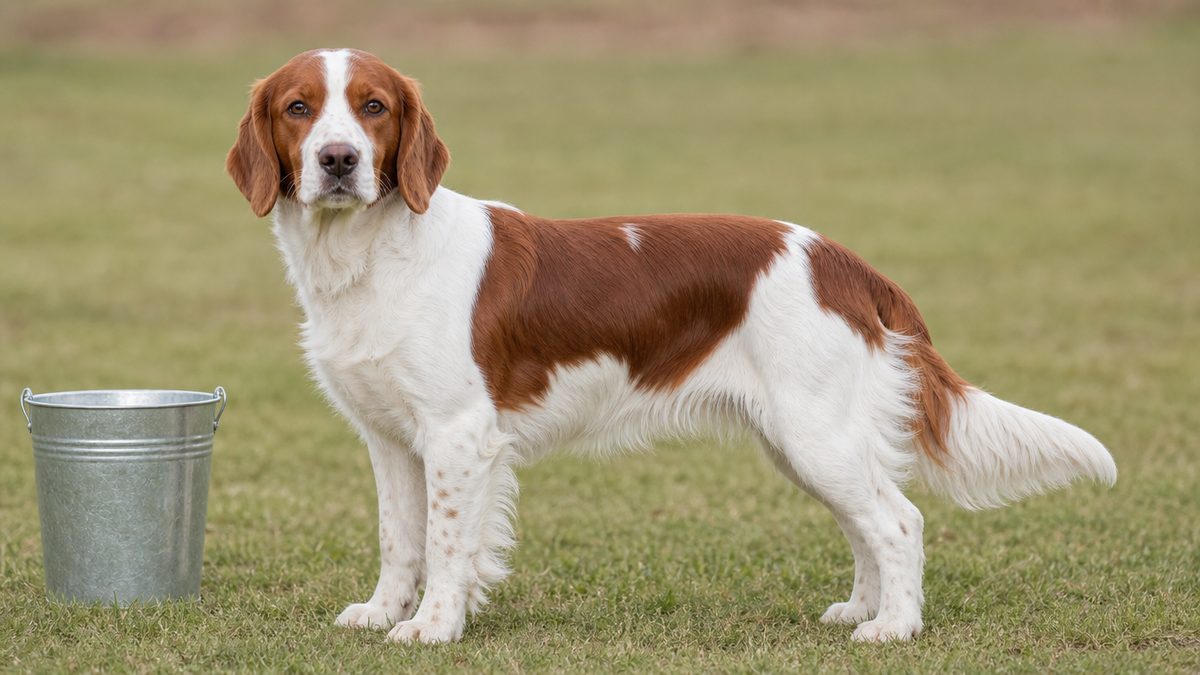
A Welsh Springer Spaniel is a compact, symmetrical Welsh gundog standing approximately 48 cm at the withers for dogs and 46 cm for bitches, carrying a straight or flat, dense, silky coat in one permitted colour, rich red and white. The Kennel Club recognised it in 1902 and files it in the Gundog group as Spaniel (Welsh Springer).
The standard, last updated on 1 January 2025, opens with a general appearance of symmetrical, compact, not leggy, obviously built for endurance and hard work. Quick and active mover, displaying plenty of push and drive. Under Characteristics it says something no other spaniel standard says: very ancient and distinct breed of pure origin. Strong, merry and very active.
| Point | Royal Kennel Club (UK) | American Kennel Club (US) |
|---|---|---|
| Height, dogs | Approximately 48 cm (19 in) | 45.7 to 48.3 cm, printed as 18 to 19 inches |
| Height, bitches | Approximately 46 cm (18 in) | 43.2 to 45.7 cm, printed as 17 to 18 inches |
| Weight | Not given at all | 18.1 to 24.9 kg males, 15.9 to 22.7 kg females |
| Colour | Rich red and white only. Any other colour unacceptable | Red & White, registration code 146 |
| Coat | Straight or flat, silky texture, dense. Never wiry or wavy; curly highly undesirable | A waterproof, weatherproof and thornproof suit |
| Ears | Set moderately low, close to cheeks, comparatively small, narrowing to a vine-leaf tip | Not specified on the breed page |
| Temperament | Kindly disposition. Never nervous | Tends to be reserved with strangers |
| Life expectancy | Over 10 years | 12 to 15 years |
| Recognised | 1902 | 1914 |
The ear clause is the one to read twice
This breed has the smallest ears of any British spaniel, and the standard says so in unusual detail. Under Ears: set moderately low and hanging close to cheeks, comparatively small and gradually narrowing towards tip and shaped somewhat like a vine leaf. Compare that with the Sussex Spaniel's thick, fairly large and lobular, or with the long heavily feathered leathers of the Cockers.
Hold that sentence, because the strongest evidence about this breed's commonest health problem contradicts what you would predict from it, and that contradiction is the most interesting thing on this page.
Two registries, two temperaments
The Kennel Club's temperament clause reads kindly disposition. Never nervous. Showing aggression unacceptable. The American Kennel Club's care page says the Welsh Springer tends to be reserved with strangers, and attributes that phrase to the breed standard, adding that early socialisation and puppy training classes are essential.
Both are quoting a breed standard. They are quoting different breed standards, because the AKC and the Kennel Club each maintain their own. Neither is wrong and no page reconciles them. Plan for reserved and be pleased if you get kindly.
One weight figure, four sources, and only one of them is a standard
The Kennel Club standard specifies no weight for this breed at all, only approximate heights. The American Kennel Club gives 40 to 55 pounds for males and 35 to 50 for females. Google's own knowledge panel, sourced to a retailer rather than a registry, gives 18 to 25 kg for males and 16 to 20 kg for females. The registry that defines the breed declines to answer the question that every aggregator answers confidently.
The standard carries both a docked and an undocked description, because the breed was previously customarily docked. In India only one of those applies. Second Schedule Part II paragraph 6(8) of the Prevention of Cruelty to Animals (Dog Breeding and Marketing) Rules 2017 states that there shall be no tail docking, ear cropping, de-barking, de-clawing, branding, dyeing or any other kind of mutilation of any body part of the pup, and that any change of appearance by artificial means is strictly forbidden. The lawful Indian dog is the undocked one: well set on and low, never carried above the level of the back, feathered, and in balance with the rest of the dog.
How rare the Welsh Springer Spaniel is, and which Kennel Club list it is on
The Kennel Club registered 213 Welsh Springer Spaniels in 2025 and lists the breed as a vulnerable native breed. That is the list for breeds under 300 registrations a year, not the at watch list, which covers 300 to 450. The distinction matters because the breed sat at 299 in 2016 and 362 in 2017, straddling the boundary.
The Kennel Club maintains two bands and they are routinely confused. Vulnerable means fewer than 300 registrations a year. At watch means between 300 and 450. The 2025 table holds 39 breeds in the vulnerable block and 8 in a separate at watch block below it, and the Welsh Springer Spaniel sits in the first.
| 2016 | 2017 | 2018 | 2019 | 2020 | 2021 | 2022 | 2023 | 2024 | 2025 |
|---|---|---|---|---|---|---|---|---|---|
| 299 | 362 | 330 | 243 | 205 | 271 | 238 | 167 | 174 | 213 |
Read that row and the band boundary does real work. In 2017 and 2018 this breed registered 362 and 330 puppies, which is squarely in the at watch band. In 2019 it fell to 243 and it has stayed below 300 in every year since. A page written in 2018 describing the Welsh Springer as at watch would have been correct then and is wrong now, and a page written today calling it at watch has simply not checked.
The recent direction is mildly encouraging. The breed bottomed at 167 in 2023 and has recovered to 174 and then 213, which is the only upward two-year run on this table for any of the six native spaniels.
The most numerous of the six vulnerable native spaniels
| Breed | 2025 | 2016 | Change |
|---|---|---|---|
| Spaniel (Welsh Springer) | 213 | 299 | down 29 percent |
| Spaniel (Clumber) | 160 | 171 | down 6 percent |
| King Charles Spaniel | 56 | 84 | down 33 percent |
| Spaniel (Field) | 48 | 80 | down 40 percent |
| Spaniel (Irish Water) | 40 | 116 | down 66 percent |
| Spaniel (Sussex) | 15 | 49 | down 69 percent |
Being the most numerous vulnerable spaniel is not the same as being available. Two hundred and thirteen puppies is the annual output of the entire United Kingdom, and Indian law rejects any import application made for trading or breeding purposes.
The Royal Kennel Club's per-breed page prints a Vulnerable native breed field, and this breed's reads Yes. That field is known to contradict the club's own vulnerable-breeds table for some breeds, so the table is the document to trust. Here the two agree, which is worth stating, because a warning about a source becoming a bias is how a check turns into an error.
History, and a red-and-white dog older than the Kennel Club
The Welsh Springer Spaniel descends from a red and white Welsh hunting dog chronicled in Welsh literature in the Middle Ages, was once simply called the Welsh Spaniel, and was recognised by the Kennel Club in 1902. Its own standard calls it a very ancient and distinct breed of pure origin.
The registry's account is short and specific. The Royal Kennel Club records that the red and white Welsh hunting dog was chronicled in Welsh literature in the Middle Ages and is thought to have provided the ancestry for the Welsh Springer Spaniel, that the breed comes only in this colour, and that at one time it was simply called a Welsh Spaniel.
It adds a detail that most breed pages miss: one of these red and white spaniels played a part in establishing the parti-coloured cocker spaniel. The dog that most Indian buyers will actually meet, a parti-coloured Cocker, owes part of its existence to this one.
Why the breed standard says pure origin
The Characteristics clause opens very ancient and distinct breed of pure origin. That is unusual phrasing for a breed standard, which normally describes a dog rather than asserting its ancestry, and it reflects the breed community's long-standing position that the Welsh Springer is not an English Springer variant.
The registries agree on that, whatever else they disagree on. The American Kennel Club calls the Welshie among Britain's oldest sporting breeds and describes it as of handy size, bigger and stronger than Cocker Spaniels but smaller than English Springers, with two hallmarks distinguishing it from other spaniels: a uniquely tapered head and a bold red and white coat.
The colour is the breed's whole identity, and the standard enforces it
Rich red and white only, followed by a separate emphasised line: any other colour or combination of colours unacceptable. The Royal Kennel Club files the breed at Colour Watch Category 0, meaning there are no non-breed-standard colour registration options at all. A liver-and-white, black-and-white or tricolour dog offered as a Welsh Springer is an English Springer or a cross.
What the registries do NOT flag
Both bodies are notably calm about this breed. The Royal Kennel Club places it at Breed Watch Category 1, meaning no points of concern specific to the breed have been identified for special attention by judges beyond what the standard already covers, and it applies no breed-specific breeding restrictions. English Wikipedia's lead notes only that the breed is rarer than the more widely known English Springer Spaniel.
That is a genuinely good conformation record for a working spaniel, and it deserves saying as clearly as the health numbers later on this page. The problems this breed does have are internal, and none of them shows in the ring.
The club's Good Practice screening list, the tier it describes as conditions that evidence indicates are a significant concern in the breed, holds exactly two items: prioritising genetic diversity, and eye testing including gonioscopy for PLA using the BVA, Kennel Club and ISDS Eye Scheme. Hip testing sits one tier down as Best Practice. For most breeds gonioscopy is not mentioned at all, so its promotion here is the registry pointing directly at the finding in this page's eye section.
Welsh Springer Spaniel price in India, and why every figure on page one is foreign
No verifiable Welsh Springer Spaniel price in India exists. No Indian listing site carries the breed, the top Indian search result for the price query is a page about the Cocker Spaniel, and the only Indian rupee band comes from a site that gives this dog the same food line as two unrelated breeds. Published foreign prices disagree by roughly a factor of eight.
Eight routes were probed on 8 September 2026 and the pattern is cleaner than for most rare breeds: there is simply no Indian commerce in this dog at all. Petbuy.in does not carry the breed and answers HTTP 404, while Purina India runs a genuine, India-localised breed page for the dog and quotes no price on it, which is the behaviour of a company that sells food rather than puppies.
| Route | Response | What the page actually contains |
|---|---|---|
| petbuy.in | HTTP 404 | No page for the breed at all |
| mrnmrspet.com | HTTP 200, then redirected | Lands on /404-page-not-found. Its ENGLISH Springer page is real and ranks for this query |
| puppiezo.com | HTTP 200 | Carousel prices only Maltipoo, Poodle, Rottweiler, Cane Corso, Doxiepoo and Goldendoodle |
| poodles.in | HTTP 200 | Rs 30,000 to Rs 60,000, on a cost table shared with two unrelated breeds |
| purina.in | HTTP 200 | A genuine Indian breed page for the dog, carrying no rupee figure |
| amazon.in | HTTP 200 | A book about the breed at Rs 2,358, ranked position 7 for the price query |
| dogbreedslist.info | HTTP 200 | USD 2,000 to 2,500, and no rupee figure |
| gooddog.com | HTTP 200 | A price range printed as USD 2,500 to USD 2,500 |
The Indian carousel again, on a second breed page
Puppiezo serves a page titled Buy Welsh Springer Spaniel Puppies Online in India, Verified Sellers. Read on 8 September 2026 its served HTML carries the figures 98,999 three times, 92,599 twice, 76,499 once and 1,20,000 once, and the only product categories its carousel links to are cane-corso, doxiepoo, goldendoodle, maltipoo, poodle and rottweiler.
Those are the same eight animals and the same four prices that appear on the same site's Sussex Spaniel page. Rs 98,999 is a house price point attached to whatever puppy is in stock, not a breed price, and no spaniel of any kind appears in the carousel on a page selling a spaniel.
Published foreign prices, and how far apart they are
| Source | Published price | At 84.38 to the dollar or 106 to the pound |
|---|---|---|
| Pooch & Mutt (UK) | GBP 350 to 1,000 | Roughly Rs 37,100 to Rs 1,06,000 |
| Lancaster Puppies (US) | USD 1,000 to 1,900 | Rs 84,380 to Rs 1,60,322 |
| Dogbreedslist (US) | USD 2,000 to 2,500 | Rs 1,68,760 to Rs 2,10,950 |
| Dogbreedslist, breeder range | USD 1,500 to 3,500 | Rs 1,26,570 to Rs 2,95,330 |
| Good Dog (US) | USD 2,500 to USD 2,500 | Rs 2,10,950, twice |
| Any Indian source | None published | Not applicable |
The spread is roughly eight to one from the bottom of the British band to the top of the American breeder range. Good Dog's entry is worth noting for a different reason: it prints a range whose two endpoints are identical, which is what a template produces when it has one data point and a field expecting two. None of these conversions is an Indian price, and each is arithmetic performed here and labelled as such.
The one Indian rupee band, and why it is not evidence
Poodles.in gives Rs 30,000 to Rs 60,000. Neither figure divides cleanly at 84.38 or 74, and both divide at 80 only because round rupee numbers ending in three zeros always do, so the division tests are uninformative here by construction. What settles it is the same-site control: the identical template gives the Welsh Terrier Rs 30,000 to Rs 70,000 and the Sussex Spaniel Rs 50,000 to Rs 1,00,000 while printing overlapping preset cost lines for all three.
The number one Indian result for the query welsh springer spaniel price in india is a Supertails article about the Cocker Spaniel, and the number three result is Mr n Mrs Pet's page for the English Springer Spaniel. Position seven is a book on Amazon.in at Rs 2,358. When a search engine cannot find a single Indian page about the dog you asked for and substitutes two other breeds and a book, that is the market answering the question.
Monthly cost of ownership in India, built from figures you can check
Bonbeno publishes no single monthly cost figure for a Welsh Springer Spaniel, because the one Indian page that does gives this breed the same food line it gives a Welsh Terrier eating 700 calories a day. What is real is the component cost of keeping a 20 kg working gundog in an Indian city, and each line below was read live from the provider's own page on 8 September 2026.
The usual number is worthless and the site's own text proves it. Poodles.in gives the Welsh Springer Spaniel a monthly total of Rs 3,550 to Rs 5,400, built from food Rs 2,250 to 3,000, grooming Rs 700 to 1,200 and health Rs 600 to 1,200. The components sum exactly: 2,250 plus 700 plus 600 is 3,550, and 3,000 plus 1,200 plus 1,200 is 5,400.
Then check the food line against two other breeds on the same site. The Sussex Spaniel gets the identical Rs 2,250 to Rs 3,000 food line inside a different total of Rs 4,650 to Rs 6,600, and so does the Welsh Terrier. The three pages state feeding requirements of 1,200 to 1,300 calories a day for the Welsh Springer, about 1,000 for the Sussex and about 700 for the Welsh Terrier, and give all three the same food cost. One food figure spanning a 600-calorie range across three breeds and two different monthly totals is a preset, not an observation.
What the components actually cost, read live
| Line | Figure | Source and caveat |
|---|---|---|
| Puppy vaccination course | From Rs 6,499 | Vetic national page, against a struck-through Rs 8,111 |
| Annual booster | From Rs 3,199 | Vetic, against a struck-through Rs 3,806 |
| Anti-rabies, single | Rs 699 | Vetic |
| 9-in-1 (DHPPiL), single | Rs 899 | Vetic |
| Kennel cough | Rs 1,349 | Vetic. Relevant if the dog boards |
| Tick and flea plus worming | Rs 1,103 a month | NexGard Spectra 15-30 kg, 3 tablets Rs 3,308, MRP Rs 3,375 |
| Bath, 60 minutes | From Rs 934 | Vetic Delhi, list price Rs 1,099 |
| Full groom and styling | From Rs 1,869 | Vetic Delhi, list price Rs 2,199 |
| Boarding, 24 hours | Rs 899 | PawSpace Bengaluru, plus 25 to 30 percent in festive season |
| Daycare, up to 10 hours | Rs 799 | PawSpace Bengaluru. The line this breed will actually use |
One line in that table deserves its own note: NexGard Spectra for the 15 to 30 kg band is three tablets at Rs 3,308 against an MRP of Rs 3,375, which is Rs 1,102.67 per monthly dose and covers the tick and flea role and the roundworm and hookworm role in one product. Two further caveats belong with that table. Vetic quotes different course prices on different city pages on the same day, so these are its national figures and a Mumbai reader should expect more. And boarding matters more for this breed than for most, because a dog needing more than two hours of exercise a day is not one you leave with a neighbour.
What this breed adds on top
- Gonioscopy, which is not a routine eye test. The Kennel Club puts eye testing including gonioscopy for PLA in this breed's Good Practice tier, above hip testing. It needs a veterinary ophthalmologist rather than a general practice, and in India that means a referral in a metro.
- A thyroid panel, which the American parent club lists among its four recommended tests. OFA ranks the breed 13th of 130 for thyroid disease, so this is not a generic wellness add-on.
- Ear care as a standing line rather than an occasional one, given the highest measured otitis prevalence of any breed in the Finnish survey.
- Daycare or a dog walker, honestly budgeted. Two hours a day in a country where the usable hours are before 8 am and after 7 pm is the single most likely commitment to fail.
Compare the component lines to the rupee against one unrelated breed on the same site. If food, grooming or health match exactly, you are reading a preset. On poodles.in the food line is identical across a 1,300-calorie gundog, a 1,000-calorie spaniel and a 700-calorie terrier, and the totals still differ, which tells you the rows are assembled from a small set of presets rather than costed per breed.
Heat tolerance in India, and the claim that this coat works in all climates
A Welsh Springer Spaniel can live in India and its exercise requirement cannot. Its homeland cell in south Wales returns an annual mean of 10.79 C and a hottest month of 16.29 C against Chennai's 27.95 C annual mean, and the American Kennel Club's claim that its coat suits it to all climates is the one assertion on this page worth testing directly.
The AKC's wording is specific: the coat is a waterproof, weatherproof, and thornproof suit that enables Welshies to show off their renowned versatility in all climates and on all terrains. The Kennel Club's standard describes the same coat as straight or flat, silky texture, dense, never wiry or wavy. Dense is the operative word, and it mentions no undercoat, which is one advantage this breed has over the Sussex Spaniel.
The homeland, by explicit latitude and longitude
Neath in south Wales, queried at 51.6600 N, 3.8060 W for the 2001 to 2020 climatology, returns a grid cell at 68.82 m against a real elevation near 20 m. That is an error of about 49 m, small enough to use. A second Welsh point, Carmarthen, returns a cell at 149.77 m against a real 20 m, an error of about 130 m, and is therefore not used here; naming which point was rejected and why is part of the check.
| Place | Annual mean T2M | Hottest month | Annual relative humidity | Peak wet bulb |
|---|---|---|---|---|
| Neath, south Wales | 10.79 C | 16.29 C (August) | 86.86 percent | 14.54 C (August) |
| Bengaluru | 23.74 C | 28.37 C (April) | 67.94 percent | 21.86 C (May) |
| Pune | 23.86 C | 28.93 C (April) | 66.80 percent | 22.97 C (June) |
| Delhi | 25.60 C | 35.88 C (June) | 45.56 percent | 26.50 C (July) |
| Kolkata | 25.81 C | 31.53 C (May) | 73.93 percent | 27.09 C (June) |
| Mumbai | 26.77 C | 31.19 C (May) | 67.39 percent | 25.77 C (June) |
| Chennai | 27.95 C | 31.51 C (May) | 72.39 percent | 26.11 C (May) |
The humidity claim is backwards, and the numbers say so
South Wales is more humid than any Indian city on this page. Neath runs 86.86 percent annual relative humidity, and never drops below 83.4 percent in any month; Chennai runs 72.39, Kolkata 73.93, Mumbai 67.39 and Delhi 45.56. A page warning you that Indian humidity will ruin a Welsh dog has it inverted. This breed comes from one of the dampest places in Europe.
What it has never met is heat. Neath's hottest month averages 16.29 C. Its peak wet bulb is 14.54 C in August, against 27.09 C in Kolkata, 26.50 C in Delhi and 26.11 C in Chennai. That is a 12 to 13 degree wet-bulb gap, and it is the largest in this batch of six breeds.
So is the AKC wrong about all climates?
Not exactly, and the distinction matters. A coat that sheds water and resists thorns is genuinely versatile across the temperate range, which is what a Welsh or American gundog writer means by all climates. What the sentence does not survive is a country where the mean annual temperature is 17 degrees warmer than the homeland and where the breed's own two-hour exercise requirement has to be met.
The heat-illness evidence makes that precise. Of the 1,259 heat-related illness events recorded across 905,543 UK dogs in 2016, 879 had a recorded trigger, and 652 of those 879, or 74.2 percent, were exertional. Environmental heat accounted for 113 and hot cars for 46. For a breed the registry files at more than two hours of daily exercise, the exertional category is the one that applies.
Neither Hall paper models the Welsh Springer Spaniel by name, and it is nowhere near the over-50 kg band carrying an odds ratio of 3.42. What transfers honestly is the bodyweight factor, odds ratio 1.42 for dogs at or above their breed and sex mean, and the exertional finding.
Second Schedule Part IV paragraph 21(1) of the Dog Breeding and Marketing Rules 2017 bars keeping certain dogs in outdoor facilities without the attending veterinary practitioner's written approval, and names dogs not accustomed to local temperatures and breeds that cannot tolerate them, such as long-haired breeds in high temperature locations. Note the citation form: the Rules themselves stop at Rule 13 and the string Rule 21 appears nowhere in the gazette.
The practical schedule
- Bengaluru and Pune are the two workable cities, at peak wet bulbs of 21.86 and 22.97 C and hottest months in April rather than May. Two hours a day is achievable across two sessions for most of the year.
- Mumbai and Chennai need air conditioning and a hard rule, because the coastal night never cools enough for a working dog to recover in.
- Delhi is the extreme case, at 35.88 C in June and a July wet bulb of 26.50 C when the monsoon arrives on top of the heat.
- Kolkata carries the highest wet-bulb load measured here at 27.09 C in June. Treat summer exertion as a veterinary risk rather than a fitness question.
The smallest spaniel ears and the highest ear-disease rate, and why that is not a contradiction
The Welsh Springer Spaniel has the smallest ears of any British spaniel and the highest measured otitis externa prevalence of any breed in the largest clinical survey of the problem. That combination breaks the usual explanation, and it is the single most useful thing an Indian owner of this breed can know.
Start with what the standard actually says, because it is the opposite of what you would expect. Ears: set moderately low and hanging close to cheeks. Comparatively small and gradually narrowing towards tip and shaped somewhat like a vine leaf. Lightly feathered, per the Coat clause. That is a smaller, thinner, more tapered ear leather than the Sussex Spaniel's thick lobular one or the Cockers' long heavily feathered ones.
The survey, and the finding that is hidden by its own title
Kaimio and colleagues reviewed the 2010 medical records of 55 private veterinary clinics in Finland, covering 98,736 dogs, to compare otitis externa across four spaniels. The paper is titled as a survey of American Cocker Spaniels. Its result was that the highest prevalence belonged to a different breed.
| Breed | Affected of total | Prevalence | 95 percent CI | Ear size in its own standard |
|---|---|---|---|---|
| Welsh Springer Spaniel | 149 of 468 | 31.8 percent | 27.6 to 36.0 | Comparatively small, vine-leaf shaped |
| American Cocker Spaniel | 89 of 329 | 27.0 percent | 22.2 to 31.7 | Long, extremely feathered |
| English Springer Spaniel | 96 of 491 | 19.6 percent | 16.1 to 23.1 | Long and wide |
| English Cocker Spaniel | 231 of 1,467 | 15.7 percent | 13.8 to 17.6 | Long, well feathered |
Every percentage above reproduces from its own counts, which is the first thing to check on a table of this shape. The rank order is the exact inverse of ear size, and the paper's own conclusion states plainly that the highest prevalence of otitis externa was found in Welsh Springer Spaniels.
What that means, honestly
It means the long-floppy-ears explanation is at best incomplete. Ear conformation is one factor among several, and the others (canal shape, skin type, allergy load, coat inside the canal) are not visible from outside the dog. The practical consequence for an Indian owner is the important part: you cannot look at this breed's small neat ears and conclude it is low risk. The measured evidence says the opposite.
One honest limit. This is a single-country, single-year clinical dataset of 468 Welsh Springer Spaniels, and clinical records over-represent dogs that came in with a problem. It is still by a distance the largest and best-controlled comparison available, and no Indian equivalent exists for any spaniel.
The age finding, which is the actionable one
Among the American Cockers surveyed, 46 percent of 72 showed their first signs of otitis before one year of age, and early onset raised the odds of end-stage disease by 3.8 times, with a 95 percent confidence interval of 1.1 to 13.6. Sixteen percent of 85 affected dogs eventually needed surgery or were euthanised. That finding is about American Cockers rather than Welsh Springers, and it is quoted because it is about timing rather than about breed, and timing transfers.
What to actually do, in an Indian monsoon
- Dry the ears actively after every bath, swim and wet walk. Overseas gundog guidance saying to towel a dog and let it air dry is written for a cool dry climate and does not transfer to a Mumbai August at 90 percent ambient humidity.
- Clean weekly with a veterinary ear cleaner, before there is a smell rather than after.
- Treat the first-year ear infection as urgent. The Finnish data ties early onset to end-stage disease.
- Ask your vet to look in the canal at every visit, not just when there is a complaint. Recurrent otitis in a spaniel is managed rather than cured, and the management works best before surgery is on the table.
- Check the ear leather for ticks at every brush, given the Indian tick-borne disease pressure.
Indian clinic studies find heavy tick-borne disease burdens: Ehrlichia canis in 56 of 178 dogs tested in Odisha, 31.46 percent, with 79 percent of infected dogs having a tick history; Babesia in 80 of 120 dogs tested in Kerala, 66.7 percent, peaking pre-monsoon in March to May; and in West Bengal, 72.9 percent of the 584 dogs screened carried two or more pathogens. These sampled clinically suspected dogs at veterinary clinics rather than random populations, so read them as pressure rather than as a population rate.
Pectinate ligament dysplasia, the screening question that defines this breed
Gonioscopy of 227 Welsh Springer Spaniels found 139 of them, 61.2 percent, affected by pectinate ligament dysplasia, with 82 of 227 moderately or severely affected. It is the precursor lesion for primary closed-angle glaucoma, it cannot be seen without a gonioscope, and it is why the Kennel Club puts gonioscopy in this breed's Good Practice screening tier.
Most breed pages list this breed's eye disorders as a bullet, and English Wikipedia gives them a dedicated subsection headed exactly that. This one has a dedicated prospective study, and the numbers deserve to be read rather than summarised.
Oliver, Ekiri and Mellersh performed gonioscopy in both eyes of 227 Welsh Springer Spaniels and measured intraocular pressure by rebound tonometry. Eyes were graded 0 for unaffected, 1 for under 20 percent of the iridocorneal angle affected, 2 for 20 to 90 percent and 3 for over 90 percent.
| Finding | Count | Proportion |
|---|---|---|
| Affected at grades 1 to 3 | 139 of 227 | 61.2 percent |
| Moderately or severely affected, grades 2 to 3 | 82 of 227 | 36.2 percent as printed, 36.1 by division |
| Showed progression on re-examination | 35 of 65 | 53.8 percent |
| Association with age | Significant | The lesion is not static |
| Association with intraocular pressure | None found | So pressure is not a screening substitute |
| Association with sex | None found | Applies equally to dogs and bitches |
One arithmetic note, made here rather than hidden. The paper prints 36.2 percent for 82 of 227; 82 divided by 227 is 36.1 percent. The gap is a rounding artefact rather than an error of substance, and the count is quoted alongside the percentage so a reader can check it. The 61.2 and 53.8 figures both reproduce exactly.
The two conclusions that matter to an owner
The lesion progresses. Fifty-three point eight percent of the sixty-five dogs re-examined got worse, and the authors state directly that dogs deemed unaffected at an early age may subsequently be diagnosed with pectinate ligament dysplasia. A clear gonioscopy at eighteen months is not a clearance for life, which is a materially different message from the one-and-done framing most screening advice uses.
Screening has not fixed it. The authors' own clinical significance statement reads that prevalence of pectinate ligament dysplasia was high despite widespread screening and selection against the condition. That is an unusually candid sentence for a breed-health paper and it should not be softened.
Why the Kennel Club promoted gonioscopy for this breed
The Royal Kennel Club splits its screening advice into two tiers. Good Practice is the tier it describes as conditions where evidence indicates a significant concern in the breed; Best Practice is one rung below. For the Welsh Springer Spaniel, Good Practice holds prioritising genetic diversity and eye testing, and gonioscopy for PLA, using the BVA, Kennel Club and ISDS Eye Scheme, while hip testing sits in Best Practice.
For most breeds gonioscopy is not mentioned at all. Its appearance in the top tier here is the registry pointing at Oliver and colleagues' finding, and it is the single clearest signal on the Kennel Club's page about what this breed's real problem is.
One methodological caution from the same research group is worth carrying: gonioscopy grading has measurable inter-examiner variability, which is exactly why a formal scheme with trained panellists exists rather than a general-practice eye check.
What OFA's American data adds, and where it contradicts itself
OFA's eye summary for the breed reports 97.6 percent normal of 1,681 evaluations, ranking 198th. Its per-diagnosis detail rows, on a denominator of 1,679, report 873 dogs normal, which is 52.0 percent. That is a gap of 45.6 points, the second widest instance of this contradiction Bonbeno has recorded, behind the Neapolitan Mastiff's 65.3 points, and neither figure should be quoted as the breed's eye rate. The gap is a property of how OFA builds these two tables rather than a finding about this breed.
What the detail rows do give is a usable list of what actually gets recorded in a large American cohort.
| Finding | Affected | Percent |
|---|---|---|
| Normal | 873 | 52.0 |
| Persistent pupillary membranes, iris to iris | 450 | 26.8 |
| Distichiasis | 278 | 16.6 |
| Cataract, significance unknown | 82 | 4.9 |
| Corneal dystrophy, epithelial or stromal | 39 | 2.3 |
| Punctate cataract, anterior cortex | 39 | 2.3 |
| Entropion | 36 | 2.1 |
Distichiasis and entropion are both named in Indian law's own list of genetic defects a breeding dog must have been tested for, under Second Schedule Part III paragraph 8(10). Hereditary cataract in this breed was first described more than forty years ago.
Primary closed-angle glaucoma is what pectinate ligament dysplasia predisposes to, and it destroys vision in hours rather than days. A suddenly painful, red, cloudy eye with a dilated pupil in a Welsh Springer Spaniel is an emergency: go to a vet immediately rather than waiting for a morning appointment. Consult your nearby vet, and say the words pectinate ligament dysplasia, because it changes what they look for.
Health issues beyond the eyes, and what the screening numbers say
Outside the eyes this is a robust breed. OFA records 10.7 percent hip dysplasia of 3,043 evaluations and 1.4 percent elbow abnormality of 1,593, both close to or better than the all-breed picture. The one that deserves attention is the thyroid, where the breed ranks 13th worst of 130.
OFA's breed code for this dog was read out of OFA's own markup rather than guessed, because WS sits one character from WSD, the Welsh Sheepdog, and WT, the Welsh Terrier. The American parent club's recommended screening list is four items and it is worth quoting because it is unusually complete: Hip Evaluation, Elbow Evaluation, Ophthalmologist Evaluation and Thyroid Evaluation. Compare that with the Sussex Spaniel's entry on the same site, which reads no recommended health tests.
| Screen | Evaluations | Result | Rank | All breeds |
|---|---|---|---|---|
| Hip dysplasia | 3,043 | 10.7 percent dysplastic | 125th of 222 | 14.2 percent of 1,713,372 |
| Elbow dysplasia | 1,593 | 1.4 percent abnormal | 134th | not comparable |
| Thyroid | 1,633 | 78.8 percent normal | 13th of 130 | 84.8 percent of 121,582 |
| Eyes, summary line | 1,681 | 97.6 percent normal | 198th | not comparable |
| Eyes, detail rows | 1,679 | 873 normal, 52.0 percent | not ranked | not comparable |
| Congenital cardiac | 90 | 98.9 percent normal | 154th | not comparable |
The hips are genuinely good, and that is worth saying plainly
At 10.7 percent dysplastic across 3,043 evaluations, this breed is better than the all-breed average of 14.2 percent. Its normal grades break down as 20.0 percent excellent, 59.5 percent good and 8.7 percent fair. Set beside the Sussex Spaniel at 38.1 percent and the Clumber at 38.8 percent, the Welsh Springer is in a different category of breed entirely on this axis, and it is the reason its Kennel Club hip recommendation sits in Best Practice rather than Good Practice.
Elbows are better still: 98.5 percent normal of 1,593 evaluations, with only 1.3 percent at Grade 1, 0.1 percent at Grade 2 and none at Grade 3.
The thyroid is the one to test
OFA ranks the Welsh Springer Spaniel 13th of 130 breeds in its thyroid table, on 1,633 evaluations. The breakdown is 78.8 percent normal, 0.4 percent autoimmune thyroiditis, 8.5 percent compensative autoimmune thyroiditis, 0.7 percent idiopathic hypothyroidism and 11.6 percent equivocal. The all-breed figures across 121,582 evaluations are 84.8 percent normal and 4.5 percent compensative autoimmune thyroiditis.
That is roughly 1.9 times the all-breed rate of the commonest finding, and it lines up exactly with the American parent club listing a thyroid evaluation among its four recommended tests. The five thyroid categories sum to 100.0 percent, which is the arithmetic check on the row.
The rest of the literature, which is thin and specific
The breed's PubMed footprint is eleven distinct records across the singular and plural name forms, and most are single cases rather than prevalence work.
- Hereditary cataract, first described in the breed by Barnett in 1980. PubMed carries no abstract for that record, so no figure is attributed to it here.
- Intradural vasculitis and haemorrhage, reported in two full sibling Welsh Springer Spaniels, which is a case report rather than a prevalence estimate.
- Spermatogenic arrest with azoospermia, reported in two dogs in 1972 and relevant only to breeders.
- Breed distribution of risk variants, from a panel screening nearly 100 mutations across many breeds.
- Meningoencephalitis of unknown origin, a 2025 multicentre English referral study in which the breed appears; it is a study of the condition rather than of this dog.
Nothing here is a diagnosis. Two of this breed's characteristic problems are silent until they are advanced. Pectinate ligament dysplasia is found by gonioscopy and not by looking at the eye, and compensative autoimmune thyroiditis is found on a blood panel and not by watching the coat. Ask a registered veterinary practitioner for both by name rather than assuming a general health check covers them.
Life expectancy, and one of the strongest longevity results in the study
The Welsh Springer Spaniel reached a median survival of 14.0 years in the largest UK longevity study, with a 95 percent confidence interval of 13.3 to 14.3 and a hazard ratio of 0.60 against the crossbred baseline at p below 0.001. Unlike most breed longevity claims, this one is statistically significant.
McMillan and colleagues' 2024 study in Scientific Reports is the strongest instrument available, and this breed has a substantial row in it. Table S3 gives 572 dogs, 162 deaths, median survival 14.0 years (13.3 to 14.3), hazard ratio 0.6 (0.51, 0.7), p less than 0.001. Table S5 confirms inclusion, flagged Y with no phylogeny reclassification, so this is the breed's own figure and not a merged one.
The significance is the part worth dwelling on. Many breed medians in that paper rest on small samples and wide intervals that cross the null; this one does not. A hazard ratio of 0.60 at p below 0.001 on 162 deaths is a real finding: Welsh Springer Spaniels in that UK population died at roughly 60 percent the rate of crossbred dogs of the same age.
The paper disagrees with itself about the sample size
Table S3 gives 572 dogs; Table S6 gives 375 alive, 162 deceased and 537 total McMillan et al. 2024. The death count is identical in both at 162. Bonbeno has found this pattern across many breeds, always with deaths agreeing and totals differing, so the rule is to build the sentence on the death count and the median with its interval, and to name the disagreement rather than averaging it.
| Source | Figure | Basis |
|---|---|---|
| McMillan et al. 2024, Table S3 | 14.0 years median (13.3 to 14.3) | 162 deaths, UK, significant at p below 0.001 |
| American Kennel Club | 12 to 15 years | Breed page, basis not stated |
| Google knowledge panel | 12 to 15 years | Attributed to a retailer |
| The Royal Kennel Club | Over 10 years | A band rather than a figure |
For once the sources broadly agree, and the study median of 14.0 sits comfortably inside the 12 to 15 band that the aggregators publish. That is unusual on this site and it deserves to be said as clearly as a disagreement would be.
Where the longevity comes from, and where it does not
The obvious candidates are the ones the screening data supports: low hip dysplasia at 10.7 percent, very low elbow disease at 1.4 percent, and a conformation the Kennel Club places at Breed Watch Category 1 with no points of concern for judges The Royal Kennel Club. The breed's characteristic problems, ear disease and pectinate ligament dysplasia, are painful and sight-threatening rather than usually fatal, which fits a long median.
What this figure does not describe is an Indian dog. These are UK survival data from a country whose annual mean is 10.79 C at the breed's own homeland, with year-round veterinary access and none of the tick-borne disease pressure Indian clinic studies record. No Indian lifespan study of this breed exists, and the companion UK life-table work covers the national dog population rather than this breed.
McMillan and colleagues issued an Author Correction in April 2024 that changes exactly one value, a Miniature Dachshund median in a figure legend, and touches no supplementary table. Reading Table S3 directly, as this page does, avoids it entirely.
Temperament and household fit, and the disagreement between two registries
A Welsh Springer Spaniel is merry, affectionate and intensely attached to its household. The Kennel Club's standard says kindly disposition and never nervous; the American Kennel Club says the breed tends to be reserved with strangers. Both are quoting a breed standard, and they are quoting different ones.
The Kennel Club's temperament clause reads in full: kindly disposition. Never nervous. Showing aggression unacceptable. Its Characteristics clause adds strong, merry and very active. The American Kennel Club describes a vigorous, medium-sized bird dog of happy disposition, known for versatility in the field and companionability at home.
Then the AKC's training paragraph says something the British standard does not: the Welsh Springer tends to be reserved with strangers, to quote the breed standard, adding that this should not be taken to mean the dog is timid or shy, and that early socialisation and puppy training classes are essential.
Neither body is wrong. They maintain separate standards. For an Indian buyer the practical reading is to plan for a dog that needs deliberate socialisation with visitors, delivery riders and building staff, and to be pleased if you end up with the kindlier version.
The attachment is the defining trait, and it cuts both ways
Every description of this breed converges on the same thing: it bonds hard. That produces a dog that is genuinely delightful to live with and a dog that copes badly with being left. In an Indian household where both adults work full days outside the home, that is the single most likely source of trouble, ahead of climate and ahead of cost.
Who this breed genuinely suits in India
- A household with somebody home most of the day, or a real daycare budget at roughly Rs 799 for up to ten hours in Bengaluru.
- An owner who will actually walk two hours a day, which is the Royal Kennel Club's own figure for the breed.
- Families with children, on both registries' descriptions, provided the dog gets its exercise first.
- Town or country. Unlike the Sussex Spaniel, which the Royal Kennel Club files as a country dog, the Welsh Springer is filed as suited to either.
- Not for a household away ten hours a day. This is the disqualifier.
- Not for an owner who wants a low-exercise spaniel. That description fits the Sussex, not this dog.
- Not for anyone who will skip the socialisation work, given the AKC's reserved-with-strangers framing.
- Not for a household with pet birds or small caged animals, given a working gundog's bred-in chase drive.
The Royal Kennel Club applies no breed-specific breeding restrictions to this breed and files it at Breed Watch Category 1, meaning no points of concern have been identified for special attention by judges. For a working spaniel with a long recorded history that is a good record, and it is worth weighing against the health sections above.
Training approach, and what this breed resists
Train a Welsh Springer Spaniel early, positively and around strangers. The American Kennel Club calls early socialisation and puppy training classes essential for a breed it describes as reserved with strangers, and notes that the chase drive for birds and small mammals has been bred in and will not be trained away.
This is a more biddable dog than the Sussex Spaniel and a less biddable one than a Labrador. The AKC's own summary is that the Welshie excels as a hunting companion and at canine sports such as obedience, tracking, agility and rally, which is a strong endorsement of trainability, immediately followed by the reserved-with-strangers caution and the instruction that a securely fenced yard is best.
Three priorities, in order
- Socialise the puppy to strangers from week eight. Indian urban life supplies an unusually high volume of unfamiliar people at the door. A breed described by its American standard as reserved needs that treated as a training goal rather than as a personality quirk.
- Recall before freedom. The chase drive is bred in and the breed is quick. Build recall on a long line, and never test it first in a park with crows.
- Settling and alone-time training. Start short absences at eight weeks and build them deliberately. This is the single highest-value piece of training for an Indian working household.
The Indian schedule problem
Most Indian training classes and most owner free time sit between 10 am and 6 pm. For eight months of the year that window is the wrong one for a dog needing two hours of physical work, because exertion accounted for 652 of the 879 UK heat-illness events with a recorded trigger. Do the mental work in the middle of the day on a cool floor and the physical work at dawn and after dark.
That split suits this breed well. It has a strong nose and the AKC lists tracking among the sports it excels at, so scent games, mantrailing setups and food puzzles genuinely tire it, and all of them can happen indoors in a Chennai May.
What to avoid
- Long lead walks as the only exercise. A dog described in its own standard as displaying plenty of push and drive is not satisfied by a slow loop.
- Skipping the fence. The AKC says a securely fenced yard is best, and an Indian building compound is not a fence.
- Training in the heat. See above.
- Assuming the dog will settle because it is affectionate indoors. It settles because it has been exercised.
A Welsh Springer Spaniel that becomes dull, gains weight without a change in feeding, or develops coat or skin changes needs a thyroid panel rather than a training plan. OFA ranks this breed 13th of 130 for thyroid disease, with compensative autoimmune thyroiditis at 8.5 percent against an all-breed 4.5 percent. Consult your nearby vet and ask for the panel by name.
Daily exercise requirement, and what happens without it
The Royal Kennel Club files the Welsh Springer Spaniel at more than two hours of exercise a day, and its own breed standard describes a dog built for endurance and hard work with plenty of push and drive. In India the whole problem is fitting that into the dark half of the day.
Two hours is the registry's own figure, sitting in the breed characteristics block beside a large-garden requirement. The standard backs it: symmetrical, compact, not leggy, obviously built for endurance and hard work. Quick and active mover, displaying plenty of push and drive.
What the exercise should be
- Off-lead running in a secure space, which is what the breed is for and what a lead walk cannot substitute for.
- Swimming where it is clean and safe. The breed is a water-tolerant gundog and swimming is the only high-intensity exercise that does not raise core temperature, which makes it uniquely valuable in an Indian summer. Dry the ears afterwards without exception.
- Scent and tracking work, which the AKC names among the sports the breed excels at and which can be done indoors on the hottest days.
- Play sessions with the family in a securely fenced yard, or long daily walks with the owner, which is the AKC's own prescription.
The Indian timetable, written out
| Season | Morning | Evening | Middle of the day |
|---|---|---|---|
| November to February | 60 to 75 minutes from 6.15 am | 45 to 60 minutes from 6 pm | Free in most cities |
| March to May | 75 minutes, finished by 7.30 am | 45 minutes, after 7.30 pm | Indoors only: scent work, puzzles |
| June to September | 60 minutes, watching wet-bulb load | 45 minutes after dark | Indoors, and dry the ears every time |
| October | 75 minutes from 6.15 am | 60 minutes from 6.30 pm | Shortening restriction |
Wet bulb is the number to watch in the monsoon. Kolkata peaks at 27.09 C wet bulb in June and Delhi at 26.50 C in July, against 14.54 C in the breed's own homeland. A 30 C afternoon in a Kolkata July is a materially harder workload than a 35 C afternoon in a dry Delhi May, and a working gundog will not stop itself.
What happens without it
An under-exercised Welsh Springer Spaniel becomes noisy, destructive and heavy, in that order. Weight is the one heat-illness risk factor from the UK data that transfers cleanly: dogs at or above their breed and sex mean bodyweight carried an odds ratio of 1.42. On a breed that is otherwise orthopaedically sound at 10.7 percent hip dysplasia, letting it get heavy is the fastest way to give away that advantage.
It also loses the thing that makes it worth owning. This is a breed that is calm and affectionate indoors because it has worked, not instead of working.
Grooming and coat care in Indian humidity
Brush a Welsh Springer Spaniel at least weekly with a soft brush plus a slicker or comb for mats, trim nails every three to four weeks, and bathe about monthly. The Indian adjustment is frequency in the monsoon and active drying of the ears and feathering, not a different technique.
The standard describes a coat that is straight or flat, silky texture, dense, never wiry or wavy, with curly coat highly undesirable, and only moderate feathering on the forelegs and above the hocks with light feathering on the ears and tail. That is a genuinely low-maintenance spaniel coat by comparison with a Cocker's.
The American Kennel Club's routine is: at least weekly grooming, a good once-over with a soft brush plus a slicker brush or metal comb to work apart mats, nails every three to four weeks, and a bath every month or so with a gentle dog shampoo.
The Indian corrections
- Brush two or three times a week from June to September rather than weekly. A dense coat that stays damp is where hot spots start.
- Dry the ears and the leg feathering actively after every wash and every wet walk. Overseas gundog guidance saying to towel and air dry is written for a cool dry climate and does not transfer to a Mumbai August at 90 percent ambient humidity.
- Do not shave the coat for summer. A dense coat that has been clipped loses its water-shedding and sun-reflecting function together, and heat is better managed with the clock and air conditioning.
- Check between the toes and along the ear leather for ticks at every brush, given the Indian tick-borne disease pressure.
- Keep the nails short. Every three to four weeks is the AKC's figure, and on Indian tile a long nail is a slipping hazard as well as a posture problem.
What professional grooming costs in India
Read live on 8 September 2026 from Vetic's Delhi page: Pet Bathing, 60 minutes, from Rs 934 against a list price of Rs 1,099, and Complete Bath and Hair Styling, 120 minutes, from Rs 1,869 against Rs 2,199. The 120-minute Haircut for Pets tier, from Rs 1,359, is not something this breed needs.
A monthly bath and blow-dry plus home brushing is the honest requirement, which puts grooming near the bottom of this breed's Indian cost stack. The expensive lines here are the ophthalmology referral and the daycare, not the coat.
Drying. Not brushing, not clipping, not shampoo choice. This breed carries the highest measured otitis externa prevalence of any dog in the largest clinical survey of the problem, and the only part of grooming that touches that risk is getting the ear canal and the surrounding feathering genuinely dry after every exposure to water.
Feeding, body condition and what is actually available in India
Feed a Welsh Springer Spaniel to a lean body condition on a complete diet appropriate to its life stage, and weigh the food. The American Kennel Club warns that some dogs of this breed are prone to getting overweight, and weight is the one heat-illness risk factor from the UK evidence that transfers cleanly to it.
There is no Welsh Springer Spaniel feeding study and no published Indian requirement for the breed. The AKC's guidance is the standard one: a high-quality diet appropriate to the dog's age, watch calorie consumption and weight level, treats in moderation because too many cause obesity, and clean fresh water available at all times.
One number is worth treating carefully. Poodles.in states that this breed needs 1,200 to 1,300 calories a day. The same site says the Sussex Spaniel needs about 1,000 and the Welsh Terrier about 700, and gives all three the identical Rs 2,250 to Rs 3,000 monthly food line Poodles.in, Welsh Terrier Price in India. A site whose costs do not respond to its own calorie figures is not a source for either.
What actually governs the amount
- Life stage. Puppy, adult or senior, on a complete diet, which is the AKC's own framing.
- Actual workload. A dog getting its two hours eats meaningfully more than one getting forty minutes, and in an Indian summer the workload legitimately falls. Adjust the food when the exercise drops, not a month later.
- Body condition, checked by hand. Run both hands flat down the ribcage; you should feel the ribs easily under a thin layer without pressing. On a dense-coated dog this beats looking.
- Thyroid status, if the weight moves without a reason. This breed ranks 13th of 130 in OFA's thyroid table, so unexplained weight gain is a reason to test rather than to cut the food.
Ears and the food bowl
This is a small point that saves real money. Even a comparatively small, vine-leaf ear leather reaches into a bowl, and a leather that goes into wet food twice a day stays damp between meals. A narrow or raised bowl, or a snood at feeding time, removes one of the few controllable inputs to the breed's highest-risk problem.
What an Indian owner can actually buy
This is a medium breed at roughly 16 to 25 kg depending on which source you use, and it is served by the ordinary medium-adult and medium-puppy lines every Indian retailer stocks. Bonbeno publishes no monthly kibble figure here, because Indian retail prices move fast enough that a figure quoted today misleads within weeks, and because the only Indian page that publishes one is printing a preset.
Ribs easily felt under a thin covering, a visible waist from above, and an abdominal tuck from the side. Do it monthly and write the date down. On a breed carrying an odds ratio of 1.42 for heat-related illness at or above breed mean bodyweight, living in a country where the peak wet bulb runs 12 degrees above its homeland's, this is the highest-value minute of care in the month.
Month by month through the first year in India
Indian law sets the earliest lawful sale of a puppy at eight weeks and expects the vaccination course to complete around eighteen weeks. For this breed the two dates that matter after that are the socialisation window, which closes early, and the first gonioscopy, which is the screen the Kennel Club puts above hips.
Two of those dates come from the gazette rather than a breeder. Rule 8(1)(a) of the Prevention of Cruelty to Animals (Dog Breeding and Marketing) Rules 2017 states that pups less than eight weeks in age are not sold, and Second Schedule Part III paragraph 8(9) states that all pups shall be vaccinated, which can start at seven to eight weeks and is usually completed at eighteen weeks.
| Age | What happens | The Indian specific |
|---|---|---|
| Under 8 weeks | Stays with the litter. Sale before this is unlawful in India | Ask to see the dam and both parents' eye certificates |
| 8 to 10 weeks | Home. Core vaccination begins. Alone-time training starts now | Vetic prices a puppy course from Rs 6,499 nationally |
| 10 to 14 weeks | Socialisation window, and this is the breed that needs it most | Meet delivery riders, building staff and lift crowds deliberately |
| 14 to 18 weeks | Vaccination course completes | Start weekly ear cleaning before the first monsoon |
| 4 to 6 months | Teething, lead manners, long-line recall | All physical work at dawn and after dark from March |
| 6 to 9 months | Adolescence. Chase drive switches on properly | Do not test recall near crows or cats. Long line only |
| 9 to 12 months | Adult coat comes in. First full Indian summer | Watch weight, watch ears, and swim if you have clean water |
| 12 to 18 months | Full exercise load builds toward two hours a day | Hip screening becomes meaningful once skeletally mature |
| 18 months onward | First gonioscopy, and repeat it | The lesion progresses, so one clear result is not a clearance for life |
The three habits to build in the first six months
- Alone-time, from week eight. Short absences, built deliberately, before the dog has learned that you never leave. For a breed this attached, in a country where households commonly leave for ten hours, this is the training that decides whether the placement works.
- Ear handling, daily. Lift both leathers, look, reward. This breed carries the highest measured otitis prevalence of any in the Finnish survey, and early onset is tied to end-stage disease.
- Stranger socialisation, deliberately. The American Kennel Club calls it essential for a breed its standard describes as reserved with strangers.
What to screen and when
The Kennel Club's Good Practice tier for this breed is prioritising genetic diversity plus eye testing, and gonioscopy for PLA, using the BVA, Kennel Club and ISDS Eye Scheme. Hip testing sits one tier down as Best Practice. The American parent club adds elbow and thyroid evaluations.
Gonioscopy is the one to diarise rather than tick off. Oliver and colleagues found 53.8 percent of re-examined dogs progressed, and stated that dogs deemed unaffected at an early age may subsequently be diagnosed. Ask your ophthalmologist how often to repeat it for your dog rather than assuming once is enough.
A docked Welsh Springer Spaniel puppy offered in India is evidence that Second Schedule Part II paragraph 6(8) has been broken, which forbids tail docking, ear cropping, de-barking, de-clawing, branding, dyeing and any other mutilation of any body part of the pup. The lawful dog is the standard's undocked description: well set on and low, never carried above the level of the back, feathered, in balance with the rest of the dog.
Head to head against the breeds an Indian buyer actually cross-shops
The realistic comparison set is the English Springer Spaniel, which Google's own People Also Ask box asks you to distinguish this breed from, and the English Cocker Spaniel, which is the spaniel actually available in India. On longevity the Welsh Springer wins; on availability it loses outright.
Every figure below comes from the same instruments, so the columns are comparable: registrations from the Kennel Club's vulnerable-breeds PDF, medians and deaths from McMillan Table S3, hips from OFA's statistics tables, and otitis from the Finnish clinical survey.
| Breed | KC 2025 | Median survival | Deaths | OFA hips | Otitis prevalence |
|---|---|---|---|---|---|
| Welsh Springer Spaniel | 213 | 14.0 yrs (13.3 to 14.3) | 162 | 10.7 pc of 3,043 | 31.8 pc of 468 |
| English Springer Spaniel | Not on the list | 13.5 yrs (13.4 to 13.6) | 6,221 | not compared here | 19.6 pc of 491 |
| English Cocker Spaniel | Not on the list | 13.3 yrs (13.2 to 13.3) | 7,584 | 6.0 pc of 10,133 | 15.7 pc of 1,467 |
| Sussex Spaniel | 15 | 13.5 yrs (12.6 to 15.1) | 34 | 38.1 pc of 396 | not studied |
| Clumber Spaniel | 160 | 12.3 yrs (11.7 to 13.9) | 85 | 38.8 pc of 1,533 | not studied |
What that table actually says
Longevity is a real advantage here, unusually. At 14.0 years the Welsh Springer is the longest-lived breed in this comparison and its hazard ratio of 0.60 is significant at p below 0.001 on 162 deaths. The English Springer at 13.5 and the English Cocker at 13.3 are close, but this is a genuine difference rather than a rounding one.
Ears are the offsetting cost. At 31.8 percent otitis prevalence the Welsh Springer is measured at roughly twice the English Cocker's rate and 1.6 times the English Springer's. If ear disease is the thing you most want to avoid, the English Cocker is the better bet of the three, which is the opposite of what ear size predicts.
Hips split the group cleanly. The Welsh Springer at 10.7 percent and the English Cocker at 6.0 percent are in one category; the Sussex at 38.1 percent and the Clumber at 38.8 percent are in another.
Welsh Springer or English Springer, which is the question people actually ask
- Colour settles it instantly. The Welsh comes only in rich red and white; any other colour or combination is unacceptable in its standard. The English is usually liver and white or black and white.
- Ears settle it on a photograph. The Welsh has comparatively small ears narrowing to a vine-leaf tip; the English has long, wide, heavily feathered ones.
- Size settles it in person. The AKC's own framing is bigger and stronger than Cocker Spaniels but smaller than English Springers.
- Rarity settles it in India. The Welsh Springer is a vulnerable native breed at 213 UK registrations; the English Springer is not on the list at all, and it is the breed an Indian listing site actually serves when you search for the Welsh Mr n Mrs Pet, Welsh Springer Spaniel….
If you want a merry, affectionate, genuinely active spaniel in an Indian city and can supply two hours a day, the English Cocker Spaniel gives you most of the temperament with half the ear risk, a real supply chain and a verifiable Indian price. The reason to want a Welsh Springer specifically is the longevity, the red and white coat, and the fact that it is a distinct and very old breed. Those are legitimate reasons; the availability is not solvable.
Mistakes Indian buyers and owners actually make with this breed
Six mistakes account for most of what goes wrong, and the biggest one is assuming that small ears mean low ear risk. The second biggest is treating a clear eye test at eighteen months as a clearance for life.
Before you buy
- Buying an English Springer by accident. The number three Indian result for this breed's price query is a page for the English Springer Spaniel, and the number one result is about the Cocker. Check the colour: rich red and white only.
- Not asking for the parents' gonioscopy results. The Kennel Club puts gonioscopy for PLA in this breed's Good Practice tier, above hip testing. A seller who offers hip scores and no eye certificate has screened the less important thing.
- Taking a rupee band from a page whose food line is a preset. The one Indian site publishing a price for this breed gives it the same monthly food cost as a terrier eating 700 calories a day Poodles.in, Welsh Terrier Price in India.
- Accepting a docked puppy, which is evidence of an offence under Second Schedule Part II paragraph 6(8).
After the dog arrives
- Assuming small ears mean low risk. This is the mistake this page exists to prevent. The Welsh Springer Spaniel has the smallest ear leather of any British spaniel and the highest measured otitis externa prevalence of any breed in a survey of 98,736 dogs' clinical records, at 149 of 468 The Royal Kennel Club.
- Treating one clear gonioscopy as permanent. Fifty-three point eight percent of re-examined dogs progressed, and the authors state that dogs deemed unaffected at an early age may subsequently be diagnosed.
- Underestimating the exercise. More than two hours a day, from a registry that files most spaniels lower, in a country where those hours have to be found before 8 am and after 7 pm.
- Leaving the dog alone all day. This is a Velcro breed and an Indian working household is its worst-case scenario. Budget for daycare at around Rs 799 for ten hours rather than hoping.
- Cutting the food instead of testing the thyroid when an adult gains weight without a change in routine. The breed ranks 13th of 130 in OFA's thyroid table.
- Skipping stranger socialisation because the dog seemed friendly as a puppy. The American Kennel Club calls it essential and describes the breed as reserved with strangers.
Sixty-one point two percent. That is the share of 227 gonioscoped Welsh Springer Spaniels found to have pectinate ligament dysplasia, the precursor lesion for primary closed-angle glaucoma, in a study whose authors describe the prevalence as high despite widespread screening. If you own this breed, find out whether your dog is one of them, and then find out again in a few years.
Adoption, import law and responsible sourcing
Adopting a Welsh Springer Spaniel in India is not realistically possible, and importing one is lawful only as your own pet. The honest route for an Indian reader who wants this kind of dog is a spaniel or spaniel cross from an Indian shelter, and this section sets out both paths with the law that governs them.
What the law permits, precisely
Dogs enter India under ITC(HS) 01061900 as a Restricted import. Policy Condition 7 allows three purposes only: a pet dog with a valid pet book and records in the importer's own name, dogs imported by research organisations with a CPCSEA recommendation, and dogs for internal security by the Defence and Police Force. Policy Condition 8 states that import of commercial dogs for breeding or any other commercial activity other than those purposes is not permitted.
Paragraph 6 of the same trade notice states that any applications for trading or breeding purposes, or applications made on behalf of some other person or entity, shall be duly rejected, and paragraph 7 limits entry to the airports and seaports of Delhi, Mumbai, Chennai, Hyderabad, Bangalore and Kolkata, with quarantine at the government station where required. DAHD added a seventh port, Cochin International Airport at Kochi, for pets arriving under the baggage rules in October 2024. The full route is set out in how to import a dog to India.
Put that beside 213 UK registrations in 2025 and no Indian listing site carrying the breed at all Puppiezo, Buy Welsh Springer Spaniel…. There is no lawful commercial supply chain into India for this dog.
The adoption route that actually exists
- Indian shelters and spaniel-adjacent rescue. Cockers and Cocker crosses reach Indian shelters regularly, most often surrendered when the exercise and ear care turned out to be real work. A red-and-white parti-coloured Cocker cross gives an Indian household a great deal of what draws people to this breed, and the Royal Kennel Club records that a Welsh Springer helped establish the parti-coloured Cocker in the first place.
- Breed rescue abroad, understood honestly. British and American Welsh Springer clubs run rescue services. Neither will place a dog into India, and an adoption is not a route around Policy Condition 8.
- Never a broker. Bonbeno does not recommend breeders and does not link puppy listings. A seller who can produce a Welsh Springer Spaniel in India on demand is telling you something about the dog.
If you are genuinely importing your own dog
- Start the import authorisation at least two months before travel, which is the trade notice's own advice.
- Register the dog in your own name on the pet book, because an application made on behalf of somebody else is refused.
- Plan around the seven permitted ports and the quarantine station attached to them.
- Bring the eye paperwork. A BVA, Kennel Club and ISDS gonioscopy certificate for the dog and both parents is worth more here than any other document, and it is not something an Indian practice can retrospectively supply.
- Register the dog locally once it is here. Municipal pet registration is a real requirement in Indian cities and is separate from import.
What responsible sourcing looks like for a vulnerable native breed
The Kennel Club's Good Practice list for this breed puts prioritising genetic diversity first, ahead of any disease test. For a breed producing 213 puppies a year that is the correct priority, and it tells you what to ask: the inbreeding coefficient of the proposed mating, not only the parents' scores, and what the breeder is doing to widen the pool.
Then ask for the four screens in order of what the evidence says matters: gonioscopy and a full eye certificate, a thyroid panel, hips, and elbows American Kennel Club Orthopedic Foundation for Animals.
You will not get a Welsh Springer Spaniel, and that is not a failure of your search. Two hundred and thirteen puppies were registered in the entire United Kingdom in 2025, and the top Indian result for its price is a page about a different breed. If what drew you here was a merry, affectionate, red-and-white spaniel with a good nose and a long life, an English Cocker Spaniel from an Indian shelter delivers most of it with half the ear risk and none of the legal problem.
Welsh Springer Spaniel questions Indian readers actually ask
Is a Welsh Springer Spaniel a good family dog?
Yes, in a household that can give it more than two hours of exercise a day and is home most of the time. The Kennel Club standard asks for a kindly disposition and says the breed should never be nervous, and it lives a median 14.0 years, one of the longest in the largest UK survival study. The two things that catch families out are the exercise requirement and how badly it takes being left alone.
How expensive are Welsh Springer spaniels?
Published prices disagree by roughly a factor of eight and none of them is Indian. Pooch and Mutt gives GBP 350 to 1,000, Lancaster Puppies USD 1,000 to 1,900, Dogbreedslist USD 2,000 to 2,500 with a breeder range of USD 1,500 to 3,500, Good Dog prints a range whose two endpoints are both USD 2,500, and a Canadian kennel quotes CAD 3,500 to 3,600 plus tax. No Indian site publishes a rupee figure for the breed at all.
What's the difference between an English and Welsh Springer Spaniel?
Colour, ears and size, in that order. The Welsh comes only in rich red and white while the English is usually liver and white or black and white. The Welsh has comparatively small ears narrowing to a vine-leaf tip; the English has long, wide, heavily feathered ones. And the Welsh is smaller, at approximately 48 cm for dogs against a taller English Springer. They are separate breeds with separate standards, not varieties.
Is a springer spaniel a good house dog?
Only if the house comes with a schedule. The Royal Kennel Club files the Welsh Springer at more than two hours of exercise a day and describes the breed standard's own words as strong, merry and very active. Indoors it is affectionate and settles well, which is what makes people think it is a house dog, but an under-exercised springer of either kind becomes a destructive one.
What is the price of a Welsh Springer Spaniel in India?
No verifiable Indian price exists. Petbuy.in returns HTTP 404, Mr n Mrs Pet answers 200 and lands on a page titled 404 Page Not Found, and Puppiezo's page for the breed prices only Maltipoos, Poodles, a Rottweiler, a Cane Corso, a Doxiepoo and a Goldendoodle. Purina India runs a genuine breed page for the dog and quotes nothing. The only Indian rupee band comes from a site whose food line is identical across three unrelated breeds.
Is the Welsh Springer Spaniel a rare breed?
Yes, by the Kennel Club's own definition. It sits on the vulnerable native breeds list, which is breeds registering fewer than 300 puppies a year, at 213 in 2025 against 299 in 2016. It is not on the at watch list, which covers 300 to 450 registrations. Among the six native spaniels on the vulnerable list it is the most numerous, well ahead of the Clumber at 160 and the Sussex at 15.
How long do Welsh Springer Spaniels live?
A median of 14.0 years, with a 95 percent confidence interval of 13.3 to 14.3, computed on 162 deaths in the largest UK longevity study. Its hazard ratio against a crossbred baseline is 0.60, and unlike most breed figures this one is statistically significant at p below 0.001. That makes it one of the genuinely longer-lived pedigree breeds rather than a breed that merely looks it on a small sample.
What eye problems do Welsh Springer Spaniels have?
Pectinate ligament dysplasia is the big one, and it is invisible without a gonioscope. Gonioscopy of 227 Welsh Springer Spaniels found 139, or 61.2 percent, affected, with 82 of 227 moderately or severely affected, and 53.8 percent of dogs re-examined showed the lesion progressing. It is the precursor to primary closed-angle glaucoma, which is why the Kennel Club puts gonioscopy in this breed's Good Practice screening tier.
Do Welsh Springer Spaniels get ear infections?
More than any other breed measured, which is genuinely surprising given how small their ears are. In a survey of the 2010 clinical records of 55 Finnish veterinary clinics covering 98,736 dogs, otitis externa prevalence was highest in the Welsh Springer Spaniel at 149 of 468, 31.8 percent, ahead of the American Cocker at 27.0 percent, the English Springer at 19.6 percent and the English Cocker at 15.7 percent.
Can a Welsh Springer Spaniel handle the Indian climate?
It can live here and it cannot work here in summer. Its homeland cell in south Wales returns an annual mean of 10.79 C and a hottest month of 16.29 C, against Chennai's 27.95 C annual mean. Because it needs more than two hours of exercise a day and exertion caused 652 of the 879 UK heat-illness events with a recorded trigger, the exercise schedule is the whole problem rather than the coat.
How much does a Welsh Springer Spaniel weigh?
The Kennel Club breed standard gives no weight at all, only approximate heights of 48 cm for dogs and 46 cm for bitches. The American Kennel Club gives 40 to 55 pounds for males and 35 to 50 for females, which is 18.1 to 24.9 kg and 15.9 to 22.7 kg. Google's knowledge panel, sourced to a retailer, gives 18 to 25 kg and 16 to 20 kg. Only one of those four figures comes from a breed standard, and it is the absence.
Does the Welsh Springer Spaniel have thyroid problems?
Yes, at a rate worth testing for. OFA's thyroid table ranks the breed 13th of 130, with 1,633 evaluations returning 78.8 percent normal and compensative autoimmune thyroiditis in 8.5 percent, against an all-breed figure of 4.5 percent across 121,582 evaluations. That is close to twice the all-breed rate, and a thyroid evaluation is one of the four tests the American parent club recommends.
Can I legally import a Welsh Springer Spaniel into India?
Only as your own pet, never to sell or breed. Dogs sit at ITC(HS) 01061900 as a Restricted import, Policy Condition 8 bars import of commercial dogs for breeding or any other commercial activity, and paragraph 6 states that any application made for trading or breeding purposes shall be duly rejected. Entry is limited to the airports and seaports of Delhi, Mumbai, Chennai, Hyderabad, Bengaluru and Kolkata and, since October 2024, Kochi airport.
How much does it cost to keep a Welsh Springer Spaniel in India each month?
Bonbeno publishes no single monthly figure, because the Indian table that does gives this breed the same food line it gives two unrelated breeds eating between 700 and 1,000 calories a day. The real components are checkable: a Vetic puppy vaccination course from Rs 6,499, an annual booster from Rs 3,199, monthly parasite cover around Rs 1,103, a bath from Rs 934, and Bengaluru boarding at Rs 899 for 24 hours.
Is the Welsh Springer Spaniel good with strangers?
The two registries disagree, and the disagreement is worth knowing. The American Kennel Club says the breed tends to be reserved with strangers, attributing that phrase to the breed standard, and says early socialisation and puppy classes are essential. The Kennel Club's own standard says something different: kindly disposition, never nervous, showing aggression unacceptable. Plan for the American description and be pleased if you get the British one.
Compare with similar breeds
Welsh Springer Spaniel sits in 1 Bonbeno group. Each one compares it directly against the breeds it is genuinely an alternative to, on the same figures.