
Breed profile
Valencian Terrier in India: Price, Tail Law, Climate and Health
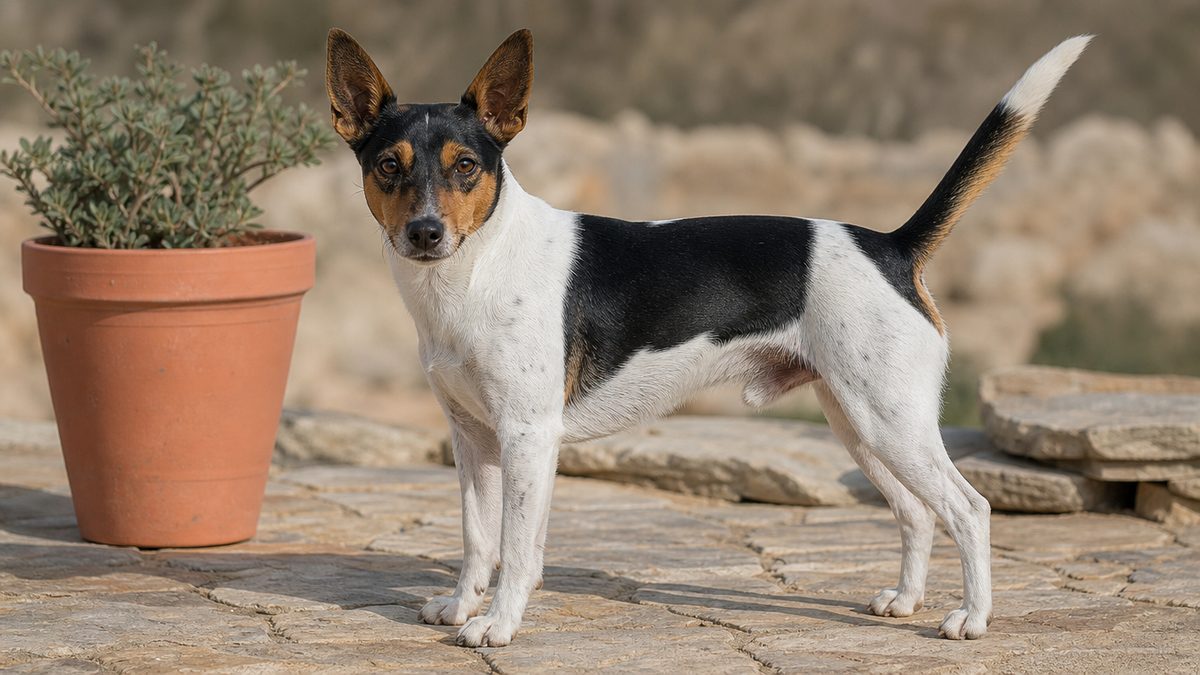
A small Valencian ratting terrier with two official standards that disagree about its proportions, its tail and even which language governs, and which the FCI admitted provisionally in June 2022.
Quick answer
No verifiable Valencian Terrier price in India exists. What is verifiable is its paperwork, and it is the most interesting in this Spanish group: the breed entered Spain's national annex with a full racial prototype in 2004 and the FCI admitted it provisionally as standard 370 on 21 June 2022, and the two official texts disagree with each other on the dog's proportions, its tail and which language governs.
This page is reference information, not veterinary advice. The Valencian Terrier's entire veterinary literature is two reproductive-physiology papers, so there is no breed health data to report and every health statement here is a general canine fact or an inference from size and type. Talk to your nearby vet before acting on any of it, and take a small dog that is limping on a hind leg or refusing to bear weight to be examined rather than resting it at home.
Valencian Terrier traits, rated for India
What the Valencian Terrier is, and why its two standards disagree
The Valencian Terrier is a small Valencian ratting terrier that Spain admitted to its national breed annex in 2004 and the Federation Cynologique Internationale accepted provisionally as standard 370 on 21 June 2022. It has two official standards, and they contradict each other five times.
Take the recognition first, because it is the strongest of any breed in this Spanish group outside the three definitive FCI ones. Orden APA/807/2004 of 24 March included five Spanish canine breeds in the annex of Real Decreto 558/2001 con sus prototipos raciales, with their racial prototypes, and the Ratonero Valenciano was one of them, alongside the Alano Español, the Pastor Garafiano, the Ratonero Mallorquín and the Ca Mè Mallorquí. Its prototype is printed in the consolidated annex from page 67. Real Decreto 1557/2005 later restated the list using the compound name Gos Rater Valencià (Ratonero Valenciano).
Then the FCI. The breed record gives group 3, section 1, provisional acceptance on 6/21/2022, breed status recognised on a provisional basis, and country of origin Spain. That date is M/D/YYYY, and the provisional table proves its own format: rows read 9/17/2024, 6/21/2022, 2/26/2020 and 4/29/2019, and 17, 21, 26 and 29 cannot be months. So the date is 21 June 2022.
| Point | Spain's national prototype, 2004 | FCI standard 370, 2022 |
|---|---|---|
| The tail | Amputated respecting no vertebra, or leaving only the first. Tailless individuals exist | Previously customarily docked, not now. The Spanish edition says ahora integra, now whole |
| Height to length | Height at the withers to longitudinal diameter 4 to 3, a dog taller than long | Height at the wither to length of body 3 to 4, a dog longer than tall |
| Muzzle to skull | Face length to skull length 3 to 5 | Length of the muzzle to length of the skull 4 to 5 |
| Size class | Talla pequeña, small size, elipometric and subbrevilinear | General appearance says small size; the FCI files it in section 1, large and medium sized terriers |
| Authentic language | Spanish, being a Spanish state instrument | The breed record says English; the English standard says Official language: ES and names a translator; the Spanish standard also declares itself a translation |
None of those is a rounding difference. The height-to-length pair is the starkest: 4 to 3 and 3 to 4 are opposite claims about the basic silhouette of the same breed. This page prints both and follows neither, because the honest position is that Spain's older text and the FCI's newer one describe the dog differently and both remain in force in their own spheres.
The FCI's own breed record names English as the official authentic language for this Spanish breed. The English edition of the standard opens TRANSLATION: Mrs. Anna Morgan; Real Sociedad Canina de España. Official language: ES Federation Cynologique Internationale. The Spanish edition opens TRADUCCIÓN: D. Cristóbal Ramos and names no authentic language at all. Both editions therefore call themselves translations while the record calls the English authentic. For comparison, the FCI records for standards 91, 204 and 336 all name Spanish as authentic and all three of their English PDFs say Official language (ES), so those three agree with themselves and this one does not.
The dog itself, where the texts agree
Size is settled and small. FCI 370 gives males 30 to 40 cm at the withers with 36 cm as the ideal and females 29 to 38 cm with 33 cm ideal, tolerating one centimetre in a balanced dog, and a weight of 4 to 8 kg for both sexes. The Spanish edition gives the same figures and states the tolerance explicitly as plus or minus a centimetre, where the English says only that one centimetre is tolerated without naming a direction.
The job is settled too, and both texts use nearly the same words. The breed was ancestrally dedicated to the traditional hunting of the water rat, rabbits and moles, is additionally a guard dog for its capacity to warn by means of the bark, and is now also a companion dog. Ears are erect, triangular and high-set, about 10 cm in the national prototype, the neck carries no dewlap, the body is quadrangular, and the feet are hare feet front and rear.
The history in the FCI standard is specific and datable. It traces the breed to early terrier imports from Great Britain crossed with similar local dogs, documents its existence in the Valencian Community from the last third of the nineteenth century, notes that its beginnings coincided with the cultivation of oranges in the region, and records Rateret and Fusterrier as other names for it.
One more piece of standing worth knowing. This was the first breed in the Comunitat Valenciana to receive its own genealogical book, before the gallina de Chulilla, the oveja guirra and the gos coniller valencià, and its studbook is kept by the Sociedad Canina de Valencia under the Generalitat Valenciana.
Valencian Terrier price in India, and why none exists
There is no verifiable Valencian Terrier price in India, and no Indian listing for the breed was found at any position. Bonbeno publishes no rupee figure for this breed.
The result set is unusual and worth describing, because it is the cleanest in this batch. Searching for this breed returns the FCI's own breed record, an encyclopedia entry, the Boletín Oficial del Estado, a Valencian veterinary college news item, the Real Sociedad Canina de España's studbook table and two Spanish cynology sites. When registries and gazettes outrank every commercial page, there is no market to describe.
Verify that yourself rather than taking it on trust, because the check is the same on every rare breed: open the ranking pages and ask which of them is an Indian seller with stock. On this breed, none is, and the FCI's own record is the top result.
The structural reasons are three. Provisional FCI recognition means pedigrees carry the FCI logo and the breed is eligible for FCI titles but not for the CACIB until definitive recognition. The studbook is a regional Spanish register kept by one association under one autonomous community. And India's import policy bars bringing dogs in for commercial purposes like breeding.
A rupee band for a rare European breed that resolves to a round number of euros or dollars at 74, 80, 84.38 or anything near 91 was produced by multiplication rather than observed in India. This site has caught Indian pages and answer engines doing exactly that repeatedly, often in the same answer that says no Indian price exists. A figure that survives every division test can still have been invented in rupees, so a clean division proves less than it looks.
One instrument limitation, stated rather than hidden
The ranked set above was harvested through a search tool whose geography is the United States rather than India. By the time this breed was researched, Bing India was serving a bot challenge reading One last step, Please solve the challenge below to continue, and DuckDuckGo was answering HTTP 202 with a stub for every query including the control. It is a real ranked set and not an India-geo one, and that changes what the list proves.
What is budgetable is the cost of keeping a 4 to 8 kg short-coated dog in an Indian city, and for this breed that is the lowest figure on any page in this Spanish cluster.
What a Valencian Terrier costs to keep in India
A Valencian Terrier is the cheapest of these six breeds to run in India by a wide margin. At 4 to 8 kg it sits in the smallest weight band for every dosed product, and a short tight coat needs no professional grooming at all.
Weight drives almost everything, and here it works in the owner's favour. Drontal Plus is Rs 125.67 a tablet dosed one per 10 kg, so a 4 to 8 kg dog needs one tablet, about Rs 126 a dose, against roughly Rs 1,005 for an 80 kg mastiff. That is an eightfold difference on an identical product, decided entirely by the animal.
Parasite prevention follows the same logic. Combination parasiticides are sold in weight bands and this dog sits in the smallest, so a monthly figure will be well under the Rs 1,103 that the 15 to 30 kg band costs. Check the band against the dog's actual weighed weight rather than against a breed figure, since 4 kg and 8 kg fall in different packs for some products.
| Line | Published Indian figure | Notes for this breed |
|---|---|---|
| Anti-rabies, single | Rs 699 at a Vetic clinic, Rs 100 at a Goa government hospital | Not weight-banded. A 12 times spread by delivery model |
| 9-in-1 DHPPiL | From Rs 899 at a Vetic clinic, Rs 600 at a Goa government hospital | A 3.3 times spread on one identical vaccine |
| Kennel cough | Rs 1,349 | Worth doing before boarding |
| Deworming | About Rs 126 a dose | One Drontal Plus tablet covers up to 10 kg |
| Monthly parasiticide | Below the Rs 1,103 that the 15 to 30 kg band costs | The smallest pack applies; check the band against a weighed weight |
| Grooming | Bathing from Rs 934 in Delhi | Nothing to clip or trim, and a small dog is quick to bathe at home |
| Overnight boarding | Rs 899 for 24 hours in Bengaluru | Warn the facility about the barking before you book |
| Municipal registration | Rs 500 in Delhi, Rs 50 in Chennai | Chennai's six municipal clinics treat and vaccinate free |
Grooming is effectively free. A short tight coat on a small dog means a rubber mitt once a week and a bath at home, and the Rs 934 Delhi bathing rate is a convenience rather than a necessity. There is no clip, no strip and no trim at any point in the dog's life.
Where the money actually goes with a small terrier
- Dental care, because small breeds accumulate periodontal disease faster and Indian scaling under anaesthesia is a recurring cost
- Orthopaedic assessment, since patellar luxation is a well-known small-breed problem and a limping small dog needs examining rather than resting
- Enrichment, because a bored terrier is destructive out of proportion to its size
- Soundproofing goodwill with neighbours, which in an Indian building is a real if unbudgeted cost
- Identification, because a 5 kg dog that slips a collar in an Indian street is very hard to recover
Municipal fees stay flat regardless of breed. Delhi charges Rs 500 to register a pet dog and Rs 500 to renew, with a Rs 100 per month late fee, and has issued 18,958 certificates since 2021. Chennai charges Rs 50 for a pet licence, issued 9,115 in 2024, and runs six municipal pet clinics providing treatment and anti-rabies vaccination free of cost. Boarding in Bengaluru runs Rs 599 for four hours, Rs 799 for a ten-hour day and Rs 899 overnight.
Can a Valencian Terrier handle the Indian climate
A Valencian Terrier copes with Indian heat better than any coated breed in this Spanish group and worse than any Indian breed. Its homeland's best measurable summer wet bulb is 21.69 C, which is effectively Bengaluru and about four and a half degrees below Chennai.
Measuring the homeland is harder here than anywhere else in this batch, and the honest answer starts with that.
Five points were queried by explicit latitude and longitude with the cell elevation echoed on every one. Valencia city and Valencia port share a single 388.86 m cell against real elevations of 15 m and 2 m, errors of plus 373.9 and plus 386.9 m. Alzira returns 474.02 m against a real 20 m, plus 454.0 m. Castellon returns 266.02 m against 27 m, plus 239.0 m. Sueca and Gandia, about 30 km apart, return a byte-identical series from one 106.96 m cell, errors of plus 95.0 and plus 85.0 m. Two nearby points agreeing to the decimal is not corroboration, it is the symptom of one cell queried twice. The 106.96 m cell is used below because it is the least wrong available, and the error is stated rather than buried.
On that cell the Valencian plain runs an annual mean of 18.09 C at 70.62 percent relative humidity, with a hottest month of August at 26.05 C and a peak Stull wet bulb of 21.69 C, against POWER's own T2MWET of 22.68 C for the same month. Using the Valencia city cell instead would give 16.46 C, 63.41 percent and 19.67 C, so the choice of wrong cell moves the answer by more than a degree and a half. Anyone quoting a single Valencian climate figure without saying which cell it came from is quoting a coin flip.
| Place | Cell elevation and error | Annual mean | Annual humidity | Hottest month | Peak wet bulb |
|---|---|---|---|---|---|
| Valencian plain, Sueca and Gandia cell | 106.96 m, plus 85 to plus 95 | 18.09 C | 70.62 % | August, 26.05 C | 21.69 C, August |
| Delhi | 206.37 m, minus 9.6 | 25.57 C | 45.51 % | June, 35.88 C | 26.50 C, July |
| Chennai | 48.95 m, plus 43.0 | 27.94 C | 72.39 % | May, 31.51 C | 26.11 C, May |
| Mumbai | 97.15 m, plus 83.2 | 26.77 C | 67.28 % | May, 31.19 C | 25.77 C, June |
| Kolkata | 7.35 m, minus 1.7 | 25.80 C | 73.84 % | May, 31.53 C | 27.09 C, June |
| Bengaluru | 841.72 m, minus 78.3 | 23.74 C | 67.84 % | April, 28.37 C | 21.86 C, May |
| Pune | 635.99 m, plus 76.0 | 23.86 C | 66.68 % | April, 28.93 C | 22.97 C, June |
Read the wet-bulb column and the answer is unusually clean. The Valencian plain's 21.69 C peak is within 0.17 C of Bengaluru's 21.86 C and 1.28 C below Pune's 22.97 C. On the Deccan plateau this dog is, in the only sense that matters physiologically, at home. Against Chennai's 26.11 C it is 4.42 C short and against Kolkata's 27.09 C it is 5.40 C short, and those are real gaps.
Humidity is not the problem either way. Valencia at 70.62 percent sits between Mumbai's 67.28 and Chennai's 72.39, so an Indian coastal summer is not a humidity shock for this breed. Heat is the variable, exactly as it is for every European breed on this site.
What a small dog changes, and what it does not
Size helps with heat and it does not make a dog heat-proof. A 4 to 8 kg dog has a favourable surface-area-to-mass ratio and sheds heat more readily than an 80 kg mastiff does, which is a genuine advantage. What size does not change is behaviour, and Hall 2020 found that 652 of the 879 heat-related illness events with a recorded trigger, or 74.2 percent, were exertional. A terrier that will not stop chasing is at risk regardless of its mass.
The one measured weight finding still applies. A bodyweight at or above the breed and sex mean carried 1.42 times the odds of heat-related illness, 1.12 to 1.80. On a dog whose whole healthy range spans 4 kg, an extra kilogram is a much larger proportional change than it is on a big breed, so weight control matters more here rather than less.
Indian law's outdoor-housing clause applies to the first limb rather than the second. Second Schedule Part IV paragraph 21(1) bars outdoor housing without the attending veterinary practitioner's written approval for dogs not accustomed to the temperatures prevalent in the area, for breeds that cannot tolerate them, and for sick, infirm, aged or young animals. A newly arrived Mediterranean terrier is not yet accustomed, whatever its size.
Valencian Terrier temperament and household fit
Spain's own national prototype describes a lively, cheerful and somewhat nervous character that is affectionate and faithful, does not like strangers, is brave in hunting and in defending its owners' property, and learns quickly. That is an accurate terrier description, and the Indian household problem is inside it.
The wording is worth quoting because it is unusually candid for a state gazette. The prototype records a character that is *vivo, alegre y algo nervioso*, lively, cheerful and somewhat nervous; affectionate and faithful, *aunque no le gustan los extraños*, though it does not like strangers; brave both in hunting and in defence of its owners' property; and quick to learn. A standard that admits its breed is somewhat nervous and dislikes strangers is telling you something useful.
The bark is the deal-breaker, and both standards say so
This is the point on which the two official texts fully agree and every prospective Indian owner should stop. Both the national prototype and FCI 370 list the dog as a guard dog specifically for its capacity to warn by means of the barkFederation Cynologique Internationale. That is not a temperament flaw, it is a named working function that the breed was selected for over generations.
In a Valencian farmhouse a dog that announced every arrival was doing its job. In a Mumbai tower or a Bengaluru apartment block it is the single most likely reason the breed does not work out, and no amount of training removes a selected trait entirely. It can be managed with a quiet cue, an early settle, and enough work to prevent boredom barking on top of alarm barking, but it should be planned for rather than discovered.
Who this breed suits
- Households in Bengaluru, Pune or a hill station, where the wet-bulb load matches the breed's homeland almost exactly
- Owners who actively want a small, alert, quick-learning dog and will do daily training rather than daily walking
- Ground-floor or independent homes rather than shared-wall apartments, because of the alarm bark
- Homes without small pets, since a dog selected to hunt rats and moles will hunt a hamster
- People who will socialise hard in the first four months, because a somewhat nervous breed that meets nothing becomes a reactive adult
Children are a qualified yes rather than a flat one. A small, quick, somewhat nervous dog with a strong bite instinct for vermin needs supervised, calm handling and a place to retreat to, and that is a household-management question rather than a breed verdict.
Everything above comes from two official standards. The breed's entire PubMed literature is two papers on sperm morphometry and motility, and neither examines behaviourValverde A, Arnau S, Garcia-Molina. Treat the temperament description as the standards' account rather than as measurement, and judge the individual dog in front of you.
Training a Valencian Terrier
Train a Valencian Terrier early, in short sessions, with food, and treat the barking as the primary training project rather than an afterthought. Spain's national prototype says plainly that they learn quickly, which cuts both ways.
Socialise between eight and sixteen weeks and do not let the size fool you into skipping it. A breed its own standard calls somewhat nervous and says does not like strangers is a breed where early, positive, unhurried exposure decides the adult dog. In an Indian city that means delivery riders, lift doors, auto-rickshaws, cattle in the road, temple bells, firecrackers, other dogs and, crucially, unfamiliar people at the door.
Then train the door. The most useful behaviour a Valencian Terrier can learn is going to a mat and settling when the bell rings, and it is easiest to build before the dog has spent a year rehearsing the alternative. Pay it heavily, practise it daily, and set it up deliberately rather than only using it when a real visitor arrives.
What to teach, in order
- Name response and a marker word, in the first fortnight, because everything else is built on them
- A go-to-mat settle tied to the doorbell, which is the behaviour that decides whether this breed works in a flat
- A quiet cue, taught by rewarding the pause after the bark rather than by punishing the bark
- Loose-lead walking, which is easy at this size and neglected for exactly that reason
- A recall away from small moving animals, practised on a line, because the prey drive is real
Do not train through corrections with a somewhat nervous small dog. Escalation produces a defensive terrier rather than a compliant one, and defensive small dogs bite. Food, brevity and a high rate of reinforcement work far better and take less time.
Timelines are quick. Expect house training in four to eight weeks, a doorbell settle by three to four months if you work at it daily, loose-lead walking by five months, and a recall away from moderate distraction by nine to twelve. The prototype's claim that they learn quickly is accurate, and it means bad habits install just as fast.
A dog selected to hunt water rats and moles has a drive that will find an outlet whether or not you provide one. A flirt pole, a chase-and-tug game with rules, a snuffle mat and a dig box in a corner of the garden all satisfy it in ten minutes a day. A terrier without an outlet redirects onto furniture, feet and the neighbour's cat.
Daily exercise a Valencian Terrier actually needs
A Valencian Terrier needs about 45 to 60 minutes of activity a day and, more importantly, two or three short bursts of intense work. This is a small dog with a working brain, and mental fatigue matters more than distance.
Distance is not the constraint at this size. A 4 to 8 kg terrier will happily walk further than most Indian owners want to in the cool hours, and walking alone will not tire it. What tires it is problem-solving, chasing under rules, digging where it is allowed to, and searching for hidden food.
That makes this breed unusually well suited to Indian constraints. On a Chennai afternoon when going outside is not sensible, ten minutes of a snuffle mat and a find-it game does more for a Valencian Terrier than an hour of pavement would. Few breeds on this site can be exercised indoors honestly; this one can.
A realistic Indian week
- Two walks a day of 20 to 30 minutes, before about 7 am and after about 8 pm from March to October
- Two or three short high-intensity sessions daily, five to ten minutes each, with a flirt pole or a chase-and-tug game
- Daily scent work indoors, scattered food or a hidden toy, which costs nothing and works in any weather
- A dig box or a permitted digging corner, so the instinct has somewhere legitimate to go
- A long line in unfenced ground, because a small fast terrier that has locked onto something is gone
Under-exercise shows up as barking and destruction rather than as restlessness, and in an apartment the barking is what the household notices first. Owners frequently treat that as a noise problem needing a training fix when it is a workload problem needing a routine fix.
Growth limits are ordinary but real. Keep repetitive jumping off furniture and hard landings to a minimum through the first year, because small breeds are prone to patellar problems and a dog that leaps off a sofa forty times a day is loading a stifle that has not finished forming. Skeletal maturity in a dog of this size arrives around ten to twelve months.
Heat still governs the timing. A small short-coated Mediterranean dog is better placed than any other breed in this cluster and it is not exempt, and 74.2 percent of triggered heat-illness events are exertional. Keep the intense work indoors and in the cool hours through an Indian summer.
Grooming a Valencian Terrier in India
The Valencian Terrier needs a rubber mitt once a week and nothing else. A short tight coat on a 4 to 8 kg dog is the lowest grooming requirement of any breed on this site's Spanish pages, and the real routine is nails, teeth and tick checks.
The coat clause is short because there is little to say. Hair is short and tight-fitting to the body, including on the tail, in a variable coat with tricolour dominating. There is no clipping, stripping, trimming or hand-stripping requirement anywhere in either official text, which distinguishes this breed sharply from the wire-coated terriers it superficially resembles.
So the weekly routine is a rubber curry mitt to lift dead hair, a bath only when the dog is actually dirty, and a hand check over the whole body. At this size a bath at home in a bucket is entirely practical, and the Rs 934 Delhi salon rate is a convenience rather than a requirement.
| Task | Dry season, November to February | Hot season, March to June | Monsoon, July to October |
|---|---|---|---|
| Coat | Rubber mitt weekly | Weekly | Twice weekly, and dry the dog after rain |
| Teeth | Brush 3 to 4 times a week | Same | Same. Small breeds accumulate tartar fast and this is the highest-value routine here |
| Nails | Monthly | Monthly | Monthly. Small dogs wear nails down less on Indian pavements than owners assume |
| Ears | Weekly check | Weekly | Every few days; erect ears ventilate well, which is a real advantage |
| Tick check by hand | Weekly | Weekly | Twice weekly, feeling rather than looking |
| Bathing | When dirty | When dirty | Only when necessary, then dry properly |
Erect ears are worth naming as an advantage. Unlike a drop-eared hound, an upright mobile ear ventilates freely, which materially lowers the otitis risk that dominates ear care for pendulous-eared breeds in an Indian monsoon. Check them; you will rarely need to do more.
Dental care is the routine that actually matters most for this breed and it is the one most often skipped. Small breeds crowd their teeth into a short jaw and accumulate periodontal disease earlier and faster than large ones, and periodontal disease in a small dog is both painful and expensive to fix under anaesthesia in India. Brushing three or four times a week from puppyhood is the single highest-return habit in this section.
Sun is a minor consideration on a white-marked tricolour dog. Unpigmented skin on the muzzle and ear tips burns, and a dog lying in Indian sun on a balcony is exposed for longer than its owner realises. Shade and timing solve it, and any product applied to skin is a question for your own vet.
Valencian Terrier health, and two papers that are not about health
The Valencian Terrier has no health literature. Its entire presence in PubMed is two papers on sperm morphometry and motility, it has no row in the largest canine survival dataset, no OFA figure could be obtained, and neither official standard publishes a screening requirement.
The literature search is worth describing, because it is a clean example of a name-form trap. Run on 9 September 2026 with the control query Labrador retriever hip dysplasia returning 126 records in the same session, PubMed gives 0 for "Valencian Terrier"[tiab], 0 for "Gos Rater"[tiab], 0 for "Rater Valencia"[tiab] and 0 for "Ratonero Valenciano"[tiab], each with a clean unrewritten translation.
Four zeros would normally end the enquiry. They would have been wrong. The breed's literature exists under a fifth name: "Rat Hunting Dog"[tiab] returns 2 records, and both include the Valencian Rat Hunting Dog among their study breeds. More instructive still, the exact phrase "Valencian Rat Hunting Dog"[tiab] itself returns 0, so the full name is not indexed as a phrase while the shorter fragment finds it. A zero on one name is a zero on one name.
| PMID | What it is | Does it report health |
|---|---|---|
| 30801867 | Valverde 2019, computer-assisted sperm motility across 37 dogs of six breeds including this one and the Spanish Mastiff | No, reproductive physiology |
| 27751991 | Soler 2017, dog sperm head morphometry and its diversity and evolution | No, reproductive physiology |
The second of the two, Soler 2017, measured dog sperm head morphometry and its diversity across breeds, and it likewise includes the Valencian Rat Hunting Dog among its subjects without reporting anything about the breed's health. Two papers, both from the same Valencian research group, both about reproduction, and none about a vocal little terrier's diseases.
Valverde 2019 does contain one finding worth carrying beyond its own subject. All eight kinematic parameters differed significantly between breeds and between individuals within each breed, and the authors conclude that results cannot be extrapolated from one breed to another. That is a small point about semen analysis and a large one about method, and on a breed with no data of its own it is a direct warning against borrowing another terrier's numbers.
No lifespan, and no screening scheme
McMillan 2024's supplementary Table S5 lists 345 breeds and contains no row at all for the Valencian Terrier under any of its names, while Spanish Hound, Spanish Mastiff, Spanish Greyhound and Spanish Water Dog all appear. So the breed is absent rather than excluded, and there is no median survival to quote. Bonbeno publishes none.
The Orthopedic Foundation for Animals could not be read either. Its disease-statistics page returned HTTP 200 with 1,752 characters of visible text ending in Searching Database, Please wait and zero rows, and a LABRADOR control returned zero on the same fetch, which makes it an instrument failure rather than an absence.
Neither official standard names a health test. Both police soundness through faults rather than through screening, and the national prototype's fault list is about conformation rather than diseaseFederation Cynologique Internationale. So a buyer has no breed-specific test to ask for, which is itself worth knowing.
What is reasonable to expect, labelled as inference
Two small-breed problems are worth raising with a vet, and neither is a breed finding. Patellar luxation is common across small breeds generally and presents as an intermittent skipping hind-leg gait, and a small dog that suddenly holds up a hind leg and then walks normally should be examined rather than rested. Periodontal disease arrives earlier and progresses faster in small breeds, which is why dental care sits high in the grooming section. Neither has been measured in this breed.
The Indian risks, which are measured
Tick-borne disease is the dominant Indian question for any dog, and a small dog is not exempt. A survey of 584 dogs in West Bengal found Babesia gibsoni in 76.54 percent and two or more pathogens in 72.9 percent of the 584 dogs screened. An Odisha series of 178 dogs found Ehrlichia canis in 56 of 178, or 31.46 percent, though notably 75 percent of infected dogs there were over 20 kg, which is a size band this breed does not reach. Both sampled clinic caseloads rather than random populations.
Heat is the second, and the climate section gives the arithmetic. The transferable findings are that bodyweight at or above the breed and sex mean carries 1.42 times the odds of heat-related illness, and that 74.2 percent of triggered events are exertional. On a dog whose healthy range spans 4 kg, weight control is proportionally more important than on a large breed.
Feeding a Valencian Terrier in India
Feed a Valencian Terrier by weighed gram to a lean body condition across two meals, and be careful, because on a 4 to 8 kg dog a few biscuits are a meaningful share of the day's calories. Small-dog obesity is easy to create and hard to see under a coat.
Weigh the food. At this size the difference between a level and a heaped scoop can be ten percent of the daily ration, and over a year that is a materially different dog. Portion against the manufacturer's chart for the dog's actual weighed weight and correct by feel every fortnight.
Score by hand weekly. Ribs easily felt under a thin covering, a waist from above, a tuck from the side. On a small dog the coat and the shape hide gain, so hands beat eyes and the scale beats both.
Leanness matters proportionally more here than on a big dog. Hall 2020 found a bodyweight at or above the breed and sex mean carried 1.42 times the odds of heat-related illness. One extra kilogram on a dog whose standard range is 4 to 8 kg is a large proportional change, and in an Indian summer it is an avoidable one.
Practical rules for a small terrier
- Weigh the whole daily ration in the morning and feed everything, treats included, out of that measured amount
- Use the dog's own kibble for training and scent games, which at this size is essential rather than optional
- Split into two adult meals or three to four puppy meals, with rest either side
- Keep water available and expect intake to climb steeply from March onward
- Count what the household feeds the dog informally, which on a small dog is usually the real cause of gain
Dental texture is worth a thought at this size. Small breeds accumulate tartar quickly, and while no food replaces brushing, a kibble the dog actually chews rather than swallows whole is better than one it does not. That is a conversation for your own vet rather than a rule from a page.
Storage matters in India regardless of breed. Buy pack sizes you will finish in a few weeks, which for a 5 kg dog means genuinely small bags, decant into an airtight container, keep the sack off the floor and discard anything musty. Aflatoxin from mould on maize and groundnut in humid Indian storage is a real hazard, and a small dog eating a contaminated food gets a proportionally larger dose per kilogram of bodyweight.
Valencian Terrier puppy timeline, month by month
A Valencian Terrier's first year has two Indian legal fixed points and one breed-specific priority. No puppy may lawfully be sold in India below eight weeks, vaccination runs from seven or eight weeks to about eighteen, and the doorbell settle has to be trained before the barking becomes a habit.
Both legal points come from the gazette. Rule 8(1)(a) of the Prevention of Cruelty to Animals (Dog Breeding and Marketing) Rules 2017 requires that pups less than eight weeks in age are not sold, and Second Schedule Part III paragraph 8(9) states that all pups shall be vaccinated, which can start at seven to eight weeks and is usually completed at eighteen weeks.
| Age | What matters most | What to avoid |
|---|---|---|
| 8 to 10 weeks | Legal earliest sale. Vaccination begins. Start tooth brushing and body handling immediately | Buying below eight weeks, which is unlawful rather than merely unwise |
| 10 to 16 weeks | The socialisation window. A somewhat nervous breed needs this more than a bold one does | Skipping socialisation because the dog is small and easy to carry past things |
| 16 to 18 weeks | Vaccination completes. Doorbell settle trained daily, deliberately, with set-ups | Letting the puppy rehearse barking at the door for three months first |
| 4 to 6 months | Loose-lead walking, recall on a line, and a permitted digging outlet | Correction-based training, which makes a nervous small dog defensive |
| 6 to 9 months | Prey drive and alarm barking mature together. Reinforce quiet and settle | Assuming the quick learner has finished learning |
| 9 to 12 months | Skeletal maturity approaches. Keep jumping off furniture to a minimum | Repetitive hard landings, which load a stifle that is still forming |
| 12 months onward | Adult routine. Dental care and weight control become the lifelong jobs | Free-feeding, which is how a 6 kg dog becomes an 8 kg dog |
Buy an undocked puppy, and say so to the seller in advance. Spain's 2004 national prototype still describes an amputated tail, the FCI's 2022 standard says the practice is no longer current, and Indian law prohibits it outrightFederation Cynologique InternationaleMinistry of Environment. A docked puppy offered in India means a prohibited procedure was performed, and the FCI's own current standard does not ask for it.
A puppy that has had its mouth opened and its teeth touched every day from eight weeks will accept brushing for life. A small dog that first meets a toothbrush at three years will not, and periodontal disease in a small breed is the most predictable avoidable veterinary cost there is. Ten seconds a day from the first week is the whole intervention.
Valencian Terrier against the small breeds Indian buyers can get
Two Spanish ratters and two commonly available small breeds are the useful comparison. On recognition the Valencian Terrier is ahead of its Spanish sibling; on availability and measured evidence in India it is far behind the Beagle and the Dachshund.
| Breed | FCI status | Spanish national annex | Measured lifespan | Available in India |
|---|---|---|---|---|
| Valencian Terrier | 370, provisional since 21 June 2022 | Yes, with prototype, since Orden APA/807/2004 | None. No row in McMillan's 345-breed table | No lawful purchase route, and no Indian listing found |
| Ratonero Bodeguero Andaluz | 371, provisional since 3 September 2024 | Yes, with prototype, since the Orden of 2 August 2001 | None published | Effectively absent |
| Ca Rater Mallorqui | None | Yes, with prototype, added by the same 2004 order | None published | Effectively absent |
| Dachshund | Definitive, and not a Spanish breed | No, it is German | 13.2 years on 926 deaths, HR 0.77; the Miniature 14.0 years on 1,655 deaths, HR 0.65 | Yes, widely, with a real Indian market |
| Beagle | Definitive, and not a Spanish breed | No, it is British | 12.5 years on 1,552 deaths, HR 0.95, p 0.07 | Yes, widely, with a real Indian market |
The Andalusian comparison is the closest and the most instructive. The Andalusian Terrier, the Ratonero Bodeguero Andaluz, entered the same national annex three years earlier and reached FCI provisional status two years later, at standard 371 on 3 September 2024, against this breed's 370 on 21 June 2022. Two Spanish ratting terriers, the same route, a couple of years apart, and the Valencian got there first.
The Ca Rater Mallorqui is the third of the trio and the one that has not moved. It was added to the national annex by the very same 2004 order as this breed, and it holds no FCI standard at allFederation Cynologique Internationale. Three Spanish ratters, one order, three different international outcomes.
For an Indian household
Neither Spanish ratter is obtainable in India through a lawful commercial route, and both share the same evidence vacuum. The Beagle has a measured 12.5 year median on 1,552 deaths and a genuine Indian market, and the Dachshund is the small earth-working breed Indian buyers actually get, at 13.2 years on 926 deaths with a hazard ratio of 0.77 against crossbreds. Both bark, which is worth saying, because a buyer drawn to a Valencian Terrier for its size will meet the same alarm-barking question in either.
For most Indian households the honest recommendation remains an Indian dog. The Indian Pariah Dog is heat-adapted, adoptable, needs no import authorisation and carries none of the evidence gaps on this page.
Mistakes people make about this breed
Five mistakes recur about the Valencian Terrier, and two of them come from reading only one of its two official standards. The one that harms a dog is buying a docked puppy in India.
- Buying a docked puppy in India, when Indian law prohibits the procedure and the FCI's current standard no longer asks for it
- Quoting the Spanish national prototype's proportions as though they were the FCI's, when the two texts state opposite height-to-length ratios
- Calling the breed FCI-recognised without the word provisional, which changes what the dog is eligible for
- Underestimating the alarm barking, which both standards list as a working function rather than a fault
- Treating a small heat-tolerant dog as heat-proof, when its homeland's peak wet bulb is still 4.42 C below Chennai's
The docking mistake is the one to spell out because two documents disagree and only one of them binds an Indian owner. Spain's 2004 racial prototype describes the tail as amputated respecting no vertebra, or leaving only the first, and notes that naturally tailless individuals exist. FCI standard 370 of 2022 says the tail was previously customarily docked, not now, and its Spanish edition says *ahora íntegra*, now whole.
In India the question does not turn on either. Second Schedule Part II paragraph 6(8) of the Prevention of Cruelty to Animals (Dog Breeding and Marketing) Rules 2017 reads that there shall be no tail docking, ear cropping, de-barking, de-clawing, branding, dyeing, injecting substances to enhance visual appeal, performing a surgery or procedure to camouflage or hide any defect or infirmity or any other kind of mutilation of any body part of the pup, and that any change of appearance by artificial means is strictly forbidden. That is absolute, and the FCI's own current standard now agrees with it.
The paperwork mistakes, and how to check them
The proportions error is settled by opening both texts. The national prototype gives height at the withers to longitudinal diameter as 4 to 3, and FCI 370 gives height at the wither to length of body as 3 to 4Federation Cynologique Internationale. Those describe opposite dogs, and any page quoting one ratio without naming its source is quoting half the evidence.
The recognition error is settled by reading the FCI record's own status field, which says recognised on a provisional basis. Provisional breeds are not eligible for the CACIB until definitive recognition, though they are eligible for FCI titles and their pedigrees carry the FCI logo. Saying the breed is FCI-recognised without that qualifier overstates what an owner actually has.
This breed's entire literature was found under a name nobody would guess. Four official and common name forms returned zero in PubMed, and "Rat Hunting Dog"[tiab] returned two papers, both of which study the Valencian Rat Hunting Dog, while the full phrase "Valencian Rat Hunting Dog" itself returns zero. Before writing the word no about any breed, run every name it has, including the ones a translator invented.
Adoption, sourcing and the Indian import position
You cannot lawfully import a Valencian Terrier into India in order to buy one, and there is no Indian breeding population. Adoption of a small dog already in India is the honest route, and for this breed's size and coat India has plenty of them.
Read the import position from the instrument itself. The Directorate General of Foreign Trade's own FAQ states that the import policy for pet dogs and cats is restricted and permitted only with a DGFT authorisation under ITC(HS) code 01061900, and lists the permitted purposes exhaustively: research by R&D organisations with a CPCSEA recommendation, internal security by the Defence and Police Force, a therapy or emotional support dog with a medical certificate, and a dog that has been the applicant's own pet for at least two years where the applicant is transferring residence to India after two years of continuous stay abroad.
It then closes the commercial route. Dogs for commercial purposes like breeding or as a gift or for other purposes are not allowed to be imported, and new born puppies are not allowed. Import without authorisation is available only to a person shifting residence permanently to India under the customs baggage rules, capped at two pets, and only through the airports and seaports of Delhi, Mumbai, Chennai, Hyderabad, Bengaluru and Kolkata and, since October 2024, Kochi airport Department of Animal Husbandry…. The full route is set out in how to import a dog to India.
What provisional FCI status does and does not give you
This matters for anyone who thinks an FCI number solves the pedigree question. Provisional recognition means the pedigrees issued for the breed carry the FCI logo and the dogs are eligible for FCI titles including the World Dog Show, but they are not eligible for the CACIB until the breed is recognised on a definitive basis. India is a full FCI member represented by the Kennel Club of India, so an FCI pedigree can in principle be honoured here, and the origin register remains the Sociedad Canina de Valencia under the Generalitat ValencianaReal Sociedad Canina de Espana.
What a rarity claim about this breed can honestly say
Any population figure would come from one association's register under one autonomous community, and there is no second register to check it against. The breed has no row in the largest canine survival dataset and two papers in the veterinary literature, neither about healthPubMed search audit run 9 September 2026…. So this page describes the breed as regionally concentrated and internationally scarce rather than putting a number on it, and any page that does give a number should be asked which register it came from and on what date.
What to do instead
- Adopt a small Indian dog, which every metro shelter holds and which is already adapted to the local wet-bulb load
- Consider the Indian Pariah Dog, which needs no cooling budget and raises no import question
- Consider a Beagle or a Dachshund if a small hunting-type dog is what you want, since both are obtainable here
- Register whatever dog you get. Delhi charges Rs 500, Chennai Rs 50, and Chennai's six municipal clinics treat and vaccinate free
- Ask any seller of any breed for the vaccination record and to see the puppy's undocked tail, both of which Indian law already requires
If your interest is genuine rather than acquisitive, the most useful thing you can do from India is read both standards side by side. The FCI's standard 370 and the racial prototype in the annex to Real Decreto 558/2001 are both public, both free, and both describe this dog differently, and nothing written about the breed in English has set them against each otherReal Decreto 558/2001, de 25 de mayo.
Valencian Terrier questions, answered from the standards
Is the Valencian Terrier recognised by the FCI?
Yes, provisionally. The Federation Cynologique Internationale accepted the Gos Rater Valencia on a provisional basis on 21 June 2022 as standard 370, filed in group 3, section 1, and the standard document itself is dated 14 September 2022. Provisional breeds are not eligible for the CACIB until definitive recognition, but they are eligible for FCI titles.
What is the Valencian Terrier price in India?
No verifiable Valencian Terrier price in India exists, and no Indian listing for the breed was found at any position. The breed is rare outside the Comunitat Valenciana, has no Indian breed club, and has no lawful commercial import route into India. Bonbeno publishes no price for it.
How big is a Valencian Terrier?
Small. FCI standard 370 gives males 30 to 40 cm at the withers with 36 cm as the ideal, and females 29 to 38 cm with 33 cm ideal, tolerating one centimetre either way in a balanced dog. Weight is 4 to 8 kg for both sexes. Curiously, the FCI files this breed under large and medium sized terriers.
Should a Valencian Terrier's tail be docked?
No, and the FCI's own current standard agrees. FCI 370 says the tail was previously customarily docked and is not now, and its Spanish edition puts it more plainly still, ahora integra, now whole. Spain's older national prototype of 2004 still describes an amputated tail. In India, Second Schedule Part II paragraph 6(8) of the Dog Breeding and Marketing Rules 2017 prohibits docking outright.
What was the Valencian Terrier bred to do?
Hunt water rats, rabbits and moles, and warn by barking. Both official texts give the same utilization: ancestrally dedicated to the traditional hunting of the water rat, rabbits and moles, and additionally a guard dog for its capacity to warn by means of the bark, with a companion role added more recently.
How long do Valencian Terriers live?
Nobody has measured it. The breed has no row at all in McMillan 2024's 345-breed supplementary table, so it is absent rather than excluded. Its entire PubMed presence is two papers on sperm morphometry and motility, neither of which reports lifespan. Bonbeno publishes no lifespan figure for this breed.
What is the Valencian Terrier's temperament?
Spain's national prototype describes a lively, cheerful and somewhat nervous character, affectionate and faithful, though it does not like strangers, brave both in hunting and in defending its owners' property, and quick to learn. That is an accurate terrier description and it contains the household warning inside it.
Can a Valencian Terrier live in Indian heat?
Better than the coated Spanish breeds and not comfortably. A short coat on a 4 to 8 kg Mediterranean dog is a reasonable starting point, and the best measurable Valencian summer wet bulb is 21.69 C against Chennai's 26.11 C and Kolkata's 27.09 C. Bengaluru at 21.86 C is effectively the same as its homeland.
Where does the Valencian Terrier come from?
The Comunitat Valenciana, and its FCI standard traces it to early terrier imports from Great Britain crossed with similar local dogs. Its existence is documented in the Valencian Community from the last third of the nineteenth century, and the standard notes that its beginnings coincided with the cultivation of oranges there.
What else is the Valencian Terrier called?
Gos Rater Valencia is the Valencian name and the one the FCI uses, Ratonero Valenciano is the Castilian form Spain's national annex uses, and the FCI standard also records Rateret and Fusterrier as breed names in use. In veterinary literature it appears as Valencian Rat Hunting Dog, which is a fifth form again.
Can you import a Valencian Terrier into India?
Not to buy one. India's pet import policy is restricted and permits import only with a Directorate General of Foreign Trade authorisation, for research with CPCSEA recommendation, Defence and Police use, a therapy or emotional support dog, or your own pet of at least two years on transfer of residence. Dogs for commercial purposes like breeding are not allowed to be imported.
Does the Valencian Terrier bark a lot?
Yes, and its own standards treat that as a working trait rather than a fault. Both texts list the dog as a guard dog specifically for its capacity to warn by means of the bark. In a Valencian farmhouse that was the job. In an Indian apartment building it is the single most likely reason the breed does not work out.
What is the name of the Spanish ratting dog breed?
Gos Rater Valencia, the Valencian name the FCI uses for provisional standard 370, also written Ratonero Valenciano in the Castilian form Spain's national annex uses, and Valencian Terrier in English, with Rateret and Fusterrier recorded as further names in use. It was ancestrally dedicated to the traditional hunting of the water rat, rabbits and moles, and additionally kept as a guard dog for its capacity to warn by barking.
Compare with similar breeds
Valencian Terrier sits in 1 Bonbeno group. Each one compares it directly against the breeds it is genuinely an alternative to, on the same figures.