
Breed profile
Villanuco de Las Encartaciones: Price in India, Status
A small Basque ratter and door dog with no breed club, no written standard, no studbook and no census, last counted at about fifty animals, and named after a completely different dog that had already vanished.
Quick answer
No Villanuco de Las Encartaciones price in India exists, and neither does a breed club, a written standard, a studbook or a census anywhere in the world. The last published count was about fifty dogs in 2013. This is the smallest breed in this Spanish batch and the one whose size would actually suit an Indian home, which is what makes its position so bleak.
This page is reference information and not veterinary advice. The Villanuco de Las Encartaciones has no clinical literature, no screening data and no written breed standard, so every health statement here is a general canine fact or an inference from the breed's size and work, labelled as such. For anything concerning your own dog, consult your nearby vet.
Villanuco de Las Encartaciones traits, rated for India
What the Villanuco de Las Encartaciones is, and why its name is misleading
The Villanuco de Las Encartaciones is a small Basque ratting and door dog, and its name is the single biggest obstacle to understanding it, because the name was given in reference to a completely different dog that had already disappeared.
Begin with the fact that resolves everything else. Spanish canine journalism records that this ratter was renamed *villanuco de Las Encartaciones* in reference to another dog of that name, larger than the present ones and already vanished, after a study was made of the comarca's breeds. The resemblance to the Villano de Las Encartaciones was therefore created deliberately by the people trying to document the small dog, and it has been propagating ever since.
First, the Basque Government's order of 15 February 2018 setting the Villano's racial prototype has a clause headed *Variedades de la raza* which reads in full: no varieties exist within the Villano de las Encartaciones breed. A small variety of the Villano cannot exist, because the instrument defining the Villano says there are none. Second, the Villano's authorised studbook keeper repeats it on its own front page. Third, the Spanish Wikipedia article on the Villanuco opens with a disambiguation note and then states that despite the great similarity of the names, the Villano is an independent breed which merely shares an area of origin.
Google disagrees with all three. Its answer panel for this breed says the traditional dog of the comarca is the Villano, *aunque tambien existe una variante de tamano pequeno conocida como Villanuco de Las Encartaciones*, although a small-size variant known as the Villanuco also exists. The panel cites the very Wikipedia article that contradicts it.
How to tell them apart without any expertise
Height, and there is no overlap. The Villano stands 58 to 63 cm at the withers in males under its Basque standard. The Villanuco stands 30 to 40 cm, with bitches a little less. One is a cattle catch dog with a broad chest and a brindle coat; the other is a farmyard ratter that mostly comes in black and white or black and tan.
| Villanuco de Las Encartaciones | Villano de Las Encartaciones | |
|---|---|---|
| Height at withers | 30 to 40 cm | 58 to 63 cm in males |
| Type | Ratter and door dog | Catch dog, perro de presa |
| Coat length | A little over 1 cm | 1 to 3 cm, very dense |
| Usual colours | Black and white or black and tan | Brindle required, over black, grey or fawn |
| Written standard | None anywhere | Basque Government order of 15 February 2018 |
| Breed club | None | Club Nacional Villano de las Encartaciones |
| Official studbook | None | Kept under the authority of Eusko Jaurlaritza |
| Published population | About 50, last counted in 2013 | 438 active dogs on the register |
| In Spain's national annex? | No | Yes, since 2005 |
What the dog actually is
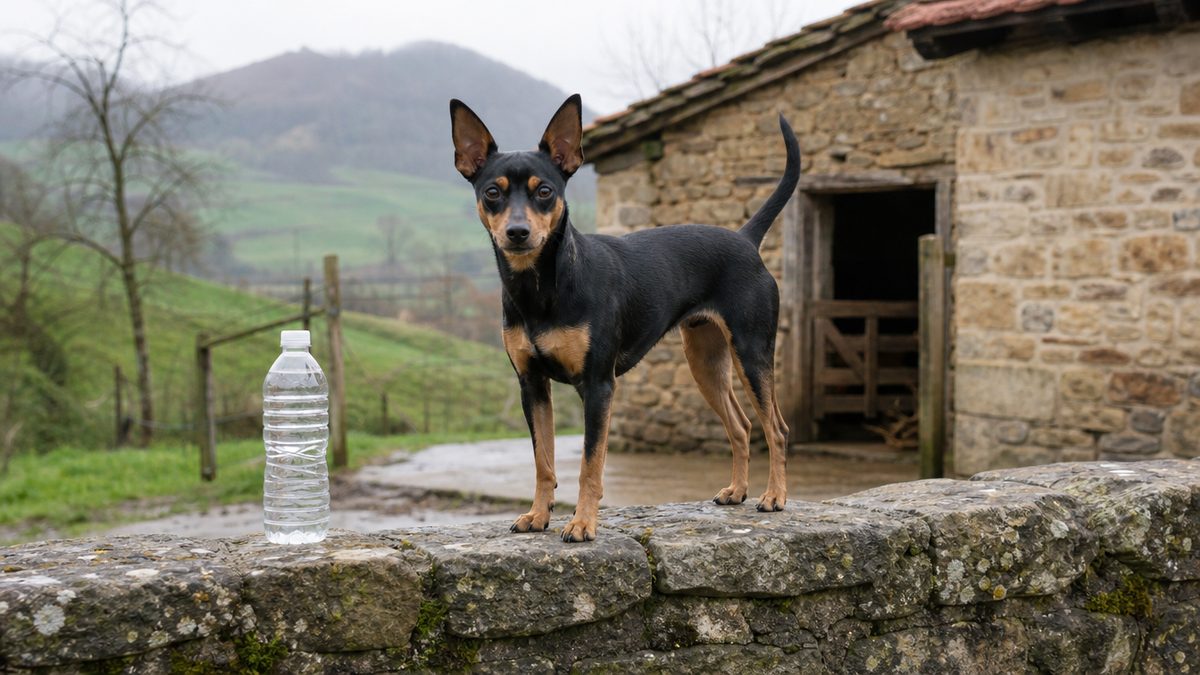
Small, fine and agile, of the general ratter type found all down Spain's Mediterranean side, but with a trunk and ears somewhat broader than the other members of that ratter type carry. English-language description gives 30 to 40 cm at the withers, fine close-fitting skin, and a coat a little more than one centimetre long; most often black and white or black and tan, less often black and cinnamon, white and cinnamon or tricolour, with the nose usually black but sometimes chocolate, and ears usually upright.
Among the specimens that were known when anybody last looked, there were two differentiated sizes and several coat colours, running from a red-brown pinto to black with tan eyebrow markings, black and white, and even the occasional brindle. That variation is what an undescribed landrace looks like before a standard is written, and no standard has been written.
The breed is commonly called Ratonero Vasco, the Basque ratter. The Spanish encyclopedia entry records the usage and adds that the name is not recommended. The reason is that it invites confusion with Spain's other ratoneros, two of which now hold recognition this dog does not.
Uses were polyvalent rather than specialised. An enthusiast quoted in the Spanish canine press describes dogs used as hunters, driving cattle by nipping at the cows' legs and helping farmers move them from house to meadow, killing rats in the stables, and standing at the house door announcing anyone approaching.
Villanuco de Las Encartaciones price in India, and the conservation status behind the answer
There is no Villanuco de Las Encartaciones price in India and there is no price anywhere, because there is no register, no club, no census and no trade in the breed at all.
The June 2025 report in the Spanish canine magazine *Ladridos* is the most recent substantial piece written about the breed, and it states the position without hedging: there is no breed club, there is no census of specimens, and the breed was already catalogued as endangered at the beginning of the century.
The counts, with their dates, and the spread between them
Three published figures exist and we give all three with their dates rather than picking the most convenient. They agree closely, which is itself worth noting.
| Figure | As at | Source |
|---|---|---|
| Fewer than fifty examples | 2009 | English Wikipedia, article last edited February 2026 |
| 50 counted, males and females together | 2013 | Revista Ladridos, June 2025 |
| About fifty specimens, described as a critical conservation situation | As at the article's last edit, February 2023 | Spanish Wikipedia |
| In critical situation, alongside the Villano and the Erbi Txakur | March 2026 | Revista Ladridos, citing the Basque agriculture department |
Mariano Gomez, a veterinary doctor and biology graduate of the University of the Basque Country, is quoted defining a breed as being in a critical state when the number of breeding females is 100 or fewer and the number of males is 5 or fewer. Against that definition, a total population of about fifty animals of both sexes is not near the threshold. It is well inside it.
Attempts were made to change this. There were efforts to form a club and to locate specimens living around the comarca, so that one more breed would not disappear, but continuity was lacking. A private enthusiast, Sergio Gomez Matxin, was publicly calling seven years earlier for people to defend and protect a native breed he described as disappearing without any interest from the institutions.
Where the breed does have official standing
It is not nowhere. The Basque Country maintains an official catalogue of native Basque animal breeds, and the Villanuco is in it. That catalogue holds 25 breeds, five of them canine: the erbi txakurra, the villano de las Encartaciones and the Villanuco de las Encartaciones, all three in critical situation, plus the Euskal Artzain Txakurra in its gorbeiakoa and iletsua varieties, classed as endangered.
This is the reason a page cannot judge a rare breed on cynological registers alone. The Villanuco is absent from Spain's national annex, absent from the RSCE's official-studbook table, and absent from the RSCE's list of ethnic groups working towards recognition Real Sociedad Canina de Espana Real Sociedad Canina de Espana. It is nonetheless in a regional government's official native-breeds catalogue. Reading only the kennel clubs would have produced a confident and wrong verdict that the breed has no official status at all.
What that standing is worth is currently unresolved. Basque Law 9/2022 of 30 June on the protection of domestic animals creates, at article 30, a special legal framework for native Basque breeds declared Genetic and Ethnological Heritage of Euskadi. The declaration was due by 31 December 2024. It has not been made. The department says more than 30 separate regulatory developments are needed to bring the law into operation, and that the annual normative plan the project sits in carries 125 initiatives.
And the Indian side, briefly
Even if a Villanuco existed to sell, India's import rules would not permit a purchase, and those import rules are worth reading before any rare-breed enquiry. Pet dog import is restricted and needs a DGFT authorisation, and the guidance states in consecutive clauses that dogs for commercial purposes like breeding, as a gift or for other purposes are not allowed to be imported, and that newborn puppies are not allowed. The single lawful route is a dog you have already owned abroad for two years, on transfer of residence, entering through one of seven named ports with an advance no-objection certificate obtained seven days before arrival Department of Animal Husbandry…. The full route is set out in how to import a dog to India.
The cost of ownership for a small ratter in India
The cost of ownership for a dog of this size in India is genuinely modest, and it is worth setting out, because the Villanuco is the one breed in this Spanish batch whose running costs an ordinary Indian household could absorb without thinking about it.
A 30 to 40 cm ratter weighing under about ten kilograms sits in the cheapest band of every Indian cost line: less food, smaller parasite doses, lower boarding rates and no special housing. We price the lines from named Indian providers rather than assemble a monthly total for a breed nobody here keeps.
| Line | Indian figure | Source |
|---|---|---|
| Puppy core vaccination course | Starts at Rs 6,499 on the national page | Vetic, 50-plus clinics |
| Annual booster | Starts at Rs 3,199 | Vetic |
| Anti-rabies, single dose | Rs 699 | Vetic |
| 9-in-1 DHPPiL, single dose | Rs 899 | Vetic |
| Deworming, per dose | About Rs 125.67 per tablet at one per 10 kg, so roughly one tablet | Drontal Plus via Supertails |
| Municipal registration, Delhi | Rs 500 new, Rs 500 renewal | MCD Delhi |
| Municipal licence, Chennai | Rs 50 | Greater Chennai Corporation |
| Boarding, under 5 kg, per 24 hours | Rs 550 at one Bengaluru operator | Operator listing |
The identical 9-in-1 vaccine costs Rs 600 at a Goa government veterinary hospital including the certificate, from Rs 899 at a Vetic clinic and from Rs 1,999 through a vet-at-home service that also charges a Rs 699 visit fee. That is a 3.3 times spread on one drug, and twelve times on anti-rabies. For a small dog, the delivery model you choose will dominate your veterinary bill far more than the animal's size does.
The Indian municipal picture is the same for a small dog as for a large one, and both facts are worth knowing. Greater Chennai Corporation issued 9,115 pet licences in 2024 at fifty rupees each and runs six municipal pet clinics providing treatment and anti-rabies vaccination free of cost. Delhi's MCD has issued 18,958 pet dog certificates since 2021 and rejected 71 of 1,006 applications in FY 2026-27. In Karnataka the position is harder to state: the Bengaluru civic fee could not be verified from a live municipal page, so we quote none rather than repeat a figure that traces to nothing.
The cost this breed does not add
Almost everything. No fencing project, no large-breed food bill, no specialist handling, no separate housing requirement and no grooming budget. On paper this is close to the cheapest dog in this batch to keep in India. The obstacle is not money.
Heat tolerance and the Indian climate
The Villanuco has better prospects in Indian heat than any other breed in this Spanish batch, and the reason is entirely size and housing rather than origin, because its origin climate is the same cool Atlantic one as the Villano's.
We have to be careful here, because the honest answer has two halves that point in different directions.
The homeland cannot be measured, and we are not going to pretend otherwise
NASA POWER cannot resolve Las Encartaciones. Sodupe, Balmaseda and Karrantza, three separate towns in the comarca, all return the same grid cell at 568.01 metres against real elevations of about 70 m, 200 m and 200 m: errors of +498 m, +368 m and +368 m. Three identical readings from three towns are one reading returned three times, not three confirmations, so we publish no Encartaciones figure.
The nearest point that survives an elevation check is Bilbao, about 20 km east of Sodupe, whose cell reports 106.47 m against a real 19 m. That cell gives an annual mean of 14.95 C at 76.8 percent relative humidity, a hottest month of August at 21.14 C and a peak Stull wet bulb of 17.68 C. Castro-Urdiales returns the same cell, so it is not an independent check either.
| Place | Cell elevation | Annual mean T2M | Annual mean RH2M | Hottest month mean | Peak Stull wet bulb |
|---|---|---|---|---|---|
| Bilbao, nearest usable cell | 106.47 m | 14.95 C | 76.8 percent | 21.14 C (Aug) | 17.68 C (Aug) |
| Chennai | 48.95 m | 27.94 C | 72.4 percent | 31.51 C (May) | 26.11 C (May) |
| Kolkata | 7.35 m | 25.80 C | 73.8 percent | 31.53 C (May) | 27.09 C (Jun) |
| Mumbai | 97.15 m | 26.77 C | 67.3 percent | 31.19 C (May) | 25.77 C (Jun) |
| Delhi | 206.37 m | 25.57 C | 45.5 percent | 35.88 C (Jun) | 26.50 C (Jul) |
| Bengaluru | 841.72 m | 23.74 C | 67.8 percent | 28.37 C (Apr) | 21.86 C (May) |
| Pune | 635.99 m | 23.86 C | 66.7 percent | 28.93 C (Apr) | 22.97 C (Jun) |
| Hyderabad | 494.59 m | 26.09 C | 60.2 percent | 33.30 C (May) | 23.35 C (Jun) |
| Ahmedabad | 46.53 m | 27.56 C | 48.2 percent | 35.06 C (May) | 26.11 C (Jun) |
Ahmedabad's peak Stull wet bulb of 26.11 C in June is the same figure to the hundredth as Chennai's peak in May. Both are correct and neither is a copy of the other; they are two different cities peaking in two different months at the same value. We mention it because an editor checking this page against a sibling might otherwise assume one had been carried across.
Why this breed still rates better than its neighbour
The origin figures above are identical to the ones on our Villano page, because it is the same comarca. What differs is the animal and the way it lives.
- Size. A 30 to 40 cm dog has far more surface area per unit of body mass than a 58 to 63 cm one, which is the basic physics of shedding heat Orden de 15 de febrero de 2018.
- Coat. A little over one centimetre against the Villano's one to three centimetres of very dense hair.
- Housing. This breed's traditional place was at the house door and in the stables, not on open pasture, so an indoor Indian life is closer to its history than to the Villano's.
- Workload. Ratting is short bursts, not sustained pursuit of cattle across steep valleys.
Bengaluru and Pune, at a peak wet bulb of 21.86 C and 22.97 C, sit within about four to five degrees of Bilbao's 17.68 C peak, which is the closest any Indian city gets to this dog's homeland NASA POWER climatology 2001 to 2020…. Chennai and Kolkata, at 26.11 C and 27.09 C, are eight and nine and a half degrees above it. A small short-coated dog living indoors with a fan or air conditioning can manage the first pair. None of them is a summer this breed evolved into.
Indian law supplies the operative rule for the outdoor case. Second Schedule Part IV paragraph 21(1) bars keeping in outdoor facilities, without the attending veterinary practitioner's written approval, dogs not accustomed to the temperatures prevalent locally. For this breed the practical reading is simple: it is an indoor dog in India, which is also what it was in Bizkaia.
Temperament and household fit
The Villanuco is described consistently as small, lively and quick to announce a stranger, and every account of it is anecdotal rather than standardised, because no body has ever written a temperament clause for the breed.
That is the honest starting point and it matters. For the Villano we could quote a government order's character clause word for word. For the Villanuco there is no such clause anywhere, so what follows is drawn from the people who actually keep the dogs, and is labelled as such.
The Spanish encyclopedia entry describes a ratting dog used as a door dog for the speed with which it warns of the arrival of strangers, and adds that its small size and good character make it much appreciated as a companion animal. The English entry says it is a good watchdog, alert to the presence of strangers or intruders, and may be kept for that reason or as a companion.
An enthusiast quoted in the Spanish canine press says of the hunting instinct that it shows even in dogs kept purely as companions: *I have a friend with two who live in a flat, and they saw a rat in a tree and escaped the house to chase it, caught it, and in two shakes it was all over*. Read that as a warning as much as a charm. A dog that will leave a flat to pursue prey is a dog that needs a closed door and a secured balcony, which in an Indian high-rise is not a small consideration.
What the breed was actually used for
- Hunting, in the general small-game sense rather than any formal discipline.
- Driving cattle by nipping at the cows' legs, helping farmers move them from the house to the meadow.
- Killing rats in the stables, which is the job the name refers to.
- Standing at the house door and announcing anyone who approached.
Those four jobs describe a farm dog of all work rather than a specialist, and that is the character an owner would meet: busy, forward, noisy on arrival and physically undemanding.
Who this would suit, in the hypothetical
Someone in a small Indian home who wants an alert, low-maintenance dog and can tolerate a great deal of barking at the door. Someone who would not leave a balcony open. Someone with no small pets, because the prey drive is the whole animal. And someone who understands that the description is the useful part, since the dog itself is not obtainable.
A dog selected for centuries specifically to announce arrivals will announce the lift, the doorbell, the delivery rider, the neighbour's door and the corridor. Housing societies are the commonest source of Indian pet disputes. If barking is a problem where you live, the trait that defines this breed is the trait that will cause it.
Training a small ratter, and what the type resists
To train a dog of this type you accept that the prey sequence is not negotiable and build a recall and a settle around it, because a ratter that has caught something will not hear you.
There is no breed-specific training literature for the Villanuco, and we will not invent any. What can be said is what applies to any small, high-drive ratting type, and it is worth saying because the same advice would apply to an Indian owner of the closest available substitutes.
- Build the recall away from a moving small animal on a long line, and do it before six months rather than after.
- Teach a settle on a mat as a trained behaviour, because a dog bred to be busy does not learn to be idle by itself.
- Manage rather than train the balcony, the gate and the front door, since prey drive beats obedience under arousal.
- Reward quiet at the door from the first week, because the alerting habit self-reinforces every single day.
- Socialise heavily between eight and sixteen weeks, which India's own rules make convenient by noting that puppy vaccination can start at seven to eight weeks and is usually complete by eighteen.
The rules an Indian breeder would meet
Any attempt to establish a small closed population in India runs straight into the same clauses that any rare-breed programme meets. Second Schedule Part II paragraph 6(3) prohibits in breeding, defined as breeding between relatives of the second to fourth grade in straight or side line within the first four generations, giving uncle to niece, nephew to aunt, cousin to cousin and grandparent to grandchild as examples, and prohibits incest breeding between parents and children or brother and sister. Paragraph 6(4) adds that female dogs shall not be mated after the age of eight years.
A population of about fifty animals cannot be bred within those limits for long without outside stock. This is not an Indian problem; it is the arithmetic of the breed wherever it is kept. It is also the reason the neighbouring Villano's club built a cross simulator and a certificate of no impurities, and why that club can say what it says about genetic membership. The Villanuco has neither tool, because it has no club to build them.
One further Indian rule is worth quoting because it reaches breed creation directly. Paragraph 6(9) provides that breeding to create new breeds of dogs or unusual looks shall be strictly prohibited. A recovery programme for an existing landrace is not breed creation, and we say so plainly rather than reaching for a clause that does not fit. But anyone proposing to reconstruct a lost type from crosses would be on the wrong side of it.
Daily exercise requirement
A dog of this size and drive needs short frequent outings plus real mental work rather than distance, and in India the outings move to the cool hours while the mental work stays indoors.
Ratting is a burst activity. A dog built for it wants frequent short bouts of intense interest rather than an hour of steady walking, and it will invent work if none is provided. In an Indian flat that invention usually takes the form of patrolling and barking.
- Two or three short outings a day beat one long one for a small high-drive dog.
- Walk before sunrise and after dark from March to October in the plains, as for any breed here.
- Use scent games and food puzzles indoors as the main daily workload, not as a supplement.
- Give the dog something legitimate to chase, since the alternative is the ceiling fan cord and the neighbour's cat.
- Keep outings short on still, humid afternoons regardless of the thermometer reading.
The wet-bulb reading, for the two Indian cities where this type does best
Bengaluru peaks at a Stull wet bulb of 21.86 C in May and Pune at 22.97 C in June, against Chennai's 26.11 C and Kolkata's 27.09 C. For a small short-coated indoor dog, the plateau cities are meaningfully easier, and that is a genuine difference rather than a rhetorical one. It is also the reason the heat rating on this page is higher than on any other page in this Spanish batch.
Indian boarding operators warn about generator backup for air conditioning during BESCOM load shedding in Bengaluru from March to May. Small dogs board cheaply, with one Bengaluru operator listing Rs 550 per 24 hours for animals under 5 kg, but a cheap kennel without a generator is a false economy in an Indian summer.
Grooming and coat care in Indian humidity
Grooming a Villanuco would be the least demanding job in this batch, because the coat is a little over one centimetre long over fine, close-fitting skin.
There is no standard to quote, so the description comes from the encyclopedia entries rather than from a registry: fine skin, close-fitting, with a short coat little more than a centimetre in length. A rubber mitt once a week and a bath when the dog is actually dirty is the whole routine in any climate.
The two things that would still need attention in India
Fine, close-fitting skin over a very short coat is easy to groom and easy to damage. Two Indian problems follow from it.
- Sunburn. A very short coat over thin skin, on a dog with white markings on the muzzle or ears, burns. Keep a white-marked dog out of direct midday sun rather than relying on the coat.
- Ticks. A short smooth coat makes ticks easy to find, which is an advantage, but the Indian tick burden is high enough that finding them is not the same as preventing them.
- Ear checks in the monsoon, because upright ears drain well but a wet farmyard dog still needs a look.
- Nails, because a small dog on Indian tile does not wear them down the way a farmyard dog on stone did.
Indian veterinary studies of dogs tested at clinics report high burdens: 56 of 178 dogs positive for Ehrlichia canis in Odisha, Babesia in 80 of 120 dogs in Kerala with a pre-monsoon peak in March to May, and in West Bengal 72.9 percent of 584 dogs screened carrying two or more pathogens. Those sampled clinically suspected dogs or clinic caseloads rather than random populations, so read them as the burden among dogs tested at veterinary clinics. Parasite control matters more in India than coat care does.
Indian grooming prices are quoted from rate cards rather than packages: haircut from Rs 1,359 and bathing from Rs 934 in Delhi, against a wider Rs 300 to Rs 2,000 market range. For a coat this short, most of that is unnecessary.
Health issues, screening and life span
No health issues have ever been published for the Villanuco de Las Encartaciones, and in this case the absence is total: no paper, no screening database entry, no club survey and no standard listing so much as a disqualifying fault.
We looked with controls in the same session and read the query translation line every time, running singular and plural forms separately because PubMed's title and abstract field does not stem plurals.
| Query | Records | Note |
|---|---|---|
| "Villanuco de las Encartaciones"[tiab] | 0 | Quoted-phrase-not-found warning returned |
| Villanuco[tiab] | 0 | Bare term, no warning, genuinely nothing |
| Villanucos[tiab] | 0 | Plural run separately |
| "Ratonero Vasco"[tiab] | 0 | The breed's other Spanish name |
| Villanuco, unquoted | 0 | Broadened form, still nothing |
| Encartaciones[tiab] | 3 | Two are Spanish donkey genetics, one is human tuberculosis in Bilbao |
| Labrador Retriever[tiab], control | 1,109 | Control passed |
| "Spanish Water Dog"[tiab], control | 9 | Control passed |
The unquoted form returned zero as well, with no rewrite into an author search and no phrase warning. When a database has widened your search on its own and still finds nothing, the absence is real rather than an artefact of a narrow phrase. This is one of the cleanest literature absences on this site.
Screening databases
The breed holds no OFA breed code. We read 435 canine codes out of OFA's own data-name markup with Labrador Retriever LR, Bulldog BU, Beagle BE and Basque Shepherd BAS passing as in-document controls, and there is no Villanuco entry and no Encartaciones entry of any kind. OFA's own publication threshold is 100 hip evaluations, or 50 for its other databases, but a breed with no code has not reached the point of being counted at all.
What can be said instead, and what cannot
Three things can be said honestly.
- Inbreeding is the health risk that matters here, and it is a straightforward consequence of a population of about fifty animals with no register to manage matings.
- Nothing has selected against anything. With no written standard, no grading scheme and no eliminating faults, no structural or behavioural defect has ever been formally screened out of this population.
- Small short-coated ratting types are not, as a class, burdened with the conformational problems that afflict flat-faced or giant breeds, which is a statement about the type rather than a finding about the breed, and we label it as one.
On life span we publish nothing. There is no cohort study, no registry median and no club survey for this breed anywhere, and importing a figure from the Ca Rater Mallorqui or the Gos Rater Valencia would be inventing one with a citation attached.
Feeding a small working dog in India
Feeding a dog of this size in India is cheap and simple, and the only real discipline is not letting a busy little dog become a fat little dog.
There is no published weight for the Villanuco. Height is given as 30 to 40 cm at the withers with bitches a little less, which puts a dog of this build somewhere in the region of five to ten kilograms depending on frame, and we give that as an inference from the height rather than as a quoted figure, because none exists.
- Weigh the daily ration rather than scooping it, because small dogs gain weight on very small errors.
- Split into two meals and keep both away from the hottest hours.
- Treat food as the training currency for a busy dog, and subtract it from the daily ration rather than adding to it.
- Check body condition by hand monthly, since a short coat shows outline but hides gradual gain.
- Keep fresh water available in more than one place through the Indian summer.
Drontal Plus is dosed at one tablet per 10 kg at about Rs 125.67 per tablet, so a dog of this size takes roughly one tablet per deworming. Combined monthly tick and worm products are sized by weight band; check the band against your own dog rather than the breed, and re-price before you commit, since Indian retail figures in this category have gone stale inside days in our own records.
We publish no monthly Indian food total. A monthly kibble figure is arithmetic rather than a quoted price, and running that arithmetic for a breed with no published weight and no Indian population would produce a number with nothing behind it.
Month by month through the first year
The first year of a small ratter is a socialisation and impulse-control project, and for this breed the timeline is anchored entirely to Indian rules, because no Spanish register exists to supply its own milestones.
That is worth pausing on. For the Villano we could anchor a timeline to the Basque order's registration ages, its twelve-month grading threshold and its minimum point scores. For the Villanuco there is no equivalent anywhere, so every milestone below comes from Indian law or from general canine development.
| Age | What should be happening | Anchor |
|---|---|---|
| Under 8 weeks | The puppy stays with its dam. India prohibits sale of pups under eight weeks | Rule 8(1)(a), 2017 Rules |
| 7 to 8 weeks | Core vaccination can begin | Second Schedule Part III, 2017 Rules |
| 8 to 16 weeks | Heaviest socialisation window: lifts, doorbells, corridors, visitors, traffic | Behavioural |
| By 18 weeks | Core vaccination course usually complete | Second Schedule Part III, 2017 Rules |
| At sale | Every pup sold must be micro-chipped with records maintained | Rule 8(1)(e), 2017 Rules |
| Over 6 months | Not to be sold without prior sterilisation unless to another licensed breeder | Rule 8(1)(b), 2017 Rules |
| 6 to 12 months | Recall and settle established before adolescent prey drive peaks | Behavioural |
| 12 months | Municipal registration or licence current where you live | MCD Delhi or GCC Chennai |
The door habit forms in the first six months
A door dog is made by a door. Every time a puppy barks at an arrival and the arrival then happens, the behaviour is rewarded by the world rather than by you, which is why it becomes so durable. Reward quiet at the door from week one, and answer the door yourself before the dog does. That single habit is worth more over a lifetime than any other training decision with this type.
The Villanuco against Spain's other ratters, and against the Villano
The Villanuco sits at the bottom of a four-step Spanish recognition ladder that its closest relatives have been climbing, and the comparison is the clearest way to show what it lacks.
Spain has several small ratting breeds, and in the last four years two of them have moved into international recognition while this one has stayed exactly where it was.
| Breed | FCI status | In Spain's national annex? | State prototype? | Authorised studbook keeper |
|---|---|---|---|---|
| Ratonero Bodeguero Andaluz | Provisional, FCI 371, admitted 3 September 2024 | Yes | Yes | RSCE, under the Junta de Andalucia |
| Gos Rater Valencia | Provisional, FCI 370, admitted 21 June 2022 | Yes | Yes | Sociedad Canina de Valencia, under the Generalitat Valenciana |
| Ca Rater Mallorqui | None | Yes | Yes | Asociacion Club Espanol del Perro Ratero mallorquin, under the Govern |
| Ratonero Murciano | None | No | No | None, though ACCAM runs a club |
| Villanuco de Las Encartaciones | None | No | No | None |
Worth knowing if you are searching the registers yourself. The FCI's English names for the two provisionally recognised Spanish ratters are Andalusian Terrier, Sherry Terrier for the Ratonero Bodeguero Andaluz and Valencian Terrier for the Gos Rater Valencia. Searching either under ratonero will find nothing at the FCI.
Where the Villanuco sits morphologically
There is one published comparative statement and it is precise. The English encyclopedia entry says the Villanuco shows some similarity to the Ca Rater Mallorqui of Mallorca and to the Gos Rater Valencia, but is phenotypically less similar to them than they are to each other.
A morphological study of the Ratonero Murciano by the officially recognised Murcian canine association concluded that among the ratters of the Spanish Mediterranean side, the Murciano sits between the Ca Rater Mallorqui and the Gos Rater Valencia on its measurements, being taller than the former and shorter than the latter, and intermediate in weight. So one of these two unrecognised ratters falls inside the recognised pair and the other falls outside it. Two independent sources, opposite placements, and neither breed has a standard.
Against the Villano, one last time
The two Encartaciones breeds share a comarca, a climate and a name, and share almost nothing else. Height 30 to 40 cm against 58 to 63 cm; a one-centimetre coat against a dense one to three centimetres; black and white or black and tan against a required brindle; a rat and a door against a semi-feral cow; about fifty dogs in no register against 438 in a government-authorised one Orden de 15 de febrero de 2018 Club Nacional Villano de las Encartaciones.
The one thing they genuinely do share is the regional catalogue. Both are among the five canine breeds of the Basque native-breeds catalogue, and both are classed as being in critical situation, along with the Erbi Txakur.
Mistakes readers make with this breed
The commonest mistake with the Villanuco de Las Encartaciones is reading about the Villano by accident, and it is a mistake the search engines actively encourage.
The substitution, demonstrated
Search the Villanuco on Google India and this is what happens. The top web result is the English Wikipedia article about the Villano. The three People Also Ask questions returned are *Como se llama el perro de las encartaciones?*, *Cual es la raza de perro Villano?* and *Cuanto pesa un villano de las encartaciones?*, all three about the Villano. And the AI panel states that the Villanuco is a small-size variant of the Villano, which the Basque Government order expressly denies Google India search result for villanuco de….
A reader who searches this breed by name is shown the other breed's encyclopedia entry, asked three questions about the other breed, and told the two are the same animal in different sizes. None of that is the reader's fault, and it is why this page spends so much of its length on a distinction that ought to be trivial.
Four more errors, and the check for each
- Assuming absence from the kennel registers means no official status. The breed is absent from Spain's national annex, from the RSCE studbook table and from the RSCE ethnic groups, and is nonetheless in the Basque Country's official native-breeds catalogue Iglesias E. 25 razas vascas a la espera de….
- Quoting one census figure as current. The counts are dated 2009, 2013 and 2023 and cluster around fifty; give the date with the number every time Wikipedia in English Wikipedia in Spanish.
- Reading Wikipedia's list of the five Basque breeds as settled. Its lead names the Pachon Navarro as the fifth and its own history section names the Pachon de Vitoria instead, while the Basque catalogue's five are the erbi txakurra, the villano, the villanuco and the Euskal Artzain Txakurra in two varieties.
- Calling it the Ratonero Vasco in a register search. It is a common name and the Spanish encyclopedia entry says it is not recommended, precisely because it collides with Spain's recognised ratoneros.
It would be easy to write that this breed is the rarest dog in Spain. We are not writing that, because nobody has counted the others on a comparable basis and the Villanuco's own count is a decade old. What can be said with a source is narrower and more useful: it has no club, no census and no standard, and the last published figure was about fifty animals. A rarity ranking would need a register, which is the exact thing this breed does not have.
Adoption and responsible sourcing
You cannot adopt or buy a Villanuco de Las Encartaciones anywhere, including in Spain, and the honest advice for an Indian reader drawn to this dog is to want the type rather than the breed.
There is no register to buy from, no club to apply to, no exporter and no lawful Indian import route Directorate General of Foreign Trade. Any dog offered in India under this name is something else, and there is no paperwork anywhere in the world that could verify otherwise, because no paperwork exists. That is worth saying twice: with the Villano you can verify a claim by asking for a pedigree number from a named register, and with the Villanuco you cannot, because there is no register to ask.
What to do instead, if the description appealed
Read back what actually attracted you. A small, short-coated, alert, physically undemanding dog that lives at the door and keeps the house free of vermin. India is full of dogs that do exactly that, and they need homes.
- Indian pariah dogs, in the small end of the range, are alert, short-coated, heat-adapted and free to adopt through shelters.
- Local shelter adults come with a known temperament, which for a high-drive type is worth more than any breed description.
- Foster first, because the fit with a busy, vocal small dog is behavioural and cannot be read off a page, and because a foster that does not work out is a dog you help rehome rather than a dog you are stuck with.
- Ask specifically about prey drive at the shelter if you keep birds, rabbits or a cat, since that is the trait this whole page is really about.
The June 2025 report sets out the route plainly: people who will involve themselves in the breed by forming a club, who will draw up a standard for it, who will begin selecting among the few specimens that exist, who will start a programme of selective breeding, and who can secure institutional backing at both local and regional level. It adds that this takes time and that there are not many other paths if this ratter is to go back to being the animal that accompanied people day to day in this Bizkaian comarca.
Mariano Gomez's three arguments for conserving native breeds are quoted in the same piece, and they are worth carrying because they apply to every breed on this site. The economic argument he calls the weakest, since conserving in the hope that something will one day prove productive is doubtful. The scientific argument is for study and research. And the third, which he considers the most important, is the historical and cultural one.
His own conclusion is bleaker and we quote it rather than soften it: apart from the stock keepers, the agriculture departments of the Basque institutions and the occasional enthusiast, the real interest in conserving the region's livestock heritage appears minimal, and only when the situation becomes irreversible will there be regret for what was not done.
Villanuco de Las Encartaciones questions, answered
¿Cómo se llama el perro de las encartaciones?
Google returned this question, in Spanish, on an English Indian search for the Villanuco, and the honest answer is that there are two. The Villano de Las Encartaciones is the large brindle cattle catch dog standing 58 to 63 cm at the withers. The Villanuco de Las Encartaciones is the small ratter and door dog standing 30 to 40 cm. They are separate breeds from the same comarca, and Google's own answer panel gets the relationship wrong.
¿Cuál es la raza de perro Villano?
The Villano de Las Encartaciones is a Spanish catch dog from Enkarterri in Bizkaia, added to Spain's national list of canine breeds in 2005 and given its racial prototype by a Basque Government order of 15 February 2018. It stands 58 to 63 cm in males, must be brindle, and its authorised studbook keeper publishes a count of 438 active dogs. Google returned this question in the Villanuco's box, which is the confusion this page exists to fix.
¿Cuánto pesa un villano de las encartaciones?
Its standard declines to say, and that is the correct answer rather than an evasion. The Basque Government order states that no average weight can be standardised, so a wide measurement margin is accepted depending on rearing conditions and other circumstances of the environment. The same order does give height: 58 to 63 cm at the withers in males and 55 to 60 cm in females. For the Villanuco no weight has ever been published either.
What is the Villanuco de Las Encartaciones price in India?
There is none, and there is no price anywhere in the world. The breed has no club, no studbook, no census and no trade, and its last published count was about fifty animals in 2013. India separately bars pet dog import for commercial purposes, as a gift or for other purposes, and bars newborn puppies, so no lawful route exists even if a seller did.
How many Villanuco de Las Encartaciones are left?
About fifty, on the most recent published count, which is from 2013. English Wikipedia records fewer than fifty as at 2009 and the Spanish article describes about fifty as a critical conservation situation. A Basque veterinary source quoted in 2025 defines a critical state as 100 or fewer breeding females and five or fewer males, so a total of fifty of both sexes sits well inside that.
Is the Villanuco a small version of the Villano?
No. The Basque Government order that defines the Villano contains a clause headed varieties of the breed which states that no varieties exist within it. The Villano's own club repeats this, and the Spanish Wikipedia article on the Villanuco states that despite the similarity of the names the Villano is an independent breed. Google's answer panel calls the Villanuco a small-size variant, and it is contradicted by all three.
Is the Villanuco de Las Encartaciones recognised anywhere?
Yes, at one level only. It is one of five canine breeds in the Basque Country's official catalogue of native Basque animal breeds, classed as being in critical situation. It is absent from Spain's national list of canine breeds, absent from the Real Sociedad Canina table of official studbooks, absent from that body's list of ethnic groups working towards recognition, and absent from the FCI.
How big is a Villanuco de Las Encartaciones?
Dogs stand 30 to 40 cm at the withers and bitches a little less, with fine close-fitting skin and a coat a little more than one centimetre long. No weight has ever been published for the breed, so a figure in the region of five to ten kilograms is an inference from the height rather than a quoted number, and we label it as one.
Could a Villanuco live in an Indian flat?
As a type, yes, and it is the only breed in this Spanish group that could. It is small, short-coated and historically kept at the house door rather than on open pasture. Two practical warnings apply: it was selected specifically to announce arrivals, which in a housing society means a great deal of barking, and its prey drive is strong enough that owners describe dogs leaving a flat to chase a rat.
What health problems does the Villanuco de Las Encartaciones have?
None have ever been published. Every PubMed query form returned zero, including the broadened unquoted form, with Labrador Retriever and Spanish Water Dog controls passing in the same session. The breed holds no OFA code among 435 canine codes read from OFA's own markup. With no written standard there is not even a list of disqualifying faults. The real risk is inbreeding in a population of about fifty animals with no register to manage matings.
Why is the Villanuco called that if it is not a Villano?
Because the name was transferred. Spanish canine journalism records that this ratter was renamed villanuco de Las Encartaciones in reference to a different dog of that name, larger than the present ones and already vanished, after a study of the comarca's breeds. The near-identical names were therefore created deliberately by the people documenting the small dog, and the confusion has propagated ever since.
Where do the remaining Villanucos live?
Almost all of them are in the comarca of Enkarterri, or Las Encartaciones, in Bizkaia, and specifically in six municipalities: Artzentales, Balmaseda, Guenes, Karrantza, Sopuerta and Trucios-Turtzioz. The breed's range is also described as extending to eastern Cantabria and the north of Burgos province, which is the same broad area the Villano occupies.
Compare with similar breeds
Villanuco de Las Encartaciones sits in 1 Bonbeno group. Each one compares it directly against the breeds it is genuinely an alternative to, on the same figures.