
Breed profile
Schillerstovare: Price in India, Health and Care
Sweden's oldest scenthound, built in the 1880s on two sibling matings, rebuilt from the mid-1990s with Lucerne, Finnish and Serbian hounds, and the only breed in this batch for which not one Indian web page exists.
Quick answer
The Schillerstovare has no price in India and no Indian web page at all. Even the template sites fail: poodles.in returns its Dog Breed Not Found page and puppiezo returns a 404. Budget roughly Rs 6,500 to Rs 10,000 a month if one ever reaches you, and expect a hunting dog rather than a pet.
This page reports published registry data and a national breed club's own health documentation for general information. It is not a diagnosis and it is not a treatment plan. Screening decisions, vaccination timing, feeding amounts and any question about heart murmurs, seizures or retained testicles in your own dog must be settled with a qualified veterinarian who has examined the animal. Consult your nearby vet before acting on anything here, and seek immediate veterinary attention for collapse in heat, breathing difficulty or a seizure.
Schillerstovare at a glance
What the Schillerstovare is, and what its standard says
The Schillerstovare is a Swedish scent hound recognised by the FCI as standard 131, in Group 6 Scent hounds and related breeds, Section 1.2 Medium-sized hounds, with working trial, accepted on a definitive basis on 5 January 1955.
Sweden is the country of origin and English is the authentic language, with the current text dated 2 October 2017 against an official valid standard published on 22 August 2017. The FCI defines the job precisely, and the negatives matter as much as the positives: a scent hound that gives tongue and is used for hunting the hare and fox. It is not a pack hound, nor hunted in couples or used for hunting deer.
Size, and where the internet gets it wrong
The standard gives males 53 to 61 cm with an ideal of 57 cm, and females 49 to 57 cm with an ideal of 53 cm. It gives no weight. General appearance is well proportioned, slightly rectangular, sinewy and noble, giving an impression of speed and strength, and the temperament clause is two words: lively and attentive.
English Wikipedia gives a single range of 53 to 61 cm for the breed and a weight of 18 to 25 kg, sourced to a 2001 FCI standard file that is now a dead link, with the sentence carrying its own citation-needed tag. Two things follow. The 53 to 61 cm range is the male range presented as the breed's, which writes out every female between 49 and 53 cm. And the weight comes from a superseded document, because the standard in force gives none.
Coat colour: the black mantle is the breed
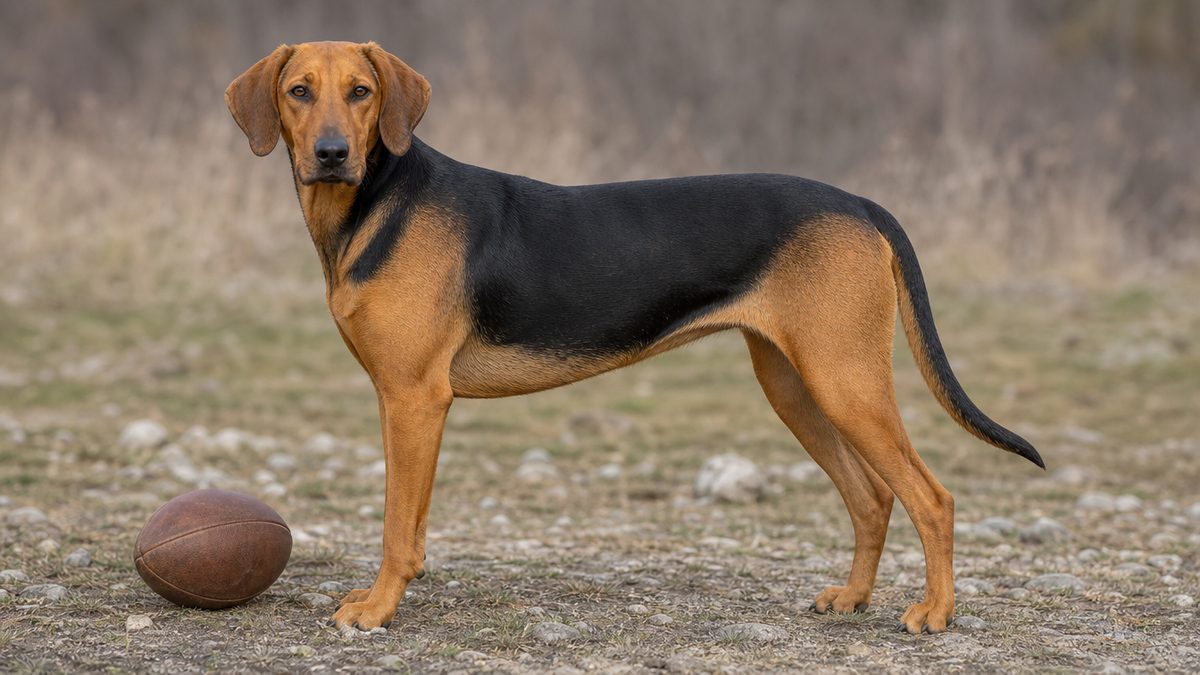
The coat is harsh, not too short, lying very close to the body, short and smooth on the head, ears and front of the legs. The colour is tan with a well defined black mantle, and the standard specifies exactly where each colour sits.
| Colour | Must cover |
|---|---|
| Black mantle | Back of neck, back, upper shoulders, sides of trunk, loin, upper side of tail |
| Tan | Head, throat, chest, lower shoulders, forelegs, hind legs to the hips, under the tail |
| Tan shades | From golden to rich and deep tan |
| White | Slight markings on chest and toes permissible only |
| Not allowed | Black hair mingled in the tan on an adult dog |
| Permitted anyway | Black markings on the cheeks |
That last pair of rows is the useful buying check. A Schillerstovare should read as two clean fields of colour with a defined boundary, not as a sooty tan. A dog with black hairs scattered through the tan is faulted by its own standard once adult.
The Schillerstovare is one of the breeds the FCI marks as subject to a working trial, and Sweden enforces that in its own breeding rules. The Swedish association's recommendation is that both sires and dams should hold two hunting trial results in the open or young class and a Good grading at a show before breeding, and that no male should leave more than four litters. Those are unusually concrete conditions, and they tell you this is a breed maintained for a job.
Built on two sibling matings, then rebuilt with three foreign breeds
The Schillerstovare is the oldest Swedish scent hound, founded in the 1880s on deliberate close inbreeding, and rebuilt from the mid-1990s with Lucerne, Finnish and Serbian hounds to escape a narrow breeding base and a hip dysplasia problem.
At the first dog show in Sweden in 1886, some 189 scent hounds were exhibited. Among them were a sister and brother named Tamburini and Ralla I, owned by the farmer Per Schiller. The breed's own strategy document adds that Schiller came from Stenungsund and was a contemporary of A.P. Hamilton, who made the Hamiltonstovare, and O.B. Rydholm.
Three founding components, one of them born in transit
- Hounds from Lilla Slappet at Kavlas, probably of South German origin, black-brown with small white markings and rather small.
- Swiss hounds of various types, imported in the 1870s by H. Carbonnier, some of them black with red-yellow markings.
- English stock imported by O.B. Rydholm, including the harrier Crossy, who reached Sweden in utero in a harrier bitch brought in by an English engineer working on the Nassjo to Oskarshamn railway.
What Schiller did next was unusual for its time. He began building the breed on the offspring of two sibling matings, aiming for a dog that could hunt among the bare and heather-clad hills of Bohuslan. The breed consolidated under strong inbreeding and reached a constant type quickly, with the continental element dominating. Per Schiller died suddenly on New Year's night 1892, aged only 34.
A recognition date worth reading twice
The FCI standard states the breed was recognised by the Swedish Kennel Club in 1907. The breed association's own document is more precise and slightly different: in 1907 the designation Schillerstovare entered the studbook as a subheading under hounds of crossed stock, and only from 1913 was the breed called Schillerstovare outright. Both are on the record. The club's version explains the standard's shorthand rather than contradicting it, and it is the more informative of the two.
Genetic variation is the club's first stated priority, and it is measured
Genetic variation carries the highest priority in the Schillerstovare's breeding strategy, and it has done since the association was founded. The RAS states that an important goal at the founding, still current today, was to hold the inbreeding coefficient low through genetic variation, and its closing summary of priorities opens with widening the breeding base and the genetic variation. The document then publishes the numbers rather than leaving the claim as a slogan.
| Period | Mean inbreeding coefficient | What the association records |
|---|---|---|
| Early 1990s | 2.5 to 3 percent | Held steady at that level |
| 2018 to 2023 | 0.5 to 1.1 percent | Falling steadily |
| 2018 alone | 0.0 percent in six litters | Six litters born that year with a calculated coefficient of zero |
Three named strategies hold it there. No single stud dog may leave more than 4 litters. Dogs from the association's own breed-care programme are used deliberately. Serbian Hounds are brought in wherever the club can obtain them. The stated ceiling is a mean inbreeding coefficient of no more than 2.5 percent, which is exactly the level the breed sat at in the early 1990s, so the association has set its limit at its own historic worst and currently runs at roughly a fifth of it.
Litter size moved the same way over the same period, although the document draws no causal link between the two. Mean litter size has stayed above 6 puppies per litter since 2006, apart from a dip in 2013 and 2014, and 2021 was a record year at 7.6 puppies per litter. For an Indian reader the transferable point is the method rather than the Swedish arithmetic. A numbered inbreeding target, a published trend and a hard cap on stud use are what a serious breed body looks like, and they are the three questions to put to anyone anywhere who offers you a puppy.
The reconstruction, which is the most interesting thing about this breed
During the 1970s and 1980s a small number of males gained too much influence in breeding. The breeding base shrank and problems including hip dysplasia were noticed. From the mid-1990s the Swedish association began crossing in other breeds to widen the base and improve health.
| Breed crossed in | FCI number | Reported outcome |
|---|---|---|
| Lucerne Hound (Luzernstovare) | Swiss Hound, 59 | Chosen because it had at that time had no case of hip dysplasia |
| Finnish Hound (Finskstovare) | 51 | Used, with mixed results |
| Serbian Hound (Serbski gonic) | 150 | Several imported; the club records good results |
The Serbian Hound needs one clarification, because the same document uses two names for it. It calls the breed balkanski gonic in its introduction and Serbski Gonic, formerly called Balkanski Gonic or Balkanstovare in its population section, which is the document telling you itself that these are one breed under an old and a new name. The FCI holds it as standard 150, SRPSKI GONIC, English name Serbian Hound, country of origin Serbia.
The Schillerstovare is not in any health programme for hip dysplasia today. The Swedish Kennel Club requires no hip radiograph for the breed, and the breed's own strategy states in as many words that the previous health programme has been removed because hips are no longer a problem. A breed that inbred itself into a corner, outcrossed deliberately to three other hounds, and then had its hip screening requirement withdrawn is about as clean a worked example of managed genetic rescue as dog breeding offers.
Schillerstovare price in India: there is not even a page
No Schillerstovare price exists in India, and unusually there is no Indian web page for the breed at all. Both template sites that publish a priced page for almost every other breed return an error for this one.
Most rare-breed pages on this site have to unpick a bad Indian price. This one does not, and the reason is a stronger finding. We requested the two Indian sites directly by URL rather than relying on a search engine.
| Site | HTTP status | Page title returned |
|---|---|---|
| poodles.in/dog-breeds/schillerstovare | 200 | Dog Breed Not Found | Poodles.in |
| puppiezo.com/dog-breeds/schillerstovare/ | 404 | None |
The poodles.in result is worth dwelling on, because it is a trap for anyone checking availability with a script. It returns HTTP 200, so a status check passes and an automated tool records the page as live, while the title says Dog Breed Not Found. Read the title, not the status. puppiezo.com is more honest about it and returns a genuine 404.
So for this breed there is no preset cost row to expose, no house price carousel, and no rupee figure to divide by 84.38, 80 or 74. The English-language results are a US insurance page, two aggregator profiles, a European puppy marketplace, an image board, the Swedish Kennel Club's own page and Wikipedia, and none of them carries a rupee figure.
Why no lawful Indian supply chain can form
Dogs are a Restricted import into India, and applications to import for trading or breeding purposes are rejected, which leaves a genuine relocating owner's pet and the narrow research and defence categories. Layer on a breed whose Swedish registrations are below its own club's target of 130 puppies a year, whose breeding rules require two hunting trial passes and a show grading before a mating, and whose working purpose is hunting fox in Scandinavian terrain, and the absence of an Indian market stops being surprising.
Treat it as a misidentification until proved otherwise. The most likely dogs to be offered under this name are a Hamiltonstovare, a Beagle cross or a generic tan-and-black hound, and the fastest check is white: the Schillerstovare permits only slight white on chest and toes, while the Hamiltonstovare carries clear white on head, neck, chest, feet and tail tip. Then ask for the studbook registration and the parents' hunting trial results, which a genuine Swedish-bred dog will have.
Monthly cost of ownership in an Indian city
Keeping a 20 to 25 kg working scent hound in an Indian metro costs roughly Rs 6,500 to Rs 10,000 a month, and the line this breed makes cheap is grooming while the line it makes expensive is everything to do with exercise.
The cost of ownership for a short-coated hound is dominated by parasite control and food. Every price below comes from a named Indian seller's or authority's own page, read on 9 September 2026.
| Item | Price | Source and note |
|---|---|---|
| NexGard Spectra, 15 to 30 kg, 3 tablets | Rs 3,308, MRP Rs 3,375 | Supertails, about Rs 1,103 a month, the correct band here |
| Anti-rabies, single dose | Rs 699 | Vetic national page |
| 9-in-1 DHPPiL | Rs 899 | Vetic national page |
| Kennel cough | Rs 1,349 | Vetic national page, and relevant given this breed's airway record |
| Adult annual booster course | From Rs 3,199 | Vetic, struck-through list price Rs 3,806 |
| Puppy course, first year | From Rs 6,499 | Vetic, struck-through list price Rs 8,111 |
| Bathing, salon | From Rs 934 | Vetic Delhi grooming list, rarely needed for this coat |
| Home boarding, Bengaluru | Rs 499 to Rs 899 per tier | PawSpace published plans |
| Delhi MCD pet dog registration | Rs 500, renewal Rs 500 | Municipal Corporation of Delhi |
| Chennai GCC pet licence | Rs 50 | Greater Chennai Corporation |
| Microchipping, Chennai | Rs 1,250 | SKS Veterinary Hospital's own transacted price |
Three of those lines are worth attributing individually, because Indian cost articles routinely omit them: PawSpace publishes its Bengaluru boarding tiers openly, the Municipal Corporation of Delhi publishes the Rs 500 registration fee and a Rs 100 per month late fee, and the Rs 1,250 Chennai microchipping figure is a clinic's own transacted price rather than a range.
The kennel cough line is not boilerplate for this breed
An Agria compilation cited in the breed's own strategy shows Schillerstovare have a higher frequency of respiratory tract disease than average, which the club attributes to hard-working hunting dogs straining their airways, alongside infection, catarrh and dental causes. In an Indian city, add dust and traffic pollution to that. The Rs 1,349 kennel cough vaccine is therefore a more defensible line on this breed's budget than on most.
Parasite control earns its place too. A West Bengal study of 584 dogs screened at veterinary clinics reported 72.9 percent of the 584 dogs screened carrying two or more pathogens, with Babesia gibsoni in 76.54 percent, and a southern Indian study of 120 dogs found Babesia in 66.7 percent with a pre-monsoon peak from March to May. Both sampled clinic caseloads, so read them as the burden among dogs presented to a vet. A dog that works in cover meets more ticks than a dog that walks on pavement.
- Budget Rs 1,103 a month for combined tick, flea and worm cover.
- Budget Rs 270 a month as the amortised share of a Rs 3,199 annual booster.
- Budget for food for a lean, hard-working 20 to 25 kg hound.
- Budget almost nothing for grooming, which is genuinely the affordable part of this breed.
- Budget for fencing, because a scent hound that picks up a line will follow it.
Greater Chennai Corporation licenses pet animals at Rs 50 and runs six municipal veterinary clinics that provide treatment and anti-rabies vaccination free of cost. For a Chennai household that removes the vaccination line entirely, which matters more to a real budget than any breed price.
Heat tolerance: a stamina hound built for a 17 degree summer
The Schillerstovare's homeland averages 7.91 C across the year and 17.19 C in the warmest month. The short close coat helps, but this is an endurance hunting breed, and endurance work is exactly what causes canine heat illness.
We queried NASA POWER by explicit latitude and longitude at Stenungsund in Bohuslan, the district the breed's own strategy names as Per Schiller's home and the terrain he bred for, at 58.0709 N and 11.8180 E. The model returned a cell elevation of 54.01 m against a real elevation near 15 m, an error of about 39 m, which is inside the usable range for a coastal plain point.
| Place | Annual mean C | Warmest month | Coldest month | Annual humidity percent | Peak wet bulb C |
|---|---|---|---|---|---|
| Stenungsund, Bohuslan | 7.91 | July, 17.19 | February, -0.62 | 86.81 | July, 14.91 |
| Delhi | 25.60 | June, 35.88 | January, 13.61 | 45.56 | July, 26.50 |
| Chennai | 27.95 | May, 31.51 | January, 24.09 | 72.39 | May, 26.11 |
| Mumbai | 26.77 | May, 31.19 | January, 23.19 | 67.39 | June, 25.77 |
| Bengaluru | 23.74 | April, 28.37 | December, 20.22 | 67.94 | May, 21.86 |
| Kolkata | 25.81 | May, 31.53 | January, 17.31 | 73.93 | June, 27.09 |
One small detail in that table is worth naming because it is easy to get wrong. Stenungsund's coldest month is February, not January, and Delhi peaks in June rather than May while Bengaluru peaks in April and is coolest in December. Planning an Indian summer routine around May puts Delhi's hottest month a month early and its wet-bulb peak two months early. The mean rises only 0.83 C from May to June, but the Stull wet bulb climbs from 20.37 C in May to 26.50 C in July. Heat load, not air temperature, is what actually moves.
Both Indian anchor cities were pulled by explicit coordinate and re-verified on 9 September 2026 rather than carried over from a sibling page. Delhi at 28.6139 N 77.2090 E returned a cell elevation of 206.37 m against a real 216 m, and Chennai at 13.0827 N 80.2707 E returned 48.95 m against a real 6 m NASA POWER climatology 2001-2020…. Both errors are small, which is what NASA POWER does over plains cities and precisely what it does not do over hill stations, so neither figure needs a lapse-rate correction.
The humidity warning is again the wrong warning
Stenungsund runs 86.81 percent annual relative humidity, well above Chennai's 72.39, Kolkata's 73.93, Mumbai's 67.39 and Delhi's 45.56. A Bohuslan coast is a damp place. So the risk to this heat-sensitive breed in India is heat and wet-bulb load, not damp air, and the useful comparison is Stenungsund's July wet bulb of 14.91 C against Kolkata's June figure of 27.09 C.
Why the coat does not save this one
The Schillerstovare has the easiest coat in this batch of six, harsh and lying very close to the body, and that genuinely helps against heat compared with a profusely coated northern spitz. The problem is the job rather than the jacket. Hall 2020 found that 652 of 879 heat-related illness events with a recorded trigger, 74.2 percent, were exertional, against 113 environmental and 46 from vehicular confinement. This breed was not separately modelled in that study, so no breed-specific odds ratio is claimed here, but a hound bred to run a line for hours sits squarely in the category the study identifies.
Indian law reaches this too. Second Schedule Part IV paragraph 21(1) of the 2017 Rules bars keeping in outdoor facilities, without written veterinary approval, dogs not accustomed to the temperatures prevalent in the area, breeds that cannot tolerate them, and sick, infirm, aged or young animals. A Scandinavian hunting hound kennelled outdoors in an Indian summer is the first of those categories.
Never let this breed run itself out in the heat. A scent hound on a line does not self-regulate, it does not respond to recall, and it will keep going past its own safe limit because that is precisely what it was selected to do. Exercise it before dawn and after dark from March to June, keep it on a long line rather than free, and treat any staggering, bright red gums or collapse as an emergency and get to your nearby vet immediately.
Temperament and household fit
The Schillerstovare is lively and attentive by its standard and reportedly easy in the house, but it is a specialist fox and hare hound and its voice, nose and stamina decide whether it fits your household.
The FCI's behaviour clause is two words, lively and attentive, which is unusually terse even for a hound standard. The breed's Swedish documentation adds substance from the working side: the breed is known for its careful, accurate line work, its hunting keenness, early hunting maturity and a resonant voice.
The voice is the working equipment
The standard's own definition of the breed's utilization is a scent hound that gives tongue. A hound that does not speak on the line is a failed hunting dog, so voice is selected for rather than tolerated. In Sweden that is an asset. In an Indian apartment block it is the single fact that decides the question, and no amount of training removes it, because you would be training against the breed's purpose.
How much a Schillerstovare barks, and what the aggregator pages add
A Schillerstovare barks because it was selected to, and the Swedish record says so in its own words. The breed's strategy document names jaktlust, tidig jaktmognad och klangfullt skall, hunting keenness, early hunting maturity and a resonant bark, as the three qualities that marked the Schiller dogs out from the beginning. The Swedish Kennel Club states the same fact admiringly, calling the breed "highly appreciated for its most powerful, clean voice";. Neither body treats the bark as a fault, because in Sweden it is the instrument the dog is bought for.
English-language breed pages then turn that working bark into a security feature the primary documents never claim. Wag's profile says the breed's likely response to a stranger is "a deep, booming bark or howl to alert their owners", calls the dog a good watch dog on that basis, and adds that it "could cause issues in an apartment setting";. The word alert appears zero times in FCI Standard 131, across all seven pages of its English text, which gives the entire behaviour clause as "Lively and attentive"; the German edition of 25.09.2018 renders it "Lebhaft und aufmerksam";. The Swedish Kennel Club leans the other way again and describes "an even and calm temperament" that is "easy to train";. An alert guard dog is therefore a character that grew in translation between Stockholm and the English-language directories, and an Indian buyer shopping for a watchdog on that description is buying a hare hound instead.
Do not put this breed in an Indian flat. A hound bred for a resonant bark, in a building where the nearest bedroom sits on the other side of one wall, produces neighbour complaints, and neighbour complaints are how dogs get surrendered. The most useful sentence on any aggregator page about this breed is Wag's own admission that the bark could cause issues in an apartment setting. Take that at face value and ignore the watchdog framing wrapped around it.
It works alone, which changes the household calculation
The standard specifies that the Schillerstovare is not a pack hound, nor hunted in couples. That means an independent worker rather than a dog that takes constant direction, and it also means the breed does not require canine company in the way a pack breed does. For an Indian household the practical translation is a dog that is content alone with a job but will make its own entertainment without one.
- Suits a rural or semi-rural Indian home with secure fencing and space to run at dawn.
- Suits an owner who wants a hardy, low-grooming, physically robust dog and can meet the exercise demand.
- Suits someone who genuinely does not mind a loud dog.
- Does not suit any apartment, for noise reasons before heat reasons.
- Does not suit an owner who wants off-lead freedom, because a hound on a scent stops listening.
- Does not suit a first-time owner, since this is a specialist hunting breed with no Indian support network.
- Does not suit a household with free-roaming cats or small pets, given what the breed hunts.
Unlike the Swedish Lapphund, this breed's documentation carries no published behaviour-test profile. Its association collects young-dog assessments from owners with a response rate of around 40 percent, covering both health and hunting qualities, but no equivalent of a national mentality description is reported. So the temperament picture here rests on the standard and on working reports rather than on a behavioural dataset, and we would rather say so than dress it up.
Training a scent hound that was bred to work alone
Train a Schillerstovare on a long line with high-value food, accept that recall competes with a scent, and give the nose a legitimate job, because this breed's independence is a selected trait rather than stubbornness.
This is a trainable dog in the sense that it learns quickly and works keenly, and it is early to mature for hunting, which its own club records as one of the breed's historical advantages. What it is not is biddable in the obedience sense once a line is under its nose, and the standard's own note that it is not a pack hound and not hunted in couples tells you it was selected to make its own decisions at distance.
A workable Indian plan
- Use a long line for the first year rather than testing recall against a scent and losing.
- Socialise deliberately with people and traffic, since a rural hunting breed meets neither by default.
- Teach a settle and a quiet cue early, and pay silence rather than punishing sound.
- Give the nose real work through tracking and scatter feeding, which tires this breed better than distance.
- Train indoors on cool floors from March to June, and treat heat as the session limit.
- Fence properly before the dog arrives, because a hound that leaves on a line does not come back on request.
The Swedish system for assessing this breed is worth knowing even if you can never use it, because it shows what the breed is measured on. Breeding animals are expected to hold two hunting trial results plus a Good show grading, the association recommends assessing dogs between 12 and 24 months so development can be tracked, and it caps a male at four litters.
The trial data is unusually detailed. For dogs born in 2015, 76 males produced 25 qualified, which is 32.89 percent of all born but 92.59 percent of the 27 that actually started, and 74 females produced 22 qualified, 29.73 percent of born and 95.65 percent of the 23 that started. Read the two denominators separately: a third of all puppies qualify, but almost every dog that is entered passes, which says the owners know which dogs to enter rather than that the tests are easy.
A reconstructed breed sometimes loses the working ability the reconstruction was meant to preserve. This one did not. The Swedish fox championship was won by a Schillerstovare in 2023, and in 2024 Schillerstovare took first, second and third place, with about 80 percent of the breed's owners hunting fox and other predators. That is the strongest available evidence that crossing in three foreign hounds fixed the health problem without costing the breed its function.
Daily exercise needs, and why this is the constraint
Plan at least ninety minutes a day for an adult Schillerstovare, almost entirely in the cool hours, and accept that no Indian city routine fully substitutes for the work this breed was built to do.
This is the highest exercise requirement in this batch of six breeds. The Schillerstovare was bred to run a hare or fox line across bare and heather-clad hills for hours, and the standard asks for parallel, strong, long-reaching movement and a body giving an impression of speed and strength.
What under-exercise produces
- Baying at every sound, because a hound with no line to follow uses its voice on whatever is available.
- Escaping, since a bored scent hound treats a boundary as a problem to solve.
- Destructive behaviour indoors during the hours the household is out.
- Weight gain, which matters on a breed whose whole conformation is built for sustained running.
An Indian pattern that works, and its honest limits
- Take 45 to 60 minutes before sunrise on a long line, which is the only genuinely safe outdoor window for most of the Indian year.
- Take 20 to 30 minutes after dark on surfaces you have tested with the back of a hand.
- Add 20 minutes of scent work indoors, which is the closest legitimate substitute for the breed's real job.
- Replace distance with tracking difficulty in April, May and June rather than shortening the session and adding frustration.
- Never run this breed off-lead in an unfenced Indian street, because a scent will win.
Scent work deserves emphasis rather than being listed as an afterthought. A dog selected for careful, accurate line work gets more from twenty minutes of tracking than from an hour of walking, and in Indian conditions it can be done indoors on a cool floor at any hour. It is the single adaptation that makes this breed's exercise budget survivable in a hot country.
For most breeds heat management and exercise are separate topics. For this one they are the same topic, because the exertional trigger is the dominant cause of canine heat illness and this breed's defining quality is willingness to keep working. Plan every session around the thermometer rather than around what the dog seems able to do, and stop before it wants to.
Grooming: the genuinely easy part of this breed
Brush a Schillerstovare once a week with a rubber mitt or bristle brush, bathe it rarely, and spend the time you save on ears, feet and ticks instead.
The coat is harsh, not too short, lying very close to the body, short and smooth on the head, ears and front of the legs, with slightly longer hair under the tail and on the back of the thighs. There is no undercoat management to do, no stripping, no clipping and no seasonal blow-out on the scale of the Nordic spitzes. It will still shed, moderately and continuously, but a weekly brush handles it.
Where the real work is on this breed
- Ears, because hanging ears that lie close to the cheeks trap moisture, and Indian monsoon humidity turns that into otitis.
- Feet and pads, since a working hound picks up grass seeds, thorns and tar, and Indian tarmac burns pads at temperatures that feel manageable in shoes.
- Ticks, checked by hand after every walk in cover, in addition to a monthly preventive.
- Teeth and throat, given the breed's above-average record of respiratory and throat problems.
- Skin folds behind the elbows, which stay damp in humid weather on a close-coated dog.
The ear point is where overseas advice transfers badly. A Swedish club can reasonably tell an owner to towel a dog and let it dry. In a Mumbai or Kolkata monsoon, an ear canal covered by a flat hanging ear stays damp for hours, and that is the commonest route to a chronic ear problem in a drop-eared breed in India. Dry the ear leather and the canal opening after every wet walk and every bath.
Salon grooming is essentially unnecessary here. A bath in Delhi starts at Rs 934, and this breed needs one perhaps every couple of months. Compared with the Swedish Lapphund in this same batch, the grooming budget is close to zero, and that is a genuine practical advantage for an Indian owner.
The standard forbids black hair mingled into the tan on an adult dog, which means a healthy, correctly coloured Schillerstovare should show two clean fields. If the tan starts to look sooty or the mantle edge blurs, that is worth mentioning to your vet alongside any coat or skin change rather than treating it as cosmetic, because coat quality on a close-coated working dog reflects condition.
Health risks, screening and life expectancy
The Schillerstovare is in the lowest insurance group with several Swedish insurers and no longer has a hip dysplasia health programme, but its own breed strategy names three historical problems and one current insurance finding that English-language sources miss entirely.
What the breed's own documentation records
The Swedish association states that the Schiller breed previously had three health problems: hip dysplasia, cryptorchidism and persistent ductus arteriosus. Other conditions including epilepsy have occurred, but to a very limited extent, and the breed sits in the lowest insurance group according to several insurance companies.
| Condition | Current position | Breeding rule applied |
|---|---|---|
| Hip dysplasia | No longer a problem; the health programme has been removed and no radiograph is required | General SKK rules only: no grade E in breeding, no D to D mating |
| Persistent ductus arteriosus | Followed a breeding programme for 20 years; cases reduced and a declining trend recently | If more than one offspring is affected, the parents are not bred again |
| Cryptorchidism | Long suspected to be high in the breed; cases in the last decade limited to a few individuals and litters | If a single male in a litter is affected, littermates and parents may be used with great caution |
| Epilepsy | Sporadic, only isolated new known cases in ten years, but carriers are known to exist | Assumed simple recessive: an affected dog is not bred, a producer of affected offspring is bred with caution |
The PDA entry deserves attention because it is the one an Indian buyer could actually act on. Persistent ductus arteriosus is a congenital heart defect that a veterinarian can usually detect as a characteristic continuous murmur on a puppy examination. Ask for that examination rather than assuming a twenty-year Swedish breeding programme protects a dog sold to you outside it, and take any murmur finding to your nearby vet.
The airway finding nobody else reports
An Agria compilation cited in the same document shows that Schillerstovare have a higher frequency of respiratory tract disease than the average breed. The club's own explanation is that throat inflammation is not uncommon in hunting dogs and can follow bacterial, viral or parasitic infection, strain on the mucous membranes during hard hunting, gastric catarrh or dental disease with bacterial growth, and that the condition most often affects high-performing hunting dogs that push their airways to the limit.
For an Indian owner that transfers directly and gets worse. Add urban dust, traffic pollution and a hot dry pre-monsoon season to a breed already recorded as airway-prone, and a persistent cough is worth a veterinary examination rather than a wait-and-see.
Life expectancy, and the literature that does not exist
No published median lifespan exists for this breed. McMillan 2024 lists the Schillerstovare in supplementary Table S5 and flags it N, meaning it was excluded from the survival analysis, so the paper produced no median, no confidence interval and no hazard ratio for it.
There is also no veterinary literature at all. Eight name forms returned zero PubMed records with clean, unrewritten query translations, and the single hit for schiller combined with dog is an ovarian mixed germ cell tumour case report that matches on Schiller-Duval bodies rather than on the breed. Controls run in the same session returned 47 records for Labrador Retriever with hip dysplasia, 26 for Norwegian Elkhound and 1 for Hamiltonstovare, so the instrument was working and the absence is real.
English Wikipedia's health section states that no unusual diseases or claims of extraordinary health have been documented for this breed, sourced to a dead link to a commercial puppy site. The breed's own SKK-established strategy, published in March 2025, names three historical health problems, an ongoing epilepsy watch with known carriers, and an insurance finding of above-average respiratory disease. Both statements are about the same dog. Read the breed club's document, and discuss any of it with your nearby vet rather than with an encyclopedia.
Feeding and nutrition for a lean working hound
Feed a Schillerstovare to a visibly lean, athletic body condition, split into two meals well clear of exercise, because this is a running breed whose whole structure depends on carrying no surplus.
The FCI describes a sinewy dog giving an impression of speed and strength, and gives no weight figure at all, so feed to the pack chart for the dog's measured weight rather than to a kilogram range taken from a website. Wikipedia's 18 to 25 kg comes from a superseded 2001 standard file and carries its own citation-needed tag.
Timing matters more on this breed than the brand does
Deep-chested running breeds should not be fed immediately before or after hard exercise. In Indian conditions that combines conveniently with the heat rule, because the only safe exercise windows are before dawn and after dark anyway. Feed the smaller meal after the morning session has finished and the dog has cooled, and the larger one in the evening well clear of the night walk.
- Weigh the dog monthly and record it, because a working hound hides weight gain under muscle.
- Feed measured meals rather than free feeding, so an appetite change is visible.
- Leave a clear gap between feeding and exercise in both directions.
- Keep treats inside the daily budget, using part of the ration for tracking rewards.
- Add water to dry food in the hot months to lift total fluid intake.
- Store kibble airtight, because Indian monsoon humidity spoils an open bag quickly.
There is no Indian feeding literature for this breed and none is invented here. Puppy feeding follows the standard medium-breed pattern of four meals a day to about four months, three to about six months, then two. Any growth plan, and any question about feeding a dog that is genuinely working in Indian heat, belongs with your nearby vet.
Several Swedish insurers place this breed in their lowest insurance group, which is about as good a general health signal as a breed gets. The exception is its airways, where insurance data shows an above-average frequency of respiratory disease attributed to hard-working hunting dogs. Dental disease is one of the causes the breed club itself lists for throat inflammation, which makes routine dental care a more load-bearing part of this breed's feeding and husbandry plan than it would be on most.
Month by month through the first year in India
Plan the first year around the eight-week legal floor on sale, a puppy heart check, the vaccination course, and the fact that this breed's recall gets harder rather than easier as the nose matures.
| Age | What matters most | India-specific note |
|---|---|---|
| Before 8 weeks | The puppy stays with its litter | Rule 8(1)(a) forbids selling a pup under eight weeks |
| 8 to 10 weeks | Settling, crate, and a veterinary heart auscultation | Ask specifically about a continuous murmur, given the breed's PDA history |
| 10 to 14 weeks | Socialisation with people, traffic and household noise | Vaccination course starts; Vetic prices a puppy course from Rs 6,499 |
| 3 to 4 months | Long-line habit established before the nose takes over | Train indoors on cool floors if this falls in March to June |
| 4 to 6 months | Tracking games introduced as the real outlet | Register with the municipality: Delhi Rs 500, Chennai Rs 50 |
| 6 months | Sterilisation discussion, and a check that both testicles are descended | Rule 8(1)(b) bars sale of an unsterilised dog over six months |
| 6 to 9 months | Stamina builds fast; resist adding distance in the heat | The hottest months are the wrong time to increase workload |
| 9 to 12 months | Adult exercise pattern, fencing tested properly | Confirm the fence before the first serious scent, not after |
The two breed-specific checks
Ask the vet to listen to the heart carefully at the first puppy visit. Persistent ductus arteriosus is one of the three conditions the breed's own strategy names, it was managed by a twenty-year Swedish breeding programme, and it usually presents as a characteristic continuous murmur that a general examination can pick up. A dog bought outside that Swedish system carries none of the programme's protection.
Check that both testicles have descended in a male puppy. Cryptorchidism is the second named condition, long suspected to run high in the breed although cases in the last decade have been limited to a few individuals and litters. It is also relevant to Indian law, since Second Schedule Part III paragraph 8(10) of the 2017 Rules lists unilateral cryptorchid or full cryptorchid males among the genetic defects a breeding dog must have been tested for.
Rule 8(1)(a) of the Prevention of Cruelty to Animals (Dog Breeding and Marketing) Rules 2017 forbids selling a puppy under eight weeks. On a breed with a specialist working temperament and no Indian support network, an early-separated puppy also loses the litter learning that makes an independent hound liveable. If a seller will break one rule, ask what else has been skipped.
Schillerstovare against the hounds it is confused with
The Schillerstovare is confused with the Hamiltonstovare above all, and an Indian buyer is realistically choosing between a hound they cannot get and a Beagle they can.
| Breed | FCI number | Coat pattern | Available in India | Published lifespan median |
|---|---|---|---|---|
| Schillerstovare | 131 | Tan with a defined black mantle, slight white on chest and toes only | No page exists on either Indian site | None; excluded from McMillan 2024 |
| Hamiltonstovare | 132 | Tricolour with clear white on head, neck, chest, feet and tail tip | Rare | See our Hamiltonstovare page |
| Smaland Hound | 129 | Black and tan, and often a natural bobtail | No | None published |
| Beagle | 161 | Usually tricolour, much smaller | Widely available | Published and well studied |
The white test
The fastest way to tell a Schillerstovare from a Hamiltonstovare is white. The Schillerstovare permits only slight white markings on the chest and toes, while the Hamiltonstovare carries clear white on the head, neck, chest, feet and tail tip. A dog offered as a Schillerstovare with a white blaze and a white tail tip is not one.
The second test is the mantle boundary. The Schillerstovare's black must form a defined mantle over specified areas with no black hair mingled into the tan on an adult, which produces two clean fields rather than the graded shading of many black-and-tan hounds.
Choosing for an Indian household
- Choose a Beagle if the appeal is a scent hound you can actually obtain, support and insure in India.
- Choose a Drever if the appeal is Swedish hound character in a slower, shorter-legged dog.
- Choose an adopted Indian dog if the appeal is a hardy, low-grooming, weatherproof animal.
- Choose the Schillerstovare only if you hunt, live rurally, and can import lawfully as a relocating owner.
One comparison is worth making against a sibling page on this site rather than against another breed. The Swedish Vallhund and the Schillerstovare were both built from tiny founder bases and both nearly failed. The Vallhund's club chose to preserve a closed population and now carries the lowest measured genetic diversity of any breed UC Davis has tested. The Schillerstovare's club chose to cross in three other hound breeds and now has no hip dysplasia programme at all. Two Swedish breeds, two opposite strategies, both documented openly by their own clubs.
Mistakes Indian buyers make with this breed
Five mistakes account for most trouble with this breed in India, and the first is believing the dog in front of you is one.
- Accepting the identification. With no Indian page and no Indian breeding population, any dog offered under this name is more likely a Hamiltonstovare, a Beagle cross or a generic tan-and-black hound.
- Trusting an HTTP status. poodles.in returns 200 for this breed with the title Dog Breed Not Found, so an automated availability check reads it as a live page.
- Taking Wikipedia's size and health text at face value, when its measurements come from a 2001 file and its health sentence is sourced to a dead commercial link.
- Putting the dog in a flat. This breed's FCI-defined job is to give tongue on a line, and that is not trainable away.
- Exercising it hard in Indian heat because it appears willing, when exertional triggers dominate canine heat illness.
The mistake specific to a reconstructed breed
Do not treat the outcross history as a defect. Some buyers, told that Lucerne, Finnish and Serbian hounds were crossed in from the mid-1990s, conclude the breed is impure or diluted. The evidence points the other way: the intervention was planned by the breed association with geneticists, it was aimed at a documented hip dysplasia problem and a narrow breeding base, the hip health programme was subsequently withdrawn, the inbreeding coefficient fell from 2.5 to 3 percent in the early 1990s to 0.5 to 1.1 percent between 2018 and 2023, and the breed went on to win the Swedish fox championship in 2023.
The mistake an answer engine will make for you
Do not accept a rupee band from an AI summary for this breed. Because no Indian page exists, there is nothing for a generated answer to quote, which is precisely the situation in which answer engines have repeatedly been recorded stating that no Indian price exists and then printing a confident rupee band derived from a foreign asking price. If a number appears, ask which page it came from, then open that page.
Ask for the studbook registration and which studbook it is in. Ask for both parents' hunting trial results, because Swedish breeding rules require two. Ask for a veterinary heart auscultation certificate given the breed's PDA history, and confirm both testicles are descended in a male. Ask for the import paperwork. Dogs are a Restricted import into India and applications to import for trading or breeding purposes are rejected, so a commercially bred Indian line of this breed has no lawful origin story.
Adoption and responsible sourcing
Adopt rather than import, because there is no lawful commercial route to a Schillerstovare in India, no Indian page for the breed, and no support network if something goes wrong.
The legal position comes first. Dogs enter India as a Restricted import and applications to import for trading or breeding purposes are rejected, leaving a genuine relocating owner's pet and the narrow research and defence categories. For a breed whose Swedish registrations sit below its own club's target of at least 130 puppies a year, and whose breeding requires hunting trial results most Indian owners could never obtain, that is the end of the commercial question.
What the appeal actually is, and where to find it here
People are drawn to this breed for a specific set of qualities: a hardy, athletic, low-maintenance dog with a short easy coat, a strong nose, real stamina and a handsome two-colour pattern. Every one of those is available in India in a dog that is already here.
- Contact your city's established shelters and rescue networks, and ask for a medium, high-stamina, scent-driven dog.
- Ask specifically about noise, because a vocal rescue dog and a vocal hound cause the same problem in a flat.
- Register the adopted dog with your municipality, at Rs 500 in Delhi or Rs 50 in Chennai.
- Budget the same Rs 1,103 a month for parasite control, because a scent-driven dog in cover meets more ticks.
- Use the free municipal veterinary clinics if you are in Chennai.
If you are determined to have this breed
Work through the Swedish system, which is open and checkable. The Swedish Kennel Club publishes the breed's page and the association publishes its full breeding strategy, which sets a maximum inbreeding coefficient of 2.5 percent on an individual mating, caps a male at four litters, requires two hunting trial results and a Good show grading for both parents, and recommends assessing dogs between 12 and 24 months. A breeder working to those rules is identifiable, and the realistic answer for an Indian buyer is a long wait and a legitimate relocation rather than a purchase.
Ask one more question that this breed makes possible and most do not. Because the association runs a breed conservation programme with its own AS-register and continues to use imported Serbian hounds, a Swedish breeder can tell you exactly which outcross lines sit in a puppy's pedigree. That is unusually good provenance, and it is worth asking for.
It is fit. A Schillerstovare in an Indian city is a fox hound with no fox, no legal off-lead ground, no safe daytime exercise window for four months of the year, and a voice its neighbours did not agree to. The breed is not fragile and it is not unhealthy; its own insurers rank it in their lowest group. It is simply a working animal with a job that does not exist here, and an adopted Indian dog gives the same companionship without asking anyone to pretend otherwise.
Schillerstovare questions Indian buyers ask
What is the Schillerstovare price in India?
There is no Schillerstovare price in India, and there is no Indian page for the breed either. Requested directly, poodles.in returns HTTP 200 with the title Dog Breed Not Found and puppiezo.com returns a genuine 404, so the two sites that publish a priced page for almost every other breed have no entry for this one.
Is the Schillerstovare the same as the Hamiltonstovare?
No. They are separate FCI breeds created in the same era by different men, Per Schiller and A.P. Hamilton, who were contemporaries. The quickest visual check is white: the Schillerstovare permits only slight white on chest and toes, while the Hamiltonstovare carries clear white markings on head, neck, chest, feet and tail tip.
How big is a Schillerstovare?
The FCI standard sets males at 53 to 61 cm with an ideal of 57 cm and females at 49 to 57 cm with an ideal of 53 cm. It gives no weight at all. Wikipedia's single 53 to 61 cm range is the male range applied to the whole breed, and its 18 to 25 kg weight comes from a 2001 standard file rather than the text in force.
Was the Schillerstovare crossed with other breeds?
Yes, deliberately and recently. From the mid-1990s the Swedish breed association crossed in the Lucerne Hound, which at the time had had no case of hip dysplasia, the Finnish Hound with mixed results, and a number of imported Serbian Hounds, formerly called Balkan Hounds, which gave good results. Many of today's Schillerstovare descend from those dogs.
Is the Schillerstovare a healthy breed?
It is now. The breed formerly had three health problems, hip dysplasia, cryptorchidism and persistent ductus arteriosus, and several insurers place it in their lowest insurance group today. The hip dysplasia health programme has been removed entirely because hips are no longer a problem, which is an unusually clear result for a breeding intervention.
How long do Schillerstovare live?
No published median exists. McMillan 2024 lists the Schillerstovare in its supplementary Table S5 and flags it N, meaning it was excluded from the survival analysis, so the study produced no median and no hazard ratio for it. That is different from the breed being absent from the paper, and no other lifespan study covers it.
Is there any veterinary research on the Schillerstovare?
None. Eight name forms returned zero PubMed records with clean query translations, and the single hit for schiller plus dog is an ovarian tumour case report matching on Schiller-Duval bodies. Controls passed in the same session at 47, 26 and 1 records, so the search worked and the absence is real.
Can a Schillerstovare live in an Indian apartment?
No, and noise is the reason before heat is. The FCI defines this breed's job as a scent hound that gives tongue, so voice is its working equipment rather than a training fault, and roughly 80 percent of its Swedish owners hunt fox and other predators with it. A flat cannot absorb that.
How much would a Schillerstovare cost per month in India?
Budget roughly Rs 6,500 to Rs 10,000 a month for a dog of this size. That is a 15 to 30 kg parasite dose at about Rs 1,103 a month, food for a lean 20 to 25 kg working hound, an annual booster from Rs 3,199 spread across the year, and a municipal licence at Rs 500 in Delhi or Rs 50 in Chennai.
Does the Schillerstovare need a working trial?
For FCI purposes yes. The breed is listed as subject to a working trial in the FCI breeds nomenclature, and its Swedish breeding recommendations require two hunting trial results in the open or young class plus a Good show grading for both sires and dams before breeding.
Is the Schillerstovare good for a first-time owner?
No. This is a fox and hare hound with high stamina, a working voice and a strong nose, and it is not a pack hound so it works alone and independently. A first-time Indian owner would be taking on a specialist hunting dog with no local support network, no breed club and no verifiable source.
What does the black mantle mean on this breed?
The black mantle is the breed's defining coat colour pattern, covering the back of the neck, the back, the upper shoulders, the sides of the trunk, the loin and the upper tail, over a tan body. Black hair mingled into the tan is not allowed in an adult, and only slight white on chest and toes is permissible.
Compare with similar breeds
Schillerstovare sits in 1 Bonbeno group. Each one compares it directly against the breeds it is genuinely an alternative to, on the same figures.