
Dog breed profile
Otterhound Price in India, Rarity, Heat and Full Breed Guide
There is no Otterhound price in India, and the reason is arithmetic. Ten puppies were registered in 2025 in the country that holds the largest population on earth, and the Kennel Club's own analysis puts the gene pool at 33.9.
Quick answer
No verified Otterhound price in India exists, because no Otterhound is sold here and none appears in any Indian registry. The Royal Kennel Club recorded 10 puppies in 2025 across the world's largest population, and the Kennel Club puts the breed's effective population size at 33.9, below the FAO's at-risk threshold of 50. Import for sale is prohibited.
This guide is general information for Indian pet owners and is not a diagnosis. Always consult a registered veterinarian near you before acting on anything you read here, and treat heat stress, sudden bleeding or a distended abdomen in a deep-chested hound as an emergency.
Otterhound at a glance, for an Indian home
What an Otterhound is
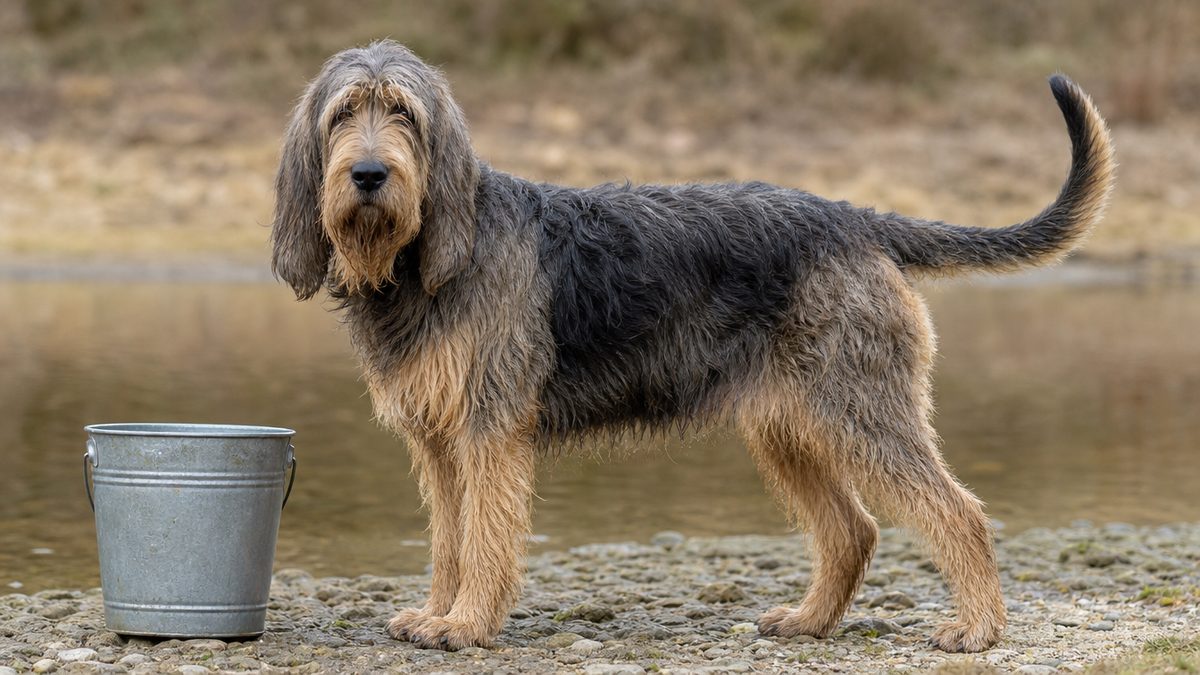
The Otterhound is a large, rough-coated British scent hound built for a long day's work in water, with a waterproof oily double coat, webbed feet and long draped ears. The Fédération Cynologique Internationale holds it as Standard 294, Group 6 Scenthounds, Section 1.1 Large-sized hounds, without working trial, with the origin given as Great Britain and the valid standard dated 13 October 2010.
Two features are load-bearing and both are unusual. The feet carry webbing, and both the FCI standard and The Royal Kennel Club use the same imperative wording, that the web must be in evidence on the forefeet and on the hind feet. The ears are described as the unique feature of the breed: long, pendulous, set level with the corner of the eye, long enough to reach the nose when pulled forward, with the leading edge folding or rolling inwards to give a curious draped appearance that the standard calls an essential point not to be lost.
The FCI standard adds the working detail that explains the coat. An Otterhound can follow a scent trail on land, called a drag, for up to twelve hours, and following a scent in water, called a wash, it may swim for five hours. A dog asked to do that needs insulation that works wet, which is why the coat is oily rather than merely thick.
The three registries disagree about the coat, and two give no weight at all
This matters more than it sounds, because coat length is the single figure an Indian reader most needs. The Royal Kennel Club and the FCI both specify a coat of 4 to 8 cm, dense, rough, harsh and waterproof but not wiry, of broken appearance, with an evident undercoat and a slight oily texture in top coat and undercoat. The American Kennel Club instead specifies an outer coat two to four inches long on the back, which is 5.1 to 10.2 cm, and makes a coat much longer than six inches a fault.
Those two ranges overlap only between 5.1 and 8 cm. A dog at the AKC's four inches is above the British ceiling, and a dog at the British floor of 4 cm is below the American one. Bonbeno publishes both rather than averaging them, because they are two live standards from two recognising bodies and neither is a misprint.
| Attribute | Royal Kennel Club | FCI Standard 294 | American Kennel Club |
|---|---|---|---|
| Height, males | 69 cm (27 in) | Approximately 69 cm | Approximately 27 in |
| Height, females | 61 cm (24 in) | Approximately 61 cm | Approximately 24 in |
| Weight, males | Not stated | Not stated | About 115 lb (52 kg) |
| Weight, females | Not stated | Not stated | About 80 lb (36 kg) |
| Outer coat length | 4 to 8 cm | 4 to 8 cm | 2 to 4 in (5.1 to 10.2 cm) |
| Undercoat | Evident, slight oily texture | Evident, slight oily texture | Water-resistant, short, woolly, slightly oily, essential |
| Trimming | Not trimmed for exhibition | Not trimmed for exhibition | No sculpturing or shaping; stripping or scissoring strongly penalised |
| Feet | Web must be in evidence | Web must be in evidence | Broad, compact, webbed |
Note what the first four rows do. Two of the three registries publish no weight for this breed at all. Every weight figure circulating for the Otterhound, including the 36 to 52 kg range in general reference works, traces back to the AKC standard alone Wikipedia, Otterhound. When a seller quotes you an Otterhound's weight as though it were a British breed specification, it is not one.
A working history that ended in a single year
Otter hunting in Britain is referenced as early as 1360, though the Otterhound as a distinct breed can be traced only to the 18th century, and the first record of the breed at a dog show was at Leeds in 1861. The modern breed carries deliberate French outcrossing: Griffons were crossed in during the second half of the 19th century, the Griffon Nivernais in the early 20th, and a Grand Griffon Vendéen and Bloodhound cross named Boatman became an ancestor of several kennels.
Then the job disappeared. In 1978 the otter was placed on Britain's protected species list and otter hunting ceased. The Royal Kennel Club's own account is blunter about what followed: the banning of otter hunting brought the dispersal and destruction of some packs and threatened the breed's future, and a small nucleus of enthusiasts kept it going, often using pack hounds. Because the dogs had been bred for hunting rather than for company, only a few bloodlines were suitable for breeding into companion animals.
Both British documents say the coat is not trimmed for exhibition and that presentation should be natural, and the AKC penalises any evidence of stripping or scissoring to shape or stylise. That rule was written for a working dog in a cold, wet country. It collides directly with what an Indian owner's instinct would be in May, and the climate section below deals with that collision honestly rather than pretending it does not exist.
One methodological note, because FCI numbers are the most-copied and least-checked figure in breed writing. Bonbeno read the Otterhound's number off the FCI's own letter index rather than assembling a URL, because fci.be resolves on the trailing number and discards the breed name, so a guessed number returns a complete and entirely wrong standard. The index for letter O lists exactly three breeds and gives the Otterhound as 294.
How rare the Otterhound actually is, reconciled across three documents
The Royal Kennel Club registered 10 Otterhound puppies in 2025 and 296 across the whole decade from 2016 to 2025. Bonbeno checked that figure against all three documents the club publishes, because its web table and its PDFs are known to disagree on other breeds, and for the Otterhound all three agree exactly.
This matters because the registration numbers are the load-bearing figure on this page, and because the Royal Kennel Club's online table carries documented defects. In the copy Bonbeno opened on 3 September 2026, the Bullmastiff and Bull Terrier (Miniature) rows are transposed in both 2016 and 2025, and the Manchester Terrier's 2019 cell reads 243 on the web against 133 in both PDFs. So the web table cannot simply be trusted, and a figure taken from it alone is not verified.
| Document | 2016 | 2017 | 2018 | 2019 | 2020 | 2021 | 2022 | 2023 | 2024 | 2025 |
|---|---|---|---|---|---|---|---|---|---|---|
| Online vulnerable native breeds table | 40 | 24 | 39 | 44 | 7 | 42 | 30 | 18 | 42 | 10 |
| 10-yearly Hound group PDF | 40 | 24 | 39 | 44 | 7 | 42 | 30 | 18 | 42 | 10 |
| 10 year Vulnerable Breed Stats PDF | 40 | 24 | 39 | 44 | 7 | 42 | 30 | 18 | 42 | 10 |
All thirty cells match. Bonbeno quotes the 10-yearly Hound group PDF, because where the club's web figures and its PDFs disagree elsewhere the two PDFs agree with each other, so a PDF is the safer document. Here it makes no difference, and reporting the agreement is as much the finding as reporting a discrepancy would have been.
The quarterly table corroborates the 2025 figure from its own arithmetic
The fourth document settles it independently. The Royal Kennel Club's quarterly Hound statistics give the Otterhound 2, 7, 1 and 0 for the four quarters of 2025, against a printed 2025 total of 10. Two plus seven plus one plus zero is ten. The annual figure reproduces from its own quarters, which is the strongest form of corroboration a single table can offer.
The same document carries the most current reading available anywhere: 0 puppies in the first quarter of 2026 and 3 in the second, so three Otterhounds were registered in the first half of 2026.
Is it really the rarest native breed? Not by annual registrations
The slogan attached to this breed is that it is Britain's rarest native breed. Read literally against the 2025 column, that is not true, and the club's own table shows why.
| Breed | 2025 registrations | Ten-year total 2016-2025 | Club asterisk |
|---|---|---|---|
| Bloodhound | 5 | 467 | No |
| Foxhound | 5 | 15 | Yes |
| Harrier | 7 | 67, six years only | No |
| Otterhound | 10 | 296 | No |
| Greyhound | 10 | 244 | Yes |
| Spaniel (Sussex) | 15 | 375 | No |
The asterisk column is the whole argument. The Royal Kennel Club marks the Foxhound and the Greyhound with a footnote reading that the breed "takes part in The Royal Kennel Club's Vulnerable Breed competitions because its registered numbers are low, but the breed is known to be numerous outside of The Royal Kennel Club";. It does not mark the Otterhound. The Foxhound's 5 is a registration artefact; packs of foxhounds exist in their thousands outside the register. The Otterhound's 10 is close to the whole picture.
So the precise claim is narrower and stronger than the slogan. The Otterhound is not the lowest-registered breed in the table, and it is the one among the lowest whose small number is not explained away by a population sitting outside the register. That is what makes the world estimate of around 600 animals, published in 2012 and still the most quoted figure, plausible in a way the Foxhound's would not be.
Wikipedia states "only 41 new registrations in 2016" and attaches it to a BBC article from 2012, which cannot contain a 2016 figure. The Royal Kennel Club's own three documents all say 40 for 2016. The one-dog difference is trivial; the fact that a widely-copied encyclopedia figure rests on a source published four years earlier is not. Take registration figures from the registry.
The PDFs were extracted with pypdf rather than through a rendering tool, because rendering tools have both dropped and inserted rows in Kennel Club statistics PDFs. One trap is worth knowing: pypdf silently drops the dashed and N/A cells in these tables, so the Harrier's row arrives as six numbers rather than ten and a naive reader assigns 2020's 12 to 2016. The Hound table proves its own alignment, because the four short rows' values sum to exactly the residual left when the full-width rows are subtracted from the printed column totals, column by column. The Otterhound's row is full width and unaffected.
All four documents used above are published by The Royal Kennel Club from a single index page, which is worth bookmarking if you want to re-run this check when the 2026 figures land. The quarterly tables update through the year and the ten-yearly tables roll forward each January.
The gene pool, measured rather than described
The Kennel Club's own population analysis of the Otterhound puts the breed's estimated effective population size at 33.9, calculated from the rate of inbreeding across the complete computerised pedigree from 1980 to 2014. The club publishes the thresholds that number should be read against, and 33.9 falls below the lower one.
Effective population size is the size of the gene pool: the number of breeding animals an idealised population would need to lose genetic diversity at the rate the real breed is losing it. The Kennel Club states the bands plainly. Above 100 is sustainable. Below 100 the rate of loss of genetic diversity increases dramatically. Below 50 the breed is at high risk of the detrimental effects of inbreeding, including inbreeding depression, an overall decrease in general fitness, reduced litter sizes and reduced fertility.
The breed's own analysis cites the source of those thresholds, which is not the kennel club but the Food and Agriculture Organization of the United Nations: below an effective population size of 100, corresponding to an inbreeding rate of 0.50 percent per generation, loss of diversity accelerates; below 50, corresponding to 1.0 percent per generation, the future of the breed may be considered at risk.
| Period | Mean registrations | Sires used | Dams used | Estimated effective population size |
|---|---|---|---|---|
| 1980-1984 | 34.2 | 24 | 29 | 19.7 |
| 1985-1989 | 45.8 | 28 | 27 | Not calculable |
| 1990-1994 | 55.4 | 34 | 39 | 8.0 |
| 1995-1999 | 44.8 | 35 | 36 | Not calculable |
| 2000-2004 | 39.2 | 26 | 29 | Not calculable |
| 2005-2009 | 46.8 | 25 | 29 | 16.4 |
| 2010-2014 | 35.2 | 23 | 25 | Not calculable |
| Whole period 1980-2014 | - | - | - | 33.9 |
Read the sire and dam columns rather than the registration column. Across the last five-year block in the analysis the entire breed was reproduced from 23 sires and 25 dams, and in 2014 alone 22 puppies were born from four sires and four dams. Blocks marked not calculable are ones where the rate of inbreeding was negative, meaning diversity increased in that window, which is why the whole-period figure of 33.9 is the one to quote.
The breeders are not the problem, and two independent sources say so
This is the part that gets misreported. The Kennel Club's own comment on the Otterhound analysis is that "there appears to be little use of popular dogs as sires in this breed", and that over the whole period the rate of inbreeding has remained relatively steady but high. The peer-reviewed study covering all 215 Kennel Club breeds reaches the same conclusion independently, noting that Otterhound breeders "appear to have been managing genetic diversity as effectively as possible" over 1980 to 2014, and that the high rate of inbreeding and low effective population size may therefore be due to small actual population size.
In other words, the bottleneck is not bad breeding. It is arithmetic. There are not enough dogs.
Asked why it cannot simply cap the number of puppies one sire may father, the Kennel Club answers with the Otterhound: "a Labrador male siring four litters in a year would be siring about 0.1% of all puppies registered that year. Compare that to an Otterhound dog doing the same and the dog would sire virtually all registered puppies that year";. Against a 2025 total of 10 puppies, that is not a hypothetical.
One caution the analysis raises about its own number, which makes 33.9 an optimistic reading rather than a pessimistic one: imported animals may appear completely unrelated when they are not, because the pedigree available to the Kennel Club is often limited in generations, hampering the detection of true but distant relationships.
The scale of the surviving verified population is visible in one more registry document. The Kennel Club publishes the list of Otterhounds DNA-tested for the breed's inherited bleeding disorder, and that register, generated on 13 May 2026, contains 14 records. Fourteen dogs is the entire published test register for the breed in its home country.
The picture has been revisited since. A 2025 analysis of the modern Kennel Club pedigree population re-examines registration landscapes and demography across the register as a whole, and it is the paper to read next if you want the direction of travel rather than the Otterhound's own 1980 to 2014 window. Neither it nor the 2015 study changes the arithmetic that matters here, which is that a breed registering 10 puppies a year has very few animals to breed from.
Otterhound price in India
There is no Otterhound price in India, because there are no Otterhounds in India. That is not a gap in this page's research. It is the most useful thing the page can tell you, and everything quoted to you as an Otterhound price in India is describing something other than an Otterhound.
Bonbeno pulled the Indian search results for this exact term on 3 September 2026 and read every page on it. Not one of the ten is a genuine offer of an Otterhound in India.
| Position | What ranks | What it actually is |
|---|---|---|
| 1 | amazon.in | A 94-page hardcover book, Otterhound (Rare Breed) by Hugh R. Movat, TFH Publications, 1997. The live page reads "Currently unavailable" |
| 2 and 5 | puppiezo.com | A listing shell containing no Otterhound price anywhere in its markup |
| 3 | quora.com | An answer priced in Australian dollars, not rupees |
| 4 | supertails.com | A Mudhol Hound price page, which is a different breed |
| 6 to 10 | hubpages, instagram, youtube, cthkennels, marshallspetzone | Generic Indian dog price lists and stores, none naming an Otterhound |
The first result is the cleanest illustration of the trap. The search snippet advertised a used copy at Rs 7,172, which reads exactly like a price for a dog until you open it. It is a second-hand 1997 book, its three reviews are from the United States and the United Kingdom, and Amazon prints "There are 0 reviews from India";. A rare breed with no market attracts merchandise, and merchandise looks like price data to a scraper.
The listing page that ranks has no Otterhound and no Otterhound price
Puppiezo's "Otterhound Puppies For Sale in India At Best Prices" page carries a breed spec card, a feeding graphic and a testimonial reel. What it does not carry is a single rupee figure attached to an Otterhound. Its "Other Available Pets" carousel holds eight puppies and zero Otterhounds.
| Name | Breed | Price shown |
|---|---|---|
| Fizey | Maltipoo | Rs 98,999 |
| Kuzo | Poodle | Rs 92,599 |
| Dugu | Poodle | Rs 92,599 |
| Kazuka | Cane Corso | Rs 94,999 |
| Doir | Goldendoodle | Rs 1,20,000 |
| Samy | Maltipoo | Rs 98,999 |
| Tugi | Rottweiler | Rs 76,499 |
| Yoki | Doxiepoo | Rs 98,999 |
Rs 98,999 appears three times on one page, on three different dogs of three different breeds. It is a house price point attached to whatever puppy is in stock, not a valuation of anything. It does not survive a conversion test either: 98,999 divided by 84.38 is 1,173.25, by 80 is 1,237.49 and by 74 is 1,337.82, so it is not a converted dollar figure. It is a rupee-native charm price ending in 999.
The same page's spec card is worth one more look, because it shows how a template fills gaps. It gives the Otterhound's height as a single "25 inches", against 69 cm (27 in) for males and 61 cm (24 in) for females in the breed standard, and its weight as 29 to 40 kg against the AKC's 52 kg for a male The Royal Kennel Club American Kennel Club. Its exercise line reads 60 minutes a day where the Royal Kennel Club specifies more than two hours. The page also claims its stock is KCI registered, for a breed the Kennel Club of India has no litters of.
Ask to measure both adult parents at the withers and to see the pedigree. A male Otterhound stands 69 cm and can weigh 52 kg. What is far more likely to be offered is a large shaggy crossbreed, a Bearded Collie or Briard cross, or a Bouvier type. Bonbeno does not broker sales and lists no breeders. We are telling you what the market contains, not directing you into it.
Monthly cost of keeping a 52 kg hound in India
The purchase price does not exist, but the running costs do, and they are quotable to the rupee. An Otterhound-sized dog is charged at the top of every Indian pricing band, because Indian veterinary and parasite pricing is weight-banded and this breed sits in the highest band that consumer products are sold in.
Bonbeno prices this section from named Indian sellers' own live pages rather than from a survey. Every figure below was read on 3 September 2026, and every one is rupee-native: none divides cleanly by 84.38, 80 or 74, so none is a disguised dollar price.
Parasite control, where the weight band bites
This is the clearest example of what size costs you here. NexGard Spectra is sold in India in weight bands, and a 52 kg male Otterhound needs the largest, the 30 to 60 kg pack. That pack is Rs 3,446 for three tablets, against a list price of Rs 3,516, which is Rs 1,149 a month. Each tablet contains 150 mg afoxolaner and 30 mg milbemycin oxime, and the product requires a prescription. It covers ticks, fleas, mange, mites, biting lice, heartworm, roundworm, hookworm and whipworm in one monthly chew, which for an Indian tick-pressure environment is the practical reason to use it.
That single line, Rs 1,149 a month, is roughly Rs 13,788 a year before a single vaccination, consultation or kilogram of food.
Vaccination, priced from a real clinic chain
| Item | Price |
|---|---|
| Puppy course, seven visits from day 30 to day 120 | From Rs 6,499 |
| Annual booster course | From Rs 3,199 |
| Anti-rabies, single dose | Rs 699 |
| Puppy DP | Rs 849 |
| 9-in-1 (DHPPiL) | Rs 899 |
| Canine Corona | Rs 899 |
| Kennel Cough | Rs 1,349 |
Read those as one chain's promotional floors rather than a national average, because that is what they are, and because Vetic quotes different course prices on different city pages on the same day while keeping the per-vaccine prices identical across them. The per-vaccine column is the stable layer; the bundle price is the variable one. Always check which city page a quoted figure came from.
What this page will not do
Bonbeno is not going to invent an all-in monthly cost for a breed that does not exist in India. There is no Indian Otterhound owner to survey, no Indian breed club to ask, and no Indian food or boarding data specific to the breed. What we can say honestly is the shape of the bill.
- Parasite control at Rs 1,149 a month, which is a real, sourced, top-band figure.
- Vaccination from Rs 6,499 in the first year and Rs 3,199 a year after that, from a named chain's published page.
- Food for a 52 kg dog, which is the largest single line and which no honest source can fix without knowing your brand and your dog's body condition.
- Air conditioning through the hot months, which for this coat is not a comfort item but a heat-management requirement, covered in the climate section below.
- Orthopaedic provisioning, because of the hip dysplasia and elbow dysplasia rates in the health section, which are among the worst recorded for any breed.
Indian breed sites publish running-cost tables as shared template rows, with the same rupee figures repeated across unrelated breeds. Bonbeno prices from named sellers' live pages and says which seller, which page and which date, so you can re-check the number yourself. Prices move; a figure without a source and a date is not a figure.
Can an Otterhound handle the Indian climate
No Otterhound should be kept in plains India, and the reason is a 24-degree gap rather than an opinion. Bonbeno queried NASA POWER by explicit latitude and longitude for the breed's home ground and for six Indian cities, echoing the elevation of every grid cell returned, and computed mean daily maxima from the daily series rather than from a period extreme.
The homeland baseline first. Kendal in Cumbria, in the otter-hunting country of north-west England, returns a cell at 284.06 m with an annual mean temperature of 7.76 C and a July mean daily maximum of 17.64 C. That is the thermal environment the 4 to 8 cm waterproof double coat was selected in.
| Point | Cell elevation | Annual mean temp | Annual mean RH | Hottest month mean daily max | Peak monthly wet bulb |
|---|---|---|---|---|---|
| Kendal, Cumbria (homeland) | 284.06 m | 7.76 C | 90.79% | 17.64 C (Jul) | 12.41 C |
| York, N England | 74.81 m | 9.19 C | 86.82% | 20.49 C (Jul) | 13.74 C |
| Delhi | 206.37 m | 25.60 C | 45.56% | 41.92 C (May) | 26.50 C |
| Mumbai | 97.15 m | 26.77 C | 67.39% | 39.50 C (Apr) | 25.77 C |
| Chennai | 48.95 m | 27.95 C | 72.39% | 36.60 C (Apr) | 26.11 C |
| Kolkata | 7.35 m | 25.81 C | 73.93% | 39.10 C (Apr) | 27.09 C |
| Pune | 635.99 m | 23.86 C | 66.80% | 38.56 C (Apr) | 22.97 C |
| Bengaluru | 841.72 m | 23.74 C | 67.94% | 36.31 C (Apr) | 21.86 C |
The headline gap is 24.28 C, between Kendal's hottest month mean daily maximum of 17.64 C and Delhi's 41.92 C. Even Bengaluru, the mildest large Indian city on this list, runs a hottest-month mean daily maximum of 36.31 C, which is 18.67 C above the homeland figure.
The humidity argument is the wrong argument, and the numbers say so
It is tempting to write that Indian humidity will finish a British water hound. It will not, and asserting it would be a reasoning error rather than a data error. Kendal runs 90.79 percent annual relative humidity, which is higher than every Indian city measured here: Kolkata 73.93, Chennai 72.39, Bengaluru 67.94, Mumbai 67.39, Pune 66.80 and Delhi 45.56. This breed comes from a genuinely wet place and its coat is waterproof by design.
What actually threatens it is heat, and heat combined with humid air, which is why the right measure is wet bulb rather than either variable alone. Peak monthly wet bulb runs 12.41 C at home against 27.09 C in Kolkata, 26.50 C in Delhi and 26.11 C in Chennai. That is a 14 to 15 degree increase in the load the dog must shed by panting, on an animal insulated to sit in cold water.
The Prevention of Cruelty to Animals (Dog Breeding and Marketing) Rules 2017, Second Schedule Part IV paragraph 21(1), bars keeping in outdoor facilities, without the attending veterinary practitioner's written approval, dogs "not accustomed to the temperatures prevalent in the area or region in question" and "dog breeds that cannot tolerate the temperatures prevalent in the area or region in question, such as long-haired breeds in high temperature locations". A 4 to 8 cm rough double coat in Delhi in May is the textbook case that clause describes.
The hill stations do not rescue this, and the grid cells prove it
The usual escape route is to suggest a hill station. Two things are wrong with that here. First, NASA POWER's grid is unreliable in mountains, and our own pull demonstrates it: the Ooty cell returns 784.64 m against a real town elevation near 2,240 m, an error of about 1,455 m, and the Shimla cell returns 897.65 m against a real 2,200 m, an error of about 1,302 m. Both cells therefore describe the valley below the town and read far too warm, so neither figure can be quoted as that town's climate. The plains cells in the same pull are accurate to within about 80 m, so the model is fine where it is flat and wrong where it is not.
Second, and more decisively, a hill station does not solve a supply problem. There is no Otterhound in Ooty to move there. The honest conclusion is that India's cool high-altitude towns would suit this coat far better than Delhi, that no data from this pull can tell you by how much, and that the question is academic while no lawful supply exists.
- Never clip the coat to cool the dog. Both British standards forbid trimming for exhibition and the AKC penalises scissoring, and more practically the undercoat is the insulation that keeps solar load off the skin.
- Expect the undercoat to thin by itself. The AKC standard notes the water-resistant undercoat may be hard to find in the summer months except on the thighs and shoulders, which is the coat doing its own seasonal adjustment.
- Walk only at the cool ends of the day, and treat the middle of the day from March to June as unusable.
- Provide climate control indoors, which for this coat is equipment rather than luxury.
- Dry the coat thoroughly after any swim or bath, because an oily double coat holds water against the skin for hours.
One published heat figure transfers to this breed and one does not, and the distinction matters. The largest UK study of heat-related illness found that dogs at or above their breed and sex mean bodyweight had raised odds of exertional heat-related illness, and that dogs over 50 kg carried higher odds again. A male Otterhound at about 52 kg sits in that band. What cannot be done is to quote a breed-specific odds ratio, because the Otterhound is far too rare to have met that study's inclusion threshold and was not modelled. The transferable factor is bodyweight, not the breed.
Temperament and household fit
The Otterhound is amiable and even tempered by its own breed standard, which heavily penalises any sign of aggression or nervousness. It is also a 52 kg pack-bred scent hound with a famously loud baying voice, and those two facts pull a household in opposite directions.
The standard's temperament clause is unusually short and unusually firm. The FCI text reads "Amiable and even tempered. Signs of aggression or nervousness should be heavily penalized", and The Royal Kennel Club's version calls them unacceptable outright The Royal Kennel Club. The FCI's historical summary describes "a kindly fellow with a typical loud baying call which he can use to good effect when he needs to indicate that he has found a prey that interests him";.
Read that second sentence as a noise disclosure. The voice is not a training failure; it is the breed's working equipment, selected over centuries so a huntsman could locate the pack across a river valley.
What the registry itself says the dog needs
The Royal Kennel Club publishes a household specification for each breed, and the Otterhound's is uncompromising. It lists the size as large, exercise as more than two hours per day, size of home as a large house, size of garden as a large garden, and town or country as country. Grooming is more than once a week and the breed sheds.
That is the registry, not a blogger, saying this is not an apartment dog. For an Indian metro reader, the specification alone answers the household-fit question before heat, price or availability enter the discussion.
| Characteristic | Royal Kennel Club entry |
|---|---|
| Size | Large |
| Exercise | More than 2 hours per day |
| Size of home | Large house |
| Size of garden | Large garden |
| Town or country | Country |
| Grooming | More than once a week |
| Sheds | Yes |
| Coat length | Medium |
| Lifespan | Over 10 years |
| Vulnerable native breed | Yes |
Who this breed suits, if supply ever existed
- Good fit. A rural or semi-rural household with genuine daily hours, secure fencing against a nose that will follow a trail for hours, tolerance for noise, and a cool climate.
- Poor fit. Any Indian metro flat, any household out at work all day, any home without climate control, and any owner who wants a dog that walks to heel past a distraction.
- Watch item. The dog is affectionate and clumsy at 52 kg. With very young children the constraint is mass, not temperament.
The Royal Kennel Club describes the weather-resistant double coat as "oily (and often odorous)";. That is the breed's own kennel club volunteering it. In a humid Indian monsoon the odour is stronger, not weaker, and it is not a hygiene failure that bathing fixes. It is the coat working as designed.
Training an independent nose hound
Train an Otterhound on the assumption that the nose outranks you, because it was bred to. This is a pack scent hound selected to work a trail for up to twelve hours away from human direction, and no amount of reward-based work removes that wiring. What good training buys you is a dog that is manageable, not one that is obedient in the retriever sense.
The comparison worth holding in mind is the Labrador Retriever, which was selected to work with a person, in sight, and to bring things back. The Otterhound was selected to work ahead of people, out of sight, and to tell them where it went by voice. Those are opposite jobs and they produce opposite defaults.
Three things that reliably go wrong
- Recall on a live scent. A dog that can follow a drag for twelve hours does not abandon one because you called. Off-lead freedom is a fenced-area privilege, not a park default. Build recall anyway, and never rely on it near a road.
- Baying. The loud call is breed equipment. It responds to management, enrichment and exercise. It does not respond to correction, and punishing it damages an amiable dog for no gain.
- Pulling on a lead. A 52 kg hound following a trail out-pulls most handlers. Loose-lead work is a first-month job with a puppy and a genuinely difficult retrofit on an adult.
What works
Scent games work, because they pay the dog in the currency it was bred for. Twenty minutes of structured nose work tires this breed more than an hour's road walk, and it can be run indoors during the hours an Indian summer makes the outdoors unusable. Water work is the other natural outlet, because the breed will swim for hours by design.
| Skill | Start | Realistically reliable by |
|---|---|---|
| Name response indoors | Week 1 home | 3 to 4 weeks |
| Sit, down, settle | Week 1 home | 6 to 8 weeks |
| Toilet training | Week 1 home | 4 to 6 months |
| Loose-lead walking | Month 2 | 9 to 15 months |
| Recall in a fenced area | Month 2 | 12 to 18 months |
| Recall off-lead on open ground | Never assume it | Treat as unreliable for life |
| Settling through a baying trigger | Month 3 | 12 months and ongoing |
The Prevention of Cruelty to Animals (Dog Breeding and Marketing) Rules 2017, Second Schedule Part II paragraph 6(8), forbids tail docking, ear cropping, de-barking, de-clawing, branding, dyeing and any change of appearance by artificial means. De-barking is named explicitly. For a breed whose defining behaviour is a loud voice, that clause is the one an owner is most likely to be tempted to breach, and it is not a grey area.
How much exercise an Otterhound actually needs
An adult Otterhound needs more than two hours a day, which is the Royal Kennel Club's own published figure for the breed rather than an estimate. In India that requirement collides head-on with the only hours of the day that are safe to use it in.
Set the two facts side by side. The registry specifies over two hours daily. Bonbeno's own climate pull gives Delhi a May mean daily maximum of 41.92 C and Kolkata an April figure of 39.10 C. Between roughly 9 am and 6 pm from March to June, a large double-coated hound cannot safely be worked at all in most of plains India, which compresses more than two hours of exercise into two narrow windows at either end of the day.
That is the practical reason this breed does not belong here, expressed as a scheduling problem rather than a slogan. It is achievable. It is achievable every single day for ten years, in the dark, before work and after it.
The listing pages understate it by more than half
Puppiezo's Otterhound page gives an "Exercise Routine" of 60 minutes per day. The Royal Kennel Club says more than 120. A buyer planning around the listing figure would be under-exercising a working hound by more than half, which is how a boredom-driven digging, baying and chewing problem starts.
- Swimming is the ideal load for a breed that may swim for five hours after a scent. Where safe clean water exists it delivers the work without heat or joint impact, which matters enormously given this breed's hip and elbow rates.
- Scent work substitutes for distance and can be done indoors during a heatwave.
- Do not jog or cycle a growing puppy, because the joints this breed inherits are already the problem covered in the health section.
- Check the pavement with your palm before any Indian walk. If you cannot hold it there for five seconds, it burns paw pads.
- Skip the midday walk entirely from March to June, and treat two cooler sessions as the whole plan.
If you want a large, active, biddable dog for Indian conditions, the honest answer is not this breed and not a hill station workaround. It is a heat-adapted native dog. The Indian Pariah Dog has a century of selection for exactly this climate, costs nothing to adopt, and is available in every city in the country. Bonbeno would rather send you there than help you plan two hours of daily exercise around a 42 degree afternoon.
Grooming a coat you are forbidden to tidy
Groom an Otterhound by working the dead undercoat out and leaving the outline alone, because both British standards state the coat is not trimmed for exhibition and that presentation should be natural, and the American standard strongly penalises any evidence of stripping or scissoring to shape or stylise.
The coat is a two-layer system doing one job. The outer layer is 4 to 8 cm long, dense, rough, harsh and waterproof but not wiry, of broken appearance. Under it sits a short, woolly, slightly oily undercoat that the AKC calls essential and makes lack of it a serious fault. Both layers carry the oil. That oil is what let the dog sit in a British river for five hours, and it is also what makes the shaggy coat smell.
The Royal Kennel Club specifies grooming more than once a week and lists the breed as shedding. In Indian humidity that weekly figure is a floor rather than a target, because a humid climate keeps the undercoat damp near the skin where air does not circulate.
What actually to do
- Brush to the skin, not across the surface. Surface brushing leaves the dead undercoat that mats, and matting under an oily topcoat is where hot spots start.
- Dry the dog completely after every bath or swim. An oily double coat holds water for hours, and a damp undercoat in monsoon weather is the single commonest driver of skin trouble in coated breeds in India.
- Check inside the long pendulous ears every week. Drop ears that reach the nose when pulled forward, on a dog bred to put its head in water, are a ventilation problem by design.
- Do not clip for summer. The undercoat is what keeps direct sun off the skin, and the standards forbid altering the coat anyway.
- Expect the undercoat to thin on its own in hot months, which the AKC standard explicitly anticipates.
British and American grooming guidance for this breed assumes a temperate climate and an air-dry finish. In an Indian monsoon, towel-and-air-dry on a 4 to 8 cm oily double coat leaves the skin damp for hours. Dry it actively, and plug the ears before bathing. This is the standard case where a parent-club instruction written for one climate should not be copied into another without saying so.
Health risks, lifespan and what to screen for
The Otterhound carries the heaviest documented orthopaedic burden of almost any breed. In the Orthopedic Foundation for Animals' cumulative tables, 46.9 percent of 644 hip evaluations are dysplastic and 32.8 percent of 259 elbow evaluations are dysplastic, ranking the breed 11th and 9th worst of all breeds respectively.
Those figures need a control to be readable, so here is one taken from the same tables on the same day.
| Measure | Otterhound | Labrador Retriever |
|---|---|---|
| Hip evaluations on file | 644 | 324,860 |
| Hips rated normal | 50.2% | 87.5% |
| Hips rated Excellent | 2.0% | 21.7% |
| Hip dysplastic | 46.9% | 11.3% |
| Hip rank among all breeds | 11th worst | 121st |
| Elbow evaluations on file | 259 | 148,727 |
| Elbow dysplastic | 32.8% | 9.9% |
| Elbow rank among all breeds | 9th worst | 49th |
The arithmetic inside those rows checks out, which is worth stating because it often does not. The Otterhound's elbow grades read 28.2 percent Grade I, 4.2 percent Grade II and 0.4 percent Grade III, which sum to 32.8, and normal plus dysplastic sums to 100.0. On the hip row, Excellent 2.0 plus Good 25.8 plus Fair 22.4 gives the printed 50.2 normal, while Mild 27.2 plus Moderate 13.7 plus Severe 6.1 gives 47.0 against a printed 46.9, a rounding difference of a tenth. Roughly 2.9 percent of the hip evaluations sit outside both the normal and dysplastic columns.
Two cautions on how to read this. These are voluntarily submitted screening results, not a random sample, so they describe the dogs whose owners chose to screen them. And 644 hip evaluations accumulated over decades is a small denominator by OFA standards, which is exactly what a breed this rare produces.
Glanzmann's thrombasthenia, the breed's own inherited bleeding disorder
The Otterhound is the breed in which canine Glanzmann's thrombasthenia was characterised. Boudreaux and Catalfamo identified a single nucleotide change in exon 12 of the gene encoding platelet glycoprotein IIb, substituting histidine for aspartic acid in the third calcium-binding domain, and concluded that thrombasthenic thrombopathia of Otterhounds is homologous to type-I Glanzmann's thrombasthenia in humans Boudreaux MK, Lipscomb DL. Clinical.
That study examined 57 dogs, of which 13 were affected Otterhounds, 23 were carriers and 17 were unaffected. Do not read those as prevalence figures. A study characterising a mutation deliberately recruits affected and carrier animals, so the proportions describe the research panel, not the breed.
What the registry does instead is manage it. With effect from 6 January 2025 The Royal Kennel Club will only register imported Otterhounds proven clear or carrier of Glanzmann's thrombasthenia, or with hereditary status in place, and identified carriers may be bred only to a hereditarily clear or DNA-tested clear Otterhound. The club states the scheme was put in place at the request of the breed clubs, to protect the UK population from reintroduction of the condition.
Bloat, named in the literature
Evans and Adams analysed gastric dilatation-volvulus across UK pedigree dogs using the 2004 purebred health survey, covering 15,881 deaths across 165 breeds and 36,006 live dogs across 169 breeds. GDV was the cause of death for 389 dogs, 2.5 percent of all reported deaths, at a median age of 7.92 years. The Otterhound is named among the five breeds at greatest risk of GDV morbidity, alongside the Grand Bleu de Gascogne, the Bloodhound, the Irish Setter and the Weimaraner.
Be precise about which list. The Otterhound appears in the paper's highest-risk group for morbidity, meaning episodes in living dogs, not in the separate highest-risk group for mortality, which names the bloodhound, Grand Bleu de Gascogne, German longhaired pointer and Neapolitan mastiff.
Lifespan
A UK survey of breed club members found a life expectancy of 10.21 years Wikipedia, Otterhound. Treat it as the best number available rather than a precise one: it is a breed-club survey of a very small population, not a primary-care veterinary dataset of the kind that gives the Labrador its figures. No Indian lifespan data exists for the breed and none can, because no Indian population exists to study.
The Dog Breeding and Marketing Rules 2017, Second Schedule Part III paragraph 8(10), requires that breeding dogs "shall have been tested for genetic defects, including hip dysplasia, progressive retinal atrophy, night blindness, hypothyroidism, entropion, ectropion, overshot, undershot jaw... wry mouth, two or more missing teeth, unilateral cryptorchid or full cryptorchid males". Hip dysplasia is named first. The word is "including", so the list is illustrative and elbow dysplasia is not excluded by its absence. For a breed running 46.9 percent hip dysplastic, that clause is not a formality.
It is worth saying plainly what does not exist. The large UK life-table study that gives Indian readers reliable life expectancies for common breeds draws on primary-care veterinary records, and a breed registering 10 puppies a year does not appear in datasets of that kind. So there is no life table for the Otterhound, no confidence interval, and no comparison on the same footing as the figures Bonbeno publishes for the Labrador or the Jack Russell Terrier. The 10.21-year breed-club figure is what exists.
Feeding a giant-breed hound in Indian conditions
Feed an Otterhound as a giant breed with a deep chest, which means controlled growth in puppyhood, a lean adult body condition, and meals split rather than bolted. Growth rate and body condition matter more than brand, because both of the breed's two documented structural risks respond to load.
The logic is short. A breed running 46.9 percent hip dysplastic and 32.8 percent elbow dysplastic in the screening tables carries joints that do not need extra kilograms on them. A breed named among the highest GDV-morbidity breeds in UK pedigree dogs does not need one enormous daily meal. Neither of those is a feeding-caused condition, and diet will not prevent an inherited one, but neither needs help.
- Use a large or giant-breed puppy formulation through growth rather than an all-life-stages food, so calcium and energy density suit a slow-growing skeleton.
- Keep the adult lean. On a 52 kg frame with these joint statistics, body condition is the cheapest orthopaedic intervention available to an owner.
- Split the daily ration across two or three meals rather than one, standard practice for deep-chested breeds.
- Avoid hard exercise around meals, again standard deep-chested-breed practice.
- Expect appetite to drop in peak summer. A healthy dog eats less when the air is 40 C. Persistent inappetence is a veterinary question, not a feeding preference.
On Indian availability, the honest position is that giant-breed formulations are sold in every Indian metro and the constraint is budget rather than supply. Bonbeno reviews Indian pet food separately and tests before publishing a verdict; see our testing method for what a Bonbeno food review does and does not claim.
Feeding amounts depend on the individual dog's age, weight, body condition and workload. Set them with a registered veterinarian who has examined your dog, particularly for a giant breed during growth, when getting it wrong has permanent orthopaedic consequences.
Otterhound puppy, month by month through the first year
An Otterhound puppy grows into a 36 to 52 kg adult, so the first year is governed by one rule: grow it slowly and keep impact off the joints, because the hips and elbows it inherits are the worst-documented of almost any breed American Kennel Club.
Bonbeno publishes no month-by-month weight chart for this breed, and that is deliberate. Every such chart circulating online for the Otterhound is extrapolated from other giant breeds, because a population producing 10 puppies a year in its home country generates no growth dataset. Substituting a Newfoundland's or a Bloodhound's curve and printing it under this breed's name would be an invention with a table around it.
What can be said honestly is the schedule of decisions, which is the part that actually changes outcomes.
- 8 to 12 weeks. Home, name, house routine, handling of feet and those long ears. Indian law prohibits the sale of pups less than eight weeks in age under Rule 8(1)(a) of the Dog Breeding and Marketing Rules 2017, so a younger puppy is an illegal sale, not an early one. Vaccination begins; Vetic's published puppy schedule starts at day 30 and runs to day 120 across seven visits.
- 3 to 4 months. Fastest growth and peak mouthing. Formal exercise stays short and frequent. Socialise hard now, because a large hound that is fearful at 52 kg is a different problem from a fearful terrier.
- 4 to 6 months. Loose-lead work in earnest, while you can still physically manage the dog. If this window falls in an Indian April to June, heat management becomes the whole plan.
- 6 to 9 months. Growth slows and adolescence starts. Discuss sterilisation timing with your vet, because in giant breeds it interacts with growth-plate closure.
- 9 to 14 months. Peak adolescence. Trained behaviour wobbles. Still no jogging, no cycling alongside, no stairs marathons.
- 14 to 18 months and beyond. Growth plates close late in giant breeds. Build adult exercise load gradually from here toward the registry's two hours a day.
For this breed the pre-purchase questions are unusually specific. The Royal Kennel Club's Good Practice list for the Otterhound puts prioritising genetic diversity first, then elbow testing and hip testing under the BVA and Kennel Club schemes, and adds the Glanzmann's thrombasthenia DNA test as Best Practice. Ask for all four on both parents. A breeder of a breed with a gene pool of 33.9 who cannot produce them is not managing the problem.
Otterhound compared with the breeds an Indian buyer can actually get
Choose almost anything else, and the comparison below shows why in numbers rather than adjectives. The Otterhound loses on availability, on heat and on joints against every breed an Indian household can realistically obtain, and it is worth seeing the size of the gap.
| Measure | Otterhound | Labrador Retriever | Bloodhound | Indian Pariah Dog |
|---|---|---|---|---|
| Available in India | No lawful supply | Yes, widely | Rare but present | Yes, free to adopt |
| Hip dysplastic, OFA | 46.9% of 644 | 11.3% of 324,860 | Not compared here | No dataset exists |
| Elbow dysplastic, OFA | 32.8% of 259 | 9.9% of 148,727 | Not compared here | No dataset exists |
| Adult male weight | About 52 kg | About 29 to 36 kg | About 46 to 50 kg | About 15 to 25 kg |
| Coat | 4 to 8 cm oily double | Short dense double | Short | Short single |
| RKC exercise requirement | More than 2 hours | 1 to 2 hours | More than 2 hours | Not rated |
| Heat suitability for plains India | Very poor | Poor | Poor | Adapted |
| GDV risk group | Top five, morbidity | Not in top group | Top group, both | No data |
| UK registrations 2025 | 10 | Not a vulnerable breed | 5 | Not applicable |
The Labrador column exists to calibrate, not to recommend. A Labrador is also a double-coated import on the same veterinary heat-risk footing, and Bonbeno's climate table applies to it too. What the comparison shows is that even against a breed with acknowledged Indian heat problems, the Otterhound is four times worse on hips and more than three times worse on elbows.
Against the Bloodhound, its nearest relative in this situation
The Bloodhound is the closest thing to a fair comparison: another endangered British scent hound, another vulnerable native breed, another dog with a serious bloat risk. It registered 5 puppies in the UK in 2025 against the Otterhound's 10, and it sits in Evans and Adams' highest-risk group for GDV mortality as well as morbidity, where the Otterhound appears only in the morbidity group.
So on bloat the Bloodhound is the worse bet, and on joints and on gene pool the Otterhound is. Neither is a sensible Indian dog. The comparison is here because a reader who has narrowed a search to rare British hounds deserves the actual figures rather than a preference.
If what attracts you is a big, shaggy, water-loving, good-natured dog, every one of those qualities is obtainable in India from a shelter today, in an animal already adapted to the climate, with no import problem, no 33.9 gene pool and no 46.9 percent hip rate. That is not a consolation prize. On the measures in the table above it is the better dog for this country.
Mistakes Indian buyers make about this breed
The failure modes here are unusual, because almost nobody in India owns an Otterhound. The mistakes are made at the search-and-purchase stage rather than at the care stage, and every one of them is avoidable in about ten minutes of checking.
- Reading a merchandise price as a dog price. The top Indian result for this term is a 1997 hardcover book whose snippet advertises Rs 7,172. A breed with no market attracts prints, mugs and out-of-print books, and every one of them looks like price data.
- Believing a listing page that carries no price. Puppiezo's Otterhound page contains no Otterhound price anywhere in its markup, while displaying eight puppies of other breeds at Rs 76,499 to Rs 1,20,000. Nothing on that page prices an Otterhound.
- Treating Rs 98,999 as a valuation. It appears three times on that single page, attached to a Maltipoo, a second Maltipoo and a Doxiepoo. It is a house price point, and it fails every conversion test, so it is not even a converted dollar figure.
- Accepting a foreign price as an Indian one. The only on-breed prices on the Indian first page are quoted in Australian dollars. Converting them yourself and calling the result an Indian price manufactures a figure no seller ever quoted.
- Assuming a rare breed can be lawfully imported to sell. It cannot. Applications for trading or breeding purposes "shall be duly rejected" under the DGFT trade notice.
- Clipping the coat for an Indian summer. Both British standards forbid trimming and the AKC penalises scissoring, and the undercoat is the barrier between the sun and the skin.
- Planning around 60 minutes of exercise. That is the listing figure. The registry says more than two hours.
- Skipping the joint screening because the dog is rare. Rarity is the reason to screen, not an excuse. A breed at 46.9 percent hip dysplastic with a gene pool of 33.9 has no margin for an unscreened mating.
- Repeating "rarest native breed" without checking. By 2025 registrations the Bloodhound and Foxhound are lower. The defensible version of the claim is in the rarity section above, and it is more interesting than the slogan.
Ask three questions. Which registry issued the pedigree, and can you verify the number with that registry directly? What are both parents' hip and elbow scores and Glanzmann's status? And under which of the DGFT's three permitted purposes was the parent stock imported? An offer that cannot answer the third question is describing a dog that is not an Otterhound, or an import that did not happen the way it is being described.
Sourcing, the law, and the adoption route that actually works
There is no responsible route to buying an Otterhound in India, so the honest advice is to stop looking and adopt instead. This section sets out precisely why the purchase route is closed, because "none available" is worth more to a reader when it comes with the instrument that closes it.
What Indian import law permits, and what it forbids
Dogs enter India under ITC(HS) heading 01061900, "Mammals: Other", where the import policy is Restricted. Policy Condition (7) allows the import of dogs for exactly three purposes: a pet dog with a valid pet book and records in the importer's own name; dogs imported by R&D organisations with the recommendation of the CPCSEA; and dogs for internal security by the Defence and Police forces. Policy Condition (8) then states that "import of commercial dogs for breeding or any other commercial activities other than the purposes mentioned above is not permitted";.
The notice is blunter still further down: "any applications for trading/breeding purposes, or applications made on behalf of some another person/entity shall be duly rejected";. Pet animals may enter only through the airports and seaports of Delhi, Mumbai, Chennai, Hyderabad, Bengaluru and Kolkata and, since October 2024, Kochi airport, with quarantine at the government station where required. The full route is set out in how to import a dog to India.
| Route | Who it is for | Could it supply the Indian pet market? |
|---|---|---|
| Policy Condition 7(i), personal pet | A pet with a valid pet book in the importer's own name | No. One dog, one owner, not for resale |
| Policy Condition 7(ii), research | R&D organisations with CPCSEA recommendation | No |
| Policy Condition 7(iii), state use | Defence and Police, internal security | No |
| Commercial breeding or trading | Prohibited by Policy Condition 8 | Applications shall be duly rejected |
So the only way an Otterhound lawfully arrives in India is in the personal baggage of someone relocating with their own dog, holding a DGFT import authorisation where the baggage rules do not cover it. That route produces individual pets. It cannot produce a breeding population, and combined with the breed's total absence from Indian registries it means no lawful Indian supply chain can form.
What KCI papers would and would not prove
The Kennel Club of India is India's national purebred registry and India's member body of the FCI, so an Indian pedigree answers to FCI nomenclature, under which the Otterhound is Standard 294. A KCI certificate would document pedigree. It would not document health, and for this breed the health documents are the ones that matter: BVA and Kennel Club hip and elbow scores and a Glanzmann's thrombasthenia result on both parents.
The adoption route
Adoption is the real recommendation here, and not as a consolation. Indian shelters rehome large, shaggy, water-loving, good-natured dogs continuously, and an adopted adult removes the two largest unknowns in any puppy purchase, which are adult temperament and early health history. The Indian Pariah Dog is the specific answer for this climate: a native landrace shaped by Indian heat rather than by a British river, available in every city, and free.
If it is the working scent hound you want rather than the look, the Bloodhound and the Basset Hound both exist in India in small numbers, and both are covered here with the same registry and screening detail.
We do not broker puppy sales, publish breeder listings or recommend a seller. The figures on this page are reported from the recognising registries' own documents, from peer-reviewed literature, from OFA's published tables and from named Indian sellers' live pages, each with its URL and the date it was read. Where a number does not exist, we say so rather than supplying one.
Otterhound questions people actually search
How rare are Otterhounds?
Rare enough that the Royal Kennel Club registered 10 puppies in 2025 and 296 across the whole decade from 2016 to 2025, in the country that holds the largest population on earth. The Kennel Club's own population analysis puts the estimated effective population size at 33.9, which sits below the FAO threshold of 50 at which a breed's future is considered at risk.
Do Otterhound dogs shed?
Yes. The Otterhound carries a double coat with a visible undercoat, and both layers shed. The Royal Kennel Club lists the breed as shedding and specifies grooming more than once a week. The outer coat is 4 to 8 cm long, dense, rough and waterproof, with a slight oily texture in both the top coat and the undercoat, which is what makes the shed hair cling and smell.
How many Otterhounds are left?
No registry publishes a world census, so every circulating figure is an estimate. The most quoted is around 600 animals worldwide, an estimate from 2012, while the American Kennel Club has described fewer than 800. What is documented rather than estimated is the UK registration series, which records 10 puppies in 2025 and 3 in the first half of 2026.
Why are Otterhounds rare?
Otter hunting was the breed's only job, and it ended. Britain protected the otter in 1978 and hunting ceased, packs were dispersed or destroyed, and only a few bloodlines suited companion homes. The breed was never numerous even at the height of otter hunting. The Kennel Club also notes that a single Otterhound sire producing four litters in a year would father virtually every puppy registered that year.
Can I buy an Otterhound in India?
No. No Otterhound appears in any Indian registry or any verifiable Indian litter, and Indian import policy closes the commercial route. Dogs sit under ITC(HS) 01061900 as a Restricted item, imports are allowed only for a pet in the importer's own name, for research with CPCSEA recommendation, or for Defence and Police use, and applications for trading or breeding purposes are to be duly rejected.
What is the Otterhound price in India?
There is none, and any figure you are quoted is describing something else. The page ranking first in India for this term is a 1997 hardcover book about the breed, not a dog. The listing shells that rank second and fifth carry no Otterhound price anywhere in their markup, while displaying a carousel of eight puppies at Rs 76,499 to Rs 1,20,000, none of which is an Otterhound.
Can an Otterhound survive the Indian climate?
Not comfortably anywhere in plains India. The homeland baseline is a July mean daily maximum of 17.64 C in Cumbria against 41.92 C in Delhi in May, a gap of over 24 degrees, on a dog carrying a waterproof oily double coat that the breed standard forbids trimming. Peak wet-bulb load in Delhi reaches 26.50 C against 12.41 C at home.
What health problems do Otterhounds have?
Three that are documented rather than anecdotal. In OFA's tables 46.9 percent of 644 hip evaluations are dysplastic and 32.8 percent of 259 elbow evaluations are dysplastic, placing the breed 11th and 9th worst of all breeds. The breed carries Glanzmann's thrombasthenia, an inherited bleeding disorder, and it is named among the five breeds at greatest risk of gastric dilatation-volvulus morbidity in UK pedigree dogs.
How long do Otterhounds live?
A UK survey of breed club members found a life expectancy of 10.21 years. That figure comes from owners of a very small population rather than from a large veterinary dataset, so treat it as the best available number rather than a precise one. No Indian lifespan data exists for this breed, and none could, because no Indian population exists to study.
Are Otterhounds hypoallergenic?
No, and no dog is. The evidence is settled: a study measuring the Can f 1 allergen across 196 dogs of so-called hypoallergenic breeds against 160 control dogs found the hypoallergenic group carried more allergen, not less. The Otterhound sheds a double coat with a visible undercoat, so it is a poor choice for an allergic household on every count.
Is the Otterhound really the rarest native breed?
Not by annual registrations, and the Kennel Club's own table shows why. In 2025 the Bloodhound and Foxhound each recorded 5 registrations and the Harrier 7, against the Otterhound's 10. What makes the Otterhound the strongest claim to rarest is that the Kennel Club asterisks the Foxhound and Greyhound as numerous outside its register, and does not asterisk the Otterhound.
What does an Otterhound cost to keep in India each month?
The purchase price does not exist but the running costs are real and quotable. A 52 kg dog needs the 30 to 60 kg parasite band, which is Rs 3,446 for three months, or Rs 1,149 a month. A Vetic puppy vaccination course starts at Rs 6,499 and the annual booster at Rs 3,199, before food for a giant-breed appetite.
Compare with similar breeds
Otterhound sits in 2 Bonbeno groups. Each one compares it directly against the breeds it is genuinely an alternative to, on the same figures.