
Dog health: emergency
Heat Stroke in Dogs in India: Signs, First Ten Minutes and What the Clinic Does
Cool first, transport second. What the threshold actually is, which authorities disagree about it, what a workup costs on two Indian government rate cards, and how to tell a dog is genuinely okay afterwards.
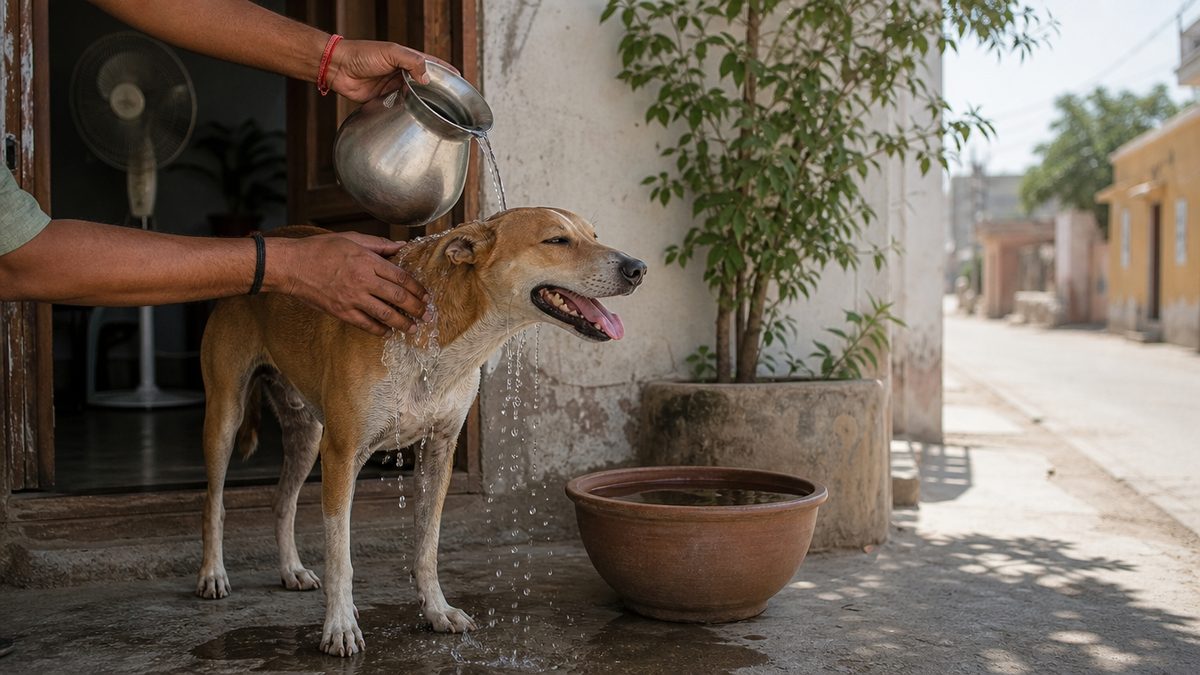
Heat stroke in dogs is an emergency. Go to a veterinary clinic now, and call ahead, if you see any of these signs.
- Collapse, seizures or unconsciousness after heat or exercise
- A rectal temperature of 40.5 C or above
- Bright red, brick-coloured or pale gums with thick drool
- Vomiting or diarrhoea containing blood
- Confusion, stumbling or an unsteady walk in the heat
- Noisy, distressed or open-mouthed breathing at rest
Quick answer
Heat stroke in dogs is a body temperature at or above 40.5 C with the cooling system overwhelmed, and it is an emergency: cool the dog first, transport second Royal Veterinary College. Across 905,543 UK dogs, 395 events in one year gave an incidence of 0.04 percent, and 14.18 percent of those events killed the dog. Exercise, not a parked car, triggered 74.2 percent of events. Your nearby vet decides for your dog.
This guide is general information for Indian pet owners and is not a diagnosis. Always consult a registered veterinarian near you before acting on anything you read here, and treat any sudden change in your pet's condition as urgent.
Signs of Heat stroke in dogs
The 10 signs to watch for are listed below. Any one of them is a reason to consult your nearby vet; none of them is a diagnosis.
- Heavy, fast panting that does not settle when the dog stops
- Thick, ropey drool or a sudden flood of saliva
- Bright red, brick-coloured or pale gums and tongue
- Restlessness and pacing, or hunting for shade and water
- Vomiting or diarrhoea, sometimes containing blood
- Wobbling, stumbling or weakness in the back legs
- Glazed eyes, confusion, or no response to its own name
- Collapse, seizures or unconsciousness
- A rectal temperature of 40.5 C or above
- Blood in the urine, or bleeding from the nose
Breeds on this site that document this condition
Each breed page below carries the figure for this condition with its denominator and its source. The 9 breeds listed are the ones on this site that document it, not a ranking of risk.
India publishes its heat risk in advance, so an owner does not have to guess. The India Meteorological Department declares a heat wave once a plains station reaches 40 C and runs 4.5 C to 6.4 C above normal, and its red alert means a very high likelihood of heat illness and heat stroke in all ages. The same bulletin tells the public not to leave pets in parked vehicles and to keep animals in shade with plenty of water. No Indian incidence series for canine heat stroke exists: a PubMed search on 23 September 2026 returned zero records while two controls passed, so every rate on this page is a UK primary-care rate. Two Indian government rate cards price the workup, from Rs 50 to Rs 300 to register a dog Bihar Animal Sciences University, Patna. The prevention routine lives in heat safety for dogs in India.
What heat stroke in dogs is, and the temperature that defines it
Heat stroke in dogs is an uncontrolled rise in core body temperature past the point where panting can shed heat, and it damages organs from the first minutes. The four sources an Indian owner is most likely to read set four different numbers for where it starts, so this page prints all four.
A healthy dog runs at 38.1 C to 39.2 C, or 100.5 F to 102.5 F, and Cornell's Riney Canine Health Center calls it heat stroke once the reading reaches 105 F, which is 40.5 C. Purina India publishes the same 40.5 C for Indian owners. The American Kennel Club sets the line at 105.8 F, or 41.0 C. The 2022 veterinary literature review defines the syndrome rather than the reading, as a body temperature above 41 C with a systemic inflammatory response and neurological dysfunction that can end in multiple organ dysfunction.
A fifth number sits in the clinical guidance. The Veterinary Committee on Trauma guidelines of 2016 tell a clinician to cool actively above 41.1 C, and the 2023 UK cooling study states that no source is provided in those guidelines for that cut-off. Treat every one of them as a working line, not a settled fact.
| Source | Where heat stroke starts | What the figure rests on |
|---|---|---|
| Cornell Riney Canine Health Center | 40.5 C (105 F) | Owner-facing reference page, against a normal range of 38.1 C to 39.2 C |
| Purina India | 40.5 C or above | Listed among the signs on its India page for Indian owners |
| American Kennel Club | 41.0 C (105.8 F) | Owner-facing article and its own FAQ |
| Caldas 2022 literature review | Above 41 C with inflammation and neurological signs | Review of the veterinary literature, following Bruchim 2006 |
| Vet-COT 2016 guidelines | Cool actively above 41.1 C | Hall 2023 records that the guidelines cite no source for the cut-off |
Why the clock matters more than the number
A dog sheds heat by panting and through its paw pads, so still, humid air does not slow the cooling system, it removes it. Researchers took rectal temperatures before and after racing from 229 greyhounds at 46 meetings across seven South Australian venues, in ambient temperatures from 11.0 C to 40.8 C. Mean temperature on arrival was 39.2 C and after one race 41.0 C, a mean rise of 2.1 C, and at 38 C ambient, an ordinary April afternoon in Nagpur or Delhi, 39 percent finished above 41.5 C.
Those were fit, short-coated athletes, hosed with cold water straight after the run. A brachycephalic pet dog on a pavement has none of that, which is why 30 minutes of vigorous exercise in hot weather is enough.
Heat exhaustion and heat stroke are one process caught at different points. The American Kennel Club describes three stages, heat stress, heat exhaustion and heatstroke, while the Royal Veterinary College splits it into early signs such as panting, restlessness and drooling and advanced signs such as confusion, collapse and seizures. Neither split is a diagnosis, and you do not need a thermometer reading before you start cooling.
How often heat stroke happens, and how often it kills
Heat-related illness reached 0.04 percent of UK dogs in a single year and killed 14.18 percent of the dogs it happened to. No Indian equivalent exists, and this page says so rather than borrowing one.
Hall, Carter and O'Neill searched the VetCompass records of 905,543 dogs under primary veterinary care at 886 UK practices in 2016. Manual review of 6,531 candidate records confirmed 1,222 affected dogs and 395 incident events, a one-year incidence of 0.04 percent (95 percent CI 0.04 to 0.05). That is a temperate, registered population, not an Indian clinic population.
Fifty-six of those 395 events killed the dog, an event fatality of 14.18 percent (95 percent CI 11.08 to 17.96). Of the 54 deaths with a manner recorded, 35 were euthanasia and 19 unassisted. Roughly one dog in seven, in a country with no season resembling an Indian May.
Published fatality figures differ by a factor of four, and the reason is which dogs get counted. The authors note their primary-care figure is lower than earlier reports of 36 to 50 percent, and the 2022 review puts mortality at 50 to 64 percent across hospitalised series, one of which is Drobatz and Macintire's 42 cases from 1976 to 1993. A referral hospital sees the dog that collapsed; primary care also counts the dog that went home. A fatality rate without its population is not a fact.
What July did there, and what May does here
Forty percent of the 2016 events, 158 of 395, fell in July. India does not open its heat-wave season on numbers that low, since a plains station must reach 40 C before a heat wave can be declared. Read the UK rates as a floor for India, not a forecast.
There is no published Indian incidence or case-fatality series for canine heat stroke. The PubMed search (heat stroke[tiab] OR heatstroke[tiab] OR heat-related[tiab]) AND (dog[tiab] OR dogs[tiab] OR canine[tiab]) AND India[tiab] returned 0 records on 23 September 2026, and a broader hyperthermia version returned 0 as well. Two controls passed on the same instrument in the same session: the query without India returned 89 records and dogs plus India without heat returned 1,018. The absence is real, not a broken search.
The first ten minutes: cool first, transport second
To treat heat stroke in its first ten minutes, cool the dog where it stands and transport second, because the drive is the delay and delayed cooling worsens the outcome. Call the clinic while somebody else pours the water.
Cool first, transport second is the Veterinary Committee on Trauma recommendation from 2016, and the Royal Veterinary College and the RSPCA both publish it as the owner's instruction RSPCA, Heatstroke in dogs (STOP, COOL. Almost nobody follows it: only 21.70 percent of the 341 UK dogs with active cooling recorded had been cooled before reaching the practice.
The seven steps below are the ones the RVC and the RSPCA give, in the order they give them.
- Stop the movement. End the walk, the game or the work at once, and carry the dog into shade if it can be carried.
- Take the heat away. Move to shade, a fan or an air-conditioned room, and open a hot vehicle rather than shutting the dog inside it.
- Pour water over the body, not the head. Any water cooler than the dog works; aim at the neck, the belly and the inner thighs, and keep water off the face of a dog already struggling to breathe.
- Immerse a young, healthy dog in a tub, tank or pool of cool water, because cold-water immersion is one of the two methods the guidelines name.
- Use evaporative cooling for an old, sick or unconscious dog. Wet the coat with water cooler than the dog and put moving air on it from a fan, a breeze or the air conditioning.
- Offer small sips of water to a conscious dog, and never force a dog to drink.
- Call ahead and drive cool. Tell the clinic a heat emergency is coming, run the air conditioning or open the windows, and keep cooling on the way. Find a registered veterinarian near you.
A wet towel laid over the dog is the commonest thing done, and it is not a recommended method. Water-soaked towels appear in 137 of 267 UK records with a method specified, 51.31 percent, while cold-water immersion and evaporative cooling together account for 64, or 23.97 percent. The RSPCA's instruction is to put a damp towel under the dog and never over it, because a towel over the body traps heat. Skip ice water and ice packs on the body, and stop active cooling near 39.4 C to 39.5 C so the dog does not overshoot into hypothermia. Everything after that is your nearby vet's call.
Cold water or not, the disagreement in print
The sources disagree about cold water, and the gap is narrower than it looks. The RSPCA states that cold water rarely causes shock in an overheating dog, while the 2022 review and Purina India warn against ice and ice-cold water because vasoconstriction and shivering slow the core down Purina India, Heat Stroke in Dogs. The objection is to ice, not to tap water cooler than the dog, and it traces to an experiment in which some dogs died on immersion into water at 1 C to 3 C. The RVC settles it by patient: immersion for young, healthy dogs, evaporative cooling for old or sick ones.
The wider finding is how rarely anything is done. Of 623 dogs presented within 24 hours of the trigger, 282, or 45.26 percent, had no cooling recorded at all. The authors conclude that canine cooling messaging needs urgent attention to dispel cooling myths.
What sets it off: the walk, not the parked car
Exercise triggers most heat stroke in dogs. Exertion accounted for 74.2 percent of the 879 UK events with a trigger recorded, against 12.9 percent for environmental heat and 5.2 percent for a vehicle.
The companion paper classified the triggers of 1,259 events in 1,222 dogs. Of the 879 with a trigger recorded, 652 were exertional, 113 environmental, 46 vehicular, 40 under the care of a clinic or groomer, 24 in a closed building and 4 blanket entrapment. Where the exercise was specified, 372 of 551 events, 67.5 percent, followed a walk.
Dying is a different table from happening. Across the 2016 to 2018 events, deaths per event ran lowest in the exertional group and highest in the confinement groups.
| Trigger | Events | Share of known triggers | Deaths | Odds of death against exertional |
|---|---|---|---|---|
| Exertional (a walk, a run, play) | 420 | 70.9 percent | 32 (7.6 percent) | Base |
| Environmental heat | 84 | 14.2 percent | 8 (9.5 percent) | 1.28 |
| Vehicular confinement | 37 | 6.3 percent | 4 (10.8 percent) | 1.47 |
| Under treatment at a vet or groomer | 31 | 5.2 percent | 3 (9.7 percent) | 1.30 |
| Building confinement | 18 | 3.0 percent | 6 (33.3 percent) | 6.06 (95 percent CI 2.13 to 17.22) |
| Blanket entrapment | 2 | 0.3 percent | 1 (50.0 percent) | 12.13 |
Read that table twice before summer. Hot cars are genuinely lethal and genuinely rare, at 5.2 percent of triggers, while the ordinary walk produced three events in four. The trigger that stands out for killing is building confinement, a dog shut in a space it cannot leave, at 6.06 times the odds of death of an exertional case.
The Indian version of building confinement
In India that category has a name on every second apartment listing. A dog left on a terrace, in a closed balcony or in a room whose fan dies with the power is in building confinement, and an Indian veterinary provider names power cuts and balcony confinement among the country's heat hazards. IMD's own advice, issued with the National Disaster Management Authority, tells the public not to leave pets in parked vehicles and to keep animals in shade with water. The routine that prevents this is in heat safety for dogs in India.
How a vet confirms it, and what the blood work is looking for
To confirm heat stroke a vet takes a rectal temperature, sets it against a history of heat or exercise, and runs blood work for the organ damage that follows. No single test confirms it, which is why the history you give at the door matters.
Heatstroke is diagnosed on the history of heat exposure plus the signs, backed by a physical examination and blood work for organ damage, with blood pressure, an electrocardiogram, clotting times and electrolytes added as needed. Even the Indian clinic page ranking for this query makes the same point, that touch is not a measurement and a thermometer is.
The list below is what those tests are looking for, and why each one earns its place.
- Rectal temperature, the only way to know how high the dog went and how far cooling has already brought it down.
- Gum colour and circulation, because bright red or pale gums and a weak pulse track the shock picture.
- Blood glucose, because low blood sugar is one of the recorded predictors of death.
- Kidney values, because acute kidney injury follows poor perfusion and muscle breakdown, and creatinine still raised 24 hours after presentation predicts death.
- Liver values, because the liver is injured by poor perfusion and it makes most of the clotting factors.
- Clotting times, because a prothrombin time above 18 seconds and an activated partial thromboplastin time above 30 seconds are among the strongest reported risks of death.
- An electrocardiogram, because ventricular tachycardia, premature ventricular complexes and low blood pressure are common findings.
- Urine, because muscle breakdown stains it: 100 of 177 racing greyhounds, 57 percent, gave a positive dipstick for haemoglobin or myoglobin after a single race, and 95 percent of 77 positives were confirmed as myoglobin.
Time to the clinic is itself a prognostic factor. The 2022 review lists obesity, a prolonged interval between the heat insult and arrival, low blood sugar, raised creatinine at 24 hours, disseminated intravascular coagulation, acute kidney injury and neurological injury among the drivers of mortality. Bloody diarrhoea and blood in the vomit mark the gut barrier breaking down.
Four facts are worth carrying on the drive, because the clinic will ask and a frightened owner forgets. What the dog was doing. What time it started. What the temperature read, if anyone measured it. What cooling you did, and for how long.
What treatment looks like, in general terms
Treatment is active cooling to a stop point, fluid support, and days of monitoring for organ damage. This page names drug classes and never a dose, because the dose belongs to the veterinarian with your dog in front of them.
In the clinic, cooling runs on the same physics as at home. Heat leaves by conduction into cooler fluid, by evaporation from a wet surface and by convection in moving air, so room-temperature fluid with a fan on it beats anything applied cold and still. Clinical reviews put damp towels only on the less-haired belly and inner thigh, because a towel over the whole dog blocks air movement, and active cooling stops near 39.5 C to avoid tipping the dog into hypothermia.
Around the cooling, the hospital treats the shock. Cornell lists intravenous fluids, oxygen, electrolytes and glucose, blood products such as fresh frozen plasma, antibiotics and gut protection, pain relief and anti-seizure medication. Fluid lost to heat stress is replaced across the first 24 hours rather than poured in at once.
The clock after the crisis
Survival is decided over days, not hours. Most dogs that die do so within the first 24 hours of treatment, dogs hospitalised beyond 72 hours survive better, and clinical signs of organ failure can appear 3 to 5 days after the event. The RVC says the same in owner language, that a pet may be admitted for tests, treatment or observation until the signs resolve.
Recovery is not a reset. Cornell states that dogs which survive are at greater risk of heatstroke again, and that the outlook depends on how high the temperature went and how long it stayed there. A dog with one episode behind it needs a stricter summer than the dog next door for the rest of its life.
What the tests and the hospital stay cost in India
A heat stroke workup at an Indian government veterinary hospital costs about Rs 950 to Rs 2,400 in tests, plus Rs 50 to Rs 300 to register and Rs 200 a day if the dog is admitted. Those two rate cards are the only Indian prices for this condition this page could verify.
Both institutions price those tests line by line. ICAR-IVRI's Referral Veterinary Polyclinic at Izatnagar publishes charges with effect from July 2022, plus tax, and the Veterinary Clinical Complex at Bihar Animal Sciences University in Patna publishes its own while treating 18,000 to 20,000 cases a year. Neither list includes medicines, fluids or oxygen.
| Item | ICAR-IVRI Izatnagar | BASU Patna |
|---|---|---|
| Registration, dog or cat | 50 normal, 150 after 12:30 pm, 300 after 5 pm and on holidays | 200 for the 9 am to 1 pm window, 300 for the 2 pm to 8 pm emergency window |
| Complete blood count | 250 | 300 |
| Kidney function | 200 (BUN and creatinine) | 700 |
| Liver function | 300 | 600 |
| Glucose | 100 | 80 |
| Creatine kinase, the muscle-damage marker | 100 | 700 |
| Sodium, potassium and chloride | Not listed | 350 |
| Routine urine examination | 100 | 100 |
| Fluid therapy | 150 | Not listed |
| Plain radiography | 150 | 400 |
| Ultrasound | 250 | 500 |
| Electrocardiogram | Not listed | 500 |
| Admission, per animal per day | Not listed | 200 |
| Blood transfusion | Not listed | 2,500 a unit, with the donor arranged by the owner |
Add the five tests a heat stroke dog usually needs and the two hospitals differ by two and a half times. A blood count, kidney and liver panels, glucose and creatine kinase come to Rs 950 at IVRI before tax and registration and Rs 2,380 at BASU before its Rs 200 or Rs 300 registration. Every figure is a rupee price published by the institution itself: divided by 84.38 the range runs from 0.95 to 29.63 US dollars and by 74 from 1.08 to 33.78, neither landing on round dollar values, so these are Indian rate cards rather than a converted dollar list.
Both rate cards are also timetables, and heat stroke does not keep office hours. BASU registers canine emergencies only between 2 pm and 8 pm, and IVRI charges Rs 50 in normal hours, Rs 150 after 12:30 pm and Rs 300 after 5 pm or on a holiday. Exertional cases cluster around walks, which in Indian cities means early morning and after dark. Save a 24-hour private clinic's number in March, not in May, and use the vet directory to find one.
What could not be verified matters too. No Indian private emergency clinic publishes an itemised rate card for heat stroke care that this page could open and cite, so no private intensive-care figure appears here. The government numbers are floors for a subsidised teaching hospital, and your own clinic's rate card is the one that will apply.
What an Indian summer changes
An Indian summer changes three things: the alert is published in advance, the humidity decides whether panting works, and the ground is far hotter than the air Washington State University College….
India declares its heat rather than leaving it to judgement. IMD considers a heat wave when a plains station reaches at least 40 C, or a hill station 30 C, and the departure from normal is 4.5 C to 6.4 C; above 6.4 C makes it severe. On actual temperature alone, 45 C declares a heat wave and 47 C a severe one, while a coastal station needs a 4.5 C departure with an actual maximum of 37 C or more. The criteria must be met at two stations in a sub-division on two consecutive days.
Heat waves run from March to June in India, peaking in May, across Punjab, Haryana, Delhi, Uttar Pradesh, Bihar, Jharkhand, West Bengal, Odisha, Madhya Pradesh, Chhattisgarh, Rajasthan, Gujarat, parts of Maharashtra and Karnataka, Andhra Pradesh and Telangana, and sometimes Tamil Nadu and Kerala. IMD issues five-day colour-coded warnings four times a day from 1 March to 30 June, jointly with the National Disaster Management Authority.
| Colour code | What triggers it | The stated impact |
|---|---|---|
| Green, no action | Maximum temperatures near normal | Comfortable temperature, no cautionary action required |
| Yellow, be updated | Heat wave conditions at isolated pockets persisting on 2 days | Heat tolerable for the general public, moderate concern for infants, the elderly and people with chronic disease |
| Orange, be prepared | Severe heat wave for 2 days, or heat wave for 4 days or more | Increased likelihood of heat illness in anyone exposed to sun for a prolonged period or doing heavy work |
| Red, take action | Severe heat wave for more than 2 days, or more than 6 heat-wave days in total | Very high likelihood of developing heat illness and heat stroke in all ages |
Those impact statements are written about people, and the same bulletin turns to animals in its own instructions. IMD says not to leave children or pets in parked vehicles, to avoid going out between 12 noon and 3 pm, and to keep animals in shade with plenty of water. An orange or red alert for your district is a free, published, advance warning for your dog.
The human numbers show the canine margin. Quoting the NDMA, the FAQ puts human heat stroke at 40 C, or 104 F, with delirium, seizures or coma. A person runs at about 37 C, so that is roughly 3 C of headroom; a dog runs at 38.1 C to 39.2 C against a 40.5 C line, which is 1.3 C to 2.4 C. The same afternoon gives your dog less room than it gives you.
Humidity, the rooftop and the pavement
Humidity is the part Indian coastal owners underestimate. High relative humidity aggravates heat by slowing evaporation and reducing cooling efficiency, and a dog's main cooling route is evaporation from the airway. IMD has a label for it, Hot and Humid Weather, declared when the maximum stays 3 C above normal with above-normal humidity. A humid 33 C monsoon afternoon in Mumbai or Chennai can take more cooling capacity from a dog than a dry 42 C afternoon in Jaipur, and neither day need carry a declaration.
The ground is the other Indian hazard, and it is measurable. Asphalt in direct sun reaches 52 C when the air is only 25 C and 57 C when the air is 30 C, and human skin is destroyed in 60 seconds of contact at 52 C, figures Washington State University's College of Veterinary Medicine quotes from Berens's 1970 work in the Journal of the American Medical Association. Indian afternoon air sits far above 25 C for four months of the year.
This page is the medicine; the routine that keeps a dog out of it lives elsewhere on this site. Walk windows, the water and shade routine and the breed-by-breed summer plan are in heat safety for dogs in India, and cats have heat safety for cats in India.
Recovery, and how to tell a dog is okay afterwards
To tell whether a dog is okay after overheating, watch it for days rather than minutes, because the organ damage shows late and the early hours can look normal.
First aid ends when the veterinarian takes over, and that handover should happen even when the dog looks recovered. The RVC's instruction is to have the pet checked even if it seems fine, because the more serious signs of heatstroke may not be immediately apparent. The review is blunter: organ failure can appear 3 to 5 days later, and most deaths fall inside the first 24 hours of treatment.
Seven things are worth watching for in the week after an episode, and any one of them is a reason to call the clinic back.
- Appetite and drinking, which should return within a day of a mild event.
- Vomiting or diarrhoea, especially with blood, because the gut lining is one of the first tissues to break down.
- Dark, brown or cola-coloured urine, which suggests muscle pigment in the urine after muscle breakdown.
- Bruising, nosebleeds or blood in the urine, the visible face of a clotting problem.
- Weakness, wobbling or a lethargic, flat dog that does not pick up.
- Any seizure or change in behaviour, because the brain is the organ the syndrome damages most reliably.
- Breathing that stays noisy or fast at rest, which needs an emergency clinic rather than an appointment next week.
A dog that recovers is not a dog restored to where it started. Cornell states that survivors are at greater risk of heatstroke again, and that chances of survival improve with early recognition, intensive treatment and supportive care. That last point is the whole argument for cooling in the first ten minutes.
Prevention, and why there is no screening test
No screening scheme, DNA test or registry exists for heat stroke in dogs, so prevention is the only test that matters, and two of the three measured risks are ones an owner can change.
The UK model quantified who gets it. Brachycephalic dogs carried 2.10 times the odds of mesocephalic dogs (95 percent CI 1.68 to 2.64), purebred dogs 1.86 times the odds of crossbreds, and dogs over 50 kg 3.42 times the odds of dogs under 10 kg (1.54 to 7.57). An overweight dog, one at or above the mean bodyweight for its breed and sex, carried 1.42 times the odds, and dogs of 12 years and over 1.75 times the odds of dogs under 2. Skull shape is fixed on the day you choose the breed; bodyweight and the hour of the walk are not, and the condition was fatal in 14.18 percent of events.
The breed cards above carry each figure with its confidence interval, and one is worth reading twice. Heavy-coated northern breeds are the ones Indian buyers are warned about, yet the Siberian Husky showed no significant elevation at all, 1.18 with an interval of 0.28 to 5.06 and p = 0.822, while the Chow Chow topped the list at 16.61. Coat is not a rule on its own, and absence of evidence in a UK dataset is not evidence of safety in an Indian May.
Prevention for an Indian dog comes down to four levers, all of them covered hour by hour in the guides. Walk before the sun is up. Cancel the walk on an orange or red alert day. Keep the dog lean and out of closed rooms, balconies and terraces. Know where your after-hours clinic is, through the vet directory, before the first 40 C day.
If your dog collapses in heat and the belly looks swollen, consider the other go-to-the-clinic-now emergency alongside this one, bloat and GDV in dogs. Both are timed in minutes.
Common questions about heat stroke in dogs
How do you know if your dog has got heat stroke?
You know it from the combination of heat or exercise and the signs, then you confirm it with a thermometer. Heavy panting that will not settle, thick drool, bright red gums, vomiting, wobbling and collapse all point to it, and a rectal temperature of 40.5 C or above is the line Cornell draws. Start cooling before you confirm anything.
Can a dog recover from a heat stroke?
Yes, many dogs recover, and the odds turn on how high the temperature went and how long it stayed there. Case fatality was 14.18 percent across 395 events in 905,543 UK dogs under primary care, while hospitalised referral series report 50 to 64 percent. Survivors carry a higher risk of a second episode for the rest of their lives.
What are the three stages of heat exhaustion in dogs?
The three stages the American Kennel Club names are heat stress, with mild panting and thirst, heat exhaustion, with heavy panting, drooling and fatigue, and heatstroke, with collapse or severe signs that need emergency care. Veterinary sources treat this as one continuous process rather than three gradable diagnoses, so act at the first stage.
What is the 7-second rule for dogs?
The seven-second rule is a pavement test. Press the back of your hand to the pavement, and if you cannot hold it there for a full seven seconds it is too hot for a dog's paws. Asphalt reaches 52 C when the air is only 25 C, and human skin is destroyed in 60 seconds of contact at that temperature.
How to know if a dog is okay after overheating?
You cannot tell in the first hour, so have the dog checked even when it looks fine, because the more serious signs may not be immediately apparent. Watch for a week for vomiting or diarrhoea with blood, dark urine, bruising, seizures, weakness, or fast breathing at rest. Signs of organ failure can appear three to five days later.
How hot does it have to be for a dog to get heat stroke?
No air temperature is safe on its own, because what the dog is doing matters more than the reading. At an ambient temperature of 38 C, 39 percent of racing greyhounds finished a single race above 41.5 C, and the mean rise across those 229 dogs was 2.1 C. Vigorous exercise in hot weather can do it in 30 minutes.