
Dog health: gastrointestinal
Bloat and GDV in Dogs in India: The Clock, the Breeds at Risk and Gastropexy
Unproductive retching and a hard, swollen belly in a deep-chested dog is a surgical emergency. What the denominators actually say, why the raised bowl is the one correction worth making, and what three Indian government hospitals charge.
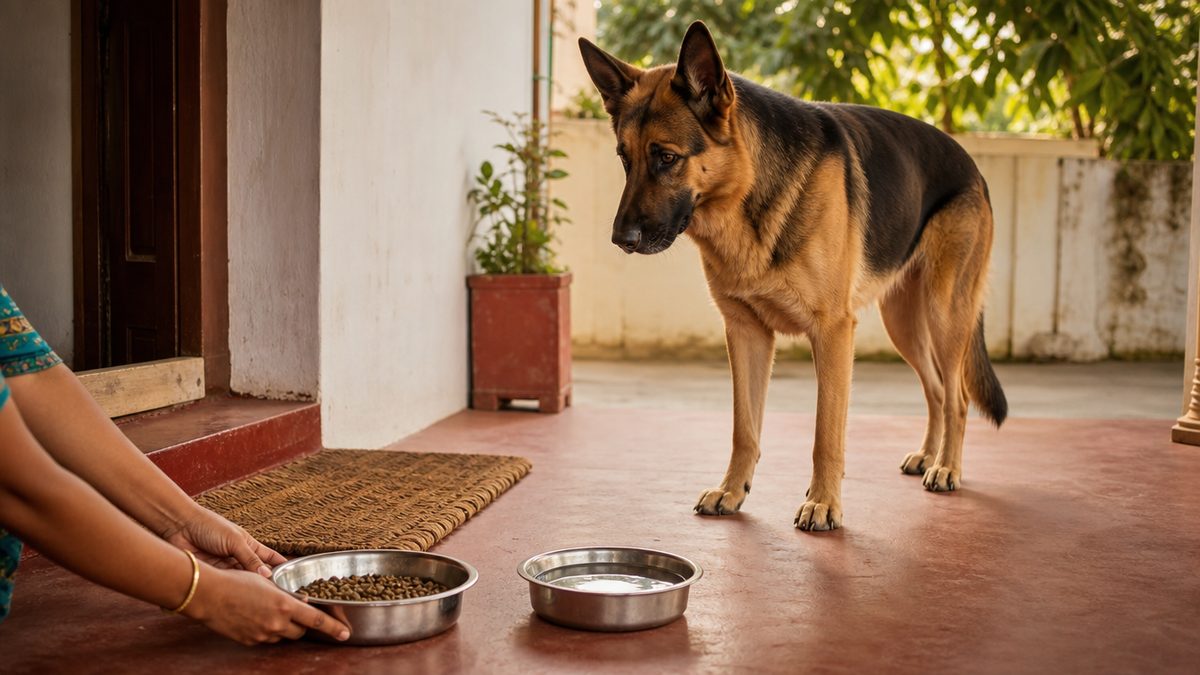
Bloat and gastric dilatation volvulus in dogs is an emergency. Go to a veterinary clinic now, and call ahead, if you see any of these signs.
- Unproductive retching in a large, deep-chested dog, at any hour
- A hard, swollen abdomen with restlessness and heavy drooling
- Pale, grey or white gums with a weak, fast pulse
- Collapse or an inability to stand, especially after a meal
- Laboured breathing alongside a visibly distended belly
- Any of these in a dog that has had bloat before
Quick answer
Bloat in dogs is a stomach that distends with gas and then twists on itself, and it is a surgical emergency measured in hours rather than days. Unproductive retching, a hard distended abdomen, restlessness and drooling in a large deep-chested dog mean going now. Cumulative incidence reached 5.7 percent across 1,914 large and giant breed dogs, and 28.6 percent of affected dogs died. Emergency surgery costs Rs 2,500 at Madras Veterinary College in Chennai. Your nearby vet decides for your dog.
This guide is general information for Indian pet owners and is not a diagnosis. Always consult a registered veterinarian near you before acting on anything you read here, and treat any sudden change in your pet's condition as urgent.
Signs of Bloat and gastric dilatation volvulus in dogs
The 10 signs to watch for are listed below. Any one of them is a reason to consult your nearby vet; none of them is a diagnosis.
- Unproductive retching, heaving repeatedly and bringing up nothing or only saliva
- A visibly swollen, hard, distended abdomen, most obvious on the left flank
- Restlessness and pacing, lying down and getting straight back up
- Heavy drooling or a sudden flood of saliva
- Standing and stretching, or turning to look at the belly
- Rapid, shallow or laboured breathing
- Pale, grey or white gums and a weak, fast pulse
- Whining or hunching when the belly is touched
- The praying position, forelimbs forward and chest near the ground
- Weakness, an inability to stand, or collapse
Breeds on this site that document this condition
Each breed page below carries the figure for this condition with its denominator and its source. The 10 breeds listed are the ones on this site that document it, not a ranking of risk.
No Indian incidence series for canine bloat exists. A PubMed search on 23 September 2026 returned one record, and that record is a Dirofilaria study in cats from Thailand which matches only on the words Onchocerca volvulus and India, so the true count is zero while two controls passed at 370 and 1,018 records. Every rate on this page is therefore a North American, British, Australian or Italian rate. India does publish the prices. Madras Veterinary College Teaching Hospital in Chennai charges Rs 2,500 for emergency surgery and Rs 100 to register a small animal, and dispenses drugs and fluids free of cost. ICAR-IVRI Izatnagar charges Rs 300 for a laparotomy and Rs 400 for a gastrotomy for pets, plus tax, and Bihar Animal Sciences University in Patna charges Rs 2,500 for a major operation on a dog and Rs 200 per animal per day to admit it. All three shut in the evening, so an Indian owner of a Great Dane, German Shepherd or Rottweiler needs a private 24-hour clinic identified in advance. The feeding routine is in the dog diet chart for India.
What bloat in dogs is, and why bloat and GDV are two different things
Bloat in dogs is a stomach that fills with gas and fluid until it distends, and gastric dilatation volvulus is that same stomach then twisting on its own axis and cutting off its blood supply. The two look identical from the outside, and only a radiograph separates them.
The twist does the killing, not the gas. A rotated stomach compresses the major abdominal vessels, so blood stops returning to the heart and the dog goes into systemic shock and multi-organ dysfunction. It also presses on the diaphragm, which makes breathing harder, and the falling oxygen delivery sets off cardiac arrhythmias. Pressure inside the organ can rupture it or kill its wall, and the spleen, which sits alongside, frequently twists with it and bleeds.
Anatomy decides who is at risk. A deep chest, measured as an increased ratio of thoracic height to width, is one of the few risk factors every source agrees on, and the MSD Veterinary Manual calls deep and narrow thoracic conformation a proven genetic risk factor along with having a first-degree relative that has had it. The American Kennel Club puts a number on the conformation effect, describing Great Danes as five to eight times more likely to bloat than dogs with a low height-to-width ratio.
The three breeds an Indian owner meets this in
Great Dane, German Shepherd and Rottweiler are the deep-chested breeds Indian households actually keep in numbers, and all three appear in the GDV literature. In a single Italian teaching hospital's series of 130 surgically treated cases between 2011 and 2024, German Shepherd Dogs were the commonest breed at 25.38 percent of cases, and 59.25 percent of the dogs were male. The Great Dane carries the highest measured incidence of any breed in the largest prospective cohort ever run, and the Rottweiler carries the lowest of the eleven breeds in it. A Rottweiler owner is not exempt, but the numbers are not the same numbers.
Size matters independently of breed. The Dog Aging Project's nested case-control study of its 47,444 enrolled dogs found raised odds in dogs above 40 kg, in purebred dogs, in males, and in dogs with a low body condition score. A lean, tall, pedigree male is the profile, which is the opposite of what most owners expect from a digestive emergency.
The first two hours, and the mistake that costs the dog
To act on suspected bloat, put the dog in a car and drive to a clinic that can operate tonight, and do not wait to see whether it passes. Without treatment a dog is likely to be in shock in only an hour or two, its heart rate rising and its pulse weakening.
The clock is measurable, which is why this page leads with it. In severe cases with complete torsion, death can follow within two to six hours of onset, and there is no reliably safe observation window. A duration of clinical signs longer than six hours before examination is a named risk factor for short-term death American College of Veterinary Surgeons. In 736 Australian cases seen at two referral and emergency centres over twenty years, dogs whose time from presentation to completion of surgery exceeded three hours had 2.53 times the odds of dying.
The first signs of bloat are behavioural before they are visible, and that is the window worth using.
- Stop the meal, the water bowl and the walk. End whatever the dog is doing and let it stand or lie still.
- Look at the left flank. A visibly swollen, hard, distended abdomen is most prominent on the left side, and it may not be obvious in a heavy-coated or very large dog.
- Count the retches. Unproductive retching, repeated heaving that brings up nothing or only saliva, is the single most specific sign.
- Phone the clinic now and use the words. Say gastric dilatation volvulus or bloat, and ask whether they can operate tonight, because a practice that cannot will only cost you the drive.
- Drive, and carry the dog if it will not walk. Use the vet directory to find a registered veterinarian, and note the clock time the signs started, because the clinic will ask.
- Say what the dog ate and when. Rapid ingestion of a large meal is the association most commonly recorded, so the last meal is part of the history.
There is no home treatment for bloat, and waiting is the mistake that kills the dog. Do not wait for morning, do not try to make the dog vomit, do not walk it off, and do not give an over-the-counter anti-gas product. The condition accelerates rather than plateauing, and the correct response is immediate transport to an emergency facility without attempting home treatment. Cornell states plainly that without medical and surgical intervention GDV is fatal, and the American Kennel Club's own veterinarian writes that much of what an internet search returns on prevention is folklore. Everything after you reach the door is your nearby vet's call.
Three in the morning is the worst time to find out where your clinic is
The hour of the emergency changes the outcome, and somebody has measured it. In that Australian series, dogs presented between 3 am and 9 am had 3.57 times the odds of dying of dogs presented between 9 am and 9 pm. The same study found dogs operated on by specialist surgeons survived at 88.7 percent against 81.7 percent for general surgeons, with intraoperative mortality of 2.9 percent against 7.0 percent. None of that is something an owner decides at 3 am. It is decided in advance, by knowing which clinic near you has an operating theatre and a surgeon at night.
What could be mistaken for bloat in dogs
Four things are mistaken for bloat in dogs, and the one that matters most is simple gastric dilatation, the same stomach distended by gas without the twist. From the outside the two are identical, and the difference is the difference between medical management and a surgical emergency.
Simple dilatation is not harmless and it is not stable. It can progress to a full volvulus with the next postural shift, so any suspected bloat is treated as a potential GDV until imaging proves otherwise. That is the reason a radiograph is not an optional extra, and the reason this page will not give you a way to tell them apart at home.
The four conditions below are the ones the clinical sources name alongside it.
- Simple gastric dilatation, gas accumulation without rotation, which may respond to decompression and medical management rather than surgery.
- Splenic torsion, because the spleen sits against the stomach and frequently twists with it, and splenic enlargement or malposition shows on the same radiograph.
- A gastric outflow obstruction from a foreign body, a tumour or pyloric stenosis, each of which can distend the stomach by blocking its exit.
- Gastric rupture, which the radiograph shows as free gas within the abdomen rather than gas confined to the organ.
Blood work does part of the same job. The American College of Veterinary Surgeons notes that a complete blood count, serum chemistry, electrolytes and a urinalysis let the veterinarian rule out diseases that mimic the clinical signs of gastric dilatation, as well as showing what the metabolic disturbance is.
The one Indian veterinary study of the canine stomach this page could find is an imaging comparison, and it lands on this exact question. Researchers at Lala Lajpat Rai University of Veterinary and Animal Sciences in Hisar, Haryana imaged 12 clinical gastric conditions in dogs in both two and three dimensions, covering gastritis, gastric ulcer, gastric dilatation, gastric foreign bodies and pyloric stenosis, which is most of the differential list above. Their finding worth carrying is a negative one. Three-dimensional ultrasonography was not diagnostic for gastric dilatation or for gastric foreign bodies, and both were better seen on the ordinary two-dimensional sonogram. A newer machine is not a better answer here, and the radiograph remains the test.
Two radiographic signs settle it. The right lateral view of a rotated stomach shows the pylorus dorsal and slightly cranial to the fundus, an appearance called the reverse C, Popeye's arm or Smurf's hat, and a soft-tissue shelf dividing the gas shadow, which is the double bubble. Gas inside the wall of the organ itself suggests the tissue is already compromised.
How often bloat happens, how often it kills, and in which population
Bloat reached 5.7 percent of 1,914 large and giant breed dogs followed prospectively for a median 2.4 years, and 30 of the 105 dogs that developed it died, which is 28.6 percent. Every other rate on this page carries its population with it, because the populations are not comparable.
The reference cohort is Glickman and colleagues at Purdue University. Eleven national breed clubs enrolled 1,914 dogs at shows between June 1994 and March 1997, and 1,843 of them, 96 percent, returned follow-up information by post and telephone at roughly yearly intervals. Incidence was 23 cases per 1,000 dog-years at risk across the seven large breeds of 23 to 45 kg and 26 per 1,000 dog-years across the four giant breeds above 45 kg, a difference that was not significant at P = 0.49. The companion paper on 1,637 dogs of the same breeds puts cumulative incidence at 6 percent. Both figures are real and they are measured on overlapping subsets of one show-dog cohort, not on the Indian pet population.
A UK emergency caseload gives a different number for a different question. VetCompass searched the records of 77,088 dogs attending 50 emergency-care clinics between September 2012 and February 2014 and found 492 presumptive GDV diagnoses, a prevalence of 0.64 percent with a 95 percent confidence interval of 0.58 to 0.70. Of the cases presented alive, survival to discharge was 49.7 percent overall and 79.3 percent among those managed surgically. Those two numbers, printed together, are the most useful pair on this page.
| Source and year | Population measured | What died |
|---|---|---|
| Brourman 1996, 137 cases | Surgically managed dogs at a university and a private specialty practice | 18 percent overall, rising to 46 percent with gastric necrosis and 55 percent where both a partial gastrectomy and a splenectomy were needed |
| Glickman 1998, 136 dogs | Dogs followed prospectively from the acute episode | 24.3 percent died or were euthanised in the first seven days |
| Glickman 2000, 1,914 dogs | Show dogs of 11 breeds followed for a median 2.4 years | 28.6 percent of the 105 dogs that developed it |
| O'Neill 2017, 492 cases | UK emergency-care caseload from 77,088 dogs | 50.3 percent of cases presented alive did not survive to discharge; 20.7 percent of surgical cases |
| Song 2020, 736 cases | Two Sydney referral and emergency centres over 20 years | 276 of 736 were humanely killed rather than operated; of those operated, 11.3 to 18.3 percent died |
| Olimpo 2025, 130 cases | Surgically treated cases at one Italian teaching hospital | 13.6 percent, a survival rate of 86.4 percent |
| ACVS, owner health topic | Not stated | Approximately 15 percent |
| MSD Veterinary Manual | Not stated | 25 to 30 percent overall in the body of the entry, and 20 to 45 percent in treated animals in its own key points |
| American Kennel Club | Not stated | About 30 percent, even after extremely intensive treatment |
Read that table for the third column, not the first. A figure of 15 percent and a figure of 45 percent are not a contradiction if one counts dogs that reached an operating table and the other counts every dog that got the condition. The sharpest illustration is the Australian series, where 276 of 736 dogs were humanely killed rather than operated on, a number no owner-facing page prints, and which sits outside every survival percentage quoted from that same study.
There is no published Indian incidence, prevalence or case-fatality series for canine bloat, and three separate searches say so. The PubMed search (gastric dilatation[tiab] OR volvulus[tiab] OR bloat[tiab]) AND (dog[tiab] OR dogs[tiab] OR canine[tiab]) AND India[tiab] returned 1 record on 23 September 2026, and that record is a study of Dirofilaria mitochondrial genomes in cats from Thailand which matches only because its abstract contains the words Onchocerca volvulus and India, so the true count is zero. Searching by author affiliation instead, with India[ad], returned 1 record, an ultrasonography comparison from Hisar which is cited in the section above and is not an incidence study. A Europe PMC search scoped to Indian affiliations returned 2 records, both of them human medicine. Controls passed on every instrument in the same session, at 370 and 1,018 records on PubMed, 862 on the affiliation search, and 406 and 11,055 on Europe PMC, so the absence is real rather than a broken query. Every rate on this page is therefore a North American, British, Australian or Italian rate, measured in a population that is not yours.
The newest study disagrees with the oldest, and both stay on the page
The Dog Aging Project reopened the question in 2026 with a different design. A nested case-control study within 47,444 enrolled dogs identified 170 owner-reported GDV events against 374 controls, giving a lifetime prevalence of 0.23 percent and an incidence of 1.74 per 1,000 dog-years. That is an order of magnitude below Glickman's show-dog figure, which is what you would expect when the denominator is every enrolled dog rather than eleven high-risk breeds. Its novel finding was that Poodles and Poodle mixes came out with the highest occurrence.
The older UK survey adds the one thing a cohort cannot. The 2004 purebred dog health survey covered 15,881 dogs that had died across 165 breeds and found bloat was the cause of death for 389 of them, 2.5 percent of all reported deaths, with a median age at death of 7.92 years. Among 36,006 live dogs there were 253 episodes in 238 dogs, with a median age at first diagnosis of five years. The breeds at greatest risk of dying of it were the Bloodhound, Grand Bleu de Gascogne, German longhaired pointer and Neapolitan mastiff.
How a vet confirms bloat, and what each test is looking for
To confirm bloat a vet takes a right lateral abdominal radiograph, because that single image is what separates a stomach that is distended from a stomach that has twisted. Everything else measures how much damage the clock has already done.
Positioning is part of the diagnosis. Right lateral and dorsoventral recumbency are the preferred views, and ventrodorsal positioning is avoided because of the risk of the dog aspirating stomach contents. That is a detail worth knowing if you are asked to help hold your own dog.
The tests below are the ones the clinical sources list, and each of them earns its place.
- A complete blood count, serum chemistry, electrolytes and a urinalysis, which show the metabolic disturbance and rule out the diseases that mimic gastric dilatation.
- Plasma lactate, because a raised concentration is a good predictor of gastric necrosis and a negative indicator of outcome, and a value above 6 mmol/L is linked to a greater chance of needing part of the stomach removed.
- An electrocardiogram, because ventricular arrhythmias are common and are looked for before, during and after surgery.
- Blood gas analysis, which measures how severely breathing has been compromised by the organ pressing on the diaphragm.
- Packed cell volume and total solids, which track the blood loss when the spleen is involved.
- Kidney values, because prerenal azotemia is a common finding and follows the systemic hypotension.
- Liver enzymes and creatine kinase, which rise with poor perfusion and with striated muscle damage.
- Coagulation assays, because disseminated intravascular coagulation is one of the risks the syndrome carries.
Four facts are worth carrying in your head on the drive, because the clinic will ask and a frightened owner forgets. What the dog ate, and how much. What time the retching started. Whether the dog has a parent, sibling or offspring that has had this. Whether it has ever had an episode before.
What treatment looks like, in general terms
Treatment runs in three steps, shock first, decompression second and surgery third, and the surgery always ends with a gastropexy. This page names drug classes and never a dose, because the dose belongs to the veterinarian with your dog in front of them.
The team stabilise the dog before they anaesthetise it, in all but the most extreme cases. The team places large-bore intravenous catheters in the front half of the body rather than the hind legs, because the distended organ is already obstructing return from the abdomen, and starts rapid fluid replacement to reverse the shock. Cornell lists the rest of what goes in around it, pain medication, electrolytes, glucose, antibiotics, anti-arrhythmic medication, and blood products where bleeding is severe.
Then the team decompresses the stomach. A tube is passed from the mouth into the stomach to release the trapped gas, and where the twist stops the tube passing, a large needle or catheter is put through the abdominal wall instead, a procedure called trocharisation American College of Veterinary Surgeons. Both routes are effective and the choice turns on experience and equipment.
Surgery is not optional once the diagnosis is made. The surgeon opens the abdomen, derotates the stomach, and then judges whether the wall of the stomach and the spleen are still alive, removing part of the stomach or the spleen where they are not. Once the organ is back in position it is permanently attached to the abdominal wall, and that gastropexy is a standard part of the operation rather than an extra.
The four findings that turn a survivable case into a fatal one
Mortality is not one number, it is a set of branches, and one study printed all of them. Across 137 surgically managed cases, overall mortality was 18 percent, but it was 46 percent in the 28 dogs with gastric necrosis, 35 percent in the 23 that needed part of the stomach removed, 32 percent in the 31 that needed the spleen removed, and 55 percent in the 11 that needed both. Dogs with preoperative cardiac arrhythmias died at 38 percent. Age above ten years was not associated with mortality.
Every one of those branches is set by how long the stomach was twisted before the dog reached a surgeon, which is the argument for the two-hour section above. The American College of Veterinary Surgeons names the same four, clinical signs for more than six hours, arrhythmias before surgery, removal of part of the stomach, and removal of the spleen.
Recovery is measured in days rather than hours. Ventricular arrhythmias need continuous cardiac monitoring for forty-eight to seventy-two hours after surgery, reperfusion injury as blood returns to starved tissue can cause kidney and liver failure, and most dogs stay hospitalised on supportive medication for several days. Exercise is restricted for a few weeks afterwards and the dog moves permanently onto two or three smaller meals rather than one large one.
What bloat costs in India, on three government rate cards
Emergency surgery on a dog costs Rs 2,500 at the Madras Veterinary College Teaching Hospital in Chennai, plus Rs 100 to register the animal. Three Indian government rate cards price parts of this emergency, and not one page in the Indian search results prices any of it.
Chennai publishes the clearest list. The Madras Veterinary College Teaching Hospital, run by the Tamil Nadu Veterinary and Animal Sciences University and handling more than one lakh cases a year, charges Rs 100 for small animal registration valid seven days, Rs 2,500 for emergency surgery, Rs 1,500 for major surgery and Rs 3,000 for specialised surgery, with an X-ray at Rs 100, a scan at Rs 300 and an electrocardiogram at Rs 50. Its pharmacy runs on an average annual budget of Rs 25,00,000 and dispenses drugs and fluids free of cost to animals brought to the hospital, which matters more here than the surgery line, because fluid therapy is most of the first hour.
| Item | TANUVAS Madras Veterinary College, Chennai | ICAR-IVRI Izatnagar | BASU Patna |
|---|---|---|---|
| Registering the dog | 100, valid 7 days | 50 normal, 150 after 12:30 pm, 300 after 5 pm and on holidays | 200 for the 9 am to 1 pm window, 300 for the 2 pm to 8 pm emergency window |
| Emergency surgery | 2,500 | Not listed as such | Not listed as such |
| Major operation | 1,500 | Not listed as such | 2,500 for a dog or cat |
| Specialised surgery | 3,000 | Not listed as such | Not listed as such |
| Laparotomy | Not listed | 300 | Not listed |
| Gastrotomy | Not listed | 400 | Not listed |
| Laparoscopic surgery | Not listed | 600 | 3,000 |
| Plain radiography | 100 | 150 | 400 |
| Ultrasound scan | 300 | 250 | 500 |
| Electrocardiogram | 50 | Not listed | 500 |
| Complete blood count | Not listed | 250 | 300 |
| Kidney function | Not listed | 200 | 700 |
| Liver function | Not listed | 300 | 600 |
| Glucose | Not listed | 100 | 80 |
| Fluid therapy | Pharmacy dispenses drugs and fluids free of cost | 150 | Not listed |
| Admission, per animal per day | Not listed | Not listed | 200 |
| Blood transfusion | Not listed | Not listed | 2,500 a unit, donor arranged by the owner |
Every figure above is a rupee price published by the institution itself, and it survives the conversion test. Rs 2,500 divided by 84.38 is 29.63 US dollars and divided by 74 is 33.78; Rs 1,500 gives 17.78 and 20.27; Rs 100 gives 1.19 and 1.35. Not one lands on a round dollar value, so these are Indian rate cards rather than an American price list run through an exchange rate.
The peer-reviewed cost analysis of prophylactic gastropexy is a United States model from 2003 and this page will not convert it into rupees. Ward, Patronek and Glickman assumed a prophylactic gastropexy costing US$400 against US$1,500 to treat an episode of GDV, and found the procedure cost-effective once lifetime risk reached 34 percent, with breakeven costs from US$20 for a Rottweiler to US$435 for a Great Dane. Multiplying US$400 by 84.38 produces Rs 33,752 and by 74 produces Rs 29,600, and that arithmetic is not a price anybody in India charges. It is the calculation that contaminates most Indian pet-cost pages, so it is shown here and then discarded. Ask your own clinic.
The Indian page that ranks for this query prices none of it. Voice of Stray Dogs runs what it calls India's largest referral hospital for dogs from Bengaluru, which its own pages also write as Bangalore, in Karnataka, and its GDV page is clinically careful, staged and specific. It publishes exactly one rupee figure anywhere on the page, ₹5,000 a month as the average cost of keeping a dog, and not one figure for the emergency it is describing. That figure is also worth a moment, because the same sentence prints it as US$40, which implies an exchange rate of 125 rather than the 84.38 or 74 that any real conversion would use, so it is a rounded parallel figure rather than a converted one.
Two things could not be sourced and are left out rather than estimated. No Indian rate card this page could open names a gastropexy line item at all, so the nearest published government figures are a laparotomy at Rs 300 and a gastrotomy at Rs 400 for pets at ICAR-IVRI Izatnagar, plus tax, neither of which is the same operation. And no Indian private emergency clinic publishes an itemised price for overnight intensive care after this surgery that could be opened and cited, so no private figure appears here. The government numbers are floors at a subsidised teaching hospital, not the bill at a metro referral hospital at midnight.
The government hospital shuts before dinner
The rate cards are also timetables, and bloat does not keep office hours. Madras Veterinary College runs 8 am to 1 pm on weekdays and 8 am to 11.30 am on Saturdays, Sundays and government holidays. Bihar Animal Sciences University in Patna registers canine emergencies only between 2 pm and 8 pm. ICAR-IVRI at Izatnagar charges Rs 50 in normal hours, Rs 150 after 12.30 pm and Rs 300 after 5 pm or on a holiday, so its rate card is itself an out-of-hours scale. A dog that starts retching at 10 pm needs a private 24-hour clinic, and the vet directory is the place to find one before you need it.
The raised food bowl, and where the evidence actually stands
A raised food bowl raises the risk of bloat rather than lowering it, and the one prospective cohort that measured it attributed approximately 20 percent of cases in large breeds and 52 percent in giant breeds to having a raised feed bowl. That is the single most useful correction on this topic, because most bowls sold for big dogs in India are sold raised.
The figure comes from a prospective cohort of 1,637 dogs aged six months and over, drawn from the same eleven breeds, whose owners were recruited at shows and followed at roughly yearly intervals. Four factors were significantly associated with increased risk, increasing age, having a first-degree relative with a history of bloat, a faster speed of eating, and a raised feeding bowl. Cumulative incidence across the study was 6 percent.
Treat the 20 and 52 percent as attributable fractions from one observational cohort rather than as the result of a trial. Nobody has randomised dogs to bowl heights, and nobody is going to. What the number does support is the direction of the advice, and three independent bodies now give it. Cornell's prevention list says to avoid raised food bowls, the MSD Veterinary Manual's owner recommendations say to avoid elevated feed bowls, and the American College of Veterinary Surgeons lists elevated feeding among the factors suggested to increase incidence.
One major body declines to make the call, and its reasoning is worth printing. The American Kennel Club's article states that older studies showed floor-level bowls caused more cases, that this was later debunked, that elevated bowls are now known to be just as much of a risk, and that with these conflicting results a solid recommendation cannot be made. Two of the four sources an Indian owner is most likely to reach therefore say to move the bowl down, one says the same thing more weakly, and one says nobody can tell.
| Question | What one source found | What another found |
|---|---|---|
| Does a raised bowl raise risk? | Glickman 2000 attributed roughly 20 percent of large-breed and 52 percent of giant-breed cases to a raised feed bowl, in a cohort of 1,637 dogs | The American Kennel Club states the results conflict and that no solid recommendation can be made |
| Does eating fast raise risk? | Glickman 2000 found faster speed of eating significantly associated with risk; the AKC puts fast eaters at five times the risk | Elwood 1998 attributed no risk to speed of eating in 74 Irish Setters, although aerophagia carried an unadjusted odds ratio of 12.44 |
| Does one meal a day raise risk? | Elwood 1998 found once-daily feeding at an adjusted odds ratio of 2.90, and the AKC puts it at twice the risk | The Dog Aging Project found no increase in odds with diet type or the number of meals fed per day across 47,444 enrolled dogs |
| Are males at higher risk? | The AKC states males are twice as likely to bloat; the Dog Aging Project confirmed male sex as a risk factor | Glickman 2000 found no significant sex difference, at P = 0.23 in large breeds and P = 0.77 in giant breeds |
| Does temperament matter? | Glickman 2000 found owner-perceived happiness significantly associated with lower incidence, at r = -0.79 and P = 0.004 | The Dog Aging Project found no increase in odds associated with fearful or anxious behaviour |
The honest summary sits between those columns. The breed-specific study that disagrees most sharply is Elwood's, which compared 74 Irish Setters with gastric dilatation against age and gender-matched controls and attributed no risk at all to speed of eating, temperament, appetite or the intensity of exercise, while finding aerophagia at an unadjusted odds ratio of 12.44, a single food type at 3.15 and once-daily feeding at 2.90. Bowl height, meal size and speed of eating are still the only risk factors an owner can change at all, they cost nothing to change, and the direction of the best available evidence is to feed from the floor in two or three smaller meals and to slow a fast eater Cornell University College of Veterinary…. That is a low-cost bet on an uncertain effect, not a guarantee, and no source anywhere claims that feeding changes prevent a first episode.
Feeding changes reduce risk factors; they do not prevent bloat, and no page should imply they do. Two of the agreed risk factors, a deep chest and a first-degree relative that has had it, cannot be changed at all. What an Indian owner can change is the bowl height, the number of meals, the speed of eating and the gap between the meal and the walk. The feeding schedule itself is set out in the dog diet chart for India, which covers meal frequency by size and age, and the first-year routine is in puppy care in India.
Prophylactic gastropexy at sterilisation, and what the evidence supports
A prophylactic gastropexy attaches the stomach to the abdominal wall so it cannot rotate, and it is commonly done during the same operation as a spay or neuter in an at-risk breed. It does not stop the stomach filling with gas, and every source that recommends it says so in the same breath MSD Veterinary Manual.
The case for it is a recurrence figure. Cornell states that a gastropexy reduces the risk of recurrence to as low as 3 to 5 percent, against a recurrence rate as high as 80 percent without one, and the American Kennel Club puts the untreated figure at up to 90 percent, which is why the stomach is tacked during the emergency operation itself. Dogs decompressed but not operated on have an extremely high recurrence rate.
Follow-up studies support the direction strongly. In 136 dogs followed prospectively after an acute episode, median survival was 547 days for dogs that had a gastropexy against 188 days for those that did not, and nine of the 85 dogs followed for up to three years had a recurrence. In 61 dogs with a median follow-up of 717 days, no dog developed a volvulus after an incisional gastropexy, with dilatation alone recurring in 3 of 34 treated cases and 3 of 27 prophylactic cases. In the largest series, 766 dogs, complications directly attributable to the gastropexy site occurred in three dogs, 0.4 percent, and none of the 446 dogs with long-term follow-up at a median of 876 days developed either dilatation or volvulus.
| Breed | Estimated lifetime risk (95 percent CI) | Mortality reduction with prophylactic gastropexy | Modelled breakeven cost of the procedure |
|---|---|---|---|
| Great Dane | 36.7 percent (25.2 to 44.6) | 29.6-fold | US$435, 2003 dollars |
| Irish Setter | Between the two extremes; the five-breed range ran from 3.9 to 36.7 percent | Between 2.2-fold and 29.6-fold | Between US$20 and US$435, 2003 dollars |
| Standard Poodle | Between the two extremes; the five-breed range ran from 3.9 to 36.7 percent | Between 2.2-fold and 29.6-fold | Between US$20 and US$435, 2003 dollars |
| Weimaraner | Between the two extremes; the five-breed range ran from 3.9 to 36.7 percent | Between 2.2-fold and 29.6-fold | Between US$20 and US$435, 2003 dollars |
| Rottweiler | 3.9 percent (0 to 11.2) | 2.2-fold | US$20, 2003 dollars |
Notice what that table refuses to do. The paper published point estimates only for the Great Dane and the Rottweiler in its abstract, so the three middle rows are shown as a range rather than invented, and the money is 2003 United States dollars and is not converted. The model found prophylactic gastropexy the preferred course of action for all five breeds examined, while stating in its own conclusion that the procedure raises ethical issues for veterinarians and breeders.
The decision is your veterinarian's and yours, not this page's. The American Kennel Club puts the difficulty plainly, that the hardest part is determining which dogs are at a high enough risk to warrant the surgery, and that it is not known whether it is cost-effective. Ask at the sterilisation appointment rather than afterwards, because doing both under one anaesthetic is the whole practical argument.
Minimally invasive options exist and India has some of the equipment. Laparoscopic-assisted, endoscopically assisted and grid gastropexy are all used for prophylactic cases. No Indian rate card names a gastropexy, but ICAR-IVRI lists laparoscopic surgery for pets at Rs 600 plus tax and Bihar Animal Sciences University lists laparoscopy surgery for dogs and cats at Rs 3,000, so the capability exists inside the government system even where the line item does not.
No registry, DNA test or screening scheme screens for bloat, which is why prevention is a conversation rather than a certificate. What does exist is a breeding rule that all three reference sources give. A dog that has had bloat, or that has a parent, sibling or offspring that has had it, should not be bred MSD Veterinary Manual American Kennel Club. Because no body records it, a pedigree from the Kennel Club of India (KCI) or from any other registry carries no information about bloat at all, so an Indian buyer of a Great Dane or a Rottweiler puppy has to ask the breeder directly whether either parent or any littermate has had an episode. That question is free, and it is the only screening available.
Living with a deep-chested dog in India
Living with a deep-chested dog in India comes down to five habits, and none of them replaces knowing which clinic near you can operate at two in the morning.
The five below are the changes the evidence supports and an Indian household can actually make.
- Split the daily ration into two or three smaller meals rather than one large one.
- Lower the bowl to the floor, because the raised food bowl is the risk factor with the largest attributed share of cases.
- Slow a fast eater with a slow-feeder bowl, and separate dogs that gulp because they are competing at mealtimes.
- Rest the dog around meals, leaving a clear gap before and after rather than walking straight out of the bowl.
- Save an after-hours number for a clinic with an operating theatre, and keep it where somebody other than you can find it.
Age changes the odds, and the curve is published. Incidence rose with age in both size groups, but in large breeds the rise did not begin until three years while in giant breeds it began earlier. The UK survey gives the ages a reader can plan around, a median of five years at first diagnosis and 7.92 years at death from it. A seven-year-old Great Dane is in the middle of its risk window, not past it, and that is the argument for reading senior dog care in India before the dog looks old.
Heat and this emergency share a summer. An Indian owner of a giant breed has two conditions to rehearse rather than one, and the other is heat stroke in dogs, which is also timed in minutes and also needs a clinic that answers at night. A restless, drooling, panting dog in May could be either, and the thing that separates them is the abdomen.
Nothing on this page is a cure claim, because there is no cure for the underlying anatomy and the published evidence offers none. What surgery does is correct the episode and, through the gastropexy, stop the stomach rotating again. Your nearby veterinarian decides what is right for your dog, and this page exists so that the conversation starts before the night it is needed.
Common questions about bloat and GDV in dogs
What are the first signs of bloat in a dog?
The first signs of bloat are unproductive retching, restlessness that will not settle, heavy drooling and a swelling, hard abdomen most obvious on the left flank. Early on the dog may simply stand and stretch or keep turning to look at its belly. All three of retching, distension and restlessness together in a big dog mean go now.
How do you fix bloat in a dog?
You fix it in a clinic, in three steps. The team reverses the shock with intravenous fluids, decompresses the stomach through a tube or a needle through the abdominal wall, then opens the abdomen, derotates the stomach, removes any dead tissue and tacks the stomach to the body wall. There is no home treatment.
What breeds are most prone to bloat?
The Great Dane is most prone, at 53 cases per 1,000 dog-years at risk and 31 of 198 dogs in the Purdue cohort. The Bloodhound led the large breeds at 39 per 1,000. In UK emergency care the Great Dane, Akita and Dogue de Bordeaux carried the highest odds against crossbreds.
What could be mistaken for bloat in dogs?
Simple gastric dilatation, gas without the twist, is the commonest confusion and looks identical from the outside. A splenic torsion, a gastric outflow obstruction from a foreign body or tumour, and a stomach that has already ruptured can all present the same way. Only a radiograph separates them, so treat every case as a volvulus until imaging says otherwise.
What are the chances of a dog getting GDV?
It depends entirely on the dog. Across 1,914 large and giant breed show dogs, cumulative incidence was 5.7 percent over a median 2.4 years. Across the Dog Aging Project's 47,444 dogs of all types, lifetime prevalence was 0.23 percent. The modelled lifetime risk runs from 3.9 percent in a Rottweiler to 36.7 percent in a Great Dane.
How much does GDV cost?
No Indian page in the search results prices it, so this page uses government rate cards. Madras Veterinary College in Chennai charges Rs 2,500 for emergency surgery and Rs 100 to register, with an X-ray at Rs 100 and a scan at Rs 300, and its pharmacy dispenses drugs and fluids free. A private metro clinic at midnight will charge more.
Should a raised bowl be used for a large dog?
No, feed from the floor. The one prospective cohort that measured bowl height attributed roughly 20 percent of large-breed and 52 percent of giant-breed cases to a raised feed bowl, and Cornell and the MSD Veterinary Manual both now tell owners to avoid elevated bowls. The American Kennel Club says the evidence conflicts.
Does a gastropexy stop bloat coming back?
It stops the twist, not the gas. Recurrence of volvulus falls to about 3 to 5 percent after a gastropexy, against as high as 80 percent without one, and in 766 dogs given a prophylactic gastropexy not one of the 446 followed long term developed either condition again.