
Dog care guide
Puppy care in India: the first year, week by week
The first year of a puppy in India laid out in three age bands, with each date taken from the guideline that sets it, the Indian rule or portal that enforces it, and the rupee figure from the seller's own page, so the calendar on your fridge matches the documents rather than the clinic's habit.
Quick answer
Puppy care in India follows five documents: core vaccine doses from 6 to 8 weeks, every 2 to 4 weeks, the last at 16 weeks or older and one at 26 weeks (WSAVA); worming at 2 weeks, fortnightly to 8 weeks, then monthly (TroCCAP); vet visits every 3 to 4 weeks (AAHA); socialisation in the first three months (AVSAB); and a rabies dose at 3 months that unlocks the Rs 500 Delhi licence. Puppy food costs Rs 86 to Rs 278 a day; your nearby vet decides.
This guide is general information for Indian pet owners and is not a diagnosis. Always consult a registered veterinarian near you before acting on anything you read here, and treat any sudden change in your pet's condition as urgent.
What puppy care in India covers in the first year: the calendar at a glance
Puppy care in India in the first year runs on five documents rather than on habit: the WSAVA 2024 vaccination guideline, the 2019 AAHA canine life stage guideline, the AVSAB puppy socialisation position statement, the TroCCAP deworming guideline for the tropics and the Dog Breeding and Marketing Rules 2017, with the municipal licence portal setting the one date the law enforces American Animal Hospital Association American Veterinary Society of Animal… Tropical Council for Companion Animal… Prevention of Cruelty to Animals. AAHA defines the puppy stage as birth to the end of rapid growth, about 6 to 9 months by breed and size, and asks for vet visits every 3 to 4 weeks through it. The table puts the three age bands side by side; the depth on vaccines, worms, ticks, sterilisation, the licence and heat sits in the linked guides.
| Age band | Vaccines due | Deworming due | Food and meals a day | Training focus | Socialisation | Vet visits | What to spend (published rupee figures) |
|---|---|---|---|---|---|---|---|
| 8 to 12 weeks | First core dose at 6 to 8 weeks and the next 2 to 4 weeks later (WSAVA); Chandigarh's department gives the first at 7 to 8 weeks and the second at 10 to 11 weeks | Every 2 weeks until 8 weeks, then monthly (TroCCAP); Chandigarh: 2 weeks, 1 month, then monthly | Puppy growth food, 4 meals a day at 2 to 3 months | Name, toilet spot, the crate as a den, handling of paws, ears and mouth | The primary window is the first three months (AVSAB); carry the pup out to see people, traffic and lifts before the course ends | Every 3 to 4 weeks (AAHA) | Rs 849 to Rs 899 a dose at a private chain; Rs 200 OPD registration at a government hospital; Rs 86 to Rs 278 a day of dry puppy food |
| 3 to 6 months | Doses every 2 to 4 weeks to a final core dose at 16 weeks or older, the most important of the series (WSAVA); rabies at 3 months (Chandigarh), which is the certificate the Delhi licence needs | Monthly (TroCCAP); Chandigarh: monthly to 6 months; a faecal test at least every 3 months | Puppy food, 2 to 3 meals a day from 4 to 6 months; weigh monthly against the maker's chart | Recall, lead walking, leave-it, short periods alone | Puppy classes once one dose is 7 days old and the first deworming is done (AVSAB); slow exposure through any fear period | Every 3 to 4 weeks until the series ends (AAHA) | Rs 500 Delhi pet dog registration; Rs 699 rabies dose at a private chain; Rs 6,499 seven-visit private package; a tick product on its label interval |
| 6 to 12 months | Core dose again at or after 26 weeks (WSAVA); the rabies booster one year after the first dose, as the leaflet and the licence require | Monthly (TroCCAP); Chandigarh: every 2 months from 6 to 12 months; the two disagree, and the tropical guideline is the stricter one | Puppy food until 10 to 13 months by adult size, then adult food; 2 meals a day | Adolescence, 6 months to 3 years, is the hardest stretch for owners (AAHA); keep classes going | Keep new people, dogs and places coming through the year (AVSAB) | Sterilisation consult; then exams every 6 to 12 months once growth stops (AAHA) | Government polyclinic rate against private clinic band for spay or castration (see the sterilisation guide); Rs 500 licence renewal each year in Delhi |
Three of the instruments are Indian, and they are the ones the ranking pages skip: Rule 8(1)(a) of the 2017 Rules, "pups less than eight weeks in age are not sold"; the Chandigarh Animal Husbandry Department's printed vaccination schedule; and the Municipal Corporation of Delhi's rule that "a valid Anti Rabies vaccination certificate by a registered Veterinary practitioner" is the pre-requisite for its Rs 500 pet dog registration, which makes the rabies date the licence date Animal Husbandry and Fisheries Department Municipal Corporation of Delhi Municipal Corporation of Delhi. The five instruments are listed below.
- WSAVA 2024 for the vaccine dates: core doses from 6 to 8 weeks, every 2 to 4 weeks, the last at 16 weeks or older, one more at or after 26 weeks.
- AAHA 2019 for the visit interval, every 3 to 4 weeks through puppyhood, and for the sterilisation ages by size.
- AVSAB for the socialisation window, the first three months, and for puppy classes from 7 to 8 weeks.
- TroCCAP for the deworming schedule in a tropical country: at 2 weeks, every 2 weeks to 8 weeks, then monthly, with a faecal test at least every 3 months.
- The 2017 Rules and the MCD portal for the law: the 8-week sale floor, the written records the buyer is owed, and the rabies certificate that unlocks the licence Municipal Corporation of Delhi.
How to take care of a puppy when the guideline and the clinic disagree
To take care of a puppy when the guideline and your clinic disagree, follow the later date for the vaccine course and the shorter interval for worming, and let your nearby vet make the final call: Chandigarh's printed course ends at 14 weeks where WSAVA wants 16 or older, and Chandigarh thins worming to every 2 months from 6 to 12 months where TroCCAP keeps it monthly Tropical Council for Companion Animal…. The dog vaccination schedule in India and dog deworming schedule for India guides carry the vials and the doses per kilogram.
Before 8 weeks: what the breeder must have done, by law and by guideline
Before 8 weeks a puppy in India cannot lawfully be sold at all, because Rule 8(1)(a) of the Prevention of Cruelty to Animals (Dog Breeding and Marketing) Rules, 2017 reads "pups less than eight weeks in age are not sold", and Rule 8(2) says the breeder "shall furnish to the purchaser in writing, details of feeding, dates of inoculations and de-worming of the pup and the name and address of the veterinary practitioner who was attending to it";. The pup stays with its mother until 8 weeks and arrives with a paper trail.
The Rules go further. Rule 8(1)(d) allows the sale of "only dogs in good health, that have been provided the medical inoculations", Rule 8(1)(e) requires that "each pup sold is micro-chipped and complete record of treatment and vaccination is maintained", and Second Schedule Part III paragraph 8(9) says "All pups shall be vaccinated which can start at the age of seven-eight weeks, and are usually completed at the age of eighteen weeks";. A Kennel Club of India certificate is not a health record; KCI registration explained shows it declares parentage and nothing else.
The guidelines match the law on timing. TroCCAP: "Puppies should be treated with a registered anthelmintic labelled for use in puppies at 2 weeks of age (to prevent vertically acquired infections becoming patent) and then every 2 weeks until 8 weeks of age. Treat the dam at the same time."; AAHA asks for the same fortnightly start, so a pup collected at 8 weeks should have been dewormed at 2, 4, 6 and 8 weeks with its mother. AVSAB says "Puppies should be handled from birth", and the RSPCA expects the previous keeper to have started to socialise and toilet train the pup RSPCA (England and Wales). The six things to ask for before you pay are listed below.
- A written feeding plan naming the food, the grams a day and the meal times (Rule 8(2)).
- A dated list of deworming doses, ideally 2, 4, 6 and 8 weeks, with the product name (Rule 8(2) and TroCCAP).
- A dated vaccination record with the vial stickers, or the vet's note that the first dose is due at 7 to 8 weeks (Rule 8(2) and Second Schedule Part III paragraph 8(9)).
- The attending veterinary practitioner's name and address (Rule 8(2)).
- A microchip number, which Rule 8(1)(e) requires for every pup sold.
- A receipt for the sale, which Rule 8(1)(g) requires the breeder to copy and keep with the microchip number.
A puppy offered at 5 or 6 weeks is being sold in breach of Rule 8(1)(a), and it is being taken from its mother before the fortnightly worming course and the litter's own socialisation are finished. Do not pay a deposit to hold a pup that young; ask for the 8-week date and the written records instead.
The same records matter for an adopted pup; the adopting a dog in India guide covers the AWBI protocol and the Indian Pariah Dog page covers the breed most shelters hold. The first 48 hours, the bed and the first night are in bringing a puppy home in India; this page picks up from the first working week.
8 to 12 weeks: the first doses, fortnightly worming, four meals and the open socialisation window
From 8 to 12 weeks a puppy needs its first two core vaccine doses, a worming dose at 8 weeks and then monthly, four small meals a day, and more new people and places than at any later point in its life, because AVSAB puts the primary socialisation window in the first three months and that window is closing while the vaccine course is still open Tropical Council for Companion Animal… Pedigree India (Mars) American Veterinary Society of Animal…. WSAVA's rule is exact: "initial vaccination of puppies against CDV, CAV and CPV at 6 to 8 weeks of age, then every 2 to 4 weeks until 16 weeks of age or older", and "Vaccinating more frequently than every 2 weeks is not advised";.
| Week | Vaccine | Deworming | Food | Training and socialisation | Vet |
|---|---|---|---|---|---|
| Week 8 | First core dose if not already given at 6 to 7 weeks; WSAVA starts at 6 to 8 weeks, Chandigarh at 7 to 8 weeks; a private chain's package has a distemper-parvo dose at day 30 and a 9-in-1 at day 45 | The fortnightly course ends with the 8-week dose; the next is due at 12 weeks (TroCCAP), or at 1 month then monthly (Chandigarh) | The breeder's food for the first week, then any switch over 7 days; 4 meals | Name, a toilet spot visited every 1 to 2 hours and after every meal, hand-feeding, touching paws, ears and mouth | First visit: weight, body condition score, faecal test, the dose plan written down |
| Week 9 | None; doses are never closer than 2 weeks apart | None | 4 meals; weigh | Carry the pup outside to see traffic, the lift, the watchman, a scooter, a child; 5 to 10 minutes alone in the crate | Book a puppy class for week 10 or 11 |
| Week 10 | Second core dose at 10 to 11 weeks (Chandigarh); WSAVA allows any 2 to 4 week gap; leptospira usually starts from 8 weeks and rides in the 9-in-1 vial | None | 4 meals | Puppy class can start once one dose is 7 days old and a worming dose is done (AVSAB) | Visit for the dose; weigh |
| Week 11 | None | None | 4 meals | Grooming handling, a car ride, a cloth over half the crate at night | None |
| Week 12 | Rabies from 12 weeks where the leaflet allows; Chandigarh gives it at 3 months; the third core dose falls at 12 to 14 weeks | Monthly dose (TroCCAP) | 4 meals until 3 months, then 3 | Second exposure round: children, one calm vaccinated adult dog, an auto ride | Visit: dose, weigh, faecal test |
Maternal antibodies are why the course is a series: WSAVA says they fall "to levels that allow an active immune response to vaccination by about 8 to 12 weeks of age" in most puppies, and the gap before that is the "window of susceptibility" the repeated doses narrow. An unvaccinated pup in this band is at its most exposed; the AVMA lists "puppies between 6 and 20 weeks old" first among the dogs at greatest risk of parvovirus. The window for socialisation does not wait. AVSAB: "it should be the standard of care for puppies to receive such socialization before they are fully vaccinated", because "Behavioral issues, not infectious diseases, are the number one cause of death for dogs under three years of age", and AAHA finds "no medical reason to delay puppy classes or social exposure until the vaccination series is completed" where sick animals are excluded and hygiene kept American Animal Hospital Association. In an Indian city the way to square the two is to carry the pup, which is the RSPCA's own 8 to 12 week advice, while the AVMA's caution is about places where dogs gather and other dogs' faeces American Veterinary Medical Association. Community dogs are seen from your arms until the 16-week dose; the free-ranging dogs in India guide explains who vaccinates them.
How to take care of a puppy from 8 to 12 weeks: the daily routine
- Feed four measured meals from the maker's feeding guide at fixed times, and lift the bowl after 15 minutes; puppies at 2 to 3 months get 4 meals a day because their stomachs are small.
- Take the pup to its toilet spot after every meal, nap and play, and reward it there; the RSPCA's toilet training method is to reward outdoors and never punish an indoor accident.
- Carry the pup out for 10 minutes twice a day to a new sight, sound or person, and stop before the "excessive fear, withdrawal or avoidance" that AVSAB names as over-stimulation.
- Handle paws, ears, mouth and tail for a minute at each meal, so the vet, the groomer and the nail clipper are ordinary later.
- Leave the pup alone in its crate for 5 to 10 minutes with a stuffed toy and lengthen the time only while it stays calm; the RSPCA says to "begin to leave them alone for short periods to prevent separation-related behaviour" in this band.
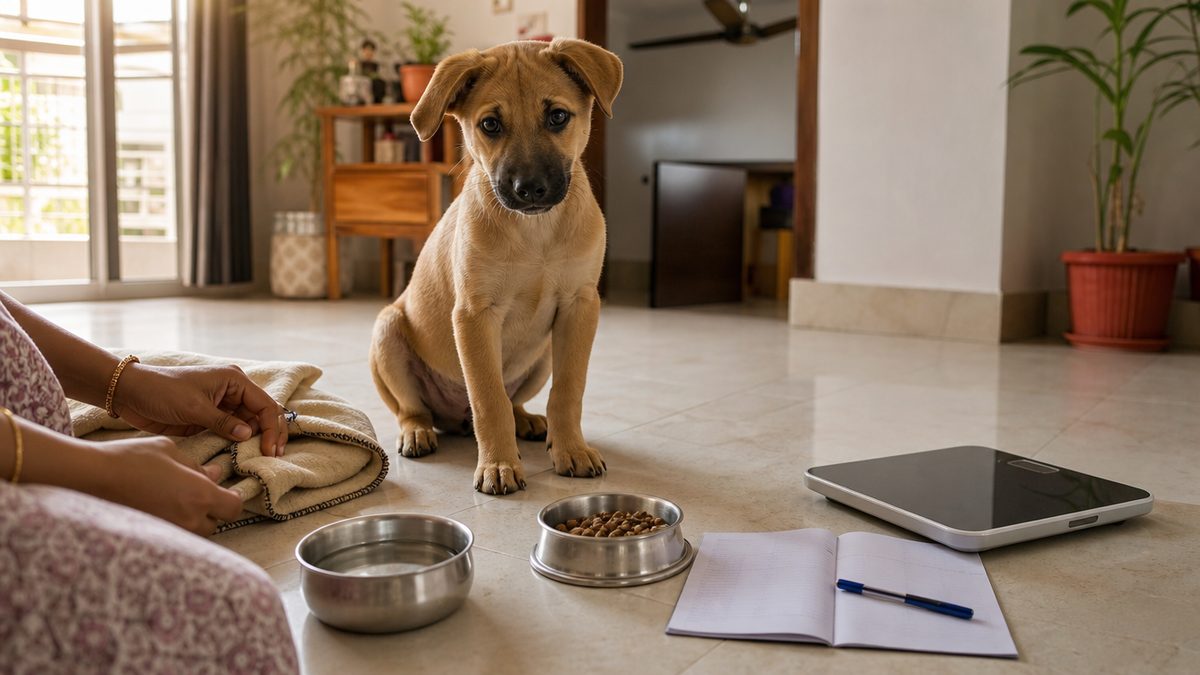
- Weigh the pup weekly on the bathroom scale and note the figure; AAHA wants weight and body condition recorded at every visit.
- Check the coat daily at the ears, armpits, groin and toes, because tick and flea control starts "as early as label allows (usually 6-8 wk)" and the dog ticks in India guide shows the brown dog tick breeds indoors all year.
Sleep in this band is short and frequent. The RSPCA's set-up is "a crate, hiding places and/or cosy bed in a quiet, draught-free place where your puppy can rest undisturbed", with a blanket from the puppy's first home, and the crate placed "in an area of the house where the family spends a lot of time"; RSPCA (England and Wales).
3 to 6 months: the 16-week dose, rabies, the licence clock, ticks and teething
Between 3 and 6 months the vaccine course ends with the dose WSAVA calls "the most important of these early vaccine doses", the one "administered at 16 weeks of age or older", the rabies dose goes in at 3 months and starts the municipal licence clock, worming settles to monthly, meals drop to 2 or 3 a day, and parasite control widens to a tick product on its label interval Animal Husbandry and Fisheries Department Municipal Corporation of Delhi Tropical Council for Companion Animal… Pedigree India (Mars) American Animal Hospital Association. The band also holds teething and, for a pup born in the cool months, the first Indian summer.
| Age | Vaccine | Deworming | Food | Training and socialisation | Vet and paperwork |
|---|---|---|---|---|---|
| 12 to 14 weeks | Third core dose (Chandigarh: 14 weeks); first rabies dose at 3 months (Chandigarh), 12 weeks in WSAVA's wording | Monthly | 4 meals to 3 months, then 3 | Recall on a long line indoors, sit, leave-it; a calm vaccinated adult dog | Rabies certificate from a registered vet; in Delhi, apply for the MCD pet dog registration |
| 16 weeks | Final core dose at 16 weeks or older (WSAVA); Chandigarh's printed course stops at 14 weeks and a private chain's package puts its last 9-in-1 at day 105, so ask for the 16-week dose; Chandigarh gives a second rabies dose at 4 months | Monthly | 3 meals | First pavement walks at dawn once the dose is a week old; puppy class continues | Weigh; body condition score 4 to 5 on the 9-point chart |
| 4 to 5 months | None; blood testing from 20 weeks is WSAVA's alternative to the 26-week dose | Monthly; faecal test 3 months after the first | 3 meals, then 2 to 3 | Teething: frozen chew toys, no hands as toys; bite inhibition; alone time built up towards an hour | Tick and flea product on its label interval |
| 6 months | Nothing until the 26-week dose | Monthly (TroCCAP); Chandigarh moves to every 2 months | 2 meals of puppy food | Adolescence begins; keep classes and exposure going | Sterilisation consult; small breeds are spayed before the first heat at 5 to 6 months (AAHA) |
The 16-week dose is the one an Indian clinic's printed course most often leaves out. Chandigarh's table finishes at 14 weeks. WSAVA goes later because maternal antibody "can be expected to have waned substantially by that age in a large majority of puppies", and adds a line for the household counting rupees: "In situations where a puppy or kitten can only receive a single vaccination (e.g. in the case of cost constraints), vaccination should be with the core vaccines at 16+ weeks of age";. One private chain's seven-visit package, from Rs 6,499 against a struck-through Rs 8,111, runs to day 120, but its last DHPPiL sits at day 105, which is 15 weeks, so it also stops a week short of WSAVA's floor unless a core dose is added.
If money allows only one core vaccination, WSAVA says make it the one at 16 weeks or older. If the clinic's card stops at 14 or 15 weeks, ask for one more core dose at 16 weeks or later and a final one at or after 26 weeks; your nearby vet decides how to fit that to your pup.
Rabies at 3 months, and why that date is also the licence date
Rabies at 3 months is both a vaccine date and a legal one in Delhi, because the MCD's terms say "A valid Anti Rabies vaccination certificate by a registered Veterinary practitioner shall be the pre-requisite for Pet dog Registration" and "Validity of Registration of the pet shall be co-terminus with that of Anti Rabies Vaccination";. The portal prints Rs 500 for a new registration, Rs 500 for renewal and Rs 100 a month late fee after a one-month grace from the certificate's expiry, and no days-from-purchase deadline, so the clock is the certificate's: vaccinate at 3 months, register, renew both a year later. The SOP grounds the duty in section 399 of the Delhi Municipal Corporation Act 1957 and asks for identity proof, residence proof and a photograph of the applicant with the dog. Other cities' portals and fees are in the dog licence in India guide.
Ticks, teeth and the first summer
Parasite control widens in this band because the label allows it: AAHA's puppy column says "Start on flea and tick control as early as label allows (usually 6-8 wk)", and a pup now walking on the ground meets the brown dog tick the dog ticks in India guide describes as active all year. Teeth are on the same checklist, "Evaluate deciduous dentition; persistent deciduous teeth", so a check at 6 months for any milk tooth still in place. Heat is the Indian item no ranking page mentions: Hall and colleagues, reviewing 905,543 dogs under UK veterinary care, found exertion triggered 74.2 percent of 1,259 heat-illness events and that "young male dogs had greater odds of exertional heat-related illness". A pup reaching its first walks in April in Delhi, Hyderabad or humid Chennai is that dog; the heat safety for dogs in India guide's pre-dawn walk windows apply from the first walk.
6 to 12 months: the 26-week dose, sterilisation timing, adult food and the first heat
From 6 to 12 months the calendar holds one vaccine date, a core dose at or shortly after 26 weeks that WSAVA now prefers to the old first annual booster, one decision, when to sterilise, which AAHA sets by adult size, and one switch, from puppy food to adult food at 10 to 13 months on the maker's own chart Royal Canin India Royal Canin India. AAHA also calls the stretch from about 6 months to 3 years "the most challenging for owners as the dog matures socially and behaviorally".
| Age | Vaccine | Deworming | Food | Behaviour | Vet, law and money |
|---|---|---|---|---|---|
| 26 weeks (6 months) | Core dose at or shortly after 26 weeks (WSAVA 2024), replacing the old 12 to 16 month booster; not needed if a blood test at 20 weeks or later shows protection | Monthly (TroCCAP) or every 2 months (Chandigarh) | 2 meals of puppy food | Adolescence: more jumping, mouthing and barking (AAHA) | Small breeds: castration at 6 months, spay before the first heat at 5 to 6 months (AAHA Textbox 1) |
| 7 to 9 months | None | Monthly or every 2 months | The Mini Puppy chart falls from 113 g to 90 g a day for a 6 kg adult weight as growth slows | Fear periods possible; keep exposure gentle and rewarded | Large breeds: wait for growth to stop, castration at 9 to 15 months, spay at 5 to 15 months (AAHA) |
| 10 to 12 months | The rabies booster falls due one year after the first dose; in Delhi the licence renews with it | Faecal test each quarter continues | Mini Puppy moves to adult food at 11 months; Medium Puppy at 12 to 13 months by adult weight (Royal Canin India) | Adult training classes and an active routine (AAHA) | Rs 500 renewal in Delhi, Rs 100 a month late after a one-month grace |
The 26-week dose exists for the pups the 16-week dose missed. WSAVA "recommends either serological testing at least 4 weeks after the last puppy vaccination ... or, alternatively, an additional vaccination at or shortly after 26 weeks of age", which "replaces an earlier recommendation for a 'first annual booster' with core vaccines at 12 to 16 months of age"; after it, core "revaccination need be given no more often than triennially", where the Chandigarh table boosters every year, a disagreement worked through in the dog vaccination schedule in India guide Animal Husbandry and Fisheries Department.
When to sterilise, by adult size
To sterilise at the right age, use AAHA's Textbox 1, set by projected adult weight and covering what the RSPCA calls neutering: castration at 6 months for small breeds and "Wait until growth stops (~9-15 months of age)" for large breeds; spay "Prior to anticipated heat cycle (5-6 months of age)" for small breeds and 5 to 15 months for large, with the line at 45 lb, about 20 kg RSPCA (England and Wales). The bitch's date is tied to her first heat because mammary tumour incidence "is reported to be 8 percent" after one heat "and 26% percent after a second";. Indian law adds a sale rule here: Rule 8(1)(b) says "dogs over six months in age are not sold without first being sterilised, unless they are being sold to another licensed breeder";. The rate cards and complication rates are in dog sterilisation in India, and the signs of a first season in dog heat cycle.
When to move from puppy food to adult food
To move a puppy to adult food, use the maker's chart rather than a birthday. Royal Canin India's Mini Puppy chart, for adult weights up to 10 kg, prints "Transition to Mini Adult" at 11 months; its Medium Puppy chart prints the transition at 12 months for an 11 or 14 kg adult and at 13 months for an 18 or 22 kg adult Royal Canin India. Waltham warns that "Switching to an adult diet too early can slow a puppy's development";. Behaviour in this band is training, not correction: the RSPCA's advice from 6 months is to "continue reward-based training and keep all experiences positive", and AAHA reminds owners that "puppies generally do not 'outgrow' their problems"; American Animal Hospital Association. KCI papers can be transferred into your name now (KCI registration explained), and the pet insurance in India guide reads each policy's exclusions and waiting periods.
How much to feed a puppy in India and what it costs a day, from the maker's own chart
A puppy in India eats between 49 g and 366 g of dry puppy food a day depending on its age and expected adult weight, on Royal Canin India's own feeding charts, and at the Supertails prices read on 18 September 2026 that comes to Rs 86 to Rs 278 a day for the three most common Indian puppy sizes Supertails, Royal Canin Mini Puppy Dog Dry… Supertails, Royal Canin Medium Puppy Dog…. The charts run by expected adult weight and month, not by today's weight, so the table is keyed the maker's way; the rupee column is arithmetic on a listed price, not a quote.
| Puppy | Age | Grams a day on the maker's chart | Bag and price | Rupees a day | Days one bag lasts |
|---|---|---|---|---|---|
| Small breed, 6 kg adult weight (a Shih Tzu or an Indian Spitz) | 4 months | 125 g | Mini Puppy 4 kg, Rs 3,793 (MRP Rs 4,310) | Rs 119 | 32 |
| Small breed, 6 kg adult weight | 8 months | 101 g | Mini Puppy 8 kg, Rs 6,820 (MRP Rs 7,750) | Rs 86 | 79 |
| Medium breed, 14 kg adult weight (a Beagle-sized dog) | 4 months | 232 g | Medium Puppy 10 kg, Rs 7,594 (MRP Rs 8,630) | Rs 176 | 43 |
| Medium breed, 29 kg adult weight (a Labrador or German Shepherd bitch) | 6 months | 366 g | Medium Puppy 10 kg, Rs 7,594 (MRP Rs 8,630) | Rs 278 | 27 |
| Medium breed, 29 kg adult weight | 10 months | 264 g | Medium Puppy 15 kg, Rs 10,850 (MRP Rs 12,330) | Rs 191 | 57 |
Every rupee figure above was tested for a disguised dollar price. Rs 7,594 divides to USD 90.00 at 84.38, which would normally flag a converted list; here it is 12 percent off a printed MRP of Rs 8,630 (8,630 multiplied by 0.88 is 7,594), and the MRP gives 102.27 at 84.38 and 116.62 at 74, so the match is arithmetic noise; the Mini Puppy bags divide cleanly at neither rate Supertails, Royal Canin Mini Puppy Dog Dry…. Over a year that is roughly Rs 31,000 to Rs 43,000 for the small pup and Rs 64,000 to Rs 101,000 for the medium and large pups, before treats: the largest line in the first-year budget and the one the ranking pages never price.
How many meals a day, and what counts against them
To set a feeding schedule, split the chart's daily grams into 4 meals at 2 to 3 months, 2 to 3 meals at 4 to 6 months and 2 meals after 6 months, which is Pedigree India's guidance. Treats count against the same grams: WSAVA says products "labeled as intended for 'short-term', 'intermittent', or 'complementary' feeding should only be fed as a small portion of the diet (10% or less)";. AAHA's puppy item is "establishing a feeding schedule and good feeding and watering habits", and it asks vets to "Discuss risks of raw food";. A home-cooked diet has to be complete for growth; the homemade dog food in India guide covers what that takes.
How to judge a puppy food sold in India
To judge a puppy food, ask the four questions WSAVA's Global Nutrition Committee puts to any brand, because words such as "holistic" or "premium" are "of little practical value for nutritional assessment";. The questions are listed below.
- Whether the company employs a qualified nutritionist, a PhD in animal nutrition or a board-certified ACVN or ECVCN specialist, on staff rather than as a consultant.
- Who formulates the diet, a trained formulator rather than "a pet owner/breeder/trainer";.
- What the quality control process is, and whether the diet meets the AAFCO or FEDIAF growth profile by analysis of the finished food.
- Whether the label carries a growth adequacy statement, a calorie figure and a contact number; calorie information is required on the label only in the United States and "should be available by contacting the manufacturer" elsewhere, which is what the toll-free number on Royal Canin India's product pages is for Royal Canin India.
The check on whether the grams are right is the pup's body, and growth monitoring runs against expected adult weight. WSAVA's 9-point body condition score puts the ideal at 4 to 5: "Ribs easily palpable, with minimal fat covering. Waist easily noted, viewed from above. Abdominal tuck evident";. AAHA cites why a lean puppy matters: Labradors kept at ideal weight "live an average of 15% longer";. Waltham's tool is the number the chart is keyed to, the puppy's ideal adult weight, used "as a reference" to "monitor your puppy's healthy growth";. Weigh the pup on the same scale every month, score the ribs and waist, and adjust the grams by 10 percent, with your nearby vet confirming the target.
German Shepherd puppy care against Shih Tzu puppy care: what changes with size
German Shepherd puppy care and Shih Tzu puppy care follow the same calendar on different clocks: a large-breed puppy keeps growing to 9 to 15 months and AAHA delays its sterilisation until growth stops, while a small-breed puppy finishes growth and moves to adult food by 10 to 11 months and is sterilised at 5 to 6 months Royal Canin India. The same size line runs through parvovirus risk, heat risk and the grams in the bowl.
| Item | Small breed (adult under about 20 kg) | Large breed (adult 20 kg and over) |
|---|---|---|
| Growth ends | About 6 to 9 months (AAHA); the Mini Puppy chart moves to adult food at 11 months | Up to 9 to 15 months (AAHA Textbox 1); the Medium Puppy chart moves to adult food at 12 to 13 months |
| Castration (AAHA) | 6 months | Wait until growth stops, about 9 to 15 months |
| Spay (AAHA) | Before the anticipated first heat, 5 to 6 months | 5 to 15 months, weighed against joint disease and some cancers |
| Meals a day | 4 at 2 to 3 months, 2 to 3 at 4 to 6 months, 2 after | The same count, with more grams per meal |
| Grams a day at 4 months | 125 g for a 6 kg adult weight (Mini Puppy) | 325 g for a 29 kg adult weight (Medium Puppy) |
| Parvovirus risk | All puppies 6 to 20 weeks (AVMA) | The AVMA lists German Shepherds, Rottweilers and Dobermanns among breeds at greater risk |
| Heat risk | Brachycephalic breeds such as the Shih Tzu had greater odds of all three types of heat illness (Hall 2020) | Young male dogs had greater odds of exertional heat illness (Hall 2020) |
Large-breed puppies pay for their size in joints. Waltham: "Large breed puppies, for example, take longer to reach maturity and commonly suffer from joint problems such as hip dysplasia", so owners should follow the recommended amount of exercise while they grow. AAHA's young adult checklist adds "Consider orthopedic radiographic screening for large-breed dogs", and its puppy nutrition item, "Evaluate breed and size for targeted nutrition", is why large-breed growth foods exist. The AVMA names German Shepherds, Rottweilers, Dobermann Pinschers, bull terrier breeds and English Springer Spaniels as breeds at greater parvovirus risk, so for a German Shepherd puppy the 16-week and 26-week doses are not optional. The German Shepherd, Labrador Retriever and Golden Retriever pages carry the hip screening figures and Indian price bands.
Small and flat-faced puppies carry the heat risk instead. Hall and colleagues found that "Brachycephalic dogs had greater odds of all three types of heat-related illness compared with mesocephalic dogs", and the Shih Tzu is brachycephalic, so its first Mumbai or Chennai summer means no walk after sunrise. Its grooming clock starts early, which is what the brush and clipper handling in the list above is for. The Beagle sits in the middle of both tables, an 11 kg adult on the Medium chart, and the Indian Pariah Dog is the heat-adapted option with the same calendar and, from a shelter, no purchase price at all.
Signs that mean the vet today, and what a puppy visit costs at a government hospital against a private chain
A puppy that is lethargic, refuses food, vomits or passes severe, often bloody diarrhoea needs a vet the same day, because those are the AVMA's signs of canine parvovirus, the disease that puts puppies between 6 and 20 weeks at greatest risk, and a government veterinary hospital in India registers a dog for Rs 200 and runs a parvovirus PCR for Rs 600 Bihar Animal Sciences University, Patna. Your nearby vet decides for your animal; this page is not a substitute for that visit.
The signs the bodies name are few and specific. The AVMA's parvovirus list runs "Lethargy, Loss of appetite, Vomiting, Severe, often bloody, diarrhea, Abdominal pain and bloating, Fever or low body temperature (hypothermia), Drooling (due to nausea)";. TroCCAP adds the worm signs, hookworm in puppies "as young as 10 days old" bringing "diarrhoea, often bloody, anaemia, hypoproteinaemia and death", and notes that because eggs may be absent from a sick pup's stool, "history and clinical signs should guide treatment decisions";. The nine signs that mean a same-day visit are listed below.
- Vomiting more than once, or any vomiting with lethargy.
- Diarrhoea with blood or a foul smell, at any age from 10 days Tropical Council for Companion Animal….
- Refusal of two meals in a row in a pup that normally eats.
- A swollen, pot-bellied abdomen or a straddle-legged stance.
- Pale gums, which TroCCAP ties to hookworm anaemia in puppies.
- Drooling with nausea, or a body that feels hot or cold to the hand.
- Worms passed in stool or vomit.
- Panting, wobbling or collapse after exercise in the heat, the exertional heat illness young dogs carry greater odds of.
- Fear, withdrawal or avoidance that lasts beyond a session, for which AVSAB says to "seek veterinary guidance";.
What a puppy visit costs: government rate card against private chain
A puppy visit in India costs Rs 200 at a government veterinary hospital and from Rs 849 a dose at a private chain, on the two rate pages read for this guide. Bihar Animal Sciences University's Veterinary Clinical Complex in Patna registers a dog for Rs 200 at its morning OPD, valid 10 days, and Rs 300 in emergency hours, and prices a faecal examination at Rs 100, a parvovirus PCR at Rs 600 and an indoor stay at Rs 200 a day. Vetic's national page prices a puppy distemper-parvo dose from Rs 849, a 9-in-1 from Rs 899, an anti-rabies dose from Rs 699 and its seven-visit package from Rs 6,499. None divides cleanly at 84.38 or 74 (Rs 6,499 gives 77.02 and 87.82), so they are Indian prices; the government-against-private comparison on one identical 9-in-1 vial is in the dog vaccination schedule in India guide.
The first-year budget from these pages is arithmetic, and food dominates it: a private vaccine package at Rs 6,499, a Delhi registration at Rs 500 and 365 days of dry puppy food at Rs 86 to Rs 278 a day give about Rs 38,000 for a small pup to Rs 108,000 for a large one, before deworming tablets, a tick product, sterilisation, insurance and any illness Supertails, Royal Canin Mini Puppy Dog Dry… Supertails, Royal Canin Medium Puppy Dog…. The dog deworming schedule for India and dog ticks in India guides price the tablets and spot-ons per kilogram, and the illness line is what the pet insurance in India guide is for.
Every date on this page is a guideline body's or a government table's, and your nearby veterinarian decides how it fits your puppy: its breed, its weight, its records from the breeder and the diseases in your city that month. WSAVA's own wording is to follow "any local laws or regulations as a priority" and "the product leaflets of locally manufactured vaccines";. Take this page to the first visit and ask the vet to write your dog's dates on it.
Common questions about puppy care in India
How do you take care of a puppy?
You take care of a puppy by running five clocks at once: core vaccine doses from 6 to 8 weeks, every 2 to 4 weeks, the last at 16 weeks or older and one more at 26 weeks; worming at 2 weeks, every 2 weeks to 8 weeks, then monthly in India; 4 meals a day of a growth food dropping to 2 by 6 months, weighed against the maker's chart; new people, sounds and places every day before 14 weeks, carried until the course ends; and a vet visit every 3 to 4 weeks. In Delhi the rabies dose at 3 months also unlocks the Rs 500 licence.
Where should puppies sleep first night?
Puppies should sleep the first night in a crate or bed in a quiet, draught-free spot where they can rest undisturbed, with a blanket brought from their first home for its familiar smell; the RSPCA's crate rule is to place it where the family spends time, out of direct sun and draughts, with water in a clip-on bowl and never as punishment. Expect two or three toilet trips before morning. The full first 48 hours are in the bringing a puppy home in India guide.
What is the 7 7 7 rule for puppies?
The 7 7 7 rule for puppies is a breeder's socialisation checklist, the Rule of Sevens, adapted from Pat Hastings' article The Puppy Puzzle: by 7 weeks a pup should have been in 7 locations, eaten from 7 containers, been handled by 7 people, taken 7 car rides, been crated 7 times, played with 7 kinds of toy, walked on 7 surfaces, gone somewhere alone 7 times and met 7 challenges. No veterinary or behaviour body publishes it; the evidence-based version is AVSAB's, which puts the primary window in the first three months and asks for exposure before the vaccine course ends. In India the checklist belongs to the breeder, since Rule 8(1)(a) bars sale under 8 weeks.
Can I leave my 9 week old puppy home alone?
Yes, you can leave a 9 week old puppy home alone for short periods, and the RSPCA says to begin doing so between 8 and 12 weeks precisely to prevent separation-related behaviour, but only in minutes built up in stages, never past the point of distress, with a chew in the crate, and never anywhere near the four-hour ceiling the RSPCA sets for any dog. If a job means long absences from day one, the RSPCA's fallback is a friend or family member for the first weeks.
When can a puppy go outside in India?
A puppy can go outside in India from the day it arrives, carried in your arms to see people, traffic and other dogs at a distance, and can walk on the ground once the 16-week core dose has been in for a week; AVSAB puts socialisation before full vaccination as the standard of care, while the AVMA's caution is about places where dogs of unknown vaccination status gather and about other dogs' faeces, which on an Indian street means the pavement and the park, not the balcony or a friend's clean floor.
How much does it cost to raise a puppy in India in the first year?
Raising a puppy in India in the first year costs roughly Rs 38,000 for a small breed to Rs 108,000 for a large one on the pages read for this guide: a private seven-visit vaccine package from Rs 6,499, a Delhi registration of Rs 500, and dry puppy food at Rs 86 to Rs 278 a day from Royal Canin India's charts at Supertails prices, before deworming tablets, a tick product, sterilisation, insurance and any illness. A government hospital course and a shelter pup cut the vaccine and purchase lines hard; food stays the largest line.
Socialisation and training through the first year: what AVSAB, AAHA and the RSPCA say, and what to do in an Indian city
Socialisation in the first year means exposing the puppy, safely and without flooding it, to the people, animals, sounds and places it will meet as an adult, with most of the work done before 12 to 14 weeks, because AVSAB calls the first three months "the primary and most important time for puppy socialization" and AAHA reports a survey in which "only one-third of puppies were receiving exposure to people and dogs outside the home during critical periods for development"; American Animal Hospital Association. Training runs on the same principle: "Positive and consistent training is associated with fewer behavioral problems and greater obedience than methods that involve punishment and/or encourage human dominance";.
AVSAB puts the stakes plainly: behaviour problems "are the number one cause of relinquishment to shelters", and "the combination of maternal immunity, primary vaccination, and appropriate care makes the risk of infection relatively small compared to the chance of death from a behavior problem";. AAHA warns that exposure done badly produces "sensitization instead of positive socialization", so each new thing is met at a distance the pup can stand, paired with food, and ended before it freezes. The RSPCA's training rule is "reward good behaviour and ignore bad behaviour";.
Twelve things an Indian puppy should meet before 14 weeks
The twelve exposures below are ordinary in a flat in Bengaluru, Pune or Kolkata and absent from every UK and US checklist that ranks for this query; each is done from your arms or on a clean floor until the 16-week dose is in.
How to teach a puppy to be alone
To teach a puppy to be alone, build the time up in stages that never reach distress, which is the RSPCA's method, with a ceiling for any dog of "no longer than four hours";. AVSAB adds the reason to schedule alone time even when you are home: "Time must be scheduled for puppies to play alone with their favorite toys ... or take naps in safe places such as crates or puppy pens", which "may help to prevent problems of over attachment";. The RSPCA's stages are numbered below.
The crate serves alone time and toilet training alike, on the RSPCA's rules: big enough for the pup "to stand, turn around, lie down and stretch in", placed where the family spends time, and "never ... used as a punishment";. AAHA lists "the benefits to crate training relative to housetraining, safety, and comfort" among puppy-visit topics alongside bite inhibition.
AVSAB's conditions are that every pup has "up-to-date vaccinations and be disease and parasite free", that classes run "on surfaces that are easily cleaned and disinfected (e.g. indoor environments)", and that dog parks and unsanitised, heavily trafficked areas are avoided until the course is done. Ask the trainer for the class's vaccination rule and how the floor is cleaned before you book.