
Dog health guide
Dog heat cycle: stages, duration, signs and how to manage a female dog in season
The biology from Cornell and Merck with every day range and its source, a counting method for the fertile window, the three weeks of managing a bitch in season with intact males at an Indian gate, the clauses of the 2017 Rules that fix when she may be bred, what a progestin injection does to the uterus, and pyometra counted in Sweden and in Ludhiana, so the spay decision is made on numbers.
Quick answer
A dog heat cycle runs in four stages: proestrus (bleeding, swollen vulva, about 9 days), oestrus (receptive and fertile, about 9 days), dioestrus (2 to 3 months) and anoestrus (1 to 6 months), repeating every 4 to 13 months from a first heat at 6 to 24 months. The fertile days fall roughly on days 11 to 16 from the first bleeding, but any mating can conceive. India's 2017 Rules bar breeding before her eighteenth month and after eight years, and pyometra is the risk in the two months after a heat. Your nearby vet decides for your dog.
This guide is general information for Indian pet owners and is not a diagnosis. Always consult a registered veterinarian near you before acting on anything you read here, and treat any sudden change in your pet's condition as urgent.
What a dog heat cycle is, and when the first one comes
A dog heat cycle is the roughly three-week fertile period, called a season or being in heat, that an unspayed bitch enters every 4 to 13 months, with 7 months the average, from her first heat at 6 to 24 months of age until the end of her life.
The full name is the oestrous cycle, spelled 'estrous' in the American sources this page reads, and it has four stages. Only the first two, proestrus and oestrus, are what an owner sees as heat; the other two, dioestrus and anoestrus, run quietly inside the body for months and matter more than they look, because they are where false pregnancy and pyometra begin. A male dog has no heat cycle at all; he can breed all year and simply answers a female's scent.
The first heat comes at puberty, and breed size sets the date. Cornell gives 6 to 24 months with smaller breeds averaging earlier than larger ones; PetMD splits it as around 6 months for small breeds and 18 to 24 months for large and giant breeds; The Kennel Club says most smaller breeds at around six months and some larger breeds not until over a year. A Beagle or an Indian pariah dog is therefore likely to cycle before her first birthday, a Rottweiler may not cycle until her second.
| Source | First heat | Interval between heats | What it adds |
|---|---|---|---|
| Merck Veterinary Manual, July 2025 | Not stated on the breeding page | 4 to 13 months, 7 the average; anoestrus 1 to 6 months | Each of proestrus and oestrus runs 3 days to 3 weeks, 9 days average |
| Cornell Riney Canine Health Center, July 2023 | 6 to 24 months, smaller breeds earlier | Two heats a year, every 5 to 11 months | Basenji and Tibetan Mastiff cycle once a year; discharge 14 to 21 days |
| PetMD, May 2025 | 6 to 24 months; small breeds about 6, large and giant 18 to 24 | About every six months, up to 11 | No menopause; heats space out with age |
| The Kennel Club (UK), undated | Smaller breeds around six months, some larger breeds over a year | Every six to seven months | Young bitches irregular at first; no litter registered to a dam over eight |
| Wairoa District Council (NZ), undated | 6 to 15 months | Every 6 to 7 months | Cycles should be regular once established |
The spread in that table is real and it is not a contradiction. Merck's 4 to 13 months is the outer range across all bitches; Cornell's 5 to 11 and the two UK pages' six to seven months describe the middle of it. The practical rule is that your own dog's interval, once she has cycled twice, is her calendar: The Kennel Club notes that young dogs may have irregular seasons that settle within a few cycles, and the Wairoa flyer says a dog's cycles may run slightly longer or shorter than average but should be regular, with an irregular pattern being a reason to see the vet. Write the first day of each heat in the vaccination book and the next one becomes predictable.
There is no canine menopause. Dogs carry on having seasons throughout their lives and can conceive at any age, with the gaps between seasons lengthening as they get older. That is why the Swedish insurance data on pyometra runs to age ten and why the Indian breeding rules put an eight-year ceiling on mating, both of which come later on this page.
The four stages of the dog heat cycle, with the days
The four stages of a dog heat cycle are proestrus, oestrus, dioestrus and anoestrus, and on Merck's figures they run about 9 days, about 9 days, 2 to 3 months and 1 to 6 months, in that order.
| Stage | Days, Merck | Days, Cornell | Hormone | What you see |
|---|---|---|---|---|
| Proestrus | 3 days to 3 weeks, 9 average | 6 to 11 on average | Oestrogen climbs from 2 to 10 pg/mL to a 50 to 100 pg/mL peak in late proestrus; progesterone stays under 1 ng/mL | Bloody discharge, a swollen vulva, males interested, she turns them away |
| Oestrus | 3 days to 3 weeks, 9 average | 5 to 9, range 1 to 20 | The LH surge (24 to 48 hours) is day zero; oestrogen falls, progesterone rises to 4 to 10 ng/mL at ovulation | She stands for a male and flags her tail; discharge lightens to straw colour or stops; the vulva is at its largest but softer |
| Dioestrus | 2 to 3 months without pregnancy | Progesterone peaks 2 to 3 weeks after ovulation, plateaus 1 to 2 weeks, falls over 10 to 30 days | Progesterone peaks at 15 to 80 ng/mL, then declines; the cervix closes | She refuses males, discharge stops, swelling subsides; a false pregnancy can show as milk and nesting |
| Anoestrus | 1 to 6 months | About 4 months for the uterus to repair | Oestrogen and progesterone low; LH and FSH rise again in late anoestrus | Nothing to see; the vulva is small and dry |
The hormones matter because they explain everything an owner notices. Oestrogen produces the bleeding and the swelling of proestrus. The LH surge, a rise over 24 to 48 hours that Merck calls 'the central endocrinological event in the reproductive cycle of female dogs', triggers ovulation two to three days later. Progesterone then climbs and stays high through dioestrus whether or not she is pregnant, which is why a bitch can produce milk and build a nest for puppies that do not exist, and why a uterus primed by weeks of progesterone is the one that gets infected.
Where the sources disagree on the days, and which to use
The published duration of a heat differs because the pages count different things. Cornell says the bloody vaginal discharge 'usually' lasts 14 to 21 days; The Kennel Club and Dogs Trust both say a dog bleeds for roughly seven to ten days Dogs Trust (UK), 'Everything you need…; PetMD gives 14 to 21 days for the whole heat. The UK pages are counting visible blood, which fades as oestrus begins; Cornell is counting all discharge, including the lighter straw-coloured discharge of oestrus. For planning a walk schedule or a spay date, use Merck's ranges, because they set the outer limits: proestrus and oestrus can each run from 3 days to 3 weeks, so a whole heat can be as short as a week and as long as six.
One more number governs the breeding rules further down. After a heat or a litter the uterus must repair itself, a process Cornell calls involution that 'requires about four months to complete';, and Merck will not induce a new cycle until at least two months of anoestrus have passed 'to permit uterine involution and repair';. A bitch bred on every heat never gets that repair time, which is what paragraph 5(3) of the 2017 Rules is written to stop.
Signs a dog is in heat, how long she bleeds, and how you know it is over
The first signs a dog is in heat are a swollen, reddened vulva and a bloody vaginal discharge, and the swelling usually shows a few days before the first drops of blood.
The Kennel Club and Dogs Trust between them list the signs below, and a bitch may show only one or two of them Dogs Trust (UK), 'Everything you need….
- Swollen vulva. Red and enlarged, obvious in some bitches and subtle in others; it stays swollen through oestrus and shrinks in dioestrus.
- Discharge that changes colour. Bloody at first, then watery, pink or straw-coloured as oestrus arrives; in some dogs yellow or brown.
- More licking of the genitals, which is also why a clean dog can hide most of the bleeding.
- More frequent urination and marking, because her urine now carries the hormones and pheromones that tell every male within scent range that she is fertile.
- Friendliness to other dogs, especially males, and a weaker recall as she becomes more fertile.
- Mounting other dogs, toys, cushions or your leg, and moving her tail to one side when touched, which is the receptive 'flagging' of oestrus.
- Anxiety, clinginess, fidgeting, nesting or going off her food.
- Defensiveness about dogs sniffing her rear at the start and end of the season, and the opposite in the fertile middle.
How long a dog in heat bleeds
A dog in heat bleeds for roughly seven to ten days on the two UK pages' figures, 'around half of their cycle' in The Kennel Club's words, while Cornell counts 14 to 21 days of discharge because it includes the lighter oestrus discharge that follows the blood Cornell University College of Veterinary…. Some bitches bleed heavily and some barely show. The point the ranking pages make and owners often miss is the direction of the sign: in a woman a period means ovulation is over, in a bitch the bleeding means ovulation is about to happen, so the days after the blood fades are the most fertile, not the least.
How to tell the heat is over
The heat is over when dioestrus begins, and Cornell defines that moment by behaviour: she 'no longer shows signs of estrus, such as standing to be mounted';. The discharge has stopped, the vulva returns to its normal size, and the males lose interest. Because oestrus can outlast the visible bleeding, Dogs Trust's rule is to keep her on the lead for at least a week after the bleeding stops, and longer if male dogs are still keen. The certain answer is a vaginal swab: Merck describes the 'diestrual shift', an abrupt return of small parabasal cells on cytology, as the marker of the first day of dioestrus, and a vet can read it in minutes.
Bleeding that runs past three weeks, a discharge that returns weeks after the season ended, or a bitch who is drinking a lot, vomiting, feverish or off her food in the two months after a heat is a same-day vet visit. Pyometra is 'generally diagnosed within 4 months after estrus';, and in the Ludhiana series 71.9 percent of the cases with a known date came 16 to 60 days after the heat began. Do not wait for the next heat to see if it settles.
Is it painful? The Kennel Club's answer is the honest one: 'it's difficult to tell', dogs cannot say, 'but we suspect that it's generally not painful', and while some bitches seem uncomfortable and fidgety, obvious signs of pain are unusual. Merck describes oestrus behaviour as 'receptive or passive';. No painkiller is routinely given for a heat. A bitch who cries, strains to urinate, is lethargic or has a foul-smelling discharge is not showing heat; she is showing something your nearby vet needs to see.
Dog heat cycle calculator: counting the fertile window from day one
A dog heat cycle calculator is a count from the first day of bleeding, and on Merck's average figures the fertile days fall roughly between day 11 and day 16, with day 1 being the first day you saw blood or a swollen vulva.
There is no formula that beats a progesterone test, and every number below is an average with a wide range. But an owner who counts can at least know which fortnight matters most. The steps are listed below.
- Write down day 1. The first day of blood or obvious vulval swelling. Merck warns that 'even the most astute owner may not notice the true onset of proestrus for a few days', so if in doubt, date it earlier rather than later.
- Expect proestrus to run about 9 days, anywhere from 3 days to 3 weeks. She bleeds, she swells, males are interested, she refuses them.
- Watch for the switch to oestrus. She stands still for a male, moves her tail aside when her rump is touched, and the discharge lightens. The LH surge sits at the end of proestrus or the start of oestrus, and Merck treats it as day zero of the fertile count.
- Add 2 to 3 days for ovulation, then 2 to 3 more for the eggs to mature. Primary oocytes ovulate 2 to 3 days after the LH peak, mature 2 to 3 days later, and live 2 to 3 days after that, which is why Merck advises breedings on days 3 to 6 after the surge. Laid over an average calendar, that is about day 11 to day 16 from the first blood.
- Keep counting for three weeks after the last blood. Oestrus itself can last 3 weeks, and fresh dog semen 'can live in the vagina for 9+ days', so a mating before the fertile window can still conceive. Dogs Trust's lead-for-a-week-after-bleeding rule is the minimum, not the whole answer.
- Book the test if the date matters. For a planned mating, a vet takes vaginal cytology every 2 to 3 days until more than 70 percent of cells are superficial, then progesterone every other day; the day it first rises above 1.5 to 2.5 ng/mL is day zero, breedings follow on days 3 to 6, and a second test 2 to 3 days later above 5 ng/mL confirms ovulation.
The calendar is only a guide for three reasons Merck states plainly. Proestrus and oestrus each vary from 3 days to 3 weeks; 'estrous behavior may precede or follow the LH peak', so the day she first stands is not the day she is fertile; and semen survives for over a week. The practical translation for an owner who is not breeding is that any mating from day 1 to three weeks after the last blood can result in puppies, and supervision has to cover the whole span. The Kennel Club puts it the same way: a bitch mated before her most fertile days can still conceive because sperm stays viable for days.
If she is mated on purpose, the same count gives the due date. Whelping comes 64 to 66 days after the LH peak, or 56 to 58 days after the first day of dioestrus on cytology, which is far more accurate than counting from the mating date. The pregnancy itself, the feeding and the whelping are on the dog pregnancy care guide.
If a mating happened at the gate
Sixty percent of misbred bitches do not conceive, so Merck advises confirming a pregnancy before treating one, unless the owner has already decided on spaying. Post-mating douches 'are of no value'. The old 'mismating injection', an injectable oestrogen, 'can prevent pregnancy' when given correctly but 'involves great risk of serious adverse effects, including pyometra and potentially fatal bone marrow suppression, and they are not advised', and oral oestrogens in dioestrus 'greatly increase the risk of pyometra';. The routes Merck does describe are prostaglandins (cloprostenol, with cabergoline), dexamethasone, or the antiprogestin aglepristone, whose 'availability remains problematic in some countries';.
The Kennel Club's page says that 'certain injections' given within the first few days after a mismating 'can prevent pregnancy' and leaves the drug unnamed. Merck's June 2025 review names the class, injectable oestrogens, and advises against it because of pyometra and bone marrow failure. If a clinic offers a mismating shot, ask which drug it is; an oestrogen is the one to refuse, and a pregnancy confirmed on ultrasound is the point at which the safer protocols are chosen with your vet.
Managing a dog in season at home and outdoors in India
Managing a dog in season in India means three weeks of lead walks, a closed gate and complete separation from every intact male, including the colony's own street dogs, because male dogs can smell a female in season over a long distance.
The male dogs at the gate
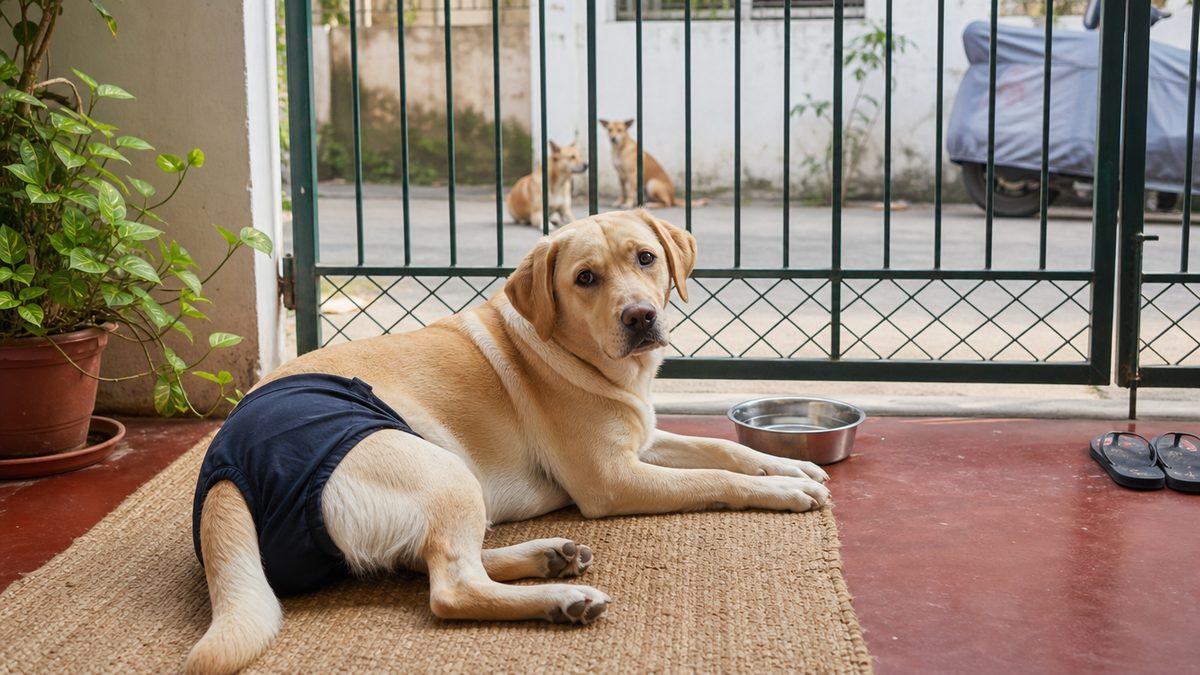
The scenario every Indian owner of an unspayed bitch meets is the one no ranking page describes: from the first day of her heat, the free-ranging males of the lane sit at the gate, follow the walk, and urinate along the compound wall. The Kennel Club explains the mechanism, her urine now carries hormones and pheromones that males can smell, and they 'may try to visit her, or may urinate near your house in an attempt to stake their claim';. In Delhi, Pune, Bengaluru or Chennai those visitors are mostly entire community dogs; how many there are and what the ABC Rules do about them is on the stray dogs in India guide. The Wairoa flyer's advice was written for a New Zealand back garden and applies word for word to an Indian ground-floor compound: do not leave her alone in the garden, keep her 'well locked up' so she neither runs off nor draws males to the back door, and confine her at night.
The 2017 Rules make the same point for licensed kennels. Second Schedule Part IV paragraph 23(3) says 'female dogs in heat shall not be housed in the same primary enclosure with sexually mature males, except for breeding';. A home with an entire male, a neighbour's Labrador who visits, or a gate with a gap under it needs the same rule, and doors, crates and a leash are the enclosure. Cloth pants stop mess, not mating: The Kennel Club notes that season pants 'may not be effective at preventing her from attracting a mate or successfully mating';.
Caring for a dog in heat comes down to one job, to supervise her every hour she could meet a male, and the routine for the three to four weeks is listed below.
- Walk on a short lead, at quiet hours, and skip the park. Early morning and after dark are both the quietest and, in an Indian summer, the coolest slots; the wet-bulb thresholds by city are on the heat safety for dogs in India guide. Keep her close; The Kennel Club advises quieter times and places, always on the lead, so she cannot run to a mate.
- Close the gate and check the compound before she goes out, including the gap under the gate, the drain and the lift lobby. A male can and will wait.
- Separate her completely from any intact male in the house, with closed doors and a crate, for the whole heat and a week beyond the last blood.
- Manage the discharge with washable dog pants or a diaper changed every 3 to 4 hours, towels on her bed, and no sofa or carpet; introduce the pants and the room limits before the season so they do not read as punishment.
- Wash bedding and pants daily. The Ludhiana authors attribute post-mating pyometra partly to 'unhygienic conditions leading to infection in the favourable environment during the impending diestrus'; humid monsoon weeks are the ones to be strictest in.
- Keep her routine and comfort her, with games, a stuffed toy and rest; Dogs Trust warns that a sudden change of routine, such as locking her in the kitchen, causes distress.
- Write the dates down: first blood, first day she stood, last blood, and the date the vulva went back to normal. Her next heat, and the two-month window in which pyometra is most likely, both count from this record.
Two more Indian realities. A bitch in season on a two-wheeler, in a lift or at a boarding kennel is a bitch surrounded by strangers' dogs, so postpone boarding and grooming appointments until she is a week past the last blood. And if a mating at the gate does happen, do not wait: the calculator section above says what Merck advises, and the dog pregnancy care guide covers a pregnancy that is carried. Your nearby vet, who knows the dog, decides which.
If you are thinking of breeding: what the 2017 Rules require
To breed a female dog lawfully in India, a breeder waits until she has reached her eighteenth month, has her certified healthy by a veterinary practitioner within ten days before mating, and never breeds her in two consecutive seasons, under Second Schedule Part II paragraph 5 of the Prevention of Cruelty to Animals (Dog Breeding and Marketing) Rules, 2017.
The Rules bind more people than the word 'breeder' suggests. Rule 2(1)(c) defines a breeder as 'an individual or group of persons who own dogs of specific breeds for breeding and sale of dogs and pups', Rule 3(1) bars any breeding activity without a certificate of registration from the State Animal Welfare Board, and Rule 4(2) sets the application fee at Rs 5,000, non-refundable, for a certificate valid two years under Rule 4(9). An owner who mates the family Labrador once and sells the pups is a breeder on that definition. The clauses that touch the heat calendar are in the table.
| Provision | What it says | What it means for the heat calendar |
|---|---|---|
| Second Schedule Part II para 5(2) | 'Only normal, healthy, mature female dogs that have reached their eighteenth month shall be bred and shall be certified as healthy by a veterinary practitioner at least ten days prior to their being bred' | The first heat, and usually the second, are never bred; a vet certificate is dated within the 10 days before the mating |
| Para 5(3) | 'No female dog shall be exploited to produce litters in two consecutive breeding seasons' | At most every other heat |
| Para 5(4) | Female dogs shall not give birth 'before the end of the period of twelve months beginning with the day on which they last gave birth to pups' | Twelve months between whelpings, counted from the last whelping date |
| Para 5(5) | 'Only one litter shall be produced in one year' and artificial insemination and 'rape stands' shall not be used | One litter a year, by natural mating only |
| Para 5(6) | 'No female dog shall be exploited to give birth to more than five litters of pups during her lifespan' | Five litters, then she is retired from breeding |
| Para 5(7) | No male used for breeding unless healthy, mature and past 'his eighteenth month', certified healthy within ten days before mating | The stud has the same age floor and the same certificate |
| Para 6(3) | In-breeding (relatives of the 2nd to 4th grade within four generations) and incest breeding (parent to child, brother to sister) 'are not permitted and are prohibited' | Check both pedigrees before the mating, not after |
| Para 6(4) | 'Female dogs shall not be mated after the age of eight years' | The last lawful mating is before the eighth birthday |
| Para 6(5) and 6(7) | Proof of age certified by a veterinary practitioner; the bitch 'up-to-date with their vaccination boosters and de-worming prior to mating' | Vaccination and deworming records dated before the mating |
| Part IV para 23(3) | 'Female dogs in heat shall not be housed in the same primary enclosure with sexually mature males, except for breeding' | Separate housing during every unbred heat |
| Rule 8(1)(a) and 8(1)(e) | Pups under eight weeks are not sold; each pup sold is micro-chipped | The litter stays at least eight weeks and is chipped before sale |
The arithmetic follows. With a first heat at 6 to 12 months and two heats a year, the earliest lawful mating is the second or third heat, at or after the eighteenth month. One litter a year and twelve months between whelpings means at most every other season, which matches the four months of uterine repair Cornell describes. Five litters and an eight-year ceiling close the career. The UK register applies the same last rule from the other side: The Kennel Club 'will not usually register a litter to a dam over the age of eight';. The genetic-defect testing clause, Part III paragraph 8(10), and the health tests it names are on the individual breed pages.
What the KCI adds, and what it does not
The Kennel Club of India registers the litter, not the breeder. Its Form C goes to the Chennai office 'after 30 days of the birth of the pups to enable litter inspection' and within 180 days, at Rs 750 per pup within 60 days on the form as printed, with both parents already registered and an Indian Kennel Gazette subscription compulsory. The form carries no rule on the dam's age or the interval between litters; those sit only in the 2017 Rules. The fees, the forms and what a certificate proves and does not prove are on the KCI registration explained guide. Paragraph 6(7)'s vaccination and deworming condition is met with the schedules on the dog vaccination schedule in India and dog deworming schedule India guides, dated before the mating.
Heat suppression injections and tablets: what a progestin does to the uterus
Heat suppression drugs for dogs are progestins, such as megestrol acetate tablets and medroxyprogesterone acetate injections, and androgens, and Merck advises against the progestin in breeding females because of 'the increased risk of cystic endometrial hyperplasia and pyometra', mammary hyperplasia and tumours, insulin resistance and rebound lactation.
The reason is the hormone itself. Progesterone is the dioestrus hormone, the one that thickens the uterine lining, closes the cervix and quietens the uterine muscle so a pregnancy can hold. A progestin injection holds the uterus in that state for months, and an infected uterus with a closed cervix is the dangerous form of pyometra. The Kathmandu Valley series counted it: of 45 pyometra bitches presented between August and December 2022, 25 (55.55 percent) had a history of medroxyprogesterone acetate injections 'for birth control'; closed-cervix pyometra occurred in 72 percent (18 of 25) of the injected bitches against 35 percent (7 of 20) of the others, an odds ratio of 4.78. The authors attribute it to the drug's progesterone-like action, endometrial proliferation, 'decreased myometrial contractility, and closure of the cervix', plus suppression of the uterine immune response.
Merck's full list for megestrol acetate is cystic endometrial hyperplasia and pyometra, mammary hyperplasia and neoplasia, 'hyperglycemia secondary to insulin resistance, and rebound hyperprolactinemia and lactation';. Androgens fare no better: long-term suppression with them 'is not advised because it is not documented to be safe', with breakthrough proestrus, clitoral enlargement, vaginitis, oily skin and altered liver values, a return to oestrus about 70 to 90 days after stopping, and severe urogenital anomalies in female puppies if given during a pregnancy. Synthetic GnRH implants can suppress cycles 'but the products are not universally available';. Merck's first line on the subject is the one to keep: 'Ovariohysterectomy or ovariectomy is the best method to prevent the estrous cycle in bitches and queens';.
If a clinic offers an injection to skip a season, ask which drug it is. If it is a progestin, medroxyprogesterone acetate or megestrol acetate, the price of one skipped season can be a closed pyometra at the next dioestrus, and the Kathmandu numbers are the nearest counted series to India: 25 of 45 pyometra bitches had been injected. No Indian pyometra caseload opened for this page recorded the injections as a variable, so the Indian rate is unknown, not zero. A bitch who has had one already needs the two-month watch after her next heat, and a conversation about spaying.
The honest Indian gap is worth stating. The Ludhiana series of 336 cases recorded breed, age, season, mating history and time since the heat, and did not record hormone treatment. Until an Indian hospital counts it, the Nepali figure, from the same climate, the same clinic practice and the same over-the-counter drug supply, is the best evidence a South Asian owner has.
Pyometra after a heat: the numbers, and when to spay in relation to a season
Pyometra, a pus-filled infected uterus, is the disease every heat cycle sets up, because it is 'generally diagnosed within 4 months after estrus' and the progesterone of dioestrus is what lets the infection take hold.
The denominators come from Sweden, where dogs are insured and rarely spayed. In an insurance database of over 200,000 dogs, 1,803 bitches in 1995 and 1,754 in 1996 had pyometra claims, a 12-month risk of about 2 percent for bitches under ten, and on the survival curves 23 to 24 percent of bitches had experienced pyometra by ten years of age, from 10 to 54 percent depending on breed; Rottweilers, Golden Retrievers, Cavalier King Charles Spaniels, rough Collies, Bernese Mountain Dogs and English Cocker Spaniels were at raised risk, German Shepherd Dogs and Dachshunds at low risk. The larger follow-up of over 260,000 bitches from 1995 to 2006 found 20,423 pyometra diagnoses, an incidence of 199 per 10,000 dog-years, 19 percent of bitches affected by age ten, a mean age at diagnosis of 7.0 years, and a Rottweiler risk of 65 percent for pyometra or a mammary tumour by ten.
India now has a counted series of its own. The Guru Angad Dev Veterinary and Animal Sciences University hospital in Ludhiana reviewed every female dog presented with a reproductive problem from 2016 to 2021 and published the result in June 2025.
| Measure | Figure | Denominator |
|---|---|---|
| Female dogs presented with a reproductive problem | 4,502 | 2016 to 2021 |
| Pyometra cases | 336, a period prevalence of 7.5 percent | of 4,502 |
| Yearly prevalence | 7.1 percent in 2016 rising to 10.0 percent in 2021 | 396 to 1,149 caseloads a year |
| Mean age at presentation | 5.6 years, range 1 to 14; 45.5 percent aged 5.1 to 8 | 336 |
| Time since the heat began, under 15 days | 5.4 percent | 16 of 295 with a known date |
| 16 to 30 days | 39.7 percent | 117 of 295 |
| 31 to 60 days | 32.2 percent | 95 of 295 |
| More than 60 days | 22.7 percent | 67 of 295 |
| Mating history | 64.2 percent never mated; 22.8 percent mated but did not conceive; 13.0 percent after whelping | 336 |
| Season of presentation | Spring 32.7 percent, autumn 20.5, summer 16.9, monsoon 16.7, winter 13.0 | 336 |
| Died | 12.2 percent overall; 11.7 percent after surgery | 41 of 336; 34 of 291 operated |
| Mean cost to the owner | Rs 5,691.50, rising every year | government hospital rates, 2016 to 2021 |
Three lines in that table change how an owner behaves. First, 71.9 percent of cases with a known date came 16 to 60 days after the heat began, which is why the two months after every season are the watch period. Second, the bitch who was never mated was the commonest patient, so 'she has never had puppies' is not protection. Third, even at government rates the average bill was Rs 5,691.50 and one dog in eight died; a private clinic in Mumbai or Bengaluru will charge several times that, and whether a policy pays is on the pet insurance in India guide. Breed prevalence within the Ludhiana caseload ran from 71.4 percent in the Saint Bernard and 54.5 percent in the Tibetan Mastiff down to 5.0 percent in the Golden Retriever and 3.4 percent in the German Shepherd, the last two agreeing with the Swedish ranking on the German Shepherd and disagreeing on the Golden.
When to spay in relation to a heat
Spaying removes the ovaries and, in most Indian clinics, the uterus, and Cornell states the consequence in one line: it 'prevents a common reproductive infection of the uterus known as pyometra and, in many cases, reduces the risk of mammary cancers';. The timing question has two halves. In relation to a heat that has just happened, Cornell says 'it is best to wait about two months after her cycle', because the hormones return to baseline and the surgery bleeds less, although a spay can be done during a heat if needed; Dogs Trust says between cycles, 'at least 3 months after being in heat';; Merck's involution rule is a minimum of two months. Both figures are published here; no source opened for this page puts the safe interval under two months, and the date within that range is your vet's.
In relation to the first heat, the 2019 AAHA guideline recommends spaying a small breed, under 45 lb (about 20 kg) projected adult weight, 'prior to anticipated heat cycle' at 5 to 6 months, and a large breed at 5 to 15 months with clinical discretion, balancing the mammary benefit of an early spay against the joint risk of one. AAHA quotes the figure behind the mammary side, 8 percent mammary neoplasia in bitches spayed after one oestrus and 26 percent after two, citing its reference 117, and adds that most of the spay-neuter literature 'documents association but not cause and effect'. A 2012 systematic review of 13 reports found nine at high risk of bias and judged the evidence that spaying, or its age, reduces mammary tumours 'weak and not a sound basis for firm recommendations'. Both are printed here because the pyometra numbers above do not depend on the mammary argument at all: a bitch with no ovaries and no uterus cannot get pyometra.
The breed-by-breed timing evidence, the surgery step by step, the recovery days and dated Indian prices are on the dog sterilisation in India guide, and the breed pages carry their own figures: the Labrador Retriever page on timing against growth-plate closure and weight, the Beagle page on how many Beagles are neutered and what it does to appetite, and the Indian pariah dog page on adopting a dog that arrives already sterilised. None of them replaces the examination; your nearby vet, who has weighed the dog and read her history, decides the date.
Common questions about the dog heat cycle
How long is a dog in heat bleed?
A dog in heat bleeds for roughly seven to ten days on The Kennel Club's and Dogs Trust's figures, while Cornell counts 14 to 21 days of discharge because it includes the lighter straw-coloured discharge that follows the blood. Some bitches bleed heavily and some barely show, and a clean dog licks most of it away. Bleeding past three weeks is a vet visit.
How do I know when dog heat is over?
Dog heat is over when she stops standing for males, the discharge has stopped and the vulva has gone back to its normal size, which Cornell defines as the start of dioestrus. Keep her on the lead for at least a week after the bleeding stops because she can still be fertile, and treat fading male interest as the practical sign. A vaginal swab read by your vet gives the certain answer.
Is a dog's heat cycle painful?
A dog's heat cycle is generally not painful on The Kennel Club's assessment: it is hard to know what a dog feels, but obvious signs of pain are unusual, and some bitches are only fidgety or uncomfortable. Merck describes oestrus behaviour as receptive and passive. Crying, straining, lethargy, fever or a foul discharge is not normal heat and needs your nearby vet the same day.
How many days will a female dog in heat accept a male?
A female dog in heat accepts a male for the length of oestrus, about 9 days on average and anywhere from 3 days to 3 weeks on Merck's figures; Cornell gives 5 to 9 days with a range of 1 to 20. Standing behaviour can begin before or after the LH surge, so the days she accepts a male do not map exactly onto the fertile days, which Merck puts at days 3 to 6 after the surge.
How many times a year is a dog in heat?
Most dogs are in heat twice a year. Merck gives the interval between heats as 4 to 13 months with 7 the average, Cornell as every 5 to 11 months, and The Kennel Club as every six to seven months; the Basenji and the Tibetan Mastiff cycle once a year. Young bitches are irregular for the first few seasons and the gaps lengthen with age, but there is no menopause and she can conceive at any age.
Can I breed my dog on her first heat in India?
No. Second Schedule Part II paragraph 5(2) of the Dog Breeding and Marketing Rules, 2017 allows only 'normal, healthy, mature female dogs that have reached their eighteenth month' to be bred, certified healthy by a veterinary practitioner within ten days before mating, and paragraph 5(3) bars litters in two consecutive seasons. A first heat at 6 to 12 months is never a lawful mating, and paragraph 6(4) ends breeding at eight years.