
Dog nutrition guide
Homemade dog food in India: how to balance a home-cooked diet and what it costs per day
The nutrient minimums a home-cooked adult dog diet has to meet, from the NRC 2006 report and FEDIAF's 2025 tables; what the Indian kitchen bowl of rice, chicken, egg, dal and curd actually delivers against them by the ICMR-NIN food composition tables; why 190 of 200 published recipes failed; the kitchen foods that harm a dog; the vegetarian question answered with its limits; and the ingredient cost per day for a 10 kg and a 25 kg dog against a dry food's own feeding chart, at Indian seller prices on 18 September 2026.
Quick answer
Homemade dog food in India is balanced only when a veterinary nutritionist formulates it against a nutrient standard: the usual bowl of rice, chicken, egg and curd meets the FEDIAF adult protein and fat minimums and delivers about 15 percent of the calcium minimum, and 190 of 200 published recipes failed a nutrient. At Indian seller prices on 18 September 2026 the ingredients cost Rs 87 a day for a 10 kg dog and Rs 174 for 25 kg, against Rs 27 and Rs 53 for a complete dry food.
This guide is general information for Indian pet owners and is not a diagnosis. Always consult a registered veterinarian near you before acting on anything you read here, and treat any sudden change in your pet's condition as urgent.
What a balanced homemade dog food has to contain
A balanced homemade dog food supplies every essential nutrient at or above a published minimum for the energy the dog eats, and the two standards that set those minimums are the National Research Council's Nutrient Requirements of Dogs and Cats (2006) and FEDIAF's Nutritional Guidelines, republished in September 2025 FEDIAF (European Pet Food Industry….
The NRC report is the 424-page scientific baseline, sold by the National Academies Press and summarised for owners in a free booklet, which puts an adult dog of 33 pounds (15 kg) eating 1,000 Calories a day at 25 g of crude protein, 14 g of total fat, 1 g of calcium and 0.75 g of phosphorus, and adds that 'a minimum of approximately 5.5% of the diet should come from fats and 10% from protein'; National Research Council. FEDIAF, the European pet food federation, reworks the NRC data into recommended levels for complete food, and its 2025 tables say plainly that they are 'minimum recommended nutrient levels for commercial pet food, not minimum requirements or optimal intake levels', which is why a veterinary nutritionist formulating a home-cooked diet works to these nutrient minimums with a margin rather than to the bare requirement. The table below carries the adult numbers; the two-figure minimums are FEDIAF's two maintenance-energy assumptions, 110 kcal per kg of metabolic weight for a dog with 1 to 3 hours of low-impact activity and 95 kcal for a single-pet household dog walked for under an hour.
| Nutrient | Minimum per 1,000 kcal ME | Minimum per 100 g dry matter | Adult maximum |
|---|---|---|---|
| Protein | 45.00 to 52.10 g | 18.00 to 21.00 g | None set |
| Fat | 13.75 g | 5.50 g | None set |
| Calcium | 1.25 to 1.45 g | 0.50 to 0.58 g | 6.25 g per 1,000 kcal (2.50 g per 100 g DM) |
| Phosphorus | 1.00 to 1.16 g | 0.40 to 0.46 g | 4.00 g per 1,000 kcal (1.60 g per 100 g DM) |
| Calcium to phosphorus ratio | 1:1 minimum | 1:1 minimum | 2:1 |
| Vitamin B12 | 3.35 to 3.87 µg per 100 g DM | 3.35 to 3.87 µg | None set |
How much to feed starts with calories, not cups
How much to feed is a calorie question before it is a gram question. The WSAVA's chart, built on the 2006 NRC maintenance formulas of 130 kcal (active adult) and 95 kcal (inactive adult) multiplied by body weight in kilograms to the power 0.75, puts a 10 kg dog at 470 to 590 kcal a day and a 25 kg dog at 940 to 1,174 kcal. FEDIAF's own practical table gives 130 kcal per kg of metabolic weight at 1 to 2 years (range 125 to 140), 110 at 3 to 7 years (95 to 130) and 95 for a dog over 7 (80 to 120), and it adds a line that matters in a Delhi June or a Shimla January: outside the dog's thermoneutral zone, requirement rises by 2 to 5 kcal per kg of metabolic weight for every degree Celsius, so the summer bowl on the heat safety guide for dogs in India is a different bowl from the winter one. The arithmetic is short. Ten kilograms to the power 0.75 is 5.62, so 95 × 5.62 = 534 kcal and 130 × 5.62 = 731 kcal; twenty-five kilograms gives 11.18, so 1,062 to 1,453 kcal. Pedigree India's feeding chart uses 534 kcal for a 10 kg dog, the NRC inactive figure exactly, which is a useful check that the commercial chart and the science are the same table.
The NRC booklet lists what a dog cannot make for itself, which is the shopping list every balanced bowl has to cover. The four sources are set out below.
- A protein source, because dietary protein carries the 10 essential amino acids a dog cannot synthesise, and 'dogs cannot survive without protein in their diets';.
- A fat source, because fats supply the essential fatty acids, carry the fat-soluble vitamins and give the most concentrated energy, with linoleic acid at a FEDIAF minimum of 3.27 to 3.82 g per 1,000 kcal FEDIAF (European Pet Food Industry….
- A calcium and mineral source, because meat, rice and dal are all low in calcium and high in phosphorus, and the booklet names 12 essential minerals, calcium and phosphorus first.
- A vitamin source, because the vitamins A, D, E and the B group have set allowances, and vitamin D was the nutrient most often under half its allowance in the 200-recipe study, 97 of 102 deficient recipes Stockman J, Fascetti AJ, Kass PH.
Water is the fifth item and the cheapest; the booklet's own answer to heat and exercise is that fresh water should be available at all times.
Why published recipes fail: 200 recipes, 106 recipes, 95 raw rations
Published homemade dog food recipes fail nutrient standards in every study that has tested them: 190 of 200 English-language recipes in the largest study, all 80 dog recipes in a Portuguese-language study, and 60 percent of 95 raw rations fed by German owners Dillitzer N, Becker N.
The largest study is Stockman, Fascetti, Kass and Larsen at the University of California, Davis, published in JAVMA in June 2013. They took 200 recipes from 34 sources, 133 from two veterinary textbooks and nine pet-care books and 67 from 23 websites, 129 of them written by veterinarians, and ran each through diet-formulation software against the NRC and AAFCO adult profiles. Most (190, or 95 percent) had at least one essential nutrient below both guidelines and 167 (83.5 percent) had several; the nutrients most often short were zinc (138 recipes, 69 percent), choline (129, 64.5 percent), copper (108, 54 percent), the omega-3 fats EPA and DHA (107, 53.5 percent) and calcium (70, 35 percent), and vitamin D was short in 102 of the 167 recipes where it could be assessed (61.1 percent). The recipes were also vague: 184 (92 percent) needed at least one assumption to prepare, 171 (85.5 percent) gave no calorie information, 58 (29 percent) named no supplement product and 13 (6.5 percent) contained garlic or onion. Only 3 recipes met every NRC recommended allowance and 9 met every AAFCO minimum; all 4 recipes written by board-certified veterinary nutritionists were adequate.
| Study | Sample | Standard used | Headline finding | Calcium finding |
|---|---|---|---|---|
| Stockman and others, JAVMA, June 2013 | 200 recipes from 34 sources (129 by veterinarians) | NRC 2006 and AAFCO | 190 of 200 (95 percent) short in at least one nutrient; 167 (83.5 percent) in several | 70 (35 percent) below the calcium allowance |
| Pedrinelli and others, Journal of Nutritional Science, 2017 | 106 recipes in Portuguese (80 dog, 24 cat, 2 both) | FEDIAF 2014 | Every diet had at least one nutrient below recommendation; 48 percent gave no precise quantities | Calcium below recommendation in 73.2 percent of dog recipes |
| Pedrinelli and others, Scientific Reports, 2019 | 75 dog and 25 cat recipes from websites, cooked and laboratory analysed | NRC and FEDIAF | None supplied every nutrient; more than 84 percent had three or more below | Calcium and potassium the nutrients most often short in dog recipes |
| Pedrinelli and others, BMC Veterinary Research, 2021 | The same 75 dog and 25 cat recipes, by ingredient count, supplement and vegetarian preparation | NRC and FEDIAF | Number of ingredients, vegetarian preparation and the presence of a supplement did not guarantee adequacy | Non-supplemented diets had calcium and the calcium to phosphorus ratio below recommendation |
| Dillitzer, Becker and Kienzle, British Journal of Nutrition, 2011 | 95 bone-and-raw-food (BARF) rations fed by German owners | NRC recommended allowance | 60 percent had at least one imbalance; about half supplied less iodine than the minimum | 10 percent supplied under 25 percent of the calcium allowance, with the ratio below 0.6:1 |
The rotation myth and the vet-written myth
Rotating recipes does not fix them. Stockman's team analysed three groups of seven recipes whose author recommended rotation, and each group combined still fell below the allowance for zinc, and two of three for choline and vitamin D; 14 nutrients were short in at least 50 recipes, so rotating across sources would not close the gaps either. A vet's name on a recipe narrows the problem without solving it: recipes by veterinarians had a median 5 nutrients below the NRC allowance against 7 for non-veterinarians, and most veterinarian-written recipes still had at least one deficiency; the only recipes that passed in full were the four by board-certified nutritionists. A page headed 'vet approved' that lists 'calcium supplement' as an ingredient without a gram, as the Australian clinic page ranking for this query does, is a recipe in that 190, not in that 4. The WSAVA's own answer to 'Can I safely use recipes for home cooked diets found in books and online?' is 'Not really', because some carry harmful ingredients such as garlic and others 'have nutritional deficiencies', and its 2011 guidelines list an 'unconventional diet (e.g., raw, homemade, vegetarian, unfamiliar)' as a nutritional risk factor to be screened at every visit World Small Animal Veterinary Association.
The NRC booklet describes the disease a low-calcium home diet causes: 'A deficiency of dietary calcium, for instance, causes a condition known as secondary hyperparathyroidism. Recognized clinically for many years in dogs fed meals consisting mainly of meat, this disease results in major bone loss, skeletal abnormalities, and pathological fractures';. FEDIAF records the other side: an inverse ratio, calcium to phosphorus at 0.4:1 or below, caused adverse effects in adult dogs in the studies its maximum rests on, and excess calcium harms growing large-breed puppies, so the amount is a calculation with a floor and a ceiling, never a pinch National Research Council.
What the Indian kitchen bowl delivers, and what it lacks
The Indian kitchen bowl of rice, boneless chicken, egg and curd meets the FEDIAF adult minimums for protein and fat and delivers about 15 percent of the calcium minimum, with the calcium to phosphorus ratio inverted at 0.29:1, by the ICMR-National Institute of Nutrition's Indian Food Composition Tables 2017 FEDIAF (European Pet Food Industry….
The IFCT 2017, by Longvah, Ananthan, Bhaskarachary and Venkaiah at the National Institute of Nutrition in Hyderabad, analysed foods sampled from six regions of the country for most entries, and it is the right table for an Indian kitchen because it measured Indian rice, Indian dal and Indian chicken rather than a US database's versions of them. The rows below are its raw values per 100 g, with energy converted from kilojoules at 4.184; the tables carry no entry for curd, so whole cow milk, the food curd is set from, stands in for it.
| Food (IFCT code) | Energy, kcal | Protein, g | Fat, g | Calcium, mg | Phosphorus, mg | Calcium to phosphorus |
|---|---|---|---|---|---|---|
| Rice, raw, milled (A015) | 356 | 7.94 | 0.52 | 7.5 | 96 | 0.08 |
| Wheat flour, atta (A019) | 320 | 10.57 | 1.53 | 30.9 | 315 | 0.10 |
| Green gram dal, moong (B010) | 326 | 23.88 | 1.35 | 43.1 | 416 | 0.10 |
| Lentil dal, masoor (B013) | 322 | 24.35 | 0.75 | 44.3 | 310 | 0.14 |
| Red gram dal, toor (B021) | 331 | 21.70 | 1.56 | 71.7 | 328 | 0.22 |
| Chicken breast, skinless (N003) | 168 | 21.81 | 9.00 | 12.9 | 178 | 0.07 |
| Egg, whole, boiled (M004) | 148 | 13.43 | 10.54 | 55.1 | 209 | 0.26 |
| Milk, whole, cow (L002), standing in for curd | 73 | 3.26 | 4.48 | 118 | 96.6 | 1.22 |
Every food on that list except milk carries far more phosphorus than calcium, which is the whole problem in one column. A dog's requirement runs the other way, at least as much calcium as phosphorus, so a bowl built from the first seven rows cannot reach 1:1 whatever the proportions Longvah T, Ananthan R, Bhaskarachary K.
The arithmetic for the usual non-veg bowl
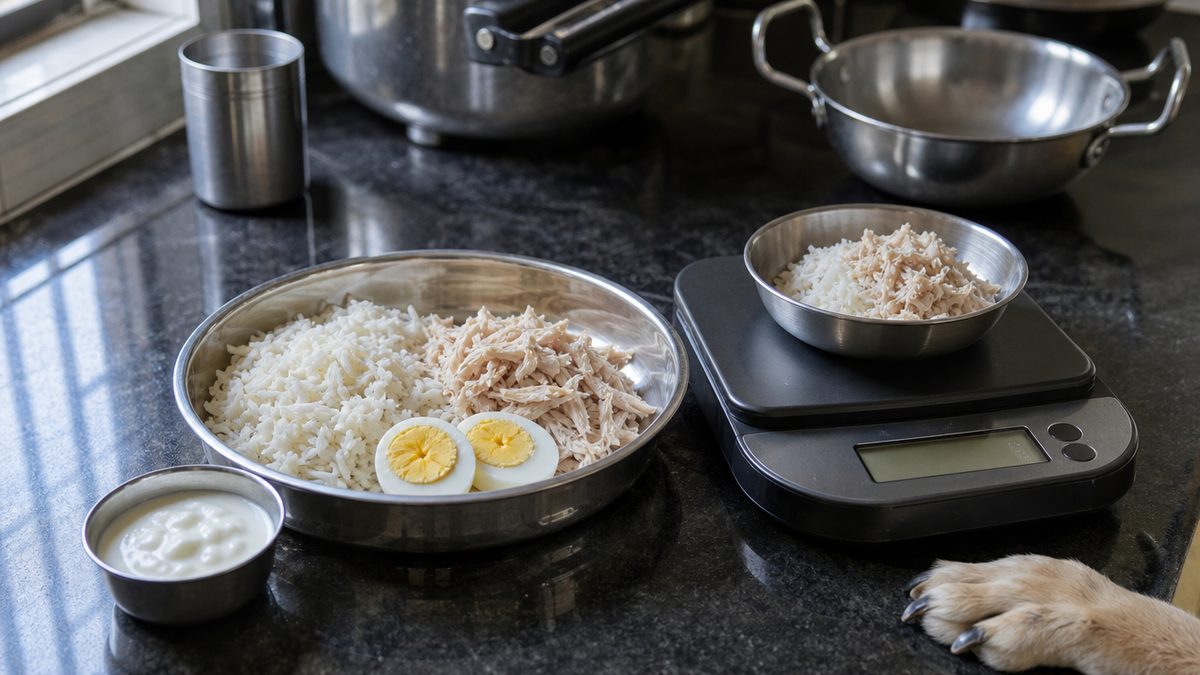
Take the bowl Indian owners describe on every ranking page, in raw weights: 150 g of rice, 150 g of boneless chicken breast, one 50 g boiled egg and 100 g of curd. By the IFCT rows it holds 934 kcal, 54.6 g of protein, 24.0 g of fat, 176 mg of calcium and 612 mg of phosphorus. Per 1,000 kcal, the unit FEDIAF uses, that is 58.5 g of protein against a 45.00 to 52.10 g minimum, 25.7 g of fat against 13.75 g, 0.19 g of calcium against 1.25 to 1.45 g, 0.66 g of phosphorus against 1.00 to 1.16 g, and a calcium to phosphorus ratio of 0.29 against a floor of 1:1. Protein and fat pass with room to spare; calcium lands at 13 to 15 percent of the minimum and phosphorus at 57 to 66 percent, with the ratio inverted. Vegetables were left out of the sum because they carry little energy and the calcium gap here is measured in hundreds of milligrams; this is a diagnostic of what the bowl contains, not a recipe, and no proportion of these four foods fixes the mineral column.
The arithmetic for the veg bowl
The vegetarian version fails earlier. Take 150 g of rice, 60 g of toor dal, 60 g of atta (two rotis' worth of flour) and 100 g of curd, 998 kcal in all: per 1,000 kcal it holds 34.6 g of protein against the 45.00 to 52.10 g minimum, 7.1 g of fat against 13.75 g, 0.19 g of calcium against 1.25 to 1.45 g and a ratio of 0.30 FEDIAF (European Pet Food Industry…. The rice-dal-roti-curd bowl is short on protein and fat as well as calcium before amino acid quality or vitamin D is even considered, which is why the vegetarian question gets its own section below.
A 10 kg dog eating 534 kcal a day needs 0.67 to 0.77 g of calcium by FEDIAF's minimum, or 0.53 g by the NRC allowance of 1 g per 1,000 kcal, and the non-veg bowl scaled to that energy provides 0.10 g National Research Council Longvah T, Ananthan R, Bhaskarachary K. Adding a calcium source is not optional, and it is not guesswork either: FEDIAF caps adult calcium at 6.25 g per 1,000 kcal and phosphorus at 4.00 g, so the grams of calcium carbonate, eggshell powder or a premix are a calculation between a floor and a ceiling, which is the veterinary nutritionist's job and the reason this page prints no recipe.
The one Indian ranking page that treats the ratio as central, The Doggos (18 March 2026), says it 'must be 1.2:1' and sells dehydrated bones as the fix; FEDIAF's 2025 tables set 1:1 as the adult minimum and 2:1 as the nutritional maximum, and the NRC booklet's allowances of 1 g calcium to 0.75 g phosphorus imply 1.33:1 FEDIAF (European Pet Food Industry… National Research Council. Both are published here with their dates; the standards govern, so any ratio from 1:1 to 2:1 meets them, and the ratio only means anything once the absolute calcium is met.
The framework: how to build a home-cooked diet that can be balanced
To build a homemade dog food that can be balanced, set the energy target first, choose one source each for protein, fat, carbohydrate, calcium and vitamins, and then have a veterinary nutritionist formulate the grams against the NRC or FEDIAF tables, because the WSAVA's position is that a home-cooked diet 'by definition, cannot be tested for adequacy' and needs formulation by 'a veterinarian specialized in nutrition';.
The steps are the same for a Labrador in Pune and an Indie in Chennai; only the numbers change. They are listed in order below.
- Weigh the dog and score its body condition. Use the WSAVA 9-point chart and a kitchen or bathroom scale; the target is a score of 4 or 5, and an ideal weight, not the current one, drives every figure that follows.
- Set the energy target from the chart, then adjust. Start at the WSAVA range for the ideal weight (470 to 590 kcal at 10 kg, 940 to 1,174 at 25 kg), pick the low end for a walked-once-a-day flat dog and the high end for a working or young dog, and move by weight change, never by appetite.
- Pick the protein source and buy it boneless. Chicken breast at 21.81 g of protein per 100 g, egg at 13.43 g and dal at 21.7 to 24.4 g are the Indian options; cooked bones are never fed, and a raw source brings the pathogen risks the WSAVA describes World Small Animal Veterinary Association.
- Pick the fat source. The bowl needs at least 13.75 g of fat per 1,000 kcal and 3.27 to 3.82 g of linoleic acid, and it needs EPA and DHA, the omega-3 pair short in 107 of 200 published recipes, which is where a fish or a fish-oil line enters.
- Pick the carbohydrate and cook it fully. Rice and atta are cooked cereal starches, which the WSAVA says dogs digest 'if they are properly cooked', and they are not 'fillers'; carbohydrate has no set minimum, so the grain is there for energy and bulk. Cook in batches, cool and refrigerate, and never leave a cooked bowl out in a humid monsoon kitchen in Mumbai or Kolkata.
- Add a calcium source by calculation. The gap in the Indian bowl is roughly 1 g per 1,000 kcal; the floor is 1.25 to 1.45 g and the ceiling 6.25 g, and a diet without a mineral supplement had calcium and the ratio below recommendation in the laboratory study.
- Add a vitamin and trace-mineral source. Zinc, choline, copper, vitamin D and vitamin E were the other deficiencies in more than 45 percent of recipes each, and no combination of kitchen foods closed them.
- Send the ingredient list to a veterinary nutritionist and feed the grams that come back. Consult your vet for a referral, or a veterinary college's nutrition unit, as the WSAVA suggests; the 4 recipes by board-certified nutritionists were the only 4 that passed in full Stockman J, Fascetti AJ, Kass PH.
- Transition over four days. The WSAVA schedule is 75:25 old to new on day 1, 50:50 on day 2, 25:75 on day 3 and 100 percent new on day 4, and a dog that vomits or has diarrhoea goes back a step and gets a call to the vet.
- Recheck twice a year. The WSAVA attaches 'twice yearly examinations and blood work testing' to any home-cooked diet, more often for a dog with a chronic condition.
Common mistakes the ranking pages make, and the portion-size rule
The common mistakes are the same on every ranking page: a calcium line with no gram, a supplement recommendation that is the page's own product, and a portion size given as a percentage of body weight. The Doggos gives 'aim for 2-3% of your dog's ideal body weight per day', and a percentage cannot tell raw rice at 356 kcal per 100 g from the same rice cooked with three times its weight in water, or lean breast at 168 kcal from thigh at more, so two owners following the rule feed very different calories Longvah T, Ananthan R, Bhaskarachary K. The WSAVA chart's own range for one weight is 25 percent wide, and Pedigree's chart cuts the ration by 10 percent for a dog exercised under an hour a day, so the portion size is the energy target divided by the calories in the formulated bowl, checked against the scale every month Pedigree India (Mars Petcare). Treats and table food stay under 10 percent of the day's calories, the WSAVA's screening line.
Growth and pregnancy are different tables entirely. FEDIAF's early-growth and reproduction column asks for 62.50 g of protein and 2.50 g of calcium per 1,000 kcal against 45.00 to 52.10 g and 1.25 to 1.45 g for an adult, so a puppy's bowl belongs on the puppy care guide and the puppy feeding chart for India, a pregnant bitch's on the dog pregnancy care guide, and an adult's day-by-day plan on the dog diet chart for India FEDIAF (European Pet Food Industry….
A recipe printed here without a nutrient analysis would be one more of the 190 of 200, and the only recipes that passed in full were formulated by board-certified nutritionists for a stated dog. What a nutritionist returns is the ingredient list above with grams against it, including the grams of the calcium source and the premix, for your dog's ideal weight, age and health; what this page gives you is the target, the arithmetic and the list to take in. Your nearby vet decides for the dog in front of them and refers you on when the case needs a specialist.
Indian kitchen foods that harm a dog: never feed these
Onion, garlic, grapes and raisins, xylitol, chocolate, salt, fatty foods and cooked bones are the Indian kitchen items on the FDA's list of edible dangers, and the Merck Veterinary Manual puts the raw onion dose that has produced clinical signs in dogs at 15 to 30 g per kg of body weight, with garlic 3 to 5 times more toxic Merck Veterinary Manual.
The list is short, and most of it hides in the tadka, which is the one thing to avoid outright. Never feed the foods in the table below, and treat a dog that has eaten one as a call to the vet the same day, because the onion and garlic damage is silent for days.
| Food | Where it hides in Indian cooking | What it does | Source |
|---|---|---|---|
| Onion and garlic, raw, cooked, dried or as powder | Tadka, masala pastes, gravies, onion powder, leftover sabzi and curry | Heinz body haemolytic anaemia; damage to red cells begins within 24 hours, haemolysis 3 to 5 days later; 15 to 30 g of raw onion per kg has caused signs in dogs, which is 150 to 300 g for a 10 kg dog, and garlic is 3 to 5 times more toxic, with powders and pastes the most concentrated forms | Merck Veterinary Manual |
| Grapes and raisins (kishmish) | Kheer, pulao, sweets, dry-fruit mixes | On the FDA's edible-danger list | FDA |
| Xylitol | Sugar-free gum, candy, some peanut butters, cough syrup, mouthwash, toothpaste | On the FDA's list; the FDA names it as toxic to dogs | FDA |
| Chocolate, tea, coffee, alcohol | Sweets, chai dregs, festival boxes | Chocolate, caffeine and alcohol are all on the FDA's list | FDA |
| Salt and fatty foods | Namkeen, fried leftovers, ghee-heavy tadka, meat fat | Both on the FDA's list; high-fat, low-fibre diets can bring diarrhoea or pancreatitis in some dogs | FDA; WSAVA World Small Animal Veterinary Association |
| Cooked bones, raw bones | Pressure-cooked chicken with bone, mutton bones | Bones can lodge in the oesophagus, stomach or intestines; hard bones fracture teeth and shards perforate the gut, and feeding bones does not reduce periodontal plaque | FDA; WSAVA World Small Animal Veterinary Association World Small Animal Veterinary Association |
| Raw meat and raw eggs | Wet-market chicken fed raw, raw egg over rice | Bacterial contamination (E. coli, Salmonella, Listeria, Campylobacter) and parasites that can infect people; households with small children, pregnant people, the elderly or immunocompromised members should not feed raw | WSAVA World Small Animal Veterinary Association |
| Raw dough, macadamia nuts, avocado | Bread dough left to rise, imported snacks | Yeast dough and macadamia are on the FDA's list; avocado is only mildly toxic to dogs | FDA |
Garlic reaches the dog through recipes as well as leftovers. Thirteen of the 200 published recipes (6.5 percent) included garlic or onion, and the WSAVA's answer on online recipes names garlic first among the harmful ingredients it has found in them, so a recipe that reads 'a pinch of garlic for immunity' is a recipe to close World Small Animal Veterinary Association. A dog that does eat raw meat or offal moves to the every-four-weeks tapeworm schedule on the dog deworming schedule for India, because the WSAVA notes that parasites travel in raw meat diets and some of them infect people. The roti and Parle-G questions, which are about community dogs rather than a formulated bowl, are answered on the guide to feeding community dogs in India.
Two things that are safe get blamed anyway. Cooked cereal grains are not 'fillers', in the WSAVA's words, and dogs digest them properly cooked; and a plain boiled egg, boneless cooked chicken, plain rice, plain roti, cooked vegetables and a spoon of curd are all safe foods for a healthy adult dog, which is a different statement from complete Longvah T, Ananthan R, Bhaskarachary K.
Can a dog eat a vegetarian homemade diet in India?
A dog can live on a vegetarian diet only when it 'contains sufficient protein and is supplemented with vitamin D', in the NRC's words, and the WSAVA adds that such diets 'are harder to formulate' because 'many vegetarian sourced nutrients are not as easily absorbed and metabolized by dogs as animal-sourced ones'; World Small Animal Veterinary Association.
The evidence for a plant-based diet is real and it has limits, and both belong on the page. Knight and colleagues asked 2,639 dog guardians about one dog each and analysed 2,536 dogs fed one diet for at least a year, 1,370 on conventional meat food (54 percent), 830 on raw meat (33 percent) and 336 on a vegan food (13 percent); by the guardians' reports 49 percent of the conventional group, 43 percent of the raw group and 36 percent of the vegan group had suffered a health disorder. The limits are the authors' own: the data are owner-reported, the raw-fed dogs were younger, and the conclusion is confined to 'nutritionally sound vegan diets', meaning commercial formulations, not a rice-dal bowl. The laboratory evidence on home versions points the other way: in the 75 cooked dog recipes, vegetarian or vegan preparation 'did not guarantee nutritional adequacy', the vegetarian recipes carried more fibre, magnesium and manganese, the animal-product recipes more protein and zinc, and zinc was deficient in both.
The Indian arithmetic is the plainest limit. The rice-dal-atta-curd bowl above holds 34.6 g of protein per 1,000 kcal against a minimum of 45.00 to 52.10 g, 7.1 g of fat against 13.75 g and 0.19 g of calcium against 1.25 to 1.45 g, so a vegetarian home diet in India starts three nutrients short before the amino acid pattern, vitamin B12 (3.35 to 3.87 µg per 100 g of dry matter in FEDIAF's table), vitamin D, zinc, iodine and EPA are looked at, none of which dal, rice or curd supply in the amounts required. A nutritionist can formulate around each of those lines with a specific product; an owner cannot do it with a spoon of turmeric. What a vegetarian formulation has to add is listed below.
- A protein combination and quantity that reaches 45 to 52 g per 1,000 kcal and meets each of the 10 essential amino acids the NRC lists, which dal alone at 21.7 to 24.4 g per 100 g cannot do at Indian bowl proportions Longvah T, Ananthan R, Bhaskarachary K.
- A calcium source by calculation, the same 1.25 to 1.45 g floor and 6.25 g ceiling per 1,000 kcal as any other bowl.
- A vitamin D source, the one supplement the NRC names for a vegetarian dog, and the nutrient most often under half its allowance in the recipe study.
- A vitamin B12 source, because the requirement is set and plant foods do not carry it.
- A zinc and iodine source, zinc being the deficiency in 69 percent of recipes and in both the vegetarian and animal-product groups of the laboratory study Pedrinelli V, Zafalon RVA.
- An omega-3 source for EPA and DHA, short in 53.5 percent of recipes.
A cat is a different animal and the WSAVA says so in one line: cats 'cannot thrive on vegetarian diets and these types of diets should not be fed to cats'; the homemade cat food guide for India covers that species.
Homemade vs dry food: cost per day for a 10 kg and a 25 kg dog
Homemade dog food costs about Rs 87 a day for a 10 kg dog and Rs 174 for a 25 kg dog in ingredients alone, against Rs 27 and Rs 53 a day for a complete dry food, at prices read from Indian sellers' pages on 18 September 2026, so the home-cooked diet is not the cheap option, and that is before the calcium and vitamin source it still needs Pedigree India (Mars Petcare).
The prices are one seller, one pack and one date each: Licious, registered in Bengaluru, Karnataka, for the chicken and eggs, Amazon.in for the rice, dal and dry food, and JioMart for the curd, and every rupee figure has been divided by 84.38 and by 74 to check that it is not a converted dollar list. Two figures, the eggs and the curd, happen to divide to USD 1.00 at 84.38; both are Indian list prices with a printed MRP and a discount line above them, and both are reported as one data point each.
| Item | Seller and pack | Price shown | Per 100 g | Exchange test (÷84.38, ÷74) |
|---|---|---|---|---|
| Chicken breast, boneless, 450 g | Licious, MRP Rs 383, 7 percent off | Rs 356 | Rs 79.11 | USD 4.22 and 4.81; rupee-native |
| Chicken curry cut, small pieces, 1,000 g (bone-in) | Licious, MRP Rs 433 | Rs 382 | Rs 38.20 with bone; more per gram of meat once the bone is removed | USD 4.53 and 5.16 |
| Eggs, pack of 6 (about 50 g each) | Licious, MRP Rs 90, 7 percent off | Rs 84 | Rs 14 an egg | USD 1.00 and 1.14; a rupee list price with a printed MRP |
| Rice, Fortune Sona Masoori Regular, 5 kg | Amazon.in, M.R.P. Rs 450, Mumbai 400001 | Rs 384 | Rs 7.68 | USD 4.55 and 5.19 |
| Toor dal, Tata Sampann unpolished, 1 kg | Amazon.in, sold by G-Mart Store, M.R.P. Rs 245, Mumbai 400001 | Rs 205 | Rs 20.50 | USD 2.43 and 2.77 |
| Curd, Amul Masti Dahi, 1 kg pouch | JioMart, list price Rs 85 | Rs 84 | Rs 8.40 | USD 1.00 and 1.14; a rupee list price |
| Pedigree Adult Chicken and Vegetables dry food, 20 kg | Amazon.in, sold by ETrade Online, ships from Amazon, Mumbai 400001 | Rs 3,264 | Rs 16.32 | USD 38.68 and 44.11 |
The arithmetic, shown
The non-veg bowl from the kitchen section costs Rs 11.52 for 150 g of rice, Rs 118.67 for 150 g of chicken breast, Rs 14 for one egg and Rs 8.40 for 100 g of curd, which is Rs 152.59 for 934 kcal, or Rs 163 per 1,000 kcal Licious (Delightful Gourmet Pvt Ltd) Licious, Farm Fresh Classic Eggs JioMart, Amul Masti Dahi 1 kg Longvah T, Ananthan R, Bhaskarachary K. A 10 kg dog at 534 kcal a day, Pedigree India's own figure and the middle of the WSAVA's 470 to 590 range, eats 0.572 of that bowl, so 86 g of rice, 86 g of chicken, 29 g of egg and 57 g of curd, for Rs 87 a day and about Rs 2,620 a month; a 25 kg dog at 1,062 kcal, the low end of the WSAVA's 940 to 1,174 range, eats 1.14 bowls for Rs 174 a day and about Rs 5,210 a month World Small Animal Veterinary Association. Dry food runs the same sums the other way: Pedigree's chart gives a 10 kg dog 165 g a day, which at Rs 16.32 per 100 g is Rs 26.93 a day and Rs 808 a month, and a 25 kg dog sits between the chart's 315 g at 24 kg and 335 g at 26 kg, so 325 g, Rs 53.04 a day and Rs 1,591 a month Amazon.in, Pedigree Adult Dry Dog Food. The ingredient bowl therefore costs about 3.2 times the dry food per day at either weight, and the bowl is still incomplete: the calcium source, the vitamin and mineral premix, the fish oil, the vegetables, the cooking gas and the nutritionist's fee are all outside the Rs 87.
Cheaper cuts narrow the gap without closing it. The 1 kg curry cut at Rs 38.20 per 100 g is bone-in, and the bone comes out after cooking and is never fed, so the meat costs more per gram than the pack price; boneless thigh at Rs 345 for 450 g (Rs 76.67 per 100 g) is a few rupees under breast. Swapping the chicken for the same weight of toor dal drops the bowl to about Rs 65 a day for a 10 kg dog and drops the protein below the minimum, as the veg-bowl sum shows. The finding is not Indian alone: a Brazilian cost study that formulated 14 complete and balanced homemade diets for dogs of 3, 15, 30 and 50 kg found homemade diets more expensive than dry maintenance diets in every scenario, with wet commercial food the most expensive of all.
On a breed page the sums scale by weight. A 32 to 35 kg Labrador Retriever needs 1,278 to 1,367 kcal at the inactive rate, about Rs 210 to Rs 225 a day at this page's ingredient prices, where its breed page's published food line of Rs 2,500 to Rs 5,000 a month is the dry-food end; a 30 to 40 kg German Shepherd sits in the same band; a 20 kg Indian Pariah Dog at 899 kcal comes to about Rs 147 a day; and the Beagle page's 2.67 times obesity odds is the reason to weigh the bowl rather than scoop it, whichever diet is chosen Longvah T, Ananthan R, Bhaskarachary K.
If you came here looking for the 95 percent rule, it is a United States label-naming rule for sealed commercial packs rather than a recipe ratio, and it does not bind an Indian pack at all; our guide to reading a pet food label in India sets out all four naming rules and why none of them applies here.
How to know the diet is working: body condition, weight and the vet's check
A homemade diet is working when the dog holds a body condition score of 4 or 5 on the WSAVA's 9-point chart, keeps a stable weight on the same scale month after month, and passes the twice-yearly examination and blood work the WSAVA attaches to any home-cooked diet.
The chart is a hands-on test, not a glance. A score of 4 is 'ribs easily palpable, with minimal fat covering. Waist easily noted, viewed from above. Abdominal tuck evident'; a 5 is 'ribs palpable without excess fat covering. Waist observed behind ribs when viewed from above. Abdomen tucked up when viewed from side'; a 6 already has 'slight excess fat covering' and a waist that 'is not prominent';. The WSAVA's 2011 guidelines flag any score under 4 or over 5 as a risk factor, and FEDIAF's feeding recommendation rests on the Kealy 2002 lifespan study, which is why 4 to 5 is the target for 'optimal health and longevity' rather than the rounder dog Indian families often prefer FEDIAF (European Pet Food Industry…. The monthly routine is listed below.
- Weigh the dog on the same scale on the same day each month, and change the bowl by about 10 percent when the weight moves, the direction Pedigree's own chart uses for a less-exercised dog.
- Score body condition with your hands, ribs, waist and tuck, against the chart's wording.
- Log the bowl in grams, cooked and raw, so the nutritionist can see what was fed when the weight changes.
- Keep treats and table food under 10 percent of the day's calories, the WSAVA's screening line.
- Book the six-monthly check with blood work, and sooner for a dog with a chronic condition, as the WSAVA specifies for a home-cooked diet.
Some dogs should not be on an owner-built diet at all until a specialist has seen them. A dog with kidney disease, pancreatitis, a food allergy, diabetes or heart failure needs a therapeutic formulation, the category the Brazilian cost study priced separately, and a puppy or a pregnant bitch needs the growth and reproduction column of the tables, not the adult one FEDIAF (European Pet Food Industry….
Nothing on this page replaces the veterinarian who examines your dog. A dog losing weight, drinking more, limping, or off its food on a home-cooked diet needs that examination, not a bigger bowl; a dog that has eaten onion, garlic, grapes or xylitol needs it the same day, because the anaemia from Allium shows 'several days' after the meal. Take the ingredient list, the grams and the weight log to the visit, ask for the nutritionist referral, and let the vet in front of the dog set the diet.
Common questions about homemade dog food in India
What are the best ingredients to use for homemade dog food?
There is no single best ingredient; a balanced bowl needs one source each for protein, fat, carbohydrate, calcium and vitamins, formulated to the NRC or FEDIAF minimums for the dog's energy. In an Indian kitchen that is boneless chicken or egg, a fat with omega-3, cooked rice or atta, a calculated calcium source and a vitamin and mineral premix, with the grams set by a veterinary nutritionist.
What are some good homemade foods for dogs?
Plain cooked rice, plain roti, boneless cooked chicken, a boiled egg, plain curd and cooked vegetables are all safe foods for a healthy adult dog, cooked without onion, garlic, salt or masala. Safe is not complete: by the ICMR-NIN tables every one of them except curd carries far more phosphorus than calcium, so a bowl of them still needs a calcium source and a premix to reach the standard.
What should top 3 ingredients be in dog food?
By the NRC's shopping list the first three are a protein source, because dogs cannot survive without dietary protein and its 10 essential amino acids; a fat source, for essential fatty acids and the fat-soluble vitamins; and a calcium and mineral source, because calcium and phosphorus head the 12 essential minerals and a meat-and-rice bowl supplies almost none of the calcium. A vitamin source is the fourth.
What are some good homemade meals for dogs?
A good homemade meal is the formulated one: a cooked protein, a cooked starch, a fat source, a calcium source and a premix in the grams a veterinary nutritionist has set for that dog's ideal weight. The WSAVA's answer on meals copied from books and websites is 'not really', because a home-cooked diet cannot be tested for adequacy and needs formulation by a veterinarian specialised in nutrition and twice-yearly checks.
What is the best homemade food for dogs?
The best homemade food is the one formulated for your dog against a nutrient standard, not a recipe. In the only 200-recipe study, 190 recipes were short in at least one nutrient and the four written by board-certified veterinary nutritionists were the only four that passed in full, so the answer is a formulation with the calcium and vitamin grams written on it, checked by your vet.
Is homemade dog food cheaper than dry food in India?
No, by the prices read on 18 September 2026. The ingredients of the usual rice, chicken, egg and curd bowl cost about Rs 87 a day for a 10 kg dog and Rs 174 for a 25 kg dog, against Rs 27 and Rs 53 a day for Pedigree's 20 kg bag at Rs 3,264 fed by its own chart, and the homemade figure excludes the calcium source, premix, vegetables and gas. A Brazilian cost study found the same ordering.
How much homemade food should I feed my dog?
Feed to calories, not to a percentage of body weight: a 10 kg adult needs 470 to 590 kcal a day and a 25 kg adult 940 to 1,174 kcal on the WSAVA chart, and the grams are that target divided by the calories in the formulated bowl. Weigh the dog monthly and hold a body condition score of 4 or 5; a rule of 2 to 3 percent of body weight cannot tell raw rice from cooked.