
Dog nutrition guide
Dog diet chart for India: daily amounts by weight, body condition and activity
Daily kilocalories, grams of three Indian-sold foods and rupees per day for 5, 10, 20 and 30 kg dogs, from the energy equation the brands themselves print, with the body condition loop that corrects it.
Quick answer
A dog diet chart for India starts from energy, not cups: resting energy is 70 times body weight in kg to the power 0.75, so a 10 kg neutered adult needs 534 to 630 kcal a day, which is 165 g of Pedigree or 135 g of Royal Canin Mini Adult, Rs 27 or Rs 99 a day in September 2026. A 5 kg dog needs 318 kcal, 20 kg 898, 30 kg 1,218; treats stay under 10 percent, and body condition sets the next bowl.
This guide is general information for Indian pet owners and is not a diagnosis. Always consult a registered veterinarian near you before acting on anything you read here, and treat any sudden change in your pet's condition as urgent.
How much should a dog eat a day? The energy method behind every chart
A dog eats the number of kilocalories that holds it at a body condition score of 4 or 5, and that number is calculated from body weight, not read off a bag. The resting energy requirement is 70 times body weight in kilograms to the power 0.75, and a life stage factor turns it into the daily maintenance energy requirement.
The arithmetic takes four steps, shown once here for a 10 kg dog so you can repeat it for any weight. Ten to the power 0.75 is 5.62 (type 10, press the x^y key, type 0.75, press equals); 70 times 5.62 is 394 kcal, the resting energy requirement; a neutered adult factor of 1.4 to 1.6 gives 551 to 630 kcal a day; that figure divided by the food's kcal per kg gives the grams. AAHA's factor sheet spells out the smartphone route, because the phone calculator turned sideways has the x^y key. The table applies AAHA's factors to the four weights this page prices.
| Dog weight | kg^0.75 | RER (kcal) | Neutered adult, 1.4 to 1.6 | Intact adult, 1.6 to 1.8 | Inactive or obese-prone, 1.0 to 1.2 | Weight loss, 1.0 |
|---|---|---|---|---|---|---|
| 5 kg | 3.34 | 234 | 328 to 374 | 374 to 421 | 234 to 281 | 234 |
| 10 kg | 5.62 | 394 | 551 to 630 | 630 to 709 | 394 to 472 | 394 |
| 20 kg | 9.46 | 662 | 927 to 1,059 | 1,059 to 1,192 | 662 to 794 | 662 |
| 30 kg | 12.82 | 897 | 1,256 to 1,436 | 1,436 to 1,615 | 897 to 1,077 | 897 |
FEDIAF, the European guideline the brands on this page formulate to, expresses the same idea per unit of metabolic weight: 95 kcal per kg^0.75 for a dog with under an hour of activity a day, 110 for one to three hours of low-impact activity, 125 for one to three hours of high-impact activity, and 150 to 175 for a working dog. For a 20 kg dog that is 898, 1,040, 1,182 and 1,419 to 1,655 kcal. The three authorities disagree at the edges and the disagreement is worth knowing. Merck's manual puts a neutered adult at 1.6 times RER and an intact one at 1.8, the top of AAHA's ranges. The WSAVA's calorie table, which many Indian clinics print, gives 470 to 590 kcal for a 10 kg dog and cites NRC 2006's 95 and 130 kcal per kg^0.75 as its reference; run the arithmetic and its rows reproduce 84 to 105 kcal per kg^0.75, or 1.2 to 1.5 times RER, at every weight from 5 to 30 kg, not the 95 to 130 its own footnote names. Use the printed row, which sits below AAHA's neutered range, and keep Merck's caution in view: an individual dog can need 30 percent more or less than any formula predicts.
Which figure to start from
Start a neutered, apartment-kept adult at the FEDIAF 95 tier, which is also the midpoint of the WSAVA row and, as the chart below shows, the exact column Pedigree India and Royal Canin India print. Start an intact dog that walks more than an hour a day at 110. Then weigh, score and adjust, because the formula chooses the first bowl and the scale chooses every bowl after it World Small Animal Veterinary Association.
Dog diet chart for India: grams and rupees per day for 5, 10, 20 and 30 kg dogs
The dog diet chart below turns the 95 kcal per kg^0.75 tier into grams of three complete foods sold in India and into rupees per day at Amazon.in prices read on 18 September 2026, using each food's own kcal per kg and feeding guide Farmina Pet Foods.
Where each kcal per kg figure comes from
Each energy figure comes from the manufacturer's own page. Pedigree India does not print kcal per kg on its product page, which lists 20 percent crude protein, 10 percent crude fat and 5 percent crude fibre; its feeding guide prints a calorie column and a grams column side by side, and dividing one by the other gives 3,180 to 3,290 kcal per kg Pedigree India (Mars Petcare). Royal Canin India's product data carries 3,960 kcal per kg for Mini Adult, 3,843 for Medium Adult and 3,967 for Maxi Adult, calculated by the NRC 2006 method, and the Mini and Maxi pages carry a feeding table by weight and activity Royal Canin India. Farmina prints 3,997 kcal per kg of metabolisable energy and a minimum-to-maximum table on its Indian page Farmina Pet Foods.
| Dog weight | Target kcal | Pedigree Adult Chicken and Vegetables, Rs 16.32 per 100 g | Royal Canin adult by size, Rs 73.09 to 85.71 per 100 g | Farmina N&D Ancestral Grain adult medium and maxi, Rs 62.00 per 100 g |
|---|---|---|---|---|
| 5 kg | 318 | 100 g, Rs 16.32 a day | Mini Adult 80 g, Rs 58.59 | Not sized; its table starts at 10 kg |
| 10 kg | 534 | 165 g, Rs 26.93 | Mini Adult 135 g, Rs 98.87 | 134 g calculated, Rs 82.87; its table prints 90 to 160 g |
| 20 kg | 898 | 275 g, Rs 44.88 | Medium Adult 234 g calculated, Rs 178.12 to Rs 200.56 on the two offers | 225 g calculated, Rs 139.36; its table prints 155 to 270 g |
| 30 kg | 1,218 | 370 g, Rs 60.38 | Maxi Adult 307 g, Rs 224.39 | 305 g calculated, Rs 188.90; its table prints 210 to 370 g |
The prices behind the rupee column were all read on Amazon.in for delivery to Gurugram 122002 on 18 September 2026. Pedigree Adult Chicken and Vegetables, 20 kg, was Rs 3,264, or Rs 16.32 per 100 g, sold by ETrade Online and shipped by Amazon. Royal Canin Mini Adult, 8 kg, was Rs 5,859, Rs 73.24 per 100 g, sold by Heads Up For Tails. Royal Canin Maxi Adult, 15 kg, was Rs 10,964, Rs 73.09 per 100 g, from ETrade Online. Royal Canin Medium Adult, 10 kg, showed two offers the same afternoon, Rs 7,612 (Rs 76.12 per 100 g) in the search listing and Rs 8,571 (Rs 85.71 per 100 g, sold by Zigly, two left) as the featured offer on the product page, so the 20 kg row carries both. Farmina N&D Ancestral Grain Chicken and Pomegranate Adult Medium and Maxi, 12 kg plus 3 kg free, was Rs 9,300, Rs 62.00 per 100 g, from Infinity E-Retails. Every figure was divided by 84.38 and by 74 and none lands on a round dollar amount (Rs 3,264 is USD 38.68 or 44.11), so these are rupee-native prices rather than a converted US list. They are one retailer's prices for delivery to Gurugram in Delhi NCR on one afternoon; a pet shop in Mumbai, Bengaluru, Chennai, Hyderabad, Pune or Kolkata prints its own, so read the price per 100 g off the bag you actually buy and run the same division.
Three things the chart shows that no bag does. First, the cheapest complete food feeds a 10 kg dog for Rs 27 a day and the dearest for Rs 99, a 3.7 times spread at the same calories, because Royal Canin's kibble is about a fifth denser in energy and four and a half times the price per gram; the affordable bowl and the premium bowl deliver the same 534 kcal Amazon.in, Royal Canin Mini Adult Dog Dry…. Second, Pedigree India's calorie column is 95 kcal per kg^0.75 to the kilocalorie at 5, 10, 20 and 30 kg, and Royal Canin's low, medium and high activity columns are 95, 110 and 125, so the two largest brands in India print the FEDIAF tiers rather than a house formula, and a bag's feeding guide and the energy equation turn out to be the same table FEDIAF (European Pet Food Industry…. Third, Farmina's minimum is below resting: 90 g for a 10 kg dog is 360 kcal, 0.91 times RER, and 210 g for a 30 kg dog is 0.94 times RER, while its maximum is 1.6 times RER, so one heading spans a weight-loss ration and an active dog's ration; feed the calculated middle, not the printed floor American Animal Hospital Association.
Three oddities to read past. Pedigree's guide prints 195 g for a 22 kg dog between 275 g at 20 kg and 315 g at 24 kg, which cannot be right and is almost certainly a typo for 295 g; interpolate rather than feed it. Royal Canin India's Medium Adult page carries the kcal per kg and a wet-pouch table but not the dry-food grams, so the 20 kg row is calculated (898 divided by 3.843) rather than read. Drools' daily-nutrition page and its Amazon listing print no energy figure at all, so Drools cannot be placed on this chart without asking the company, which is what the WSAVA's selection sheet tells an owner to do when a label omits calories. To run the chart for a bag that is not on it, take the five steps below.
- Find the kcal per kg on the bag, the manufacturer's Indian page or by asking the company; a bag that prints only protein and fat has to be asked, as the WSAVA sheet says.
- Calculate the target: weight in kg to the power 0.75, times 95 for a quiet neutered adult or 110 for one that walks over an hour a day, which for a 12 kg dog is 6.45 times 95, or 613 kcal.
- Divide the target by the kcal per gram to get the day's grams; 613 kcal on a 3.5 kcal per gram food is 175 g, on a 4 kcal per gram food 153 g.
- Split the grams into two meals and cut the treats out of the total, keeping treats under a tenth of the calories.
- Weigh and score the dog after four weeks and adjust by about 10 percent, which is the loop in the next section.
What the ranking charts print instead
The charts that rank for this query do none of this. The PDF that ranks first is a 2022 recipe booklet giving '10 percent carbohydrates, 40 percent protein, 50 percent fresh vegetables' with no weight, no calories and no source. An Indian bakery's chart gives half to three-quarters of a cup twice a day for a 4 to 10 kg adult without naming the food the cup holds, beside Rs 1,699 dog cakes for sale. A cup of Pedigree and a cup of Royal Canin hold different energy, so a cup is not an amount; grams of a named food are.
Feed to body condition, not to the bag: the correction loop
Body condition score decides whether the chart's number was right for this dog, and it is read by hand and eye in a minute.
On the WSAVA nine-point chart a 4 is 'ribs easily palpable, with minimal fat covering, waist easily noted, viewed from above, abdominal tuck evident'; a 5 is 'ribs palpable without excess fat covering, waist observed behind ribs when viewed from above, abdomen tucked up when viewed from side'; a 7 is 'ribs palpable with difficulty, heavy fat cover, noticeable fat deposits over lumbar area and base of tail, waist absent or barely visible';. FEDIAF's guideline, citing Kealy's 2002 lifespan study, recommends feeding to hold a 4 or 5 for optimal health and longevity. AAHA's factor sheet ends with the same instruction, that intake is adjusted by monitoring body weight and body condition score. The loop has five steps.
- Weigh the dog on the same scale at the same time each month and write the number down; a 10 kg dog that has gained 500 g has gained 5 percent, which the eye misses under a coat.
- Score the ribs, waist and tuck against the chart with the dog standing and flat hands over the ribcage; a Pomeranian's or an Indian Spitz's coat hides the waist, so the hands, not the eye, give the score.
- Change the ration by about 10 percent when the weight or the score moves, 16 g for a 10 kg dog on Pedigree, 27 g at 20 kg, 37 g at 30 kg, then hold for four weeks and weigh again; Pedigree's own guide cuts 10 percent for a dog exercised under an hour a day, the same step.
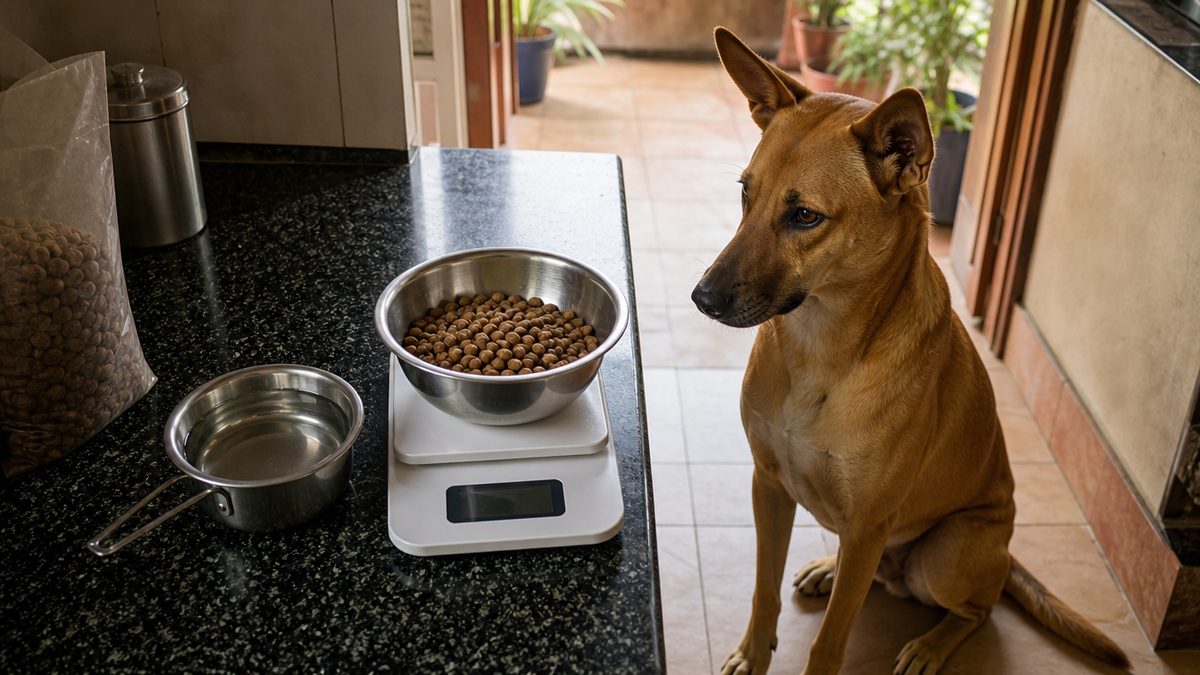
- Measure grams on a kitchen scale, not a cup, because a heaped cup and a level cup are two rations and a 1 kg digital scale costs less than a week of Royal Canin.
- Ask the vet when the dog needs 10 to 30 percent less than the label to stay lean, Merck's threshold for moving to a less energy-dense food, because a maintenance food fed at a deep restriction cuts every nutrient along with the calories.
Do not slim an overweight dog by halving its maintenance food. A maintenance diet is formulated for a dog eating a full ration, so a deep cut reduces protein, calcium and every vitamin with the calories; Merck's manual says that is what weight-management and therapeutic weight-loss diets exist for, and adds that a dog needing unusually little food to stay lean should be checked for hypothyroidism. AAHA's weight-loss factor is 1.0 times RER at the ideal weight, 394 kcal for a dog that should weigh 10 kg, and a vet sets it against that ideal weight, not the current one. Your nearby vet decides the target and the food for your dog.
What should a dog eat daily? The FEDIAF minimums and what 'complete' means on a label
A dog should eat, every day, a food whose nutrient content meets the adult minimums and is labelled complete for its life stage, and the minimums are public numbers.
'Complete pet food' has a legal definition in FEDIAF's guideline, taken from EU Regulation 767/2009: food which, by reason of its composition, is sufficient for a daily ration, so that fed for the whole life stage as the only source of nutrients it provides all the animal's nutritional needs; 'complementary' food, which includes treats, is sufficient only in combination with other foods. The nutritional requirements behind that word sit in Table III-3, calculated from NRC 2006 for a lean 15 kg adult. The figures below are minimum recommended levels for a food, not the amount a dog needs, and the table's right-hand column carries nutritional maximums for calcium, phosphorus and vitamin D that a home supplement can breach.
| Nutrient | Per 100 g dry matter, 110 kcal basis | Per 100 g dry matter, 95 kcal basis | Per 1,000 kcal ME, 110 basis | Per 1,000 kcal ME, 95 basis | Adult maximum |
|---|---|---|---|---|---|
| Protein | 18.00 g | 21.00 g | 45.00 g | 52.10 g | None set |
| Fat | 5.50 g | 5.50 g | 13.75 g | 13.75 g | None set |
| Calcium | 0.50 g | 0.58 g | 1.25 g | 1.45 g | 2.50 g per 100 g DM; 6.25 g per 1,000 kcal |
| Phosphorus | 0.40 g | 0.46 g | 1.00 g | 1.16 g | 1.60 g per 100 g DM; 4.00 g per 1,000 kcal |
| Calcium to phosphorus ratio | 1 to 1 | 1 to 1 | 1 to 1 | 1 to 1 | 2 to 1 |
| Vitamin D | 55.2 IU | 63.9 IU | not extracted here | not extracted here | 227 IU per 100 g DM (EU legal), 320 IU (nutritional) |
Reading an Indian bag against the table
The two columns exist because the guideline scales a nutrient to the energy a dog eats: a sedentary dog at 95 kcal per kg^0.75 eats less food, so each gram of that food has to carry more protein and calcium to deliver the same daily amount, which is why the 95 column is higher. On an Indian bag the words to find are 'complete' and the life stage. Pedigree's feeding guide and product page say '100 percent complete' and 'wholesome and complete meal', Royal Canin's pages say 'complete feed for dogs' with the size and age band, and Farmina's says 'complete food for adult dogs'; Pedigree India, PEDIGREE Chicken… Royal Canin India Farmina Pet Foods India. Pedigree prints 20 percent crude protein and 10 percent fat, Royal Canin Medium Adult 25 percent protein and 14 percent fat, and Farmina 30 percent protein, 18 percent fat, 0.9 percent calcium and 0.8 percent phosphorus at 9 percent moisture; all three sit above the 18 g of protein and 5.5 g of fat per 100 g of dry matter, though a label figure is as fed and the guideline is dry matter, so a label at 10 percent moisture reads about a tenth low against the table Royal Canin India Farmina Pet Foods India FEDIAF (European Pet Food Industry….
The WSAVA's selection sheet adds the questions a label cannot answer: does the company employ a nutritionist with a PhD or ACVN or ECVCN board certification, who formulates the recipe, is the finished product analysed, and is research published; and on the label, is there a complete statement for the life stage, calories per gram, a contact number and the name of who makes the food. Calorie information is required on labels only in the United States, the sheet notes, and where it is missing it should be available from the manufacturer, which is why this page derived Pedigree's kcal per kg from its own two columns Pedigree India (Mars Petcare). Feeding frequency is the one thing the ranking pages get right: two meals a day, morning and evening, with the day's grams halved between them, is what Pedigree's guide instructs and what FEDIAF expects a label's feeding instructions to state; a feeding schedule matters less than the total FEDIAF (European Pet Food Industry….
Senior, neutered, active and overweight dogs: which multiplier applies
Age, neutering and activity move the daily figure by 10 to 40 percent, and each has a published factor rather than a guess.
Senior dogs over seven years need 95 kcal per kg^0.75, range 80 to 120, against 110 for a three to seven year old and 130 for a one to two year old in FEDIAF's Table VII-6, because activity falls with age; the guideline puts the drop at 10 to 15 percent and warns that seven is a study cut-off rather than a rule, so a nine-year-old that still runs needs more. The NRC's owner booklet puts the cut at 20 percent fewer calories than a middle-aged adult, and its own table gives 745 kcal for an older active 30 lb (13.6 kg) dog against 922 for a young adult, a 19 percent gap. Two authorities, two numbers: the FEDIAF figure is the newer and governs the chart here, with the NRC's 20 percent as the outer bound for a dog that has plainly slowed. For a 20 kg senior that is 757 to 1,135 kcal, centred on 898, the same figure as a low-activity adult.
Neutered dogs get the lower factor in every scheme, AAHA 1.4 to 1.6 against 1.6 to 1.8 intact and Merck 1.6 against 1.8, and the difference is about an eighth of the bowl. Pegram's VetCompass study of 22,333 UK dogs found neutered status associated with recorded overweight, alongside middle age and being insured. A dog sterilised under the programme in the dog sterilisation guide for India should move to the neutered factor in the month after surgery and be weighed at the next visit, not left on the intact figure. An active dog is a working dog by the guidelines' definitions, not a dog that walks twice a day: FEDIAF's 150 to 175 tier is for three to six hours of work, AAHA's moderate-work factor of 2.0 to 5.0 is for the same, and a pet that gets an hour on the lead sits in the 95 to 110 band American Animal Hospital Association. Indian heat cuts the walk rather than the formula: FEDIAF puts the upper critical temperature for adult dogs at 30 to 35 degrees C and adds 2 to 5 kcal per kg^0.75 for every degree outside the thermoneutral zone, so a dog cooling itself at 38 degrees spends energy on panting while doing less, and on a humid monsoon afternoon the walk shrinks to a lap of the building; the scale, not the season, should set the bowl, and the heat safety guide for dogs in India gives the walk windows city by city.
How common overweight is, with denominators
Overweight is common and under-recorded. Pegram and colleagues found 1,580 of 22,333 UK dogs recorded as overweight in 2016, 7.1 percent, and concluded that vets were under-reporting it; the Pug carried 3.12 times the odds of a crossbred, the Beagle 2.67 and the Golden Retriever 2.58. When dogs are scored rather than diagnosed the figure is far higher: Courcier's Glasgow team scored 696 dogs at five practices and found 271 overweight (38.9 percent) and 142 obese (20.4 percent), with snack frequency and weekly exercise among the risk factors. India has one clinic figure with a denominator. Preet and Turkar screened 500 healthy adult dogs at the GADVASU hospital in Ludhiana on a five-point scale and found 180 overweight or obese, 36 percent (111 overweight, 69 obese), with table scraps, treats, feeding frequency and exercise among the associated factors; Labradors were 55.55 percent of the overweight group. That is one Punjab hospital's clientele rather than India, but it is the only Indian denominator this page found. The Labrador, Beagle and Pug pages carry the breed-level figures; a 30 to 40 kg German Shepherd sits on the 30 kg row of the chart and a 20 kg Indian Pariah Dog on the 20 kg row.
Weight loss uses 1.0 times RER at the target weight in AAHA's sheet and 90 kcal per kg^0.75 or less for an obese-prone adult in FEDIAF's: 394 kcal for a dog whose ideal weight is 10 kg and 897 for 30 kg, under the vet's eye and on a food formulated for restriction, for the reason the note above gives Merck Veterinary Manual.
Treats within 10 percent and water: the two lines the chart assumes
Treats stay under 10 percent of the day's calories and water is never limited, and both lines have numbers.
The WSAVA's treat sheet sets the ceiling at less than 10 percent of daily calorie intake, counts chews, biscuits, supplements and the cheese a tablet is hidden in as treats, and lists the calories of the usual suspects: a digestive biscuit 75 kcal, a tablespoon of peanut butter 81, 28 g of cheddar 120, a dried pig's ear 242. At the 95 tier the allowance is 32 kcal a day for a 5 kg dog, 53 for 10 kg, 90 for 20 kg and 122 for 30 kg, so one digestive biscuit is a 10 kg dog's whole allowance and a 5 kg dog's allowance and a half. Pedigree's guide says the same in its own words, that non-complete treats stay under 10 percent of daily calories and the meal is reduced to make room. Courcier's and Preet's studies both list treat and snack frequency among the factors associated with obesity, which is the 10 percent line seen from the other end Preet GS, Turkar S. Risk Factors Associated….
Water intake in a thermoneutral room runs about 44 to 66 mL per kg of body weight a day, 440 to 660 mL for a 10 kg dog and 1.3 to 2 litres for a 30 kg dog, more on a dry diet than a wet one because dry food holds 3 to 11 percent water and canned food 60 percent or more, and it is never restricted. The NRC's booklet adds that the need rises with exercise and heat and that water should be offered during exercise. Two bowls in two rooms, refilled morning and evening, is the practical version.
The Indian home bowl against the same minimums, and the foods to avoid
The rice, roti, chicken and curd bowl meets some of the FEDIAF minimums and misses calcium by a wide margin, and the full treatment is in the homemade dog food guide for India Longvah T, Ananthan R, Bhaskarachary K FEDIAF (European Pet Food Industry….
Roti is the Indian question Google asks, so here is the atta row from the ICMR-National Institute of Nutrition's Indian Food Composition Tables 2017, measured in Hyderabad on samples from six regions: per 100 g, whole wheat flour holds 10.57 g of protein, 1.53 g of fat, 64.17 g of carbohydrate, 30.94 mg of calcium and 315 mg of phosphorus, at 1,340 kJ or 320 kcal. Per 1,000 kcal that is 33 g of protein against FEDIAF's 45 g minimum, 4.8 g of fat against 13.75 g, 0.10 g of calcium against 1.25 g, and a calcium to phosphorus ratio of 0.1 to 1 against a floor of 1 to 1 FEDIAF (European Pet Food Industry…. Dogs digest properly cooked starch with over 90 percent efficiency and have no dietary carbohydrate requirement as adults, Merck's manual says, so a plain roti is safe and useless in equal measure, safe as a small part of a bowl and useless as the bowl. The homemade food guide runs the non-vegetarian and vegetarian bowls line by line and prices them; the short version is that a home diet is balanced only when a veterinary nutritionist formulates it, and at Indian ingredient prices it costs more per day than the dry food on the chart, not less.
The foods to avoid are the same on the FDA's list and the WSAVA's, and the Indian kitchen holds most of them. Seven groups are listed below.
- Onion, garlic, leek and chive in any form, raw, cooked, dehydrated or as the powder in a masala or a curry base: garlic is 3 to 5 times as toxic as onion, 15 to 30 g of raw onion per kg of body weight has produced signs in dogs, and the anaemia appears 3 to 5 days after the meal, so the link to the food is easy to miss.
- Grapes, raisins, sultanas and currants, including the kishmish in a kheer or a pulao.
- Chocolate, coffee, tea and caffeinated drinks World Small Animal Veterinary Association.
- Xylitol, the sweetener in sugar-free gum, sugar-free sweets, some cough syrups and toothpaste.
- Alcohol and raw yeast dough World Small Animal Veterinary Association.
- Macadamia nuts, salt in quantity, fatty leftovers and bones: the FDA lists fatty foods and salt as hazards and bones, corn cobs and fruit pits as obstruction risks, and the WSAVA lists cooked and raw bones as dangerous.
- Human medicines, including paracetamol, ibuprofen and aspirin, unless the vet prescribes them.
The feeding community dogs guide applies the same list to a street feeder's bucket, where the roti-and-leftovers bowl is the default.
What this dog diet chart does not cover: puppies, pregnancy and illness
This chart is for healthy adult dogs from one year to old age, and three groups need a different table.
Puppies eat 3.0 times RER under four months and 2.0 times from four months to maturity by the AAHA sheet, more than twice an adult's calories per kilogram, and the ration changes every few weeks as the puppy grows; the puppy feeding chart for India carries the growth-curve method and the puppy foods' own tables. FEDIAF adds the warning that puppies are never fed free choice, because overfeeding a large-breed puppy accelerates growth and skeletal deformity.
A pregnant bitch eats normally for six weeks and then up to 3.0 times RER in the last 21 days, and a nursing one 3.0 to 6.0 times or more depending on the litter; the dog pregnancy care guide works both through for one dog. A dog with a diagnosed disease, or on a therapeutic diet, is outside every table on this page; the calorie target and the food are the vet's decision, and Merck's manual notes that an unusually low need to stay lean is itself a reason to test for hypothyroidism. Your nearby vet decides for your dog. This page gives you the arithmetic to bring to that visit, and the scale to check the answer against.
If the dog scores a 4 or 5 on the WSAVA chart and its weight has not moved in two monthly weigh-ins, the grams you are feeding are the right grams, whatever the bag, the clinic poster or this chart says. Every table here chooses the first bowl; the dog confirms it, which is AAHA's one-line rule that intake is adjusted by monitoring body weight and body condition score American Animal Hospital Association.
Common questions
What should a dog eat daily?
A dog should eat a complete food, every day, in the amount that holds a WSAVA body condition score of 4 or 5. For a 10 kg neutered adult that is about 534 to 630 kcal, which is 165 g of Pedigree or 135 g of Royal Canin Mini Adult by their own tables, plus water at all times, with treats under 10 percent of those calories.
Is roti good for dogs?
Roti is safe for a healthy adult dog in small amounts and is not a meal. Atta holds 64 g of carbohydrate, 10.6 g of protein and 31 mg of calcium per 100 g by the IFCT 2017, so per 1,000 kcal it gives 33 g of protein against FEDIAF's 45 g minimum and 0.10 g of calcium against 1.25 g. Dogs digest cooked starch well and have no carbohydrate minimum, so roti adds energy and little else.
What are the 10 best foods for dogs?
No veterinary body ranks ten foods and this page does not either. The WSAVA's selection sheet asks four questions of the brand, a qualified nutritionist, who formulates, quality control and published research, and four of the label, a complete statement for the life stage, calories per gram, a contact number and who makes it. Pedigree, Royal Canin and Farmina all carry a complete statement; only two print kcal per kg.
How many grams of dry food should a dog eat per day?
Grams depend on the food's kcal per kg, so a chart without a named food is a guess. At 95 kcal per kg^0.75, a 5 kg dog needs 318 kcal, a 10 kg dog 534, a 20 kg dog 898 and a 30 kg dog 1,218; on Pedigree India's own guide that is 100, 165, 275 and 370 g, and on Royal Canin Mini or Maxi Adult 80, 135 and 307 g, then adjusted 10 percent at a time to the body condition score.
How much does it cost to feed a dog per day in India?
Between Rs 16 and Rs 225 a day for a complete dry food on 18 September 2026 Amazon.in prices: a 5 kg dog costs Rs 16.32 on Pedigree or Rs 58.59 on Royal Canin Mini Adult, a 10 kg dog Rs 26.93 or Rs 98.87, a 20 kg dog Rs 44.88 on Pedigree or Rs 139 on Farmina, and a 30 kg dog Rs 60.38 on Pedigree or Rs 224.39 on Royal Canin Maxi Adult, all at the same calories.