
Dog nutrition guide
Puppy feeding chart for India: how much, how often, by age and expected adult weight
Every ranking page copies one brand's bag table or prints cups. This chart is built from the FEDIAF growth equation and the AAHA factors, keyed to what the puppy will weigh as an adult, converted into grams with two Indian foods' printed calorie figures and into rupees with prices read the same day, with the arithmetic shown once so you can redo it for your bag. It also gives meals a day from four sources, what a 1 month and a 2 month puppy eat and why a 45-day puppy should not be yours yet, the FEDIAF calcium ceiling that governs a Labrador, German Shepherd or Golden Retriever puppy, and the weekly weigh-and-score check that catches overfeeding before the ribs do.
Quick answer
A puppy food chart starts from expected adult weight and age, not from the bag: the FEDIAF growth equation gives a puppy that will weigh 30 kg 999 kcal a day at 2 months, 1,406 at 4 months and 1,540 at 6 months, which is 239, 336 and 368 g of a 4,184 kcal/kg food, or Rs 172 to Rs 265 a day at Supertails prices on 18 September 2026. Feed three meals to 6 months, then two; keep a large-breed puppy under FEDIAF's calcium ceiling and never free-fed. Weigh weekly; your nearby vet sets the target.
This guide is general information for Indian pet owners and is not a diagnosis. Always consult a registered veterinarian near you before acting on anything you read here, and treat any sudden change in your pet's condition as urgent.
How this puppy food chart is built: expected adult weight, age and a published growth equation
This puppy food chart is built from expected adult weight and age with the FEDIAF 2025 growth equation, then converted into grams with a named food's own kcal per kg and into rupees with a dated Indian listing Farmina Pet Foods India Supertails, Farmina N&D Chicken &…. The ranking pages copy one brand's bag table or print cups; the arithmetic below is shown once so you can redo the chart for whatever bag is in your kitchen.
Two published methods give a growing puppy's energy need, and both start from metabolic weight, which is body weight in kilograms raised to the power 0.75. FEDIAF, the European pet food industry's nutrition body, prints one equation for 8 weeks to 1 year: kilocalories of metabolisable energy a day = [254.1 minus 135 x (weight now divided by expected adult weight)] x weight now to the power 0.75. The 2024 edition prints the same equation, so nothing moved between editions. The American Animal Hospital Association starts from a resting energy requirement (RER) of 70 x weight in kg to the power 0.75 and multiplies it by a growth factor of 3.0 under 4 months and 2.0 from 4 months; Merck's professional manual prints the same two factors.
The chart also needs the puppy's weight now, and FEDIAF supplies that: five growth curves by expected adult weight, each giving the percentage of adult weight a puppy has reached at a given week of age. The table prints them. The two curves for dogs over 27.5 kg are why a Labrador puppy at 6 months is nowhere near finished, and why a Shih Tzu at the same age is three-quarters grown.
| Expected adult weight | Growth curve | At 8 weeks | At 17 weeks (4 months) | At 26 weeks (6 months) | At 52 weeks |
|---|---|---|---|---|---|
| Up to 7 kg | 36.92 x ln(weeks) minus 43.57 | 33 percent | 61 percent | 77 percent | 100 percent |
| Over 7 to 15 kg | 36.86 x ln(weeks) minus 48.22 | 28 percent | 56 percent | 72 percent | 97 percent |
| Over 15 to 27.5 kg | 39.88 x ln(weeks) minus 60.70 | 22 percent | 52 percent | 69 percent | 97 percent |
| Over 27.5 to 47.5 kg | 36.96 x ln(weeks) minus 56.18 | 21 percent | 49 percent | 64 percent | 90 percent |
| Over 47.5 kg | 36.61 x ln(weeks) minus 62.39 | 14 percent | 41 percent | 57 percent | 82 percent |
The arithmetic, once, for a 30 kg-adult Labrador puppy at 13 weeks
- Find the weight now. 36.96 x ln(13) minus 56.18 = 36.96 x 2.565 minus 56.18 = 38.6 percent of 30 kg, which is 11.6 kg. Weigh the puppy; if the scale disagrees with the curve, the scale wins and the curve tells you which way the puppy is drifting.
- Raise it to the power 0.75. 11.6 to the power 0.75 = 6.28. AAHA's sheet gives the phone method: open the calculator, turn the phone sideways, type 11.6, press the x to the power y key, type 0.75, press equals.
- Apply the FEDIAF bracket. 254.1 minus 135 x (11.6 divided by 30) = 254.1 minus 52.2 = 201.9. Multiply by 6.28: 1,268 kcal a day.
- Cross-check with AAHA. RER = 70 x 6.28 = 440 kcal; under 4 months the factor is 3.0, so about 1,320 kcal a day (1,319 on the unrounded weight), 4 percent above FEDIAF.
- Convert to grams. Divide the kilocalories by the food's kcal per gram. Farmina N&D Puppy Medium & Maxi prints 4,184 kcal per kg, so 1,268 divided by 4.184 = 303 g; Pedigree Professional Large Breed Puppy prints 370 kcal per 100 g, so 1,268 divided by 3.7 = 343 g Pedigree India, PEDIGREE Professional Large….
- Convert to rupees. On 18 September 2026 Supertails listed the Farmina 12 kg bag at Rs 8,639 against an MRP of Rs 9,390, which is Rs 0.72 a gram, so 303 g costs Rs 218 a day; the Pedigree 10 kg bag at Rs 3,450 against an MRP of Rs 3,920 is Rs 0.345 a gram, so 343 g costs Rs 118 Supertails, Pedigree PRO Expert Nutrition….
The two methods do not always agree, and the disagreement is worth knowing. The AAHA factor drops from 3.0 to 2.0 on the fourth-month birthday, so for the same Labrador puppy it gives 1,319 kcal at 3 months and 1,044 kcal at 4 months, a 21 percent cut in a day, while FEDIAF's single equation rises smoothly from 1,268 to 1,406 kcal FEDIAF (European Pet Food Industry…. On the Labrador row the two agree within 5 percent at 2 to 3 months and again at 10 months and differ by 26 percent at 4 months; on the 5 kg row the AAHA figure runs 11 to 14 percent above FEDIAF at 3 and 10 months, so the gap is not one number. FEDIAF's equation is the newer one, calibrated in 2019 on privately owned growing dogs, and its guideline says it exists 'to prevent excessive energy supply to young dogs', so this chart runs on it and prints the AAHA figure beside it. The National Research Council's consumer booklet sits higher than both: 990 kcal a day for a 10 lb puppy growing to 33 lb, where FEDIAF gives 663 and AAHA 653 for the same puppy. PetMD, the second-ranking page, prints 649 kcal for a 10 lb puppy under 4 months, which is 3 x RER to the kilocalorie, so its chart is the AAHA method in pounds without saying so. Three bodies, three numbers, a 50 percent spread: a chart is a starting point and the puppy's weekly weight is the verdict.
Puppy feeding chart for India: grams a day, kilocalories and cost per day by expected adult weight and age
The puppy feeding chart below gives kilocalories a day from the FEDIAF equation for five adult sizes at 2, 3, 4, 6 and 10 months, the AAHA figure beside it, and the grams and rupees a day on two foods sold in India whose pages print a calorie figure Farmina Pet Foods India Pedigree India, PEDIGREE Professional Large…. Choose the row by what the puppy will weigh as an adult, from its parents or its breed page, not by what it weighs today.
| Expected adult weight | Age | Expected weight now | kcal a day, FEDIAF (AAHA beside it) | Farmina N&D Puppy Medium & Maxi, 4,184 kcal/kg: grams and rupees a day | Pedigree Pro Puppy, 3,700 to 3,800 kcal/kg: grams and rupees a day |
|---|---|---|---|---|---|
| 5 kg (Shih Tzu, Pomeranian) | 2 months | 1.9 kg (38 percent) | 326 (AAHA 337) | 78 g, Rs 56 | 86 g, Rs 32 |
| 5 kg (Shih Tzu, Pomeranian) | 3 months | 2.6 kg (51 percent) | 374 (AAHA 425) | 89 g, Rs 64 | 98 g, Rs 36 |
| 5 kg (Shih Tzu, Pomeranian) | 4 months | 3.1 kg (61 percent) | 396 (AAHA 323) | 95 g, Rs 68 | 104 g, Rs 38 |
| 5 kg (Shih Tzu, Pomeranian) | 6 months | 3.8 kg (77 percent) | 413 (AAHA 384) | 99 g, Rs 71 | 109 g, Rs 40 |
| 5 kg (Shih Tzu, Pomeranian) | 10 months | 4.8 kg (95 percent) | 405 (AAHA 451) | 97 g, Rs 70 | 106 g, Rs 39 |
| 10 kg (Beagle, Indian Spitz) | 2 months | 3.3 kg (33 percent) | 511 (AAHA 511) | 122 g, Rs 88 | 135 g, Rs 49 |
| 10 kg (Beagle, Indian Spitz) | 3 months | 4.6 kg (46 percent) | 605 (AAHA 663) | 145 g, Rs 104 | 159 g, Rs 59 |
| 10 kg (Beagle, Indian Spitz) | 4 months | 5.6 kg (56 percent) | 651 (AAHA 511) | 155 g, Rs 112 | 171 g, Rs 63 |
| 10 kg (Beagle, Indian Spitz) | 6 months | 7.2 kg (72 percent) | 689 (AAHA 615) | 165 g, Rs 119 | 181 g, Rs 67 |
| 10 kg (Beagle, Indian Spitz) | 10 months | 9.0 kg (90 percent) | 688 (AAHA 730) | 165 g, Rs 118 | 181 g, Rs 67 |
| 20 kg (Indian pariah dog) | 2 months | 5.4 kg (27 percent) | 770 (AAHA 742) | 184 g, Rs 132 | 208 g, Rs 72 |
| 20 kg (Indian pariah dog) | 3 months | 8.3 kg (42 percent) | 970 (AAHA 1,029) | 232 g, Rs 167 | 262 g, Rs 90 |
| 20 kg (Indian pariah dog) | 4 months | 10.5 kg (52 percent) | 1,067 (AAHA 814) | 255 g, Rs 184 | 288 g, Rs 100 |
| 20 kg (Indian pariah dog) | 6 months | 13.8 kg (69 percent) | 1,153 (AAHA 1,005) | 276 g, Rs 198 | 312 g, Rs 108 |
| 20 kg (Indian pariah dog) | 10 months | 17.9 kg (89 percent) | 1,160 (AAHA 1,216) | 277 g, Rs 200 | 314 g, Rs 108 |
| 30 kg (Labrador, Golden Retriever) | 2 months | 7.5 kg (25 percent) | 999 (AAHA 953) | 239 g, Rs 172 | 270 g, Rs 93 |
| 30 kg (Labrador, Golden Retriever) | 3 months | 11.6 kg (39 percent) | 1,268 (AAHA 1,319) | 303 g, Rs 218 | 343 g, Rs 118 |
| 30 kg (Labrador, Golden Retriever) | 4 months | 14.6 kg (48 percent) | 1,406 (AAHA 1,044) | 336 g, Rs 242 | 380 g, Rs 131 |
| 30 kg (Labrador, Golden Retriever) | 6 months | 19.3 kg (64 percent) | 1,540 (AAHA 1,288) | 368 g, Rs 265 | 416 g, Rs 144 |
| 30 kg (Labrador, Golden Retriever) | 10 months | 24.9 kg (83 percent) | 1,584 (AAHA 1,558) | 378 g, Rs 272 | 428 g, Rs 148 |
| 40 kg (German Shepherd male, Rottweiler) | 2 months | 10.0 kg (25 percent) | 1,240 (AAHA 1,182) | 296 g, Rs 213 | 335 g, Rs 116 |
| 40 kg (German Shepherd male, Rottweiler) | 3 months | 15.4 kg (39 percent) | 1,574 (AAHA 1,636) | 376 g, Rs 271 | 425 g, Rs 147 |
| 40 kg (German Shepherd male, Rottweiler) | 4 months | 19.4 kg (48 percent) | 1,744 (AAHA 1,295) | 417 g, Rs 300 | 471 g, Rs 163 |
| 40 kg (German Shepherd male, Rottweiler) | 6 months | 25.7 kg (64 percent) | 1,910 (AAHA 1,598) | 457 g, Rs 329 | 516 g, Rs 178 |
| 40 kg (German Shepherd male, Rottweiler) | 10 months | 33.1 kg (83 percent) | 1,965 (AAHA 1,933) | 470 g, Rs 338 | 531 g, Rs 183 |
The Pedigree column uses Professional Small Breed Puppy, 3,800 kcal/kg and Rs 0.368 a gram from the 3 kg bag at Rs 1,104, for the 5 and 10 kg rows, and Professional Large Breed Puppy, 3,700 kcal/kg and Rs 0.345 a gram from the 10 kg bag at Rs 3,450, for the rest Supertails, Pedigree PRO Expert Nutrition… Pedigree India, PEDIGREE Professional Large… Supertails, Pedigree PRO Expert Nutrition…. Farmina's 12 kg bag was marked out of stock on the listing that day; its 2.5 kg bag at Rs 2,556 works out to Rs 1.02 a gram, 42 percent dearer, so the Farmina rupee column is the large-bag price and a small-bag buyer pays more. Read across a Labrador's row and the range is Rs 93 to Rs 272 a day between 2 and 10 months depending on the bag, before treats, and a 40 kg German Shepherd puppy at 6 months is Rs 178 to Rs 329 a day.
The maker's own table as a check on the formula
Farmina's feeding guide, for a puppy with a projected adult weight of 30 kg, lists 185 g at 2 months, 280 g at 3, 300 g at 4, 370 g at 6 and 355 g at 10 months. The FEDIAF rows above give 239, 303, 336, 368 and 378 g on the same food: within 12 percent from 3 months on, and 29 percent higher at 2 months, where the maker is more cautious than the equation. Royal Canin India prints a grams table on every puppy product page but no calorie figure, describes Maxi Puppy as a 'moderate energy' food for the long growth of large breeds without saying how moderate, and for the same 30 kg-adult puppy at 6 months its Maxi Puppy table says 449 g while its Golden Retriever Puppy table says 370 g, a 21 percent gap between two bags from one maker. That gap is the reason the chart works in kilocalories first: a gram figure means nothing until the bag's kcal per kg is known, from the maker's page, the pack or the maker's helpline.
The price test
Every rupee figure on this page was divided by 84.38 and by 74 to catch a converted dollar list. Rs 8,639 gives 102.38 and 116.74; Rs 9,390 gives 111.28 and 126.89; Rs 3,450 gives 40.89 and 46.62; Rs 3,920 gives 46.46 and 52.97; Rs 1,104 gives 13.08 and 14.92; Rs 7,410, the Royal Canin Maxi Puppy 10 kg selling price, gives 87.82 and 100.14 Supertails, Pedigree PRO Expert Nutrition… Supertails, Pedigree PRO Expert Nutrition… Supertails, Royal Canin Maxi Puppy Dog Dry…. Nothing lands on a whole dollar at either rate, so these are Indian shelf prices, read from one listing on one day; they are arithmetic, not a quote, and the puppy care in India guide carries the same day's Royal Canin prices for the first year's budget.
How often to feed a puppy: meals a day by age, from four down to two
Feed a puppy three meals a day from weaning to 6 months and two from 6 to 12 months, which is Merck's professional recommendation, with a fourth meal before 12 weeks in Merck's owner guide and in Royal Canin India's and Pedigree India's schedules Merck Veterinary Manual, pet owner version Royal Canin India Pedigree India (Mars Petcare). The day's grams from the chart are split across those meals; the number of meals changes with age, the daily total does not.
| Source | Weaning to 12 weeks | 3 to 4 months | 4 to 6 months | 6 to 12 months |
|---|---|---|---|---|
| Merck Veterinary Manual, professional version, 2024 | Three; small breeds may need more than three | Three | Three | Two |
| Merck Veterinary Manual, owner version, 2025 | Four (6 to 12 weeks) | Three | Three | Two |
| Royal Canin India puppy feeding guide | Four portions during weaning | Three | Small breeds two from 4 months; large breeds three to 6 months | Two (small breeds to 10 months, large breeds to 12) |
| Pedigree India, how much to feed | Four to six small meals from weaning; four at 2 to 3 months | Four | Two to three | Two |
| NRC owner booklet, 2006 | Multiple, well-spaced meals | Two to three | Two to three | Two to three |
So the answer to whether a 4 month old puppy can eat once a day is no on every source: three meals at 4 months on both Merck pages, two or three on Pedigree India, and Royal Canin India drops small breeds to two only from 4 months and large breeds only from 6 Merck Veterinary Manual, pet owner version Pedigree India (Mars Petcare) Royal Canin India. Merck gives the reason the small ones stay on more meals: 'small-breed puppies may have to be fed more than three times a day';. Pedigree India's page contradicts itself lower down, saying puppies 'should continue with 3 meals a day' at 6 months after saying two above it; both sentences are on the same page today, and this guide follows Merck's two from 6 months for a large breed and three for a toy.
A sample day for a 30 kg-adult puppy at 3 months, the 303 g of the Farmina food from the chart, is set out below.
- Morning, 7 am: 100 g, before the walk, while the pavement is still cool.
- Midday, 1 pm: 100 g, the meal a working household hands to whoever is home, or a timed feeder.
- Evening, 7 pm: 103 g, at least two hours before bed so the last toilet trip is a full one.
- Water all day, changed often and the bowl cleaned, in steel, ceramic or glass rather than plastic, on Royal Canin India's advice, which ties a puppy's water need to dry food and to 'the temperature of their surroundings'. A kibble-fed puppy in a Delhi or Hyderabad May, or a humid Mumbai, Chennai or Kolkata monsoon, drinks more than the same puppy in a Bengaluru or Pune winter; the heat safety guide has the walk windows for those cities and the water rule for a hot day.
- Treats inside the total, under 10 percent of the day's calories, taken off the bowl rather than added to it.
None of these schedules is free feeding. FEDIAF's guideline says 'puppies should never be fed ad libitum', because overfeeding 'has been demonstrated to lead to accelerated growth, which can result in skeletal deformities especially in large and giant breeds';. The Labrador Retriever page says the same for a breed that does not stop when it is full, and Pedigree India's line that a puppy 'cannot eat a lot before they become full' is the same fact from the other end: small stomach, several meals, none of them open-ended.
1 month and 2 month puppy food chart: weaning, the eight-week rule and what to feed before the chart starts
A 1 month puppy food chart does not exist in any guideline body's tables, because a 30-day puppy is nursing: FEDIAF's growth equation is 'valid from weaning age (8 weeks)', the NRC says owners start offering food at about 4 weeks because mother's milk 'is no longer sufficient', and mothers suckle their puppies 'for at least 6 weeks'; National Research Council of the National…. The 2 month puppy food chart is the first row of the chart above, and 2 months is also the youngest age at which a puppy can lawfully be sold in India.
Weeks one to four: milk, measured per kilogram of the puppy
For the first four weeks the puppy's need is written per kilogram of its own weight, not per adult weight: Merck's neonatal figures are 133 kcal per kg a day in week one, 155 in week two, 175 to 198 in week three and 220 in week four. A healthy neonate gains 5 to 10 percent of its body weight a day, or 1 to 3 g a day for every kilogram of anticipated adult weight, and is weighed daily for two weeks and then every three days to one month. If the mother is absent, bottle feeding replaces her, and Merck says manufactured milk replacers are superior to homemade versions and none equals the dam's milk. Cow's milk and curd are not milk replacer; Royal Canin India's own FAQ lists dairy products among the foods to keep away from a puppy.
Weeks four to eight: weaning onto a growth food
Weaning starts at about four weeks on the NRC's page and 'at one month old' on Royal Canin India's, with meals 'split into four portions'; Royal Canin India. The food is a complete growth or starter diet soaked to a gruel, not rice porridge: Merck warns that 'an exclusive hamburger and rice diet' induces calcium deficiency and secondary nutritional hyperparathyroidism, and that rickets is seen 'most often' when homemade diets are fed without supplementation. Pedigree India's starter for large breeds prints 400 kcal per 100 g, the densest figure in its puppy range, which is what a weaning puppy with a stomach the size of a lime needs. The breeder feeds this stage. A buyer should not be feeding it, which is the point of the box below.
A 45-day Labrador puppy is 6.4 weeks old. Rule 8(1)(a) of the Dog Breeding and Marketing Rules, 2017 says every breeder shall ensure that 'pups less than eight weeks in age are not sold', and the Second Schedule requires individual health records from eight weeks or weaning, whichever comes first. A '45 days labrador puppy food chart' is therefore a chart for a puppy that should still be with its mother, and no guideline body prints one. If you already have such a puppy, feed the breeder's starter food soaked, four meals a day, weigh it every day, and see your nearby vet this week; the bringing a puppy home guide covers the records to ask for and the first fortnight.
At 2 months the chart starts. For a puppy that will weigh 30 kg the FEDIAF row is 999 kcal, which is 239 g of the Farmina food or 270 g of the Pedigree large-breed puppy food; Royal Canin India's Labrador Retriever Puppy table says 214 g for a 26 kg adult and 226 g for a 32 kg adult at 2 months, and its Maxi Puppy table 273 g for a 30 kg adult Royal Canin India Royal Canin India. Dry food is fine at 2 months: Merck's owner table runs a 'puppy diet' from 6 weeks, four meals to 12 weeks, and Farmina's own table starts at 2 months Farmina Pet Foods. Soak the kibble for the first week if the puppy struggles with it, and keep the breeder's brand for the first fortnight before any change, as Royal Canin India advises, because a new home is stress enough.
Large-breed puppies (Labrador, German Shepherd, Golden Retriever): slow growth, the calcium ceiling and no free feeding
A large-breed puppy, one that will weigh more than 15 kg, is fed for slow growth on a food that stays under FEDIAF's calcium ceiling of 1.6 g per 100 g dry matter before 14 weeks and 1.8 g after, in measured meals and never ad libitum. The Labrador Retriever, German Shepherd and Golden Retriever pages already say to use a large-breed puppy formulation and keep the puppy lean; this section gives the numbers behind that advice.
The mechanism is absorption. Merck's professional manual explains that from weaning to about 6 months a puppy 'may not be able to regulate intestinal absorption of calcium when excess calcium is in the diet', that excess calcium 'is more problematic for growing (weaning to 1 year) large- and giant-breed dogs', and that supplementation above 3 percent of dry matter caused osteochondrosis signs in rapidly growing large-breed dogs that small breeds on the same intake did not show. FEDIAF's substantiation cites the same studies and sets 'a strict nutritional maximum' for large-breed puppy foods: 1.6 percent of dry matter from 9 weeks caused no side effects in Weber's trials, up to 1.8 percent is tolerated in later growth by every breed except the Great Dane, which stays at 1.6. The minimum for a large or giant breed puppy is 1 percent until about 6 months, so the window is narrow, 1.0 to 1.6 percent of dry matter, and a tablet on top of a complete food is what pushes a puppy out of it.
| Growth phase | Minimum | Nutritional maximum | Calcium to phosphorus ratio, maximum |
|---|---|---|---|
| Early growth, under 14 weeks | 1.00 | 1.60 | 1.6 to 1 |
| Late growth, 14 weeks on, adult weight up to 15 kg | 0.80 | 1.80 | 1.8 to 1 |
| Late growth, adult weight over 15 kg, until about 6 months | 1.00 | 1.80 (1.60 for Great Danes) | 1.6 to 1 |
| Adult, for comparison | 0.50 to 0.58 | 2.50 | 2 to 1 |
Reading a bag against the ceiling
Labels print calcium as fed, so divide by the dry-matter fraction to compare with the ceiling. Farmina's puppy food prints calcium 1.10 percent at 9 percent moisture: 1.10 divided by 0.91 = 1.21 g per 100 g dry matter, inside the limit. Royal Canin India's Labrador Retriever Puppy prints calcium 9.9 g per kg and phosphorus 8.3 g per kg at a maximum 11 percent moisture: 0.99 divided by 0.89 = 1.11 percent, ratio 1.2 to 1, also inside. Pedigree India's Professional Large Breed Puppy page prints protein, fat, fibre and energy but no calcium, so that figure has to come from the pack or the helpline before the bag goes into a German Shepherd puppy. Merck's shortcut for the buyer is the label statement: a large-breed growth food carries the AAFCO line 'including growth of large size dogs (32 kg or more as an adult)', and small and medium puppies can eat a growth or all-life-stage food that does not.
The page ranking third for '45 days labrador puppy food chart' tells Labrador owners on Pedigree or Drools to add 'Bone builder / Kalk tabs';. A complete puppy food already sits between 1.0 and 1.6 percent calcium, the puppy cannot regulate what it absorbs before 6 months, and the excess goes into the growing skeleton Merck Veterinary Manual. Nothing goes into a large-breed puppy's bowl beyond its complete food unless your nearby vet prescribes it for that puppy after seeing it.
Slow is the target, and the evidence that slow costs nothing is old and clear. Merck states that 'a slow growth rate is preferable to a fast growth rate', that large-breed puppies fed 50 to 70 percent of their littermates' free-choice intake reached the same adult height, length, bone and muscle mass with only body fat reduced, and that it is 'difficult to stunt the growth of a puppy' on a complete growth diet fed in measured meals two to three times a day. AAHA cites the payoff at the other end of life: Labradors kept at ideal weight through their life stages 'live an average of 15% longer', against a US population in which 56 percent of dogs are overweight or obese. FEDIAF adds the trap: puppies on a high energy intake 'do not necessarily show increased Body Condition Scores', which is why the check in the section after next is the scale as much as the hands.
Shih Tzu, Labrador and Golden Retriever puppy food charts: the maker's rows against the formula
A shih tzu puppy food chart, a labrador puppy food chart and a golden retriever puppy food chart are the same chart read at three adult weights, 5 kg, 26 to 32 kg and 30 kg. The table sets Royal Canin India's breed-specific feeding tables beside the FEDIAF kilocalories for the same adult weight, so you can see how one maker's grams move with age and where they disagree with each other Royal Canin India Royal Canin India FEDIAF (European Pet Food Industry….
| Puppy and product | 2 months | 4 months | 6 months | 10 months | Switch to adult food |
|---|---|---|---|---|---|
| Shih Tzu, 5 kg adult, Royal Canin Shih Tzu Puppy | 96 g | 113 g | 103 g | 80 g | 11 months |
| Shih Tzu, 5 kg adult, FEDIAF kcal a day | 326 | 396 | 413 | 405 | Curve ends at 12 months, at adult weight |
| Labrador, 26 kg adult, Royal Canin Labrador Retriever Puppy | 214 g | 287 g | 328 g | 290 g | 16 months |
| Labrador, 32 kg adult, the same product | 226 g | 312 g | 382 g | 341 g | 16 months |
| Golden Retriever, 30 kg adult, Royal Canin Golden Retriever Puppy | 225 g | 308 g | 370 g | 329 g | 16 months |
| Any large breed, 30 kg adult, Royal Canin Maxi Puppy | 273 g | 374 g | 449 g | 355 g | 15 months |
| Labrador or Golden, 30 kg adult, FEDIAF kcal a day | 999 | 1,406 | 1,540 | 1,584 | Curve ends at 12 months, at 90 percent of adult weight |
Three things stand out. The Shih Tzu's grams plateau at 4 to 5 months and fall from 6 months on, because a 5 kg-adult puppy is three-quarters grown at 6 months and its growth term shrinks; the Shih Tzu page measures the adult against about 400 kcal a day, and the puppy at 10 months is already there FEDIAF (European Pet Food Industry…. The Labrador and Golden rows peak at 6 months and fall by 10 to 12 percent to 10 months even though the puppy is still gaining, because the growth term shrinks as the puppy closes on its adult weight; the FEDIAF figure moves the same way, up 3 percent from 6 to 10 months and then flat Royal Canin India. And a Labrador headed for 32 kg eats 16 percent more than one headed for 26 kg at 6 months, which is the whole argument for choosing the row by the parents' weight rather than the puppy's.
Royal Canin's breed tables keep a Labrador and a Golden on puppy food to 16 months and a Shih Tzu to 11, and its Maxi Puppy to 15 months; Merck's owner page puts adulthood at 9 to 12 months for most dogs and 'almost 2 years' for large and giant breeds Royal Canin India Royal Canin India Merck Veterinary Manual, pet owner version. AAHA defines the puppy stage as birth to the end of rapid growth, 'about 6 to 9 months, varying with breed and size', which is the moment the meals go to two, not the moment the food changes. The adult amounts, when the switch comes, are in the dog diet chart for India, and the transition itself is a week of mixing, old food to new, at the same day's calories.
Body condition score and the growth curve: how to check any chart against the puppy in front of you
Check a puppy feeding chart against the puppy every week with two tools, the WSAVA body condition score, where 4 or 5 out of 9 is ideal, and the puppy's weight plotted against its expected adult weight, because a puppy can be overfed and growing too fast while its ribs still feel right.
On the WSAVA chart a 4 is 'Ribs easily palpable, with minimal fat covering. Waist easily noted, viewed from above. Abdominal tuck evident', a 5 is 'Ribs palpable without excess fat covering. Waist observed behind ribs when viewed from above. Abdomen tucked up when viewed from side', and a 6 is 'Ribs palpable with slight excess fat covering. Waist is discernible viewed from above but is not prominent';. FEDIAF's feeding recommendations are set to hold a dog at 4 to 5 'for optimal health and longevity', citing the same restricted-feeding Labrador study AAHA cites American Animal Hospital Association. AAHA asks the vet to monitor weight, body condition score and muscle condition score at every visit and, for a puppy, to set the feeding plan by 'the breed and size of the dog to allow for targeted nutrition for appropriate growth';.
Why the scale matters more than the hands in a puppy
Waltham built growth standards from the records of more than 6 million young dogs at US primary-care hospitals, charting weight from 12 weeks to 2 years in centiles like a child's growth chart, and found that size categories worked as well as breed curves: the Shih Tzu sits in the 5 to under 10 kg class and the Labrador, Golden Retriever and German Shepherd in the 30 to under 40 kg class. The follow-up study is the finding to act on: fewer than 5 percent of healthy dogs crossed more than two centile lines while growing, but 68 percent of the dogs that were obese by 3 years had crossed two or more centile lines upward as puppies, and 49 percent of those underweight by 3 years had crossed two or more downward. Merck asks for weekly weighing with the ration adjusted 'such that the puppy gains a small amount of weight each week';. The FEDIAF percentages in the first table are the free version of that chart: a 30 kg-adult puppy at 6 months near 64 percent of adult weight, about 19 kg, is on the curve; one at 24 kg has crossed it, whatever its ribs feel like.
- Weigh the puppy on the same scale at the same time each week, stand on a bathroom scale with and without it and subtract, and write the number down.
- Divide by the expected adult weight and compare with the FEDIAF percentage for that week; two consecutive weeks above the curve mean the grams come down, two below mean they go up.
- Score the ribs, waist and tuck against the WSAVA descriptions and aim at 4 or 5, never at the round puppy the neighbours admire.
- Recompute the chart row every month from the new weight, because the equation runs on the weight now.
- Rule out worms before adding food. A puppy that eats well and stays thin or pot-bellied is treated on the schedule in the dog deworming schedule for India before the ration goes up.
- Let your nearby vet set the target weight. Every guideline on this page ends the same way: the chart is a starting point, and the vet adjusts it for the puppy on the table.
Cups, treats, home food and the six feeding mistakes a chart cannot fix
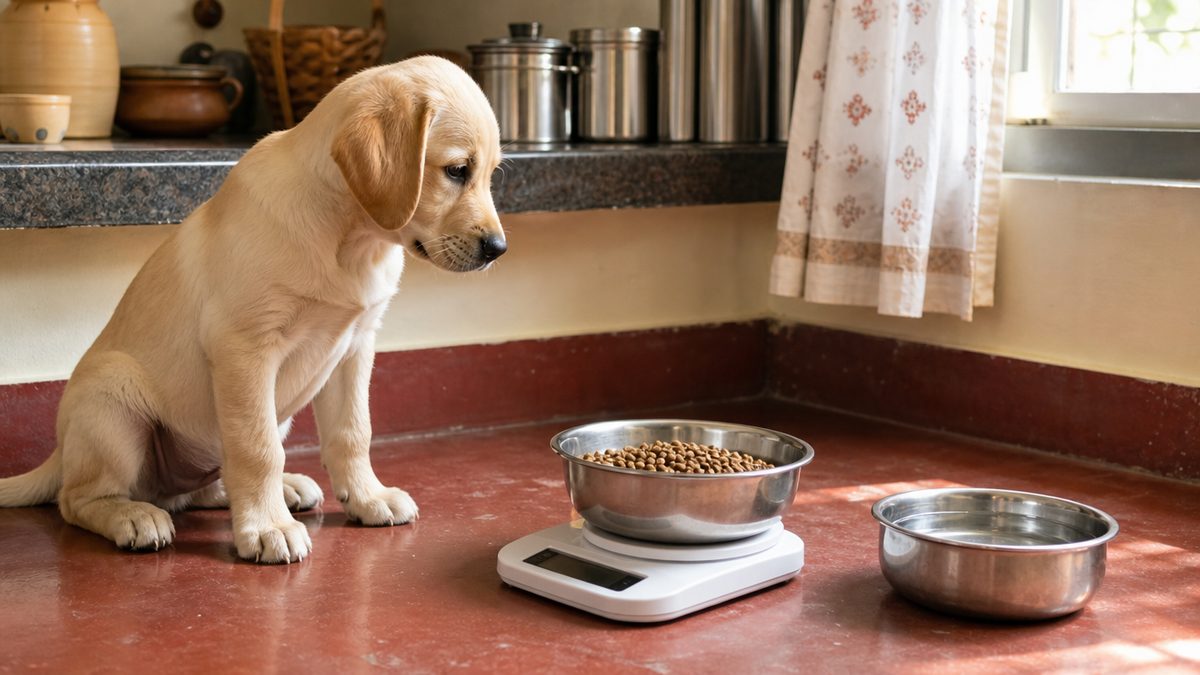
Measure puppy food in grams on a kitchen scale, keep treats under 10 percent of the day's calories and count home-cooked food inside the same total, because a cup is not a unit: Farmina's cup holds 105 g, Royal Canin's Maxi Puppy cup about 78 g, and the same 'two cups' is 156 g on one bag and 210 g on the other Royal Canin India Pedigree India, Feeding guidelines.
Two of the pages ranking for 'puppy feeding chart' print the identical cups table in pounds, half to one cup a day for a puppy maturing at 3 to 12 lb at 1.5 to 3 months, without saying which cup or which food. Royal Canin India's own cups differ between its bags: 264 g is 3 and 3/8 cups on Maxi Puppy, which is 78 g a cup, 214 g is 2 and 3/8 cups on Labrador Retriever Puppy, 90 g a cup, and 80 g is 7/8 of a cup on Shih Tzu Puppy, 91 g a cup Royal Canin India Royal Canin India. So whether 2 cups of food a day is enough for a puppy has no answer until the cup is weighed: 2 cups is 156 to 210 g, which at the 3.7 to 4.2 kcal per gram the Pedigree and Farmina pages print is roughly 580 to 880 kcal, enough for a 5 kg-adult puppy at any age, about right for a 10 kg-adult puppy at 6 months, and little more than half of what a 30 kg-adult puppy needs at the same age FEDIAF (European Pet Food Industry….
Treats and table food come out of the same day's calories. Pedigree India's feeding guidelines say non-complete treats must account for less than 10 percent of daily calories and that the grams on a pack assume every calorie comes from complete food. For the 1,540 kcal Labrador puppy at 6 months that is about 150 kcal, 35 to 40 g of its own kibble handed out as training rewards and taken off the bowl. Home-cooked food is fine as a complete diet and wrong as a topping: a puppy that gets rice and chicken on top of the chart's grams is overfed, and one that gets only rice and chicken is short of calcium, the deficiency Merck describes in dogs on meat-and-rice diets. The homemade dog food guide for India shows how a balanced home diet is built and costed. AAHA's line on raw meat is that it 'does not advocate or endorse' feeding it, and a puppy's unfinished immune system is one more reason to wait.
Six mistakes
- Feeding by today's weight instead of expected adult weight. A 7 kg puppy needs 687 kcal if it will be a 10 kg Beagle and 958 kcal if it will be a 30 kg Labrador, on the same equation.
- Free feeding. FEDIAF's rule is that puppies 'should never be fed ad libitum', and every schedule on this page is measured meals.
- Adding calcium to a large-breed puppy's food. The ceiling is 1.6 percent of dry matter before 14 weeks, and the puppy cannot regulate absorption before 6 months Merck Veterinary Manual.
- Feeding the adult amount early. Pedigree India's adult table gives a 10 kg dog 534 kcal a day, while the same dog as a 9 kg puppy at 10 months needs 688 on the FEDIAF equation; the puppy row stays until the maker's or the vet's switch age FEDIAF (European Pet Food Industry….
- Copying a chart at an unknown calorie density. The Zoomies chart assumes 3,500 to 3,800 kcal/kg and prints 480 to 580 g for a Labrador at 9 to 12 months, which is 1,750 to 2,120 kcal at its own midpoint, above the 1,584 kcal the equation gives a 30 kg-adult puppy at 10 months FEDIAF (European Pet Food Industry….
- Skipping the weekly weigh. The centile data say the overweight adult was visible on the puppy scale, and the hands alone miss it.
The rest of the first year, the vaccines, deworming, socialisation and the vet costs month by month, is in the puppy care in India guide; this page is the feeding column of that year, and the one line it shares with every other column is that your nearby vet decides for your puppy.
Puppy feeding questions, asked the way Google India asks them
How much food should I feed my puppy chart?
Use the chart above: find the row for the puppy's expected adult weight and age, read the kilocalories, and divide by your bag's kcal per gram. A puppy that will weigh 30 kg needs 999 kcal a day at 2 months, 1,406 at 4 months and 1,540 at 6 months on the FEDIAF equation, which is 239, 336 and 368 g of a 4,184 kcal/kg food.
Can a 4 month old puppy eat once a day?
No. Merck's professional manual has puppies on three meals a day from weaning to 6 months and two from 6 to 12 months; its owner guide, Royal Canin India and Pedigree India all keep a 4-month-old on at least two, and small breeds on three or more, because a puppy's stomach cannot hold a day's food at once.
What to feed a 4 month old puppy?
A complete growth food, dry or wet, fed in three measured meals, with a large-breed formula for a puppy that will weigh 32 kg or more as an adult; Merck's test is the AAFCO line 'including growth of large size dogs' on the pack. At 4 months a 30 kg-adult puppy needs about 1,406 kcal a day on the FEDIAF equation.
What to feed a 30 day old puppy?
Its mother's milk, with the first soaked growth food offered from about 4 weeks. The NRC says owners start feeding puppies food at approximately 4 weeks because milk is no longer sufficient, and mothers suckle for at least 6 weeks; Royal Canin India starts gradual weaning 'at one month old' in four portions a day.
How much should I feed a 1 month old puppy?
By its own weight, not a chart: Merck's neonatal requirement is 220 kcal per kg of body weight a day in the fourth week, after 133, 155 and 175 to 198 in weeks one to three. A nursing puppy takes that from the dam; a hand-reared one takes it as milk replacer, weighed daily, gaining 5 to 10 percent of body weight a day.
What food for a 1 month old puppy?
Mother's milk first, a manufactured puppy milk replacer if she is absent, and from about four weeks a complete starter or growth food soaked to a gruel. Merck says commercial milk replacers are superior to homemade versions and none equals the dam's milk; Pedigree India's large-breed starter prints 400 kcal per 100 g for this stage.
Can I feed my 1 month old puppy rice?
Not as the food. A one-month puppy is weaning onto a complete growth diet, and rice supplies energy without the calcium a growing skeleton needs; Merck records calcium deficiency and secondary hyperparathyroidism in dogs fed meat-and-rice diets and rickets 'most often' on unsupplemented homemade diets. A spoon of rice mixed into soaked starter food does no harm.
What should I feed my 45 days old puppy?
The breeder's starter food, soaked, in four meals a day, because at 45 days a puppy is 6.4 weeks old and should still be with its mother: Rule 8(1)(a) of the Dog Breeding and Marketing Rules, 2017 bars the sale of pups under eight weeks. Weigh it daily and see your nearby vet this week.
Can I give rice to my 45 days old puppy?
A little, mixed into soaked starter food, but rice cannot be the diet. At 45 days the puppy is weaning onto a complete growth food; a diet of rice and meat leaves it short of calcium, the deficiency Merck describes as nutritional secondary hyperparathyroidism, with rickets appearing on homemade diets fed without supplementation.
Can I give rice to my 2 month old puppy?
Yes as a small part of a balanced home diet, no as the meal. Merck's manual says an exclusive hamburger-and-rice diet induces calcium deficiency in dogs, and a growing puppy is the dog most exposed to that. The homemade dog food guide shows how rice, meat, egg and a calcium source are balanced for growth.
Can I give my 2 month old puppy dry food?
Yes. Merck's owner table runs a puppy diet from 6 weeks with four meals a day to 12 weeks, FEDIAF's growth equation starts at the 8-week weaning age, and Farmina's and Royal Canin India's puppy tables both begin at 2 months. Soak the kibble for the first week if the puppy struggles with it.
How much should a 7kg puppy eat?
It depends on what the 7 kg puppy will become. On the FEDIAF equation a 7 kg puppy needs 687 kcal a day if its adult weight is 10 kg, 822 if 15 kg, 890 if 20 kg and 958 if 30 kg, which on a 4,184 kcal/kg food is 164 to 229 g. The adult weight, from the parents or the breed page, sets the row.
How much should I feed my puppy per feeding?
The day's grams from the chart divided by the number of meals for that age: three from weaning to 6 months and two after, on Merck's schedule. A 30 kg-adult puppy at 3 months on 303 g of a 4,184 kcal/kg food gets about 100 g a meal; the same puppy at 8 months on two meals gets about 190 g each.
What is a good feeding schedule for a puppy?
Three measured meals at fixed times from weaning to 6 months, for example 7 am, 1 pm and 7 pm, then two from 6 to 12 months, with water down all day and treats counted inside the total, which is Merck's professional schedule; Merck's owner guide and Royal Canin India add a fourth meal before 12 weeks.
Should a puppy be fed 2 or 3 times a day?
Three until 6 months and two after, on Merck's professional recommendation, with small breeds possibly needing more than three because of their small stomachs. Royal Canin India moves small breeds to two meals from 4 months and large breeds from 6; Pedigree India allows two to three between 4 and 6 months.
How do I calculate how much food my puppy needs?
Weigh the puppy, raise the weight in kg to the power 0.75 on a phone calculator, then multiply by [254.1 minus 135 x (weight now divided by expected adult weight)] for kilocalories a day, the FEDIAF equation for 8 weeks to 1 year. Divide by the bag's kcal per gram for grams. AAHA's cross-check is 70 x kg to the power 0.75, times 3 under 4 months and 2 after.
How much food should a Shih Tzu puppy eat?
Royal Canin India's Shih Tzu Puppy table for a 5 kg adult runs 96 g a day at 2 months, 113 g at 4, 103 g at 6 and 80 g at 10 months, then adult food from 11 months. The FEDIAF equation for a 5 kg-adult puppy gives 326 to 413 kcal a day across the same ages, in three to four meals because a toy breed's stomach is small.
How much food should Golden Retriever puppies eat?
Royal Canin India's Golden Retriever Puppy table for a 30 kg adult runs 225 g at 2 months, 308 g at 4, 370 g at 6 and 329 g at 10 months, on puppy food to 16 months. The FEDIAF equation gives the same puppy 999, 1,406, 1,540 and 1,584 kcal, in three meals to 6 months then two, on a large-breed food under the calcium ceiling.
Is 2 cups of food a day enough for a puppy?
Cups are not a unit, so weigh one: Farmina's cup is 105 g and Royal Canin's Maxi Puppy cup about 78 g, so 2 cups is 156 to 210 g, roughly 580 to 880 kcal. That feeds a 5 kg-adult puppy at any age and is little more than half of the 1,540 kcal a 30 kg-adult puppy needs at 6 months on the FEDIAF equation.