
Cat nutrition guide
Homemade cat food in India: what a cat needs, what is unsafe and how to cost it
What the NRC and FEDIAF tables say a cat must get, the four nutrients a cat cannot make, what 114 checked recipes got wrong, the Indian kitchen foods that poison a cat, and the arithmetic that puts a properly completed home diet at Rs 283 a day against Rs 48 for a complete dry food.
Quick answer
Homemade cat food in India is safe only when it is cooked boneless meat completed with a supplement formulated to the FEDIAF or NRC cat minimums and sized by a veterinary nutritionist, because a cat cannot make taurine, arachidonic acid, vitamin A or niacin and 0 of 114 published recipes met every NRC allowance. Onion, garlic, raw fish, milk, daily liver and bones are unsafe; rice is fine as a spoonful. It costs about Rs 283 a day for a 4 kg cat against Rs 48 for complete dry food.
This guide is general information for Indian pet owners and is not a diagnosis. Always consult a registered veterinarian near you before acting on anything you read here, and treat any sudden change in your pet's condition as urgent.
What a cat needs from its food: the NRC and FEDIAF minimums
A 4 kg cat needs about 190 to 250 kcal a day, with at least 25 g of protein in every 100 g of dry matter, taurine, arachidonic acid, preformed vitamin A, niacin and calcium balanced against phosphorus, and every one of those figures comes from two documents that no ranking page for homemade cat food quotes.
The first document is the National Research Council's 2006 report Nutrient Requirements of Dogs and Cats, the reference the US Food and Drug Administration relies on to regulate pet food, whose owner booklet lists daily recommended allowances for an adult cat weighing 9 lb (4.1 kg) that eats 250 kcal a day National Research Council. That cat needs 12.5 g of crude protein, 5.5 g of fat, 0.18 g of calcium, 0.16 g of phosphorus, 63 micrograms of vitamin A and 2.5 mg of niacin every day.
The second is the FEDIAF Nutritional Guidelines, the table European pet food manufacturers formulate to, peer reviewed by independent veterinary nutritionists and republished in September 2025. Its adult cat minimums sit in two columns, one for an active cat eating 100 kcal per kg of metabolic body weight and one for an indoor or neutered cat eating 75 kcal, and the indoor column is higher per 100 g because a cat that eats less food has to get more nutrient out of every gram.
| Nutrient | Active adult, per 100 g dry matter | Indoor or neutered adult, per 100 g dry matter | Per 1,000 kcal (active adult) |
|---|---|---|---|
| Protein | 25.00 g | 33.30 g | 62.5 g |
| Taurine, wet or canned food | 0.20 g | 0.27 g | 0.50 g |
| Taurine, dry food | 0.10 g | 0.13 g | 0.25 g |
| Arachidonic acid | 6.00 mg | 8.00 mg | 15 mg |
| Vitamin A | 333 IU (ceiling 40,000 IU) | 444 IU | 833 IU |
| Calcium | 0.40 g | 0.53 g | 1.00 g |
| Phosphorus | 0.26 g | 0.35 g | 0.64 g |
| Calcium to phosphorus ratio | 1:1 minimum, 2:1 maximum for an adult | same | same |
| Fat | 9.00 g | 9.00 g | 22.5 g |
Two rows in that table decide whether a home diet is complete. FEDIAF sets taurine twice as high in canned food as in dry food because heat-processed food loses more taurine to gut bacteria, and a home-cooked chicken stew is a heat-processed wet food, so the 0.50 g per 1,000 kcal figure is the one that applies to it, 125 mg a day for a cat eating 250 kcal. The calcium to phosphorus ratio must sit between 1:1 and 2:1, and boneless muscle meat on its own sits well below 1:1, which is the arithmetic behind every case of nutritional secondary hyperparathyroidism in a cat fed only meat and rice.
How the two documents agree on one 4 kg cat
The two documents land on the same numbers when you run them against one cat. FEDIAF's 833 IU of vitamin A per 1,000 kcal is 208 IU for a cat eating 250 kcal a day; the NRC's 63 micrograms of retinol is 210 IU at FEDIAF's own conversion of 0.3 micrograms per IU National Research Council. On protein, FEDIAF's 62.5 g per 1,000 kcal is 15.6 g a day at 250 kcal against the NRC's 12.5 g, so 12 to 16 g a day is the working band for a 4 kg cat. A home diet also has to stay under the ceilings, and the one a liver-heavy recipe hits first is FEDIAF's 40,000 IU of vitamin A per 100 g of dry matter.
Every figure in the FEDIAF table is a concentration in the food as fed over a day, so a diet that is complete for a 5 kg outdoor cat eating 300 kcal can be short for a 4 kg neutered flat cat eating 190 kcal of the same recipe, because the second cat eats a third less of everything. That is why the balancing is a veterinary nutritionist's job and why this page gives no recipe.
Why a cat cannot be vegetarian: the four nutrients it cannot make
A cat cannot make taurine, arachidonic acid, vitamin A or enough niacin inside its own body, all four come from animal tissue, and that biochemistry is what obligate carnivore means in a nutrition table rather than in a slogan National Research Council.
The four gaps are listed below, each with what happens when the diet leaves it empty.
- Taurine. A cat's ability to synthesise taurine is limited and cannot cover what it loses every day through bile acids, so taurine is an essential nutrient for the cat and not for the dog, and deficiency leads to feline central retinal degeneration, dilated cardiomyopathy and reproductive failure. Taurine is abundant in fish, birds and small rodents and is absent or present only in traces in plants.
- Arachidonic acid. Cats cannot readily convert linoleic acid, the omega-6 fat in vegetable oils, into arachidonic acid, which is absent from vegetable oils and fats and found in the fat of meat, poultry and eggs.
- Preformed vitamin A. Cats lack the intestinal dioxygenase enzyme that splits beta-carotene, so carrot and pumpkin supply them no vitamin A at all; they need retinol from liver, fish oil or a synthetic source, and too much liver produces hypervitaminosis A with skeletal lesions.
- Niacin. Cats cannot synthesise substantial niacin from tryptophan and must get the whole requirement from food; kittens on a purified diet without niacin stopped growing in 10 to 15 days and died by day 50, and adult cats deprived of it lose weight and may die.
Taurine is the one with a historical body count, and the proof came from commercial food, not from home cooking. In 1987 Pion, Kittleson, Rogers and Morris reported in Science low plasma taurine with echocardiographic myocardial failure in 21 cats fed commercial cat foods and in 2 of 11 cats fed a purified diet marginally low in taurine for 4 years, and oral taurine normalised left ventricular function in both groups. FEDIAF records the same episode, foods with taurine levels that had looked adequate in purified-diet studies producing retinal degeneration and dilated cardiomyopathy in pet cats, as the reason its canned-food minimum sits above the dry-food one. The NRC's list of what taurine deficiency does adds blindness, deafness, poor immune response, poor neonatal growth and congenital defects.
What the evidence on plant-based diets for cats actually shows
The guideline bodies leave no room on this. The NRC booklet says strict vegetarian diets are not appropriate for cats unless supplemented with the nutrients essential for cats that are not found in plants, and that unsupplemented vegetarian diets can result in harmful deficiencies of amino acids, fatty acids and vitamins. The WSAVA's answer to 'Are vegetarian diets adequate for pets?' is that cats are obligate carnivores, cannot thrive on vegetarian diets, and should not be fed them. Merck lists vegetarian diets beside unbalanced homemade diets and dog food as the commonest causes of nutritional problems in cats.
Two owner surveys are quoted against that position, and both describe their own limits. The larger, in PLOS ONE in September 2023, surveyed guardians of 1,369 cats, 127 of them (9 percent) fed a vegan diet, and found that none of its seven illness indicators differed significantly, with 42 percent of meat-fed and 37 percent of vegan-fed cats reported to have at least one disorder. Its authors record that men were 9 percent of respondents and 70 percent lived in the UK, that the survey never asked whether the diets met FEDIAF or AAFCO profiles, that 42 percent of cats had outdoor access and may have hunted, and that guardian opinion is less reliable than veterinary examination or blood tests. The earlier Canadian and American survey, with 187 of 1,026 cats (18.2 percent) on plant-based diets, reached a similar owner-perception result and states that it 'is subject to bias, as well as methodological limitations'.
A commercial vegan cat food depends on synthetic taurine, and even those products are not reliably complete: of 24 commercial vegetarian diets for dogs and cats analysed in 2015, 6 missed AAFCO amino acid minimums, 3 of them for taurine, and only 3 met every labelling rule. A vegetarian recipe mixed in an Indian kitchen has no route to taurine, arachidonic acid or preformed vitamin A except a synthetic supplement designed for it, and no complete plant-based premix for cats was found on an Indian seller's page in this search on 18 September 2026. The honest answer to 'vegetarian cat food homemade' is that it does not exist as a complete diet.
What happens when someone checks a homemade cat food recipe
When 114 homemade cat food recipes from books and websites were run through nutrition software, not one met every NRC recommended allowance for an adult cat, and that 2019 evaluation is the reason this page teaches a framework and not a recipe.
The evaluation, in the Journal of the American Veterinary Medical Association, found that 113 of the 114 recipes gave vague preparation instructions, 46 gave no feeding directions, and only 94 carried enough detail to analyse. Recipes written by non-veterinarians and recipes without a supplement product had more nutrients below the allowance; with assumptions in their favour, 5 veterinarian-written recipes met every allowance except choline, and in 2 of those 5 taurine adequacy could not be confirmed.
| Nutrient | Share of recipes below the allowance | What it does in a cat |
|---|---|---|
| Choline | 89.7 percent | Liver fat metabolism; the one even vet-written recipes missed |
| Iron | 76.6 percent | Pale gums, lethargy, weakness, poor growth |
| Thiamine (vitamin B1) | 62.8 percent | Neurological signs, seizures; destroyed by raw-fish thiaminase |
| Zinc | 61.7 percent | Skin lesions, growth retardation |
| Manganese | 57.4 percent | Bone development, enzyme function |
| Vitamin E | 57.4 percent | Fat tissue pathology, especially on fish-heavy diets |
| Copper | 45.7 percent | Connective tissue, iron metabolism, coat pigment |
| Crude protein | 6.4 percent (6 of 94) | The one nutrient home cooks almost always cover |
The pattern matters more than any row. Protein was short in only 6 of 94 recipes, because chicken supplies it, while the trace minerals and B vitamins a formulated supplement carries were short in half to nine tenths of them. A cat on such a home-prepared diet looks fine for months, because a nutritional imbalance of that kind is slow, which is why the WSAVA's answer to 'Can I safely use recipes for home cooked diets found in books and online?' is 'Not really': such recipes may contain ingredients harmful to cats such as garlic, may be written by people without training in feline nutrition, may be outdated, and may carry serious deficiencies that make them harmful when fed long term.
The two failures with a clinical name are calcium and vitamin A. Feeding predominantly meat, or an exclusive meat-and-rice diet, induces calcium deficiency and nutritional secondary hyperparathyroidism, in which the pelvis and vertebrae demineralise first and the bone loss is severe by the time a fracture shows on an X-ray; feeding only liver induces vitamin A toxicity. The Bengal page on this site records that this bone disease has been reported in Bengal cats, a breed Indian owners often feed 'chicken', and the WSAVA notes that an unbalanced home diet is especially damaging to kittens, which can suffer painful skeletal disorders and pathological fractures.
The only ranking page written for an Indian kitchen prints a 'Chicken and Rice Balanced Meal' of boiled chicken, a little rice and mashed pumpkin, with no calcium source and no supplement quantity, and tells the reader to 'consider adding' taurine, calcium powder and fish oil with vet advice. Against the FEDIAF table above, that meal has no calcium to phosphorus ratio, no measured taurine and no vitamin E, and it is the shape of recipe the 2019 evaluation found short on 7 nutrients FEDIAF (European Pet Food Industry….
What is unsafe for a cat in an Indian kitchen
Onion and garlic in any form, raw freshwater fish, raw egg white, liver as a staple, milk and curd, cooked bones and any human painkiller are the seven things an Indian kitchen most often puts in front of a cat that it should not, each with a documented mechanism and, for onion, a dose Sanderson SL, Nutritional Requirements… World Small Animal Veterinary Association U.S. Food and Drug Administration.
The ingredients to avoid, with the mechanism and the published figure where one exists, are set out in the table below from Merck, FEDIAF, the WSAVA's 2025 cat treat guide and the FDA.
| Food | What it does | The figure or the rule |
|---|---|---|
| Onion, garlic, chives, leek (tadka, gravies, leftover curry) | Oxidative damage to red cells, Heinz-body haemolytic anaemia; cats are the most susceptible species | Toxicosis reported in cats after less than a teaspoon of cooked onion or 5 g per kg of raw onion; FEDIAF puts the toxic dose of fresh onion at 5 to 10 g per kg; garlic is 3 to 5 times more toxic |
| Raw freshwater fish (rohu, catla, tilapia, raw) | Thiaminase enzymes destroy thiamine (vitamin B1) | Cooking destroys the thiaminase; the 2019 evaluation found thiamine short in 62.8 percent of recipes anyway |
| Raw egg white | Avidin binds biotin | Cook the egg; avidin is destroyed by cooking |
| Liver every day | Hypervitaminosis A, skeletal lesions, outgrowths of the neck vertebrae | FEDIAF ceiling 40,000 IU of vitamin A per 100 g dry matter; a small share of liver, never the base |
| Milk, curd, paneer, cream | Lactose intolerance in many cats, diarrhoea | WSAVA lists milk and dairy products among the items to avoid |
| Cooked chicken or fish bones | Broken teeth, oesophageal or intestinal obstruction, constipation | WSAVA: bones can be very dangerous for cats; feeding bones does not reduce periodontal disease |
| Salt, spices, fried and fatty food | Gastrointestinal upset; pancreatitis risk with high-fat food | FDA lists salt and fatty foods among edible dangers; cats prefer bland, warm food |
| Chocolate, grapes, raisins, caffeine, alcohol, xylitol, raw dough | Toxic to cats at household amounts | FDA and WSAVA lists; the sweetener xylitol sits in sugar-free products |
| Paracetamol (Crocin, Dolo), ibuprofen, aspirin | Human painkillers; acetaminophen is fatal to cats | FDA: never give a cat a medicine intended for people unless a veterinarian directs it |
Onion is the one an Indian household feeds without knowing. Toxicosis in cats has followed raw, cooked, dehydrated and granulated onion and garlic, the sulphur compounds are released by chopping, cooking and chewing, haemolysis follows 3 to 5 days later, and the signs are lethargy, pale gums, fast breathing, dark urine and collapse. Cats are more sensitive than dogs because of their haemoglobin structure, and 5 to 10 g of fresh onion per kg of body weight is already toxic. For a 4 kg cat that is 20 to 40 g of onion, a spoon of leftover gravy base, and a teaspoon of cooked onion has been enough in a reported case.
Raw meat is the second Indian habit worth naming, and its food safety concerns are documented rather than theoretical. The WSAVA finds no evidence that raw meat-based diets give any health benefit over commercial or balanced home-cooked diets, and growing evidence that they carry Salmonella, E. coli, Campylobacter, Listeria and Toxoplasma to the cat and to the people who handle the food or the litter, with small children, pregnant people and the elderly at most risk. The 2021 AAHA/AAFP feline guideline states that neither body advocates or endorses feeding cats any raw or dehydrated non-sterilised food, including treats of animal origin. Freezing does not kill all the bacteria, and an Indian summer kitchen, where meat sits at 35 degrees between the butcher and the bowl, is the worst case for it.
A cat is rarely handed a raw onion. It is handed the chicken from the family's curry, cooked in an onion and garlic base, and the dose accumulates over a week. If a cat that eats table food goes quiet, pale in the gums and breathes fast a few days after such a meal, the nearby veterinarian needs to hear about the onion, because the anaemia has no antidote and the treatment is supportive.
Is rice okay for cats, and what home foods can a cat eat?
Rice is safe for a cat as a small, cooked part of a complete diet, and it is not a food a cat needs at all, because carbohydrates are not essential for cats and the short feline intestine limits how much plant fibre a cat can use.
The NRC booklet says carbohydrates, while not essential, provide an abundant source of energy, that a cat's short intestine limits fermentation of fibre, and that meals should not have more than 10 percent fibre. The WSAVA adds that cats can digest cereal grains if properly cooked and the overall diet is complete and balanced, with no evidence of harm. The problem with rice in India is never the rice; it is that rice displaces meat, and a bowl of rice and milk contains no taurine, no arachidonic acid, no preformed vitamin A, and a sugar many cats cannot digest World Small Animal Veterinary Association.
Anything a cat gets on top of a complete diet is a treat, and the WSAVA's rule is that treats stay under 10 percent of daily calories, 22 kcal a day for a 4 kg cat on its table. The same sheet prices human foods: 28 g of lean cooked chicken breast is 47 kcal, 28 g of canned tuna in water is 36 kcal, 59 ml of semi-skimmed milk is 27 kcal and 28 g of cheddar is 120 kcal, so the whole daily allowance is about 13 g of chicken, and one cube of cheese is five days of it.
The home foods that are safe as a topper, cooked, unseasoned and within that 10 percent, are listed below.
- Cooked boneless chicken or mutton, shredded, with no salt, onion or masala.
- Cooked egg, white and yolk, since cooking destroys the avidin in raw white.
- Cooked fish with every bone removed, sea fish or freshwater, never raw because of thiaminase.
- A teaspoon of plain cooked rice or mashed pumpkin, which adds energy and fibre and nothing a cat lacks.
- Water, which a cat drinks at about 2 ml for every gram of dry food and needs available at all times.
The rice-and-milk bowl, and what it does over a year
The rice-and-milk bowl is the default meal for a house cat in much of India, and it fails on every row of the FEDIAF table. Milk and dairy sit on the WSAVA's list of items to avoid because many cats are lactose-intolerant Sanderson SL, Nutritional Requirements…. The NRC's deficiency signs read like the complaints owners bring to Indian clinics: retinal degeneration and weight loss for vitamin A, pale gums and lethargy for iron, skin lesions for zinc, and for taurine a heart that fails without warning. A cat that eats only rice and milk is being fed a deficiency.
How to make cat food at home in India: the framework, not a recipe
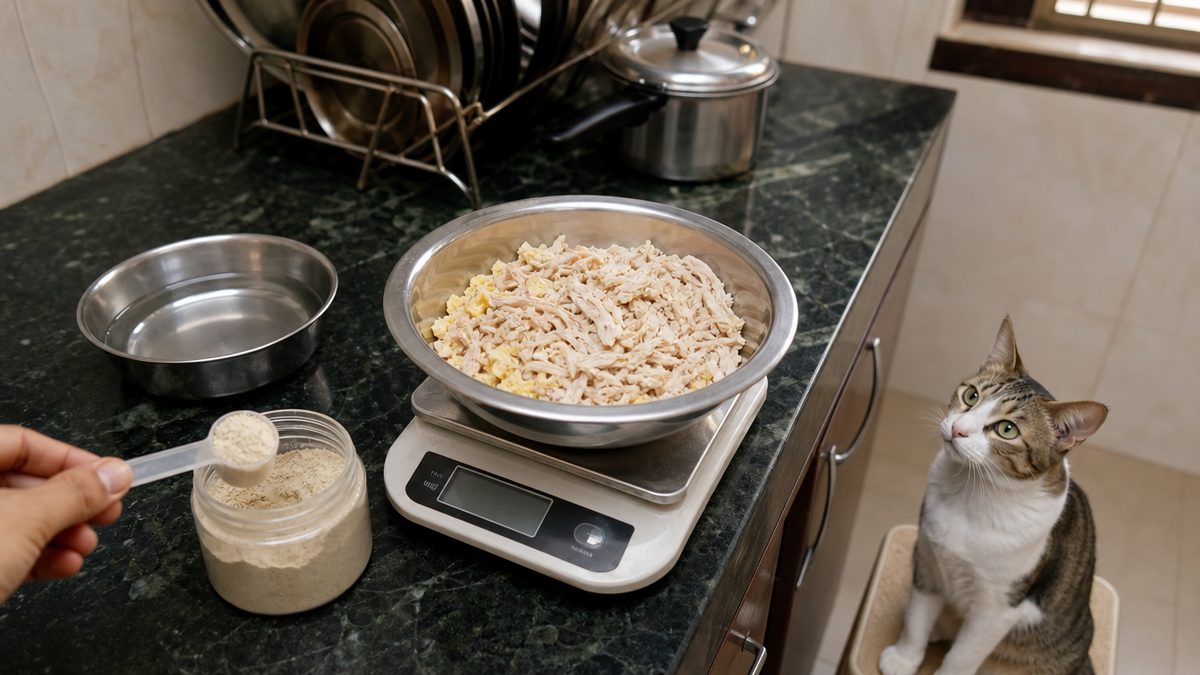
To make cat food at home in India, you set a calorie target for the cat's weight, build the meal from boneless meat, a little organ meat, cooked egg and cooked fish, add a formulated supplement for what meat lacks, have a veterinary nutritionist size the amounts, cook it, transition over 7 to 10 days and monitor; this page gives that framework with the numbers, not a recipe, because no recipe is complete without a nutrient source sized to it Wilson SA, Villaverde C, Fascetti AJ Quimby J, Gowland S, Carney HC, DePorter T.
- Set the calorie target from the cat's weight. For a lean 4 kg adult the NRC formula of 100 kcal times body weight to the power 0.67 gives 253 kcal, the WSAVA's table gives 225 to 250 kcal, FEDIAF's indoor or neutered figure of 75 kcal per kg of metabolic weight gives 190 kcal, and the AAHA/AAFP resting energy formula of 30 times kg plus 70 gives 190 kcal, so start between 190 and 250 kcal and adjust every two weeks to the body condition score, because individual cats vary up to 50 percent either way FEDIAF (European Pet Food Industry… Quimby J, Gowland S, Carney HC, DePorter T World Small Animal Veterinary Association.
- Choose the ingredient classes an Indian kitchen has. Boneless chicken breast or thigh and mutton for muscle meat, chicken liver and heart as a small share for vitamin A and taurine, egg cooked for protein and fat, sea fish or freshwater fish cooked and deboned, an animal fat or fish oil source for arachidonic acid and omega-3, and water, because the cat's weak thirst drive is why canned food at 78 to 82 percent water suits it National Research Council. Liver stays a minor ingredient under the vitamin A ceiling.
- Add the nutrient source that makes it complete. A premix supplement formulated to AAFCO or FEDIAF profiles supplies the calcium, iodine, choline, vitamin E, zinc, manganese, copper, thiamine and taurine that the 2019 evaluation found missing, and the cats.com page that ranks first for this query recommends exactly that route World Small Animal Veterinary Association. On 18 September 2026 the only such product found on an Indian-facing seller's page was EZComplete for cats through the import reseller desertcart.in at Rs 15,786 for a 450 g pouch shipped from the USA with duties included, which the seller rates at about 96 days of meals. A single-nutrient taurine powder such as the 50 g Chompz pack on Amazon.in at Rs 549 with a 1 g scoop fixes taurine and nothing else.
- Have a veterinary nutritionist formulate the amounts. Home-cooked diets cannot be tested for adequacy the way a commercial food is analysed or trialled, so the WSAVA says a veterinarian specialised in nutrition should formulate the diet; ask your nearby vet for a referral or contact the veterinary college in your state, and treat a 'pet nutritionist' or 'certified nutritionist' without a veterinary qualification as unverified, since the WSAVA's owner guide says there is no standardised training behind those titles and the qualification to look for is board certification by the ACVN or ECVCN or a PhD in animal nutrition World Small Animal Veterinary Association.
- Cook it, do not feed it raw, and never with bones. The WSAVA and the 2021 AAHA/AAFP guideline both come down against raw meat, raw fish carries thiaminase and raw egg white carries avidin, and cooked bones fracture teeth and block guts Quimby J, Gowland S, Carney HC, DePorter T Sanderson SL, Nutritional Requirements…. Cook gently and add the supplement after cooking, since heat processing is what lowers taurine.
- Transition over 7 to 10 days in a separate bowl. The AAHA/AAFP guideline allows 7 to 10 days for a diet change, and the WSAVA warns that a cat offered the new food mixed into the old bowl often refuses both, so offer them side by side and move the proportion a quarter at a time.
- Monitor the cat, not the recipe. A cat on a home-cooked diet needs twice-yearly examinations and blood work, or more often with a chronic condition, a weight every two weeks, and a body condition score kept at 4 to 5 out of 9.
Storage is the step Indian kitchens skip. A home-cooked diet cannot be left out of refrigeration for long, which is why the WSAVA notes that grazing strategies are easier with dry food, and its rule for an opened can, refrigerated and fed within 48 to 72 hours, is the right ceiling for a cooked batch in a humid Mumbai or Chennai kitchen. Cook once, portion into meal-sized boxes, refrigerate two days' worth, freeze the rest, and warm a portion before serving, since cats prefer warm food to cold.
Persian, Bengal, Siamese or British Shorthair: does the breed change the diet?
No. The NRC and FEDIAF tables are written for cats, not breeds, so a 'homemade Persian cat food list' is the same list as any other cat's, sized to weight and energy National Research Council. What changes is management. The Persian cat page on this site notes that a Persian bringing up hairballs regularly is telling you the coat is not being combed enough, that fibre supplements and hairball pastes manage the symptom, and that persistent vomiting can also signal brachycephalic airway syndrome, so the comb cures hairballs and a home diet does not; Royal Canin India's adult food uses psyllium fibre for the same purpose. The Bengal cat page carries the breed's record of bone disease on unbalanced meat diets, the British Shorthair page holds the one-minute body condition score check, and the Siamese cat has no breed-specific feeding rule at all.
What homemade cat food costs per day in India against dry food
A home diet for a 4 kg cat costs about Rs 283 a day once the supplement that makes it complete is included, against Rs 48 a day for Royal Canin Fit 32 at its own feeding chart and about Rs 18 for Whiskas, at Amazon.in prices on 18 September 2026, so a properly completed homemade diet runs six to fifteen times the price of a complete dry food Amazon.in, Royal Canin Fit 32 Regular Adult… Amazon.in, Whiskas Adult.
The arithmetic is shown line by line so the reader can rerun it with a local butcher's price. Every rupee figure was divided by 84.38 and by 74 to check it is not a converted dollar list; none lands on a round dollar number, and the one imported item is a landed price with duties, not a conversion.
| Item | Price and source | Arithmetic | Per day |
|---|---|---|---|
| Boneless chicken breast, about 150 g (190 kcal, the AAHA resting requirement) | Rs 356 per 450 g, M.R.P. Rs 383, Licious, 127 kcal per 100 g | Rs 356 divided by 450 g = Rs 0.79 per g, times 150 g | Rs 119 (Rs 128 at M.R.P.) |
| Complete premix for home-prepared cat food (EZComplete, 450 g) | Rs 15,786 landed, desertcart.in, seller's own 'approx 96 days' | Rs 15,786 divided by 96 days | Rs 164 |
| Homemade, chicken plus complete premix | The two rows above | Rs 119 + Rs 164 | Rs 283, about Rs 8,500 a month |
| Homemade, chicken plus taurine powder only (not complete) | Rs 549 per 50 g, Amazon.in, 1 g scoop | Rs 549 divided by 50 days = Rs 11, plus Rs 119 | Rs 130, still short on choline, iron, calcium, vitamin E, zinc |
| Royal Canin Fit 32, complete dry, at its own chart of 54 g a day for a 4 kg cat at ideal weight | Rs 3,568 per 4 kg, M.R.P. Rs 4,060, Amazon.in | Rs 3,568 divided by 4,000 g = Rs 0.89 per g, times 54 g | Rs 48 (Rs 55 at M.R.P.) |
| Whiskas Adult Ocean Fish, complete dry, at the same 54 g for comparison | Rs 1,008 per 3 kg, M.R.P. Rs 1,120, Amazon.in | Rs 1,008 divided by 3,000 g = Rs 0.34 per g, times 54 g | Rs 18 (Rs 20 at M.R.P.) |
| One egg, cooked, as an occasional protein swap | NECC suggested wholesale price 18 September: Rs 5.35 (Hyderabad) to Rs 6.45 (Kolkata) each | Per 100 eggs, divided by 100 | Rs 5 to Rs 7 wholesale; retail higher |
Three things in that table need saying. First, the chicken line is a floor, not a recipe: 150 g of breast covers 190 kcal and 32 g of protein, but a nutritionist will move some of it to thigh, heart and liver, and a neighbourhood butcher in Delhi or Pune sells boneless chicken below the Rs 0.79 per gram of Licious, the Bengaluru online butcher, so the meat cost can fall while the shape of the sum does not. Second, the premix is the cost driver at Rs 164 a day; a veterinary nutritionist can sometimes replace it with Indian pharmacy supplements, but that substitution is exactly the formulation work this page says to pay for. Third, the Rs 130 line is the diet most Indian home cooks actually feed, chicken with a taurine powder, and it is cheaper only because it leaves out the 7 nutrients the 2019 evaluation found short Amazon.in, Chompz Taurine for Cats…. An egg at the NECC's suggested wholesale price of Rs 5.35 to Rs 6.45 on 18 September 2026 is the cheapest animal protein in the table, and it goes in cooked.
The dry-food side is read from the manufacturers' own pages. Royal Canin India's Fit 32 page prints 54 g a day for a 4 kg cat at ideal weight and 43 g if overweight, on a food of 32 percent protein and 15 percent fat with 13,000 IU of vitamin A per kg. Whiskas India's site gives 30 percent crude protein and 9 percent fat and says to serve twice a day 'as per the cat's body weight', but publishes no gram chart, so its Rs 18 line uses the Royal Canin quantity for comparison only Amazon.in, Whiskas Adult. Both are labelled complete and balanced, the claim a home diet has to earn through a nutritionist rather than print on a bag.
The WSAVA's stated benefit of a home-cooked diet is that it can be custom made to the cat's preferences, health status and the ingredients you can source, and the ranking pages' most useful recipes are the ones written for kidney disease, diabetes and food sensitivity, all of which are veterinary diets. For a healthy adult cat the money buys control, not nutrition; for a cat with a diagnosis, or one that refuses every commercial food, it can buy a diet nobody sells in India.
How much and how often to feed, and how to know it is working
Feed a 4 kg adult cat 190 to 250 kcal a day in at least two meals, keep water available at all times, and judge the amount by the body condition score every two weeks rather than by the bowl World Small Animal Veterinary Association.
| Weight | Kilocalories a day (obese-prone to lean) |
|---|---|
| 2.0 kg | 160 to 170 |
| 3.0 kg | 200 to 210 |
| 3.5 kg | 215 to 230 |
| 4.0 kg | 225 to 250 |
| 4.5 kg | 240 to 270 |
| 5.0 kg | 250 to 290 |
| 6.0 kg | 265 to 330 |
| 7.0 kg | 280 to 370 |
How much should I feed my cat is a question the table answers only as a starting point, because formulas and label amounts are estimates and individual cats vary up to 50 percent either way; the WSAVA's rule is to adjust every two weeks until the cat holds an ideal weight at a body condition score of 4 to 5 out of 9. The 2021 AAHA/AAFP guideline scores 6 or 7 out of 9 as overweight and 8 or more as obese, reports feline obesity prevalence of 1.8 to 40 percent across studies, names neutering as a risk factor, and warns that free-choice feeding predisposes to overconsumption. The NRC puts it more bluntly: 30 to 40 percent of cats will overeat and become fat if food is always out.
How often is easier. A cat with free access eats 12 to 20 small meals over the day and night, so cats should be fed more than once a day, and a home-cooked diet, which cannot sit out in an Indian kitchen, is best given as three or four refrigerated portions warmed before serving World Small Animal Veterinary Association. Water matters more for a cat than for a dog: a cat drinks about 2 ml for every gram of dry food and takes 24 hours to replace a water loss a dog replaces in one, which is why canned food at 78 to 82 percent water, or a moist home-cooked diet, protects against urinary stones.
A working diet shows in three places within a month: the weight on the scale every two weeks, ribs felt under a thin layer of fat with a waist behind them, and a coat that is not dull. What it cannot show is the slow deficiency, which only the twice-yearly blood work catches.
Kittens, pregnant queens, seniors and sick cats: when the vet decides
A kitten, a pregnant or nursing queen, a senior over 10 and any cat with kidney, urinary, thyroid or digestive disease each need a different diet from the adult framework above, and for those cats a nearby veterinarian, not this page, decides what goes in the bowl National Research Council.
Kittens are the group a home diet damages fastest. A kitten at 10 weeks needs 200 kcal per kg of body weight a day against 80 kcal per kg at 10 months, can be weaned onto a commercially balanced kitten food from 3 to 5 weeks, and should eat a diet carrying an adequacy statement for growth. FEDIAF's growth column asks for 1.00 g of calcium per 100 g of dry matter against 0.40 g for an adult, and an unbalanced diet in a kitten produces the painful skeletal disorders and pathological fractures the WSAVA warns about. The kitten care guide for India and the newborn kitten care guide carry the feeding by week; a kitten does not get the adult framework.
A queen changes the sums twice. The NRC says to feed a pregnant cat enough to gain 40 to 50 percent of her body weight by the end of pregnancy, that a mother nursing more than two kittens needs 2 to 2.5 times the calories she needed at mating, and that lactating cats should have free access to a palatable, high-calorie food. FEDIAF's lactation formula for a queen with 3 or 4 kittens adds 60 kcal per kg of body weight, multiplied by the week of lactation, on top of maintenance. The cat pregnancy care guide covers the timeline; the diet through it is a growth-and-reproduction diet, not an adult one.
Seniors go the other way. The AAHA/AAFP guideline puts a mature adult of 7 to 10 years at roughly its resting energy requirement, a senior over 10 at 10 to 25 percent above it because digestion weakens, and names being underweight as a common problem in old cats. A sick cat gets a therapeutic diet: the guideline notes that simply feeding less of a maintenance food can cause vitamin and mineral deficiencies, which is also why the ranking pages' kidney disease and diabetes recipes are a veterinarian's decision and not a download.
- Book the check before the change: weight, body condition score, a diet history and, for a cat over 7, blood and urine tests, so the nutritionist formulates against real numbers.
- Keep the cat vaccination schedule in India and the cat deworming schedule for India running; a cat fed raw meat sits on that guide's higher deworming tier, and a cooked home diet does not change either schedule.
- Recheck at six months with blood work, as the WSAVA asks of every home-cooked diet, and sooner if the cat loses weight, goes off food, or its coat dulls.
Everything on this page is general information for an adult cat in India and is not a diagnosis; the reader's nearby veterinarian, who can weigh the cat, score its body condition and read its blood work, decides what that cat eats. A daily quantity by weight is the subject of the separate cat diet chart for India, and the dog side of the question is the homemade dog food guide for India.
Common questions about homemade cat food in India
What is a good homemade cat food?
A good homemade cat food is cooked boneless meat with a small share of organ meat, water, and a supplement formulated to AAFCO or FEDIAF cat profiles, sized by a veterinarian trained in nutrition. The WSAVA's answer is that a home-cooked diet can be adequate only if it is complete and balanced, and a diet that cannot be tested has to be formulated by someone qualified to do it.
What is the one meat to never feed a cat?
No single meat is banned; the forms are. Raw freshwater fish carries thiaminase that destroys thiamine, raw meat of any kind carries Salmonella, E. coli and Toxoplasma to the cat and the household, daily liver causes vitamin A toxicity, and cooked bones fracture teeth and block the gut. Cooked boneless chicken, mutton or sea fish is safe inside a complete diet.
Do vets recommend homemade cat food?
Only under conditions. The WSAVA says a home-cooked diet can be adequate if a veterinarian specialised in nutrition formulates it and the cat gets twice-yearly examinations and blood work; the 2021 AAHA/AAFP guideline says cats should eat diets carrying an adequacy statement and does not endorse raw food. Neither body recommends a recipe from a book or website.
What home foods can I feed a cat?
Cooked boneless chicken, mutton or fish, cooked egg, and a spoon of plain rice or pumpkin are safe on top of a complete diet, within the WSAVA's limit of 10 percent of daily calories, which is 22 kcal or about 13 g of cooked chicken breast for a 4 kg cat. Onion, garlic, milk, chocolate, grapes and anything cooked in a curry base stay off the list.
What is the best homemade food for cats?
The one a veterinary nutritionist has balanced for your cat. When 114 published recipes were analysed against NRC allowances in 2019, none met every one: choline was short in 89.7 percent, iron in 76.6 percent and thiamine in 62.8 percent, and only 5 veterinarian-written recipes came close. Meat, a formulated premix and a nutritionist's amounts beat any recipe found online.
How do I make homemade cat food for my cat?
Set a calorie target from the cat's weight, 190 to 250 kcal for a 4 kg adult, build the meal from cooked boneless meat, a little liver or heart, cooked egg and water, add a supplement formulated to FEDIAF or AAFCO cat profiles so taurine reaches 0.50 g per 1,000 kcal and calcium 1.00 g, have a veterinary nutritionist size it, then transition over 7 to 10 days and weigh the cat every two weeks.
Can I feed rice to my cat?
Yes, a spoon of plain cooked rice is safe, and no, a cat does not need it: carbohydrates are not essential for cats, the short feline intestine limits how much fibre it can use, and the NRC caps fibre at 10 percent of a meal. Rice becomes a problem when it replaces meat, because it carries none of the taurine, arachidonic acid or vitamin A a cat cannot make.
What type of homemade food can cats eat?
Cooked, meat-based food with a complete supplement is the only type that can be made adequate at home. The WSAVA finds no evidence that raw meat-based diets are healthier than balanced home-cooked or commercial food, documents their bacterial and parasite risks, and warns that home-prepared cooked and raw diets can both carry serious deficiencies and excesses unless formulated properly.
What should I feed my cat as a vegetarian?
A complete commercial cat food, keeping the vegetarian choice for your own plate. The NRC says strict vegetarian diets are not appropriate for cats unless supplemented with the nutrients cats cannot get from plants, and the WSAVA says such diets should not be fed to cats; a home-mixed vegetarian recipe has no source of taurine, arachidonic acid or preformed vitamin A at all.
Can cats live without eating meat?
Only on a manufactured diet that adds synthetic taurine, arachidonic acid, preformed vitamin A and niacin, and even those are unreliable: 6 of 24 commercial vegetarian pet diets analysed in 2015 missed amino acid minimums, 3 of them for taurine. The largest owner survey found no significant health difference in 127 vegan-fed cats, but never checked whether the diets were complete.
Is rice okay for cats?
Rice is okay in a small cooked amount on top of a complete diet, and the WSAVA notes cats digest properly cooked cereal grains with no evidence of harm. It is not okay as the bowl itself: a rice-and-milk diet supplies no taurine and no preformed vitamin A, and many cats are lactose-intolerant, so the milk adds diarrhoea to the deficiency.
How to make cat food at home in India?
Use boneless chicken, mutton or cooked fish, a small share of liver or heart, cooked egg and water, add a premix formulated for cats and have a veterinary nutritionist set the amounts. The only complete cat premix found on an Indian-facing seller's page on 18 September 2026 was an imported 450 g pouch at Rs 15,786 through desertcart.in, about Rs 164 a day, so budget first.