
Cat health guide
Newborn and orphaned kitten care in India: feeding, warmth, weight and when to call a vet
Birth to eight weeks, with the mother and without her: the feeding volumes, box temperatures and weight thresholds quoted from International Cat Care and two feline-medicine reviews, what a tin of milk replacer cost on Indian pages on 18 September 2026, the signs that mean a vet today, and what the Animal Birth Control Rules 2023 say about the community cat and her litter.
Quick answer
Newborn kitten care in India starts with warmth, not milk: a kitten below 36°C must not be fed by mouth. Leave a litter with a mother who is feeding it. Hand-rear an orphan on kitten milk replacer only, 8 to 10 feeds a day for two weeks, about 2 to 3 ml per feed for a 100 g kitten, in a box at 30 to 34°C, and weigh it daily; no gain by day 2 is a risk. Crying, cold, limpness or refusing to suckle mean a vet.
This guide is general information for Indian pet owners and is not a diagnosis. Always consult a registered veterinarian near you before acting on anything you read here, and treat any sudden change in your pet's condition as urgent.
The first hour with a newborn kitten: warm it before you feed it
The first hour with a newborn kitten runs in one order: look for the mother, warm the kitten, check it, weigh it, and only then feed it, because a cold kitten cannot digest milk and a kitten forced to feed while hypothermic can inhale it Alley Cat Allies.
Start with the mother cat, because a kitten found under a car or in a stairwell is usually not alone. Alley Cat Allies, whose care guide ranks first for this query on Google India, says to watch from a hidden spot for a few hours, since the mother is likely hunting, moving her litter or resting, and to step in only if she has not returned after those hours or the kittens or the mother look sick. International Cat Care adds that kittens being fed by their mother, even partly, stay with her.
Warmth comes before food. A healthy kitten has a rectal temperature of 36 to 37°C at 24 hours old and no control of its own temperature, so it cools fast when wet, in a cold room or away from its mother; below 35°C it stops suckling, dehydrates and its gut stalls, and oral feeding is indicated only once the body temperature has reached 36°C. So a cold kitten is warmed slowly first, against your body or a towel-wrapped bottle of warm water, and fed second; cold paws and ear tips are the field check.
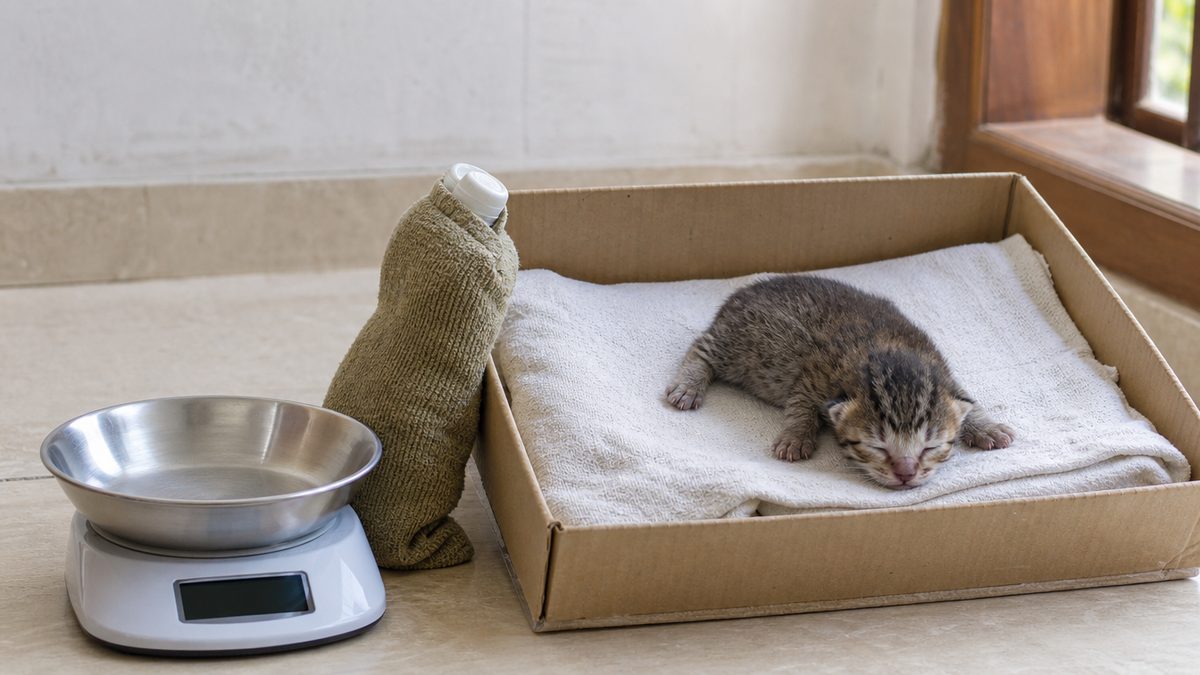
Then look at it. Gums are red for the first 7 days and pink after; dry, pale grey or bluish gums belong to a sick kitten, and a cleft palate, common in Siamese lines and easily missed, is why the review says every newborn's palate should be inspected. Weigh the kitten in a bowl on a kitchen scale, in grams, and write it down with the time.
- Watch for the mother from a distance for a few hours if the kitten was found outdoors; if she returns, leave the litter with her.
- Warm the kitten slowly with body heat or a covered warm-water bottle, never a bare hot surface, and never submerge it in water.
- Check the gums, the roof of the mouth and the umbilical stump, which dries and falls off at about 3 days.
- Weigh it in grams; a domestic shorthair weighs 90 to 110 g at birth.
- Feed only once it is warm, with kitten milk replacer, in the position and volume the feeding section gives.
- Call your nearby vet the same day if it is cold, limp, crying continuously or refusing to suckle, and take the whole litter and the mother if you have them.
Do not feed a cold kitten. If hypothermic kittens are forced to eat, regurgitation, aspiration pneumonia or ileus can follow, and oral feeding is only indicated once the body temperature has reached 36°C. Alley Cat Allies puts it in four words, do not feed chilled kittens, and it is the rule most home rescues in India break in the first ten minutes.
When the mother cat is there: what she does in the first eight weeks and what is left for you
When the mother cat is present she supplies warmth, colostrum, milk, toileting and the first lessons, and what is left for you in the first eight weeks is a warm quiet nest, a daily weight for each kitten, her food and worming, and a vet visit for the whole litter at the first sign of trouble Quimby J, Gowland S, Carney HC, DePorter T.
Colostrum is the reason to keep even a struggling litter with her: the milk of the first hours carries the antibodies a kitten is born without, the gut absorbs them only in the first day, and the kitten that misses them is the one that falls ill early. A queen with a large litter usually needs only supplemental feeding of the smallest kittens, not hand-rearing of all of them.
The numbers around a normal birth are worth knowing before you judge a litter. In 1,056 pedigree litters from 942 UK households the mean litter was 4.6 kittens, the mean live birth weight 93.5 g, 7.2 percent of kittens were stillborn, 8.0 percent of pregnancies ended in a caesarean and 9.1 percent of live kittens died before 8 weeks. In 28,065 kittens from 5,303 French purebred queens, 8.5 percent were stillborn and 16.0 percent of those born died before weaning. A flat-faced queen changes the odds: the Persian cat page carries the study putting brachycephalic queens at 3.27 times the odds of a difficult birth, and a kitten delivered after a long labour is at high risk in its first 48 hours.
| Milestone | Age |
|---|---|
| Umbilical cord falls off | 3 days |
| Eyelids open | 7 to 10 days on average |
| Ear canals open | 9 days on average |
| Crawling | 7 to 14 days |
| Walking | 14 to 21 days |
| Voluntary passing of urine and stool | 3 weeks |
| First teeth (deciduous incisors and canines) | 3 to 4 weeks |
| Normal vision | 30 days |
| Functional hearing and adult iris colour | 4 to 6 weeks |
She also teaches. Food acceptance, toileting habits, litter preferences and the fear response to other species are learned from the queen, and the sensitive socialisation period begins as early as 2 to 3 weeks and may be closing by 9 to 10 weeks, which is the guideline bodies' only answer to when a kitten may be handled; Purina's page says not in the first two weeks with the mother present, WebMD says not while the eyes are closed Purina South Africa WebMD, Newborn Kitten Care. For two weeks a normal litter eats or sleeps 90 percent of the time; kittens that cry excessively or fail to suck are usually ill or short of milk, and the whole litter and the mother go to the vet together.
Her own care is the last item: deworm her with the litter from the kittens' third week, on the cat deworming schedule for India, book her sterilisation for after weaning on the routes the cat sterilisation guide lists, and read the birth itself on the cat pregnancy care guide International Cat Care.
Warmth targets by week: three published schedules, and what they mean in an Indian room
The warmth target for a newborn kitten without its mother is a box at about 30 to 34°C in the first week, falling to the low or mid twenties by the end of the first month, and the three veterinary sources that print a schedule disagree by 2 to 3 degrees at every step, so all three are in the table Munnich A. Fading kitten syndrome.
| Age | International Cat Care, 2025 | JFMS review 2013, quoting Gross 2010 | JFMS review 2022 | Maddie's Fund, 2013 |
|---|---|---|---|---|
| Week 1 | 29.4 to 32.2°C (85 to 90°F) | 32 to 34°C | 32°C | About 35°C (95°F) nesting area |
| Days 7 to 10 and week 2 | Reduce gradually to 26.7°C (80°F) by 7 to 10 days | 27 to 29°C | 26°C | Reduce gradually |
| Week 3 | Reducing | 24 to 27°C | Not stated | Reducing |
| Week 4 onwards | 22.2°C (72°F) by the end of the first month | 24°C to 12 weeks | Not stated | About 24 to 27°C (75 to 80°F) |
What the box temperature does to a kitten
The box is physiology, not comfort. A newborn cannot shiver and takes the temperature of its surroundings; as it cools, the heart rate falls from 200 to 260 beats a minute at 36°C to 40 to 50 at 21.1°C, and hypothermia is the trigger for most of what follows. How long that lasts is placed at about 2 weeks by Maddie's Fund, at least 3 by Alley Cat Allies and over 4 by the 2013 review Alley Cat Allies Little S. Playing mum.
Reading the table in an Indian room
In an Indian room the table reads differently from the way it reads in Ottawa or London. On a May afternoon in most of the country the room is already at or above the week-1 target, so the heat pad or warm-water bottle is for nights, monsoon evenings, an air-conditioned bedroom and a Delhi or Kolkata January night, and the summer risk runs the other way: kittens kept too hot become constipated from dehydration and cry continuously, and the crying stops when the kitten is moved out of the overheated box. Every source therefore wants a gradient, a box large enough to crawl away from the heat with an unheated area always available, and humidity around 55 to 60 percent Little S. Playing mum.
Which heat source, and how to test it
The heat source is the last disagreement. International Cat Care lists a well-covered hot water bottle, an electric heat pad or a microwave heat pad; the 2013 review does not recommend heating pads at all, because they heat unevenly and burn, and prefers wrapped hot water bottles or a heat lamp with the temperature checked at kitten level Little S. Playing mum. Maddie's Fund's home test is that the surface should not feel too hot to the back of your hand held there for 2 minutes. A kitten that is listless and cool to the touch goes back to the warm-first rule; a vet measures the real figure rectally, and most digital thermometers start at 32°C, which says how cold a fading kitten can get Munnich A. Fading kitten syndrome.
Feeding an orphaned kitten: how much, how often and in what position
Feed an orphaned kitten 20 to 30 percent of its body weight in prepared milk replacer over 24 hours, split into 8 to 10 meals for the first two weeks, about 2 to 3 ml per feed for a 100 g kitten, and never more per feed than its stomach holds, about 4 to 5 ml per 100 g of body weight Little S. Playing mum.
Volume by body weight
The volume comes from the weight, not the age. Maddie's Fund's one-page chart turns the two published constants, about 20 kcal per 100 g a day and a stomach capacity of about 4 ml per 100 g, into millilitres per feed, and it is the only weight-based table any source in this harvest prints.
| Estimated age | Kitten weight | Formula per day | Per feed (stomach capacity) | Feeds a day |
|---|---|---|---|---|
| Under 1 week | 57 g | 15 ml | 2 ml | 7 |
| Under 1 week | 85 g | 23 ml | 3 ml | 7 |
| Under 1 week | 113 g | 31 ml | 5 ml | 7 |
| 1 week | 142 g | 38 ml | 6 ml | 7 |
| 1 week | 198 g | 54 ml | 8 ml | 7 |
| 2 weeks | 255 g | 69 ml | 10 ml | 7 |
| 2 weeks | 312 g | 84 ml | 12 ml | 6 to 7 |
| 3 weeks and over | 340 g | 92 ml | 14 ml | 6 to 7 |
| 3 weeks and over | 397 g | 107 ml | 16 ml | 5 |
| 4 weeks and over | 454 g | 123 ml | 18 ml | 5 |
| 4 weeks and over | 510 g | 138 ml | 20 ml | 4 |
| 5 weeks and over | 567 g | 153 ml | 23 ml | 4 |
The chart's footnote explains the gap between it and the tins: most commercial replacers deliver under 1 kcal per ml, so a kitten needs more volume than its stomach comfortably takes, and exceeding the per-feed figure risks aspiration, vomiting, diarrhoea and gas. Beaphar's own table is more generous, 50 ml a day for a 100 g kitten on days 2 to 7 in 6 to 12 feeds, so read the tin's figure as a ceiling and let the daily weight say whether the kitten is getting enough; a starved kitten is fed at half its requirement for the first 24 to 48 hours Little S. Playing mum.
| Age | International Cat Care | Alley Cat Allies | Cats Protection | JFMS review 2022 |
|---|---|---|---|---|
| 0 to 2 weeks | 10 feeds in 24 hours, every 2 to 2.5 hours | Every 2 hours to day 10, then every 3 to 4 hours to 2.5 weeks | Every 2 to 2.5 hours | 8 to 10 meals a day |
| 2 to 4 weeks | 7 feeds in 24 hours, every 2.5 to 3.5 hours | Every 5 to 6 hours from 2.5 weeks | Follow the manufacturer | Reduce, for example to 5 meals, as weight allows |
| 4 to 5 weeks | 5 feeds in 24 hours, every 3.5 to 5 hours | 2 to 3 times a day, weaning begins | Weaning from 3 to 4 weeks | Weaning |
Position, teat and temperature
Position decides whether the milk reaches the stomach or the lungs: all four paws on a surface, on its front with the head up, never on its back, a teat hole that drips with no squeezing, and milk never forced from the bottle Alley Cat Allies. Spoons and eye droppers are avoided because of aspiration, syringe droplets are unsafe before about day 8 because a newborn has no gag reflex, tube feeding is a technique a vet shows you, and every feed ends with a burp on its front or against your shoulder Munnich A. Fading kitten syndrome Alley Cat Allies.
Warm the milk to 35 to 38°C and test a drop on the inside of your wrist, where Cats Protection says you should not feel it at all when it is right Cats Protection, Hand-rearing kittens. Prepare no more than a day's supply, discard anything left out for an hour, and sterilise bottles and teats, for which a steriliser sold for human baby bottles is suitable International Cat Care. Overfeeding is the most common cause of non-infectious diarrhoea in orphaned kittens in the first three weeks, so when stools loosen the answer is a smaller volume, a feed or two diluted half and half with water, and the vet if it persists Little S. Playing mum.
Kitten milk replacer in India: what is sold, what it costs, and why cow's milk is not a substitute
Kitten milk replacer in India means three imported powders, Royal Canin Babycat Milk at an MRP of Rs 1,600 for 300 g, Beaphar Lactol at Rs 1,150 for 200 g and PetAg KMR at Rs 4,959 for a 340 g tin on the pages we opened on 18 September 2026, plus Indian-made 200 g packs at Rs 419 to Rs 553, and every veterinary source in this guide says cow's or goat's milk is not a substitute Amazon.in, Pet-Ag KMR Kitten Milk Replacer… International Cat Care.
| Product | Pack | Price on the page | Where | What the page said |
|---|---|---|---|---|
| Royal Canin Babycat Milk | 300 g, in sachets | MRP Rs 1,600, offer Rs 1,408 | Zigly | Sold out on the day |
| Royal Canin Babycat Milk | 300 g | Rs 2,300 | Amazon.in, on the KMR page's carousel | Marketplace listing |
| Beaphar Lactol Kitten Milk | 200 g | Rs 1,150 (Rs 575 per 100 g) | Amazon.in | In stock |
| PetAg KMR powder | 6 oz (170 g) | No price shown | Amazon.in | Currently unavailable |
| PetAg KMR powder | 12 oz (340 g) | Rs 4,959, MRP Rs 5,999 | Amazon.in | Listed for delivery |
| Vetina Puppy and Kitten Milk Replacer | 200 g | Rs 553, MRP Rs 750 | Amazon.in, same carousel | Indian-made |
| Ventripro Milk Replacer for Cats and Kittens | 200 g | Rs 419, MRP Rs 440 | Amazon.in, same carousel | Indian-made |
The exchange-rate test and the stock on the day
Each rupee figure went through the exchange-rate test this site runs on every Indian price, dividing by 84.38 and by 74: Rs 1,600 gives 18.96 and 21.62, Rs 1,150 gives 13.63 and 15.54, and Rs 4,959 gives 58.77 and 67.01, none a round dollar figure, so all three read as Indian marketplace prices. Availability matters more: Royal Canin's own Indian catalogue listed no Babycat Milk when we opened it, and the one Indian retailer page we opened was sold out on the day, so buy the tin before the kitten arrives if a pregnant community cat lives in your building Zigly, Royal Canin Babycat Milk Replacer….
Making it up is on the tin, and the two manufacturers differ: Royal Canin says 10 ml of powder to 20 ml of low-mineral bottled water at about 50°C, fed lukewarm within an hour, with the bottle retired once teeth appear at 3 or 4 weeks; Beaphar says 7 level scoops to 100 ml of warm water, about 1,250 kcal per litre, refrigerated up to 24 hours and reheated to 38°C Beaphar, Lactol Kitty Milk 250 g product…. Both are cow's milk modified towards queen's milk, with more energy and less lactose.
Cow's milk, buffalo milk and the home substitutes
Cow's milk, buffalo milk, packet milk with glucose, and the Cerelac and Lactogen that rescue groups pass around are what people reach for at 11 pm when no kitten formula is in the house, and the guideline position is short. International Cat Care: never use cow or goat's milk, because protein and fat levels are too low. The 2013 review gives the reason, cow's milk is lower in protein and fat than queen's milk and a poor source of taurine, and goat's milk has no advantage over it; Cats Protection says kittens find both hard to digest and Alley Cat Allies says they cause diarrhoea Cats Protection, Hand-rearing kittens Alley Cat Allies. No source names a human infant formula or a cereal as acceptable, and nothing in them makes buffalo milk an exception.
Warmth is the emergency, not the meal: Alley Cat Allies says to hold off bottle feeding until the kitten is completely warm. Homemade formulas are, in the 2013 review's words, best reserved for short-term or emergency use, and Maddie's Fund says to avoid them whenever possible Peek L. Caring for Orphaned Kittens.…. The one recipe a ranking page prints is Alley Cat Allies' emergency mix of evaporated milk, one beaten egg yolk and corn syrup, labelled for emergencies only. A vet can put droplets of 10 to 20 percent glucose on a hypoglycaemic kitten's gums; that is a clinic measure, and your nearby vet decides for your kitten.
Toileting, weaning and the litter tray from birth to eight weeks
A kitten under three weeks cannot pass urine or stool on its own, so an orphan's carer stimulates it with damp cotton wool before and after every feed, weaning onto solid food starts at three to four weeks, and a shallow litter tray goes in at about four weeks International Cat Care.
The mother does this by licking under the tail, and you copy her with soft tissue, damp cotton wool or a fragrance-free wet wipe, before and after feeding, because a kitten with an empty bladder feeds better. How long it is needed is one more spread: under 2 weeks with the reflex triggered on the tray from 3 (International Cat Care), under 3 weeks (the 2013 review and Cats Protection), under 4 (Alley Cat Allies) Cats Protection, Hand-rearing kittens Alley Cat Allies. Normal stool on milk is pasty, yellow to light brown, about the consistency of toothpaste; a kitten that passes nothing for a day, strains, or has diarrhoea is a same-day call, and every kitten with diarrhoea is checked for worms Cats Protection, Hand-rearing kittens.
Weaning starts at 3 to 4 weeks, as soon as the kitten will lap, because even the best milk replacers cause problems. The steps every source agrees on are listed below.
- Offer the prepared milk replacer in a flat, shallow dish at ground level from 3 weeks; many kittens learn by stepping in it and licking their paws Little S. Playing mum.
- Mix wet kitten food, or dry kitten food soaked soft, with a little milk into a paste and offer it for about 30 minutes several times a day, warmed to about 38°C if refused cold Little S. Playing mum.
- Reduce the milk as the paste is taken until the kitten eats only solid food; never force food into the mouth.
- Retire the bottle when the teeth come through at 3 to 4 weeks, since they damage teats, and pour the milk into a clean bowl.
- Expect 30 percent or more of the day's calories from solid food by 5 to 6 weeks, dry food chewed from then, and weaning complete between 6 and 9 weeks.
The AAHA and AAFP guideline puts the start of weaning at 3 to 5 weeks and the need afterwards at about 200 kcal per kg a day at 10 weeks, and weaning is also the second peak of kitten deaths, so the daily weigh-in continues through it.
Litter goes in at about 4 weeks: a tray with low sides holding 2.5 cm or less of non-clumping litter, placed away from the food, with the kitten put in it after every feed, play and nap, a little soiled litter left in it as a reminder, and a sandy texture International Cat Care Cats Protection, Hand-rearing kittens. The sources disagree on newspaper: the 2013 review allows shredded newspaper in the tray, Alley Cat Allies says paper or fabric teaches bad habits, so switch an old-newspaper tray to a sand-textured litter once the kitten uses it reliably Alley Cat Allies. Kittens accept the substrate they see the queen use, and offering more than one type is suggested.
Hygiene runs through all of it, because an unweaned orphan without colostrum has little or no immunity: sterile bottles, washed hands, a clean dry nest, a gentle wipe with a moist cloth twice a week, and no contact with other cats or their litter trays until the vaccines are in Little S. Playing mum. Fleas on a small kitten cause anaemia; comb them out daily, and do not use spot-on flea products on kittens of 6 weeks or younger without the vet, who may use fipronil off-label from 2 weeks but never ivermectin Munnich A. Fading kitten syndrome. Worming starts at about 3 weeks, by weight, on the cat deworming schedule for India International Cat Care.
Weight by week: the chart that tells you the kitten is gaining
A newborn kitten weighs 90 to 110 g, gains 10 to 15 g a day, doubles its birth weight somewhere between 7 and 14 days depending on the source, and must not weigh less on day 2 than it did at birth, because that loss is a mortality risk whatever the birth weight Cats Protection, Hand-rearing kittens Mugnier A, Gaillard V.
| Age | Maddie's Fund chart | Cats Protection | Alley Cat Allies |
|---|---|---|---|
| Birth | 57 to 113 g in the first week | 90 to 110 g | 3 to 5 oz (85 to 142 g) in the first week |
| 1 week | 142 to 227 g | Gain 50 to 100 g a week (10 to 15 g a day) | About 8 oz (227 g), birth weight doubled |
| 2 weeks | 255 to 312 g | Birth weight doubled | Not stated |
| 3 weeks | 340 to 425 g | Gaining 50 to 100 g a week | Close to 15 oz (425 g) |
| 4 weeks | 454 to 539 g | Gaining 50 to 100 g a week | Not stated |
| 5 weeks | 567 g and above | Gaining 50 to 100 g a week | Not stated |
The three columns do not agree. International Cat Care says a kitten doubles its birth weight in 7 to 10 days, Cats Protection says two weeks, Alley Cat Allies' progression chart says a week, and the largest dataset, 5,504 live-born kittens from 193 French catteries, found an average first-week gain of 9.5 percent of body weight a day, which doubles a kitten in roughly a week and a half Cats Protection, Hand-rearing kittens Alley Cat Allies Mugnier A, Gaillard V. That dataset, co-authored by a Royal Canin researcher, had a median birth weight of 101 g and 19.5 percent of kittens classed as low birth weight for their breed.
The second-day weight
The figure that should change what you do is the second-day weight. In that population 11.4 percent of kittens weighed less on day 1 than at birth and 5.7 percent still did on day 2, and losing weight between birth and day 2 was a risk factor for death in the first two months whatever the birth weight; mortality to two months was 7.4 percent overall but 19.2 percent for low-birth-weight kittens against 4.4 percent for the rest. The 2022 review sets the practical triggers: a birth weight more than 25 percent below the breed average is low, a loss of more than 10 percent of birth weight in the first 24 hours calls for supplemental feeding, and the same loss by day 2 adds a vet's diagnostics; small kittens can seem to suckle all the time and never gain, and only the scale shows it.
The weighing routine and the record
So the routine is simple. Weigh each kitten in a bowl on kitchen scales at the same time every day, or every 12 hours for the first two weeks if hand-rearing, then daily until weaned and once or twice a week to 8 weeks; tell littermates apart with a dab of nail polish on a claw, and keep the record a vet can read over the phone, listed below Little S. Playing mum.
- Weight in grams, at the same hour each day, with the birth weight or the first weight you took.
- Millilitres taken at each feed and the number of feeds in 24 hours.
- Stool and urine after each stimulation, with colour and consistency.
- Crying, restlessness, muscle tone and how much of the day the kitten sleeps.
After weaning the target is about 100 g a week until 5 months, and a growth rate that stalls is, in the 2013 review's words, a very common sign of illness or malnutrition that should always be investigated; an underweight kitten at 8 weeks is a vet visit before it is a bigger meal.
Fading kitten syndrome: the signs that mean a vet today
Fading kitten syndrome is the name for a kitten born apparently healthy that becomes inactive, stops feeding and dies, usually within the first two weeks of life, the period in which over half of all kitten deaths occur, and the signs that mean a vet the same day are listed below.
- Crying that does not stop after warming and a feed; crying is the response to failure to nurse, to pain and to cold, and a kitten that cries continuously in a hot box stops when moved out of it.
- Weight that is flat or falling on the daily scale, or more than 10 percent below the birth weight.
- Cold to the touch, or a rectal temperature below 35°C, which stops suckling and gut movement.
- Gums that are dry, pale grey or bluish instead of red in the first week and pink after.
- Limp posture, poor muscle tone, restlessness, or a kitten that is neither eating nor sleeping for most of the day.
- Refusing the teat, or lethargic and dull after feeds, tremor, or seizures, which are the signs of low blood glucose.
- Diarrhoea, no stool for a day, a swollen abdomen, or dark yellow urine, which points to dehydration.
- Eyelids swollen or matted with pus, yellow nasal discharge, or laboured breathing.
Most causes look the same from outside, which is why supportive care comes first and diagnosis second. The most common non-infectious cause is neonatal isoerythrolysis, a type A kitten drinking a type B mother's colostrum, and most of those kittens die in the first week; the most common infectious cause is bacterial sepsis, let in by hypothermia, hypoglycaemia and missed colostrum. Congenital defects sit underneath, a cleft palate common in Siamese lines, hydrocephalus met with increasing frequency in Persian cats, megaoesophagus most often in Siamese and related breeds, and a blood glucose under 50 mg/dl in a kitten up to 2 weeks old is abnormal on its own.
The denominators are these. Of live kittens in 1,056 UK pedigree litters, 9.1 percent died by 8 weeks; of 28,065 French purebred kittens, 16.0 percent died before weaning; of 5,504 cattery kittens weighed daily, 7.4 percent died by 2 months Fournier A, Masson M, Corbiere F, Mila H Mugnier A, Gaillard V. For orphans the textbook range Maddie's Fund quotes is 15 to 40 percent by 12 weeks, and in a British series of 274 kitten post-mortems 55 percent of deaths were infectious. The closest thing to an Indian community-kitten figure is Spanish: of 68 stray kittens under 8 weeks necropsied after dying in shelters, 66 percent died of infection, respiratory disease led under 1 week and gut disease after, 40 percent carried a congenital malformation, and the paper cites earlier studies putting stray-kitten deaths by 6 to 8 weeks at 12.8 to 48 percent.
What the clinic does is why the visit is worth the auto fare: the rectal temperature, glucose from a droplet of blood off the ear or paw, warming before any milk goes in, warm fluids, glucose on the gums if the sugar is low and an antibiotic if sepsis is suspected, because a kitten in its first two weeks needs 120 to 180 ml of fluid per kg a day and dehydration moves fast. Take the whole litter and the mother with the sick kitten, and let the vet near you decide; nothing on this page is a diagnosis.
Kittens can die very quickly, in International Cat Care's words, and the 2013 review says a neonate's condition can deteriorate rapidly, so carers consult a vet promptly when anything varies from normal Little S. Playing mum. Sudden death is possible even with everything done right, and Alley Cat Allies' ranking page says it more gently: some neonatal kittens are not going to survive despite your best efforts Alley Cat Allies.
Community kittens in India: when to leave the litter, when to step in, and what the law says
A litter of community kittens in India stays with its mother unless she has not returned after a few hours of watching or the kittens or the mother look sick, and the law that reaches them is the Animal Birth Control Rules 2023, whose definition of a community animal covers cats and whose Rule 19 sets the mother's sterilisation route Ministry of Fisheries.
Leave them be is the rule, from the organisation that ranks first for this query: in nearly all cases kittens outdoors do not need rescuing, removing them from their mother can harm them, and you give her food, water, shelter and quiet and leave the litter until it is weaned at around 8 weeks. Cats Protection puts the line at the same age, and Indian law draws it in the same place for sale: the Pet Shop Rules 2018, read from the Karnataka animal husbandry department's copy, define an un-weaned animal to include kittens and pups below eight weeks, and rule 7(15) says no pet shop shall sell un-weaned or underage animals, so for an unweaned kitten the welfare line and the legal line coincide Ministry of Environment.
When you do have to take them, the shelter is often the worst place for a neonate and a foster home the best: Maddie's Fund reports that shelter kittens are more likely to suffer infectious disease and that the AAFP's 2006 vaccine panel recommended kittens under 8 weeks be housed in a clean foster home, and Friendicoes in Delhi says its own shelter can be a high-risk zone for infection and asks fosters for a minimum of three weeks. The NGO cat wards in Mumbai, Bengaluru, Delhi, Pune and Chennai are on the cat sterilisation guide and the rescues that rehome on the cat adoption guide; either is where a lactating foster queen, the best option for an orphan in the 2013 review's words, may be found, though Cats Protection calls fostering onto another queen very risky, and the NGO vet who knows the queen decides Cats Protection, Hand-rearing kittens.
What the Animal Birth Control Rules 2023 say about cats
The law is short on cats and worth quoting exactly. Rule 2(j) of the Animal Birth Control Rules 2023 defines community animals as "any animal born in a Community for which no ownership has been claimed by any individual or an Organisation, excluding wild animals", which takes in a cat and her litter under your car. Rule 19 says that "Upon the advice of State Board, the Sterilisation of cats may be conducted by a recognised Animal Welfare Organisation with training and expertise in spay or neuter of cats", that "the infrastructure and reimbursement of expenses for a Cat Birth Control program shall be provided by the local authority", that cats "must not be housed with or come in contact in any way with dogs", and that post-operative care must be away from "the sounds or smells of dogs"; everything else in the rules is written for dogs, with rule 7 classing pet animals as dogs and rule 8 putting a street animal's sterilisation on the local authority.
What the AWBI's 2025 cat guideline adds
The AWBI's 2025 cat guidelines say what a compliant ward does with a colony: humane capture with box traps, drop traps and kitten traps, cats housed away from dogs, a V notch on the right ear, at least four days of post-operative care, and release back to the exact location of capture. What they do not say is when a nursing mother may be taken; the dog chapter says nursing mothers with puppies under two months should not be captured, no equivalent line exists for cats, so the queen's timing is the ward's judgement and the safe request is to book her once the kittens are weaned. The day you find a litter runs like this.
- Watch for a few hours from a distance before touching anything, and provide food, water and shade for the mother if she is there.
- Count the kittens, note where they are, and look for the signs above, cold, crying, limp, discharge, without moving the nest.
- Leave a fed, warm, quiet litter with its mother until 8 weeks, and keep dogs, children and society staff away from the spot.
- Take the litter only if the mother has not returned after hours, or a kitten or the mother is sick or injured, and then warm first, weigh, and feed replacer.
- Call an NGO cat ward or a nearby vet the same day for an orphan; ask about a lactating foster queen before you commit to bottles.
- Book the mother's sterilisation for after weaning through a recognised animal welfare organisation, on the local authority's account under Rule 19.
Rule 19(1) of the Animal Birth Control Rules 2023 puts the infrastructure and the reimbursement of expenses for a cat birth control programme on the local authority, and the AWBI's 2025 guideline says a cat programme runs through an AWBI-recognised animal welfare organisation or the local body's own vets Animal Welfare Board of India. In practice the NGO wards charge a fee and the municipal budget has not followed the rule, which is why the sterilisation guide prints what each ward asked for on the day.
From eight weeks: vaccines, worms, sterilisation and the handover
From eight weeks a kitten reared by its mother or by hand moves onto the ordinary kitten calendar: the first vaccine at about 8 to 9 weeks, worming that began at 3 weeks and continues by weight, sterilisation by five months, and the kitten care guide for India for everything after.
Two things carry over. An orphan that never had colostrum has no maternal antibodies to wane, so its vaccination timing is a conversation with the vet rather than a date, and Maddie's Fund reports shelter protocols that vaccinate from 4 weeks in high-risk settings; the doses and the Indian clinic schedules are on the cat vaccination schedule for India International Cat Care Peek L. Caring for Orphaned Kittens.…. And a hand-reared single kitten is the one most likely to grow up nervous, so socialise it in weeks 3 to 8, not at adoption: pleasant handling for 30 to 60 minutes a day and gentle exposure to people, sounds, the carrier and a vet visit inside the window that may close by 9 to 10 weeks Quimby J, Gowland S, Carney HC, DePorter T.
From here the kitten is a kitten, not a neonate. Worming continues on the cat deworming schedule for India, a community kitten that stays in the colony is sterilised through the Rule 19 route on the cat sterilisation guide, and one that comes indoors is adopted on the paperwork the cat adoption guide describes, with an 8-week floor for taking it home.
Common questions about newborn and orphaned kittens in India
How do you take care of a newborn kitten?
Take care of a newborn kitten by keeping it warm before anything else, leaving it with its mother if she is feeding it, and, if it is orphaned, feeding kitten milk replacer 8 to 10 times a day in the first two weeks with the kitten on its front, stimulating it to pass urine and stool before and after each feed, keeping the box at about 30 to 34°C with a cooler corner, weighing it at the same time daily, and calling a vet the day it cries, chills, or stops gaining.
What do 1 day old kittens look like?
A 1 day old kitten has its eyes sealed shut and its ears folded flat, cannot stand, cannot keep itself warm and cannot pass urine or stool without its mother's licking; it fits in a palm and weighs 90 to 110 g for a domestic shorthair, with the umbilical cord still attached until about day 3. Its gums are red rather than pink. Siamese and Oriental kittens may be born with the eyes partly open, which is normal for those breeds.
How many days until you can touch a newborn kitten?
No veterinary guideline gives a number of days. The 2021 AAHA/AAFP guideline puts the start of the socialisation window at 2 to 3 weeks and asks for gentle handling from then, and International Cat Care asks for short gentle handling sessions guided by the mother's tolerance; Purina's ranking page says to avoid touching kittens in their first two weeks when the mother is present. Weighing is handling, and every source wants it daily from day one, done with washed hands.
How long will newborn kittens survive without mom?
No source gives a number of hours, and the honest answer is that it depends on warmth first. A newborn has no control of its body temperature, cools rapidly once separated from its mother, and below 35°C stops suckling and digesting; hypoglycaemia follows because it has no reserves. Alley Cat Allies says to watch a found litter for a few hours before assuming the mother is gone, and to warm a cold kitten before feeding it anything.
What should you not do with newborn kittens?
Do not feed a cold kitten, do not feed it on its back, do not force milk from the bottle, do not use cow's or goat's milk, do not use a spoon or dropper, do not bathe or submerge it, do not use spot-on flea products before the vet says so, do not separate a litter from a mother who is feeding it, and do not take a sick kitten to the vet alone; International Cat Care says to take the whole litter and the mother together.
How long will a newborn kitten survive without milk?
No guideline prints a number of hours; what they print is that kittens have no energy reserves and deteriorate very rapidly, which is why International Cat Care schedules 10 feeds in 24 hours at 2 to 2.5 hour intervals for the first two weeks and Cats Protection says a kitten that refuses to feed is an urgent call to the vet. A blood glucose under 50 mg/dl is abnormal in a kitten under two weeks, and a vet treats that on the spot.
What can I feed a newborn kitten if I don't have milk?
Feed nothing until the kitten is warm, then buy a kitten milk replacer the same day; Royal Canin Babycat Milk, Beaphar Lactol and Indian-made 200 g packs are on Amazon.in and pet retailers at Rs 419 to Rs 1,600. The 2013 JFMS review says homemade formulas are for short-term or emergency use only, and cow's, goat's or buffalo milk is not a substitute because its protein, fat and taurine are too low. Alley Cat Allies prints one emergency recipe, evaporated milk, egg yolk and corn syrup, for emergencies only.
How long do baby kittens live?
Most kittens live to adulthood, and the published losses have denominators: 9.1 percent of live kittens in 1,056 UK pedigree litters died before 8 weeks, 7.4 percent of 5,504 French cattery kittens died before 2 months, and 16 percent of 28,065 French purebred kittens died before weaning. Over half of kitten deaths fall in the first two weeks. For stray kittens the studies a 2024 necropsy paper cites put deaths by 6 to 8 weeks at 12.8 to 48 percent.
When do newborn kittens open their eyes?
Newborn kittens open their eyes at 7 to 10 days on average, within a range of 2 to 16 days, and the ear canals open at about 9 days; the eyes stay blue-grey until the adult colour comes in at 4 to 6 weeks. Eyelids that swell or mat with pus before or after opening are a vet visit, because neonatal conjunctivitis is one of the infections that fades a kitten.