
Cat health guide
Cat pregnancy: how long it lasts, the signs, week-by-week care and the birth
The gestation length with its range from the veterinary literature and a Mumbai study of Persian queens, the signs week by week, what to feed and what it costs per day in India, the birth with the minutes that mean a vet visit, and the unplanned litter: Rule 19 of the ABC Rules 2023, the spay decision and the NGO route after the kittens.
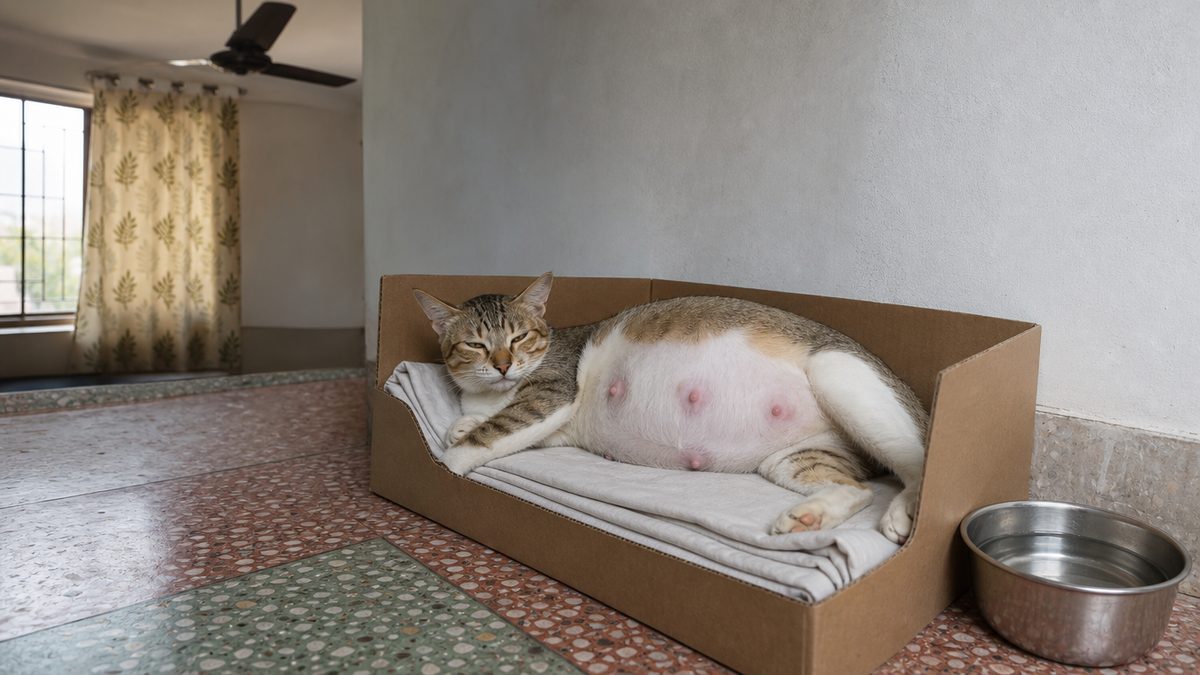
Quick answer
The cat pregnancy period is 63 to 65 days on average, about nine weeks, with a documented range of 52 to 74 days. The first sign is the nipples pinking up at 15 to 20 days; a vet confirms by ultrasound at 25 to 35 days. A growth food costs about Rs 78 to Rs 121 a day for a 4 kg queen at a 2026 Indian MRP. Twenty minutes of hard straining without a kitten is a vet visit. Your nearby vet decides for your cat.
This guide is general information for Indian pet owners and is not a diagnosis. Always consult a registered veterinarian near you before acting on anything you read here, and treat any sudden change in your pet's condition as urgent.
How long is a cat pregnant? The cat pregnancy period with its range, source by source
The cat pregnancy period is 63 to 65 days on average, about nine weeks, and the veterinary literature records a range of 52 to 74 days from mating to birth, so a queen who is a week early or a week late is inside the normal spread.
The one review written for veterinarians puts the mean gestation period at 65.6 days, counted from the first or last mating to the onset of labour, with a range of 52 to 74 days, and notes that pregnancies shorter than 60 days are associated with reduced kitten viability. The owner-facing sources print a tighter band because they quote the middle of that spread: International Cat Care says 63 to 65 days, VCA says 60 to 67 with an average of 63 to 65, and Royal Canin India says around 65 with a range of 61 to 72 Barnes C, Williams K Royal Canin India. The two large surveys agree with the review: a UK study of 1,056 pedigree litters found a mean of 65.1 days with 90.2 percent of births between days 63 and 67 and 97.1 percent between 61 and 69, and a 2022 review in the Journal of Feline Medicine and Surgery gives 65 days with 95 to 97 percent of births between 61 and 70 Strom Holst B. Feline breeding….
The ranges differ because the start date is uncertain. A queen is receptive for four to six days and may mate several times with several males, so 'day one' can be any of them, and studies counting from the last mating print shorter means than studies counting from the first Sparkes AH, Rogers K, Henley WE. Count from the first mating you know of, and treat the due date as a window.
| Source | Mean | Range | What it is based on |
|---|---|---|---|
| Root Kustritz, Theriogenology 2006 | 65.6 days | 52 to 74 days | Review of four colony and survey studies |
| Sparkes and others, JFMS 2006 | 65.1 days | 50 to 80 days | 1,056 UK pedigree litters; 90.2 percent born on days 63 to 67 |
| Strom Holst, JFMS 2022 | About 65 days | 57 to 72 days | Clinical review; 95 to 97 percent of births on days 61 to 70 |
| Thakur and others, Bombay Veterinary College 2015 | 64.92 days | 62 to 69 days | 13 Persian queens in Mumbai with known mating dates |
| International Cat Care 2025 | 63 to 65 days | Not given | Owner advice, nine-week pregnancy |
| Royal Canin India | Around 65 days | 61 to 72 days | Manufacturer feeding page |
Does breed change it? The Persian cat pregnancy time
Breed changes the cat pregnancy period by about two days at most, which is inside the uncertainty of the mating date. One study cited in the veterinary review recorded a mean of 63 days for Siamese queens and 65 days for Persian queens. The only Indian data we found is a Bombay Veterinary College (Parel, Mumbai, Maharashtra) study of 13 clinically healthy Persian queens aged 1.5 to 6 years and weighing 1.5 to 3.0 kg, which recorded a mean of 64.92 days from the last mating, a range of 62 to 69 days, a mean litter of 4.23 kittens (2 to 6), and 92.3 percent of births between days 63 and 67. Larger litters came earlier in that study (a correlation of minus 0.66), and the UK survey found the same effect at 0.1 days shorter per extra kitten Sparkes AH, Rogers K, Henley WE. So a Persian cat is not pregnant for longer than a street cat; where breed matters is the birth itself, covered below.
One threshold settles the 'is she late' question: the JFMS review recommends a caesarean section 71 days after mating if there are no signs of impending labour, to avoid fetal death from complete uterine inertia. Cats Protection's 'week 10 is a waiting game, then call the vet' is the same day counted differently. Past 70 days from the first mating, the vet decides, not the calendar.
The signs of cat pregnancy by week: what you can see, and what only the vet can see
The first signs of cat pregnancy are the nipples turning pinker and more prominent at about 15 to 20 days and the calling stopping, and everything before that is invisible without a vet.
Pinking up is the sign the sources agree on: PetMD puts it at 16 to 20 days, Purina India at 15 to 18, and International Cat Care describes the nipples becoming more visible and pinker as the first outward change International Cat Care, Cat pregnancy. The heat cycles end around week three, some queens go off food or vomit around week four, and the belly does not look distended until the last 20 days or so, when the mammary glands also fill Lovejoy J (reviewed by Morrison BJ). Cat…. Behaviour changes less than owners expect: VCA says it 'alters very little', with some cats more loving and a few aggressive Cats Protection, Caring for your pregnant…. Weight is the measurable sign. By the birth a queen should have gained 12 to 38 percent of her pre-pregnancy weight in the review's figures, 1 to 2 kg in Purina India's, and no more than 40 percent of her ideal weight in Royal Canin India's ceiling Royal Canin India. Nesting, the search for a quiet, dark, safe place, usually starts in the final two weeks, and the kittening area you set up is more likely to be used if it is in the spot she has already chosen.
What the vet can see, and when. A vet can palpate the uterine swellings from about day 15, most easily on days 21 to 25, and with difficulty after day 35, when the swellings run together. On ultrasound the gestational chambers show from day 10 and fetal heartbeats from days 16 to 17; the Merck manual says the scan is best performed at 25 to 35 days, because false negatives occur before day 21 Davidson AP. Pregnancy Determination…. A relaxin blood test developed for dogs gives a reliable answer in cats from day 29. The fetal skeletons are not visible on a radiograph until about day 42 to 45, and the litter count is most reliable after day 55; radiography at this stage is not teratogenic Barnes C, Williams K. A scan can undercount, because a larger kitten can hide a smaller one. The same visit rules out a false pregnancy, in which a queen who ovulated without conceiving develops mammary changes and even milk with no kittens Strom Holst B. Feline breeding….
What the confirmation costs in India. The Chandigarh Administration's fee page for its government veterinary institutions, read on 18 September 2026, lists an outdoor ticket for pet animals at Rs 30, a pregnancy diagnosis fee of Rs 20 and an X-ray at Rs 30 per film, with the note that the radiology wing is not functioning. Those are government rates (Rs 20 divided by 84.38 is 24 US cents, so nothing was converted). No private clinic rate card we opened prints an ultrasound fee for a cat, so ask before the appointment.
| Week | What you may see | What the vet can do | What to do |
|---|---|---|---|
| 1 to 2 | Nothing; she may still call and mate again, so a litter can have several fathers | Implantation at about day 14 | Keep her in if you do not want a second mating |
| 3 | Nipples pinker and larger; heat ends | Palpation from day 15, easiest days 21 to 25 | Book the confirmation visit |
| 4 | Vomiting or going off food in some queens; weight rising | Ultrasound best at 25 to 35 days; relaxin test from day 29 Strom Holst B. Feline breeding… | Switch to a kitten or growth food over 5 to 7 days |
| 5 | Belly rounding | Palpation gets hard after day 35 | Stop lifting her by the belly; feed 10 percent more each week |
| 6 | Round belly, kittens moving, appetite up | Radiograph shows skeletons from day 42 to 45 | Smaller, more frequent meals |
| 7 | Nesting begins | Litter count by radiograph is most reliable after day 55 | Set up the nest box where she already goes |
| 8 | Nipples swollen, belly fur thinning from grooming | Fetal heart outline visible from day 50 | Keep her indoors for the final two weeks |
| 9 | Restless, pacing, a little red-tinged discharge, stops eating in the last 24 hours Barnes C, Williams K | Temperature drops below 37.8 C in the 12 to 24 hours before labour | Save the vet's out-of-hours number; have a carrier ready |
| 10 | No kittens yet | Caesarean is recommended at 71 days after mating if there are no signs of labour | Call the vet at the end of week 10 at the latest |
What to feed a pregnant cat, how much, and what it costs per day in India
Caring for a pregnant cat starts with food: feed her a complete kitten or growth food from the day the pregnancy is confirmed until the kittens are weaned, because her energy need rises by about 10 percent a week and her protein need rises with it.
The diet for a pregnant cat is a growth diet. International Cat Care recommends a growth-type food as soon as you know she is pregnant, fed on through weaning, and PetMD asks for the switch by the end of the first month at the latest Lovejoy J (reviewed by Morrison BJ). Cat…. The veterinary review gives the floor, at least 32 percent protein and 18 percent fat, and records that queens on a taurine-deficient diet resorb or abort their litters or deliver low-birthweight kittens, which is why the food must carry an AAFCO nutritional adequacy statement. Two things are off the menu. The AAHA and AAFP guidelines do not endorse any raw or dehydrated non-sterilised food, and the review says a pregnant queen should neither hunt nor be fed raw meat, because Toxoplasma gondii picked up from tissue cysts can abort her or kill kittens infected in the womb Root Kustritz MV. Clinical management…. A pregnancy is not the time to improvise a recipe; the homemade cat food guide covers what a complete home diet needs.
How much is where the sources disagree, and the disagreement is worth printing. The JFMS review and Royal Canin India both raise energy by about 10 percent a week, but the review ends the pregnancy at 25 to 50 percent above maintenance, VCA says one-and-a-half times, and Royal Canin India says 70 percent more by the final stage Barnes C, Williams K Royal Canin India. The safe reading is that the scale, not the formula, governs: weigh her every week and keep the gain inside the 12 to 38 percent the review reports, because obesity in the queen is associated with both dystocia and stillbirths. Nursing is different. A queen produces up to a quarter of a litre of milk a day, her need rises to two or three times normal by weaning, and both Royal Canin India and VCA say to feed the growth food without restriction until the kittens are weaned Barnes C, Williams K.
| Stage | Weight | Dry food per day | Cost per day |
|---|---|---|---|
| Gestating queen | 4 kg | 62 to 96 g | Rs 78 to Rs 121 |
| Kitten, 1 month | 0.4 kg | 26 g | Rs 33 |
| Kitten, 2 months | 1 kg | 45 g | Rs 57 |
| Kitten, 4 months | 2 kg | 61 g | Rs 77 |
The price, tested. Royal Canin India's Mother & Babycat is a 34 percent protein, 25 percent fat food labelled for the gestating and lactating queen, and its own table feeds a 4 kg gestating queen 62 to 96 g a day. Flipkart's listing on 18 September 2026 prints the MRP, inclusive of all taxes, as Rs 2,520 for 2 kg and Rs 630 for 400 g, which is Rs 1,260 and Rs 1,575 per kilogram. Divided by 84.38 the big bag is USD 29.87 and by 74 it is USD 34.05, neither a price anyone would print, so the figure is rupee-native and not a converted dollar list. At Rs 1.26 a gram the queen costs Rs 78 to Rs 121 a day and the 2 kg bag lasts 21 to 32 days. Any complete kitten food with the AAFCO statement and the 32 percent protein floor does the same job at its own price.
Vaccines, dewormers and medicines during pregnancy
Vaccinate before the mating, not during the pregnancy. The review records that a modified-live panleukopenia vaccine given in pregnancy can cause abortion or kittens born with cerebellar hypoplasia, depending on the stage, and PetMD's rule is that live vaccines are never given to pregnant animals while a killed rabies vaccine may be, if the vet judges it appropriate Lovejoy J (reviewed by Morrison BJ). Cat…. The cat vaccination schedule for India records which Indian trivalents are live and what their leaflets say about pregnancy. Parasite prevention is timed, not skipped: the JFMS review recommends a single emodepside spot-on about 7 days before the expected birth to stop Toxocara cati larvae reaching the kittens through the milk, or treating the kittens themselves later, and PetMD asks for a faecal sample first. The cat deworming schedule for India carries the kitten timing and the Indian leaflets. Every other drug is the vet's call; the same review notes that aglepristone, given for a mammary condition, aborts a pregnant queen. The five feeding rules are listed below.
- Feed a complete growth food with an AAFCO statement, at least 32 percent protein and 18 percent fat, from confirmation to weaning.
- Increase the ration by about 10 percent a week, in smaller and more frequent meals as the kittens crowd her stomach.
- Weigh her weekly and keep the total gain between 12 and 38 percent of her starting weight Royal Canin India.
- Offer no raw meat and no hunting, and keep the litter tray clean, because of Toxoplasma.
- Keep water down at all times and switch to unrestricted feeding the day the kittens arrive.
The birth: the three stages of labour, the normal intervals, and the signs that mean call the vet now
A normal cat birth runs in three stages, with a kitten arriving within 5 to 30 minutes of hard straining and 10 minutes to an hour between kittens, and most non-pedigree cats deliver the whole litter without any help from you.
The day before. Most queens stop eating in the last 24 hours, the rectal temperature drops below 37.8 C in the 12 to 24 hours before labour, and she becomes restless, vocal, purring and panting, grooms her teats and makes repeated visits to the nest box International Cat Care, Cat Birth. A small amount of red-tinged discharge around the vulva in week nine is normal; fresh blood at any earlier stage, or a green, black or foul discharge before a kitten, is not Lovejoy J (reviewed by Morrison BJ). Cat… Purina India, Cat Pregnancy Information &….
Stage one is the cervix relaxing and the uterus starting to contract, with no visible straining. It lasted under 2 hours in 82.9 percent of the 1,056 UK litters, but in a first litter it can run up to 36 hours and still be normal Barnes C, Williams K. Stage two is the straining you can see: the first kitten enters the birth canal, the water bag appears and bursts at the vulva, and the kitten normally follows within 5 to 30 minutes, head first in about two-thirds of births and tail first in the rest. Stage three is the placenta, one per kitten, usually passed straight after each kitten and eaten by the queen; count them, because one left behind is an infection risk. Stages two and three repeat for every kitten. The interval between kittens is 10 minutes to an hour in the VCA and International Cat Care handouts; the JFMS review gives a median of 30 minutes with 95 percent of kittens born within 100 minutes of the one before International Cat Care, Cat Birth Strom Holst B. Feline breeding…. The whole litter is usually out within 6 hours, which held for 85.7 percent of the UK litters. How many kittens? The average litter is 4 with a range of 1 to 12 Sparkes AH, Rogers K, Henley WE International Cat Care, Cat Birth.
Interrupted labour is normal in cats and frightens owners. A queen may stop straining after one or more kittens, settle, suckle and eat for 24 or even 36 hours with kittens still inside, then deliver the rest; the UK survey recorded up to 48 hours between kittens in an unassisted delivery Sparkes AH, Rogers K, Henley WE. A resting queen who eats is pausing; a straining queen who produces nothing is not. The signs that mean a vet now, with the times the veterinary sources give, are listed below.
- Twenty minutes of intense straining without a kitten Lovejoy J (reviewed by Morrison BJ). Cat…; International Cat Care says 20 to 30 minutes.
- Ten minutes of straining with a kitten visible at the vulva and not coming.
- Gentle traction on a stuck kitten causes her pain.
- Fresh blood from the vulva for more than ten minutes, or a discoloured discharge before any kitten is born.
- A rectal temperature above 39.4 C, or a queen who is depressed and lethargic during or after the birth.
- Crying out in pain, panting, exhaustion and giving up after signs of labour, with no kitten.
- No labour by day 71 from mating with no signs of it starting.
The two Indian pages that rank for 'pregnant cat care india' both say to seek help after 30 minutes of straining without a kitten Cuddle Paws Co, Gachibowli, Hyderabad. The veterinary handouts say 20 minutes, and International Cat Care says 20 to 30 Lovejoy J (reviewed by Morrison BJ). Cat… International Cat Care, Cat Birth. Go at 20. Do not pull on a kitten yourself beyond the gentlest test, and do not give oxytocin at home: the JFMS review says medical treatment of dystocia succeeds in only about 30 percent of cats, must follow an examination that rules out an obstruction, and carries a risk of uterine hyperstimulation and placental detachment if repeated. The vet nearest you decides between oxytocin and surgery for your cat, and this page is not that examination.
How often the birth goes wrong, with the denominators
Among 118,168 queens seen by a UK out-of-hours emergency chain between 2017 and 2023, 1,102 presented with dystocia, an incidence of 0.93 percent, and about two-thirds of feline dystocia is uterine inertia rather than a kitten that will not fit. Of those 1,102 queens, 386 were given oxytocin and 104 of them still went to surgery; a caesarean section was performed in 394 (35.8 percent); 38 queens (3.5 percent) died before discharge; and 1,072 of the 2,784 kittens born in those cases (38.5 percent) did not survive to discharge. In the ordinary pedigree breeding population the numbers are smaller: 8.0 percent of 1,056 litters ended in a caesarean and 7.2 percent of kittens were stillborn. Queens under three years old had 1.79 times the odds of dystocia of queens aged three to six, so a first litter in a young cat is the riskier one.
The first days after the birth: the queen, the newborn kittens and the four post-birth emergencies
Postpartum care is mostly the queen's own work: in the first days after the birth she does almost everything herself, and your job is warmth, food, a count of kittens against placentas, and watching for four emergencies: retained membranes, metritis, mastitis and eclampsia International Cat Care, Cat pregnancy.
A newborn kitten weighs about 100 g, doubles that in a week and triples it in three, on a milk that is high in protein and fat; the UK survey's mean for kittens born alive was 93.5 g, lighter in larger litters Sparkes AH, Rogers K, Henley WE. The first milk, colostrum, is the kittens' only protection against disease in their early weeks, so a kitten that is not suckling within hours is that day's problem. Kittens cannot control their body temperature for the first two weeks and a wet newborn loses heat fast, so VCA asks for the nest box to be held at 29.4 to 32.2 C for the first four days, about 26.7 C by days seven to ten and about 22.2 C by the end of the first month, with the box large enough for the kittens to move away from the heat if they are too warm. That last clause is the Indian one: in a summer room that is already at or above the week-one target, the risk is a box that traps heat, not one that leaks it. Most kitten deaths come early: 9.1 percent of the UK survey's kittens died between birth and 8 weeks and the majority of those in the first week. The newborn kitten care guide covers the weighing, warming and hand-rearing that follow if the queen cannot.
Reviving a kitten that is not breathing is the one thing you may have to do at speed, and the two handouts disagree on one step. Both say to tear the membranes from the nose, clear the mouth, tear the cord an inch from the kitten rather than cutting it, and rub the kitten briskly with a clean towel, head lower than its bottom. VCA's handout, last updated July 2024, says swinging a kitten to clear fluid 'is no longer recommended as it can cause severe brain trauma' and describes suction instead; International Cat Care's page, updated September 2025, says to try the towel first and keeps a very gentle swing as a fallback International Cat Care, Cat Birth. Rub first, and use a paediatric bulb syringe if you have one. The four post-birth emergencies, each with the sign that names it, are listed below.
- Retained membranes: a restless queen who will not settle with her kittens, poor appetite, a brownish discharge; the retained set decomposes inside her and needs treatment the same day.
- Metritis: usually within 3 days of the birth, a dull queen who ignores her kittens, refuses food, has a fever and a foul, purulent discharge International Cat Care, Cat Birth.
- Mastitis: one gland firm, hot, swollen and painful in early lactation, sometimes with a coloured discharge from the nipple; if it is only congestion, warm compresses and milking the gland may relieve it, and if it is infected she needs the vet.
- Eclampsia: a sudden fall in blood calcium, usually 3 to 5 weeks after the birth in a queen nursing a large litter, starting as restlessness, panting, tremors and a stiff gait and progressing to seizures; stop the kittens suckling and go, because intravenous calcium reverses it. The review also records it 3 to 17 days before the birth, with vague signs.
The queen herself eats without limit on the growth food until weaning, and she can be pregnant again while still nursing, because lactation does not stop her coming into heat. The kittens start on solid food from about four weeks, can be weaned onto a kitten food from 3 to 5 weeks, use the litter tray by four weeks, groom each other by six and can be rehomed from around 8 weeks once fully weaned Quimby J, Gowland S, Carney HC, DePorter T. Their own calendar starts early: the cat deworming schedule carries the kitten timing and the day the nursing queen is treated alongside them, the cat vaccination schedule carries the first kitten dose, and the kitten care guide takes over from there.
The unplanned litter in India: the community queen, Rule 19 of the ABC Rules 2023 and the summer birth
Most cat pregnancies an Indian reader meets are unplanned, in a community cat or an entire pet that got out, and the law's only line on cats is Rule 19 of the Animal Birth Control Rules 2023, which lets a recognised animal welfare organisation sterilise them at the local authority's expense.
The numbers behind the unplanned litter are stark and none of them is Indian, because no Indian survey counts cat litters. International Cat Care records that nearly 50 percent of cat litters in the UK in 2023 were unplanned and that a queen can have up to three litters a year. The one cohort study of free-roaming cats, run through a trap-neuter-return clinic and 50 monitored litters, found pregnant cats in every month of the year with a peak in March, April and May, a mean of 1.4 litters per queen per year, a median of 3 kittens per litter, and 127 of 169 kittens (75 percent) dead or disappeared before six months, trauma the commonest cause. International Cat Care adds that cats near the equator probably breed with little seasonal change, so an Indian community queen can be pregnant in any month. A Hyderabad pet-store blog says Indian cats deliver 'between three and six kittens'; no study supports a separate Indian litter size, and the Mumbai Persian figure of 4.23 is the only published Indian number Thakur PJ, Rangnekar MN, Gulavane SU.
Rule 19, quoted. The Animal Birth Control Rules, 2023, notified as G.S.R. 193(E) on 10 March 2023, mention cats in one rule. Rule 19 reads: "Sterilisation and Immunisation of Domestic or Feral cats: Upon the advice of State Board, the Sterilisation of cats may be conducted by a recognised Animal Welfare Organisation with training and expertise in spay or neuter of cats, in a manner provided in the Guidelines for Cat Sterilisation and Immunisation, published by the Board," and its three sub-rules put the infrastructure and reimbursement on the local authority, forbid housing cats with dogs in a dog ABC centre, and require post-operative care away from the sounds and smells of dogs. The guideline the rule promises is section 7 of the AWBI's revised ABC module of February 2025: humane box traps, a V notch on the right ear, mandatory rabies vaccination and release at the exact spot of capture. Rule 19 says 'may', on the State Board's advice, so in practice the wards that run are NGO wards: Blue Cross Society of Pune sterilises a community cat for Rs 1,000 with rabies and Tricat vaccination and 7 days of post-operative care included, booked by email and never as a walk-in. The cat sterilisation guide lists the wards in Mumbai, Bengaluru, Delhi, Pune and Chennai, and Rule 20, which puts the feeding of community animals on the resident welfare association, is on the community feeding guide Ministry of Fisheries.
The pregnant community queen is a gap in the guideline. The AWBI's cat section requires that 'for female cats, pregnancy status should be determined' at the pre-surgical examination, and then says nothing about what a programme does with a pregnant cat. The dog chapters of the same module are explicit the other way: 'visibly pregnant bitches should not be caught', 'nursing mothers with puppies under two months should not be captured for sterilization', and the surgical checklist requires a dog that 'is not pregnant';. So for a community queen the decision sits with the ward's veterinarian, working from the guideline in the next section. Until then, the advice on the one Indian ranking page is sound: do not relocate a heavily pregnant stray unless her safety demands it, give her shelter, food and water, and get veterinary help if complications occur.
Heat season and the monsoon
A summer birth in India inverts the warmth advice written for Britain and North America. The nest-box targets of 29.4 to 32.2 C in the first four days assume a cold room; VCA's own caveat is that the box must let the kittens move away from heat, and that a heat lamp can make both mother and kittens too hot. The heat safety guide gives the hours of the day to avoid in nine Indian cities from hourly weather data; a box on a balcony sits in the same air as the dog it was written for. Put the box in the coolest room you have, on the floor rather than by a window, with water beside it, and in the humid monsoon weeks raise it off a wet floor and change the bedding daily, because a queen chooses a dry site and moves her litter when it stops being safe. The six steps for a community queen, in order, are listed below.
- Confirm she is pregnant and not ill. A swollen belly has other causes, and the fee at a government veterinary institution in Chandigarh is Rs 20 for the diagnosis on top of a Rs 30 ticket Animal Husbandry and Fisheries Department.
- Leave her where she is unless the spot is dangerous, and give her a box in a covered corner she already uses.
- Feed a growth food and water daily from confirmation to weaning, at Rs 78 to Rs 121 a day for a 4 kg queen on the priced example above.
- Watch the birth from a distance and apply the 20-minute rule, with a carrier and the nearest clinic's number ready.
- Book her spay for after weaning with an NGO ward or a clinic; Blue Cross Society of Pune's package is Rs 1,000 and a Delhi clinic's basic cat spay is Rs 5,000 The Vet Connect, New Delhi.
- Plan for the kittens before they arrive: rehoming from 8 weeks, and the adopting a cat guide for the people who take them.
Spaying a pregnant cat: what the veterinary guideline says, and who decides
A pregnant cat can be spayed: the Association of Shelter Veterinarians' 2016 guideline states that for animals that are pregnant, lactating or in oestrus 'the task force's experience has been that neutering can be safely performed', with additional medical care where the patient's condition needs it, and whether your cat should be is a decision for the veterinarian who examines her.
The same guideline sets out what 'additional care' means. It lists animals 'in advanced stages of pregnancy' among the high-risk patients for whom oxygen supplementation before and after surgery and intravenous fluids are recommended, and it describes the surgery itself: when the gravid uterus is removed en bloc the fetuses, which remain unconscious throughout gestation, do not experience pain, and the uterus and amniotic sac are not opened. The JFMS review adds two points from the other end of the pregnancy: an ovariohysterectomy after a caesarean section has no negative effect on lactation, so a queen delivered by surgery can be spayed in the same anaesthetic and still nurse, while an en bloc ovariohysterectomy in place of a caesarean gives poor kitten survival and is best kept for litters that are already dead.
None of those documents makes the decision for a particular cat, and this page does not either. The stage of pregnancy, her condition, her age, whether she is a community cat who will not be caught again, and whether anyone can raise the kittens all sit in the vet's examination. In India the AWBI's cat guideline requires the pregnancy check and is silent on what follows, so an NGO ward may have its own rule and will tell you when you book; Blue Cross Society of Pune, for example, asks for the age, sex and 'any other relevant details' of each cat by email before it gives a slot Blue Cross Society of Pune. Ask the ward or the clinic directly, and expect the answer to depend on how far along she is.
This page gives the guideline wording, the odds and the prices so that you walk into the clinic informed. The veterinarian who examines your cat decides whether she is spayed now, delivered and spayed later, or delivered and left entire, and that decision can change between week four and week eight. If your cat is a community cat, the ward's veterinarian makes the same call at the pre-surgical examination the AWBI guideline requires Griffin B, Bushby PA, McCobb E.
After the litter, the standing recommendation is the spay. Cats Protection tells owners to ask the vet about the best time to neuter after the kittens are born, and International Cat Care's reasons apply with force to a queen who has just proved she can get pregnant: pyometra, mammary tumours, the risks of birth itself, and another litter as soon as she calls again, which nursing does not prevent Lovejoy J (reviewed by Morrison BJ). Cat…. The kittens go on the same list: they reach sexual maturity from around four months, so the four-month neutering age International Cat Care recommends applies to every female in the litter and, because siblings will breed with each other, to the males too. The cat sterilisation guide carries the age evidence, the pain protocol and the fees by city; the two read for this page are Rs 1,000 all-in at Blue Cross Society of Pune for a community cat and Rs 5,000 for a basic cat spay at a Delhi clinic, before post-operative medicines The Vet Connect, New Delhi. Should she call before you get there, the cat in heat guide covers the three weeks in between.
Persian, Siamese and the flat-faced breeds: the pregnancy is the same length, the birth is not
Breed does not change the cat pregnancy period in any way an owner can use, a Persian queen averaging 65 days and a Siamese 63 in one study, but breed changes the odds of a difficult birth by two to ten times.
The Mumbai study is the Persian owner's number: 13 Persian queens under controlled breeding delivered at 64.92 days on average, between 62 and 69, with 4.23 kittens a litter, and the authors' own conclusion is that the gestation length in Persian cats 'is about 64.92 days from last mating';. The UK survey shows the tails of the same distribution: two Persian queens with recorded gestations of 80 days delivered litters of five in which every kitten was dead, and one Persian at 50 days delivered six dead kittens, which is why a Persian past day 70 without labour is a vet visit rather than a wait Strom Holst B. Feline breeding…. The length is the same; the reasons to worry are not.
The birth is where breed shows. In the emergency-care study of 118,168 queens, purebred queens had 2.53 times the odds of dystocia of crossbred queens and brachycephalic queens 3.27 times the odds of non-brachycephalic queens; International Cat Care names the British Shorthair, the Oriental breeds, the Birman, the Ragdoll, the Abyssinian and the Somali as breeds in which dystocia is more likely, and describes 'hysterical inertia', labour that stops from sheer apprehension, as not uncommon in the Oriental, Siamese and Burmese International Cat Care, Cat Birth. A Finnish study cited by the JFMS review diagnosed dystocia in 15 percent of Birmans. The breed rows from the emergency study are below, with the reference category, crossbred queens, for scale.
| Breed | Odds of dystocia vs crossbred | Caesarean rate among dystocic queens |
|---|---|---|
| Devon Rex | 10.38 (95 percent CI 4.61 to 23.37) | 3 of 7 (42.9 percent) |
| Tonkinese | 8.27 (2.92 to 23.43) | 2 of 4 (50.0 percent) |
| Birman | 7.40 (3.17 to 17.28) | 3 of 6 (50.0 percent) |
| Exotic Shorthair | 6.29 (2.23 to 17.73) | 1 of 4 (25.0 percent) |
| British Shorthair | 3.81 (2.96 to 4.89) | 35 of 79 (44.3 percent) |
| Persian | 3.60 (2.37 to 5.45) | 11 of 25 (44.0 percent) |
| Siamese | 3.22 (2.05 to 5.05) | 13 of 21 (61.9 percent) |
| Burmese | 2.88 (1.41 to 5.89) | 4 of 8 (50.0 percent) |
| Bengal | 1.95 (1.32 to 2.89) | 15 of 28 (53.6 percent) |
| Maine Coon | 1.46 (0.86 to 2.46), not significant | 5 of 15 (33.3 percent) |
| Ragdoll | 1.41 (0.96 to 2.09), not significant | 14 of 28 (50.0 percent) |
| Crossbred (reference) | 1.00 | 151 of 362 (41.7 percent) |
Two things follow for an Indian owner. First, the Persian cat sits at 3.60 times the odds of a difficult birth and a 44 percent caesarean rate once the birth goes wrong, and the flat face is the reason, since brachycephalic queens as a group carried 3.27 times the odds; the breed page carries the same study and the reasons not to breed her casually. Second, the odds sit on the breed, not on the calendar: a Persian's pregnancy is planned around the 20-minute rule and a clinic that can operate at night, because the due date is the same 63 to 67 days as any other cat's Barnes C, Williams K. A street-born domestic shorthair carries the reference odds in that table, which is the strongest argument this page has for letting an Indian community queen deliver where she is, with a watcher, rather than moving her to a cage.
Common questions about cat pregnancy, answered from the sources
How many months is a pregnant cat?
About two months. International Cat Care puts the cat pregnancy period at 63 to 65 days, which it calls a nine-week pregnancy, and the veterinary review behind it records a mean of 65.6 days with a range of 52 to 74 days from mating to birth, so a queen can run a week either side of the ninth week and still be normal.
What are the first signs of cat pregnancy?
Pinking up: the nipples become pinker and more prominent about 16 to 20 days after mating, while the calling stops. Cats in the first two trimesters are often calmer and friendlier than usual, the belly does not look distended until the last 20 days, and a vet can palpate the kittens at about two and a half weeks and see heartbeats on ultrasound at three to four.
Can kittens get pregnant at 3 months?
Not in any source we read. International Cat Care says kittens reach sexual maturity from around four months and that the first season is usually around six months but can be earlier; PetMD gives four months as the youngest and five to six as the common age. That is why the recommended neutering age is four months, before the first season, and why male and female littermates are separated by then.
How many months is cat pregnancy?
A little over two months. The Journal of Feline Medicine and Surgery review gives a mean of about 65 days with a range of 57 to 72 and 95 to 97 percent of births between days 61 and 70, and it recommends a caesarean section at 71 days after mating if there is no sign of labour, so a tenth week is possible but the end of it is a veterinary visit, not a longer wait.
What are the first signs of pregnancy in a cat?
In Cats Protection's week-by-week guide the first visible signs arrive in week three: the heat cycles end and the nipples become darker and slightly larger. In week four some queens vomit or go off their food and the weight starts to rise, and that is the week a vet can confirm the pregnancy with an ultrasound scan rather than a guess.
Is pregnancy painful for cats?
A normal pregnancy is not described as painful in any veterinary source we read, and the behaviour that worries owners most, the rolling and yowling of a cat in heat, is normal calling rather than pain. In a normal birth International Cat Care says the productive straining 'does not appear to cause pain'; a queen crying out in pain, or straining 20 to 30 minutes without a kitten, is the sign to call the vet.
How to take care of your cat when she's pregnant?
Feed a growth-type kitten food from the day you know, on through weaning, and ask the vet for the specific advice International Cat Care recommends at that first visit. Give no live vaccine and no unprescribed medicine, deworm on the vet's timing, provide a cardboard box with snug bedding in a quiet, dark place two weeks before the due date, keep her in for those two weeks, and contact the vet the moment anything worries you.
What is the typical pregnancy period for an Indian cat?
The same 63 to 67 days as anywhere else. The only Indian study we found, 13 Persian queens at Bombay Veterinary College in Mumbai with known mating dates, recorded a mean of 64.92 days, a range of 62 to 69, and 92.3 percent of births between days 63 and 67. No published study measures gestation in Indian non-pedigree cats, and nothing in the biology suggests it would differ.
How does a cat act a week before giving birth?
She nests. In the final week the queen searches for a kittening bed, makes repeated visits to it, scratches and rearranges the bedding, becomes restless and often wants reassurance, and in the last 24 hours usually stops eating while her temperature drops below 37.8 C. A small red-tinged discharge in week nine is normal; panting and a first bout of straining mean the birth has started.