
Dog care guide
Senior dog care in India: what changes after seven and the checks worth paying for
Old age is not a disease. This guide gives the breed-by-breed date a dog becomes senior, the AAHA test list with government prices, what senior food actually changes, the two household tablets that harm, and why the old dog is the one heat kills.
Quick answer
Senior dog care in India begins at the last 25 percent of a dog's expected life: about 6 for a Pug, 7.5 for a German Shepherd or Beagle, 9 for a Labrador. From then the 2023 AAHA guideline asks for blood and urine tests every 6 to 12 months and a yearly thyroid test, Rs 2,300 to Rs 4,300 at a government hospital in Patna. Dogs of 12 and over carry 8.87 times the odds of dying from heat, so walks move to dawn.
This guide is general information for Indian pet owners and is not a diagnosis. Always consult a registered veterinarian near you before acting on anything you read here, and treat any sudden change in your pet's condition as urgent.
When a dog becomes senior: the last quarter of its expected life
A dog is senior for the last 25 percent of its expected lifespan, the 2019 AAHA life stage definition that the 2023 AAHA senior care guideline adopts, so the date depends on breed and size rather than on a birthday.
So when is a dog considered senior? The guideline sets no age on purpose, because variation between dogs widens with the years, and asks the vet to estimate the dog's lifespan from its breed and count back a quarter. The AVMA turns that into size bands from kennel club figures: small breeds 8 to 11, medium 8 to 10, large 8 to 9, giant 6 to 7. Kennel club figures carry no denominator; the two studies below do, and they disagree.
Teng and colleagues built life tables from 30,563 dogs that died under UK primary veterinary care between 2016 and 2020: life expectancy at birth was 11.23 years overall, 11.77 for the Labrador Retriever (2,500 dogs), 10.16 for the German Shepherd (1,110), 9.85 for the Beagle (172), 7.65 for the Pug (197) and 11.82 for crossbreds (6,511). McMillan and colleagues pooled 584,734 dogs from 18 sources and found longer medians: 13.1 years for the Labrador, 11.6 for the Pug, 12.0 for crossbreds, and 12.7, 12.5 and 11.9 for small, medium and large purebreds. Teng's figure counts every puppy that died, which is why the Pug, with a probability of death before year 2 far above average, lands at 7.65; McMillan's draws on insurance data that under-represent high-risk brachycephalic breeds. Neither is Indian, and no Indian life table exists: a PubMed search on 18 September 2026 for "pariah dog" or "INDog" returned zero records while the Labrador hip dysplasia control returned 47, so the Indian Pariah Dog page carries only blog-quoted lifespans and this page applies the crossbred figures to an Indie.
| Dog | Life expectancy at birth, Teng 2022 (dogs counted) | Median survival, McMillan 2024 | Senior begins at 75 percent of each | Breed page |
|---|---|---|---|---|
| Labrador Retriever | 11.77 years (2,500) | 13.1 years | 8.8 to 9.8 years | Labrador Retriever |
| German Shepherd | 10.16 years (1,110) | Not printed in the paper's text | 7.6 years | German Shepherd |
| Beagle | 9.85 years (172) | Not printed in the paper's text | 7.4 years | Beagle |
| Pug | 7.65 years (197) | 11.6 years | 5.7 to 8.7 years | Pug |
| Indie, on the crossbred figures | 11.82 years (6,511) | 12.0 years | 8.9 to 9.0 years | Indian Pariah Dog |
Use the earlier date. Starting senior screening a year early costs one extra blood test; starting late costs the year in which a kidney, a heart valve or a thyroid was quietly failing. That means a Pug from 6, a German Shepherd and a Beagle from about 7 and a half, a Labrador and an Indie from 9, and earlier for an overweight dog; the Golden Retriever page carries the cancer and joint figures behind that. Whatever the breed, the risks climb after 8: a dog of 9 to 11.9 years had 28.83 times the odds of an arthritis diagnosis of a dog under 3, and 12 and over had 53.89 times. The dog age in human years guide converts these ages; the adult dog care guide covers the years before.
What changes after seven, and what is disease dressed as age
Sleeping more, slowing on walks, greying, weaker hearing and stiffer joints are the changes an older dog shows, and the 2023 AAHA guideline's first instruction is that old age is not a disease: owners read chronic pain and organ disease as ageing, and the vet's job is to test that assumption.
What age do dogs slow down, and why slowing is a reason to screen
Dogs slow down at 6 to 10 depending on size: Blue Cross puts middle age at over seven, large breeds slowing from six and small dogs at nine or ten, and warns that a change in behaviour can be pain or illness. In 455,557 dogs under UK primary care the median age at first osteoarthritis diagnosis was 10.5 years, and against a dog under 3, a dog of 6 to 8.9 years had 12.58 times the odds of a diagnosis, 9 to 11.9 had 28.83 times and 12 and over 53.89 times. A dog that slows at 7 is already in the twelve-times band, so the slowing is the symptom to investigate.
Sleep, senses, teeth and lumps
It is normal for a senior dog to sleep more and abnormal for the sleep to move to the wrong time: the guideline names daytime sleeping with night-time restlessness as the commonest sign of canine cognitive dysfunction, and the AVMA lists sleeping more among the signs of arthritis pain. Loss of hearing and loss of vision are usual and are managed, not treated: teach hand signals while the dog can still hear, stop rearranging furniture once eyesight fails, tap the floor for a deaf dog, and keep a deaf or blind dog on a lead outdoors.
Dental disease is treated under anaesthesia, and age alone is not a reason to refuse it: advanced age is not a contraindication, and dental radiographs matter because periodontal bone loss in small old dogs can end in a jaw fracture. Lumps are measured and sampled, not watched, because a mast cell tumour can look exactly like a lipoma; the AVMA adds, without a source, that cancer causes almost half the deaths in dogs over 10.
The common health problems behind those changes are arthritis, kidney disease, heart disease, diabetes, Cushing's syndrome, dental disease and cancer, and the five changes to report in the same week rather than watch for a season are listed below.
- Sleep that has flipped, all day asleep and pacing, panting or howling at night.
- A new lump, however small and however soft, until a needle sample has named it.
- Drinking or urinating more, or a house-trained dog wetting its bed, which can be kidney disease, diabetes, Cushing's syndrome or incontinence rather than age.
- Stiffness after rest, a reluctance to climb stairs or jump into the car, or a yelp when lifted.
- Weight moving either way by more than a kilogram between monthly weighings without a change in food.
The senior screening panel, and what it costs at a government veterinary hospital
The senior screening panel in the 2023 AAHA guideline is a complete blood count, a chemistry profile and a urinalysis every 6 to 12 months, plus a thyroxine (T4) test and a blood pressure reading once a year; for a dog that is unwell, the minimum database is a detailed blood profile with a thyroid panel plus urinalysis, before any imaging.
The blood finds what the eye does not. The 2019 guideline cites 1,421 apparently healthy dogs in which significant abnormalities turned up in 39.5 percent, and asks for a baseline so a creatinine or a liver enzyme can be trended against the dog's own earlier values. It sets the rhythm of veterinary check-ups at twice a year for a senior, each with the minimum database, a pain score, gait analysis and a body map of lumps. An electrocardiogram is yearly only in high-risk breeds such as Boxers and Dobermans, and imaging follows a finding rather than the calendar.
Two government veterinary hospitals publish rate cards that price every line of that panel, and no ranking page quotes either. The ICAR-Indian Veterinary Research Institute's referral polyclinic at Bareilly lists its pet charges with effect from July 2022 and carries no thyroid test; Bihar Animal Sciences University's clinical complex in Patna, on a page marked updated 31 July 2026, prices T4 and TSH at Rs 2,000, cortisol at Rs 1,000 and a Master Health Checkup bundle at Rs 2,000.
| Test | AAHA frequency for a senior dog | IVRI Bareilly, per test | BASU Patna, per test |
|---|---|---|---|
| Registration | Each visit | Rs 50 (Rs 150 after 12:30 pm, Rs 300 after 5 pm or on a holiday) | Rs 200 OPD, valid 10 days (Rs 300 emergency) |
| Complete blood count | Every 6 to 12 months | Rs 250 | Rs 300 |
| Kidney function (BUN, creatinine) | Every 6 to 12 months, in the chemistry profile | Rs 200 | Rs 700 |
| Liver function | Every 6 to 12 months, in the chemistry profile | Rs 300 | Rs 600 |
| Glucose | In the chemistry profile | Rs 100 | Rs 80 |
| Urinalysis | Every 6 to 12 months | Rs 100 | Rs 100 |
| Thyroxine (T4) | Yearly | Not on the card | Rs 2,000 (T4 and TSH) |
| Blood pressure | Yearly | Not on the card | Not on the card |
| X-ray | When a finding points at a region | Rs 150 | Rs 400 |
| Abdominal ultrasound | When a finding points at a region | Rs 250 | Rs 500 |
| Electrocardiogram | Yearly in high-risk breeds only | Not on the card | Rs 500 |
| Master Health Checkup (CBC, sugar, liver, kidney, lipids) | A bundle, not an AAHA line | Not offered | Rs 2,000 |
The six steps that make a senior visit worth its fee, all taken from the guideline's own intake list, are these.
- Weigh the dog on the morning of the visit and note the week's food, water and toilet habits, because the guideline's history starts with eating, drinking, elimination and activity.
- Film 30 seconds of the dog walking, climbing a step and getting up from the floor; the task force uses client videos to catch early musculoskeletal and neurological change.
- List every medicine, supplement and home remedy, turmeric included, because the intake asks for all of them to check for interactions.
- Carry the last blood report, so the new creatinine and liver enzymes are read as a trend against the dog's own baseline.
- Ask for the Table 1 panel by name: complete blood count, chemistry, urinalysis, and once a year T4 and blood pressure.
- Fix the next date before leaving, 6 to 12 months out for a well dog and sooner if anything was abnormal.
Added up, the AAHA panel without thyroid costs Rs 1,000 at IVRI and Rs 1,900 at BASU from single tests, or Rs 2,300 at BASU as the bundle plus urine and registration; the T4 and TSH pair takes the Patna total to Rs 3,900 or Rs 4,300 Bihar Animal Sciences University, Patna. None of those totals divides at 84.38 or 74 (Rs 1,000 is 11.85 or 13.51 dollars, Rs 2,300 is 27.26 or 31.08, Rs 3,900 is 46.22 or 52.70), so they are rupee-native fees. Neither card prices blood pressure; a private clinic fills that line. Vetic's own dog blood-test guide, updated January 2025, prints no price, and its cat page lists a CBC at Rs 799 and a liver or kidney test at Rs 1,249, figures this page does not transfer to dogs. Bring the last report to every visit, because the value of the panel is the trend, and your nearby vet decides which lines apply to your dog and how often.
Appetite, thirst and weight: the three numbers to write down every month
An older dog that is suddenly hungry all the time, drinking more, or changing weight without a change in food has a differential list, not an age, and the top three are Cushing's syndrome, diabetes mellitus and a course of steroid medication MSD Veterinary Manual.
Cushing's syndrome is the excess-cortisol disease of the middle-aged to older dog: drinking and urinating more, eating more, a pendulous belly, panting, muscle wasting and thin skin, and because it results from prolonged exposure to excess glucocorticoids, a long course of steroid tablets for itchy monsoon skin produces the same picture. Diabetes mellitus is the other hungry-and-thirsty disease: more urine, more water, more food and weight loss, mostly in middle-aged dogs, with cataracts as the dog-specific complication. A hungry dog losing weight points at diabetes, a hungry dog with a sagging belly at cortisol, and either way the next step is the panel above, where BASU's glucose line is Rs 80 and its cortisol line Rs 1,000.
Weight is the number to monitor, and the kitchen scale is the instrument: Blue Cross asks owners to weigh a dog every one to two months, cut food when the trend climbs, and see the vet when weight falls or thirst changes. Maintenance energy requirement falls across a dog's life, seniors lose muscle and gain fat, and the ideal body condition score is 4.5 to 5 of 9 because calorie-restricted dogs live longer: in the study behind that line, 48 paired Labrador Retrievers, the dogs fed 25 percent less for life carried less fat, had lower insulin and glucose, lived a significantly longer median life span and developed chronic disease later. Diet and weight management is the cheapest senior treatment on this page.
Score the body, not the breed. On the WSAVA chart a 4 is ribs easily felt with an obvious waist, a 5 is ribs felt without excess fat and a waist behind the ribs, a 6 has ribs under slight fat and a faint waist, and at 7 the ribs are hard to feel and the waist is gone. A heavy senior gets a worse deal on every page of this guide: dogs at or above their breed's mean weight carried 2.30 times the odds of an arthritis diagnosis and 1.42 times the odds of a heat-related illness event. Muscle loss is the opposite trap: a thin old dog with a wasted back needs more protein and a work-up, not less food.
Senior dog food: what changes in the bowl and what does not
Senior dog food has no legal definition, because the Association of American Feed Control Officials has no senior nutrient profile, so the word on the bag is a marketing age band; what the evidence changes is calories down, fibre up, protein held or raised, moisture added, and portions set by the scale.
Four things change. Senior dogs need less caloric density and more fibre, a senior diet may carry a mild increase in protein to offset lean-mass loss, and adding moisture increased nutrient digestibility in senior dogs. Cornell's nutritionist says the same from the clinic: slightly higher protein for seniors, while many senior diets on the market are lower protein, omega-3 from marine oils, and warmed or wet food for a dog whose sense of smell has faded. One thing does not change: a dog that still walks every day keeps its portion, cut only when it lounges more and gains weight. Disease changes the diet more than age: protein restriction is for kidney disease at IRIS stage 3, not for healthy dogs, while omega-3 for arthritic joints and medium-chain triglycerides for cognitive dysfunction are the tools with evidence.
What a manufacturer's own senior guide says, and what it costs in India
Royal Canin India moves a large breed on to its mature diet at 5 and a small breed at 8: Maxi Adult 5+ is a complete feed for dogs of 26 to 44 kg over 5, protein 26 percent, fat 17 percent, feeding a 30 kg dog 312 g a day at low activity and 362 g at medium; Mini Adult 8+ covers dogs up to 10 kg over 8. Those are a manufacturer's bands, and a Labrador at 5 is a mature adult on the AAHA definition. On 18 September 2026 the 4 kg bag of Maxi Adult 5+ sold for Rs 2,824 on Amazon.in against an MRP of Rs 3,030; neither divides at 84.38 or 74 (35.91 or 40.95 dollars, 33.47 or 38.16). The monthly figure is arithmetic: a 30 kg dog at low activity eats 9.36 kg a month, 2.34 bags, about Rs 6,600 at the selling price or Rs 7,100 at MRP Amazon.in listing. A home-cooked diet needs the same protein discipline and a vet-balanced recipe, in the homemade dog food guide; the dog diet chart guide has the gram tables for the years before.
Buy it for what it does, not for the word on the bag. A senior diet lower in protein than the adult version is the opposite of what the AAHA guideline and Cornell ask for in an old dog losing muscle; one lower in calories, higher in fibre and carrying fish oil is doing the three things the evidence supports, and the adult food in a smaller measured portion plus a vet-dosed omega-3 reaches the same place Cornell University College of Veterinary…. Weigh the dog monthly and let the scale set the portion.
Pain, arthritis and mobility in an Indian flat: floors, stairs and the medicines that kill
Arthritis is the commonest reason an older dog slows: it was diagnosed in 2.5 percent of 455,557 UK dogs in one year, 6.13 percent of Labradors, 7.74 percent of Golden Retrievers and 4.93 percent of German Shepherds, and only 25.5 percent of diagnosed dogs were told to lose weight.
Chronic joint pain hides as stiffness, and the guideline wants it measured: chronic pain scales at every senior visit and a video of the dog walking, climbing and jumping at home, because a dog holding still on a clinic table hides the early change. In the arthritis study 75 percent of diagnosed dogs were recommended an analgesic, mostly non-steroidal anti-inflammatory drugs, but exercise restriction was advised in only 18.8 percent. Treatment is multimodal and early: drugs, weight management, physiotherapy, acupuncture and home modification together, with hydrotherapy or exercise therapy for wasted muscles.
The flat
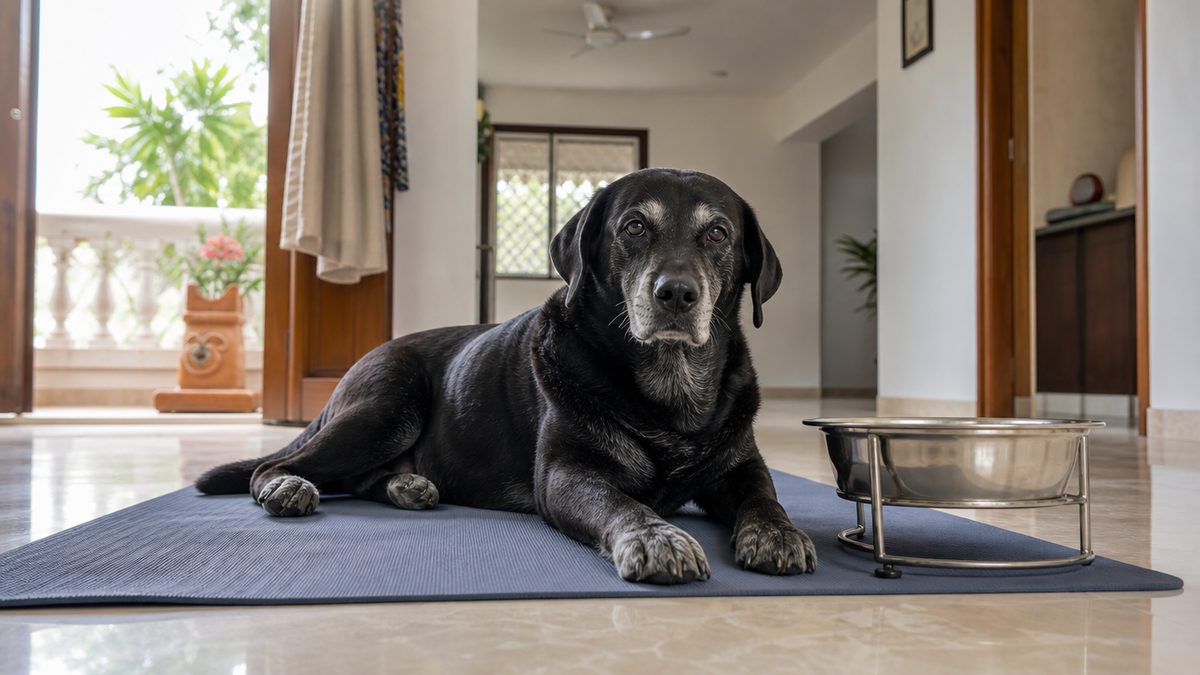
A polished floor is the arthritic dog's enemy, and most Indian flats are floored in vitrified tile, marble or granite. The guideline's home list is short and cheap: rugs or yoga mats for footing on slippery floors, ramps rather than steps, bowls raised to chest height, a padded bed near the door the dog uses, a fitted harness so a large dog is lifted by the handle, toe grips or boots, and a nightlight; Blue Cross adds a baby gate across the stairs. In a building without a lift, carry a small dog and use the harness handle on a large one, keep walks short and frequent, and run a rubber-backed mat from bed to door and bed to bowl, because the slip on the way to the water is the painful fall that ends the week. Grooming becomes nursing: gentle brushing because old skin thins, nails kept short, the coat around the back end trimmed and clean in a dog that has begun leaking urine, waterproof covers on the bedding, and no diaper left on for hours Blue Cross (UK), Caring for older dogs.
The flat is set up in one afternoon, in this order.
- Lay rubber-backed mats or yoga mats along the two routes the dog uses most, bed to door and bed to bowl, over the tile.
- Raise the food and water bowls to chest height on a stand or a stack of books.
- Move the padded bed next to the door the dog uses and out of the afternoon sun.
- Gate the stairs with a baby gate so the dog never attempts them alone.
- Fit a padded harness with a handle and lift a large dog by it on stairs and into cars.
- Plug in a nightlight on the route to the water bowl for a dog whose eyes have dimmed.
Pain relief: the vet decides, and two household tablets are dangerous
No pain medicine is safe without the vet, and two that Indian homes keep in the drawer harm dogs. The MSD Veterinary Manual says ibuprofen is no longer recommended in dogs because it causes gastric ulcers and perforations, and that dogs dosed at 8 to 16 mg per kg a day for 30 days developed gastric ulceration; one 400 mg tablet is 16 mg per kg for a 25 kg dog. Paracetamol shows clinical signs in dogs above 100 mg per kg, but toxicosis occurs at lower doses with repeated exposure and liver damage is commoner in dogs than in cats; one 500 mg tablet is 50 mg per kg for a 10 kg dog, and a tablet a day for a week is repeated exposure. The dog-licensed anti-inflammatories a vet prescribes come with the blood panel for a reason: the guideline's example of a dangerous interaction is a non-steroidal given to a dog already on steroids, and it warns that turmeric, sold everywhere in India as a joint remedy, has caused gastrointestinal ulceration in humans and mice.
Never give an old dog paracetamol, ibuprofen or any human painkiller, and never add a prescribed dog anti-inflammatory to a steroid unless the vet who prescribed both knows. Ibuprofen is no longer recommended in dogs at any dose, and paracetamol harms at lower doses with repeated exposure. A dog in pain gets a vet visit, a pain score, a blood panel and a prescription written for its weight and kidneys; your nearby registered veterinarian decides the drug, the dose and the recheck.
Heat: why the old dog is the one that dies
A dog of 12 or older had 8.87 times the odds of dying from a heat-related illness event and 5.89 times the odds of a severe one, against a dog under 2, in the VetCompass study of UK heat events from 2016 to 2018, and no page ranking for senior dog care in India mentions heat at all.
Age raised the odds of the event as well as of dying from it: in the 2016 incidence study of 905,543 dogs, the 12-and-over group had the greatest odds of a heat event, 1.75 times a dog under 2, because older dogs carry the heart and airway disease that limits heat loss. The AAHA guideline names one such disease, geriatric onset laryngeal paralysis polyneuropathy, increasingly recognised in old Labradors and other large breeds, which causes noisy breathing on exertion and hind-limb weakness, and tells clinicians to warn owners that heat stroke is a complication. A Labrador of 11 that has started to breathe loudly on the evening walk is the dog those odds describe.
The Indian rule is simple. The heat safety guide gives the coolest hour to walk in Delhi, Mumbai, Chennai, Kolkata, Bengaluru, Hyderabad, Pune, Ahmedabad and Jaipur and the IMD alert that cancels the walk; for a senior that hour is the only hour, an orange or red alert is a no-walk day, and the walk is shorter, on shade and earth, with water carried. That guide separates the dry-heat cities, Delhi, Ahmedabad and Jaipur, from the humid coastal ones, Mumbai, Chennai and Kolkata, where its wet-bulb figures run highest, so indoors a fan and moving air matter more than the thermometer there. Heavier dogs overheat sooner, 1.42 times the odds at or above the breed's mean weight, so the monthly weigh-in matters more in summer. Cool first, transport second, applies unchanged; an old dog collapses earlier and recovers later, so the vet is called from the roadside, not after.
The senior summer routine from April to the monsoon is short and is listed below.
- Walk in the pre-dawn hour only, and not at all on an IMD orange or red alert day.
- Keep a brachycephalic senior, a Pug or a Bulldog, in an air-conditioned room from 11 am to 5 pm, because brachycephalic dogs had 3.01 times the odds of a fatal heat event.
- Move the bed to a tiled floor under a fan and out of the afternoon sun, and keep a wide, heavy water bowl filled twice a day.
- Report new noisy breathing on exertion the same week; in an old Labrador it can be laryngeal paralysis, the airway disease the AAHA guideline links to heat stroke.
- Cool first, transport second if the dog collapses: water cooler than the dog over the body, a fan or breeze, then the car, with the vet called on the way.
Cognitive dysfunction: the DISHAA checklist, the howling at night, and the 1.9 percent who get diagnosed
Canine cognitive dysfunction affects roughly 14 to 22.5 percent of dogs older than 8 by the 2023 AAHA guideline's figure; in the survey behind the lower end, 14.2 percent of 497 dogs aged 8 to 19.75 years met the case definition while only 1.9 percent had been diagnosed by a veterinarian.
Its signs are grouped as DISHAA: Disorientation, altered social Interactions, changed Sleep-wake cycles, loss of House training, altered Activity and increased Anxiety; the commonest in dogs are daytime sleeping with night-time restlessness, less interaction, disorientation at home and anxiety, with visual impairment, a disturbed sense of smell, tremors and falling as early markers. Prevalence rose exponentially with age in the Australian survey and did not differ by breed size. Diagnosis is by exclusion, which is why the blood panel comes first: a physical and neurological examination, biochemistry and urinalysis rule out a brain tumour, pain and organ disease, and the Canine Dementia Scale, a home questionnaire scored at each visit, catches early disease and tracks it. Treatment works best early: selegiline is the only licensed drug and helps up to 70 percent of dogs; antioxidant and medium-chain triglyceride diets had their best effect combined with the mental stimulation of new walking routes, new toys, scent games and short training tasks; and anxiety is treated in its own right because chronic pain and anxiety travel together. Selegiline interacts with several common drugs, so it is the vet's decision after the work-up.
Why an older dog howls at night
An older dog that howls or barks more has three likely causes, cognitive dysfunction, hearing loss and pain, and they overlap. The AVMA lists increased barking, reaction to sounds, anxiety, wandering and changed sleep among cognitive dysfunction signs, and notes they can look contradictory, a dog that seems deaf yet startles at noise. Blue Cross lists vocalising, pacing and not sleeping at night as dementia signs, and separately describes the deaf dog that cannot hear how loud it is or be reassured by a voice from the next room. The guideline supplies the third: anxiety in an impaired dog is often driven by chronic pain, so treating the pain is part of treating the howling. The steps are a nightlight, the bed moved to where the family sleeps, a routine, no punishment, and a vet visit with a pain score and the senior panel; a dog that howls only when left alone is describing anxiety, and a dog that howls while pacing at 3 am is describing its brain or its joints.
Quality of life, the insurance age caps, and the end
Quality of life in a senior dog is judged by a written record rather than a feeling: the 2023 AAHA guideline asks owners to mark good and bad days on a calendar, keep dated photographs and videos, and use a validated scale, warning that most quality-of-life scales found online are not validated.
Palliative care begins at the chronic diagnosis, not at the end: the guideline says it should be offered at any chronic, progressive or terminal diagnosis, runs alongside curative treatment, increases both quality and quantity of life when started early, and ends in hospice with a daily plan and a crisis plan written in advance. It names the caregiver's limits as part of the plan: a vet who sees a family exhausted by a dog that paces all night is told to fix the sleep before proposing the dental. The time to say goodbye is decided with the vet from an honest quality-of-life assessment, and advanced age by itself is not the criterion for any medical decision American Veterinary Medical Association. What that day involves in India is in the guide to when your pet dies.
Insurance closes before the senior years begin
Pet insurance in India ends at 10 for most dogs and 6 for a giant breed, and cannot be started after 7: Bajaj General Insurance takes a dog between 3 months and 7 years, or 4 for a giant, and covers it to 10, or 6 for a giant, only if renewed every year without a break. The pet insurance guide reads all five Indian wordings and finds the same shape: entry closes between 4 and 9 years, cover ends at 7 to 10 for dogs and 4 to 6 for giants, and every wording excludes disease that existed before the policy. A senior dog is therefore almost always self-insured, and the sums on this page are the budget: a Rs 1,000 to Rs 4,300 government panel twice a year, about Rs 6,600 a month of food for a large dog, and the vet's fees on top.
Three things this page does not do. It does not name a pain drug as safe, because none is without a prescription for the dog's weight and kidneys. It does not give an Indian lifespan for the Indie, because no study has measured one. And it does not replace the vet who has examined your dog: the tests, the diet, the drugs and the last decision are made with your nearby registered veterinarian.
Common questions
What age do dogs slow down?
Dogs slow down between 6 and 10 depending on size, large breeds from about 6 and small dogs nearer 9 or 10, but the slowing is usually a disease rather than a birthday. In 455,557 UK dogs the median age at first arthritis diagnosis was 10.5 years, and a dog of 6 to 8.9 years already had 12.58 times the odds of that diagnosis of a dog under 3.
Is it normal for a senior dog to sleep a lot?
Yes, a senior dog normally sleeps more; what is not normal is sleep at the wrong time. The 2023 AAHA guideline names daytime sleeping with night-time restlessness as the most common sign of canine cognitive dysfunction, and pain from arthritis also shows as more sleep, so a dog that sleeps all day and paces at 2 am needs a vet visit and the senior blood panel.
Why is my senior dog suddenly hungry all the time?
The three causes at the top of the list are Cushing's syndrome, diabetes and steroid medication. Cushing's produces more hunger, more thirst, a pendulous belly, panting, muscle wasting and thin skin in middle-aged to older dogs; a long steroid course for itchy skin gives the same picture. A hungry dog losing weight points at diabetes. The blood panel and urinalysis separate them.
How long can a senior dog live?
Across 584,734 UK dogs, 95 percent of both sexes had died by 18.3 years; the median was 12.7 years for females and 12.4 for males, 12.7 for small purebreds, 12.5 for medium, 11.9 for large and 12.0 for crossbreds, with a Labrador at 13.1, a Pug at 11.6 and a Mastiff at 9.0. A dog that reaches its senior quarter at 9 has three to four more years on those medians, and the top few live to 18.
What age do dogs start deteriorating?
The measurable decline starts between 6 and 9 and steepens after 12. Compared with a dog under 3, the odds of an arthritis diagnosis were 12.58 times at 6 to 8.9 years, 28.83 times at 9 to 11.9 and 53.89 times at 12 and over in 455,557 UK dogs, and cognitive dysfunction prevalence rose exponentially with age in the 497-dog Australian survey. The AAHA rule is to start senior screening at 75 percent of expected lifespan, before the decline shows.
Is it worth buying senior dog food?
It is worth buying when the bag does what the evidence asks: fewer calories, more fibre, protein held or raised, fish oil for the joints, and a portion set by the dog's monthly weight. It is not worth buying when the senior version is lower in protein than the adult one, which Cornell's nutritionist says many are; an old dog losing muscle needs more protein, not less.
What does senior dog food mean?
Senior dog food means whatever the manufacturer decides, because the Association of American Feed Control Officials has no senior nutrient profile and no regulator defines the word. Royal Canin India puts a large breed on its mature diet at 5 and a small breed at 8, both earlier than the AAHA senior quarter for those dogs. The AAHA guideline's own description of a senior diet is lower caloric density, more fibre and a mild increase in protein.
Why is my older dog suddenly hungry all the time?
Diabetes mellitus, Cushing's syndrome and a steroid prescription are the usual reasons. Diabetes shows as more hunger with more thirst, more urine and weight loss, occurs mostly in middle-aged dogs, and in dogs leads to cataracts when poorly controlled; Cushing's adds a sagging belly, panting and thin skin. Both are found on the senior blood panel and a urine test, which is why the appetite change is a vet visit, not a bigger bowl.
Why is my older dog howling so much?
Cognitive dysfunction, hearing loss and pain are the three causes, and they often overlap. The AVMA lists increased barking, reaction to sounds, anxiety and changed sleep among cognitive dysfunction signs; a deaf dog cannot hear its own volume or a voice from the next room; and anxiety in an impaired dog is often driven by chronic pain. A nightlight, a bed near the family, a routine, no punishment, and a vet visit with a pain score and blood panel are the steps.