
Breed profile
Kromfohrländer in India: One Founder Dog, and No Indian Market
A German breed built after 1945 from one stray dog and his neighbour's fox terrier, now down to 73 registered puppies a year in its own country.
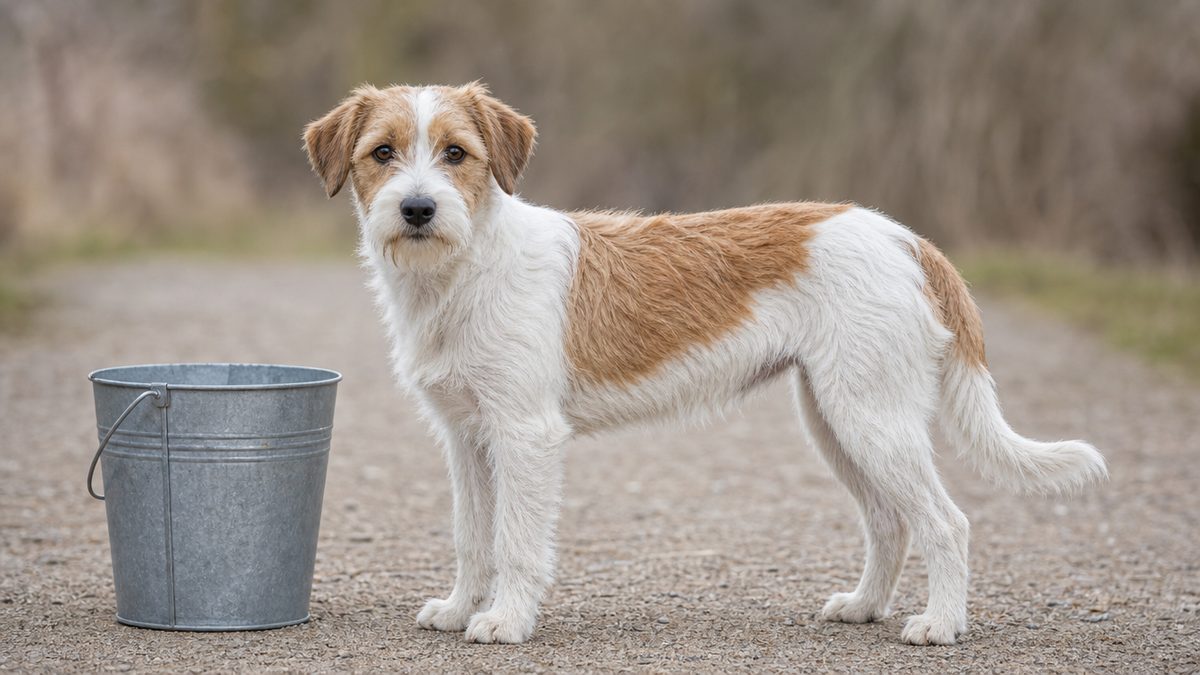
Quick answer
No Kromfohrlander price in india survives checking. Germany's own kennel body registered just 73 puppies in 2025, down from 308 in 2011, and the one India-hosted page quoting Rs 50,000 to Rs 80,000 assigns running costs by template. The breed was founded in 1945 on a single stray dog called Peter and a neighbour's fox terrier, then built by mating Peter to his own daughters. It comes in two coat varieties and carries a well-documented bleeding disorder.
This page reports published veterinary research and registry data for general information. It is not veterinary advice and cannot substitute for examining your own dog. A Kromfohrländer that bleeds longer than expected from a small wound or after a nail trim, bruises easily, develops thickened cracked footpads, strains to urinate, or has a seizure needs a registered veterinary practitioner, not a web page. Raise the breed's bleeding history with your vet before any surgery, dental procedure or spay or neuter.
Kromfohrländer at a glance
What a Kromfohrländer is, and the standard that governs it
The Kromfohrländer is a medium-sized German companion dog created after 1945 near Siegen, standing 38 to 46 cm at the withers and existing in two separate coat varieties. It is one of the youngest German breeds, it holds its own section in the FCI's Group 9, and it is now rarer in Germany than at any point in fifteen years.
The FCI recognises it as Standard 192, Kromfohrländer, origin Germany, in Group 9 Companion and Toy Dogs, Section 10 Kromfohrländer, accepted on a definitive basis on 28 November 1955. That section number is not a detail. The FCI gave this breed a section of its own, named after it, containing nothing else, which is a status usually reserved for a dog that fits nowhere.
Read the German, not the English
The standard is dated 12 October 1998 and its English version prints Official language (DE), translated by Mrs C. Seidler and brought up to date by Dr Paschoud. So the German text governs, and figures in a translation can drift. We extracted both with pypdf and compared them figure by figure.
They agree. The German gives *Widerristhöhe: Zwischen 38 cm und 46 cm* and *Gewicht: Rüde 11 kg bis 16 kg, Hündin 9 kg bis 14 kg*, and the English gives height 38 to 46 cm with males 11 to 16 kg and females 9 to 14 kg. No drift. That is a negative result and it is worth stating, because on other FCI standards this site has found a translation quietly turning a one-sided tolerance into a symmetric one.
The AKC's independently derived figures land in the same place: 15 to 18 inches is 38.1 to 45.7 cm, and 20 to 35 pounds is 9.1 to 15.9 kg. Three sources, one size. For a breed this rare, that unanimity is unusual and reassuring.
Two coat varieties, and why registries handle them differently
The standard opens its general appearance with the fact that there are two separate varieties distinguished by coat type, Rauhhaar and Glatthaar, rough and smooth. They are not colour variations. They are shown separately and described separately.
| Rough coat (Rauhhaar) | Smooth coat (Glatthaar) | |
|---|---|---|
| Beard | Yes, a defining feature | No beard |
| Texture | Thick, rough, harsher on back and quarters than on sides | Thick, smooth, lying close to the body |
| Length at withers and back | No longer than 7 cm | No longer than 7 cm |
| Length on the sides | About 3 cm | About 3 cm |
| Face and muzzle | Longer hair | Short hair |
| Feathering | Per body coat type | Distinct feathering behind forelegs and on upper thighs desirable |
| Undercoat | Short and soft | Short and soft |
| Tail | Coat per body type | Good plume |
The practical consequence for a buyer is that the two varieties are different grooming propositions and different-looking dogs, and a photograph of one tells you little about the other. Both carry an undercoat, which is what matters for India.
What the dog is supposed to be like
The authentic German describes it as *anpassungsfähiger, lernfähiger und temperamentvoller, gegenüber Fremdpersonen zurückhaltender Begleit- und Haushund mit geringem Jagdtrieb*, which the English renders as adaptable, docile and high-spirited companion and house-dog, somewhat reserved about strangers, with a little hunting instinct FCI-Standard N 192 KROMFOHRLÄNDER. Aggressiveness and timidity are explicitly not desired, and unbalanced temperament is a disqualifying fault.
Note that *lernfähig* means able to learn rather than docile. The English translation softens it. A dog described in its own language as quick to learn and spirited is not a placid lap dog, and the difference matters when you are deciding whether to buy one.
Recognition status, and a sharp contrast between two registries
The FCI has recognised this breed on a definitive basis since 1955. The AKC has not recognised it at all: it sits in the Foundation Stock Service. The tell is on the AKC's own page, where the popularity field prints as 'Ranks of 210' with the number blank, because a breed outside the competitive groups has no registration rank to report. Fully recognised breeds carry a figure there.
In Germany the breed is looked after by the Rassezuchtverein der Kromfohrländer e.V., the VDH member club, whose own structure includes a *Körung*, a formal breeding-suitability assessment, alongside its breeder list. English Wikipedia's entry on the breed is short and covers only history and characteristics.
One dog in 1945, and the story two German sources tell differently
The Kromfohrländer was founded on a single stray dog and one neighbour's fox terrier bitch in 1945, and then built by mating that dog to his own daughters. The founder event is confirmed in peer-reviewed pedigree work. What the founder actually was is disputed between the German kennel body and German cynological writing, and this page prints both accounts.
The undisputed part about the founder dog first. Ilse Schleifenbaum lived near Siegen in southern North Rhine-Westphalia, close to a district called *krom Fohr*, which in standard German is *krumme Furche*, a crooked furrow. The breed takes its name from that place. In 1945 a stray, half-starved dog that American soldiers had picked up and carried east on their march found people in the Siegerland who took him in. He was named Peter.
The disagreement about Peter
The Verband für das Deutsche Hundewesen, Germany's national kennel body, states it flatly in its own breed portrait: *Es war gar kein Streuner, sondern ein Griffon Vendéen, ein drahthaariger französischer Vorstehhund*. He was no stray at all, but a Griffon Vendéen, a wire-haired French pointing dog. The FCI standard is consistent with that, naming the breed's ancestors as the wire-haired Fox Terrier and the Grand Griffon Vendéen.
A German cynological account tells it differently. It records that the *Ur-Peter* is today willingly and retrospectively described as a purebred Grand Griffon Vendéen in order to lend the breed prestige, that in reality the whole story is shaky, and that Peter's ancestry is at best anecdotally transmitted.
A national kennel body says he was a Griffon Vendéen. A cynological source says nobody knows and the label was applied afterwards. Both are German, both are current, and neither produces a pedigree for a stray dog picked up in wartime France. The honest position is that the breed's own paperwork begins with an animal of unknown ancestry, and that is a normal way for a twentieth-century reconstruction to begin. Compare the Kooikerhondje, whose founding bitch Tommy is at least named and located, on a farm in Friesland.
There is a smaller date wobble inside the same VDH account. It says Peter was taken in in 1945 and became a father *schon ein Jahr darauf*, a year later, which would put the first litter in 1946, while other accounts date the mating itself to 1945. We have not been able to settle it and we are not going to pick.
How the breed was actually built
The dam was a fox terrier bitch belonging to the Schleifenbaums' neighbours, described in one account as more or less purebred, and the resulting litter was strikingly uniform, which is what encouraged Schleifenbaum to repeat the mating. Later litters from the same pair were less uniform. The foundation stock was then established by deliberate matings between Peter and his own daughters.
That sentence is the whole genetic history of the breed, and it has a specific consequence for an Indian reader that we return to in the adoption section: father-to-daughter mating is precisely what Second Schedule Part II paragraph 6(3) of India's Dog Breeding and Marketing Rules 2017 defines as incest breeding and prohibits.
The bottlenecks, measured
This is where the story stops being anecdote and becomes data. A pedigree analysis published in *Genetics Research* took the Kromfohrländer specifically, identified as FCI Gr9 Sec10, with pedigrees tracing back to the foundation of the breed and available for 5,527 individuals. Distributions of allele frequencies were estimated by Monte Carlo simulation, homozygosity was compared against Hardy-Weinberg expectation to track changes in mating systems across the breeding history, and breeding lines were separated by hierarchical cluster analysis.
Its finding is the one number that matters most on this page. The founder event in 1945 was followed by two further bottlenecks: one caused by strong selection in a very small population, and one triggered by rigorous disease management.
The breed narrowed a second time because breeders were doing the right thing. Removing carriers of a serious disease from a population of a few hundred dogs necessarily removes genetic diversity with them. That is the trap every very rare breed sits in, and it is why the von Willebrand figures in the health section are so high: there is no way out that does not cost something.
Recognition came fast for a breed with that history. The FCI accepted it on a definitive basis on 28 November 1955, ten years after the founder mating, achieved through persistent lobbying of the newly founded VDH. As the German account dryly puts it, they were different times.
Kromfohrländer price in India, and the search engine that will not answer
No Kromfohrlander price in india survives checking, and this breed carries an unusual second problem: the Indian search engine returns nothing about it at all. Three different queries produced three complete result-set substitutions while a control passed in the same session, so the ordinary way of checking an Indian market is unavailable here.
Start with the number that settles the supply question. The VDH, Germany's national kennel body, publishes annual puppy registrations for every breed its member clubs register. The Kromfohrländer row, read as raw text from the VDH's own table, runs as follows.
| Year | Puppies | Year | Puppies |
|---|---|---|---|
| 2025 | 73 | 2017 | 179 |
| 2024 | 114 | 2016 | 132 |
| 2023 | 103 | 2015 | 192 |
| 2022 | 168 | 2014 | 170 |
| 2021 | 240 | 2013 | 222 |
| 2020 | 129 | 2012 | 174 |
| 2019 | 206 | 2011 | 308 |
| 2018 | 229 |
Seventy-three puppies in the whole of Germany in 2025, against 308 in 2011. That is a fall of 76 percent in fifteen years, and it is the lowest figure in the fifteen years the table covers. For scale, the same table records 6,374 German Shepherd puppies and 2,035 Poodles in 2025. A breed producing 73 puppies a year in its country of origin does not have an export market to India, and no arithmetic about exchange rates is needed to see that.
The search engine failure, which is itself the finding
We could not read an Indian result set for this breed, and the way it failed is worth publishing because a reader trying the same searches will hit the same wall.
| Query | Reported count | What actually came back |
|---|---|---|
| kromfohrlander dog india | About 54 results | Ten Korean university scholarship pages, Chosun and Pusan National |
| kromfohrlander price in india | About 20,700 results | Ten Vietnamese Hanoi-to-Paris flight booking pages |
| kromfohrlander dog breed | About 27,000 results | Ten 'how to get help in Windows' support articles |
| labrador retriever price in india (control) | About 26,400 results | Ten genuine Indian Labrador price and listing pages |
All four returned HTTP 200 with plausible-looking result counts Bing search results page for kromfohrlander… Bing search results page for kromfohrlander…. The control passing in the same session is what makes this diagnostic rather than a dead end: the instrument works, and the breed token specifically is triggering the substitution. We therefore draw no conclusion, in either direction, from those three result sets. An absence of Indian listings is not proven, because the query that would prove it was never actually run.
The two India-hosted pages that do exist
Working around the search engine, two India-hosted pages on this breed are reachable and they contradict each other on the central question.
- One publishes Rs 50,000 to Rs 80,000, on a site whose running-cost figures are template constants. We proved that on the same site's other pages: its Kooikerhondje and Lagotto Romagnolo pages carry byte-identical monthly costs for two completely unrelated breeds. Its heading *Healthcare Guide for your Kromfohrlander* is a template default with the URL slug dropped in.
- The other publishes no rupee figure at all. Read in full, this India-hosted page names no Indian city, no breeder and no seller. Its only place name is Siegen in North Rhine-Westphalia, and its only other breeds are the Fox Terrier and the Griffon. It is a translated German breed article on an Indian domain.
- A third ranking page prints dollars, not rupees, giving USD 500 to 600 as a rough estimate from a reputable breeder.
Running the division tests
Indian pages routinely publish a dollar figure run through one exchange rate, so the arithmetic is worth doing on Rs 50,000 to Rs 80,000.
- At 84.38, they become USD 592.6 and 948.1. Not round.
- At 74.00, they become USD 675.7 and 1,081.1. Not round.
- At 80.00, they become USD 625 and 1,000. Clean, but 80 is structurally weak because any figure ending in three zeros divides cleanly at it by construction.
- At 66.67, they become USD 750 and 1,200. Clean for the same structural reason.
So the arithmetic does not convict, and we are not going to claim it does. What convicts is the control page. A site whose monthly costs for a German companion dog are identical to its costs for an Italian truffle dog is not reporting Indian market data about either, and a country producing 73 puppies a year is not supplying one.
If somebody in India offers you a Kromfohrländer, consider what the dog physically is. A white dog with brown patches, semi-drop ears and either a beard or a smooth coat describes a great many Indian mixed-breed dogs and several fox terrier crosses, which is unsurprising given a wire fox terrier is half the breed's ancestry. Ask for the FCI or VDH pedigree number and the import paperwork before the price.
What a 9 to 16 kg European companion costs to keep here
There is no Indian purchase price for this breed, but the cost of ownership is real and sourceable, because it is the cost of keeping any 9 to 16 kg dog in an Indian city. Two lines are genuinely breed-specific: a bleeding-disorder DNA test that no Indian rule requires, and the rough variety's beard.
Keep the two questions apart. A breed price is what a puppy sells for, and for this breed in India it does not exist. A cost of ownership is what feeding, vaccinating, grooming and treating a dog of its size costs here, and that is knowable. The site that conflates them ends up printing a template.
The published Indian institutional costs
If a Kromfohrländer reached India lawfully as an owner's pet, the registry paperwork has a published tariff. The Kennel Club of India charges Rs 2,500 to register an imported dog, Rs 1,000 for a certified four-generation pedigree, Rs 1,500 for a five-generation pedigree, Rs 2,000 for an export pedigree, and Rs 500 to transfer ownership of a registered dog within twelve months of the puppies' date of birth, rising to Rs 1,000 after that. Those are the only rupee figures on this page that come from an Indian institution rather than a content site.
The test to budget for that nobody will prompt you about
This is the breed-specific line. Von Willebrand disease type I is documented in this breed at a mutation frequency of 80.5 percent in one genotyped cohort, and a DNA test for the causal variant exists commercially. Indian law requires nothing of the kind: Second Schedule Part III paragraph 8(10) of the Dog Breeding and Marketing Rules 2017 lists the genetic defects a breeding dog must have been tested for, and while its list opens with the word including and is therefore illustrative rather than closed, it does not name von Willebrand disease, footpad hyperkeratosis, hyperuricosuria or cystinuria.
So the screening burden falls entirely on the owner. Budget for a one-off DNA panel from a laboratory that tests the specific VWF variant, and for a pre-surgical clotting assessment before any spay, neuter, dental or biopsy.
We could not open and verify a published Indian price list for canine coagulation testing or for a VWF DNA panel from an Indian laboratory this session. Rather than convert a European figure or repeat an unsourced one, we are saying we do not have it. Ask two referral hospitals in your city.
The costs that scale with size
For the recurring bill, treat the Kromfohrländer as a small-to-medium dog at 9 to 16 kg. That is materially cheaper to run than the large European breeds Indian buyers usually cross-shop against, and slightly more expensive than a true small breed.
- Food is the largest recurring line and scales almost linearly with bodyweight, so a 13 kg dog eats around 40 percent of what a 33 kg retriever eats.
- Grooming depends entirely on which variety you have. The smooth coat needs a weekly brush. The rough coat needs a weekly brush plus regular beard cleaning, and in India a wet beard in a humid month is a skin problem waiting to start.
- Ear care is a real recurring line, because the standard specifies semi-drop ears lying close to the head, which is a poorly ventilated canal in a hot country.
- Tick and flea prevention is not optional anywhere in India, and in a breed with a documented bleeding disorder it is closer to a clinical intervention than a convenience. See the health section.
This is a cheap dog to feed and a moderate dog to groom, and an expensive dog to screen properly, in a country where nobody will tell you to screen it. If you economise anywhere, do it on the grooming salon and not on the clotting test.
Health issues: four papers, one bleeding disorder, and a declared commercial interest
The Kromfohrländer's entire veterinary literature is four papers, and three of them are about two diseases. That is not a gap in our research; it is the finding. Every figure below comes from work whose subject animals were Kromfohrländer, and where a study's authors declared a commercial interest in the test they were validating, we say so.
We ran PubMed through the NCBI eutils API and read the query translation line on every search, because a breed name can be silently rewritten into something else. 'Kromfohrlander' returns 4 records with a clean translation of "Kromfohrlander"[All Fields]. 'Kromfohrlaender' returns 0 and is flagged as a phrase not found. The OR form of all three spellings returns the same 4. Controls in the same session returned 126 records for Labrador Retriever hip dysplasia and 21 for Kooiker dog, so the instrument was working.
Four papers is the entire published literature on this breed. For comparison, the Kooikerhondje has 21 under its most productive name form. That scarcity is itself a reason to be careful: there is no large cohort study, no breed-wide screening programme published in English, and no mortality data.
There is no OFA row either
OFA publishes statistics only once a breed passes a submission threshold, 100 hip evaluations or 50 for its other databases. We retrieved OFA's disease statistics tables live on 2 September 2026, 2,231,869 characters, and searched them case-insensitively. The strings KROMFOHR, KROM and FOHR each occur zero times, and the three LANDER hits are Munsterlanders.
The control string LABRADOR occurs 109 times in the same retrieval, so the search worked and the absence is real. The correct wording is that the Kromfohrländer has no row in OFA's published statistics tables, not that it is absent from the OFA database. Dogs of the breed may well have been evaluated; too few have for OFA to publish.
Von Willebrand disease type I, the best-documented problem
Eighty-seven Kromfohrländer were genotyped for the c.7437G>A mutation in the VWF gene, the same variant previously shown to cause von willebrand disease type I in the Doberman Pinscher. The results are startling.
| Genotype | Share of cohort | Showed bleeding symptoms | vWF serum concentration |
|---|---|---|---|
| Wild type (WT/WT) | 19.5 % | None | 28 to 137 % |
| Heterozygous (WT/MUT) | 65.5 % | 23.2 % | 3 to 77 % |
| Homozygous (MUT/MUT) | 15.0 % | 45.5 % | 1 to 23 % |
| Carrying the mutation at all | 80.5 % | 21 % of the whole cohort bled | - |
The authors' conclusion is the part that matters clinically. Because both heterozygotes and homozygotes show reduced serum von Willebrand factor and both bleed at some rate, while wild-type homozygotes bled not at all, they postulate that in this breed, unlike most affected breeds, inheritance follows an autosomal dominant mode with incomplete penetrance rather than the usual autosomal recessive pattern.
That reclassification is not academic. Under a recessive model, a carrier is safe and only a homozygote is at risk. Under this model, nearly two dogs in three in that cohort carry a real, if lower, bleeding risk.
First, the authors declare that three of them own or are employed by FERAGEN GmbH, a company providing genetic testing for inherited disorders to breeders, owners and veterinarians, and a fourth consults on haematology for pharmaceutical companies. That is a declared commercial interest in the test whose value the paper establishes, and it is disclosed in the paper itself. Second, the counts are small: 15.0 percent of 87 dogs is about 13 animals, so the headline 45.5 percent bleeding rate among homozygotes rests on roughly six dogs. The direction of the finding is well supported. The precision of the percentages is not.
Hereditary footpad hyperkeratosis, and the breed it shares it with
Hereditary footpad hyperkeratosis is a palmoplantar hyperkeratosis inherited as a monogenic autosomal recessive trait. A genome-wide association study in 13 Kromfohrländer cases against 29 controls produced a single strong signal on chromosome 5 at p 1.0 x 10 to the minus 13, which replicated in an independent cohort of 10 Irish Terrier cases against 21 controls at p 6.9 x 10 to the minus 10. Shared haplotype analysis across both breeds narrowed the interval to 611 kb containing 13 predicted genes, and re-sequencing one affected Kromfohrländer at 23.5x coverage against 46 genomes of unaffected dogs from other breeds found a single private non-synonymous variant: FAM83G c.155G>C, changing a conserved arginine to proline at p.R52P. Affected dogs show moderate to severe orthokeratotic hyperplasia of the palmoplantar epidermis.
The finding was confirmed independently by a different route. A Swedish group sequenced a Kromfohrländer family trio, an affected offspring and both healthy parents, at 9.2x average coverage without any prior GWAS. After filtering they had 527 single-nucleotide variants and 15 indels homozygous in the offspring and heterozygous in both parents, narrowing to seven candidate variants in six genes, of which only FAM83G c.155G>C was concordant across eight further cases and 16 healthy Kromfohrländer.
Two independent teams, two methods, one variant. This is the most solid genetic finding on the page, and a DNA test for it is straightforward.
The conditions named on testing panels but not in the literature
A commercial genetic-testing panel lists exactly three conditions for this breed: hereditary footpad hyperkeratosis, hyperuricosuria, and von Willebrand's disease type 1. Hyperuricosuria predisposes a dog to urate stones, and cystinuria is separately reported in German breed writing alongside epilepsy, patellar luxation, elbow dysplasia, hereditary eye disease and autoimmune disease.
We can source hyperuricosuria to a testing panel and the wider list to a German breed encyclopedia. We cannot source a prevalence figure for any of them from a study that included this breed, so we are not printing one. A page that gave you a percentage for Kromfohrländer epilepsy would be inventing it.
Why tick-borne disease matters more in this breed than in most
This is the India-specific argument, and no page written for Germany can make it. A survey of 525 dogs across four Indian cities found that 261 of them, 49.7 percent, carried at least one tick-borne pathogen by PCR, with Hepatozoon canis in 30 percent, Ehrlichia canis in 20.6 percent, Mycoplasma haemocanis in 12.2 percent, Anaplasma platys in 6.5 percent and Babesia vogeli in 5.5 percent. Co-infection occurred in 39 percent of cases, and ticks were found on 278 dogs, 53 percent of those examined.
Now put that beside a breed in which four dogs in five carry a von Willebrand mutation. Ehrlichia canis causes thrombocytopenia and bleeding. Anaplasma platys destroys platelets directly. A dog with reduced von Willebrand factor that also acquires a platelet-destroying infection does not have two problems. It has one compounded one, and the compounding happens in India and not in the Siegerland.
Year-round tick prevention in this breed is therefore a clinical intervention, not a convenience, and it is the single most useful thing an Indian owner of this breed can do.
Lifespan
The AKC gives 13 to 15 years and a ranking aggregator gives the same range. Neither is a mortality study. The breed has no row in the Dogs Trust table of 155 breeds behind the 2024 life expectancy work, where our control, the Labrador Retriever, appears at 13.1 years from 43,428 dogs and 16,155 deaths. So no cohort-derived figure exists, and we are not going to borrow the Wire Fox Terrier's on the grounds that it is half the ancestry.
Heat tolerance: a homeland at 8.3 degrees C, and the elevation check that matters
The Kromfohrländer has poor heat tolerance. The NASA POWER cell for Siegen averages 8.3 degrees C across the year with a warmest month of 17.6 degrees C in July, and that cell sits about 143 m above the real town, so the true homeland figure is roughly a degree warmer still. Chennai's coolest month averages 24.09 degrees C, which is hotter than the hottest month this breed comes from.
We queried NASA POWER by explicit latitude and longitude rather than by place name, and then checked the elevation the model returned, because POWER reports a grid cell rather than a point and in hilly terrain the two can be a kilometre apart.
The returned cell for Siegen reports an elevation of 393.15 m against a real town elevation near 250 m, so the cell sits about 143 m high. At the standard lapse rate of roughly 6.5 degrees C per 1,000 m that makes the cell about 0.9 degrees C too cold for the town, giving a corrected homeland annual mean near 9.2 degrees C. We label that a correction rather than a measurement. It is small enough not to change any conclusion and large enough to be worth declaring.
| Place | Cell elevation | Annual mean | Warmest month mean | Annual relative humidity |
|---|---|---|---|---|
| Siegen, Germany (cell) | 393.15 m | 8.30 C | 17.60 C (July) | 84.66 % |
| Siegen, corrected to ~250 m | - | ~9.2 C estimated | ~18.5 C estimated | - |
| Chennai | 48.95 m | 27.95 C | 31.51 C (May) | 72.39 % |
| Delhi | 206.37 m | 25.60 C | 35.88 C (June) | 45.56 % |
| Mumbai | 97.15 m | 26.77 C | 31.19 C (May) | 67.39 % |
The annual gap between corrected Siegen and Chennai is about 18.8 degrees C. Both coat varieties carry a short soft undercoat under the topcoat, so neither is a hot-country coat, and the rough variety additionally carries a beard that stays damp.
The humidity point people get backwards
Germany is not dry. The Siegen cell reports 84.66 percent annual relative humidity against Chennai's 72.39 percent NASA POWER climatology API queried…. So this is not a dry-to-humid transition and describing it as one would be wrong. What changes in India is not the humidity but the humidity plus eighteen degrees, and hot-and-humid is the combination that stops a panting dog cooling itself. Mumbai in August runs 90.36 percent relative humidity; Delhi is the opposite problem, drier at 45.56 percent annual but with a June mean of 35.88 degrees C.
What the heat research supports, and what it does not
The largest study of canine heat-related illness examined 905,543 UK dogs under primary veterinary care in 2016 and recorded 1,259 events from 1,222 dogs. Of the 879 events with a recorded trigger, 652, or 74.2 percent, were exertional, against 113 environmental and 46 from vehicular confinement. Its companion paper on the same cohort with a stricter case definition reported 395 confirmed events, an incidence of 0.04 percent and a case fatality of 14.18 percent.
Those papers model breeds that cleared an inclusion threshold. A breed producing 73 puppies a year in Germany is nowhere near that threshold in a UK dataset, and it is not in the over-50 kg high-risk band either. So no breed-specific odds ratio exists for the Kromfohrländer and we are not importing one from a breed the authors did study. What transfers is the mechanism: three heat emergencies in four follow exercise, which is the variable you control.
Indian law, cited correctly
The relevant provision is Second Schedule Part IV paragraph 21(1) of the Prevention of Cruelty to Animals (Dog Breeding and Marketing) Rules, 2017, headed *Outdoor housing facilities*. It bars keeping in outdoor facilities, without the attending veterinary practitioner's written approval, dogs not accustomed to local temperatures, breeds that cannot tolerate the temperatures prevalent in the area or region in question, and sick, infirm, aged or young animals.
It is not 'Rule 21'. We extracted the gazette with pypdf and that string occurs zero times in it; the Rules themselves stop at Rule 13 and everything numbered above that is a Second Schedule paragraph.
Where in India this breed is least uncomfortable
The hill stations, and you cannot read that off the raw satellite data. The POWER cell for Ooty reports 784.64 m against a real town elevation near 2,240 m, an error of 1,455 m, and returns an annual mean of 23.5 degrees C for a place that is nothing like that warm. A lapse-rate correction puts the real annual mean near 14.0 degrees C, which is about 4.8 degrees C above corrected Siegen and the closest an Indian town gets.
- Walk before sunrise and after full dark from March to October in every plains city, not at dusk.
- Test the pavement with the back of your hand for five seconds before every walk.
- Dry the beard on a rough-coated dog after every drink and every walk in a humid month.
- Never clip the coat short for summer, because the undercoat insulates against heat as well as cold.
- Stop at the first change of gait or refusal to continue, which precede collapse.
Temperament and household fit
The Kromfohrländer is an adaptable, quick-learning, spirited house dog that is reserved with strangers and has only a low hunting drive. That combination makes it a genuinely good flat dog and a poor choice for a household with constant visitors, which is the opposite of how its terrier-ish appearance reads.
Take the description from the authentic German rather than the translation, because the translation softens it. The standard says *anpassungsfähiger, lernfähiger und temperamentvoller, gegenüber Fremdpersonen zurückhaltender Begleit- und Haushund mit geringem Jagdtrieb*. That is adaptable, able to learn, and spirited; alert and reserved towards strangers; a companion and house dog with a low hunting drive. The English renders *lernfähig* as docile, which is a different word describing a different dog.
Aggressiveness and timidity are named as undesirable in the temperament clause, and unbalanced temperament, meaning aggressiveness or timidity, appears again in the disqualifying faults. That duplication is a small drafting oddity in the standard itself, and it tells you how seriously the breed's founders took temperament in a dog built from an unknown stray.
The low prey drive is the useful part
This is what separates the Kromfohrländer from the wire fox terrier that is half its ancestry. A terrier with a high prey drive in an Indian city is a management problem around street cats, monkeys and free-ranging dogs. A companion breed the standard credits with *geringem Jagdtrieb* is far easier to walk on a lead in a dense neighbourhood, and it is the single most India-relevant thing the standard says about behaviour.
Who this breed suits in India
- A quiet flat or house with one or two primary people, because a dog described as reserved with strangers wants a small circle, not a crowd.
- Someone who is home most of the day. This is a companion breed by classification, not by marketing, and it is not built to be left.
- An owner who enjoys training, because a dog described as quick to learn and spirited gets bored rather than tired.
- A hill-station household, or a plains household genuinely willing to run a pre-dawn and post-dark schedule for eight months a year.
Who should not buy one
- A household with constant footfall. Reserve with strangers is written into the standard, and a dog meeting six new people a day never gets to settle.
- Anyone who wants a guard dog. A friendly, reserved, low-drive companion is not a deterrent, and expecting one of a 13 kg dog is unfair to it.
- Anyone buying on the terrier look. The dog looks like a scruffy fox terrier and behaves like a sensitive companion, and buyers who wanted the first thing are disappointed by the second.
- A family who cannot commit to a screening and clotting conversation with a vet before any procedure, given the breed's bleeding history.
Ranking US pages rate this breed on scales including sensitivity level, tolerance for being alone, and friendliness toward strangers, and another describes it as sensitive, loving and loyal with a distinctive smile and a habit of sneezing in greeting. None of those pages cites a source and none of them is written for a hot country. Where they and the FCI standard agree, as they do on reserve with strangers, we are comfortable. Where only they say something, we treat it as description rather than data.
Training a quick-learning, reserved dog
Train the Kromfohrländer with reward, variety and short sessions, and socialise it deliberately against a reserve that is written into its breed standard. The authentic German calls it lernfähig, able to learn, and temperamentvoll, spirited, and names timidity as an undesirable trait, so building confidence is part of the job rather than an optional extra.
The standard gives you the brief: adaptable, quick to learn, spirited, reserved with strangers, low hunting drive, with aggressiveness and timidity both undesired. A dog that learns quickly and gets bored quickly needs work, and a dog whose standard flags timidity as a fault needs early confidence-building rather than protection from the world.
What works
- Reward-based marker training, in three to five minute blocks rather than long sessions.
- Scentwork and search games, which suit a dog with a nose and low prey drive better than chase games do.
- Trick training, which is the cheapest confidence builder there is for a reserved dog.
- Rally and obedience, where the breed's willingness to learn is an advantage.
- Jumping and agility foundations, because the standard notes it likes to jump and moves with strong drive.
What this breed resists
Three failure modes recur, and all three come from the same place.
- Repetition. A dog described as quick to learn disengages from the twelfth identical repetition. Get it right three times and stop.
- Forced greetings. Reserve with strangers is in the standard. Making the dog accept a stranger's hand teaches it that its discomfort will be ignored, which is how a reserved dog becomes a snappy one.
- Correction-based handling. The founders bred deliberately against timidity, and harsh handling reintroduces it faster than anything else.
The socialisation window, and the Indian scheduling problem
Socialise from the day the puppy arrives, in small positive doses, letting it retreat every time it wants to. The Indian complication is a genuine conflict: the coolest hours are the safest hours to walk, and they are also the hours with the least going on. From March to October in a plains city, the safe outdoor window is before sunrise and after dark, which is exactly when there is nothing to socialise to.
Work around it rather than through it. Use short car trips, terraces, quiet stairwells, lift rides and controlled indoor visitor meetings, and accept that the dog's exposure budget in an Indian summer is smaller than a German puppy's and has to be spent more carefully.
Realistic timelines are unremarkable for a small companion breed. Expect house training in six to ten weeks, a reliable recall in an enclosed space by six months, an outdoor recall you would actually trust between twelve and eighteen months, and settled adult behaviour by about two years.
If the dog backs off from a stranger, that is the breed working correctly, not a training failure. The standard asks for a dog reserved with strangers. Do not punish the retreat, and do not let a visitor chase it.
Daily exercise: moderate distance, real mental work
Give a Kromfohrländer 45 to 60 minutes of movement a day plus deliberate mental work, and schedule all of it outside daylight hours in a plains Indian city for most of the year. It is classified as a companion and house dog with a low hunting drive, not as a working gundog, so the requirement is moderate rather than heavy.
Set the expectation from the classification. The FCI files this breed in Group 9, Companion and Toy Dogs, and the standard's stated utilisation is *Begleit- und Haushund*, companion and house dog FCI-Standard Nr. 192 KROMFOHRLÄNDER. That is a genuinely different brief from a retriever or a hound, and it is good news for an Indian flat.
What the standard does describe is a dog with real movement in it: flowing, active, with even strides, front action reaching well forward, hind action with strong drive, and a note that it likes to jump. So it needs somewhere to move, not just somewhere to walk.
A workable week
- Two walks a day of 20 to 30 minutes each, at the dog's pace.
- Three scentwork sessions a week of ten minutes indoors, which tire this breed faster than distance.
- Two training sessions a day of five minutes, which count as exercise for a quick-learning dog.
- Jumping and body-awareness games in a safe space, given the standard's own note that it likes to jump.
- One longer outing a week where the weather genuinely allows it, rather than forcing one in April.
The Indian timetable
| City type | Usable months | Hot months | Note |
|---|---|---|---|
| Delhi and the north plains | Dec to Feb | Mar to Oct, pre-dawn and post-dark only | Dry heat; carry water and prefer shade over speed |
| Chennai and the coast | Dec to Jan, early only | Feb to Nov, pre-dawn and post-dark only | No genuinely cool season; the annual floor is 24.09 C |
| Mumbai and Pune | Dec to Feb | Mar to Nov, pre-dawn and post-dark only | August humidity of 90 percent blocks evaporative cooling |
| Bengaluru | Most of the year, early and late | Mar to May | The most workable large Indian city for this breed |
| Hill stations | Most of the year | Brief and mild | The only Indian setting where the coat is not fighting the weather |
The reason to be strict about timing rather than distance is in the data. Of 879 UK heat-related illness events with a recorded trigger, 74.2 percent were exertional rather than environmental or vehicular, and case fatality in the companion paper's confirmed events was 14.18 percent. The walk is the risk, and the walk is the thing you schedule.
A beard holds water and heat. After any hot walk, check that the beard is not soaked and the skin beneath it is not inflamed, because a permanently damp beard in an Indian summer becomes a bacterial skin problem quickly.
Grooming two different coats in Indian humidity
Grooming a Kromfohrländer depends entirely on which variety you have, and most pages ignore that. The rough coat is thick and harsh with a beard and needs weekly brushing plus beard care. The smooth coat lies close to the body and needs less. Neither should be clipped short for Indian summer, because both carry an undercoat.
The standard sets the specification and the two varieties are described separately. Both are capped at no longer than 7 cm at the withers and back and about 3 cm on the sides, and both carry a short, soft undercoat. The rough coat is thick and rough in texture, with a beard, longer hair on face and muzzle, and hair on the back and quarters harsher than on the sides. The smooth coat is thick, smooth, close-lying and beardless, with longer hair on the ears, lower neck and chest, a good tail plume and desirable feathering behind the forelegs and on the upper thighs.
The routine that works here
- Brush weekly for both varieties, and more often through moults, working the undercoat out rather than cutting it off.
- Clean and dry the beard daily on a rough-coated dog, especially after drinking and after meals, and always after a humid walk.
- Dry the feathering behind the forelegs and on the thighs after any bath or rain, because that is where damp sits longest on a smooth-coated dog.
- Check the ears weekly, lifting the leather and looking and smelling.
- Keep the feet dry through monsoon, which matters more in this breed than most because of the footpad condition below.
Hereditary footpad hyperkeratosis causes moderate to severe orthokeratotic hyperplasia of the palmoplantar epidermis, meaning thickened, hardened, cracking pads. Cracked pads in an Indian monsoon are an entry route for infection, and hot pavement is harder on a thickened pad than a normal one. Inspect the pads weekly and take any cracking to a vet rather than treating it with a household balm.
Ears, and the Indian evidence that does not agree with itself
The standard specifies semi-drop ears set on high at the side, triangular with rounded tips, lying close to the head. That is a warm, poorly ventilated canal in a hot country.
Indian data on when otitis externa strikes is genuinely unsettled, and this page publishes the disagreement rather than picking a side. A study in and around Durg district, Chhattisgarh, examined 281 dogs and found 51 positive cases, split 21 in summer (41.18 percent), 17 in the rainy season (33.33 percent) and 13 in winter (25.49 percent). Prevalence rose steeply with age, from 5.88 percent in dogs up to one year to 45.10 percent in dogs five years and older, and cytology found cocci in 76.1 percent of smears, bacilli in 47.6 percent and yeast in 19.0 percent.
Other Indian series this site has cited peak in the monsoon instead. Both are real Indian data. The operating conclusion for an owner is that there is no safe season, so check the ears every week all year.
The overseas advice that does not transfer
Northern European grooming guidance for coated breeds routinely says to towel a dog and let it air dry. In a German autumn that is fine. In an Indian monsoon, air-drying a bearded dog with semi-drop ears means the beard and the ear canal stay wet for hours in ambient humidity above 89 percent. Dry this breed actively. That is the single adaptation its care needs in India, and no source written for Germany will tell you to make it.
Feeding a 9 to 16 kg companion dog in India
Feed the Kromfohrländer as a small-to-medium companion dog and hold it lean. The standard gives males 11 to 16 kg and females 9 to 14 kg, and the AKC's 20 to 35 pounds converts to almost exactly the same range, so unlike most rare breeds there is no dispute about the target weight.
The German standard states *Gewicht: Rüde 11 kg bis 16 kg, Hündin 9 kg bis 14 kg*, and its English translation gives the identical figures. The AKC independently publishes 20 to 35 pounds, which is 9.1 to 15.9 kg, and a ranking aggregator gives 22 to 31 pounds. Three sources, one range. Use your own dog's sex and frame to place it within it.
Life stages
| Stage | Meals per day | What matters most |
|---|---|---|
| 8 to 16 weeks | 4 | Small frequent meals of a complete puppy food; steady rather than fast growth |
| 4 to 8 months | 3 | Check ribs weekly; this is where Indian households overfeed |
| 8 to 12 months | 2 | Transition to adult food as growth finishes |
| 1 to 8 years | 2 | Hold a lean condition and adjust for the walking schedule, not the calendar |
| 8 years and over | 2 | Reassess with a vet, and ask about urinary monitoring given hyperuricosuria in the breed |
Body condition, and one breed-specific reason it matters
You should feel the ribs easily under a thin covering, see a waist from above and a tuck-up from the side. The standard describes an underline tucked up towards the loins, so the correct outline is your target.
The breed-specific reason to hold that condition is the feet. Hereditary footpad hyperkeratosis thickens and cracks the palmoplantar epidermis, and every extra kilogram loads a pad that is already compromised, on Indian pavements that are already hard on it.
Water, urine and the hyperuricosuria question
Hyperuricosuria is one of exactly three genetic conditions a commercial testing panel lists for this breed, and it predisposes a dog to urate stones. The practical management for any dog at risk of urinary crystals is dilution: constant access to fresh water, and enough of it to keep urine dilute.
That interacts badly with Indian heat, where a dog loses more water and often drinks from a bowl that has been sitting warm all day. Change the water rather than topping it up, offer it after every walk, and mention the breed's hyperuricosuria status to your vet before agreeing to any long-term diet.
The only India-hosted page publishing one for this breed assigns running costs by template rather than by breed, which we proved on its own control pages. Price two brands you would actually feed, at roughly 180 to 280 g a day depending on the dog, and you will have a better figure than anything currently published.
Indian practicalities
- Store food airtight, because coastal humidity turns kibble rancid well before the printed date.
- Feed after exercise in hot months, with a gap either side of the walk.
- Do not free-feed, because a dog with fewer usable walking hours gains weight quietly.
- Clean the beard after every meal on a rough-coated dog, or food in the beard becomes a skin problem.
- Discuss any raw diet with your vet first, since a breed with a documented bleeding disorder is a poor candidate for avoidable gastrointestinal upset.
The first year, month by month
Plan a Kromfohrländer's first year around three things: a screening and clotting conversation Indian law will never prompt you to have, deliberate confidence-building against a reserve written into the standard, and a heat calendar that decides when the puppy can be outdoors at all.
Indian law fixes the start. Rule 8(1)(a) of the Dog Breeding and Marketing Rules 2017 provides that pups less than eight weeks in age are not sold, and Rule 8(1)(e) requires each pup sold to be micro-chipped with a complete record of treatment and vaccination maintained. Both are genuine Rules, unlike the housing and breeding clauses elsewhere on this page, which are Second Schedule paragraphs.
| Age | What to do | Breed-specific note |
|---|---|---|
| 8 to 10 weeks | Settle in, house training, start the vaccination course | Vaccination can start at seven to eight weeks and usually completes at eighteen weeks under the Rules |
| 10 to 14 weeks | Gentle, deliberate socialisation in small doses | Reserve with strangers is in the standard. Build confidence, never force greetings |
| 3 to 4 months | Lead work, name response, handling of ears, beard and feet | Weekly foot handling now makes lifelong pad checks easy |
| 4 to 6 months | Recall in an enclosed space, first scentwork games | Short sessions; a quick-learning dog switches off when drilled |
| 6 to 9 months | Adolescence, with rules unchanged | Ask your vet about a VWF DNA test if the breeder did not provide parental results |
| 9 to 12 months | Adult food, structured walks, first full health check | Get the clotting conversation on the record before any procedure is scheduled |
| 12 months | Discuss desexing timing | Do not book surgery before reading the callout below |
In one genotyped cohort, 80.5 percent of Kromfohrländer carried the VWF c.7437G>A mutation and 21 percent of the cohort showed bleeding symptoms, with the authors concluding an autosomal dominant pattern with incomplete penetrance rather than the usual recessive one. Under that model a carrier is not automatically safe. Tell your vet the breed's bleeding history before any spay, neuter, dental or biopsy, and ask whether a buccal mucosal bleeding time or factor assay is warranted first.
The screening nobody in India will ask you for
Second Schedule Part III paragraph 8(10) of the 2017 Rules lists the genetic defects a breeding dog must have been tested for. The list opens with the word including, so it is illustrative rather than closed, and it names hip dysplasia, progressive retinal atrophy, night blindness, hypothyroidism, entropion, ectropion, overshot and undershot jaw, wry mouth, two or more missing teeth and cryptorchidism.
Read that against this breed's actual problems. Von Willebrand disease, footpad hyperkeratosis and hyperuricosuria are all absent from it, and the string 'patella' appears zero times in the whole gazette. So Indian law mandates testing for conditions this breed is not particularly known for, and mandates nothing for the three that a commercial panel lists as its genetic health conditions. That gap is why the screening burden is entirely yours.
One clause where the standard and Indian law happen to agree
The standard specifies a tail that is not docked, medium long, a sabre tail carried hanging at rest with the tip curved slightly up. Second Schedule Part II paragraph 6(8) forbids tail docking, ear cropping, de-barking and de-clawing, and any change of appearance by artificial means. So a correctly bred Kromfohrländer is already compliant, and a docked one is both a fault under the standard and the product of a prohibited procedure here.
The standard describes the hocks as 'without dewclaws'. Where a breeder removes hind dewclaws to meet that description, the removal is de-clawing, which paragraph 6(8) forbids outright. A dog born without them is fine. A dog that had them taken off in India is the product of a prohibited procedure, and it is worth asking which you are being offered.
The heat calendar for a puppy
From March to October in a plains Indian city, all outdoor time moves to before sunrise and after dark. Second Schedule Part IV paragraph 21(1) bars keeping young animals in outdoor facilities without a vet's written approval, alongside breeds that cannot tolerate local temperatures, so a puppy of this breed falls into two of the three listed categories at once. It lives indoors.
Head to head against what an Indian buyer can actually get
Anyone reaching a Kromfohrländer page in India is usually comparing it against a Wire Fox Terrier, a Jack Russell or a Beagle, because those are the dogs it resembles and the ones actually available. On availability and screening, all three beat it comprehensively. On temperament in a flat, it beats two of them.
Set the comparison honestly. This is not a table of which dog is better. It is a table of which dog you can obtain, screen and keep comfortably in an Indian city.
| Kromfohrländer | Wire Fox Terrier | Jack Russell Terrier | Beagle | |
|---|---|---|---|---|
| Available in India | No verified listing found | Occasionally | Widely | Very widely |
| Verified Indian price | None | Published by Indian sellers | Published by Indian sellers | Published by Indian sellers |
| Adult weight | 9 to 16 kg | About 7 to 9 kg | About 6 to 8 kg | About 10 to 11 kg |
| Prey drive | Low, stated in the standard | High | High | High, and nose-led |
| Coat | Rough or smooth, both with undercoat | Wiry, needs stripping | Smooth or broken | Short, dense |
| Heat tolerance | Poor | Moderate | Moderate | Moderate |
| Documented inherited burden | vWD I at 80.5 % carrier rate, footpad hyperkeratosis, hyperuricosuria | Several, well studied | Several, well studied | Several, well studied |
| Published literature | 4 papers | Extensive | Extensive | Extensive |
| OFA statistics row | None | Present | Present | Present |
| Lawful import to breed or sell | No | No | No | No |
Against the Wire Fox Terrier, which is literally half of it
This is the comparison that matters, because a wire fox terrier is one of the two ancestors the standard names, and because a fox terrier cross is the dog an Indian buyer is most likely to be sold under this breed's name.
The genuine difference is drive. The Kromfohrländer standard specifies *geringem Jagdtrieb*, a low hunting drive, while the fox terrier was built to go to ground after quarry. In an Indian neighbourhood with street cats, monkeys and free-ranging dogs, that difference decides whether walks are pleasant or a wrestling match. If low prey drive is what attracts you, that is a real and defensible reason to prefer this breed, and it is the only one on this page that does not come with a caveat.
The distinguishing marks, if someone is offering you one, are in the standard: white base colour with light brown to very dark brown patches or a saddle, and a symmetrical brown mask on the head divided by a white blaze reaching the forehead or the nape. Semi-drop triangular ears lying close to the head. An undocked sabre tail. A wire fox terrier is predominantly white with black and tan markings and a very different head.
Against the two European reconstructions on this site
If what draws you is a rare rebuilt European breed rather than this specific dog, read the neighbours, because the contrast is instructive.
| Kromfohrländer | Kooikerhondje | Hovawart | |
|---|---|---|---|
| Rebuild began | 1945 | 1942 | 1922 |
| Founding stock | One stray sire and one fox terrier dam | A founding bitch, Tommy, from Friesland | Declared outcrosses to several established breeds |
| Founder identity known? | Disputed between German sources | Named and located | Documented |
| Defining inherited problem | von Willebrand type I, 80.5 % carriers in one cohort | von Willebrand type III, now eradicated from Dutch breeding stock | Hypothyroidism and degenerative myelopathy |
| Solved it? | No | Yes, by DNA test within a few years | Partially |
| Home-country registrations | 73 puppies in Germany, 2025 | About 450 puppies in the Netherlands at the 2008 census | Three separate German clubs |
| OFA statistics row | None | Six databases, first-ranked in two | Present |
The row that matters is the second-to-last. The Kooikerhondje had a comparable bleeding disorder, in a comparably tiny population, and eliminated it from its breeding stock within a few years of getting a DNA test, without an apparent increase in inbreeding. The Kromfohrländer's equivalent problem is still sitting at 80.5 percent carrier frequency. Two breeds, the same class of problem, two different outcomes. That is the strongest single argument for choosing the Dutch breed over the German one if both were somehow available.
The Hovawart is the third comparison and the one that shows what a wider rebuild looks like: a breed reconstructed from declared outcrosses to several established breeds rather than from one dog, and correspondingly less inbred.
What Indian owners get wrong with this breed
Six mistakes account for most of the harm done to Kromfohrländers in India. The first is buying a dog that is not one, which is unusually likely here because the breed's own ancestry makes a fox terrier cross look plausible.
1. Paying a rare-breed premium for a fox terrier cross
Germany produced 73 puppies in 2025 and no verified Indian listing exists. A wire fox terrier is half the breed's declared ancestry, so a fox terrier cross genuinely resembles the target. Check the symmetrical masked head with a white blaze, the saddle or patch markings on a white base, the semi-drop ears and the undocked sabre tail against the standard, and ask for the FCI or VDH pedigree number before discussing price.
2. Booking surgery without mentioning the bleeding history
This is the one that kills dogs. Four in five dogs in the published cohort carried a von Willebrand mutation and the authors concluded the inheritance is dominant with incomplete penetrance, so a heterozygote is not automatically safe. Tell the vet before the spay, not during it.
3. Treating tick prevention as optional
Half the dogs in a four-city Indian PCR survey carried a tick-borne pathogen, and two of the commonest, Ehrlichia canis and Anaplasma platys, attack platelets. In a breed with reduced von Willebrand factor that is a compounding risk rather than an additive one.
4. Walking at dusk in summer
Nearly three-quarters of heat-related illness with a recorded trigger was exertional, and the homeland peaks at a monthly mean of 17.6 degrees C. A 6 p.m. walk in April feels acceptable to a human and is the most dangerous routine thing an owner does to this dog.
5. Ignoring the beard and the feet
A rough-coated dog's beard stays wet in Indian humidity and becomes a skin problem. The pads are the other neglected item: hereditary footpad hyperkeratosis causes thickened, cracking pads, and cracked pads plus monsoon water is an infection route. Both take one minute a week to check and neither is in any care guide written for Germany.
6. Clipping the coat for summer
Both varieties carry a short soft undercoat. Clipping it off removes insulation that works in both directions and exposes skin to sun. Change the schedule and the airflow instead.
The Kromfohrländer was founded by mating Peter to his own daughters, and rebuilding any very rare breed tempts people toward the same approach. Second Schedule Part II paragraph 6(3) of India's Dog Breeding and Marketing Rules 2017 prohibits in breeding, defined as breeding between relatives of the 2nd to 4th grade in straight or side line within the first four generations, and incest breeding, defined as mating between parents and children or between brother and sister. Only out breeding and line breeding are permitted. The method that created this breed is unlawful in India today. That is not a criticism of 1945; it is a warning to anyone planning to replicate it here.
Adoption, lawful import, and verifying what you are offered
The only lawful way a Kromfohrländer reaches India is as somebody's own relocating pet. Importing one to breed or sell is prohibited outright, and with Germany producing 73 puppies a year there is no export surplus to import anyway. Adoption within India will not produce this breed, and that is worth saying plainly rather than burying.
Take the law first, because it decides what is possible. DGFT Trade Notice 22/2022-23 of 19 December 2022 places dogs under ITC(HS) 01061900 as Restricted. Policy Condition (7) permits import only for a pet dog with a valid pet book and records in the importer's name, for research organisations with a CPCSEA recommendation, or for internal security by Defence and Police forces. Policy Condition (8) states that import of commercial dogs for breeding or any other commercial activity is not permitted, and paragraph 6 adds that applications for trading or breeding purposes shall be duly rejected.
- Permanent import as passenger baggage is allowed without DGFT authorisation only to a person transferring residence to India after two years of continuous stay abroad, for up to two pets.
- Everything else needs a DGFT import authorisation, applied for against an Importer Exporter Code or the permanent personal-use code, with the application examined by the Department of Animal Husbandry and Dairying.
- Entry is limited to seven ports: Delhi, Mumbai, Chennai, Hyderabad, Bengaluru, Kolkata and, since October 2024, Kochi, with quarantine at the government station where required. The full route is set out in how to import a dog to India.
- Begin two months early, which is the notice's own advice.
Put that beside the supply. Seventy-three registered puppies across the whole of Germany in 2025 means German breeders have waiting lists, not exports. Between the law and the arithmetic, there is no route by which a Kromfohrländer puppy legitimately reaches an Indian buyer. That is the answer, not a gap in this page.
Registering a dog once it is here
The FCI members register lists India as a Full member represented by the Kennel Club of India in Chennai, so the KCI issues pedigrees against FCI nomenclature and this breed's FCI Standard 192 status carries across. Registering an imported dog costs Rs 2,500, a certified four-generation pedigree Rs 1,000 and an export pedigree Rs 2,000.
The adoption route, honestly described
You cannot adopt this breed in India, and you can adopt one abroad. That is the whole of it, so this section is short.
- Breed-club rehoming in Germany. The Rassezuchtverein der Kromfohrländer e.V. is the VDH member club and the correct first contact for anyone serious about this breed rather than about its look. US-facing pages also point readers toward breed rescue groups.
- Indian shelters and rescues, where you will not find this breed. What you may find is a small-to-medium, white-and-brown, reserved, quick-learning dog with a low prey drive that suits the same household better and is already adapted to the climate. If the traits are what attracted you rather than the pedigree, that is not a consolation prize.
Five checks on anyone offering you this breed
- Ask for the FCI, VDH or KCI pedigree number and read the breed printed on the document, not the breed in the advertisement.
- Ask which coat variety it is and check it against the standard. A bearded dog is Rauhhaar and a beardless one is Glatthaar, and a seller who cannot answer has not read the standard.
- Ask for the parents' VWF DNA results, because in one cohort four dogs in five carried the mutation. A breeder with no answer is offering an unscreened dog from a breed with a documented bleeding disorder.
- Ask where the dog entered India and in whose name, given the only lawful route is a personal pet import.
- Refuse any puppy under eight weeks, which Rule 8(1)(a) prohibits, and insist on the microchip and vaccination record Rule 8(1)(e) requires.
The Kromfohrländer is a genuinely appealing dog: adaptable, quick to learn, low prey drive, moderate size, moderate exercise needs, and unusually well suited to a flat. It is also a breed built on one dog of disputed ancestry in 1945, narrowed twice since, carrying a bleeding mutation in four dogs out of five, with four papers to its name, no OFA row, no Indian supply chain and a search engine here that will not even return results for its name. If you want the temperament, look for the temperament. If you want this specific pedigree, the honest advice is to want it in Germany.
Kromfohrländer questions, including the ones India makes unanswerable
What is the Kromfohrlander price in India?
No Kromfohrlander price in india can be verified. One India-hosted page quotes Rs 50,000 to Rs 80,000 on a template whose running costs are shared across unrelated breeds, and a second India-hosted page on the breed carries no rupee figure at all. Germany registered 73 puppies of this breed in the whole of 2025, and Indian law forbids importing a dog to breed or sell, so no Indian supply chain exists to price.
How rare is the Kromfohrlander really?
Very. Its own national kennel body registered 73 puppies in 2025, against 308 in 2011, a fall of 76 percent across fifteen years. For scale, the same VDH table records 6,374 German Shepherd puppies and 2,035 Poodles in 2025. The breed also has no row in OFA's published statistics tables and only four papers in the entire veterinary literature.
Was the Kromfohrlander really created from one dog?
From one sire and one dam, then from close inbreeding on that sire. A stray picked up by American soldiers in France reached Ilse Schleifenbaum near Siegen and was named Peter; in 1945 he mated a neighbour's fox terrier bitch. A pedigree analysis of 5,527 individuals confirms a founder event in 1945 followed by two further bottlenecks, one from strong selection in a very small population and one from rigorous disease management.
What breed was Peter, the founding dog?
Sources disagree and this page prints both. The German kennel body states flatly that he was no stray at all but a Griffon Vendéen, a wire-haired French pointing dog, and the FCI standard names the Grand Griffon Vendéen and the wire-haired Fox Terrier as the breed's ancestors. A German cynological account says the Grand Griffon Vendéen label was applied retrospectively to lend the breed prestige and that Peter's ancestry is at best anecdotal.
What are the two Kromfohrlander coat varieties?
Rough coat and smooth coat, Rauhhaar and Glatthaar in the authentic German standard, and they are shown as separate varieties. The rough coat is thick and harsh and has a beard; the smooth coat is thick, smooth, close-lying and has no beard, with longer hair on the ears, lower neck and chest and a well-plumed tail. Both are capped at 7 cm at the withers and back with a short soft undercoat.
How big does a Kromfohrlander get?
Between 38 and 46 cm at the withers, with males 11 to 16 kg and females 9 to 14 kg. Unusually for a breed of this rarity, the authentic German text and the English translation agree exactly on both figures, and the AKC's 15 to 18 inches and 20 to 35 pounds convert to almost the same range, so there is no dispute about size here.
What health problems does the Kromfohrlander have?
Three are documented in peer-reviewed work on this breed specifically. Von Willebrand disease type I is the largest: 80.5 percent of one cohort of 87 dogs carried the mutation and 21 percent showed bleeding symptoms. Hereditary footpad hyperkeratosis is caused by a FAM83G variant and is autosomal recessive. Hyperuricosuria is the third named on genetic-testing panels. Cystinuria, epilepsy and patellar luxation are also reported.
What is the average lifespan of a Kromfohrlander?
The AKC gives 13 to 15 years and that is the only registry figure we could verify. It is not a mortality study. The breed has no row in the Dogs Trust table of 155 breeds behind the 2024 life expectancy paper, where our control, the Labrador Retriever, appears at 13.1 years from 43,428 dogs, so no cohort-derived life expectancy for this breed exists in that dataset and we are not going to borrow a terrier's.
Can a Kromfohrlander live in the Indian climate?
It can be kept in India with serious management and it is not suited to it. The homeland cell at Siegen averages 8.3 degrees C across the year and peaks at 17.6 degrees C in July, and even that cell sits above the real town. Chennai's coolest month averages 24.09 degrees C, hotter than the hottest month the breed comes from. Both coat varieties carry an undercoat, so neither is a hot-country coat.
Is the Kromfohrlander recognised by the AKC?
Not fully. It sits in the AKC's Foundation Stock Service rather than in a competitive group, and the tell is on the AKC's own breed page, whose popularity field prints as 'Ranks of 210' with the number left blank while fully recognised breeds carry a figure. The FCI recognised it on a definitive basis on 28 November 1955, which makes the contrast between the two registries stark.
Can I legally import a Kromfohrlander into India?
You can bring one in as your own pet and you cannot import one to breed or sell. DGFT Trade Notice 22/2022-23 classes dogs as Restricted under ITC(HS) 01061900 and permits import only for a pet dog with a valid pet book in the importer's name, for research with CPCSEA recommendation, or for Defence and Police use. Applications for trading or breeding purposes shall be duly rejected, and entry is limited to seven ports.
Why can't you find Kromfohrlander information on Indian search results?
Because the Indian search engine does not return results for the query at all. Three separate Bing India queries for this breed returned Korean university scholarship pages, Vietnamese Hanoi-to-Paris flight bookings and Windows support articles, each at HTTP 200 with a plausible result count. The Labrador control passed in the same session, so the instrument works and the breed term specifically is being substituted.
Does the Kromfohrlander standard require a docked tail?
The opposite. The standard specifies a tail that is not docked, medium long and strong at the set-on, a sabre tail carried hanging at rest with the tip curved slightly up. This matters in India because Second Schedule Part II paragraph 6(8) of the Dog Breeding and Marketing Rules 2017 forbids tail docking, ear cropping, de-barking and de-clawing outright, so the standard and Indian law agree here rather than colliding.
Is the Kromfohrlander hypoallergenic?
No, and no dog is. Vredegoor and colleagues measured Can f 1 across 196 dogs of so-called hypoallergenic breeds against 160 control dogs and found the hypoallergenic group higher in hair at 2.26 against 0.77 micrograms per gram, with no difference in airborne allergen, concluding there is no evidence for the classification. The Kromfohrländer standard describes a short soft undercoat on both varieties and says nothing about reduced shedding.
What is the price of a Kromfohrlander Dog?
Outside India, one ranking aggregator estimates USD 500 to 600 from a reputable breeder, and German club puppies are sold through waiting lists rather than advertised prices. Inside India no figure survives checking, because the only India-hosted page carrying one assigns running costs by template and a second Indian page on the breed prints no rupee figure at all.
Some of the common health issues found in Kromfohrlander dogs
Three are documented in work on this breed specifically. Von Willebrand disease type I was found in 80.5 percent of one cohort of 87 dogs, with 21 percent showing bleeding symptoms. Hereditary footpad hyperkeratosis is caused by the FAM83G c.155G>C variant and is autosomal recessive. Hyperuricosuria is the third condition commercial panels test for. Cystinuria, epilepsy and patellar luxation are reported without prevalence figures.
How to take care of senior Kromfohrlander dogs?
Keep an older Kromfohrländer lean, check the footpads weekly for the thickening and cracking that hereditary footpad hyperkeratosis causes, and keep water constantly fresh because hyperuricosuria predisposes the breed to urate stones. Raise the breed's bleeding history at every veterinary visit, since older dogs accumulate procedures. Indian heat is harder on an old dog than a young one, so shorten walks rather than dropping them.
Compare with similar breeds
Kromfohrländer sits in 2 Bonbeno groups. Each one compares it directly against the breeds it is genuinely an alternative to, on the same figures.