
Breed profile
Cão de Gado Transmontano: The Transmontano Mastiff in India
A 75 to 85 cm Portuguese livestock guardian bred to stand between a flock and an Iberian wolf, measured against what India can actually offer it.
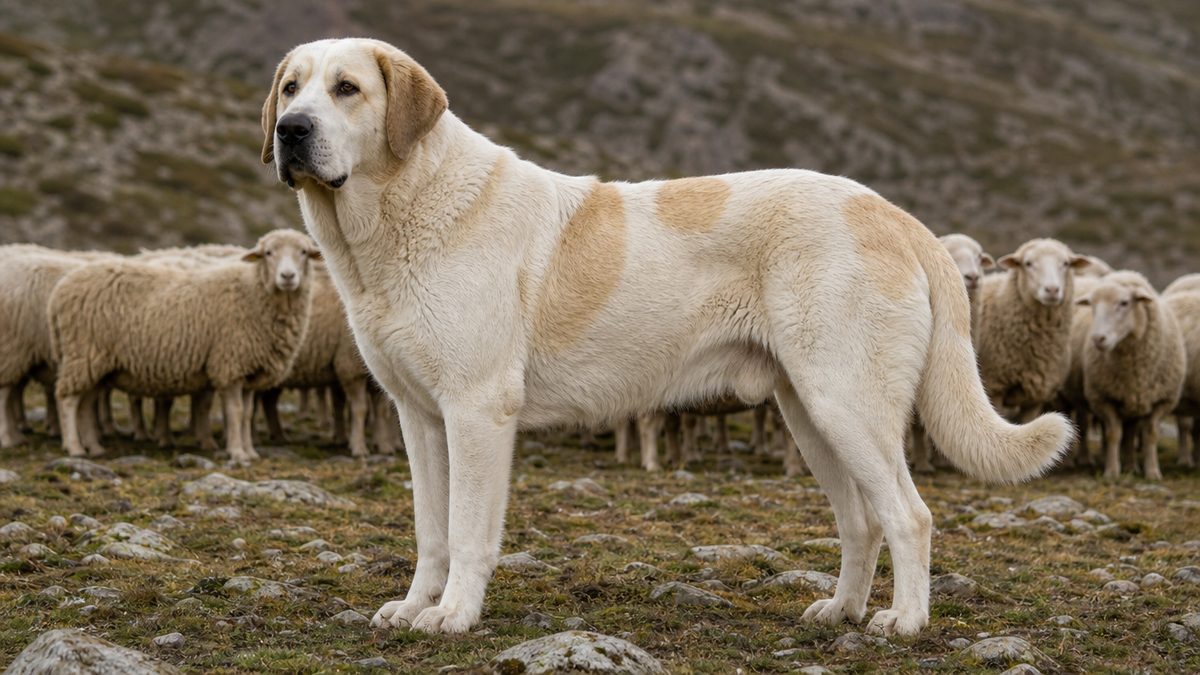
Quick answer
The cão de gado transmontano is a Portuguese livestock guardian dog standing 75-85 cm and weighing 60-75 kg in males, bred in Trás-os-Montes to guard sheep and goat flocks against Iberian wolves. The FCI recognises it provisionally as standard No. 368, accepted on 26 February 2020. It is effectively absent from India, and its cold upland origin and 60 kg-plus bodyweight make Indian plains heat a serious risk.
This guide summarises kennel-club breed standards, published conservation-programme evaluations, peer-reviewed veterinary literature, Indian import and breeding law and satellite climate data as general information for Indian pet owners. It is not a diagnosis and it is not treatment advice. Consult a registered veterinarian near you before acting on anything you read here, and treat collapse, laboured panting that will not settle, a distended abdomen with unproductive retching, or a suspected heat stroke as an emergency.
Cão de Gado Transmontano at a glance
What the Cão de Gado Transmontano is
The cão de gado transmontano is a very large Portuguese livestock guardian dog from Trás-os-Montes, standing 75-85 cm and weighing 60-75 kg in males, bred to live with sheep and goat flocks and to stand between them and the Iberian wolf. The FCI classifies it in Group 2, Section 2.2, molossoid breeds of mountain type, without working trial.
Its history is the history of Iberian transhumance. The FCI standard's own historical summary says the breed's origin 'is common to the history of all Iberian mastiffs and its evolution is linked with Peninsular transhumance routes', and describes it as 'a companion of the shepherd with specific duties in guarding against wolf attacks, since ever abundant in the area';. The Portuguese text at the Clube Português de Canicultura says the same thing in the country of origin's own words, tying the breed to the movement of flocks between the region and adjacent ones. This is not a dog that was designed. It settled into the high country of Trás-os-Montes, adapted to the steep pastures where sheep and goat flocks graze on ground that road vehicles cannot reach, and fixed morphologically around the work. The standard ties its shape directly to that: flocks graze these slopes traditionally, and the breed evolved 'in perfect symbiosis with the environment and with the work demanded'.
Size and build
Size is the first fact and the one that governs everything else on this page.
| Measure | Males | Females |
|---|---|---|
| Height at the withers | 75-85 cm | 68-78 cm |
| Weight | 60-75 kg | 50-60 kg |
The standard calls for a 'large molossoid dog, strong and rustic, standing out by its imposing and noble look and sober expression', with a square profile, high limbs and strong bone. It also insists on clear sexual dimorphism, males being noticeably taller and bulkier than females. Proportions are near-square: height at the withers and body length are almost equal, and the height at the elbow is noticeably more than half the height at the withers. That last detail is a working specification rather than an aesthetic one. Long legs under a deep but not barrel-shaped chest are what let a heavy dog cover broken ground at a trot all day.
Coat and color
The coat is thick, of medium length and abundant, with smooth, very dense hair and an obvious undercoat, running shorter and finer on the head, ears, muzzle and limbs. That double coat is the single most consequential feature for an Indian reader, and it is covered properly in the grooming and climate sections below.
Colour is unusually permissive. The commonest patterns are white marked with black, yellow, fawn or wolf grey. Solid coats come in fawn, yellow or wolf grey, brindled or not, and white markings on the feet or a white blaze on the head are common. The dog may be ticked through the body, or carry tan on the cheeks, eyebrows and anal region, making it tricolour. What the standard rejects is the two extremes: solid black and solid white are severe faults. A seller offering a solid white 'Transmontano' is offering a dog the standard penalises heavily, whatever else it may be.
Two details that matter under Indian law
The tail is described in the standard as 'Entire and thick, well covered with hair, of medium set and size, not reaching over the hock';, hanging sabre-shaped and carried high and sickle-shaped in motion. Entire means undocked. The ears are natural pendant ears, medium sized, triangular, thick and very mobile, folding forward when the dog is attentive. Nothing in this standard asks for a docked tail or a cropped ear, which places it on the right side of Indian law without any adjustment. The hind pasterns 'may present simple or double dewclaws', so dewclaws are standard-sanctioned and are meant to stay on the dog.
The bite is scissors or pincer, and an evidently undershot or overshot jaw is a severe fault. That matters because Indian breeding law lists 'undershot jaw (when incisors do not touch or mesh)' among the defects a breeding dog must have been tested for, and some molosser standards actually require the malocclusion the law names. This one does not, so no collision arises.
A 60 to 75 kg rustic mountain guardian with a dense double coat, natural ears, an entire tail and a standard that asks for calm rather than aggression. Everything difficult about keeping it in India follows from those numbers and that coat.
Breed recognition: provisional, not definitive
The FCI recognises the cão de gado transmontano on a provisional basis only, as standard No. 368, accepted on 26 February 2020 and still provisional when the register was checked on 27 August 2026 Fédération Cynologique Internationale. Every ranking page on the India SERP says 'FCI recognised' without saying which kind, and the difference is not cosmetic.
The FCI's nomenclature entry carries the status in a labelled field. It reads Breed status: Recognized on a provisional basis, with 'Date of acceptance on a provisional basis by the FCI: 2/26/2020', country of origin Portugal, and, unusually for a Portuguese breed, official authentic language: English. The standard PDF prints the same valid date, 26/02/2020, above a translation dated 27.03.2020.
What provisional status actually costs
The provisional register states the consequence on its own face: 'FCI breeds recognised on a provisional basis are not eligible for the CACIB until they are recognised on a definitive basis, but are eligible for the FCI titles (Winner of the World Dog Show, Winner of the Section Shows - Europe, Asia and the Pacific, Americas and the Caribbean). In addition, the pedigrees issued to the dogs of these breeds have to carry the FCI logo'.
So a Transmontano can be shown and can win FCI titles, but cannot accumulate the CACIB certificates that lead to an International Beauty Champion. For a buyer whose reason for wanting a rare breed is competition, that is the answer, and it is not on any page currently ranking.
Six and a half years and counting
The breed has been provisional since 26 February 2020, which is six years and six months as of this writing. That is neither unusual nor reassuring, because the register shows how wide the range is.
| Breed | Standard no. | Provisional since |
|---|---|---|
| Australian Stumpy Tail Cattle Dog | 351 | 6 July 2005 |
| Lancashire Heeler | 360 | 1 May 2016 |
| Cão de Gado Transmontano | 368 | 26 February 2020 |
| Gos Rater Valencià | 370 | 21 June 2022 |
| Buldogue Campeiro | 374 | 6 August 2025 |
| Macedonian Shepherd Dog Karaman | 378 | 11 February 2026 |
The Australian Stumpy Tail Cattle Dog has been provisional for twenty-one years. Provisional status is a waiting room with no published exit date, and nothing in the register suggests the Transmontano is close to leaving it. The register's four newest entries all date from 11 February 2026, and the Transmontano was not among the breeds promoted or added on that date.
Portugal recognised it first, in 2012
National recognition came earlier and from a different direction. The Portuguese record of Iberian wolf conservation notes that the Parque Natural de Montesinho 'contributed, indeed, to the recognition of the Cão de Gado Transmontano in 2012';. That is eight years before the FCI acted, and it explains a puzzle in the older literature: a 2004 evaluation of Portugal's guardian-dog programme describes the Transmontano in a footnote as a fourth breed 'currently under recognition by the Portuguese Kennel Club';, while a Portuguese club dossier still described the breed as awaiting FCI recognition years later. The sequence runs: working population first, national recognition in 2012, FCI provisional recognition in 2020, definitive recognition not yet.
What this means for recognition in India
The Kennel Club of India is a full FCI member, so the KCI issues pedigrees against FCI nomenclature, and the FCI's provisional status is therefore the operative answer to the India recognition question. The KCI itself publishes no breed list at all, for any breed, so a search of its site returns nothing for this breed and nothing for a Labrador either. That is a broken instrument rather than a finding, and it must not be read as the KCI declining to recognise the breed. What the FCI does publish for India is registration volume: 32,219 puppies and 33,880 purebred dogs entered in the studbook in 2025, with no breed breakdown.
The FCI serves a decoy: a URL ending 'breeds-recognised-on-a-provisional-basis-2.html' returns HTTP 200 and a complete English Setter page. The register used here is at /nomenclature/provisoire.aspx, and its own heading reads 'Breeds recognised on a provisonal basis'. FCI breed URLs also resolve on the trailing number rather than the name, so the breed page and the standard PDF were both checked for the name printed inside them before any figure was taken.
The wolf-coexistence programme, and which one this breed is actually in
The cão de gado transmontano is placed with flocks to reduce wolf predation, and therefore to reduce the retaliatory killing of wolves, but it sits in two different Portuguese programmes that are constantly conflated. Separating them is the first honest thing anyone can say about this breed, because only one of them produced the numbers everybody quotes.
The logic behind both programmes is the same, and it is worth stating because it is not obvious. Portugal's Iberian wolf has been fully protected since the Lei de Proteção do Lobo-Ibérico, Lei 90/88 of 13 August 1988, and is classified Em Perigo, Endangered, the highest threat category. The main cause of its decline is illegal persecution by shepherds, motivated by livestock losses. A guardian dog is therefore not primarily a livestock intervention. It is a wolf intervention that works by removing the shepherd's reason to kill wolves.
Programme one: Montesinho, 1994 to 2010, and it is the Transmontano's
The Transmontano-specific action ran out of a national park. From 1994 to 2010 the Parque Natural de Montesinho, under the Portuguese conservation authority ICNF, supported livestock keepers across the Bragança district by handing over Cão de Gado Transmontano puppies specifically to sheep and goat producers, to improve flock protection and reduce the conflict arising from wolf predation. The same source records that Montesinho thereby contributed to the breed's national recognition in 2012.
This is the programme that made the modern breed. It is also the programme that published no comparable quantitative evaluation. The nearest thing to a public outcome figure is a statement by an ICNF technician at a 2014 awareness session in Parâmio, Bragança, reported by local radio, that the breed 'has contributed significantly to the reduction of Iberian wolf attacks' in the Montesinho area. The same report carries shepherds complaining that support payments for keeping the breed had been cut. That is a qualitative claim from an interested official, with no denominator, and it should be read as such.
Programme two: Grupo Lobo's Programa Cão de Gado, and its numbers are not this breed's
Grupo Lobo, the Portuguese wolf NGO founded in 1985, established its Programa Cão de Gado to rehabilitate the use of national guardian breeds across the entire wolf range, realising a proposal first drawn up in 1987. It supplies food and full veterinary care until each dog reaches maturity at two years, the point at which its effectiveness is assessed.
The Portuguese conservation record dates the Programa Cão de Gado to two years after the 1994 Montesinho action, that is 1996. Grupo Lobo's own earlier progress note also says the organisation 'initiated in 1996 a new line of action';. But Ribeiro and Petrucci-Fonseca's 2004 evaluation states the programme 'has been ongoing since 1997';. One year, three publications, two answers, and no basis in the sources for picking between them.
The critical point for this page is which dogs it used. The 2004 evaluation names three breeds, the Cão de Castro Laboreiro, the Rafeiro do Alentejo and the Cão da Serra da Estrela, and adds a footnote on the same page: 'A fourth LGD breed named Cão de Gado Transmontano (originated in the Northeast of Portugal) is currently under recognition by the Portuguese Kennel Club'. In 2004 the Transmontano was outside the sample.
Programme three, and this one does use the breed
Rewilding Portugal's LIFE WolFlux livestock guard dog programme, running since early 2020 south of the Douro, delivers dogs of the Serra da Estrela or Cão de Gado Transmontano breeds free of charge to livestock keepers, together with a year of dog food and two years of veterinary and insurance cover. It handed over its 101st dog in February 2024, past its 100-dog target, to farmers in the Guarda, Aveiro and Viseu districts and one in Castelo Branco. The Portuguese wolf population is put at 250 to 300 animals, split in two by the Douro, with only scattered packs on the southern side.
So the breed is genuinely, currently, in a wolf-coexistence programme. What that programme has published about its results is examined next, and it is not a number.
What the wolf programme actually measured, with denominators
The measured outcome is a 33 percent to 100 percent reduction in wolf damage across flocks that received a guardian dog, from Ribeiro and Petrucci-Fonseca's 2004 evaluation, and a 10 to 40 percent reduction in 60 percent of cases when each flock was compared against the damage suffered by neighbouring flocks. Both figures are real, both are widely repeated, and neither carries a stated denominator.
What the study did
The programme placed 75 pups, 38 males and 37 females, into goat and sheep flocks ranging from 50 to 700 animals in the North and Centre of Portugal. Pups went in after weaning at around seven to eight weeks, spent two to three weeks confined with the livestock overnight, then began accompanying the flock. Project staff visited every 15 days for pups under six months and every 30 days thereafter, until the dogs reached adulthood at 12 to 18 months.
The effectiveness method was a before-and-after comparison: the mean number of damages in the three years before the dog arrived, against the damages in the year after the dog turned 12 months. Evaluation was restricted to adult dogs over 18 months.
The results, and the denominator that is missing
| Finding | Figure | Stated base |
|---|---|---|
| Pups placed | 75 (38 male, 37 female) | 75 |
| Dog mortality before adulthood | 24 percent | 18 of 75 |
| Reduction in wolf damage, before vs after | 33 to 100 percent | not stated |
| Reduction relative to neighbouring flocks | 10 to 40 percent, in 60 percent of cases | not stated |
| Adult dogs attentive to the flock | almost 90 percent | not stated |
| Adult dogs that killed flock animals | 1 | not stated |
| Shepherds calling the dogs very effective | 95 percent | not stated |
| Shepherds crediting the dog for the damage reduction | 60 percent | not stated |
The mortality figure is the only one whose base can be reconstructed, and it checks out: disease accounted for 8 deaths, poison 2, four dogs died of other causes including being run over, being shot by hunters, a blow to the head and a wolf attack, and four disappeared. That is 18, and 18 divided by 75 is exactly 24 percent. Every effectiveness figure in the paper is quoted without its N. Since evaluation was limited to adults over 18 months and roughly a quarter of the cohort died before then, the base for the damage-reduction range is necessarily well under 75, and the paper never says what it is.
The authors' own warning, which nobody repeats
The paper does not claim the dogs caused the reduction. It states that 'there was a considerable variability in the number of damages throughout the years, suggesting that other factors unrelated to the dog's action (e.g. fluctuations in predators density, availability of alternative prey, changes in flock management, and in habitat conditions affecting the efficiency of the attacks) could also be responsible for the observed changes';. A before-and-after design without a control group cannot separate the dog from the year, and the authors say so.
One further figure from the same paper reframes the whole conflict, and it is the most useful thing on this page for anyone thinking about livestock guardians anywhere. In some areas of Portugal, kid-goat mortality from lack of disease prevention can exceed 50 percent of the yearly production per flock, while the maximum recorded wolf predation was around 5 percent. The predator that shepherds organise against kills roughly a tenth of what poor husbandry does.
And the current programme has published no figure at all
LIFE WolFlux, the programme that actually uses this breed, reports its outcome qualitatively. Its veterinarian states that 'although the dogs haven't completely stopped wolf attacks, many farmers haven't experienced a single attack since they received a dog', and that guard dogs 'will undoubtedly reduce predation';. 'Many farmers' is not a proportion, and 'undoubtedly' is not a measurement. After 101 dogs placed over four years, no predation-reduction rate, no denominator and no comparison group has been published.
A systematic review of the whole literature from 1990 to 2016 screened 27,781 publications, read 562 in full, and found only 21, that is 3.7 percent, using a case-control design. Just five of those 21 concerned livestock guarding dogs. Four suggested lower predation risk, with risk ratios as low as 0 for lambs in fenced herds and 0.08 on open range in one North American study. One of the five measured a risk ratio of 1.7, that is more depredation where the dog was present, though the authors attributed that to the herd being the wrong statistical unit since only part of it was guarded. None of the five was Portuguese, and the review could not meta-analyse because it had a mean of 3.2 studies per intervention.
How big the programme is, and what it will not tell you
Grupo Lobo's Programa Cão de Gado has supported more than 380 livestock breeders and integrated more than 690 puppies of the four Portuguese guardian breeds into goat, sheep and cattle herds. It names the Transmontano as one of those four, and then declines to say how many of the 690 were Transmontanos.
The breed split, and the gap in it
The Results page gives a partial breakdown: roughly 55 percent of integrated dogs were male and 45 percent female, with about 340 Serra da Estrela dogs, mostly short-haired, and more than 280 Castro Laboreiro dogs. Add those and you get 620 of more than 690, which leaves roughly 70 dogs to be divided between the Transmontano and the Rafeiro do Alentejo across the programme's whole history. No Transmontano-specific placement count is published on any of the programme's pages, and that absence was confirmed rather than assumed: all three pages load, carry full content, and name the breed explicitly.
So the honest ceiling is this. The Transmontano is one of four breeds in a programme of roughly 690 dogs, and it is not one of the two that account for 620 of them. It is a minority breed inside the programme most often cited as evidence for it.
Grupo Lobo's main programme page says the programme 'has already delivered more than 600 dogs';. Its Results page says 'more than 690 puppies';. Same organisation, same website, two figures. We are printing both rather than averaging them or picking the larger, and a reader quoting either should say which page it came from.
The second evaluation, which finally supplies a denominator
The 2004 paper gave a reduction range with no N. A later analysis does better. Grupo Lobo reports, citing Ribeiro and Petrucci-Fonseca's 2005 paper in Carnivore Damage Prevention News, that according to 90 participating livestock farmers the presence of the dogs reduced wolf losses in 74 percent of cases, with the recorded decrease varying between 13 percent and 100 percent. That is a stated base of 90 farmers, which is the clearest denominator anywhere in this literature.
| Ribeiro & Petrucci-Fonseca 2004 | Ribeiro & Petrucci-Fonseca 2005, as reported by Grupo Lobo | |
|---|---|---|
| Reduction range | 33 to 100 percent | 13 to 100 percent |
| Proportion showing a reduction | 60 percent of cases, relative to neighbouring flocks | 74 percent of cases |
| Stated base | not stated | 90 participating livestock farmers |
| Behaviour rating | almost 90 percent of adult dogs attentive | more than 90 percent rated Very Good or Excellent |
The two do not agree and should not be blended. The 2005 range starts at 13 percent rather than 33, which is a materially weaker floor, and the 74 percent and 60 percent figures are measuring different things against different comparisons. One arithmetic caution: 74 percent of 90 is 66.6, which is not a whole number of farmers, so the underlying count is not recoverable from the published figure and should not be reconstructed.
Dog mortality: 24 percent or over 40 percent
The programme's own current figure for how many of these dogs die young is far worse than its 2004 one. Grupo Lobo states that the hazards of the job 'result in a mortality rate of over 40 percent in the first 2 years of life, although some have managed to live beyond 12 years of age';. The 2004 evaluation reported 24 percent, or 18 of 75. Grupo Lobo cites two American series for comparison, one of 449 dogs with 50 percent mortality and one of 100 dogs with 39 percent in the first two years and 6.3 percent thereafter. Anyone romanticising this breed's working life should sit with those numbers: between a quarter and a half of the dogs placed do not reach two years old.
What the wolf population is doing, including at home
Portugal's 2019/2021 national wolf census detected 58 packs, confirming 56 and rating two as probable, across 182 UTM squares of 10 by 10 km covering roughly 15,700 square kilometres. ICNF puts the population at about 300 animals, the midpoint of an estimate range of 190 to 390, built on a mean of three adult or subadult wolves per pack. The wolf has been strictly protected since Lei 90/88 of 13 August 1988 and has held the threat status Em Perigo, Endangered, since 1990.
The trend in the breed's own district is the uncomfortable part. Between the 2002/2003 and 2019/2021 censuses, national pack numbers fell from 63 to 58, a decline of 8 percent, and the Bragança nucleus, the Transmontano's home ground, fell from 25 packs to 22, a decline of 12 percent. Only Peneda and Gerês grew, from 16 packs to 24. Seventeen of the 58 packs, 29 percent, hold territories shared across the Spanish border.
Price in India: there is no price, and that is the finding
No Indian source quotes a price for a live cão de gado transmontano, because no Indian supply exists. That is the first line of this section rather than the last, because it is the most useful thing an Indian buyer can be told. Every rupee figure that surfaces on this breed name belongs to a book, a piece of merchandise, or a different breed entirely.
The searches behind that statement were controlled before the absence was reported. A query for Indian rupee prices for this breed returned zero results, while the identical query pattern run for a Labrador in the same session returned five plausible Indian price pages, so the instrument was working. One further check, a site-restricted search of a large Indian listing site, returned zero for this breed and zero for Labrador, which is impossible; that instrument was broken and no conclusion was drawn from it. Another Indian listing site returned an HTTP 403 human-verification wall. Those two are recorded as undetermined rather than as evidence of absence.
What the rupee figures actually are
| Figure | What it is | Divided by 84.38 | Divided by 74 | Verdict |
|---|---|---|---|---|
| Rs 1,452 | A paperback book about the breed, Amazon India | 17.21 | 19.62 | Converted list. USD 19.62 at 74 is a 19.99 print-on-demand paperback |
| Rs 442 | The ebook edition of the same book | 5.24 | 5.97 | Converted list. USD 5.97 at 74 is a 5.99 ebook |
| Rs 3,216 | A sweatshirt, Etsy | 38.11 | 43.46 | Live marketplace currency conversion |
| Rs 2,929 | A baby bodysuit, Etsy | 34.71 | 39.58 | Live marketplace currency conversion |
| Rs 98,999 | An Anatolian Shepherd listing on an Indian site | 1,173.25 | 1,337.82 | Rupee-native and arbitrary. Not this breed |
The two Amazon figures are the only ones on this page that behave like a genuine converted list, and they are converting the price of a book. Divide Rs 442 by 74 and you get 5.97, which is a 5.99 ebook; divide Rs 1,452 by the same rate and you get 19.62, which is a 19.99 paperback. That is what a real conversion looks like: the quotients are prices a seller would actually print.
The Rs 98,999 house price, and why it is not this breed's
Rs 98,999 is a recurring charm price on one Indian listing site, and it is attached to whichever puppy is in stock rather than to any breed. The same site prints the identical Rs 98,999 on its Anatolian Shepherd, Weimaraner, French Mastiff and Neapolitan Mastiff listings, four unrelated breeds. It survives no conversion test: 98,999 divided by 84.38 is 1,173.25, by 74 is 1,337.82, by 80 is 1,237.49 and by 66.67 is 1,484.91. No seller anywhere prices a dog at 1,173 dollars and 25 cents. It is Rs 99,000 minus one rupee, a rupee-native charm price with no dollar behind it. The decisive detail is that the same site carries no Transmontano page at all, so the breed is not even in the template mill's inventory.
One near-miss deserves naming, because it is exactly the trap the 80 test sets. A different listing on the same site, Rs 1,59,999, divides by 80 to 1,999.99, which looks like a real 2,000 dollar price. It is not. Rs 1,60,000 divided by 80 is 2,000 by construction, because 1,000 divided by 80 is 12.5 and any figure ending in three zeros divides cleanly at that rate. Take one rupee off and you get 1,999.99. The match is arithmetic, not evidence.
One more figure that is not a price
A Facebook post circulating a breed list appeared to show 'TRANSMONTANO MASTIFF' beside numbers, alongside entries reading 'TIBETAN MASTIFF (230)' and 'TOSA (260)'. Those are FCI breed standard numbers, not prices. The Tibetan Mastiff is FCI standard 230 and the Tosa is 260, exactly as this breed is 368. Read as a price list it would produce a dramatic and entirely false claim.
What Indian pages offer instead
The only India-hosted written profile of the breed found on the SERP is a retailer's breed page that carries no price, no puppies, and a product search returning no results. The social-media accounts that surface the breed name are Indian pet shops using long lists of breed names as hashtag spam while actually selling Golden Retrievers and Tibetan Mastiffs. If an Indian seller offers you a Transmontano, the reasonable prior is that you are being offered something else with a rare name attached, and the FCI import position discussed under adoption means there is no lawful commercial route by which a real one could have arrived.
What it would actually cost to keep
The honest cost structure for a cão de gado transmontano in India is dominated by food volume and by heat mitigation, and we are not publishing a monthly rupee total, because there is no verified Indian cost data for this breed and inventing one would be worse than leaving the gap. What can be said is which cost centres are real and how they scale.
The clearest external evidence of what this breed costs to keep comes from the programme that gives them away. Rewilding Portugal's LIFE WolFlux hands over the dog free, then supplies dog food for a full year and covers every dog's veterinary and insurance costs for two years. A conservation programme funded by the European Commission's LIFE instrument does not subsidise trivial costs. Food and veterinary care for the first two years are the two line items a funder judged large enough to remove as a barrier for a working livestock keeper.
The cost centres, in the order they bite
- Food volume. An adult male at 60-75 kg eats on a completely different scale from the 25-30 kg dogs most Indian feeding guidance is written around. Whatever your brand costs per kilogram, multiply by the ratio of bodyweights before you budget.
- Cooling. Air conditioning through the hot months is not a luxury for a dense double-coated dog in a city whose wet-bulb sits 5 to 10 degrees above its origin, and it is a recurring electricity cost, not a one-time purchase.
- Veterinary care priced by weight. Anaesthesia, most drugs and many procedures are dosed and charged by bodyweight, so a 70 kg dog costs multiples of a 15 kg dog for the same intervention.
- Containment. A guardian breed that decides for itself needs fencing that actually holds it, and that is a capital cost most Indian homes have not budgeted.
- Import, if the dog is not already yours. Quarantine, an Advance No Objection Certificate and an import authorisation apply, and the commercial route is closed outright.
Why no rupee figure appears here
Bonbeno publishes cost figures where at least three Indian sources can be compared and the disagreement between them shown. For this breed there are zero Indian sources of any kind quoting an ownership cost, so there is nothing to compare and nothing to disagree about. A monthly figure produced by scaling another breed's Indian cost by bodyweight would look precise and would be an invention with a decimal point, which is exactly the failure mode this site exists to avoid. Where no reliable figure exists, we say so.
The cost nobody budgets
The largest realistic cost is the one that does not appear on a spreadsheet. Roughly one in seven heat-related illness events in a large primary-care dataset ended in the dog's death, and three quarters of those events were exertional Hall, E.J., Carter, A.J. & O'Neill. An emergency presentation for heat stroke in a 70 kg dog is expensive, frequently unsuccessful, and, in an Indian city, foreseeable. Budgeting for this breed honestly means budgeting for the possibility that the climate ends the arrangement early.
Before costing this breed, cost the alternative. An adopted Indian pariah dog carries no purchase price, no import authorisation, no quarantine, no air-conditioning requirement through the hot months, and a bodyweight that makes every weight-priced veterinary line item a fraction of what a 70 kg dog costs.
Suitability for the Indian climate
The cão de gado transmontano is built for a place with an annual mean of 10.9 degrees Celsius and a January mean daily minimum of 0.1 degrees, which is the coldest origin climate of almost any breed on this site. Chennai's annual mean runs 17.1 degrees warmer than that, and its coldest month's mean daily minimum is 20.9 degrees, which is above Bragança's warmest month's mean. There is no Indian city that resembles this dog's home.
Every figure below was pulled from NASA POWER by explicit latitude and longitude rather than by place name, because slug-based climate sites on this project have repeatedly served a complete, correctly formatted document for the wrong city at HTTP 200. The climatology period the API returned is '30-year Meteorological and Solar Monthly & Annual Climatologies (January 1991 - December 2020)';. Monthly mean daily maxima and minima were computed from the 1991-2020 daily series, 10,958 records per point with no fill values, because the climatology endpoint's maximum and minimum fields are period extremes rather than monthly means and pairing an extreme with a mean humidity would produce a badly wrong answer.
Origin against four Indian metros
| Location | Annual mean | Coldest month mean daily min | Hottest month mean daily max | Humidity that month | Wet-bulb from mean daily max |
|---|---|---|---|---|---|
| Bragança, Trás-os-Montes (origin) | 10.9 C | 0.1 C (Jan) | 28.7 C (Jul) | 51.5 percent | 21.4 C |
| Delhi | 25.7 C | 7.0 C (Jan) | 42.2 C (Jun) | 35.3 percent | 29.1 C |
| Mumbai | 26.7 C | 16.9 C (Dec) | 37.8 C (May) | 60.5 percent | 31.1 C |
| Chennai | 27.9 C | 20.9 C (Jan) | 36.6 C (May) | 63.7 percent | 30.6 C |
| Bengaluru | 23.6 C | 14.6 C (Dec) | 35.8 C (Apr) | 47.8 percent | 26.8 C |
Read the wet-bulb column rather than the dry-bulb one. Wet-bulb temperature is what limits evaporative cooling, and a panting dog cools evaporatively. Against Bragança's July wet-bulb of 21.4 degrees, Mumbai runs 9.7 degrees higher, Chennai 9.2, Delhi 7.7 and Bengaluru 5.4 NASA POWER daily point series, 1991-2020 NASA POWER daily point series, 1991-2020 NASA POWER daily point series, 1991-2020. Bengaluru is the mildest of the four on both measures and is still 12.8 degrees warmer than the origin on annual mean.
The humid cities are worse than the hot one
Delhi is the hottest Indian city in the table on dry-bulb, at a June mean daily max of 42.2 degrees, yet its June wet-bulb of 29.1 is lower than Mumbai's May figure of 31.1 NASA POWER daily point series, 1991-2020. Delhi's own worst month for heat stress is not June at all: it is July, at a wet-bulb of 30.7 degrees, when the monsoon adds humidity to heat that is still substantial. Bengaluru's peak likewise shifts from April to May, at 27.5 degrees. If you are assessing this breed against an Indian city, the dry-bulb maximum will mislead you about which month is dangerous.
Both wet-bulb columns are computed from 30-year monthly averages, so they smooth away every individual hot and humid day. Real peak wet-bulb hours run substantially higher than any figure here, and none of these may be read as a survivability threshold. The Stull approximation was validated against the paper's own worked example, where 20.0 degrees at 50 percent humidity returns 13.7 degrees.
The hill stations do not rescue it, and here is why we cannot say more
The obvious thought is that a Himalayan hill station might suit a cold-climate mountain dog, and it may well. We are not publishing figures for Shimla or Leh, because the satellite data does not support them. NASA POWER's grid cell for Shimla sits about 1,297 metres below the town's true elevation, and its Leh cell sits about 1,119 metres above Leh, so the returned series describe different places at different heights. A cell that low reports Shimla as far warmer than a 2,195-metre hill station is. Rather than print a figure we know is measuring the wrong altitude, we are saying that a station-based source is needed for those two, and that we did not have one. The same check ruled out treating Vinhais, in the Montesinho area, as independent corroboration of Bragança: both requests return the identical grid cell and byte-identical data.
The verdict by city
- Chennai, Kolkata and coastal Kerala: unsuitable. A wet-bulb near 30.6 degrees through the hottest month, on a dog carrying a dense double coat, leaves almost no evaporative headroom.
- Mumbai: unsuitable, and the worst of the four on wet-bulb at 31.1 degrees.
- Delhi, Jaipur and the northern plains: unsuitable in summer, and the monsoon is worse than the pre-monsoon heat. A January mean daily minimum of 7.0 degrees gives roughly two workable months a year.
- Bengaluru and Pune: the least bad Indian option and still poor. Bengaluru's April mean daily max of 35.8 degrees is 7.1 degrees above Bragança's July figure.
- Himalayan uplands: plausible on first principles and unquantified here, because the satellite grid does not resolve those elevations.
Heat risk: what the evidence supports and what it does not
The strongest evidence bearing on this breed's heat risk is Hall, Carter and O'Neill's 2020 study of 905,543 UK dogs, in which dogs over 50 kg had 3.42 times the odds of heat-related illness compared with dogs under 10 kg. That finding applies to the Transmontano by bodyweight. It does not apply to it by breed, because the breed is not in the model, and that distinction is worth spelling out.
The weight-band figure, with its reference category and its limits
| Bodyweight band | Odds ratio | 95 percent CI | P |
|---|---|---|---|
| Under 10 kg | Base | ||
| 10 to under 20 kg | 1.82 | 1.31-2.53 | <0.001 |
| 20 to under 30 kg | 2.13 | 1.51-3.02 | <0.001 |
| 30 to under 40 kg | 1.74 | 1.14-2.65 | 0.010 |
| 40 to under 50 kg | 1.76 | 0.91-3.40 | 0.093 |
| 50 kg and over | 3.42 | 1.54-7.57 | 0.002 |
Three things have to be said alongside that 3.42, or it becomes a slogan. First, the reference is a dog under 10 kg, so the sentence is 'compared with a Pomeranian', not 'compared with an average dog'. Second, the band rests on seven cases against 6,391 non-case dogs, which is why the confidence interval runs from 1.54 all the way to 7.57. That is a real effect measured imprecisely. Third, the band is open-ended. A 60 to 75 kg Transmontano male falls inside 'over 50 kg' but sits well above the typical UK dog populating it, so the figure is if anything conservative for this breed, and no one can say by how much.
One more caution. These odds ratios come from a model in which bodyweight replaced the breed variable, because bodyweight is definitive of breed type and the two cannot sit in the same model. So the 3.42 is not additive with a breed effect.
The figure that transfers cleanly
The more useful number for a breed page is a different one. In the study's main multivariable model, dogs whose bodyweight was at or above the mean for their own breed and sex had 1.42 times the odds of heat-related illness (95 percent CI 1.12-1.80, P 0.004) compared with dogs below their breed and sex mean. That is about a dog being heavy for itself, which applies to a Transmontano regardless of whether the breed was studied, and it is directly actionable: keeping this dog lean is a heat intervention, not just a joint one.
Why we are not quoting a breed-specific odds ratio
The breed is absent from the model. Hall and colleagues included a named breed category only where there were at least five heat-related illness cases and/or at least 5,000 dogs of that breed in the study population. A search of the paper's full text, its XML, its HTML and its supplementary tables returns zero occurrences of 'Transmontano', against control searches in the same documents returning 17 to 29 hits for Labrador and 25 to 29 for Bulldog. No livestock guardian breed of any kind appears among the 34 named categories, and the only mastiff-type named is the Dogue de Bordeaux at OR 5.31. A Transmontano in that dataset would have been pooled into 'other purebred', which carried an odds ratio of 1.28 with a confidence interval of 0.76 to 2.14, not statistically significant.
The study's brachycephalic finding, an odds ratio of 2.10, likewise does not transfer. The Transmontano is mesocephalic: its standard calls for a muzzle only slightly shorter than the skull. Borrowing a flat-faced breed's risk for it would be fabrication wearing a citation.
Exercise is the trigger, not the car
The companion paper from the same team analysed 1,259 heat-related illness events from 1,222 dogs and found exertional heat-related illness was the predominant trigger at 74.2 percent of the 879 events where a cause was recorded, against 12.9 percent environmental and only 5.2 percent from confinement in a vehicle. In the main study, 40 percent of cases, 158 of 395, occurred in July, and the event fatality rate was 14.18 percent, 56 deaths from 395 events, with a confidence interval of 11.08 to 17.96 percent.
Roughly one in seven heat-related illness events killed the dog, and three quarters of events were brought on by exercise rather than by being shut in somewhere hot Hall, E.J., Carter, A.J. & O'Neill. A guardian breed that wants to patrol, in a country where the ambient wet-bulb already sits 5 to 10 degrees above its origin, is the exact combination those numbers describe. The dog will not stop itself.
Temperament and household fit
The breed standard describes the cão de gado transmontano as 'a docile but reserved dog', 'cautious without being aggressive, always calm and with a serene expression';, and disqualifies dogs that are either aggressive or overly shy. The breeders' association is blunter about what that means in a home, and its verdict is the one to weigh: 'This dog is not for everyone and it is certainly not adapted to live in an urban flat';.
What the standard actually specifies
The temperament clause is unusually detailed, and every line of it is a working specification. The dog 'is an exceptional guard when protecting flocks against wolf attacks, always attentive in its duty'. It 'lives and socializes with other males without conflict, imposing a dominance hierarchy when living in groups', and the standard notes that guarding a flock 'is never done by a single animal';. With strangers, 'after an initial reserve, it allows handling without problems, being very sensitive to gentle treatment and attention'.
Read that as a job description rather than a personality profile. This is a dog designed to work in a group, at distance from people, making its own decisions about threats. Nothing in it describes a dog that waits to be told what to do.
Independence is the defining trait, and it is deliberate
The breeders' association explains where the independence comes from. Pups join the herds at two months old and learn from the lambs and their own mothers. 'Contact with humans is scarce and the relationship with the shepherd is weak. They soon learn to live on their own and to make important decisions on their own';, and the association adds that they 'very often reach adulthood without being aware that they have a name to which they should respond'. Even when the open country is swapped for a garden, it says, the dog 'has this genetic inheritance well imprinted and is naturally curious, suspicious and independent', and 'instinctively knows how to mark his territory';.
The association is equally frank that the temperament is 'dominant and patronising regarding other domestic animals he lives with but he considers to be inferior';. In a Portuguese yard that is manageable. In an Indian household with an existing cat or a small dog, it is a standing negotiation.
Resource guarding, and why it exists
The single most useful behavioural warning comes with its own explanation. 'The Transmontano Mastiff pup is jealous and possessive, which can represent danger when he reaches adulthood, if we don't train him to control that instinct';. The association traces it to the working reality: in the field the strongest survives, and 'defending the little food he is given becomes a primary survival need'. It therefore says the pup must learn at home to have its food and toys touched without growling, and to tolerate the family showing affection to other pets and children, 'because the master himself becomes an object of great importance that he won't want to share with anybody';.
Males and females are not the same dog
The association draws a sharper sex difference than most breed sources do. The male 'is dominant by nature and has a more impetuous and rebellious character', while females 'are more docile and tender, although they don't have the same impressive look of the male'. Its own recommendation is explicit: 'It is certainly easier to live with a female Transmontano Mastiff, and this is something to be considered before acquiring a dog';. The standard supports the physical half of that: males are noticeably taller and bulkier, at 75-85 cm and 60-75 kg against 68-78 cm and 50-60 kg.
Living conditions, stated plainly
The association names the failure mode. Used to vast spaces, 'these dogs suffer intensely when kept captive, confined by chains or kennels';, growing sad, gloomy and constantly barking. It also says that anyone wanting a dog to be left alone on a farm without human contact should choose a different breed entirely, because 'the Transmontano Mastiff must have a mission to fulfil and a shepherd to guide him';. A massive, protective, independent guardian with no flock and no space is the specific configuration this breed handles worst.
The association describes the breed digging holes big enough to lie in within minutes, and explains it directly: 'The harsh climate of Trás-os-Montes explains this need: in the country, to escape the winter cold or the summer heat, the best solution is a good hole in the ground';. That is a heat-management behaviour, and in a climate 5 to 10 degrees warmer on wet-bulb than the one it evolved for, the dog will do it harder and more often. An Indian garden will not survive it, and a balcony gives the dog no option at all.
Training: what works and what this breed resists
To train a cão de gado transmontano you work on respect and consistency rather than obedience drills, because the breeders' association states outright that 'he does not need to be trained to fulfil his guarding task'; and that what he does need is to be taught 'to live by the rules and respect the family, friends and other domestic animals in the house'. The guarding is free. The manners are the entire job.
The association's own timeline
The breeders' association gives specific age-linked targets, which is rare in breed writing and worth reproducing.
| Age | What the dog should already do |
|---|---|
| 2 months | Walk on a lead without pulling, respond to his name, use a toilet area if living indoors, stay alone at night without howling, and treat a sharp voice as a reprimand and the word NO as demanding immediate obedience |
| 3 months | Accept a firm reprimand without baring his teeth. The association's keyword is respect |
| Under 12 months | Grow from roughly 8 kg and 35 cm at 50 days to about 60 kg and 80 cm |
| After 12 months | Become a skilled protector of his territory, which the association says happens on its own |
That growth line is the reason the timeline is compressed. You have a few months to establish rules with an animal you can still lift, and after that you are negotiating with a 60 kg dog.
What the breed resists
Force. The association is unambiguous: 'Physical force and violence are last resource alternatives and more than often bring results contrary to those that are desired. Because this dog is stubborn and very intelligent and does not easily forget an offence or abuse, he can even become spiteful';. Its recommended method is tonal, using harsh reprimands for errors and 'lavish praise through words and verbal incentives' for success, so the dog learns to read voice rather than to fear hands. It sums the approach up as 'discipline allied to affection'.
It also warns about two affection behaviours that are charming in a puppy and dangerous later. Pawing 'with an impulse of a 60 kg body can have devastating effects once the dog grows up', and the breed's habit of nipping to show love becomes 'quite painful' in an adult. On both, the association adds: 'Beware that they are very stubborn and won't learn easily!';.
The evidence on how these dogs go wrong
The 2004 programme evaluation identified seven juvenile dogs behaving incorrectly, and named the cause: 'mostly due to incorrect behaviour by the shepherds that were reinforcing their own bond with the dog or limiting their contact with livestock';. In two cases where the handlers did not change, the dogs had to be transferred to other flocks. That is the clearest finding in the literature about training this type of dog, and it is uncomfortable: the commonest problem was the handler bonding with the dog too much.
The same study assessed dogs on the three components Coppinger and Coppinger defined for guardians, attentiveness, trustworthiness and protectiveness. Almost 90 percent of adult dogs were attentive to the flock, all adults showed protective behaviour, and only one adult dog ever attacked and killed flock animals, and was immediately removed. Trustworthiness, in other words, is very high once the dog is grown, and the risk window is adolescence.
What this means if you socialise one in an Indian city
You cannot socialise this dog to a flock, so you must socialise it to the environment it will actually guard. Introduce building staff, delivery riders, neighbours and their dogs deliberately and repeatedly in the first six months, while the dog is small enough to manage. Train a reliable recall and a settle before the dog outgrows your ability to enforce anything physically. And accept the association's warning about what happens if you do not put the time in: instead of a companion 'willing to trade his life for that of the family', you will 'live with a stubborn, independent and uncontrollable beast' that is 'still be very intelligent';.
Daily exercise requirement
A working cão de gado transmontano covers 15 to 20 km in a single day with its flock, according to the Portuguese breeders' association, and it describes that level of activity as 'vital for him to grow up normally and for the development of his powerful skeletal structure, as well as for his emotional development and psychological balance'. No Indian city routine reproduces that, and the heat is what stops you trying.
The dog is built for it. The FCI standard notes that 'despite the size and corpulence, the gait is light, energetic, rhythmical and with great extension', while the Portuguese text describes a light, elastic trot with an energetic gallop when the work demands it Clube Português de Canicultura. The association adds that an adult can jump clear of the ground on all four feet and clear a high wall without a run-up, which is a containment problem as much as an exercise one.
The collision with Indian heat
Here is the difficulty in one sentence: the breed needs sustained daily distance, and sustained exertion is precisely what causes heat-related illness. In UK primary-care data, exertional heat-related illness accounted for 74.2 percent of events, against 5.2 percent from confinement in a vehicle, and dogs over 50 kg carried 3.42 times the odds of an event compared with dogs under 10 kg. A dog that wants 15 km and weighs 70 kg, in a city whose hottest month sits above a 30 degree wet-bulb, is the exact case those numbers describe.
A controlled walking study in a hot, sunny tropical climate gives a sense of the physiology. Across 135 walks at black-globe temperatures from 19 to 50 degrees Celsius, walking when black-globe temperature exceeded 35 degrees produced a hair-coat temperature rise of 20.5 degrees, a skin temperature rise of 7.2 degrees, and a respiratory rate climbing from roughly 47 to about 374 breaths per minute, against walks below 30 degrees. That study used five mixed-breed dogs in Brazil, not double-coated giants in India, so treat it as an illustration of direction and magnitude rather than a figure for this breed.
A workable Indian routine, if you have one of these dogs
- Walk before sunrise and after full dark, and treat the middle of the day as unavailable from March to October in most of the country.
- Measure the surface, not the air. If the pavement is too hot for the back of your hand for five seconds, it is too hot for the dog's pads.
- Split the distance into two or three shorter outings rather than one long one, which lowers the exertional load per session.
- Carry water and offer it often, because the tropical walking study recorded a 215 ml increase in intake on the hottest walks.
- Stop on the first sign of laboured panting that does not settle, and treat it as an emergency rather than a rest break.
Substitute mental work for distance where you cannot give distance. Scentwork, food puzzles, long chews and structured patrolling of a secure yard use the dog's attention without loading it thermally. None of this replaces 15 km, and you should not pretend to yourself that it does.
An animal that can clear a high wall without an impulse, digs a body-sized hole in minutes, and considers its space 'truly his, under his guard' is not contained by an ordinary Indian compound wall or a gate. Fencing that actually holds this breed is a capital cost, and an escaped 70 kg guardian in an Indian street is a public-safety problem, not just a lost dog.
Grooming and coat care in Indian humidity
You groom a cão de gado transmontano by brushing the undercoat out often enough that it never mats, and by keeping the ears dry, because the coat the standard specifies is 'thick, of medium length and abundant', with hair that is 'smooth and very dense' and an undercoat that is explicitly 'obvious';. A coat built to hold warmth on a Portuguese hillside becomes a humidity trap in an Indian monsoon.
What the coat actually does
A double coat is an insulating layer, and there is measurement behind that. Infrared thermography of 50 privately owned dogs, acclimated at 23 degrees Celsius, found double-coated dogs carried a mean body surface temperature of 28.25 degrees against 31.77 degrees for short-coated dogs, a difference of roughly 3.5 degrees. That is the coat holding heat away from the surface, in both directions.
Be careful what you conclude from it. That study does not show that double-coated dogs overheat more, and it says nothing about clipping. We could find no controlled canine study testing whether clipping a double coat impairs heat dissipation. The widely repeated advice never to shave a double-coated dog is grooming-trade convention, not published evidence, and this page will not dress it up as a finding. What is evidenced is that the coat is an insulating layer; what follows for clipping is genuinely unsettled.
The routine
- Brush two to three times a week through the whole year, and daily during a coat blow, working down to the skin rather than over the top of it.
- Use an undercoat rake rather than a slicker alone, because the dense undercoat is what mats and a surface brush will leave it.
- Dry the dog properly after every bath and every soaking, especially the neck folds, where the standard describes loose skin forming a simple dewlap up to the withers.
- Check the ears weekly and after any swim or heavy rain, since the ears are thick, pendant and mobile, which is the shape that traps moisture.
- Inspect for ticks daily in the monsoon, working through the ruff, the ear bases, between the toes and around the dewclaws.
Do not air-dry this dog in an Indian monsoon
Overseas guardian-breed guidance often says to towel a working dog and let it dry naturally. That is reasonable in a dry upland climate and poor advice in Indian monsoon humidity, where a dense undercoat can stay damp for a day. Two Indian veterinary series show why ear care matters, and they disagree with each other, which is worth knowing rather than hiding.
| Series | Cases / screened | Peak season | Peak share | How that season is defined |
|---|---|---|---|---|
| Palam Valley, Himachal Pradesh | 81 of 2,476 (3.27 percent) | Rainy | 59.25 percent (48 of 81) | July and August only |
| Durg, Chhattisgarh | 51 of 281 (18.14 percent) | Summer | 41.18 percent (21 of 51) | March to June, four months |
The Palam Valley series puts 59.25 percent of otitis cases in a two-month rainy window, with summer at 18.51 percent, winter at 12.34 percent and autumn at 9.87 percent. The Durg series puts 41.18 percent in summer against 33.33 percent in the rains and 25.49 percent in winter. Both sets of rows sum to their stated totals and every percentage divides out correctly, so neither is an error. The disagreement is substantially an artefact of how each study cut the calendar: Durg's four-month summer absorbs the pre-monsoon build-up that Palampur separates out, and Durg has no autumn category at all. The practical answer is the same either way, which is to keep the ears dry from March through September rather than to pick a month.
Nobody markets this breed as hypoallergenic, which spares us the usual argument. What it does attract is the claim that a rustic working coat needs no maintenance. The standard's own words are 'very dense' with an 'obvious' undercoat; dense coats on 70 kg dogs in humid heat need more brushing than a short-coated dog, not less.
Health problems, screening and lifespan
No breed-specific health data exists for the cão de gado transmontano. It has no entry in the Orthopedic Foundation for Animals database, no published lifespan study, and no breed-club screening scheme that we could find. This section gives the risks that follow from its size and structure, each sourced from breeds and populations that were actually studied, and it labels every borrowed figure as borrowed.
The screening gap, and how it was checked
The OFA statistics tables were retrieved in full and searched case-insensitively on 27 August 2026. 'Transmontano' returns zero and 'gado' returns zero. So do 'Estrela', 'Castro Laboreiro' and 'Rafeiro': not one of the four Portuguese livestock guardian breeds has a row in OFA's published disease-statistics tables. Corrected on 27 August 2026: three of them do hold OFA breed codes, read from the raw breed list at api.ofa.org/api/bb.php, the Estrela as EMD, the Castro Laboreiro as CDC and the Rafeiro do Alentejo as RA. Only the Transmontano is absent from that list as well. Holding a code means the breed can be submitted; it does not mean any dog has been. Control searches in the same dump returned 109 hits for 'Labrador' and 176 for 'mastiff', so the search was working and the absence is real. OFA requires 100 hip evaluations, or 50 for its other databases, before a breed appears at all, and none of these breeds has reached it.
Hip dysplasia: what comparable guardians actually show
Since this breed has no figures, here are the ones that do exist for large guardian breeds that are screened. These are other breeds' numbers and must not be read as this breed's.
| Breed | Evaluations | Dysplastic |
|---|---|---|
| Great Pyrenees | 7,497 | 9.5 percent |
| Anatolian Shepherd | 3,076 | 9.8 percent |
| Labrador Retriever (reference) | 324,743 | 11.3 percent |
| Komondor | 1,103 | 13.1 percent |
| Tibetan Mastiff | 1,403 | 16.7 percent |
| Kuvasz | 2,126 | 17.6 percent |
| Maremma Sheepdog | 273 | 17.9 percent |
| Cane Corso | 3,865 | 37.2 percent |
| St. Bernard | 2,967 | 49.9 percent |
The pattern in that table is the useful part. Working-selected livestock guardians cluster between 9.5 and 17.9 percent, while giant molossers selected for show type run far higher, with the St. Bernard at 49.9 percent of 2,967 evaluations. A breed kept functional by shepherds, as the Portuguese breeders' association says this one has been with human interference in breeding selection kept to a minimum, would be expected toward the lower group. That is a reasonable expectation and it is not a measurement, and nobody should quote a hip figure for this breed until somebody screens some dogs.
What you can act on is the one hip finding that is experimental rather than observational. Forty-eight Labrador puppies were split into two groups of 24, one fed freely and one given 25 percent less of the same food until two years old. By the OFA method, 7 of 24 limit-fed dogs were dysplastic against 16 of 24 fed freely; by the Swedish method, 5 of 24 against 18 of 24. Keeping a giant-breed puppy lean roughly halved the hip dysplasia rate in a controlled trial, and that transfers to any large breed.
Bloat is the risk that actually kills
Gastric dilatation-volvulus is the size-linked emergency for a deep-chested 70 kg dog. A prospective cohort of 1,914 dogs across 11 breeds recorded an incidence of 26 cases per 1,000 dog-years at risk in giant breeds over 45 kg, against 23 in large breeds of 23 to 45 kg, with a cumulative incidence of 5.7 percent across all breeds; 30 of the 105 dogs that developed it, 28.6 percent, died. A later UK emergency-practice study of 77,088 dogs found 492 cases, a prevalence of 0.64 percent, and reported that 49.7 percent of dogs presented alive survived to discharge overall, rising to 79.3 percent of surgical cases.
Two modifiable factors come from the same research group. Chest shape matters: in 155 Irish Setters, dogs with the deepest thorax relative to width carried roughly eight times the risk of the shallowest, though with only 11 cases the confidence interval ran from 1.44 to 49.57 and the estimate is very imprecise. And the counterintuitive one: approximately 52 percent of gastric dilatation-volvulus cases among giant-breed dogs, and 20 percent among large breeds, were attributed to having a raised feeding bowl. Fast eating and a first-degree relative with a history were the other significant factors.
Lifespan: no figure, and we are not borrowing one
No lifespan study covers this breed. The only longevity statement we found from a source close to the working population is Grupo Lobo's remark that although guardian dogs suffer a mortality rate of over 40 percent in the first two years of life, 'some have managed to live beyond 12 years of age';. That is an upper anecdote about working dogs, not a median for pets, and it should not be converted into a range. Pages quoting a tidy '10 to 12 years' for this breed are quoting a giant-breed convention, not a measurement of this breed.
The Indian health risks this breed walks into
The Indian-specific risk for a cão de gado transmontano is tick-borne disease, because a survey of 525 dogs across four Indian regions found 261, or 49.7 percent, infected with at least one tick-borne pathogen, and prevalence tracked the climate gradient almost exactly. A dense-coated 70 kg dog in a humid Indian city sits at the wrong end of that gradient with the largest and least inspectable surface area.
| Region | Climate as the study describes it | Dogs sampled | Prevalence |
|---|---|---|---|
| Mumbai | Tropical | 162 | 80 percent |
| Delhi | Monsoon-influenced humid subtropical | 162 | about 75 percent |
| Sikkim | Subtropical highland | 101 | 17 percent |
| Ladakh | Montane | 100 | 11 percent |
The pathogen mix matters as much as the headline. Hepatozoon canis led at 30 percent, followed by Ehrlichia canis at 20.6 percent, Mycoplasma haemocanis at 12.2 percent, Anaplasma platys at 6.5 percent, Babesia vogeli at 5.5 percent and Babesia gibsoni at 0.2 percent. Dogs carrying ticks were 3.3 times more likely to be infected, with a confidence interval of 2.2 to 4.8, and 61.3 percent of infected dogs carried more than one pathogen.
Read the regional column as a preview of what this breed's Indian life looks like. The two locations where infection was rare, Sikkim at 17 percent and Ladakh at 11 percent, are the two cold, high places where a cold-climate dog would also be most comfortable. The two where it was near-universal are the two big plains metros where almost every Indian dog owner actually lives.
What that means in practice
- Run tick prevention year round, not seasonally, and choose a product your veterinarian confirms covers the local tick species.
- Inspect by hand, not by eye. A very dense undercoat hides ticks completely, so work fingertips through the ruff, ear bases, armpits, groin, between the toes and around the dewclaws.
- Treat lethargy, pale gums, nosebleeds or unexplained bruising as urgent, since Ehrlichia canis and Babesia present that way rather than dramatically.
- Ask for a tick-borne panel rather than a single test if the dog is unwell, because more than three fifths of infected dogs in that survey carried multiple pathogens.
- Keep the yard short and clear, because a dog that digs and lies in ground hollows is deliberately putting itself where ticks are.
The two risks that compound each other
Heat and coat interact badly with tick control. You cannot solve the heat problem by clipping the coat, because there is no controlled canine evidence either way on what clipping a double coat does to heat dissipation, and you cannot solve the tick problem by leaving the coat unmanaged. What remains is the unglamorous answer: brush it out often enough to see skin, keep the dog lean, and keep it out of the heat, which happens to be the same three habits that lower heat-illness odds, hip risk and tick load at once.
There is no breed-specific screening panel to ask for, no breed club scheme to enrol in, and no OFA record to compare your dog against. An Indian veterinarian treating one of these dogs is working from giant-breed principles and general canine medicine, which is reasonable, but it means you have less information about this dog than you would about a Labrador. Factor that into the decision, not just into the care.
Care and feeding across the life stages
Feed a cão de gado transmontano puppy less richly than its size suggests, because the Portuguese breeders' association warns explicitly that 'it is a mistake to feed them with very rich food and calcium-based additives', and a controlled trial in Labradors shows that restricting intake by 25 percent roughly halved hip dysplasia rates Kealy, R.D., Olsson, S.E., Monti. The instinct to pour food into a giant puppy is the instinct to resist.
Why the metabolism is built for less
The association explains something that surprises most owners: weaning pups of this breed 'eat relatively little and show little appetite' despite doubling in size between two or three and six months. Its explanation is ecological. Under working conditions the food given to weaning pups is 'always poor', a potato or rice broth with meat leftovers if lucky, and the regional sheep are raised for meat so milk and cheese are absent. Pups also feed last, after the older dogs. 'Their metabolism has adapted to this poor feeding and their bodies manage with little to sustain their development';.
Its practical recommendation is modest by giant-breed standards: a good commercial food plus boiled chicken, two meals a day, and 'water availability at all times', because these dogs 'drink abundantly along the day'.
Life-stage feeding
| Stage | Meals per day | The priority |
|---|---|---|
| 50 days to 4 months | 3 | A large-breed puppy food, fed to a lean body condition. No calcium supplement |
| 4 to 12 months | 2 | Restrained growth. This is the window the Kealy trial acted on |
| 12 to 24 months | 2 | Continue lean. The skeleton is still finishing on a dog this size |
| Adult | 2 | Split the daily ration in two and never feed one large meal |
| Senior | 2 | Weigh monthly, because a heavy dog is a heat risk as well as a joint one |
Never feed from a raised bowl. Roughly 52 percent of gastric dilatation-volvulus cases in giant breeds were attributed to exactly that, and it is the cheapest intervention on this page. Slow a fast eater with a puzzle bowl, since speed of eating was the other significant factor in the same study.
Body condition beats a feeding chart
Judge the dog, not the bag. You should feel the ribs easily under a thin layer of fat, see a waist from above and a tuck from the side, which the standard already asks for in describing a 'slightly tucked belly';. There is a heat argument for this as well as a joint one: dogs whose bodyweight sat at or above the mean for their own breed and sex carried 1.42 times the odds of heat-related illness, with a 95 percent confidence interval of 1.12 to 1.80. Keeping this dog lean is a heat intervention.
Indian availability
Large-breed dry food from the major international brands is widely sold in Indian metros, and the practical constraint for this breed is volume rather than choice: an adult male at 60-75 kg eats on a scale most Indian household budgets and most Indian feeding charts are not written for. Fresh water at all times matters more here than in Portugal, because a dog drinking to thermoregulate in Indian heat drinks considerably more than one in a 10.9 degree annual mean.
Month by month through the first year
A cão de gado transmontano puppy goes from roughly 8 kg and 35 cm at 50 days to about 60 kg and 80 cm before its first birthday, on the breeders' association's own figures, which means everything you intend to teach has to be established while the dog is still liftable.
| Age | Where the dog is | What you do |
|---|---|---|
| 7 to 8 weeks | About 8 kg and 35 cm at 50 days. In the Portuguese programmes, pups are placed with flocks at this age, after weaning | Settle, start lead work, establish the toilet area and the night routine |
| 2 months | The socialisation window is open and closing | The association's targets: lead without pulling, name response, sleeping alone without howling, NO means stop |
| 3 months | Confidence rising, testing begins | Accept a firm reprimand without baring teeth. Handle food and toys constantly so resource guarding never establishes |
| 4 to 6 months | Doubling in size. This is the growth window the Kealy trial acted on | Feed lean, keep exercise low-impact, avoid stairs and jumping, socialise hard with people and other dogs |
| 6 to 9 months | Adolescence. The programme evaluation found this is when guardian dogs go wrong | Hold the rules. Do not let a growing dog win a negotiation you would not let an adult win |
| 9 to 12 months | Approaching 60 kg and 80 cm | Containment becomes the priority. The dog can now clear a wall and dig a body-sized hole |
| 12 months and after | Territorial protection arrives on its own, without training | Manage rather than teach. Introduce every regular visitor deliberately |
| 18 to 24 months | Programme dogs are only assessed for effectiveness at two years | Treat maturity as two years, not one, for both temperament and skeleton |
The three windows that matter most
The socialisation window, weeks 7 to 16. In Portugal this window is spent with livestock: pups go into the flock after weaning, spend two to three weeks confined with the animals overnight, then start accompanying them to pasture, with human contact deliberately limited. In an Indian home you are doing the opposite, deliberately building tolerance of people and city noise. Whichever you choose, the window is the same length and it does not reopen.
The growth window, months 4 to 12. A dog gaining 50 kg in under a year is laying down skeleton at a rate that overfeeding measurably damages. Resist supplements, keep the dog lean, and keep impact low.
The adolescence window, months 6 to 12. The 2004 evaluation identified seven juveniles behaving incorrectly and attributed it mainly to handler error rather than to the dogs. Adolescence is where the handler's consistency is tested, not the dog's character.
A puppy born so that months 4 to 12 fall across an Indian summer is being asked to do its fastest growing during the months when it can safely exercise least. There is no clean answer to that, and it is one more reason this breed's requirements and this climate do not reconcile.
Transmontano against the breeds it is confused with
The cão de gado transmontano is the tallest and heaviest of the four Portuguese guardian breeds, at 75-85 cm and 60-75 kg in males against the Estrela's 65-73 cm and 45-60 kg, and it is the only one of the eight breeds below that the FCI has not yet recognised definitively. Every figure in the table comes from the relevant FCI standard, read after confirming the breed name printed inside each document.
| Breed | FCI std | Status | Height (males) | Weight (males) | Standard's stated job |
|---|---|---|---|---|---|
| Cão de Gado Transmontano | 368 | Provisional | 75-85 cm | 60-75 kg | Livestock guarding dog for sheep and goat flocks |
| Cão da Serra da Estrela | 173 | Definitive | 65-73 cm, plus 2 cm tolerance | 45-60 kg | Livestock guarding dog, watch dog, companion; also draught work |
| Rafeiro do Alentejo | 96 | Definitive | 66-74 cm | 45-60 kg | Guard dog for property and livestock |
| Cão de Castro Laboreiro | 170 | Definitive | 58-64 cm, plus 2 cm tolerance | 30-40 kg | Guard dog, watch dog and livestock guarding dog |
| Cão Fila de São Miguel | 340 | Definitive | 50-60 cm | 25-35 kg | Cattle dog |
| Do-Khyi (Tibetan Mastiff) | 230 | Definitive | 66 cm minimum | Not specified in the standard | A companion, watch and guard dog |
| Mastín Español | 91 | Definitive | 77 cm minimum, no upper limit | Not specified in the standard | Guard and defense |
| Kangal Çoban Köpeği | 331 | Definitive | 72-78 cm, plus or minus 2 cm | 48-60 kg | Shepherd dog used for guarding sheep |
Two cells that say 'not specified' and mean it
The Tibetan Mastiff and Spanish Mastiff standards give a minimum height and no weight at all FCI-Standard N° 91. Any kilogram figure you find online for either breed came from somewhere other than the FCI standard. The Spanish Mastiff standard goes further and states that there is no upper limit of size, adding that it is desirable the minima be amply exceeded. So the Transmontano's 60-75 kg is a real, bounded number in a field where two of its closest comparators have none, and a page that prints kilogram ranges for all three is inventing two of them.
The confusion Google is actually making
The single People Also Ask question Google India rendered for this breed's name asks about the Cão Fila de São Miguel. The two breeds are not close. The Fila de São Miguel is 50-60 cm and 25-35 kg, sits in Group 2 Section 2.1, Dogue type rather than Mountain type, and its standard's utilisation is one word, 'Cattle dog'. The Transmontano is 25 centimetres taller at the withers and roughly double the weight. If you arrived here after reading about a Fila de São Miguel, you were reading about a different animal.
That comparison carries a legal point for India too. The Fila de São Miguel standard says its ears 'are cropped with rounded tips in countries where ear cropping is not forbidden' and that the tail is 'docked at the 2nd or 3rd vertebra in countries where tail docking is not forbidden'. Both procedures are forbidden in India, so an Indian Fila de São Miguel is uncropped and undocked and remains fully standard-compliant. The Transmontano standard raises the question at all: it asks for natural pendant ears and an entire tail regardless of jurisdiction.
The Tibetan Mastiff question, and the claim to be careful with
The Tibetan Mastiff is the natural Indian comparison, because it is the one very large mountain guardian that actually exists in the Indian market. A supposed ancestral link between the Iberian mastiffs and the Tibetan Mastiff circulates widely, and the English encyclopedia entry for this breed flags it while stating that no proof of it exists. The FCI standard for the Transmontano makes no such claim: it ties the breed's origin to the other Iberian mastiffs and to Peninsular transhumance routes, and stops there. Treat the Tibetan link as folklore until someone publishes a genetic study, and note that the two standards describe different dogs anyway, one with a stated 60-75 kg range and one with no weight at all.
Which of them would suit India better
None of these eight is a good Indian house dog, and the ranking among them is a ranking of bad options. The Castro Laboreiro is the most interesting outlier: at 30-40 kg it is roughly half the Transmontano's weight, and its standard describes a short coat of about 5 cm without undercoat. Lacking an undercoat is a genuine thermal difference, not a marketing one. The Rafeiro do Alentejo's standard prefers a short to medium coat that is thick, straight and dense, and the Estrela comes in both long and short varieties, so within the Portuguese group there is real variation in coat load. The Transmontano sits at the wrong end of it: heaviest body, dense coat, obvious undercoat.
The FCI indexes breeds under their original-language names, so the Estrela and the Fila de São Miguel are filed under C for 'Cão', the Tibetan Mastiff under D for 'Do-Khyi', and the Spanish Mastiff under M for 'Mastín'. Searching the English name returns nothing. There is also no FCI standard for an 'Anatolian Shepherd Dog' any more; standard 331 was renamed to Kangal Çoban Köpeği.
Where Indian law meets this breed's own practices
Indian breeding law collides with this breed at three specific points: the age at which Portuguese practice places puppies, the dewclaws the standard sanctions, and the in-breeding that a population this small would tempt anyone into. All three sit in the Prevention of Cruelty to Animals (Dog Breeding and Marketing) Rules, 2017, and each clause below was read from the gazette text rather than paraphrased.
The eight-week rule against a 50-day tradition
Rule 8(1)(a), Conditions for sale, requires every breeder to ensure that 'pups less than eight weeks in age are not sold'. Portuguese working practice runs earlier than that. The breeders' association describes the pup leaving its mother 'after 50 days', and the programme evaluation places pups into flocks 'after weaning (around 7-8 weeks old), during the socialization period';. Fifty days is roughly seven weeks and one day.
The two are not in direct conflict, because the Indian rule governs sale rather than placement, and the Portuguese programmes hand dogs over free rather than selling them. But anyone in India buying a puppy of this or any breed at the age Portuguese shepherds traditionally take one is buying below the legal minimum. Note also Rule 8(1)(b), which bars selling a dog over six months old without first sterilising it unless the buyer is another licensed breeder, and Rule 8(1)(e), which requires each pup sold to be micro-chipped with a complete record of treatment and vaccination.
Do not remove the dewclaws
Second Schedule Part II paragraph 6(8) reads, verbatim: 'There shall be no tail docking, ear cropping de-barking, de-clawing, branding, dyeing, injecting substances to enhance visual appeal, performing a surgery or procedure to camouflage or hide any defect or infirmity or any other kind of mutilation of any body part of the pup and any change of appearance by artificial means is strictly forbidden'.
That matters here because FCI Standard 368 says the rear pasterns are 'proportioned to limb height, with simple or double dewclaws';. The dewclaws are part of the breed, and de-clawing is named in the prohibition. This is one of the rare cases where the standard and Indian law agree completely: leave them on. The same clause disposes of tail docking and ear cropping, which this standard does not ask for anyway, since it requires an entire tail and natural pendant ears.
This provision is Second Schedule Part II paragraph 6(8), not 'Rule 6(8)'. The Rules' own Rule 6 is a different provision headed 'Requirements to be met by breeders and establishments', and what it does is make the Second Schedule binding. Citing the paragraph as a Rule sends anyone who looks it up to the wrong text.
The in-breeding clause, and why it bites hardest on a rare breed
Second Schedule Part II paragraph 6(3) prohibits two named techniques and defines both: 'in breeding, mating between dogs that are related, which means that at least one ancestor of either is present on the side of both sire and dam and in breeding is breeding between relatives of the 2nd to 4th grade in straight or side line within the first four generations e.g. uncle to niece, nephew to aunt, cousin to cousin, grandparents to grandchildren', and 'incest breeding, mating between parents and children or between brother and sister, i.e. 1st grade relatives'. Only out breeding and line breeding are permitted.
A breed with a few thousand animals concentrated in one Portuguese district, and effectively none in India, is exactly the case where a breeder reaches for close matings to fix type. Indian law removes that option to four generations. Anyone contemplating breeding this dog in India should read that clause before, not after, and Second Schedule Part II paragraph 6(9), a single sentence, closes the other door: 'Breeding to create new breeds of dogs or unusual looks shall be strictly prohibited'.
What the Rules do not require, which is also useful
Two absences were confirmed by searching the extracted gazette text directly. 'Patella' and 'luxation' appear zero times, and 'BAER' and 'deaf' appear zero times across all 14 pages. The word 'hearing' appears once and refers to an appeal hearing before the Secretary, Animal Husbandry, not an auditory test. So there is no Indian patella-grading requirement and no Indian deafness-testing requirement, whatever a seller may tell you. Do not let anyone charge you for a mandatory test that Indian law does not mandate.
Mistakes Indian buyers make about this breed
The commonest mistake Indian buyers make about the cão de gado transmontano is treating the word 'recognised' as settled, when the FCI's own register shows the breed is recognised only on a provisional basis and has been since 26 February 2020. Five further errors follow from the same habit of reading a summary instead of a source.
Mistake 1: reading 'FCI recognised' as full recognition
Every English-language page on the India SERP says the breed is FCI recognised, and none says which kind. The FCI's nomenclature entry for standard No. 368 prints the answer in a labelled field: Breed status, Recognized on a provisional basis. The provisional register spells out what that costs. Provisional breeds are not eligible for the CACIB until they are recognised on a definitive basis, though they may compete for FCI titles such as Winner of the World Dog Show, and their pedigrees must carry the FCI logo. If you buy this breed intending to show it seriously, that distinction is the whole answer to what you can and cannot enter.
Mistake 2: quoting the wolf-programme numbers as this breed's numbers
The predation-reduction figures attached to Portuguese guardian dogs come from Ribeiro and Petrucci-Fonseca's 2004 evaluation, which reported reductions in wolf damage ranging from 33 percent to 100 percent across the flocks it followed. That study placed 75 pups of three breeds, the Cão de Castro Laboreiro, the Rafeiro do Alentejo and the Cão da Serra da Estrela, and its own footnote records that a fourth breed, the Cão de Gado Transmontano, was at that point only 'currently under recognition by the Portuguese Kennel Club';. The Transmontano was not in the sample that produced the numbers. Quoting them as this breed's performance is a citation pointing at the wrong dog.
Mistake 3: assuming a rupee price exists
No Indian page quotes a price for a live Transmontano, because no Indian supply exists. The rupee figures that surface on this breed name are books and merchandise: Rs 1,452 and Rs 442 for a print and ebook edition on Amazon India, and Rs 3,216 and Rs 2,929 for a sweatshirt and a bodysuit on Etsy. A buyer who sees a five-figure rupee number attached to this name is looking at a template. The recurring Rs 98,999 on one Indian listing site is attached to the Anatolian Shepherd, the Weimaraner, the French Mastiff and the Neapolitan Mastiff alike, and that site carries no Transmontano page at all.
Mistake 4: confusing it with the Cão Fila de São Miguel
Google itself makes this one. The People Also Ask box Google India renders for the target query contains a question about the Cão Fila de São Miguel, a different Portuguese breed from the Azores, which tells you the engine is not confident what the query means. Two Portuguese breeds whose names both begin 'Cão' and both end in a place are easy to blur, and a buyer who blurs them ends up researching a 48 to 60 cm cattle dog while believing they are reading about an 85 cm flock guardian.
Mistake 5: buying the guarding instinct and then removing the job
The breed standard describes a dog that works in company and never alone. It says the breed lives and socialises with other males without conflict, imposes a dominance hierarchy in groups, and that flock guarding 'is never done by a single animal';. An Indian buyer who takes one dog into a flat has removed both halves of the design: the flock and the other dogs. The guarding instinct does not switch off because the sheep are missing. It relocates onto whatever the dog decides is its charge, which in a housing society is the gate, the stairwell and the family.
Mistake 6: reading a working dog's fitness as heat fitness
A dog that trots all day over stony pasture looks robust, and Indian buyers routinely read that robustness as heat tolerance. It is the opposite. The work is done at Bragança's mean annual 10.9 degrees Celsius, under a coat the standard describes as thick, medium length, very dense and carrying an obvious undercoat. In UK primary-care records, dogs over 50 kg had 3.42 times the odds of heat-related illness compared with dogs under 10 kg, and 74.2 percent of heat-related illness events were exertional rather than caused by a hot car. Exercise is the trigger, not confinement, and a heavy working dog is the animal most exposed to it.
Before you accept any claim about this breed, ask which document it came from and open that document. The FCI register settles recognition in one labelled field. The 2004 evaluation settles which breeds the wolf numbers describe, in a footnote on its own second page. Both take under a minute to check and both contradict what the ranking pages say.
Adoption, sourcing and what to do instead
There is no adoption route to a cão de gado transmontano in India, so the honest recommendation is to adopt a dog that suits the climate and to follow the breed abroad rather than import it. Indian law closes the commercial route to this breed outright, and the welfare arithmetic closes the rest.
Indian import law permits no route to acquire this breed as stock. Under the Directorate General of Foreign Trade's Trade Notice No. 22/2022-23, dogs sit at ITC(HS) 01061900 as Restricted. Policy Condition (7) states that 'Import of dogs is allowed only for the following specific purposes: i. Pet dog with valid pet book and relevant records/documents in the name of importer. ii. Dogs imported by the R&D Organisations for conducting research with the recommendation of CPCSEA. iii. For the internal security by the Defence and Police Force.' Policy Condition (8) adds that 'Import of commercial dogs for breeding or any other commercial activities other than the purposes mentioned above is not permitted', and the notice says plainly that 'any applications for trading/breeding purposes, or applications made on behalf of some another person/entity shall be duly rejected';.
The one legal doorway is a personal pet already owned abroad. The same notice restricts pet imports to the airports and seaports of Delhi, Mumbai, Chennai, Hyderabad, Bangalore and Kolkata, requires an Advance No Objection Certificate from the Regional Officer or Quarantine Officer at those ports, and allows import as passenger baggage without DGFT authorisation only for people transferring residence to India after two years of continuous stay abroad. DAHD added a seventh port, Cochin International Airport at Kochi, for pets arriving under the baggage rules in October 2024. So the realistic Transmontano in India is a dog that came home with a returning family, not a dog anybody bought here. The full route is set out in how to import a dog to India.
What adopting instead actually looks like
Adopt an Indian dog that already works in this climate. The Indian pariah dog is the obvious answer for anyone drawn to an independent, low-maintenance, weather-hardy animal, and it is available free from every municipal shelter in the country. If the appeal is specifically size and a guarding presence, the Bully Kutta and the Rajapalayam are large Indian breeds that evolved here, and rescue Labradors and German Shepherds appear in Indian shelters constantly. None of these needs an import permit, a quarantine station or a rupee.
- Visit a registered shelter rather than a listing site, and meet the dog before any money moves.
- Ask what the shelter knows about the dog's history, and accept that a rescue often has none.
- Check the dog's body condition and coat yourself, and have your own veterinarian examine it within a week.
- Budget for sterilisation and the full vaccination course from day one, not later.
- Confirm your building's rules in writing before you commit, because a large dog is where a housing society objection actually bites.
If you are set on the breed, follow it where it is
The breed's own institutions are Portuguese and reachable. The Clube Português de Canicultura publishes the standard in Portuguese and English Clube Português de Canicultura, and the Associação de Criadores de Cão de Gado Transmontano is the breeders' association. The working population sits inside conservation programmes rather than a pet market: Rewilding Portugal's LIFE WolFlux programme hands dogs of this breed and the Serra da Estrela to livestock keepers free of charge, along with a year of food and two years of veterinary and insurance cover, and reached its 101st dog in February 2024. Those dogs are placed with flocks, not sold to households, which is the clearest possible statement of what the breed is for.
A dog bred to spend its life outdoors with a flock in a place whose January mean daily minimum is 0.1 degrees Celsius is not being rescued by a move to an Indian city. If what draws you is the look, a photograph costs nothing. If what draws you is the temperament, an Indian pariah dog will give you the independence and the hardiness without asking a 60 kg animal to live somewhere it was never built for.
Questions people actually ask
Are cao de fila dogs rare?
This is the one People Also Ask question Google India rendered for the Cão de Gado Transmontano, and it is about a different breed, which tells you how confused the search results are. The Cão Fila de São Miguel is an Azorean cattle dog of 50-60 cm and 25-35 kg, in FCI Group 2 Section 2.1. The Transmontano is 75-85 cm and 60-75 kg and sits in Section 2.2. Both are uncommon outside Portugal, and neither has an Indian market.
Is the Cão de Gado Transmontano recognised by the FCI?
Yes, but only on a provisional basis, as standard No. 368, accepted on 26 February 2020 and still provisional when the register was checked on 27 August 2026. Provisional breeds cannot compete for the CACIB until they are recognised definitively, though they can win FCI titles, and their pedigrees must carry the FCI logo. Portugal recognised the breed nationally earlier, in 2012.
How big does a Cão de Gado Transmontano get?
Males stand 75 to 85 cm at the withers and weigh 60 to 75 kg; females stand 68 to 78 cm and weigh 50 to 60 kg, under FCI Standard 368. That makes it the largest of the four Portuguese livestock guardian breeds, taller and heavier than the Estrela Mountain Dog at 65-73 cm and 45-60 kg.
Can a Cão de Gado Transmontano live in India?
Not comfortably anywhere in the plains. Its home district has an annual mean of 10.9 degrees Celsius and a January mean daily minimum of 0.1 degrees, while Chennai's annual mean is 17.1 degrees higher. On wet-bulb temperature, which is what limits a panting dog's cooling, Mumbai's hottest month runs 9.7 degrees above the breed's home July. Bengaluru is the least bad Indian option and is still 12.8 degrees warmer on annual mean.
What is the price of a Cão de Gado Transmontano in India?
There is no price, because there is no Indian supply. Every rupee figure attached to this breed name belongs to something else: Rs 1,452 and Rs 442 for a book and its ebook edition, and roughly Rs 3,000 for merchandise. The recurring Rs 98,999 on one Indian listing site is attached to four unrelated breeds and that site has no Transmontano page at all.
Does the Cão de Gado Transmontano really reduce wolf attacks?
The published Portuguese figures report reductions of 13 to 100 percent in wolf losses, in 74 percent of cases across a base of 90 participating farmers, and an earlier evaluation gave a range of 33 to 100 percent with no stated base. Both come from programmes using several Portuguese breeds, and no evaluation isolates the Transmontano. The authors themselves warn that other factors, including predator density and flock management, could explain part of the change.
What is the difference between a Cão de Gado Transmontano and an Estrela Mountain Dog?
Size and status are the two clear differences. The Transmontano is 75-85 cm and 60-75 kg in males against the Estrela's 65-73 cm and 45-60 kg with a separate 2 cm tolerance. The Estrela is definitively recognised by the FCI as standard 173 and comes in long-haired and short-haired varieties, while the Transmontano is standard 368 and provisional only.
Is the Cão de Gado Transmontano related to the Tibetan Mastiff?
No proof of that link exists, and the FCI standard makes no such claim. It ties the breed's origin to the other Iberian mastiffs and to Peninsular transhumance routes and stops there. The two standards describe different dogs anyway: the Transmontano has a stated 60-75 kg weight range while the Tibetan Mastiff standard gives a minimum height of 66 cm and no weight at all.
How long does a Cão de Gado Transmontano live?
No lifespan study covers this breed, so we publish no figure. The nearest statement from a source close to the working population is Grupo Lobo's note that although livestock guardian dogs suffer over 40 percent mortality in the first two years of life, some have lived beyond 12 years. That is an upper anecdote about working dogs, not a median for pets, and pages quoting a tidy 10 to 12 years are repeating a giant-breed convention.
Can you import a Cão de Gado Transmontano into India?
Only as a personal pet you already own. Under DGFT Trade Notice 22/2022-23, dogs are Restricted at ITC(HS) 01061900, and import is allowed only for a pet dog with a valid pet book in the importer's name, for research with CPCSEA recommendation, or for Defence and Police use. The notice says applications for trading or breeding purposes shall be duly rejected, and limits entry to Delhi, Mumbai, Chennai, Hyderabad, Bangalore and Kolkata. DAHD added a seventh port, Cochin International Airport at Kochi, for pets arriving under the baggage rules in October 2024.
Is the Cão de Gado Transmontano good with children?
The standard describes a docile but reserved dog that is cautious without being aggressive and allows handling after an initial reserve. The breeders' association is more careful, warning that the breed is jealous and possessive and that a puppy must be taught to tolerate the family showing affection to children and other pets, because the owner becomes an object it will not want to share.
Does the Cão de Gado Transmontano shed a lot?
Yes. The FCI standard specifies a thick coat of medium length that is smooth, very dense and carries an obvious undercoat, and an undercoat that dense sheds heavily on a seasonal cycle. Plan on an undercoat rake two to three times a week year round and daily work during a coat blow. Nobody markets this breed as hypoallergenic, and it is not.
How much exercise does a Transmontano Mastiff need?
A working dog covers 15 to 20 km in a day with its flock, and the breeders' association calls that level of activity vital for normal skeletal and psychological development. In India the constraint is heat rather than willingness: exertional heat-related illness accounted for 74.2 percent of heat-related illness events in a large UK dataset, so the dog's own drive to patrol is the hazard.
Is the Cão de Gado Transmontano a good guard dog for a house?
The breeders' association says to choose a different breed for that. It states plainly that anyone wanting a guard dog to be left alone on a farm without human contact, or chained, should look among the many other breeds classified as guard dogs, because the Transmontano must have a mission to fulfil and a shepherd to guide him. It also says the breed is not adapted to live in an urban flat.
Compare with similar breeds
Cão de Gado Transmontano sits in 1 Bonbeno group. Each one compares it directly against the breeds it is genuinely an alternative to, on the same figures.