
Breed profile
Wetterhoun: The India Guide
Friesland's curly-coated otter dog, measured against Indian heat, Indian law, and a rescue programme that has crossed it to four other breeds since 2013.
Quick answer
The Wetterhoun is a Frisian water dog with no Indian market and a gene pool its own national club has been rescuing since 2013 by crossing it to four other breeds. Its entire published literature is one paper describing a lethal RAG1 severe combined immunodeficiency in which affected puppies die between six and ten weeks old, and that paper is indexed under Frisian Water Dogs, so a search on the breed's own name returns zero.
This guide summarises breed-standard documents, a national breed club's own health and breeding publications, peer-reviewed veterinary research, Indian breeding and import law and satellite climate data as general information for Indian pet owners. It is not a diagnosis and it is not treatment advice. Consult your nearby vet, a registered veterinarian you can reach the same day, before acting on anything you read here, and treat a puppy between six and ten weeks old that develops repeated infections, or any dog that collapses after exercise in heat, as an emergency.
Wetterhoun at a glance
What the Wetterhoun actually is
The Wetterhoun is one Dutch breed, registered by the Federation Cynologique Internationale at number 221, with no varieties, and it is a water dog rather than a pointing dog.
The FCI files it in Group 8, Retrievers, Flushing Dogs and Water Dogs, Section 3 Water Dogs, with a working trial, alongside the Barbet, the Lagotto Romagnolo, the Portuguese Water Dog and the Spanish Water Dog. That group placement is the first thing most readers get wrong, because the Wetterhoun is usually presented in English as the Stabyhoun's sibling, and the Stabyhoun sits in Group 7 with the pointing dogs.
Definitive acceptance came on 21 December 1959, two months before the Stabyhoun's 25 February 1960. The country of origin is the Netherlands, and, as with its sibling, the official authentic language is English rather than Dutch. Breed 221 also has no row in the FCI's varieties and CACIB table, so there are no size, coat or colour varieties to choose between: one standard, one dog.
The breed standard, in numbers
The standard gives an ideal height rather than a range, 59 cm at the withers for males and 55 cm for females, and an approximate weight of 34 kg for males and 28 kg for females. It states no size tolerance at all, where the Stabijhoun standard allows two centimetres either way, so size and weight are pinned to a point in one document and to a band in the other. The proportions are square: withers height to body length measured from prosternum to point of buttock is 1 to 1.
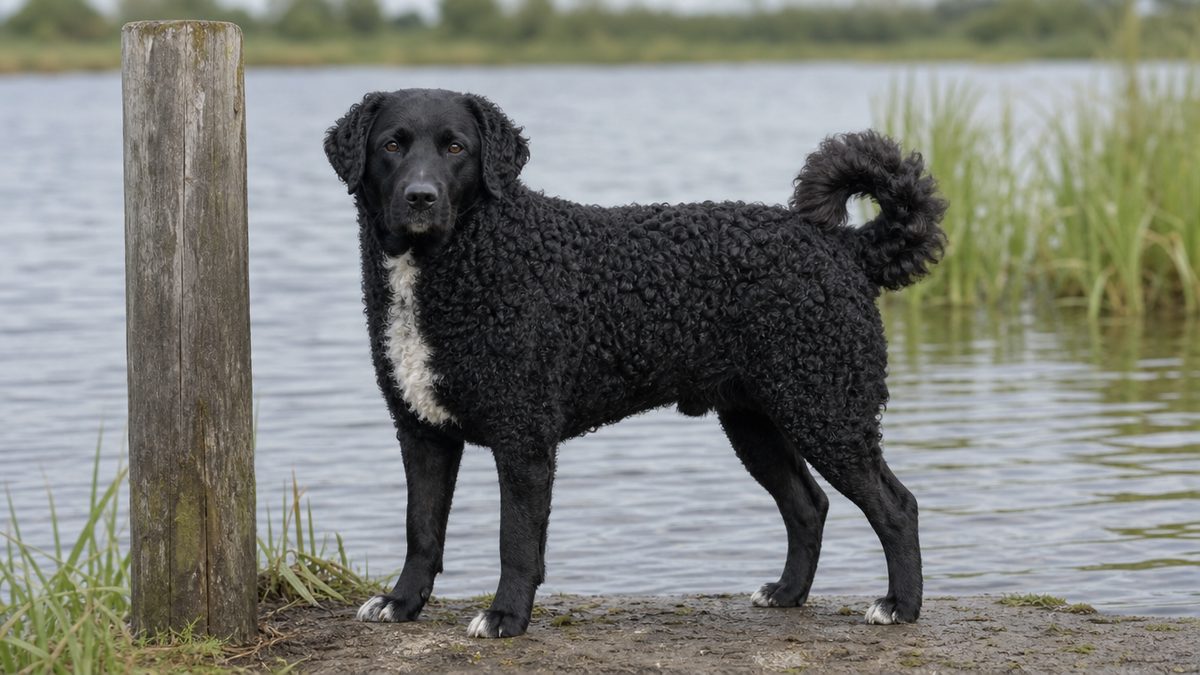
The coat is the breed. The standard asks for dense curls, described as solid, firm curls of hair bundles, with hair that is quite coarse and feels greasy, and short hair on the head and legs. Colour is solid black with white markings on the chest or toes, or solid brown with white markings on the chest or toes, with patches, ticking and roan allowed. Any colour other than those defined is a severe fault.
| Field | FCI standard 221 | American Kennel Club | Royal Kennel Club |
|---|---|---|---|
| Status | Definitively recognised since 1959 | Foundation Stock Service | Absent from the 227-breed A to Z |
| Group | 8, Water Dogs, with working trial | Foundation Stock Service | Not applicable |
| Height | Ideal 59 cm males, 55 cm females, no tolerance stated | Not published in the same form | Not published |
| Weight | About 34 kg males, 28 kg females | Not published in the same form | Not published |
| Authentic language | English | Not applicable | Not applicable |
| Coat | Dense solid firm curls, coarse, feels greasy | Not published as a list | Not applicable |
| Disqualifying faults | Under- or overbite, insufficient breed type, aggression or extreme shyness | Not published | Not applicable |
History, as the standard tells it
The FCI's own account is unusually frank about its uncertainty. It says the breed was supposedly brought by gypsies and or sailors from countries around the Baltic Sea, that in the nineteenth and twentieth centuries the dogs were used to pull dog carts but were mostly used as hunting dogs on the otter and other small predators, and that the Wetterhoun was mainly found in the water-rich areas of Friesland in the northern Netherlands.
The modern history is a separation. In the early twentieth century the Wetterhoun and the Stabijhoun were regularly crossbred with each other, threatening what was unique in each. In 1938 a group of enthusiasts of the Kynologenclub Fryslan began purifying the breed again, and in 1942 both breeds were officially recognised, with the first standard dated 10 February 1944. The standard then prints a population figure: about 1,000 dogs worldwide in 2013.
The standard's utilization clause still names otter hunting as the breed's traditional job. Otter hunting has not been a lawful activity in the Netherlands for a long time and the Eurasian otter was itself extirpated there in the late twentieth century before being reintroduced. Read that line as a statement about what the dog was shaped for, not as a description of anything a modern owner will do with it.
Where the breed sits in each register, and the name it is filed under
The Wetterhoun is fully recognised by the FCI, held in the American Kennel Club's entry-level register, absent from the Royal Kennel Club entirely, and filed by researchers under a name most readers have never seen.
The AKC position is the entry rung: its own breed page carries the group value foundation-stock-service, the same value returned by the Stabyhoun, the Large Munsterlander and the Drentsche Patrijshond, while the Labrador Retriever returns sporting and the Small Munsterlander returns miscellaneous-class. The Foundation Stock Service is where the AKC records breeds it will register but not yet show in a group.
The British position is a clean absence with a passing control. The Royal Kennel Club's Breeds A to Z carries 227 breeds; Wetterhoun returns zero occurrences while Labrador returns seven and Munsterlander eight in the same document. For India the register that matters is the FCI's, because India is a full member represented by the Kennel Club of India, which registered 33,880 pure-bred dogs across 80 member clubs in 2025; nothing in the material examined here attaches any of them to this breed, and Indian import law closes the route by which they might.
The name problem, and why it matters more here than anywhere
Two independent authorities file this breed as the Frisian Water Dog rather than the Wetterhoun, and that single fact decides whether a researcher finds the breed's literature or reports an absence that is not there.
PubMed returns zero records for Wetterhoun, reporting the phrase as not found, while a search for Frisian water dog returns the 2011 Genes and Immunity paper on severe combined immunodeficiency in the breed. Independently, McMillan 2024's supplementary breed table lists the breed as Frisian Water Dog, with inclusion flag N, no phylogeny reclassification, a Kennel Club group of NA, FCI group Retrievers, Flushing Dogs and Water Dogs, body size Medium and cephalic index Mesocephalic.
So a page that checks only the common name concludes twice over that this breed has no literature and was overlooked by the largest UK longevity study. Both conclusions would be wrong. The literature exists and the study considered the breed by name.
Before reporting that a breed is absent from a database, enumerate its names: the native-language name, the FCI name, the English name, anglicised spellings and diacritic-stripped forms. For this breed the productive form was one nobody would guess, and it was found only because two different sources happened to use it.
Wetterhoun price in India
There is no Wetterhoun price in India, because there is no Wetterhoun in India, and with a world population of about 1,000 dogs there is no surplus anywhere for one to come from.
The FCI standard itself printed the world population as about 1,000 dogs in 2013, roughly a sixth of the 6,000-plus its sibling the Stabijhoun records in the same document set. A breed at that size does not export puppies to countries with no club, no breeders and no register activity.
Indian law closes the commercial route independently of scarcity. Dogs enter the Indian tariff at ITC (HS) 01061900, Mammals: Other, with an import policy of Restricted. Import is permitted only for a pet dog with a valid pet book and records in the importer's name, for research organisations with a CPCSEA recommendation, and for internal security by the Defence and Police Force. Policy Condition 8 states that import of commercial dogs for breeding or any other commercial activities is not permitted, and the notice adds that applications for trading or breeding purposes, or made on behalf of another person or entity, shall be duly rejected.
The only lawful private route
Import as passenger baggage without a DGFT authorisation is available only to a person transferring residence to India after two years of continuous stay abroad, for cats and dogs only, up to two animals, through the airports and seaports of Delhi, Mumbai, Chennai, Hyderabad, Bengaluru and Kolkata and, since October 2024, Kochi airport, with the process advised to start at least two months before travel Department of Animal Husbandry…. The full route is set out in how to import a dog to India.
How to test any Indian price you are shown
- Divide the rupee figure by 84.38, then by 80, then by 74, and check whether a round foreign asking price falls out, because a converted overseas figure is not an Indian observation.
- Confirm the listing sells a live animal at all, since the commonest rupee figures attached to rare breed names in India belong to books, prints and merchandise.
- Check the photograph against the standard, because a wavy-coated brown dog sold as a Wetterhoun is far more likely to be a Barbet, a Lagotto or a crossbreed.
- Ask which register the litter is recorded in, since the Kennel Club of India issues pedigrees against FCI nomenclature.
- Walk away if the seller cannot answer all four.
The Wetterhoun's curl is solid, firm and coarse, in distinct bundles, and short on the head and legs. A Barbet's coat is longer, softer and covers the head; a Portuguese Water Dog is usually clipped; a Lagotto is woollier and smaller. Most Indian listings for rare curly breeds are illustrated with whichever curly dog the seller could find a photograph of, and for a breed of about 1,000 animals worldwide, the photograph is the first thing to check.
Monthly cost of ownership for a dog this size in India
Budget roughly Rs 7,000 to Rs 13,000 a month for a 28 to 34 kg dog in an Indian metro, built entirely from Indian care costs because no breed-specific Indian cost row exists for this breed.
| Item | Indian price | Frequency | Source |
|---|---|---|---|
| Anti-rabies vaccine | Rs 699 | Annual | Vetic clinic price list |
| Nine-in-one DHPPiL | Rs 899 | Annual booster | Vetic clinic price list |
| Kennel cough | Rs 1,349 | Annual, optional | Vetic clinic price list |
| Adult annual booster course | From Rs 3,199 | Annual | Vetic clinic price list |
| NexGard Spectra 15 to 30 kg | Rs 3,308 for 3 tablets, about Rs 1,103 a month | Monthly | Supertails listing |
| Bath, and bath with styling | From Rs 934, and from Rs 1,869 | Every 4 to 8 weeks | Vetic Delhi grooming |
| Delhi MCD pet dog registration | Rs 500 new and Rs 500 renewal, Rs 100 a month late fee | Annual | MCD Delhi |
| Chennai GCC pet licence | Rs 50 | Annual | Greater Chennai Corporation |
Note the parasite line carefully for this breed. NexGard Spectra's 15 to 30 kg pack at Rs 3,308 for three tablets works out at about Rs 1,103 a month, but a male Wetterhoun at the standard's approximate 34 kg is above that band and needs the next size up, so treat Rs 1,103 as a floor rather than the figure.
Two Indian facts in that table matter more than the arithmetic. Greater Chennai Corporation's six municipal veterinary clinics provide treatment and anti-rabies vaccination free of cost, and the corporation issued 9,115 pet licences in 2024 at Rs 50 each. Delhi charges Rs 500 to register a pet dog and Rs 500 again to renew, with a Rs 100 per month late fee. The same statutory act costs ten times more in one metro than another.
Indian kibble prices move fast enough that a monthly figure quoted today misleads within weeks, and a 34 kg dog's ration is the single largest variable in the whole budget. Weigh your dog's actual daily ration, price your actual bag, and do the arithmetic yourself. A page that prints a confident monthly food cost for a breed with no Indian population is printing a template row.
Suitability for the Indian climate
The Wetterhoun is the worst Indian-climate fit in this group of breeds, because its coat is a cold-water insulation system and its homeland's peak wet-bulb load sits 11.48 degrees below Kolkata's.
Friesland is flat, wet and cool. A query at Leeuwarden returns an annual mean of 10.35 degrees at 84.77 percent relative humidity, a warmest month of August at 17.95 degrees and a coolest of February at 3.33 degrees, from a cell at 0.12 metres against a real town elevation near one metre. A second point at Drachten returns a separate cell at 1.94 metres with an annual mean of 9.95 degrees and a warmest month of July at 17.98 degrees.
Leeuwarden, Sneek and Heerenveen all return a byte-identical satellite cell at 0.12 metres. Normally identical cells are a warning that one grid square is being asked to describe several different places. Here the whole province is at sea level, so the errors are 0.88, 0.12 and 0.88 metres and the cell genuinely is the province. The check still had to be run before the figure could be used.
Homeland against seven Indian cities
| Place | Annual mean C | Relative humidity % | Hottest month | Peak wet-bulb C | Cell elevation m |
|---|---|---|---|---|---|
| Friesland, Netherlands | 10.35 | 84.77 | August, 17.95 | 15.61 | 0.12 |
| Chennai | 27.95 | 72.39 | May, 31.51 | 26.11 | 48.95 |
| Mumbai | 26.77 | 67.39 | May, 31.19 | 25.77 | 97.15 |
| Kolkata | 25.81 | 73.93 | May, 31.53 | 27.09 | 7.35 |
| Delhi | 25.60 | 45.56 | June, 35.88 | 26.50 | 206.37 |
| Pune | 23.86 | 66.80 | April, 28.93 | 22.97 | 635.99 |
| Bengaluru | 23.74 | 67.94 | April, 28.37 | 21.86 | 841.72 |
The coat is the problem, not the humidity
It would be easy to write that Indian humidity will finish a Dutch water breed. Friesland is more humid than every Indian city in that table, at 84.77 percent against Kolkata's 73.93 and Delhi's 45.56. Damp is this dog's native condition; it was bred to work in it.
The problem is heat carried in damp air, which wet-bulb temperature measures directly. Friesland peaks at 15.61 degrees in August. Kolkata peaks at 27.09 in June, Delhi at 26.50 in July, Chennai at 26.11 in May and Mumbai at 25.77 in June. The 11.48 degree gap to Kolkata is the finding, and it makes this a heat-sensitive breed in India rather than a merely inconvenienced one. Bengaluru at 21.86 and Pune at 22.97 are the least bad options and are still six to seven degrees above the homeland peak.
The coat compounds it. A layer of dense, solid, firm curls holds still air against skin, which is exactly what an animal wants in cold water and exactly what it does not want in a Chennai May. Note also that Delhi peaks in June rather than May, and that Bengaluru and Pune peak in April and are coolest in December, so a page writing May beside every Indian city has measured nothing.
What the heat literature supports
Hall 2020 in Scientific Reports modelled heat-related illness across 905,543 UK dogs under primary veterinary care and found 395 confirmed events, with dogs at or above their breed and sex mean bodyweight at 1.42 times the odds and dogs over 50 kg at 3.42 times. The companion paper in Animals recorded 1,259 events from 1,222 dogs, of which 879 had a recorded trigger, and 652 of those 879, that is 74.2 percent, were exertional. The Wetterhoun was not separately modelled in either, so no breed-specific odds ratio exists and none should be invented. What transfers is the mechanism and the bodyweight finding, which matters for a breed whose standard puts males at about 34 kg.
Second Schedule Part IV paragraph 21(1) of the Prevention of Cruelty to Animals (Dog Breeding and Marketing) Rules 2017 bars keeping in outdoor facilities, without the attending veterinary practitioner's written approval, dogs not accustomed to the temperatures prevalent in the area, breeds that cannot tolerate them such as long-haired breeds in high temperature locations, and sick, infirm, aged or young animals. A dense curled water-dog coat from a province whose warmest month averages 17.95 degrees sits inside the first two categories at once.
Temperament and household fit
The Wetterhoun is self-willed by nature, and the FCI standard opens its behaviour clause with exactly that phrase.
The rest of the clause is short and worth quoting in full: as a family pet the Wetterhoun is affectionate; in and around the house it is watchful and keen to catch vermin; it can initially be reserved with strangers, but should not be fearful. Aggressive or overly shy dogs are a disqualifying fault, as is a dog clearly showing physical or behavioural abnormalities.
Self-willed is the operative phrase and it is not a euphemism. An otter dog worked alone in water, guarding a yard and killing vermin on its own initiative, was selected to make decisions without instruction. A breed shaped that way is loyal without being obedient, and the two are different things.
- Households with a garden, a boundary and preferably access to water suit this breed and nothing else really does.
- Households with experience of independent working breeds will find it straightforward; first-time owners generally will not.
- Households with rodents, rabbits or poultry should expect the dog to do the job the standard says it does.
- Households wanting a dog that greets every visitor should read reserved with strangers again, and then socialise deliberately from eight weeks.
- Households where the dog is alone all day suit it badly, because a watchful dog with nothing to watch invents work.
The British breed group covering both Frisian breeds describes the same dog for a pet audience, and the two accounts are not in conflict. Both describe a farm and water dog that has been asked to become a companion, and the honest version keeps the independence in.
Training approach and what this breed resists
To train a Wetterhoun, build a relationship the dog values before you ask for compliance, because a self-willed breed evaluates instructions rather than executing them.
This is a materially harder training proposition than a retriever and it is fair to say so plainly. A dog bred to work otters alone, guard a yard and kill vermin was never selected for handler focus in the way a gundog that must stay within shot was. It is not a stupid dog and it is not a defiant one. It is a dog with its own opinion about whether an instruction is worth following. It is genuinely trainable, in the sense that a medium-sized working breed with this much drive learns quickly, but it is trainable on terms it accepts rather than on demand.
A realistic Indian training sequence
- Weeks 8 to 16, socialise daily in the cool hours to traffic, autorickshaws, cattle, community dogs and building-site noise, and pay particular attention to strangers, because reserve towards them is a selected trait.
- Weeks 10 to 20, build a recall on a long line before the dog can ever self-reward by chasing something.
- Months 4 to 8, train an emergency stop and a settle on a mat, both of which buy control around livestock and around water.
- Months 6 to 12, introduce controlled swimming if safe clean water exists, since it satisfies the breed in a way land work does not.
- Months 9 to 18, proof everything against real distraction, which is where most Indian training plans quietly stop.
What this breed resists is being told rather than asked. Short, varied, well-paid sessions work; drilling does not. The most useful single habit is to make yourself the source of the thing the dog wants next, which for a Wetterhoun is usually access to water or to a scent.
Dutch training material for this breed assumes cool weather, open ground and water. Take the structure, which is early socialisation and early recall, and rebuild the timetable around dawn and dusk. Do not copy the assumption that a curly-coated 34 kg dog can work through an Indian afternoon.
Daily exercise requirement, and what happens without it
Plan on 60 to 90 minutes of real exercise a day in the cool hours, with swimming wherever clean safe water exists, because this is a Group 8 water dog and land walking does not substitute.
The FCI requires this breed to pass a working trial and gives its utilization as hunting dog, water dog, traditionally otter hunting, and guarding the yard. Three of those four jobs are unavailable to an Indian pet owner, which is the real exercise problem: the dog's needs are not only quantitative. This is a versatile working animal rather than a specialist, and an energetic one, so a dog that will happily retrieve from water for an hour will not accept twenty minutes on a lead as a substitute.
The Indian constraint is timing. Delhi's hottest month averages 35.88 degrees with a peak wet-bulb load of 26.50. Exertional illness, not confinement, accounts for 652 of the 879 heat events with a recorded trigger in the largest study of the problem. A 34 kg curly-coated water dog exercised at four in the afternoon in an Indian May is that study's central scenario with the coat working against it.
- March to October, exercise before sunrise and after dark only, and treat the middle of the day as indoor time.
- November to February in the north, most of the day is usable and this is when to build condition.
- Year-round on the Deccan plateau, Bengaluru and Pune buy four to five degrees of wet-bulb relief against Kolkata, which widens the window without removing the limit.
- Swim wherever the water is clean, still and safe, and dry the ears immediately afterwards.
- Substitute scent games in a shaded courtyard on days when distance is unsafe, since a vermin dog's brain tires before its legs do.
Without enough, the reported failure modes are the ordinary ones for an under-employed guarding water dog: barking at the gate, digging, patrolling, and a recall that erodes because the dog has decided its own plans are better.
Grooming and coat care in Indian humidity
Do not brush a Wetterhoun's curls out, check the coat weekly for damp held inside the bundles, and dry the ears after every swim, because the coat that makes this breed is also what makes it a monsoon risk.
The standard describes dense curls that are solid, firm bundles of hair, with the hair itself quite coarse and feeling greasy, and short hair on the head and legs. That greasy feel is functional and is not dirt. It is the water repellency that let the dog work in cold Frisian water, and stripping it with frequent shampooing makes the coat wetter for longer, not cleaner.
In Indian humidity the risk shifts. A curl bundle holds water in its core for hours after the surface looks dry, and warm moisture against skin for hours is how hot spots and secondary bacterial infection begin. The job in an Indian June is not brushing; it is checking and drying.
Ears, water and the Indian monsoon
A water breed with drop ears is the classic combination for ear disease. An Indian series from the Palam Valley in Himachal Pradesh found otitis externa concentrated in dogs with pendulous ear carriage, and its ear-carriage table carries an internal arithmetic error worth naming if you quote it: it prints 53 pendulous cases at 69.13 percent of 81, but 53 of 81 is 65.43 percent, and 69.13 percent of 81 is 56, which is the figure that balances against its 25 erect-ear cases. Quote it with the discrepancy stated or not at all. The direction is not in question.
- Dry the ear leather and the canal entrance after every swim and every bath, from June to September without exception.
- Check the skin under the curls weekly by parting the coat, because damp inside a bundle is invisible from outside.
- Bathe only when genuinely dirty, since the coat's greasy feel is its water repellency and shampoo removes it.
- Never clip or shave the coat for heat, because it will not grow back in the same texture and the standard's curl is the breed.
- Check between the toes weekly for grass seed and the early softness of interdigital infection.
Northern European guidance for curly water breeds routinely says to let the dog shake and air dry. That is correct in Friesland, where the warmest month averages 17.95 degrees. It is wrong in a Kolkata August at a wet-bulb load of 27.09 degrees, where air drying a curled coat means many hours of warm damp held against skin. Towel firmly, dry the ears first, and give the dog moving air.
Health risks and lifespan
The Wetterhoun's published health record is one paper, it describes a lethal recessive immunodeficiency, and the breed's own club is thirteen years into a formal outcross programme because of the population that produced it.
Severe combined immunodeficiency, the one paper
Verfuurden and colleagues at Utrecht University investigated mortality of puppies at eight to twelve weeks of age, which was frequently observed in the breed. Blood parameters and clinical signs were monitored in newborns from three litters, and three puppies from two litters showed strongly reduced immunoglobulins and lymphocytes and were euthanised after first display of disease. The clinical and pathological features were consistent with severe combined immunodeficiency.
Eight genes involved in V(D)J recombination were investigated, and a nonsense mutation in RAG1 was identified, at a position similar to nonsense mutations found in human SCID. The authors concluded that SCID due to a RAG1 mutation caused the high mortality. The parent club's own description agrees and adds the practical detail: affected puppies make no resistance to infection themselves, and once the antibodies from their mother's milk run out they develop varied disease signs and die between six and ten weeks old.
What else the club reports, with its own frequencies
The NVSW publishes not just a list but how often it sees each thing, which is rarer and more useful than a list alone.
| Condition | What the club reports |
|---|---|
| Severe combined immunodeficiency | Hereditary; affected pups die between 6 and 10 weeks old |
| Cardiac abnormalities | Several interrelated defects; on average 3 reports a year, with a traceable hereditary line |
| Entropion | Reported about 1 to 2 times a year; correctable surgically but damaging if left |
| Cryptorchidism | Reported on average 4.5 times a year, unilateral and bilateral |
| Hip dysplasia | Radiographic diagnosis; HD-A is the best result |
| Elbow dysplasia | Radiographic diagnosis; carriers cannot be identified by radiography |
| Fertility failure | Attributed directly to the small population and the high inbreeding percentage |
That last row is the one that explains the rest. The club states plainly that the small population and the high inbreeding percentage cause fertility problems, that more and more matings fail, and that it is becoming increasingly difficult to make healthy combinations. A national breed club saying that about its own breed in public is not a marketing document.
The outcross programme, litter by litter
The response is the Beleidsplan Fokkerij Wetterhounen 2013 to 2028, a formal breeding policy plan executed with the Dutch Kennel Club's permission and revised as recently as February 2024. Its purpose, in the club's words, is to bring fresh blood into the breed and broaden the breeding population so as to lower the inbreeding percentage and solve the associated problems. Genetic diversity, in other words, is being treated as the disease and the outcross as the treatment.
| Date | Event |
|---|---|
| 2013 | Beleidsplan Fokkerij Wetterhounen 2013 to 2028 begins, with the Dutch Kennel Club's permission |
| 2014 | Labrador Retriever used as the first outcross breed; Barbet chosen by the breeders' council |
| November 2014 | First F1 litter, Labrador by Wetterhoun |
| 12 September 2015 | First look-alike assessment day, 23 unregistered Wetterhouns presented to three judges |
| 31 October 2015 | First outcross puppies shown publicly and official pedigrees issued to look-alike owners |
| 3 September 2016 | Second look-alike assessment day |
| July and August 2017 | Two F2 litters born from the first outcross combination |
| 11 November 2017 | F1 litter, Airedale Terrier by Wetterhoun, three males and three females |
| 17 March 2018 | The programme is covered by De Volkskrant magazine and by NOS Nieuws |
| 9 July 2019 | F1 litter, Barbet by Wetterhoun, seven puppies |
| 24 October 2019 | First third-generation litter, eight puppies, six years into the plan |
| 12 April 2020 | Second F3 litter, from the 2014 Labrador line via a male descendant |
| 2 September 2023 | Sixth outcross litter, five puppies, sired by a Laika |
Five breeds have been used so far: the Labrador Retriever, the Poodle, the Airedale Terrier, the Barbet and a Laika. The Laika choice is the most instructive, because the club explains its reasoning: it wanted a breed of the primitive type, genetically distant from the Wetterhoun and therefore a valuable genetic addition to a small vulnerable breed, generally healthy, of comparable build, and with the necessary working drive. It then used an Embark DNA test to compute the expected coefficient of inbreeding for the combination and found it below one percent. Embark's own breed resource for the Wetterhoun exists as a public page.
The club also runs a look-alike route, inviting owners of unregistered Wetterhouns with one or both parents of the breed to assessment days, and it publishes those invitations in West Frisian as well as Dutch. An update mentions scientific research at Bern on coat problems in the breed, presented alongside an Embark lecture.
Lifespan, and what could not be measured
No study lifespan exists. McMillan 2024 lists the breed in Supplementary Table S5 under the name Frisian Water Dog with inclusion flag N, so it was considered and excluded rather than merged, and it has no row in Table S3. The crossbred comparator in that study is 111,053 dogs at a median of 12.0 years, and the study covers 155 purebred breeds in total McMillan KM, Bielby J, Williams CL. For a nearby comparison the Irish Water Spaniel, the other curly Group 8 water dog, has a median of 10.8 years on 68 deaths in that table.
No OFA figure appears on this page. api.ofa.org and wp.ofa.org both refused connections from this environment, and ofa.org's statistics page returned a 49 KB JavaScript shell with zero table rows and zero breed names. That is an instrument failure rather than a finding about the breed, and OFA's own publication threshold of 100 hip evaluations, or 50 for its other databases, means a breed of about 1,000 dogs worldwide would very likely not appear even when the site is reachable.
Feeding a Frisian water dog in India
Feed to a nine-point body condition score rather than to a chart, using the standard's approximate 34 kg for males and 28 kg for females as a sanity check rather than a target.
The FCI standard does publish a weight, which many working-breed standards do not, and that gives a defensible starting point. It also says approximately, so it is a guide rather than a specification. Score by feel every fortnight: ribs easily felt under a light covering, waist visible from above, abdominal tuck visible from the side, which is 4 or 5 of 9 on the WSAVA scale.
Condition matters more here than brand, and for a heat reason rather than a joint one. Hall 2020 found dogs at or above their breed and sex mean bodyweight carried 1.42 times the odds of heat-related illness. On a curly-coated 34 kg dog in an Indian summer, carrying extra weight compounds a coat problem the dog already has.
- Weeks 8 to 16, four meals a day of a complete puppy food, never left down in Indian heat where a bowl attracts ants within the hour.
- Months 4 to 8, three meals a day, and resist pushing growth, because a fast-growing 30 kg-plus dog loads developing joints.
- Months 8 to 12, two meals a day and a move to an adult formulation towards the end of that window.
- Adult, two meals a day with the larger one after evening exercise rather than before it.
- Through summer, feed the main meal after dark, because a dog that has just eaten sheds heat less efficiently.
Free access to clean water is the cheapest heat intervention available, and a curly-coated dog exercised at dawn in a Chennai May will drink more than an Indian owner expects.
Month by month through the first year
A Wetterhoun puppy timeline has one window that matters more than any other, because severe combined immunodeficiency kills affected puppies between six and ten weeks old.
| Age | Developmental job | Constraint or risk |
|---|---|---|
| Under 8 weeks | Stays with the litter | Rule 8(1)(a) forbids sale of pups less than eight weeks old |
| 6 to 10 weeks | Maternal antibodies fade | The exact window in which SCID-affected puppies die, per the parent club |
| 7 to 18 weeks | Core vaccination course | The Rules say vaccination can start at seven to eight weeks and usually completes at eighteen |
| 8 to 16 weeks | Socialisation window | All of it in the cool hours from March to October, with strangers a priority |
| 3 months | Microchipping | Second Schedule paragraph 30(b) requires a vet to micro-chip pups over three months |
| 4 to 6 months | Recall on a long line | Build it before the first monsoon collapses outdoor time |
| 6 to 9 months | Growth plates still open | No forced road work, no stair drilling, no repeated jumping |
| 9 to 12 months | Adult curled coat arrives | Learn to check under the curls before the first Indian August |
| Over 6 months | Sale rules change | Rule 8(1)(b) bars sale over six months unless sterilised, except between licensed breeders |
Three of those rows are Indian law. Rule 8(1)(a) requires that pups less than eight weeks in age are not sold. Rule 8(1)(b) requires that dogs over six months are not sold without first being sterilised, unless sold to another licensed breeder. Second Schedule Part IV paragraph 30 requires every dog to be identified by an official tag on its collar and requires a veterinary practitioner to micro-chip all breeding stock and pups over three months. The gazette hyphenates micro-chipping, so search both spellings.
The window that is specific to this breed
For most breeds the eight to twelve week period is about socialisation. For this one it is also the period in which an affected puppy will show repeated infections it cannot fight, and in which the published mortality was observed. A puppy in that window that keeps getting sick is not a puppy with bad luck, and a breeder who cannot discuss SCID has not read the literature about their own breed.
Greater Chennai Corporation's six veterinary clinics provide treatment and anti-rabies vaccination free of cost. For a first-year puppy that is the largest avoidable cost in the whole schedule, and most Chennai owners do not know the service exists.
Head to head against the breeds an Indian buyer would actually get
An Indian buyer cannot get a Wetterhoun, so the useful comparison is against its Frisian sibling, its outcross partners and the curly water dogs that are obtainable.
| Breed | FCI number and group | Ideal height | Coat | McMillan 2024 median |
|---|---|---|---|---|
| Wetterhoun | 221, Group 8 | 59 cm males | Dense solid firm curls, coarse, greasy | None; filed as Frisian Water Dog, flag N |
| Stabyhoun | 222, Group 7 | 50 to 53 cm males | Straight, medium length, bushy trousers | None; flag N |
| Barbet | 105, Group 8 | 58 to 65 cm males | Long, woolly, curly, covering the head | None published |
| Irish Water Spaniel | 124, Group 8 | 53 to 59 cm males | Dense crisp ringlets with a smooth face | 10.8 years on 68 deaths |
| Labrador Retriever | 122, Group 8 | 56 to 57 cm males | Short, dense, weather resistant | 13.1 years on 16,155 deaths |
That table also happens to be a picture of the outcross programme. Two of the five breeds in it, the Barbet and the Labrador Retriever, are breeds the Dutch club has deliberately crossed into the Wetterhoun since 2013. The Irish Water Spaniel row is included because it is the closest published lifespan for a curly Group 8 water dog, and 10.8 years on 68 deaths is a much weaker figure than the Labrador's 13.1 on 16,155.
Wetterhoun against Stabyhoun, the comparison that matters most
These two share a club, a province, a crossbreeding history until 1938 and a recognition year of 1942. They are not similar dogs and they do not have similar problems. The Wetterhoun is 59 cm and about 34 kg with a curled coat, filed in Group 8; the Stabyhoun is 50 to 53 cm and 22 to 27 kg with a straight coat, filed in Group 7.
Their inherited diseases point in different directions. The Wetterhoun's published problem is immunological, a RAG1 severe combined immunodeficiency. The Stabyhoun's is cardiac, a patent ductus arteriosus birth incidence of 1.05 percent on a population whose mean inbreeding coefficient is 31.4 percent. Both were characterised at Utrecht University and Peter Leegwater is an author on both papers, so the entire published genetics of both Frisian breeds runs through one research group.
If what appeals here is a large, loyal, water-loving dog, the Labrador Retriever is genuinely obtainable in India, has a lifespan measured on 16,155 deaths, and carries a short coat that dries in an Indian monsoon. It is the least romantic answer on this page and it is the right one for almost every Indian household.
Common mistakes buyers and owners make with this breed
The commonest mistake with the Wetterhoun is searching one name, and the second is buying a curly dog on a photograph.
- Searching only Wetterhoun and concluding the breed has no research, when its only paper and the largest UK longevity study both file it as the Frisian Water Dog.
- Buying a curly brown dog from a photograph, when a Barbet, a Lagotto and a crossbreed all look similar at web resolution and the world population here is about 1,000 dogs.
- Treating the coat's greasy feel as dirt and shampooing it out, which removes the water repellency the coat exists for.
- Letting a curled coat air dry in an Indian monsoon, which holds warm damp against skin for hours inside the curl bundles.
- Reading affectionate and skipping self-willed, when the standard opens the behaviour clause with the second phrase.
- Assuming the Wetterhoun and Stabyhoun are two sizes of one breed, when they sit in different FCI groups with different coats and different inherited diseases.
- Planning to import one to breed from, which Policy Condition 8 of the Indian import policy does not permit.
The mistake that reaches furthest
The broadest error is treating a confident page as an evidenced one. Several sites ranking for rare breed names publish pages assembled from templates, in which the cost table, the size class and sometimes the body copy belong to another dog. The check is cheap: pull one unrelated breed from the same site and compare the cost lines to the rupee. If they match exactly, the row is a shared preset rather than an observation.
For this breed there is a second and better check. The Dutch parent club publishes its own problems, its own frequencies and its own outcross litters with dates, in Dutch and in West Frisian. If an English-language page about the Wetterhoun does not mention severe combined immunodeficiency or the 2013 to 2028 breeding plan at all, it has not read the club.
Adoption and responsible sourcing
Adopting a Wetterhoun in India is not a realistic route, and with about 1,000 dogs in the world it is barely a realistic route anywhere.
No Indian rescue listing, breed-rescue network or shelter placement for this breed was found, which is what a breed with no domestic population looks like. There is nothing to rescue because nothing was bred or imported in numbers.
The three routes that exist, ranked
- Adopt an Indian dog of similar temperament from a shelter, which is available immediately and has no import problem.
- Choose a water-loving breed genuinely present in India, such as the Labrador Retriever, and get published health data and a supply chain you can inspect.
- Import a pet under the baggage route only if you are personally transferring residence to India after two years of continuous stay abroad, which is the single lawful private path.
How to verify a Wetterhoun seller anywhere in the world
- Ask what the breeder does about severe combined immunodeficiency, and expect them to know the RAG1 paper exists.
- Ask whether the litter sits inside or outside the 2013 to 2028 outcross plan, and how many generations from an outcross it is.
- Ask for hip and elbow scores on both parents, which the club lists as its two orthopaedic screens.
- Ask which register the litter is recorded in and check the number against FCI nomenclature.
- Ask the age of the pups, because Indian law forbids sale below eight weeks and most national rules say the same.
One thing counts strongly in this breed's favour and should be said plainly. A club that publishes its inbreeding problem, names the diseases with annual frequencies, gets permission from its national kennel club to cross to five other breeds, and then publishes every litter with its date, is behaving far better than most. A breed whose problems are documented is safer than a breed whose problems are hidden, and the Wetterhoun's are documented in unusual detail for a population of about 1,000 dogs.
If you read this far because you liked a rugged curly water dog, the realistic Indian version is a shelter dog with a working temperament, or a Labrador from a breeder you can visit. Neither needs an import authorisation, and both are dogs you can meet before you commit.
What the pages ranking for this breed actually tell you
The result set for the Wetterhoun is a DNA-testing company, an encyclopedia and five aggregators, and not one of them carries the thirteen-year outcross programme that is the most important fact about the breed.
The harvest itself has to be reported honestly, because it failed. Google, queried with an Indian geo and language, returned a 92 KB page whose entire visible body said there was trouble accessing Google Search, with zero organic results on a Labrador Retriever control. Bing India returned HTTP 200 with the correct title and Indian language chips, then ten organic results about an Indonesian internet-banking service, on the same control. DuckDuckGo served a CAPTCHA. Brave Search, the one engine whose control passed in this session, returned HTTP 429 to all three Wetterhoun queries after four attempts each with escalating waits.
So no People-also-ask box could be captured for this breed, and that is a statement about the instrument rather than about the breed. An absence is only real when a control succeeded in the same session, and here no control succeeded on the queries that mattered. The competitor set below was gathered from a working index and every page was then fetched directly and its headings harvested, which is verifiable in a way a throttled search is not.
What ranks, and what it covers
The set is led by Embark Veterinary's breed resource, Hundeo, the English Wikipedia article, emma.ca, Wag Walking, DogBreedInfo, PawChamp and Stabyhoun UK. Wikipedia's article carries four content headings: Appearance, History, Temperament and See also. DogBreedInfo's page has one H1 and no H2 at all.
There is something quietly appropriate about Embark ranking first, since the Dutch club used an Embark test to compute the expected coefficient of inbreeding for its Laika outcross. The company's own page for the breed does not mention that.
The gap this page fills
None of the ranking set tells a reader that the breed's only peer-reviewed paper is indexed under a different name, that the paper describes a lethal RAG1 immunodeficiency killing puppies between six and ten weeks, that the national club has crossed the breed to five other breeds since 2013 under a plan agreed with the Dutch Kennel Club, that the club reports cardiac cases at about three a year and cryptorchidism at 4.5, or that Indian import policy forbids bringing the breed in to breed from. That set of absences is why this page exists.
Wetterhoun questions buyers actually ask
Is the Wetterhoun a good family dog?
It is affectionate with its own family and the FCI standard says so, while also calling it self-willed by nature, watchful, keen to catch vermin and initially reserved with strangers. Aggressive or overly shy dogs are a disqualifying fault. So it makes a good family dog for a family with a garden, some experience of independent working breeds, and the willingness to socialise a reserved puppy deliberately from eight weeks. It is a poor fit for an Indian flat, where the standard's yard-guarding and vermin-catching jobs both disappear.
Is the Wetterhoun suitable for beginners?
No. The FCI standard opens the breed's behaviour clause with the words self-willed by nature, which is a registry describing a dog that evaluates instructions rather than following them. Add a world population of about 1,000 dogs, a lethal recessive immunodeficiency in the breed, a coat that needs checking under the curls in Indian humidity, and no Indian breeder to advise you, and a first dog should be something else. The trainability is real, but it is trainability on the dog's terms.
How long does a Wetterhoun live?
No study figure exists for this breed. McMillan 2024, the largest UK longevity study, lists it in Supplementary Table S5 under the name Frisian Water Dog with the inclusion flag N and a Kennel Club group of NA, meaning it was considered and excluded rather than merged into another row, so it has no median in the study's results table. For scale, the crossbred comparator there is 111,053 dogs at a median of 12.0 years, and the Irish Water Spaniel, the nearest curly Group 8 water dog with a published figure, sits at 10.8 years on 68 deaths.
What is the Wetterhoun price in India?
No verifiable Indian price exists, because no Indian breeder or seller of this breed was found and the world population was put at about 1,000 dogs in the FCI standard itself. Indian import policy classifies dogs as a Restricted item and states that applications for trading or breeding purposes shall be duly rejected, so no lawful commercial supply chain can form here. Treat any Indian page quoting a Wetterhoun puppy price as unsourced until it names a litter, a breeder and a registration number.
Is the Wetterhoun a healthy breed?
Its own parent club says the breed is, despite the very small population, fortunately still a relatively healthy one, and then lists what it sees. Severe combined immunodeficiency is the serious entry: a RAG1 nonsense mutation in which affected puppies make no resistance to infection and die between six and ten weeks old once maternal antibodies run out. The club also reports about three cardiac cases a year, entropion once or twice a year, cryptorchidism 4.5 times a year, and hip and elbow dysplasia, and says the high inbreeding percentage is now causing matings to fail.
How big does a Wetterhoun get?
The FCI standard gives an ideal height of 59 cm at the withers for males and 55 cm for females, and an approximate weight of 34 kg for males and 28 kg for females. Unusually, it states no tolerance at all around those heights, where the sibling Stabyhoun standard allows two centimetres either way. The overall picture the standard asks for is square, with the height at the withers equal to the body length measured from the prosternum to the point of the buttock.
What is the difference between a Wetterhoun and a Stabyhoun?
They are two FCI breeds in two different groups despite sharing a club, a province and a history of being crossbred with each other until 1938. The Wetterhoun is 221 in Group 8 with the water dogs, stands 59 cm and about 34 kg, and carries dense solid curls that feel greasy. The Stabyhoun is 222 in Group 7 with the pointing dogs, stands 50 to 53 cm and 22 to 27 kg, and carries a straight coat of medium length. Their inherited diseases differ too: immunological in one, cardiac in the other.
Can a Wetterhoun handle Indian heat?
No, and this is the least heat-tolerant breed in this cluster. Friesland's warmest month averages 17.95 degrees and its peak wet-bulb load is 15.61 degrees in August, against 27.09 degrees in Kolkata, 26.50 in Delhi and 26.11 in Chennai. A coat of dense solid curls is engineered to hold a layer of insulation against cold water, which is precisely the wrong structure for shedding heat. Exercise would have to move entirely into the cool hours from March to October, and even then the coat works against the dog.
Why does a search for Wetterhoun return no research papers?
Because the literature is filed under a different name. PubMed returns zero records for Wetterhoun, with the phrase reported as not found, while a search for Frisian water dog returns the 2011 Genes and Immunity paper describing severe combined immunodeficiency caused by a RAG1 mutation in the breed. McMillan 2024's supplementary breed table does the same thing, listing the breed as Frisian Water Dog. A page that searches only the breed's common name will report an absence that is not there.
What is the Wetterhoun outcross programme?
It is a formal thirteen-year breeding plan, the Beleidsplan Fokkerij Wetterhounen 2013 to 2028, run by the Dutch parent club with the Dutch Kennel Club's permission, to bring fresh blood into a very small and very inbred population. Five breeds have been used so far: the Labrador Retriever, the Poodle, the Airedale Terrier, the Barbet and a Laika chosen after an Embark DNA test showed an expected coefficient of inbreeding below one percent. The first third-generation litter was born on 24 October 2019 and the sixth outcross litter on 2 September 2023.
How long do Wetterhouns live?
No study figure exists. McMillan 2024, the largest UK longevity study, lists the breed in its Supplementary Table S5 under the name Frisian Water Dog with the inclusion flag N and a Kennel Club group of NA, so it was considered and excluded rather than merged or overlooked, and it has no row in the table of medians. The crossbred comparator in that study, 111,053 dogs, has a median of 12.0 years. Given a lethal recessive immunodeficiency in the breed, a headline lifespan is not the number to buy on.
Is the Wetterhoun recognised by the Kennel Club or the AKC?
Not by the Royal Kennel Club, which does not list it at all: Wetterhoun returns zero occurrences in the club's 227-breed A to Z while Labrador returns seven and Munsterlander eight in the same document. The American Kennel Club holds it in the Foundation Stock Service, its entry-level register, the same rung as the Stabyhoun, the Large Munsterlander and the Drentsche Patrijshond, and one below the Miscellaneous Class where the Small Munsterlander sits.
What does a Wetterhoun cost per month in India?
Budget roughly Rs 7,000 to Rs 13,000 a month for a 28 to 34 kg dog in an Indian metro, built entirely from Indian care costs because no breed-specific Indian cost row exists. Parasite cover runs about Rs 1,103 a month using NexGard Spectra for the 15 to 30 kg band at Rs 3,308 for three tablets, and a dog at the top of this breed's weight range needs the next band up. An adult annual booster starts at Rs 3,199, a single anti-rabies dose is Rs 699, and a bath starts at Rs 934.
Does the Wetterhoun need to swim?
It needs water more than most breeds and the standard says why. The FCI files it in Group 8 Section 3 with the water dogs, gives its utilization as hunting dog, water dog, traditionally otter hunting and guarding the yard, and describes a coat of dense curls that is a cold-water design. In India the constraint is not the dog's willingness but the availability of clean, safe, still water, and every swim has to be followed by drying the ear leather and the canal entrance.
Is the Wetterhoun good with children?
The standard describes it as affectionate as a family pet while calling it self-willed by nature, watchful, keen to catch vermin and initially reserved with strangers, though it says the dog should not be fearful. Aggressive or overly shy dogs are a disqualifying fault. That combination suits an experienced household with a garden better than a first-time family, and in an Indian setting the watchfulness towards strangers is the trait that needs deliberate socialisation from eight weeks.
Compare with similar breeds
Wetterhoun sits in 1 Bonbeno group. Each one compares it directly against the breeds it is genuinely an alternative to, on the same figures.