
Breed profile
Portuguese Water Dog Price in India, Health and Heat Guide
What the Portuguese Water Dog actually costs in India, what the FCI standard really says, and what 12,073 hip evaluations and a documented genetic bottleneck tell you before you buy.
Quick answer
No defensible portuguese water dog price in india exists. The two Indian breed sites that quote one disagree by five times, from Rs 50,000 to Rs 1,50,000 on poodles.in against Rs 2,50,000 to Rs 5,00,000 on happypet.care, while printing an identical monthly cost row. The top-ranking Indian listing pages show no Portuguese Water Dog at all. Budget instead for the real recurring cost, which is a professional clip every four to six weeks.
This page reports published veterinary research, registry statistics and breed standards. It is not a diagnosis and it is not a treatment plan. Screening decisions, vaccination schedules, feeding changes and any suspected illness must go to a registered veterinarian who has examined your dog. If your dog collapses, strains to breathe, or shows sudden weakness or vomiting in hot weather, treat it as an emergency and reach a veterinarian immediately.
Portuguese Water Dog at a glance
What the Portuguese Water Dog is, in one page
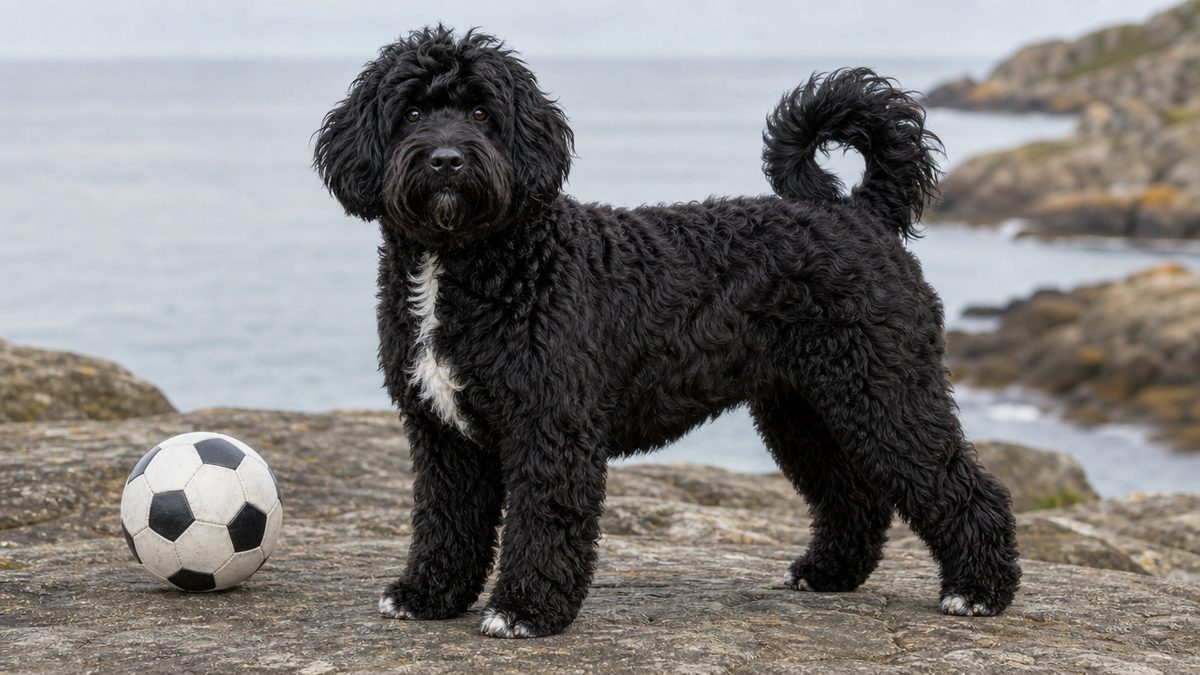
The Portuguese Water Dog is a medium-sized Portuguese fishing dog, FCI breed number 37, standing 50 to 57 cm at the withers in males and weighing 19 to 25 kg, with a single coat that carries no undercoat at all.
Its official name is Cao de Agua Portugues, and the FCI files it in Group 8, Retrievers, Flushing Dogs and Water Dogs, Section 3, Water Dogs, without a working trial. Females stand 43 to 52 cm with an ideal of 46 cm and weigh 16 to 22 kg. Those are the numbers a seller should be able to match, and an Indian listing that quotes anything far outside them is describing a different dog.
The standard's own history is short and unusually honest. It says the breed could once be found along the entire Portuguese coast, that continuous change in fishing methods pushed it back to the Algarve, and that the Algarve is now considered its birthplace. The Portuguese Kennel Club prints the same account in Portuguese. There is no claim of Roman or Phoenician antiquity here, which is worth noting because the sibling Portuguese breed on this site carries exactly that claim and it does not survive testing.
The job it was actually bred for
The standard describes a dog that jumps into the sea to retrieve escaped fish, dives after them, recovers broken nets and loose cables, and swims messages between boats and shore over long distances. That is not decoration. It explains the webbed feet, described in the standard as webbing extending over the whole length of the toes and covered with abundant long hair, and it explains why the breed's energy level is what it is.
The job is also gone. Blaschikoff and colleagues note in 2026 that new sanitary regulations mean these dogs are no longer allowed onto fishing boats, so the breed is no longer used for its original function anywhere. Every Portuguese Water Dog alive today is a companion animal whose exercise routine has to be supplied by a person rather than by a working day.
Two coat varieties, and what they mean for you
The FCI records two varieties, long and wavy, and shorter and curly. The standard describes the first as slightly shiny and woolly and the second as dense, lustreless and forming compact cylindrical curls, both with no undercoat. Ranking pages routinely call this a water-repellent coat; the standard says only that the hair is strong and abundant, so treat the water-repellent claim as marketing rather than as a figure from the standard.
The standard also says something Indian buyers should read twice. Partial clipping is described as typical for the breed once the coat gets too long, with the hindquarters, muzzle and part of the tail clipped and a plume left at the tail tip. That is the lion clip. The alternative, an even trim all over, is the retriever clip. Both are the breed's normal presentation and neither is a shortcut you invented.
| Measure | Males | Females |
|---|---|---|
| Height at withers | 50 to 57 cm, ideal 54 cm | 43 to 52 cm, ideal 46 cm |
| Weight | 19 to 25 kg | 16 to 22 kg |
| Coat | no undercoat, two varieties | no undercoat, two varieties |
| Tail | natural, never docked | natural, never docked |
| Dewclaws | disqualifying if present | disqualifying if present |
FCI 37 disqualifies a docked, rudimentary or non-existent tail, and it disqualifies the presence of dewclaws. Indian law agrees on the first: Second Schedule Part II paragraph 6(8) of the Dog Breeding and Marketing Rules 2017 forbids tail docking, ear cropping, de-clawing and any change of appearance by artificial means. A docked Portuguese Water Dog in India is both a disqualified show dog and evidence of a prohibited procedure.
It disqualifies congenital or acquired deafness too, which is unusual and worth knowing before a seller waves away a puppy that does not respond to its name.
Reading the FCI record properly, and the date trap inside it
The FCI accepted the Portuguese Water Dog on a definitive basis on 1 February 1955, and published the official valid standard on 4 November 2008. Getting those two dates right takes one extra step, because the FCI writes the same date two different ways in two of its own documents.
The breed record prints the acceptance date as 2/1/1955 and the standard publication date as 11/4/2008. Read as day first, those are 2 January 1955 and 11 April 2008. Read as month first, they are 1 February 1955 and 4 November 2008. Only one reading is right, and the document proves which on its own face.
How the format was proved, from the document itself
The breed number itself came off the FCI's own letter index rather than from a guess, because an FCI URL resolves on its trailing number and will serve a different breed's complete standard without erroring. The letter C index returned CAO DE AGUA PORTUGUES resolving to 37, with CHESAPEAKE BAY RETRIEVER 263 and CRNOGORSKI PLANINSKI GONIC 279 present on the same fetch as controls. Worth recording: that index rendered breed names in their ORIGINAL language with English URL slugs, and an absence read off one language is not an absence.
The same record carries four standard-publication dates, one per language. The English row reads 3/30/2009. There is no thirtieth month, so the first field is the month and the record is M/D/YYYY. That single row settles every other date on the page, which is why the FCI record is the better instrument for this than the standard is.
The standard PDF proves the opposite convention, equally cleanly. Its header reads 30.03.2009/EN, and its own date of publication of the official valid standard reads 04.11.2008. The first field is 30, so the PDF is D.M.YYYY. Both documents are describing the same two days. Record 3/30/2009 and PDF 30.03.2009 are both 30 March 2009; record 11/4/2008 and PDF 04.11.2008 are both 4 November 2008.
| Document | As printed | Format proof available inside it | Means |
|---|---|---|---|
| FCI breed record 37 | 11/4/2008 | yes, 3/30/2009 in the same table | 4 November 2008 |
| FCI Standard 37, English PDF | 04.11.2008 | yes, header 30.03.2009 | 4 November 2008 |
| FCI Standard 37, French PDF | 04.11.2008 | no, its only other date is 05.05.2010 | 4 November 2008 |
| FCI Standard 37, German PDF | 04.11.2008 | no, its only other date is 06.09.2013 | 4 November 2008 |
| Clube Portugues de Canicultura | 04-11-2008 | no, it prints no second date | 4 November 2008 |
Three of those five documents cannot prove their own format, because neither field in 04.11.2008 exceeds twelve Clube Português de Canicultura. Anyone reading the French PDF or the Portuguese Kennel Club page alone has to borrow the convention from somewhere else, and borrowing the wrong one turns 4 November into 11 April.
The four language rows all reconcile
Checking the record against the actual PDFs closes the loop. The record says the German standard was published 9/6/2013, and the German PDF's only dates are 04.11.2008 and 06.09.2013. The record says French 5/5/2010, and the French PDF is dated 05.05.2010. Four rows, four documents, no disagreement. Where this site has found the FCI contradicting itself on other breeds, by forty-seven days on one and by four years on another, breed 37 is clean.
The usual rule for FCI standards is to read the 'Langue faisant foi' line, which names the authentic language. FCI 37's French PDF does not have one. The string occurs zero times in the whole document, while the sibling standard for the Portuguese Podengo prints 'Langue faisant foi : (EN)' plainly. So for this breed the authentic language has to come from the record's own field, which reads English. Same body, same translators, one document names its authority and the other does not.
One genuine discrepancy did turn up, and it is a year rather than a day. Blaschikoff and colleagues tabulate the Portuguese Water Dog's FCI official valid standard as 2009, while the FCI's record and all three standard PDFs give 4 November 2008. The paper's 2009 matches the English standard's own publication date of 30 March 2009, so the two are almost certainly different fields on the same record rather than an error. Both figures are printed here rather than reconciled away.
One last registry document is worth naming because it matters on the sibling page and not on this one. The FCI maintains a separate register titled 'LIST OF BREED VARIETIES THAT CAN BE CROSSED', last updated 21 September 2023, and breed 37 appears nowhere in it. The Portuguese Water Dog's two coat varieties are recorded on its breed page with a blank CACIB column, so they are descriptive rather than separately awarded. Compare the Portuguese Podengo, whose six varieties all carry the asterisk and all appear in that crossing register.
Portuguese Water Dog price in India, and why no number survives
There is no defensible portuguese water dog price in india. Two Indian breed sites publish figures that differ by five times, no Indian listing site had a single dog of the breed in stock when this page was researched, and the highest-ranking Indian page prints prices that belong to other breeds entirely.
Start with the disagreement, because it is the whole finding. poodles.in states in its own FAQ markup that a Portuguese Water Dog puppy in India typically costs Rs 50,000 to Rs 1,50,000. happypet.care prints a cost of buying of Rs 2,50,000 to Rs 5,00,000. The floors differ by five times and the ceilings by more than three. Two sites cannot both be observing the same market.
| Figure | Source | Divided by 84.38 | Verdict |
|---|---|---|---|
| Rs 50,000 to Rs 1,50,000 | poodles.in buying price and FAQ schema | 593 to 1,778 | Unverifiable round-lakh editorial figure |
| Rs 2,50,000 to Rs 5,00,000 | happypet.care cost of buying | 2,963 to 5,926 | Unverifiable; divides to USD 3,000 and 6,000 at 83.33, but round lakhs do that by construction |
| Rs 4,650 to Rs 6,600 | monthly row on BOTH sites | 55 to 78 | Shared template constant, not a per-breed observation |
| Rs 98,999 / 92,599 / 94,999 / 76,499 / 1,20,000 | Puppiezo carousel | 1,173 / 1,097 / 1,126 / 907 / 1,422 | House price point attached to Maltipoos, Poodles and a Rottweiler |
| No figure at all | Mr n Mrs Pet, Royal Canin India | not applicable | The India-hosted pages carry no price |
The template row is the tell
Both Indian sites print an identical monthly cost row of Rs 4,650 to Rs 6,600 happypet.care breed guide…. Two unrelated domains agreeing to the rupee on a running cost, while disagreeing five-fold on the purchase price, is exactly backwards from what independent observation looks like. The monthly row is a shared preset and the buying price is the field a human typed, so the field they typed is the field they disagree about.
Pulling a control breed from poodles.in in the same session confirms it. Its Plott Hound page prints the identical food line of Rs 2,250 to Rs 3,000 while carrying a different buying price of Rs 30,000 to Rs 60,000 and a different ideal weather band. One line shared, another not. The cost table is assembled from presets and only the headline price varies.
The top two results show no dogs of this breed
Puppiezo holds positions one and two on the Indian SERP for this query and prints no price for the breed at all. Its Other Available Pets carousel prints Rs 98,999 three times, Rs 92,599, Rs 94,999, Rs 76,499 and Rs 1,20,000, against two Maltipoos named Samy and Fizey, a Doxiepoo named Yoki, two Poodles, a Cane Corso, a Rottweiler and a Goldendoodle. Not one Portuguese Water Dog appears on the page that ranks for the breed's price.
Mr n Mrs Pet reports three results and then shows a Weimaraner in Jaipur, a Cavalier King Charles Spaniel in Jaipur and a French Bulldog in Bangalore. That site is not simply an empty shell, and that is what makes the result decisive. Its Alaskan Klee Kai page, run as a rare-breed control in the same session, returned five genuine listings of that breed. The site can carry rare stock. It has none of this one.
Nobody in India had a Portuguese Water Dog for sale when this page was researched, against a Labrador control that returned dozens of genuine Indian listings in the same session. A confident rupee price for this breed therefore comes from one of three places: a template, an imported dollar figure, or a dog that is not a Portuguese Water Dog. Ask for the pet book, the FCI or KCI registered pedigree, and the import paperwork before you ask for a price.
The honest anchor is the US market, clearly labelled as such. A-Z Animals gives USD 1,500 to 3,000 to buy and USD 50 to 300 to adopt. Those are American numbers for an American buyer and this page does not convert them into a claimed Indian price, because converting a foreign price is how the fabricated Indian prices in the table above were manufactured in the first place.
The search behind this section was instrumented rather than assumed. Google India returned a live four-question People-also-ask box for this breed on the question-form query, and a Labrador Retriever control on the same endpoint in the same session returned its own box, so the absence of Indian price content is a finding about the market rather than a broken search.
Real monthly cost of ownership in an Indian city
Budget Rs 9,000 to Rs 14,000 a month for a 20 to 25 kg Portuguese Water Dog in an Indian metro, which is roughly double the Rs 4,650 to Rs 6,600 both Indian breed sites print, because their shared row omits the one cost this breed cannot avoid.
The omitted cost is the clip. A coat with no undercoat does not shed itself out, so it grows until somebody cuts it. Vetic's Delhi grooming page prices a haircut from Rs 1,359, bathing from Rs 934 and a complete bath and styling from Rs 1,869. At a clip every four to six weeks, that is Rs 1,100 to Rs 1,900 a month before anything else, and it is not in either template row.
| Line | Indian figure | Source | Monthly |
|---|---|---|---|
| Professional clip | from Rs 1,359 per haircut | Vetic, Delhi grooming page | Rs 1,100 to Rs 1,900 |
| Parasite control | Rs 3,308 for 3 tablets, 15 to 30 kg | Supertails, NexGard Spectra | Rs 1,103 |
| Food | quality dry food for a working-build dog | arithmetic, not a quoted price | Rs 4,000 to Rs 7,000 |
| Vaccination, annualised | booster from Rs 3,199 a year | Vetic national page | about Rs 270 |
| Consultation, annualised | Rs 500 to Rs 1,000 per visit | one data point, see note | Rs 250 to Rs 500 |
| Boarding, if you travel | Rs 899 per 24 hours | PawSpace Bengaluru | variable |
| Municipal registration | Rs 500 new and Rs 500 renewal | MCD Delhi, dogs only | about Rs 42 |
The vaccination line comes from Vetic, a chain running more than fifty clinics across seven metros, which prices anti-rabies at Rs 699, the nine-in-one DHPPiL at Rs 899 and kennel cough at Rs 1,349, with a puppy core course starting at Rs 6,499 and an annual booster starting at Rs 3,199. Those course prices differ between the chain's own city pages on the same day, so record which city page a figure came from rather than treating a difference as a price rise.
A dog sanctuary and a general insurer both publish Rs 500 to Rs 1,000 for a consultation and Rs 1,500 to Rs 3,000 for core vaccination, byte-identical on both ranges. Two unrelated organisations agreeing exactly on two separate quantities is evidence that one copied the other, not that the figure is confirmed twice. It is used here as a single data point and flagged as one.
Two municipal facts worth more than any price list
MCD Delhi charges Rs 500 to register a pet dog and Rs 500 to renew, with a late fee of Rs 100 a month, and it registers dogs only. Greater Chennai Corporation charges Rs 50 for a pet licence, issued 9,115 of them in 2024, and runs six municipal pet clinics that give treatment and anti-rabies vaccination free of cost. A Chennai owner of a heavy-coated breed can therefore get the rabies shot at no charge, which changes the arithmetic more than any breed price would.
One more line most Indian pages skip. This breed's screening is DNA-based rather than radiographic for four of its five conditions, so it is a one-time cost per dog rather than a recurring one, and it belongs in the purchase decision rather than the monthly budget.
Boarding is the line that surprises Indian owners of a clipped breed. PawSpace in Bengaluru prices an overnight stay to 24 hours at Rs 899, daycare to ten hours at Rs 799 and an hourly stay to four hours at Rs 599. Book a groom for the week before a boarding stay rather than the week after, because a matted coat and a kennel are a bad combination in Indian humidity.
Heat, humidity and where this dog can actually live in India
Heat is the constraint and humidity is not, which is the opposite of what most Indian breed pages say about a coated European dog. The Algarve, this breed's own birthplace, runs 74.09 percent annual relative humidity, which is HIGHER than Chennai, Mumbai, Bengaluru, Pune and Delhi.
Every figure below was pulled from NASA POWER by explicit latitude and longitude, and every point's returned grid-cell elevation was checked against the real elevation of the place, because that model returns a grid cell rather than a point. Faro came back at 54.06 m against a real 10 m, Delhi at 206.37 m against 216 m, Chennai at 48.95 m against 6 m, Bengaluru at 841.72 m against 920 m, Pune at 635.99 m against 560 m and Kolkata at 7.35 m against 9 m. All six are plains cells and all six are usable. No hill station was used.
| Place | Annual mean | Annual RH2M | Hottest month (mean T2M) | Coolest month (mean T2M) |
|---|---|---|---|---|
| Faro, Algarve | 17.89 C | 74.09 percent | 23.75 C (August) | 12.91 C (January) |
| Lisbon | 16.54 C | 80.37 percent | 20.47 C (August) | 12.77 C (February) |
| Delhi | 25.60 C | 45.56 percent | 35.88 C (June) | 13.61 C (January) |
| Mumbai | 26.77 C | 67.39 percent | 31.19 C (May) | 23.19 C (January) |
| Chennai | 27.95 C | 72.39 percent | 31.51 C (May) | 24.09 C (January) |
| Bengaluru | 23.74 C | 67.94 percent | 28.37 C (April) | 20.22 C (December) |
| Pune | 23.86 C | 66.80 percent | 28.93 C (April) | 19.62 C (December) |
| Kolkata | 25.81 C | 73.93 percent | 31.53 C (May) | 17.31 C (January) |
The humidity claim is wrong and the heat claim is right
Lisbon at 80.37 percent is more humid than every Indian city in that table. Faro at 74.09 percent is more humid than Chennai at 72.39, Mumbai at 67.39, Bengaluru at 67.94, Pune at 66.80 and Delhi at 45.56, and is level with Kolkata at 73.93. A Portuguese Water Dog arriving in Chennai is not meeting damp air for the first time. It is meeting eight degrees more routine heat with the same damp air, which is a different problem and needs a different answer.
Wet bulb is the number that combines the two, and it was computed here from mean temperature and mean relative humidity, never from a period maximum. Faro peaks at 18.96 C wet bulb in August. Bengaluru peaks at 21.86 C in May, Pune at 22.97 C in June, Mumbai at 25.77 C in June, Chennai at 26.11 C in May, Delhi at 26.50 C in July and Kolkata at 27.09 C in June. Bengaluru sits 2.90 C above the homeland. Kolkata sits 8.13 C above it.
| Place | Hottest month by mean daily max | Mean daily max |
|---|---|---|
| Faro, Algarve | August | 28.19 C |
| Bengaluru | April | 35.62 C |
| Chennai | May | 36.46 C |
| Pune | April | 38.61 C |
| Mumbai | April | 39.43 C |
| Delhi | May | 42.73 C |
NASA POWER's climatology and monthly endpoints report T2M_MAX as the single highest value in the period, not a mean daily high. Delhi's climatology T2M_MAX for May is 48.08 C, which is near its all-time record and not a routine afternoon. The 42.73 C in the table above is the mean of 7,305 daily maxima, which is what a routine May afternoon actually looks like.
The practical ranking follows from the wet-bulb column. Bengaluru and Pune are workable year round with early walks. Mumbai, Chennai and Kolkata are workable from November to February and need indoor management from March to June. Delhi is the hardest, because its June mean of 35.88 C is twelve degrees above the homeland's hottest month, even though its air is by far the driest. Heat tolerance in this breed is a management problem, not a coat problem.
Indian law has a clause aimed squarely at this. Second Schedule Part IV paragraph 21(1) of the Dog Breeding and Marketing Rules 2017 bars keeping in outdoor facilities, without the attending veterinary practitioner's written approval, dogs not accustomed to local temperatures and breeds that cannot tolerate them, naming long-haired breeds in high temperature locations. A Portuguese Water Dog left on an Indian terrace through a May afternoon is the case that clause describes.
Hall and colleagues give the risk its shape. In 905,543 UK dogs under primary veterinary care in 2016 there were 1,259 heat-related illness events from 1,222 dogs, and of the 879 events with a recorded trigger, 652 or 74.2 percent were exertional rather than environmental. In the companion paper on the same cohort, bodyweight at or above the breed and sex mean carried an odds ratio of 1.42. Exercise is what causes heat illness in dogs, and this is a breed that demands exercise.
Temperament, and the household this breed actually suits
The FCI standard calls the Portuguese Water Dog exceptionally intelligent, impetuous, wilful, courageous, sober and resistant to fatigue, and says it understands and obeys easily and happily. Read those together and you get an affectionate, biddable dog that will out-think a casual owner.
Wilful is the word to sit with. It is not a euphemism for stubborn in the terrier sense; it means the dog forms its own plan and executes it. Combined with the standard's remarkable visual and scent faculties and a severe, penetrating and attentive expression, you have an animal that notices everything and acts on it.
Ranking pages reach for the same four words and they are not wrong, only incomplete. The AKC calls the breed affectionate and loyal to its family, Royal Canin's India edition presents an energetic and playful dog and rates its energy level near the top of its scale, and Puppiezo's Indian product page leads with 'Playful/Charming/Gentle';. What none of them adds is that a loyal, playful, energetic dog with nothing to do at two in the afternoon in May is the same dog that eats the sofa.
Who this breed suits
- Households with someone home most of the day, because a dog bred to work beside one person on a boat does badly with eight-hour solitude.
- Owners who want to train something, not own something. This is a highly trainable dog that gets worse, not calmer, without work.
- Families with school-age rather than toddler-age children, because a 25 kg dog that plays by body-checking will knock a small child over.
- Anyone in Bengaluru or Pune who walks at six in the morning and can commit to a clip every four to six weeks.
- People who genuinely want an active dog and are honest that they are not buying a low-maintenance one.
Who should not buy one
- Anyone buying on the hypoallergenic claim, which is not supported by measurement.
- Anyone whose flat is empty from nine to seven, because separation anxiety in this breed is predictable rather than unlucky.
- First-time owners who want an easy dog, because easy to train is not the same as easy to live with.
- Households in Delhi or Chennai without air conditioning and without a person who will walk before sunrise.
- Anyone who will not budget for grooming, which is the largest recurring line on the page above.
The standard also describes a guarding role. These dogs guarded the boat and the fisherman's property, and that instinct shows up in an Indian flat as alert barking at the lift, the delivery rider and the neighbour's door. It is a manageable trait if you socialise the dog to building traffic early, and a serious nuisance if you do not.
Aggressive or overly shy behaviour is a disqualifying fault in FCI 37, and any dog clearly showing physical or behavioural abnormalities is disqualified. A seller describing an aggressive Portuguese Water Dog as protective or true to type is describing a dog that fails its own breed standard.
On apartment living, the honest verdict is a qualified yes. A Portuguese Water Dog is quiet indoors, leaves almost no hair on the floor and settles well once exercised, and Royal Canin's own India page rates it as suited to apartment living. The qualifier is that apartment living works only where somebody is home and the two hours happen. A flat is not the problem; an empty flat is.
Training a dog that learns faster than you teach
Train this breed with short daily sessions, a real job, and rules set before it invents its own, because the standard's own description of a dog that understands and obeys easily is exactly what makes it dangerous to leave untrained.
The failure mode is not resistance. It is speed. A Portuguese Water Dog learns which cupboard holds the treats in two repetitions, learns that barking moves you off the sofa in three, and learns that the door handle turns downward in a fortnight. What Indian owners describe as a stubborn dog is usually a dog that learned a different lesson than the one being taught.
A realistic first-year timetable
- Weeks 8 to 12: name, recall in one room, crate as a rest place, and handling practice for the coat. Start brushing before the coat needs it.
- Weeks 12 to 16: socialise deliberately to lift doors, autorickshaws, building guards, delivery riders and other dogs. This window closes.
- Months 4 to 6: loose-lead walking on Indian pavements, settle on a mat, and the first swim if you have safe access to water.
- Months 6 to 9: impulse control, stay with distraction, and a formal retrieve. Give the retrieve a name; it becomes your reset button for life.
- Months 9 to 12: build the exercise routine to adult volume, add scent games for mental stimulation, and proof recall away from home.
Mental stimulation is not optional padding here. A dog bred to solve problems on a moving boat will find problems if none are supplied, and in an Indian flat those problems are usually the skirting board, the doormat or the neighbours. Fifteen minutes of scent work costs less time than an hour of walking and tires the dog more.
What Indian conditions change
Two things. Heat moves training to dawn and after dark for four to six months a year, which is manageable if you plan for it and impossible if you do not. And swimming, the breed's natural outlet, is hard to arrange. Most Indian cities have no safe open water for a dog, so the retrieve on land and structured scent work have to carry the load that a swim would carry in Portugal.
If a breeder recommends close-relative matings to fix type in a small Indian population, refuse. Second Schedule Part II paragraph 6(3) of the Dog Breeding and Marketing Rules 2017 prohibits in-breeding, defined as breeding between relatives of the second to fourth grade within the first four generations, and incest breeding between parents and children or brother and sister. Only out breeding and line breeding are permitted.
How much exercise a Portuguese Water Dog really needs
Plan on two hours a day, split into at least two sessions, with at least one of them mentally demanding rather than merely long. This is a medium-sized dog with a working build, and the FCI standard describes an animal resistant to fatigue that swam, dived and carried messages between boats for a living.
The Indian complication is timing rather than volume. For four to six months of the year, the only usable hours in Chennai, Mumbai, Delhi or Kolkata are before sunrise and after dark, because the mean daily maximum in those cities runs from 36.46 C to 42.73 C at the peak. A two-hour requirement is achievable at 5.30 in the morning and unachievable at four in the afternoon.
What two hours should contain
- Forty-five to sixty minutes of brisk walking, split morning and evening, on lead in Indian traffic.
- Twenty minutes of retrieve work, because retrieving is what this dog was built to do and it tires the mind as well as the body.
- Fifteen minutes of scent or puzzle work indoors, which substitutes for the swim you probably cannot arrange.
- Ten minutes of obedience or trick training, kept short and finished while the dog still wants more.
- Free running in a secured space wherever you can get it, because a dog this agile needs to turn at speed.
Swimming deserves its own note. It is the ideal exercise for this breed and it is the safest form of exercise in Indian heat, because water carries heat away far faster than air does. Very few Indian cities offer safe access, so treat a swim as a bonus rather than a plan, and check the water for currents, sewage outfalls and glass before you let a dog into it.
Of 879 UK heat-related illness events with a recorded trigger, 652 or 74.2 percent were exertional, 113 environmental and 46 vehicular confinement. The danger to a Portuguese Water Dog in India is not being left in a warm room. It is being walked, played with or run in the afternoon by an owner meeting the two-hour requirement at the wrong time of day.
What happens without the exercise is predictable and it is what Indian rehoming posts describe. An under-exercised Portuguese Water Dog chews, digs at flooring, barks at every corridor sound and shadows its owner from room to room. None of that is a temperament fault. It is an unmet exercise routine presenting as a behaviour problem.
Grooming in Indian humidity, and the cost nobody prices
Clip this dog every four to six weeks and brush it two to three times a week, because a single coat with no undercoat does not shed itself out and will mat to the skin in an Indian monsoon.
The standard is explicit that the whole body is abundantly covered with strong hair with no undercoat, in two varieties, one long and wavy and one shorter and curly. A single coat sounds like less work than a double coat and is more. A double-coated dog drops its undercoat seasonally; this one holds every dead hair in the coat until a comb or a clipper removes it.
The two clips, and which one suits India
Every Indian spec card prints a shedding level for this breed and every one of them is misleading on its own. Puppiezo lists shedding as a headline attribute and Royal Canin's India page rates the shedding level low, which is true about your floor and false about your workload. A low shedding level in a coat with no undercoat means the dead hair stays in the dog, so the grooming bill replaces the vacuum cleaner rather than removing the job.
The lion clip is the traditional one and the standard describes it as typical, with the hindquarters, the muzzle and part of the tail clipped short and a plume of full-length hair left at the tail tip. The retriever clip takes the whole coat down to an even length of roughly 2.5 cm. For an Indian owner the retriever clip is the practical choice, because an even short coat dries faster, mats less and is easier for a groomer who has never seen the breed to reproduce.
| Task | Frequency | Indian cost |
|---|---|---|
| Brush and comb to the skin | 2 to 3 times a week | your time |
| Professional clip | every 4 to 6 weeks | from Rs 1,359 per haircut |
| Bath | every 3 to 4 weeks, or after a swim | from Rs 934, or at home |
| Complete bath and styling | as an alternative to the two above | from Rs 1,869 |
| Ear check and dry | after every bath or swim | free, and non-negotiable |
| Nail trim | every 3 to 4 weeks | add-ons from Rs 99 |
The coat with no undercoat still shades the skin, and a shaved dog in Indian sun gets sunburn and heat gain rather than relief. Clip short, do not shave to the skin, and cool the dog with water on the belly, groin and paws rather than by removing its coat. The FCI standard treats hair different from the described types as a disqualifying fault, so a shaved-out coat can also change what the dog looks like as it regrows.
Ears are the Indian-specific risk
Overseas breed clubs commonly tell owners to towel a water dog off and let it air dry. That advice was written for a temperate climate and it does not transfer. A drop-eared dog with a dense coat, bathed or swum and left damp in an Indian monsoon, is the standard recipe for otitis externa. Dry inside the ear leather after every bath and every swim, and check weekly for smell rather than waiting for head-shaking.
The improper coat is worth recognising before you pay for it. Parker and colleagues showed in 2010 that an insertion in the RSPO2 gene correlates with improper coat in this breed. Improper-coated dogs are healthy and make good pets; they simply carry a flatter coat than the standard describes and cannot be shown. A seller presenting one as a rare short-coated variety at a premium is either uninformed or dishonest.
Follicular dysplasia has also been described specifically in this breed, by Miller and Scott in Veterinary Dermatology in 1995. Patchy coat loss in a young Portuguese Water Dog is a reason to see a veterinarian rather than to change shampoo.
Health, screening and what 12,073 hip evaluations show
Screen for five things before you buy: GM1 gangliosidosis, juvenile dilated cardiomyopathy, prcd progressive retinal atrophy, Early Onset PRA and hips. All five have published OFA tables for this breed, which is unusual and which makes an unscreened Portuguese Water Dog puppy an avoidable risk.
| OFA table | Evaluations | Normal | Carrier or affected |
|---|---|---|---|
| Hips | 12,073 | 86.7 percent | 12.0 percent dysplastic |
| Elbow | 5,366 | 97.9 percent | 2.0 percent abnormal |
| GM1-gangliosidosis | 4,490 | 99.7 percent | 0.3 percent carrier, 0.0 percent affected |
| Progressive retinal atrophy | 5,004 | 85.8 percent | 14.0 percent carrier, 0.2 percent affected |
| Early Onset PRA | 1,153 | 98.9 percent | 1.0 percent carrier, 0.1 percent affected |
| Juvenile dilated cardiomyopathy | 847 | 97.5 percent | 2.5 percent carrier, 0.0 percent affected |
| Microphthalmia syndrome | 400 | 91.3 percent | 8.8 percent carrier, 0.0 percent affected |
| Chondrodystrophy CDDY/IVDD | 686 | 81.2 percent | 17.9 percent carrier, 0.9 percent abnormal |
| Patella | 75 | 100.0 percent | 0.0 percent abnormal |
| Thyroid | 113 | 85.8 percent | 11.5 percent equivocal |
The hip row reconciles exactly in both directions, which is worth stating because it means the table can be trusted. Excellent 16.8 plus good 59.5 plus fair 10.4 equals the printed 86.7 percent normal, and mild 8.0 plus moderate 3.6 plus severe 0.4 equals the printed 12.0 percent dysplastic. Twelve percent hip dysplasia on 12,073 evaluations is a real number on a real denominator, and it is why hips still need screening in a breed people think of as healthy.
GM1 gangliosidosis, and what a screening programme looks like when it works
GM1 gangliosidosis is a fatal lysosomal storage disease of puppies, first described in this breed by Saunders and colleagues in Veterinary Pathology in 1988 and characterised clinically by Shell and colleagues the following year. Wang and colleagues isolated the normal canine beta-galactosidase gene and identified the mutation behind the dog model in 2000, which is what made a DNA test possible.
The result is visible in the register. OFA holds 4,490 GM1 results for the Portuguese Water Dog against 4,838 for all breeds combined, so this one breed accounts for roughly 93 percent of every GM1 test OFA has published, and 0.0 percent of those dogs are affected. A community that tested itself almost out of a fatal disease is the strongest argument on this page for buying only from someone who screens.
Juvenile dilated cardiomyopathy, and a disagreement the literature never settled
Juvenile dilated cardiomyopathy kills affected puppies between about two weeks and seven months. Dambach and colleagues described the familial form in 1999, Alroy and colleagues published genetic, clinical, biochemical and morphologic findings in 2000, and Sleeper and colleagues described the disease in juvenile Portuguese Water Dogs in 2002. Werner and colleagues then mapped a novel dilated cardiomyopathy locus to canine chromosome 8 in 2008.
The disagreement is about cause. Alroy and colleagues linked the autosomal recessive trait to low plasma taurine in infancy. Sleeper, Henthorn and Lankford published a formal letter in the American Journal of Medical Genetics in 2001 titled 'Differing opinion regarding the etiology of juvenile cardiomyopathy in Portuguese water dogs';. Both positions are in print, neither has been withdrawn, and this page publishes the disagreement rather than picking the more convenient side.
Two separate retinal diseases, not one
Most pages mention progressive retinal atrophy and stop. There are two forms in this breed. The first is prcd, caused by a mutation Zangerl and colleagues identified in a novel retinal gene that also causes retinitis pigmentosa in humans, and OFA records 14.0 percent carriers across 5,004 tests. The second is a distinct early-onset form linked by Murgiano and colleagues in 2020 to a CCDC66 frameshift variant, and OFA lists it separately as Early Onset PRA. A puppy cleared for one is not cleared for the other.
Eyes carry a third line. Shaw and colleagues described microphthalmia with multiple anterior segment defects in Portuguese Water Dogs in 2019, and Murgiano and colleagues published the breed as a naturally occurring canine model of syndromic congenital microphthalmia in 2024. OFA's microphthalmia syndrome table shows 8.8 percent carriers of 400 tested.
Addison's disease, and reading OFA's eye tables honestly
Addison's disease is the condition this breed is genuinely over-represented for, and it is the one with no DNA test. Chase and colleagues identified two loci regulating late-onset Addison's disease in Portuguese Water Dogs in 2006, and Oberbauer and colleagues published a genetic evaluation of the disease in the breed in the same year.
The population-level scale comes from Sweden. Hanson and colleagues studied naturally occurring adrenocortical insufficiency in an insured population of 525,028 dogs, which is the largest denominator available for this disease. Short and colleagues ran a candidate gene analysis of canine hypoadrenocorticism across three dog breeds in 2013, and Treeful and colleagues published a case-control survey of environmental risk factors for primary hypoadrenocorticism in 2023.
What an Indian owner needs from all that is practical. Addison's presents vaguely, as intermittent vomiting, weakness, poor appetite and collapse under stress, and it is frequently mistaken for gastroenteritis until an adrenal crisis. There is no DNA test to buy your way out of it, so the honest position is that a Portuguese Water Dog in India needs an owner who will push for an ACTH stimulation test when a young adult keeps getting mysteriously unwell, and a veterinarian who will listen.
Addison's is treatable and manageable once diagnosed, and dangerous while it is not. In a country where this breed is essentially unknown, the diagnostic delay is the risk rather than the disease. Tell your veterinarian at the first appointment that the breed carries a documented predisposition to hypoadrenocorticism, and ask them to note it in the file.
OFA's eye tables contradict themselves, and both halves are printed here
OFA's eye summary for the Portuguese Water Dog reports 98.2 percent normal across 20,427 evaluations, with 1.7 percent abnormal. The detail rows underneath, on 20,432 dogs tested, tell a different story. The row labelled NORMAL (OTHER .000) records 15,448 dogs, which is 75.6 percent, a gap of 22.6 percentage points from the summary line.
| Detail row | Affected | Percent |
|---|---|---|
| Normal (other .000) | 15,448 | 75.6 |
| Persistent pupillary membranes, iris to iris | 1,625 | 8.0 |
| Cataract, significance unknown | 1,462 | 7.2 |
| Punctate anterior cortex cataract | 943 | 4.6 |
| Distichiasis | 676 | 3.3 |
| Corneal dystrophy, epithelial or stromal | 293 | 1.4 |
| Summary line for comparison | 1.7 percent abnormal | 98.2 normal |
Three individual diagnoses each exceed the summary's total abnormal figure of 1.7 percent, and a part cannot exceed its whole. The two figures are not measuring the same thing, so neither should be quoted as the breed's eye rate. This site has now seen the same contradiction on more than a dozen breeds, so treat it as a property of OFA's tables rather than a finding about this dog. The practical reading is that persistent pupillary membranes and minor cataract findings are common and usually harmless, while the summary line is measuring something narrower.
Lifespan, measured at 13.0 years in McMillan's Table S3
McMillan 2024 gives the Portuguese Water Dog a median survival of 13.0 years, 95 percent CI 11.5 to 14.9, from 36 recorded deaths, at a hazard ratio of 0.85 (0.61 to 1.18) against the crossbred group, which is not a statistically significant difference at p = 0.32. Read that as a small sample rather than a strong claim: 36 deaths is one of the thinner rows in the table, and the confidence interval is 3.4 years wide. The figure was missing from this page because the word Portuguese occurs zero times in the paper's article body, against in-document controls of Labrador three times, Border Terrier twice, Miniature Dachshund twice and Jack Russell once. A body-text zero is not an absence: Whippet returns zero in the same body and the Whippet is in the study. The per-breed rows are published only in Supplementary Table S3.
Teng and colleagues' UK life tables give an all-dog life expectancy at birth of about eleven and a half years and are a reasonable general anchor, but they are not this breed's number. Chase and colleagues did publish age relationships of postmortem observations in Portuguese Water Dogs, working from a necropsy series rather than a survival study. Indian breed pages that print a confident 10 to 14 or 12 to 15 years are copying each other; happypet.care prints both ranges on the same page.
The bottleneck, and why it matters more than the price
The Portuguese Water Dog went through a severe demographic bottleneck from the 1950s onward and was considered in 1970 the rarest dog breed in the world, and a 2026 whole-genome study measures what that left behind.
Blaschikoff and colleagues sequenced 46 unrelated dogs across ten of the eleven Portuguese native breeds at nine to sixteen times coverage, then merged the data with public genomes and downsampled it to the 170,000-marker Illumina CanineHD array alongside 1,770 dogs from 211 breeds. The Portuguese Water Dog is named in the paper's own abstract as the breed showing a severe demographic bottleneck.
| Population | Measure | Value |
|---|---|---|
| Portugal, whole-genome sequence | F-ROH | 0.20 plus or minus 0.12 |
| Portugal, SNP array | F-ROH | 0.21 plus or minus 0.12 |
| United States, SNP array | F-ROH | 0.27 plus or minus 0.06 |
| All Portuguese breeds, average | inbreeding | 0.14 |
| Global reference dataset, average | inbreeding | 0.26 |
The American population carries the highest value of the two, at an SNP-array F-ROH mean of 0.27, and the paper notes that its first litter was born in 1971. It also records that the US population is now larger than the Portuguese one, and that its morphotype has diverged from the original working type. So the breed most Indian buyers would import from is the more inbred of the two populations and the further from the standard.
That is the argument for screening restated as arithmetic. A breed rebuilt from a handful of survivors concentrates recessive alleles, which is exactly why one breed accounts for 93 percent of OFA's GM1 tests, why 14.0 percent of its prcd tests come back carrier, and why 17.9 percent of its chondrodystrophy tests do. Founder effect is not an abstraction here. It is the reason the test list is five items long.
Portuguese breeds as a group show lower average inbreeding than the global dataset, 0.14 against 0.26, and similar heterozygosity, 0.41 against 0.38. The paper also reports that long runs of homozygosity above 5.2 Mb are almost entirely absent, which indicates that RECENT inbreeding is not the problem. The bottleneck is historical, and the community has managed the years since it reasonably well.
Body size in this breed has its own genetics, and it is unusually well studied because the breed became a research model. Chase and colleagues showed that an interaction between the X chromosome and an autosome regulates size sexual dimorphism in Portuguese Water Dogs. That is why the standard can give males an ideal height of 54 cm and females 46 cm and expect both to be typical.
One number puts the rarity in perspective for an Indian buyer. The country of origin held roughly 2,639 registered Portuguese Water Dogs in 2025, in a national dog population of 2,581,870 registered animals. That is about one in a thousand dogs in Portugal, in the breed's own homeland.
Feeding a working-build dog in Indian conditions
Feed an adult Portuguese Water Dog to a visible waist and easily felt ribs rather than to a number on a bag, because a 19 to 25 kg working-build dog carrying an extra two kilos is measurably more likely to suffer heat illness.
That link is the reason body condition belongs in a feeding section on an Indian page. Hall and colleagues found that bodyweight at or above the breed and sex mean carried an odds ratio of 1.42 for heat-related illness in a cohort of 905,543 UK dogs. In a country where the mean daily maximum reaches 42.73 C in Delhi in May, an overweight Portuguese Water Dog is carrying a risk factor rather than a few extra kilos.
A practical Indian feeding plan
- Puppy to four months: four meals a day, on a large-breed or all-breed puppy food, weighed rather than scooped.
- Four to eight months: three meals a day, and start checking ribs weekly with your hands rather than your eyes.
- Eight months onward: two meals a day, adjusted to activity rather than to the bag's chart.
- Adult maintenance: roughly 300 to 390 g a day of a quality dry food for a 20 to 25 kg dog, which is arithmetic rather than a quoted price.
- Hot months: feed the larger meal after the evening walk, when the dog has cooled, rather than before the morning one.
Water is the Indian-specific point most feeding sections miss. A dog that pants for four to six hours a day loses far more water than the same dog in Portugal, and a Portuguese Water Dog exercising at dawn in Chennai will drink through the day. Two bowls in different rooms, refilled twice a day, is a better system than one large bowl filled once.
This breed has a published association between low plasma taurine in infancy and its juvenile dilated cardiomyopathy, and that association is disputed in the same literature. The sensible response is not to supplement on your own initiative, but to feed a complete diet from a manufacturer that formulates to a recognised standard, and to raise the question with your veterinarian rather than with a breeder or a forum.
Indian availability is genuinely fine for this breed. A 20 to 25 kg dog eats a mainstream adult formula sold in every metro, and there is no need for an imported or breed-specific food. Where the budget goes is grooming, not nutrition.
Month by month through the first year
Plan the first year around three fixed points: the socialisation window that closes at about sixteen weeks, the first professional clip at four to five months, and the growth period during which you keep exercise short.
| Age | What matters most | Cost or action |
|---|---|---|
| 8 to 10 weeks | Home, crate, name, first handling of feet and ears | Puppy core course starts, from Rs 6,499 at Vetic |
| 10 to 12 weeks | Deliberate socialisation begins, carried if not yet fully vaccinated | Second and third vaccine visits |
| 12 to 16 weeks | The window that closes. Lifts, autos, guards, riders, other dogs | Anti-rabies, Rs 699 as a single vaccine |
| 4 to 5 months | First professional clip, before the coat needs it, so it is not frightening | From Rs 1,359 |
| 5 to 7 months | Loose-lead walking, settle on a mat, formal retrieve introduced | Municipal registration, Rs 500 in Delhi |
| 7 to 9 months | Impulse control and recall proofing. Keep jumping and hard turns limited | Monthly parasite control, about Rs 1,103 |
| 9 to 12 months | Build to adult exercise volume gradually | Annual booster from Rs 3,199 |
Two Indian details shape that table. First, the socialisation window falls inside the monsoon or the summer for most of the country, so plan carried outings rather than cancelled ones. A puppy that meets the world only in October has missed the window regardless of the reason.
Second, introduce the groomer early and cheaply. A four-month-old that has been clipped once when it did not need it will stand for the clip at four years. A dog that first meets clippers at ten months, matted and hot, will fight them for the rest of its life, and in a country with few groomers who know the breed that fight is expensive.
Rule 8(1)(a) of the Prevention of Cruelty to Animals (Dog Breeding and Marketing) Rules 2017 provides that pups less than eight weeks in age are not sold. A seller offering a six-week-old Portuguese Water Dog puppy is breaking that rule, and a seller willing to break it is unlikely to have run the five screening tests either.
Growth management matters more in a heavy-boned working breed than in a light one. Keep forced running, repeated stair descents and hard turning off the plan until the dog is at least a year old, and let the retrieve be short and flat rather than high and twisting. Hip dysplasia at 12.0 percent of 12,073 evaluations is partly genetic and partly what happens to a growing joint.
Treat the puppy timeline above as a budget as well as a plan. Run through the first year at the figures in the right-hand column and the vaccination, registration, parasite and grooming lines come to roughly Rs 25,000 to Rs 35,000 before food, which is the number most Indian pages leave out of the purchase decision entirely.
Head to head against the breeds Indian buyers cross-shop
Most people looking at a Portuguese Water Dog in India are really choosing between it, a Standard Poodle, a Labrador Retriever and a Golden Retriever, and the decision turns on grooming cost and availability rather than on temperament.
| Portuguese Water Dog | Standard Poodle | Labrador Retriever | Golden Retriever | |
|---|---|---|---|---|
| Adult weight, males | 19 to 25 kg | about 20 to 32 kg | about 29 to 36 kg | about 30 to 34 kg |
| Coat | single, no undercoat | single, no undercoat | double, heavy shedder | double, heavy shedder |
| Clip needed | every 4 to 6 weeks | every 4 to 6 weeks | none | none |
| Monthly grooming cost in India | Rs 1,100 to Rs 1,900 | Rs 1,100 to Rs 1,900 | near zero | near zero |
| Hair on your floor | very little | very little | constant | constant |
| Availability in India | none found | widely available | everywhere | everywhere |
| Indian price you can verify | none | yes | yes | yes |
| Exercise need | about 2 hours | about 1.5 hours | about 1.5 hours | about 1.5 hours |
| Screening tests to demand | five | several | hips, elbows, eyes | hips, elbows, eyes, heart |
The Standard Poodle is the honest recommendation for most Indian buyers who want this dog. It offers the same single coat, the same low hair shedding, a similar clip schedule and a similar energy level, and it is actually obtainable in India with a price you can check against multiple sellers. Anyone drawn to the Portuguese Water Dog for the coat is describing a Poodle they can buy this month.
The retrievers win on availability and lose on hair. A Labrador Retriever sheds constantly and needs no clip, which suits an owner who would rather vacuum than pay a groomer. A Golden Retriever carries a heavier coat again and a worse heat profile. Both have real Indian prices, real Indian breeders and veterinarians who have seen a thousand of them.
The Portuguese Water Dog is often set against the Portuguese Podengo simply because both are Portuguese. They have almost nothing in common. The Podengo is a short or wire-coated primitive hunting breed in FCI Group 5, filed as one breed in three sizes, and it is the commonest declared breed in Portugal at 10.9 percent of 2,581,870 registered dogs. If heat tolerance is your constraint, read the Portuguese Podengo page instead.
One caution on the Labrador comparison. The Labrador Retriever is the control breed used throughout this page's research, precisely because it is thick with Indian listings and Indian pricing. That is the contrast worth internalising: the same searches that return dozens of genuine Indian Labrador pages return nothing at all for this breed.
Mistakes Indian owners make with this breed
Six mistakes account for almost every unhappy Portuguese Water Dog in India, and five of them are made before the dog arrives.
- Buying on the hypoallergenic claim. Vredegoor and colleagues measured Can f 1 across 196 dogs of so-called hypoallergenic breeds against 160 controls and found the hypoallergenic group HIGHER in hair, at 2.26 against 0.77 micrograms per gram, and higher in the coat, at 27.04 against 12.98. Low visible hair is a cleaning benefit, not an allergy benefit.
- Budgeting from the Indian template row. Both Indian breed sites print Rs 4,650 to Rs 6,600 a month and neither includes the clip. The real figure is roughly double.
- Shaving the coat in April. It causes sunburn and heat gain rather than relief, and the FCI standard treats hair different from the described types as a disqualifying fault.
- Letting the dog air dry after a bath or a swim. That is standard overseas advice written for a temperate climate, and in an Indian monsoon it is how a drop-eared dense-coated dog gets otitis externa.
- Meeting the two-hour exercise requirement in the afternoon. Of 879 UK heat-illness events with a recorded trigger, 652 were exertional. Walk before sunrise.
- Accepting a puppy with no screening papers because the breed is rare. Rarity is the reason to insist, not to relax.
Two mistakes made by Indian websites rather than owners
The first is quoting a price from a page that has no dogs. Puppiezo ranks first and second for this query with a page carrying prices for two Maltipoos, two Poodles, a Cane Corso, a Rottweiler, a Goldendoodle and a Doxiepoo, and no Portuguese Water Dog. Any Indian figure that traces back to that carousel is describing a different animal.
The second is repeating a life expectancy nobody measured. happypet.care prints 10 to 14 years in its spec card and 12 to 15 years in its prose on the same page, and poodles.in prints 10 to 14. None of those is sourced to a study, and this page prints no lifespan number at all rather than joining in.
Among 584 dogs screened in West Bengal, 76.54 percent carried Babesia gibsoni and 72.9 percent of the 584 screened carried two or more pathogens. Among 120 dogs tested in Kerala, Babesia was found in 80, which is 66.7 percent, with a pre-monsoon peak from March to May. Both sampled clinically suspected dogs presented at veterinary clinics rather than random populations, so these are not population prevalences. They are still the reason monthly parasite control at about Rs 1,103 is not optional here.
How a Portuguese Water Dog can lawfully reach India
Only one route exists in practice, and it is a personal pet import. DGFT Trade Notice 22/2022-23 makes dogs a Restricted import under ITC(HS) 01061900 and states that applications for trading or breeding purposes shall be duly rejected.
The notice permits entry in three situations: a pet accompanied by a valid pet book in the importer's name, research use with a CPCSEA recommendation, and Defence or Police use, and it limits entry to six named ports. DAHD added a seventh port, Cochin International Airport at Kochi, for pets arriving under the baggage rules in October 2024. Nothing in that list allows a commercial importer to bring in Portuguese Water Dog puppies to sell, which is the structural reason no Indian seller has any. The full route is set out in how to import a dog to India.
A separate route governs personal pet movement under the Livestock Importation Act, 1898, and it moves independently of the DGFT notice. Whether the ports list under one instrument matches the other is a question this page does not answer, because the two routes have different law behind them and reading one into the other is how a wrong sentence propagates across thirty breed pages.
What that means for a buyer
- Expect to import a dog you already own, or to relocate with one, rather than to buy one delivered to an Indian city.
- Ask for the pet book in the importer's name, because that is the document the notice actually names.
- Verify the FCI or KCI registered pedigree separately from the health screening; they prove different things.
- Assume you will be your veterinarian's first Portuguese Water Dog, and bring the screening results to the first appointment.
- Treat any Indian seller offering immediate delivery as a reason to walk away rather than a stroke of luck.
The recognition question has a clean answer even though the KCI's website does not give one. The FCI members register lists India as a full member represented by the Kennel Club of India in Chennai, so a KCI pedigree is issued against FCI nomenclature and FCI recognition effectively answers the Indian recognition question. The KCI publishes no per-breed list, so searching it returns nothing for this breed and nothing for a control breed either, which is a limitation of the instrument rather than a statement about the dog.
Second Schedule Part III paragraph 8(10) of the Dog Breeding and Marketing Rules 2017 requires that breeding dogs have been tested for genetic defects including hip dysplasia and progressive retinal atrophy, among others, and the word it uses is 'including', so the list is illustrative rather than closed. For this breed that means the Indian legal minimum already covers two of the five tests the breed actually needs.
Adoption, rescue and sourcing this breed responsibly
Adopt rather than import if what you want is a dog, because no Portuguese Water Dog rescue exists in India and the Indian shelters that do exist are full of dogs that suit the climate far better.
That is not a disclaimer. It is the accurate answer to the sourcing question for this breed in this country. Zero live Indian listings were found against a Labrador control that returned dozens of genuine Indian pages in the same session, and no Indian breed rescue for the Portuguese Water Dog appears anywhere. A person in Pune who wants a curly-coated, low-hair, highly trainable dog has better routes than waiting for one.
Three routes that actually work
- Adopt an Indian street or shelter dog. They are adapted to the heat, cost nothing to acquire, and municipal clinics in Chennai vaccinate and treat free of cost.
- Look for a Standard Poodle or Poodle cross through a rescue. The coat behaviour is close, the grooming schedule is identical, and rehomed adults of clipped breeds turn up regularly.
- If you genuinely need this breed, work through the national breed club in the country you are importing from, ask for the five screening results by certificate rather than by assurance, and accept the timeline that comes with it.
Verification matters more here than in almost any other breed on this site, because rarity is what fraud feeds on. Ask to see the OFA or equivalent certificates for GM1 gangliosidosis, juvenile dilated cardiomyopathy, prcd-PRA, Early Onset PRA and hips, each by certificate number rather than by claim. A breeder who screens will produce them immediately, because producing them is the point of doing it.
They will say the coat needs a clip every four to six weeks, that the dog cannot be left alone all day, that Addison's disease has no DNA test and needs an owner who watches for it, and that the American population carries an F-ROH of 0.27. A seller who tells you the breed is hypoallergenic, low maintenance and good in Indian heat is selling you something else.
One closing note on what this page could not establish. No Indian veterinary literature on this breed exists, no Indian breed club exists, and no Indian rescue exists, and each of those absences was checked rather than assumed. Where a figure could not be sourced, this page prints no figure, which is why it carries no lifespan, no Indian price and no claimed number of dogs in the country.
Portuguese Water Dog questions Indian buyers actually ask
What is the downside of Portuguese Water Dogs?
The downside is the coat and the workload, in that order. The coat has no undercoat and does not shed itself out, so it needs a professional clip every four to six weeks, which in Delhi starts at Rs 1,359 a haircut and is the single largest recurring cost of the breed in India. Add roughly two hours of real exercise a day, and a documented genetic bottleneck that makes verified screening non-optional.
Can Portuguese Water Dogs be left alone for 8 hours?
No, not as a routine. This is a dog bred to work beside one person all day on a boat, and separation anxiety is the predictable result of long solitary days. Eight hours alone in an Indian apartment, five days a week, is the single most reliable way to produce a destructive Portuguese Water Dog. If your household is empty that long, choose a different breed rather than planning to fix it later.
Are Portuguese Water Dogs prone to aggressive behavior?
No. The FCI standard lists aggressive or overly shy temperament as a disqualifying fault, so a genuinely aggressive dog fails its own breed standard. The standard describes the breed as impetuous, wilful and courageous, which produces pushiness and guarding of the boat or the house rather than aggression toward people. Under-exercised dogs of any breed become reactive, and that is a management failure rather than a breed trait.
Are Portuguese Water Dogs good with children?
Generally yes, with a caveat about size and speed rather than temperament. A 19 to 25 kg dog that swims, retrieves and body-checks in play will flatten a toddler by accident. The standard describes a dog that understands and obeys easily, which is what makes it manageable around children, and the practical rule in an Indian flat is to supervise, teach the dog not to jump, and give it its exercise before the children come home rather than after.
What is the price of a Portuguese Water Dog in India?
There is no verifiable price. Two Indian breed sites publish figures that differ by five times, poodles.in at Rs 50,000 to Rs 1,50,000 and happypet.care at Rs 2,50,000 to Rs 5,00,000, while printing an identical Rs 4,650 to Rs 6,600 monthly cost row that is a shared template constant. Neither is a market observation, because no Indian listing site had a single Portuguese Water Dog in stock when this page was researched.
Is the Portuguese Water Dog hypoallergenic?
No dog is. Vredegoor and colleagues measured Can f 1 across 196 dogs of so-called hypoallergenic breeds against 160 control dogs and found the hypoallergenic group higher, not lower, at 2.26 against 0.77 micrograms per gram of hair. The breed sheds little visible hair because the coat holds it, which is a housekeeping benefit and not an allergy benefit.
Can a Portuguese Water Dog live in Chennai or Mumbai?
It can be kept there, with real constraints. Its homeland at Faro averages 23.75 C in August against Chennai's 31.51 C in May, so the gap is about eight degrees of routine heat rather than a humidity problem. Faro actually runs 74.09 percent annual relative humidity against Chennai's 72.39, so the damp is not the shock. Walk before sunrise, keep the coat clipped short but never shaved, and treat Indian summer afternoons as indoor time.
How much does it cost to keep a Portuguese Water Dog in India per month?
Budget roughly Rs 9,000 to Rs 14,000 a month once grooming is counted honestly. Two Indian breed sites both print Rs 4,650 to Rs 6,600, but that figure is a shared template row and it omits the clip. Add a professional groom every four to six weeks from Rs 1,359, monthly parasite control at about Rs 1,103 for a 15 to 30 kg dog, and food for a 20 to 25 kg working dog.
What health tests should a Portuguese Water Dog breeder show me?
Ask for five. GM1 gangliosidosis, juvenile dilated cardiomyopathy, prcd progressive retinal atrophy and Early Onset PRA are all DNA tests with published OFA tables for this breed, and hips are an evaluation rather than a test. OFA holds 4,490 GM1 results with zero affected dogs, which shows the screening works, and 5,004 prcd results of which 14.0 percent are carriers, which shows why it is still needed.
Why is the Portuguese Water Dog so rare in India?
Because no lawful supply chain exists. DGFT Trade Notice 22/2022-23 makes dogs a Restricted import and states that applications for trading or breeding purposes shall be duly rejected, so the only legal route is a personal pet import with a valid pet book in the importer's name. The breed's own country holds only about 2,639 registered dogs, so there is very little to export in the first place.
Do Portuguese Water Dogs shed?
They shed, but the hair stays in the coat instead of landing on your floor. The FCI standard describes abundant strong hair with no undercoat in two varieties, one long and wavy and one shorter and curly. That is why the breed needs clipping rather than de-shedding, and why an unclipped coat in an Indian monsoon mats down to the skin and traps moisture against it.
Is the Portuguese Water Dog recognised by the Kennel Club of India?
India is a full FCI member represented by the Kennel Club of India in Chennai, so a KCI pedigree is issued against FCI nomenclature and the breed is recognised in that sense. The KCI publishes no per-breed list, so a search there returns nothing for this breed and nothing for any control breed either, which is an instrument limit rather than a finding about the breed.
What is an improper coat in a Portuguese Water Dog?
It is a recessive coat type caused by an insertion in the RSPO2 gene, described by Parker and colleagues in 2010. Affected dogs carry a flatter coat with less furnishing than the standard describes, they are healthy, and the only consequence is that they cannot be shown. It is worth knowing because a seller may present an improper-coated puppy as a rare variety and price it as such.
Compare with similar breeds
Portuguese Water Dog sits in 1 Bonbeno group. Each one compares it directly against the breeds it is genuinely an alternative to, on the same figures.