
Dog breed profile
Barbado da Terceira in India: Price, Recognition and Reality
The Azorean cattle dog, read from its own Portuguese standard and two University of the Azores theses, against Indian heat, Indian law and an Indian search page that offers a wall plaque.
Quick answer
There is no Barbado da Terceira price in India, because the breed has no Indian population and no lawful import route for sale or breeding. This Azorean cattle dog is recognised by Portugal's kennel club and absent from the FCI entirely. Its home island's hottest month is cooler than a Chennai winter, so heat tolerance here rates 2 out of 5.
This page reports published veterinary research and breed-standard text. It is not veterinary advice and does not replace examination by a registered veterinarian. Discuss MDR1 testing, parasite prevention and any drug protocol with your own veterinarian before acting on anything here.
Barbado da Terceira at a glance, rated for India
What a Barbado da Terceira actually is
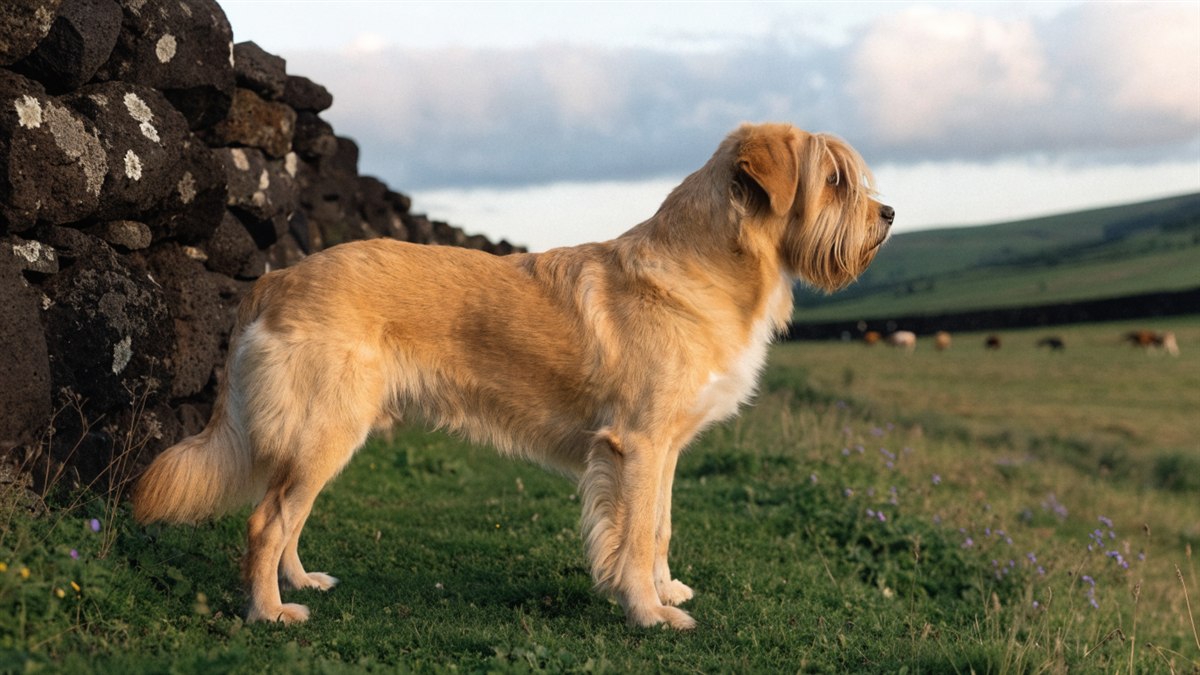
The Barbado da Terceira is a medium-sized long-coated cattle dog from the island of Terceira in the Azores, bred to gather and drive cattle on steep volcanic pasture and to guard the farm. Its own standard, published by the Clube Português de Canicultura and reproduced by the Azorean breeders' association, places it in FCI Group 1, Section 2, cattle dogs other than the Swiss cattle dogs, and gives males 52 to 58 cm and 25 to 30 kg, females 48 to 54 cm and 21 to 26 kg.
The general appearance clause opens with one word that sets the tone: cão rústico, a rustic dog, with a strong well-muscled body covered in long, abundant, wavy hair. Rustic is doing real work in that sentence. It signals a landrace shaped by function on a working island rather than a show type refined in a ring.
The name does the describing too. Barbado means bearded, and the standard traces it to one clause: the hair is abundant on the whole head, on the muzzle and over the eyes where it falls forward, and thick along the jaw line, originating the beard from which the breed takes its name. That is not decoration. A dog working loose cattle on wet basalt takes head knocks, and the coat over the eyes and jaw is the padding.
Read the standard rather than the aggregator summaries and four things separate this dog from the generic shaggy herder the ranking pages describe.
- Coat with abundant undercoat over the whole body. The clause reads long, thick, slightly wavy, neither straight nor curly, com sub pêlo abundante em todo o corpo. A soft coat with no undercoat is listed as a severe fault.
- A working clip written into the standard. The same clause states that the working clip shortens the coat uniformly and that this presentation should be the one used in beauty shows. A breed standard that blesses clipping is rare, and it changes the Indian grooming answer completely.
- A tail that may be shortened or entire. Set medium to low, shortened to the third vertebra or entire, not passing the hock, with natural bobtails accepted.
- Drop ears, broken, well covered with hair. Set medium to high, triangular, medium sized, pendent and broken, with mobility, lifting at the base and folding forward when the dog is alert.
The colours, and the two that disqualify
Five colours are correct: yellow, grey, black, fawn and wolf-grey, each in light, common and dark tones, with white permitted on the chest, belly and tail tip and in the named marking patterns. Two colours end a show career rather than cost points. A brown coat and a mottled coat are eliminating faults, alongside blue eyes whether wholly or partly blue, timidity, aggression, and over or undershot jaws.
Height is policed at both ends. Above 60 cm or below 48 cm is a severe fault, which is a narrower working window than the headline 52 to 58 cm range suggests.
What it was bred to do, in the standard's own words
The utilization clause names three jobs in order: cattle-driving dog par excellence, guard dog, companion. The Azorean association is more specific about the first, describing a dog used in a recolha de gado bravo, the gathering of wild or semi-feral cattle, and crediting the slightly rolling walk and elastic trot with making that work possible. The United States club puts the same job in plainer terms: a herding dog that does not respond quickly and intelligently to a 2,200-pound aggressive bull will be injured.
The origin story is settlement history rather than kennel history. The association records that dogs arrived with the Portuguese settlers from the fifteenth century, that further dogs came ashore with peoples passing through the islands over the following centuries, and that the Barbado probably evolved from that mixture under island isolation. It also names the honest comparison set. The association itself says the resemblance to the Bouvier des Flandres, the Briard, the Old English Sheepdog and Portugal's own Cão da Serra de Aires could lead you to look for the true origin elsewhere, and argues that insularity fixed a distinct phenotype and function anyway.
Every Indian-facing page in the ranking set gives sizes. One of them, an openly ai-assisted draft, gives both sexes an identical 25 to 30 kg and 52 to 56 cm. The Portuguese standard gives females a separate 48 to 54 cm and 21 to 26 kg, so that page is wrong about half the breed. Where this guide and an aggregator differ, this guide is quoting the standard.
Recognition, precisely: a Portuguese breed the FCI does not list at all
The Barbado da Terceira is recognised by the Clube Português de Canicultura and is absent from the Fédération Cynologique Internationale altogether, not provisionally recognised and not definitively recognised. Bonbeno settled the second half by reading the FCI's own two lists rather than a page claiming to be one of them. Fédération Cynologique Internationale
What the Portuguese kennel club did, and when
The CPC recognised the breed in 2004, making it the tenth Portuguese breed to be recognised, and the Portuguese state veterinary authority, the Direcção-Geral de Veterinária, recognised it in the same year. The 2010 University of the Azores molecular thesis states the year without hedging, and adds the detail that matters most: O Cão Barbado da Terceira foi reconhecido oficialmente pelo Clube Português de Canicultura como raça em 2004, and that recognition rested on work by Rocha (2002), the first molecular characterisation of the population then in existence, carried out to demonstrate its structure and distinguish these animals from other dog breeds.
The sequence is documented step by step by the Azorean breeders' association. Carla Molinari and Jorge Gonçalves of the CPC visited Terceira in August 1997 with the club's Azores delegate António José Amaral, to judge whether the dogs constituted an indigenous breed. After repeated study visits a CPC delegation led by Molinari and Vice-President Luís Catalan concluded in 2003 that the homogeneity and genetic diversity of these animals needed registering. In April 2004 a protocol was signed between the CPC, the Direção Regional do Desenvolvimento Agrário and the University of the Azores. The provisional standard was presented to a CPC general assembly in 2005.
Recognition is dated 2004 by three independent sources. The standard on which the breed is judged was presented in 2005 and both the Azorean association and a United States breeder page call that standard provisional. Nobody publishes a later document upgrading it. So the honest description is a breed recognised nationally in 2004 and still working from a standard its own association describes as provisional, which is not the same thing as a finished, definitive standard.
What the FCI has, and what it does not
The FCI keeps two relevant registers and the breed is in neither. Its alphabetical nomenclature runs BARBET (105) straight into BASENJI (43) with nothing between them, and that same nomenclature does carry provisionally recognised breeds, including the BULDOGUE CAMPEIRO (374), so the absence is not an artefact of the list only holding definitive breeds.
The provisional list was checked separately, because that is where a recently recognised national breed would sit first. The document Bonbeno read carries the printed heading Breeds recognised on a provisonal basis, spelling error included, and names 20 breeds from the Australian Stumpy Tail Cattle Dog (351) to the Macedonian Shepherd Dog Karaman (378). Neither Barbado da Terceira nor the word Barbado appears anywhere on it.
That list also settles the objection that the FCI route is somehow closed to small Portuguese breeds. It is not. The Cão de Gado Transmontano (368), a Portuguese livestock guardian, sits on the provisional list. Portugal can and does put breeds through. The Barbado has not completed that process.
The position has been stable for a long time. Writing in Canine Chronicle in 2017, Ria Hörter recorded that the Barbado was provisionally recognised by the Portuguese Kennel Club in 2004 and that, unlike comparable Iberian and other Portuguese island breeds, it is not recognised by the FCI, and noted that a group of owners founded the Clube Português do Barbado da Terceira in 2013 precisely to write the standard and pursue FCI recognition. Nine years on from that article, the FCI lists still do not carry the breed.
| Registry | Status | Evidence read |
|---|---|---|
| Clube Português de Canicultura | Recognised, 2004. Tenth Portuguese breed. Standard presented 2005 and described as provisional | CPC standard text, association history, 2010 UAç thesis |
| Direcção-Geral de Veterinária (Portugal) | Recognised, 2004 | Wikipedia, citing the CPC |
| Fédération Cynologique Internationale | Not listed. Not definitive, not provisional | FCI nomenclature B list and the FCI provisional list, both read 20 August 2026 |
| American Kennel Club | Foundation Stock Service, Herding Group. Not a regular AKC breed | AKC FSS and Miscellaneous breeds by group |
| Kennel Club of India | No standard and no published register entry found | Searched; nothing located |
One FCI URL that looks exactly like the provisional list returns HTTP 200 and serves a complete English Setter page instead. Anyone reading it would find no mention of this breed and report a correct conclusion from the wrong document. The defence is to confirm the names printed inside the page you landed on, which is why the 20 breeds are itemised above.
The American position, and a date three sources fight over
The American Kennel Club records the Barbado da Terceira in its Foundation Stock Service, in the Herding Group, and not as a regular AKC breed. It appears as one of 17 breeds in the Herding section of the AKC's FSS and Miscellaneous Breeds Broken Out By Group page.
Foundation Stock Service is a recording service rather than recognition. It exists so a developing breed can build a studbook the AKC will later accept, and enrolment continues until the AKC Board accepts the breed for regular status. That is why the AKC's own breed page for the Barbado runs to two sentences, offers no standard, and gives no height, weight or life expectancy. An Indian reader treating an AKC page as the authoritative source on this breed will come away with almost nothing, and that is the AKC being honest rather than the AKC being thin.
The contested date
Three sources give three answers for when FSS enrolment happened, and none of them cites an AKC board minute.
| Source | Date given | Who wrote it |
|---|---|---|
| Showsight Magazine, December 2024 | 2021 | The President and Secretary of the Barbado da Terceira Club USA |
| New World Barbado da Terceira Kennel | January 2020 | A United States breeder page |
| Wikipedia | Since 2021 | Citing the AKC |
Bonbeno prints all three rather than picking the most convenient one. The disagreement is small but it is a fair signal of how thin the documentary record on this breed is: two of those three sources are written by the same small community, and they still do not agree on the year.
What the American club adds, and what it does not
The United States club is a useful source on population and on the breed's working character, and a poor source on Indian care. It counted 99 Barbados in the United States and Canada combined as of November 2024, with more litters expected, and describes the group as working with the Portuguese clubs to save a rare breed from extinction. It also gives the sharpest one-line description of the job anywhere in English: a herding dog that does not respond quickly and intelligently to a 2,200-pound aggressive bull will be injured.
Its care guidance is a different matter. Describing the breed as relatively low-maintenance and not requiring excessive grooming or bathing is defensible advice in Pennsylvania and poor advice in Mumbai. That divergence is worked through in the grooming section, and it is the general rule for this page: take the overseas clubs seriously on what the breed is, and check them against Indian evidence on how to keep it.
It matters because AKC recognition is the usual channel by which a breed reaches Indian buyers, via imported dogs and via Indian clubs adopting an international standard. A breed sitting in Foundation Stock Service has not passed through that channel, has no AKC standard for an Indian club to adopt, and has no FCI standard either. That is the structural reason the breed is unavailable here, and it is independent of import law.
Two Terceira dogs, and the one the FCI calls extinct
Terceira produced two documented dog types and English-language pages routinely merge them. The Barbado da Terceira is a long-coated Group 1 herding and cattle-driving dog that is alive and registered. The Cão de Fila da Terceira, or Terceira Mastiff, was a molosser, and the FCI's own current standard for the neighbouring São Miguel breed describes it as extinct.
The sentence sits in FCI-Standard N° 340 for the Cão Fila de São Miguel, the Saint Miguel Cattle Dog, English text dated 20 June 2007. Its Brief Historical Summary reads: a cattle dog originating in the island of Saint Miguel in the Azores, also known as the Cow Dog, and its history is linked to that of the now extinct Terceira Dog.
Read carelessly that looks like the FCI declaring the Barbado extinct three years after Portugal recognised it. Read carefully it does not. The extinct animal is the Fila da Terceira, the island's mastiff, a different dog with a different build and a different job. The Barbado is a bearded, wavy-coated driving dog; the Fila type was a broad-skulled gripping dog of the sort the São Miguel standard still describes, Group 2 Section 2.1, molossoid, dogue type.
A reader searching for a Terceira dog will meet three names that are not synonyms. Barbado da Terceira is the living herding breed. Cão de Fila da Terceira, or Terceira Mastiff, is the extinct molosser. Cão Fila de São Miguel is a separate living breed from a different island, and it is the one with a full FCI standard. Anyone quoting an FCI standard number for the Barbado is quoting a number the FCI has not issued.
How the two Azorean cattle dogs compare on paper
The comparison is worth doing because the São Miguel dog is the only Azorean cattle dog with a definitive FCI standard, and it is what an Indian reader will find if they search for an Azorean cattle dog at all.
| Barbado da Terceira | Cão Fila de São Miguel | |
|---|---|---|
| Island | Terceira | São Miguel |
| FCI standard | None issued | N° 340, published 21.05.2007 |
| FCI group | Group 1 Section 2 in the Portuguese standard only | Group 2, Section 2.1, molossoid, dogue type |
| Height, males | 52 to 58 cm | 50 to 60 cm |
| Weight, males | 25 to 30 kg | 25 to 35 kg |
| Height, females | 48 to 54 cm | 48 to 58 cm |
| Weight, females | 21 to 26 kg | 20 to 30 kg |
| Coat | Long, thick, slightly wavy, abundant undercoat | Short, dense (dogue type) |
| Ears | Natural drop, broken, well coated | Cropped with rounded tips where cropping is not forbidden |
| Tail | Shortened to the third vertebra or entire; bobtails accepted | Docked at the 2nd or 3rd vertebra where docking is not forbidden |
| Bite behaviour on stock | Not specified in the standard | Bites low on dairy herds to avoid the udders, higher on stray cattle |
Both standards contemplate a procedure Indian law forbids
This is the clause an Indian buyer has to know about. The Barbado standard permits a tail encurtada até à terceira vértebra, shortened to the third vertebra. The São Miguel standard goes further and specifies docking at the second or third vertebra, and ear cropping with rounded tips, in countries where those are not forbidden.
India is a country where they are forbidden. The Prevention of Cruelty to Animals (Dog Breeding and Marketing) Rules, 2017, Second Schedule Part II, paragraph 6(8), states that there shall be no tail docking, ear cropping, de-barking, de-clawing, branding, dyeing, injecting substances to enhance visual appeal, or any other kind of mutilation of any body part of the pup, and that any change of appearance by artificial means is strictly forbidden.
So the practical Indian reading of the Barbado standard is that the second half of its tail clause is the only lawful half here. An entire tail is correct under the standard and lawful in India. A natural bobtail is correct under the standard and lawful, because it is not a procedure. A tail shortened by a breeder is unlawful, and a dog presented in India with a surgically shortened tail is evidence of an offence rather than evidence of type.
Standards that say "where docking is not forbidden" are written for a world in which some countries still allow it. That phrasing is not permission for India. Neither is a Portuguese show photograph. If a seller tells you a shortened tail is breed-correct, they are quoting a clause that India's own rules override.
The founder base, measured: 50 dogs in 2002, 257 in 2010
The Barbado da Terceira was rebuilt from a small documented founder base, and two University of the Azores master's theses are the only places the founder population numbers are published. The founding molecular study covered 50 animals. The 2010 follow-up covered 257 animals across twelve microsatellite loci and identified 79 alleles in total.
No ranking page cites either thesis. Both are in Portuguese, both are open on the University of the Azores repository, and between them they contain every hard population number that exists on this breed. That is the single biggest gap this guide fills.
What the 2010 characterisation found
Lisandra Monteiro's thesis, supervised by Professor Artur da Câmara Machado at the Centro de Biotecnologia dos Açores, analysed 257 Barbados with twelve microsatellites. Its own comparison against the founding Rocha (2002) study is stark on sample size alone: Rocha characterised 50 animals, Monteiro characterised 257, and 19 new alleles appeared purely because the sample was five times larger. Anyone quoting the heterozygosity jump from 0.595 to 0.998 as evidence the breed improved is misreading a sampling effect, and the thesis says so.
The finding that does hold is a loss of alleles over time. The thesis split the dogs into three birth cohorts and counted alleles in each.
| Birth cohort | Alleles present | Change |
|---|---|---|
| Born before 2001 | 71 | baseline |
| Born 2001 to 2004 | 58 | 13 alleles lost |
| Born after 2004 | 62 | 4 recovered |
| Whole population | 79 | across all three cohorts |
Losing 13 of 71 alleles between the oldest cohort and the next is a 18.3 percent drop, and the thesis names it plainly: there is a significant loss of alleles between the first and the last two groups, which represents a genetic impoverishment of the population, and this process will have to be counteracted. Observed heterozygosity across those cohorts moved 0.998, then 0.994, then 0.997, so the thesis concludes heterozygosity itself is not being lost even though allelic richness is.
The popular sire problem, with numbers
Paternity was checked on 107 of the 257 dogs. Those 107 animals were fathered by 35 different sires, and the distribution was severely uneven. One dog, BT29, sired 24 of them. BT97 sired 14. BT22 sired 13. Most of the remaining sires fathered between one and four.
Divide it out. Three males account for 51 of 107 offspring, which is 47.7 percent of the sampled generation, and one of them alone accounts for 22.4 percent. The thesis's own recommendation follows from that arithmetic: attention must be paid to the sires used, the number of males in use should be increased, and the number of offspring per sire should be balanced.
The thesis does not say this breed is inbred. It concludes the population still maintains enough genetic variability not to undergo an inbreeding process, while warning that a small population carries a higher probability that two individuals share common ancestors, and that excessive consanguinity would cost the breed vigour and bring health disorders. Both halves of that sentence are true and both belong on the page.
Ten pedigrees in 107 did not survive DNA testing
Of the 107 dogs checked against the parentage their owners declared, 97 were compatible with both declared parents across all twelve loci and the rest were incompatible on at least one locus. That is 10 of 107, a 9.3 percent mismatch rate, in the breed's own home population, tested by its own university, using samples supplied by its own breeders' association.
That figure is not a scandal and it is not unusual for a young studbook. It is a caution about paperwork. A Barbado pedigree is a claim about parentage, and roughly one in eleven of those claims failed verification when someone actually tested them. Any buyer being shown a pedigree for this breed should treat it as a document worth verifying rather than a guarantee.
How many dogs exist
Two population counts are published and they are fifteen years apart. A 2005 CPC census recorded 222 dogs, with 73 entered at a single-breed show that January. As of November 2024 the United States club counted 99 Barbados in the United States and Canada combined. The 2010 thesis sampled 257 animals, which is consistent with a home population in the low hundreds. Nothing published gives a current worldwide total, and this guide does not estimate one.
Barbado da Terceira price in India: no rupee price for the dog exists
There is no Barbado da Terceira price in India, because there is no Indian market for the breed. Bonbeno pulled the India result page for "barbado da terceira price in india" on 20 August 2026 and the only rupee figure attached to this breed anywhere on it was Rs 5,539, for a decorative wall plaque. Not one page on that result set publishes a rupee price for a dog.
Look at what the India page one actually contains, because the composition is the answer.
| Position | Domain | What it actually is |
|---|---|---|
| 1 | flipkart.com | A print-on-demand paperback, a Terceira Cattle Dog training guide |
| 2 | amazon.in | Another print-on-demand paperback, tricks and agility |
| 3 | poultrybazaar.net | A daily poultry rate sheet |
| 4 | findmydogbreed.com | The only genuine dog-cost page. All dollars, no India figure |
| 5 | amazon.in | A wall plaque at Rs 5,539, MRP Rs 10,599. The only rupee figure for the breed |
| 6 | market.todaypricerates.com | Mandi rates for vegetables, fruit, eggs and meat |
| 7 | priceinindia.website | A generic retail price-comparison shell |
| 8 | agriboz.com | Wholesale mandi rates per quintal |
| 9 | commodityonline.com | Commodity mandi prices |
| 10 | boldsky.com | State-wise liquor prices in India |
Five of the ten results are agricultural commodity or liquor price sheets. Two are books. One is a wall sign. The search engine matched the word price and found nothing in India that sells this dog, because nothing in India sells this dog. There is no Indian puppy price to report, cheap or expensive, and no seller against whom to test whether an advertised puppy price is affordable or absurd.
The dollar figures the ranking pages do publish, converted
The one credible cost page on the India result set publishes no per-breed price at all and says so in writing. It states that it does not invent per-breed first-year or lifetime totals, and that its dollar figures come from exactly three places: its own tracked bands where they exist, the ASPCA's 2021 United States national dog cost table, and the AKC's published purebred purchase window. For this breed it has no tracked band, so it falls back to the AKC's generic USD 500 to 5,000 for any purebred puppy and the ASPCA's national first-year figure of USD 3,221.
Neither of those is a Barbado da Terceira price and neither is an Indian price. Converted at 84.38 rupees to the dollar, purely so a reader can see the scale of what is being repeated, the AKC band becomes roughly Rs 42,000 to Rs 4,22,000 and the ASPCA first-year figure becomes about Rs 2,72,000. Those are American numbers wearing a rupee costume, and this guide publishes them only to label them.
Indian pages for rare breeds routinely publish a "price" that is a US dollar figure run through one exchange rate. Divide any rupee figure you find for this breed by 84.38. If it lands on a round dollar number, such as 500, 800, 1,500 or 2,500, you are looking at a converted American blog post rather than an Indian quotation. Bonbeno found no Indian rupee price for the dog to run this test against, which is itself the finding.
What about the wall plaque
The Rs 5,539 sign is worth one paragraph because it is the highest-ranking rupee figure for this breed in India. It is listed against an MRP of Rs 10,599, a 48 percent discount. Divide those by 84.38 and you get about USD 65.6 and USD 125.6, which are not round dollar amounts, so this looks like ordinary marketplace pricing rather than a straight conversion. It is also, obviously, not a dog. A reader who searches this breed's price in India is currently being offered a paperback, a poultry rate and a sign.
What you are actually being offered if a seller does appear
No Indian seller for this breed was found. If one appears, the realistic possibilities are a different long-coated herding breed presented under an unfamiliar name, a crossbred village dog with a beard, or an auto-generated listing page that exists identically for several hundred breeds. Two of the three ranking dog pages already show the template signature: one prints a heading reading "arbado da Terceira Care and Grooming Tips" with the initial letter missing, and another prints its own generation method on the page as ai assisted draft.
Bonbeno does not recommend breeders, does not link puppy listings and does not quote a live price as an offer. On this breed there is nothing to quote.
Why no lawful supply chain for this breed can form in India
A Barbado da Terceira cannot lawfully be imported into India to be bred or sold, and that single fact is why no Indian price exists and why none is coming. Dogs sit under ITC (HS) 01061900 as a Restricted import, and DGFT Trade Notice 22/2022-23 limits entry to three named purposes, none of which is trade.
Bonbeno downloaded the five-page notice from the DGFT content server and extracted the text directly rather than relying on a summary. The operative clauses read as follows.
| Clause | What it says |
|---|---|
| ITC (HS) 01061900 | Mammals, Other. Import Policy: Restricted. Subject to Policy Condition 6 of the chapter |
| Policy Condition (7) | Import of dogs is allowed only for: a pet dog with valid pet book and records in the name of the importer; dogs imported by R&D organisations with CPCSEA recommendation; or for internal security by the Defence and Police Force |
| Policy Condition (8) | Import of commercial dogs for breeding or any other commercial activities other than the purposes above is not permitted |
| Paragraph 6 | Any applications for trading or breeding purposes, or applications made on behalf of another person or entity, shall be duly rejected |
| Paragraph 7 | Import of pet animals is allowed only through the airports and seaports of Delhi, Mumbai, Chennai, Hyderabad, Bangalore and Kolkata, with quarantine where required; DAHD added Kochi for pets arriving under the baggage rules in October 2024 |
| Paragraph 5 | Pet owners are advised to start the authorisation process at least two months before travel |
Read Policy Condition 8 and paragraph 6 together and the commercial route is closed twice over, once as a policy bar and once as a mandatory rejection of the application. There is no discretionary channel a breeder can argue their way through.
The only door that is open, and how narrow it is
One lawful route exists and it is a personal one. A person relocating to India may bring in a pet dog. The notice allows import as passenger baggage without DGFT authorisation only for up to two pets, only on a permanent import, and only for persons transferring their residence to India after two years of continuous stay abroad. Anything outside that, a shorter stay abroad, a third animal, or an animal not travelling as baggage, requires a DGFT import authorisation examined by the Department of Animal Husbandry and Dairying.
The paperwork is not trivial either. The applicant needs a vaccination book, pet passport or pet book, and the pet's passport, and must obtain an advance No Objection Certificate from the Regional or Quarantine Officer of the port, submitting the DGFT licence and a health certificate from the exporting country's veterinarian, seven days before travel and relaxable only to three.
One realistic path exists for a Barbado da Terceira to be in India lawfully. Someone who has lived abroad for more than two years, who already owns the dog, moves home and brings it with them. That is not a supply chain. It produces individual dogs, not litters for sale, and it is why a rupee price cannot form.
The second lock: no registry route either
Even if a dog arrived, there is no Indian registration path for it. The Kennel Club of India publishes no standard for the breed and no register entry for it was located in an August 2026 search. The FCI, whose standards Indian clubs generally follow, has issued no standard at all for this breed, so there is no international document for an Indian club to adopt. The Portuguese standard exists but is a CPC document, described by the breed's own Azorean association as provisional.
Between the import bar and the registry vacuum, an Indian breeder could not lawfully obtain breeding stock, and could not register the resulting puppies with any Indian body if they did. That is the whole answer to "where can I buy one in India", and no ranking page gives it.
And breeding advice from abroad has to be checked against Indian rules
This matters for a small-population breed in particular. Breed clubs managing a narrow gene pool sometimes recommend close matings to fix type. India's Dog Breeding and Marketing Rules, 2017, Second Schedule Part II paragraph 6(3), prohibits in-breeding, defined as mating dogs related in the 2nd to 4th grade within the first four generations, and prohibits incest breeding between parents and offspring or between siblings. Only out breeding and line breeding are permitted. Given that 35 sires produced 107 of the studied dogs and one sire produced 24 of them, the relatedness of any two Barbados is a live question, not a theoretical one.
Heat tolerance: the Azores are mild and oceanic, which is not the same as warm
The Barbado da Terceira rates 2 out of 5 for heat tolerance in India, and the reason is arithmetic rather than opinion. Its home island's hottest month, August, has a mean of 23.0 degrees C and a mean daily maximum of 25.6 degrees C. Chennai's coolest month, January, has a mean of 25.4 degrees C, so Chennai's coldest month is warmer on average than Terceira's hottest.
Southern Europe is a large place and "Portuguese breed" tells you nothing useful about heat. The Azores sit 1,500 km out in the Atlantic and their climate is temperate oceanic, not Mediterranean and certainly not tropical. The parasitology team working on Terceira describes the archipelago in exactly those terms: high levels of air humidity, mild temperatures, low insolation rates, regular and abundant rainfall, with average temperatures of 13 degrees C in winter and 24 degrees C in summer.
The comparison, on one methodology
All three rows below come from the same climate source and the same style of monthly normal, so the comparison is like for like rather than three different methods stitched together.
| Angra do Heroismo | Bengaluru | Chennai | |
|---|---|---|---|
| Annual mean temperature | 18.0 C | 24.4 C | 29.1 C |
| Warmest month | August | April | May |
| Warmest month, mean | 23.0 C | 28.0 C | 33.0 C |
| Warmest month, mean daily high | 25.6 C | 34.0 C | 38.4 C |
| Coolest month, mean | 15.0 C (February) | 21.4 C (December) | 25.4 C (January) |
| Annual rainfall | 1,085 mm | 985 mm | 1,235 mm |
Three readings fall out of that table and each one is decisive.
- Chennai's coldest month is hotter than Terceira's hottest. 25.4 degrees C in January against 23.0 degrees C in August. A Barbado in Chennai never experiences a month as cool as its homeland's peak summer.
- Bengaluru, the mildest large Indian option, still runs 5 degrees warmer at peak. April averages 28.0 degrees C against Terceira's 23.0 degrees C, and its mean daily high of 34.0 degrees C is 8.4 degrees above Terceira's.
- The gap is in the daily maximum, which is what actually kills dogs. A mean high of 25.6 degrees C means the dog was selected in a place where the afternoon is comfortable. Every large Indian city has afternoons this breed has never been selected against.
The coat is why the gap matters
A mild home climate would be survivable if the dog were lightly coated. It is not. The standard requires long, thick, slightly wavy hair with abundant undercoat over the whole body, and lists a soft coat without undercoat as a severe fault. The hair is abundant on the entire head, over the eyes and along the jaw, and abundant on the limbs including between the toes. That is an insulating envelope built for wet Atlantic wind at 15 degrees C.
Compare the nearest FCI-recognised Portuguese herding dog and the difference is instructive. The Cão da Serra de Aires carries long goat-textured hair without undercoat, and its standard describes a dog perfectly adapted to the Alentejo's temperature changes. That is a mainland dog bred for a hot dry summer. The Barbado is not that dog, and reasoning from one to the other is the mistake most Indian pages make.
Terceira is humid, so the argument is not that the breed has never met humidity. It is that Terceira is humid AND cool, while Chennai is humid AND hot. A dog loses heat by panting, and panting works poorly when the air is already near saturation. Chennai runs about 71 percent annual relative humidity at a 29.1 degree annual mean. That combination is the one this coat has never been tested against.
City by city, honestly
| City | Verdict | Why |
|---|---|---|
| Bengaluru, Pune | Workable with management | Coolest large-city options, but April still runs 5 degrees above the breed's hottest month |
| Mumbai, Kolkata | Difficult | Warm and very humid together, which removes the dog's main cooling route |
| Chennai, Hyderabad | Poor | Chennai's coolest month exceeds Terceira's warmest; no month offers relief |
| Delhi NCR | Not advisable | May averages a 40.1 C daily maximum and June a 33.3 C mean, roughly 14.5 degrees above the breed's hottest month |
| Shimla, Ooty, Darjeeling | Genuinely suitable | Cool and moist year-round, the closest Indian analogue to the home climate |
The clause that overturns the never-shave rule for this breed
The Barbado da Terceira's own standard permits and expects a clip. The coat clause states that a tosquia de trabalho encurta o pêlo uniformemente, the working clip shortens the hair uniformly, and that this presentation should be the one used in beauty shows. That is unusual, it is written into the standard, and it changes the Indian grooming answer.
Nearly every Indian coat guide repeats one rule for double-coated dogs: never shave. The rule exists for good reason. On most double-coated breeds the outer guard hairs regrow slowly or not at all after clipping, the undercoat comes back faster and denser, and the dog ends up worse insulated against sun and worse ventilated. Applied blindly, though, the rule tells an Indian owner to keep a full winter coat on a dog through a Chennai May, which is not what the breed's own registry says.
What the standard actually authorises, and what it does not
Read the Portuguese carefully and three things are true at once.
- A uniform working clip is correct. Not a strip, not a pattern trim, not a shaved body with a fluffy head. The clause says the hair is shortened uniformly.
- It is show-legal in the breed's home country. The same sentence says this presentation should be used in beauty shows, which removes the usual objection that clipping ruins a show career.
- The undercoat is still required. A soft coat without undercoat is a severe fault, so the clip shortens the coat rather than removing the dog's coat structure. Clipping to the skin is not what is being described.
Ask for a uniform scissor or clipper length over the whole body, not a shave, and not a breed-specific pattern the groomer will have to invent. Leave the beard and the hair over the eyes long enough to keep doing their job. Keep the belly and the inside of the thighs shorter than the back, because that is where a lying dog dumps heat into a cool floor. Nothing about that brief requires a groomer who has seen the breed, which is fortunate, because in India none will have.
Why this is worth more than a paragraph
This is the seam where overseas advice and Indian conditions actually diverge, and the divergence runs in the direction people do not expect. The United States club, writing for a North American readership, describes the breed as relatively low-maintenance, not requiring excessive grooming or bathing, and credits the double coat with withstanding various weather conditions. That is reasonable in Pennsylvania. In an Indian monsoon it is the advice that produces a matted, hot, permanently damp dog.
Two things drive that. First, a coat this dense over a humid Indian summer dries slowly, and a coat that never fully dries mats at the skin where the owner cannot see it. Second, this breed carries hair between the toes and a heavy beard, both of which stay wet after every walk on a wet street. The remedy is not to abandon the coat. It is to shorten it uniformly, as the standard already allows, and to dry the dog properly rather than letting it air dry.
The bathing and drying rule, and the Indian evidence behind it
Never let this dog air dry in India, and never bathe it without drying the ear canals. Indian clinical series consistently put ear disease among the commonest presentations, and moisture is the mechanism. A Chhattisgarh series of 281 dogs found otitis externa in 51 of them, 18.14 percent, and the paper's own discussion names humid environments and excessive moisture in the ears from swimming or bathing as promoters of bacterial growth. A Jammu series screened 273 canine skin cases and found otitis externa in 60, 21.97 percent.
For a drop-eared, heavily coated breed with hair around and inside the ear leather, that is not background risk. It is the specific risk this coat creates in this climate, and it is dealt with in the grooming section in detail.
Temperament: what a C-BARQ study of 67 Barbados actually found
The Barbado da Terceira is a stable, sociable working dog that turns aggressive mainly when it judges its territory or its rank to be under threat. That is not a breeder's impression. It is the conclusion of a 2013 University of the Azores master's thesis that ran the C-BARQ questionnaire on the owners of 67 Barbados and a 16-subtest behavioural trial on 24 of them.
No page ranking in India cites this study, and it is the only structured behavioural data that exists on the breed. Elisabete Azevedo's thesis used the Canine Behavioral Assessment and Research Questionnaire supplied by Dr James Serpell of the University of Pennsylvania, 101 questions across several sections, on owners of dogs over one year old registered with the Azorean breeders' association. The sample was 38 males and 29 females. The behavioural trial ran 16 subtests and 47 behavioural variables on 11 males and 13 females, twice each a month apart, in October, November and December 2011, in the same place with the same team and the same assessor.
What the study concluded
- Generally stable and sociable. The Barbados in the sample were, in general, stable animals, sociable, able to establish good relationships with strange people and with other animals.
- With one clear exception. The exceptions arose essentially when the dog felt its territory or its hierarchical position threatened, and it then reacted aggressively.
- Bold but not reckless. In non-social contexts they were little given to fear, but showed some difficulty approaching the source of a noise quickly without the owner's support.
- Bonded to one person. They form a strong bond with a particular family member and do not demand constant attention.
- Obedient and handleable. They proved obedient, active dogs that allowed themselves to be manipulated despite feeling some stress.
- Low object play and low predatory scores, which the author explicitly attributes in part to the stimuli possibly not being the most suitable and the number of questions being insufficient to determine those traits.
The thesis found no large statistically significant differences between the sexes on most behavioural variables. That is worth knowing for anyone choosing on sex alone.
This is a small study and it says so. Test-retest reliability was not high for most behavioural variables, and the author could not statistically validate the questionnaire against the behavioural trial as originally intended, although some significant correlations between individual C-BARQ questions and trial variables were detected. Treat these findings as the best evidence available on this breed's temperament, not as settled science. There is nothing stronger to replace them with.
The shift the study documented in passing
One finding is about owners rather than dogs, and it is the most relevant one for an Indian household. The results pointed to a greater tendency to acquire the Barbado as a companion animal in preference to the herding function for which it was originally selected. The breed is already moving from farm to family in its own homeland, which is a fair indication that it can make the transition. It is not an indication that the guarding wiring has been bred out, because the standard still lists guard dog as the breed's second stated purpose.
Which Indian household this suits, and which it does not
Front-load the answer. This dog suits a household with ground-level space, a defensible boundary, an owner at home for a decent part of the day, and someone willing to manage a territorial response to visitors. It does not suit a first apartment, a household with heavy footfall of strangers at the door, or an owner who wants a dog that ignores the world.
| Situation | Fit | Reason |
|---|---|---|
| House with a garden or compound | Good | A territory it can define and patrol, which is what the guarding trait wants |
| Family with older children | Good | Described in the standard as affectionate, easy to teach and cheerful |
| Apartment living, shared walls | Poor | A territorial dog in apartment living meets dozens of strangers a week at its own door |
| Home with frequent deliveries and staff | Needs work | Territorial and hierarchical threat is the study's named aggression trigger |
| First-time owner | Not advised | A guarding landrace with almost no behavioural literature and no Indian trainer familiar with it |
| Left alone all day | Poor | An active working dog with strong attachment to one person |
Training: an easy dog to teach and a hard dog to overrule
To train a Barbado da Terceira, work with its reward system rather than against its judgement, and put every session in the cool part of the Indian day. The standard describes a dog that is intelligent, de ensino fácil, easy to teach, cheerful and voluntarioso, wilful, in the same sentence. Both halves of that description are the training brief.
A cattle dog that gathers semi-feral stock has to make decisions without being told. Selection for that produces a dog that learns a cue in very few repetitions and then decides, in the moment, whether the cue is the right answer. Handlers coming from a biddable gundog will read that as disobedience. It is not. It is the trait the breed exists for.
What works
- Reward-based marker training in short sessions. Five to eight minutes, three times a day, beats one thirty-minute block for a dog that learns fast and bores faster.
- Give the behaviour a job. A retrieve to hand, a place command with a real purpose, a wait at the gate that the dog can see the point of. A working breed complies more readily when compliance is functional.
- Socialise deliberately and early. The behavioural study names territorial and hierarchical threat as the aggression trigger, so the fix is exposure to strangers and to other dogs while the dog is young enough for it to be ordinary.
- Train early morning or after dark. A double coat plus an Indian afternoon means the dog stops learning and starts thermoregulating.
- Recruit the bonded person. The study found these dogs form a strong bond with one particular family member. That person is the training asset.
What fails
- Confrontational handling. Alpha rolls, scruff corrections and physical intimidation applied to a dog whose named aggression trigger is a threat to hierarchical position.
- Drilling. Repetition past the point of understanding, which this breed reads as pointless and disengages from.
- Afternoon obedience. Heat is a training variable in India, not a footnote.
- Punishing the guard bark. The standard lists guarding as a stated purpose, so the response the dog was bred for cannot be extinguished by correction. Redirect it to a cue instead.
Realistic Indian timelines
| Skill | Realistic timeline | Note |
|---|---|---|
| Name response and marker charge | 3 to 7 days | Fast. The standard's "easy to teach" is accurate |
| Toilet training | 3 to 8 weeks | Monsoon slows this because the dog refuses to go out in rain |
| Sit, down, place | 2 to 3 weeks | Learned quickly, maintained only if it stays useful |
| Loose-lead walking | 2 to 4 months | A driving dog wants to be ahead and moving |
| Reliable recall off-lead | 6 to 12 months | Slowest skill in a breed selected to work at a distance |
| Settled response to visitors | 6 to 18 months | The territorial trait is managed, not trained away |
With no Indian population, no Indian trainer has handled one. Choose a trainer on method rather than on breed claims. Anyone advertising Barbado da Terceira experience in India is describing experience they cannot have. A good force-free trainer with working-breed experience will do far better than a specialist who is inventing a specialism.
Exercise: 60 to 90 minutes a day, split around the heat
Plan 60 to 90 minutes of real work a day for an adult Barbado da Terceira, split into a long cool-hour session and a shorter one, plus daily thinking work. No published study sets a figure for this breed, so this range is reasoned from what the standard says the dog was built to do rather than copied from a ranking page.
Say plainly what is and is not known. Nobody has measured the daily energy requirement of a Barbado da Terceira. What is documented is the job: a dog that gathers and drives cattle, including semi-feral cattle, over island pasture, with andamentos ágeis e com boa impulsão, agile paces with good drive, permitting abrupt changes of direction, an elastic trot with good reach and suspension, and an energetic, fast gallop. That is a full working day of intermittent sprinting and turning, not a dog that was bred to lie down.
Structuring it around an Indian day
| Slot | Duration | Content |
|---|---|---|
| 05:30 to 07:00 | 40 to 55 min | The main session. Brisk walk, off-lead work in a safe space, recall games, some sprint and turn work |
| Midday | 0 min outdoors | Indoors. Scent games, chew work, a food puzzle, training reps on a cool floor |
| After sunset | 20 to 35 min | Second walk plus a short training block |
| Through the day | 15 to 20 min total | Thinking work in small pieces. This dog tires mentally as well as physically |
In Chennai and Delhi the morning slot has to move earlier through summer, because the ground stays hot long after the air cools. The back of a hand held on the pavement for five seconds is the test. If it is uncomfortable for a hand it is unusable for a paw, and a heavily coated dog will keep walking on it because it wants to work.
What happens without it
An under-exercised working dog of this type does not become calm. It becomes a nuisance in specific, predictable ways: barking at every sound past the gate, patrolling and fence-running, mouthing and herding at children's heels, destroying soft furnishings, and escalating its response to visitors. The behavioural study already identifies territorial reaction as this breed's aggression trigger, and boredom feeds directly into it.
The first is exercising a double-coated dog on the assumption that a fit dog can cope. Fitness increases the dog's willingness to keep going past its cooling capacity, which makes it more dangerous, not less. The second is stopping exercise entirely through summer, which produces a bored, overweight, frustrated dog by September. The answer is to move the sessions, not to cancel them.
Puppies and joints
Do not run a growing Barbado. A medium-to-large breed at 25 to 30 kg adult weight is still closing growth plates well past its first birthday, and forced repetitive exercise, long runs beside a bicycle or repeated stair work during that window is a joint risk no rare breed can afford. Free play on soft ground, short walks scaled to age, and swimming where clean water is available all build the same fitness without the loading.
One caution specific to this breed. India's Dog Breeding and Marketing Rules require breeders to test for hip dysplasia among a list of genetic defects, so the condition is legally on the radar here even where breed-specific data is absent. No hip screening scheme exists for the Barbado and no prevalence figure has been published, which is covered in the health section.
Grooming in Indian humidity: the beard, the undercoat and the drop ear
Brush a Barbado da Terceira to the skin at least three times a week in India, dry it completely after every bath and every wet walk, and check the ears weekly. The coat clause is the reason: long, thick, slightly wavy hair with abundant undercoat over the whole body, plus hair between the toes and a heavy jaw beard.
The overseas advice on this breed is written for a dry cold climate and it does not transfer. The United States club describes the breed as relatively low-maintenance, not requiring excessive grooming or bathing. That is defensible in a North American winter. In Mumbai in July it produces a matted dog with a wet beard and an inflamed ear canal.
The weekly routine
- Brush to the skin three times a week, more during a seasonal shed, using a slicker followed by a wide comb. The test is whether the comb reaches skin without catching, not whether the top coat looks tidy.
- Work the friction zones every session. Behind the ears, the armpits, the groin, the trousers and the tail. Mats form there first and are invisible under a long top coat.
- Comb the beard daily and dry it after every meal and drink. A permanently damp beard in Indian humidity produces skin fold irritation and smell.
- Trim the hair between the toes. The standard says hair is abundant on the limbs including between the digits, and in monsoon that hair holds water and grit against the interdigital skin.
- Check ears weekly, and after every swim or bath, looking for redness, smell and head-shaking.
Ears: the Indian evidence, and where two studies disagree
This is a drop-eared, broken-eared breed whose ear leathers are well covered with hair. That is the exact anatomy that traps warm moist air against the canal, and Indian clinical series show what follows.
| Series | Sample | Otitis externa | Peak |
|---|---|---|---|
| Durg, Chhattisgarh, 2018 | 281 dogs screened | 51 dogs, 18.14 percent | Summer, 41.18 percent of the 51 cases, against 33.33 percent in the rainy season and 25.49 percent in winter |
| Jammu, 2014 | 273 canine skin cases | 60 cases, 21.97 percent | August, 28.33 percent of the 60 cases, then October at 26.66 percent, lowest December at 10.00 percent |
The breed's home islands supply a useful counterpoint on the same question. A 2026 study of 297 dog faecal samples from five Azorean islands, Terceira included, found Toxocaridae prevalence peaking in summer at 21 to 23 percent, parasite intensity highest in autumn, and the presence of Ancylostomatidae and Cystoisospora correlated with rainfall while temperature favoured the shedding of Trichuris vulpis eggs. Warm and wet drives parasite load in the Azores exactly as it does in India, which is why an Indian preventive schedule for this breed should be year-round rather than seasonal.
Those two Indian series look like a contradiction and are not. The Durg series ran a full year and split it into summer, rainy and winter, finding the largest share of cases in summer. The Jammu series only sampled from August to December 2011, so it could not observe an Indian summer at all, and its August peak sits at the start of its own window. Publish both, note the window, and the disagreement resolves into a single practical message: warm months are ear months, whether the moisture arrives as humidity or as rain.
Overseas grooming guides for coated breeds routinely say to towel the dog and let it air dry. In an Indian monsoon that is the instruction that fills an ear canal. Towel first, then use a dryer on cool or low warm, and finish the ears, beard, armpits and groin last because those are the slowest to dry. Plug or fold the ears before you pour water anywhere near the head.
Ticks, and why a long coat makes them harder
A dense long coat hides ticks, and India's tick load is not trivial. A survey of 525 dogs across four Indian regions found 261, or 49.7 percent, infected with one or more tick-borne pathogen, with Hepatozoon canis at 30 percent, Ehrlichia canis at 20.6 percent and Babesia vogeli at 5.5 percent. The study found no significant association with age, sex or body condition, so a healthy young dog is not protected by being healthy or young.
The practical consequence for a long-coated breed is that visual checking is insufficient. Run fingers over the whole dog daily, concentrating on the ears, between the toes, the groin and under the collar, and keep the tick preventive on schedule year-round rather than seasonally.
Bathing frequency
Bathe every three to four weeks in a humid Indian city, or sooner when the dog is genuinely dirty, using a mild shampoo and rinsing completely. Under-bathing a heavy coat in humidity is as much a problem as over-bathing, because sebum and dust bind into the undercoat. The rule that actually matters is not frequency, it is that the dog is completely dry afterwards.
Health: one real finding, and a long list of things nobody has measured
One peer-reviewed health finding exists for the Barbado da Terceira and it is important. A 2022 study at the University of Lisbon found the MDR1 nt230(del4) deletion in a heterozygous form in 7 of 23 tested Barbados, and reported it in this breed for the first time. Beyond that, there is no screening programme, no published disease-prevalence survey and no lifespan study for this breed.
The MDR1 finding, with its denominator
Maria Cristina Barroso and colleagues at CIISA, Faculty of Veterinary Medicine, University of Lisbon, tested 105 dogs for the four base-pair deletion in the MDR1 gene. The sample included 23 Barbados da Terceira, 10 Cão da Serra d'Aires, 55 from breeds already known to carry the mutation such as the Australian Shepherd and Border Collie, and 17 from other breeds. In the Barbados the mutant allele was detected as a heterozygous genotype in 7 of the 23 tested animals, which the authors state had not been previously reported.
Divide it out and be careful about which number you are quoting. 7 of 23 is 30.4 percent of the dogs tested carrying one copy. Because every heterozygote carries one mutant allele out of two, the mutant allele frequency in that sample is 7 of 46, or 15.2 percent. Those are two different statistics and the higher one is the one that describes a dog's chance of being affected by the drug problem.
The MDR1 gene makes P-glycoprotein, a pump that keeps certain drugs out of the brain. The 4 bp deletion breaks the pump. Many veterinary drugs are P-gp substrates, including macrocyclic lactones such as the avermectins, and in an affected dog a normal dose can cross into the brain and cause the reaction long known as ivermectin toxicosis. The study's own conclusion is that clinicians should be aware of this mutation and its implications for drug therapy, and that animals from suspected breeds should be tested as soon as possible after birth to know their MDR1 genotype.
For an Indian owner this ivermectin sensitivity is the single most actionable thing on the page, because ivermectin is widely and cheaply used here for mange and parasites. If a Barbado da Terceira is in India, test the dog's MDR1 genotype before any avermectin, and tell every treating vet the result. A DNA test is inexpensive and it is the difference between a routine deworming and a neurological emergency. This applies to a dog with one copy as well as two, because heterozygotes can show increased sensitivity at higher doses.
Sample size caveat, stated plainly
Twenty-three dogs is a small sample and it was not drawn to be representative of the breed. It establishes that the mutation is present in the breed. It does not establish the true population frequency, and the study makes no such claim. Anyone quoting 30.4 percent as the breed's MDR1 carrier rate is over-reading a first report.
What the Portuguese standard says about breeding stock
The standard adds two health-adjacent lines that a buyer can hold a breeder to. Only functionally and clinically healthy dogs with typical breed conformation should be used for reproduction, and any dog evidently showing physical or behavioural anomalies must be disqualified. Timidity and aggression are eliminating faults in their own right, which means a nervous or reactive Barbado is not a breeding animal under its own standard.
That is the whole of the breed-specific health picture. The next section sets out, with the control queries, what has been looked for and not found.
What has been looked for and not found, and the searches that prove it
No screening programme, no disease-prevalence survey and no life expectancy study exists for the Barbado da Terceira. Absence is a strong claim, so each search below is reported with the control query run in the same session, because an unproven absence is a broken query rather than a finding.
This matters more than it sounds. The easy way to write a rare-breed health section is to borrow a related breed's numbers and hope nobody checks. This page does not do that. It reports what was searched, what came back, and how the search proved itself.
| Question | Result | Control run in the same session |
|---|---|---|
| Literature on the breed in PubMed | One genuine record, the MDR1 study. PubMed silently rewrote the query to ("barbado" OR "barbados"[MeSH]) AND "da" AND "terceira", so the raw count is not coverage | "Portuguese Water Dog" returned 27 records on a clean, unrewritten translation. The database was working |
| Terceira plus dog in PubMed | 5 records. Each one was opened by title: three are Azorean parasite or Leishmania surveys, one is the MDR1 study, one is a beach-sand contamination paper | Same session, same endpoint as the passing control above |
| Hip, elbow or eye screening statistics at OFA | None obtainable. Three routes were tried and the tables now load by script, so no breed label reaches the served HTML for any breed | The failure was general, not breed-specific, so NO absence is claimed for this breed from OFA. A broken tool proves nothing either way |
| A breed-club health scheme or DNA panel | None found for this breed | None |
| A published lifespan study | None found | None |
Several ranking pages give a life expectancy of 12 to 14 years. None of them cites anything. There is no mortality study, no insurance dataset and no club survey for this breed, and 12 to 14 years is the default life expectancy applied to almost every medium breed on template sites. Bonbeno would rather print nothing than print a number with no source behind it. If you need a planning assumption, use the general range for a 25 to 30 kg dog and treat it as an assumption, not as this breed's measured life expectancy.
What Indian law already requires a breeder to test for
Even without breed-specific data, India's Dog Breeding and Marketing Rules set a floor. Second Schedule Part III paragraph 8(10) requires that dogs shall have been tested for genetic defects including hip dysplasia, progressive retinal atrophy, night blindness, hypothyroidism, entropion, ectropion, overshot and undershot jaw, wry mouth, two or more missing teeth, and unilateral or full cryptorchidism. MDR1 is not on that list, which is a gap for this breed specifically, and it is the one test an owner should insist on regardless.
A non-zero result count is not proof a search worked. PubMed returned one record for the breed name, but the translation it silently applied collapsed the phrase into three separate terms, one of which resolved to the MeSH heading for Barbados the country. The single record turned out to be the genuine MDR1 study, but only because it was opened and its title read. Guessing an identifier is worse still: two PMC IDs guessed while researching this page resolved to a vitamin D meta-analysis and an Australian plant endophyte study, both real papers, neither about dogs.
What to do in the absence of data
Front-load the answer. Where breed-specific evidence does not exist, screen the individual dog rather than the breed. That means a full orthopaedic and ophthalmic examination by your own veterinarian, an MDR1 genotype, a baseline blood panel while the dog is healthy so later results have something to be compared against, and honest record-keeping so the next owner of this breed in India has something more than this page.
It also means resisting the urge to fill the gap with a neighbouring breed's figures. The Cão da Serra de Aires and the Cão Fila de São Miguel are different breeds with different structures and different founder histories, and borrowing their numbers would produce a page that reads more confident and is less true.
What a 25 to 30 kg coated dog costs to keep in India each month
Budget a monthly cost of roughly Rs 6,000 to Rs 15,000 to keep a dog of this size and coat type properly in an Indian metro, plus a first-year setup and an emergency reserve. That monthly cost is not affordable in the way a village dog is affordable, and the coat is the reason. No Barbado da Terceira-specific Indian cost data exists, so every figure below is the published Indian cost of a service applied to a 25 to 30 kg long-coated dog, with the source named on each line. Sploot. Dog Parenting Costs in India
Say what this table is not. It is not a Barbado da Terceira price and it is not a survey of Barbado owners in India, because there are none. It is the cost structure of keeping a dog with this weight, this coat and this activity level, built from Indian published figures rather than converted American ones.
| Line | Monthly range | Source of the range |
|---|---|---|
| Food, quality commercial diet | Rs 1,500 to 4,000 | Published Indian range for large breeds |
| Flea and tick prevention | Rs 300 to 1,000 | Published Indian monthly range |
| Heartworm prevention | Rs 200 to 500 | Published Indian monthly range |
| Routine veterinary, amortised | Rs 200 to 400 | Annual wellness visit Rs 2,000 to 4,500, spread over twelve months |
| Professional grooming | Rs 1,300 to 3,000 | Bath and brush plus a haircut, at published Indian salon rates |
| Ear cleaning and nail trim | Rs 500 to 1,200 | Rs 300 to 700 and Rs 200 to 500 per visit |
| Treats, toys, replacements | Rs 500 to 1,500 | Household estimate, not a published figure |
| Walker or day care, if needed | Rs 300 to 1,000 per visit | Published Indian per-visit range |
| Typical monthly total | Rs 6,000 to 15,000 | Sum of the lines above, excluding walker and one-off costs |
The coat is the line that moves
Grooming is where this breed diverges from a short-coated dog of the same weight, and where an Indian owner's bill grows. A long-coated dog in a humid city needs a professional session roughly monthly rather than quarterly, and the beard, feet and ear hair need attention between sessions. If you do the brushing at home properly, the professional line drops toward the bottom of its range. If you do not, it rises and you add a dematting charge.
First-year and one-off costs
| Item | Published Indian range |
|---|---|
| Core vaccinations, first course | Rs 500 to 1,500 per shot |
| Annual core vaccination thereafter | Rs 1,500 to 3,000 |
| Deworming | Rs 300 to 800 |
| Spay or neuter | Rs 2,000 to 15,000 |
| Basic consultation | Rs 500 to 1,000 |
| Training course | Rs 2,000 to 6,000 |
| Crate, bedding, bowls, lead, grooming tools | Household estimate, budget Rs 8,000 to 15,000 |
Indian published figures put a minor to major surgery at Rs 5,000 to over Rs 50,000, overnight hospitalisation at Rs 1,500 to 5,000 a night, and emergency consultation at Rs 1,000 to 2,500. For a breed with no screening scheme and no prevalence data, you cannot plan around known risks, so the reserve does the work instead. Rs 50,000 accessible is a sensible floor.
The two costs unique to this breed
First, an MDR1 DNA test, which is not a routine Indian panel and may need to be sent abroad or ordered through a laboratory that offers it. Given the finding of the deletion in 7 of 23 tested Barbados, this is not optional for this breed. Second, import and quarantine, if the dog is arriving with a returning resident. That involves a DGFT import authorisation where the baggage exemption does not apply, an advance NOC from the port quarantine officer, and quarantine at the government station where required, none of which is free and none of which is quick.
What is not on this list is a purchase price, because there is nothing lawful to purchase in India.
Feeding: portion to body condition, not to a chart
Feed a Barbado da Terceira to a body condition score of 4 or 5 out of 9 and adjust the portion from what you can feel, not from a cup measure on a bag. The WSAVA 9-point scale is the reference: ribs easily felt with minimal fat cover, a waist visible from above, and an abdominal tuck seen from the side.
This matters more than usual on this breed for one reason. A long, thick coat with abundant undercoat hides body shape completely. An owner assessing a Barbado by eye will not see it gaining weight until the gain is substantial. The assessment has to be done with hands, through the coat, at least monthly.
The hands-on check, in three steps
- Feel the ribs. Flat palm along the ribcage. At an ideal score the ribs are easily felt under a thin fat covering, like the back of your knuckles rather than the back of your hand.
- Look from above, after parting the coat. A waist should be visible behind the ribs.
- Look from the side. The abdomen should tuck up rather than run level to the hind legs.
Scores of 1 to 3 are under ideal and 7 to 9 are over ideal on the WSAVA chart, with 4 and 5 the target. Record the score in the same place each month so a slow drift is visible.
Life-stage feeding for a 25 to 30 kg working breed
| Stage | Meals per day | Priority |
|---|---|---|
| 8 to 16 weeks | 4 | Steady growth, not fast growth. A large-breed-appropriate puppy diet with controlled calcium |
| 4 to 8 months | 3 | Growth-plate window. Keep the puppy lean; an overweight adolescent loads developing joints |
| 8 to 14 months | 2 to 3 | Transition to adult food toward the end of this window, on veterinary advice |
| Adult, 14 months on | 2 | Adjust monthly by body condition. Working or high-activity dogs need more, not most dogs |
| Senior | 2 | Watch for muscle loss separately from fat gain; the coat hides both |
Feeding around Indian heat
Move meals to the cool ends of the day. Feed the larger meal after the evening walk once the dog has stopped panting, and keep the morning meal light and after the morning session rather than before it. A deep-chested dog of this size should not exercise hard on a full stomach, and an Indian afternoon meal on a heavily coated dog is a meal it does not want.
Water matters more than the food. A double-coated dog in an Indian summer drinks substantially more than a short-coated one of the same weight. Put out more bowls than you think you need, refresh them through the day rather than topping up, and add a shallow tray the dog can stand in if it will.
Tell the veterinarian, before anything is prescribed, that this breed has been documented to carry the MDR1 nt230(del4) deletion. That has nothing to do with food and everything to do with what gets added to it. Several common parasite treatments are P-glycoprotein substrates, and this is the conversation that has to happen before the first deworming rather than after it.
Availability in India
Nothing about this breed's feeding requires an imported or specialist diet. A good large-breed puppy food followed by a good adult food, both widely available in Indian retail, is the right answer, and the published Indian monthly range for feeding a large dog well is Rs 1,500 to Rs 4,000. What this breed does need is a diet the owner does not change casually, because with no breed-specific gastrointestinal or allergy data published, an owner has no baseline to interpret a reaction against.
The first year, month by month, in an Indian household
To raise a Barbado da Terceira puppy in India, front-load socialisation into the first four months, protect the joints through the whole year, and get the MDR1 genotype before any parasite treatment. The month-by-month plan below is built from the breed's standard and the behavioural study, and it flags where Indian conditions change the schedule.
| Age | What is happening | What to do |
|---|---|---|
| 8 to 10 weeks | Legal minimum age to leave the breeder in India is eight weeks under Rule 8(1)(a) | Settle in. Four meals a day. Begin handling the beard, feet and ears daily so grooming is never a fight later |
| 10 to 14 weeks | Core socialisation window, and the most important month of the dog's life | Meet new people, surfaces, sounds and calm dogs every day. This is the direct counter to the territorial aggression the study identified |
| 3 to 4 months | Teething. Vaccination course completing | Marker training in five-minute blocks. Get the MDR1 test done and the result written into the dog's file |
| 4 to 6 months | Fast growth. Confidence rising | Three meals. Short walks scaled to age, no forced running. Start the monthly body condition score through the coat |
| 6 to 8 months | Adolescence begins. Recall gets worse before it gets better | Do not stop training when it gets harder. Long-line work rather than off-lead freedom |
| 8 to 10 months | Guarding behaviour starts to appear at the gate | Give the alert a cue and an off switch. Do not punish it; the standard lists guarding as a purpose |
| 10 to 12 months | Coat thickening toward adult texture; undercoat becoming obvious | Brushing moves to three times a week minimum. First professional groom, uniform working clip |
| 12 to 18 months | Growth plates closing. Adult temperament settling | Transition to adult food on veterinary advice. Only now begin sustained running or jumping work |
The Indian legal points that touch the first year
Two clauses of the Dog Breeding and Marketing Rules apply directly. Rule 8(1)(a) requires that pups less than eight weeks in age are not sold, so a seller offering a six-week puppy is breaking the rule and telling you something about the rest of their practice. Rule 8(1)(b) requires that dogs over six months are not sold without first being sterilised, unless the sale is to another licensed breeder.
Vaccination timing is also written into the Rules. All pups shall be vaccinated, which can start at the age of seven to eight weeks and is usually completed at the age of eighteen weeks. That eighteen-week completion is later than some Indian owners assume, and it is the reason the socialisation window and the vaccination window overlap.
The socialisation window closes around 14 to 16 weeks and the vaccination course finishes around 18. A puppy kept isolated until fully vaccinated misses the window entirely, and on a breed whose documented aggression trigger is territorial and hierarchical threat, that is the worst possible trade. Socialise on clean surfaces, in arms, in the car, at home with vaccinated visiting dogs, and with as many strangers as you can arrange.
The first monsoon
A Barbado puppy's first monsoon is a coat-management event. Toilet training stalls because the puppy will not go out in rain, so establish an undercover toilet spot before the rain starts. Every wet walk needs a full dry afterwards, ears and beard last. Interdigital hair should be trimmed before the season rather than during it. The Indian otitis series make the reason plain enough: warm wet months are when ear disease presents.
Head to head against the breeds an Indian buyer would actually be choosing between
Anyone in India drawn to a Barbado da Terceira is really choosing between a shaggy herding look and a working herding brain, and both are available here in breeds that are legally obtainable. The table below sets the Barbado against four comparators, every row of which comes from a published standard rather than an aggregator spec card. Fédération Cynologique Internationale Fédération Cynologique Internationale Fédération Cynologique Internationale Fédération Cynologique Internationale
| Barbado da Terceira | Old English Sheepdog | Border Collie | Portuguese Sheepdog | Fila de São Miguel | |
|---|---|---|---|---|---|
| FCI standard | None issued | N° 16 | N° 297 | N° 93 | N° 340 |
| Group / Section | Group 1 Sec 2 (Portuguese standard only) | Group 1 Sec 1 | Group 1 Sec 1, with working trial | Group 1 Sec 1 | Group 2 Sec 2.1 |
| Height, males | 52 to 58 cm | 61 cm and upwards | 53 cm ideal | 45 to 55 cm | 50 to 60 cm |
| Weight, males | 25 to 30 kg | Not specified in the standard | Not specified in the standard | 17 to 27 kg (both sexes) | 25 to 35 kg |
| Coat | Long, wavy, abundant undercoat | Profuse, hard texture | Two varieties, moderately long and smooth | Long, goat-textured, no undercoat | Short (dogue type) |
| Tail in the standard | Entire, shortened to 3rd vertebra, or natural bobtail | Customarily docked, or undocked natural | Moderately long, reaching the hock | Long, reaching the hocks | Docked at 2nd or 3rd vertebra where permitted |
| Clip written into the standard | Yes, uniform working clip, show-legal | No | No | No | No |
| Legally obtainable in India | No | Yes | Yes | Rare but lawful | Rare but lawful |
| Heat tolerance in India | 2 of 5 | 1 of 5 | 3 of 5 | 3 of 5 | 3 of 5 |
If you want the look
The Old English Sheepdog is the closest visual match and the worse Indian choice. It is taller, at 61 cm and upwards for males against the Barbado's 52 to 58 cm, and its coat clause specifies a profuse, hard-textured coat with no clipping provision at all. The Barbado is smaller and its own standard already authorises a uniform working clip, which is a real advantage in an Indian summer. If the shaggy bearded look is the draw and the dog has to live in Chennai, the Barbado is genuinely the better-designed animal of the two, and it is the one you cannot get.
The OES standard also carries the docking language India forbids: previously customarily docked, docked meaning customarily completely docked, with undocked natural carriage as the alternative. Under Second Schedule Part II paragraph 6(8), only the undocked version is lawful here.
If you want the working brain
The Border Collie is the obvious substitute and the honest recommendation for most people. It is a Group 1 Section 1 sheepdog carried with working trial, which is the FCI's way of saying the breed is still assessed on its work, and it is available and registrable in India. It is lighter, at an ideal 53 cm for males, and its coat comes in a moderately long and a smooth variety, the smooth being a materially easier proposition in Indian heat.
Be honest about what you are trading. A Border Collie is a gathering sheepdog with an intense eye and enormous stamina; the Barbado is a driving cattle dog with a guarding job written into its standard. They are not interchangeable temperaments. If what you actually want is a family guard with herding ability, the Border Collie will disappoint you in one direction and exhaust you in another.
If you want a Portuguese herding dog specifically
The Cão da Serra de Aires is the Barbado's nearest Portuguese relative in job description, it holds a full FCI standard, and its coat carries no undercoat, which makes it the more heat-workable of the two on paper. It is also lighter at 17 to 27 kg. Its standard describes a dog perfectly adapted to the Alentejo's temperature changes, which is a warmer and drier brief than the Azores. It is rare in India but there is at least an FCI standard for an Indian club to work from.
An Indian pariah dog is short-coated, locally adapted, heat-hardy, alert, territorial and available free from any Indian shelter. It will not look like a Barbado da Terceira. On every functional attribute an Indian household actually experiences, from heat tolerance to tick resistance to vet familiarity, it outperforms every imported breed in this table. That is not a consolation prize and it belongs at the top of any honest shortlist.
Nine mistakes Indian buyers and owners make with this breed
The commonest mistake with a Barbado da Terceira in India is believing you have found one. Every error below traces to a single cause: an absent breed generates content anyway, and that content is written by people and systems that have never seen the dog. Here are nine specific ones, with the correction.
- Paying an Indian seller for one. No lawful Indian supply exists, because DGFT Policy Condition 8 bars commercial import of dogs for breeding and paragraph 6 requires that trading or breeding applications shall be duly rejected. Anything sold in India as this breed is something else.
- Trusting a spec card over the standard. One ranking page gives both sexes 25 to 30 kg and 52 to 56 cm. The Portuguese standard gives females 48 to 54 cm and 21 to 26 kg. The page in question prints its own method on itself: ai assisted draft.
- Accepting a docked tail as breed-correct. The standard permits a shortened tail, Indian law does not. Second Schedule Part II paragraph 6(8) forbids tail docking and any other mutilation. An entire tail or a natural bobtail is both correct and lawful.
- Using ivermectin without an MDR1 test. The deletion was found heterozygous in 7 of 23 tested Barbados, reported in the breed for the first time in 2022. In India, where avermectins are cheap and routine, this is the mistake with the worst outcome.
- Assuming a southern European breed handles Indian heat. The Azores are oceanic, not Mediterranean. Terceira's hottest month averages a 25.6 degree daily maximum; Chennai's coolest month averages 25.4 degrees. Climates to Travel, world climate guide
- Applying the never-shave rule blindly. This standard explicitly permits a uniform working clip and says it should be the show presentation. Refusing to clip on general principle keeps a full winter coat on a dog through an Indian May.
- Copying the club's low-maintenance grooming line. The United States club describes the breed as not requiring excessive grooming or bathing. That is written for a North American climate and it produces a matted, permanently damp dog in an Indian monsoon.
- Letting the dog air dry. Two Indian series put otitis externa at 18.14 percent of 281 dogs and 21.97 percent of 273 canine skin cases, and moisture in the ear is a named promoter. A drop-eared, hairy-eared breed cannot air dry safely here.
- Treating a pedigree as proof of parentage. In the breed's own home population, 10 of 107 declared parentages were incompatible with the DNA on at least one locus. That is roughly one in eleven.
The three claims to challenge hardest
| The claim | The evidence |
|---|---|
| "It lives 12 to 14 years." | No lifespan study, mortality dataset or club survey exists for this breed. That figure appears on template sites for almost every medium breed and none of them cites anything |
| "It's a robust and healthy breed." | There is no screening programme and no prevalence survey, so nobody knows. The one published genetic finding is a drug-sensitivity mutation in 7 of 23 tested dogs |
| "It's FCI recognised." | It appears in neither the FCI nomenclature nor the FCI's own provisional list, both read on 20 August 2026 Fédération Cynologique Internationale |
Three tells appeared in the ranking set for this breed. A heading with a dropped first letter, reading "arbado da Terceira Care and Grooming Tips". A climate rating attributed to a named internal model rather than to data. And a printed data-method label reading ai assisted draft. When a page tells you how it was made, believe it, and go and read the standard instead.
Adoption and responsible sourcing, when the breed you want does not exist here
Adopt an Indian dog, because a Barbado da Terceira is not lawfully obtainable in India and the qualities that attract people to it are available in dogs that need homes now. If you are already abroad with one and moving here, the lawful route is the returning-resident pet import, not a purchase.
Why this section is not a consolation paragraph
Look at what the Barbado is actually being chosen for: a medium, sturdy, alert dog that bonds hard to one person, guards a boundary, tolerates handling, works with its owner and looks like nothing else on the street. Indian shelters are full of dogs that do all of that. The behavioural study's own summary of the breed, stable, sociable, good with strange people and other animals except when territory is threatened, describes a great many Indian dogs too.
There is one attribute an Indian dog has that no imported breed in this guide can match, and it is the one that decides whether the next fifteen years are pleasant. It was selected, over centuries, by an Indian summer.
Where to look
- Municipal and NGO shelters in your own city, where a home visit is possible and the dog can be met more than once.
- Breed-specific rescue for the comparators, since Old English Sheepdogs, Border Collies and other imported herding dogs do get surrendered in India, often for exactly the reasons this guide describes.
- Foster-to-adopt, which is the right structure for a first-time owner considering a guarding or herding type, because it tests the match before it becomes permanent.
- Veterinary clinics, which usually know which local dogs need placing and have seen the animal's actual health history.
If you are importing your own dog
The lawful route is narrow and worth restating exactly. Import as passenger baggage without DGFT authorisation is available only to a person transferring residence to India after two years of continuous stay abroad, for up to two pets, on a permanent import. Outside that you need a DGFT import authorisation, examined by DAH&D, applied for at least two months before travel, with the pet book, vaccination record and pet passport, plus an advance NOC from the quarantine officer at one of the six ports the DGFT notice names, obtained seven days before travel. A pet arriving under the baggage rules can also land at Kochi since October 2024. The full route is set out in how to import a dog to India.
That is a route for a dog you already own. It is not a route for acquiring one, and any agent offering to arrange it for a dog you have not yet bought is describing an application that the notice says shall be duly rejected.
If a seller does appear, the verification checklist
- Ask for the import authorisation. A dog of this breed in India lawfully arrived under DGFT authorisation or the baggage exemption. Ask to see the paperwork by document number, not by photograph.
- Ask for the parents' registration. There is no Indian registry for this breed and the FCI has issued no standard. Any pedigree presented has to trace to the Clube Português de Canicultura, and that is checkable.
- Ask for the MDR1 genotype of both parents, in writing, from a named laboratory.
- Check the tail. A surgically shortened tail on a puppy born in India is evidence of an offence under Second Schedule Part II paragraph 6(8).
- Check the age. Rule 8(1)(a) prohibits selling pups under eight weeks.
- Ask about relatedness of the parents. Second Schedule Part II paragraph 6(3) prohibits in-breeding within four generations and any parent-offspring or sibling mating. In a breed where 35 sires produced 107 studied dogs, this question is not academic.
- Walk away from any of the above being refused. On a breed this rare, a seller who cannot document provenance is not selling this breed.
The Portuguese and United States clubs describe themselves as working together to save a rare breed from extinction, with 99 Barbados counted in the United States and Canada as of November 2024 and every litter mattering to genetic diversity. That is a conservation project run on a very small population. Extracting dogs from it for an Indian pet market would work against it, which is a reason to leave the breed alone that has nothing to do with Indian law.
The honest bottom line
This guide exists so that an Indian reader searching this breed's price gets a real answer instead of a mandi rate sheet and a wall plaque. The real answer is that the Barbado da Terceira is a genuinely interesting island cattle dog, recognised in Portugal in 2004, absent from the FCI, rebuilt from a documented founder base of 50 genotyped dogs, carrying one confirmed drug-sensitivity mutation, adapted to an ocean climate whose hottest month is cooler than a Chennai winter, and not available in India. Climates to Travel, world climate guide Read about it, then go and meet a dog that needs you.
Barbado da Terceira questions Indian buyers actually ask
What is the Barbado da Terceira price in India?
No Barbado da Terceira price exists in India. The breed has no Indian population, and DGFT Trade Notice 22/2022-23 bars commercial import of dogs for breeding or sale, so no lawful supply chain can form. The only rupee figure attached to the breed on India's page one is Rs 5,539, for a decorative wall plaque on Amazon.in.
Is the Barbado da Terceira recognized by major kennel clubs?
Partly. The Clube Português de Canicultura recognised it in 2004, as did Portugal's Direcção-Geral de Veterinária, and the American Kennel Club records it in the Foundation Stock Service, Herding Group. The Fédération Cynologique Internationale does not list it at all, neither in its nomenclature nor on its provisional list, both checked on 20 August 2026.
How long does a Barbado da Terceira typically live?
Nobody knows, and this guide publishes no figure. No lifespan study, mortality dataset or breed-club health survey exists for the Barbado da Terceira. The 12 to 14 years repeated across template sites carries no citation on any page that prints it, and it is the default figure those sites apply to most medium breeds.
What are the main health concerns for Barbado da Terceiras?
One documented concern exists. A 2022 University of Lisbon study found the MDR1 nt230(del4) deletion in a heterozygous form in 7 of 23 tested Barbados, reporting it in the breed for the first time. That mutation affects how the dog handles several common drugs, including avermectins. Beyond it, no screening programme and no prevalence survey exist.
What health tests should Barbado da Terceira parents have?
Ask for the MDR1 genotype of both parents in writing from a named laboratory, because that is the only mutation confirmed in this breed. India's Dog Breeding and Marketing Rules separately require breeders to test for hip dysplasia, progressive retinal atrophy, night blindness, hypothyroidism, entropion, ectropion and jaw defects. MDR1 is not on that legal list, which is a gap for this breed.
Can a Barbado da Terceira handle the Indian climate?
Poorly in most Indian cities. Its home island's hottest month averages 23.0 degrees, while Chennai's coolest month averages 25.4 degrees, so Chennai's winter is warmer than a Terceira summer. Delhi's May averages a 40.1 degree daily maximum against Terceira's 25.6. The standard requires abundant undercoat over the whole body, so heat tolerance rates 2 out of 5.
What is the grooming requirement for a Barbado da Terceira?
Brush to the skin at least three times a week in Indian humidity, comb the beard daily, trim the hair between the toes, and check the drop ears weekly. Unusually, the breed's own standard permits a uniform working clip and states that this presentation should be used in beauty shows, so clipping is breed-correct rather than a compromise.
How much exercise does a Barbado da Terceira need?
Plan 60 to 90 minutes of real work daily for an adult, split into a long cool-hour session and a shorter evening one, plus thinking work through the day. No study measures this breed specifically, so the range is reasoned from a standard describing agile paces, abrupt direction changes and an energetic gallop for driving semi-feral cattle.
Can a Barbado da Terceira live in an apartment?
It is a poor fit. This is a territorial cattle-driving and guard dog needing 60 to 90 minutes of daily work, and a 2013 behavioural study of 67 Barbados found their aggression arose specifically when they judged their territory or hierarchical position threatened. A shared-wall flat presents dozens of strangers a week at the door.
Do Barbado da Terceiras shed a lot?
Yes. The standard requires a long, thick, slightly wavy coat with abundant undercoat over the whole body, and lists a soft coat without undercoat as a severe fault. Any dog with that coat structure sheds seasonally and continuously. No page describing this breed as low-shedding or hypoallergenic is quoting the standard.
Are Barbado da Terceiras good with kids?
Generally yes, with supervision and socialisation. The standard describes a companion loyal to its owner, intelligent, easy to teach, cheerful and gentle, and the behavioural study of 67 dogs found them stable and sociable with strangers and other animals. The exception the study names is threat to territory or rank, which visiting children can trigger.
Where does the Barbado da Terceira originate from?
The island of Terceira in the Azores, roughly 1,500 km out in the Atlantic from mainland Portugal. Its association records that the breed probably evolved from dogs brought by settlers from the fifteenth century onward for gathering wild cattle, further shaped by dogs of peoples passing through the islands over later centuries.
Is the Barbado da Terceira the same as the Terceira Mastiff?
No. They are two different dogs from the same island. The Barbado is a long-coated herding and cattle-driving breed that is alive and registered in Portugal. The Cão de Fila da Terceira, or Terceira Mastiff, was a molosser, and the FCI's own standard for the neighbouring Cão Fila de São Miguel describes the Terceira Dog as extinct.
How much does it cost to own a Barbado da Terceira?
In India, budget roughly Rs 6,000 to Rs 15,000 a month for a 25 to 30 kg long-coated dog, covering food, preventives, amortised routine veterinary care and monthly professional grooming, using published Indian service rates. There is no purchase price to add, because there is nothing lawful to purchase here.
Should I get a Barbado da Terceira puppy or an adult?
In India the realistic answer is neither, because no lawful source exists. If you are relocating with an adult you already own, the returning-resident import route applies. If you want the qualities the breed offers, adopt an Indian dog, which is heat-adapted, locally understood by vets and available now.
Can a Barbado da Terceira be left alone during the workday?
Not comfortably. The behavioural study found these dogs form a strong bond with one particular family member, and the standard describes an active working animal bred to drive cattle. A dog with that wiring left alone all day typically develops barking, patrolling, fence-running and destructive behaviour rather than settling.
What is the temperament of a Barbado da Terceira?
Stable and sociable, with one exception. Elisabete Azevedo's C-BARQ study of 67 Barbados, 38 males and 29 females, found them generally stable, sociable and able to build good relationships with strange people and other animals, reacting aggressively essentially when the dog felt its territory or hierarchical position threatened. They bond strongly to one family member, proved obedient and handleable, and the standard still lists guard dog as the breed's second purpose after cattle driving.
How big do Barbado da Terceira dogs get?
Medium sized. The Portuguese standard gives males 52 to 58 cm at the withers and 25 to 30 kg, and females 48 to 54 cm and 21 to 26 kg, and treats anything above 60 cm or below 48 cm as a severe fault. Indian-facing pages that print one identical 25 to 30 kg and 52 to 56 cm figure for both sexes are wrong about half the breed.
Compare with similar breeds
Barbado da Terceira sits in 2 Bonbeno groups. Each one compares it directly against the breeds it is genuinely an alternative to, on the same figures.