
Breed profile
Majorca Shepherd Dog Price in India, Heat and Health
What FCI Standard 321 says in Spanish, why the UKC's height range does not overlap it, and why every English page ranking in India is quoting the wrong register.
Quick answer
No verifiable majorca shepherd dog price in india exists, and not one page ranking for that query in India quotes a rupee figure. The Majorca Shepherd Dog is the Ca de Bestiar, FCI breed 321, a 66 to 73 cm all-black Mallorcan herding and guard dog accepted on a definitive basis on 26 May 1982. Indian law bars importing any dog to sell or breed. Budget instead for care, from Rs 2,000 to Rs 4,500 a year for a wellness visit.
This page reports published registry data and veterinary research for general information. It is not veterinary advice and it cannot replace examining your own dog. Heat-related illness, gastric dilatation volvulus, hip dysplasia and tick-borne disease all need a veterinarian, several of them urgently. Consult a registered veterinary practitioner before acting on anything here, and treat collapse, a distended abdomen, unproductive retching or suspected heatstroke as an emergency and go to a vet immediately.
Majorca Shepherd Dog at a glance
What the Majorca Shepherd Dog is, and what it is not
The Majorca Shepherd Dog is the Ca de Bestiar, a large solid-black herding and guard dog from Mallorca, held by the FCI as breed 321 in group 1 and accepted on a definitive basis on 26 May 1982. It is not a black Labrador, and almost every English page describing it starts from that comparison and gets its size wrong by about ten centimetres.
Three names describe one dog. Ca de Bestiar is the Catalan, and it means the dog of the livestock. Perro de Pastor Mallorquin is the Spanish, and it is the name the Real Sociedad Canina de Espana files it under. Majorca Shepherd Dog is the English name the FCI prints, and it is the name that causes the trouble, because Majorca is also a holiday island and an English search for the breed returns tourism.
The FCI's own alphabetical index makes the same point structurally. Look for the breed under M and it is not there: the letter M index carries eleven breeds, from the Macedonian Shepherd Dog Karaman at 378 to the Mudi at 238, with the Mastin del Pirineo and the Mastin Espanol proving that Spanish breeds do appear on it. The Ca de Bestiar sits under C, because the FCI indexes breeds by their original names. A reader who searches the register in English concludes the breed is unrecognised.
What the standard actually describes
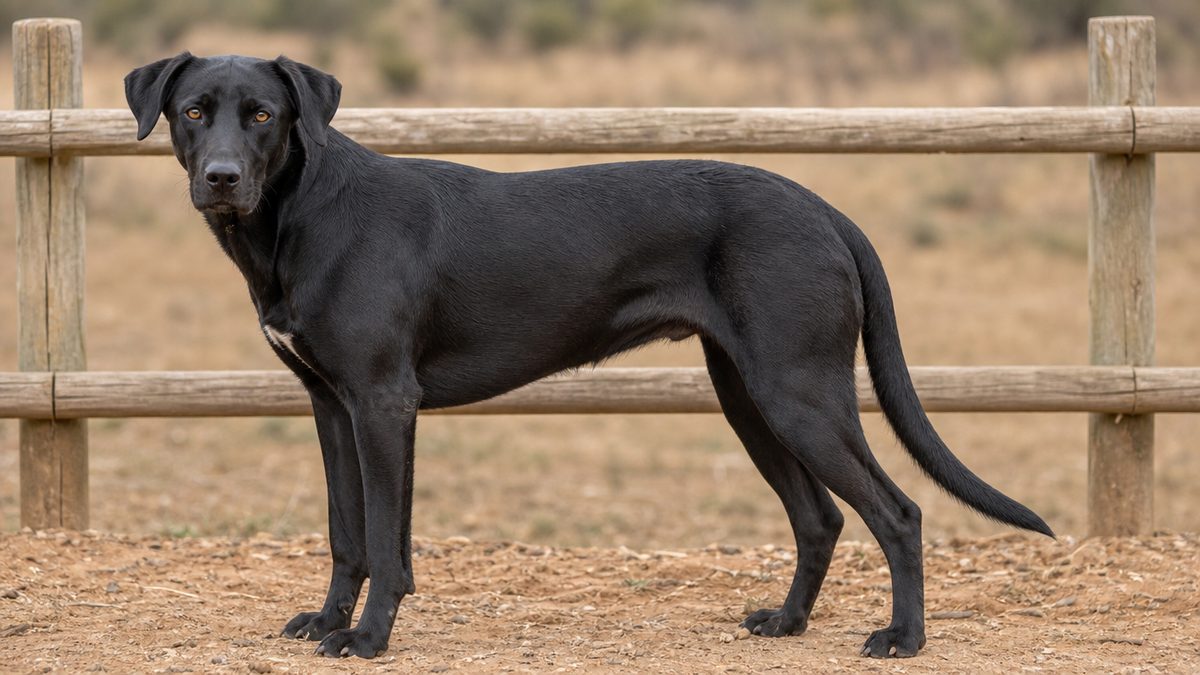
FCI Standard 321 describes a large dog, and it says so in its first line: perro de talla grande sin ser exagerada, large in size without being exaggerated, of medium weight. It is completely black, or black with a white patch on the chest, well proportioned, rustic, strong, muscular, robust and agile. Two coat varieties exist, short hair as the common one and long hair, which the standard names the Ca cabrer and gives a sharper muzzle.
The working brief in the standard is three jobs, not one. Utilizacion reads perro de pastoreo, de guarda y de defensa: a dog that herds, that guards and that defends. The Balearic Government's own breed page narrows that to what the dog mostly did, which was sheep. Its survival and activity, the page says, have been tied to the custody of animals and very especially to sheep.
| Breed | Studbook census | FCI status |
|---|---|---|
| Ca Rater Mallorquí | 2,119 | Not recognised |
| Ca Eivissenc (Ibizan Hound) | 1,037 | Breed 89 |
| Ca Mè Mallorquí | 654 | Not recognised |
| Ca de Bestiar | 507 | Breed 321 |
| Ca de Conills de Menorca | 316 | Not recognised |
| Ca de Bou | 243 | Breed 249 |
Read that table the way a buyer should. The Ca de Bestiar is the second largest of Mallorca's own dog populations and the fourth of six Balearic ones, so it is rare by any international measure and unremarkable at home. Three of the six have no FCI number at all, which is why the Ca de Bestiar's number matters: it is one of only three Balearic breeds an Indian buyer could in principle get papers for.
Where the breed came from, and why nobody says more than that
The origin is undefined, and the people who study the breed say so in print. A SEMILLA and University of Cordoba poster on the breed's population structure opens by stating that its origins are indefinite and linked to two theories, one deriving it from the Alano and one from mastiff-type dogs. The 2020 paper by the same group repeats it, describing the undefinition of the origins of both the Ca de Rater and the Ca de Bestiar.
Wikipedia is equally plain: the origins are unknown, and while the dog is mentioned in earlier texts, the first descriptions of it date from the nineteenth century. Compare that with the ranking pages, which say the breed has existed since ancient times and descends from Roman Molosser-type dogs brought to Spain by Roman soldiers, with no source attached to either claim Petlur, Majorca Shepherd Dog breed page.
The official prototype was approved in 1980. International recognition followed two years later, in 1982. The Ministry of Agriculture recognised the breed as a Spanish breed in 2001, and the Balearic Government recognised the Club del Ca de Bestiar as its breeders' association on 29 November 2002. Four dates, all documented, all inside twenty-two years Butlleti Oficial de les Illes Balears num.….
The breed standard, read in the language that governs it
FCI Standard 321's authentic language is Spanish, and the FCI publishes no English version of it at all. The English row on its own breed record is blank, and 321g01-en.pdf returns HTTP 404. Every English description of this breed is therefore somebody's translation, and two of the FCI's own translations disagree with the Spanish on numbers.
Start with the figures that do agree, because they are the ones a buyer needs. Height at the withers is 66 to 73 cm for males and 62 to 68 cm for females, with a stated tolerance of one centimetre above or below, on which points are deducted. Weight is around 40 kg, and the standard's own table of ideal male measurements gives 41 kg at 71 cm. The French translation and the Real Sociedad Canina's English edition both carry the same numbers Real Sociedad Canina de Espana.
Two numbers the German translation gets wrong
The German text of the same standard differs from the Spanish original on two figures, and both are checkable in a minute.
| Clause | Spanish (authentic) | French | German |
|---|---|---|---|
| White chest patch, serious fault above | más de 1 dm² | dépasse un dm2 | mehr als 1 Quadratzentimeter |
| Adult female weight ceiling, disqualifying | más de 45 kg | dépassant 45 kg | mehr als 54 kg |
| Dewclaws present at birth | se deberán amputar | il faut procéder à leur ablation | sollten sie entfernt werden |
| Height, males | 66 a 73 cm | 66 à 73 cm | 66-73 cm |
| Weight, general | en torno a 40 kg | autour de 40 kg | ca. 40 kg |
A square decimetre is one hundred square centimetres. Under the authentic Spanish, a white chest patch is only a serious fault once it exceeds a hand-sized 10 cm by 10 cm; under the German, anything bigger than a fingernail is FCI-Standard Nr. 321 CA DE BESTIAR. The female weight error is a simple digit transposition, 45 written as 54, and it moves the ceiling by nine kilograms. Since the FCI's own record names Spanish as the authentic language, the Spanish figures govern and the German ones are translation errors.
A contradiction inside the authentic text itself
The size clause and the disqualification clause do not agree, and the conflict appears in all three languages, so it belongs to the original rather than to a translator. The size section admits dogs one centimetre outside the stated limits with a points deduction, which permits a 65 cm male. The disqualification list then eliminates any male under 66 cm Real Sociedad Canina de Espana. A 65 cm dog is therefore simultaneously tolerated and disqualified.
The female clause has the opposite defect, a gap rather than an overlap. The stated range is 62 to 68 cm and the disqualifying limits are under 60 cm and over 70 cm, so a 61 cm bitch is neither in range nor disqualified. Nothing in the document says how a judge should score her.
The four points that identify a real one
Four clauses do the work of telling a Ca de Bestiar from a black crossbreed, and you can measure or see all four on a dog in front of you.
- Solid black only, in jet, ordinary or pitch shades, with white permitted only as a thin tie on the chest and on the feet. Any other colour disqualifies, and a single white toe on a forefoot disqualifies on its own.
- A black nose. A pink or white nose is a disqualifying fault, and light or brown spots on the nose leather cost points.
- Folded ears, never cropped. The standard says sin amputar, and lists cropped ears among the disqualifications.
- A head that is neither molossoid nor greyhound-like. A mastiff head, very wide and heavy, and a long narrow head with barely any stop, are both disqualifying.
Under Movimiento the standard states that the preferred gait, and the working one, is the gallop. Most herding standards describe a trotting dog. This one describes a dog that works its flock at a gallop with the hind legs placed outside the front, as if it were jumping. That single sentence tells you more about the exercise requirement than any breed page will.
Two registries, one breed, and height ranges that do not overlap
The FCI and the United Kennel Club both recognise this breed and describe two different dogs. The FCI requires 66 to 73 cm at the withers for a male and disqualifies anything under 66 cm; the UKC gives an average of 22 to 24 inches, which is 55.9 to 61.0 cm United Kennel Club. The UKC's ceiling sits 5.04 cm below the FCI's floor, so the two ranges do not touch.
Nothing about the UKC document warns you. It is a real standard, published in the Herding Dog Group, copyright 2006, and the breed appears on the UKC's own breed-group index. Finding it takes one piece of care: the registry's own URL spells the breed ca-de-bestair, with the i and the a transposed. Assemble the obvious URL and you get a 404 and conclude the UKC does not hold the breed, which would be wrong.
| Point | FCI 321 (authentic Spanish) | UKC (2006) |
|---|---|---|
| Size class | Large, without being exaggerated | Medium sized |
| Height | 66-73 cm males, 62-68 cm females | 22-24 in average = 55.9-61.0 cm |
| Weight | Around 40 kg, ideal male 41 kg | 77-88 lb = 34.9-39.9 kg |
| Coat varieties | Short hair and long hair (Ca cabrer) | The coat is short |
| Eyes | Small, slightly almond, not far apart, honey-coloured | Small, round and set wide apart |
| Muzzle | Length equal to the skull | Medium sized, well proportioned |
| Bite | Scissor | Scissors or level |
| Function | Herding, guard and defence | Flock guardian |
| Disqualifications | 13 items, including any non-black colour | 3 items: cryptorchidism, viciousness or extreme shyness, albinism |
Why the gap matters more than it looks
The two registries nearly agree on weight and disagree completely on height. The UKC's 77 to 88 pounds is 34.9 to 39.9 kg, which sits just under the FCI's around 40 kg. Put a 40 kg dog on a 60 cm frame and you have described a much heavier-built animal than the 71 cm, 41 kg dog the FCI's own table of ideal proportions specifies. The UKC standard is internally coherent only if you read it as describing a different, stockier dog.
Now trace where the English-language internet got its numbers. DogZone, which carries a veterinary byline, states that most breed members measure between 56 cm and 61 cm and weigh 35 to 40 kg. Those are the UKC's figures converted. It then says the breed standard was written in 1980, which is the Spanish standard, not the UKC's 2006 one. Petlur gives males 24 to 26 inches and females 22 to 24 inches, which straddles the UKC single range split by sex.
So the picture on page one of an Indian search is the UKC's dog wearing the Spanish standard's history. A buyer told to expect a 58 cm dog will reject a correct 70 cm Ca de Bestiar as oversized, and accept an undersized one as typical.
The CACIB detail nobody reports
The FCI's breeds-with-varieties table records this breed with an asterisk in the breed-level CACIB column and blank cells against both the short-haired and long-haired varieties. Compare the Ibizan Hound, whose smooth-haired and rough-haired varieties each carry their own asterisk. Two Balearic breeds, two coat splits, two different rulings: the Ibizan's coats compete for separate certificates and the Ca de Bestiar's compete for one between them.
What this means for a dog in India
Wikipedia files the breed under both FCI breeds and livestock guardian dogs, which is a third classification again, and it is the one that fits the UKC's flock-guardian reading rather than the FCI's herding one. Spanish law takes yet another view: Real Decreto 558/2001 lists the Ca de Bestiar among 33 Spanish canine breeds and gives recognition of its studbook-keeping association to the Balearic Government rather than to Madrid. India is a full FCI member represented by the Kennel Club of India in Chennai, so the KCI issues pedigrees against FCI nomenclature, and the Ca de Bestiar sits in that nomenclature as breed 321. Recognition, in other words, is not the obstacle. Supply is. A registered dog of this breed would have to arrive with an FCI-country pedigree naming it Ca de Bestiar, and there is no lawful commercial route for one to arrive at all.
Ask which register the paper comes from before you look at the dog. An FCI-country pedigree will name the breed Ca de Bestiar and carry the number 321. A UKC registration is a different document with a different standard behind it, and a dog registered to the UKC's 22 to 24 inch average is not a dog the FCI standard would place. Neither is fake. They simply are not describing the same animal.
Majorca Shepherd Dog price in India: no figure exists, and here is the proof
No verifiable majorca shepherd dog price in india exists, and the pages that rank for the query print no rupee figure at all. Bonbeno searched the term from India, read every result on page one, and found books, stock photographs, a YouTube video and a holiday island. This section shows how that result set is built, because that is worth more to a buyer than any number.
Search the target term from India and the first page answers a different question. The organic results include a YouTube breed video, an unsourced American breed database, a British breed encyclopedia, Royal Canin's Indian breed page, a Pinterest board, an Instagram tag page, a Flipkart listing for a training paperback, a Supertails article about German Shepherds, a TradeIndia page selling German Shepherd and Doberman puppies, and a stock-photo library. Not one offers a live dog of this breed.
The second result prices the breed in dollars and contradicts itself twice
The highest-ranking page that carries a price at all is Petlur, and its price is USD 1000 to 1500. Three things on that page settle how much weight it can carry.
- Its Breed Information table states Not recognized by the American Kennel Club. And Not recognized by FCI. The FCI has held this breed as number 321 on a definitive basis since 1982.
- Its own History section, on the same page, states the breed is now recognized by several kennel clubs, including the American Kennel Club and the Kennel Club of Great Britain. The page contradicts its own table within a few hundred words, and both statements are wrong.
- Its Monthly Cost field reads the cost of a Majorca Shepherd Dog can vary greatly depending on the breeder, but typically ranges from $1,500 to $2,500. That is a purchase price pasted into a recurring-cost field, next to a Daily Cost of $50 to $100, which would be $18,250 to $36,500 a year.
The same page carries three incompatible size sets. Its table says Large, 75 to 90 pounds, males 24 to 26 inches. Its description says medium-sized, 40 to 60 pounds, 20 to 24 inches, 10 to 12 years. Its history says males reach up to 30 inches. The centimetre conversions do not even agree with each other: 24 inches is rendered as 60 cm on the male line and 62 cm on the female line, two lines apart.
Test the dollar figure before converting it
Do not turn USD 1000 to 1500 into rupees. Bonbeno has repeatedly found Indian breed prices that are American figures run through one exchange rate, and the correct response to an unsourced dollar band is to leave it in dollars and say what it rests on, which here is nothing: no breeder, no sale, no date, no country. There is no Indian market for this breed to convert a price into.
| Figure | Where it appears | What supports it |
|---|---|---|
| USD 1000-1500 | Petlur breed page, purchase price | Nothing stated |
| USD 1,500-2,500 | Petlur, in the monthly-cost field | Nothing; it is a purchase price |
| USD 50-100 | Petlur, daily cost | Nothing; implies USD 18,250 a year |
| No rupee figure | Royal Canin India, Wikipedia, DogZone, UKC, FCI, RSCE | Not applicable; none quotes a price |
| No Indian listing | Whole first page of results | Books, stock photos, tourism |
Why no lawful Indian supply chain can form
India's import rules close the question rather than merely explaining a shortage. DGFT Trade Notice 22/2022-23 puts dogs under ITC(HS) 01061900 as Restricted, and Policy Condition 7 permits import only for a pet dog with a valid pet book in the importer's name, for R&D with CPCSEA recommendation, or for internal security by the Defence and Police forces. Policy Condition 8 states that import of commercial dogs for breeding or any other commercial activity is not permitted, and point 6 states that any applications for trading or breeding purposes shall be duly rejected.
Entry is limited to six ports, Delhi, Mumbai, Chennai, Hyderabad, Bangalore and Kolkata, and up to two pets travel as passenger baggage without a DGFT authorisation only for someone transferring residence to India after two years of continuous stay abroad. A separate instrument, Notification S.O. 4396(E) of 10 October 2024 under the Livestock Importation Act 1898, adds Cochin International Airport to the pet route under the quarantine station at Chennai. Whether that changes the trade notice's own port list is a different question this page does not answer.
Ask for the exporting country's FCI pedigree naming the breed Ca de Bestiar, the parents' registered names, and the DGFT import authorisation number, before any money moves. With a worldwide studbook of 507 dogs and 17 registered breeders, a dog of this breed arriving in India is a traceable event, not a stock item.
Monthly cost of ownership in India, using the figures that do exist
Budget between ₹6,000 and ₹14,000 a month for a 40 kg dog in an Indian metro, and treat that as a construction from published line items rather than a survey. There is no purchase price to quote for this breed, but Indian veterinary, grooming and food costs are real, published and apply to any dog of this size.
Start with the veterinary line, because it is the one with a named Indian source behind it. HDFC ERGO's September 2025 guide to Indian dog vet costs gives a basic consultation at ₹500 to ₹1,000, core vaccinations including rabies and DHPPiL at ₹1,500 to ₹3,000 a year, deworming at ₹300 to ₹800, and a total annual wellness visit at ₹2,000 to ₹4,500. Spread across twelve months that is roughly ₹170 to ₹375 a month before anything goes wrong.
| Item | Published range | How often for this breed |
|---|---|---|
| Basic consultation | ₹500-₹1,000 | 2 to 3 times a year |
| Core vaccinations | ₹1,500-₹3,000 | Annually |
| Deworming | ₹300-₹800 | Every 3 to 6 months |
| Total annual wellness visit | ₹2,000-₹4,500 | Once a year |
| Complete blood count | ₹800-₹1,500 | Annually from about age six |
| X-ray or ultrasound | ₹1,200-₹4,000 | Once, for a hip screen |
| Ear cleaning | ₹300-₹700 | Monsoon months, folded ears |
| Nail trimming | ₹200-₹500 | Monthly |
| Emergency consultation | ₹1,000-₹2,500 | Hopefully never |
| Overnight hospitalisation | ₹1,500-₹5,000 per night | Hopefully never |
The lines with no Indian source, marked as estimates
Food is the biggest recurring cost and Bonbeno has no published Indian figure for this breed specifically, so treat what follows as arithmetic rather than a citation. A 40 kg working-build adult eats in the region of 500 to 700 grams of a good dry food a day. At Indian large-breed pricing that lands somewhere between ₹4,000 and ₹9,000 a month depending on brand tier, and it is the number that decides whether the dog is affordable. Verify it against the actual bag price where you shop rather than against any breed page.
Two other lines matter for a big black dog in India and neither has a breed-specific source either. Parasite prevention is not optional here, because 261 of 525 dogs sampled across Delhi, Mumbai, Sikkim and Ladakh carried at least one tick-borne pathogen. And cooling is a real running cost: a dog that cannot be walked between 09:00 and 18:00 for eight months of the year needs somewhere genuinely cool indoors, which in most Indian cities means running a fan or an air conditioner it would otherwise not need.
Why you should distrust any single monthly figure you are shown
The one page ranking in India that prints a monthly cost gives it as USD 1,500 to 2,500, which is a purchase price in the wrong field, alongside a daily cost of USD 50 to 100. Taken literally that is over ₹15 lakh a year to feed one dog. A cost figure that is not broken into line items cannot be checked, and this is what an unchecked one looks like.
Food ₹4,000 to ₹9,000, routine veterinary care ₹170 to ₹375 amortised, parasite prevention ₹400 to ₹900, grooming ₹200 to ₹500 for nails and ears, and a reserve for emergencies. Call it ₹6,000 to ₹14,000 a month in a metro, with the food line doing most of the moving. Only the veterinary and grooming numbers here are cited; the rest is arithmetic and is labelled as such.
Heat tolerance in India, measured against Mallorca rather than guessed
Mallorca is genuinely Mediterranean and genuinely cooler than India, and the gap is measurable and smaller than most. Palma de Mallorca's peak monthly-mean wet bulb is 22.2 C in August, while Chennai's May reaches 26.1 C and Delhi's July reaches 26.5 C Stull R. Wet-Bulb Temperature from Relative…. That is a 3.9 to 4.3 C wet-bulb gap on a dog whose only permitted coat colour is black. The dry-bulb extremes are far further apart: Palma's record high is 34.3 C and Delhi's is 48.8 C.
Bonbeno queried NASA POWER by explicit latitude and longitude for every point below and echoed back the grid-cell elevation each time, because POWER returns a cell rather than a point. The Indian cells check out at plains scale: Delhi came back at 206.37 m against a city near 216 m, Chennai at 48.95 m against roughly 6 m, Bengaluru at 841.72 m against roughly 920 m, Mumbai at 97.15 m against roughly 14 m and Pune at 635.99 m against roughly 560 m. Palma came back at 31.47 m against a city near 13 m, so that baseline is sound.
Mallorca's mountains defeated the instrument, and saying so matters
The Serra de Tramuntana runs the length of the island's north-west coast and rises to Puig Major at about 1,436 m. POWER reported that point's cell elevation as 32.70 m and returned a series byte-identical to the one it returned for Soller, 12 km away and near sea level. A third query at Lluc, roughly 525 m up, came back at 44.44 m. One grid cell was describing a mountain, a valley town and a coastal town at once, and it was wrong about the mountain by roughly 1,403 m.
So this page uses the Palma figure as the homeland baseline, which is defensible because that is where the island's population and most of its farmland sit, and reports plainly that it could not resolve the Tramuntana separately. A lapse rate of about 6.5 C per 1,000 m would put the high Tramuntana some 9 C cooler than Palma, which is an estimate and is labelled one.
| Place | Cell elevation | Hottest month | Record high | Peak mean wet bulb |
|---|---|---|---|---|
| Palma de Mallorca | 31 m | August | 34.3 C | 22.2 C (Aug) |
| Bengaluru | 842 m | April | 40.4 C | 21.9 C (May) |
| Pune | 636 m | April | 43.2 C | 23.0 C (Jun) |
| Mumbai | 97 m | April | 44.9 C | 25.8 C (Jun) |
| Hyderabad | 495 m | May | 45.0 C | 23.4 C (Jun) |
| Chennai | 49 m | May | 42.7 C | 26.1 C (May) |
| Jaipur | 406 m | June | 46.9 C | 25.3 C (Jul) |
| Delhi | 206 m | June | 48.8 C | 26.5 C (Jul) |
| Kolkata | 7 m | May | 46.8 C | 27.1 C (Jun) |
Read the two temperature columns differently. The record-high column is NASA POWER's T2M_MAX, the hottest single reading the 2001 to 2020 climatology holds for that month, so it is an extreme rather than an average afternoon. The wet-bulb column is computed from each month's mean air temperature paired with that month's mean relative humidity, so it is a monthly mean across day and night and the worst afternoon hour runs above it. The two must never be paired, because a record high combined with a mean humidity yields wet-bulb figures higher than anything ever recorded on earth. The method is applied identically to every point, so the comparison between them holds.
Reading that table honestly
This is a more heat-tolerant dog than a Nordic breed and a much less heat-tolerant one than an Indian pariah-type dog, and the table places it. Seven of the eight Indian cities on it exceed Mallorca's peak, and the ranking is not the intuitive one. Bengaluru is the exception, at 21.9 C against Palma's 22.2 C. Kolkata is the hardest at 4.9 C above, ahead of Delhi, because it pairs high heat with monsoon humidity in the same month. Delhi's and Jaipur's worst wet-bulb month is July, not June, which is the month owners relax because the rain has started.
That inversion is the single most useful line here for an Indian owner. Owners plan around the hottest thermometer reading, which falls in May or June. For a panting dog, July and August are worse in the northern plains, because evaporative cooling stops working as humidity climbs. Delhi's July wet bulb of 26.5 C and August's 26.2 C are the two most dangerous months of this breed's Indian year, and both sit above its June figure of 24.4 C.
What the heat-illness research supports, and what it does not
Hall 2020 in Scientific Reports found that dogs at or above their breed and sex mean bodyweight had 1.42 times the odds of heat-related illness, with a confidence interval of 1.12 to 1.80, and that dogs over 50 kg carried odds of 3.42. The first factor transfers to this breed and the second does not, because a Ca de Bestiar is a 40 kg dog and sits below the 50 kg band. This breed was not itself modelled in that cohort, so keeping one lean is a supported intervention and nothing more specific is available.
India's own criterion, reproduced by the NDMA from the IMD, is that a heat wave is not considered until a station's maximum reaches at least 40 C in the plains, and is declared outright whenever the actual maximum stays at 45 C or more. Delhi, Jaipur, Hyderabad, Mumbai and Kolkata all average a monthly maximum above 40 C in their hottest month. For this dog that is not an occasional event to plan around, it is most of the summer.
Managing a black 40 kg dog through an Indian summer
To keep a Majorca Shepherd Dog through an Indian summer, move all work to before sunrise and after dark, keep the dog indoors on hard cool flooring through the day, and never house it outdoors. Indian law is unusually specific about the last point, and it names this breed's second coat variety almost exactly.
Second Schedule Part IV paragraph 21(1) of the Prevention of Cruelty to Animals (Dog Breeding and Marketing) Rules, 2017 bars keeping three categories of dog in outdoor facilities without the attending veterinary practitioner's written approval: dogs not accustomed to the temperatures prevalent in the area, dog breeds that cannot tolerate the temperatures prevalent in the area or region in question, such as long-haired breeds in high temperature locations, and sick, infirm, aged or young animals.
The long-haired Ca cabrer variety of this breed is the exact case that clause describes, with an outer coat running past 7 cm on the loin. The provision is a Second Schedule paragraph rather than a Rule; the Rules themselves stop at Rule 13, so a citation reading Rule 21 is wrong by construction.
The colour problem nobody mentions
This is the only common European herding breed whose standard permits exactly one colour, and that colour is black. A black coat absorbs across the whole visible spectrum, so in direct Indian sun the coat surface runs materially hotter than a pale one on an otherwise identical dog. Bonbeno has no measurement of that difference in this breed and will not invent one, but the practical consequence is not in doubt: shade is not optional and a black dog on hot paving at noon is in trouble faster than a fawn one.
- Walk before sunrise, which in Delhi in June means starting by 05:15 and being home by 06:30.
- Test the paving with the back of your hand for five seconds before every walk. If you cannot hold it, the dog cannot stand on it.
- Cool the dog with room-temperature water on the belly, groin and paw pads, not with ice, and get to a vet rather than waiting to see whether it settles.
- Carry water on every outing, including the short evening one, because a 40 kg dog dehydrates faster than its owner does.
- Skip the mid-day walk entirely from March to June and again through the monsoon, and replace it with indoor scentwork.
Why exertional heat illness is the risk, not the parked car
The companion Hall 2020 paper in Animals recorded 1,259 heat-related illness events from 1,222 dogs in a cohort of 905,543, of which 879 had a recorded trigger. 652 of those 879 events, or 74.2 percent, were exertional rather than caused by a hot vehicle or a hot room. Exercise is what puts dogs in the emergency room. This is a breed whose standard says its working gait is the gallop, which is precisely the wrong instinct to indulge in an Indian May.
The NDMA defines the national thresholds an Indian owner can actually watch. A heat wave is not considered until a plains station reaches at least 40 C, and is declared outright at 45 C or above regardless of the normal maximum. Delhi's June record high is 48.8 C and Jaipur's is 46.9 C, so both cities have passed the 45 C declaration threshold. Their June monthly means are 35.9 C and 34.6 C, so that threshold is something they reach on their hottest days rather than something they average.
Heavy unrelenting panting that does not slow when the dog stops, brick-red or very pale gums, unsteadiness, vomiting, or collapse. Start cooling with room-temperature water on the way and go to a veterinarian immediately. An emergency consultation in India runs ₹1,000 to ₹2,500 and IV fluids with supportive care ₹2,000 to ₹5,000, which is a great deal cheaper than waiting.
Temperament and household fit, starting from what the standard admits
The Ca de Bestiar is a one-owner territorial guard dog that the FCI's own standard calls extremely timid in youth and brave and quarrelsome as an adult. That is a harder brief than any English breed page gives it, and it is the single most important paragraph in the standard for anyone deciding whether to live with one.
The Spanish text reads: a dog of great nobility, of one owner only, who accepts the approaches of strangers with difficulty. Intelligent, docile, affectionate, extremely timid and reserved in his youth; his sentimentality reaches unsuspected limits. Faithful to his master until death. Brave and quarrelsome. The Real Sociedad Canina's English edition renders the same passage almost word for word.
The eye paragraph reinforces it. The expression is described as enigmatic, intelligent and sad at once, showing even distrust. A registry that describes a breed's default expression as distrustful is telling you how the dog meets a stranger at the gate.
Where the marketing and the standard part company
Royal Canin's Indian page credits the FCI for its key facts and then lists three of them: requires minimal grooming, makes a great watchdog, and gentle with children. The first two are fair. The third sits awkwardly beside a standard that says the dog accepts strangers with difficulty and is quarrelsome, and beside DogZone's own summary that the breed is not recommended for a first-time owner or for a family with young children.
Bonbeno's reading is that both are describing something real. Inside its own family the dog is affectionate to the point the standard calls unsuspected. Outside it, the breed was selected for exactly the behaviour that makes a guard dog useful and a flat-dweller's life difficult.
| Situation | Verdict | Why |
|---|---|---|
| A farm or a walled house with land | Good fit | The job it was bred for, with a boundary it can patrol |
| A single-owner household | Good fit | The standard describes a dog of one owner only |
| An apartment with shared stairs | Poor fit | Territorial guarding aimed at neighbours and delivery riders |
| A home with frequent visitors | Poor fit | Accepts the approaches of strangers with difficulty |
| A first dog | Poor fit | Territorial behaviour is inherent, not trained in |
| A household with toddlers | Caution | A 40 kg galloping dog in a corridor is a collision risk |
The timidity clause, and why it decides puppy-buying
The standard says extremely timid and reserved in his youth, and then disqualifies a dog for aggression or extreme timidity as an adult. Both statements are in one document, and together they define the whole job of raising this breed: the puppy is expected to be shy, and the adult is not allowed to be. Everything between those two states is socialisation, and the window for it closes long before the dog is grown.
The UKC standard reaches the same place by a different route, disqualifying viciousness or extreme shyness in the ring. Two registries with almost nothing else in common agree on this.
Most Indian homes are visited daily by people the dog does not live with: a domestic worker, a milk delivery, a courier, a building guard. A breed described in its own standard as accepting strangers with difficulty will treat each of those as an intrusion unless it met dozens of them, pleasantly, before sixteen weeks of age. Plan that before the puppy arrives, not after the first incident.
Training approach, and the two things this breed resists
To train a Ca de Bestiar, spend the first four months on socialisation rather than obedience, then build a short reliable recall and leave the guarding instinct alone. The breed learns its work without being taught and resists two specific things: repetition drills and confrontational handling.
The standard describes an intelligent, docile dog whose sentimentality reaches unsuspected limits, and whose expression shows distrust. Those two facts together define the method. This is a trainable breed and an independent one at the same time, and the two are not in conflict: it learns fast and decides for itself whether to comply. A dog that is sensitive to its handler and suspicious of pressure will shut down under corrections that a Labrador would shrug off, and DogZone's own advice, that an owner must assert their position of dominance early on, is the approach most likely to produce the shutdown.
Socialisation first, and count the exposures
The standard expects the puppy to be extremely timid and the adult not to be, and disqualifies extreme timidity in a grown dog. Getting from one to the other is a numbers exercise, and in India the numbers are easy to hit because the traffic exists.
- Socialise the puppy to fifty different people before sixteen weeks, in short pleasant encounters where the puppy chooses to approach.
- Ride four different vehicle types, including an auto-rickshaw, because a dog that panics in transport cannot get to a vet.
- Hear the neighbourhood on purpose: pressure horns, construction, temple bells, firecrackers at low volume.
- Practise the doorbell twenty times a week with a food reward, before the dog decides for itself what the doorbell means.
- Introduce the people who will come daily, one at a time, and let each of them feed the puppy.
What to train, and what to leave alone
Three behaviours are worth real work. A recall that survives a moving cat, because the working gait in the standard is the gallop and a 40 kg dog at a gallop is not catchable. A settle on a mat, because most of an Indian summer is spent indoors and a bored guard dog patrols. And handling tolerance, so that ear cleaning, nail trims and a veterinary examination happen without a fight, which for a dog this size is a safety matter rather than a convenience.
One behaviour is not worth training in: guarding. This breed does it whether or not you ask, and formal protection work on a dog already described as brave and quarrelsome adds risk without adding capability. What is worth training is the off switch, a reliable cue that ends the alert.
Weeks 8 to 16, socialisation and nothing else that matters. Months 4 to 6, name, recall on a long line, settle. Months 6 to 12, the same three behaviours in harder places, plus loose-lead walking on a 30 kg adolescent. Months 12 to 24, expect a second fear period and a rise in territorial behaviour, and re-run the socialisation work rather than assuming it held.
Daily exercise requirement, and what happens without it
Plan on 60 to 90 minutes a day of real work for an adult Ca de Bestiar, split across a pre-dawn and a post-sunset session for most of the Indian year. FCI Standard 321 says outright that the preferred gait, and the working one, is the gallop, which is an unusually direct statement of exercise need for a breed standard.
The standard describes the movement in enough detail to make the requirement concrete. The trot is in diagonal bipeds with the rear third tilting slightly against the front; the gallop is frank, rustic and fast, with the hind legs set well apart at the base and placed outside the front legs, as if the dog were jumping. That is a description of an animal built to cover ground over broken terrain for hours, which is what herding sheep across a Mallorcan finca actually involves.
DogZone puts the practical minimum at hour-long daily walks and warns that under-stimulated dogs develop hyperactivity and excessive barking. That matches the standard's picture and matches what any 40 kg working herder needs.
The Indian constraint, stated as a schedule
The problem in India is not the amount of exercise, it is the window. In Delhi in June the monthly mean is 35.9 C, the record high is 48.8 C and the July wet bulb is 26.5 C, so the safe hours are roughly 05:00 to 06:30 and after 20:00. In Chennai the May wet bulb of 26.1 C never really releases at night, which makes the coastal south harder than the raw temperature suggests. Bengaluru at a 21.9 C peak wet bulb is the most workable Indian city for this breed, and it is the one that sits marginally below Palma.
| Season | Morning session | Evening session | Mid-day |
|---|---|---|---|
| November to February | 45-60 min, any time before 09:00 | 45 min after 17:30 | Short walk acceptable |
| March to June | 45 min, before 06:30 | 30-45 min after 20:00 | None. Indoors only |
| July to September (monsoon) | 40 min, before 06:30 | 30 min after 20:00 | None. Wet bulb peaks now |
| October | 45-60 min before 08:00 | 45 min after 18:30 | Short walk acceptable |
What to do with the hours you cannot walk
Substitute nose work and problem-solving, because they tire a herding dog without raising its core temperature. Scatter-feeding a meal across a room takes twenty minutes and replaces a walk's worth of mental load. Frozen food-stuffed toys do double duty in summer. Short indoor shaping sessions of five minutes, three times a day, are worth more to this breed than one long boring one.
What does not substitute is a garden. A 40 kg territorial dog left alone in a yard patrols the fence, and patrolling is self-reinforcing: it rehearses the exact behaviour you least want, and does it at whatever temperature the yard happens to be.
An under-exercised Ca de Bestiar does not become destructive in the usual way. It becomes a louder and more reactive guard, because guarding is the outlet the breed already has. If your dog has started barking at sounds it used to ignore, add work before you add training, and add it at a time of day when the wet bulb allows.
Grooming and coat care in Indian humidity
To groom a short-coated Ca de Bestiar in India, run a rubber curry mitt over it twice a week, check the folded ears every week through the monsoon, and bath it only when it is actually dirty. The coat is the easy part; the ears and the skin under a black coat are where Indian conditions bite.
The standard describes the short coat as 1.5 to 3 cm on the loin, lying close to the skin, over a very fine, thin, tightly adherent undercoat. The long-haired Ca cabrer variety runs past 7 cm on the loin, longer in winter, with fringing on the tail, ear tips and the backs of the limbs. Both coats are required to be soft, hard and fairly fine. The skin beneath is elastic, wrinkle-free, hard and light grey.
Note what the standard does not describe: a Labrador's dense water-repellent double coat. Petlur lists the coat as Thick, Double-Coated, Medium length and offers a recommended toolkit of slicker brush, pin brush, shedding blade, comb and mat rake. For a 2 cm close coat over a thin undercoat, a mat rake has nothing to do.
The ears are the maintenance item, not the coat
The standard specifies folded, triangular ears of small size relative to the head, high set, hanging and slightly away from the muzzle, with a longitudinal fold and a transverse one at the first third. A folded ear over a humid canal is the classic anatomy for otitis externa, and DogZone flags the risk directly, recommending an ear cleaner every one to two weeks and drying the canals after any exposure to water.
That advice was written for a British climate and it transfers to India with the frequency raised rather than lowered. Through the monsoon, check weekly and clean when there is visible wax or smell, and dry the canals after every bath or swim. An Indian ear cleaning at a clinic costs ₹300 to ₹700, which is worth paying once to be shown the technique.
The overseas bathing advice that does not transfer
DogZone states plainly that bathing them is to be avoided, because the fur does not need regular cleaning. In Britain that is reasonable. In an Indian city where a black-coated dog walks through dust, road grime and standing monsoon water, a dog bathed only occasionally develops exactly the skin problems the advice is meant to prevent. Bath when dirty, use a plain dog shampoo, rinse thoroughly, and dry the coat and the ear canals properly rather than letting the dog air-dry in humid air.
- Rubber curry mitt twice a week, more in the spring shed, which is when the fine undercoat comes out.
- Weekly tick check by hand along the neck, between the toes and inside the ears, given that 261 of 525 Indian dogs sampled carried a tick-borne pathogen.
- Nails monthly, at ₹200 to ₹500 at a clinic, or at home if the puppy was taught to accept it.
- Never shave a Ca de Bestiar for summer. The coat is short already and the exposed light-grey skin underneath has no pigment protection.
- Never remove dewclaws, whatever the standard says. Indian law forbids it.
FCI Standard 321 states that a dog may be born with or without dewclaws and that where present, they must be amputated. The Real Sociedad Canina's English edition says the same, and the German translation softens it to should be removed FCI-Standard Nr. 321 CA DE BESTIAR. Second Schedule Part II paragraph 6(8) of India's 2017 Rules forbids de-clawing by name, alongside tail docking, ear cropping, de-barking and any other kind of mutilation, and calls any change of appearance by artificial means strictly forbidden. In India, leave the dewclaws on.
Health risks and lifespan, with the numbers that actually exist
No breed-specific health survey exists for the Majorca Shepherd Dog, and no OFA statistics row exists under any of its names. What does exist is population data, and it is the honest basis for a health section: 53 founders, a studbook census of 507, 17 registered breeders and five microsatellite markers deviating from Hardy-Weinberg equilibrium Alanzor Puente JM, Pons Barro AL.
Absence is a claim, so it has to be earned. Bonbeno retrieved the Orthopedic Foundation for Animals' complete disease-statistics page and searched it case-insensitively. BESTIAR returns zero. MALLOR returns zero. MAJORCA returns zero. The controls in the same file passed: LABRADOR 109, IBIZAN 50, GERMAN SHEPHERD 75, PHARAOH 31 and CIRNECO 13. OFA requires 100 hip evaluations before publishing a breed, so this is a breed with no row rather than a breed with a bad one.
PubMed behaves the same way and warns you differently. The unquoted phrase Ca de Bestiar is silently translated into an author search for de, ca and returns zero. The fragment Bestiar[tiab] returns 2 records, both population-genetics papers from the same Balearic and Cordoba group, against controls of 126 for Labrador Retriever hip dysplasia and 1 for Bergamasco in the same session. Two papers is the whole veterinary literature for this breed, and neither is about disease.
What the population data says about risk
The 2020 study traced the breed's genealogical records back to founders and found 53 founders in the reference population, seven maximum generations traced, and a historical average of only 1.04 complete generations, which means the pedigrees are shallow. It identified 17 breeders across eight breeder locations and 198 owners across 51 owner locations, with average inbreeding running between 0.27 and 1.41 percent across subpopulations.
That inbreeding figure is low, and the same group explains why: the population is atomised across many owners holding a few dogs each, and breeders are drawing at least 63 percent of their sires from outside their own line. A fragmented population is inefficient to manage and accidentally protective against inbreeding.
| Measure | Value | Source |
|---|---|---|
| Mean number of alleles | 6.17 | IJMS 2024 |
| Observed heterozygosity (Ho) | 0.754 | IJMS 2024 |
| Expected heterozygosity (He) | 0.761 | IJMS 2024 |
| Markers deviating from HWE | 5 | IJMS 2024 |
| Founders in reference population | 53 | Animals 2020 |
| Average inbreeding | 0.27-1.41% | Animals 2020 |
| Historical population analysed | 385 dogs (191 M, 194 F) | SEMILLA poster |
One caution about that first row. The paper's abstract states that the Ca de Bestiar shows the highest mean number of alleles (6.17) and then, in the same paragraph, reports the Ca Rater at 6.61 and the Ca Me at 6.5, both higher. The claim contradicts the numbers printed beside it. Bonbeno quotes the value and not the superlative.
Lifespan, and why every figure you see is an estimate
No life expectancy study covers this breed. FCI Standard 321 gives none, which is normal for an FCI standard. Royal Canin India prints 11 to 13 years while crediting the FCI for its key facts, which the FCI standard cannot be the source of. DogZone prints 11 to 13. Petlur prints 11 to 13 in its table and 10 to 12 in its own description. Take 11 to 13 years as a reasonable expectation for a fit 40 kg dog and not as a measured breed figure.
Two conditions deserve mention on general grounds rather than breed evidence, and Bonbeno labels them inference. Any deep-chested 40 kg dog carries elevated risk of gastric dilatation volvulus, which DogZone lists on this breed's page as gastric bloat, and any heavy-boned working breed is a candidate for hip dysplasia, which is why hip dysplasia heads the list of defects Indian law requires registered breeders to have tested for under Second Schedule Part III paragraph 8(10) DogZone, Majorca Shepherd Dog.
Feeding a 40 kg working dog in an Indian kitchen
Feed an adult Ca de Bestiar to a body condition you can feel rather than to a cup measurement, and keep it lean, because bodyweight at or above the breed and sex mean carries 1.42 times the odds of heat-related illness. The standard's own ideal male is 41 kg at 71 cm, and it disqualifies a visibly obese dog even inside the weight limits.
The standard gives you a target, which is unusual and useful. Weight is around 40 kg, with a disqualifying floor of 30 kg and ceiling of 50 kg for males, and 25 kg and 45 kg for females. The table of ideal male proportions specifies 41 kg at 71 cm at the withers, with a thoracic perimeter of 81 to 83 cm. Those numbers give an owner in India something to measure against when no breed-specific growth chart exists.
Body condition, not a feeding chart
Run your hands over the dog weekly. You should feel the ribs under a thin covering with light pressure, see a waist from above and a tuck from the side. The standard describes the belly as slightly tucked up, never greyhound-like, and never so dropped that it merges into the line of the chest. That is a good visual definition of correct condition for this breed, written by people who judge it.
| Stage | Meals per day | Priority | Watch for |
|---|---|---|---|
| 8 to 16 weeks | 4 | Large-breed puppy food, controlled calcium | Growing too fast on a 40 kg frame |
| 4 to 12 months | 3 | Steady growth, not maximum growth | Loose gait, reluctance to rise |
| 12 to 24 months | 2 | Transition to adult food around 15 to 18 months | Weight gain as growth stops |
| Adult | 2 | Lean condition, ribs easily felt | Summer appetite drop, which is normal |
| Senior, from about 8 | 2 | Joint support, annual blood work at ₹800-₹1,500 | Muscle loss over the hindquarters |
Two Indian-specific feeding rules
Split the daily ration and never feed around exercise. This is a deep-chested 40 kg breed, which is the classic build for gastric dilatation volvulus, and the standard describes a chest that is broad and high, reaching the elbow, with arched ribs. Leave at least an hour either side of any hard work, and feed two smaller meals rather than one large one.
Expect appetite to fall in summer and do not chase it with richer food. A dog that is eating less in May because it is hot does not need more calories per bite; it needs its exercise moved and its water increased. Free water at all times is not a slogan for a black-coated dog in an Indian summer, it is the intervention.
Food availability itself is not the constraint. Large-breed dry foods are widely stocked in Indian metros and any of them will do the job; the failure mode here is portion creep in a household that cannot walk the dog for four months of the year, not a lack of suitable product.
Hall 2020 found that dogs at or above their breed and sex mean bodyweight carried odds of 1.42 (1.12 to 1.80) for heat-related illness in a cohort of 905,543 UK dogs. This breed was not itself modelled, and the over-50 kg odds ratio of 3.42 does not apply to a 40 kg dog. The transferable finding is the first one, and in India it is worth more than it is in Britain.
Month by month through the first year
A Ca de Bestiar puppy's first year has one deadline that matters and it falls at sixteen weeks. Everything after that is maintenance of a temperament the standard expects to be timid at the start and forbids from being timid at the end. This timeline is built from the standard, Indian law and Indian veterinary cost data rather than from a breed club's growth chart, because none exists.
Indian law sets the starting point. Rule 8(1)(a) of the 2017 Rules requires that pups less than eight weeks in age are not sold. Under Second Schedule Part III paragraph 8(9) a breeder shall vaccinate every pup, which can start at seven to eight weeks and is usually completed by eighteen weeks, which lines up with the socialisation window and means the two have to run together rather than in sequence.
| Age | What is happening | What to do | Indian cost |
|---|---|---|---|
| 8-10 weeks | Legal minimum age to leave the breeder | First consultation, start the vaccination course | ₹500-₹1,000 consult |
| 10-16 weeks | Socialisation window closing | Fifty people, four vehicle types, the doorbell twenty times a week | Vaccination course ₹1,500-₹3,000 |
| 16-18 weeks | Vaccination course completes | Deworming, first tick prevention | ₹300-₹800 deworming |
| 4-6 months | Rapid growth on a large frame | Recall on a long line, no forced road work | - |
| 6-9 months | Adolescent guarding starts to appear | Re-run stranger introductions, teach the off switch | - |
| 9-12 months | Second fear period likely | Repeat socialisation, do not correct fear | - |
| 12-18 months | Growth plates close, adult food | Hip screening radiograph if breeding is contemplated | X-ray ₹1,200-₹4,000 |
The first Indian summer is the one to plan around
A puppy born in October meets its first real heat at six months, in April, at exactly the age its exercise needs are rising. That is the wrong combination. In Delhi that April averages 30.4 C and has recorded 45.6 C, and the outdoor housing prohibition in Second Schedule Part IV paragraph 21(1) names sick, infirm, aged or young animals as one of the three categories that may not be kept outdoors without written veterinary approval. A Ca de Bestiar puppy in an Indian April lives indoors.
What to ask the breeder before the puppy is eight weeks old
- The pedigree, naming the breed Ca de Bestiar and the FCI number 321.
- The parents' heights, measured, against the standard's 66 to 73 cm and 62 to 68 cm rather than against the UKC's 22 to 24 inches.
- Written confirmation that dewclaws have not been removed, because the standard asks for removal and Indian law forbids it.
- Hip results on both parents, since hip dysplasia heads the list of defects Second Schedule Part III paragraph 8(10) requires breeding dogs to have been tested for.
- How many people the litter has met, which for this breed matters more than any other question on the list.
Do not start formal obedience drilling before four months. The standard describes a puppy that is extremely timid and reserved in youth and an adult that is disqualified for extreme timidity. Every hour spent on pleasant exposure before sixteen weeks buys more adult temperament than any hour of sit-and-stay ever will.
Compare with similar breeds, and what actually separates them
The Majorca Shepherd Dog is cross-shopped against the black Labrador it resembles and against the other Mallorcan breeds it shares an island with, and it is a different animal from all of them. The comparison that matters for an Indian buyer is not which is nicer, it is which one you can lawfully obtain and screen.
| Breed | FCI number | Height (males) | Job | Obtainable in India |
|---|---|---|---|---|
| Majorca Shepherd Dog (Ca de Bestiar) | 321 | 66-73 cm | Herding, guard, defence | No lawful commercial route |
| Ca de Bou | 249 | 55-58 cm | Catch dog, guard | No lawful commercial route |
| Ca Rater Mallorquí | Not recognised | Small terrier type | Ratting, hunting | No |
| Ibizan Hound | 89 | 66-72 cm | Rabbit hunting | No verified Indian listing |
| Labrador Retriever | 122 | 56-57 cm ideal | Retrieving, assistance | Yes, widely, with KCI papers |
| German Shepherd Dog | 166 | 60-65 cm | Herding, working | Yes, widely, with KCI papers |
Against the black Labrador, which is the comparison everyone makes
DogZone opens its profile by calling the Ca de Bestiar a dog that looks much like a black Labrador Retriever, and repeats the comparison twice more. It is a fair first impression and a bad guide. FCI Standard 122 gives a Labrador male an ideal height of 56 to 57 cm; FCI Standard 321 gives a Ca de Bestiar male 66 to 73 cm and disqualifies him below 66 Estandar-FCI N 321 CA DE BESTIAR. That is a full ten centimetres of dog, in an animal of broadly similar weight, which means a very different build.
The temperaments are further apart than the outlines. A Labrador was selected to work with strangers and retrieve to hand. This breed was selected to hold a boundary, and its own standard calls it quarrelsome and says it accepts the approaches of strangers with difficulty. Anyone buying it because it looks like a Labrador has bought the opposite dog.
Against the other Mallorcan breeds
Mallorca has four native dog breeds and only two of them are in the FCI register. The Ca de Bou is FCI 249, a shorter, heavier catch dog at 55 to 58 cm and 35 to 38 kg for a male, with a studbook census of 243, the smallest of the six Balearic populations. The Ca Rater Mallorquí is the most numerous at 2,119 dogs and has no FCI number, and the Ca Mè Mallorquí is in the same position. The Ca de Bestiar is the only Mallorcan breed that is both large and FCI-recognised.
It is also the one the Balearic Government treats most optimistically. Its conservation situation on the Balearic breeds portal reads Situación De Fomento, the promotion category, where the Ca de Bou and the Ibizan Hound both read Amenazada, threatened.
The comparison an Indian buyer should actually run
If what you want is a big, black, serious property dog that you can obtain, screen and register in India, the honest shortlist does not include this breed. A German Shepherd from a KCI-registered litter gives you an FCI group 1 herding breed at 60 to 65 cm for a male, with real Indian availability, real Indian prices and hip scoring that Indian breeders actually do. An adult from an Indian shelter gives you a dog whose temperament you can assess in person, which for a guarding breed is worth more than any pedigree.
A short, close, single-purpose coat on a large working dog is rarer than it sounds, and it is a real advantage in Indian humidity compared with the Caucasian Shepherd or Tibetan Mastiff-type dogs Indian buyers reach for when they want a guard. The problem is not that this breed would suit India badly. It is that there are 507 of them in the world and no lawful way to get one here Directorate General of Foreign Trade.
Mistakes Indian owners and Indian pages actually make with this breed
Six mistakes recur, and five of them start on a page rather than in a household. The commonest is treating a 66 to 73 cm herding dog as a 58 cm black Labrador, which follows from reading the UKC's numbers under the Spanish standard's history.
- Believing the size you read. The English-language pages ranking in India give 56 to 61 cm and 24 to 26 inches. FCI Standard 321 gives 66 to 73 cm for males and disqualifies anything under 66. Measure the dog.
- Trusting a page that says the breed is unrecognised. The second organic result in India states Not recognized by FCI in its table and then says the breed is recognised by the American Kennel Club in its history. The FCI has held it as number 321 since 1982 Federation Cynologique Internationale.
- Removing the dewclaws because the standard says to. FCI 321 requires amputation where dewclaws are present; Second Schedule Part II paragraph 6(8) forbids de-clawing outright in India.
- Housing the dog outdoors. Part IV paragraph 21(1) bars breeds that cannot tolerate local temperatures from outdoor facilities without written veterinary approval, naming long-haired breeds in high-temperature locations, which is what the Ca cabrer variety is.
- Following the overseas grooming advice literally. Avoid bathing works in Britain and produces skin problems on a black dog walking through an Indian monsoon.
- Walking in the middle of the day because it is not the hottest month. Delhi's most dangerous wet-bulb months are July and August, not June, and Kolkata peaks at a 27.1 C wet bulb in June.
The mistake the sources make, and how to spot it
Every ranking page on this breed carries at least one internal contradiction, and the contradictions are the cheapest way to grade a source. Petlur prints three incompatible size sets and converts 24 inches to 60 cm on one line and 62 cm on the next. DogZone carries a veterinary byline and states a height range whose entire span disqualifies a male under the standard it credits. Its Open Graph title and URL name the Polish Hound, which means anything sharing that page shares it as a different breed.
Even primary sources need this treatment. The FCI's own German translation prints the white-chest limit as one square centimetre where the Spanish original says one square decimetre, and the female weight ceiling as 54 kg where the Spanish says 45 kg Estandar-FCI N 321 CA DE BESTIAR. A peer-reviewed abstract calls this breed's 6.17 mean alleles the highest in its study while printing 6.61 for another breed two sentences later. Check the arithmetic on the page in front of you, whoever wrote it.
Two official Spanish bodies disagree about the breed's security
The Balearic Government's own breed page calls the Ca de Bestiar a very widespread breed, present in many country houses, and its breeds portal files the conservation situation as De Fomento, the promotion tier. The Real Sociedad Canina de España lists the same breed among 21 vulnerable Spanish breeds for 2026-27.
Both can be true at once, because they measure different things: widespread on Mallorca and vulnerable as a national registered population of 507 dogs. Bonbeno publishes the disagreement rather than picking one. Worth noting alongside it: the RSCE's list grew from 16 breeds in 2025-26 to 21 in 2026-27, with the Gos d'Atura Català, Ratonero Bodeguero Andaluz, Podenco Ibicenco, Alano Español and Majorero added and nothing removed.
A 2026 study of Balearic breed censuses found that herding and guarding breeds showed greater susceptibility to census decline than hunting breeds, and that the number of breeding females recorded in foundational censuses was a critical long-term sustainability indicator. The Ca de Bestiar is a herding and guarding breed. The De Fomento label may be the more optimistic of the two official readings.
Adoption and responsible sourcing in India
To adopt a dog like a Majorca Shepherd Dog in India, look for a large black herding-type adult in a shelter rather than a registered Ca de Bestiar, because no verified Indian listing for the breed exists and no lawful commercial import route does either. The adoption route here is real. The purchase route is not.
Say the honest thing first. There are 507 registered Ca de Bestiar in the world, held across 17 recognised breeders and a few hundred owners, almost all of them on one Mediterranean island Alanzor Puente JM, Pons Barro AL. Bonbeno found no Indian listing for a live dog of this breed, and the Indian search results for its price return books on Amazon.in and Flipkart, a stock-photo library and holiday guides to Mallorca Flipkart listing Bing India search results captured on 2….
What adoption realistically offers
Indian shelters regularly take in large, short-coated, black or mostly black protective adults of mixed herding and guarding type, particularly in the northern and western states. A dog of that description will give you the same job description, better heat adaptation and, crucially, a temperament you can assess in the animal rather than infer from a standard.
- Adopt from a registered shelter or a recognised municipal facility, and ask for the intake record and any behaviour notes.
- Meet the dog three times before deciding, and once with a stranger arriving at the door, which is the exact situation this type of dog is selected on.
- Screen for tick-borne disease before it comes home, given that 261 of 525 dogs sampled across Delhi, Mumbai, Sikkim and Ladakh were positive for at least one pathogen.
- Budget the first wellness visit at the published ₹2,000 to ₹4,500 and a first consultation at ₹500 to ₹1,000.
- Assume the adult's guarding behaviour is already formed and plan management rather than a cure.
If you are determined to source the breed itself
One lawful path exists and it is narrow. You may bring in a dog as your own pet, never for sale or breeding, and only through Delhi, Mumbai, Chennai, Hyderabad, Bangalore or Kolkata under DGFT Trade Notice 22/2022-23. Import as passenger baggage without a DGFT authorisation is restricted to people transferring residence to India after two years of continuous stay abroad, and covers up to two pets. The notice advises starting the authorisation at least two months before travel. A separate 2024 notification adds Cochin International Airport to the pet route.
So the realistic profile of a Ca de Bestiar owner in India is somebody returning from Spain with the dog they already have. It is not somebody buying one here, and the population arithmetic says the same thing: a breed with 507 registered dogs does not have a quiet Indian supply nobody has noticed.
What responsible sourcing looks like if you do acquire one abroad
- Verify the pedigree against the FCI's own nomenclature, where the breed is Ca de Bestiar, number 321, group 1, accepted definitively on 26 May 1982.
- Measure both parents against 66 to 73 cm and 62 to 68 cm, not against the UKC's 22 to 24 inch average.
- Ask for hip results, since no OFA baseline exists for this breed to compare against and the parents' own films are all the evidence there will be.
- Confirm the dewclaws are intact, because the standard asks for amputation and Indian law forbids it.
- Check the mating against Indian law if the dog will be bred here. Second Schedule Part II paragraph 6(3) prohibits in-breeding between relatives of the second to fourth grade within four generations, and incest breeding between parents and children or brother and sister outright.
That last point is not theoretical for a breed like this one. A population descended from 53 founders with a historical average of 1.04 complete generations traced is exactly the situation in which an overseas club might recommend close breeding to hold a type together, and following that advice in India would be unlawful Prevention of Cruelty to Animals.
The honest recommendation
If you want this specific breed and you live in India, you almost certainly cannot lawfully get one unless you are already abroad with the dog. If what you want is a large, black, short-coated, territorial working dog, a German Shepherd from a KCI-registered litter or a shelter adult of similar build gives you an animal you can meet, screen, register and afford to keep here.
This page names no breeder, links no listing and quotes no live offer. Bonbeno reports published price ranges as editorial content and, where none exists, reports that instead. If a page tells you what a Majorca Shepherd Dog costs in India, ask it to show you the dog, the pedigree number and the import authorisation.
Majorca Shepherd Dog questions Indian buyers actually ask
What is the Majorca Shepherd Dog price in India?
No verifiable Majorca Shepherd Dog price in India exists. Not one page ranking for that query in India quotes a rupee figure. The second organic result prices the breed at USD 1000 to 1500 and then gives its monthly cost as USD 1,500 to 2,500, which is a purchase price dropped into a recurring-cost field. Any Indian number you are quoted for this breed has no published source behind it.
What is the average price of a Majorca Shepherd Dog?
There is no Indian answer, and the American figure that circulates is unsourced. Petlur prints USD 1000 to 1500 with no breeder, no sale record and no date attached. What is real is the running cost of a 40 kg dog in India: an annual wellness visit at Rs 2,000 to Rs 4,500, core vaccinations at Rs 1,500 to Rs 3,000 and deworming at Rs 300 to Rs 800.
How big is a Majorca Shepherd Dog?
That depends on which register you read, and the two do not overlap. FCI Standard 321 gives 66 to 73 cm at the withers for males and 62 to 68 cm for females, at around 40 kg. The United Kennel Club gives an average of 22 to 24 inches, which is 55.9 to 61.0 cm, so the UKC's ceiling sits 5.04 cm below the height the FCI disqualifies a male for falling under.
Is the Majorca Shepherd Dog recognised by the FCI?
Yes, definitively, since 26 May 1982. The FCI holds it as breed 321, Ca de Bestiar, in group 1 section 1, sheepdogs, with Spain as country of origin and no working trial. The breed record also grants it a CACIB at breed level, while leaving the CACIB column blank against both its short-haired and long-haired varieties, so the two coats compete for one certificate between them.
Is the Majorca Shepherd Dog rare?
Yes, and the number is published. The six Balearic studbooks record 507 Ca de Bestiar against 2,119 Ca Rater Mallorqui, 1,037 Ca Eivissenc, 654 Ca Me Mallorqui, 316 Ca de Conills and 243 Ca de Bou. The Real Sociedad Canina de Espana lists the breed second among 21 vulnerable Spanish breeds for 2026-27, where the previous edition of that list named only 16 breeds.
Can a Majorca Shepherd Dog handle Indian heat?
It can live in India with real management, and the wet-bulb gap is smaller than for most imported breeds. Palma de Mallorca peaks at a 22.2 C monthly-mean wet bulb in August, while Chennai reaches 26.1 C in May and Delhi 26.5 C in July, a gap of 3.9 to 4.3 C on a solid black dog. The dry-bulb extremes are a different matter: Delhi has recorded 48.8 C against Palma's 34.3 C.
What health problems does the Majorca Shepherd Dog have?
No breed-specific health survey exists, and saying so is more honest than borrowing one. The Orthopedic Foundation for Animals holds no statistics row for the breed under any name, against a Labrador control of 109 matches in the same file. What is documented is population structure: 53 founders, 17 breeders and five microsatellite markers deviating from Hardy-Weinberg equilibrium.
How long do Majorca Shepherd Dogs live?
No lifespan study covers this breed, so treat every figure you see as an estimate. Royal Canin India and DogZone both print 11 to 13 years; Petlur prints 11 to 13 years in its spec table and 10 to 12 years in its own description four lines below. FCI Standard 321 gives no life expectancy at all, which is normal for an FCI standard.
Can you import a Majorca Shepherd Dog to India?
Only as your own pet, never to sell or breed. DGFT Trade Notice 22/2022-23 classifies dogs as Restricted under ITC(HS) 01061900, permits import only for a pet dog with a valid pet book in the importer's name, for R&D with CPCSEA recommendation or for Defence and Police use, and states that applications for trading or breeding purposes shall be duly rejected.
Is the Majorca Shepherd Dog the same as a black Labrador?
No, and the comparison is where the misinformation starts. DogZone opens by calling it a dog that looks much like a black Labrador and then gives its height as 56 to 61 cm, which is the UKC's range rather than the FCI's 66 to 73 cm. A Labrador-shaped mental image is what lets a ten-centimetre error pass unnoticed on page after page.
Does the Majorca Shepherd Dog have a long-haired variety?
Yes on paper, and possibly not in life. FCI Standard 321 describes two varieties, short hair as the commoner one and a long-haired form called the Ca cabrer whose coat runs past 7 cm on the loin. Wikipedia reports that variant as rare or possibly extinct on the authority of Raber's 1993 encyclopedia. The UKC standard mentions no long coat at all.
Is the Majorca Shepherd Dog good with children?
Its own standard is more cautious than the marketing. Royal Canin India lists Gentle with children as one of three key facts while crediting the FCI for its characteristics. The FCI text says the breed accepts the approaches of strangers with difficulty, is extremely timid and reserved in youth, and is brave and quarrelsome. Read the standard, not the summary of it.
Does Indian law affect how this breed is bred or kept?
It does, in two specific ways. FCI Standard 321 requires dewclaws to be amputated where they are present, and Second Schedule Part II paragraph 6(8) of the 2017 Rules forbids de-clawing and any other kind of mutilation outright. Part IV paragraph 21(1) also bars keeping long-haired breeds outdoors in high-temperature locations without a vet's written approval.
Who keeps the studbook for the Majorca Shepherd Dog?
The Club del Ca de Bestiar, recognised by the Balearic Government on 29 November 2002 under Real Decreto 558/2001. That decree gives recognition of studbook-keeping associations for Spanish breeds to the Autonomous Community where the breed originates, which is why a Mallorcan breed's register is a Balearic matter rather than a Madrid one.
Compare with similar breeds
Majorca Shepherd Dog sits in 2 Bonbeno groups. Each one compares it directly against the breeds it is genuinely an alternative to, on the same figures.