
Breed profile
Braque d'Auvergne: The Breed Guide For India
France's black-and-white pointing dog from the Cantal, read out of FCI-180 and the French studbook rather than copied from the aggregators, and judged honestly against an Indian climate the standard never imagined.
Quick answer
The braque d'auvergne is a French pointing dog, FCI standard 180, standing 57 to 63 cm and bred in the Cantal for all-day hunting on hard ground. Its black coat with ticked or greying white markings is the only one of the five French Braques that requires black. No Indian price exists, no Indian breeder exists, and Indian import law closes the commercial route entirely.
This page reports published veterinary research, registry data and breed-standard documents for general information. It is not a diagnosis and it is not a treatment plan. Consult a registered veterinarian about any individual animal, especially before acting on anything here about ear disease, heat stress, eye screening or feeding.
Braque d'Auvergne at a glance
What a Braque d'Auvergne actually is, read out of FCI-180
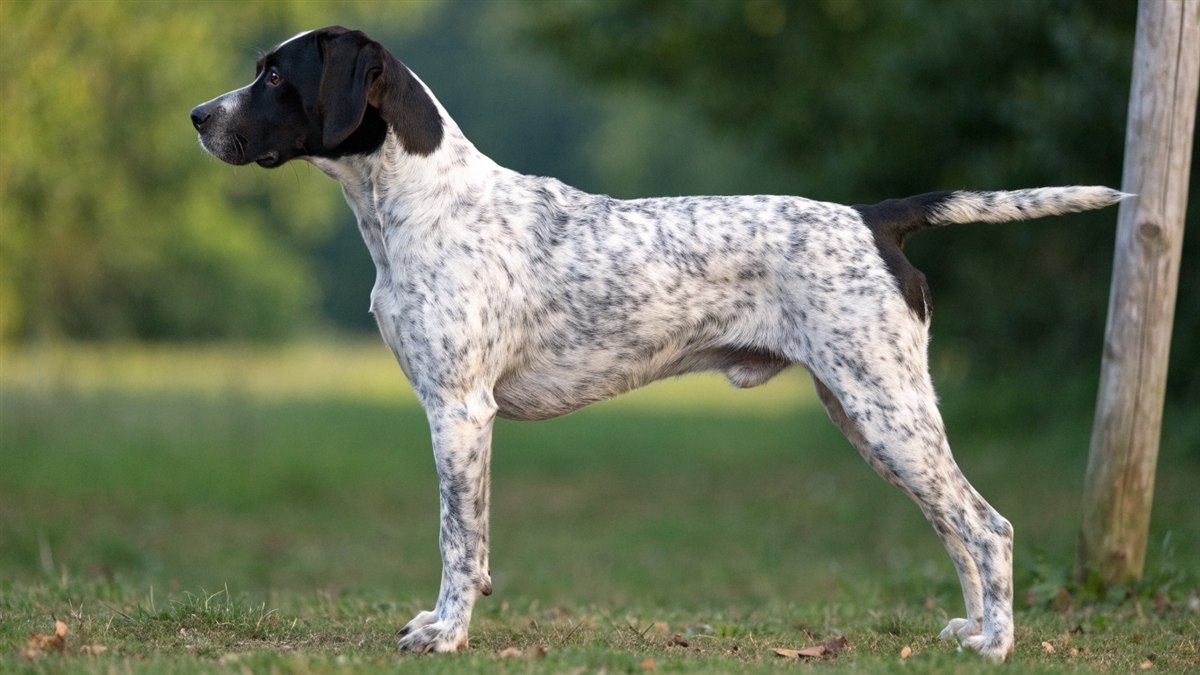
A Braque d'Auvergne is a French pointing dog recognised by the FCI as standard 180, standing 57 to 63 cm at the withers in males and 53 to 59 cm in females, carrying a short black coat broken by white ticked or greying markings. The standard's own heading reads BRAQUE D'AUVERGNE (Auvergne Pointer), Group 7 Pointing Dogs, Section 1.1 Continental Pointing Dogs of the Braque type, with working trial.
We opened the document before quoting it, because this project has caught the FCI's own server returning a complete, correctly formatted standard for the wrong breed at HTTP 200. The PDF at `180g07-en.pdf` prints its breed name in the first three lines, and it is the right one. The nomenclature record adds the dates the standard itself omits: definitive FCI recognition on 30 June 1955, country of origin France, official authentic language French.
Size and build
The size and build clause is short and exact. Males measure 57 to 63 cm with an ideal of 60 cm; females 53 to 59 cm with an ideal of 56 cm; and both sexes carry a tolerance of plus 2 cm and minus 1 cm, so the absolute legal range is 56 to 65 cm for a dog and 52 to 61 cm for a bitch. Body length from point of shoulder to point of buttock is approximately equal to the height at the withers. Chest depth is exactly half the height at the withers. Muzzle length is slightly less than or equal to skull length.
FCI-180 publishes no weight at all. Every weight figure you will find for this breed was supplied by somebody other than the FCI, and the four we traced disagree with each other. That matters more than it sounds, because a weight range is the single number an Indian buyer uses to judge whether a dog will fit a flat.
Coat colour, and what the standard really says
The coat colour clause is where almost every English page goes wrong. FCI-180 reads "Colour: Black with white markings of variable importance", and names two recognised patterns, flecked or greying, which the French original gives as mouchetee ou grisonnee. The head "should be black preferably with a white blaze on the muzzle extending to the skull", and the standard then says in terms that "A white and flecked ear or the side of the head white and flecked cannot be considered as faults.";
Wikipedia describes the reverse animal: "The short, glossy coat is white with mottling of black... The head and ears are always black."; The Royal Kennel Club's breed page says the same thing in softer words, "white with black mottling" and "The head and ears are predominantly black";. The standard makes black the ground and white the marking, and it explicitly permits a white ear. Two of the three most-read English sources have the figure and the ground the wrong way round.
The nose is the one thing the standard will not compromise on. "Nose: Always black." A Dudley nose, unpigmented eyerims, a yellow eye and wall eyes are all disqualifying faults, as are an entirely black coat, an entirely white coat, absence of flecking, and tawny or "burnt bread" fawn glints.
Appearance and working brief
The general appearance clause states the job before the looks. The dog is "Rectilinear, of medium proportions. Robust, strongly boned, but without heaviness", and its conformation "predisposes it to cover long distances with a supple action, permitting it to maintain its activity the whole day on the most difficult terrains."; Its habitual hunting gait is "an average gallop, regular and slightly rocking", not a trot.
Temperament gets one sentence and no hedging. "Gentle dog, very affectionate, intelligent and obedient. Its training consists mainly of developing its natural qualities. Its sense of smell is powerful. It adapts well to family life." An American owner-breeder quoted in Gun Dog puts the working range at 50 to 60 yards before the dog checks back, which is close for a pointing dog.
History and origins in one paragraph
The history and origins clause is four sentences long. "The Auvergne pointer is a very ancient breed, present in the Cantal region for more than two centuries. Descending from a multi-pointer common source, derivation has been made by a selection to which the Knights of Malta might have participated. Created by and for hunters, it has a strong identity reinforced by its coat."; That last clause is about the black and white coat, which both the FCI and the French kennel club treat as the thing that kept the breed distinct. The French original uses the conditional, auraient participe, which is the grammatical form French uses for a claim it is reporting rather than asserting. We take that claim apart in its own section below.
Three separate figures for this breed's height are in circulation: 57 to 63 cm from FCI-180, 55 to 65 cm from Wikipedia's infobox and Pets4Homes, and 53 to 63 cm from Wikipedia's own body text on the same page. Only the first comes from a kennel club. If a seller quotes you a height, ask which document it came from.
The five French Braques compared clause by clause, and how much really separates them
Colour is the obvious difference between the five French Braques, and it is not the only one. We read FCI-180, 179, 133, 134 and 115 in full and compared them clause by clause. Unlike the Anglo-Francais pack hounds, whose three standards share roughly twenty clauses of near-identical boilerplate, these five were drafted in four different decades by four different clubs and they disagree on size, pigment, head shape, bite, dewclaws and tail.
The sharpest finding is that two of the five standards are mutually exclusive on a single anatomical point. FCI-180 requires the nose to be "Always black";. FCI-115 disqualifies "Presence of black, notably: On the nose, On the lips, On the palate, In the nails."; A dog that satisfies the Auvergne standard's most basic pigment requirement would be thrown out of the ring as a Braque Saint-Germain, and the reverse holds too. These are not variants of one breed with a colour preference. They are opposite selections.
| Clause | Auvergne (180) | Bourbonnais (179) | Francais Gascogne (133) | Francais Pyrenees (134) | Saint-Germain (115) |
|---|---|---|---|---|---|
| Standard in force | 24.03.2004 | 21.02.2006 | 01.08.2023 | 01.08.2023 | 01.08.2023 |
| Height, males | 57-63 cm | 51-57 cm | 60-69 cm | 51-58 cm | 56-62 cm |
| Height, females | 53-59 cm | 48-55 cm | 58-68 cm | 49-56 cm | 54-59 cm |
| Size tolerance | +2 cm, -1 cm | +/-1 cm | none stated | none stated | +2 cm only |
| Nose colour | Always black | Matches the coat | Brown | Chestnut-brown | Dark pink |
| Eye colour | Dark hazel | Hazel or dark amber | Chestnut brown or dark yellow | as Gascogne | Golden-yellow |
| Ground colour | Black | White, heavily ticked | Chestnut brown | as Gascogne | Dull white |
| Markings | White, flecked or greying | Fine brown or fawn ticking | White, may be speckled | as Gascogne | Orange (fawn) |
| Skull shape | Almost oval from above | Round from all sides, pear-shaped head | Almost flat | as Gascogne | Slightly rounded, ogival at the rear |
| Cranio-facial lines | Slightly divergent | Parallel or very slightly divergent | Slightly divergent | as Gascogne | Parallel or very slightly divergent |
| Ear set | Below eye level | At eye level or slightly above | At eye level | Above eye line | Level with the eye |
| Bite | Scissors or level | Scissors, level tolerated | Complete, pincer tolerated | as Gascogne | Scissors only |
| Missing teeth | Loss of 2 premolars or any other tooth eliminates | Complete dentition required | Must be complete | as Gascogne | More than one tooth beyond PM1 disqualifies |
| Tail | Docked 15-20 cm, or natural to the hock | Naturally bobtailed, or docked at the base | Generally docked; long tail no fault | Fine, docked or naturally short | Natural, no docking clause |
| Dewclaws | Disqualifying, including traces of removal | Disqualifying, including evidence of removal | Not mentioned | Not mentioned | A fault, not a disqualification |
| Working trial | Required | Required | Required | Required | Required |
Read down the table and the boilerplate hypothesis fails. Each of the five prints its own height range, nose colour, eye colour and head shape, and no two agree on the tail. Only two clauses repeat across all five: the working-trial requirement, and the FCI closing note on descended testicles. Federation Cynologique Internationale Federation Cynologique Internationale
One pair is a real exception, and it is not the Auvergne. FCI-134, the Braque Francais type Pyrenees, is not written as a free-standing standard at all. Its classification clause states that the Pyrenean dogs show "the same general characteristics as those of the Gascogne type" and "only differ on the following points", then lists ten short deltas. So the two Braque Francais types are one standard with an appendix, while the Auvergne, the Bourbonnais and the Saint-Germain are three separate documents that happen to sit in the same section.
What separates the Auvergne beyond colour
Four clauses separate the Braque d'Auvergne from all four siblings, and none of them is about colour. It is the only one of the five to fix an ideal height as well as a range, 60 cm for dogs and 56 cm for bitches. It is the only one to specify the croup's angle numerically, oblique at 35 degrees to the topline, and the shoulder at 45 degrees. It is the only one whose ears are set below eye level rather than at or above it. And it is the only one that describes its working gait as a gallop that is "regular and slightly rocking" rather than simply a gallop.
Two clauses it shares with exactly one sibling, the Bourbonnais. The dewclaw disqualification appears in FCI-180 and FCI-179 and nowhere else in the group, both phrased to cover the scar as well as the claw. So does the demand that white be broken by ticking, listed in FCI-180 as "Absence of flecking" among the disqualifications and in FCI-179 as white patching carrying "fine brown ticking";.
Black ground and a black nose means Auvergne. White ground with brown or fawn ticking and no black anywhere means Bourbonnais. Chestnut brown, with or without white, means Braque Francais. White with orange markings, a pink nose and a yellow eye means Saint-Germain. If somebody shows you a mostly white dog and calls it a Braque d'Auvergne, they have the wrong breed or the wrong name.
Two breed standards describe this dog, and they do not agree
Two kennel clubs publish a Braque d'Auvergne breed standard, and an Indian buyer needs the FCI one. The Kennel Club of India is an FCI member body, so FCI-180 is the document that governs a KCI-registered dog. The Royal Kennel Club's version, written when the breed joined the UK register in 2016 and last updated on 1 April 2025, is a rewrite rather than a translation, and it differs on seven clauses that a judge would actually score.
| Clause | FCI-180 (governs a KCI dog) | Royal Kennel Club (UK) |
|---|---|---|
| Body proportion | Body length approximately equal to height at withers | Body length just slightly longer than height at withers |
| Size tolerance | Plus 2 cm, minus 1 cm | 3 cm either way |
| Working gait | An average gallop, regular and slightly rocking | An endurance trot, steady, straight and true |
| Colour terms | Flecked or greying (mouchetee ou grisonnee) | Ticked or roan |
| Dewclaws | Presence, or traces of removal, disqualifies | No dewclaw clause at all |
| Teeth | Loss of two premolars or any other tooth is eliminatory | No tooth-count clause |
| Disqualifications | Fifteen listed, including eye colour, nose pigment and size | None. Entirely black, white or tan is only highly undesirable |
Only one clause survives both documents word for word, and it is the tail. FCI-180's French original says the docked tail measures 15 to 20 cm; the Royal Kennel Club says "Docked: length of 15 to 20 cm (6 to 8 ins)";. That agreement is useful, because the FCI's English PDF garbles this exact figure into an unreadable string, which is a good reminder to read the French when a number looks wrong.
Why the difference matters in India
The gap that matters most in India is the dewclaw clause, because it is the one clause that collides with Indian law. FCI-180 disqualifies "Presence of dewclaws or traces of their removal", so a dog that has them and a dog that had them removed are both out. The Royal Kennel Club standard has no equivalent sentence, so a UK breeder faces no such rule. An Indian breeder faces both the FCI clause and a legal prohibition on removing the claw, which we set out in the Indian-law section below.
The gait difference is the second one worth knowing. FCI-180 describes a dog whose "habitual hunting gait is an average gallop", a description that assumes a dog moving across country at speed for hours. The Royal Kennel Club replaced that with "An endurance trot";. A buyer reading only the UK document would picture a considerably less demanding animal than the French club selects for, and the Royal Kennel Club's own breed page contradicts the softer picture anyway by rating the exercise requirement at "More than 2 hours per day";.
The Royal Kennel Club also records something the FCI standard cannot: what UK owners are told to screen for. Hip testing under the BVA/KC Hip Dysplasia Scheme sits under Best Practice, prioritising genetic diversity sits under Good Practice, and the breed is Breed Watch Category 1, meaning no points of concern have been identified for special attention by judges. There is no breed-specific DNA testing package.
Pets4Homes tells UK buyers that reputable breeders screen hips "through reputable bodies such as the Animal Health Trust";. The Royal Kennel Club's own page names the BVA/KC scheme, not the Animal Health Trust, as the route for this breed. Where a commercial page and a kennel club disagree about which body issues a health certificate, believe the kennel club and ask to see the certificate itself.
The Knights of Malta story, and what happens when you open the 1726 book
The Knights of Malta story rests on no document, and the FCI's own grammar admits it. Four bodies tell four different versions of where this breed came from, their confidence runs in the opposite direction to their evidence, and the one claim that has ever been checked against a primary source is the negative one.
| Source | What it says | Confidence | Document behind it |
|---|---|---|---|
| Club du Braque d'Auvergne (RABA) | "Tres certainement selectionne par les Chevaliers de Malte" | Near-certain | None cited |
| Pets4Homes | Knights of Malta links in the 16th century | "French legends suggest" | None cited |
| FCI-180 | "une selection a laquelle auraient participe les Chevaliers de Malte" | French conditional mood | None cited |
| Societe Centrale Canine | Historians rarely agree; knights may have brought back dogs born in the Holy Land, or the breed is a local cross | Explicitly unsettled | None cited |
Read the four in order and the pattern is exact. The breed club is the most certain and cites nothing, writing simply that the breed was "tres certainement selectionne par les Chevaliers de Malte" and has been a fixed breed for more than two centuries. The FCI, the body that actually publishes the standard, switches into the conditional, auraient participe, which is the tense French uses to report a claim it will not vouch for. The French kennel club goes further and opens its own breed article by saying the historians rarely agree, then offers a competing account in which the knights brought back dogs born in the Holy Land rather than on Malta, and a second in which the breed is old south-western braque stock crossed with local dogs and later with English Pointer blood. Confidence falls as authority rises.
What Paul Megnin found in 1944
The only person known to have gone looking for evidence found none. Paul Megnin published an enquiry into the breed's origins in 1944, and the account of it reaching English readers runs through Craig Koshyk, author of *Pointing Dogs, Volume One: The Continentals*. Megnin's three findings were that the Order of Malta was never actually dissolved after 1798, that the Order's own archivist M. Chauvelot searched its records and found no mention of hunting dogs of any kind, and that the descendants of Commander de Fargues, a Maltese knight from the Auvergne, had never heard of an ancestor bringing back black-and-white dogs.
We checked the 1726 book ourselves
Megnin's fourth point was that the Abbe de Vertot's exhaustive 1726 *Histoire des chevaliers hospitaliers de S. Jean de Jerusalem... et aujourd'hui les chevaliers de Malte* contains no reference to hunting dogs. That is a claim about a specific document, so we opened it. All four volumes are on the Internet Archive, and we machine-searched 6,566,602 characters of OCR text.
The first pass returned zero for *chasse*, and that was our own error rather than the book's silence: the 1726 long s is optically read as f, i, l or T, so the word comes back as chaffe or chaiTe. Re-run with a tolerant pattern, *chasse* appears 114 times and *chasseur* 27 times, while the positive controls Malte and Grand Maitre return 1,697 and 1,952. The extraction works and the vocabulary is there.
With the search working, the result stands. The exact phrase *chiens de chasse* appears zero times in 6.5 million characters. Across all four volumes there are exactly three places where a dog word and a hunt word sit within 200 characters of each other, and we read all three. One is a genealogical blazon, *chien courant d'argent*, beside a knight surnamed de Clermont-Chaste. One is the insult *ces chiens* beside a Turkish captain nicknamed Chasse-diables. The third is the only real one, a complaint that decadent knights "nourrissent un grand nombre de chiens et d'oiseaux pour la chasse" while giving few alms and neglecting the defence of Christendom.
That single sentence is the entire hunting-dog content of the standard history of the Order. It names no type, no colour, no origin and no destination. The word *braque* occurs four times in the whole work: once as a verb, a cannon *braque* at water level, and three times in the heraldry of the Brachet family, *deux chiens braques d'argent*, which is a pun on the family name. Megnin's negative claim survives an independent machine check of the primary document.
Nothing in the positive Malta story does. The only origin claim on this page grounded in a document anyone can open is the absence: Vertot 1726 contains no hunting dog worth the name, and we have shown our working. The FCI's conditional mood is the honest position, the breed club's "tres certainement" is not, and a 16th-century date contradicts the standard's own "more than two centuries".
The French studbook numbers, and why this breed registers normally
French studbook registration of the Braque d'Auvergne fell from 340 dogs in 2019 to 159 in 2025, a drop of 53 percent in six years. We pulled seven annual Statistiques LOF PDFs from the Societe Centrale Canine, extracted each with pypdf rather than trusting a summary, and checked every printed percentage against the raw counts.
| Year | Braque d'Auvergne | Conf | Conf / Inscr | Braque du Bourbonnais | Epagneul Breton | Retriever du Labrador |
|---|---|---|---|---|---|---|
| 2019 | 340 | not published | - | 70 | 4,562 | 8,000 |
| 2020 | 306 | not published | - | 37 | - | - |
| 2021 | 239 | not published | - | 94 | - | - |
| 2022 | 210 | 66 | 31% | 74 | 5,193 | 8,407 |
| 2023 | 229 | 78 | 34% | 71 | 4,388 | 7,301 |
| 2024 | 203 | not retrieved | - | 51 | 3,953 | 6,483 |
| 2025 | 159 | 73 | 46% | 61 | 3,793 | 6,531 |
Every published percentage in those tables divides out. 73 of 159 is 45.9 percent, printed as 46. 78 of 229 is 34.06 percent, printed as 34. 66 of 210 is 31.4 percent, printed as 31. The year-on-year changes check too: 159 against 203 is minus 21.7 percent, printed as minus 22. Societe Centrale Canine Societe Centrale Canine We report the arithmetic because the same check failed on a different source later in this page.
Does the Anglo-Francais confirmation problem apply here? No.
It does not, and the confirmation column is what settles it. French registration works in two stages. A puppy is entered provisionally at birth, and the entry only becomes definitive when the dog is presented to an approved judge at twelve months or more and confirmed. Kennels that never show therefore never complete the studbook entry, which is why the Anglo-Francais pack-hound breeds produce years of zeros while dogs plainly exist.
The Braque d'Auvergne behaves in the opposite way. The two years before the confirmation column existed show the same population moving normally rather than disappearing, at 306 registrations in 2020 and 239 in 2021. Societe Centrale Canine Its confirmation ratio was 31 percent in 2022, 34 percent in 2023 and 46 percent in 2025, against 11 percent for the Berger Australien, 17 percent for the Berger Allemand, 23 percent for the Border Collie and 12 percent for the Labrador in the same 2025 table. Nearly half of all Auvergnes registered in 2025 were taken in front of a judge. These are individually owned gundogs whose owners engage with the registry, not kennel stock that never leaves the kennel.
The 2019 table, the only one that splits the total, says the same thing from another angle. All 340 Braques d'Auvergne registered that year were French-bred descendants of registered parents, with zero imports and zero foreign-title transfers. The breed reproduces itself inside France and does not depend on imported stock.
Where the breed sits in its own group
Within Group 7 in France the Auvergne is a mid-ranking native breed, not a curiosity. In the 2025 table it sat fifth among the Braques on 159 registrations, behind the Braque Allemand a poil court on 1,287, the Braque de Weimar on 829, the Braque Francais type Pyrenees on 623 and the Braque Hongrois a poil court on 216, and ahead of the Braque Francais type Gascogne on 35, the Braque Saint Germain on 16, the Braque Italien on 16 and the Braque de l'Ariege on 6. The Bourbonnais sat on 61. It is roughly ten times commoner than the Saint-Germain and roughly twenty-four times rarer than the Epagneul Breton.
The decline is real but it is not collapse, and it is not specific to this breed. The Epagneul Breton fell from 4,562 to 3,793 and the Labrador from 8,000 to 6,531 across the same window. Societe Centrale Canine French registrations are falling generally, and the Auvergne is falling somewhat faster than the national gundog average while holding a far higher confirmation rate.
The Statistiques LOF 2024 PDF would not download; the connection closed twice on the direct URL and the file did not appear in a site map search. The 2024 registration figure of 203 in the table above comes from the Inscr 2024 column printed inside the 2025 document, so it is the SCC's own number. The 2024 confirmation count is genuinely missing from this page and we have not guessed it.
Braque d'Auvergne price in India: there is no such thing
There is no Braque d'Auvergne price in India, because there is no Indian supply. We ran India-targeted searches on 23 August 2026 for the breed name, for the breed name plus price, and restricted to the four largest Indian puppy-listing sites, and found not one Indian for-sale listing, not one Indian breeder, and not one rupee figure attached to this breed by anybody.
An absence is only worth reporting if the search that produced it works, so we proved it twice. The identical site-restricted query with the word *labrador* in place of the breed name returned ten results across the same four domains, including a full Indian price ladder of INR 30,000 to INR 1,20,000 with eight city pages behind it. A plain India-targeted search for *labrador retriever price in india* returned eight Indian retail results on the first page. The queries function. The breed is not there.
The third control is the strongest, because it comes from the other side of the market. Supertails published a 2026 price list of more than forty Indian breeds, compiled from breeder networks, KCI registration data and marketplace surveys. Searching the whole article for the string *Braque* returns zero, for any of the five French Braques. India's largest pet-care publisher, working from breeder data, does not know this breed exists as a commodity.
What Indian pages offer you instead
Two Indian domains rank for this breed and neither sells a dog. The first is a Kolkata grooming service with a page at /breed/braque-d-auvergne. Its banner reads "Exciting offer on all services for Braque d'Auvergne" and its price list runs from 1,285 to 4,785 rupees for baths and spa packages. Those are grooming prices, not dog prices.
We tested whether that page is a real service offering or an auto-generated shell by fetching the same site's page for the Braque du Puy, a breed that has been extinct for most of a century and appears in no FCI nomenclature. The two pages are identical: same headings, same title tag reading "Best Pet Grooming Service in Kolkata", same description, with only the breed name injected into one banner line. The breed index on both pages lists Bracco Italiano, Braque Francais, Braque Saint-Germain, Braque d'Auvergne and Braque du Puy in a row. It is a dictionary of breed names, not a customer list.
The second Indian page is a breed encyclopedia entry, and it refutes itself in four places. Its own meta description reads "care of Boykin Spaniel and dog breed mixes". Its Nutrition section is about exercise and its Exercise section is about nutrition, the two headings having been swapped. The Nutrition text discusses Bichons. And it lists the breed as "apartment friendly", which is the opposite of what the Royal Kennel Club says. The Royal Kennel Club, Breeds A to Z
The two division tests, and why neither fires here
Indian pages routinely publish a "price" that is a dollar figure run through one exchange rate. This site has caught it at 84.38 three times and at 74 once, and the test is arithmetic anybody can repeat. Divide the rupee figure by 84.38 and then by 74. If either quotient is a round dollar number, you are reading a converted American price list rather than an Indian market.
Neither test fires for this breed, because there is no rupee figure to divide. That is the honest result and it is worth more than a fabricated band. Keep the tests for the day somebody quotes you one. The confirming detail on a converted list is that the only rows refusing to divide are the hand-typed Indian breeds, so if a table's Rajapalayam and Caravan Hound are the awkward numbers, a human wrote those two and imported the rest.
| Figure | Source | Market | What it is not |
|---|---|---|---|
| 800 to 1,500 pounds | Pets4Homes breed page | United Kingdom | Not an Indian price and not converted here, because no rate was published with it |
| 150 to 250 pounds of setup, 70 to 120 pounds a month | Pets4Homes, same page | United Kingdom | Not the purchase price, and not Indian costs |
| At least 2,500 US dollars | Trainer Patrick Hecht, quoted in Gun Dog, on the cost of importing a puppy to the United States | United States import | Not a purchase price; the puppy costs extra |
| Rs 98,999 | An Indian listing site's recurring carousel | None | Not this breed's price, and not any breed's price |
This one figure has been caught on ten separate pages of a single Indian listing site, three times on one page, attached to whichever puppy is in stock. The recurring animals are two Maltipoos and a Doxiepoo, and the same carousel prints Rs 92,599, Rs 94,999, Rs 76,499 and Rs 1,20,000 beside it. It appears on pages for breeds the site does not stock at all, including the Komondor, the Basenji, the Rat Terrier and the Great Dane. Run the tests on it: 98,999 divided by 84.38 is 1,173.25 dollars and divided by 74 is 1,337.82, neither of them round. It is not even a conversion. It is a rupee-native charm price ending in 999, and it means nothing about any dog.
Indian import law closes the only route that was left
Importing a Braque d'Auvergne into India as a commercial transaction is not permitted, and the rule says so in one sentence. DGFT Trade Notice 22/2022-23, dated 19 December 2022, states that "any applications for trading/breeding purposes, or applications made on behalf of some another person/entity shall be duly rejected." We read the five-page notice as extracted text rather than a summary.
The classification comes first. Under ITC (HS) 01061900, other mammals including cats and dogs, the import policy is Restricted, subject to Policy Condition 6. Policy Condition 7 then limits the purposes to three, and the list is exhaustive. A pet dog with a valid pet book and relevant records in the name of the importer; dogs imported by R&D organisations for research with the recommendation of the CPCSEA; and dogs for internal security by the Defence and Police Force. Policy Condition 8 adds that "Import of commercial dogs for breeding or any other commercial activities other than the purposes mentioned above is not permitted.";
What the pet route actually allows
One lawful route exists and it belongs to a person, not to a market. Up to two pets may come in as passenger baggage without a DGFT import authorisation, and only where the owner is transferring residence to India after two years of continuous stay abroad. An import authorisation from DGFT is required if the stay abroad was under two years, if the pet is not travelling as passenger baggage, or if the pet cannot be imported under the baggage rules. More than two pets always needs an authorisation, examined by the Department of Animal Husbandry and Dairying against the justification supplied.
Entry is limited to seven places. "Import of pet animals is allowed only through airports and seaports of Delhi, Mumbai, Chennai, Hyderabad, Bangalore and Kolkata", with quarantine at the government station of the port where required, and an Advance No Objection Certificate from the Regional Officer or Quarantine Officer at that port. DAHD added a seventh port, Cochin International Airport at Kochi, for pets arriving under the baggage rules in October 2024. Owners are told to start the authorisation process at least two months before travel.
Add the registry gap and no supply chain can form
Two facts together explain why no Indian Braque d'Auvergne market exists and probably never will. The first is that the commercial import route is closed by rule. The second is that the breed has no Indian registry footprint to build on: it appears in no Indian breed price list compiled from KCI data, and every Indian page ranking for it is a template. Pink Paws Grooming, Kolkata
Between them those two facts mean the only Braque d'Auvergne that can lawfully arrive in India is one particular dog, already owned abroad by one particular person who is moving here. That person cannot then sell puppies commercially without falling foul of the same trade notice, and could not lawfully have imported a mate.
The scale of the international market makes the point from the other end. An American trainer with four of these dogs told Gun Dog that importing a puppy to the United States costs "at least 2,500 dollars... and that's not including a bunch of other expenses", that waiting lists run to two years, and that European breeders often will not release their best dogs abroad. A country with a legal import route, an established gundog culture and a hundred-odd Auvergnes still cannot get puppies easily. India has none of those three things.
Ask them which of the three Policy Condition 7 purposes the import fell under, which of the seven permitted ports it came through, and to show you the DGFT import authorisation or the pet book in the importer's own name. A commercial seller cannot produce those documents, because the trade notice says an application in that form "shall be duly rejected". Whatever the dog is, it did not arrive by the route they are implying. The full route is set out in how to import a dog to India.
Indian law and FCI-180 collide on the tail and the dewclaw
Two clauses of the Braque d'Auvergne standard cannot lawfully be satisfied in India, and one Indian rule mandates screening for exactly the faults the standard disqualifies. We read the Prevention of Cruelty to Animals (Dog Breeding and Marketing) Rules 2017 from the machine-readable gazette text and grepped for every phrase quoted here, because this document has handed fabricated clause numbers to three separate researchers on this project.
The docked tail is illegal to produce
FCI-180 describes a docked tail as normal. "Docked, it has a length of 15 to 20 cm", with the undocked alternative reaching the point of the hock and no further. The Second Schedule, Part II, paragraph 6(8) of the 2017 Rules reads: "There shall be no tail docking, ear cropping de-barking, de-clawing, branding, dyeing, injecting substances to enhance visual appeal, performing a surgery or procedure to camouflage or hide any defect or infirmity or any other kind of mutilation of any body part of the pup and any change of appearance by artificial means is strictly forbidden.";
So an Indian-bred Braque d'Auvergne carries a natural tail, and that is not a compromise. The standard already permits it. What an Indian reader must not accept is a puppy presented with a 15 to 20 cm stump and an explanation about breed type. Any hero image, breeder photograph or catalogue picture showing a docked dog is showing something that cannot lawfully be produced here.
The dewclaw clause is the harder one
The dewclaw creates a trap with no lawful exit. FCI-180 lists among its disqualifying faults, under Limbs, "Presence of dewclaws or traces of their removal."; Both states disqualify. A puppy born with front dewclaws is out of the ring, and a puppy whose dewclaws were removed is also out of the ring because the scar is itself a disqualification.
Indian law removes the second option entirely. The same paragraph 6(8) forbids "de-clawing... or any other kind of mutilation of any body part of the pup", and paragraph 6(9) separately prohibits "Breeding to create new breeds of dogs or unusual looks";. An Indian breeder therefore cannot lawfully remove a dewclaw, and an Indian-bred dog that has one can never be shown under FCI rules. Only the Bourbonnais standard shares this clause among the five Braques, and no Indian page about either breed mentions it.
Where Indian law and the standard agree
The overlap is remarkable and nobody has pointed it out. Second Schedule Part III paragraph 8(10) requires that "The dogs shall have been tested for genetic defects, including hip dysplasia, progressive retinal atrophy, night blindness, hypothyroidism, entropion, ectropion, overshot, undershot jaw (when incisors do not touch or mesh), wry mouth, two or more missing teeth, unilateral cryptorchid or full cryptorchid males.";
Four items on that mandatory list are disqualifying faults in FCI-180. Entropion and ectropion appear as "Eversion or inversion of eyelids or traces of corrective intervention". Overshot and undershot appear as a gap of more than 1 mm between the incisive arcades. Two or more missing teeth appear as "The lack of 2 other premolars (PM2 or PM3) or of any other tooth including PM4 is eliminatory", with only PM1 tolerated. And cryptorchidism appears in the closing note. An Indian breeder complying with the Rules would already be screening for most of what the standard eliminates.
Three more provisions that bind any Indian breeder
- Rule 8(1)(a), Conditions for sale. "Every breeder shall ensure that pups less than eight weeks in age are not sold." This is the main Rule 8, not the Second Schedule paragraph 8, and the document numbers both.
- Second Schedule Part II paragraph 6(3). In-breeding and incest breeding are prohibited. Only out breeding and line breeding are permitted, and in-breeding is defined to cover relatives of the second to fourth grade within the first four generations, naming uncle to niece, nephew to aunt, cousin to cousin and grandparents to grandchildren.
- Second Schedule Part II paragraph 5(2) and 5(7). Females may not be bred before eighteen months, males may not be used before eighteen months, and both need a veterinary health certificate at least ten days before mating. Paragraph 5(6) caps a female at five litters in her lifetime and 6(4) stops breeding her after eight years.
Clause numbers in this document are genuinely contested between researchers, because it numbers things twice. There is a Rule 8, Conditions for sale, and a separate Second Schedule Part III paragraph 8, Health related requirements. Everything above was grepped from the gazette text at awbi.gov.in and the paragraph numbering was read from the surrounding text, not inferred. Where you quote this instrument, say which of the two eights you mean.
Monthly cost of ownership, bounded honestly
Running a 25 kg short-coated gundog in an Indian city costs roughly the same as running any other 25 kg dog, plus one line item most breeds do not need. We can bound the recurring cost from published Indian figures and from the breed's own care requirements, and we can say plainly which parts of it we cannot price.
Start from the Indian baseline. Supertails puts average monthly maintenance for a dog in India at 3,000 to 11,000 rupees in its main text, and at 3,000 to 18,000 in its own summary box a few hundred words earlier, an internal disagreement we report rather than average. Its first-year budget, purchase included, is 80,000 to 2,00,000 rupees, and it says urban Indian households now spend 5,000 rupees or more a month. Those figures are for the popular breeds, and a Braque d'Auvergne sits at the top of the weight band they cover.
| Line | Basis | Confidence |
|---|---|---|
| Food for a 22 to 28 kg active dog | Top of the Indian large-breed band in every published list | Published, breed-neutral |
| Ear cleaning and ear medication | Drop-eared gundog in a monsoon climate; see the ear section | Breed-specific, not priced by any Indian source |
| Routine vet, vaccination, deworming, tick and flea control | Standard Indian large-dog schedule | Published, breed-neutral |
| Grooming | Once a week at home, no professional clipping needed | Royal Kennel Club rating, no cost attached |
| Exercise infrastructure | More than two hours a day, which in most Indian cities means a vehicle to reach open ground | Royal Kennel Club rating, cost not published |
| Cooling | Fan or air conditioning through eight to ten hot months; see the climate section | Breed-specific, unpriced |
| Insurance | 25 to 60 pounds a month in the UK; the Indian pet-insurance market is not comparable | Foreign figure, do not convert |
The one line that separates this breed from a Labrador of the same weight is the ear. A drop-eared dog in a Chennai or Mumbai monsoon needs a weekly ear check and an ear cleaner in the cupboard, and a proportion of those dogs will need a veterinary otitis consultation and a course of medication in July or August. We have not found a single published Indian figure for what an otitis consultation and treatment course costs, so we will not invent one. Budget for it as a real and recurring line and ask your own vet for a number.
The UK figures, and why we are not converting them
Pets4Homes gives UK setup at 150 to 250 pounds, food at 40 to 50 pounds a month, insurance at 25 to 60 pounds a month, monthly upkeep at 70 to 120 pounds, over 1,200 pounds a year in veterinary expenses, and a lifetime cost of 15,000 to 20,000 pounds over 12 to 14 years. Those are real published figures for a real market, and they are useless as Indian numbers.
Converting them would produce exactly the artefact this site exists to catch. A UK insurance premium reflects a UK insurance market; a UK veterinary bill reflects UK veterinary wages. Running those through any exchange rate produces a plausible-looking rupee figure that describes nothing in India. We print the pounds as pounds and leave them there.
The cost nobody prices
The largest real cost of this breed in India is not money. The Royal Kennel Club rates the exercise requirement at more than two hours a day and says the breed suits the country rather than the town, a large house and a large garden. In a Chennai or Delhi flat, meeting that means two outings a day inside a narrow cool window, most days, for twelve to fourteen years. That is a time cost of roughly 700 to 900 hours a year, and no Indian price list has a row for it.
Three lines on this page carry no rupee figure because no source publishes one: Indian otitis treatment for a drop-eared dog, the electricity cost of cooling a black-coated dog through an Indian summer, and the cost of reaching open ground twice a day in a large Indian city. Each is real and each is breed-relevant. A page that filled them in with invented numbers would look more complete and be worth less.
Heat tolerance in India: Bonbeno rates this breed 2 out of 5
The Braque d'Auvergne comes from a place with zero months averaging 25 C and it is asked to work all day. Chennai has ten such months, and Chennai's coolest month is warmer than the Cantal's hottest. We rate its heat tolerance 2 out of 5, and here is the arithmetic, the source and the mechanism, so you can disagree with the rating rather than take it on trust.
One source, one method, coordinates printed
Every figure below comes from the NASA POWER Climatology API, version 2.9.7, drawing on MERRA-2, using the 20-year monthly climatology from January 2001 to December 2020. Every query was made by explicit longitude and latitude, never by place name, so a server cannot silently return the wrong city. The metric is the count of calendar months whose mean 2-metre air temperature reaches 25 C, plus the annual mean and the relative humidity at 2 metres. NASA Prediction Of Worldwide Energy…
We did not use climate-data.org. Six wrong documents have been caught on that host by four researchers on this project, all served at HTTP 200, all complete, all for the wrong place. A coordinate query cannot make that mistake.
| Place | Coordinates | Annual mean T2M | Warmest month mean | Coolest month mean | Months at 25 C or above | Peak monthly RH |
|---|---|---|---|---|---|---|
| Aurillac, Cantal (breed home) | 44.9264 N, 2.4444 E | 9.1 C | 18.0 C (July) | 0.8 C (January) | 0 | 91.3% (January) |
| Chennai | 13.0827 N, 80.2707 E | 28.0 C | 31.5 C (May) | 24.1 C (January) | 10 | 82.3% (November) |
| Mumbai | 19.0760 N, 72.8777 E | 26.8 C | 31.2 C (May) | 23.2 C (January) | 9 | 90.4% (August) |
| Delhi | 28.6139 N, 77.2090 E | 25.6 C | 35.9 C (June) | 13.6 C (January) | 7 | 74.9% (August) |
| Pune | 18.5204 N, 73.8567 E | 23.9 C | 28.9 C (April) | 19.6 C (December) | 4 | 90.8% (August) |
| Bengaluru | 12.9716 N, 77.5946 E | 23.7 C | 28.4 C (April) | 20.2 C (December) | 3 | 81.0% (October) |
The single number that decides it
Chennai's coolest month averages 24.1 C. The Cantal's hottest month averages 18.0 C. The gap is 6.1 degrees, and it runs the wrong way all year. Bengaluru's coolest month, 20.2 C in December, is still 2.2 degrees above the warmest month this breed was selected in. Pune's coolest, 19.6 C, is 1.6 degrees above it. Only Delhi offers months genuinely cooler than a Cantal summer, in January and February, and Delhi pays for that with a June mean of 35.9 C, which is 17.9 degrees above the breed's home July.
Why the coat cuts both ways
The mechanism has three parts and they compound. First, the coat. FCI-180 specifies hair that is "Short, not too fine, never hard, shiny", with no undercoat mentioned anywhere. A single short coat sheds heat well by convection, which is why the breed handles a French summer, and offers almost no barrier to direct solar radiation, which is a different problem. Gun Dog notes the same coat makes the breed "somewhat intolerant of extremely cold temperatures", so nobody is claiming it is thick.
Second, the colour. Of the five French Braques, this is the only one whose standard requires a black ground; the Bourbonnais and the Saint-Germain are predominantly white and the Braque Francais is chestnut. Federation Cynologique Internationale A black surface absorbs a larger fraction of incident shortwave radiation than a white one, so the same Indian midday sun loads this breed harder than its siblings. That is not a fault in the standard. It is a consequence of a colour selected in a region where solar load is not the binding constraint.
Third, the brief. The general appearance clause says the dog's conformation "predisposes it to cover long distances" and lets it "maintain its activity the whole day on the most difficult terrains", at a gallop. That is a whole-day working animal, and the whole day it was designed for averages 18 C. The French kennel club writes that the breed keeps going "meme les jours d'ouverture ou il fait tres chaud", even on shooting-season opening days when it is very hot. The French general opening falls in September, and Aurillac's September mean is 14.1 C. The club's "very hot" is a month that would count as a cold snap in Chennai.
What that means for a specific Indian city
In Bengaluru and Pune the dog is workable, with the exercise moved into the cool hours and abandoned in April and May afternoons. In Delhi it is workable for four months and dangerous for three. In Chennai and Mumbai it is a permanent management problem, because there is no cool season to recover in and the humidity peaks above 90 percent in Mumbai in August, which is exactly when a panting dog loses the ability to cool itself by evaporation.
Two things would move this rating up. A published thermoregulation study on short-coated Continental pointing dogs in a tropical climate would beat our reasoning, and none exists. A well-documented Indian working line adapted over generations would beat the climatology, and there is no Indian population at all. Two things would move it down: a dog kept on a west-facing balcony, and an owner who exercises at 11 in the morning because that is when they are free.
Long ears and a short coat: what this combination costs in Indian humidity
The Braque d'Auvergne carries a low-set drop ear long enough to reach the root of its own nose, and that single conformation feature raises its odds of otitis externa by roughly 80 percent against a prick-eared dog. Add an Indian monsoon and a breed whose own promoters push it into water, and ear care stops being a grooming footnote and becomes the main recurring health cost.
The standard is precise about the ear and the description matters. "Attached rather towards the rear. At rest, the ear is set below a line running from the upper level of the nose to the eye... Turned slightly inward, neither curled nor flat, the ear is supple and slightly satiny. The tip is fairly round. Drawn forward, it should reach the root of the nose, without going further than the tip."; Low set, hanging close to the cheek, rounded rather than pointed, and long. That is a lid on the ear canal.
The number, with its denominator
The best available figure comes from VetCompass primary-care records in the UK. O'Neill and colleagues took a random sample of 22,333 dogs and found a one-year otitis externa prevalence of 7.30 percent. Against breeds with erect ear carriage, breeds with pendulous ear carriage had 1.76 times the odds (95 percent CI 1.48 to 2.10) and breeds with V-shaped drop ear carriage had 1.84 times the odds (95 percent CI 1.53 to 2.21). Semi-erect ears showed no difference at all, odds ratio 1.03.
The Braque d'Auvergne's rounded, close-hanging leather falls into the pendulous category rather than the V-shaped one, but the point survives either classification, because both carry the same penalty and only the erect category escapes it. The same study also found the Kennel Club Gundog group carried 1.42 times the odds of otitis externa against breeds the Kennel Club does not recognise, and this is a gundog.
The authors name the mechanism plainly: a pendulous conformation "can result in heat and moisture retention within the ear canal". Heat and moisture are precisely what an Indian monsoon supplies. Mumbai's August relative humidity averages 90.4 percent and Pune's 90.8 percent.
The Indian seasonal evidence
One Indian series puts the seasonal loading beyond argument. At the veterinary clinics of CSK Himachal Pradesh Krishi Vishvavidyalaya in Palampur, 2,476 dogs were screened between June 2022 and July 2023 and 81 were diagnosed with otitis externa, a hospital prevalence of 3.27 percent. Of those 81 cases, 48 presented in the rainy season of July and August, 59.25 percent of the year's caseload in two months. Summer, April to June, accounted for 15 cases; winter, December to March, for 10; autumn, September to November, for 8.
Check that against the ear-carriage split from the same paper and the picture sharpens. Twenty-five of the 81 cases were erect-eared breeds, 30.86 percent, and the erect-eared breeds in its own table are German Shepherd, Pomeranian and Husky. The remaining 56 dogs, 69.13 percent, were drop-eared breeds, led by Labrador Retriever, Pug, Beagle and Golden Retriever. Two-thirds of an Indian clinic's otitis caseload had the ear this breed has. That count of 56 is a correction to the paper, which prints 53 beside the same percentage; the next section shows why 56 is the right number and 53 cannot be.
The care advice that does not transfer
Overseas guidance for this breed treats water work as an unqualified good. The French kennel club describes it as "aussi bon retriever que chien d'arret", as good a retriever as a pointer. Craig Koshyk reports being told that Braques d'Auvergne are excellent swimmers who take to water easily as puppies. In the Cantal, where the wettest month averages 91 percent humidity at a mean temperature of 0.8 C, water in an ear canal dries out. In Mumbai in August it does not.
So the Indian adaptation is specific and small. Plug the ears before any bath or swim, dry the canal after, and treat July and August as the season to check daily rather than weekly. Never adopt the phrase "let him air dry" from an overseas grooming guide; an Indian monsoon does not have dry air to lend you.
- Check both ears weekly through the year and daily through July and August, looking for redness, odour, head shaking and pawing.
- Dry the canal after every bath, swim or heavy rain, with a soft cloth and no cotton bud pushed into the canal.
- Plug the ears before bathing. The Palampur series recorded excessive moisture as a predisposing factor in 17 of its 81 cases, 20.98 percent, and moisture accumulation in the canal in 33.33 percent.
- Clip nothing. The ear leather is short-coated and needs no trimming; the problem is airflow, not hair.
- Escalate early. Treatment error was recorded in 11.11 percent of the Palampur cases, which is nine dogs whose first course of treatment made things worse.
Palampur sits at roughly 1,270 m in the Kangra valley, which is not Chennai. Its monsoon peak is real but its baseline prevalence of 3.27 percent is low, and the paper itself notes another Indian series, Parmar and colleagues in 2020, reporting 57.76 percent. Prevalence figures from Indian teaching-hospital caseloads are not population prevalences, and they vary enormously with which clinic and which referral pattern. Use the seasonality, not the headline rate.
The Indian ear study everyone quotes has three broken numbers in it
Divide every percentage you are handed before you trust it. The Palampur otitis paper is the most-cited Indian source on drop-eared dogs and ear disease, and three of its printed figures fail arithmetic. One of them, the pendulous-ear count, is the figure this breed's page most needs, and the correct value is 56 rather than the printed 53.
The paper reports 81 otitis cases out of 2,476 dogs screened at Palampur between June 2022 and July 2023. Every count in it therefore has 81 as its denominator, and every percentage should be that count divided by 81. Most of them are. 34 of 81 is 41.9753, printed as 41.97. 48 of 81 is 59.2593, printed as 59.25. 37 of 81 is 45.679, printed as 45.67. 30 of 81 is 37.037, printed as 37.03. Those four truncate the third decimal. One rounds instead: 65 of 81 is 80.2469, printed as 80.25. The house style is inconsistent by one digit, and every table still sums to 81.
The pendulous-ear row cannot be right
Table 5 prints "Pendulous ear breed | 53 | 69.13%". 53 divided by 81 is 65.43 percent, not 69.13. The percentage 69.13 requires a count of 56, because 56 divided by 81 is 69.1358, which truncates to exactly 69.13. One of the two numbers in that cell is wrong.
Three independent checks say the count is wrong and the percentage is right.
- The row must sum to the sample. The next line of the same table reads "Erect ear breed | 25 | 30.86%". Every dog is one or the other. 56 plus 25 is 81, the whole sample. 53 plus 25 is 78, leaving three dogs with no ear at all.
- The percentages already sum to 100. 69.13 plus 30.86 is 99.99, which is what two truncated percentages of a two-way split should give. The authors' percentages are internally consistent; only the count is not.
- The breed table settles it independently. Table 1 lists the eleven breeds. The prick-eared ones are German Shepherd on 12, Pomeranian on 10 and Husky on 3, which is exactly 25, matching the erect-ear row to the dog. The other eight breeds account for the remaining 56. The paper's own prose confirms the split, naming German Shepherds and Pomeranians as the erect-eared group and Labrador Retrievers and Pugs as the pendulous one.
We can even see where 53 came from. Elsewhere the paper states that bacterial infections were present in 65.43 percent of cases, and the secondary-cause column gives cocci-associated 30 and rod-associated 23. Thirty plus twenty-three is 53, and 53 of 81 is 65.43 percent. The bacterial count from the adjacent column has been typed into the predisposing-factor column one across. The Braque d'Auvergne's ear conformation was shared by 56 of 81 Indian otitis cases, not 53.
Two more broken figures nobody has flagged
The same arithmetic catches two transcription errors in Table 1 that no one appears to have noticed, and both are provable from inside the paper.
| Row | Printed | Correct value | Proof from inside the paper |
|---|---|---|---|
| Table 5, Pendulous ear breed | 53 cases, 69.13% | 56 cases, 69.13% | Erect ear row is 25; 56 plus 25 is 81, the whole sample |
| Table 1, Pomeranian and Mongrel | 10 cases, 12.43% | 10 cases, 12.34% | Table 4 prints 12.34 for the same count of 10 out of the same 81 |
| Table 1, Pug | 8 cases, 9.80% | 8 cases, 9.87% | Table 4 prints 9.87 for a count of 8 out of the same 81 |
The Pomeranian error is a straight digit transposition, 12.34 typed as 12.43, and the proof is that Table 4 of the same paper prints 12.34 for the winter season, which also has a count of 10. The same count, the same denominator, two different printed percentages in one three-page paper. The Pug row is the same failure at one decimal place, 9.87 typed as 9.80, again contradicted by Table 4's autumn row of 8 cases at 9.87.
One thing that looks like an error and is not
The paper's results section opens "In a study of 50 cases of Otitis externa, the primary cause was identified in 45.67% (37/81) as hypersensitivity", and 50 does not equal 81. It is not a contradiction. Add the primary-cause column of Table 5: hypersensitivity 37, parasitism 5, hypothyroidism 2, viral disease 2, immune-mediated 4. That is exactly 50, the number of cases in which a primary cause was identified at all. The sentence is badly worded, not wrong.
Any figure quoted as n of N, X percent can be divided out in a calculator before you believe it. When the arithmetic fails, look at the neighbouring columns before you discard the whole paper: here the count was wrong and the percentage was right, and a fourth number in the same table told us which. Four of this paper's five percentage groups check out exactly, so this is a careful piece of work with a typesetting problem, not a fabrication.
Health problems and life expectancy: 53 eye exams are the entire screening record
Fifty-three eye examinations are the only health data with a denominator that exists for this breed anywhere in the world. There are no hip figures, no elbow figures, no cardiac or thyroid figures, and no peer-reviewed literature at all. Anyone quoting you a Braque d'Auvergne disease prevalence is quoting somebody's impression.
What the OFA actually holds
The Orthopedic Foundation for Animals carries a BRAQUE D'AUVERGNE row in one database and one only. We retrieved the full inline statistics dump, searched it case-insensitively, and confirmed the printed breed label on every row before taking a number off it, because a guessed OFA breed code returns a complete and plausible table for a different dog.
| Database | Evaluations | Result |
|---|---|---|
| Eyes (CAER), summary | 53 | 92.5% normal, 0.0% breeder option, 7.5% abnormal, rank 45 |
| No findings recorded | 53 | 31 dogs, 58.5% |
| Persistent pupillary membranes, iris to iris | 53 | 6 dogs, 11.3% |
| Cataract, significance unknown | 53 | 7 dogs, 13.2% |
| Other, suspected as not inherited | 53 | 7 dogs, 13.2% |
| Punctate cataract, anterior cortex | 53 | 3 dogs, 5.7% |
| Punctate, equatorial cortex / nucleus / incipient capsular | 53 | 2 dogs each, 3.8% |
| Microphthalmos, distichiasis, PPM iris to lens, PPM iris to cornea, retinal dysplasia folds, other suspected inherited | 53 | 1 dog each, 1.9% |
| Hips | none published | Below the 100-evaluation threshold |
| Elbows, patella, cardiac, thyroid | none published | Below the 50-evaluation threshold |
Every one of those percentages divides out against 53. 49 normal and 4 abnormal is 92.45 and 7.55 percent, printed as 92.5 and 7.5, and they sum to 53. 31 of 53 is 58.49. 6 of 53 is 11.32. 7 of 53 is 13.21. The table is internally consistent.
The absences are meaningful because OFA publishes its own threshold. Its FAQ states: "Breeds are not included in the OFA statistics tables until a minimum number of individuals have been evaluated. For hips, each breed must have at least 100 evaluations in the database. For all other databases, there must be at least 50."; The eye row at 53 clears the 50-evaluation bar. The absence of a hip row means fewer than 100 Braques d'Auvergne have ever had hips read by the OFA. The control that proves the search worked is the sibling: BRAQUE FRANCAIS appears in both the eye database on 139 evaluations and the hip database on 135, at 97.0 percent normal and 3.0 percent dysplastic.
Peer-reviewed literature: zero papers
PubMed holds no record about this breed, and we proved the search before saying so. Searching "Braque d'Auvergne" returns 0 records. The positive controls run in the same session returned 1,084 for Labrador Retriever and 5 for Bracco Italiano, so the tool works.
A non-zero count is not proof either, and the second query shows why. "Auvergne Pointer" returns 1 record, but PubMed reports its own translation as `"auvergne"[All Fields] AND ("pointer"[All Fields] OR "pointers"[All Fields])`, and the single hit is a 2019 plant-cell-biology paper on the 3D architecture of the plant nucleus. The bare term "Braque" returns 28 records, and opening every one of them finds the Cubist painter Georges Braque, authors surnamed Braque, and four genomics papers on the Braque Francais type Pyrenees. Not one is about the Braque d'Auvergne.
The comparison inside the family is the useful part. The Braque Francais type Pyrenees has four dedicated papers, on genome-wide association for morphology and hunting behaviour, copy number variation, genomic characterisation and runs of homozygosity. The Braque Saint-Germain appears in three French pedigree-diversity studies by Leroy and colleagues, in 2006, 2009 and 2012, the last two of which single it out as a breed needing special effort to maintain diversity. Leroy G and Rognon X. Assessing the impact… The Braque d'Auvergne appears in none of the seven.
Life expectancy: no registry publishes one
Three commercial figures circulate and none has a study behind it. Pets4Homes says 12 to 14 years. Monkoodog says 11 to 14. The Royal Kennel Club will only say "Over 10 years", which is a category rather than an estimate. The FCI standard publishes no life expectancy, the French club publishes none, and no mortality study of the breed exists. Bonbeno publishes no lifespan figure for the Braque d'Auvergne, because there is nothing to publish.
Fifty-three examinations is enough to clear OFA's publication bar and nowhere near enough to establish a breed prevalence. Persistent pupillary membranes in 6 of 53 dogs is a real observation in a real sample and it is also six dogs. Treat the row as evidence that eye screening is worth doing in this breed, not as a risk figure. Publish the denominator every time you quote it, and re-check it before you rely on it, because OFA counts move as evaluations are added.
Every published number for this breed, followed back to its source
Nine numbers circulate about the Braque d'Auvergne and only two of them come from a kennel club. We traced each one to the page that first printed it, checked it against FCI-180 and the French studbook, and recorded which ones have nothing behind them.
| Figure | Who publishes it | Verdict |
|---|---|---|
| Height 57 to 63 cm dogs, 53 to 59 cm bitches, tolerance +2/-1 | FCI-180 and the Royal Kennel Club | Sourced. Use this. |
| Height 55 to 65 cm dogs, 51 to 61 cm bitches | Wikipedia infobox, repeated verbatim by Pets4Homes | Matches no standard. The low end is below the FCI floor for both sexes. |
| Height 53 to 63 cm | Wikipedia's own body text, on the same page as the infobox above | Contradicts its own infobox. Sourced to a 1995 encyclopedia, not to a standard. |
| Weight 22 to 28 kg | Pets4Homes | FCI-180 publishes no weight. No stated basis. |
| Weight, male 20 to 27, female 20 to 21.5, units not given | Monkoodog | No units, no source, and a female range 5.5 kg narrower than the male one for a breed whose height ranges overlap. |
| Weight 48 to 62 pounds in hunting condition | Monkoodog, in a different paragraph on the same page | Contradicts the same page's own kilogram figures. |
| Lifespan 12 to 14 years | Pets4Homes | No study. No registry publishes a lifespan. |
| Lifespan 11 to 14 years | Monkoodog | No study, and disagrees with the figure above. |
| Lifespan over 10 years | Royal Kennel Club | A category on a form, not an estimate. |
| Revived from a stock of 20 dogs by Andre de Tournay | Pets4Homes | No source. Contradicted by the count below. |
| Descended from about 25 dogs that survived the war | Monkoodog | No source. Disagrees with the figure above by five dogs. |
| About 300 puppies whelped a year, constant | Craig Koshyk, writing in 2012 | Was true then. The studbook says 159 in 2025. |
The post-war bottleneck: two numbers, no document
The claim that the modern breed descends from a couple of dozen survivors appears everywhere and rests on nothing we could find. One page says 20 dogs and names Andre de Tournay. Another says about 25. Neither cites a source and neither gives a year. A five-dog disagreement in a founder count is a large disagreement, because founder counts are exactly the sort of figure that gets rounded upward in retelling.
The best-researched account of the same period says something materially different. Craig Koshyk reports that the breed fell on hard times in the war, that by the 1950s there were very few breeders left, and crucially that some of those breeders were crossing English Pointers into their lines to produce a lighter, faster dog, before the parent club restored order. The French kennel club's own article independently names "l'apport de sang britannique avec du pointer" as part of the breed's more recent history.
That matters for anyone quoting a founder number. If Pointer blood entered the lines after the war, the modern population is not the closed descendant group of 20 or 25 animals that both figures imply. Publish neither number without the Pointer caveat beside it.
The one number our own data updates
Koshyk wrote in 2012 that roughly 300 puppies were whelped a year and that the figure had been more or less constant since the 1980s. The French studbook confirms he was right for a long time: 340 registrations in 2019 and 306 in 2020. It then shows the run ending. 239 in 2021, 210 in 2022, 229 in 2023, 203 in 2024 and 159 in 2025. Societe Centrale Canine A forty-year plateau broke in the four years after 2020, and no page except this one says so.
One published fact that is simply a different breed
Pets4Homes lists the breed's nicknames as "Auvergne Pointer, Bleu d'Auvergne, Braque Francais". Braque Francais is not a nickname. It is two separate FCI breeds, standards 133 and 134, with their own clubs, their own working trials, their own chestnut-brown pigment and their own studbook rows that registered 623 and 35 dogs in 2025. Federation Cynologique Internationale Auvergne Pointer and Bleu d'Auvergne are genuine, the second being an unofficial name the French kennel club itself uses for the blue impression of the ticked coat.
If you retain nothing else from this section, keep these. Height is 57 to 63 cm for dogs and 53 to 59 cm for bitches, from FCI-180, with a tolerance of plus 2 and minus 1. And there is no published weight and no published lifespan for this breed from any kennel club anywhere. Any page that gives you both with confidence has invented at least one of them.
Temperament and household fit: gentle, sensitive, and built for a job you cannot give it
The Braque d'Auvergne is an affectionate, biddable, unusually soft dog that lives happily in a family and cannot live happily without work. Every source agrees on the temperament and they disagree sharply on whether it suits a flat, which is the only question an Indian buyer is actually asking.
FCI-180 gives temperament one sentence and it is unusually warm for a breed standard. "Gentle dog, very affectionate, intelligent and obedient. Its training consists mainly of developing its natural qualities. Its sense of smell is powerful. It adapts well to family life."; The Royal Kennel Club's rewrite says "Gentle, affectionate, intelligent and obedient. Adapts well to family life", plus a characteristics clause describing a dog that "tends to work closely with handler" and has a "desire to please";.
The French kennel club adds the qualifier that matters. "la sensibilite du Braque d'Auvergne exclut toute brutalite", the breed's sensitivity rules out any roughness, and it describes a dog naturally obedient, gentle and sensitive that finds its place with firm handling done with a light touch. A Virginia trainer who has worked with several put the same thing more bluntly: "You can shut them down simply by raising your voice... They almost seem to become resentful of you if you get too harsh with them, as if they aren't being treated as an equal.";
The apartment question, answered by the disagreement
Two sources give opposite answers and one of them is a kennel club. The Royal Kennel Club rates size of home as large house, size of garden as large garden, town or country as country, and exercise as more than 2 hours per day. Pets4Homes says "Apartment living is generally unsuitable" and that the breed thrives in rural or semi-rural homes with secure spacious gardens. The one page saying "This dog is apartment friendly" is the Indian one whose own meta description is about a Boykin Spaniel and whose nutrition section is about Bichons.
The French kennel club sits between them and is worth quoting exactly, because it is the closest thing to a native verdict. "Son caractere facile lui permet aussi de s'adapter a la vie citadine, mais n'oubliez pas que c'est un chien d'arret et que sa vocation premiere reste avant tout la chasse." Its easy character lets it adapt to city life, but do not forget it is a pointing dog whose first calling remains hunting. That is a conditional yes, and the condition is the two hours.
Who this breed suits in India
- Suits a household with a securely fenced outdoor space, in Bengaluru, Pune, the hills or a smaller town, where somebody is home most of the day.
- Suits an owner who wants a soft, handler-focused dog and will train with food and praise rather than correction.
- Suits a family with children, given the breed's gentleness, with the usual supervision around a 25 kg dog and a toddler.
- Does not suit a Chennai or Mumbai high-rise flat with two working adults, which is the commonest Indian household profile for an imported gundog.
- Does not suit a home with free-roaming small pets. Every source names a strong prey drive, and this is a dog selected to find, point and retrieve birds.
- Does not suit anyone who will be out ten hours a day. Separation anxiety is named by both commercial sources and follows directly from a dog bred to work beside a handler.
The prey-drive point deserves one specific Indian caveat. An off-lead pointing dog in an Indian park is a dog among free-roaming community dogs, cats, poultry and traffic, and a breed selected to lock on to a bird scent and hold it will not hear you. Recall on a live scent is the one thing this breed does not reliably do, which we cover in training.
A dog you can shut down by raising your voice is a dog that never needs a correction collar and never needs to be shouted at. In a household that understands that, it is the easiest gundog imaginable to live with. In a household that shouts, it will become withdrawn and stop offering behaviour, and the owner will conclude the dog is stupid. Nothing about that outcome is the dog's doing.
Training: almost everything is easy, and one thing is not
To train a Braque d'Auvergne, work with food and praise, keep sessions short and never raise your voice, because a raised voice shuts this breed down. The standard says training "consists mainly of developing its natural qualities", which is a French kennel club's way of saying most of the work is already done. The exception is recall on a live scent, and no amount of obedience fixes it.
FCI-180's temperament clause doubles as a training instruction. "Its training consists mainly of developing its natural qualities. Its sense of smell is powerful."; The Royal Kennel Club adds that the breed "tends to work closely with handler" and that this trait "combined with its gentle nature and desire to please, makes a highly trainable pointer";. Both documents describe a dog that offers behaviour rather than resisting it.
What the breed resists
It resists pressure, and only pressure. The trainer Patrick Hecht, who owns four of them, told Gun Dog: "They are super laid back and don't take to heavy-handed training at all. You can shut them down simply by raising your voice, so they don't take to the same kind of training other bird dogs might tolerate... They are intelligent dogs, but they aren't GSPs or Labs so they have to be trained differently." He reports using an electric collar exactly once in his career with the breed. The French kennel club states the same rule as a prohibition: the breed's sensitivity "exclut toute brutalite";.
One second-hand observation is worth recording with its caveat. A trainer who had worked with a single Braque d'Auvergne described it as "highly likable and driven" but also "a slow developer";. That is one dog and the article says so. Treat it as a reason not to panic at eight months rather than as a breed characteristic.
The thing that does not train out
Recall away from a live bird scent is the hard limit, and it follows from the standard rather than from poor training. This is a dog whose "sense of smell is powerful" and whose whole selection history is finding and holding game. Its working range is genuinely close by pointing-dog standards, 50 to 60 yards before it checks back for confirmation or guidance, which is why American hunters like it in grouse and woodcock cover. Close is not the same as controllable.
In India that translates into one rule. Off-lead work happens inside a fenced area or on a long line, and nowhere else, for the dog's whole life. An Indian park contains community dogs, cats, poultry, traffic and scent trails no European field has, and a pointing dog locked on to one of them is not listening.
A realistic Indian timeline
| Age | Priority | Indian adjustment |
|---|---|---|
| 8 weeks | Home arrival. Rule 8(1)(a) of the 2017 Rules prohibits selling a pup under eight weeks, so nothing legitimate arrives earlier. | Socialise indoors and on the terrace before vaccination is complete |
| 8 to 16 weeks | Name, recall on a long line, crate, handling of ears and feet, exposure to people and surfaces | Do the outdoor sessions before 8 am and after 6 pm |
| 4 to 6 months | Sit, down, stay, leave it, loose-lead walking, retrieve games | Keep sessions to ten minutes; heat shortens attention faster than boredom does |
| 6 to 12 months | Long-line recall under increasing distraction, scent games, water introduction with ears plugged | Avoid forced exercise on hard ground; this is a large breed still closing growth plates |
| 12 to 18 months | Formal obedience, controlled off-lead work in fenced ground only | In France, confirmation before a judge happens from 12 months, which is the same window |
| 18 months on | Advanced scent work, tracking, agility if joints are sound | Two hours a day of real work becomes the maintenance dose, not the training goal |
Two training methods that work well elsewhere should be dropped in India for this breed. Long midday sessions are unsafe for a black-coated dog under an Indian sun, so split the work into two short cool-hour blocks. And forced water retrieves are a bad first introduction here, because the same session that teaches confidence also floods a drop ear in a humid month.
Pair ear handling with food from week eight. A dog that offers its ear for inspection is a dog whose otitis gets caught in week one instead of week four, and in a breed carrying roughly 1.8 times the baseline odds of ear disease that habit is worth more than any obedience title.
Daily exercise: two hours, and India gives you three hours a day to fit them in
The Braque d'Auvergne needs more than two hours of exercise a day, which is the Royal Kennel Club's own published rating, and an Indian city offers roughly three usable cool hours a day for eight to ten months of the year. That is the arithmetic that decides whether this breed works in your household, and it is arithmetic rather than opinion.
Two independent sources put the requirement in the same place. The Royal Kennel Club rates exercise at more than 2 hours per day, alongside a large house, a large garden and a country rather than town setting. Pets4Homes says "at least 2 hours of vigorous exercise daily, including long walks and opportunities to run and explore safely". Neither figure is disputed by any source we found.
The standard explains why. "Its conformation predisposes it to cover long distances with a supple action, permitting it to maintain its activity the whole day on the most difficult terrains", moving at "an average gallop, regular and slightly rocking", with "movement of average amplitude but with a sustained rhythm which confers its notorious endurance to the dog";. Two hours is not a target somebody invented. It is the reduced maintenance dose for an animal selected to work a whole day.
The Indian window, city by city
Work backwards from the climate table. In Chennai, ten months average 25 C or more and the coolest month still averages 24.1 C, so the usable window is roughly 5.30 to 8 am and 6.30 to 8 pm all year, which is about three hours. In Mumbai the same window applies with the added problem that August humidity averages 90.4 percent, which suppresses evaporative cooling exactly when the temperature is most tolerable.
Bengaluru and Pune are the workable cities. Bengaluru has three months at or above 25 C and a December mean of 20.2 C, which opens the window to four or five hours for most of the year and closes it hard in April. Pune is similar with four hot months. Delhi is bimodal: January and February give you a full European day, and June, at a monthly mean of 35.9 C and a highest recorded June temperature of 48.8 C across the same 20-year climatology, gives you almost nothing.
| City | Usable cool hours per day, most of the year | Worst months | Verdict |
|---|---|---|---|
| Bengaluru | About 4 to 5 | April, May | Requirement can be met year-round with planning |
| Pune | About 4 | March to May | Requirement can be met, with a hard stop in the pre-monsoon |
| Delhi | 6 or more in winter, under 2 in June | May to July | Feast and famine; the famine is dangerous |
| Mumbai | About 3 | April, May, and humid August | Marginal; the humidity is the limiting factor, not the heat |
| Chennai | About 3 | March to July | Requirement cannot reliably be met |
What happens when you do not meet it
Under-exercise in this breed does not show up as hyperactivity so much as as destruction and distress. Both commercial sources name separation anxiety and boredom-driven destruction as the failure mode, and the breed's own handler-focus makes it worse: a dog bred to work beside a person, left alone and unworked, has lost both halves of its job.
Two substitutions genuinely help and one does not. Scent work helps, because it uses the faculty the standard calls powerful and it can be done indoors on a hot afternoon: hide food in a room, hide it in a cardboard maze, teach a search cue. Retrieve games help, because the French kennel club rates the breed as good a retriever as a pointer. What does not help is a longer walk on a lead in the heat, which adds thermal load without adding mental work.
Puppy exercise, which is a different rule
Do not run a Braque d'Auvergne puppy. Both sources warn that over-exercising a young dog of this size risks joint damage, and advise controlled exercise avoiding jumping and stairs until the dog matures, with intensity increasing progressively. Given that hip dysplasia is the one condition the breed's own French club runs a screening protocol for, and the Royal Kennel Club lists hip testing as Best Practice, the caution is well placed.
If you live in a Chennai flat, work office hours and have three usable cool hours a day, of which you will realistically spend one with the dog, you cannot meet this breed's exercise requirement. That is not a reason to feel bad; it is a reason to choose a different dog. The section on adoption below names what a household in that position should be looking at instead.
Grooming a short black coat in Indian humidity: ten minutes of work and one real job
Grooming a Braque d'Auvergne takes ten minutes a week and the coat is the easiest part of owning one. The Royal Kennel Club rates grooming at once a week, the standard describes a coat with no furnishings to mat, and no professional clipping is ever required. The real job is the ear, and the second real job is not shaving the dog.
FCI-180's coat clause is one line: "Hair: Short, not too fine, never hard, shiny." The skin is "Fine enough, rather loose without exaggeration."; There is no undercoat clause, no feathering, no trousers, no ear fringe and nothing to strip. The Royal Kennel Club rates grooming at once a week and shedding at yes. Pets4Homes says professional grooming is generally unnecessary and that a chamois leather brings up the shine.
A weekly routine that fits an Indian household
- Brush once a week with a rubber curry or a bristle brush, twice a week in the seasonal moult, working outdoors so the hair does not land on the sofa.
- Check both ears every week and every day in July and August, for redness, smell, discharge and head shaking.
- Dry the ear canal after every bath, swim or soaking in the rain, and plug the ears before you start the bath.
- Wipe the coat down with a damp cloth between baths, which in a dusty Indian city does more for the coat than bathing does.
- Trim the nails every two to three weeks. The standard wants nails "strong and short", and a dog exercised on soft ground will not wear them down.
- Inspect the feet after every walk in the hot months. Indian pavement in May burns pads that European fieldwork never tested.
The instruction from overseas that does not transfer
Overseas grooming guidance for short-coated gundogs routinely ends with some version of towel him off and let him air dry. In the Cantal, where the wettest month runs 91 percent humidity at a mean of 0.8 C, that works, because cold air holds little water and a coat and an ear canal dry out on their own. In Mumbai in August, at 90.4 percent humidity and 26.1 C, ambient air will not dry anything. Dry the dog actively, and dry the ear canal deliberately, or the monsoon will do the job the Palampur clinic saw 48 times in two months.
Do not shave a black short-coated dog
Shaving is the commonest Indian summer mistake with any short-coated breed and it is worse on a black one. The coat is a single short layer sitting over skin that FCI-180 describes as fine and rather loose. Remove it and you expose fine skin directly to a solar load that the black pigment was already absorbing, and you gain nothing in cooling because the hair was too short to insulate in the first place. There is no evidence that clipping a short single coat improves heat loss, and there is an obvious sunburn risk under the white ticked areas where the skin is unpigmented.
The unpigmented skin under white markings is the specific point worth knowing about this breed. A dog whose ground colour is black with white markings of "variable importance" carries patches of pink skin under the white, and those patches burn. In Chennai and Bengaluru that is a real consideration for a dog lying out on a terrace at midday.
Shedding, and the hypoallergenic question nobody should ask
The Royal Kennel Club records shedding as yes and Pets4Homes describes moderate shedding peaking seasonally. Nobody markets this breed as hypoallergenic and nobody should, because the claim has no support for any breed. Vredegoor and colleagues measured Can f 1 across 196 dogs of so-called hypoallergenic breeds against 160 controls and found the hypoallergenic group higher, at 2.26 against 0.77 micrograms per gram on hair and 27.04 against 12.98 in the coat, with no difference in airborne allergen. Their conclusion was that "There is no evidence for the classification of certain dog breeds as being 'hypoallergenic.'"; FCI-180 says nothing about shedding at all.
Ten minutes of brushing a week, nails every fortnight, a damp cloth between baths, no clipper and no razor ever, and an ear check that becomes daily in the monsoon. Everything difficult about grooming this breed in India is inside the ear.
Feeding: no weight chart works for this breed, and the standard shows why
Feed a Braque d'Auvergne to body condition rather than to a weight chart, because no kennel club publishes a weight for this breed and the three commercial figures that exist disagree with each other. FCI-180 gives heights, ideal heights and proportions, and it gives no weight at all, which means every gram-per-day table you will find was built on somebody's guess.
Check the standard yourself. FCI-180 runs through height at the withers, ideal height, body length, chest depth, muzzle-to-skull ratio and neck length, and never states a weight. The Royal Kennel Club standard does the same. What is published is Pets4Homes on 22 to 28 kg for both sexes, and Monkoodog on male 20 to 27 and female 20 to 21.5 with no units, plus 48 to 62 pounds in a different paragraph on its own page. Three figures, one page contradicting itself, and no registry behind any of them.
Body condition instead
Body condition scoring solves the problem completely, and it works on a dog whose adult weight you do not know. Run your hands along the ribs: you should feel each one under a thin layer with no pressing. Look down from above: there should be a visible waist behind the last rib. Look from the side: the underline should rise towards the belly, which is exactly what FCI-180 asks for anyway, "Rises gently towards the belly, not whippety."; The standard has given you the body-condition target in its own words.
That underline clause is worth dwelling on because it cuts both ways. A Braque d'Auvergne with no visible tuck-up is overweight, and one with a deep whippety tuck-up has been overworked or underfed. Both are visible from across a room and neither needs a weighing scale.
Life-stage feeding
| Stage | Meals a day | What matters | Indian note |
|---|---|---|---|
| 8 weeks to 4 months | 3 to 4 | Controlled growth on a large-breed puppy formulation, calcium and phosphorus at the label ratio | Do not top up with milk or paneer; lactose intolerance is common and diarrhoea in a monsoon month is a real risk |
| 4 to 12 months | 3, then 2 | Slow growth is correct in a large breed; fat puppies get bad hips | Reduce food, not exercise, in the hot months when the dog moves less |
| 12 months to 7 years | 2 | Adult maintenance adjusted to actual daily work, which in India will be less than the breed's design load | A dog exercising one hour instead of two needs a smaller ration, not the packet's number |
| 7 years on | 2 | Controlled protein and fat, joint support if the vet agrees | Indian summers hit older dogs hardest; watch water intake and weight together |
One number from the commercial sources is usable as a sanity check rather than a prescription. Pets4Homes suggests adult portions typically ranging from 300 g to 414 g of dry food daily. Treat that as the outer bracket for a 25 kg working dog on a European exercise load, and expect an Indian pet dog on one hour a day to need meaningfully less.
Water, heat and the one Indian feeding rule
Do not feed a large deep-chested dog immediately before or after hard exercise, and in India that rule collides with the cool-hour window. Most Indian owners will walk the dog at 6 am and again at 7 pm, which are also the natural mealtimes. Separate them by an hour in each direction. Fresh water must be available at all times, and in a black-coated dog through a Chennai May that means more than one bowl and a refill schedule.
Indian availability is genuinely not a constraint for this breed. Large-breed adult and puppy formulations from the major international and Indian brands are widely stocked in the metros and online, and nothing about a Braque d'Auvergne requires a prescription or specialist diet. Sensitivity to abrupt food changes is named by one source, so transition over a week when you switch.
Weigh your own dog monthly through the first year and note the figure with the date. In a breed where no registry publishes a weight, your own growth curve is better data than anything on the internet, and a vet can read a plateau or a spike off it in seconds. Bring it to every consultation.
The first year month by month, on an Indian calendar
Plan a Braque d'Auvergne puppy's first year around three fixed points: the eight-week legal minimum before it can be sold, the twelve-month mark when a French dog is presented for confirmation, and the monsoon, which is when its ears become the main job. The rest of the year is ordinary large-breed puppy work done in a narrower daily window.
| Month | Development and handling | The Indian adjustment |
|---|---|---|
| Before 8 weeks | The puppy stays with the litter. Rule 8(1)(a) of the 2017 Rules prohibits selling a pup under eight weeks in age, and paragraph 8(9) of the Second Schedule Part III says vaccination can start at seven to eight weeks and usually completes at eighteen weeks. | Any Indian seller offering a six-week puppy is breaking Rule 8(1)(a). Walk away. |
| Month 2 | Home arrival, crate, name, house training, gentle handling of ears, feet and mouth every day. | Do the outdoor socialisation on your own terrace or a private garden until vaccination is complete. |
| Month 3 | Socialisation window. People, surfaces, sounds, vehicles, the vet's waiting room, other vaccinated dogs. | Every outing before 8 am or after 6 pm. Never leave a puppy in a parked car for any length of time. |
| Month 4 | Recall on a long line begins. Loose-lead walking. First proper ear inspection routine, once a week. | If month four falls in July or August, make the ear check daily from the start. |
| Month 5 | Sit, down, stay, leave it. Retrieve games with a soft dummy. Growth is fast; keep the puppy lean. | Cut the food, not the walks, when heat reduces activity. |
| Month 6 | Adult teeth in. Prey drive becomes visible. Long-line work under real distraction. | Free-roaming community dogs and cats are the distraction that matters here, not pheasants. |
| Month 7 | First heat possible in a bitch, though breeding is prohibited before eighteen months. Water introduction, ears plugged. | Introduce water in a controlled clean pool, never an open Indian tank or lake. |
| Month 8 | Adolescent regression. Recall gets worse before it gets better. Do not escalate to corrections. | A raised voice sets this breed back weeks. Go back to the long line instead. |
| Month 9 | Scent games and tracking. This is the faculty FCI-180 calls powerful and it tires the dog indoors. | Scent work is the answer to an unwalkable May afternoon. |
| Month 10 | Structured obedience. Nails, ears and teeth are now a fixed weekly routine. | Check pads after every walk; May pavement burns them. |
| Month 11 | Growth plates closing in a large breed. Still no forced running, no stairs work, no jumping. | Resist the temptation to start running with the dog because the weather finally allows it. |
| Month 12 | In France a dog becomes eligible for confirmation before an approved judge from twelve months, which is what turns a provisional studbook entry into a definitive one. | Hip screening conversations start here. The French club runs its own dysplasia reading protocol; the Royal Kennel Club lists hip testing as Best Practice. |
Two things on that table are legal facts rather than advice, and both come from the gazette text of the 2017 Rules. Selling a pup under eight weeks is prohibited by Rule 8(1)(a), and no female may be bred before her eighteenth month under Second Schedule Part II paragraph 5(2). An Indian buyer who is offered a seven-week puppy or a twelve-month brood bitch is being offered something the seller cannot lawfully do.
The one milestone Indian owners get wrong
Confirmation is not a formality and Indian buyers rarely hear of it. A French puppy is entered in the studbook provisionally at birth, and the entry only becomes definitive when an approved judge examines the adult dog at twelve months or more. This breed's owners actually do it: 73 of the 159 Braques d'Auvergne registered in 2025 were confirmed, a rate of 46 percent against 12 percent for the Labrador in the same table. If you are ever offered pedigree paperwork for a Braque d'Auvergne, ask whether the parents were confirmed, not merely registered.
Two things not on the calendar
Nothing on this timeline involves docking a tail or removing a dewclaw, because both are prohibited in India under Second Schedule Part II paragraph 6(8) and FCI-180 disqualifies the scar from a removed dewclaw anyway. If a breeder proposes either at three days old, they are proposing an offence.
This calendar describes what to do with a Braque d'Auvergne puppy in India. It does not describe how to obtain one, because there is no lawful commercial route. Read the price and import sections before you read this one, and treat this timeline as what would apply if a lawfully imported pet dog were bred from privately, which is a narrow and unlikely case.
Head to head against the dogs an Indian buyer can actually get
Nobody in India is choosing between a Braque d'Auvergne and a Braque du Bourbonnais, because neither is available. The real comparison is against the gundogs that do exist in the Indian market, and on the two axes that matter here, availability and heat, the Auvergne loses to all of them.
| Breed | Indian price band | Coat | Bonbeno heat rating | Available in India |
|---|---|---|---|---|
| Braque d'Auvergne | None published anywhere | Short single, black ground | 2 of 5 | No. No breeder, no listing, no KCI price data |
| Labrador Retriever | INR 8,000 to 80,000 (Supertails); INR 30,000 to 1,20,000 (Mr n Mrs Pet) | Short double, water-resistant | 3 of 5 | Yes, in every city |
| Beagle | INR 15,000 to 60,000 | Short double, pendulous ear | 3 of 5 | Yes |
| German Shepherd | INR 20,000 to 75,000 | Double, erect ear | 2 of 5 | Yes |
| Indian pariah or Indie | Free from a shelter | Short single, evolved in situ | 5 of 5 | Yes, immediately, in every city |
The price columns come from two Indian retail sources that disagree with each other by a factor of nearly four on the Labrador, INR 8,000 to 80,000 against INR 30,000 to 1,20,000. Mr n Mrs Pet, Labrador Retriever Puppies… We print both rather than averaging them, because the spread is itself the finding: Indian purebred pricing is not a market rate, it is whatever the seller says.
The comparison that actually matters
Against the four Indian options the Auvergne offers one genuine advantage and it is temperament. A soft, handler-focused, biddable gundog that shuts down rather than escalating is easier to live with than a German Shepherd for most first-time owners, and the FCI standard's "gentle, very affectionate, intelligent and obedient" is not marketing copy, it is a breed standard.
Everything else is worse. It is unobtainable. Its exercise requirement is higher than the Labrador's and its heat tolerance is lower, because the black ground colour loads it harder in the sun than a yellow Labrador and it has no undercoat to trap a cooling layer. Its ear conformation carries the same otitis penalty as the Beagle's without the Beagle's availability. And it has 53 eye evaluations of published health data worldwide, against the tens of thousands the Labrador has.
If you want this dog specifically, what are you actually after?
- If you want the black-and-white ticked coat, an Indian pariah with a ticked coat is common, free and evolved for this climate. The look is the easiest part of this breed to substitute.
- If you want a soft, biddable gundog, a Labrador from a screened Indian litter gives you the temperament with published hip and elbow data, real availability and a heat tolerance one point higher.
- If you want a close-working pointing dog, no pointing breed is well supplied in India, and the honest answer is that upland bird hunting is not a legal recreational activity here in the way it is in France, so the working brief has nowhere to go.
- If you want a rare breed nobody else has, that is a reason to buy a painting, not a dog. Rarity in India means no vet has seen one, no breed rescue exists, and no screening data applies.
And against its own four siblings
For completeness, since these five pages are published together: among the six Braques of French origin the Auvergne is the second most numerous in France, after the Braque Francais type Pyrenees, at 159 registrations against 623 in 2025, and far ahead of the Bourbonnais on 61 and the Saint-Germain on 16. The Braque Dupuy does not appear in the French studbook at all, and does not appear in the FCI nomenclature. None of the five is obtainable in India, so the ranking is of academic interest only. Full comparisons live on the Braque Francais, Braque Dupuy, Braque du Bourbonnais and Braque Saint-Germain pages.
Against every breed an Indian household can actually acquire, the Braque d'Auvergne wins on temperament and loses on availability, heat tolerance, exercise burden and published health data. Four losses and one win is a clear answer, and the win is the one you can get elsewhere.
Nine mistakes Indian readers make with this breed
Most of the mistakes made about the Braque d'Auvergne in India happen before anyone buys a dog, because most of what an Indian reader will find about it is wrong. These nine are the ones we can document from the ranking pages themselves.
- Believing it is a white dog with black spots. Wikipedia and the Royal Kennel Club's breed page both say white with black mottling, and the standard says the reverse, black with white markings of variable importance. If a seller's photograph shows a predominantly white dog, you are looking at a Braque du Bourbonnais, an English Pointer cross or something else entirely.
- Believing the head and ears are always black. Wikipedia says always. FCI-180 says the head "should be black preferably with a white blaze" and then states that a white and flecked ear, or a white and flecked side of the head, "cannot be considered as faults". A white ear is not a defect and a seller should not be discounting a puppy for it.
- Taking the height from Wikipedia. Its infobox gives 55 to 65 cm for males, its own body text gives 53 to 63 cm, and the standard gives 57 to 63 cm with a tolerance of plus 2 and minus 1. Three numbers on two pages, and only one comes from a kennel club.
- Believing it is apartment friendly. One Indian page says exactly that. The Royal Kennel Club rates the breed as needing a large house, a large garden, a country setting and more than two hours of exercise a day. The Indian page saying otherwise has a meta description about a Boykin Spaniel.
- Accepting a docked tail as breed type. A 15 to 20 cm docked tail is described in FCI-180, and producing one in India is prohibited under Second Schedule Part II paragraph 6(8) of the 2017 Rules. A docked puppy in India is evidence of an offence, not of breeding quality.
- Letting a breeder remove the dewclaws. FCI-180 disqualifies the presence of dewclaws and the traces of their removal, so removal fixes nothing and Indian law prohibits de-clawing under the same paragraph 6(8). There is no lawful version of this operation here.
- Treating the ear as a grooming detail. A pendulous ear carries roughly 1.76 times the odds of otitis externa against an erect ear, one Indian series put 59.25 percent of its annual otitis caseload into July and August, and 56 of those 81 cases were drop-eared breeds. Weekly checks all year and daily checks in the monsoon are the actual care requirement.
- Shaving the dog in May. The coat is a single short layer over fine skin, with unpigmented skin under every white marking. Clipping removes what little protection exists from solar load and adds a sunburn risk, and there is no cooling benefit to gain from a coat that was never insulating.
- Paying any rupee figure for this breed. No Indian price exists. If somebody quotes you one, divide it by 84.38 and by 74 and see whether it resolves to a round dollar figure, and treat Rs 98,999 with particular suspicion, because that exact number has been caught on ten pages of one Indian site attached to whichever puppy was in stock.
The two mistakes that cost the dog most
Exercising at the wrong time of day is the one that hurts. An Indian owner working office hours will naturally walk the dog when they get home, and in Chennai in May that is still above 30 C at 7 pm. Two hours in the wrong window is worse for a black short-coated dog than one hour in the right one.
Raising your voice is the other. Every source on this breed independently reaches the same conclusion, from FCI-180's "gentle dog, very affectionate", to the French kennel club's flat statement that its sensitivity "exclut toute brutalite", to an American trainer's "You can shut them down simply by raising your voice."; Societe Centrale Canine Tony J. Peterson Indian dog training still leans on correction in many places. This is not a breed that survives it.
The largest error available here is buying a dog that is sold to you as a Braque d'Auvergne. There is no lawful commercial import route into India for this breed, no Indian breeder, no listing on any of the four major Indian puppy sites, and no entry in India's most comprehensive breed price list. Whatever is in the crate, it is not what the label says.
Adoption and responsible sourcing: what to do instead
Adopt, because in India there is no responsible way to buy this breed. There is no lawful commercial import route, no Indian breeder, no Braque d'Auvergne rescue anywhere in the country and no Indian veterinary experience of the breed. What follows is how to verify a claim if somebody makes one, and what an Indian household that wanted this dog should actually bring home.
Three questions that end a false claim in a minute
- "Which Policy Condition 7 purpose did the import fall under?" DGFT Trade Notice 22/2022-23 permits exactly three, a pet dog with a valid pet book in the importer's own name, an R&D import with CPCSEA recommendation, and Defence or Police use. It also states that any application for trading or breeding purposes "shall be duly rejected". A commercial seller has no answer to this question.
- "Show me the pet book in the importer's name, and the port." Entry is permitted only through Delhi, Mumbai, Chennai, Hyderabad, Bengaluru, Kolkata or, since October 2024, Kochi, with an Advance No Objection Certificate from that port's Quarantine Officer. Paperwork either exists or it does not.
- "Were the parents confirmed, or only registered?" In the French system a studbook entry becomes definitive only after an approved judge examines the adult dog. This breed's owners actually do it, at 46 percent in 2025, so a genuine French-bred Braque d'Auvergne is likely to have confirmed parents and a seller who has never heard the word is not describing a French dog.
What Indian listings actually contain
We searched for this breed across the four largest Indian puppy-listing sites and found nothing, with a Labrador control returning ten results through the identical query. The two Indian domains that do rank for the breed name sell grooming and app subscriptions, and one of them lists the extinct Braque du Puy in the same index. India's most comprehensive breed price list, built from breeder networks and KCI data, does not mention any Braque.
Nothing verifiable is on offer, and a claim nobody can check against a document is not a claim. So the honest description of the Indian market is that there is nothing in it. If a dog is offered to you under this name, the realistic possibilities are a black-and-white pointer cross, an English Pointer, a ticked Indian pariah, or a Braque du Bourbonnais photograph attached to a different dog.
The dog to adopt instead
An Indian pariah with a ticked black-and-white coat gives you the look, the size class, the short single coat and a heat tolerance this breed cannot match, from an animal that evolved in this climate rather than in a French mountain department averaging 9.1 C. Every large Indian city has shelters full of them, adoption is free or nearly so, and the dog in front of you has a known temperament rather than a predicted one.
If the pointing-dog temperament is what you are after rather than the appearance, look for a Labrador or a Labrador cross in shelter care. You get the soft, biddable, retrieve-driven character, the breed has published hip and elbow screening data in the tens of thousands of dogs, and Indian vets see it every day.
Where to look
- Municipal and NGO shelters in your own city. Ask specifically for medium to large adult dogs, which are the hardest to rehome and the easiest to assess.
- Breed-specific rescue for Labradors and retrievers, which exists in most Indian metros. No Braque rescue exists anywhere.
- Veterinary clinics, which routinely know about owner-surrender dogs before any listing does.
- Foster first. A two-week foster tells you more about whether a 25 kg active dog fits your flat and your cool-hour window than any breed page can, including this one.
If you already own one in India
A small number of Braques d'Auvergne will legitimately be in India, brought in as personal pets by people relocating after two years abroad. If that is you, three things follow. Print the ear section and give it to your vet, because the breed is unfamiliar here and the monsoon risk is specific. Book an eye examination, because eyes are the only database with any published data on this breed at all and persistent pupillary membranes turned up in 6 of 53 examinations. And do not breed from the dog, both because a single imported animal cannot lawfully be paired with an imported mate and because the Rules require both parents to be over eighteen months, certified healthy, and unrelated within four generations.
FCI-180 describes a dog "created by and for hunters" that adapts well to family life. The first half of that sentence has nowhere to go in India and the second half is available from a shelter for nothing. An Indian household that wants a gentle, biddable, short-coated, medium-large dog can have one this week, in a body that was built for this climate.
Braque d'Auvergne: the questions Indian readers actually ask
What is the price of a Braque d'Auvergne in India?
No Braque d'Auvergne price exists in India. We searched the four largest Indian puppy-listing sites, ran a Labrador control through the identical query that returned ten results, and checked India's most comprehensive 40-breed price list, which contains no Braque of any kind. Any rupee figure you are quoted was invented for you.
Is Braque d'Auvergne available in India?
The Braque d'Auvergne is not available in India. There is no Indian breeder, no listing on any major Indian puppy site, and no lawful commercial import route, because DGFT Trade Notice 22/2022-23 states that import applications for trading or breeding purposes shall be duly rejected.
Can a Braque d'Auvergne survive Indian heat?
It can survive in Bengaluru or Pune with the exercise moved into the cool hours, and it is a permanent management problem in Chennai and Mumbai. Its home department in the Cantal has zero months averaging 25 C, while Chennai has ten and Chennai's coolest month is 6.1 degrees warmer than the Cantal's hottest.
Is the Braque d'Auvergne a white dog with black spots?
No. FCI standard 180 specifies black with white markings of variable importance, in two recognised patterns, flecked or greying. Wikipedia and the Royal Kennel Club's breed page both describe the reverse, a white dog with black mottling, and the standard also states that a white and flecked ear cannot be considered a fault.
How big does a Braque d'Auvergne get?
Males stand 57 to 63 cm at the withers with an ideal of 60 cm, and females 53 to 59 cm with an ideal of 56, both with a tolerance of plus 2 cm and minus 1 cm. FCI-180 publishes no weight at all, so every weight figure in circulation comes from a commercial page rather than a kennel club.
How long do Braque d'Auvergne live?
Nobody knows, and Bonbeno publishes no figure. Two commercial pages say 12 to 14 and 11 to 14 years, the Royal Kennel Club only says over 10 years, no kennel club publishes a lifespan for the breed, and PubMed holds zero records about it, so no mortality study exists to check any of them against.
Did the Knights of Malta really bring this breed to France?
No document supports it. FCI-180 uses the French conditional, auraient participe, and the French kennel club says historians rarely agree. We machine-checked all four volumes of Vertot's 1726 history of the Order, 6,566,602 characters, and found the phrase chiens de chasse zero times and exactly one genuine hunting-dog mention, which describes nothing.
What is the difference between a Braque d'Auvergne and a Braque Francais?
They are separate FCI breeds with separate standards. The Auvergne is standard 180, black with a black nose and 57 to 63 cm in males. The Braque Francais is standards 133 and 134, chestnut brown with a brown nose, and the Gascogne type stands 60 to 69 cm, reaching six centimetres above the Auvergne's upper limit of 63.
Is Braque d'Auvergne good for apartment?
No. The Royal Kennel Club rates the breed as needing a large house, a large garden, a country rather than town setting, and more than two hours of exercise a day. The one page describing it as apartment friendly is an Indian breed encyclopedia whose own meta description is about a Boykin Spaniel.
Do Braque d'Auvergne have health problems?
The only screening data that exists anywhere is 53 OFA eye examinations, at 92.5 percent normal and 7.5 percent abnormal, with persistent pupillary membranes in 6 dogs and cataract of unknown significance in 7. There is no hip row, because fewer than 100 dogs have ever had hips read, which is OFA's publication threshold.
Can I import a Braque d'Auvergne puppy to India?
Only as your own pet, and only in narrow circumstances. Import of dogs is Restricted, permitted for a pet dog with a valid pet book in the importer's name, for CPCSEA-recommended research, or for Defence and Police use, through seven ports only. Applications for trading or breeding purposes shall be duly rejected.
Is tail docking allowed for Braque d'Auvergne in India?
No. Second Schedule Part II paragraph 6(8) of the Dog Breeding and Marketing Rules 2017 states that tail docking, ear cropping, de-barking, de-clawing and any other mutilation is strictly forbidden. FCI-180 describes a docked tail of 15 to 20 cm, and it equally permits the natural tail reaching the point of the hock.
How much exercise does a Braque d'Auvergne need?
More than two hours a day, which is the Royal Kennel Club's own published rating and is matched independently by Pets4Homes at least two hours of vigorous exercise daily. The standard describes a dog whose conformation lets it maintain activity the whole day on the most difficult terrains, at a gallop.
Is the Braque d'Auvergne hypoallergenic?
No dog breed is. Vredegoor and colleagues measured Can f 1 across 196 dogs of so-called hypoallergenic breeds against 160 controls and found the hypoallergenic group higher, at 2.26 against 0.77 micrograms per gram on hair, concluding there is no evidence for the classification. FCI-180 says nothing about shedding at all.
What is a rare French dog breed?
The Braque d'Auvergne is one, and the French studbook shows exactly how rare. Registrations in the Livre des Origines Francais fell from 340 dogs in 2019 to 159 in 2025, a drop of 53 percent, against 6,531 Labradors in the same 2025 table. Within the French Braques it sat fifth on 159, ahead of the Braque Francais type Gascogne on 35, the Braque Saint-Germain on 16, the Braque Italien on 16 and the Braque de l'Ariege on 6, with the Braque du Bourbonnais on 61.
Quel est le caractère du Braque d'Auvergne ?
Google asks this breed's questions in French, and the answer comes from the French standard. FCI-180 describes a gentle dog, very affectionate, intelligent and obedient, whose training consists mainly of developing its natural qualities and which adapts well to family life. The French kennel club adds that the breed's sensitivity rules out any roughness, a trainer reports you can shut one down simply by raising your voice, and every source names a strong prey drive and a need for more than two hours of work a day.
Quel est le prix d'un chiot Braque d'Auvergne ?
No Indian price exists, because no Indian breeder, listing or rupee figure for the breed could be found, and the only real published prices are foreign. Pets4Homes gives 800 to 1,500 pounds for a puppy in the United Kingdom plus 150 to 250 pounds of setup and 70 to 120 pounds a month, and a trainer quoted in Gun Dog puts the cost of importing a puppy to the United States at at least 2,500 US dollars on top of the puppy itself. The Rs 98,999 on one Indian listing site is a carousel charm price attached to whichever puppy is in stock.
Quelle est l'espérance de vie moyenne d'un braque d'Auvergne ?
Nobody has measured it, and Bonbeno publishes no figure. Two commercial pages print 12 to 14 and 11 to 14 years, the Royal Kennel Club says only over 10 years, no kennel club publishes a lifespan for the breed, and a PubMed search returns zero records about it, so no mortality study exists against which any of those numbers can be checked.
Quels sont les avis sur le Braque d'Auvergne ?
The published opinions agree on the dog and disagree on the home. The Royal Kennel Club rates it as needing a large house, a large garden, a country setting and more than two hours of exercise a day, and Pets4Homes says apartment living is generally unsuitable. The French kennel club says its easy character lets it adapt to city life provided you remember it is a pointing dog whose first calling is hunting, and a Virginia gundog trainer describes a dog that becomes resentful if handled harshly. The one page calling it apartment friendly is an Indian entry whose own text is about other breeds.
Compare with similar breeds
Braque d'Auvergne sits in 2 Bonbeno groups. Each one compares it directly against the breeds it is genuinely an alternative to, on the same figures.