
Breed profile
Bohemian Shepherd (Chodsky Pes): India Guide
The Czech Republic's national sheepdog, rebuilt from three dogs of unknown origin after a 1984 newspaper appeal, recognised by the FCI on a provisional basis only since 29 April 2019, and screened by its own club in tables that run to 1,258 dogs. What the standard actually says, how it differs from the German Shepherd clause by clause, and why no Indian price exists.
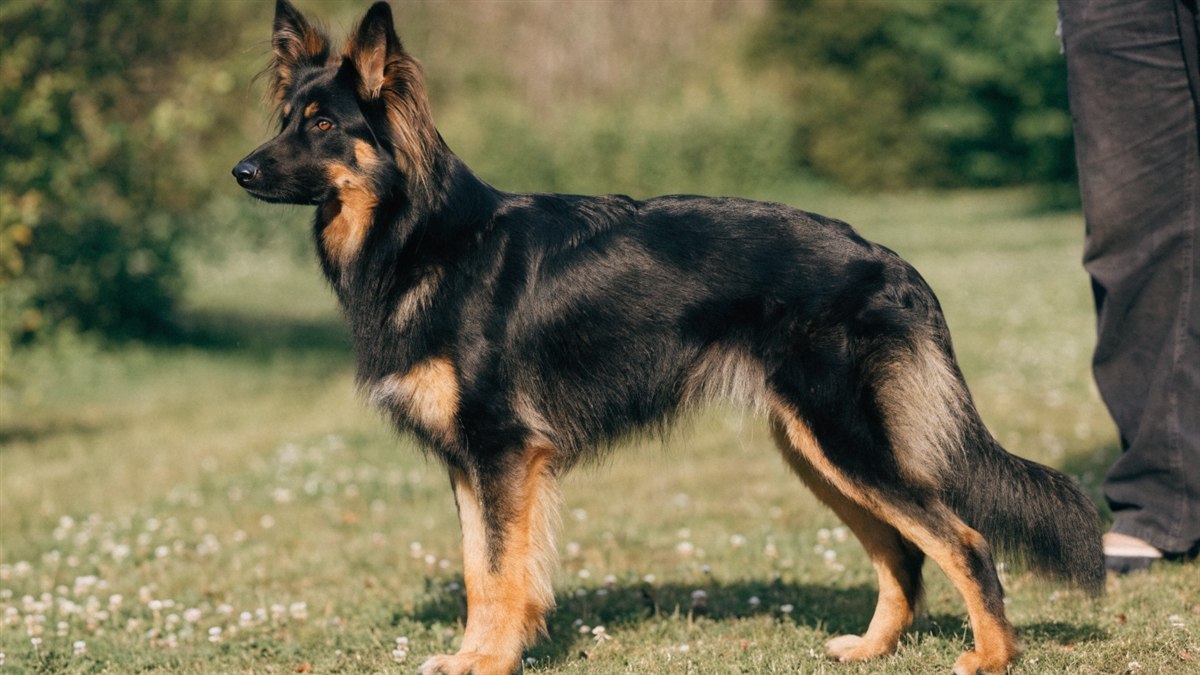
Quick answer
The Bohemian Shepherd is a medium-sized Czech sheepdog, 52 to 55 cm and 19 to 27 kg for a male, black and tan only, with a compulsory long double coat. The FCI recognises it on a provisional basis, not definitively, since 29 April 2019. Its Czech club records 10.4 percent hip dysplasia across 849 graded dogs. It is unavailable in India and no Indian price exists.
This guide is general information for Indian pet owners and is not a diagnosis. Consult a registered veterinarian who has examined your dog before acting on anything you read here, and treat any sudden collapse, laboured breathing or unresponsiveness in hot weather as an emergency requiring immediate veterinary care.
Bohemian Shepherd traits, rated for India
What the Bohemian Shepherd is, in the words of its own breed standard
The Bohemian Shepherd, Chodsky pes in Czech, is a medium-sized long-haired sheepdog from the Chodsko region of south-west Bohemia, standing 52 to 55 cm at the withers in males and 49 to 52 cm in females, and permitted in one colour only, black to gunmetal-black with vivid tan markings. The FCI classifies it in Group 1, Section 1 Sheepdogs, with a working trial.
Start with the numbers the standard actually prints, because almost every English page about this breed prints different ones. FCI-Standard N 364, published 20 February 2019, gives males 52 to 55 cm and 19 to 27 kg, females 49 to 52 cm and 17 to 24 kg. It disqualifies any male under 50 cm or over 57 cm and any female under 47 cm or over 54 cm.
Four sources, four different dogs
| Source | Male height | Weight range | Life expectancy |
|---|---|---|---|
| FCI Standard N 364 | 52 to 55 cm | 19 to 27 kg males, 17 to 24 kg females | Not stated |
| American Kennel Club | 20.5 to 21.7 in (52.1 to 55.1 cm) | 41 to 60 lb (18.6 to 27.2 kg) | 12 to 15 years |
| Wikipedia | 48 to 55 cm | 15 to 25 kg | 12 to 14 years |
| Dogbreedslist.info | 48 to 56 cm | 16 to 25 kg | 10 to 13 years |
| Dimensions.com | 48 to 56 cm | 16 to 27 kg | 9 to 14 years |
| GoofyTails, India | 52 to 57 cm | 19 to 27 kg | 12 to 15 years |
Two things fall out of that table. The AKC row is not independent data, it is the FCI standard converted into inches and pounds: 52 cm is 20.47 in, 55 cm is 21.65 in, 17 kg is 37.5 lb and 24 kg is 52.9 lb FCI-Standard N 364. And Wikipedia's 48 cm and 15 kg sit below the standard's own disqualification floor, so a dog matching Wikipedia's minimum would be disqualified from the ring under the standard Wikipedia links to. Google's Indian knowledge panel repeats Wikipedia's 48 to 56 cm and 16 to 25 kg rather than the standard.
GoofyTails prints males at 52 to 57 cm and females at 49 to 54 cm. The standard's ideal is 52 to 55 and 49 to 52, and its fault list allows a deviation of plus or minus 2 cm before the dog is penalised. Add 2 cm to each upper figure and you get exactly 57 and 54. A tolerance for a fault has been silently reprinted as the breed's normal size FCI-Standard N 364.
Coat, colour and the parts that make the breed
The coat is the breed. Guard hair runs 5 to 12 cm, glossy, straight or slightly wavy, over a well developed undercoat that is shorter and softer, and the standard calls the result weather-resistant. Only the face, the ear tips and the front of the limbs carry short smooth hair. The neck, back, backs of the thighs and hocks carry the longest coat, and the tail has long wavy fringes on the underside.
Colour has no options. Black to gunmetal-black with vivid tan markings is the only permitted coat colour, and any other colour is a disqualifying fault, as is complete absence of tan markings, markings in the wrong places, a short coat, or lack of undercoat. A white chest mark is tolerated up to 3 cm and faulted beyond that. If someone offers you a sable, grey or all-black Bohemian Shepherd, the standard says it is not one.
- Ears: short, erect, forward-facing, set high and close together, triangular with a broad base, and covered in long thick hair that forms brushes. Hanging or floppy ears are a disqualifying fault.
- Proportions: height at withers to body length is 10 to 11, so the dog is slightly longer than tall. Chest depth is half the height at withers, and the chest does not reach below the elbow.
- Tail: carried in a slight curve, reaching the hocks, thickly coated, and explicitly not to be docked.
- Teeth: a full set in a scissors bite. Absence of any tooth except PM1 and M3 is a disqualifying fault.
- Gait: the natural gait is a low trot, light, supple and far reaching.
Temperament in the standard is unusually specific for a working breed. It reads lively with fast but not impetuous reactions, docile, easily trained, attentive, modest, undemanding, tenacious, fearless, strong-nerved and exceptionally vigilant, with a superb sense of smell and no signs of nervousness. Aggressive or overly shy dogs are disqualified.
The Czech parent club adds one framing the standard does not. In the FCI's own judging presentation the breed is described as a medium-sized sheepdog that is lower than most sheepdog breeds, and the club states plainly that the aim of the reconstruction was to recreate a small sheepdog, which is the point a judge is expected to hold in mind. Read alongside the German Shepherd standard, that is the whole difference in one line.
FCI recognition, precisely: provisional, not definitive, since 29 April 2019
The Bohemian Shepherd is recognised by the FCI on a provisional basis only. Its nomenclature entry prints the breed status as 'Recognized on a provisional basis', gives the date of acceptance on a provisional basis as 29 April 2019, and the date of publication of the official valid standard as 20 February 2019. It has never been recognised definitively.
That distinction is not administrative trivia, and it is the single fact every ranking page gets loose. The FCI's own provisional list states the consequence in one sentence: breeds recognised on a provisional basis 'are not eligible for the CACIB until they are recognised on a definitive basis', though they are eligible for FCI titles at the World Dog Show and the Section Shows, and their pedigrees must carry the FCI logo.
Read the real list, not the one that looks like it
This site checks the FCI's provisional list at the URL that actually serves it, /nomenclature/provisoire.aspx, because a plausible-looking alternative path on the same domain returns a complete and entirely unrelated breed page at HTTP 200. Read on 23 August 2026, the genuine list carried 20 breeds, the highest standard number being 378 for the Macedonian Shepherd Dog Karaman. The row reads 'CHODSKY PES (364) (BOHEMIAN SHEPHERD DOG)', date of provisional recognition 29 April 2019, date in force 20 February 2019.
Three FCI documents were opened and the breed name printed inside each one was checked before any figure was taken: the provisional list, which names CHODSKY PES (364) in its table; the nomenclature entry, whose page heading reads CHODSKY PES (364); and standard 364, whose first page reads 'FCI-Standard N 364 (Bohemian Shepherd Dog)' with origin Czech Republic Federation Cynologique Internationale FCI-Standard N 364.
The seven-year approval, dated
| Date | What happened |
|---|---|
| 1948 | A group of Czech cynologists drafted a proposal to have the Chodsky pes recognised by the FCI. It failed on disagreements about the basic breed characteristics |
| 2012 | The Klub pratel chodskeho psa submitted the official application to the FCI |
| 2018 | The club sent its complete studbook database to Gregoire Leroy of the FCI scientific commission for genetic analysis |
| 13 April 2019 | The breed was presented to the FCI standards and scientific commissions, the last step of the process |
| 20 February 2019 | Date of publication of the official valid standard, and the date the recognition took effect Federation Cynologique Internationale |
| 29 April 2019 | The FCI Presidium, meeting in China, approved the breed provisionally for ten years Federation Cynologique Internationale |
| 7 May 2019 | Date on the English text of standard 364 |
| April 2019 | The AKC accepted the breed into its Foundation Stock Service, which is a recording service and not AKC recognition |
Two details in that table repay attention. The FCI's own entry gives an in-force date of 20 February 2019 that precedes the acceptance date of 29 April 2019 by ten weeks, so the standard was published before the Presidium voted. And the club chair records the provisional grant as running for ten years, which places the review around 2029. The FCI list itself does not print an expiry, so treat 2029 as the club's account rather than an FCI-published deadline.
What is national, and what is international
Nationally the breed is fully administered. The Ceskomoravska kynologicka unie, the Czech kennel club, lists Chodsky pes with FCI number 364 in Group I, assigns it to studbook office II, and names the Klub pratel chodskeho psa as the member club that manages it. The club itself was founded in November 1991 and had almost 700 members when its chair wrote in 2019 Jana Kudrnacova, chair of the Klub pratel….
So the honest one-line answer is that the Bohemian Shepherd is a nationally established Czech breed with a full studbook, an FCI standard number and provisional international status, and it is not yet a definitively recognised FCI breed. The breed it is most often mistaken for, the German Shepherd, has held definitive FCI recognition under standard 166 for decades, and its standard was last revised in 2010. That gap of status, not any difference in quality, is what a buyer outside the Czech Republic runs into first.
The revival: every living Bohemian Shepherd descends from three dogs found in 1984
The modern Bohemian Shepherd was reconstructed from three dogs of unknown origin, a bitch called Bessy and two dogs called Dixi and Blesk, after a 1984 appeal in the Czech cynological press. The first litter was born on 20 October 1985 and the club studbook records it as one litter of six puppies. By 2025 the same studbook recorded 94 litters and 441 puppies in a single year.
Separate three kinds of claim before reading anything about this breed's history, because they are usually run together.
- What the breed standard says. FCI-Standard 364 cites Jindrich Simon Baar writing about Chodsky dogs in 1923 to 1924, J.A. Gabriel describing the Chods as 'Dog-heads' in 1864, and Alois Jirasek's novel illustrated by Mikolas Als.
- What the Czech club says. The Klub pratel chodskeho psa publishes a breed history and its chair published a detailed portrait in 2019, and the two disagree with each other in three places Jana Kudrnacova, chair of the Klub pratel….
- What is simply repeated. English pages assert a continuous medieval lineage. The standard itself refuses to.
FCI-Standard 364 sets out the Chodsko literary record and then says: 'One cannot of course claim that the above documents state facts of the origin of the present-day Chodsky Dog. It is simply a historical support for the existence of a well-established type of sheepdog with origin in the Czech territory';. Any page telling you this is an unbroken breed from the thirteenth century is saying something the breed's own standard declines to say.
What the 1984 appeal actually found
Vilem Kurz sent Jan Findejs photographs of breeds he thought could be regenerated, and Findejs chose the Chodsko sheepdog. In 1984 pictures ran in the cynological press with an appeal to owners of surviving dogs of the type. Two owners came forward, both from the Prostejov area in Moravia. There was no response at all from the Sumava region, which is the breed's own homeland. The reconstruction therefore began roughly 300 km from Chodsko.
Breeding started on three individuals of unknown origin, Bessy, Dixi and Blesk, chosen because their type and temperament matched the picture the founders had assembled from period drawings and written material Klub pratel chodskeho psa.
The first six years, checked against the register
The club chair states that 90 puppies from 16 litters were raised up to 1990. That figure was tested here against the club's own year-by-year studbook counts, read separately for each year on 23 August 2026, and it verifies exactly.
| Year | Litters | Puppies |
|---|---|---|
| 1985 | 1 | 6 |
| 1986 | 1 | 6 |
| 1987 | 2 | 11 |
| 1988 | 2 | 15 |
| 1989 | 3 | 13 |
| 1990 | 7 | 39 |
| Total to 1990 | 16 | 90 |
| 1991 | 11 | 74 |
| 1992 | 11 | 66 |
Sixteen litters and ninety puppies. The chair's figure and the register agree to the animal Klub pratel chodskeho psa. The club's history page makes a second claim that does not close as cleanly: it says 35 litters were raised from 1987 to 1992, where the register gives 2 plus 2 plus 3 plus 7 plus 11 plus 11, which is 36 Klub pratel chodskeho psa. One litter out of thirty-six is a rounding-grade discrepancy, not a problem, but it is worth knowing which of the two numbers came from the database.
Three points where the club contradicts itself
| Point | Club history page | Club chair, 2019 |
|---|---|---|
| Breeder of the first litter | Ladislav Hykl, kennel 'na Barance'; | Leopold Hykel of Prostejov, kennel 'na Barance'; |
| Dogs added later to widen the blood | Two bitches, Dina and Brita, and three dogs, Brix, Alex and Harry | Two dogs, Brix and Alex, and three bitches, Dina, Betty and Teri |
| When the effort began | Findejs took the first steps after Kurz wrote to him, with the press appeal in 1984 | Owners were traced between 1982 and 1984 |
Both documents are the parent club's. Neither is careless work, and the disagreement is the ordinary fate of an oral history written down twice. What matters for a buyer is the shape both agree on: a founding base of three dogs, five more added within about five years, and a studbook closed to dogs of unknown origin by a breeders' collegium decision in 2000.
From six puppies to four hundred and forty-one
| Year | Litters | Puppies registered |
|---|---|---|
| 1985 | 1 | 6 |
| 1995 | 29 | 172 |
| 2005 | 34 | 169 |
| 2015 | 76 | 375 |
| 2025 | 94 | 441 |
| 2026, to 23 August | 46 | 242 |
That is 441 puppies in 2025 against 6 in 1985, a multiple of 73.5. Growth was not steady: the register shows 172 puppies in 1995 and 169 in 2005, so the breed spent a decade flat before more than doubling between 2005 and 2015. The club chair reported more than 7,300 dogs bred in total by 2019 and placed the breed inside the top ten Czech breeds by puppies registered with the national studbook. Outside the Czech Republic the numbers collapse: Wikipedia records roughly 100 Bohemian Shepherds in the whole of North America as of 2023.
Bohemian Shepherd against German Shepherd, clause by clause from both standards
The two standards do not overlap at all on male size. A male German Shepherd's minimum height of 60 cm is 5 cm above the height at which a male Bohemian Shepherd is disqualified, and the German Shepherd's minimum weight of 30 kg is 3 kg above the Bohemian Shepherd's maximum of 27 kg FCI-Standard N 364. A dog that is a correct German Shepherd cannot be a correct Bohemian Shepherd, and the reverse holds too.
This is the comparison Indian buyers actually search for, and until now it has existed as a YouTube video and one self-contradicting paragraph. The paragraph is worth quoting because it ranks first in India for the breed's price query: dogbreedslist.info calls the Chodsky pes 'possibly also one of the predecessors to the German Shepherd', then closes the same paragraph with 'Therefore, there is no proof that they are related to German Shepherds';. Both sentences are in one block of text.
Wikipedia takes the opposite line, stating there is no evidence the two are related, and cites the Czech club's history page for it. That page was read for this guide and it does not mention the German Shepherd anywhere. So the claim may well be true, but the citation offered for it does not support it.
The way out is to stop arguing about ancestry and compare the two published standards line by line. Both are FCI Group 1 Section 1 sheepdogs with a working trial, so they are judged in the same section by the same kind of judge FCI-Standard N 166.
| Clause | Bohemian Shepherd (364) | German Shepherd (166) |
|---|---|---|
| Height, males | 52 to 55 cm. Disqualified below 50 or above 57 | 60 to 65 cm. Disqualified over or under by more than 1 cm |
| Height, females | 49 to 52 cm. Disqualified below 47 or above 54 | 55 to 60 cm |
| Weight, males | 19 to 27 kg | 30 to 40 kg |
| Weight, females | 17 to 24 kg | 22 to 32 kg |
| Body proportion | Height to length 10 to 11 | Trunk length exceeds height by about 10 to 17 percent |
| Chest depth | Half the height at the withers, and not below the elbow | About 45 to 48 percent of the height at the withers |
| Ears | Short, erect, set high and close together, triangular, and covered in long thick hair forming brushes | Medium size, erect, carried upright and aligned, pointed, auricle facing forward |
| Coat | One coat only. Guard hair 5 to 12 cm over a well developed undercoat. Shorthaired or lack of undercoat is a disqualifying fault | Two accepted varieties, double coat and long double coat, both with undercoat |
| Colour | Black to gunmetal-black with vivid tan markings. Any other colour is disqualifying | Black with reddish-brown, brown or yellow to light grey markings; single-coloured black; grey with darker shading; black saddle and mask. White is not allowed |
| Skin | Taut and close-fitting all over, dark pigmentation | Loosely fitting, but without forming folds |
| Tail | Reaches the hocks, carried in a slight curve, not to be docked | At least to the hock but not beyond the middle of the hind pastern. Operative corrections forbidden |
| Croup | Begins at the same height as the back and slopes slightly, with no transition | Long and slightly sloping, about 23 degrees to the horizontal |
| Stifle angle | 120 degrees | About 120 degrees |
| Shoulder to upper arm | Around 90 degrees | Ideally 90 degrees, generally up to 110 |
| Missing teeth | Absence of any tooth except PM1 and M3 is disqualifying | Disqualified for lacking one PM3 and another tooth, one canine, one PM4, one M1 or M2, or three teeth in total |
| Origin and standard date | Czech Republic, standard published 20 February 2019 | Germany, standard published 11 August 2010, methodical breeding from 1899 |
Ear coat: the Bohemian Shepherd's standard requires the earlobes to be covered in long thick hair forming brushes at the root and along the edges, and calls the ear the feature that determines true breed type. The German Shepherd's standard requires short hair on the inside of the ears FCI-Standard N 166. Colour: one pattern versus five or more. Skin: taut and close-fitting versus loosely fitting.
Proportionally, the smaller dog is the deeper one
Read the chest rows together. The Bohemian Shepherd's chest is half its height at the withers, while the German Shepherd's is 45 to 48 percent FCI-Standard N 166. In absolute terms a 62 cm German Shepherd has much the deeper chest, but as a fraction of the dog, the Czech breed is built deeper. Its shoulder angle is also tighter, around 90 degrees against the German Shepherd's 90 to 110, which is part of why the standard describes the natural gait as a low trot rather than the long ground-covering trot the German standard builds toward.
The Czech club puts the point in one sentence in the FCI's own presentation for judges: the Bohemian Shepherd is a medium-sized sheepdog that is lower than most sheepdog breeds, and the presentation prints a comparative diagram of head modelling against the Deutscher Schaferhund, the Malinois, the Tervueren and the Hollandse Herdershond so that judges stop reading it as a small German Shepherd. Compare it also against the four-variety Belgian Shepherd, which solves the same coat problem a different way.
Where the health data diverges hardest
The German Shepherd carries 146,658 hip evaluations in the OFA register, of which 20.4 percent are dysplastic, and 68,130 elbow evaluations, of which 18.7 percent are abnormal Orthopedic Foundation for Animals. The Bohemian Shepherd does not appear in either table. The Czech club's own figures, set out later on this page, are far lower on both joints, and the reasons for that gap, including a hard breeding ceiling that the German Shepherd's parent body has never imposed, matter more to an Indian buyer than any question about ancestry.
Bohemian Shepherd price in India: there isn't one, and here is the proof
No Indian price exists for the Bohemian Shepherd. A search for the breed's price restricted to India on 23 August 2026 returned ten results, and not one was an Indian listing, an Indian breeder or an Indian rupee figure for this breed. Google itself reports only about 180 results for 'bohemian shepherd' in India.
That is a strong claim, so it was earned with a control run in the same tool in the same session. The query 'labrador retriever price in india' returned ten results carrying real Indian numbers, including Rs 30,000 to Rs 1,20,000 broken down by quality tier and by eight cities. The search works. The query for this breed simply has nothing Indian to return.
What you are actually offered instead
| Result | What it actually offers |
|---|---|
| dogbreedslist.info, position 1 | A US dollar estimate and an admission that no puppies were found for sale |
| supertails.com, position 2 | German Shepherd price in India, a different breed |
| mrnmrspet.com, position 3 | Belgian Shepherd puppies for sale in India, a different breed |
| YouTube, position 4 | Belgian Shepherd puppies for sale in India, a different breed |
| quora.com, position 5 | German Shepherd puppy price, a different breed |
| supertails.com, position 6 | A 40-breed Indian price list that does not include this breed |
| tradeindia.com, position 7 | German Shepherd and Doberman listings, different breeds |
| etsy.com, position 8 | Digital downloads and clip art, priced in rupees |
| amazon.in, position 9 | A book about the breed |
| mrnmrspet.com, position 10 | German Shepherd puppies for sale in India, a different breed |
Eight of the ten results are a different breed, a picture file or a book. This is the classic substitution pattern for a breed with no Indian supply, and the substitution is almost always toward the German Shepherd or the Belgian Shepherd, which are the two breeds an Indian seller can actually source.
The only published price, and what it is worth
One figure exists anywhere in English. Dogbreedslist.info gives 'Average $2000 - $2500 USD' and then undercuts it in the next sentence: 'we weren't able to find any puppies for sale at this time. An estimate could run you probably over $2,000 USD';. That is an estimate of an import cost, published by a site that could not find a puppy, and it is not an Indian price by any reading.
Indian pages routinely publish a 'price' that is a US dollar figure run through one exchange rate, and this site has caught it at exactly 84.38 three times. There is nothing to test here, because no Indian rupee price for this breed was found at all. So run the test forwards instead. USD 2,000 at 84.38 is Rs 1,68,760 and USD 2,500 is Rs 2,10,950. If you meet a listing near either number, divide by 84.38 in a calculator. A round dollar figure coming back means you are looking at the American estimate in Indian clothes, not an Indian market price.
Why no supply chain can form
Two independent rules close the loop, one at each end of the journey.
- India restricts the import. DGFT Trade Notice 22/2022-23 places dogs under ITC(HS) 01061900 as Restricted, and Policy Condition (7) allows import only as a pet dog with a valid pet book in the importer's own name, by an R&D organisation with CPCSEA recommendation, or by the Defence and Police for internal security. Policy Condition (8) bars commercial import for breeding, and paragraph 6 states that applications for trading or breeding purposes 'shall be duly rejected'.
- The Czech club restricts the export. Its registration rules state that purchase, sale or export of dogs through commercial organisations is inadmissible, an export pedigree can only be issued to a natural person, and an owner who is not the dog's breeder may export only one dog per calendar year.
Put those together and there is no lawful route by which a trader could bring Bohemian Shepherds into India to sell. The only legal path is a person moving to India with their own dog, and even that runs through import authorisation, one of seven permitted ports and an advance quarantine NOC Department of Animal Husbandry…. The full route is set out in how to import a dog to India.
Supply is thin even where the breed is popular. The Texas kennel that ranks tenth for the breed in India is hoping for a litter in early 2027, keeps no formal waitlist, and gives preference to homes active in search and rescue or AKC performance sports. Roughly 100 Bohemian Shepherds are thought to exist in all of North America. A breed that is unavailable to an American buyer with a US address is not quietly available in Pune.
The practical answer, then. If you want this breed in India, the honest options are to relocate with one you already own, or to choose a breed that is genuinely here. If someone quotes you a price in rupees for a Bohemian Shepherd puppy in an Indian city today, ask to see the export pedigree, the DGFT import authorisation and the pet book in the importer's name before any money moves.
Importing one, and what provisional FCI status does to a KCI pedigree
A Bohemian Shepherd can only enter India as a person's own pet, never as stock. DGFT Trade Notice 22/2022-23 makes dogs a Restricted import and permits entry only for a pet dog with a valid pet book in the importer's name, for R&D with a CPCSEA recommendation, or for Defence and Police internal security. Provisional FCI recognition then decides what the dog's paperwork is worth once it arrives.
Work the paperwork question through properly, because the honest answer is not the one most readers expect.
The pedigree does travel
The Kennel Club of India is India's national canine organisation within the FCI, and the FCI publishes its statistics: 32,219 puppies and 7,412 litters registered in 2025, 1,425,001 pure-bred dogs in the studbook since its creation, 80 member clubs, 28 FCI judges and two CACIB all-breed shows in the year. Because the KCI sits inside the FCI system, an FCI export pedigree from the Czech studbook is the right kind of document to present.
The FCI's provisional list settles the rest in two clauses. Pedigrees issued to dogs of provisionally recognised breeds 'have to carry the FCI logo', and such breeds 'are not eligible for the CACIB until they are recognised on a definitive basis', while remaining eligible for FCI titles at the World Dog Show and the Section Shows.
India ran two CACIB all-breed shows in 2025. Those are precisely the shows at which a Bohemian Shepherd could not compete for the CACIB, because the FCI bars provisionally recognised breeds from that certificate. The dog can be entered and judged, and it can hold Czech and other national titles, but the international beauty champion route through India's two CACIB shows is closed while the breed stays provisional. This is a reading of the FCI's published rule applied to India's published show count, not a KCI statement.
Whether the KCI registers the breed at all
No KCI publication naming the Chodsky pes or the Bohemian Shepherd was found in this research. That absence is reported weakly and deliberately: repeated searches surfaced no KCI breed-list page for any breed, so the search cannot distinguish between the KCI not listing this breed and the KCI's breed list simply not being indexed. Treat it as a question to put to the KCI in writing before importing, not as a finding.
What can be said with confidence is that the breed has no Indian constituency. The KCI recognises 80 member clubs, and the Czech parent club, which coordinates the breed worldwide and had close to 700 members in 2019, is not among them.
The import route, step by step
- Confirm eligibility. Up to two pets enter as passenger baggage without DGFT authorisation only for a person transferring residence to India after two years of continuous stay abroad. Anything else needs an import authorisation from DGFT.
- Apply early. The trade notice advises pet owners to begin the import authorisation process at least two months before travel, using form ANF-2M against their own IEC or the permanent IEC IIHIE0153E for personal-use imports.
- Carry the documents. Vaccination book or pet passport or pet book, a certificate for emotional support, and the pet's passport are the listed mandatory documents for a permanent import.
- Enter through a permitted port. Import is allowed only through the airports and seaports of Delhi, Mumbai, Chennai, Hyderabad, Bengaluru and Kolkata and, since October 2024, Kochi airport, with quarantine at the government station where required Department of Animal Husbandry….
- Get the advance NOC. An advance No Objection Certificate from the Regional or Quarantine Officer of that port is required, obtained seven days before travel and relaxable to three, on the strength of the DGFT licence and a veterinary health certificate from the exporting country.
One clash between the Czech club's rules and Indian law
Puppy age is the first place the two rulebooks disagree. The Czech club sets the minimum age for a puppy to leave its dam at 50 days. Indian law is stricter: Rule 8(1)(a) of the Prevention of Cruelty to Animals (Dog Breeding and Marketing) Rules, 2017 requires that 'pups less than eight weeks in age are not sold', and eight weeks is 56 days. A puppy collected at the Czech minimum is six days younger than an Indian breeder could lawfully sell.
Inbreeding is the second. The Czech club permits matings up to 6.25 percent on Wright's coefficient, reduced from 12.5 percent at its 2015 general meeting Jana Kudrnacova, chair of the Klub pratel…. A first-cousin mating produces a coefficient of exactly 6.25 percent, and the Indian Rules name 'cousin to cousin' among the relationships prohibited under in breeding. So the club's ceiling is set at the exact value Indian law forbids at the limit. Anyone breeding this dog in India could not use the club's full allowance, and would in any case need registration with a State Animal Welfare Board first.
Both rulebooks agree on the tail. The FCI standard says the tail is 'not to be docked', and Second Schedule Part II paragraph 6(8) of the 2017 Rules forbids tail docking and ear cropping outright. A docked or cropped Bohemian Shepherd would be both a disqualified show dog and evidence of an offence.
Heat tolerance: the coat evolved where the hottest month averages 18.6 C
The Bohemian Shepherd rates 2 out of 5 for heat tolerance in India. Its home region has no month averaging above 20 C, while Chennai has no month averaging below 24 C, and the standard makes the long double coat compulsory by disqualifying any dog that is shorthaired or lacks an undercoat FCI-Standard N 364.
Build the argument from the coat outward, because the coat is the whole of it. FCI-Standard 364 specifies guard hair 5 to 12 cm long over a well developed undercoat that is shorter and softer, and calls the result weather-resistant. Short hair appears only on the face, the ear tips and the front of the limbs. Shorthaired coats and absence of undercoat are both disqualifying faults, which means the insulation is not an option the breeding can remove.
The origin climate, queried by coordinates
Chodsko sits in the Bohemian Forest foothills around Domazlice. NASA POWER's 20-year MERRA-2 climatology, queried at latitude 49.4406 and longitude 12.9294 so that no place name could be substituted, returns the grid cell at 12.929 east and 49.441 north at 548 m elevation.
| Place | Coolest month, mean | Warmest month, mean | Annual mean | Gap to Chodsko's annual mean |
|---|---|---|---|---|
| Chodsko, Czech Republic | -2.83 C (January) | 18.61 C (July) | 7.87 C | 0 |
| Chennai | 24.09 C (January) | 31.51 C (May) | 27.95 C | +20.08 C |
| Mumbai | 23.19 C (January) | 31.19 C (May) | 26.77 C | +18.90 C |
| Delhi | 13.61 C (January) | 35.88 C (June) | 25.60 C | +17.73 C |
| Pune, 636 m | 19.62 C (December) | 28.93 C (April) | 23.86 C | +15.99 C |
| Bengaluru, 842 m | 20.22 C (December) | 28.37 C (April) | 23.74 C | +15.87 C |
Read the two middle columns against each other and the problem is finished in one line. Chennai's coolest month, January at 24.09 C, is 5.48 C warmer than the hottest month the breed's coat was ever selected under. Even Pune in December, at 19.62 C, is 1.01 C above Chodsko's July. There is no month anywhere in these five Indian cities that is as cool as a Bohemian summer NASA POWER Climatology API v2.9.7 NASA POWER Climatology API v2.9.7.
Chodsko's July relative humidity is 68.08 percent. Chennai's July relative humidity is 67.47 percent. The two are 0.61 percentage points apart. Over the same month, mean temperature runs 18.61 C in Chodsko and 29.70 C in Chennai, a difference of 11.09 C NASA POWER Climatology API v2.9.7. This coat already handles Chennai's humidity. What it has never met is that humidity at eleven degrees hotter.
Where humidity does bite: the west-coast monsoon
Mumbai and Pune invert the picture in July and August. Mumbai in August averages 26.05 C at 90.36 percent relative humidity, and Pune 23.30 C at 90.8 percent, against Chodsko's August of 18.23 C at 68.46 percent NASA POWER Climatology API v2.9.7 NASA POWER Climatology API v2.9.7. A dog sheds heat mainly by evaporating water from its respiratory tract, and evaporation depends on the vapour-pressure gradient between the airway and the air. At 90 percent humidity that gradient is small, so panting returns much less cooling per breath than the same effort would in Delhi's June, where humidity sits at 36 percent. Pune's monsoon is only 5 C hotter than a Czech August, and it is still the harder month for this coat.
What the published risk factors do and do not say
The largest primary-care study of canine heat-related illness examined 905,543 UK dogs and found 395 confirmed events, an incidence of 0.04 percent and an event fatality rate of 14.18 percent. Its identified risk factors were breed, bodyweight above the breed and sex mean, age over two years, a brachycephalic skull and bodyweight over 50 kg. Coat length was not among them.
That cuts both ways, and this page reports it as it stands. Two of the strongest published risk factors do not apply to the Bohemian Shepherd at all: it is mesocephalic with a long muzzle and a full evaporative surface, and at 19 to 27 kg for a male it is nowhere near the 50 kg threshold Hall EJ, Carter AJ, O'Neill DG. Against a Saint Bernard or a Chow Chow this is a much safer dog in Indian heat. The rating of 2 rests on the coat and the climate gap, not on borrowed brachycephalic risk.
NASA POWER's MERRA-2 grid is coarse, and a hill-station query proves it. Asked for Shimla at 31.1048 north and 77.1734 east, the service returned a cell at 897.65 m elevation, against the town's real altitude of roughly 2,200 m. That cell is not Shimla, so no hill-station temperature appears on this page. The five city rows above were kept because each returned an elevation consistent with the city: 49 m for Chennai, 97 m for Mumbai, 206 m for Delhi, 636 m for Pune and 842 m for Bengaluru.
City by city, that gives a short verdict. Bengaluru and Pune are the two cities where this breed is genuinely workable, because both sit above 600 m and hold their annual mean under 24 C NASA POWER Climatology API v2.9.7. Delhi is a seasonal problem rather than a constant one: its January mean of 13.61 C is the only Indian figure in the table a Czech dog would find familiar, but its June mean of 35.88 C is 17.27 C above Chodsko's July. Chennai and Mumbai are hard all year, because neither has a recovery season at all.
Managing the coat in Indian heat, and why you must not shave it
Cool the room, never the dog's coat. The Czech club's own guidance is that the Bohemian Shepherd needs no clipping at all, and the FCI standard makes a shorthaired coat or absent undercoat a disqualifying fault, so shaving removes the dog's own insulation and its breed type at once FCI-Standard N 364.
The club's chair writes that the coat's structure makes the dog resistant to bad weather, cold and rain, and adds four Czech words about heat, 'V horku dobre izoluje', meaning that in heat it insulates well. That is sound advice where the hottest month averages 18.61 C, and it is the classic example of breed-club care guidance written for another climate.
The mechanism the club describes is real. A standing double coat traps still air and reflects radiant sun, which is why a shaved double-coated dog can suffer worse in direct sunlight and can regrow a patchy coat. What does not transfer is the conclusion that the coat therefore solves heat. Insulation works in both directions, and in a Chennai May at 31.51 C the ambient air is already above the dog's comfortable skin temperature for much of the day, so the layer that kept heat out in July in Bohemia is also keeping metabolic heat in Jana Kudrnacova, chair of the Klub pratel….
The room, not the clippers
Indian law frames this correctly, and unusually for a general regulation it makes the answer breed-specific. Second Schedule Part I paragraph 15 of the Prevention of Cruelty to Animals (Dog Breeding and Marketing) Rules, 2017 requires indoor housing temperature to be 'ambient and comfortable, depending on the breeds of dogs that are housed insides', with a second sub-rule that the temperature 'shall be such as provides for their health and well-being'. Paragraph 16 expressly permits air conditioning as a means of ventilation, and paragraph 2 requires protection from the extremes of weather. Those clauses bind registered breeders rather than pet owners, but they set the standard of care a court would recognise.
- Move exercise to the ends of the day. Walk before sunrise and after dark, and treat the middle of the day as indoor time from March to October in every city in the table above.
- Cool the floor, not the fur. A tiled or stone floor, a raised mesh bed with airflow underneath and a fan at floor height do more than any grooming decision.
- Wet the underside, not the topcoat. Water sitting in a dense undercoat holds heat and macerates skin. Wet the belly, the groin, the armpits and the paws, where the coat is thin and the blood is close.
- Watch the second walk of the day. Heat-related illness is an exertion problem before it is a weather problem, and bodyweight above the breed mean was an identified risk factor in the largest primary-care study of it.
- Keep the dog lean. A Bohemian Shepherd male should sit inside 19 to 27 kg by its own standard, and every kilogram over that is added insulation and added metabolic heat Hall EJ, Carter AJ, O'Neill DG.
Recognising trouble early
Heat-related illness in dogs is not rare in absolute terms and it kills. In a UK primary-care population of 905,543 dogs, 395 confirmed events were recorded in one year, and 14.18 percent of those events ended in death. The UK incidence figure of 0.04 percent should not be carried across to India, because the exposure is not comparable: the study's own authors note that the low fatality rate they found may reflect the temperate UK climate. Treat sudden collapse, laboured breathing or a dog that stops responding on a walk as an emergency and go to a vet.
The monsoon coat problem
The wet season is a skin problem before it is a heat problem. A coat 5 to 12 cm deep with a dense undercoat holds water against the skin for hours, and Mumbai and Pune both sit above 90 percent relative humidity through August, so a wet dog does not dry NASA POWER Climatology API v2.9.7 NASA POWER Climatology API v2.9.7. Towel the dog to the skin rather than to the surface, work a slicker brush through the undercoat while it is damp, and dry the ear canals and the armpits deliberately. The club's routine of occasional combing behind the ears, on the leg feathering and on the tail is written for a climate where a dog dries on its own.
One further reason to keep the coat dry in India is that the same wet undercoat is where ticks sit unnoticed. In a Chennai study of 230 dogs, 229 carried ticks at a mean intensity of 5.6 per dog, and 67.8 percent were positive for at least one tick-borne pathogen. That is covered in full in the health section, but it belongs here too, because coat management is tick management on a long-haired breed.
Health, with denominators: what the Czech club's own register actually shows
The Bohemian Shepherd has no OFA entry and no PubMed literature, but its Czech parent club publishes seven screening tables with real sample sizes, from 4 dogs to 1,258. Across five full years of hip scoring, 2021 to 2025, 849 dogs carried an FCI grade and 88 of them, 10.4 percent, scored C or worse.
Most breed pages say this dog is healthy and stop. The claim is probably true, and it is checkable, because the Klub pratel chodskeho psa publishes its screening results per disease with the counts attached. Every figure below was read from those tables on 23 August 2026 and its arithmetic divided out.
Hips, five years, dog by dog
| Year | A | B | C | D | E | Total entries |
|---|---|---|---|---|---|---|
| 2021 | 123 | 54 | 13 | 6 | 8 | 205 |
| 2022 | 128 | 57 | 13 | 5 | 1 | 205 |
| 2023 | 81 | 79 | 13 | 6 | 1 | 180 |
| 2024 | 66 | 63 | 6 | 5 | 0 | 140 |
| 2025 | 55 | 55 | 7 | 4 | 0 | 121 |
| Five-year total | 453 | 308 | 52 | 26 | 10 | 851 |
Two of the 851 entries carry no grade, so the graded denominator is 849. That gives A 53.4 percent, B 36.3 percent, C 6.1 percent, D 3.1 percent and E 1.2 percent. Grade C or worse is 88 of 849, which is 10.4 percent, and moderate or severe dysplasia, grades D and E together, is 36 of 849, or 4.2 percent.
Grade A drops from 60.3 percent of graded dogs in 2021 to 45.5 percent in 2025, which looks alarming until you add B back in. A and B combined run 86.8, 90.7, 88.9, 92.1 and 90.9 percent across the five years, a flat line. What moved was the boundary between A and B, not the rate of dysplasia. The 2026 figures to 23 August, 80 dogs with 10 at C or worse, sit in the same range.
Context matters more than the bare percentage. Hip radiography has been compulsory for breeding in this club since 1997, the ceiling is grade C, and a grade C dog may only be mated to a grade A or B dog Klub pratel chodskeho psa. So this population has been under selection for nearly thirty years, and the 10.4 percent figure is what remains after it.
Against the breed it is confused with
| Measure | Bohemian Shepherd (KPCHP) | German Shepherd (OFA) |
|---|---|---|
| Hips, sample | 849 graded dogs, 2021 to 2025 | 146,658 evaluations, all years |
| Hips, affected | 10.4 percent at FCI grade C or worse | 20.4 percent dysplastic (11.9 mild, 6.9 moderate, 1.6 severe) |
| Elbows, sample | 1,130 dogs | 68,130 evaluations |
| Elbows, affected | 1.5 percent at grade 1 or worse (1,111 at 0/0, 98.32 percent) | 18.7 percent abnormal (14.2 grade 1, 3.7 grade 2, 0.8 grade 3) |
The elbow gap is the striking one. Against the German Shepherd's 18.7 percent, the Bohemian Shepherd club records 17 affected elbows in total, and even the worst grade, 2/2, appears once Orthopedic Foundation for Animals. One honesty note on that table: the club's grade rows sum to 1,128 while its stated total is 1,130, and the club calculates its percentages against 1,130. The two-dog gap does not move the conclusion, but it is there.
Two structural reasons sit behind the difference, and neither is about which dog is nobler. This is a 19 to 27 kg dog rather than a 30 to 40 kg one, and lower mass on the same joint architecture is protective. And the Czech club's grade ceiling is a hard breeding rule enforced through compulsory bonitation, which the German Shepherd's parent body has never imposed as a condition of registration.
Degenerative myelopathy, the rest of the screening, and the missing lifespan study
One Bohemian Shepherd in three carries a copy of the degenerative myelopathy mutation. Of 1,258 dogs tested for the SOD1 variant, 806 were clear at G/G (64.07 percent), 417 were carriers at G/A (33.15 percent) and 35 were homozygous A/A (2.78 percent). That is the largest dataset the club holds and the only screening figure on this page that is not reassuring.
The club acted on it. Testing for degenerative myelopathy became compulsory for breeding from 1 January 2024, and a carrier, an affected genotype or an untested dog may now be used only in a mating with a clear dog. The health programme's list of subsidised voluntary tests was amended on the same date to remove the DM subsidy, because the test had stopped being voluntary. Ask any breeder for the DM certificates of both parents, not the puppy's alone, since two clear parents cannot produce an affected dog.
The club's own explanatory text is careful. G/G means the dog does not carry the mutated allele. G/A means one copy and a weak predisposition that can pass to the next generation. A/A means two copies, a strong predisposition and certain transmission. A/A is a genotype, not a diagnosis, and the club describes it as predisposition rather than disease. At 35 dogs out of 1,258 it is uncommon, but at 417 carriers it is very much still in the population.
Every other screen, with its denominator shown
| Screen | Dogs tested | Result |
|---|---|---|
| Spinal spondylosis | 513 | 508 negative, 99.03 percent. 3 mild, 1 moderate, 1 severe |
| Shoulder osteochondrosis | 460 | 459 negative, 99.78 percent. 1 positive |
| MDR1 drug sensitivity | 16 | All 16 N/N. Denominator far too small to state a prevalence |
| Pituitary dwarfism, LHX3 | 4 | All 4 N/N. The panel is effectively empty |
Read the bottom two rows as absences rather than clean bills of health. Sixteen dogs cannot establish an MDR1 frequency, and four cannot establish anything at all Klub pratel chodskeho psa. The dwarfism entry is worth watching rather than dismissing, because the LHX3 mutation the club tests for is the German Shepherd Dog mutation, shared with the Saarloos and Czechoslovakian wolfdogs, all drawn from the same central European shepherd pool.
The club's voluntary programme, Smernice KPCHP 1/2015, in force since 31 January 2015, subsidises nine screens at 200 Czech crowns each: elbows, spondylarthrosis, shoulder osteochondrosis, hereditary eye disease, BAER hearing, thyroid function, echocardiography, lumbosacral transitional vertebra added on 1 April 2025 and caudal vertebral anomaly added on 1 January 2026. Its stated aim is not to exclude dogs that test badly but to test enough of the population that the statistics mean something, which is precisely why these tables exist and the German Shepherd's Indian buyers have nothing comparable to read.
Life expectancy: one traceable figure, and no study behind it
Published life expectancies span 9 to 15 years and only one of them has a source you can follow. The AKC prints 12 to 15 years with no citation, dogbreedslist.info prints 10 to 13 and dimensions.com prints 9 to 14, neither sourced Dogbreedslist.info Dimensions.com, 'Bohemian Shepherd'. Gives…. Wikipedia's 12 to 14 years cites the club chair's 2019 article, and the citation was followed back for this guide: she does write that average life expectancy runs twelve to fourteen years, with individuals reaching fifteen or sixteen, and she names five of her own dogs with their ages Jana Kudrnacova, chair of the Klub pratel….
So the chain holds. It is still one experienced breeder's observation rather than a mortality study, and the honest figure to carry is 12 to 14 years on that basis alone.
A PubMed search for '"Chodsky pes" OR "Bohemian Shepherd"' on 23 August 2026 returned zero records. PubMed also printed that it had processed the search without automatic term mapping and had ignored both terms, so no silent query rewrite hid a result behind noise. Two controls ran in the same session. '"Czechoslovakian Wolfdog"' returned 10 records, every one genuinely about that breed, including work on its genomic composition and on retinal dysplasia in 117 dogs. '"German Shepherd" hip dysplasia' returned 95. A rare Czech national breed can appear in PubMed. This one has not.
The same absence holds at the OFA. A full retrieval of the OFA disease-statistics page on 23 August 2026 returned 13,967 table rows, and a case-insensitive search found no BOHEMIAN and no CHODSKY anywhere in it, while LABRADOR returned 109 rows, GERMAN SHEPHERD 75 and CZECHOSLOVAKIAN VLCIAK 20. The OFA's own threshold explains why: a breed needs 100 hip evaluations to appear at all, and almost every Bohemian Shepherd in the world is X-rayed in Europe under the FCI scheme, not submitted to an American register.
The practical consequence for an Indian buyer is simple. Ask for the Czech paperwork, because it is the only paperwork that exists: the hip grade in the pedigree, the DM genotype of both parents, and whichever of the nine voluntary screens the breeder has bothered to do.
The Indian health risks the Czech screening does not cover
None of the Czech club's seven screens tests for the diseases most likely to make this dog ill in India. Ticks and the pathogens they carry are the Indian risk, and in a Chennai study of 230 dogs, 229 of them, 99.6 percent, carried ticks at a mean intensity of 5.6 per dog.
Set the two lists side by side. The Czech club screens for hips, elbows, degenerative myelopathy, spondylosis, shoulder osteochondrosis, eyes, hearing, thyroid, heart, coat-colour dilution and two vertebral anomalies Klub pratel chodskeho psa. Not one of those is a vector-borne disease, because in the Czech Republic vector-borne disease is not the thing that kills dogs. In India it is near the top of the list.
What a Chennai study found
Manoj and colleagues sampled 230 free-ranging dogs across four areas of Chennai between October and December 2018 and tested both the dogs and 295 ticks taken from them.
| Finding | Result |
|---|---|
| Dogs carrying ticks | 229 of 230, 99.6 percent, mean intensity 5.6 |
| Dominant tick species | Rhipicephalus sanguineus sensu lato, on 98.3 percent of infested dogs |
| Positive for at least one pathogen | 156 of 230, 67.8 percent |
| Hepatozoon canis | 37.8 percent |
| Anaplasma platys | 22.6 percent |
| Ehrlichia canis | 16.1 percent |
| Babesia vogeli | 10 percent |
| Babesia gibsoni | 0.4 percent |
These were free-ranging dogs in a capture-neuter-vaccinate-release programme, not owned pets on monthly tick prevention, and none showed obvious clinical signs at sampling. A vaccinated, treated house dog in an apartment faces a far lower exposure. What the study establishes is the pressure in the environment, and that pressure is what a preventive plan has to hold back.
Why the coat makes this worse than it looks
A tick has to be found to be removed. On a short-coated dog you find it with a hand. On a Bohemian Shepherd you are looking through guard hair of 5 to 12 cm over a dense undercoat, longest exactly where ticks prefer to attach: the neck, the backs of the thighs and hocks, the ear roots and the ear edges, all of which the standard describes as the most heavily coated parts of the dog. The brushes of long hair at the base and edges of the ears, which the standard treats as the mark of true breed type, are also the single best hiding place on the animal.
- Check by feel, not by sight. Run fingertips along the skin against the lie of the coat, ear base to tail root, after every walk in vegetation.
- Prioritise the head and ears. Part the ear brushes and check the inner and outer surfaces and the fold at the base.
- Keep the coat dry. A damp undercoat in a Mumbai or Pune August at over 90 percent humidity is both a tick refuge and a skin-infection risk.
- Budget for year-round prevention. Indian preventive care including deworming and tick and flea control runs about Rs 5,000 to Rs 8,000 a year on top of vaccinations at Rs 1,500 to Rs 3,000.
- Ask your vet about local vector pressure rather than reading a Czech source. Prevalence varies widely across India and the Chennai figures are Chennai's.
The one thing Indian law already requires of a breeder here
If a Bohemian Shepherd is ever bred in India, the genetic screening is not optional. Second Schedule Part III paragraph 8(10) of the 2017 Rules requires that dogs 'shall have been tested for genetic defects, including hip dysplasia, progressive retinal atrophy, night blindness, hypothyroidism, entropion, ectropion, overshot, undershot jaw, wry mouth, two or more missing teeth, unilateral cryptorchid or full cryptorchid males'.
Three of those line up with what the Czech club already does or requires. Hip dysplasia is compulsory there and capped at grade C. Thyroid testing is on the club's voluntary list. And missing teeth are a disqualifying fault in the standard at a stricter threshold than the Rules set, since the standard disqualifies the absence of any tooth except PM1 and M3 while the Rules speak of two or more Prevention of Cruelty to Animals. An Indian breeder following the Czech club's rules would clear most of the Indian requirement, which is a rare piece of good news in this comparison.
For an owner rather than a breeder, the practical list is short. Keep vaccination current, keep tick prevention year-round rather than seasonal, keep the coat dry and combed to the skin, and know where the nearest emergency clinic is before you need it. This breed's inherited risks are documented in Czech and are mostly low. Its Indian risks are environmental and are entirely yours to manage.
Temperament and household fit: the club says do not buy one to guard your gate
The Bohemian Shepherd's own parent club advises against buying it as a property guard. Its chair writes that the breed 'should not be acquired for the purpose of guarding premises', because it is not a bruiser but a sporting dog and a companion, and because leaving one alone in a compound on food and occasional affection is unthinkable for the breed. That is the single most important sentence on this page for an Indian buyer.
The reason it matters is that in India the shepherd-type dog is very often bought precisely for the gate. A dog that looks like a smaller German Shepherd gets slotted into the same job, and this breed was not rebuilt for it.
What the standard commits to
FCI-Standard 364 describes a lively dog with fast but not impetuous reactions, docile, easily trained, attentive, easy to control and amenable, modest, undemanding, tenacious and a loving member of the family, fearless, strong-nerved and exceptionally vigilant, with a superb sense of smell and a lively personality showing no signs of nervousness. Aggressive or overly shy dogs are disqualifying faults, which puts nervousness and sharpness outside the breed rather than at its edges.
Note the exact pairing. The standard asks for vigilant and fearless in the same sentence as docile and amenable. It is a dog that tells you something is happening and then defers to your judgement about it, which is a different animal from one that resolves the matter itself.
What the people who live with them add
- Non-aggressive by design. The club chair describes the breed as completely non-aggressive toward people, other dogs and other animals, while remaining self-assured and watchful.
- Fast to switch states. She notes the dog moves quickly from rest to activity and back, which is what makes it workable for owners of very different ages and energy levels.
- Beginner-tolerant. She recommends it for first-time owners specifically because it is not dominant in character, adapts well and is easy to bring up.
- Attached to the point of dependence. Her words are that the dog is a 'zavislak', an addict, who loves the owner and the family and requires being part of their everyday life.
- An alert, not a deterrent. The US breeder ranking for the breed describes dogs that are not aggressive by nature, may be aloof with strangers, will alert to anything unusual, and have a good off switch.
The AKC's summary agrees on the family side, calling it an excellent family dog on account of its devotion to family members and adoration of children, and lists agility, dog dancing, search and rescue, nose work, tracking, pastoral work and obedience among the arenas it succeeds in.
Asked about mondioring, the FCI-recognised protection sport whose disciplines include full-body biting on a padded decoy, the club chair says she cannot picture this breed doing it. The breed carries a working trial requirement in the FCI nomenclature and does well in tracking, obedience and IGP-style all-round work Jana Kudrnacova, chair of the Klub pratel…, but it is not built as a hard protection dog and buying one on that expectation will disappoint both of you.
Who should buy one, and who should not
| Good fit | Poor fit |
|---|---|
| A household where someone is home most of the day, or where the dog goes with the family | A home where the dog would be alone ten to twelve hours a day |
| A first-time owner willing to train consistently and socialise early | A buyer who wants a deterrent at the gate |
| An active family in Bengaluru or Pune, with hill or early-morning walking available | A Chennai or Mumbai flat with no air conditioning and no shaded outdoor time |
| Someone who wants a sport partner for nose work, agility, rally or dog dancing | Someone who wants a low-input dog that entertains itself |
| A home with children and other pets, introduced properly | A home that expects the dog to live outdoors year round |
The last row is worth pressing. A Czech breed that the club says must be inside family life, kept in a climate where the standard's own coat is a liability outdoors, is a dog that lives in your rooms. If the plan is a kennel in the compound, choose a breed that suits that plan, and the Indian Pariah Dog is a far better answer to it than any imported shepherd.
Training: a sensitive dog that remembers, so consistency beats correction
Train this breed with motivation and consistency, because it is sensitive and it remembers. The Czech club's chair puts it directly: the Bohemian Shepherd learns very readily and its appetite for activity makes teaching easy, but it is sensitive in character and retains a great deal, so she recommends suitable motivation, clearly given commands, consistency and no economy at all with praise or reward.
The standard sets the same expectation in its own language. It calls the dog docile, easily trained, attentive, easy to control and amenable, with fast but not impetuous reactions. Fast but not impetuous is the useful phrase. You get quick uptake without the raw drive that makes a novice owner's life difficult.
What the breed resists
- Harshness. A sensitive dog that remembers will file a bad session and bring it back to the next one.
- Isolation. The club is unambiguous that a puppy must not be kept away from the outside world, and that the earlier it meets strange people, environments and other dogs, the fewer problems appear later.
- Boredom. This is a working sheepdog carrying an FCI working-trial requirement, and an unoccupied one invents work.
- Being left. The chair describes the breed as needing to be part of the family's everyday life, so long solitary days undo training rather than consolidating it.
- Protection work of the hardest kind. The club does not see this breed in mondioring, and buying one to bite is the wrong plan.
The handover checklist the club expects of a breeder
Before a puppy leaves, the club's chair sets out what it should already have learned: that some things are permitted and some are not, contact with unfamiliar people, exposure to different kinds of sound, a response to its recall, the cue for its place or bed, motivation for a treat or a toy, and tolerance of handling including teeth, ears and combing. The breeder is expected to brief the new owner on all of it so the owner continues rather than restarts.
Print that list and use it as an interview. Any breeder anywhere who cannot answer it has not done the work, and for an Indian buyer importing at eight weeks or later, the socialisation window is the part of the purchase you cannot buy back.
Realistic timelines, taken from the club's own calendar
The Czech club's breeding schedule gives dated maturity milestones that work well as training checkpoints, because they are the ages at which the breed is actually assessed rather than round numbers someone invented.
| Age | What the club does | What that means for your training |
|---|---|---|
| 50 days | Earliest the club permits a puppy to leave its dam. Indian law's floor is higher at eight weeks, or 56 days | Socialisation is already the breeder's job before this point |
| 7 to 15 months | Svod dorostu, the youth review, is compulsory | Handling, stacking and tolerance of strangers examining the dog |
| 12 months | Minimum age for the compulsory hip radiograph | Keep growth-stage exercise controlled until this is done |
| 18 months | Earliest bonitation, the temperament and conformation assessment that decides breeding eligibility | Adult attention span and reliable recall should be in place |
| 24 months | Minimum age for breeding, raised from a lower figure with effect from 1 January 2024 | Full mental maturity. Sport titles realistically start here |
The club's own 2026 results pages record titles across a wide spread of disciplines in a single season, including FCI-IGP, FCI-IBGH, FCI-SPr, FCI-UPr, FCI-FPr and FCI-IFH tracking and obedience grades, rally obedience, nose work, herding tests, dog dancing and the basic ZZO companion exam. That breadth from a population registering a few hundred puppies a year is the best available evidence that the trainability claim is not marketing.
Training this dog in an Indian city
Two adjustments matter here that a Czech source will not mention. Move sessions to the cool ends of the day, because a dog panting hard in a Chennai afternoon is not learning anything. And build the socialisation programme around Indian street reality: horns, two-wheelers, free-ranging dogs, cattle, festival noise and crowded lifts. A dog the standard describes as exceptionally vigilant will have an opinion about all of it, and the time to shape that opinion is before six months, not after. Formal training in India costs roughly Rs 5,000 to Rs 15,000 for a basic course, which is money well spent on a breed this responsive.
Exercise needs: an endurance dog, and India can only give it half the day
Plan on 90 to 120 minutes of real work a day, split across the two cool ends of an Indian day. The Czech club's own record of what the breed does gives the honest calibration: canicross races of roughly 3 to 5 km are treated as routine, and dogtrekking, where a handler and dog cover 20 km at informal events and 80 or 100 km and more at official multi-day races, is described as a discipline that suits the breed because it is hardened and tenacious.
Those distances are the point. This is not a dog with a high five-minute burst and a long nap. The standard's natural gait is a low trot, light, supple and far reaching, which is an endurance gait, and the breed carries an FCI working-trial requirement rather than a companion classification Federation Cynologique Internationale.
What the breed actually competes in
| Discipline | What the club records |
|---|---|
| All-round sport training | Described as the royal discipline and still the most popular among owners, with a high number of completed three-part national and FCI-IGP examinations |
| Tracking | Czech national champion titles under IPO-FH, now FCI-IGP-FH, plus a youth trackers championship win |
| Search and rescue | The first US rescue dog of the breed took part in the work in New York after 11 September 2001. Mantrailing has several dozen dogs in training and the first first-level certification was passed in 2022 |
| Agility | Several dogs in the top LA3 category holding the A3Ch champion title, with qualification to a world championship |
| Dogfrisbee | Multiple European championships and a world record in quadruped |
| Herding | Working sheep and goats on protected and mountain grazing, with 'herding work champion' titles and first Czech representation at the European championship in 2023 |
| Nose work | A national champion bitch in 2021 |
| Police work | The first Bohemian Shepherd in Czech Police service, certified for narcotics detection |
The club states that the Bohemian Shepherd has no separate working and show lines, and that most of its working dogs are also successful in the show ring. The German Shepherd has been split into working and show populations for decades. If you buy a Bohemian Shepherd, you are not choosing between a dog that can work and a dog that looks right, because the population has not divided.
A workable Indian week
- Morning, 45 to 60 minutes before sunrise. Brisk walking at the dog's trot, with 10 minutes of scent games worked in. Nose work suits this breed and it tires a dog without heating it.
- Evening, 30 to 45 minutes after dark. Recall work, rally patterns or a puller session. Keep the pace lower than the morning walk because ground heat lingers.
- Twice a week, one longer outing. A 6 to 8 km walk in the coolest part of a weekend morning, or a hill route if you are in Bengaluru or Pune where the annual mean sits under 24 C NASA POWER Climatology API v2.9.7.
- Daily, indoors, 15 to 20 minutes. Puzzle feeding, trick training or hoopers-style pattern work. The club notes hoopers uses no jumping obstacles at all, which makes it usable in a corridor and gentle on joints.
- Never, from March to October. A midday walk on tar in Chennai, Mumbai or Delhi. Delhi's June mean of 35.88 C is a mean, not a peak.
What happens without it
An under-exercised working sheepdog does not become calm. It becomes noisy, destructive and reactive to the corridor, and in an Indian apartment block those three things end tenancies. The club's own advice is blunt on the underlying cause: this is not a dog to be left in a compound on food and occasional attention, and it needs to be part of the family's daily life. Indian sources describe the same failure mode in cost terms, listing behavioural assessment and programmes at Rs 3,000 to Rs 10,000 and replacement of destroyed belongings as ordinary consequences of a bored dog.
An 80 km dogtrekking route is a Czech activity in a Czech climate. In a country where the coolest Indian city in this guide still runs an annual mean 15.87 C above Chodsko's, distance work carries an exertional heat risk that no amount of fitness removes NASA POWER Climatology API v2.9.7. Scale ambition to the thermometer, not to the breed's reputation, and remember that heat-related illness in dogs killed 14.18 percent of confirmed events even in the UK.
Compare the requirement honestly against the breeds Indian buyers actually cross-shop. A Border Collie needs more mental work than this. A Labrador Retriever needs about as much physical work and far less problem-solving. A Bohemian Shepherd sits between them, and its distinguishing need is not intensity but company: it wants to do the work with you.
Grooming a long-haired Czech coat in Indian humidity
Brush this coat twice a week and to the skin, not across the top. The Czech club calls the coat easy to maintain and says it does not mat, needing only occasional combing in the longer areas behind the ears, on the leg feathering and on the tail. That is accurate in a Czech autumn. In a Mumbai August at 90.36 percent relative humidity, the problem changes from tangles to a coat that never dries.
Know what you are working with. The breed standard specifies guard hair of 5 to 12 cm, glossy and of a coarser type, straight or slightly wavy, over a well developed undercoat that is shorter and softer. The coat is longest on the neck, the back, the backs of the thighs and the hocks, with long wavy fringes under the tail. Only the face, the ear tips and the front of the limbs carry short smooth hair, and the erect ears carry brushes of long thick hair at the root and along the edges.
Coarse guard hair over a soft undercoat is a low-matting combination, which is why a hardy working sheepdog could be kept by farmers with no grooming table. The club is right about that. What it is not describing is a long-haired dog in a monsoon.
A routine that works here
- Brush twice a week in the dry season and every other day from June to September. Use a slicker to lift the undercoat and a wide-tooth comb to check you have reached the skin.
- Work the five long-coated zones by name: behind and around the ears, the ruff on the neck, the trousers on the backs of the thighs, the hocks, and the tail fringes.
- Dry to the skin after every wetting, monsoon rain included. Towel, then a cool blow-dryer at low pressure, and finish the ear canals and the armpits by hand.
- Bathe rarely and only when the dog can dry the same day. A bath before a humid overnight is how hot spots start.
- Check the coat and the skin together. Every brushing session is also a tick check, which matters on a breed whose densest coat sits exactly where ticks attach.
The club states the breed needs no scissoring or clipping for shows at all, only a well combed coat in good condition. The FCI breed standard goes further and makes a shorthaired coat or an absent undercoat a disqualifying fault. Shaving a double-coated dog removes its shade layer, exposes skin to Indian sun and can produce a patchy regrowth. Cool the room instead.
How much this dog sheds, and who says so
The standard says nothing about shedding, which is normal for an FCI text. The ranking pages fill the gap with unsourced ratings: dogbreedslist.info scores shedding 3 out of 5 and calls grooming low maintenance despite the long hair, while the Indian retailer page says the breed sheds moderately year round with heavier seasonal coat changes and recommends brushing two to three times weekly GoofyTails, 'Bohemian Shepherd'. Treat those as opinion. What is documented is a dense undercoat, and a dense undercoat is shed twice a year in a temperate climate and more diffusely in a warm one.
Colour, and the test the club has just made compulsory
The black and tan pattern is the only permitted colour, and the standard lists the tan markings by position: inside and on the edges of the ears, above the eyes, on the cheeks, blending into the throat in a crescent, on the brisket separately from the throat, on the inner and rear thighs, on the feet and pasterns to the hock, on the forelegs to the elbow, and under the tail. A white chest mark is tolerated to 3 cm.
From the club's general meeting of 28 September 2025, a locus D test is compulsory for breeding, and only dogs testing D/D or D/d may be used, with carriers permitted only in a mating with a D/D dog. Locus D controls colour dilution. Since any colour other than black with tan is disqualifying, the test exists to stop dilute puppies appearing in a breed that has no lawful place for them. Ask for the locus D result alongside the hip grade and the DM genotype.
What grooming costs in India
Professional grooming in India runs about Rs 300 for a basic wash to Rs 2,000 for a full session on a large long-haired dog, and long-coated breeds are usually booked monthly. For this breed, monthly professional sessions are optional and home brushing is not. Budget instead for tools, a decent slicker, a comb and a dryer, and for the time: twenty minutes, three times a week, every week, for twelve to fourteen years.
Feeding: a 25 kg dog with a Czech club that disagrees with its own standard
Feed to a target of 19 to 27 kg for a male and 17 to 24 kg for a female, which is what FCI-Standard 364 specifies. The Czech club's chair publishes a tighter and lower range in the same year the standard was adopted, calling 18 to 25 kg the optimal weight and putting the ceiling at 26 kg. Where they disagree, feed to the club's lower figure, because in India a lean dog is a cooler dog.
That disagreement is worth stating rather than averaging. The standard's upper bound for a male is 27 kg; the club chair's ceiling is 26 kg and her optimum tops out at 25 kg Jana Kudrnacova, chair of the Klub pratel…. A one to two kilogram difference sounds trivial until you remember that the largest study of canine heat-related illness identified bodyweight above the breed and sex mean as an independent risk factor. In Chennai or Mumbai the extra kilogram is not cosmetic.
Life stages, and where the club's calendar sets the checkpoints
| Stage | Age | What matters most |
|---|---|---|
| Puppy, settling in | 8 weeks to 4 months | Continue the breeder's food and schedule. Indian law requires the breeder to furnish the purchaser in writing with details of feeding, inoculation dates, de-worming and the attending vet's name and address |
| Puppy, growth | 4 to 12 months | Controlled growth on a medium-breed puppy diet. The compulsory hip radiograph cannot be taken before 12 months, so this is exactly the window in which overfeeding costs joints |
| Adolescent | 12 to 18 months | Transition to adult food. Bonitation, the club's conformation and temperament assessment, starts at 18 months and body condition is part of what a judge sees |
| Adult | 18 months to 8 years | Hold 18 to 25 kg for a male and lower for a female. Two meals, both at the cool ends of the day |
| Senior | 8 years on | Reduce calories, keep protein, watch the spine. Spondylosis is rare in this breed at 0.97 percent of 513 dogs screened, but it is a senior finding when it appears |
Ribs easily felt under the coat but not seen, a visible waist from above, and an abdominal tuck from the side. On a dog carrying 5 to 12 cm of guard hair you cannot judge condition by eye, so do it with your hands once a week. If you can see the waist through the coat, the dog is thin. If you cannot find the ribs, it is heavy.
What to feed in India, and what it costs
Availability is genuinely not a problem, which is unusual for a breed with no Indian presence. The Czech parent club's own listed sponsors include Royal Canin and Brit, and both brands are sold widely in India. A Czech breeder's feeding sheet can therefore be followed in Bengaluru without substitution, which removes one of the standard risks of importing a dog.
Cost sits at the upper end of medium. Indian figures put quality food for a medium dog at Rs 1,500 to Rs 4,000 a month and for large working breeds at Rs 5,000 or more. A 22 kg working sheepdog getting 90 to 120 minutes of exercise a day realistically lands at Rs 3,000 to Rs 5,000 a month on commercial food.
- Feed twice, early and late. The same reasoning as exercise: a dog digesting a large meal generates heat it then has to lose.
- Keep water everywhere. Panting is the cooling mechanism and it costs water. Two bowls in different rooms, refilled twice a day.
- Do not free-feed. A breed the club describes as undemanding and modest will still eat what is in front of it, and the standard's weight ceiling is not generous.
- Change food slowly. Ten to fourteen days of gradual transition, and never in the first fortnight after an international move.
- Ask the vet before homemade. Indian home diets can work but a growing 20 kg dog needs calcium and phosphorus in the right ratio, and getting that wrong is a joint problem you cannot undo.
One thing this page will not give you is a breed-specific calorie table. No feeding study exists for the Bohemian Shepherd, and inventing numbers for a breed with zero peer-reviewed literature would be exactly the kind of confident fabrication this guide has spent its length correcting elsewhere. Feed a medium working dog, weigh monthly, and adjust.
Monthly cost of ownership in India, honestly bounded
Budget Rs 5,500 to Rs 11,000 a month to keep a Bohemian Shepherd well in an Indian metro, against a published Indian range of Rs 3,000 to Rs 10,000 a month for dogs generally. The breed sits above the middle of that range for three reasons: it is a 20 to 26 kg working dog, it carries a coat that needs air conditioning in summer, and every piece of health paperwork it comes with is foreign.
Take the Indian baseline first, because it is real and published rather than estimated. VOSD, an Indian animal-welfare organisation running a 1,800-dog facility, puts total monthly cost at Rs 3,000 to Rs 10,000 and beyond, annual cost at Rs 25,000 to Rs 80,000 or more, and lifetime cost at roughly Rs 3 lakh to Rs 10 lakh.
| Item | Published Indian range | For this breed |
|---|---|---|
| Food | Rs 1,500 to Rs 4,000 for a medium dog, Rs 5,000 plus for large working breeds | Rs 3,000 to Rs 5,000 |
| Preventive vet care, spread monthly | Rs 5,000 to Rs 8,000 a year for deworming, tick and flea control and blood work | Rs 450 to Rs 700 |
| Vaccination, spread monthly | Rs 1,500 to Rs 3,000 a year | Rs 125 to Rs 250 |
| Grooming | Rs 300 to Rs 2,000 a session, long coats usually monthly | Rs 0 to Rs 2,000, depending on whether you brush at home |
| Cooling | Not costed in general Indian guides | Adds to the household electricity bill from March to October. Not optional in Chennai or Mumbai |
| Accessories and consumables | Ongoing rather than one-off | Rs 500 to Rs 1,000 |
| Training or walking help | Rs 3,000 to Rs 6,000 a month for a professional walker | Rs 0 if you do the two daily walks yourself |
The same Indian source notes that a dog costing Rs 4,000 a month to maintain in Pune may cost Rs 7,000 a month in South Delhi, because veterinary, grooming, boarding and training fees all track the city. For this breed the gradient is steeper still, because the two cheapest cities to keep it in, Pune and Bengaluru, are also the two coolest NASA POWER Climatology API v2.9.7.
The first year, and the costs nobody budgets
Indian first-year figures run Rs 30,000 to Rs 80,000 once the setup, vaccinations, food, grooming, training and routine vet visits are added, with Rs 15,000 to Rs 25,000 landing in the first month alone. For an imported dog, add the import authorisation process, the flight, the advance quarantine NOC and the two-month lead time the DGFT advises.
- Boarding: Rs 500 to Rs 2,000 a day, so a ten-day trip costs more than a month of food.
- Dental cleaning under anaesthesia: Rs 3,000 to Rs 8,000, and it is not optional forever.
- Hospitalisation for one to three days: Rs 8,000 to Rs 30,000.
- Behaviour help: Rs 3,000 to Rs 10,000 for an assessment and programme, which an under-exercised working sheepdog makes likely.
- Senior years: more frequent visits, joint support and special diets, and Indian guidance is explicit that a dog's last years are usually its most expensive medically.
One cost this breed avoids and one it adds
It avoids the breed-typical surgical bill. The German Shepherd's OFA record shows 20.4 percent dysplastic hips and 18.7 percent abnormal elbows across very large samples, and orthopaedic intervention in India runs Rs 30,000 to Rs 80,000 Orthopedic Foundation for Animals Rakesh Shukla, Voice of Stray Dogs (VOSD). The Czech club's register puts this breed at 10.4 percent for hips and 1.5 percent for elbows under compulsory screening. Lower joint risk is real money over twelve to fourteen years.
It adds a cooling bill and a translation problem. Every health document that comes with the dog is in Czech, every reference range and grade abbreviation belongs to a Czech laboratory, and an Indian vet meeting a DKK grade or a bonitation code for the first time will need the pedigree explained. Budget an unhurried first consultation and take printed translations of the hip grade, the DM genotype and the locus D result with you.
The honest bottom line: over a twelve to fourteen year life at Rs 5,500 to Rs 11,000 a month, this dog costs between about Rs 8 lakh and Rs 18.5 lakh before a single emergency, which is at or above the top of the Indian lifetime range. The purchase price, which does not exist in India anyway, was never the number that mattered.
Month by month through the first year, keyed to the club's own assessment dates
Work the first year against the Czech club's calendar rather than a generic puppy schedule, because this breed has real dated checkpoints: the puppy may leave the dam at 50 days, the youth review falls between 7 and 15 months, the hip radiograph cannot be taken before 12 months, and bonitation starts at 18 months. Indian law raises the first of those to eight weeks.
The club's registration rules set the minimum age for a puppy to leave its dam at 50 days, and require the litter to be microchipped by then. Rule 8(1)(a) of the Prevention of Cruelty to Animals (Dog Breeding and Marketing) Rules, 2017 requires that pups less than eight weeks in age are not sold, and eight weeks is 56 days. Six days separate the two rulebooks. For an import there is a further practical reason to wait: air travel and a new climate at 50 days is a worse start than at twelve weeks.
| Age | What is happening | What you do |
|---|---|---|
| 0 to 7 weeks | With the dam and littermates. Vaccination can begin at seven to eight weeks under the Indian Rules | Nothing yet. The breeder is doing the most important work of the dog's life |
| 8 to 9 weeks | Earliest lawful sale age in India. Microchipped, wormed, first vaccinations recorded | Collect the written feeding, inoculation and de-worming details the breeder must furnish |
| 9 to 12 weeks | Settling. Coat is still short and soft, so heat risk is lower than it will be | Start crate and toilet routine. Begin the socialisation list the club expects: strangers, sounds, handling of teeth and ears |
| 3 to 4 months | Fast growth. Adult coat starting | Two to four short walks a day, not one long one. Introduce the brush before the coat needs it |
| 4 to 6 months | Teething, and the socialisation window closing | Indian street exposure: horns, two-wheelers, lifts, cattle, festival noise. This is the month that decides how the adult reacts |
| 6 to 9 months | Adolescence. Recall gets worse before it gets better | Reinforce recall daily. The club is explicit that recall must be constantly consolidated rather than assumed |
| 7 to 15 months | Svod dorostu window, the club's compulsory youth review | Practise being handled and examined by a stranger, even if you will never show the dog |
| 12 months | Earliest date for the compulsory hip radiograph | Book it. A grade in the pedigree is worth having whether or not you breed |
| 12 to 18 months | Adult coat and adult weight arriving. Males settle at 19 to 27 kg | Move to adult food. Start real endurance work only now |
| 18 months | Earliest bonitation, the club's conformation and temperament assessment | Full adult attention span. Sport titles become realistic |
The first Indian summer
Time the arrival if you can. A puppy landing in Chennai in April meets a month averaging 30.51 C at the exact point its adult undercoat is coming in, which is the worst possible pairing. December to February is the window in every city in this guide, and in Delhi that window is genuinely mild, with a January mean of 13.61 C.
- Set the room before the dog arrives. Tiled floor, raised airflow bed, fan at floor level, and cooling from March onward.
- Start tick prevention from the first vet visit, not the first tick. In Chennai, 99.6 percent of one sampled dog population carried ticks.
- Do not over-exercise a growing dog to burn energy. Use scent games and training instead, which the breed's nose makes easy.
- Keep the growth curve flat. Overfeeding before the twelve-month radiograph is the one puppy mistake with a permanent joint cost.
- Photograph and file every Czech document on arrival. Hip grade, DM genotype, locus D result, bonitation code, export pedigree.
One expectation to reset. Puppies of this breed all look much alike and do not show their adult colour until around six or seven months, so the tan markings you were promised may be indistinct at collection. Judge the markings against the standard's list of positions at six months, not at eight weeks.
Head to head against the four breeds Indian buyers cross-shop
Against the German Shepherd, Belgian Shepherd, Border Collie and Indian Pariah Dog, the Bohemian Shepherd wins on documented joint health and loses decisively on availability. It is the only one of the five with no Indian price, no Indian breeder and no lawful commercial import route Klub pratel chodskeho psa.
Google's own related-searches strip for this breed in India names the comparison people want: Bohemian Shepherd vs German Shepherd. That one is settled clause by clause earlier on this page. Here is the wider field an Indian buyer is actually choosing between.
| Measure | Bohemian Shepherd | German Shepherd | Belgian Shepherd | Border Collie | Indian Pariah Dog |
|---|---|---|---|---|---|
| Male height | 52 to 55 cm | 60 to 65 cm | Around 62 cm, four coat varieties | Around 53 cm | Around 51 to 61 cm |
| Male weight | 19 to 27 kg | 30 to 40 kg | 25 to 30 kg | 14 to 20 kg | 15 to 30 kg |
| FCI status | Provisional since 29 April 2019 | Definitive, standard 166 | Definitive | Definitive | Not FCI recognised |
| Hip data available | 10.4 percent grade C or worse, 849 dogs, club register | 20.4 percent dysplastic, 146,658 evaluations, OFA | Registered with OFA | Registered with OFA | No breed register |
| Elbow data available | 1.5 percent affected, 1,130 dogs | 18.7 percent abnormal, 68,130 evaluations | Registered with OFA | Registered with OFA | No breed register |
| Working and show lines split | No split. Working dogs also win in the ring | Long-standing split | Split by variety and by discipline | Split working and show | Not applicable |
| Heat tolerance in India | 2 of 5. Long double coat, mesocephalic, 19 to 27 kg | 2 of 5. Double coat, larger mass | 2 to 3 of 5, depending on variety | 2 of 5. Working coat, low mass | 5 of 5. Evolved here |
| Available in India | No. No Indian price found | Yes, widely | Yes | Yes | Yes, free from any street or shelter |
| Suitable as a gate guard | No. The parent club advises against it | Commonly used as one | Commonly used as one | No | Naturally territorial |
Only the cells carrying a citation are sourced measurements taken for this guide. The height, weight and heat entries for the Belgian Shepherd, Border Collie and Indian Pariah Dog are indicative comparisons drawn from those breeds' own guides on this site and are there to give scale, not to be quoted as data. The Bohemian Shepherd and German Shepherd rows are read directly from the two FCI standards and the two registers.
The three real choices
Compared with the German Shepherd, you are trading size and availability for documented joint health and a temperament the parent club describes as completely non-aggressive. The Bohemian Shepherd is roughly two thirds the weight, half the hip risk and a twelfth the elbow risk, and it cannot be bought in India at all Klub pratel chodskeho psa Orthopedic Foundation for Animals Orthopedic Foundation for Animals.
Compared with the Belgian Shepherd, the interesting difference is administrative. The Belgian solved the coat problem by holding four varieties inside one definitively recognised standard. The Czechs solved it by permitting exactly one coat and one colour and disqualifying everything else. If you want predictability of appearance, the Czech approach delivers more of it.
Compared with the Border Collie, this is a less demanding dog mentally and a more sociable one. The Bohemian Shepherd is versatile across a wide spread of sports rather than obsessive about one, and the club's own list runs from herding to canistherapy. A Border Collie in an under-stimulated Indian flat is a harder problem than a Bohemian Shepherd in the same flat.
Compared with the Indian Pariah Dog, there is no contest on climate, cost or availability. A pariah is heat-adapted, free to adopt and needs no import authorisation. What the Bohemian Shepherd offers instead is a documented pedigree, a screened hip and elbow history, a known DM genotype and a trainable, biddable temperament bred toward for forty years. Whether that is worth an international relocation is the reader's call, and for most Indian households the honest answer is no.
Nine mistakes Indian buyers make with this breed, most of them before purchase
The most expensive mistake is made before the dog exists: paying a deposit on a Bohemian Shepherd puppy in an Indian city. No Indian price, breeder or listing for the breed was found in a search restricted to India, while the same search returned real Indian prices for a control breed in the same session. Every other error on this list is recoverable.
- Paying for a puppy that does not exist. Eight of the ten results for the breed's Indian price query are a different breed, a picture file or a book. Ask for the export pedigree, the DGFT import authorisation and the pet book in the importer's name before any money moves.
- Accepting a rupee price that is a dollar figure in disguise. The only published price anywhere is USD 2,000 to 2,500, from a page that admits it found no puppies for sale. At 84.38 to the dollar that is Rs 1,68,760 to Rs 2,10,950. Divide any Indian quote by 84.38 and see whether a round dollar number comes back.
- Buying it as a gate dog. The parent club states the breed should not be acquired to guard premises and that leaving one alone in a compound is unthinkable for it. A dog bought for the gate and kept at the gate will bark, escape or shut down.
- Reading the internet's size instead of the standard's. Wikipedia's 48 to 55 cm and 15 to 25 kg and Google's knowledge panel repeat of it both sit below the standard's disqualification floor, and the one India-hosted page adds the fault tolerance to the top of the range GoofyTails, 'Bohemian Shepherd' FCI-Standard N 364. Use 52 to 55 cm and 19 to 27 kg for a male.
- Treating provisional FCI status as full recognition. The breed is recognised on a provisional basis only and is not eligible for the CACIB until that changes, which matters at India's two CACIB all-breed shows a year.
- Shaving the coat in summer. The club says the breed needs no clipping at all, and the standard makes a shorthaired coat or absent undercoat a disqualifying fault. Cool the room instead.
- Believing the coat handles heat because a Czech source says it insulates. It does insulate, in a country whose hottest month averages 18.61 C. Chennai's coolest month is 5.48 C warmer than that NASA POWER Climatology API v2.9.7.
- Skipping the DM certificates of both parents. One dog in three tested carries the mutation, and 2.78 percent are homozygous. Two clear parents cannot produce an affected dog, so ask for both.
- Assuming a European health record covers Indian risks. Nothing the club screens for is a vector-borne disease, and in a Chennai sample 67.8 percent of dogs carried at least one tick-borne pathogen.
Two mistakes that are the internet's fault, not the buyer's
The first is the lifespan. Four sources give four answers spanning 9 to 15 years, and three of them cite nothing Dimensions.com, 'Bohemian Shepherd'. Gives…. Only Wikipedia's 12 to 14 traces to a real source, and that source is a breeder's own observation rather than a study Jana Kudrnacova, chair of the Klub pratel…. A buyer who plans on fifteen years because the AKC said so is not being careless.
The second is the German Shepherd question. The page that ranks first in India for this breed's price calls it a possible predecessor of the German Shepherd and then, in the same paragraph, concludes there is no proof the two are related. Wikipedia's contrary claim cites a club page that does not mention German Shepherds at all Klub pratel chodskeho psa. Nobody reading either page could reach a correct view.
Open the FCI provisional list at fci.be/en/nomenclature/provisoire.aspx and confirm CHODSKY PES (364) is on it, which also confirms it is not definitively recognised. Open the Czech club's DKK statistics page and check the current year's hip grades. Then ask the seller for the dog's hip grade, DM genotype and locus D result, and check that the pedigree carries the FCI logo, which provisionally recognised breeds are required to display Klub pratel chodskeho psa. Three links and three documents settle the question.
Adoption and responsible sourcing: the realistic route is not a purchase
Adopt a dog that is already in India, because that is the only route to this breed's temperament that does not require an international relocation. A Bohemian Shepherd cannot be bought here, the Czech club forbids export through commercial organisations, and Indian law rejects any import application made for trading or breeding purposes Directorate General of Foreign Trade.
That is not a disclaimer paragraph. It is the practical answer to the question most readers arrived with, and it deserves the same detail as a price table would.
Three routes, ranked by how likely they are to work
| Route | How realistic | What it requires |
|---|---|---|
| Adopt an Indian dog with a similar job description | Highly realistic and immediate | A visit to any Indian shelter. A medium, biddable, people-oriented dog is the commonest thing in them |
| Relocate with a dog you already own | Realistic if you are moving anyway | DGFT import authorisation or transfer-of-residence baggage entry, one of seven permitted ports, advance quarantine NOC, and two months of lead time Department of Animal Husbandry… |
| Import a puppy from the Czech Republic to buy one | Very difficult and possibly not lawful | An export pedigree issued only to a natural person, a Czech breeder willing to place abroad, and an Indian application that does not read as trading or breeding, which would be rejected Directorate General of Foreign Trade |
The US kennel that ranks in India's top ten for this breed hopes for a litter in early 2027, keeps no formal waitlist, and gives preference to homes active in search and rescue or AKC performance sports. Around 100 Bohemian Shepherds are thought to exist in the whole of North America. Anyone offering you one in an Indian city next month is not describing a real dog.
What to adopt instead, and why it is a fair substitute
The traits people want from this breed are medium size, a stable non-aggressive temperament, high biddability, a good off switch and a working nose Jana Kudrnacova, chair of the Klub pratel… Lone Star Bohemian Shepherds, Texas. Four of those five are common in Indian shelter dogs, and the fifth, the coat, is the one trait you would be better off without in Chennai. An Indian Pariah Dog delivers the temperament, the size and the trainability with a coat that evolved for the climate you live in.
If the appeal is specifically the herding sheepdog mind, the Border Collie and the Australian Shepherd are both available in India and both appear in Indian shelters when the buyer underestimated them. If the appeal is the shepherd silhouette, the German Shepherd is India's most surrendered large breed for exactly the reasons this guide has set out about exercise and company.
Verifying a breeder anywhere, including abroad
- Check the pedigree carries the FCI logo. Provisionally recognised breeds are required to display it, so a pedigree without one is a question rather than a document.
- Ask for the hip grade of both parents and check it is A, B or C. The club's ceiling is C, and a C dog may only be mated to an A or B.
- Ask for the DM genotype of both parents. Compulsory for breeding in the club since 1 January 2024.
- Ask for the locus D result. Compulsory since the club's meeting of 28 September 2025.
- Ask which of the nine voluntary screens were done. Elbows, spondylarthrosis, shoulders, eyes, BAER, thyroid, heart, LTV and CAACV.
- Refuse any dog offered below eight weeks. Indian law forbids the sale of pups under eight weeks and the Czech club's own floor of 50 days is lower Klub pratel chodskeho psa.
If you are surrendering one
A dog of this breed in India is by definition an imported dog with paperwork, so it is traceable and it is valuable to a rescue that can place it well. Contact a breed-agnostic rescue with the export pedigree, the hip grade and the DM result in hand, and be honest about why the placement failed, because in an Indian metro the reason is usually the climate or the hours alone rather than the dog. Financial unpreparedness is described by Indian welfare organisations as a leading driver of abandonment, and the lifetime figure for this breed sits at the top of the Indian range.
Bonbeno does not broker sales and does not recommend breeders. The prices on this page are reported as published editorial figures and nothing here is an offer.
Bohemian Shepherd: the questions Google and Indian buyers actually ask
Is a Bohemian Shepherd a good family dog?
Yes, and its own parent club says so more strongly than most. The FCI standard calls the breed docile, attentive, amenable and a loving member of the family, and disqualifies aggressive or overly shy dogs. The club's chair describes it as completely non-aggressive toward people, other dogs and other animals, and as a dog that needs to be part of family life every day. It is a poor fit only where nobody is home.
What's the difference between a Bohemian Shepherd and a German Shepherd?
Size settles it before anything else. A male German Shepherd stands 60 to 65 cm and weighs 30 to 40 kg, while a male Bohemian Shepherd stands 52 to 55 cm and weighs 19 to 27 kg, and is disqualified above 57 cm. The two standards do not overlap at all on male height or male weight. The Bohemian Shepherd also permits one colour only, black with tan, and one coat only, long with an undercoat, where the German Shepherd allows several of each.
How rare is a Bohemian Shepherd?
Rare outside the Czech Republic and reasonably common inside it. The Czech club registered 94 litters and 441 puppies in 2025 and had bred more than 7,300 dogs in total by 2019. Outside Europe the numbers collapse: roughly 100 are thought to exist in the whole of North America, and Google returns only about 180 results for the breed name in India.
How much is a Bohemian Shepherd?
No Indian price exists. The only published figure anywhere is USD 2,000 to 2,500 from a site that also admits it could not find a single puppy for sale. Converted at 84.38 rupees to the dollar that would be Rs 1,68,760 to Rs 2,10,950, so treat any Indian quote near those numbers as an American estimate in rupee clothing rather than a market price.
Is the Bohemian Shepherd recognised by the FCI?
Provisionally, not definitively. The FCI's nomenclature entry prints the breed status as recognised on a provisional basis, with acceptance dated 29 April 2019 and the standard published on 20 February 2019. Provisionally recognised breeds are not eligible for the CACIB until definitive recognition, though they can win FCI titles at the World Dog Show and the Section Shows.
Can a Bohemian Shepherd handle the heat in India?
Poorly, and the numbers say why. Its home region in Bohemia has no month averaging above 20 C, with July at 18.61 C, while Chennai has no month averaging below 24 C. The compulsory long double coat cannot be bred away or shaved off, because both a short coat and a missing undercoat are disqualifying faults. Bengaluru and Pune are the two Indian cities where it is genuinely workable.
Can I buy a Bohemian Shepherd in India?
No, and two separate rules prevent it. Indian import policy allows dogs in only as a person's own pet with a valid pet book in the importer's name, and states that applications for trading or breeding purposes shall be duly rejected. The Czech club's own rules make purchase, sale or export of dogs through commercial organisations inadmissible. There is no lawful commercial route between the two countries.
How long do Bohemian Shepherds live?
Twelve to fourteen years is the only figure with a source you can follow, and its basis is one experienced breeder's observation rather than a mortality study. Published lifespans range from 9 to 15 years across four sources, three of which cite nothing at all. There is no peer-reviewed literature on this breed: a PubMed search returned zero records while two control searches in the same session returned 10 and 95.
Do Bohemian Shepherds get hip dysplasia?
Less often than the breed it resembles. Across five full years of the Czech club register, 2021 to 2025, 849 dogs carried an FCI hip grade and 88 of them, 10.4 percent, scored C or worse, with 4.2 percent at grade D or E. The German Shepherd's OFA record shows 20.4 percent dysplastic across 146,658 evaluations. Hip radiography has been compulsory for Czech breeding since 1997, capped at grade C.
Does the Bohemian Shepherd shed a lot?
It sheds a dense undercoat, and how much depends on your climate rather than the breed. The standard requires a well developed undercoat and guard hair of 5 to 12 cm, and makes the absence of undercoat a disqualifying fault. The ranking pages rate shedding as moderate and recommend brushing two to three times weekly, but none of them cites a source for that rating.
Is the Bohemian Shepherd a good guard dog?
The parent club advises against buying one for that job. Its chair writes that the breed should not be acquired to guard premises, because it is not a bruiser but a sporting dog and companion, and that leaving one alone in a compound on food and occasional attention is unthinkable. It is exceptionally vigilant and will alert you, which is a different thing from deterring anyone.
What health tests should a Bohemian Shepherd breeder show me?
Four documents are compulsory in the Czech club and you should see all of them for both parents: the hip grade, capped at C with a C dog matable only to an A or B; the degenerative myelopathy genotype, compulsory since 1 January 2024; the locus D colour test, compulsory since September 2025; and the bonitation result. Then ask which of the nine subsidised voluntary screens were also done.
How much does it cost to keep a Bohemian Shepherd in India?
Budget Rs 5,500 to Rs 11,000 a month in an Indian metro, against a published Indian range of Rs 3,000 to Rs 10,000 for dogs generally. Over twelve to fourteen years that is roughly Rs 8 lakh to Rs 18.5 lakh before any emergency. Food for a 22 kg working dog runs Rs 3,000 to Rs 5,000 a month, and summer cooling is a real line item rather than a luxury.
Compare with similar breeds
Bohemian Shepherd sits in 2 Bonbeno groups. Each one compares it directly against the breeds it is genuinely an alternative to, on the same figures.