
Dog nutrition guide
Can dogs eat coconut? Eight Indian forms, weighed against India's own food tables
Every page on this question answers it for one food called coconut. An Indian kitchen holds at least eight, their energy runs from 15 to 624 kilocalories per 100 g, and the one being sold hardest to Indian pet owners has the weakest canine evidence of the lot.
Quick answer
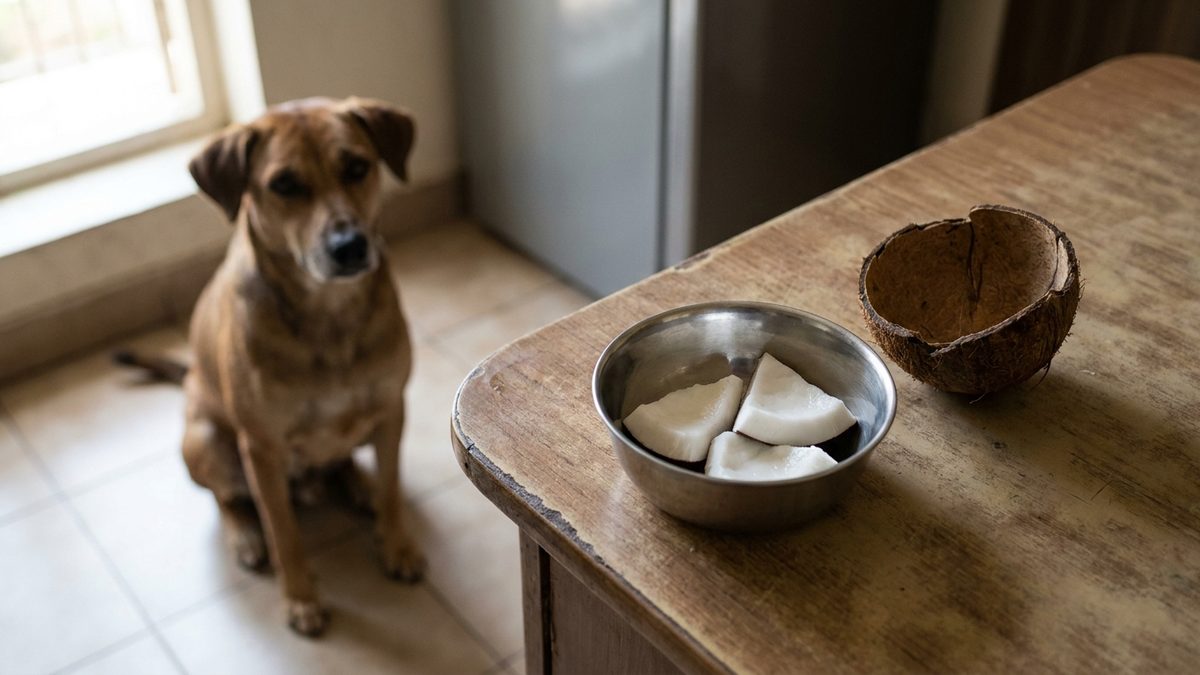
Can dogs eat coconut? Yes, plain fresh coconut kernel is safe in a small counted amount, and the amount is smaller than owners expect. India's own food tables measure it at 409 kilocalories per 100 g, so a healthy 10 kg dog's daily ceiling is about 11 g. Coconut water, copra, coconut milk and coconut oil are four different foods with four different ceilings. Never give the husk or the shell.
This guide is general information for Indian pet owners and is not a diagnosis. Always consult a registered veterinarian near you before acting on anything you read here, and treat any sudden change in your pet's condition as urgent.
Can dogs eat coconut, and which form are you actually holding
Dogs can eat plain fresh coconut kernel in a small counted amount, and that answer covers about one eighth of what an Indian household calls coconut. Tender coconut water, the soft malai of a green nut, mature grated nariyal, dry copra, coconut milk, coconut oil, coconut chutney and the sweets are eight separate foods with eight separate answers, and the energy between the lightest and the heaviest differs forty-fold.
Start with the scale of the thing, because it explains why this page exists. The Coconut Development Board records India's 2024-2025 production at 20,301.22 million nuts from 2,194.92 thousand hectares, at a productivity of 9,249 nuts per hectare. Four states, Kerala, Karnataka, Tamil Nadu and Andhra Pradesh, accounted for 89.16 percent of the coconut area and 91.11 percent of the production in the Board's own annual report. In Chennai and Bengaluru coconut arrives in the chutney, the sambar and the thoran every day. In Delhi, Mumbai and Pune it arrives dry, as copra in the puja thali and the sweet. A page written for an American kitchen that holds one bag of sweetened flakes is answering a question nobody here asked.
| The form | Verdict for a healthy adult dog | What decides it | Where the evidence stands |
|---|---|---|---|
| Fresh grated kernel, mature nariyal | Give, counted, plain and unsweetened | Energy. At 409 kcal per 100 g it is the densest ordinary treat in an Indian kitchen | Measured in six Indian regions at 41.38 g of fat and 1,711 kJ per 100 g |
| Malai, the soft flesh of a tender coconut | Give, counted, treating it as fresh kernel until someone measures it | Energy, probably much lower than mature kernel because it is mostly water | India's food tables carry no separate row for it. No figure exists, and this page does not invent one |
| Copra, dry kernel | Give, counted, and the portion is roughly two thirds of the fresh one | Energy again. 624 kcal per 100 g, the densest row on this page | Measured in six Indian regions at 63.26 g of fat and 2,611 kJ per 100 g |
| Tender coconut water | A few spoons at most, and never instead of water | Potassium, not energy. The energy ceiling is so loose it stops meaning anything | 215 mg of potassium against 28.09 mg of sodium per 100 g. One canine study exists and it was intravenous |
| Coconut milk, the pressed first and second extract | Skip it. There is no Indian figure and the shop version carries additives | Unknown energy, plus whatever the tin contains | No row in India's food tables. Purina advises that a vet may well recommend avoiding it |
| Coconut oil | Not needed, and a teaspoon costs more of the day than owners think | Pure fat at about 9 kcal per gram, and 90.86 percent of it saturated | The canine trials behind the medium-chain claim did not use coconut oil. Full section below |
| Coconut chutney | Refuse the ones with garlic. Count the rest as fresh kernel plus oil | The Allium in the tempering, not the coconut | Our onion and garlic page carries the doses in grams |
| Coconut sweets and barfi | No | Sugar, khoya and ghee carried on top of the densest nut in the kitchen | Covered on our Diwali sweets page, which holds the mithai arithmetic |
Never give a dog the husk or the shell, at any size, for any reason. The American Kennel Club's position is unqualified: you should never feed your dog the husk or shell of the coconut, because it can potentially create risk for intestinal blockage, and gastrointestinal upset due to stomach irritation can also occur. That is a mechanical problem and the dose logic on the rest of this page does not apply to it. Our bones for dogs page carries the obstruction clinical picture in full.
Three questions sort any coconut form in front of you
- Weigh the energy. No coconut form is toxic, so almost every question about it is an arithmetic question, and the arithmetic is in the next two sections.
- Refuse the object. Husk, shell and a whole nut handed over as a chew toy injure by shape rather than by chemistry.
- Bin whatever was added. Garlic in the chutney, sugar in the barfi, salt in the savoury version and additives in a carton are the reason to say no to a prepared coconut dish, and the coconut itself is rarely the problem.
That third question is the one Indian households get wrong most often, because coconut almost never arrives on its own. It arrives ground into a chutney with green chilli and garlic, simmered into a curry, cooked into a sweet or pressed into an oil. Separate the dog's share before any of that happens and seven of the eight rows above become a counting problem.
What India's own food tables measure, and the three forms they do not
India measures coconut in exactly three rows. The Indian Food Composition Tables 2017, compiled at the ICMR-National Institute of Nutrition in Hyderabad, carry H006 dry kernel, H007 fresh kernel and K002 coconut water, each sampled across six regions, plus T001 coconut oil in a separate fatty-acid table. Everything else an Indian kitchen makes from a coconut is unmeasured in India.
Those four rows are worth reading side by side, because owners treat them as one food and the numbers say they are four.
| Row (IFCT food code) | Moisture, percent | Total fat, g | Energy, kJ | Energy, kcal | Total dietary fibre, g | Potassium, mg |
|---|---|---|---|---|---|---|
| Coconut water (K002) | 95.77 plus or minus 0.42 | 0.16 plus or minus 0.02 | 64 plus or minus 7 | 15 | not reported | 215 plus or minus 40.0 |
| Coconut, kernel, fresh (H007) | 36.14 plus or minus 0.36 | 41.38 plus or minus 0.42 | 1,711 plus or minus 13 | 409 | 10.42 plus or minus 0.28 | 246 plus or minus 81.2 |
| Coconut, kernel, dry (H006) | 3.97 plus or minus 0.73 | 63.26 plus or minus 0.30 | 2,611 plus or minus 9 | 624 | 15.88 plus or minus 0.79 | 739 plus or minus 62.0 |
| Coconut oil (T001) | not applicable | pure fat | not published in these tables | about 900 by the Atwater factor | none | not reported |
Read the first two rows against each other and the whole page follows. Drying a coconut removes 32 percentage points of water, and what is left behind concentrates: the fat goes from 41.38 g to 63.26 g, the energy from 409 to 624 kcal and the potassium from 246 mg to 739 mg per 100 g. A north Indian kitchen that stocks copra rather than fresh nariyal is therefore handling the heaviest form of coconut there is, and a tablespoon of grated copra at roughly 8 g carries about 50 kcal against about 33 kcal for the same spoon of fresh.
The malai of a tender coconut has never been measured in India
Nobody has published an Indian composition figure for the soft jelly inside a green nut, and the index of IFCT 2017 shows why the confusion persists. Its vernacular list files H007, coconut kernel fresh, under the Malayalam name Karikku and the Odia name Paida, both of which mean the tender nut, while filing H006, coconut kernel dry, under the Malayalam Thenga and the Tamil Kopparai, which mean the mature nut and copra. The composition settles the argument against the index. At 36.14 percent moisture and 41.38 g of fat, H007 is hard mature white kernel, not the soft spoonable flesh of a tender coconut, which is mostly water.
So the honest position on malai is that it is almost certainly much lighter than the fresh-kernel row, and that nobody has measured how much lighter. Treat a spoon of malai as though it were fresh kernel until an Indian figure exists. That overstates its energy, which is the safe direction to be wrong in.
Coconut milk, desiccated coconut, coconut chutney and any coconut sweet are absent from IFCT 2017 entirely. Its coconut index contains three entries and no more. Any gram figure you read online for coconut milk in an Indian recipe has been estimated from a foreign table, and the coconut milk sold in a carton in Mumbai or Kolkata is a manufactured product whose fat content is set by the maker rather than by the nut.
The fatty acid profile is where the marketing claim breaks
India measured the fatty acids in coconut oil and the result does not match what is printed on the pet shelf. IFCT's Table 12 gives coconut oil, sampled in six regions, as 2.76 plus or minus 0.37 percent caprylic acid (C8:0), 5.18 plus or minus 0.20 percent capric acid (C10:0), 49.57 plus or minus 0.81 percent lauric acid (C12:0), 21.12 percent myristic, 9.26 percent palmitic and 2.97 percent stearic, with total saturated fatty acids at 90.86 plus or minus 0.33 percent.
Two numbers in that row matter more than the rest. The true medium-chain acids, C8 plus C10, come to 7.94 percent. And alpha-linolenic acid, the plant omega-3, is blank, which the table's own header defines as below the detectable limit, so total polyunsaturated fat equals the 1.90 percent linoleic acid and nothing else. Coconut oil is a saturated fat with no measurable omega-3 in it, measured in India, on Indian oil.
How much coconut, in grams, by your dog's weight
To size a coconut portion, divide one tenth of your dog's daily energy by the form's energy per 100 g. Our mango page established that method for a single fruit, our Indian fruit page extended it across the fruit cart and our vegetable page extended it again and found where it breaks. This page extends it to one plant that spans both ends of the range at once.
The ceiling itself is published. Treats should always make up less than 10 percent of a dog's daily calorie intake, and treats should never replace a meal. The denominator is published too. A healthy adult dog in ideal body condition needs 280 to 351 kcal a day at 5 kg, 470 to 590 at 10 kg, 790 to 993 at 20 kg, 940 to 1,174 at 25 kg and 1,080 to 1,346 at 30 kg. The table below uses the lower figure in each range, because a flat-dwelling dog in Mumbai or Bengaluru walked once a day sits near the bottom of its band.
| Dog weight | Daily energy, kcal | The whole 10 percent treat budget | Coconut water, 15 kcal per 100 g | Fresh kernel, 409 kcal per 100 g | Copra, 624 kcal per 100 g | Coconut oil, about 900 kcal per 100 g |
|---|---|---|---|---|---|---|
| 5 kg | 280 to 351 | 28 to 35 kcal | 183 g | 7 g | 4 g | 3 g, about two thirds of a teaspoon |
| 10 kg | 470 to 590 | 47 to 59 kcal | 307 g | 11 g | 8 g | 5 g, about one teaspoon |
| 20 kg | 790 to 993 | 79 to 99 kcal | 516 g | 19 g | 13 g | 9 g, about two teaspoons |
| 25 kg | 940 to 1,174 | 94 to 117 kcal | 615 g | 23 g | 15 g | 10 g, about two teaspoons |
| 30 kg | 1,080 to 1,346 | 108 to 135 kcal | 706 g | 26 g | 17 g | 12 g, under a tablespoon |
Three readings come out of that table and none of them appears on any page currently ranking for this question. All three are about portion size rather than safety, which is the shape of almost every honest coconut question.
- Count fresh coconut as a treat with a very small ceiling. Eleven grams is about one and a half tablespoons of grated nariyal for a 10 kg Indie, and it is the whole day's allowance, not the amount to give alongside a biscuit.
- Cap copra tighter still. A dry coconut piece the size of a two-rupee coin can be most of a small dog's budget, which matters in the week after a puja when copra prasad is on every surface in the house.
- Subtract whatever you give from dinner. A ceiling bolted onto a full bowl has capped nothing, which our dog diet chart carries the daily grams for.
Coconut is the one plant where the method breaks at both ends
Our vegetable page found that an energy ceiling stops being a real constraint on a food that is mostly water, and used lauki as the example, where a 10 kg dog's ceiling works out at 427 g of a vegetable that is 95.17 percent water. Coconut reproduces that finding inside a single fruit. Coconut water is 95.77 percent water and 15 kcal per 100 g, so a 10 kg dog's energy ceiling is 307 g, which nobody would pour and nobody should.
At the other end of the same nut, copra at 624 kcal per 100 g gives that same dog 8 g, which is less than any other whole food this site has costed. Copra is the most energy-dense of the three coconut rows India measures, at more than one and a half times fresh kernel and more than forty times coconut water. One plant, one tenth of one dog's day, and a thirty-eight-fold difference in the answer depending on which part of it you are holding. That is the case for refusing to answer the question for coconut as a single food.
For coconut water the binding constraint is potassium rather than energy. At the 307 g ceiling above, a 10 kg dog would take in about 660 mg of potassium and about 86 mg of sodium from the drink alone, on top of a complete diet already formulated to supply both. That is the real reason to stop at a few spoons, and the coconut water section below sets out what is and is not known about it.
The fat question, and the causal link nobody has actually proved
Coconut is largely saturated fat, and the honest statement of the risk is narrower than every page on this query makes it. Indian coconut oil measures 90.86 percent total saturated fatty acids and fresh kernel carries 41.38 g of total fat per 100 g. What that does to a dog's pancreas is much less settled than the warnings suggest.
The warnings themselves are real and widely published. Purina states that coconut has a high fat content which can lead to stomach upsets and also increase the risk of pancreatitis, a serious condition. PetMD goes further, stating that if too much is ingested, or it is in a form that is not meant to be ingested, significant stomach upset and pancreatitis will develop. The American Kennel Club quotes a veterinary surgeon saying that coconut is higher in fat, so dogs that should not eat high-fat diets or are overweight should find other treats instead.
Hold those three against what the clinical literature supports. The formulation threshold is firm: for a dog being managed for pancreatitis, a ration with less than 20 g of fat per 1,000 kcal should be chosen. Whether dietary fat causes the disease in the first place is a separate claim, and our pancreatitis page sets out in full where the recent reviews have landed on it, which is not where the pet-food internet has. That page owns the clinical picture, the Indian case series and the diagnostic argument, and this one does not repeat them.
What this page can add is the arithmetic that the threshold produces for coconut specifically, because nobody has run it.
| Dog weight | Whole-day fat at under 20 g per 1,000 kcal | Fat in one teaspoon of coconut oil | Share of the day it takes |
|---|---|---|---|
| 5 kg | 5.6 to 7.0 g | 4.6 g | 66 to 82 percent |
| 10 kg | 9.4 to 11.8 g | 4.6 g | 39 to 49 percent |
| 20 kg | 15.8 to 19.9 g | 4.6 g | 23 to 29 percent |
| 30 kg | 21.6 to 26.9 g | 4.6 g | 17 to 21 percent |
For a 10 kg dog on a prescribed low-fat ration, one teaspoon of coconut oil is roughly half the fat its whole day was designed around. That is not a toxicity finding. It is the reason a dog on a therapeutic diet should get no coconut oil at all without the prescribing veterinarian saying so, and the reason the figure matters more than the word moderation.
The weakness of the evidence that dietary fat causes canine pancreatitis is not a reason to feed a dog fat. It is a reason to stop repeating a causal sentence that the research has not established, and to keep the portion small for the reason that is established, which is energy. A dog that has ever been treated for pancreatitis, is overweight, or is on any prescription diet should get coconut only if the veterinarian who manages it says so.
Coconut oil for dogs: what the canine evidence actually shows
Coconut oil is sold to Indian pet owners for coat, skin, digestion, immunity and brain function, and the canine evidence supports almost none of it. The one body of good canine trial data behind the medium-chain triglyceride claim used an oil that is not coconut oil and could not be replaced by it.
Look first at what is being claimed here, in India, by sources an owner would reasonably trust. A veterinary clinic chain's own blog calls coconut oil a superfood, credits it with natural antimicrobial, antifungal and antiviral properties, and recommends half to one teaspoon for small dogs and half to one tablespoon for medium to large dogs, rising to one teaspoon and one to two tablespoons respectively over two to three weeks. No body weight is attached to small, medium or large anywhere in that advice.
Run the top of that range through the published treat ceiling. Two tablespoons of coconut oil is about 27.6 g and about 248 kcal, which is 1.8 to 3.1 times the entire daily treat budget of a dog between 20 kg and 30 kg, and 18 to 31 percent of its whole day's energy. Even the starting dose of one teaspoon, 41 kcal, is 1.2 to 1.5 times the whole treat budget of a 5 kg dog. The American Kennel Club's figure is the defensible one by comparison: up to a teaspoon or so for a large dog is okay, with the warning that if fed large amounts of oil, diarrhoea can occur.
The medium-chain triglyceride claim, and the substitution nobody checks
This is the most important paragraph on the page. Dogs do have good trial evidence for medium-chain triglycerides, and it is not evidence for coconut oil. In a six-month multicentre randomised, double-blinded, placebo-controlled crossover trial in 28 dogs with idiopathic epilepsy, the test oil was a supplement purified from palm and rapeseed oil containing 50 to 65 percent octanoic acid (C8) and 30 to 50 percent decanoic acid (C10). An earlier randomised crossover trial in 21 dogs used a ketogenic medium-chain triglyceride diet and found seizure frequency significantly lower on it, 2.31 per month against 2.67 on the placebo diet, with three dogs achieving seizure freedom.
Now set that composition beside India's measurement of coconut oil. C8 plus C10 comes to 7.94 percent of Indian coconut oil's fatty acids, against 80 percent or more of the trial oil Berk BA, Law TH, Packer RMA, Wessmann. The dogs in the multicentre trial received an average of 7.03 mL of supplement a day. Matching that intake of C8 and C10 from coconut oil would take roughly 71 to 89 mL a day, ten to thirteen times the volume, carrying about 590 to 730 kcal, which is more than the entire daily energy requirement of a 10 kg dog. The substitution is not merely weaker. It is arithmetically impossible inside any dog's diet.
Lauric acid, which is half of coconut oil, is the reason the shortfall is not made up by volume alone. It is formally a medium-chain fatty acid and it does not behave like one at the point that matters. A review arguing in favour of lauric acid still records that C8 and C10 are poorly incorporated into chylomicrons and tend to enter the portal circulation directly after absorption, so they have rapid access to the liver, while rodent studies show that lauric acid has a higher propensity to be absorbed via the lymphatics and so its access to the liver is delayed. Ketone production is the mechanism the canine trials turned on, and lauric acid is the wrong fatty acid for it.
Purina's own page states that a lot of the health claims about coconut are based on the effect of medium chain triglycerides, that the amount of MCTs can vary between different coconut products, and that it therefore cannot recommend giving coconut as a reliable way to get the benefit of those nutrients. That is the correct conclusion, reached without the Indian composition data that makes it conclusive.
Weight loss: the one trial that tested it found the opposite
Coconut-derived medium-chain fat did not help overweight dogs lose weight, and the only trial to test it found it made things worse. Researchers fed experimentally overweight dogs a basal diet supplemented with 8 percent of one of three fat sources, one of them soya-canola oil alone, one with 20 percent coconut and one with 40 percent coconut, across a 14-week weight loss study. Body weight reduction was lower on both coconut diets, 14.6 percent and 15.7 percent against 20.1 percent, and fat mass was higher, 27.9 percent and 28.2 percent against 18.7 percent. The authors' conclusion is flat: feeding diets with medium-chain fatty acids at these inclusion levels to experimentally overweight dogs during 14 weeks does not result in faster weight loss compared to unsaturated long-chain fatty acids.
The same study found the dogs ate far more of the coconut diets, 155 g a day against 17 g for the control in a two-pan preference test. Palatability is the finding that actually transfers to a kitchen. A dog will happily take coconut oil, which is exactly why it is easy to over-give.
Coat, skin, digestion and the nose, one claim at a time
| The claim | What the canine evidence shows | What to do with it |
|---|---|---|
| Shiny coat and moisturised skin, applied or fed | PetMD states that veterinarians typically do not recommend using coconut oil for a dog's skin because the risk often outweighs the benefits, and that the antibacterial and antifungal claims remain anecdotal in dogs | Our atopic dermatitis page owns the itch question and the graded treatment guidelines. Start there, not here |
| Cures ringworm and fungal skin disease | No published veterinary trial supports it, which our ringworm page establishes with its own controlled literature search | Treat ringworm as a diagnosis and a prescription, never as an oil |
| Helps digestion | The only directly relevant canine work fermented coconut endosperm fibre, not oil, with canine faecal bacteria in a dish, and found it had a butyrogenic effect. The authors call for research on gastrointestinal health and faecal quality in actual dogs | A test tube result is a reason to study something, not a reason to feed it |
| Brain and cognition in an older dog | Real, and for medium-chain triglycerides rather than coconut oil. Aged Beagles on a diet supplemented with 5.5 percent MCT over 8 months performed significantly better on most cognitive protocols than controls | Ask a veterinary surgeon about a formulated MCT product for an ageing dog. Coconut oil is not that product |
| Good for a working or sporting dog | The one trial that looked found a cost. Eighteen English Pointers were fed diets differing in fat source, and non-conditioned dogs fed coconut oil had decreased odorant-detecting capabilities between week 4 and week 12 | If your dog's nose is its job, this is a reason to leave coconut oil out |
The pattern across those five rows is worth naming. Every genuine positive finding in dogs belongs to purified medium-chain triglycerides, which coconut oil is mostly not, and the two findings that belong to coconut oil itself, the weight-loss trial and the scent-detection study, both point the wrong way. That is the opposite of how the category is sold.
Nothing above tells you to buy a coconut oil, a medium-chain triglyceride oil or any other supplement, and this page names no brand in either direction. The MCT trials were run on a specific formulation, at a dose calculated from each dog's metabolic weight, under veterinary supervision, in dogs with a diagnosed condition. None of that describes a jar of cooking oil from a kirana shop.
Coconut water for dogs in Indian heat, and the one canine study that exists
Coconut water is a weak potassium solution with very little sodium, and the only published canine study of it was an intravenous infusion that moved electrolytes in the wrong direction. A few spoons as a treat is reasonable. Using it to rehydrate a dog in May is not supported by anything.
The composition comes first because it settles most of the argument. IFCT 2017 measures tender coconut water, sampled in six Indian regions, at 95.77 percent moisture, 64 kJ per 100 g, 215 plus or minus 40.0 mg of potassium, 28.09 plus or minus 4.41 mg of sodium, 27.47 plus or minus 4.28 mg of calcium and 18.19 plus or minus 6.03 mg of magnesium per 100 g. Potassium outweighs sodium roughly seven to one. A fluid designed to replace what a panting, scouring or vomiting animal loses needs the ratio the other way round, and our summer hydration page carries the oral electrolyte evidence in dogs and the formulation argument in full.
Then there is the canine study, and there is exactly one. In 1979, researchers publishing in the Indian Journal of Physiology and Pharmacology infused tender coconut water intravenously into anaesthetised dogs at 0.5 mL per kg per minute to a total dose of 100 mL per kg of body weight. Serum sodium decreased while potassium and calcium increased; urinary sodium excretion decreased while potassium and calcium excretion increased; and there was glycosuria.
Three limits sit on that result and stating them is the point. It was intravenous rather than oral, so it bypassed the gut entirely. The dose was enormous, 100 mL per kg, which is a litre in a 10 kg dog. And the animals were anaesthetised, with the authors recording that the serum electrolyte changes were more prominent in the paraldehyde anaesthetised group. None of that describes a spoonful offered on a hot afternoon in Chennai.
What it does tell you is the direction of travel. The one time anyone put tender coconut water into a dog and measured what happened, sodium fell and potassium rose. That is the shape of the risk the American Kennel Club flags when it says coconut is high in potassium, so caution should be used for dogs with kidney disease or other electrolyte disturbances.
An animal that is flat, vomiting, scouring, refusing food or not drinking needs a veterinary surgeon who can examine it and check its electrolytes. Our heat stroke page covers the emergency and our summer hydration page covers what has actually been tested. Offering coconut water instead of going is the version of this advice that costs an animal its life in a humid Indian May.
What a few spoons is reasonable for
- A healthy adult dog that likes the taste, as a counted treat, plain and unsweetened, with the fresh water bowl untouched beside it.
- A dog that has been offered the pulp of a tender coconut as well, in which case count the malai as fresh kernel and stop earlier.
- Never a dog with diagnosed kidney disease, a known electrolyte problem, or any condition for which a veterinary surgeon has set a potassium or sodium target.
- Never from a street vendor's glass with salt, masala or syrup in it, and never from a flavoured carton, because the additive is the problem rather than the coconut.
On the monsoon and the hot months, one practical note. Coconut oil solidifies below roughly 24 degrees, which in Delhi or Pune means a winter teaspoon is a scooped lump and a May teaspoon is a free-running liquid. The two are not the same weight. If you are going to measure anything on this page, measure it on a kitchen scale in grams rather than in spoons.
The husk and shell, the chutney and the sweets
The husk and shell are an obstruction question rather than a nutrition one, and the chutney and the sweets are questions about what was added rather than about coconut. Those three are where most Indian coconut actually reaches a dog, and the answers have nothing to do with the arithmetic above.
Take the husk and shell first. They are indigestible fibrous and woody material, the wrong shape and the wrong size for a dog's gut, and the AKC's instruction is to never feed them because of the risk of intestinal blockage and stomach irritation. The evidence that coconut obstructs is real and it is human. A Europe PMC search on 22 October 2026 for obstruction or foreign body with coconut returned 15 records, including intestinal obstruction secondary to coconut fibres, obstruction of the small bowel due to boli of ingested coconut, a paediatric coconut bezoar and a coconut leaf midrib skewer causing small bowel obstruction and perforation. Not one of the 15 involved a dog or a cat.
That is the honest statement of the risk. Coconut fibre demonstrably obstructs a mammalian gut, it has been documented doing so in people, and no veterinary case series exists. The absence of published dog cases is not reassurance, because the husk is also the part nobody writes a paper about. Our bones for dogs page carries the obstruction clinical picture, the presenting signs and the reason delay makes it worse, and the practical difference is simple: a bone can splinter and perforate, a coconut shell fragment is more likely to lodge whole, and both are a same-day telephone call.
One of the related searches Google India returns on this query is whether you can give a dog a coconut to play with. No. A dog that works at a whole nut for an hour gets shell fragments and husk fibre into its mouth and down its throat, and a tooth fracture is the other half of the bill. If your dog has already swallowed shell or husk, telephone a veterinary surgeon the same day rather than waiting for a symptom, and do not try to make the dog vomit at home.
Coconut chutney is an Allium question wearing a coconut costume
A South Indian coconut chutney is ground fresh kernel plus green chilli, ginger, roasted gram, salt and very often garlic, finished with a tempering of oil, mustard and curry leaves. The coconut in it is a counting problem. The garlic is not, and our onion and garlic page carries the doses per kilogram and the reason a powder beats a bulb. Refuse the chutney that has garlic in it at any quantity, and treat the garlic-free version as fresh kernel with cooking oil and salt on top, which our spices, salt and masala guide costs properly.
The sweets are simpler still. Coconut barfi, nariyal laddoo and Bengali narkel naru are grated coconut bound with sugar, jaggery or khoya, which stacks the densest nut in the kitchen underneath the densest sugar in it. Our Diwali sweets page holds the mithai arithmetic and the doses for kishmish and cocoa where those turn up in the same box, which in an Indian sweet shop they frequently do.
The grated coconut that reaches a dog without anyone deciding to feed it
Most coconut a household dog eats was never offered to it. It comes off the floor during a Ganesh Chaturthi or Pongal preparation, out of the puja plate after a nariyal is broken, or off a plate of leftovers in a humid kitchen where a bowl of coconut chutney has sat out since lunch. Sweep the floor before the dog is let back in, keep the prasad plate above nose height, and treat a chutney that has stood through a warm afternoon the way you would treat your own share of it.
How to give coconut to a dog, if you give it at all
To give coconut safely, weigh the dog's share on a kitchen scale before anything is added, cap it at the gram figure for that form, and subtract it from the next meal. Five steps cover every form on this page.
- Grate or chop the dog's piece off a fresh mature kernel, with no shell and no brown skin attached. A chunk the dog has to work at is a choking shape; a grated spoonful is not.
- Weigh it in grams rather than guessing in spoons. The ceiling for a 10 kg dog is 11 g of fresh kernel or 8 g of copra, and both look like far less than people expect on a plate.
- Measure the first serving at a tenth of the ceiling and wait a day. Coconut is unfamiliar, it is fatty, and loose stool on the first exposure is usually a dose problem rather than an intolerance.
- Subtract what you gave from the evening meal, on the same day, by the same number of kilocalories. A treat budget added on top of a full bowl is not a budget.
- Refuse the whole category on any day the dog has already had a biscuit, a piece of roti or a spoon of curd, because the 10 percent ceiling covers everything crossing the line, not each item separately.
Coconut is optional. A dog that turns its head away from grated nariyal has lost nothing nutritionally, because a complete and balanced diet already supplies everything coconut contains. Purina makes the same point in its own words, that coconut is high in vitamins, minerals and fibre but these are things your dog will get from their complete and balanced diet. There is no deficiency to correct here and no reason to persist.
Three dogs get no coconut without a veterinary surgeon's say-so. A dog that has ever been treated for pancreatitis, because of the fat arithmetic in the section above. An overweight dog, because its daily allowance has already been cut and there is no spare 10 percent to spend, which our obesity page explains. And a dog on any prescription or formulated diet, because the formulation assumes it is the whole bowl.
Cats and coconut, in short
Cats can have a pea-sized piece of plain coconut without coming to harm, and there is no published feeding study of coconut in cats at all. The section is short because the honest answer is short.
A Europe PMC search on 22 October 2026 for coconut with a cat or feline term returned 88 records, and the only one specific to the domestic cat was the recovery and cryopreservation of epididymal sperm using powdered coconut water as an extender. Coconut's main appearance in the veterinary literature across both species is as a laboratory medium for freezing semen, not as a food. That is the single most useful fact about how thin this field is.
What follows from the species rather than from coconut is the part that matters. A cat is an obligate carnivore with a small daily energy allowance and a short list of nutrients it cannot make for itself, which our Indian food for cats page sets out with the numbers. Coconut supplies none of them. On a 4 kg cat the arithmetic is unforgiving: a treat ceiling of a few kilocalories means a pea-sized piece of fresh kernel is already most of it.
- Plain fresh or dry kernel, pea-sized, rarely, is unlikely to cause harm and supplies nothing a cat needs.
- Coconut milk and coconut cream are a poor idea in a species whose fat tolerance nobody has tested, and the carton version carries additives.
- Coconut water is a potassium drink, and a cat with any kidney history should never be offered it without veterinary advice. Our chronic kidney disease in cats page covers why that history is so common in Indian cats.
- Sweetened coconut, coconut sweets and anything containing a sugar-free sweetener are refused outright.
What this page can prove, and what it cannot
Eight claims here are measurements with denominators and six widely repeated claims about coconut and dogs are not established, so the line between them is drawn below rather than left for you to guess.
Eight claims are established, and each names its source.
- Fresh Indian coconut kernel carries 41.38 g of fat and 1,711 kJ per 100 g, dry kernel 63.26 g and 2,611 kJ, and coconut water 0.16 g and 64 kJ, each sampled in six Indian regions.
- Indian coconut oil measures 90.86 percent total saturated fatty acids, 49.57 percent lauric acid and 7.94 percent C8 plus C10, with alpha-linolenic acid below the detectable limit.
- The oil used in the multicentre canine MCT epilepsy trial was purified from palm and rapeseed and contained 50 to 65 percent C8 and 30 to 50 percent C10.
- In that trial, 2 of 28 dogs became seizure free, 3 had a reduction of 50 percent or more, 12 had a smaller reduction and 11 showed no change or an increase.
- Overweight dogs on coconut medium-chain-fat diets lost less weight, 14.6 and 15.7 percent against 20.1 percent, and finished with higher fat mass.
- Aged Beagles supplemented with 5.5 percent MCT for 8 months performed significantly better on most cognitive test protocols than controls.
- Intravenous tender coconut water in anaesthetised dogs decreased serum sodium, increased potassium and calcium, and produced glycosuria.
- Treats should always make up less than 10 percent of a dog's daily calorie intake, against published daily energy figures of 470 to 590 kcal for a 10 kg dog World Small Animal Veterinary Association.
Six further claims are not established, and the list below marks where this page reasons rather than reports.
- No Indian composition figure exists for tender coconut malai, coconut milk, desiccated coconut, coconut chutney or any coconut sweet. IFCT 2017 carries three coconut rows and no others, so every gram figure on this page covers only what those rows cover.
- No published feeding study of coconut in dogs exists in India. A Europe PMC title, abstract and affiliation search on 22 October 2026 returned 2 records, a Labrador semen cryopreservation paper and a 1997 drug paper, neither of them a feeding study.
- No canine case of coconut husk or shell obstruction is published. The 15 obstruction records that mention coconut are human, and the AKC's warning rests on mechanism rather than on a veterinary series American Kennel Club.
- No canine coconut allergy series exists. Owners and Google both ask whether dogs are allergic to coconut and nobody has measured it, so this page reports individual intolerance signs rather than a prevalence.
- The coconut oil energy figures on this page use the Atwater factor of 9 kcal per gram and a density of 0.92 g per mL, because IFCT publishes a fatty acid profile for coconut oil and no energy value. Those two conversions, the 71 to 89 mL matching calculation and every gram ceiling in the portion table are Bonbeno's arithmetic on published figures rather than published figures themselves.
- Whether dietary fat causes canine pancreatitis, as against aggravating a dog that already has it, is genuinely unsettled, and our pancreatitis page carries that argument with the recent reviews behind it. This page states the fat threshold and does not restate the causal claim.
PetMD states that regular use of coconut oil in dogs is not recommended. The AKC quotes a veterinary surgeon saying up to a teaspoon or so for a large dog is okay, and uses coconut water for her own dogs at sport events. Purina says the MCT content varies too much between coconut products to recommend coconut as a reliable way to get the benefit. We have not averaged those three. The Indian composition data is on Purina's side and the portion arithmetic is on the AKC's, and an owner is better served knowing that the field has not settled than reading one of the three presented as consensus.
Finally, the boundary this page keeps. Bonbeno names no product, ranks no brand, prescribes no supplement and gives no dose of any medicine. If your dog is gaining weight, itching, passing loose stool for more than a day, or has ever been treated for pancreatitis, what goes in its bowl is a decision for the veterinary surgeon who has examined it, which is why this page publishes under the medical disclaimer at the top.
Common questions
Is fresh coconut safe for dogs to eat?
Yes, plain fresh coconut kernel is safe for a healthy adult dog in a small counted amount. India's own food tables measure it at 41.38 g of fat and 409 kcal per 100 g, which makes it the densest ordinary treat in an Indian kitchen, so a 10 kg dog's daily ceiling works out at about 11 g. Remove the shell and the brown skin, grate it, and subtract what you give from the next meal.
What happens if my dog eats coconut?
Nothing, in most cases, if it was plain kernel in a small amount. Coconut is not toxic to dogs. A large amount causes loose stool or an upset stomach because of the fat load, and a dog that swallowed husk or shell is a different problem that needs a same-day telephone call to a veterinary surgeon. Watch for vomiting, refusing food, no stool or a tense belly, and call rather than wait if any of those appear.
Can dogs have coconut flakes?
Plain unsweetened flakes yes, in a smaller amount than fresh coconut, and sweetened flakes no. Dried coconut concentrates everything the fresh nut contains: India's food tables put dry kernel at 63.26 g of fat and 624 kcal per 100 g against 41.38 g and 409 kcal fresh. That makes a 10 kg dog's ceiling about 8 g rather than 11 g. Sweetened baking flakes add sugar the dog has no use for.
Is it okay to give your dog coconut oil?
It is not harmful in a very small amount and it is not necessary, and the canine evidence for the benefits claimed is weaker than the marketing. One teaspoon is about 41 kcal, which is 70 to 88 percent of a 10 kg dog's entire daily treat budget and more than the whole budget of a 5 kg dog. PetMD states plainly that regular use of coconut oil in dogs is not recommended.
Can I give human coconut oil to my dog?
The oil in your kitchen and the oil sold for dogs are the same substance, so the question is the quantity rather than the label. What neither of them is is a medium-chain triglyceride supplement. India's food tables measure coconut oil at 7.94 percent C8 plus C10, while the oil used in the canine epilepsy trials was 50 to 65 percent C8 and 30 to 50 percent C10. Hair oil with added fragrance or preservative is not food and should not be fed.
How much coconut water can I give my dog?
A few spoons as an occasional treat, and never instead of fresh water. The energy ceiling is useless here because coconut water is 95.77 percent water at 15 kcal per 100 g, so a 10 kg dog's energy limit works out at 307 g, which nobody should pour. Potassium is the real limit at 215 mg per 100 g against only 28 mg of sodium. A dog with kidney disease or any electrolyte problem should have none without veterinary advice.
Are dogs allergic to coconut?
Nobody has measured it. No published canine coconut allergy series exists, so there is no prevalence figure to give you and anyone quoting one has estimated it. What is documented is individual intolerance, which shows up as loose stool, oily stools or vomiting after a fatty dose and resolves when you stop. Introduce a tenth of the ceiling, wait a day, and stop if the stool changes or the dog itches.
What happens if my cat eats coconut?
A pea-sized piece of plain coconut is unlikely to cause a healthy cat any harm, and a larger amount causes vomiting or loose stool because of the fat. No feeding study of coconut in cats has ever been published. A cat is an obligate carnivore with a very small daily energy allowance, so coconut displaces food it actually needs, and a cat with any kidney history should not be offered coconut water at all.