
Dog health guide
Bones for dogs in India: cooked, raw, curry-cut and what the evidence shows
One in five to one in three Punjabi dog owners feeds bone, and it is measured. Yet in the largest published series of dogs with a bone stuck in the oesophagus, only 2 of 39 bones were chicken, and the force that cracks a dog's carnassial tooth varies seven-fold between one dog and the next.
Quick answer
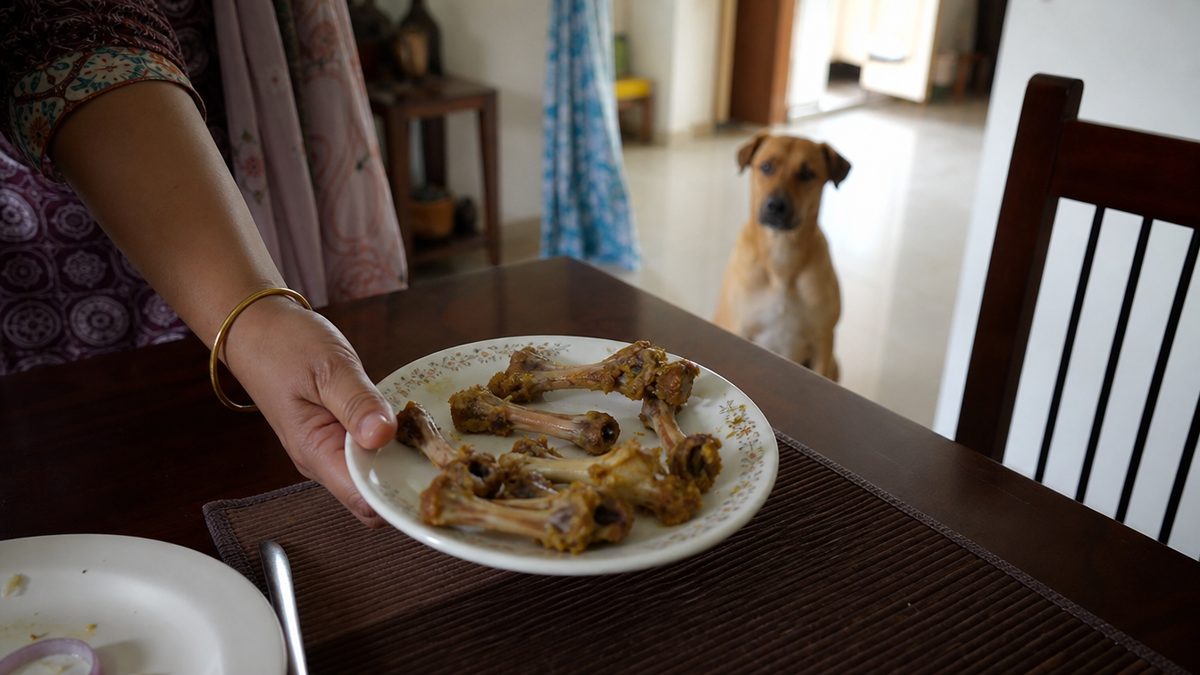
Can dogs eat chicken bones safely? No, and not for the reason most pages give. Cooking drives water out of bone and denatures the collagen that lets bone bend before it breaks, so a cooked bone shatters instead of crushing. In published case series the bone that lodges in a dog's oesophagus is usually a chop or a vertebra rather than a chicken bone, and the dog it lodges in is usually small. If a bone has already been swallowed, do not induce vomiting and call a veterinarian.
This guide is general information for Indian pet owners and is not a diagnosis. Always consult a registered veterinarian near you before acting on anything you read here, and treat any sudden change in your pet's condition as urgent.
Cooked bone versus raw bone, and what cooking actually changes
Cooked bone behaves differently from raw bone because heat drives out water and damages collagen, and collagen is the part of bone that lets it bend before it breaks.
Bone is two materials doing two jobs. The mineral phase makes it stiff and strong. The collagen makes it tough, and toughness is a separate property: it is how much energy the material soaks up before a crack runs through it. A study of 33 baboon femurs measured both at once and found that the percentage of denatured collagen had an inverse correlation with the toughness of bone and a positive correlation with its elastic modulus, while mineral content correlated mainly with stiffness and strength. Read that in plain terms. Damage the collagen and the bone becomes stiffer and less tough at the same time, and stiffer plus less tough is the engineering definition of brittle.
Be clear about what that study is and is not. It measured age-related collagen damage in primate bone, not a chicken thigh in a pressure cooker, and we found no published fracture test on cooked poultry bone at the sizes a dog actually chews. The mechanism below is inference from bone mechanics plus veterinary description. It is not a measurement of your Sunday roast, and no page that tells you otherwise has one either.
The veterinary description is consistent. A practising veterinarian writing on this exact question puts it as raw bone still holding its moisture and collagen so it has some give, while cooking drives that moisture out and leaves the bone dry and brittle, so a cooked bone snaps into sharp shards instead of crushing.
Where Indian coverage has the mechanism backwards
India's largest English newspaper published the opposite explanation. Its pets desk, carrying a named pet nutritionist, states that cooked bones are a no-no for all dogs because they soften upon cooking and can splinter. Softening and splintering are opposite behaviours. A soft material deforms and absorbs the load; a brittle one releases it as a crack. The conclusion in that article is right and the reason given for it is wrong, which matters because a reader who believes bone softens has no way to work out why pressure cooking does not help.
The page ranking first in India for this query contradicts itself inside one article. It states that once a chicken bone is cooked it becomes much more fragile and can easily break into sharp pieces, then three headings later states that cooked bones tend to be slightly softer than raw bones. Both sentences are on the same page, written for the same reader, on the one point the whole article turns on.
| Preparation | What it does to the bone | How well established that is |
|---|---|---|
| Raw | Water and collagen intact, so the bone has some give and tends to crush rather than shard | Mechanism supported by bone biomechanics; no fracture test on dog-chewed bone |
| Boiled in a curry | Prolonged wet heat, collagen solubilised, bone left dry and brittle on cooling | Described by veterinary sources, inferred from collagen and toughness data |
| Pressure cooked | Same direction as boiling, at higher temperature and pressure | The only controlled trial using these conditions found no tooth fractures in 13 days, on large cut bovine bone only |
| Roasted or tandoori | Dry heat, strongest drying effect, the classic splintering carcass | Described by veterinary sources, not measured |
| Dehydrated | Water removed slowly at low temperature; sellers claim collagen structure is preserved | Claimed by the companies selling them, with no citation we could find |
Cook the meat and bin the bone, in a closed bin outside the kitchen. No source we read, in India or anywhere else, recommends feeding a cooked bone of any kind. The disagreements below are about raw bone, dental benefit and emergency handling, never about this.
How often Indian households feed bone, and which bones
Indian households feed bone far more often than the advice pages assume, and the only published measurement puts it between one home in five and one home in three.
Researchers at the Department of Animal Nutrition, Guru Angad Dev Veterinary and Animal Sciences University, Ludhiana surveyed 138 dog owners across the Fatehgarh Sahib and Ludhiana districts of Punjab. Bone was fed by 29.7 percent of the Fatehgarh Sahib owners and 20.3 percent of the Ludhiana owners. For comparison inside the same survey, meat reached 48.4 and 54.1 percent and eggs 71.9 and 62.2 percent, so bone sits well below meat but well above anything a reader would call unusual.
The quantities are the part nobody has used. In rural Fatehgarh Sahib the dogs were offered 45.16 g of bone a day against 18.18 g in urban Fatehgarh Sahib, a difference the authors report as significant at P below 0.05, and the Ludhiana split ran the same way at 29.49 g rural against 15.71 g urban. A rural Punjabi dog is eating roughly two and a half times the bone of an urban one in the same district. Advice written for a flat in Mumbai or Pune is not addressing the household where the practice is heaviest.
Treat those figures as the best Indian measurement that exists rather than as a national rate. They come from two districts of one state in one survey, and nobody has run the equivalent in Chennai, Bengaluru, Hyderabad, Kolkata or Ahmedabad. If a page quotes you a national percentage for bone feeding in India, ask where it came from.
The Indian bone set is not the Western one
Western pages on this subject are largely about beef and pork bones, which are the two meats most Indian kitchens never cook. The bones that actually appear on an Indian floor are different, and the Times of India piece names several of them directly: chicken feet, chicken necks and chicken wings as edible chews, and buffalo marrow bone, buffalo trotter and goat or buffalo trachea as recreational ones.
- Cooked chicken bones, from a roast, a tandoori plate or a biryani.
- Mutton and goat curry cut, which is bone-in by definition and goes into the pressure cooker with everything else.
- Paya and trotters, slow-cooked for hours, then left on a plate at dog height.
- Buffalo marrow bones, sold as a recreational chew and recommended as one in Indian consumer coverage.
- Fish bones, from a Kolkata, Chennai or Goan kitchen, where the fish head is routinely given to the household dog.
- Bone meal, sold as haddi powder and added to home-cooked food as a calcium source.
Two of those have no Western equivalent at all. Curry cut puts fragments of goat vertebra and rib into a dish the dog is often fed from, and bone meal is swallowed as a powder rather than chewed. Neither appears in the pages ranking in India for this query, all of which were written for American kitchens.
Bone is the calcium source people reach for when they cook at home, and whether a home-cooked bowl is actually balanced is a separate question with its own evidence. That is covered in full in is homemade dog food balanced, and the recipes and portions sit in homemade dog food in India and the dog diet chart for India. This page is about bone as a thing a dog chews and swallows.
The injury that puts dogs in hospital is in the oesophagus
The oesophagus is where a swallowed bone does the most damage, because a bone that stops there can go neither forward nor back and begins pressing on the wall from the moment it lodges.
The standard reference is unambiguous about which object this is. Bones are the most common foreign body, and objects usually lodge in the areas of the oesophagus with the least distensibility, which are the thoracic inlet, the heart base, and the caudal oesophagus just in front of the diaphragm. The same entry names oesophageal stricture formation as the most common complication, and lists perforation consequences that include pleuritis, mediastinitis, pyothorax, pneumothorax and a fatal aorto-oesophageal fistula.
Now the denominators. A nine-year review at University College Dublin assessed 44 dogs with an oesophageal foreign body. The paper's abstract reports that 88.6 percent were bones or bone fragments, and its results section counts 39, which is 39 of 44; the body of the paper prints that fraction as 86.6 percent, so there is an arithmetic slip in the published text and we publish it rather than picking a side.
The bone in the query is not the bone in the hospital
Of those 39 bones, the breakdown is the single most useful fact on this page. There were 23 chops or vertebrae, of which 12 were lamb, 6 were pork and 5 were unidentified. There were 2 chicken bones. There was 1 turkey bone and 1 beef bone, and 12 of unrecorded type. Everyone searches for chicken, and chops and vertebrae are what fill the endoscopy list. For an Indian reader that transfers straight across: mutton curry cut is a chop-and-vertebra meal.
A later series at North Carolina State University reviewed 129 dogs with bone in the oesophagus or stomach over 14 years, 45 oesophageal and 84 gastric. Comparing the two groups explains who this happens to. The oesophageal dogs had a median weight of 7 kg against 18.6 kg for the gastric dogs, and a median age of 4 years against 6. The commonest breeds in the oesophageal group were Shih Tzu, West Highland White Terrier, Chihuahua, Jack Russell Terrier, Yorkshire Terrier and Pomeranian.
The bone that lodges is not bigger. The dog is smaller.
This is the finding that changes what an owner should do. The cross-sectional areas of the oesophageal and the gastric bones were statistically indistinguishable, at a median 471 mm2 against 557 mm2. What differed was the bone to body weight ratio: 98.21 mm2 per kg in the dogs where it stuck against 28.6 mm2 per kg in the dogs where it passed, a difference at P below 0.001. A drumstick that a 25 kg Labrador swallows without incident is a different object for an 8 kg Indian Spitz or a Shih Tzu, and the difference is not judgement, it is arithmetic.
Delay is the other variable you control. In the same series, oesophageal mucosal erosions were present in 3 of 11 dogs presented within 6 hours, 9 of 16 presented between 6 and 48 hours, and 16 of 18 presented after 48 hours, and chronic cases carried an odds ratio of 18.82 for erosion against peracute ones. The Dublin series found the same thing from the other direction: median duration of signs was 2 days in the dogs whose bone came out endoscopically and 5 days in the dogs where endoscopy failed.
| Time from swallowing to presentation | Dogs with erosions | What that means for you |
|---|---|---|
| Under 6 hours | 3 of 11 | Most oesophagus still intact. This is the window worth racing for. |
| 6 to 48 hours | 9 of 16 | Rather more than half already have mucosal damage. |
| Over 48 hours | 16 of 18 | Damage is close to universal, and endoscopic removal is likelier to fail. |
The signs point upward, to the throat and chest rather than the belly, and they are not the signs of a stomach upset.
- Gagging, retching or repeated attempts to swallow, which are the classic oesophageal foreign body signs in the reference manual.
- Drooling, sometimes blood-tinged, from a dog that has suddenly started holding its head oddly.
- Regurgitation rather than vomiting, meaning food comes back up without the heaving of a true vomit.
- Refusing solid food while still taking water, which is what a partial obstruction looks like.
- A hard, freely movable lump you can feel in the neck, as the Bengaluru and Namakkal cases both had.
The long tail is worth knowing before you decide to wait and see. Of 29 Dublin dogs followed up, 7 were left unable to eat food that had not been mashed, which the authors attributed to oesophageal stricture, and the duration of signs before removal did not separate them from the ones that recovered fully.
Two Indian cases, and what they show
Indian veterinary journals carry this as case reports rather than counts. At the Veterinary Clinical Complex, Veterinary College and Research Institute, Namakkal, in Tamil Nadu, a three-month-old Doberman puppy was presented after two days of excessive salivation and regurgitation after solid food. Radiography found a foreign body in the cranial oesophagus and it was retrieved under C-arm fluoroscopic guidance in a single attempt; the figure caption identifies it as a chicken bone, and the puppy was normal the next day.
At the Department of Veterinary Surgery and Radiology, Veterinary College, Hebbal, Bangalore, a one-year-old Shih Tzu was presented after three days of continuous vomiting and anorexia with a hard swelling palpable in the throat. Attempts to remove the bone with throat forceps under general anaesthesia failed because of its size, so an oesophagotomy was performed through a midline approach. The dog was off oral feeding for five days on intravenous fluids, had liquid diet for two days and semi-solid for two more, was back on its regular diet on day 10 and had sutures out on day 11.
Both cases are small dogs or puppies, both presented after a delay, and both are consistent with the overseas denominators rather than different from them. What India does not have is a series with a denominator behind it, so nobody can tell you how often this happens here.
What happens if the bone gets past the oesophagus
A bone that reaches the stomach usually dissolves there, and the largest published series deliberately left most of them alone.
Of the 84 dogs with a bone in the stomach at North Carolina State, 62 did not undergo any surgical or endoscopic procedure and the bones were left in place to be digested, with no evidence of short-term or long-term adverse effects in the dogs for which follow-up existed. Thirty-eight of the 84 were incidental findings, meaning the bone was spotted on radiographs taken for something else entirely. Twenty-four had clinical signs, and 20 of those 24 were vomiting.
Where follow-up imaging was done, the bones went fast. In two dogs the gastric bone had resolved within a day, in two more it had gone by the time of repeat imaging at 14 or 18 days, and in three it was already smaller within a day.
Do not read that as permission. Every one of those dogs had been radiographed by a referral hospital that knew where the bone was, how big it was and what the dog weighed. The same study is the one that found the oesophageal dogs had almost four times the bone to body weight ratio of the gastric ones, and which bone goes where is not something an owner can choose after the fact.
Intestinal perforation is the rare bad end of this, and it is why nobody treats a swallowed bone as a non-event. A shard sharp enough to perforate the gut wall spills its contents into the abdomen, and the manufacturer page in the Indian results names the result directly as peritonitis, a bacterial infection of the abdomen caused by stomach or intestinal punctures, alongside rectal bleeding and damage to the throat and oesophagus. The signs are the ones already listed here, which is the difficulty: a dog that will perforate and a dog that will digest the bone uneventfully look the same on day one.
Constipation, obstipation and bone meal
Bone that is swallowed but not digested leaves at the other end, and the reference manual names it in the list of causes. Intraluminal obstruction of the colon develops from the inability to pass poorly digested, often firm matter, and the examples given are hair, bones and litter mixed with faecal material. Obstipation is defined there as intractable constipation with an inability to evacuate the mass of dry, hard faeces, where impaction can extend from the rectum to the ileocolic valve.
Two details in that entry are worth an owner knowing. Plain abdominal radiographs can show what the faeces actually contain, and the manual's own example of what shows up is bones. And when enemas fail, impacted faeces are extracted manually under general anaesthesia with the airway protected, and complete removal may need two to three attempts over as many days. A dog straining in the garden three days after a plate of mutton is not a minor problem that will sort itself out.
The same hazard is why bone meal deserves its own thought. Haddi powder added to a bowl is not chewed, is not shaped and does not splinter, but it is still indigestible mineral arriving in bulk. A pet-food manufacturer's own Indian page puts the general version plainly, that since bones cannot be completely digested a dog can develop constipation if it chews on bones too much.
Two neighbouring problems live on other pages and we will not rebuild them here. Swallowed decoration, string and the linear foreign body problem that affects cats more than dogs are covered with their own survival figures in diyas, candles and burn risk to pets. The sudden load of fat that comes with paya, marrow or a skin-on carcass is a separate emergency, and that is pancreatitis in dogs.
Fractured teeth are the bone injury nobody counts
Fractured teeth are the under-reported bone injury because a cracked carnassial rarely stops a dog eating, so it goes unnoticed for months and never reaches a statistic.
Tooth fracture in dogs is reported at a prevalence of 20 to 27 percent, and the veterinary dental literature itself notes that the work quantifying that number is limited. Nothing in the Indian SERP for bones mentions it at all.
A cadaveric study at the University of Pennsylvania put a number on what it takes. Twenty-four maxillary fourth premolars, the upper carnassial, were harvested with their surrounding alveolar bone, potted in acrylic, held at 60 degrees and loaded until they failed. The mean maximum force before fracture was 1,281 newtons with a standard deviation of 403 newtons, at a mean impact angle of 59.7 degrees.
What failed matters as much as the number. The commonest result was a complicated crown fracture, meaning the pulp was exposed, in 12 of the 24 teeth. Six had an uncomplicated crown fracture, five a complicated crown-root fracture and one an uncomplicated crown-root fracture. A complicated fracture is an open channel from the mouth into the living tissue of the tooth. It hurts, it gets infected, and it ends in root canal treatment or extraction.
The spread is the finding, not the average
The individual teeth in that study ranged from one that failed at 306 newtons, taken from a Bernese Mountain Dog over 34 kg, to one that held to 2,029 newtons, from a German Shepherd mix. That is close to a seven-fold difference between two teeth doing the same job. Neither breed, age, weight nor impact angle predicted it; the only variable that survived the regression was the crown height to diameter ratio, at P equal to 0.005, with a lower ratio associated with more resistance.
That spread is the answer to the commonest argument in favour of bones, which is that somebody's dog has chewed them for ten years with no trouble. A ten-year run is one observation of one set of teeth near the top of a very wide distribution. It tells you nothing about the tooth in front of you, and nobody can measure that tooth without anaesthesia and radiographs.
Which teeth break is predictable even when the force is not. The upper fourth premolar and the lower first molar are the carnassials, the shearing pair a dog puts a bone between, and they are the teeth this study was built around. What a fractured tooth then does to the jaw over the following years, what it costs to treat in India and who may legally treat it are all covered on periodontal disease in dogs and cats.
That is exactly why it is missed. A dog with an exposed pulp shifts chewing to the other side and carries on, and the owner notices nothing for months. If your dog chews bones or any hard object, ask for the carnassials to be looked at specifically at the next appointment, by name, rather than waiting for a sign.
Does chewing bone actually clean teeth
Chewing bone removes dental calculus quickly, and that part is measured, but removing calculus is not the same as preventing periodontal disease and the evidence splits exactly there.
The measurement is good and it is recent. Twelve healthy four-year-old Beagles averaging 12.7 kg, none of whom had ever had a professional dental cleaning or a toothbrushing, were given one piece of autoclaved bovine femur a day for 13 days, either cortical bone from the shaft or spongy bone from the end. At day 0, calculus covered 56.2 percent of the tooth surface in the cortical group and 62.6 percent in the spongy group. By day 14 the spongy-bone group had lost 89.5 percent of its calculus and the cortical group 64.7 percent, both significant at P below 0.05.
The injuries in the same trial are the half that gets quoted less. Radiographs taken on day 14 found no root or enamel fractures from the 13 days of chewing. But seven lesions were recorded, all of them in the spongy-bone group: four traumatic gingival lesions, two dogs with pieces of bone wedged between teeth, and one tooth extracted, that last in a dog which already had extensive alveolar bone loss and grade II mobility on that tooth at day 0. The cortical-bone group recorded zero.
The authors name their own limits, which is why this is a usable study rather than a marketing claim. The bones were cut to roughly 4 cm on a band saw, a fresh piece was offered each morning, the old one was removed after 20 hours, and the whole thing ran 13 days. They describe that high level of control as a limitation that may be difficult to replicate, and say long-term studies are required to evaluate the impact of bones on teeth and periodontium after prolonged supplementation.
Where the two literatures disagree, and why both can be right
A peer-reviewed review of raw diets reaches a different-sounding conclusion. It states that claims for improved oral health in diets with raw bones find support in studies showing less calculus among feral or wild dogs and cats, yet on balance the limited published evidence does not support claims of reduced periodontal disease with raw feeding.
Those two findings do not actually contradict each other, and seeing why is the useful part. One measured calculus, which is mineralised deposit on the visible crown. The other asked about periodontal disease, which is destruction of the attachment below the gum line. Scraping the crown clean is real and fast. Whether it changes what happens under the gum over years is not established, and the trial that measured the scraping ran for 13 days. Anyone who tells you bones prevent gum disease is quoting the first study to answer the second question.
The commercially neutral position is unexciting and well supported. A manufacturer's Indian page notes that having a good chew can crack off tartar and prevent plaque build-up, and that chewing stimulates saliva flow, and then recommends chews designed for the job rather than bones. What the evidence actually ranks for prevention, including the one home measure the reference texts call most effective, is set out on periodontal disease in dogs and cats.
Which bones specifically, in an Indian kitchen
Each bone in an Indian kitchen carries a different risk, so the useful answer runs bone by bone rather than yes or no.
| Bone | Where it appears | The specific risk | Position |
|---|---|---|---|
| Cooked chicken bones | Roast, tandoori, biryani, leftovers in the kitchen bin | Brittle shards, oesophageal lodgement in small dogs, oral injury | Never fed deliberately, and binned outside the kitchen |
| Mutton and goat curry cut | The commonest bone-in Indian dish, pressure cooked | Chops and vertebrae are the exact shapes that filled the Dublin endoscopy series | Never fed; pick the bone out before the bowl goes down |
| Paya and trotters | Slow-cooked, often left on a plate at dog height | Cooked bone plus a heavy fat load in one object | Never fed; see the pancreatitis page for the fat half |
| Fish bones | Fish head and frame, routinely given to the household dog | Fine sharp bones, oral and pharyngeal injury; no published series we found | Not fed; debone before the fish reaches the bowl |
| Buffalo marrow bone | Sold and recommended in India as a recreational chew | Dense weight-bearing bone, a documented tooth-fracture shape, and jaw entrapment once hollowed | Not recommended here; the dental evidence points the other way |
| Bone meal, haddi powder | Added to home-cooked food as a calcium source | Indigestible bulk, constipation and obstipation; separate question of whether the dose is right | A nutrition question, not a chewing one; see the calcium page |
| Raw chicken necks and feet | Sold as edible chews, named as such in Indian coverage | Bacterial contamination, gulping rather than chewing, choking | Genuinely contested; the disagreement is set out below |
The pressure cooker, which deserves a straight answer
A pressure cooker is in almost every Indian kitchen and it changes the bone, so the question is fair and the honest answer is more interesting than the usual one. A domestic cooker runs at roughly one atmosphere above ambient, which puts the contents near 120 degrees Celsius. The Beagle trial above autoclaved its bones at 1.0 atm for 30 minutes at 120 degrees, which is the same physical treatment, and those bones removed up to 89.5 percent of dental calculus in 13 days without fracturing a root or an enamel surface on radiographs.
That is as far as the evidence goes, and it does not go where a reader might want it to. Those were 4 cm blocks of bovine femur, cut on a band saw, given one at a time to a supervised dog in a research kennel and taken away after 20 hours. Nothing in that trial tests a pressure-cooked chicken bone, a goat vertebra out of a curry, or a dog left alone with either. An Indian seller of dehydrated chews states flatly that this applies to all cooked bones, whether boiled, fried, roasted, baked or pressure cooked, and that there is no safe way to cook a bone for a dog to eat. That page carries no citation for the claim and sells the alternative, and the single controlled trial we found that used heat and pressure did not produce the fractures it predicts. Both things are true at once, and the useful reading is that the trial does not license the kitchen.
Marrow bones and the lower jaw
A marrow bone becomes a ring once the dog has eaten the marrow out, and a ring can slip over the lower jaw and lodge behind the canine teeth, after which it will not come off without sedation. We looked for a published case series counting this and found none: what exists is clinic case posts and veterinary continuing-education demonstrations of the removal. We record it as a described hazard rather than a counted one, and say so rather than borrowing somebody else's number.
What is measured about marrow bones is the density. Beef, buffalo and other weight-bearing bone is heavier and denser than poultry bone, often will not digest at all, and raises the odds of obstruction, irritation and a fractured tooth on the way in. Indian consumer coverage recommends buffalo marrow bone as a recreational chew with a dental benefit. Set that recommendation against the carnassial fracture forces above and decide for yourself.
Fish frames and heads go to the dog in Kolkata, Chennai, Goa and most of the coast, and we found no published veterinary series on fish bone injury in dogs to quote at you. The mechanism is not in doubt, because a fine sharp bone can lodge in the mouth, the tonsillar area or the oesophagus, and the Merck entry lists needles and fishhooks alongside bone among objects that lodge there. Debone the fish. We will not pretend there is a denominator behind that advice.
The raw bone argument, reported rather than settled
The raw bone argument is a real disagreement between people reading real evidence, and the two sides have measured different things.
What the raw side has is mechanical and dental. Raw bone keeps its water and its collagen and so crushes rather than shards, which is the same biomechanics that condemns the cooked version. Bone chewing removes calculus fast and measurably, and the review that is sceptical of raw feeding concedes that claims for improved oral health find support in studies showing less calculus among feral or wild dogs and cats.
What the other side has is microbiological, and it has denominators. Surveys of raw pet food in North America have reported Salmonella-positive samples at 7.1, 8, 9, 20 and 21 percent across five studies, while just 1 of 480 conventionally processed dog food samples yielded Salmonella in one of the same research groups' work. A Netherlands study found Salmonella in 20 percent of 35 commercial raw food samples, and Italian material intended for pet food manufacture yielded it from 12 percent. In the United Kingdom, more than half of regulated serovar isolations in animal feeding stuffs in recent years came from raw pet food, including tripe, despite most samples coming from the much larger processed sector.
The commercial pages in the Indian results do not split the difference so much as pick. One manufacturer states that raw bones are stronger but can still splinter, so it does not recommend them, and adds the bacterial argument. The page ranking first holds both positions in two paragraphs, stating that dogs should not eat raw chicken bones and then that raw chicken bones are safer than cooked chicken bones when accidentally ingested, because before cooking they are much harder to fracture and splinter when chewed.
The Indian version of the argument is about the house, not the bone
The most interesting Indian contribution to this debate is not about bone mechanics at all. A certified canine nutritionist selling dehydrated chews argues that the raw question in India turns on the hygiene gap rather than the bone: wet markets instead of sterile supermarkets, humidity in Mumbai, Chennai and Kolkata, dogs that drag a raw bone across the floor and the rug and then lick a child's face, and households where the dog sleeps on the bed alongside elderly parents.
That is reasoning rather than measurement, and it should be labelled as such, but it is reasoning about the right variable. Every Salmonella figure quoted above was generated in North America or Europe. We found no Indian survey of contamination in raw pet food or raw meaty bones, and no Indian measurement of household transmission from a raw-fed dog. A monsoon kitchen with an unreliable cold chain is a different exposure from a Dutch freezer, and whether it is worse or merely different is not something anybody has measured here.
The study that would answer it is a long-term trial that follows the same dogs for years on raw meaty bones against a controlled chew, and records both the periodontal outcome and the injury count in the same population. The existing dental trial ran 13 days, and the microbiological evidence comes from food samples rather than from dogs followed over time. Until somebody runs the long version, anybody who tells you the question is closed is telling you their position, not the evidence.
What to do if your dog has already eaten a cooked bone
To handle a swallowed cooked bone, take away whatever is left, do not make the dog vomit, and call a veterinarian instead of waiting for a symptom to appear.
- Check for choking first. Gasping, pawing at the mouth, blue gums or difficulty breathing is an immediate emergency and nothing else on this list comes before it.
- Do not induce vomiting at home. The veterinarian quoted by the American Kennel Club says explicitly not to, because it can lead to oesophageal obstruction, aspiration pneumonia and oesophagitis.
- Clear away the rest of the bones, the plate and the bin, calmly, before the dog goes back for a second round.
- Do not chase the dog or grab at its mouth. Chasing encourages a dog to swallow its prize whole, and a dog that guards food may bite.
- Write down three things: the time, what kind of bone, and roughly how much. Bone type and bone size relative to your dog are what the vet will reason from.
- Phone the clinic now rather than after a symptom appears, because the erosion figures above are driven by hours, not by signs.
- Watch for the named signs for a full 48 hours: hard swallowing, extending the neck, repeated retching, drooling, refusing food, vomiting, diarrhoea, a tender belly, straining to pass stool, or black or bloody stool.
- Keep watching the stool for several days afterwards, because constipation from bone fragments arrives later than everything else.
On how long to watch, the AKC's emergency veterinarian puts the window at 12 to 24 hours, saying there is typically little to worry about if the dog is free of signs and eating normally within that period. The oesophageal data argue for acting inside the first 6 hours rather than observing through them, so treat 12 to 24 hours as the all-clear window and not as a waiting period.
The bread argument, which we are not going to settle for you
The page ranking first in India advises feeding a few slices of plain white bread or soft food right after ingestion, to coat the bone and hopefully prevent harm from any sharp edges. The AKC's veterinarian says the opposite and gives a mechanism: the pH of a dog's stomach is very low and can easily dissolve chicken bones within a couple of hours, and feeding food can temporarily increase that pH, which slows the dissolution down. A third veterinary source agrees on the principle and extends it to medicines, advising against antacids and acid reducers because stomach acid is exactly what is needed to break the bone down.
There is a fourth data point and it muddies rather than resolves. In the North Carolina State series, short-term dietary management including the addition of white bread was recommended in 4 of the 62 dogs whose gastric bones were left to digest. So a referral hospital did use it, in a small minority of cases, on dogs it had radiographed. All four sources agree the acid is the thing doing the work. They disagree about whether a small amount of food helps mechanically or hinders chemically. Ask the vet you are already calling, and do not give any medicine on your own.
- Go now if the dog is gasping, pawing at its mouth or has blue gums, because that is choking and not a bone in the gut.
- Go now if it is gagging, retching repeatedly, swallowing hard or extending its neck, which point at the oesophagus.
- Go now if the belly is tender, bloated or painful to touch, or if vomiting will not stop.
- Go now if there is black or bloody stool, or if the dog has gone flat and will not get up.
- Go anyway if a bone was swallowed and you cannot reach anyone to ask, because elapsed hours are the variable with the strongest published effect on damage.
This page names no medicine for any of the above, because the choice of drug is a veterinary decision made on a dog the vet can put hands on. Do not reach for a human painkiller, an antacid, a laxative or an old strip from the cupboard. Two of those, antacids and acid reducers, work directly against the stomach acid that is dissolving the bone, and a laxative given to a dog with an obstruction is dangerous rather than merely useless.
What to give instead, as categories rather than brands
To replace a bone, separate the three jobs it was doing, which are chewing time, calculus abrasion and calcium, and then supply each of the three from a different place.
A bone is popular because it does three unrelated things at once, and that bundling is what makes it hard to give up. Pull the three apart and each one has a safer answer, and none of those answers needs a bone. The safer alternatives below are categories rather than products, because a verdict on a named product needs first-hand testing that we have not done.
- Chewing time. Use a chew that gives way under a tooth rather than one that resists it. The rough field test used in veterinary dentistry is whether the object yields before the tooth does, because the fracture data above show individual carnassials failing at as little as 306 newtons.
- Calculus abrasion. Use the measures the reference texts actually rank, which start with regular toothbrushing and add a designed dental chew, both covered with their evidence on the periodontal disease page.
- Calcium. Take it from a formulated source with a known dose, not from a bone of unknown composition. Whether your bowl needs any is the question the calcium page exists to answer.
- Food reward and novelty. Use a measured portion of the dog's own daily ration inside a puzzle feeder instead of an extra calorie load bolted on the side.
- Supervision. Whatever you choose, sit with the dog the first few times and watch whether it chews or gulps. A gulper changes the risk of every item on this list.
Bonbeno does not rank or recommend a named commercial product anywhere, because a verdict needs first-hand testing. What we can say is which category removes which risk, and this one removes the splinter, the oesophageal lodgement and most of the tooth-fracture risk in a single substitution.
There is no Indian register, government dataset or published case series counting dogs injured by bones, as at 20 October 2026. What exists is individual case reports from Namakkal in Tamil Nadu, from Bangalore and from a handful of other Indian veterinary colleges, each a single dog with no denominator behind it. One Indian teaching hospital publishing its annual foreign-body caseload by object type would be the most useful contribution anyone could make to this question, and until that exists every claim about how common bone injury is in Indian dogs, including ours, is an impression.
Common questions
Do chicken bones dissolve in dogs' stomachs?
Often, yes. An emergency veterinarian quoted by the American Kennel Club states that the pH of a dog's stomach is very low and can easily dissolve chicken bones, and most bones, within a couple of hours. That is why the same source advises against feeding anything immediately afterwards, since food temporarily raises stomach pH and slows the process down. Dissolving in the stomach is not the problem. Getting as far as the stomach is.
Will my dog be ok if he ate a cooked bone?
Usually, and the published numbers support that, but the odds depend on your dog's size more than on the bone's. In a series of 129 dogs, the ones whose bone stuck in the oesophagus had a median weight of 7 kg while the ones whose bone reached the stomach had a median weight of 18.6 kg, and the bones themselves were the same size. A small dog that has swallowed a cooked bone is a phone call to the vet now, not in the morning.
How long after eating a chicken bone will a dog get sick?
Signs usually appear within the first 12 to 24 hours, and an emergency veterinarian quoted by the American Kennel Club says there is typically little to worry about if the dog is free of signs and eating normally inside that window. Constipation from bone fragments is the exception and arrives later, over the following days. The absence of signs in the first hours is not proof that nothing is lodged, because oesophageal damage builds quietly with time.
Can you give your dog cooked bones?
No. Every veterinary source we read, Indian and foreign, says not to, and they agree on the conclusion even where they disagree on the reason. Cooking drives water out of bone and damages the collagen that gives it toughness, so the bone becomes stiffer and more brittle and shatters into shards instead of crushing. Boiling, roasting, frying and pressure cooking all push in the same direction. Cook the meat and bin the bone.
What bones are okay for dogs to eat?
No bone is established as safe, and the honest ranking is by how much risk each carries rather than by a green list. Cooked bone of any kind is ruled out by every source. Dense weight-bearing bone such as a buffalo or beef marrow bone carries the highest tooth-fracture risk, since individual carnassial teeth have been measured failing at as little as 306 newtons. Raw poultry bone is genuinely contested on bacterial grounds rather than mechanical ones.
Are raw uncooked bones good for dogs?
The evidence splits by outcome, so we publish the split. Chewing bone removes dental calculus fast and that is measured: autoclaved spongy bone cleared 89.5 percent of calculus from 12 Beagles in 13 days. A peer-reviewed review of raw diets nonetheless concludes that the limited published evidence does not support claims of reduced periodontal disease with raw feeding. Scraping the visible crown clean and protecting the attachment under the gum are two different claims.
How do I know if a bone is stuck in my dog's stomach?
You cannot tell from the outside, which is why radiographs exist and why bone is useful on them. Bones are radiopaque and show on plain films, and in one series 38 of 84 gastric bones were found incidentally on radiographs taken for something else. Where there are signs, vomiting is by far the commonest, reported in 20 of the 24 dogs that had any. Retching, hard swallowing and neck extension point higher up, at the oesophagus.
Why do dogs love eating chicken bones?
Bone carries marrow, fat and residual meat, it smells strongly of all three, and chewing it is self-reinforcing work. The practical consequence matters more than the explanation. Dogs tend to swallow chicken bones whole rather than chew them, so there is no moment in which an owner can intervene, and the fix has to happen before the bone is ever within reach. Bin bones outside the kitchen, in a closed bin.