
Dog and cat health: dental
Periodontal disease in dogs and cats: what the prevalence figures measure, and what a scale and polish costs in India
A cited, vet-reviewed page on the commonest disease in adult dogs and cats. It traces the 80 percent figure back to the 1997 textbook chapter it came from, sets it against the 22,333-dog and 18,249-cat measurements that disagree with it, publishes what four veterinary bodies have ruled about anaesthesia-free scaling, and prices a scale and polish from Indian rate cards.
Quick answer
Periodontal disease in dogs is inflammation and destruction of the tissues holding a tooth in its socket, and it is the commonest diagnosis in both dogs and cats. UK primary care recorded it in 12.52 percent of 22,333 dogs and 15.2 percent of 18,249 cats in a year, while detailed examinations of anaesthetised dogs report 44 to 100 percent. The famous 80 percent figure is a 1997 textbook aggregate. Treatment needs general anaesthesia; anaesthesia-free scaling cleans only what you can see.
This guide is general information for Indian pet owners and is not a diagnosis. Always consult a registered veterinarian near you before acting on anything you read here, and treat any sudden change in your pet's condition as urgent.
Signs of Periodontal disease
The 10 signs to watch for are listed below. Any one of them is a reason to consult your nearby vet; none of them is a diagnosis.
- Breath that smells rotten rather than merely doggy
- Yellow-brown calculus along the gum line, worst on the upper cheek teeth
- A red, swollen or bleeding margin where gum meets tooth
- Chewing on one side, or dropping food from one side of the mouth
- Pawing at the face, or turning away when the muzzle is touched
- Drooling, sometimes blood-tinged
- A loose tooth, or a tooth that has quietly disappeared
- Gum receding so the root surface shows
- Facial swelling below an eye, or a draining sore on the cheek
- A normal appetite, which is common and does not mean a healthy mouth
Breeds on this site that document this condition
Each breed page below carries the figure for this condition with its denominator and its source. The 10 breeds listed are the ones on this site that document it, not a ranking of risk.
India changes four things about this condition. First, price. Two Indian sources publish a band for a professional dog dental cleaning, Rs 2,000 to Rs 10,000 and Rs 3,000 to Rs 10,000 or more, and both name anaesthesia and diagnostics as the variables that move it. Second, the government rate cards. The ICAR-IVRI Izatnagar card of June 2024 prices 45 surgical and imaging procedures for a pet animal and not one of them is dental, while it prices the bloodwork around a dental separately, a complete blood count at Rs 300 and kidney and liver panels at Rs 300 and Rs 400. Madras Veterinary College publishes two different surgery cards from two departments of the same college. Third, radiography. Intraoral dental radiography exists at GADVASU Ludhiana and at the Madras Veterinary College dental unit, which handles around 50 to 60 cases a year, and a 2023 Indian study published reference equations expressly for places where dental radiography is not available. Fourth, the law. Section 30 of the Indian Veterinary Council Act, 1984 reserves veterinary practice to registered veterinary practitioners, with a narrow supervised exception for minor veterinary services whose statutory examples are vaccination, castration and dressing of wounds.
What periodontal disease is, and what the prevalence figures actually measure
Periodontal disease is inflammation and destruction of the four tissues that hold a tooth in its socket, the gingiva, the periodontal ligament, the cementum and the alveolar bone, driven by the animal's own immune response to bacterial plaque sitting on the tooth surface. Gingivitis is the early stage, it is confined to the gum and it is reversible; periodontitis is the later stage, it destroys attachment and it is not.
The number almost every page repeats is that 80 percent of dogs have periodontal disease by the age of three. That figure has a source, and the source is not a study. The MSD Veterinary Manual, which ranks first on this query in India, writes that 'Up to 70% of cats and 80% of dogs have some level of periodontal disease by age 2' and attaches one reference to it, a textbook chapter, Wiggs RB and Lobprise HB, Periodontology, in Veterinary Dentistry, Principles and Practice, Lippincott Raven, 1997. The 2025 FelineVMA guidelines cite the successor of that same chapter for '80-85% in cats over 2 years of age' and mark the row with an asterisk that their own footnote defines as 'Aggregate range of prevalence';.
So the 80 percent line is a textbook aggregate from 1997, not a measurement with a denominator behind it. It is still being repeated in 2026: a review in the Journal of Veterinary Dentistry opens with 'Periodontal disease is the most prevalent oral condition in companion animals, affecting over 80% of dogs and cats by three years of age' and gives no population and no sample size for it.
AAHA itself does not print a percentage. Its guideline landing page says only that by three years of age, most dogs and cats have some level of periodontal disease that often goes unnoticed by owners, and the 21-page guideline behind it contains neither the word prevalence nor the figure 80 percent anywhere in its 100,991 characters Bellows J, Berg ML, Dennis S, Harvey R. The body that wrote the standard of care declined to put a number on it, and the pages that rank did not.
The figures that do carry denominators disagree with each other, and the reason they disagree is the single most useful thing on this page. A review from the WALTHAM Petcare Science Institute put the two ranges side by side. Primary-care practices, where the diagnosis rests on looking into a conscious dog's mouth, report an average prevalence of 9.3 to 18.2 percent. Detailed examinations of anaesthetised dogs report 44 to 100 percent.
That is not a contradiction. It is two different instruments measuring two different things, a recorded diagnosis against a detected lesion, and the gap between them is roughly fivefold.
The largest measured populations, dog and cat
The biggest denominator anyone has published for dogs comes from VetCompass at the Royal Veterinary College. A random sample of 22,333 dogs was drawn from 905,554 dogs under veterinary care at 784 UK clinics during 2016, and 2,797 of those 22,333 dogs were diagnosed with periodontal disease that year, a one-year period prevalence of 12.52 percent (95 percent confidence interval 12.09 to 12.97).
The cat equivalent, from the same programme three years later, sampled 18,249 cats from 1,255,130 under primary care in 2019. 2,780 cats met the case definition for periodontal disease, a one-year period prevalence of 15.2 percent (95 percent confidence interval 14.72 to 15.76), and 3,870 cats had dental disease of any type, 21.2 percent (20.62 to 21.81). Periodontal disease was the most commonly recorded specific disorder in cats that year.
Both of those are diagnosis prevalences in a conscious-examination population, which is why they sit inside the WALTHAM primary-care band rather than near 80 percent.
The number closest to the 80 percent claim, and the population it came from
One cross-sectional study gets close to the textbook figure and names its population. Purdue University and USDA-APHIS assessed 445 adult dogs of 42 breeds at 24 commercial breeding facilities in Indiana and Illinois, mean age 3.15 years, scoring each mouth visually on the American Veterinary Dental College 0 to IV scale. The overall prevalence of gingivitis or periodontitis, grades I to IV, was 86.3 percent (95 percent confidence interval 82.9 to 89.3).
Read that carefully before you carry it home. Those are commercial breeding kennels, not family pets, and the scoring was visual rather than radiographic. A figure of 86.3 percent at a mean age of 3.15 years is a real measurement of a real population, and it is not a statement about the dog on your sofa.
| Source | Population | How it was assessed | Figure |
|---|---|---|---|
| VetCompass UK dogs, 2021 | 22,333 dogs randomly sampled from 905,554 under primary care in 2016 | Diagnosis recorded in the clinical record | 12.52 percent, 95 percent CI 12.09 to 12.97 |
| VetCompass UK cats, 2023 | 18,249 cats randomly sampled from 1,255,130 under primary care in 2019 | Diagnosis recorded in the clinical record | 15.2 percent, 95 percent CI 14.72 to 15.76 |
| WALTHAM review, 2020 | Pooled primary-care surveys of dogs | Visual assessment of the conscious dog | 9.3 to 18.2 percent |
| WALTHAM review, 2020 | Pooled detailed examinations of dogs | Examination under anaesthesia | 44 to 100 percent |
| Purdue and USDA-APHIS, 2018 | 445 adult dogs, 42 breeds, 24 commercial breeding facilities, mean age 3.15 years | Visual AVDC 0 to IV scoring | 86.3 percent, 95 percent CI 82.9 to 89.3 |
| Wiggs and Lobprise textbook chapter, 1997, as cited by MSD | Not stated | Not stated | Up to 70 percent of cats and 80 percent of dogs by age 2 |
| Feline colony of 109 cats, as tabulated by FelineVMA | 109 cats in a colony | Detailed periodontal assessment | Gingival inflammation 96 percent, periodontal bone loss 98.2 percent |
The last two rows explain the argument. When a page tells you 80 percent and does not tell you who was measured or how, it has handed you a textbook's aggregate; when it tells you 12.52 percent, it has handed you what a vet wrote down.
The one thing not to take from any of this is relief. A low recorded prevalence is a measure of how often vets write the diagnosis down, not of how many mouths are healthy, and the same guidelines that set the standard say that many grossly normal teeth carry pathology detectable only on an intraoral radiograph under general anaesthesia.
Age is the strongest single predictor in both species. In dogs, against a baseline of two to four years, the adjusted odds of periodontal disease were 1.91 at four to six years, 2.76 at six to eight, 3.17 at eight to ten, 3.76 at ten to twelve and 3.91 at twelve and over. The median age of a dog with the diagnosis was 7.54 years against 3.90 years for dogs without it. In cats the odds rose steeply with age and then plateaued from twelve years onward, and the median age with the diagnosis was 9.47 years against 4.94 without.
Breed predisposition is real, and it does not run the way owners expect
Eighteen breed types showed increased adjusted odds of periodontal disease against crossbred dogs in the VetCompass model, and the four highest were Toy Poodle at 3.97 times (95 percent confidence interval 2.21 to 7.13), King Charles Spaniel at 2.63 (1.50 to 4.61), Greyhound at 2.58 (1.75 to 3.80) and Cavalier King Charles Spaniel at 2.39 (1.85 to 3.09). Four breeds showed reduced adjusted odds, German Shepherd Dog at 0.25, French Bulldog at 0.43, Staffordshire Bull Terrier at 0.45 and Labrador Retriever at 0.49.
Size drives most of that. Dogs with an adult bodyweight below their own breed and sex mean had 1.31 times the adjusted odds of periodontal disease compared with dogs at or above it, and increasing adult bodyweight was associated with progressively decreasing adjusted odds. The Kennel Club Toy group carried 1.89 times the adjusted odds of breeds the Kennel Club does not recognise. Harvey's examination of 1,350 dogs under anaesthesia at veterinary hospitals across the USA and Canada found the same pattern three decades earlier, with missing teeth, mobility, calculus, gingival inflammation, furcation exposure and attachment loss all more common in small dogs than large ones.
Two Indian favourites break the pattern in opposite directions and the difference is instructive. The Chihuahua looked unremarkable on the crude figures, an unadjusted odds ratio of 1.16 with a confidence interval of 0.94 to 1.44 and P = 0.164, and then rose to 2.09 times the adjusted odds (1.66 to 2.63, P below 0.001) once age, bodyweight, sex and insurance were accounted for. The Shih Tzu stayed flat in both, an adjusted odds ratio of 0.92 with a confidence interval of 0.70 to 1.20 and P = 0.523, so this dataset gives no evidence that the breed carries raised risk.
Skull shape matters less than the internet claims. Brachycephalic dog types carried 1.25 times the adjusted odds of mesocephalic types, a real but modest effect, and the French Bulldog, an extreme brachycephalic, had the lowest prevalence of any common breed at 2.01 percent (95 percent confidence interval 0.87 to 3.92). The authors are careful about that, noting a protective effect in French Bulldogs could be an artefact of diagnostic differences rather than a real one.
Cats show a narrower spread. The highest breed prevalences were Siamese at 18.7 percent (95 percent confidence interval 12.24 to 26.72) and Maine Coon at 16.67 percent (11.37 to 23.18) against a population figure of 15.2 percent, and adult body weight from 4.0 to under 7.0 kg carried higher odds than weighing under 3 kg.
The four stages, and why a vet cannot tell you which one your animal has from across the room
Periodontal disease is staged from PD1 to PD4 on how much of the tooth's attachment has been lost, and the stage decides the treatment. Attachment loss is measured with a periodontal probe and confirmed on an intraoral radiograph, both of which need the animal anaesthetised, so a stage assigned from a conscious look is a guess.
The staging in the AAHA guidelines runs in four steps and each step carries its own treatment. Stage 1, PD1, is gingivitis, and it is treated with dental scaling, polishing, irrigation and home dental care. Stage 2, PD2, is early periodontal disease with less than 25 percent attachment loss, and it adds locally applied antimicrobials and subgingival scaling where pocketing exists. Stage 3, PD3, is established periodontal disease with 25 to 50 percent attachment loss, and periodontal surgery there succeeds only where the owner will commit to daily home care, with extraction indicated if they will not. Stage 4, PD4, is advanced periodontal disease with more than 50 percent attachment loss, and its prognosis is described as guarded.
| Stage | What has happened | What the guideline recommends |
|---|---|---|
| PD1 | Gingivitis, inflammation confined to the gum, no attachment loss | Dental scaling, polishing, irrigation, home dental care |
| PD2 | Early periodontal disease, under 25 percent attachment loss | PD1 care plus locally applied antimicrobials and subgingival scaling where pocketing exists |
| PD3 | Established periodontal disease, 25 to 50 percent attachment loss | Closed or open root planing, locally applied antimicrobials, or advanced treatment such as guided tissue regeneration; extraction if daily home care will not happen |
| PD4 | Advanced periodontal disease, over 50 percent attachment loss | Extraction or periodontal surgery including osseous procedures, then consistent home care; prognosis guarded |
The stage boundary that matters most to an owner is the one between PD1 and PD2, because gingivitis is reversible and preventable while periodontitis is an irreversible loss of the supporting tissues. Everything you can do at home works on the left of that line.
What a normal mouth measures
Probing depth is the number a vet is looking for, and the normal figure is small. AAHA puts it at no more than 2 to 3 mm in a midsized dog and 1 mm in a midsized cat, with each tooth probed in at least six places parallel to the roots. A cat's margin for error is therefore about a third of a dog's, which is one of several reasons a cat is not a small dog in this disease.
Awake, the examiner usually underestimates. The guidelines say so directly, that in many instances the examiner will underestimate the presence of disease during conscious evaluation, only to have the full extent revealed by periodontal probing and intraoral radiography. The MSD manual splits the same task into a conscious oral examination and an anaesthetised oral examination for the same reason.
The two numbers that settle the radiograph question
28 percent of grossly normal teeth in dogs had clinically important findings radiographically, and a similar study in cats reported 42 percent. Those are teeth that looked fine. The guideline's conclusion from them is that if full-mouth intraoral radiographs cannot be taken, it is the responsibility of the healthcare team to tell the owner that a complete, comprehensive examination cannot be performed.
The same section notes that the American Veterinary Medical Association's Professional Liability Insurance Trust considers it difficult to defend recommending dental procedures without appropriate client counselling and without offering intraoral dental radiography. That is a professional-liability position, not a marketing line.
When to take your animal in, and the one sign owners read backwards
Book an appointment when the breath turns genuinely foul, when the gum line bleeds or recedes, when chewing shifts to one side, or when a tooth moves, and do not wait for your animal to stop eating. A normal appetite is the sign owners read backwards, and the 2025 FelineVMA guidelines say plainly that changes in appetite are an uncommon finding in cats with oral and dental diseases, so a normal appetite does not always equate with a healthy mouth.
Periodontal disease is painless to look at and painful to live with, and cats in particular mask oral pain. The feline VetCompass paper records that although periodontitis is the most common clinical finding during feline consultations in general practice, it is often overlooked as a source of pain, and that recognition is difficult because cats are capable of masking overt signs of oral discomfort.
The FelineVMA guidelines give the veterinary team a specific list of things to tell caregivers to watch for during the cat's ordinary day, while it is eating, drinking, grooming, yawning or vocalising. The signs they name are unexpected oral odours, red or bleeding gums, chewing on one side of the mouth or with the head tilted to one side, dropping of food, pawing at the face, facial swelling, excess salivation, abnormal oral discharge of any kind and inappetence The same guidelines list halitosis, loose teeth, bleeding gums and gingival recession among the clinical signs, while noting that in many cases clinical signs are absent altogether.
Go today, not next month, if there is facial swelling under an eye, a draining sore on the cheek, a jaw that hangs oddly or will not close, bleeding that does not stop, or an animal that has stopped eating altogether. Swelling below an eye is usually an abscessed upper fourth premolar and a jaw that will not close can be a pathological fracture through bone thinned by periodontitis, which AAHA lists among the risks of overlooking disease. Find a clinic through the vet directory and go. Nothing on this page replaces the judgement of the vet who can put hands on your animal.
Pain is the part owners consistently miss, because the animal does not complain. The AAHA guidelines note that periodontal probing is a noxious stimulus and that removal of plaque and calculus requires subgingival surfaces to be cleaned, a process that is uncomfortable and at times painful for the patient. An animal that tolerates a mouth in that state is not comfortable; it is adapted.
Breath is the most useful early signal an owner has, and it is worth being precise about it. Halitosis in these animals is bacterial, produced by the plaque biofilm and the tissue breakdown under the gum, not by what the animal ate. Vetic's own Indian clinic page lists persistent bad breath alongside inflamed bleeding gums, gum infections and abscesses, and eventual tooth loss as the sequence.
- Smell the breath once a week, close, not from arm's length.
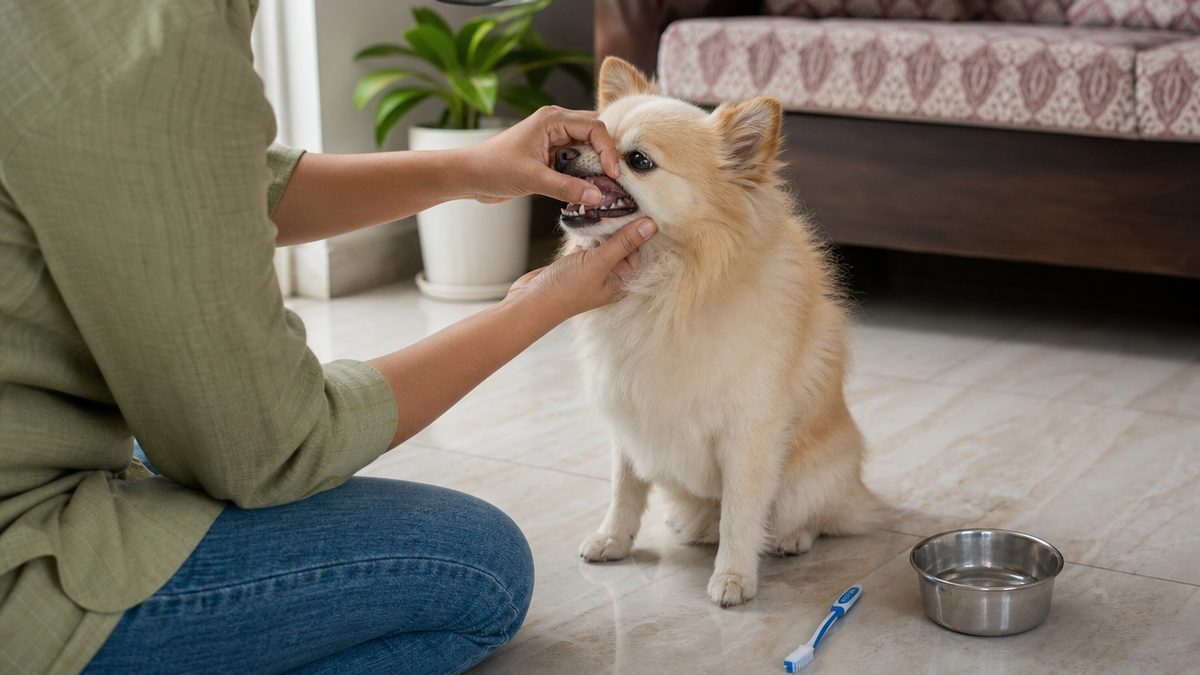
- Lift the lip on both sides and look at where gum meets tooth, not at the white crowns.
- Press gently along the muzzle and jaw and note any flinch or head turn.
- Watch one meal a week for chewing that stays on one side or food that drops.
- Count the teeth you can see on each side and notice when one goes missing.
How periodontal disease is diagnosed, step by step
To diagnose periodontal disease properly a vet performs a conscious oral evaluation first, then an anaesthetised examination with a periodontal probe and full-mouth intraoral radiographs, and charts the findings tooth by tooth. The conscious part sets expectations and the anaesthetised part produces the diagnosis.
AAHA sets out a twelve-step protocol for a professional dental cleaning and periodontal therapy, and the order of the first five steps is the whole argument for anaesthesia. Step one is an oral evaluation of the conscious patient. Step two is to radiograph the entire mouth of the anaesthetised patient using intraoral film or an intraoral digital system. Step three is scaling supragingivally with a hand scaler and subgingivally with a curette or a powered ultrasonic scaler followed by a curette inserted subgingivally. Step four is crown polishing. Step five is oral evaluation with a periodontal probe, after scaling and after the radiographs have been obtained, with each tooth probed in at least six places.
Step six is subgingival irrigation, and only at step seven, after the findings, a therapy plan, the fees and informed consent have been shared with the owner, does periodontal therapy or extraction happen. That sequencing is why a quoted price for a scale and polish is an estimate until the radiographs are read.
What pre-anaesthetic testing covers
Blood and urine tests before anaesthesia evaluate kidney and liver function, because those organs govern how the animal metabolises the anaesthetic and other drugs, and some animals also need chest radiographs or a heart ultrasound to assess cardiovascular function; where abnormalities turn up, the anaesthetic protocol is adjusted. An Indian veterinary group describes the same practice, a pre-anaesthetic blood test before sedation, which can be done on the same day as the dental procedure, to check that kidney and liver are functioning well enough to handle the drugs.
There is also a pre-anaesthetic examination on the morning itself, where the team checks vitals and listens to heart and lungs for any change since the last visit.
Why the radiograph is not optional in a complete assessment
An anaesthetised oral examination with intraoral radiography is necessary for complete assessment of oral health, and without it the full extent of disease can easily be underestimated, leading to inappropriate treatment recommendations and failure to detect painful disease conditions. The specific risks named are overlooking retained tooth roots and causing an iatrogenic jaw fracture.
The MSD manual lists intraoral dental radiography as its own diagnostic heading alongside periodontal probing, furcation exposure and mobility, which is how a reference text organises a diagnosis that cannot be made by looking.
Anaesthesia-free scaling is a different procedure, and four veterinary bodies have said so
Anaesthesia-free scaling cleans the part of the tooth you can see and leaves the part where the disease lives. The most critical part of a dental scaling procedure is scaling the tooth surfaces that are within the gingival pocket, where periodontal disease is active, and access to the subgingival area of every tooth is impossible in an unanesthetized canine or feline patient. That sentence is from the American Veterinary Dental College and it is the whole argument in one line.
The AVDC calls the practice Non-Professional Dental Scaling rather than anaesthesia-free dentistry, on the ground that the more accurate term describes what it is, and its position statement, adopted by the AVDC Board of Directors on 10 April 2004, gives four reasons the procedure is inappropriate.
- Tartar is firmly adhered, the instruments must have a sharp working edge, and even slight head movement could injure the animal's oral tissues while the operator may be bitten when the patient reacts.
- Removal of dental tartar on the visible surfaces of the teeth has little effect on a pet's health, provides a false sense of accomplishment, and the effect is purely cosmetic.
- Inhalation anaesthesia through a cuffed endotracheal tube buys three things, the cooperation of a patient that does not understand the procedure, elimination of pain during examination and treatment, and protection of the airway and lungs from accidental aspiration.
- A complete oral examination is not possible in an unanaesthetised patient, because the tongue-facing surfaces of the teeth cannot be examined and areas of disease and discomfort are likely to be missed.
Three more bodies have ruled the same way since, and the wording hardens each time. AAHA in 2019 wrote that general anaesthesia with endotracheal intubation, appropriate monitoring and physiologic support is necessary for dental procedures including dental cleaning and scaling, and that so-called anaesthesia-free dentistry has not been shown to be safer or comparable to the capacity to clean teeth above and below the gum line in an anaesthetised patient and is therefore unacceptable. The Canadian Veterinary Medical Association, in a position statement dated 21 October 2022, does not condone anesthesia-free or sedation-free dentistry, including non-professional dental scaling in any animal species.
The World Small Animal Veterinary Association's 2026 global dental guidelines include a discussion of the deleterious effects of anaesthesia-free dentistry on the ground that the procedure is ineffective at best and damaging at worst. The 2025 FelineVMA guidelines state that the association and its Guidelines Task Force oppose anaesthesia-free dentistry and endorse the previously published position statements on it.
The one study that measured an outcome, not an opinion
All four of those are positions. One study put a number on it. In the Purdue survey of 445 dogs at 24 commercial breeding facilities, the facility owners were asked which preventive measures they used, and non-professional dental scaling was one of the options. In the ordered logistic regression, dogs at facilities using non-professional dental scaling had 2.82 times the odds of worse periodontal disease (95 percent confidence interval 1.34 to 5.91, P = 0.006), while provision of a chew item was associated with 0.43 times the odds (95 percent confidence interval 0.24 to 0.77, P = 0.005).
That is an observational association from a cross-sectional design, so it cannot prove the scaling caused the disease, and animals with worse mouths may be exactly the ones whose owners try it. Read honestly, it still says the same thing the position statements say, that the procedure is not doing what the people paying for it think it is doing.
The one thing an owner must not get wrong on this page. A scale that removes the brown off the crowns has not treated the disease. Periodontal disease lives in the pocket between gum and root, the AVDC says reaching that pocket on every tooth is impossible in a conscious dog or cat, and the visible result is described by the same statement as purely cosmetic. If a groomer, a pet shop or a mobile service offers to clean your animal's teeth without anaesthesia, what you are buying is an appearance. AAHA puts it flatly, that clients should be informed that groomers and others should never be allowed to scale a pet's teeth. Your own vet decides what is safe for your animal, and this page cannot.
Where the fear of anaesthesia actually comes from
Fear of anaesthesia is the most common cause of clients' decisions to forego dental procedures for their pets, and AAHA names it as such before it answers it. The guideline's own answer is that medically important and indicated procedures should not be absolutely discouraged on the basis of chronologic age or most underlying comorbidities, and that each patient is considered individually.
Cornell's clinicians answer the four myths owners actually bring, and two of them are the ones this section is about. To 'My wife is a dental hygienist, and she scales the dog's teeth', the answer is that while that might help with tartar, it is plaque and not tartar that causes the big problems. To 'My dog is too old to go under anesthesia', the answer is that the biggest anaesthetic risks for dental patients are low blood pressure and low body temperature because the procedure takes time, and that dedicated licensed veterinary technicians monitor the patient continuously. To the heart-murmur objection, Cornell's position is that the murmur is all the more reason to keep the mouth clean, with a cardiac consultation and an echocardiogram before the procedure as the gold standard.
The AVDC accepts the honest version of the risk, that anaesthesia will never be 100 percent risk-free, and sets against it that modern anaesthetic and patient evaluation techniques minimise the risks and that millions of dental scaling procedures are safely performed each year in veterinary hospitals. An Indian veterinary group makes the practical version of the same argument, that skipping anaesthesia can end up costing more because tooth root infections that are missed need lengthy surgery later, with a risk of jaw fracture in the process.
What treatment involves, and what changes once the radiographs are read
Treatment of periodontal disease means removing plaque and calculus from above and below the gum line under general anaesthesia, polishing the crowns, probing and charting every tooth, and then treating or extracting what the radiographs show. Removal of supragingival calculus alone is purely cosmetic and ineffective to treat disease.
The instruments matter and the guideline is specific about them. Scaling is done supragingivally with a hand scaler and subgingivally with a curette, or with an appropriately powered ultrasonic scaler followed by a curette inserted subgingivally, and a rotary scaler is not to be used because it excessively roughens the tooth enamel. Curettes have a rounded back, which makes them less traumatic to soft tissue than sickle scalers, and every professional teeth cleaning should include hand scaling of the accessible root surfaces.
Cementum covering the roots contains cell-activating proteins that encourage reattachment and dentin does not, which is why aggressive curettage that removes cementum is discouraged. Polishing after scaling reduces microabrasions on the enamel.
Why extraction is not a failure
At PD3 and PD4 the choice is between periodontal surgery and extraction, and the guideline makes the deciding factor the home care that will actually happen rather than the lesion alone. At PD3 the guideline says periodontal treatment including surgery will only be successful if the client is committed to consistently administering home dental care, with extraction indicated if client and patient will not commit to daily home oral hygiene. At PD4 the options are to extract the tooth or to attempt periodontal surgery including osseous resective or additive procedures, and the prognosis is considered guarded.
An animal with a diseased tooth removed is usually more comfortable than an animal with the tooth still in place. Advanced periodontal disease resulting in extraction is described by Cornell as a shame precisely because it was likely preventable and probably caused a lot of unnecessary pain along the way.
Pain relief is part of the procedure, not an extra
Because dental procedures are painful, intraoperative and postoperative pain management, often using multimodal protocols, is an essential component of veterinary dentistry. Local anaesthetic nerve blocks are standard, and the guideline instructs the operator always to aspirate before injecting to avoid an intravascular injection, whichever block or site is used.
The FelineVMA guidelines make the same point about timing that owners rarely hear, that pain management should start when disease is identified during the awake examination and continue until the procedure can be performed, not only on the day.
This page names drug classes and never an amount. Which drug, how much and how often are decisions for the veterinarian who has examined your animal, weighed it and seen its bloodwork.
Cats are not small dogs here, and three diseases get confused with each other
Cats get periodontal disease, and they also get two separate diseases that look like it in an awake mouth, tooth resorption and feline chronic gingivostomatitis. They are distinct entities with different prevalences, different mechanisms and different treatments, and the 2025 FelineVMA guidelines tabulate them separately for that reason.
Periodontal disease in cats has the denominators already given, a one-year period prevalence of 15.2 percent in 18,249 UK cats under primary care. The other two numbers look nothing like it.
| Disease | Study and population | Reported prevalence |
|---|---|---|
| Periodontal disease | O'Neill and colleagues, 18,249 cats under UK primary care | 15.2 percent one-year period prevalence |
| Periodontal disease | Williams and colleagues, UK companion cats up to 6 years | Gingivitis in 24.5 percent of cats under 12 months and 56.3 percent of cats aged 5 to 6 years |
| Periodontal disease | Girard and colleagues, a colony of 109 cats | Gingival inflammation 96 percent, periodontal bone loss 98.2 percent, aggressive periodontal disease 12.8 percent |
| Periodontal disease | Textbook chapter in Wiggs' veterinary dentistry, marked by FelineVMA as an aggregate range | 80 to 85 percent in cats over 2 years of age |
| Tooth resorption | Lommer and Verstraete, 265 cases | Radiographic evidence in 60.8 percent of cats |
| Tooth resorption | Gorrel | Radiographic evidence in 29 percent of cats |
| Tooth resorption | Vapalahti and colleagues, a large case-control study | 3.9 percent of all cats studied, 21 percent of cats diagnosed with oral or dental disease |
| Feline chronic gingivostomatitis | Healey and colleagues, first-opinion veterinary practice | 0.7 percent of all cats studied |
| Feline chronic gingivostomatitis | Kim and colleagues, feral cats in Korea | 26.6 percent |
Look at what that table does. For tooth resorption alone, four studies give 3.9 percent, 29 percent, 60.8 percent and 66 percent, and the reason is the population and the instrument again, a general cat population against cats presented for a dental procedure with full-mouth radiographs taken.
Tooth resorption, and why it needs its own page
Tooth resorption is odontoclastic destruction of the tooth itself, not inflammation of its support, and AAHA records it as affecting 27 to 72 percent of domestic cats and fewer dogs. A review of 120 cats that had full-mouth radiographs at a private clinic in Israel between October 2015 and February 2023 found lesions in 79 of 120 cats, 66 percent, rising to 83.3 percent in cats aged 10 years and older, with the mandibular fourth premolars the most commonly affected teeth in 82.3 percent of cases.
The practical difference is that a resorptive lesion is often invisible until it breaks through the crown, and the same paper's summary notes that reported prevalence runs 29 to 37.5 percent in clinically healthy cats against 60.8 to 67 percent in cats presenting for dental problems. It is a separate condition with its own diagnosis and its own treatment, and it gets its own page at tooth resorption in cats.
Gingivostomatitis is rarer than the internet suggests
Feline chronic gingivostomatitis is severe inflammation extending beyond the gum into the mucosa, and in first-opinion practice it was found in 0.7 percent of cats, while a study of feral cats in Korea reported 26.6 percent. Those two numbers are not in conflict either; one is the general owned population and one is a feral population with a different infectious burden.
The FelineVMA guidelines also describe early-onset gingivitis as a distinct entity, characterised clinically by moderate to severe periodontal disease and histologically by neutrophilic lymphoplasmacytic inflammation, with an unknown cause, and warn that it can progress to aggressive periodontitis or to gingivostomatitis if it is not treated early under general anaesthesia.
For a cat, then, the awake examination tells you less than it does for a dog, the normal probing depth is a third of a dog's at 1 mm, and 42 percent of grossly normal feline teeth carried clinically important radiographic findings. Everything about the feline mouth pushes towards radiographs under anaesthesia earlier, which is why AAHA puts a cat's first complete assessment at one year of age.
What a scale and polish costs in India, and whether dental radiography exists here
Two Indian sources publish a price band for a professional dog dental cleaning, Rs 2,000 to Rs 10,000 and Rs 3,000 to Rs 10,000 or more, and no Indian government veterinary rate card that this page could open prices a dental procedure at all Lickicious, Pet Dental Health Importance ICAR-Indian Veterinary Research Institute. Dental radiography does exist in India, at a small number of named teaching hospitals, and an Indian study published regression equations in 2023 specifically for places where it is not available.
Vetic, an Indian clinic chain, prints the cost of dog dental cleaning in India as ranging from Rs 2,000 to Rs 10,000, written on its own page as ₹2,000 to ₹10,000 and varying with severity of dental disease, use of anaesthesia, diagnostic tests required and clinic infrastructure. Read that as a metro-chain price rather than a national one, because the same page's own footer lists its clinics in eleven named cities, Gurgaon, Delhi, Hyderabad, Mumbai, Chennai, Noida, Ghaziabad, Bangalore, Pune, Faridabad and Kolkata. An Indian pet-food brand's guide gives Rs 3,000 to Rs 10,000 or more, varying with the extent of cleaning, whether extractions are required and the anaesthesia protocol, and adds that Mumbai, Delhi and Bengaluru tend to be at the higher end.
Those two are close enough to be worth checking for independence and different enough at the floor, Rs 2,000 against Rs 3,000, to be two data points rather than one copy. Run through the exchange-rate test, Rs 2,000 to Rs 10,000 is about USD 24 to USD 119 at 84.38 to the dollar, or USD 27 to USD 135 at 74. Those are Indian prices and not a converted American list.
Run the same test on the directory page that also ranks and it fails. Justdial's Hyderabad page for Dog Dental Cleaning Services, read on 27 September 2026, prices a Basic Cleaning at '$200 to $500' and a Comprehensive Exam at '$50 to $150' on a page about Hyderabad, which converts to roughly Rs 16,900 to Rs 42,200 at 84.38 to the dollar, eight to four times the Indian range that Indian clinics publish. Seven of the ten businesses that page lists are filed under Pet Grooming Services, Pet Shops or Pet Care Takers rather than Veterinary Hospitals, and one is a dog trainer. A price in dollars on an Indian city page is the clearest possible sign that nobody checked.
What the government rate cards say, and what they leave out
The public teaching hospitals publish their fees line by line, and the dental line is missing. The ICAR-Indian Veterinary Research Institute at Izatnagar lists 45 numbered items under Charges for surgical procedures and diagnostic imaging services with effect from June 2024, and they are specific enough to price Cherry Eye at Rs 500 and Entropion or Ectropion at Rs 250 for a pet animal. Not one of the 45 lines is a dental procedure.
What IVRI does price is everything a dental sits inside. Registration for a dog or cat is Rs 30 at normal hours, Rs 200 after 12:30 pm and Rs 400 after 5 pm or on holidays. Chemical restraint is Rs 100. Plain radiography is Rs 150. Haematology as a complete blood count is Rs 300, a kidney function test as blood urea nitrogen and creatinine is Rs 300, and a liver function test is Rs 400, all marked plus tax as applicable.
That answers the pre-anaesthetic bloodwork question directly. At a government teaching hospital the bloodwork is a separate line item, not part of a package, and a complete blood count plus kidney and liver panels comes to Rs 1,000 before the procedure itself.
At the Madras Veterinary College teaching hospital in Chennai, part of the Tamil Nadu Veterinary and Animal Sciences University, the Department of Clinics fee structure prices small animal registration at Rs 100 valid for seven days, minor surgery at Rs 500, major surgery at Rs 1,500, specialized surgery at Rs 3,000, an X ray at Rs 100 and haematology, biochemistry, urine or culture at Rs 50. The Department of Veterinary Surgery and Radiology at the same college publishes a different card, minor surgery Rs 1,000, major surgery Rs 3,000 and specialized or emergency surgery Rs 5,000, with an X-Ray of head and neck to a maximum of two views at Rs 300.
Two departments of the same government college publish two different surgery fee cards, and neither names a dental procedure. That disagreement is published here rather than averaged away, because an owner phoning either department will be quoted from the card that department holds.
| Item | Price in rupees | Where it is published |
|---|---|---|
| Professional dog dental cleaning, private clinic chain | 2,000 to 10,000 | Vetic, own page |
| Professional dog dental cleaning, second Indian published range | 3,000 to 10,000 or more | Lickicious, own page |
| Any dental procedure | Not listed | ICAR-IVRI Izatnagar, 45-line surgical and imaging card, June 2024 |
| Dog or cat registration, normal hours | 30 | ICAR-IVRI Izatnagar |
| Chemical restraint | 100 | ICAR-IVRI Izatnagar |
| Plain radiography | 150 | ICAR-IVRI Izatnagar |
| Haematology, complete blood count | 300 | ICAR-IVRI Izatnagar |
| Kidney function test, blood urea nitrogen and creatinine | 300 | ICAR-IVRI Izatnagar |
| Liver function test | 400 | ICAR-IVRI Izatnagar |
| Small animal registration, valid seven days | 100 | TANUVAS Madras Veterinary College, Department of Clinics |
| Minor surgery | 500 | TANUVAS Madras Veterinary College, Department of Clinics |
| Minor surgery | 1,000 | TANUVAS Madras Veterinary College, Department of Veterinary Surgery and Radiology |
| Major surgery | 1,500 | TANUVAS Madras Veterinary College, Department of Clinics |
| Major surgery | 3,000 | TANUVAS Madras Veterinary College, Department of Veterinary Surgery and Radiology |
| X ray | 100 | TANUVAS Madras Veterinary College, Department of Clinics |
| X-Ray head and neck, maximum two views | 300 | TANUVAS Madras Veterinary College, Department of Veterinary Surgery and Radiology |
Does dental radiography exist in India
Yes, at named teaching hospitals, and it is rare enough that an Indian study was built around its absence. The Department of Veterinary Surgery and Radiology at Guru Angad Dev Veterinary and Animal Sciences University, Ludhiana, radiographed the mandibular first molar of 50 healthy dogs under general anaesthesia using a portable digital dental x-ray machine and a computed radiography system with occlusal dental film, and published regression equations against body weight and age whose stated purpose is to act as a ready reference at places where dental radiography is not available.
That study also found what the UK data implies. Small breeds showed a decline in the root length to crown height ratio and in the mandible height to first mandibular molar height ratio compared with medium and large breeds, which the authors link to a greater chance of tooth loosening in smaller breeds. Root canal width fell with age, making the pulp cavity harder to approach in older dogs.
The second named facility is in Chennai. The Dental and Oro maxillary Surgery Unit at the Madras Veterinary College is equipped with an ultrasonic dental scaler, a 20 mA dental x-ray unit, a dental autoclave and a root canal therapy unit with a high speed dental burr, and the department records around 50 to 60 cases per year through that unit, including scaling, tooth extraction and reconstructive procedures.
Fifty to sixty dental cases a year, at one of India's largest veterinary teaching hospitals, is the honest measure of how thin this service is. An owner outside a metro referral centre should assume a scale and polish will happen without intraoral radiographs and should ask directly whether the clinic has a dental x-ray unit, because AAHA's position is that where full-mouth radiographs cannot be taken the team should say so.
Who may legally scale an animal's teeth in India
The AVDC's opening sentence about unlicensed practice is written for the United States and Canada. The Indian instrument is section 30 of the Indian Veterinary Council Act, 1984, which provides that no person, other than a registered veterinary practitioner, shall practise veterinary medicine in any State.
There is one carve-out and it is narrow. The proviso lets a State Government permit a holder of a diploma or certificate of veterinary supervisor, stockman or stock assistant to render, under the supervision and direction of a registered veterinary practitioner, minor veterinary services, and the Act's own Explanation defines minor veterinary services as the rendering of preliminary veterinary aid, like, vaccination, castration, and dressing of wounds, and such other types of preliminary aid or the treatment of such ailments as the State Government may specify by notification in the Official Gazette.
Two things follow. Dental scaling is not among the three examples the statute names, although the word 'like' makes that list illustrative rather than closed, so whether any state has notified it is a question for that state's gazette and this page does not claim an answer. And section 57 makes practising veterinary medicine or rendering minor veterinary services outside those two categories an offence, punishable on first conviction with a fine which may extend to one thousand rupees and on a subsequent conviction with imprisonment which may extend to six months or a fine not exceeding five thousand rupees or both, those being the amounts as enacted in 1984.
The Indian evidence on plaque and what controls it
One Indian study has screened dogs for plaque and gingivitis and then tested control measures. At the College of Veterinary Science and Animal Husbandry, Orissa University of Agriculture and Technology, Bhubaneswar, 32 dogs drawn from the Teaching Veterinary Clinical Complex and private pet clinics in the city were scored, and 71.87 percent had plaque deposition and 34.37 percent had gingivitis of some degree.
The correlation with age was strong, r = 0.89 between advancing age and plaque deposition and r = 0.85 between age and gingivitis, both at p below 0.05. After ultrasonic scaling under mild anaesthesia or sedation, the dogs were split into four groups, and the group given both a dental hygiene chew and a chlorhexidine application had 100 percent of animals remain free of fresh plaque deposits.
Thirty-two dogs is a small denominator and a single centre, which is exactly why it is labelled here rather than presented as an Indian national figure. It is, as far as this page could establish, the only published Indian series that screens pet dogs for plaque and gingivitis and then measures an intervention.
A controlled absence, recorded honestly. PubMed E-utilities returned HTTP 500 on every attempt on 27 September 2026, including on a rabies control that normally returns dozens of records, so the instrument was down rather than the literature empty. The search was run through Europe PMC instead, restricting periodontal, dental and oral-health veterinary titles to Indian author affiliations, which returned 24 records of which two are veterinary and Indian, the Bhubaneswar plaque study and the Ludhiana radiography study. The roster note that seeded this page listed three PubMed records for its India search, and all three are artefacts: two are Tel Aviv University human-dentistry papers that match because India ink was used as a marker in the injected solution, and the third is a study of fluorosis, dental caries and periodontal status in children in Haryana.
Prevention, ranked by how well the evidence supports it
Brushing the teeth is the only home measure the reference texts call most effective, and the MSD Veterinary Manual states it plainly in its key points, that providing daily or at least every other day toothbrushing appears to be the most effective way to improve and maintain periodontal health. Nothing else on the shelf can prevent the disease on its own. Dental diets, chews, gels, rinses, sprays and water additives are described there as helping to stabilise and decrease the incidence of the disease, not to replace brushing.
The honest problem with brushing is that owners stop. A phone survey of 51 dog guardians six months after a veterinary dental procedure found 53 percent brushing several times per week and 38 percent who had discontinued brushing altogether. Studies in laboratory beagles found that brushing at a minimum of three times per week was necessary to maintain oral health, and that daily brushing was needed in dogs that already had gingivitis.
So the practical target is daily, the floor that still works is three times a week, and two-fifths of owners who intend to do it have stopped within six months.
What a chew is worth, with a number
Provision of a chew item was associated with 0.43 times the odds of worse periodontal disease in the Purdue survey of 445 dogs, 95 percent confidence interval 0.24 to 0.77, P = 0.005. That is the only preventive measure in that model that came out protective, and it came out protective against a background where non-professional dental scaling came out harmful at 2.82 times the odds.
The Indian study points the same way and adds a combination. After ultrasonic scaling, the group of dogs given both a dental hygiene chew and a chlorhexidine application had every animal free of fresh plaque deposits, against lower but not zero plaque in the groups given one or the other.
How to tell a product that works from a product that sells
The Veterinary Oral Health Council runs a register of products shown to retard the accumulation of dental plaque or calculus, and AAHA points owners at it by name. The register lists each product with the claim it earned, plaque or tartar or both, the company, whether it is veterinary-only or consumer, and the year the seal was awarded, so a diet such as a prescription canine dental diet carries a Plaque and Tartar claim with a seal awarded in 1998.
VCA's own page is blunt about the limit of any diet, that pet food manufacturers have developed dental diets that can help reduce the formation of plaque and tartar, but that once tartar has formed, professional scaling and polishing under general anaesthesia will be needed because it cannot easily be removed by diets or brushing. A dental diet is a plaque-delaying measure, never a descaling measure.
- Brush daily where you can and three times a week as the floor, using a brush and paste made for animals.
- Add a chew item, which is the one measure that tested protective in a 445-dog survey.
- Check any product against the Veterinary Oral Health Council register before buying it.
- Book the first complete assessment by one year of age for a cat or a small to medium dog and by two years for a larger breed.
- Ask for a six-monthly awake oral health examination in between, which AAHA calls appropriate.
The timing recommendation is stricter than most owners expect. AAHA recommends a true dental prophylaxis, meaning complete dental cleaning, polishing and intraoral dental radiographs in the absence of obvious lesions, by 1 year of age for cats and small to medium breed dogs and by 2 years of age for larger breeds, so that hidden conditions such as unerupted or malformed teeth are found and treated.
Small breeds need more of all of it. AAHA notes that owners of dogs that will reach maturity at a small size should be told that the level of dental care and prevention their pet needs is likely to be more involved than for a larger dog, and that brachycephalic breeds also tend to have more dental issues because of the rotation and crowding of teeth.
Start the conversation with kittens and puppies, not with seven-year-olds. The FelineVMA guidelines put discussion and guidance for home preventive care at the first kitten visit and say the recommendations should be reviewed at each appointment throughout the cat's life.
What periodontal disease does to the rest of the body, and what the guideline actually says
Periodontal disease is associated with poorer health elsewhere in the body, and the association is better evidenced than the mechanism. AAHA states directly that the long-held dogma that specific oral bacteria are directly responsible for infection in distant organs is oversimplified and difficult to prove. The association with systemic health parameters is shown; the causal chain popularly described is not.
That matters because the popular version is what Indian clinic pages sell on. Vetic's page answers 'Does dog teeth cleaning help prevent heart and kidney disease?' with 'Yes. Proper dog dental cleaning reduces bacterial spread, lowering the risk of heart, liver, and kidney complications';. AAHA's guideline, from which that clinic would take its standards, says the direct-infection model is oversimplified and difficult to prove.
Both can be worth acting on, for different reasons. The guideline's own framing is that the systemic spread of inflammatory mediators, cytokines and bacterial endotoxins from periodontal pathogens can affect the vascular system throughout the body, which is an inflammation argument rather than a bacteria-in-the-heart argument.
The largest association study, and its awkward findings
The biggest dataset on this in cats followed 169,242 cats evaluated at least three times at 829 primary-care hospitals between 1 January 2002 and 30 June 2013. Cats with an initial diagnosis of periodontal disease of any stage, 56,414 of them, were frequency matched by age and year of entry with 112,828 cats that had no history or evidence of it, and periodontal disease was associated with an increased risk of chronic azotemic kidney disease, with the risk highest for cats at stage 3 or 4.
Two findings in the same model should stop anyone reading it as a simple causal result. General anaesthesia within the year before study exit was itself associated with increased kidney-disease risk, and a diagnosis of diabetes mellitus or hepatic lipidosis was associated with decreased risk. A model in which diabetes protects cats from kidney disease is a model carrying detection and survival effects, and the authors' own conclusion is the modest one, that the findings supported the benefit of maintaining good oral health.
The MSD manual reflects the same care, listing periodontal disease as associated with an increased risk of chronic azotemic kidney disease rather than as a cause of it.
The comorbidity finding that is hard to explain away
The feline VetCompass study measured something different and simpler. Cats with periodontal disease carried a higher median count of comorbid disorders, 3 against 1, and had 1.79 times the odds of being diagnosed with at least one comorbid disorder, 95 percent confidence interval 1.62 to 1.99. The authors' conclusion is that the study offers evidence on a close link between periodontal disease and reduced overall health in cats.
Some of that is inevitably detection. A cat that is seen often gets more diagnoses of everything, including this one. The same dataset shows the shape of that effect in dogs, where insured dogs had 1.30 times the adjusted odds of a periodontal disease diagnosis than uninsured dogs, 95 percent confidence interval 1.14 to 1.47. Insurance does not cause gum disease; it causes the mouth to be looked in.
The one systemic effect nobody disputes is the local one. AAHA lists chronic pain, oronasal fistula, jaw fracture and abscessation among the consequences of untreated disease, and describes the pain and infection associated with periodontal disease as strong contributors to quality of life and longevity.
Living with it, and the five questions to ask at the next appointment
An animal that has had periodontal disease treated needs a home routine and a recheck interval, because the plaque comes back within days of the polish. AAHA frames the goal as keeping the mouth in a relatively pain-free and healthy state between dental therapy procedures, through effective home oral hygiene.
Recovery from the procedure itself is usually quick and the difference is often visible in behaviour rather than in the mouth. Owners commonly report a dog that plays again or a cat that grooms again, and the guidelines treat the pain that preceded that change as the thing the procedure removed.
Expect a follow-up. Cornell describes a follow-up examination as frequently recommended, especially where surgical procedures were performed, and describes comprehensive discharge instructions as part of the visit. FelineVMA puts follow-up evaluation on the same footing for early-onset gingivitis, because it can progress to aggressive periodontitis or gingivostomatitis.
Five questions worth asking
- Does this clinic have an intraoral dental x-ray unit, and will full-mouth radiographs be taken.
- What stage is each affected tooth, PD1 to PD4, and what does that stage change.
- Is pre-anaesthetic bloodwork included in the quoted price or billed separately.
- What pain relief will be given during the procedure and sent home afterwards.
- When is the next anaesthetised assessment due, and what awake check happens in between.
Keep the quote honest with yourself. Both Indian published ranges name diagnostics and anaesthesia as the variables that move the price, so a low quote usually means fewer of those rather than a cheaper clinic Lickicious, Pet Dental Health Importance.
What good looks like a year on
A year after treatment, a well-managed mouth has breath that is unremarkable, a gum margin that is pink rather than red, no visible calculus ridge along the upper cheek teeth and no tooth that moves. The guideline's test is not the crowns, it is the probing depth, no more than 2 to 3 mm in a midsized dog and 1 mm in a midsized cat, measured at six points on every tooth.
Which of these steps suits your animal, and how often, is a decision for the veterinarian who examines it. The evidence on this page describes populations; your dog or cat is an individual, and the clinic you can reach is the one that gets to decide. Find one through the vet directory, and read the wider routine in the adult dog care guide and the adult cat care guide.
Two conditions on this site interact with this one and are worth reading next. An animal that carries extra weight is harder to anaesthetise safely and lives with more inflammation generally, which is covered on obesity in dogs and cats, and a cat with kidney disease needs its anaesthetic protocol adapted, which is covered on chronic kidney disease in cats.
Questions Indian owners ask about periodontal disease in dogs and cats
Can periodontal disease be cured in dogs?
No, not once it has passed gingivitis. Gingivitis is the early stage, is confined to the gum and is reversible and preventable, while periodontitis is an irreversible loss of the supporting tissues that can be stabilised but not easily reversed, and can end in tooth loss. Treatment stops progression rather than curing what is gone.
How long can a dog live with severe periodontal disease?
No published study reports survival time in dogs by periodontal stage, so any number you are given is invented. The WALTHAM review of the frequency and impact of the disease describes the link to systemic health as potential rather than established, and treats pain and tooth loss as the certain harms.
What are the different stages of periodontitis?
There are four stages of periodontal disease. PD1 is gingivitis with no attachment loss. PD2 is early disease with under 25 percent attachment loss. PD3 is established disease with 25 to 50 percent loss. PD4 is advanced disease with more than 50 percent loss, and its prognosis is guarded.
Can I live a normal life with periodontal disease?
That question is about people, and Google returns it on a canine query. For a dog or cat the animal answer is that untreated periodontal disease causes chronic pain, oronasal fistula, jaw fracture and abscessation, so a normal life depends on treating it rather than living alongside it.
How much vet charge to clean dog teeth?
Two Indian sources publish a range. An Indian clinic chain prints Rs 2,000 to Rs 10,000 for dog dental cleaning, varying with disease severity, use of anaesthesia, diagnostics required and clinic infrastructure. A second Indian guide gives Rs 3,000 to Rs 10,000 or more, with metro cities at the higher end.
Is dental cleaning painful for dogs?
The cleaning itself is painful without anaesthesia, which is why it is not done awake. Periodontal probing is a noxious stimulus and subgingival cleaning is uncomfortable and at times painful, so the guideline makes intraoperative and postoperative pain management an essential component of veterinary dentistry.
Is anaesthesia-free dental scaling as good as a scale under anaesthesia?
No, and four veterinary bodies have said so. The AVDC calls the visible-surface result purely cosmetic and says subgingival access on every tooth is impossible in a conscious animal. AAHA calls it unacceptable, the CVMA does not condone it, and WSAVA calls it ineffective at best and damaging at worst.
Do cats get periodontal disease as well as dogs?
Yes, and slightly more often by diagnosis. Periodontal disease was the most commonly recorded specific disorder in 18,249 UK cats under primary care in 2019, with a one-year period prevalence of 15.2 percent, and cats with it had 1.79 times the odds of carrying at least one other diagnosed disorder.
Is dental radiography available in India?
At a small number of named centres. GADVASU Ludhiana radiographs dogs under anaesthesia with a portable digital dental machine, and Madras Veterinary College runs a dental unit with a 20 mA dental x-ray handling around 50 to 60 cases a year. A 2023 Indian study published equations for places without it.
Does dry food clean my dog's teeth?
Dental diets can help reduce the formation of plaque and tartar, but ordinary dry food does not descale teeth. Once tartar has formed, professional scaling and polishing under general anaesthesia is needed, because tartar cannot easily be removed by diets or by brushing.